
Sandy City Zoning Code
CHAPTER 21
24 PARKING, ACCESS AND CIRCULATION REQUIREMENTS
21-24-1 Purpose
- These regulations are established to reduce street congestion and traffic hazards in Sandy City by incorporating adequate, attractively designed facilities for off-street parking as an integral part of every use of land in the City. These regulations are intended to complement any performance standards relating to development of parking lots as may be contained in other chapters of this title.
- This chapter also provides for vehicle ingress and egress, internal circulation, reciprocal access, and transportation demand management options within developments. Vehicular access and circulation must be properly designed so that the City street system will be able to accommodate traffic at an acceptable level of service. Thus, this chapter is intended to balance the right of reasonable access to private property with safe and efficient travel.
- Streets have been categorized in the Transportation Plan by function and classified for access purposes based upon their level of importance and function. Regulations have been applied to these roadways for the purpose of mitigating traffic demand and reducing traffic accidents, personal injury, and property damage attributable to access systems, and to thereby improve the safety and operation of the street network. These regulations further the orderly use of land, protect community character, provide universal pedestrian and bicycle access, and conserve natural resources by promoting well-designed road and access systems.
(LDC 2008, § 15A-24-01)
Amended by Ord. 21-08 § 1(Exh. A) on 3/23/2021
21-24-2 General Provisions
- General.
- Minimum off-street parking space with adequate provision for ingress and egress by standard-sized vehicles shall be provided at the time of erection of any main building or at the time any main building is enlarged or increased in capacity. Exception: Those homes existing or constructed prior to February 1, 2008, shall be exempt from the requirement to enlarge their attached garage to meet the present standard.
- Parking areas shall be considered as structures since they represent a three-dimensional appearance when occupied. Parking shall be designed as outdoor rooms promoting maintenance and ownership.
- Parking Space Size.
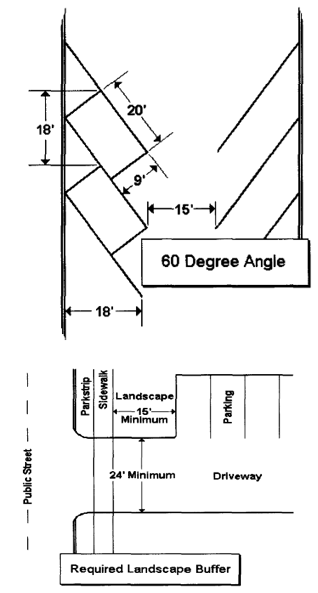
- All parallel parking spaces shall be a minimum of nine feet wide by 20 feet long, unless otherwise specified in this chapter.
- All parking spaces (not including parallel spaces) shall be a minimum of nine feet wide by 20 feet long, as designated on the diagram in this chapter.
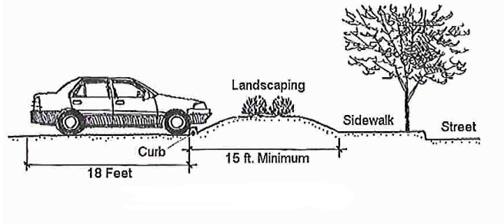
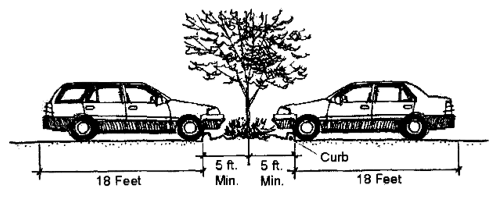
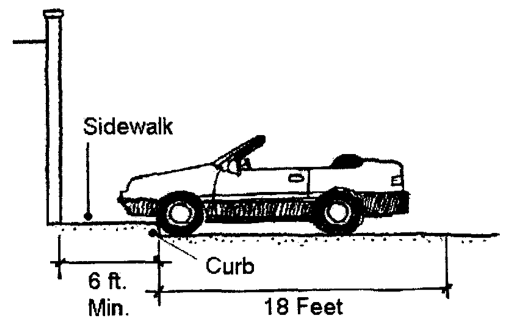
- Parking spaces (not including parallel spaces) may be reduced to 18 feet in depth based upon the following exceptions:
- Where cars overhang landscape areas that are at least 15 feet wide along street frontages;
- Where cars overhang landscape areas that are at least five feet wide along a side or rear property line or adjacent to an interior parking lot landscape area that is at least ten feet wide (for double loaded parking). In order to encourage Low Impact Development (LID) standards, double loaded parking may be built with 18 foot stalls and a four foot landscaped area in between (unless approved otherwise by Sandy City to accommodate LID design requirements);
- Where cars overhang a sidewalk on private property where the sidewalk is at least six feet in width; or
- 90-degree parking within a parking structure.
- Where cars overhang landscape areas that are at least 15 feet wide along street frontages;
- Floor Area Defined. For the purposes of parking requirements, floor area shall be defined as the gross square footage of the building.
(LDC 2008, § 15A-24-02; Ord. No. 14-06, 4-23-2014)
Amended by Ord. 19-23 § 1(Exh. A) on 10/8/2019
Amended by Ord. 21-08 § 1(Exh. A) on 3/23/2021
Amended by Ord. 25-16 on 7/15/2025
21-24-3 Special Access And Parking Provisions
- Alternative to On-Site Parking.
- Off-Site Parking. Off-site parking may be allowed for the required parking of any new use, structure, or building in any commercial or RM District that cannot be provided on the premises due to the property's size or location according to the following criteria:
- The off-site parking must be located on other appropriately zoned property.
- The off-site parking cannot be more than 300 feet of walking distance from the nearest point of the parcel.
- The adjacent site has excess parking that is not required for their use, or the hours parking is needed will not conflict with the hours of use on the adjacent property.
- The applicant shall provide a document to the Community Development Department, signed by the owners of the alternate site and recorded at the Salt Lake County Recorder's Office, that stipulates the permanent reservation of use of the site for said parking.
- Temporary Off-Site Event Parking.
- Temporary off-site parking for events may be allowed after review and approval of a Parking and Access Management Plan by the Planning Commission at a public meeting. Temporary parking is parking established for a fixed period of time with the intent to discontinue such parking upon the expiration of the time period. An occasional event with an expected attendance of less than 500 persons or if the event does not occur more than once a year shall not be subject to the requirements of this section.
- The applicant will be responsible to make provisions for on- and off-site parking, safe pedestrian routes to and from the off-site parking, transportation to and from off-site parking locations beyond a 5,000-foot (approximately 15 minutes) walking route, entry and exiting methods, temporary or permanent traffic control methods, and restricting parking in identified areas.
- The Parking and Access Management Plan must be approved prior to the issuance of a temporary use permit, business license or Certificate of Occupancy required for the event, project, or use. Upon approval, the Parking and Access Management Plan shall be available for public inspection. All approved updates of a Parking and Access Management Plan shall be available for public inspection.
- The applicant may be responsible to post a guarantee for improvements and implementation of various components of the Parking and Access Management Plan.
- The Parking and Access Management Plan shall be submitted with the application for the project or use and shall:
- Determine the total number of parking spaces required based upon the land use category less any anticipated mass transit use projection, which may be limited to 15 percent of the total number of required parking spaces unless greater mass transit use is demonstrated.
- Establish the minimum number of on-site spaces that are required. Specify the number of those on-site spaces that will be reserved for or utilized by employees, VIPs, buses, media, etc.
- Establish the minimum number of off-site spaces, if any, that are required within a 1,650-foot (approximately five minutes) walking route of the site.
- Establish the minimum number of off-site parking spaces, if any, that are required within a 5,000-foot (approximately 15 minutes) walking route of the site.
- Establish the minimum number of off-site parking spaces, if any, that are required beyond the 5,000-foot (approximately 15 minutes) walking route of the site.
- Identify all off-site parking sites potentially available to be used for Subsections (a)(2)e.3 through 5 of this section. Identify methods that the applicant will provide for safe pedestrian routes to and from the parking sites satisfying Subsections (a)(2)e.3 and 4 of this section (e.g., wider sidewalks, trails, bridges, permanent or temporary traffic control devices, individuals directing traffic, etc.), and methods to provide transportation to and from those sites satisfying Subsection (a)(2)e.5 of this section (e.g., Trax, UTA buses, shuttle buses, etc.), and provide a timeline for the implementation of the identified methods. Each potential off-site parking location shall conform to the parking area development and maintenance requirements in this section.
- Identify neighborhoods and other areas that will specifically not be allowed to be part of the calculation of available parking spaces or will be subject to parking restrictions during the event. Identify measures that the applicant will implement to prevent parking within restricted areas (e.g., signage, security personnel, proposed new parking regulations, etc.), and provide a timeline for the implementation of the identified methods.
- Identify pedestrian exit times and volumes to on-site and off-site parking areas. Identify methods that the applicant will implement to manage the projected volume expeditiously and safely (e.g., wider sidewalks, temporary or permanent traffic control methods, etc.), and provide a timeline for the implementation of the identified methods.
- Include a Traffic Study presenting traffic counts, times and circulation patterns for a geographic area encompassing all potential off-site parking sites if required by the City Engineer. If required, the Traffic Study shall also present the projected impact of the event on existing traffic counts, times and circulation patterns.
- Identify the methods the applicant will implement, on vacant or unimproved lots, to control the dust and debris.
- Identify any permits or approvals necessary from other transportation agencies with jurisdiction over roads or streets affected by the temporary or permanent traffic control measures identified in Subsections (a)(2)e.7 through 9 of this section.
- Specify a date by which the applicant must provide the Planning Commission with evidence of availability of off-site parking spaces, safe pedestrian routes, transportation services, measures to prevent parking in restricted areas, and measures to manage entry and exit times and volumes of pedestrians and vehicles.
- Indicate the time period for which the Parking and Access Management Plan will be in effect.
- Be updated on a yearly basis or as otherwise required by the Planning Commission after the project or event has commenced operation. The Planning Commission shall hold at least one public meeting prior to the approval of any updated Parking and Access Management Plan.
- Off-Site Parking. Off-site parking may be allowed for the required parking of any new use, structure, or building in any commercial or RM District that cannot be provided on the premises due to the property's size or location according to the following criteria:
- Parking Increase. Developments are required to provide a certain number of parking stalls, as determined by this title, based on the land uses associated with the site. In some cases, it may be appropriate to allow for more than the required parking. At the time of site plan review, a Parking Plan shall be submitted showing all parking spaces, the overall circulation system, and justification for requesting increases in parking space requirements as specified below:
- Increase up to Ten Percent. The Director may approve an increase of up to ten percent of the amount of required parking upon review of one or more of the following that justifies the request:
- Parking Demand Analysis. A study provided by a licensed transportation engineer that demonstrates actual usage of employees and customers of the proposed land use or similarly situated land uses in other locations.
- Market Demand Analysis. A study provided by a licensed real estate professional or real estate financial professional that provides estimates of current market demand for a particular land use.
- Increase above Ten Percent. The Planning Commission may approve an increase of up to 25 percent of the amount of required parking upon review of the criteria listed in Subsection (b)(1) of this section. The Planning Commission may approve a request to increase the amount of parking provided beyond the 25 percent increase of required parking if the additional parking is sited within a parking structure that meets the following criteria:
- The parking structure contains at least 90 percent or more of the total proposed parking stalls of the development; and
- The footprint of the parking structure consumes no more than 50 percent of the above grade total site area, is contained within the proposed building footprint, or is completely underground; and
- The parking structure contains at least three levels; and
- The parking structure does not exceed the height of the surrounding buildings within the site.
- Increase up to Ten Percent. The Director may approve an increase of up to ten percent of the amount of required parking upon review of one or more of the following that justifies the request:
- Parking Reduction. Developments are required to provide a certain number of parking stalls, as determined by this title, based on the land uses associated with the site. In some cases, it may be appropriate to allow for less than the required amount of parking. At the time of site plan review, a Parking Plan shall be submitted showing all proposed parking spaces, the overall circulation system, and justification for requesting reductions in parking space requirements as specified below:
- Reduction up to Ten Percent. The Director may approve a reduction of up to ten percent of the amount of required parking upon satisfactory review of one or more of the following that applies to the request:
- Parking Demand Analysis. A study provided by a licensed transportation engineer that demonstrates projected usage of residents, employees, and customers of the proposed land uses or similarly situated land uses in other locations.
- Market Demand Analysis. A study provided by a qualified real estate market analyst that estimate current market demand for a particular land use. For the purpose of this section, a real estate analyst shall be defined as a real estate professional with expertise in financial analysis in support to the financing, acquisition, marketing and leasing of real property based on the study of economic conditions and market trends.
- Walkability and Multi-Modal Design. Provide a site plan design that demonstrates walkable elements and promotes multiple modes of transportation. A study by a licensed transportation engineer shall provide a quantitative analysis of the anticipated parking demand and automobile trips based on the proposed design.
- Proximity to Transit. A site that is within a half-mile ADA route distance of existing or immediately planned local fixed mass transit station that would help reduce the number of needed parking stalls and automobile trips.
- Low to Moderate Income Housing. A housing development that is proposing to set aside at least 20 percent of their units for residents that qualify for at least 80 percent low to moderate income.
- Reduction above Ten Percent. The Planning Commission may approve a reduction above ten percent of the amount of required parking. Upon satisfactory review of two or more of the criteria listed in subsection (c)(1) of this section, they may approve up to a 15 percent reduction. Upon satisfactory review of three or more of those criteria, they may approve up to a 20 percent reduction. Upon satisfactory review of four or more of those criteria, they may approve up to a 25 percent reduction.
- No parking reduction shall be applied to any detached single-family housing development within the City limits.
- Residential Parking Reduction. If a reduction to any parking requirement is granted for a residential development, it shall be required of the developer/owner to provide a minimum of one stall to each residential unit and include it in the base sale or lease price of the unit.
- Amendments. Any amendments to the approved site plan or change in land use will cause any previously approved parking reductions for the site to be reviewed again by the appropriate authority and ensure that the required justification requirements have been met.
- Reduction up to Ten Percent. The Director may approve a reduction of up to ten percent of the amount of required parking upon satisfactory review of one or more of the following that applies to the request:
- Shared Parking.
- Shared Parking Proposal. Notwithstanding any other parking requirements provided in this chapter, when land uses occupy the same lot or adjacent lots, the total number of off-street parking spaces required for each use may be combined and shared. A proposal for sharing off-street parking shall be presented to the Director. If the proposal involves the accommodation of more than ten parking spaces (total accumulated spaces required for all involved uses), the Director may present the proposal to the Planning Commission for site plan review.
- Requirements. In order to qualify for approval for shared parking, applicants shall present the following:
- The location and identity of each use that will share the facility.
- The total parking requirement for each use.
- The projected hours of operation of each use and the hours during which the peak parking demand will be experienced.
- The number of existing and/or proposed parking spaces.
- A site plan that provides for a distance of no greater than 500 feet from the nearest entrance of each use to the nearest edge of the parking facility.
- A site plan that demonstrates that the proposed shared parking facility will comply with all standards required by this title for parking lot development.
- Drive-Thru Business Stacking Space. (See Chapter 21-23, Commercial, Office, Industrial, and Transit Corridor Development Standards.)
- Excessive Parking. Developments shall not have parking in excess of that required by this title without prior approval of the Director or Planning Commission, upon written justification of the specific need for more parking spaces than the provisions of this title allows. In addition, developers are encouraged to work out shared parking agreements with adjacent users wherever possible according to the provisions for shared parking contained within this title.
- Prohibited Parking. No parking shall occur in any alley, driveway, service driveway, traffic aisle (either public or ways open to the public), delivery area (other than for a minimal period of time needed for the delivery of goods and materials to a specific tenant) or other location designed for through traffic unless:
- Said area has been specifically designated for parking on the original approved site plan; or
- The original site plan has been specifically modified by written approval of the City Engineer, for parking space use; and
- Be designed in accordance with the parking designs specified in this chapter.
(LDC 2008, § 15A-24-03; Ord. No. 18-18, § 1, 6-28-2018; Ord. No. 18-26, § 1(15A-24-03), 9-20-2018)
Amended by Ord. 19-23 § 1(Exh. A) on 10/8/2019
Amended by Ord. 21-08 § 1(Exh. A) on 3/23/2021
21-24-4 Residential Parking Requirements And Restrictions
- Single-family Dwellings (Detached). All single-family detached dwellings shall provide at least a two-car garage for the daily storage of personal vehicles plus meet all guest parking space requirements of Section 21-24-8(b), except as provided in Subsection (d).
- Two-family Dwellings (Duplex) or Single-family Attached Dwellings (Townhomes or Twin Home) shall meet the minimum parking space requirements of Section 21-24-8(b), except as provided in Subsection (d).
- Multiple Unit Dwellings (Apartments or stacked Condominiums) shall meet the minimum parking space requirements of Section 21-24-8(b).
- A garage is not required for a single-family, attached or detached, dwelling that is “owner-occupied affordable housing,” as defined by UCA 10-9a-534(1). Notwithstanding this exception, the required number of parking spaces shall meet the minimum parking space requirements of Section 21-24-8(b). A deed restriction provided by Sandy City is required to be signed and notarized by the property owner and recorded with the Salt Lake County Recorder's Office. This provision does not apply to two-family dwellings (duplexes) or multiple unit dwellings (apartments or stacked condominiums).
- All residential parking shall meet the following standards and dimensions:
- Uncovered parking spaces shall be a minimum of nine feet wide by 20 feet long.
- Enclosed or covered parking spaces shall be a minimum of 10 feet wide by 20 feet long.
- The minimum garage size for residential development shall be as follows: Note: The minimum width and depth shall be measured from the interior wall face of the garage. No encroachments or obstructions (i.e. stairs, doorway clear openings, etc) are allowed within these minimum areas.
Type of Garage Minimum Width Minimum Depth Single 10 ft. 20 ft. Double 20 ft. 20 ft. Triple 30 ft. 20 ft. - Garages may be front or side loading. Any detached garages shall comply with the requirements for detached accessory structures as described elsewhere in this Title. Garages shall only be used for the parking of vehicles.
- Each unobstructed tandem parking space in the dwelling unit’s driveway or garage, may only be counted toward two parking spaces to meet the minimum parking space requirement. Tandem parking within a parking lot is not permitted.
- Uncovered parking spaces shall be a minimum of nine feet wide by 20 feet long.
- Vehicles Must Be Parked Upon a Hard Surface.
- All areas utilized for the parking of vehicles shall be paved with a hard surface (e.g., concrete, asphalt, brick, or other water impenetrable surface). This includes the front yard, side yard, and rear yard of the home. It is prohibited to park upon areas that have been landscaped or are reserved for future landscaping.
- Exceptions:
- A six-inch gravel base complying with City specifications may be used for the storage of recreational vehicles. This area must be kept weed-free.
- Single-family residential properties with animal rights will be allowed to store animal transport trailers. These trailers are not required to be parked on a gravel or hard surface, but must be parked within the rear setback of the home.
- Passenger vehicles used for daily transportation located at a residence that existed prior to hard surface parking requirements (concrete or asphalt) are exempt from this requirement. The resident bears the burden of proof relative to this exception.
- Maximum Hard Surface Area. The maximum area of hard surface for the purpose of parking vehicles on a residential lot shall be restricted to not more than 20 percent of the front yard, excluding the driveway providing access to the primary attached or detached garage, 35 percent of the rear yard, and one of the two side yards associated with the lot. Exception: The maximum area of hard surface allowed for residential lots with circular driveways shall be determined on a case-by-case basis.
- Junk Vehicles That are Parked/Stored Outside. A maximum of one junk vehicle may be parked or stored upon a lot outside a fully-enclosed permanent structure. Any parking of junk vehicles shall comply with the hard surface requirements stated within this section and shall be within the side or rear yard. If on a corner lot and located adjacent to the street, the junk vehicle must be screened from view from the street by a six-foot opaque fence. All junk vehicles shall be covered with a cover manufactured specifically for covering vehicles (no tarps allowed). Earth tone colors are encouraged (beige or brown tones) for vehicle covers.
- Carports. All structures attached to the dwelling for the purpose of protecting or otherwise covering the vehicle shall comply with Building Codes for the structure and with existing zoning regulations for minimum distance between main dwelling structures and side property lines. Detached carports are required to meet the minimum standards for an accessory structure and the adopted Building Codes.
- Parking of Recreational Vehicles.
- Parking Location Restrictions. Recreational vehicles parked or stored at a residence must be located within the rear or side yard of the home. Such vehicles may only be parked or stored within the front yard of a home if it is physically impossible due to natural topography or property boundaries to locate a recreational vehicle within the rear or side yard of a home.
- Restricted Parking Area. No recreational vehicle shall park or extend within a restricted parking area. The restricted parking area is defined as follows:
- Interior Lots (Non-Corner Lots). The street right-of-way, which includes the back edge of sidewalk (edge closest to the home, a minimum of five feet), or any area in which parking or storing of a recreational vehicle would create a traffic visibility hazard.
- Corner Lots. Both frontages shall comply with those standards outlined for interior lots and nothing shall be parked that intrudes into the corner sight visibility triangle as defined by this title.
- Prohibited Parking Locations. Recreational vehicles shall not be parked or stored within the street right-of-way.
- Number of Recreational Vehicles Permitted. Only one such vehicle may be parked within the front yard, and then only when a side or rear yard location is not available. All recreational vehicles parked or stored on a residential lot must be owned by an occupant who resides at the residence.
- Parking of Commercial Vehicles.
- Parking Location Restrictions. Commercial vehicles parked or stored at a residence must be located within the rear or side yard of the home. Such vehicles may only park within the front yard of a home if it is physically impossible due to natural topography or property boundaries to locate a commercial vehicle within the rear or side yard of the home.
- Restricted Parking Area. No commercial vehicle shall park or extend within the restricted parking area. The restricted parking area is defined as follows:
- Interior Lots (Non-Corner Lots).
- Any area in which parking or storing of the commercial vehicle would create a traffic visibility hazard.
- Commercial vehicles less than 24 feet in length and less than eight feet in height may not be closer than ten feet from the back edge of the sidewalk (edge closest to the home) or the public right-of-way.
- Commercial vehicles between eight feet and ten feet in height and less than 30 feet in length shall be parked in the side yard or rear yard.
- Commercial vehicles over ten feet in height or more than 30 feet in length shall not be parked on a residential lot.
- Semi-tractors, trailers, or trucks shall not be parked on a residential lot.
- Corner Lots. Both frontages shall comply with those standards outlined for parking or storage of commercial vehicles on interior lots and nothing shall intrude into the corner site visibility triangle as defined by this title.
- Prohibited Parking Locations. Commercial vehicles shall not be parked or stored within the street right-of-way.
- Number of Commercial Vehicles Permitted. Only one such vehicle may be parked on a residential lot. A commercial vehicle parked or stored on a residential lot must be owned or apportioned by an occupant who resides at the residence.
- Storage of Commercial Vehicles. The storage of any commercial vehicles for a period exceeding 72 hours is prohibited except for a bona fide temporary absence of the owner.
- Interior Lots (Non-Corner Lots).
- Enforcement. The authority to enforce the provisions of this section shall be vested in the Sandy City Police Department and with the Community Development Department.
(LDC 2008, § 15A-24-04; Ord. No. 10-26, 7-30-2010)
Amended by Ord. 21-08 § 1(Exh. A) on 3/23/2021
Amended by Ord. 25-16 on 7/15/2025
21-24-5 Parking Lots; Design Criteria
- On-Site Parking Required. All required parking shall be provided on-site unless otherwise allowed by other provisions in this chapter.
- Parking Consolidation.
- Parking facilities need not be located in one consolidated area of a particular site, but may be separated by landscaping or building elements for reasonable safe pedestrian access to the building. However, all parking must be located conveniently to the entrances to all buildings.
- Location of parking shall be determined not only from its visual relationship to a building and site but also as it relates to safe and convenient pedestrian and vehicular circulation patterns. Location may also be determined by the relationship and location of customer parking, employee parking, service area parking, vehicular display areas, and circulation patterns thereto on adjoining properties. Combined entrance, access, circulation, service, loading, and parking areas may be required.
- Reciprocal Access.
- Reciprocal access shall be designed into all commercial developments. Some cases may exist where grading differences or building locations make reciprocal access between developments impractical.
- When a development is built in phases, each phase shall include the minimum number of parking stalls, necessary driveways, and access points required for the uses proposed in that phase of construction.
- Minimum Parking Backout. The minimum depth of a parking space backout area for all parking lots designed with 90 degree parking, whether designed for single or double loaded parking, shall be a minimum of 24 feet.
- Curb. The perimeter of all paved surfaces shall be finished with six-inch-high concrete curbing with handicap ramps, where necessary.
- Parking Lot Surface. Every parcel of land used as a parking or storage area shall be paved asphalt, brick, or concrete surfacing and shall be arranged and striped to provide orderly and safe loading, unloading, parking, and storage of vehicles.
- Deviations to Surfacing Materials. The City Engineer and Director shall review and may approve or deny the use of other surfacing materials such as pervious surfaces, including, but not limited to, pervious concrete, porous asphalt or permeable interlocking concrete pavement. The use of any pervious surfaces shall comply with Sandy City Standard Specifications.
- Striping. Parking lot striping shall be maintained on a regular basis so that striping is visible for the safe ingress/egress and parking of vehicles.
(LDC 2008, § 15A-24-05)
Amended by Ord. 21-08 § 1(Exh. A) on 3/23/2021
21-24-6 Loading Areas
Loading and refuse collection areas shall not be permitted between buildings and streets. Loading areas and refuse collection areas shall not face toward any street and must be screened from view of public and private streets and rights-of-way.
- Streets shall not be used directly for loading, unloading, or refuse collection.
- Buildings and improvements upon lots must be designed to properly accommodate loading, unloading, and refuse collection.
- At least one off-street loading space shall be provided and maintained on the same lot with every building or part thereof having a gross floor area of 10,000 square feet or more, that is to be occupied by a commercial or industrial use, to or from which delivery of materials or merchandise are regularly made by a motor vehicle.
- Off-street loading spaces may not block use of required parking space areas of site or adjacent sites.
- Loading space shall be located no closer than 30 feet from the edge of the dock to any residential district and shall be located in the side or rear yard.
- All loading and unloading shall be performed on the site. Such on-site loading areas shall be in addition to required off-street parking and shall not be located within driveways.
- Each loading area shall be not less than 12 feet wide, 25 feet long and, if enclosed or covered, 14 feet high. Adequate turning and maneuvering space must be provided on the site.
- Loading/unloading and refuse collection activities shall follow hours specifically noted in Chapter 13-2.
(LDC 2008, § 15A-24-06)
Amended by Ord. 21-08 § 1(Exh. A) on 3/23/2021
21-24-7 Accessible Parking Spaces Requirements For Persons With Disabilities
- Accessible parking and passenger loading facilities for residential and commercial uses shall be as outlined in the International Building Code, the American National Standard (ICC/ANSI A117.1), as adopted by the State of Utah.
- Accessible parking spaces required by this section may be counted towards the fulfillment of the general on-site parking requirements of this chapter.
(LDC 2008, § 15A-24-07)
Amended by Ord. 21-08 § 1(Exh. A) on 3/23/2021
21-24-8 Parking Space Requirements
- Specific Requirement for Each Land Use. Off-street parking shall be provided for land uses as described below. Parking for uses not specifically listed below shall be provided in the same ratio as the use most nearly approximating the characteristics of the unlisted use, as determined by the Planning Commission. Land uses are grouped into categories that have comparable parking requirements.
- Table of Parking Requirements by Land Use Category. The following minimum parking is required:
Parking Requirements by Land Use Category
Land Use Categories
Space Requirements Residential
Single-family Dwelling, Detached
2 spaces per dwelling unit (within an enclosed garage) - Additional guest parking
2 car off-street parking in the dwelling's driveway, plus one space for each domestic (e.g., maid, nanny, gardener, etc) or support staff person employed on the premises during the highest employment shift. Two-family (Duplex) or Single-family Attached Dwelling (Twin Home or Townhomes i.e. tri-plex, four-plex, five-plex, etc.)
2 spaces per dwelling unit* -Additional guest parking
2-car off-street parking in the dwelling's driveway is required. Alternatively 0.25 spaces per unit after a base of 1 per unit for the first 5 units if provided in an off-street parking lot. Multiple-unit Dwellings (apartments or stacked condominiums)
-one-bedroom unit
1.5 spaces per unit* -two-bedroom unit
2.0 spaces per unit* -three or more bedroom unit
2.5 spaces per unit* -Additional guest parking
0.25 spaces per unit after a base of 1 per unit for the first 5 units in an off-street parking lot *NOTE: There shall be no less than an average of 1.5 covered parking spaces (1.0 carports. 0.5 garages) per unit two-family (Duplex) or single-family attached dwellings (twin home or townhomes) and multiple unit dwellings (apartments or stacked condominiums).
Assisted living center, nursing home, convalescent home and other similar uses as determined by the Planning Commission upon review.
0.5 spaces per bed, plus 10% for support staff/physicians, plus a bus only parking stall to meet the dimensions of a handicap parking stall Senior or elderly housing
1 space per unit (The completed parking ratio may be reduced to one space per unit for any congregate care facility, provided that adequate space is created and landscaped that can be converted to additional parking stalls to comply with the minimum standards as set forth for Planned Unit Developments. The area that is held in reserve for additional parking shall not be located within a required landscape setback area, and shall not be used in the calculations for any required landscaping or open space coverage percentage.) Retail Commercial
Automotive repair (service bays are not included in the required number of required parking spaces)
5 spaces per 1,000 sq. ft. Commercial retail sales and services**
Heavy commercial
Commercial center, community
Commercial center, convenience
Commercial center, neighborhood
Commercial center, regional
Liquor sales
Exceptions: ** Reduction may be allowed by the Planning Commission for retail businesses with exceptionally large show room floor space per volume of sales (e.g., furniture store at a ratio of 3 spaces per 1,000 sq. ft.)
Commercial Services, Offices
Bar, tavern, club
3.5 spaces per 1,000 sq. ft. Business or financial services
4.0 spaces per 1,000 sq. ft. Dance hall, discotheque
3.5 spaces per 1,000 sq. ft. Day care, group
One space for each instructor (plus drop-off space) Veterinary office
4 spaces for each practitioner Medical and health care
5 spaces per 1,000 square feet OR 4 spaces for each practitioner plus 1 space per employee (including practitioner) at highest shift, whichever is greater. For the purpose of the parking ratio. Employees include nursing staff, receptionist, rehabilitation specialists, and dental assistants. Site plan shall be reviewed to verify compliance with this standard upon application of business license. Business License shall be denied if adequate parking is unavailable. Motel, hotel
1 space per rental unit, 1 space for each 200 sq. ft. of assembly, conference space, banquet, sit-down restaurant facility and office space Recreation, Indoor
Bowling center
5 spaces per lane Movie theater
1 space per 4 seats Skating rink
3 spaces per 1,000 sq. ft. of skating area Restaurants
Restaurant—sit down
1 space per 3 seats (including outdoor seating) plus 0.5 space per number of employees on the largest shift (minimum of 5 employee spaces) Restaurant—drive-in/drive thru (all fast food outlets with large proportion of take-out and/or drive-in service.)
1 space per 100 sq. ft. of floor area. Required parking spaces do not include spaces required in drive thru lanes). Public Uses
Hospital
2 spaces per bed Rehabilitation center
0.5 space per bed School, private or quasi-public
As determined by Planning Commission review School, public
As determined by Planning Commission review Elementary and middle school
1 space per teacher and staff plus 1 space per 2 classrooms. Senior high school
1 space per teacher and staff plus 1 space per 5 non-bussed students. Religious or cultural activity
1 space per 4 seats Theater or concert hall
1 space per 4 seats Industry
Industry, light and medium
1 space per 1,000 sq. ft. of gross floor area Warehouse, wholesale, storage
1 space per 1,000 sq. ft. of storage space Special Review
Athletic, tennis or health centers
Specific off-street parking shall be determined by the Planning Commission. Auto, truck, R.V. and equipment sales and storage
Cemetery, columbarium, mausoleum
Golf course
Park (active and passive)
Recreation center
Recreation, outdoor
(LDC 2008, § 15A-24-08; Ord. No. 10-26, 7-30-2010)
Amended by Ord. 19-23 § 1(Exh. A) on 10/8/2019
Amended by Ord. 21-08 § 1(Exh. A) on 3/23/2021
Amended by Ord. 25-16 on 7/15/2025
21-24-9 Parking Structure Design Standards
- Setbacks. The parking structure shall comply with the minimum requirements, including all height adjustments for stepped buildings.
- Maximum Height. The parking structure shall comply with all height requirements, including the stepping back of the additional stories above grade.
- Parking Stall Size Requirements.
- Ninety-degree stalls within parking structures shall be a minimum of nine feet wide by 18 feet long. Drive aisle dimensions and all other angled parking shall be designed according to the specifications listed within the chapter.
- Signage shall be installed on parking structures to discourage the parking of oversized vehicles.
- Parking Structure Appearance Requirements. Parking structures shall be designed to complement adjacent non-parking structures and blend in with the local manmade or natural environment. If adjacent to an existing or future office building and the facility is adjacent to a right-of-way, the parking structure shall be designed to appear as an office building with simulated window openings and doors, unless otherwise approved by the Planning Commission. Exterior elements shall use at least one of the following materials: embossed concrete, polished masonry, colored glass, and/or brick. Stucco shall not cover more than 20 percent of the hard vertical surface area. Stucco may only be used if approved by the Planning Commission after determination that the material blends with the adjacent manmade or natural environment and is used in an architecturally pleasing manner (such as quoins, pediments, etc.).
- Landscaping. The parking structure shall be landscaped at the base of the facility with trees and shrubs, along with other materials that will de-emphasize the use of the facility as a parking structure. It is strongly encouraged, but not required, to landscape the top level with trees, grass, and other pedestrian-friendly elements.
(LDC 2008, § 15A-24-09; Ord. No. 14-06, 4-23-2014)
Amended by Ord. 21-08 § 1(Exh. A) on 3/23/2021
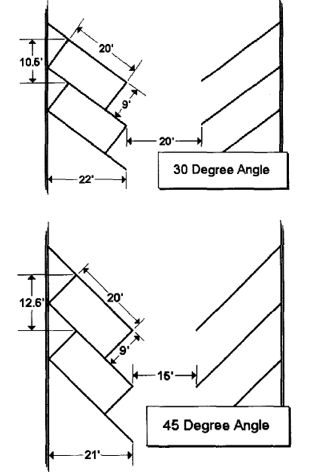
21-24-10 Parking Stall Dimensions
Drive aisle widths shown below are minimums. If the drive aisle is determined to be a fire access road, this Code and the International Fire Code may require additional width.
(LDC 2008, § 15A-24-10)
Amended by Ord. 19-23 § 1(Exh. A) on 10/8/2019
Amended by Ord. 21-08 § 1(Exh. A) on 3/23/2021
21-24-11 City Approval Of Access Required
Access to a public street requires approval by the Public Works Director based on the standards contained in this title and the Sandy City Standard Specifications and Details for Municipal Construction.
(LDC 2008, § 15A-24-11)
Amended by Ord. 21-08 § 1(Exh. A) on 3/23/2021
21-24-12 Traffic Impact Analysis
The City may require a traffic impact analysis prepared by a registered engineer to determine access, circulation, transportation demand management, and other reasonable transportation system mitigation requirements.
(LDC 2008, § 15A-24-12)
Amended by Ord. 21-08 § 1(Exh. A) on 3/23/2021
21-24-13 Access; Ingress And Egress
- Ingress and Egress. All parking areas shall be designed to provide ingress and egress from a public street by forward motion of the vehicle. Single-family developments are exempt from this requirement.
- Paved Access. All off-street parking areas shall have access to a public street by means of a paved driveway that extends no less than 15 feet from the public right-of-way to the nearest parking area and/or driveway access to parking spaces. No parking space shall be located within the first 15 feet of a driveway. Single-family developments are exempt from this requirement.
- Entry/Guardhouse Gateways. Where an entry gate or guardhouse controls vehicle access or egress, a stacking lane shall be provided as required by the City Engineer. The stacking lane shall not interfere with maneuvering, traffic flow of aisles, streets, bike paths, parking spaces, and sidewalks.
- Unobstructed Access. Unobstructed and direct driveways shall be provided from commercial off-street parking or loading facilities to a street or alley. Loading driveways may coincide with driveways to parking facilities.
(LDC 2008, § 15A-24-13)
Amended by Ord. 19-23 § 1(Exh. A) on 10/8/2019
Amended by Ord. 21-08 § 1(Exh. A) on 3/23/2021
21-24-14 Access And Maneuvering For Fire And Refuse Trucks
Parking lots shall include the necessary dimensions for the on-site maneuvering of refuse vehicles and fire trucks, as determined by the City Engineer and Fire Marshal. A 20 to 26-foot-wide, unobstructed driveway, lane, or other access way and turn-around may be required for this purpose, as required in the International Fire Code. No off-site maneuvering is permitted.
(LDC 2008, § 15A-24-14)
Amended by Ord. 19-23 § 1(Exh. A) on 10/8/2019
Amended by Ord. 21-08 § 1(Exh. A) on 3/23/2021
21-24-15 Driveway Access; General Standards
- Determination of Necessity. In establishing permissible curb openings and sidewalk or driveway crossings for access to private property, such curb openings or driveways shall not be authorized where they are unnecessary or where they would interfere with the movement of vehicular traffic, with public improvements, or with the rights of the public in the adjacent street or alley. In no case shall any curb opening be of greater width than necessary for reasonable access to the property to be served.
- Width of Curb Openings. In determining the width of curb openings and spacing of driveways, the end transitions in each case will not be considered a part of the width of the curb opening. The curb opening or width of each driveway shall be defined as the throat width of the driveway at the inside point of the curb transition radius at the top face of the curb.
- Number of Curb Openings. Only one driveway opening per street frontage/per parcel shall be allowed unless a capacity or safety need for more than one driveway opening can be demonstrated to the City Engineer. This may be determined on a case-by-case basis.
- Reciprocal/Shared Access. Where nonresidential uses share a property line, off-street parking lots serving the properties shall be made accessible to each other unless grade differences or building locations make reciprocal access between developments impractical.
- Single-Family Residential.
- Minimum separation from driveways, measured from edge of driveway to edge of driveway at back of sidewalk, is 30 feet for multiple drive approaches along the same parcel.
- No circular driveway that cuts across corner lots to access two separate streets is allowed.
- No driveway will be permitted within 30 feet of an ADA ramp as measured from the edge of driveway to the edge of the ADA ramp at the back of sidewalk.
(LDC 2008, § 15A-24-15)
Amended by Ord. 19-23 § 1(Exh. A) on 10/8/2019
Amended by Ord. 21-08 § 1(Exh. A) on 3/23/2021
21-24-16 Driveway Separations
- Frontage on Arterial (106 feet plus) or Major Collector Streets (80 Feet Plus). Uses, other than single-family dwellings, on parcels with less than 150 feet of frontage shall be required to share a common driveway in order to assure that a minimum of 170 feet of continuous curb and gutter exists from the throat of one driveway to the throat of the next adjacent driveway. Driveways offset less than 170 feet from existing driveways, approved driveways, or existing public streets on the opposite side of the street shall not be allowed unless the City Engineer determines that an unacceptable capacity or safety impact will not result.
- Frontage on Minor Collector (60 feet or 66 feet) or Local Streets (50 Feet Plus). Uses with less than 70 feet of frontage shall be required to share a common driveway in order to assure that a minimum of 90 feet of continuous curb and gutter exists from the throat of one driveway to the throat of the next adjacent driveway. Driveways offset less than 170 feet from existing or approved driveways on the opposite side of the street shall not be allowed unless the City Engineer determines that an unacceptable capacity or safety impact will not result. Single-family developments are exempt from this requirement.
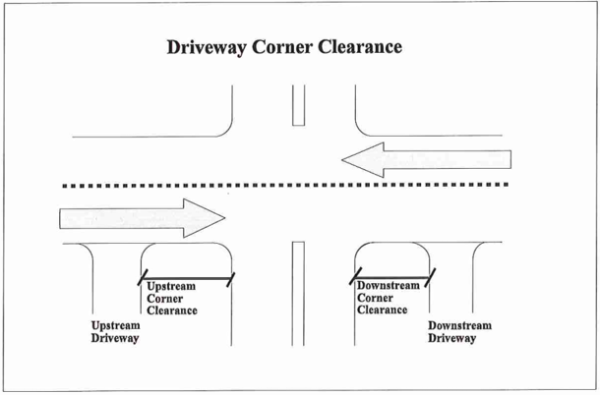
- Driveways Adjacent to Intersections. The minimum distance from the intersection to the nearest driveway shall be according to the following intersection illustration and distance table. (Distances are measured from the back of curb to the throat of the nearest edge of the driveway.)
Median Barrier Present
Arterial
Major Collector
Minor Collector
Driveway clearance
No
200 feet
175 feet
50 feet
Driveway clearance
Yes
185 feet
115 feet
50 feet
- Deviations to Driveway Separation. The City Engineer shall review and may approve or deny deviations to the above standards based upon a site visit and review of items, including, but not limited to:
- Safety.
- Alternative access points and potential for reciprocal/shared access.
- Sight lines.
- Impact on traffic flow.
(LDC 2008, § 15A-24-16)
Amended by Ord. 19-23 § 1(Exh. A) on 10/8/2019
Amended by Ord. 21-08 § 1(Exh. A) on 3/23/2021
21-24-17 Driveways; Widths And Curb Designs; Non-Single-Family Residential Developments
- One-Way.
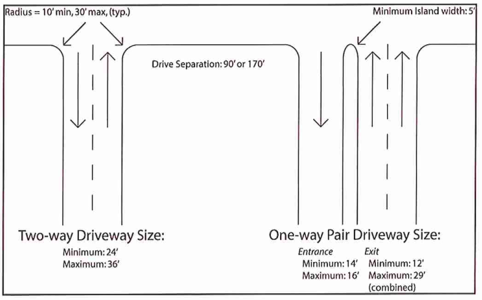
- One-way driveways shall be not less than 12 feet, nor more than 24 feet in width. A wider one-way driveway may be required by the Sandy City Fire Marshal.
- Exception: No two complementary one-way driveways may total more than 45 feet in width.
- Two-Way.
- Two-way driveway approaches shall be not less than 24 feet, nor more than 36 feet in width. In determining the width of curb openings and spacing of driveways, the end transitions in each case will not be considered a part of the width of the curb opening. A wider driveway may be required by the Sandy City Fire Marshal.
- Wherever a common driveway is constructed serving two or more properties, the common curb opening shall have a maximum width of 36 feet.
- The City Engineer shall review and may approve or deny deviations to the above driveway width standards based upon review of the site and land use, along with impact on streets and neighbors.
- Drive Approaches. All driveway approaches shall be constructed with curb radii and provide for handicap access.
- Minimum Curb Radius. All drive approaches shall have a minimum end transition (curb radius) of ten feet and a maximum of 30 feet. If the driveway is to be used for delivery truck traffic, the minimum curb radius shall be 25 feet.
- Driveways. Driveways shall be located a minimum of five feet from the property line, measured from the throat of the driveway. This does not apply to property lines where a shared driveway is proposed.
- One-Way Paired Driveways. Where a driveway is of the split, one-way paired directional type, there shall be a raised landscaped island of at least five feet in width between the two driveways. The size of the entrance shall have a minimum of 14 feet and a maximum of 16 feet. The exit lanes shall be a minimum of 12 feet and a maximum of 29 feet (combined).
- Maximum Curb Opening Coverage. The total width of all curb openings shall not exceed 40 percent of a project's frontage. For corner lots, the total width of all curb openings shall not exceed 30 percent of the combined frontages.
- Vehicle Encroachment. No curb opening will be approved that allows vehicle encroachment on any portion of a street right-of-way for loading, unloading, or standing.
- Drainage. Curb openings, curb cuts and driveways shall be paved and shall provide for adequate drainage as defined in Sandy City Standard Specifications. When an opening is intended for redirecting storm water runoff into a LID feature, an energy dissipation system such as a one-foot × one-foot of cobbles shall be provided to protect the LID feature.
- Drive Angle to Right-of-Way. All driveways shall intersect the street at a 90-degree angle to a distance at least 15 feet from the property line.
(LDC 2008, § 15A-24-17)
Amended by Ord. 19-23 § 1(Exh. A) on 10/8/2019
Amended by Ord. 21-08 § 1(Exh. A) on 3/23/2021
21-24-18 Unused Or Abandoned Drive Approaches
- Upon the issuance of a building permit, any unused or abandoned drive approaches or portions thereof shall be restored to the original curb section by the removal of the drive approach and replacement with high back curb and gutter to Sandy City Specifications and Details for Municipal Construction at the expense of the property owner adjoining that portion of the right-of-way.
- Upon refusal or neglect of the property owner or agent to restore the unused or abandoned drive approach to its original high back curb and gutter section, the City may proceed to do such work and all expenditures so incurred shall be charged against the owner or agent.
(LDC 2008, § 15A-24-18)
Amended by Ord. 21-08 § 1(Exh. A) on 3/23/2021
21-24-19 Improvements In Public Right-Of-Way
Improvements in the public right-of-way shall be designed and constructed in conformance with the AASHTO specifications, including, but not limited to, the following:
- Minimum Design Vehicle. The minimum design vehicle shall be the single-unit truck.
- Sight Obstructions. No object shall be situated to interfere with the required sight distance of intersections as set forth in the AASHTO specifications.
(LDC 2008, § 15A-24-19)
Amended by Ord. 21-08 § 1(Exh. A) on 3/23/2021
21-24-20 Pedestrian And Bicycle Access And Circulation Standards
- Purpose. The purpose of this section is to provide transportation options and ensure that new pedestrian and bicycle facilities are designed to be attractive, safe, and convenient to use, as well as ADA accessible and supportive of transit use.
- Pedestrian and Bicycle Accessibility. All projects that are subject to the provisions of this title shall provide for pedestrian and bicycle accessibility. Accessibility shall be from a direct, convenient, and attractive pathway system that conforms to the following standards:
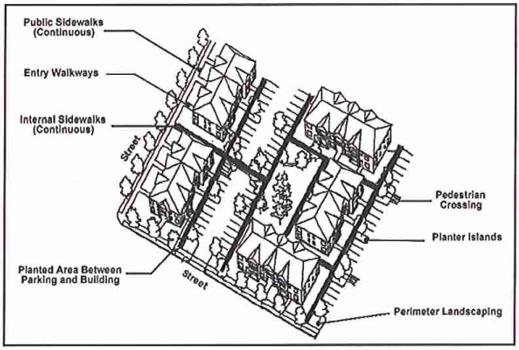
- Continuous Pathways. A pathway system shall extend through the development site and connect the street sidewalk to all primary building entrances as generally shown in the following Figure. The Director may require the developer to connect or stub pathways to adjacent streets, private property, adjacent trails, plazas, future phases of development, and open space areas (when reciprocal access is available or can reasonably be provided).
- Pathways Encouraged to be Raised. For the purpose of pedestrian safety, pathways through parking lots are encouraged to be raised on a six-inch-high curb, with the exception of areas crossing driveways.
- Continuous Pathways. A pathway system shall extend through the development site and connect the street sidewalk to all primary building entrances as generally shown in the following Figure. The Director may require the developer to connect or stub pathways to adjacent streets, private property, adjacent trails, plazas, future phases of development, and open space areas (when reciprocal access is available or can reasonably be provided).
- Pathway Safety, Comfort, and Convenience. All portions of a development shall be accessible by a direct, convenient, attractive, safe, and comfortable system of pedestrian facilities, as follows:
- Direct. Pathways should not deviate unnecessarily from a direct route or involve a significant amount of out-of-direction travel.
- Safety, Comfort, and Accessibility. Pathways should be free from hazards, have appropriate lighting levels (i.e., relative to the adjacent uses and considering natural surveillance), be suitable for people in wheelchairs (e.g., traction, not bumpy, etc.), and/or people with visual impediments, and provide a reasonably route of travel between destinations. The pathway system shall comply with ADA requirements.
- Access to Primary Building Entrances and Parking Areas.
- For commercial, industrial, mixed use, public, and institutional buildings, at least one pedestrian pathway is required to connect the public sidewalk to the primary entrance. A primary entrance is the main public building entrance. In the case where no public entrance exists, pathway connections shall be provided to the main employee entrance.
- For multifamily buildings and ground floor residential uses in mixed use buildings, the primary entrance is the front door (i.e., facing the street), except that for multifamily buildings or courtyard housing in which each unit does not have its own exterior entrance facing a street, the primary entrance may be a lobby, courtyard, plaza, or breezeway that serves as a common entrance for more than one dwelling.
- Pedestrian Amenities. Pedestrian amenities such as benches, planters, trees, lighting, etc., are required along sidewalks and pathways to provide defensible space, crime prevention, pedestrian comfort, and accessibility.
- Design and Construction Standards for Pathways and Access Ways. At a minimum, all pathways and access ways shall conform to the following standards:
- Vehicle Separation from Pathways and Access Ways. Pathways and access ways adjacent to a driveway, street (public or private), or parking spaces are encouraged to be raised six inches and curbed, and be separated from the driveway/street by a buffer strip with a minimum width of 11 feet (combined landscaping and meandering walk), utilizing bollards, lighting, landscape berming, or other physical barriers. The ends of the raised portions must be constructed with accessible curb ramps.
- Housing Separation from Pathways and Access Ways. Pedestrian pathways and access ways shall be separated a minimum of ten feet from all residential living areas on the ground floor, except at building and courtyard entrances, to provide for privacy in living areas. Separation is measured from the pathway edge to the closest dwelling unit. The separation area shall be landscaped. Pathway/building separation is not required for commercial, industrial, public, or institutional uses except as may be required through site plan review.
- Crosswalks. Where pathways and access ways cross parking areas, driveways, or private streets, they shall be clearly marked in accordance with ADA standards. Continuous pedestrian pavement materials are encouraged across such areas.
- Surface Materials. Pathway and access way surfaces shall be concrete and have a width that is based on their function. Pavers, brick, and other ornamental paving may be used if it has a smooth finish. Textured or bumpy materials may be used as an edge treatment provided an accessible route is provided between the edge treatment. Multi-use paths (e.g., bicycles and pedestrians), shall be concrete or asphalt.
- Shade on Long Access Ways and Pathways.
- When the primary entrance of a building is more than 100 feet from the nearest point of a public sidewalk and the entrance is accessed by a pathway traversing a parking lot with more than 100 parking spaces, an overhead, shade structure or tree canopy is encouraged along the pathway.
- Shade elements may include opaque structures (e.g., arbors, pergolas, porticos, awnings, canopies, etc.), and/or shade trees planted 30 feet on center or closer.
(LDC 2008, § 15A-24-20)
Amended by Ord. 21-08 § 1(Exh. A) on 3/23/2021

