
Sandy City Zoning Code
CHAPTER 21
2 GENERAL PROVISIONS
21-2-1 Violations And Penalties
- Violations. It is unlawful to construct, erect, install, alter, change, maintain, use, or permit the construction, erection, installation, alteration, change, maintenance or use of any house, building, structure, sign, landscape area, parking lot, fenced lot or other land contrary to any of the provisions of this title. Any land use that is specifically prohibited by this title or is unspecified and not classified by the Director is prohibited in any district.
- Property Owner is Responsible Party. The owner and/or the person in possession of any property used in violation of this title shall be responsible for any violation thereof, whether or not he or his agent has committed the prohibited acts or has neglected to prevent the performance of the prohibited acts by another person.
- Penalty. Any person, firm, or corporation violating any of the provisions of this title (and any amendments hereto, or of any adopted subdivisions, official maps, major street plan ordinance, or regulations) shall, upon conviction, be punishable as a Class C misdemeanor.
- Number of Offenses. Every person, firm, or corporation shall be deemed responsible or guilty of a separate offense for each and every day during which any violation is committed or continued.
- Remedy.
- The City, or any adversely affected owner of real estate within the City in which violations of this title occur or are about to occur, may, in addition to other remedies provided by law, institute:
- Injunctions, mandamus, abatement, or any other appropriate action.
- Proceedings to prevent, enjoin, abate, or remove the unlawful building, use, or act.
- The City need only establish the violation to obtain the injunction.
- The City may, in addition to other remedies provided by law, enforce the ordinance by:
- Withholding building permits; or
- Taking action to cancel any permit or approval for failure to comply fully with the terms of any permit or approval, including, but not limited to, a conditional use permit, site plan review, building permit, variance, or special exception. The authority that issued the permit or approval shall consider the matter at a public hearing preceded by at least ten days' notice to the licensee/permittee. Cancellation or revocation of a permit or approval may be appealed in the same manner as the original action.
- The City, or any adversely affected owner of real estate within the City in which violations of this title occur or are about to occur, may, in addition to other remedies provided by law, institute:
- Nuisance and Abatement. Any required fencing, landscaping, parking lot, lighting, or other required site plan elements, building or structure erected, constructed, altered, enlarged, converted, moved, removed, or maintained contrary to the provisions of this title, and any use of any conditional use permit, approved site plan, other approved development plans and permits, land, building, or premises established, conducted, or maintained contrary to the provisions of this title shall be, and the same hereby is declared to be, unlawful and a public nuisance. In addition to other remedies provided by law, the City Attorney, upon request of the Director, may immediately commence action or proceedings for the abatement and removal and enjoinment thereof in the manner provided by law, and may take other steps and apply to such courts as may have jurisdiction to grant such relief as will abate and remove such building use or structure, and restrain and enjoin any person, firm, or corporation from erecting, building, maintaining, or using any such building, structure, or property contrary to the provisions of this title. The remedies provided for herein shall be cumulative and not exclusive.
(LDC 2008, § 15A-02-01)
21-2-2 Severability
Should any chapter, section, clause, or provision of this title be declared by the courts to be unconstitutional or invalid, such decision shall not affect the validity of the title as a whole or any part thereof other than the part so declared to be unconstitutional or invalid.
(LDC 2008, § 15A-02-02)
21-2-3 Compliance And Scope
- Use of Land, Buildings, and Structures. No land shall be used or occupied and no building or structure shall be designed, erected, altered, used, or occupied for any use except those uses specifically permitted on the land upon which the building or structure is located or erected or use established as permitted in the regulations for the district in which said land is located. Storage of any kind on a vacant lot is prohibited.
- Development to be in Accordance with Terms of Licenses, Permits, or Approvals.
- All construction, operations, and occupancy shall be in accordance to approved building permits, conditional use permits, approved site plans, business licenses, and other permits which may be required. No deviance from said permits or approvals shall be made unless the proper variances, special exceptions, or appeals have been granted as per this title.
- No building permit shall be issued until all permits, reviews, or approvals required by this title have been secured. Grading permits may be issued by the Building and Safety Division prior to the issuance of a building permit with the approval of the Sandy City Engineer and Director, accompanied by a bond (amount to be determined by the Sandy City Engineer). Except as specifically provided herein, the securing of one required review or approval shall not exempt the recipient from the necessity of securing any other review or approval required by this title.
- Conformance to Ordinance Provisions. All City officials who are vested with the duty or authority to issue permits shall conform to the provisions of this title and shall issue no permit, certificate, license for uses, buildings, or purposes in conflict with the provisions of this title. Any such permit, certificate or license issued in conflict with the provisions of this title, intentionally or otherwise, shall be null and void.
- Inspection of Property.
- Inspection of Buildings, Structures, and Land Uses. The Director is hereby authorized to inspect or cause to be inspected all buildings and structures in the course of construction, modification or repair, and to inspect land uses to determine compliance with the provisions of this title; provided, however, that no such inspection shall be required as a condition precedent to commencement or continuation of any construction, modification, or repair of any building or structure unless otherwise provided herein or elsewhere in the ordinances of Sandy City.
- Right of Entry. The Director or any authorized employee shall have the right to enter any building for the purpose of determining the use thereof or to enter the premises for the purpose of determining compliance with the provisions of this title, provided such right of entry shall be exercised only at a reasonable hour and in no case shall entry be made to any building in the absence of the owner or tenant thereof without their consent or a written order of a court of competent jurisdiction.
(LDC 2008, § 15A-02-03)
21-2-4 Fees
A fee shall be paid for certain reviews and permits as established by the City Council. No such fee shall be returnable in the event that the permit or approval applied for is denied.
(LDC 2008, § 15A-02-04)
21-2-5 Administrative Reviews And Permits
- Review for Building Permits. The Chief Building Official shall submit all applications for building permits to the Director for review. Such review shall determine compliance with the regulations of this title. The requirements for a building permit shall be established by the Director. The Chief Building Official shall issue no building permit until the application is approved for zoning compliance by the Director.
- Review for Business Licenses and Home Occupations. All applications for business licenses, home occupations, or renewal of such licenses shall be submitted to the Director for review to determine compliance with this title.
- Site Plan Review. All applications for site plan review as provided for in this title shall be submitted to the Director. The Director shall receive all submittals to ensure completeness and prepare submittals for review.
- Conditional Use Permit. All applications for a conditional use permit shall be submitted to the Director as provided for in this title. The Director shall receive all submittals, ensure completeness of submittals, and prepare submittals for review by the Planning Commission.
- Temporary Use Permit. All applications for a temporary use permit shall be received by the Director and follow the procedure as described in this Code.
- Amendments. All requests for amendments or changes to this title or Zone District Map shall be initiated with the Director. The amendment process shall proceed as provided for in this title.
- Sign Permit. As provided in this title, the Director shall be responsible for issuance of permits for signs and for enforcement of sign regulations.
- Grading Permit. As provided in this title, the Building and Safety Division shall be responsible for issuance of permits for grading and for enforcement of grading regulations.
(LDC 2008, § 15A-02-05)
21-2-6 Expiration Of Licenses, Permits And Approvals
Each license, permit, or approval issued, as set forth herein, shall expire after 180 days if no construction is undertaken or no work is done, unless a different time period is specifically set forth at the time of issuance of the license or permit or in this title, or unless an extension is granted by the issuing agency prior to expiration.
(LDC 2008, § 15A-02-06)
21-2-7 Lot Standards
Except for more flexible requirements, as those pertaining to planned unit developments or as may be otherwise provided in this title, every lot within the City shall have such area as is required by this title and shall have the required frontage upon a dedicated or publicly-approved street before a building permit may be issued.
(LDC 2008, § 15A-02-07)
21-2-8 Substandard Lots
The requirements of this title as to minimum lot area or lot width shall not be construed to prevent the use for a single unit dwelling of any lot or parcel of land in the event that such lot has been held in separate ownership prior to and continuing since the adoption of the ordinance from which this title is derived and zoning regulations in effect prior to the adoption of the ordinance from which this title is derived.
(LDC 2008, § 15A-02-08)
21-2-9 Every Dwelling On A Lot
Unless otherwise permitted by this title, every dwelling structure shall be located and maintained on a separate lot having no less than the minimum area, width, depth, frontage, and public improvements required by this title for the zone district in which the dwelling structure is located, except group dwelling complexes under single ownership and management which are permitted by this title may occupy one lot for each such multi-structure complex. No recreational vehicle as herein defined shall be located, placed, used, or occupied for residential purposes in any zone district.
(LDC 2008, § 15A-02-09; Ord. No. 13-13, 6-5-2013)
21-2-10 Yard Space For One Building Only
No required yard or other open space around a building, or which is hereafter provided around any building, for the purpose of complying with the provisions of this title, shall be considered as providing a yard or open space for any other building, nor shall any yard or other required open space on an adjoining lot be considered as providing the yard or open space on a lot whereon a building is to be erected or established.
(LDC 2008, § 15A-02-10)
21-2-11 Yard To Be Unobstructed, Exceptions
Every part of a required yard shall be open to the sky and unobstructed, except for accessory buildings in a rear or side yard and for the ordinary projections of skylights, sills, cornices, chimneys, flues, other ornamental features which project into a yard not more than two feet, and fire escape structures projecting into a yard not more than five feet.
(LDC 2008, § 15A-02-11)
21-2-12 Clear View Of Intersecting Streets
- In all districts or uses for which a front yard is required, no opaque obstruction to view in excess of three feet high (above top back of curb) shall be placed on any corner lot within a triangular area formed by the intersection of straight lines extended from the back of the curb (or future curb) and a line connecting them at points 60 feet from the intersection of the curb line, except a reasonable number of trees pruned to permit unobstructed views to automobile drivers.
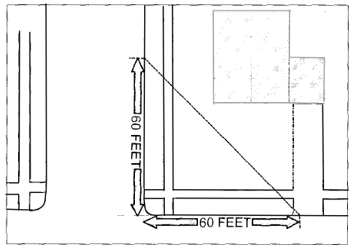
- Deviations from these requirements must be reviewed by the Transportation Engineer to determine if there is an acceptable degree of safety.
(LDC 2008, § 15A-02-12)
21-2-13 Sale Or Lease Of Required Space
No space needed to meet the width, yard, area, coverage, parking, or other requirements of this title for a lot or building may be sold or leased apart from such lot or building.
(LDC 2008, § 15A-02-13)
21-2-14 Division Of Lots Below Minimum Space Requirements
No parcel of land which has less than the minimum width and area requirements for the zone district in which it is located may be divided from a larger parcel of land for the purpose, whether immediate or future, of a building or development as a lot.
(LDC 2008, § 15A-02-14)
21-2-15 Conservation Of Values
It shall be the responsibility of each property owner to maintain their property in a good, clean condition, making necessary repairs to the home, accessory structures (e.g., fencing, yard lights, and other appurtenances) and landscaping. Good condition shall mean properly painted structures, fences in an upright and stable position, landscaping free of weeds, dead materials (e.g., dead trees or shrubs), as well as generally accepted maintenance practices for residential property, as more specifically addressed within Title 19.
(LDC 2008, § 15A-02-15)
21-2-16 Improvement Completion Assurance (Guarantee)
- Purpose. The purposes of this section are:
- To ensure all improvements that are required as a condition of development are completed pursuant to requirements adopted in Sandy City land use regulations and are subject to warranty;
- To set forth the requirements for improvement agreements and financial assurance including, without limitation, improvement completion assurance for constructing improvements after, or prior to, recording a plat or obtaining a building permit; and
- To comply with the provisions of the Utah Municipal Land Use, Development, and Management Act by, among other things, setting forth forms of acceptable improvement completion assurance and a method of partial release.
- Definitions. The following words and phrases, when used in this section, shall have the meanings ascribed to them in this subsection, except where the context clearly indicates a different meaning:
- City Engineer's Calculation ("Calculation") means a document prepared by the City Engineer that shows a list of improvements for which financial assurance is required, the quantity, unit type, unit cost, and extended cost of each item, as well as a total dollar amount for all the items listed on the calculation. The unit prices are intended to be the cost of construction and to include the cost of materials, overhead, mobilization, traffic control, special inspections, testing, audits by third parties, and all other expenditures needed for the completion of the improvements listed on the calculation. The calculation determines the dollar amount of the improvement completion assurance.
- Cost of Construction means the estimated cost of completing the improvements, as determined by the City Engineer.
- Improvement means permanent public and private infrastructure, items, structures, facilities, systems, or landscaping required as a condition to recording a subdivision plat, obtaining a building permit, or developing a commercial, office, industrial, mixed use, or multifamily residential development.
- Improvement Completion Assurance ("Guarantee") means a cash bond, escrow bond, or letter of credit required by City to guarantee the proper completion of Improvements required as a condition precedent to: (a) recording a subdivision plat; or (b) development of a commercial, office, industrial, mixed use, or multifamily project.
- Applicability. The provisions of this section shall apply to all development requiring improvements. As a condition precedent to recording a plat, obtaining a building permit, or commencing development, the following are required:
- An improvement agreement is required for all improvements.
- A guarantee is required for all improvements that have not been inspected and accepted by the City, and that are:
- Publicly owned and maintained;
- Essential or required to meet the building code or fire code;
- Required to meet flood or storm water management requirements;
- Required to meet street and access requirements; or
- Essential and necessary public safety requirements adopted in a land use regulation, as determined by the City Engineer or Director.
- A guarantee is required for all improvements that have not been inspected and accepted by the City and are public landscaping improvements.
- Improvement Agreement and Guarantee. Prior to recording a plat or commencing any development, the developer shall provide to the City an improvement agreement and a guarantee in accordance with the following requirements.
- Developer Responsibility. The developer is responsible for compliant completion and warranty of all improvements. Developer shall timely complete the improvements and guarantee the improvements to be free of defects in materials and workmanship in accordance with this title, the improvement agreement, and all other applicable approvals, regulations, standards, and specifications.
- Forms, Duration, Terms. The developer shall execute an improvement agreement and guarantee using forms that are acceptable to the City. The improvement agreement and guarantee shall be for a duration of 12 months from the date the guarantee is posted with the city. If requested by the developer, a separate improvement agreement and guarantee for construction of the public sidewalks may be created for a duration of 18 months from the date the guarantee is posted with the City. The guarantee shall run to the benefit of the City and shall remain in effect until such time as the City approves a partial release. The improvement agreement and guarantee shall contain language that promises and ensures compliant completion and warranty of the improvements by the developer. The guarantee shall contain a provision for unconditional payment of the face amount of the guarantee within ten business days from the date the City makes a written declaration of developer's failure to perform pursuant to this section.
- Improvement Warranty Period; Improvement Warranty Guarantee.
- Developer shall provide an unconditional warranty that improvements comply with the City's standards for design, materials, and workmanship and will be free of defects in materials and workmanship for 12 months following the date when the improvements are inspected and approved by the City Engineer, unless the City Engineer determines, for good cause, that a 12-month period would be inadequate to protect the public health, safety, and welfare; or has substantial evidence, on record of prior poor performance by the developer; or has substantial evidence that the area upon which the improvements will be constructed contains suspect soil and the City has not otherwise required the applicant to mitigate the suspect soil. Improvements listed on the same calculation shall have the same improvement warranty period.
- Financial assurance shall be required for the duration of the improvement warranty period, in the amount set forth in this section, to secure performance of replacement and repairs of improvements in accordance with developer's unconditional warranty.
- Amount of the Guarantee and Improvement Warranty Guarantee.
- The amount of the guarantee will be determined as follows:
- The City Engineer will prepare a calculation to determine the amount of the guarantee. The amount of the guarantee shall be 100 percent of the cost of construction plus ten percent of that amount to cover administrative costs incurred by the City to complete the improvements, if necessary.
- The City Engineer may divide up the list of items on the calculation and create no more than four separate calculations. In the case where there is more than one calculation, the sum of the calculations shall be the total dollar amount required for the guarantee.
- During the improvement warranty period the amount of the improvement warrantee guarantee for each calculation shall be ten percent of the amount shown on the calculation or ten percent of the developer's reasonable proven cost of completion, whichever is less, except the guarantee for the Storm Water Pollution Prevention Plan requirements shall not be reduced and shall remain at 100 percent.
- The amount of the guarantee will be determined as follows:
- Developer Shall Complete Improvements in a Timely Manner. All improvements shall be completed to the satisfaction of the City Engineer within 12 months from the date the guarantee is posted with the City, unless the developer requests an extension in writing, and the extension is approved by the Director and City Engineer for good cause. If a separate improvement agreement and guarantee for construction of public sidewalks has been approved by the City, all improvements for public sidewalks shall be completed to the satisfaction of the City Engineer within 18 months from the date the original guarantee is posted with the City, unless the developer requests an extension in writing, and the extension is approved by the Director and City Engineer for good cause. The developer shall execute an improvement agreement promising completion within the required time, and the improvement agreement shall be amended for any approved extensions.
- Specified Sequence for Completion of Improvements. To protect the health, safety and welfare of the City and its residents from traffic, flood, drainage or other hazards, the City Engineer may require that the improvements be completed or repaired in a specified sequence and/or within a specified period of time, which may be less than the time specified in the improvement agreement and guarantee. The City Engineer will notify the developer in writing of that requirement if the City Engineer deems such action necessary.
- Failure to Complete Improvements in a Timely Manner. If the developer fails to satisfactorily complete the improvements within 12 months from the date when the guarantee is posted, or 18 months from the date when a guarantee is posted for construction of public sidewalks, or within a shorter time period specified by the City Engineer in order to protect the health, safety and welfare of the City and its residents from traffic, flood, drainage or other hazards, or as extended by the City Engineer pursuant to this section, the City may, in its sole discretion, pursue all lawful remedies, including without limitation, declaring the developer in default of the improvement agreement, declaring the guarantee forfeited by the developer, and demanding payment pursuant to the terms of the guarantee. The City may spend the funds to pay for construction, replacement, or repair of incomplete or defective improvements, as well as the City's administrative overhead and any other associated costs incurred by the City. The City may take any other action it deems appropriate to enforce the improvement agreement, collect on the guarantee, recover amounts not covered by the guarantee and any other civil or criminal remedies allowable by law, which may include liens.
- Initiating Inspections. The developer shall request inspections of the installed improvements in writing when all improvements listed on one or more calculations are complete, at the end of an improvement warranty period, and after correcting deficiencies noted in a prior inspection. The request shall contain a statement affirming that all improvements associated with an individual calculation are complete and all deficiencies have been corrected. Inspections will be scheduled by the City Engineer upon receiving the developer's written request. Inspections may, but are not required to, be scheduled without written request from the developer upon determination by the City Engineer that time for completion of an improvement warranty period has run.
- Developer Shall Correct Deficiencies in a Timely Manner. The developer shall correct any deficiencies noted by City inspectors within 30 days from the time the inspector notifies the developer. Extensions may be authorized by the City Engineer for good cause beyond the developer's control after receipt of a written request and explanation from the developer.
- Partial Release of Guarantee. Upon completion of the improvements listed on an individual calculation, and inspection and approval of those improvements by the City Engineer, the City may release up to 90 percent of the portion of the guarantee amount shown on that calculation.
- Final Release of Guarantee. Upon completion of the improvements warranty period for the improvements listed on an individual calculation, and the subsequent inspection and approval of those improvements by the City Engineer, the City will release all remaining portions of the guarantee amount shown on that calculation.
- Acceptable Types of Guarantees. Guarantees shall be approved by the City and may be either:
- An irrevocable letter of credit, containing information required by the City, from a bank or credit union chartered under the laws of the State of Utah or the United States of America, licensed and regulated by the Department of Financial Institutions of the State of Utah or its successor, insured by the Federal Depository Insurance Corporation or National Credit Union Share Insurance Fund, and having an office in the State of Utah. The letter of credit shall be signed by the guarantor, with the signature notarized and attested and shall be automatically extended upon expiration, unless released by a letter issued by the Mayor and the City Engineer;
- An escrow bond, submitted on forms provided by the City, having as a guarantor an organization licensed and regulated by the Department of Financial Institutions of the State of Utah, or its successor, having an office in the State of Utah, and which is insured by the Federal Depository Insurance Corporation or National Credit Union Share Insurance Fund. Escrow bonds shall consist of a letter of commitment, signed by both the guarantor and the developer, with the signatures notarized and attested; or
- c. A cash bond, submitted on forms provided by the City and signed by the developer, with the signature notarized and attested.
- Developer's Certification of Notification to Subcontractors. The developer may be required to sign a statement that certifies that the developer has or will notify all contractors and subcontractors that the City will not release any portion of the guarantee until all improvements on a calculation are completed and the work has been inspected and accepted by the City Engineer, at which time the City will release no more than the portions allowed under this section.
- Construction of Improvements Prior to Plat Recordation or Issuance of Building Permit. If the developer desires to complete the improvements prior to recording a subdivision plat or prior to receiving a building permit, the developer may post an alternative guarantee in accordance with the following requirements.
- The alternative guarantee shall be in an amount needed, as determined by the City Engineer, to remove incomplete improvements and restore disturbed property, including, without limitation, a base rate of $10,000.00 per disturbed acre (rounded up to the full acre), $10,000.00 per culinary water main line connection, and $10,000.00 per stormwater main line connection.
- After posting the alternative guarantee, the developer may complete all improvements, except that no plat will be recorded, and no building permit will be issued by the City.
- When the improvements have been completed by the developer and inspected and approved by the City Engineer, the developer shall provide an improvement warranty guarantee as set forth in this section. Upon the developer posting the improvement warranty guarantee, the City will release the subdivision plat to be recorded, or the City will issue the building permit, provided all other City requirements have been satisfied.
- A guarantee as described in this section will be required for all incomplete or deficient improvements prior to recording the plat or receiving a building permit.
Editor's note(s)—Ord. No. 23-08, § 1(Exh. A), adopted July 18, 2023, repealed the former § 21-2-16, and enacted a new § 21-2-16 as set out herein. The former § 21-2-16 pertained to guarantee for improvements and derived from LDC 2008, § 15A-02-16; Ord. No. 11-15, adopted Sept. 9, 2011; Ord. No. 12-04, adopted Jan. 27, 2012; Ord. No. 16-02, adopted Jan. 14, 2016.
Adopted by Ord. 23-08 § 1(Exh. A) on 7/18/2023
Amended by Ord. 24-10 § 1(Exh. A) on 6/18/2024
21-2-17 Nonconforming Use Provisions; Purpose
It is the purpose of these regulations to control and gradually eliminate those uses of land or buildings which, although legal at the time of their establishment, do not now conform to the use regulations of the district within which they are situated. Such uses shall be deemed nonconforming uses. Likewise, these regulations are intended to control and gradually eliminate buildings which, although legal at the time of their erection, do not now conform to the height, bulk, and location regulations of the zone district within which they are situated. Such buildings shall be deemed to be nonconforming buildings. Any building or use which was permitted prior to enactment of the ordinance from which this title is derived, but which is designated by this title as a conditional use, shall not be considered nonconforming and shall not be subject to the provisions of this chapter. This chapter is also established to control and gradually eliminate sites and lots which were legal at the time of their establishment, but no longer meet the regulations of the district within which they are located. Such sites and lots shall be designated as nonconforming sites and lots.
(LDC 2008, § 15A-02-17)
State law reference(s)—Nonconforming uses, U.C.A. 1953, § 10-9a-511.
21-2-18 Continuing Existing Uses
Except as hereinafter specified, any use, building, or structure lawfully existing at the time of the enactment or subsequent amendment of this title, may be continued, even though such use, building, or structure does not conform with the provisions of this title for the district in which it is located. Except as otherwise provided by law, nothing in this title shall prevent the strengthening or restoring to a safe condition of any part of any building or structure declared unsafe by proper authority.
(LDC 2008, § 15A-02-18)
21-2-19 Construction Approved Prior To Title
A building, structure, or part thereof which does not conform to the regulations of the district in which it is situated, but for which a building permit was legally issued and construction started prior to the enactment of the ordinance from which this title is derived, may be completed in accordance with such plans providing work has progressed continuously and without delay. Such building or structure shall be deemed to be nonconforming and shall be subject to the regulations set forth herein.
(LDC 2008, § 15A-02-19)
21-2-20 Nonconforming Structures
- Director Review. The Director may approve repairs and/or changes to a nonconforming structure under the following conditions:
- The structure is legally nonconforming.
- The alteration, movement, enlargement or addition is in keeping with the intent of this title.
- The proposed alteration, movement, enlargement or addition will not impose undue burden upon the lands located in the vicinity of the nonconforming structure.
- The structure does not encroach further into the required setbacks beyond which has previously legally been approved.
- Any applicable development standards for parking, landscaping, screening, etc., are still met or not made less conforming with the expansion.
- No additional dwelling units are added to the building or structure.
- Damaged or Destroyed Structures. A noncomplying structure that is involuntarily damaged or destroyed, in whole or in part, by fire or other calamity may be restored or rebuilt, provided that such restoration is started within a period of one year and is diligently pursued to completion and the noncompliance is not increased. A noncomplying structure shall not be rebuilt or restored if:
- The structure is allowed to deteriorate to a condition that the building is rendered uninhabitable and is not repaired or restored within six months after written notice to the property owner that the structure is uninhabitable and that the right to rebuild or restore such noncomplying structure will be lost if the structure is not repaired or restored within six months; or
- The property owner has voluntarily demolished or removed a majority of the noncomplying structure.
(LDC 2008, § 15A-02-20; Ord. No. 12-04, 1-27-2012; Ord. No. 13-15, 6-11-2013)
State law reference(s)—Nonconforming structures, U.C.A. 1953, § 10-9a-511.
21-2-21 Nonconforming Uses
- A nonconforming use may be changed to a conforming use.
- Any nonconforming use which has been changed to a conforming use shall not thereafter be changed back to a nonconforming use.
- A vacant building or structure may be occupied by a use for which the building or structure is designed or intended if so occupied within a period of one year after the use became nonconforming.
- Cessation of Use. A use shall be deemed to have ceased when it has been discontinued for a period of one year or more, whether or not the intent is to abandon said use.
(LDC 2008, § 15A-02-21; Ord. No. 13-15, 6-11-2013)
State law reference(s)—Nonconforming uses, U.C.A. 1953, § 10-9a-511.
21-2-22 Amortization Of Nonconforming Uses
In order to respond to exceptional or unusual circumstances involving the termination of nonconforming uses, the City Council may approve an amortization formula for the termination of such uses over a period of time to be agreed upon with the owner of the property, subject to reasonable regulations with respect to the continuation of the nonconforming use during the amortization period.
(LDC 2008, § 15A-02-22)
State law reference(s)—Nonconforming uses, U.C.A. 1953, § 10-9a-511.
21-2-23 Properties Affected By Eminent Domain Proceedings
- Purpose.
- The purpose and intent of this section is to provide authority, guidelines, criteria, and procedures for the planning commission to review and grant special exceptions in connection with eminent domain proceedings or negotiations.
- At times, it is necessary to acquire properties in whole, or in part, through eminent domain proceedings or negotiations. Properties acquired in part result in remainder parcels that, in some cases, become nonconforming with respect to certain provisions of this title. The creation of new nonconformities or increases in the degree of nonconformity of existing legal nonconformities, can impose hardships on landowners and to remainder parcels. It is deemed a valid public purpose to grant special exceptions, pursuant to the provisions of this section, for nonconformities created by eminent domain proceedings or negotiations.
- Nothing contained in this section shall be construed or interpreted to permit the existence or continuance of violations of the City Code that are determined to be an immediate threat to the public health, safety, or welfare.
- Special Exception. In certain cases, the impacts of an eminent domain proceeding or negotiation may be mitigated, either wholly or in part, through planning commission approval of special exceptions, which may be applied for by the property owner or the condemning authority.
- Subject to this section, Planning Commission may grant special exceptions for provisions of this title, including, but not limited to, lot area, lot depth, lot width, setbacks, parking, open space, landscaping, signage, etc.
- Special exception submittal requirements are as follows (as applicable):
- Survey of the affected property.
- A scaled site plan showing proposed modifications with dimensions relative to, but not limited to, the following: building and sign setbacks, number of parking spaces, typical parking space dimensions, landscape buffer width, sign locations, sign area and height.
- A table that compares: (i) pre-condemnation conditions; (ii) post-condemnation conditions without the proposed special exceptions; and (iii) post-condemnation conditions with the proposed special exceptions. At a minimum, the following shall be included: lot area, lot width, lot depth; setbacks; building square footage; percent of open space; sign face area and setback; number and type of signs; number of parking spaces and typical parking space and drive aisle dimensions; and landscape buffer width and percent of interior parking lot landscaping.
- Special Exception Review Criteria. The planning commission shall review special exceptions. In granting the special exception, the planning commission shall make findings and reach affirmative conclusions as to the following criteria:
- Granting the special exception does not adversely affect the health, safety, and welfare of the public.
- Granting the special exception is the minimum necessary for the reasonable use of land and improvements.
- Granting the special exception does not have a materially detrimental impact on the rights or enjoyment of property of adjacent property owners.
- The special exception is the result of a hardship imposed by eminent domain proceedings or negotiations.
- City staff has provided a recommendation to the planning commission describing whether the proposed changes that would be authorized by the special exception are necessary and appropriate for the changes in the property caused by the eminent domain proceedings or negotiations.
- Approval Authority. The planning commission may deny, approve, or approve with conditions any special exception requested pursuant to this section.
- Appeal. The decision of the planning commission may be appealed as set forth in this title.
- Term of the Special Exception.
- Except as set forth in this section, the granting of a special exception is valid until, and shall terminate at, such time as the property is rezoned, developed or subject to a change of use.
- Provided that future improvements comply with the City Code in place at the time of application for the improvements and plans submitted for development or change of use for the site meet all City Code requirements in effect at the time of the new application, the special exception shall remain valid and shall not terminate upon City approval of the following:
- Interior finishes to existing structures;
- Exterior improvements to existing structures that have a value of less than 50 percent of the value of the structure;
- Accessory structures;
- Ancillary uses;
- Detached single-family property that is not being rezoned, subdivided or subject to change of use;
- Construction related to implementation of the special exception.
Editor's note(s)—Ord. No 21-21, § 1(Exh. A), adopted June 29, 2021, renumbered the former §§ 21-2-23 and 21-2-24 as §§ 21-2-24 and 21-2-25, respectively, and enacted a new § 21-2-23 as set out herein. The historical notation has been retained with the amended provisions for reference purposes.
Adopted by Ord. 21-21 § 1(Exh. A) on 6/29/2021
21-2-24 Water Drainage
Drainage shall not be allowed to flow onto adjoining lots unless an easement for such purpose has been granted by the owner of the lot on which the water flows.
(LDC 2008, § 15A-02-23; Ord. No. 16-33, 10-29-2016)
Editor's note(s)—See editor's note, § 23-2-23.
Amended by Ord. 21-21 § 1(Exh. A) on 6/29/2021
21-2-25 Sandy City Standard Specifications And Details For Municipal Construction
- Adoption of Standard Specifications and Details. The City Council, after receiving a recommendation from the Planning Commission, shall adopt, by ordinance, Standard Specifications and Details for Municipal Construction not inconsistent with the provisions of this title. The Standard Specifications and Details for Municipal Construction may be temporarily changed, altered or amended from time to time by the City Engineer as necessary, provided that such change, alteration or amendment does not materially:
- Increase a land use applicant's cost of development compared to the existing specifications; or
- Impact a land use applicant's use of land.
- Adoption of Temporary Specifications. The City Engineer shall present temporary changes, alterations and amendments of the Standard Specifications and Details for Municipal Construction to the Planning Commission and City Council for review, consideration and adoption on an annual basis. Adoption of such amendments shall comply with the requirements set forth in this title.
- Notice and Hearing. Notice and hearing requirements shall be the same as required for proposed land use regulations in accordance with this title and applicable state laws.
- Compliance with the Standard Specifications and Details for Municipal Construction. Compliance with the Standard Specifications and Details for Municipal Construction, as amended, shall be required as a condition of development approval, issuance of a building permit, and issuance of related permits and approvals.
(Ord. No. 18-01, § 1, 2-4-2018)
Editor's note(s)—See editor's note, § 23-2-23.
Amended by Ord. 21-21 § 1(Exh. A) on 6/29/2021

