
Sandy City Zoning Code
CHAPTER 21
23 COMMERCIAL, OFFICE, INDUSTRIAL, AND TRANSIT CORRIDOR DEVELOPMENT STANDARDS
21-23-1 Purpose And Applicability
- Purpose. The commercial, office, industrial, and transit corridor district development standards are intended to provide a set of standards whereby developments can be designed into well-planned commercial and industrial centers using the latest industry ideas and techniques.
- Scope. This chapter establishes performance and development standards to encourage and facilitate orderly growth and well-planned development within Sandy City. These standards are intended to ensure good building and overall site design, good architectural design and visual appearance, street layout, parking design, pedestrian design, appropriate fencing, buffering, and screening, as well as compliance with the district regulations and other provisions of this title relating to public health, safety, and general welfare of the overall community. The standards set forth within this chapter shall be interpreted to be the minimum standards within the district unless otherwise stated.
- Applicability. Uses permitted and conditional shall conform to the development standards provided in this title and to the application procedures for the development.
- Applicability of Other Code Chapters. Uses permitted and conditional under this chapter shall also conform to the applicable development standards provided elsewhere in this title. Uses shall also conform to any overlay zone requirements that are applicable. Uses permitted as a conditional use shall also comply with the requirements for conditional use permits.
(LDC 2008, § 15A-23-01)
Amended by Ord. 21-08 § 1(Exh. A) on 3/23/2021
21-23-2 Ancillary Uses
All permitted and conditional land uses within each district may conduct ancillary uses provided such use is not regulated by other sections or is listed as a prohibited land use in the district. Certain ancillary uses may be allowed if determined to be compatible with the primary use as determined by the Planning Commission.
(LDC 2008, § 15A-23-02)
Amended by Ord. 21-08 § 1(Exh. A) on 3/23/2021
21-23-3 General Commercial And Industrial Development Standards
Development shall occur according to the following general standards and requirements, as well as the development requirements listed in the individual districts. In all cases, the more restrictive development standards shall govern.
- Site Plan Review Required. Site plan review with City staff is required of all new, modified, and expanded development projects. Additionally, the site plan may be required to be reviewed by the Planning Commission as may be specified within a zoning district or if the necessity is determined by the Director.
- Architectural Design Standards. All retail commercial, office, industrial, and institutional developments shall follow all standards listed in the Architectural Design Standards adopted by Sandy City.
- CPTED (Crime Prevention Through Environmental Design) Principles.
- The developer is required to consider the basic principles of CPTED when designing the site plan, Landscape Plan, and architectural design for a project. Use of the CPTED principles is strongly encouraged in the interest of the future security of the project from both the owner as well as the customer's standpoint. The concept of CPTED is based upon the theory that the proper design and effective use of the built environment can lead to the reduction in the incidence and fear of crime and be an improvement in the quality of life.
- The following principles should be taken into account in the design of all buildings and developments:
- Natural Surveillance. Physical design that keeps potential intruders under the perception of continual watch, using "eyes on the street" (e.g., view to streets, driveways, and parking lots), and visual permeability in architecture, lighting, and landscaping.
- Natural Access Control. Physical design that guides the mobility of people and decreases crime opportunity and increases perception of risk to potential offenders.
- Territorial Reinforcement. Physical design that encourages users of property to develop ownership over it, developing space with an easily discernable purpose, using symbolic barriers such as low lying fences/walls, landscaping and signage, eliminating ambiguous spaces, encouraging easy maintenance, and discouraging crime.
- Management and Maintenance. Responsibility for managing and maintaining the property. Show that someone cares about seeing that the property is in a presentable appearance and is secure for the customers that use the facility.
- CPTED Landscaping Standards. These should be used including planting shrubs with a maximum height of two to three feet and trees with a proper ground clearance of seven feet above walkways and sidewalks and 14 feet above vehicular travel and parking lanes. This shall be accomplished through proper pruning practices, not by clear cutting, topping trees or other pruning for exposure techniques.
- Public Safety. In order to encourage public safety through natural surveillance, natural access control, and territorial reinforcement, solid windowless walls are not permitted adjacent to streets, pedestrian areas, and open space amenities.
- Symbolic barriers such as low lying fences/walls, landscaping and signage shall be used to discourage crime and to promote safety.
- Ground floor parking garages shall not be permitted immediately adjacent to streets, unless permitted by the Planning Commission.
- Developments shall have street side building elevations with extensive windows, balconies, decks, or landscape terraces being encouraged.
- General Building Locations and Setbacks. In addition to the specific building setback requirements listed in each individual district, the following general standards shall apply:
- No building shall be closer than six feet from any private road, driveway, or parking spaces in order to allow areas adjacent to the building for foundation landscaping and buffering of pedestrian walkways. Exceptions may be made for any portion of the building that contains a drive-up window or where the Planning Commission may approve a zero-foot setback.
- Except as specified in the Storefront Conservation Floating Zone, the public right-of-way boundary shall be considered the front property line of a lot. Where a lot is bordered on two or more sides by a public right-of-way boundary, all such sides shall be considered as front property lines.
- In all cases, the area between the front property line and the building shall be known as the front yard.
- Table of Minimum Building Setbacks. All measurements are in feet and all front setbacks are measured from the top back of curb.
District | Front Standard Setback* | Side, Shared Party Walls Allowed | Side, No Shared Walls | Side, Abut Residential** | Rear, Standard | Rear, Abut Residential District** |
RC District | 25 | Y | 10 | 30 | 20 | 30 |
CC District | 25 | Y | 10 | 30 | 20 | 30 |
CN District | 25 | Y | 10 | 30 | 20 | 30 |
CN(HSN) District | 0-251 | Y | 0-101 | 30 | 0-201 | 20 |
BC District | 25 | Y | 10 | 30 | 10 | 302 |
CvC District | 25 | Y | 10 | 30 | 20 | 30 |
HBD District | 0-253 | Y | 0-103 | 0-153 | 0-153 | 0-153 |
CR-PUD District | 25 | Y | 0 | 0 | 04 | 04 |
LC District | 25 | Y | 10 | 30 | 10 | 30 |
PO District | 25 | Y | 10 | 30 | 30 | 30 |
ID District | 25 | Y | 10 | 30 | 1 | 30 |
CBD District | 256 | Y | 106 | 30 | 206 | 30 |
CBD-P District | See Note #6 below | |||||
CBD-O District | See Minimum landscape standards for CBD Zone | |||||
CBD-A&C District | See Note #6 below | |||||
Automall District (Dealer Area) | 94 | Y | 15 | — | 05 | — |
Automall District (Commercial Area) | 25 | N | 105 | — | 105 | — |
RD District | 257 | Y | 10 | 10 | 207 | 207 |
* Except as modified by the Storefront Conservation Floating Zone, a minimum of 15 feet from the back of sidewalk shall be maintained for all buildings regardless of the minimum setback shown in the table, except where a zero-foot setback is allowed and used.
** Exception: For commercial developments with a dedicated open space area (canal, trail, etc.), between the proposed development and an adjacent residential district, the setback can be reduced to a minimum of ten feet from the commercial developments property line rather than the typical 30 feet.
Notes:
1. CN(HSN) District.
- Front Yard. All buildings shall be setback between zero to 25 feet from the front property line unless otherwise noted below or approved by the Planning Commission during site plan review.
- Where a structure is proposed to be constructed on a site adjacent to existing structures that have been built on or near the front property line, the proposed new structure shall follow that precedent.
- Where new construction is proposed for a vacant corner lot on a block with no setback from the street, the proposed new construction shall again follow that model.
- Side Yard. Where the side yard abuts another commercial district property, a building shall extend to the property line or be no closer than ten feet from the side property line and be developed as specified elsewhere in this Code.
- Rear Yard. Where the rear yard abuts another commercially zoned property, a building shall extend to the property line or be located no closer than 20 feet from the rear property line.
2. BC District. When the development abuts a residential district, the rear setback shall be a minimum of 30 feet.
3. HBD District. Where a structure is proposed to be constructed on a site adjacent to existing structures that have been built on or near the front property line, the proposed new structure shall follow that precedent. Where new construction is proposed for a vacant corner lot on a block with no setback from the street, the proposed new construction shall again follow that model. Where a structure is proposed to be constructed on a block where there is no zero lot line precedent and where the existing pattern of development shows front and side yard setbacks, the proposed project shall conform to a zero lot line pattern where possible.
4. CR-PUD District; Rear Yard. None except where visible from right-of-way or Interstate 15. Where a rear yard is visible from the right-of-way or Interstate 15, the rear yard setback shall be 20 feet.
5. AM District.
- AM District; Dealership Area.
- Front, Side and Rear Setback for Parking Structures. The setback for parking structures that are used for vehicle inventory/display may be reduced by the Planning Commission after considering the following factors:
- Height and configuration of the structure.
- Relationship and impact to other buildings on-site and on adjoining properties.
- Location of any public utility easements.
- Visibility from vehicular approaches.
- Rear Setback. Minimum ten-foot rear yard setback when adjacent to commercial area. Minimum 50-foot rear yard setback when adjacent to Interstate 15.
- Front, Side and Rear Setback for Parking Structures. The setback for parking structures that are used for vehicle inventory/display may be reduced by the Planning Commission after considering the following factors:
- AM District; Commercial Area. Side and rear setbacks may be reduced to five feet if developed in conjunction with an adjoining lot development. Rear setbacks may be reduced to zero feet if totally screened from view.
6. CBD Districts.
- CBD and CBD-O.
- Building and parking setbacks along Interstate 15 shall be a minimum of 50 feet or an average of 50 feet with no point closer than 40 feet.
- For new or existing developments in the CBD Zoning District over ten acres in size, the Planning Commission may be allowed to modify the setbacks after considering the following factors:
- Overall Master Plan layout for new or expanded development, or a site plan of the existing development.
- Relationship and impact to other existing or proposed buildings on-site and adjoining properties (present and future) and whether such setback modifications is compatible with the scale and design of said buildings.
- Physical features such as rail lines, canals, and controlled ingress and egress.
- Location of any public utility easements.
- Compliance with all applicable building and fire code requirements.
- Side and Rear Yard for CBD. The Planning Commission may approve, during site plan review, a zero side and/or rear yard setback for parking structures that are placed underneath or behind the main building, or for manufacturing uses, if they determine there would not be a negative impact on adjacent properties, after considering the following factors:
- Height and configuration of parking structure or manufacturing use.
- Relation and impact to other buildings on-site and adjoining properties (present and future).
- Natural land features such as slopes and vegetation.
- Physical features such as rail lines, canals, and controlled ingress and egress.
- Location of any public utility easements.
- Visibility from vehicular approaches.
- CBD-P.
- Front Setback. In order to encourage a "Main Street" effect along the Parkway, buildings shall maintain a zero lot line front setback from the approved sidewalk and streetscape profile of Centennial Parkway and Sego Lily Drive (10000 South). Buildings that originate within the CBD-P District with a zero lot line front setback may continue that setback for the length of the building into the CBD District. This reduced setback does not apply to other non-contiguous structures within the development. Front setback variations may be used when an activity related to pedestrian use is maintained (e.g., outside seating for restaurants, urban streetscapes).
- Side and Rear Setbacks. Zero lot line side setbacks with attached structures in compliance with the International Building Code are required except for pedestrian access and usable open space areas. Rear setbacks shall be of sufficient depth to allow required parking and landscaped areas to the rear of the buildings.
- CBD-A&C.
- Front Setbacks. Front setbacks of buildings shall maintain a zero-foot setback from the approved sidewalk and streetscape profile. Variations shall be required for building articulation and when an activity is related to pedestrian use (e.g., outside seating for restaurant, pedestrian walking areas, residential courtyards, etc.). A maximum setback of ten feet is allowed for residential courtyards.
- Side and Rear Setbacks. Zero-foot setback may be approved by the Planning Commission for all other lot lines.
7. RD District.
- Front Yard. All buildings shall be set back at least 25 feet from all public streets. Unless otherwise approved by the Planning Commission, with a recommendation from the City Transportation Engineer, based upon future transportation needs for the City, there shall be no parking between the building and a public street. Said area shall be landscaped or developed into a pedestrian plaza (e.g., fountain, seating, landscape planters, etc.).
- Rear Yard. Unless nonresidential uses are developed conjointly, buildings shall be set back at least 20 feet from rear property lines.
- Table of Maximum Building Heights. All building heights are measured in feet and are measured to the peak of the roof, if pitched, or to the top of the roof parapet, if flat. If the building is located upon a slope, then the base measurement point is taken from the average finished grade.
District | Building Height | Max Height within 250 feet of Residential District |
RC District | See Note #3 below | |
CC District | 352 | 35 |
CN District | 40 | 40 |
CN(HSN) District | 40 | 40 |
BC District | 504 | 40 |
CvC District | 30 | 30 |
HBD District | 40 | 40 |
CR-PUD | 70 | 70 |
LC District | 40 | 40 |
PO District | 258 | 258 |
ID District | 805 | 40 |
CBD District | 1406 | 356 |
CBD-P Subdistrict | See Section 21-23-21(a) | |
CBD-O Subdistrict | See Section 21-23-21(a) | |
CBD-A&C Subdistrict | See Section 21-23-21(a) | |
AM District, Dealership Area | 401 | N/A |
AM District, Commercial Area | 401 | N/A |
RD District | 807 | 807 |
Notes:
1. AM District. An additional height bonus is allowed at a rate of one additional foot of height for each additional foot of setback (in excess of 30 feet) to a maximum height of 70 feet.
2. CC District. Additional height is allowed at a rate of one additional foot of height for each additional foot of setback (in excess of 30 feet) to a maximum height of 50 feet.
3. RC District.
- East of State Street. Buildings within 100 feet of an R-1 Residential District boundary may be erected to a maximum height of 40 feet. An additional height bonus of one additional foot of height per additional two feet from the required minimum setback may be granted up to a maximum height of 60 feet. The Planning Commission may increase the required setback or require additional architectural elements for buildings taller than 35 feet from the east property line, if, after due consideration, the Commission deems it necessary to mitigate any negative impacts that the proposed development may have on residential development.
- West of State Street. Buildings may be built to a maximum height of 75 feet. Buildings where appurtenances are constructed for the purpose of mitigating noise and/or light may be built to a maximum of 115 feet. For those developments where any portion of a building is within 100 feet of an R-1 Residential District boundary, they may be erected to a maximum height of 40 feet. An additional height bonus of one additional foot of height for each additional two feet of setback from the required minimum setback may be granted up to a maximum height of 60 feet for any portion of the building within the 100-foot buffer area. Maximum building height shall be measured from average finished grade to the top of the roof.
4. BC District. No building shall exceed a height of 40 feet from average finished grade to the peak of the roof line, except that an additional height bonus is allowed at a rate of one additional foot of height for each additional foot of setback (in excess of 39 feet) to a maximum height of 50 feet.
5. ID District. East of Interstate 15, buildings shall be erected to a height no greater than 40 feet for any part of the building intended for human occupancy.
6. CBD Districts.
- West of State Street. Buildings may be built to a maximum height of 140 feet or no more than ten stories.
- Exceptions:
- Multifamily buildings (including vertical mixed use buildings that contain residential uses) may be allowed up to 140 feet without restriction on the number of stories.
- The Planning Commission may approve a building taller than 140 feet, or more than ten stories, not to exceed 20 stories, after considering the following factors:
- Overall Master Plan layout of the project, which may include the size, scale, location, and topography of the property.
- Relationship and impact to other buildings on-site and adjoining properties.
- Unique architectural design.
- Exceptions:
- East of State Street. Buildings within 100 feet of an R-1 Residential District boundary may be erected to a maximum height of 40 feet to the peak of the roof. An additional height bonus of one foot per additional two feet from the required setback may be granted up to a maximum height of 65 feet.
7. RD District. Buildings may be built to a maximum height of 80 feet west of Interstate 15 and 65 feet east of Interstate 15. For those developments that are east of Interstate 15, any portion of a building within 100 feet of an R-1 Residential District boundary may be erected to a maximum height of 40 feet to the peak of the roof. An additional height bonus of one foot per additional two feet from the required setback may be granted up to a maximum height of 65 feet for any portion of the building beyond the 100-foot buffer area.
8. PO District. Actual building height may exceed the height limitation in the building height matrix if the required building setbacks (front, side, and rear) are increased by a ratio of one foot of height for every two feet of additional setback. The height may be increased up to a maximum of 50 feet to the peak of the roof. If additional height is desired, the development must include all of the following five additional design criteria:
- Open Space. The increase in height creates additional usable open space that would otherwise not be available if additional height is not granted.
- Landscaping. Additional landscape elements (either hardscape or greenscape) soften the appearance of the building and provide additional buffer areas adjacent to a residential district.
- Aesthetics. The proposed building design and architecture are distinctive, unique, and compatible with the immediate surroundings (both manmade and natural).
- Impact on Residential Areas. The proposed building height provides for a reduced impact on adjacent residential districts (e.g., varied building setback, unique roof line, residential appearance, etc.).
- Gathering Place/Plaza. The increased height creates a unique people place that will create local interest. Such places might include a fountain, a pedestrian plaza, usable landscaping, etc.
(LDC 2008, § 15A-23-03; Ord. No. 12-15, 5-15-2012; Ord. No. 14-24, 9-4-2014; Ord. No. 14-35, 11-13-2014; Ord. No. 14-37, 11-24-2014; Ord. No. 16-01, 1-14-2016; Ord. No. 18-14, § 1(exh. A), 6-5-2018)
Amended by Ord. 21-08 § 1(Exh. A) on 3/23/2021
Amended by Ord. 21-36 § 1(Exh. A) on 12/7/2021
21-23-4 Lot Size And Width
Lots shall be of sufficient size and width to assure compliance with all requirements of this chapter.
(LDC 2008, § 15A-23-04)
Amended by Ord. 21-08 § 1(Exh. A) on 3/23/2021
21-23-5 Public Improvements
- General.
- The developer of the project shall be responsible for the dedication and improvement of all off-site public improvements that do not presently exist according to the width of the ultimate right-of-way, as called out in the Transportation Element of the Sandy City General Plan, on or along the property being developed. If a property has multiple street frontages, improvements are required along all streets.
- Such improvements shall include, but are not limited to, curb, gutter, sidewalk, streetlights, drive approaches, waterways, road base, asphalt, striping, streetscape, storm drainage, fire hydrants, copper laterals, piping of irrigation ditches and flood control systems, fencing of canals, extension of water lines, appurtenances and sewer lines, removal of utility lines out of the right-of-way (with the exception of traditionally buried lines such as sewer, water, and natural gas transmission lines), etc.
- Other Off-Site Improvements. The developer may also be responsible for other off-site work such as participation in the cost of such items as traffic lights and traffic medians that are related to the impacts created by a particular project.
- Compliance with City Specifications. All required improvements shall be designed and installed by the developer according to the Sandy City Standard Specifications and Details for Municipal Construction.
(LDC 2008, § 15A-23-05)
Amended by Ord. 21-08 § 1(Exh. A) on 3/23/2021
21-23-6 Parking Lots And Loading Areas
- General. There shall be provided at the time of erection of any main building or at the time any main building is enlarged or increased in capacity, minimum off street parking space with adequate provision for ingress and egress in accordance with the requirements herein.
- Parking Areas, Development, and Maintenance. Every parcel of land used as a public or private parking area, including a commercial parking lot for automobiles, farm equipment, or other open air sales lot, shall be developed and maintained consistent with the approved site plan for the project.
(LDC 2008, § 15A-23-06)
Amended by Ord. 21-08 § 1(Exh. A) on 3/23/2021
21-23-7 Screening At Boundaries Of Residential Districts
- Masonry Wall. For commercial and industrial developments abutting residential districts (except recognizable holding zones for future commercial or industrial development), an opaque masonry wall shall be installed and maintained along all district boundaries, other than streets, where the premises abut areas zoned for residential uses.
- Height. Except where otherwise provided, the opaque masonry wall shall be a minimum of eight feet in height. If requested by the adjacent residents, the Planning Commission may approve a lower wall based upon unusual circumstances (e.g., views, landscaping, etc.). A lower height wall may be required adjacent to a front property line for sight distance and traffic safety.
- Grade. Where there is a difference in elevation on opposite sides of the wall, the height of the required wall shall be measured from the highest elevation.
- Signs are Prohibited. No signs or sign supports shall be permitted on any required wall.
- Materials. Acceptable construction materials for walls shall be brick, ceramic tile, stone, pre-cast concrete panel, concrete block, or such other masonry materials as the Director may approve. Concrete panels and posts must be reinforced with rebar and wire as determined by the Chief Building Official.
- Other. Under special conditions where it has been determined that the development may create unique impacts on an adjoining residential district (e.g., hillside developments, developments adjacent to dedicated open space), the Director shall review and may approve other methods of screening such as bermed landscaping, open style fencing, screen height, placement of screen, or other types of screening.
(LDC 2008, § 15A-23-07)
Amended by Ord. 21-08 § 1(Exh. A) on 3/23/2021
21-23-8 Storage And Display Areas
- Storage Areas. Storage areas, including, but not limited to, areas containing vehicle storage, merchandise, or equipment, etc., shall be paved with hard surface paving (unless otherwise approved by the Director) and screened with decorative opaque fencing and landscaping. Each wall or fence shall be at least six feet in vertical height or equal in height to the material to be screened and shall be sufficient to screen facilities from view of a public street and neighboring lots.
- Outdoor Displays. Outdoor displays in front of buildings and within parking lots (e.g., lawnmowers, trailers, tires, garden supplies, plants, sheds, fencing, building materials, and general merchandise) shall only be displayed in front of buildings and within parking lots as shown on the approved site plan for the development. Said displays shall not block pedestrian walkways and shall maintain a minimum setback of ten feet from driveways.
- General Display Standards. Vehicles, equipment and other merchandise for sale or rent may only be displayed within the required front landscape setback upon the approval of designated concrete, or decorative brick paver display pads to be shown on an approved site plan for the development.
- Display Pad Standards.
- No more than two display pads are allowed within the required front landscape area for each 100 feet of owned or leased property street frontage (i.e., greater than 150 feet of frontage would allow up to three display pads, but less than 150 feet would be limited to two display pads).
- Display pads may cover up to a maximum of 25 percent of the required front landscape area and shall not be more than two feet in height above the sidewalk grade.
- All display pads shall have landscaping to surround the pads on the front (facing the street) and both sides to a width not less than five feet. Landscaping shall consist of additional combinations of shrubs and ground covers to enhance and soften the pad appearance.
- All displays shall be kept within approved display pads.
- Traffic Safety. No outside displays (either permanent or temporary) shall be permitted to block required driveways, traffic visibility, traffic and parking aisles, parking spaces, public rights-of-way (including sidewalks), nor be located upon any landscaped area (other than on approved display pads).
- Distance from Residential District. No outdoor storage shall be located within 30 feet of any district zoned for residential use.
(LDC 2008, § 15A-23-08)
Amended by Ord. 21-08 § 1(Exh. A) on 3/23/2021
21-23-9 Trash Enclosure Areas
- Design Standards. Enclosures shall be provided for all garbage and/or recycling containers (dumpsters), and design of said enclosure shall be consistent with the Sandy City Architectural Design Standards.
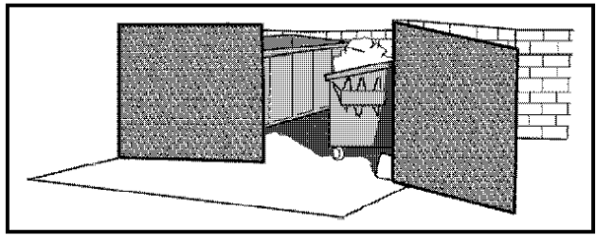
- Gates. Enclosure material shall be composed of solid masonry, a minimum six feet high, compatible with adjacent buildings with opaque gates to be closed when not in use. Gate frames shall be made of solid metal, and facing may be solid metal or other durable materials approved by the Director.
- Screening. Each enclosure and its gates shall be equal in vertical height to the trash dumpster to be screened and be sufficient to screen said facilities from view from public and private roads and neighboring lots.
- Location. No dumpster shall be permitted in the required front building setback, nor shall it block required driveways, traffic and parking aisles, parking spaces, or sidewalks.
- Setbacks. No dumpster shall be located within five feet of any side or rear commercial property line or ten feet of any side or rear property line adjacent to a residential district.
- Access. Public roads shall not be used directly for refuse collection.
(LDC 2008, § 15A-23-09; Ord. No. 14-37, 11-24-2014)
Amended by Ord. 21-08 § 1(Exh. A) on 3/23/2021
21-23-10 Roof-Mounted Mechanical Equipment
- Screened. All roof-mounted mechanical equipment and vents (including swamp coolers) shall be screened entirely from view from adjacent public rights-of-way and properties. This may be accomplished using one or more of the following alternatives:
- A separate continuous screening system.
- Groupings of pieces of mechanical equipment with an architecturally designed screening system that blends with the architectural design and materials of the proposed building.
- Extension of the building's parapet walls to screen the equipment from public view.
- Engineered. All roof-mounted mechanical equipment (including its height above the roof) and the proposed screening system shall be shown to scale on the building's structural plans and approved by the Director prior to issuance of a building permit. Said roof screen systems shall also be designed, structurally engineered, and stamped by a licensed engineer for drifting snow and wind loads, and approved by the Plans Examiner of the Building and Safety Division.
(LDC 2008, § 15A-23-10)
Amended by Ord. 21-08 § 1(Exh. A) on 3/23/2021
21-23-11 Lighting
- Spotlights. Reflectors, spotlights, floodlights and other sources of illumination may be used to illuminate buildings, landscaping, signs, parking, and loading areas, provided they are equipped with proper lenses or other devices concentrating the illumination upon the building, landscaping, signs, parking, and loading areas.
- Light Spill. No unshielded lights, reflectors, spotlights, strobe lights, or search lights shall be so located so that they are pointed towards or are directly visible from public rights-of-way. All lighting shall be shielded and directed downward to avoid light spill beyond the property line. Unshielded, exterior wall-mounted floodlights (wall packs) are prohibited. Intensities shall be controlled so that neighboring areas will not be adversely affected by glare or excessive light.
- Appropriate Lighting. Pole mounted fixtures are required for parking lot lighting. Lighting of pedestrian pathways is also required. Lighting of buildings and site identification signs are permitted.
- Site Drawings. Design and location of standards and fixtures shall be specified on the site development drawings. The use of color corrected high pressure sodium (white light) light fixtures is strongly encouraged.
(LDC 2008, § 15A-23-11)
Amended by Ord. 21-08 § 1(Exh. A) on 3/23/2021
21-23-12 Utilities
- All utility lines shall be placed underground in designated easements. No pipe, conduit, cable, line for water, gas, sewage, drainage, steam, electricity, or any other energy or service shall be installed on a permanent basis above ground. However, backflow devices have to be installed above ground. Therefore, no pole or other support structure shall be erected, altered, or replaced upon any lot (outside of any building) above the surface of the ground except for hoses, movable pipes used for irrigation or other purpose during construction.
- Transformers shall be grouped with other utility meters, where possible. Gas meters, electric service meter panels, electric service entrance equipment, and other utility boxes shall be grouped together, where possible, and attached to the side of the buildings and shall be painted to match the adjacent building wall.
- Each contractor and owner/developer shall be responsible to know the whereabouts of all underground utilities. Protection of such utilities shall also be their responsibility. Prior to construction, contact must be made with "Blue Stakes" to identify underground utility lines.
- Where overhead poles exist, service lines to new developments must be placed underground from the nearest overhead service pole.
- This section does not require removal of any existing electrical transmission facilities and electrical distribution lines, nor does it restrict the repair, minor relocation, and maintenance of any such existing facilities, except that if any development requires a road widening to meet the impacts of that development and there are utility poles in the road to be widened, the developer, at his own expense, shall be responsible to remove those utility poles out of the public right-of-way and to underground all utility lines across the frontage of the development that may be associated with those utility poles.
- The director of the Department of Public Works may approve, with the consent of the City Council, an alternative to the requirement of placing existing utility lines underground on a temporary basis, upon finding that the burial is currently impractical and would be best accomplished as part of a future large-scale project. The Director may also approve an alternative to the requirement of placing new and existing utility lines underground on Utah State highway projects, upon findings by the Director.
- Street Tree/Street Light Coordination. Actual tree spacing during site plan review may be adjusted, as necessary, to match existing streetscape or to adapt to unique on-site conditions that would justify such (e.g., topography, street lights, power lines and poles, and other utilities). In some cases, street trees may need to be placed behind sidewalks, or eliminated, in order to accommodate on-site conditions. Parkstrips on arterial and collector streets should accommodate street trees, street lights, and other needed utilities. Street trees should be placed such that the street lighting system functions properly and achieves the desired result.
- All utility boxes (e.g., transformers, switch gear, telephone, cable TV, back flow preventers, etc.), shall be shown on the site plan and Utility Plan and shall be placed a minimum of five feet from any sidewalk or parking lot curbing. Said utility boxes shall not be located within any required traffic sight triangle, as determined by the Sandy City Transportation Engineer and shall be screened from view with appropriate landscaping or architectural elements compatible in material and color with the primary structure. Each box shall be shown in its exact location and shall be noted with its exact height, width, and length.
(LDC 2008, § 15A-23-12; Ord. No. 09-01, 3-5-2009; Ord. No. 11-07, 5-3-2011; Ord. No. 16-34, 10-29-2016)
Amended by Ord. 21-08 § 1(Exh. A) on 3/23/2021
Amended by Ord. 26-50 on 7/2/2026
21-23-13 General Maintenance
- Property (including all buildings, landscaping, fences, walls, drives, parking lot surfacing and striping, signs, or other structures) shall be maintained in good repair and in accordance with the approved site plan for the project.
- Roads and pavements shall be kept true to line and grade and in good repair.
- Drainage ditches shall be kept clean and free of any obstructions.
- Post-Construction Storm Water Maintenance Agreements are required according to requirements identified in Sandy City Standard Specifications.
(LDC 2008, § 15A-23-13; Ord. No. 15-22, 7-15-2015)
Amended by Ord. 21-08 § 1(Exh. A) on 3/23/2021
21-23-14 Grading And Drainage
- Approval. A site plan with grading, drainage, and clearing plans (including proposed vegetation removal) shall be approved by the Community Development and Public Works Departments before any such activities begin. Storm Water Analysis and Drainage Plans shall meet requirements in Sandy City Standard Specifications.
- Adjoining Lots. Drainage shall not be allowed to flow upon adjoining lots unless an easement for such purpose has been granted by the owner of the lot upon which the water flows.
- Natural Grade. Lot grading shall be kept to a minimum. Where possible, roads and development shall be designed for preservation of the natural grade.
- Sensitive Areas. Grading shall not occur on any land where the natural slope is equal to or in excess of 30 percent in accordance with the provisions of the Sensitive Area Overlay Zone.
- Storm Water Pollution Prevention Plan (SWPPP) and Notice of Intent (NOI) are required according to the requirements identified in Sandy City Standard Specifications.
(LDC 2008, § 15A-23-14; Ord. No. 15-22, 7-15-2015)
Amended by Ord. 21-08 § 1(Exh. A) on 3/23/2021
Amended by Ord. 26-50 on 7/2/2026
21-23-15 Reciprocal Access
Provisions for reciprocal access and common driveways are required between all abutting developments in planned commercial centers and between abutting, separately owned commercial developments, unless not found to be practical by the Director in consultation with the Transportation Engineer. This will provide for a continuous flow of vehicles from one parking lot to another and prevent the need for unnecessary ingress and egress to the public street.
(LDC 2008, § 15A-23-15)
Amended by Ord. 21-08 § 1(Exh. A) on 3/23/2021
21-23-16 Alcoholic Beverages; Distance Requirements
The distance requirements between outlets and restaurants from community locations shall be governed by the Title 32B, Alcoholic Beverage Control Act (UCA 32B-1-202).
(LDC 2008, § 15A-23-16)
Amended by Ord. 21-08 § 1(Exh. A) on 3/23/2021
Amended by Ord. 25-22 on 9/30/2025
21-23-17 Drive-Up/Drive-Thru Windows (Food And Non-Food Uses)
The following regulations shall apply to all drive-up/drive-thru window uses (including food service, service retail, general retail and financial services):
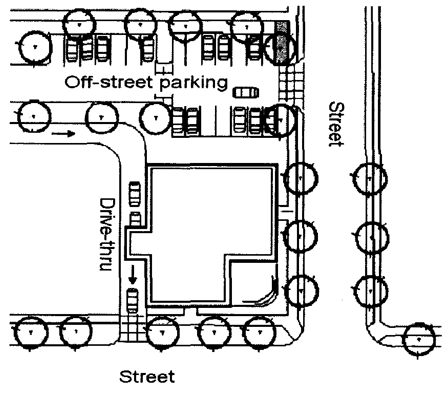
- Adjacent to Residentially Zoned Property. Drive-up/drive-thru windows shall not be located directly adjacent to residentially zoned property. Drive-up/drive-thru windows and their stacking lanes shall be separated from residentially zoned properties by an intervening building (when located on the same side of the street as the drive-thru use) or separated by a major arterial road.
- Stacking (Queuing) Spaces. Stacking lanes shall be provided for all drive-up/drive-thru service windows.
- Minimum Queuing Spaces Required. The following number of queuing spaces shall be provided per lane (these are in addition to the required parking space for each use):
- Drive-thru restaurants: a minimum of nine spaces (five spaces before the order board, three spaces before the pick-up window and one dedicated space beyond the pick-up window for customers waiting for food pick up).
- Financial institutions: a minimum of three spaces in each teller lane.
- Pharmacy: a minimum of two spaces in each lane.
- Dry cleaners: a minimum of two spaces.
- Coffee kiosks: a minimum of three spaces for each service window.
- Thrift shop drop off: a minimum of five spaces for each drop off lane.
- Queuing Design Standards.
- Queuing lanes shall not be allowed to wrap around in front of the main building entrance doors, nor block required back out areas for adjacent parking spaces, unless there is no other alternative for location of the building and drive thru lanes on the site.
- Queuing lanes are strongly discouraged between the building and the street unless there is no other alternative for location of the building and drive-thru lane(s) on the site.
- All drive-thru queuing areas shall also provide a separate escape lane.
- Maximum Queuing Lanes. Queuing lanes shall be limited to a maximum of the following number of lanes per business use (including ATM lanes):
- Drive-thru restaurants: two lanes.
- Financial institutions: six lanes.
- Pharmacy: two lanes.
- Dry cleaners: one lane.
- Coffee kiosks: two lanes (one on each side of the building).
- Thrift shop drop off: three lanes.
- Minimum Queuing Spaces Required. The following number of queuing spaces shall be provided per lane (these are in addition to the required parking space for each use):
- Placement of Building. It is strongly encouraged to place the building adjacent to public streets and to utilize provisions of Chapter 21-14 to enhance the building site. Placement of the building beyond the required setback lines is discouraged and must be specifically approved by the Planning Commission if no other viable alternative exists.
- Speaker Boxes. Speaker boxes designed to communicate from the ordering window/menu board shall not be audible on any residential property adjacent to the business and shall comply with Chapter 13-2.
- Alcohol Restrictions. No restaurant establishment that has a drive-up window will be allowed to have an alcohol license of any kind.
(LDC 2008, § 15A-23-17; Ord. No. 17-09, 3-9-2017)
Amended by Ord. 21-08 § 1(Exh. A) on 3/23/2021
21-23-18 Automotive Service Stations (Includes Stand-Alone Gas Stations And Convenience Stores With Gas Pumps)
- Purpose. The purpose of this section is to mitigate adverse impacts on adjoining streets and properties caused by auto service stations, which are intense uses characterized by large areas of paving which permit vehicles to maneuver freely.
- Site Organization.
- Spatial Relationship. Structures on the site should be spatially related (e.g., buildings should be organized into a simple cluster).
- Driveways.
- Driveway cuts shall be limited and located as far from the intersection as possible and are required to be shared with adjacent uses and/or properties, where possible, to eliminate traffic conflicts at intersections.
- Driveways shall be designed and located to ensure a safe and efficient movement of traffic on and off the site.
- No more than one two-way driveway shall be permitted for any street frontage up to 100 lineal feet.
- No more than two one-way access driveways shall be permitted for any street frontage regardless of lineal feet.
- On-Site Vehicle Storage. Areas in which autos, trailers, etc., are stored as an accessory use must be screened by a wall or opaque fencing to a minimum height of six feet.
- Special Requirements.
- Patron Vehicle Servicing. Areas should be provided on self-service station sites to allow patrons to service their vehicles with air and water. These facilities should be located where they do not obstruct circulation patterns of the site.
- Car Washes.
- Car wash structures will not be permitted within 50 feet of residential developments.
- Automatic car wash facilities should provide areas for vacuuming and drying of vehicles upon exiting the car wash structure. These areas shall be located where they do not obstruct circulation patterns of the site.
- A minimum of eight feet of space shall be provided between the exit of the car wash structure and any cross driveway to allow for sight distance of vehicles in the crossing driveway.
- Pump Island Canopy Design.
- Setbacks. Fuel pump island canopies located at service stations shall be set back a minimum of 20 feet from all front property lines.
- Vehicle Stacking. Each pump island should generally include stacking space for a minimum of two vehicles (total of 40 feet) on-site so that driveways within the site or adjacent street areas are not utilized for waiting customers. Pump island stacking shall not encroach upon required parking space back out areas (24 feet minimum) or two-way driveways for general site circulation (24 feet minimum).
- Lighting. All canopy illumination and lighting directed toward the ground shall be recessed into the canopy.
- Vertical Clearance. There shall be a minimum clearance of 13 1/2 feet to the bottom of the canopy above grade.
- Height. Vertical canopy fascia utilized for signage may not exceed four feet in height, and the height to the top of the vertical fascia may not exceed 20 feet from grade unless otherwise approved by the Planning Commission.
- Architectural Design.
- All building elevations shall follow the Sandy City Architectural Design Standards.
- The length of pump canopies shall be minimized as much as possible. If the site allows, pump canopies shall be broken up into two separate locations. This reduces the effect of pump canopies dominating other buildings on the site.
- Pump island structural columns shall use the same architectural materials as the main building (e.g., stone, brick, etc.), and shall run from ground level to the bottom of the canopy.
- Gas tank vents shall be an integral part of the building design in terms of form, color and texture.
- Speaker Boxes. Speaker boxes designed to communicate from pump islands shall not be audible on any residential property adjacent to the business and shall comply with Chapter 13-2.
(LDC 2008, § 15A-23-18; Ord. No. 10-23, 7-12-2010; Ord. No. 10-42, 12-14-2010)
Amended by Ord. 21-08 § 1(Exh. A) on 3/23/2021
21-23-19 Extended Hours Within 250 Feet Of A Residential District
Any commercial use located within 250 feet of a residential district where such commercial use desires to operate after 10:00 p.m. and/or before 6:00 a.m. shall require a separate conditional use approval from the Planning Commission.
(LDC 2008, § 15A-23-19)
Amended by Ord. 21-08 § 1(Exh. A) on 3/23/2021
21-23-20 Industrial Uses Within 300 Feet Of A Residential District
Any industrial use located within 300 feet of a residential district shall require a separate conditional use approval from the Planning Commission.
(LDC 2008, § 15A-23-20)
Amended by Ord. 21-08 § 1(Exh. A) on 3/23/2021
21-23-21 Additional Specific Nonresidential Development Standards (Standards Unique To Each Individual District)
- Central Business District (CBD).
- Purpose of CBD District. The Central Business District Zone is established to stimulate economic development by providing a unique planning environment for large-scale regional commercial and office development adjacent to Interstate 15. This district encourages creative development and site design for regional commercial and office uses within planned commercial centers which will serve the south valley area.
- Residential and Mixed Use Concept. The concept of residential and mixed use is allowed in the CBD Zone and represents a departure from traditional zoning to the extent that it encourages a combination of land uses which might normally be regarded as incompatible. The inclusion of residential dwellings is allowed on sites of sufficient size to assure adequate site development and a satisfactory and safe residential environment. Where residential uses are included, the objective of the mixed use concept is to create self-contained communities in which residents may walk to work, shopping and recreational facilities.
- Architectural Review. An architectural review committee, as established by joint resolution of the City Council and Mayor, shall review all buildings to be erected in the Central Business District and its subdistricts prior to its submission to the Planning Commission. The committee, in accordance with the Sandy City's Architectural Design Standards, shall review each proposed building's architectural design, colors, and materials. After reviewing the application, the Committee will forward their comments to the Planning Commission. They may also recommend amendments and/or changes to the Development Code for the District to the Planning Commission and City Council and any other design criteria, standards, and guidelines relating to the development of lots within the CBD District area.
- CBD Zone Subdistricts. The zone also establishes subdistricts within the CBD Zone which are described hereafter.
- The Centennial Parkway District (CBD-P) is established as a subdistrict within the CBD Zone to encourage "Main Street" type development along the Centennial Parkway Corridor between 10000 South and the ring road of the South Towne Mall. This district extends east and west of the Parkway right-of-way for approximately 100 feet, excluding CBD-A&C Zone.
- The Office Park District (CBD-O) is established as a subdistrict within the CBD Zone to encourage large scale office use and regional governmental uses. This area is described as follows: The East Jordan Canal on the north; State Street on the east; approximately 1,000 feet north of the ring road of the South Towne Mall on the southeast, and the ring road of the South Towne Mall on the southwest; and Interstate 15 on the west, excluding the Centennial Parkway District and the CBD-A&C District.
- The Arts and Culture District (CBD-A&C) is established as a subdistrict within the CBD Zone to create an environment wherein arts, cultural and recreational uses may be integrated into mixed use developments using standards which are designed to be pedestrian-friendly. Those parcels within the zone are designated as such on the zoning map.
- Procedures for Development in CBD, CBD-O, CBD-P, and CBD-A&C Districts.
- The Planning Commission will review all development proposals in the CBD, CBD-O, CBD-P, and CBD-A&C Districts.
- Prior to the Planning Commission taking action, plans must be submitted in accordance with this title.
- A master site plan shall be submitted and reviewed by the Planning Commission, showing all phases of the development. Once the master site plan has been reviewed by the Planning Commission, all developments shall comply with the site plan requirements as required by this title.
- Land Coverage.
- Lot coverage by buildings and covered or semi-enclosed outbuildings shall not exceed 40 percent.
- Coverage for both buildings and paved areas (parking, loading and circulation) shall not exceed 90 percent, thereby reserving a minimum of ten percent for landscaped areas after completion of any future expansion.
- Existing developments may expand only to the extent of the coverage limits above. If such existing developments currently exceed the above coverage limits, expansion shall not occur.
- Properties within the Centennial Parkway and Arts and Culture Subdistricts are exempt from the limitations imposed by these percentages, but shall conform to the standards listed hereafter.
- Residential Uses. The following shall apply to residential development:
- A minimum area equal to or greater than 15 percent of the gross living area of a residential use shall be provided as common residential recreation space. This requirement may be accomplished with indoor or outdoor facilities such as usable roof tops, atriums, covered or outdoor swimming pools, walking trails, green spaces, plazas, and other areas determined by the Director to be common residential recreation space. This space provided need not be limited exclusively for these residents.
- The physical separation of pedestrian and vehicular traffic is encouraged.
- In the CBD-P Subdistrict, the residential use shall be limited to the second story or higher and must be located within a mixed use project. The first (or primary) story shall be utilized for commercial activity.
- In the CBD-P and A&C Subdistricts, the density of the project shall be reviewed and approved by the Planning Commission, and shall be based on such factors as compatibility with surrounding area, availability of a parking structure (required for residential use), and proposed amenities.
- Architectural Design and Materials. All uses, including mixed use and residential, shall comply with the Sandy City Architectural Design Standards for Commercial, Office, Institutional, and Industrial Developments.
- Basic materials shall be "Mountain Red" brick or a similar high quality material, such as polished granite, glass, stone, etc.
- Color of exterior building materials shall be composed of colors that encourage buildings to blend into the environment. Generally, they shall be limited to no more than three major colors per development. If glass surfaces are to be tinted, such tinted glass shall be considered as one of the colors allowed and shall conform to the color requirements included herein.
- Plans for the exterior modifications to any existing structures must be submitted to the Planning Commission for approval and must meet the same requirements as all other structures within the CBD Zone.
- Public Art. Some public art is required and can be utilized to promote a sense of community identity and is required to be integrated into building and site designs. Murals, statuary, and building elements can be used to reflect local cultural and ethnic interests and add a unique element to public spaces within the development.
- Landscaping. Landscaping guidelines are established to maintain the site qualities that exist in the CBD Zone area and minimize alteration, removal, or degradation of landscaping that currently exists in the area. The following requirements are in addition to those regulations in the landscaping requirements of this title:
- No plans for any building, structure or other improvements shall be approved by the Planning Commission unless there shall also have been submitted separate landscape plans satisfactory to the Planning Commission.
- The land area not occupied by buildings, structures, hard surfacing, vehicular driveways or pedestrian walkways shall be kept in a weed-free condition or landscaped, as approved by the Planning Commission.
- Plant Materials.
- Sixty percent medium trees and shrubs in a combination with deciduous trees with a caliper from two to three inches and evergreen trees with a height from five to eight feet.
- Forty percent small trees and shrubs in a combination with deciduous trees with a caliper of one and one-half to two inches and evergreen trees with a height of four feet.
- Where possible, a 50/50 mix of deciduous and evergreen tree species shall be used for on-site landscaping.
- Street trees with a minimum two-inch caliper shall be installed along all public rights-of-way by the developer of the property. The species-type, location, and spacing of trees shall be as shown on the approved Landscape Plan, in compliance with designated streets within the City's Streetscape Plan.
- For streets not specified in the Plan, the following trees may be used as part of an approved Landscape Plan:
Bur Oak
(Quercus macrocarpa)
Hedge Maple
(Acer campestre)
Little Leaf Linden
(Tilia cordata 'Greenspire')
(Tilia cordata 'Rancho')London Plane
(Platanus acerifolia)
Norway Maple
(Acer platanoides 'Cleveland')
(Acer platanoides 'Columnare')
(Acer platanoides 'Emerald Queen')
(Acer platanoides 'Schwedleri')
(Acer platanoides 'Deborah')(Improved Schwedleri)
Red Maple
(Acer rubrum 'October Glory')
(Acer rubrum 'Red Sunset')Red Oak
(Quercus rubrum)
Redmond Linden
(Tilia euchlora 'Redmond')
Sycamore Maple
(Acer pseudoplatanus)
- For planted medians, and accent trees, both on-site and at intersections, the following trees may be used:
Bechtel Crab Malus ioensis 'Klehms Improved') Bradford Pear (Pyrus calleryana 'Bradford') Crimson King Maple (Acer platanoides 'Crimson King')
(Acer platanoides 'Royal Red')Flowering Plum (Prunus cerasifera 'Blireiana') Kwanzan Cherry (Prunus serrulata 'Kwanzan') Washington Hawthorn (Crataegus phaenopyrum)
- Buffers, Fences, and Walls.
- The intent in having special buffer, fence, and wall requirements is to provide quality separation between incompatible commercial uses, and to provide physical and visual protection between commercial and residential uses.
- Landscape buffers are preferred rather than fences and walls where a separation is desirable. A visually open look should be encouraged between similar uses. Visual screening is often more important than a physical separation and the Planning Commission may, at its own option, require special treatment of such areas.
- Buffer treatment may be required whenever a change occurs between residential and nonresidential uses. Additional landscaping and screening may be required at the discretion of the Planning Commission within the setback which separates the uses. Fences or walls will be reviewed for their effectiveness in screening a view, and for their color and texture in relationship to building materials.
- Where differing uses are to be developed adjacent to existing residential areas, special consideration shall be made to protect the privacy of residents and requirements shall be the discretion of the Planning Commission. As a minimum, the negative effects of noise and artificial lighting shall be minimized to protect existing residents.
- Exterior lighting shall be shielded and directed in such a manner as to prevent unnecessary direct light glare on residential units and adjoining properties. Facilities that produce late night customers or activities shall address possible disruption of privacy for residential areas. Items that may be considered adequate include, but are not limited to, location, buffering, screening, lighting, and hours of operation.
- Surface and Parking Terrace Areas. Because surface parking areas present a three-dimensional appearance when occupied, they shall comply with the following:
- Location of parking shall be determined not only from its visual relationship to building and site, but also as it relates to safe, convenient pedestrian and vehicular circulation patterns. The placing of building and parking elements on a site shall be evaluated by the Planning Commission on the basis of the following factors:
- Type of land use and structure.
- Building height and configuration.
- Relationship to other buildings, both horizontally and vertically.
- Natural land features such as slopes and vegetation.
- Physical features such as rail lines, canals, and controlled ingress and egress.
- Visibility from vehicular approaches and distant highways.
- Parking shall not occur adjacent to any public street or the freeway except when:
- It has been established that such a location is needed or justified by other site conditions or building entrance orientation.
- The use is restricted to visitors and/or key employees.
- Parking is 80 percent screened by fencing, walls, and/or landscaping from the highway or street by either depressing the paved areas or using elevated landscape berms.
- A minimum of ten feet of landscaped screening consisting of mixed evergreen and deciduous trees must be provided adjacent to public streets and the freeway. The number of trees for this area shall be determined by a standard of one tree per every 200 square feet of landscaping required.
- Surface parking (permanent or temporary) may be allowed in addition to a parking structure upon the approval of the Planning Commission where it can be shown that the Phasing Plan, size and scope of the project would require some surface parking (e.g., stand-alone restaurant, bank, etc.).
- Parking terraces and underground parking is strongly encouraged and shall be required for hotel development of six stories or more and all other buildings over three stories. The parking terrace may be constructed in subsequent phases as a condition of approval with the first phase. If the parking structure required for the first phase is to be postponed to a subsequent phase, the conditions of approval shall be recorded as a deed restriction upon the property and shall be recorded with the Salt Lake County Recorder's Office.
- When an interior road is required by Sandy City and is designed so that on-street parking may be accommodated, a pro-rated share of such may be used to satisfy overall parking requirements. Parallel or angle parking may be approved based upon the overall design and width of the street, as recommended by the City Transportation Engineer and approved by the Planning Commission.
- Location of parking shall be determined not only from its visual relationship to building and site, but also as it relates to safe, convenient pedestrian and vehicular circulation patterns. The placing of building and parking elements on a site shall be evaluated by the Planning Commission on the basis of the following factors:
- Uses and Standards Unique to the Centennial Parkway District (CBD-P).
- Building Setbacks. In order to encourage a "Main Street" effect along the parkway, buildings shall maintain a zero lot line front setback from the approved sidewalk and streetscape profile of Centennial Parkway and 10000 South Street. Buildings that originate within the CDB-P Zone with a zero lot line front setback may continue that setback for the length of the building into the CBD Zone. This reduced setback does not apply to other non-contiguous structures within the development. Front setback variations may be used when an activity related to pedestrian use is maintained (i.e., outside seating for restaurant).
- Building Height.
- The height of buildings shall be limited to one- to three-story structures within the front 30 feet of the 100-foot depth of the subdistrict on both sides of Centennial Parkway. The Planning Commission may consider and approve variations to the maximum height requirements for structures within the front 30 feet. Such items to consider include architectural design, main street theme, etc. Structures extending beyond the front 30 feet may be stepped up to a maximum ten stories.
- The Planning Commission may approve a building permit taller than 140 feet, or more than ten stories, not to exceed 20 stories, after considering the following factors:
- Overall Master Plan layout of the project, which may include the size, scale, location, and topography of the property.
- Relationship and impact to other buildings on-site and adjoining properties.
- Unique architectural design.
- Architectural Design. In addition to the Sandy City Architectural Design Standards, the following requirements shall apply to new developments:
- The use of exposed concrete (architectural concrete excepted), metal, or plastic for storefront facades is not permitted. However, the use of brass, copper, or aluminum is permitted for decorative trim.
- Buildings shall conform to a structural module of 30 feet horizontal and 15 feet vertical.
- Window shapes and sizes shall be so designed to be compatible from building to building and shall comprise at least 50 percent of the street elevation.
- 4. Windows with reflective film or glass are not permitted at street level.
- Walkways, Courtyards, Plazas.
- Materials for walks, courtyards, and plazas shall be related to the materials of adjacent buildings and shall be a non-skid finish. Design shall encourage comfortable and safe pedestrian use, including landscaping, seating areas, and lighting, as appropriate.
- Two mid-block connections must be developed between 10000 South and the mall ring road. These connections may be developed as walkways or a combination walkway and vehicular lane. Additional walkways between buildings may be required as needed for proper pedestrian access from parking areas to storefronts.
- Signage. Signing within the Centennial Parkway Subdistrict shall be limited to cabinet or pan channel wall signs, and awning signs in compliance with Chapter 21-26. Low-profile (monument) signs may be permitted with the following limitations: the sign shall have as the prominent feature the name of the building (i.e., "Aetna Plaza," "One Sandy Center," etc.). All other lettering shall be no taller than four inches in height. The maximum height of the sign shall be four feet for the portion containing general copy, and overall height of six feet above sidewalk grade. It is intended that the top two feet be utilized to identify the name of the building. The sign shall not be located upon the public right-of-way. It may not extend into the required sight visibility triangle, unless otherwise approved by the City Transportation Engineer. The lettering font style for tenant identification shall be the same for all tenants. The materials for the sign shall be similar to that of the main building.
- Uses and Standards Unique to the Office Park District (CBD-O).
- Building Height.
- Minimum Height. Buildings shall be at least four stories in height, except as permitted below.
- Maximum Height. Buildings shall be no taller than 140 feet in height, west of State Street.
- Exceptions to Building Height.
- Structures adjacent to State Street shall be two to three stories within 100 feet of the street with an increase of two stories for each additional 30-foot setback up to a maximum of ten stories.
- Ancillary buildings, as may be approved by the Planning Commission, may be one story tall, provided the structure is built concurrently with the remaining project building.
- Structures within the Government Center Block (those properties bounded on the north and east by Civic Center Drive, on the west by Monroe Street and on the south by Sego Lily Drive) may be built to a minimum of two stories. Any structures south of City Hall shall be a maximum of two stories.
- The Planning Commission may approve a building taller than 140 feet, or more than ten stories, not to exceed 20 stories, after considering the following factors:
- Overall Master Plan layout of the project, which may include the size, scale, location, and topography of the property.
- Relationship and impact to other buildings on-site and adjoining properties.
- Unique architectural design.
- Building Height.
- Uses and Standards Unique to the Arts and Culture District (CBD-A&C).
- Application. In order to zone a parcel to the CBD-A&C Zoning District, a complete zoning application shall be submitted. The application shall include a Conceptual Master Plan that will be reviewed by both the Planning Commission and City Council in making a recommendation/determination as to the appropriateness of the zone for the parcel. The Conceptual Master Plan shall show all phases of the proposed development (including any phasing plans).
- Planning Commission Review. After a property has been zoned CBD-A&C, the Planning Commission shall review each project and each building within the project area to evaluate its impact on the neighborhood, the zone district, and the region. Review shall include the proposed setbacks, lot coverage, building height, building design and materials. The Planning Commission may approve setbacks, increased lot coverage and/or increased building height from those allowed in the CBD zone if the project includes each of the following:
- Building Setbacks.
- Front Setbacks. Front setbacks of buildings shall maintain a zero-foot setback from the approved sidewalk and streetscape profile. Variations shall be required for building articulation and when an activity is related to pedestrian use (e.g., outside seating for restaurant, pedestrian walking areas, residential courtyards, etc.). A maximum setback of ten feet is allowed for residential courtyards.
- Side and Rear Setbacks. A zero-foot setback may be approved by the Planning Commission for all other lot lines.
- Lot Coverage. The Planning Commission may approve building coverage up to a maximum of 90 percent, if the project includes the following:
- At ground level, interconnecting pedestrian walkways (minimum five feet wide) shall be constructed of alternative hardscape materials which include colored and stamped concrete, pavers, etc. Additional areas of landscaping, street furniture, etc., shall be provided along the walkways; and
- At ground level or above, a combination of at least three diversification elements of the following shall be included: courtyards, plazas, walkways, open green space, water features, planters, statuary.
- Private Street Improvements. All private streets shall be constructed to City standards, including curb, gutter, sidewalk, and asphalt.
- Building Articulation. At a minimum, the first level shall have architectural articulation separate from the above stories to create a human scale to the walking environment. The following requirements shall also be incorporated into the building design:
- Storefront Width. Buildings shall conform to a structural module of 30 feet horizontal and 15 feet vertical.
- Proportion of Openings. Storefronts should maintain a high ratio of windows to walls at the street level to create interest for pedestrians. Windows and doors shall comprise at least 70 percent of the first floor facade and at least 40 percent of the upper floor facades.
- Entries. The main entry to a building leading to a lobby, stair, or central corridor shall be emphasized at the street. The entry should include architectural enhancements, such as a change in materials, decorative fixtures, special paving, or other treatments that announce a point of arrival.
- Corner Buildings. Corner buildings shall provide a prominent corner entrance to street level shops or lobby space in a manner consistent with main entries as described above.
- Approval of Increased Building Height. The Planning Commission may approve buildings over 140 feet in height, up to a maximum of 600 feet. In addition to the maximum building height, parapets, roof-mounted mechanical, and other architectural features that are incorporated into the buildings to meet LEED standards may be approved above the maximum building height if they are designed to meet the Sandy City Architectural Design Standards.
- Building Articulation. Buildings shall be articulated horizontally to differentiate between levels and create an identifiable base, middle, and top. The "Main Street" level may be considered the base of the building.
- First Phase of Development. The first phase of the development shall contain at least three different land uses from among the following: residential, office, a group of retail shops, health spa, theater, public/private or quasi-public schools, hotel, business or financial service, restaurant etc. The overall Master Plan shall have at least four different land uses.
- 24 Hour Occupancy. At least one of the project buildings shall include a hotel or residential component.
- Pedestrian Walkways. There shall be at least one main pedestrian thoroughfare which is strictly for pedestrian traffic (e.g., elevated art walk, promenade, walkway, etc.).
- Parking.
- Temporary Surface Off-Street Parking. For phased developments, off street temporary surface parking may be permitted adjacent to the right-of-way for a period no longer than five years. There shall be a 15-foot minimum landscape buffer between all surface parking lots and the right-of-way.
- Parking Stall Dimensions. The minimum parking stall depth shall be 18 feet.
- Architectural Design. Building structures within the same project shall conform to an approved overall architectural theme in order to set the Arts and Culture Subdistrict of the Central Business District street frontages and skyline apart from other portions of the CBD Zone. Developments should be innovative and unique in architectural design, while enhancing the visual appearance of Sandy City and promoting a sense of community. These standards are intended to promote the design of an urban environment that is built to a human scale at the street level, to encourage creativity in new developments (as opposed to homogeneity or look-alike developments), and to foster attractive street fronts and pedestrian environments, while accommodating vehicular movement and access.
- CPTED (Crime Prevention Through Environmental Design) Principles. The developer is required to consider the basic principles of CPTED when designing the site plan, Landscape Plan, and architectural design for a project. The following principles should be taken into account in the design of all buildings and developments:
- Natural Surveillance. Physical design which keeps potential intruders under the perception of continual watch, using "eyes on the street" (e.g., view to streets, driveways, and parking lots) and visual permeability in architecture, lighting, and landscaping.
- Natural Access Control. Physical design which guides the mobility of people and which decreases crime opportunity and increases perception of risk to potential offenders.
- Territorial Reinforcement. Physical design which encourages users of property to develop ownership over it, developing space with an easily discernable purpose, using symbolic barriers such as low lying fences/walls, landscaping and signage, eliminating ambiguous spaces, encouraging easy maintenance, and discouraging crime.
- Management and Maintenance. Responsibility for managing and maintaining the property. Show that someone cares about seeing that the property is in a presentable appearance and is secure for the customers that use the facility.
- CPTED Landscaping Standards. These should be used including planting shrubs with a maximum height of two to three feet and trees with a proper ground clearance of seven feet above walkways and sidewalks and 14 feet above vehicular travel and parking lanes. This shall be accomplished through proper pruning practices, not by clear cutting, topping trees or other pruning for exposure techniques.
- Public Safety. In order to encourage public safety through natural surveillance, natural access control, and territorial reinforcement, solid windowless walls are not permitted adjacent to streets, pedestrian areas, and open space amenities.
- Building Setbacks.
- Automall (AM)—Dealership Subdistrict and Commercial Area Subdistrict. The Sandy Automall Development Master Plan (the Master Plan) for the Automall (AM) District was adopted by the Sandy City Council in 1992 and amended in 2015, to assist owners and designers by setting out general design criteria, guidelines, and concepts which must be adhered to. The Master Plan also illustrates design ideas for the developer and City to use in interpreting the intent of the Master Plan when reviewing each individual project. Owners and designers should, therefore, also refer to the Automall Master Plan for these requirements. The goal of the Master Plan is to ensure development of a consistently high quality planned environment, thus protecting and enhancing the investment of all those locating within the Automall development area. The Automall (AM) District does not supersede any federal, state or local codes, ordinances, or requirements. The most restrictive requirements of such laws and the Automall (AM) District shall be applied to new and existing developments.
- Automall Architectural Review. Each site development plan proposed in the Automall District and its subdistricts, prior to its submission to the Planning Commission, shall be reviewed by staff for compliance with the Automall Master Plan and in accordance with the Sandy City's Architectural Design Standards.
- Extent of the Automall (AM) District. The requirements of the Automall District shall apply to all properties within the boundaries of the Master Plan. Such area is defined by a northern boundary of the center of 10600 South Street, an eastern boundary of the center of State Street, a southern boundary of the center of 11000 South Street, and a western boundary of Interstate Highway 15.
- Areas Within the AM (Automall) District. There are two areas within the Automall District (see diagram below):
- An auto dealership area for dealerships and their accessory uses; and
- A commercial area.
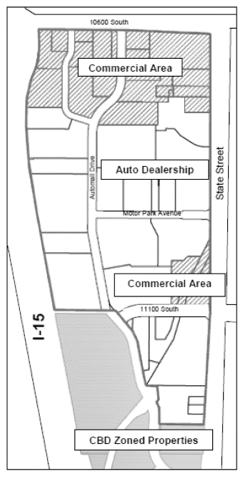
- Compliance with Code Requirements. All new developments within each of the two areas shall meet all requirements of the specific area as set forth in the Automall District, all applicable provisions of the Master Plan, and the Sandy City Architectural Design Standards.
- Areas Within the AM (Automall) District. There are two areas within the Automall District (see diagram below):
- General Development Standards and Exceptions for Automall District. All provisions of Chapter 21-23 shall apply, with the following exceptions:
- Land Coverage. The principles of CPTED (natural surveillance, natural access control, territorial reinforcement, management and maintenance, landscaping standards, and public safety) must be considered when designing the site plan, Landscape Plan, and architectural design for a project.
- Utilities. Owners may be required to grant easements for underground utility services and/or may be required to install storm drainage or other common utility systems upon their property in accordance with the Master Plan when good engineering design and the needs of the properties within the Automall District so dictate.
- Architectural Design and Materials. The treatment of building mass, materials, and exterior appurtenances shall create an aesthetically pleasing building and site that is in character with the proportions of other surrounding developments. Architectural character and design must also be consistent with the guidelines that are contained within the Master Plan. Requirements applicable to all buildings are as follows:
- All drive approaches, sidewalks, curbs, parking lot areas, exterior display pedestals, and other improvements along the street and freeway frontages shall be constructed in conformance with the details, finishes, sizes, materials, and patterns dictated by the Master Plan.
- Plans for the exterior modifications to any existing structures must be submitted as set forth above for architectural review and comments.
- Buffers, Fences, and Walls.
- Special buffers, fences, and walls may be required to provide quality separations between public/commercial areas, service, loading, refuse collection, equipment, and storage areas.
- Fences or walls will be reviewed for their compatibility and conformance to the Master Plan and their location and effectiveness in screening a view and for their color and texture in relationship to building materials and adjoining properties.
- The Planning Commission may require additional setback to those found in further sections of this title if it is found that site characteristics so demand. In such case, the placement of buildings and parking elements on a site shall be evaluated by the Planning Commission on the basis of the following factors:
- Relationship to other buildings, both horizontally and vertically.
- Physical and natural land features such as slopes, canals, or trees.
- Ingress and egress.
- Visibility from vehicular approaches and distant highways.
- Type and use of structure.
- Building height.
- Parking and Service Area. Off-street parking must be provided to reasonably accommodate all anticipated customers, employees, and display vehicles. Curb side parking on public streets within the Automall will only be permitted in areas especially designed and designated for such use in accordance with the Master Plan. Where curb side parking is permitted, this parking shall be reserved for customer use only.
- Site Lighting Guidelines. Exterior wall-mounted floodlights are expressly prohibited in the front and side car display areas visible from public streets and Interstate 15. Wall-mounted floodlights may be allowed for storage areas behind buildings where not visible. Parking lot, pole-mounted fixtures shall be of a uniform type as designated by the Master Plan. Intensities shall be controlled to maintain uniformity throughout the Automall area. Design and location of standards and fixtures shall be specified on the site development drawings.
- Street Lights Within Public Right-of-Way. Owners will be required to install street lights. All street lights shall be designed and installed as required by the Sandy City Street Light Ordinance and the Automall Master Plan. If proposed site improvements conflict with the location of existing street lights, the owner shall be responsible for the relocation of the street lights.
- Neon Lighting. Neon lighting may be permitted on a very limited basis and be reviewed by the Planning Commission for appropriateness on each individual project.
- Wrecked or Damaged Vehicle Parking. Parking of wrecked or damaged vehicles is not permitted except for those vehicles being serviced on-site immediately. Such parking areas shall be visually screened from public streets, Interstate 15, and adjacent properties by an opaque screen wall a minimum of six feet high.
- General Landscaping.
- The purpose of landscaping guidelines is to maintain the site qualities that exist within the Automall area and to minimize alteration, removal, or degradation of landscaping that currently exists.
- Separate Landscape and Irrigation Plans shall be submitted, together with buildings, structures and other improvements for architectural review as set forth above. Landscaping and irrigations systems in accordance with approved plans must be installed prior to occupancy of the site or as otherwise approved by the Community Development Department as seasonal conditions may dictate. All landscaping and irrigation systems shall comply with Section 21-25-4 contained elsewhere in the title.
- The land area not occupied by buildings, structures, hard surfacing, vehicular driveways or pedestrian walkways shall be landscaped as approved by the Planning Commission, except for approved areas specifically designated for future development.
- Landscaping Within the Public Rights-of-Way. Street trees, landscaping and irrigation systems shall be installed and maintained in the parkstrip areas along all public rights-of-way by the owner of the property. The species, location, and spacing of trees shall be as shown on the street development standard drawings contained within the Master Plan.
- On-Site Landscaping.
- Materials. The site shall be landscaped with trees, shrubs, ground cover, and/or turf. Trees, shrubs, and ground cover materials shall be selected from the palette of planting materials designated in the Master Plan.
- Trees. A variety of trees are required, as follows:
- Trees are not required in display landscape areas.
- Trees are required to be planted in landscape areas adjacent to buildings, at a minimum of one tree for every 30 feet of building perimeter that is directly adjacent to a landscape area. Trees may be located in groups as addressed in the Master Plan.
- Front Landscape and Display Setback. The design of the setback will include display area for displaying vehicles. It will also include a landscape treatment that reflects "mountain meets urban" theme. (See Typical Front Landscape and Display Setback Illustration in the Master Plan.)
- Landscaped Feature Areas. Landscaped feature areas shall be provided in areas designated by the City. The design contours, location, type, spacing of trees, sidewalks, benches, sculptures, fountains, or other amenities within such feature areas shall be in accordance with standard drawings contained within the Master Plan. Landscape feature areas may be converted to vehicle display areas, in accordance with the Master Plan.
- Street Improvements Within the Public Rights-of-Way.
- Improvements Required to be Provided at Time of Development. All public improvements are required to be provided by the developer at the time of development in accordance with the Development Master Plan. Existing street improvements shall not be removed, altered, or modified without the approval by Sandy City.
- Sidewalk. Sidewalks along State Street and 10600 South shall follow the eight-foot design already established on existing developments in the area.
- Development Standards for Automotive Dealerships Only. The following development standards shall apply to automotive dealerships only and are in addition to the general standards and exceptions listed above:
- Building Mass. Proximity to adjacent structures and walls may dictate height requirements to create a gradual transition between high and low elements.
- Parking/Vehicle Storage.
- Customer Parking. Each lot shall provide designated customer parking in the amount of a minimum of no less than six off-street parking spaces. Customer spaces shall be clearly marked and designated and shall be located between the street and any rear lot or service areas. Additional spaces may be required if industry standards so require for the size and type of dealership.
- Employee Parking. Employee parking shall be located off street in designated parking areas. It is the intent that employee parking spaces not be visible from a public street. The quantity required shall be equal to the maximum number of employees on any given shift.
- Service Area Parking. Sufficient service area parking spaces to accommodate anticipated parking needs of vehicles being repaired or serviced shall be provided, but in no case shall there be less than one space per service bay. Designated spaces shall be marked and reserved for service parking.
- Access and Internal Circulation.
- Driveway Access. Shared driveways shall be a minimum of 25 feet and a maximum of 36 feet wide. Other driveways shall be a minimum of 25 feet and a maximum of 32 feet wide. All drives to have 12 1/2-foot radius. A maximum of two driveways (one shared and one private) will be permitted per lot unless total street frontage of an individual lot exceeds 400 feet (see Typical Lot Development Plan-Access and Circulation Illustration in Development Master Plan).
- Service Area Access. Service write up areas must have sufficient stacking lanes on-site to stack a minimum of one vehicle per service bay. Stacking lanes shall not block flow of traffic to or from other areas of the dealership.
- Reciprocal Access. Reciprocal access between dealership properties is encouraged in order to eliminate additional driveways.
- Fences, Screens, and Walls.
- Fences, screens, and walls shall be compatible and architecturally complementary between two adjoining sites. This may be achieved by use of similar materials and finishes to the building, landscaping materials, or other architectural design features.
- Fences shall extend from the side wall of the building and be designed as an integral compatible element with the building facade. Location of fences shall be compatible with adjoining property users to permit the common use of gates and accesses.
- Fences and walls between adjoining automobile dealership properties generally are not permitted. No chainlink or plain concrete block fences are permitted except where not visible from public streets or outdoor sales and display parking areas.
- Primeter walls and fences are generally not permitted or required except where dealerships are adjoining commercial areas of the Automall.
- Display Pedestals. The quantity, spacing, location, shape, size, design, and materials shall be in accordance with the Master Plan.
- New and Used Car Display. Car displays, arrangement of parking spaces, and circulation shall be at the dealer's option. However, coordination with and compatibility to display area on adjoining properties must be considered. All vehicles in designated display areas must be properly prepared, cleaned, and ready for sale. No car display shall block minimum required driveways or those driveways shown in the approved site plan.
- Display Vehicle Security. To the extent deemed necessary by individual dealers, curb walls (no higher than 16 inches), closely spaced concrete bollards, boulders/cairns/rocks, berms, low security fencing and rails may be used. Design must be compatible with project theme and architectural detailing in other parts of the site as addressed in Master Plan.
- Landscaping and Display Areas.
- Landscaping shall consist of different varieties of shrubs, flowers, trees, and other planted material in accordance with the Master Plan.
- All revisions to the existing landscape areas shall incorporate water efficient landscape materials.
- Landscaping Adjoining Rights-of-Way.
- Landscaped areas shall be a combination of gravel, mulch, ground covers, low shrubs, and flowers. (Select materials from palettes provided in the landscaping section of the Automall Master Plan.)
- A minimum of 20 feet depth of landscaping and display will be required along all public rights-of-way.
- Building Landscaping.
- Landscaping shall be maintained at the base of all buildings and decorative fences on elevations facing any public right-of-way or as otherwise approved by the Planning Commission.
- A minimum of eight square feet of landscaping per lineal foot of street frontage shall be required at the base of buildings or within the site area.
- Where used, landscaping shall be a minimum of five feet wide at the base of buildings and decorative walls on elevations facing public rights-of-way and must be landscaped with a combination of shrubs, flowers, lawn, and other planted materials.
- Landscaping at the base of raised showrooms may be sloped. Shrubs that have an initial height of approximately two feet may be placed to cover the base of the building.
- Rear and Side Property Line Landscaping.
- Landscaping at the side yards or rear yard may be eliminated if the area is not visible from public rights-of-way, or if the yard area is used in conjunction with an adjoining property for common driveways and/or parking. However, a minimum of ten feet of landscaped area will be required on all side yards adjoining commercial areas.
- Landscaping or other barriers between adjoining dealership properties in the front sales and display areas are prohibited unless otherwise approved by the Planning Commission.
- Architectural Design and Materials.
- Retail Showrooms. All buildings and retails showrooms shall be designed to be consistent with the Master Plan. A variety of architectural schemes, finish materials, and colors is required.
- Showroom Windows. It is the intent that building showrooms be designed to maximize exposure facing the street. Accordingly, fronts should be primarily glass with ceiling heights encouraged to be no less than 12 feet.
- Materials. Building materials shall be selected which require low maintenance. Unpainted, plain concrete walls are prohibited. Roofs shall not be exposed unless they are part of the decorative or architectural treatment of the building.
- Site Lighting. Dealerships are allowed to use a variety of poles and fixtures in order to achieve a unique lighting plan. However, in order to create a lighting color that is harmonious throughout the area, energy efficient lighting shall be incorporated and the luminaries shall be similar throughout the dealerships (e.g., 5000K luminaries). The Automall Dealers Association shall review any proposed changes to on-site lighting.
- Additional Development Standards for Automotive Dealerships Adjacent to Interstate 15. The following development standards shall apply to automotive dealerships adjacent to I-15 only and are in addition to the general standards and exceptions listed above:
- Site or Property Landscaping. A five-foot minimum landscape strip shall be required along the Interstate 15 right-of-way. Such area shall be planted with shrubs, ground covers, and other landscape elements in accordance with the Development Master Plan.
- Architectural Design and Materials. The design finishes and materials of all building sides facing Interstate 15 shall be of the same type and quality as that used for other building facades.
- Additional Development Standards for Applicable to Commercial Developments Only. The following development standards shall apply to commercial developments only and are in addition to the general standards and exceptions listed above:
- Location. The location of all commercial areas are designated in this title.
- Automobile Service and Repair Facilities. Overnight parking areas shall be screened from adjacent commercial and dealership front display areas.
- Access and Internal Circulation.
- Access Locations. Private access shall be located no closer than 20 feet from the edge of the driveway to a common property line unless shared with an adjacent driveway.
- Internal Circulation. Cross easements shall be required to permit perpetual use of common drives, parking areas, and service areas at no cost to the adjacent property owner, unless it can be demonstrated that significant cost will be incurred.
- Fences, Screens, and Walls.
- Fences, Screens, and Walls Prohibited. Fences, screens, and walls between properties are prohibited unless otherwise required by this title.
- Materials. When required, fences shall consist of decorative masonry and/or pre-cast concrete and be of a design, style, and finish to be compatible to the building. Wood, iron, and masonry decorative elements may be utilized. Chainlink, vinyl, or plain CMU concrete block walls are prohibited.
- Freeway Fences. Fences along Interstate 15 shall match the general design, style, and spacing as provided throughout the overall freeway fence design. (See Freeway Fence Illustration in the Development Master Plan.)
- Landscaping. In front yard areas, landscape shall consist of a minimum of 20 feet of landscaping adjacent to the right-of-way unless otherwise approved by the Planning Commission using Chapter 21-14.
- Architectural Design and Materials. Building materials shall be selected which require low maintenance. Unpainted, plain concrete walls are prohibited. Roofs shall not be exposed unless they are part of the decorative or architectural treatment of the building.
- Site Lighting. All parking areas shall be uniformly lit with pole lights of uniform type, height, and intensity according to the Development Master Plan.
- Hardscape Standards. All hardscape design for driveways, sidewalks, etc., shall comply with all provisions of the palette materials and layout listed in the Automall Development Master Plan.
- Signs. All signs shall comply with Chapter 21-26 with the following exceptions:
- General Standards. The following criteria shall govern the construction, placement, and type of all signs within the Automall development area:
- Location of all ground-mounted signs, except directional signs, shall be a minimum of three feet from front property lines and ten feet from edge of driveways, or as may be required by the City Transportation Engineer for traffic safety and visibility.
- No exposed raceways, ballast boxes, transformers, or conduits are permitted.
- Signs shall be internally illuminated.
- No flat-faced box or cabinet type sign with painted copy shall be permitted.
- Businesses fronting 10600 South, State Street, Motor Park Avenue, Holiday Park Drive, and 11000 South shall be allowed monument signs only. In addition, no freestanding signs, off-premises signs or billboards shall be permitted on any parcel within the Automall District with the exception of the one freestanding "South Towne Automall" identification sign for the entire Automall District along the Interstate 15 freeway frontage and the entrance identification signs listed in Subsection (b)(8)b.2 of this section.
- All proposed signs that meet the criteria set forth in this title shall be approved by the Planning staff.
- Identification Signs for the Automall Area. Off-premises signs shall not be allowed except for the following:
- Freeway Identification.
- One freestanding freeway identification pylon sign to identify the Automall will be permitted. The size and height of the freeway identification sign shall be reviewed as part of the architectural review process set forth above and approved by the Planning Commission.
- The freeway identification sign may include a lighted reader board or other form of moving display on which advertising of community events and Automall promotional activities may be shown. No dealer logos, names, or vehicle type identifications will be permitted except as may be used within the lighted reader board in conjunction with Automall advertisements.
- Entrance Signs. Four freestanding signs to identify the entrances to the Automall will be permitted at the entrances located at 10600 South, Auto Mall Drive, State Street and Motor Park Ave, 11000 South and State Street, and approximately 10760 South and State Street. Size and height of entrance signs shall be reviewed as part of the architectural review process set forth above and approved by the Planning Commission. No dealerships' logos, names, or vehicle type identifications permitted.
- Street Light Banners. Banners promoting the Automall will be permitted to be hung on street lights within the Automall District. These signs should be uniformly 30 inches by 60 inches. These should not promote individual dealerships, but may promote Automall-wide events or promotions, at the discretion of the Automall Dealers Association. No banner shall be attached to any City light poles except by the City Department of Public Works.
- Interior Light Banners. Individual dealerships may install banners on light poles within their property boundaries. These banners should be used to promote their dealership and brand. They should not be used to advertise events or promotions. Individual owners are responsible for installation of banners on their own property. Banners should be uniformly 24 inches by 48 inches.
- Freestanding Signs. No additional freestanding signs for commercial businesses or auto dealerships will be permitted.
- Freeway Identification.
- Street Identification/Monument Signs.
- Location. The signs must be located within the required front landscape setback area. No signs shall be closer than 75 feet from a common lot line, and a minimum of 35 feet from a landscape feature area. The location and spacing shall be subject to approval by the Planning staff.
- Quantity. One sign per site, per interior street frontage will be allowed. An exception would be that additional signs may be permitted in special cases for auto dealerships having multiple dealerships upon the same site. These signs shall be separated by a minimum of 100 feet between signs.
- Copy. Copy is encouraged to emphasize the manufacturer's brand with the dealer's name being secondary to the brand name.
- Size.
- Overall dimension of sign faces shall fit within the areas of seven feet, six inches high by eight feet wide or six feet high by ten feet wide. Maximum height above street curb shall not exceed a total of nine feet, including sign area, support base, and/or berm.
- Non-dealership commercial businesses within the area shall follow the number, maximum square footage, and height above curb standards stated in Chapter 21-26.
- Support Bases. All monument signs shall incorporate a support base of a minimum of one foot and a maximum of three feet above grade. Base height shall be included in the overall height allowed, but will not be included in the square footage allowed. Support base material shall be similar to that of the primary building material of the site on which the sign is located.
- Building Signs.
- Location. Signs shall be mounted on building facades, parallel to and contiguous with the wall upon which the sign is attached. Signs may be attached to screen walls or service buildings facing a street. Location and spacing are subject to approval by the Planning staff.
- Quantity. One sign per street frontage is permitted. Signs may be permitted on building facades facing Interstate 15 upon review and approval by the Planning staff.
- Copy. Signs are encouraged to contain brands of vehicles sold, manufacturer's logo, dealer's name, identification of used cars or trucks, secondary manufacturer's lines, or similar identification.
- Construction. Signs shall be internally illuminated individual pan-channel or channel-lume construction.
- Street Directional Signs.
- Location. Directional signs shall be located behind the property line at driveway areas subject to review and approval by the Planning staff.
- Size. Directional signs shall be up to a maximum of six square feet per sign per entry drive. Maximum height shall not exceed four feet above adjacent sidewalk or curb height.
- Copy. Signs should be encouraged to include directions to entrances, exits, service areas, parts departments, customer parking, etc. Maximum letter height shall not exceed six inches.
- Construction. Sign materials and bases shall be compatible with monument signs. They may be double-sided. (See Directional Sign Illustration in the Master Plan.)
- Internal Directional/Destination Signs.
- Location. Signs shall be located behind the front landscape and display setback. Signs may be freestanding in landscaped planters or attached to fences or walls.
- Size. Signs shall be a maximum of 36 inches high by 48 inches wide. Base height shall be according to the Master Plan.
- Copy. Copy may be multi-line with maximum letter height of three and one-half inches. It may include messages such as service areas, showrooms, customer parking, parts, etc.
- Construction. Sign materials and bases shall be compatible with monument signs. They may be double-sided. Illumination is not required. (See Internal Directional/Destinational Signs in the Development Master Plan.)
- Quantity. The number of signs shall be limited only to those necessary to direct vehicular traffic.
- Information Signs.
- Location. Signs shall be on building elevations, fences, or other solid backing.
- Size. The combined area of all information signs per building frontage shall not exceed 16 square feet with a maximum letter height of 12 inches. If the letter height does not exceed eight inches, the sign area may be increased to a total of no more than 20 square feet. Combined area of other sign information may not exceed six square feet with a maximum letter height of eight inches.
- Copy. Signs may include messages such as parts, services, used cars, etc.
- Construction. Signs shall be single-sided, mounted flat with a depth no greater than one inch. Individual cut-out letters are recommended but not necessarily required. Signs shall not be painted on building facades. All information signs are to be of the same color, letter style, and design. (See Information Sign Illustration in the Master Plan.)
- Standards for Temporary Signs for Auto Dealer Area Only.
- Standards. The auto dealership area of the Automall District shall comply with the following standards:
- Temporary signs shall not be placed in the common landscape feature areas for the Automall development, or in the parkstrip between the curb, gutter and sidewalk.
- All of the general provisions for all temporary signs located within Chapter 21-26. All approved temporary signage will be allowed Thursday through Sunday only, plus all dates permitted as free promotional periods. All signs shall be removed before 8:00 a.m. of the day following the allowed dates.
- Signs shall be set back from the property lines a minimum of three feet and cannot obstruct the right-of-way. They shall not be attached to telephone poles, fences, trees or security gates adjacent to streets.
- Signs shall not be placed where they obstruct the view of any sign identified as a public necessity sign.
- Temporary Permit Required.
- Prior to installing any temporary signs, the South Town Automall Dealers Association shall obtain a yearly sign permit for all temporary signs. A calendar that specifies which days may be allowed, including the free promotional periods, shall be submitted with the application to the Community Development Department no later than December 1 for the following year.
- The following types of sign devices may be used. No other sign device may be displayed unless specifically listed below:
- Banners. Banners shall not exceed five feet by 11 feet, and must be securely attached to a structure or to ground posts. Banners mounted to the ground must have a stabilizing crossbar between the ground posts and the top of the sign. Each dealer is limited to two banners per street frontage.
- Blade Banners. Blade banners shall not exceed 14 feet tall, this includes a blade sign of six feet tall and 28 inches wide. Each property may not exceed four banners per dealership frontage and each banner must be separated by at least ten feet.
- Balloons.
- Small balloons attached to vehicles antennas or the security fences along dealership municipal right-of-way frontage, not to exceed seven feet in height from ground level, designed to attract attention from closer distances may be placed on all retail vehicles in dealership lot during designated fly dates.
- Tall balloons designed to attract attention from long distances shall be allowed for each dealer only during the designated fly dates and shall follow the following criteria:
- One string of tall balloons shall be allowed per dealership during designated fly dates, not to exceed six feet (72 inches) in diameter and shall not be flown higher than 80 feet in total height off the ground.
- Window Signs. Window signs are allowed for ground floor windows only. They shall not be located as to block clear view of exits or entrances or to create a safety hazard. Any window sign shall not disrupt the visibility from employee stations to the parking area or of low enforcement personnel into the business. The following shall also apply:
- They shall not cover more than 50 percent of any single window, nor more than 33 percent of the entire surface area of a group of windows on each building face. A single window is any window, or any section of windows, that is separated from another window by 12 inches or more. Any door, with windows, is always considered a separate window. (See graphic below.)
- Window signs and permanent wall signs combined shall not exceed 20 percent of the exterior wall area of the tenant.
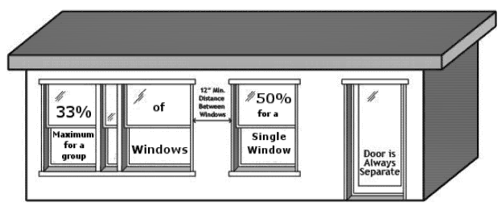
- Standards. The auto dealership area of the Automall District shall comply with the following standards:
- General Standards. The following criteria shall govern the construction, placement, and type of all signs within the Automall development area:
- Regional Commercial District (RC). No additional development standards are required in the RC District (other than all general commercial, office, industrial, and transit corridor development standards contained in this chapter).
- Regional Commercial—Planned Unit Development District (CR-PUD). No additional development standards are required in the CR-PUD District (other than all general commercial, office, industrial, and transit corridor development standards contained in this chapter).
- Community Commercial District (CC). No additional development standards are required in the CC District (other than all general commercial, office, industrial, and transit corridor development standards contained in this chapter).
- Neighborhood Commercial District (CN). No additional development standards are required in the CN District (other than all general commercial, office, industrial, and transit corridor development standards contained in this chapter).
- Neighborhood Commercial—Historic Sandy Neighborhood District (CN(HSN)).
- Parking. All parking shall be located to the rear or side of the building.
- Landscaping. The entire front yard setback area shall be landscaped.
- Historic Business District (HBD).
- Architectural Design, Appearance and Materials. All structures shall be designed to have a historical appearance (e.g., flat roof, multi-paned windows, use of brick and composite siding combinations, wood accent pieces, parapet walls, etc.). The architectural design must be approved by the Planning Commission. To maintain the historical appearance, the base of the commercial/office structure shall have additional landscaping, including additional mature trees (a mix of trees consisting of evergreens (six-foot-high minimum) and deciduous trees (two-inch caliper minimum)).
- Parking. All parking shall be to the rear or side of the building with no parking in the front of the building. When calculating required parking stalls, those spaces located upon the adjoining public street may be included in the overall total.
- Signs. All signs shall comply with the standards and size limitations as written in the Chapter 21-26, with the following exceptions:
- Neon is not permitted for illumination or building decoration.
- Internally illuminated cabinet or backlit awning signs are not permitted.
- Projecting wall signs are permitted and encouraged.
- Boulevard Commercial District (BC).
- Double Frontage Lots. For those BC District lots that have frontage on both 700 East and a residential (R-1 District) street along the rear, a minimum depth of 100 feet of the property (as measured from the property line adjacent to said residential street's right-of-way) shall be left for the development of residential lots only.
- Architectural Design, Appearance and Materials.
- All structures shall be designed to have a residential appearance (e.g., pitched roof, bay windows, use of brick, stone, and composite siding combinations along with wood accent pieces). (See Exhibit #1.)
- All buildings shall utilize a pitched roof with a steepness of at least four-twelfths pitch. No flat roofs shall be permitted.
- To maintain the residential appearance, the base of the commercial/office structure shall include additional landscaping, including additional mature trees (a mix of trees consisting of evergreens (six-foot-high minimum) and deciduous trees (two inch caliper minimum)).
- The architectural design of all structures in the BC District (including residential) shall comply with the Sandy City Architectural Design Standards.
- Limited Commercial District (LC).
- Mixed Use Concept. The concept of mixed use is allowed in the LC District and represents a departure from traditional zoning to the extent that it encourages a combination of land uses which might normally be regarded as incompatible.
- Residential Uses Allowed. Residential dwellings are allowed only on sites of sufficient size to ensure adequate site development and a satisfactory and safe residential environment.
- Where Residential Uses are Included. Where residential uses are included, the objective of the mixed use concept is to create self-contained communities in which residents may walk to work, to shopping and to recreational facilities.
- Nonresidential Use Location. Nonresidential uses shall be placed at the front of the property. Parking shall be placed at the rear or side of the building.
- Architectural Design. Buildings shall be designed to be architecturally compatible with the adjacent residential district.
- Hours of Operation. No retail use shall operate after 10:00 p.m., nor open before 6:00 a.m. A non-retail use may apply for a conditional use permit for extended hours before 6:00 a.m. or after 10:00 p.m.
- Mixed Use Concept. The concept of mixed use is allowed in the LC District and represents a departure from traditional zoning to the extent that it encourages a combination of land uses which might normally be regarded as incompatible.
- Convenience Commercial District (CvC). No additional development standards are required in the CR-PUD District (other than all general commercial, office, industrial, and transit corridor development standards contained in this chapter).
- Professional Office District (PO).
- Ancillary Retail Commercial Uses. Ancillary Retail Commercial Uses may be allowed in PO Districts at the following ratios:
- No more than 50 percent of a shared use building.
- No more than ten percent of a primary use for a stand-alone project and must be part of a complex of office buildings. Said retail use shall not be developed prior to the first office building.
- Architectural Design. Developments adjacent to residential districts shall have a residential look to enhance compatibility with the adjacent neighborhood and shall comply with the Sandy City Architectural Design Standards. (See Exhibit #1.)
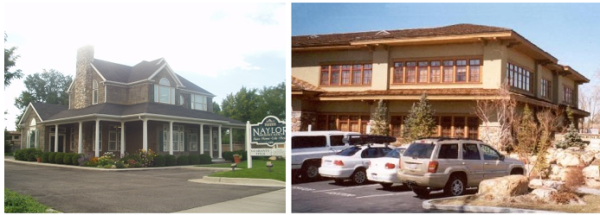
- Ancillary Retail Commercial Uses. Ancillary Retail Commercial Uses may be allowed in PO Districts at the following ratios:
- Industrial Development District (ID).
- Loading. No loading or unloading may be performed on any public right-of-way or private right-of-way. No loading docks shall face rights-of-way unless approved by the Director because of site constraints. The Director shall require screening, including landscaping or walls or a combination of walls and landscaping, to mitigate the impacts of loading docks facing rights-of-way.
- Transit Corridor (TC). No additional development standards are required in the CR-PUD District (other than all general commercial, office, industrial, and transit corridor development standards contained in this chapter).
- Research and Development District (RD).
- Parking.
- Parking terraces and underground parking is strongly encouraged and shall be required for structures of five stories or more. The parking terrace may be constructed in subsequent phases with the approval of a development agreement between the developer and Sandy City. The signed Development Agreement shall be recorded and shall be binding on all future developers and property owners of said property.
- Surface parking (permanent or temporary) may be allowed in addition to a parking structure where it can be shown that the Phasing Plan, size, and, scope of the project would require some surface parking (e.g., stand-alone restaurant, bank, etc.).
- Development Standards.
- Planned Research, Development, or Office Park. Regardless of the size and ownership of individual parcels, a "Planned Research, Development or Office Park" master site plan must be submitted for review and approval by the Planning Commission showing all phases of the development, including the parking structure, if required. The plan must show both existing and reasonably projected development on adjoining properties, determined through consultation with adjoining owners.
- The intent of the above is to achieve a consistent overall planned development with consistent site standards when the project area is completely built out.
- Expansion of existing developments not previously having a "Planned Research, Development or Office Park" approval shall require Planning Commission approval at the time of expansion.
- Residential Uses. The following shall apply to residential development in the RD District:
- Not less than 15 percent of the gross living area of a residential use shall be provided as common residential recreation space. This requirement may be accomplished with indoor or outdoor facilities (e.g., roof tops, atriums, covered or outdoor swimming, etc.).
- Residential development west of I-15 shall require a vertical mixed-use design.
- The physical separation of pedestrian and vehicular traffic is encouraged.
- All residential developments shall comply with standards for planned unit developments (PUD). The more restrictive ordinance shall apply.
- Building Height. A minimum of two stories is required.
- Specific Ancillary Uses. The following may be allowed only as a subordinate function of the primary use of the development upon review by the Planning Commission:
- Warehouse.
- Heavy Commercial.
- Light Industrial.
- Planned Research, Development, or Office Park. Regardless of the size and ownership of individual parcels, a "Planned Research, Development or Office Park" master site plan must be submitted for review and approval by the Planning Commission showing all phases of the development, including the parking structure, if required. The plan must show both existing and reasonably projected development on adjoining properties, determined through consultation with adjoining owners.
- Parking.
(LDC 2008, § 15A-23-21; Ord. No. 11-04, 3-25-2011; Ord. No. 12-08, 2-28-2012; Ord. No. 12-31, 8-20-2012; Ord. No. 14-35, 11-13-2014; Ord. No. 14-37, 11-24-2014; Ord. No. 15-19, 6-26-2015; Ord. No. 16-01, 1-14-2016)
Amended by Ord. 19-01 § 1(Exh. A) on 1/8/2019
Amended by Ord. 21-08 § 1(Exh. A) on 3/23/2021
Amended by Ord. 20-18 § 1(Exh. A on 6/15/2021
Amended by Ord. 23-08 § 1(Exh. A) on 7/18/2023
21-23-22 Planned Commercial Center Development Standards
In addition to all other development standards listed in this chapter and elsewhere in this title, all planned commercial centers shall be developed in compliance with the following additional development standards:
- Site Plan Review. A master development site plan for a planned commercial center shall be reviewed and approved by the Planning Commission.
- General Site Design.
- A planned commercial center shall be designed as an integrated complex of leasable or individually owned spaces in a single building, group of buildings, or parcels.
- Regardless of ownership, a planned commercial center site plan shall show the relationship of all proposed and future buildings and pads to all parking facilities, pedestrian walkways, landscape areas, service entrances, and abutting streets.
- Architectural Design and Materials.
- All planned commercial centers shall comply with the Sandy City Architectural Design Standards.
- A common theme of architectural design and materials, approved by the Planning Commission, shall be followed for the overall project that will include all attached, detached, and/or freestanding pad buildings.
- Landscaping.
- Landscape Design. A consistent landscaping design shall be developed for an overall planned commercial center that includes all pads and freestanding buildings.
- Frontage. Where a planned commercial center abuts a public street right-of-way, there shall be a minimum of at least 15 feet of landscaping along the perimeter, exclusive of required driveways.
- Lighting. A consistent lighting plan and light design including light heights, standard design, and color as well as light intensity shall be established for an overall planned commercial center.
- Signs. A sign theme shall be submitted which shall be approved by the Planning Commission at the time of review of a planned commercial center that covers all signage on the site including all center identification signs as well as a theme for all tenant signs.
- Grading. Grading of an overall planned commercial center shall be done in such a way as to allow all buildings, pads, and other out building sites to be tied together with reciprocal access driveways both on and off the site, unless not found to be practical by the Director in consultation with the Transportation Engineer.
(LDC 2008, § 15A-23-22)
Amended by Ord. 21-08 § 1(Exh. A) on 3/23/2021
21-23-23 Industrial Or Research Park Standards
- Industrial Environmental Standards.
- Finding of Dangerous or Objectionable Elements. No land or building devoted to industrial uses shall be used or occupied in any manner so as to create dangerous, injurious, noxious, or otherwise objectionable fire, explosive, or other hazard; noise or vibration, smoke, dust, odor, or other form of air pollution; heat, cold, dampness, glare, electrical, or other disturbance; liquid or solid refuse or waste; or other substance, condition, or element, in such a manner or in such an amount as to affect adversely the surrounding area or adjoining premises.
- State Agency Notification. The Director of Community Development shall confirm that the Environmental Health Services Section of the State Health Division is informed of applicants with uses that pose a potential risk.
- Performance Standards Review.
- In addition to meeting requirements for potential dangerous or objectionable elements, the application for industrial use shall include a description of the proposed machinery, products, and processes to be located at the development.
- If the proposed use may cause the emission of dangerous or objectionable elements, the application may be referred for investigation and report to one or more expert consultants qualified to advise as to whether a proposed use will conform to the applicable environmental and performance standards specified in this title. The cost of such expert report shall be borne by the applicant.
- Within 20 days after receiving the aforesaid application or report, if a report was required, the City shall determine whether reasonable measures are proposed to be employed to ensure compliance with the applicable environmental performance standards. On such basis, the City may authorize or refuse to authorize issuance of permits or may require a modification of the proposed plans, construction specifications, device or operation and shall so inform the Chief Building Official.
- Continued Compliance. Any permit so authorized and issued shall evidence only that reasonable measures are proposed to be taken. It shall not relieve the applicant of the responsibility of meeting all performance and environmental standards when the plant is actually in operation; and, in case of a failure to perform in accordance with the standards, whatever additional devices or modifications in process shall be necessary to achieve full compliance with the standards are required to be made and shall be the sole responsibility of the applicant.
- Continued Enforcement.
- The Director shall investigate any purported violation of environmental or performance standards; and, if necessary for such investigation, may request that the City employ qualified experts.
- If the City finds that a violation has existed or does exist, the Director shall serve notice that compliance with the environmental or performance standards must be achieved within a specified period of time or the plant will be shut down.
- Should the violation of environmental or performance standards pose an immediate threat to public health, convenience, or welfare, the Mayor may order the offending plant to cease operation until proper steps are taken to correct the conditions which cause the violation.
- The services of any qualified experts employed by the City to advise in establishing a violation shall be paid by the violator if said violation is established.
- Locations Where Determinations Are to Be Made for Enforcement of Environmental and Performance Standards. The determination of the existence of dangerous and objectionable elements shall be made at any point; provided, however, that the measurements having to do with noise, vibration, odors, or glare shall be taken at the lot line of the establishment or use.
- Standards for Dangerous and Objectionable Elements.
- Noise.
- No use shall emit or cause the emission of sound from a stationary source such that one hour equivalent sound level (Leq) of resultant sound measurement at the lot line of the establishment or use exceeds by six dB(A) or more, the one-hour equivalent sound level (Leq) caused by ground transportation as estimated for that point of measurement and that time of day, pursuant to FHWA-RD-77-108 Highway Traffic Noise Prediction Mode, or by other techniques at least as accurate as those set out in FHWA-RD-77-108.
- The sound level measuring instrumentation shall conform with ANSI S1.4-1971 Type 1, and the measurement procedure shall be compatible with that according to ANSI S1.13-1977, with the following adjustments:
- Adjustment for Temporal and Tonal Characteristics of Sound. If the sound has a pronounced audible tonal quality such as a whine, screech, buzz, or hum, or if the sound has an audible cyclic variation in sound level such as beating or other amplitude modulation, five dB(A) shall be added to the measured sound level to allow for increased subjective response to the sound.
- Quasi-Steady Impulsive Sound. Where the sound is of a repetitive impulse nature so that a steady reading is obtained using the "slow response" setting on the sound level meter, then ten dB(A) shall be added to the measured value to allow for the increased subjective response to the sound.
- An adjustment may be made under only one of the two preceding subsections. In a case where both subsections apply, then Subsection (b)(1)a.2(i) takes precedence.
- No use shall emit or cause or permit the emission of sound of an impulsive nature from a stationary source such that it results in an impulsive sound level at a point of measurement in excess of 80 dB(A) or in a one-hour equivalent level (Leq) exceeding that one hour equivalent (Leq) level caused by ground transportation as estimated for that point of measurement and that time of day, pursuant to FHWA-RD-77-108 or equivalent method.
- Vibration. No vibration (other than from transportation facilities or temporary construction work) shall be permitted which is discernible without instruments at the property line of the industrial use.
- Odors. No emission of odorous gases or other odorous matter shall be permitted in such quantities as to be readily detectable when diluted in the ratio of one volume of odorous air to four volumes of clean air at the property line of the industrial use or at the point of greatest concentration. Any process which may involve the creation or emission of any odors shall be provided with a secondary safeguard system so that control will be maintained if the primary safeguard system should fail.
- Glare. No direct or sky-reflected glare, whether from floodlights or from high temperature processes such as combustion or welding or otherwise, shall be permitted to be visible at the property line of the industrial use. This restriction shall not apply to signs or lighting of buildings or grounds for advertising or protection otherwise regulated by the provisions of this title.
- Fire and Explosion Hazards. All activities involving, and all storage of, flammable and explosive materials, shall be provided at any point with adequate safety devices against the hazard of fire and explosion and adequate firefighting and fire suppression equipment and devices standard in the industry. Burning of waste materials in open fires is prohibited at any point.
- Air Pollution. No particulate or gaseous pollutants shall be emitted into the air in violation of the Utah Air Conservation Act (U.C.A. 1953, § 19-2-101 et seq.), its amendments, or resulting regulations.
- Liquid or Solid Wastes. No discharge at any point into a public sewer, private sewage system, stream, ditch, canal, or into the ground shall be allowed contrary to the Water Quality Act (U.C.A. 1953, § 19-5-101 et seq.), its amendments, the subsequent Wastewater Disposal Regulations, or the Utah Code on Solid Waste Disposal Regulations.
- Noise.
- Standards for Dangerous and Objectionable Elements.
- Compliance with Other Regulations. All uses must meet any other applicable City, County, State or Federal regulations.
(LDC 2008, § 15A-23-23)
Amended by Ord. 21-08 § 1(Exh. A) on 3/23/2021
21-23-24 Mixed Use Development Standards
- Purpose and Intent.
- This section is established to provide a zone to be used near City transportation corridors that allows a mix of specific land uses that are typically found separately in mutually exclusive zoning districts. Mixed use represents a departure from characteristic zoning to the extent that it encourages a combination of land uses which might normally be regarded as incompatible.
- The intent of this zone is to create self-sustaining villages that become walkable neighborhoods, in which residents may walk to work, to shopping, to recreational facilities, and have access to mass transit. These neighborhoods are to provide a variety of housing opportunities and choices that include a range of household types, family sizes, and incomes. They shall provide convenient pedestrian commercial services, employment opportunities, and shall be located in areas with existing, or probable future, multiple transportation choices. Design standards include requirements that help provide a true neighborhood by stipulating various mix of uses, "build to" lines, compact building design, preservation of open space, pedestrian-friendly streets and streetscape, parking concealment, architectural control, and maintenance. Proposed developments with increased land intensity and housing density but without the above walkable elements are unacceptable and will not be approved.
- Procedures.
- The Planning Commission will review all development proposals in the MU Zone. All exterior building elevations visible from adjacent properties or streets must also be reviewed and approved by the Planning Commission.
- Prior to the Planning Commission taking action, plans must be submitted in accordance with this title.
- All submissions shall be made well in advance of planned construction for proper coordination and feedback, and shall be reviewed at a City Development Review Meeting and/or respective architectural review meeting before submittal to the Planning Commission.
- For a typical building project, 12 copies of the required information must be submitted for complete review and recommendation by the Planning Commission. One copy will remain on file with the Planning Division and the second copy will be returned with comments. Communication with the Planning Commission may be directed to the Director.
- The owner's representative, for on-going coordination with the Planning Commission, must also be identified, including address and telephone number.
- Land Coverage. It is the intent to create efficient usage of land within the Mixed Use District by controlling the intensity of different types of land uses and providing sufficient critical mass to create a walkable neighborhood.
- Coverage for both buildings and paved areas (parking, loading and circulation) shall not exceed 90 percent, thereby reserving a minimum of ten percent for landscaped areas and open space.
- Parking terraces and underground parking is strongly encouraged. Surface parking (permanent or temporary) may be allowed in addition to, or in lieu of, a parking structure, upon the approval of the Planning Commission, where it is screened from streets and where it can be shown that the Phasing Plan, design, size and scope of the project substantially provides a walkable community.
- Uses Allowed. In order to achieve an overall walkable development, appropriate land uses, pedestrian connections, cross-easements, common driveways, consistent site standards, etc., must be coordinated, even though properties may be individually owned. In order to encourage pedestrian activity and to improve air quality, drive-thru windows are not permitted in conjunction with uses such as fast food restaurants, dry cleaners, banks, etc.
- Location Restrictions.
- Mixed use developments shall be located along transportation corridors and other locations where walkable components (i.e., housing choices, convenience commercial, employment, community facilities, transportation linkages, park or other open space, schools, churches, etc.) are already present, planned, or where the size and scale of development is such that said components can be provided within the project itself.
- As a guiding principle, mixed use components should be within a five-minute (or one-fourth mile) walking distance. The actual blend of vertical and/or horizontal mixed use development shall be determined by the Planning Commission depending upon the size, scale, and location of the development. Where size and scale permit, housing units shall include a mix of housing types, housing size, and number of bedrooms, encouraging neighborhoods with a mix of family cycles and incomes.
- Ancillary Uses. All permitted and conditional land uses within the MU Zone may conduct ancillary uses, as specifically defined in Chapter 21-37, provided such use is not regulated by other sections or is listed as a prohibited land use in this zone.
- Location Restrictions.
- Development Standards. The following standards are to be considered as applying specifically to development in the Mixed Use (MU) District, in addition to general standards provided elsewhere in this title.
- Mixed Use Master Plan. Regardless of the size and ownership of individual parcels, a walkable Mixed Use Master Plan must be submitted to the Planning staff for review and approval by the Planning Commission. The plan must show all phases of the development (including any phasing plans) and both existing and reasonable projected development on adjoining properties, determined through consultation with City staff and adjoining property owners.
- The intent of the above is to achieve a consistent overall mixed use development with uniform and compatible site standards when the project area is completely built out. Standards that will be applied to a Master Plan are set forth in this chapter.
- Remnant parcels left from old developments, rebuilds of existing parcels, or pads within existing center developments, are required to make reasonable compliance with mixed use development standards through consultation with the Director.
- Parcel Size. Parcels shall be of sufficient size to ensure compliance with building setbacks, landscaping, access, parking, and walkability standards.
- Building Placement and Massing.
- Setbacks.
- Building facades shall comprise at least 70 percent of each street edge identified as "build-to lines." To meet this requirement, building facades must be zero to five feet from street side (typically inside edge of sidewalk) property lines where build-to lines are drawn. Awnings and architectural features may project beyond build-to lines, as approved by the Planning Commission. Street side setback variations may be used when an activity related to pedestrian use is maintained, (i.e., special landscaping, outside seating for a restaurant). Recessed plazas, courtyards, and trellises are encouraged.
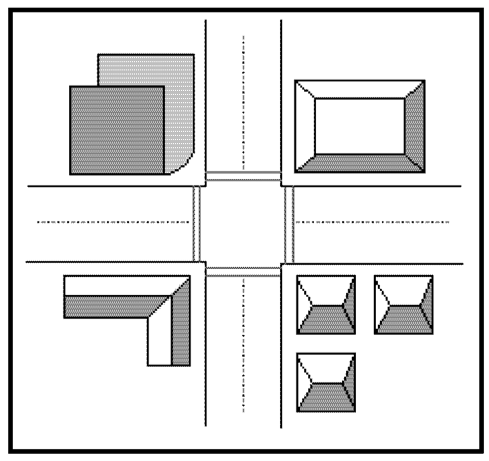
- Zero lot line side setbacks with attached structures, in compliance with the International Building Code, may be required except for necessary driveway access, pedestrian access, open space, and landscape areas. Rear setbacks shall be of sufficient depth to allow proper parking and landscaped areas to the rear of the buildings. Unless otherwise approved by the Planning Commission, rear yards and the rear of buildings shall not directly abut streets. If the rear of building is approved adjacent to a street, pedestrian access and street oriented building treatment must be adequately addressed.
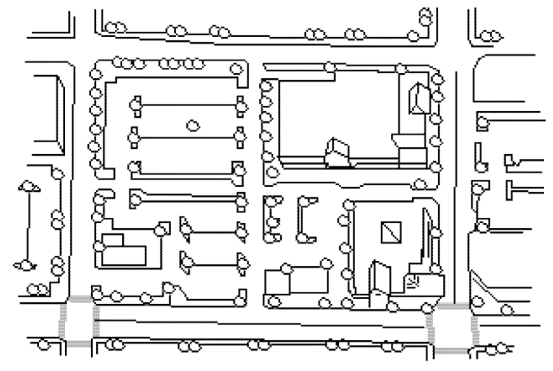
- Building facades shall comprise at least 70 percent of each street edge identified as "build-to lines." To meet this requirement, building facades must be zero to five feet from street side (typically inside edge of sidewalk) property lines where build-to lines are drawn. Awnings and architectural features may project beyond build-to lines, as approved by the Planning Commission. Street side setback variations may be used when an activity related to pedestrian use is maintained, (i.e., special landscaping, outside seating for a restaurant). Recessed plazas, courtyards, and trellises are encouraged.
- Building Orientation. The entrances of all retail, civic, residential, and office buildings shall front onto streets, with the exception of center block residences (which still must front pedestrian ways) and anchor stores greater than 30,000 square feet in size. Secondary entries may be required at the rear of street-facing buildings. Where possible, like land uses shall face like land uses or open space (i.e., retail across the street from retail, town homes from town homes, etc.). Loading docks and service areas must be screened from streets and adjacent properties through architectural design and landscaping. Anchor store entrances must be connected to adjacent streets via landscaped, publicly accessible walkways. Access from parking areas may be via mid-block passageways or paseos, to the street.
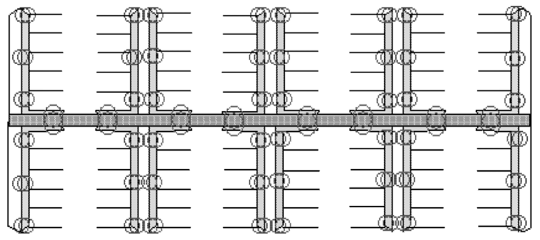
- Building Height.
- Buildings at build-to lines shall have a minimum and maximum height as indicated on the table by building type, with height to be measured in accordance with the City's adopted ordinances and standards.
Land Use Commercial, Office and Vertical Mixed Use Condos, Town Homes, Garden Apartments Single-Family, Twin Homes, and Quads Civic Uses and other Stand-Alone Uses Minimum building height Two stories Two stories One story One story Maximum building height Four stories Three stories Two stories Three stories - Buildings of greater height than allowed in the above table may be approved by the Planning Commission on a limited basis, based upon the size, scale, topography, and uniqueness of the development. Approved structures with additional height may be required to include suitable "step-back" architecture and other architectural features which encourage a village feel on street level.
- Buildings at build-to lines shall have a minimum and maximum height as indicated on the table by building type, with height to be measured in accordance with the City's adopted ordinances and standards.
- CPTED (Crime Prevention through Environmental Design).
- Where practically possible, CPTED principles shall be used in the design and layout of buildings, streets, accesses and open space areas. Design shall promote natural surveillance, access control, territorial reinforcement, sense of ownership, management, and maintenance. CPTED landscaping guidelines shall be used, including planting shrubs with a maximum height of two to three feet and trees with a proper ground clearance of six to eight feet above walkways and sidewalks and eight to ten feet above vehicular travel and parking lanes.
- In order to encourage public safety through natural surveillance, natural access control, and territorial reinforcement, blank walls are not permitted adjacent to streets, pedestrian areas, and open space amenities. Symbolic barriers, such as low-lying fences/walls, landscaping and signage, shall be used, as appropriate, to discourage crime and to promote safety. Ground floor parking garages are not permitted immediately adjacent to streets. Developments shall have street side building elevations with extensive windows, with balconies, decks or landscape terraces being encouraged.
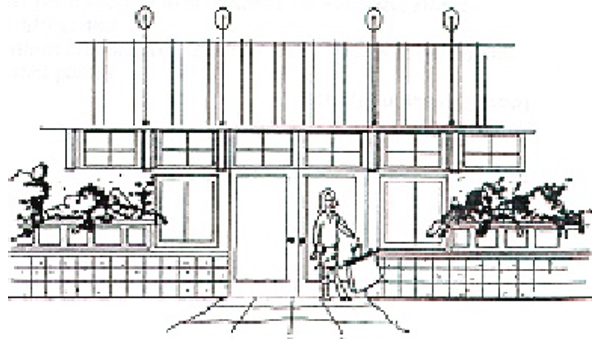
- Setbacks.
- Land Use Impact and Buffering.
- Landscape buffers are preferred over fences and walls where a separation is desirable. A visually open look should be encouraged between compatible uses. Visual screening which creates outdoor rooms is often more important than a physical separation and the Planning Commission may, at its own option, require special treatment of such areas. Fences or walls, if determined to be necessary or desirable, must be reviewed for their effectiveness in protecting private space while not creating isolated uses or dead space void of natural surveillance. Approved fences or walls shall be compatible in color, texture, and design in relationship to building materials.
- In order to mitigate any negative impacts, the Planning Commission, after due consideration, may modify building setbacks and heights, and require additional architectural and/or landscape elements, as needed between uses, within and without a mixed use development.
- Architectural Design and Materials. The treatment of building mass, materials and exterior appurtenances shall create an aesthetically pleasing building and site that is in character with the proportions of other surrounding buildings, and yet provides diversity in design. Requirements applicable to all buildings are as follows:
- All sides of buildings shall receive equal design consideration, particularly where exposed to pedestrian and/or vehicular traffic and adjacent properties.
- Basic building materials shall include, but are not necessarily limited to, architecturally treated pre-cast concrete, brick, stone, granite, ceramic tile, architectural metals and glass. All residential uses shall be predominantly brick or masonry. Limited amounts of stucco and masonite siding may be considered if the quality of the design merits such consideration. The use of exposed concrete (architectural concrete excepted), metal, or plastic for storefront facades is not permitted. All buildings within the development shall possess a similar architectural theme and have common architectural elements creating a unifying development.
- No more than four colors may be used per development. Earth tone colors are encouraged to help buildings blend into the environment; however, color may vary if approved by the Planning Commission as being compatible with surrounding developments. Approved tinted glass surfaces shall be considered as one of the colors allowed and shall conform to the color requirements included herein. Building styles shall be compatible with existing buildings within the respective MU Zone.
- Buildings shall be designed to relate to grade conditions with a minimum of grading and exposed foundation walls, creating easy pedestrian access from sidewalks, parking areas, etc. Commercial buildings shall be designed with ground floor architectural separation in order to enhance street activity and walkability. All buildings shall have expansive windows, balconies, terraces, or other design features which are oriented to the street, or other people spaces, in order to maximize interface connection. Windows, display windows, doors, and arcades must make up at least 70 percent of street-facing facades on the first story of commercial developments. Window shapes and sizes shall be so designed to be compatible from building to building. Tinted windows or windows with reflective film or glass are not permitted at street level.
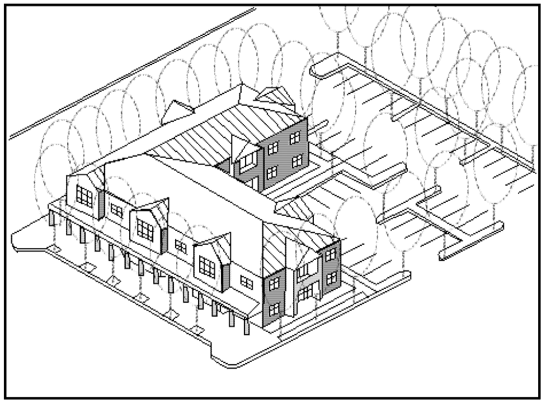
- Mechanical equipment shall be located or screened so as not to be visible from streets, pedestrian areas, and adjacent developments. Screens shall be aesthetically incorporated into the design of the building whether located on the ground or on the roof.
- Plans for significant exterior modifications to any existing structures must be submitted to the Planning Commission for approval and must meet the same requirements as all other structures within the MU Zone.
- Signage.
- Proper design and placement of signs and their lighting is critical and shall be compatible with structures and uses. Mixed use developments shall have a sign theme which promotes mixed use compatibility. Permitted signs within the MU Zone shall be in compliance with Chapter 21-26, except that freestanding and off-premises signs or billboards shall not be permitted. Wall signs, projecting wall signs, and window signs, approved as part of a sign theme, are encouraged.
- Monument signs and directional signs are discouraged. Where approved, a monument sign must comply with the following limitations: the sign shall have as the prominent feature the name of the development (i.e., "Jordan Village," "Jordan Plaza," etc.). All other lettering shall be no taller than four inches in height. The maximum height of the sign shall be four feet for the portion containing general copy, with an overall maximum height of six feet above sidewalk grade. It is intended that the top two feet be utilized to identify the name of the development. The lettering font style for tenant identification shall be the same for all tenants. Monument signs shall be constructed with the materials similar to that of the main building. Monument signs may not extend into the required sign visibility triangle, unless otherwise approved by the City Transportation Engineer.
- Open Space.
- Significant usable open space shall be provided within the mixed use development, depending upon size, scale, and nature of the development as determined by the Planning Commission. Approved open space may include, but is not limited to, commons, pocket parks, plazas, courtyards, landscape features, water fountains and features, greenbelts, and trail connections. A Village Green, as a commons area, may be required adjacent to mass transit connections or other significant activity. Building materials used within open space areas shall be related to the materials of adjacent buildings and shall be a non-skid finish. Design shall encourage comfortable and safe pedestrian use, including landscaping, seating areas, and lighting as appropriate.
- Areas of environmental concern or interest may be required to be preserved (i.e., drainages, steep slopes, connections to trail systems, and water features). Unless otherwise specified thru special agreement or understanding with the City, all open space areas shall be maintained by property owners or Homeowners' Associations.
- Landscaping. Landscaping guidelines are established to improve and then maintain site qualities while minimizing alteration, removal, or degradation of approved landscaping. Landscaping, in general, shall follow CPTED (Crime Prevention Through Environmental Design) principles.
- Landscape and Streetscape Plans. No plans for any building, structure or other improvements shall be approved by the Planning Commission unless there shall also have been submitted landscape and streetscape plans satisfactory to the Planning Commission.
- Landscaping to be Installed within 30 Days. Landscaping in accordance with the plans submitted must be installed within 30 days following the occupancy of the site or as otherwise approved by the Community Development Department as seasonal conditions may dictate.
- Future Development Areas to be Weed-Free or Landscaped. Future development areas or land area not occupied by buildings, structures, hard surfacing, vehicular driveways or pedestrian walkways shall be kept in a weed-free condition or landscaped, as approved by the Planning Commission.
- Plant Materials.
- Sixty percent medium size trees; deciduous trees with a caliper from two to three inches and evergreen trees with a height from five to eight feet. 40 percent small size trees and shrubs in a combination with deciduous trees with a caliper of one and one-half to two inches and evergreen trees with a minimum height of four feet. Where possible, a 50/50 mix of deciduous and evergreen trees and shrubs shall be used for on-site landscaping.
- Street trees with a minimum two-inch caliper shall be installed along all public rights-of-way by the developer. The species-type, location, and spacing of trees shall be as shown on the approved Landscape Plan, in compliance with designated streets within the City's Streetscape Plan. For streets not specified in the Streetscape Plan, the following trees may be used as part of an approved Landscape Plan, depending upon space requirements:
Bur Oak
(Quercus macrocarpa)
Flowering Pear
(Pyrus calleryana 'Redspire')
(Pyrus calleryana 'Aristocrat')Hedge Maple
(Acer campestre)
Little Leaf Linden
(Tilia cordata 'Greenspire')
(Tilia cordata 'Rancho')London Plane
(Platanus acerifolia 'Bloodgood')
Norway Maple
(Acer platanoides 'Cleveland')
(Acer platanoides 'Columnare')
(Acer platanoides 'Emerald Queen')
(Acer platanoides 'Schwedleri')
(Acer platanoides 'Deborah')
(Improved Schwedleri)Red Maple
(Acer rubrum 'October Glory')
(Acer rubrum 'Red Sunset')Red Oak
(Quercus rubrum)
Redmond Linden
(Tilia euchlora 'Redmond')
Sycamore Maple
(Acer pseudoplatanus)
- For planted medians and accent trees, both on-site and at intersections, the following trees may be used:
Bechtel Crab (Malus ioensis 'Klehms Improved') Crimson King Maple (Acer platanoides 'Crimson King')
(Acer platanoides 'Royal Red')Flowering Plum (Prunus cerasifera 'Blireiana') Kwanzan Cherry (Prunus serrulata 'Kwanzan') Washington Hawthorn (Crataegus phaenopyrum)
- Installation. It shall be the responsibility of the developer to grade, place topsoil, seed, sod, install sprinkler irrigation systems, and properly plant trees, shrubs, and other approved plant materials.
- Maintenance. It shall be the responsibility of the developer and/or property association to properly maintain landscaped areas, including watering, mowing, pruning, fertilizing, and the removal and replacement of dead plant materials in a timely manner.
- Vegetation Modification/Removal. Pruning vegetation for exposure, which results in unnatural plant specimens, is prohibited. Necessary vegetation removal shall be replaced with equal or better quality plant materials. Trees that are necessarily removed shall be replaced with trees with comparable total caliper. Street trees replacement shall be in compliance with the City's Streetscape Plan, unless otherwise approved by the Planning Division.
- Utility Connections. When disturbances are made to existing landscaped areas, the existing landscaping must be replaced to its previous condition. Other modification of landscaped areas shall require approval by the Director.
- Outdoor Lighting.
- The lighting of streets, pedestrian areas, parking lots, and open space is required. Exterior wall-mounted floodlights are expressly prohibited. Indirect lighting, bollard lighting, and landscape lighting is encouraged. Lighting of a building and site identification signs are permitted as allowed elsewhere in this title.
- Lighting will be judged as to how adequately it meets its intended purpose. Design and location of standards and fixtures shall be specified on the site development drawings. Intensities shall be controlled so that safety lighting is provided while neighboring areas are protected from glare or excessive direct light. See cross-section illustration for additional requirements in the report: "Sandy Civic Center Development Master Plan." Street light design fixtures shall evoke a village feel and be installed as required by the Street Lighting Policy.
- Streets and Pedestrian Ways.
- Streets. All accesses within a Mixed Use (MU) development shall have connectivity with existing and future street patterns. A grid street pattern or modified grid pattern is required where practically possible. Cul-de-sac streets will not be approved unless it can be demonstrated that no other practical way exists to make connectivity. In order to uphold and enhance traditional neighborhood development principles, private streets are discouraged and gated communities are prohibited.
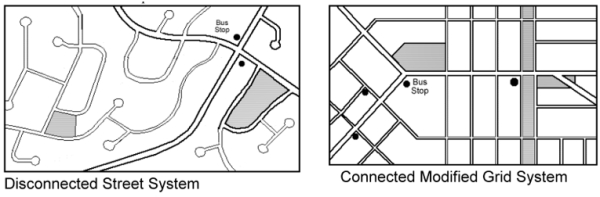
- Widths. Street widths shall be determined during site plan review as may be recommended by the City Transportation Engineer and approved by the Planning Commission. In general, streets shall be designed to meet the level of travel and service, while incorporating principles of traffic calming and pedestrian compatibility (i.e., tree lined streets with pedestrian ways and linkages), decreasing the need for pavement width by spreading traffic through a grid or modified street hierarchy system.
- Sidewalks and Walkways.
- The design of pedestrian ways may include a solitary meandering pathway or trail, a pedestrian street and the many possible designs in between. Walkways and connections to trail systems shall be incorporated into the project. Choice of appropriate pedestrian access will be made based upon the scale and type of mixed use project being proposed and by the way uses are intermingled. The standard nine-foot cross-section (five-foot parkstrip, four-foot sidewalk) is a minimum, while a wider parkstrip and/or sidewalk may be required depending upon the land use and the desired effect. All streets shall have sidewalks and curbside streetscape.
- Pavers, borders, and other sidewalk design materials with compatible colors shall be used as needed in order break up expanses of hard-surfacing and to encourage pedestrian interest and activity.
- In vertical mixed use areas, wider sidewalks are required in order to enhance street and land use connectivity. Portions of the parkstrip may be paved to accommodate street furniture, leaving tree wells for street trees. Street furniture, including, but not limited to, benches, trash receptacles, artwork, drinking fountains, bike racks, and newspaper racks, may be required depending upon the nature of approved uses. Street furniture requirements shall include an overall design theme for compatibility.
- Crosswalks. Extensive use of crosswalks shall be incorporated within the project, at intersections, mid-blocks, within parking lots, or other needed pedestrian connections. A pedestrian inconvenience distance of 150 feet should be used as a guideline. Crosswalks shall be so configured to be a design feature of the development (i.e., heavy painted lines, pavers, edges, and other methods of emphasizing pedestrian use). Bulb-outs and other pedestrian design shall be used to shorten walking distances across open pavement. Planted medians shall be used in appropriate areas to encourage walking and to act as a refuge for crossing pedestrians.
- Streets. All accesses within a Mixed Use (MU) development shall have connectivity with existing and future street patterns. A grid street pattern or modified grid pattern is required where practically possible. Cul-de-sac streets will not be approved unless it can be demonstrated that no other practical way exists to make connectivity. In order to uphold and enhance traditional neighborhood development principles, private streets are discouraged and gated communities are prohibited.
- Other Forms of Transportation.
- All forms of transportation shall be considered within and without the mixed use development with the intent to improve convenience and reduce automobile trips. All forms of transportation should be encouraged, including bus, bicycle, and pedestrian. Access connections shall be required where deemed essential to provide circulation or access to churches, schools, playgrounds, shopping centers, transportation, and other community facilities.
- Appropriate bus turnouts and stops shall be coordinated and planned as part of the development review process. Based upon land use and the level of demand, bicycle parking shall be provided in appropriate locations (i.e., visible from store fronts and entrances to office buildings and residential structures).
- Parking Areas. Parking areas shall be considered as structures since they present a three-dimensional appearance when occupied.
- Location of parking shall be determined not only from its visual relationship to the building and site, but also as it relates to safe, convenient pedestrian and vehicular circulation patterns. The placing of building and parking elements on a site shall be evaluated by and Planning Commission on the basis of the following factors:
- Type of land use and structure.
- Building height and configuration.
- Relationship to other buildings, both horizontally and vertically.
- Natural land features such as slopes and vegetation.
- Physical features such as rail lines, canals, and controlled ingress and egress.
- Visibility from vehicular approaches and distant highways.
- Safe pedestrian connections to buildings, walkways, open space, and streets.
- Where possible, parking lots shall be broken up and planned as outdoor rooms through the use of buildings, walkways, open space, and landscape design. When approved, larger parking lots shall be broken up with substantial tree and ground cover. Large parking lots should be broken up into rooms of no more than 300 parking stalls through the use of connecting walkways.
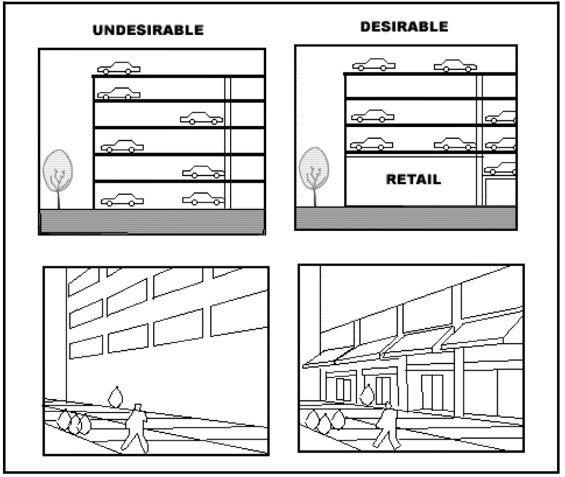
- Unless otherwise approved by the Planning Commission, parking lots are prohibited adjacent to any street.
- Underground parking, deck or terrace parking, and parking garages are encouraged and may be required in conjunction with structures of three stories or more. Said structures shall have architectural treatments compatible with adjoining buildings. Parking structures with first level parking immediately adjacent to the frontage of a street are prohibited. Parking structures shall be designed around natural light with safety lighting added as needed. Landscaping, within and without, may be required to enhance compatibility and safety.
- Developments are not allowed to be over-parked without justification. Developments may be approved with less than required parking if evidence can be shown that the nature of the land use proposed will not generate the number of stalls as recommended in Chapter 21-24, as may be approved by the Planning Commission. Developments may also be under-parked if justified with a walkable design that demonstrates such, and/or where local multi-modal transit systems exist or are immediately planned, which would help reduce the number of needed parking stalls and/or automobile trips. Shared parking arrangements may be required in order to reduce unnecessary parking areas and to encourage pedestrian activity.
- Where possible, on-street parking shall be provided adjacent to developments, and a pro-rated share of such may be used to satisfy overall parking requirements. Parallel or angle parking may be approved based upon the overall design and width of the street, as recommended by the City Transportation Engineer and approved by the Planning Commission.
- Location of parking shall be determined not only from its visual relationship to the building and site, but also as it relates to safe, convenient pedestrian and vehicular circulation patterns. The placing of building and parking elements on a site shall be evaluated by and Planning Commission on the basis of the following factors:
- Mixed Use Master Plan. Regardless of the size and ownership of individual parcels, a walkable Mixed Use Master Plan must be submitted to the Planning staff for review and approval by the Planning Commission. The plan must show all phases of the development (including any phasing plans) and both existing and reasonable projected development on adjoining properties, determined through consultation with City staff and adjoining property owners.
- Environmental Concerns.
- Building, landscape, and solar design should be adjusted, where possible, to be compatible with the local climate. Such design should include, but may not be limited to, window placement, building recesses, overhangs, trellises, awnings, porches, and landscape placement, planned in such a way to enhance livability and reduce energy costs.
- The use of lighter colored building materials (i.e., roof tops), fences/walls, and extensive deciduous and evergreen tree cover shall be incorporated into developments in order to reduce the urban heat island effect. Where possible, streets, driveways, parking lots, etc., should use concrete or other materials which absorb less sunlight. Parking lot landscaping shall be provided at the ratio of at least one tree per six parking stalls.
- Where possible, drought-resistant ground covers, shrubs, and trees shall be incorporated into the landscape to reduce water usage and storm runoff. Extensive areas of grass or other high water use plants without a public purpose are discouraged.
- Requirements Unique to Residential Uses. The following shall apply to residential uses:
- Multifamily residential use shall comprise a variety of types of housing, fulfilling housing needs with a wide assortment of housing options and shall be designed using traditional neighborhood development design principles. The number of bedrooms per unit and other housing design options shall be varied in proportions to assist in providing suitable housing for a market range of household incomes, family size, and life cycles. The site plan design of multifamily development shall conform to requirements heretofore presented. Setbacks shall be determined by the Planning Commission based upon acceptable layout and design. Where practically possible, like housing shall face like housing or open space.
- The following traditional neighborhood development standards shall be required for multifamily residential:
- Properly designed off-street surface parking hidden from streets, parking terraces, or underground parking. Garage units associated with multifamily development should be rear loaded. Where only front loaded garages are possible, they shall be subservient to the residential structure.
- Roofs with a four-twelfths pitch or greater, unless otherwise approved by the Planning Commission.
- Dwelling and garage gables facing streets and alleys.
- Extensive windows facing streets, alleys and pedestrian connections.
- Covered entrance porches.
- Entry sidewalks that connect directly to public sidewalks.
- The following traditional neighborhood development standards for multifamily residential shall be encouraged:
- Multi-level structures.
- Dormers and/or shutters, and other window treatments.
- Street side balconies/decks.
- Streets which de-emphasize the need and speed of automobiles.
- Other pedestrian oriented design.
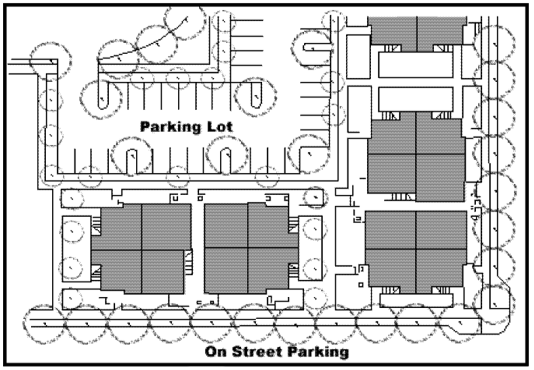
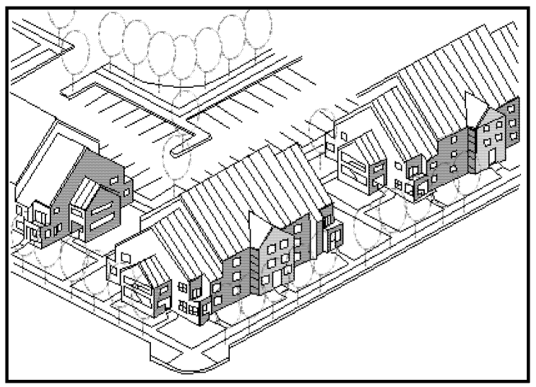
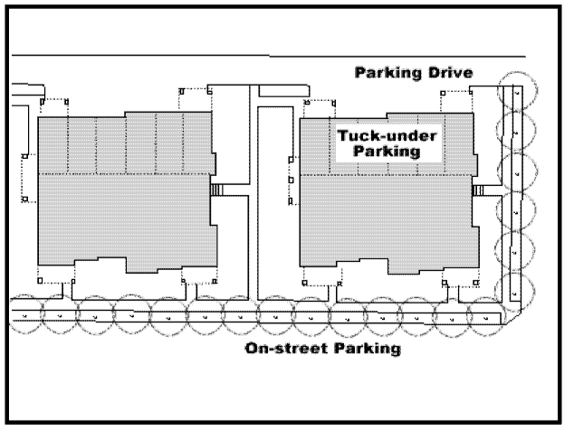
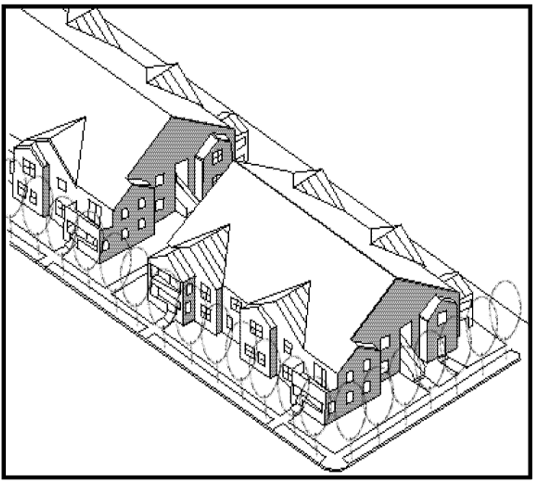
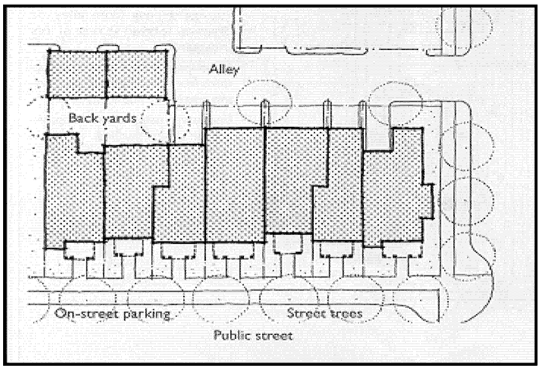
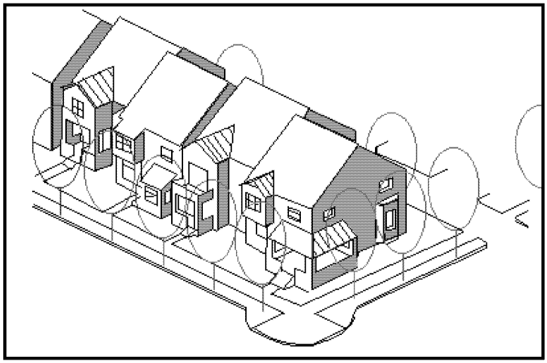
- The following traditional neighborhood development standards shall be required for multifamily residential:
- Single-family residential uses, if approved, shall be designed using traditional neighborhood development design principles. Front setbacks shall range between 12 and 20 feet typically measured from the inside edge of sidewalk to the porch. Front loaded garages shall be subservient to the dwelling and shall not have a setback less than 18 feet. Side and rear setbacks shall be determined by the Planning Commission based upon acceptable subdivision layout and design.
- The following traditional neighborhood development standards shall be required for single-family residential:
- Subservient garages (i.e., back loaded detached with alley access, front loaded detached, attached but set back from the front line of the home by at least five feet, side entry attached, or a combination of the above).
- Roofs with a four-twelfths pitch or greater.
- Dwelling and garage gables facing streets and alleys.
- Covered open front porches comprising at least 50 percent of the front elevation (not including the garage), in no case being less than 15 feet in width.
- Entry sidewalks that connect directly to public sidewalks.
- The following traditional neighborhood development standards for single-family residential shall be encouraged:
- Two-story dwellings.
- House dormers and/or shutters, and other window treatments.
- Street side balconies/decks.
- Wrap-around porches, particularly on corner lots.
- Streets which de-emphasize the need and speed of automobiles.
- Other pedestrian oriented design.
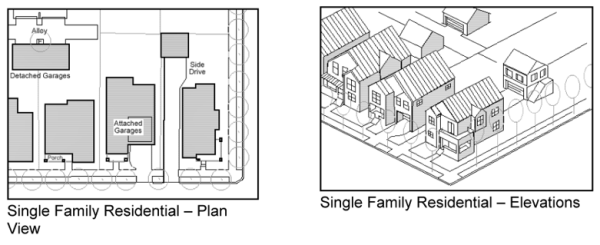
- The following traditional neighborhood development standards shall be required for single-family residential:
- Multifamily residential use shall comprise a variety of types of housing, fulfilling housing needs with a wide assortment of housing options and shall be designed using traditional neighborhood development design principles. The number of bedrooms per unit and other housing design options shall be varied in proportions to assist in providing suitable housing for a market range of household incomes, family size, and life cycles. The site plan design of multifamily development shall conform to requirements heretofore presented. Setbacks shall be determined by the Planning Commission based upon acceptable layout and design. Where practically possible, like housing shall face like housing or open space.
- Service Areas.
- Loading and refuse collection areas must be screened from public view. These areas are not permitted between buildings and streets unless they can be adequately screened through landscaping and architectural design. Streets shall not be used directly for commercial loading, unloading, or refuse collection. Building and improvements upon lots must be designed to properly accommodate loading, unloading and refuse collection. Screen walls and enclosures shall be constructed with materials compatible with the structures they serve. Loading and refuse collection areas shall be properly maintained in a debris-free condition.
- Except for approved and screened R.V. storage lots associated with a residential use, storage areas, including the storage of materials, merchandise, pallets, etc., shall be within buildings.
(LDC 2008, § 15A-23-24; Ord. No. 12-07, 2-28-2012)
Amended by Ord. 21-08 § 1(Exh. A) on 3/23/2021
Adopted by Ord. 23-08 § 1(Exh. A) on 7/18/2023

