
Sandy City Zoning Code
CHAPTER 21
21 SUBDIVISION DESIGN STANDARDS
State law reference(s)—Subdivision regulations, U.C.A. 1953, § 10-9a-601 et seq.
21-21-1 Purpose
The purposes of this chapter are:
- To promote the health, safety and general welfare of the residents of Sandy City.
- To provide for the orderly development of the City, with adequate provisions for traffic, light, air, recreation, transportation, water, drainage, sewage, and other public requirements.
(LDC 2008, § 15A-21-01)
Amended by Ord. 21-08 § 1(Exh. A) on 3/23/2021
21-21-2 General Development Standards
The standards and improvements required of this chapter shall apply to all development within Sandy City (unless modified or eliminated as allowed herein), whether a subdivision is required or not (e.g. lot of record). All standards found herein shall also be in conformance to the Sandy City Standard Specifications and Details for Municipal Construction (herein known as "Standard Specifications", as adopted by Sandy City. City inspections are required for the installation of all required improvements. If the developer/builder/owner fails to have the City inspection prior to installation, the City Engineer may require remedial action, including, but not limited to, the removal and replacement of the improvements in question.
Editor's note(s)—Ord. No. 19-23, § 1(Exh. A), adopted Oct. 8, 2019, amended § 21-21-2 in its entirety to read as herein set out. Former § 21-21-2 pertained to Curbs, Gutters, Sidewalks and Drive Approaches and derived from LDC 2008, § 15A-21-02.
Adopted by Ord. 19-23 § 1(Exh. A) on 10/8/2019
Amended by Ord. 21-08 § 1(Exh. A) on 3/23/2021
21-21-3 Residential Driveways
- Driveways shall be provided for all residential building lots to access the primary garage. A driveway is not required to access a detached structure. If the access to the structure is used to store vehicles, then the surface must be paved. The drive approach for the driveway shall be a minimum width of 12 feet and shall not exceed the maximum width of 36 feet. A secondary drive approach may be permitted upon review and approval by the City Engineer as permitted in this Code.
- No downsloping driveways shall be permitted unless otherwise approved by the City Engineer due to unusual topographic constraints. The driveway must maintain a positive slope away from the home as required by the International Building Code.
- The minimum grade at which a driveway shall be allowed to be built is two percent slope, and the maximum grade at which a driveway shall be allowed to be built is 12 percent slope, except as hereafter provided. The City Engineer, under exceptional circumstances, may approve driveway slopes having a grade exceeding 12 percent and may impose conditions of approval to mitigate any hazards created by the steepness of the driveway.
- Residential driveways shall be constructed in compliance with the Standard Specifications.
- A driveway that exceeds 150 feet in length may be deemed a Fire Department access road, as determined by the Fire Marshal, and must follow the design requirements of a private lane.
(LDC 2008, § 15A-21-03)
Amended by Ord. 19-23 § 1(Exh. A) on 10/8/2019
Amended by Ord. 21-08 § 1(Exh. A) on 3/23/2021
21-21-4 Culinary Water Systems
- The developer shall extend culinary water systems to each lot within a subdivision and shall be in conformance with the Standard Specifications. The developer shall install water lines and laterals throughout the subdivision, extending to the farthest boundaries thereof, or beyond as may be determined by the City as necessary to provide service.
- All water utility trenches within Sandy City rights-of-way shall be compacted in conformance with the Standard Specifications. All trenches located outside of Sandy City rights-of-way and located beneath the driveway or within five feet of any public improvement shall be backfilled in 12-inch maximum lifts and mechanically compacted. Backfill and compaction operations shall be certified in writing to the City Engineer by the developer/builder through his licensed professional prior to the City issuing a Certificate of Occupancy. The location of the ends of all water laterals shall be located and marked at the property line by the developer.
(LDC 2008, § 15A-21-04;)
Amended by Ord. 19-23 § 1(Exh. A) on 10/8/2019
Amended by Ord. 21-08 § 1(Exh. A) on 3/23/2021
21-21-5 Fire Hydrants
Fire hydrants shall be installed by the developer in accordance with the Standard Specifications, the International Fire Code, and other local ordinances at locations designated by the Fire Department as approved on the City-approved construction drawings. The roadway where a hydrant is located is a fire access road; the minimum roadway width shall be 26 feet within 20 feet of the hydrant.
(LDC 2008, § 15A-21-05)
Amended by Ord. 19-23 § 1(Exh. A) on 10/8/2019
Amended by Ord. 21-08 § 1(Exh. A) on 3/23/2021
21-21-6 Sanitary Sewer And Other Utility Systems
- Construction.
- The developer shall extend sanitary sewer systems to each lot in a subdivision in conformance with the requirements of the responsible sewer district and the Standard Specifications. The developer shall install main sewer lines and laterals throughout the entire subdivision, extending to the farthest boundaries thereof or beyond as determined by the City, or appropriate sewer district to be necessary to provide service.
- All sanitary sewer trenches within Sandy City rights-of-way shall be compacted in conformance with the Standard Specifications. All trenches located outside of Sandy City rights-of-way located beneath the driveway or within five feet of any public improvement shall be backfilled in 12-inch maximum lifts and mechanically compacted. Backfill and compaction operations shall be certified in writing to the City Engineer by the developer/builder through his licensed professional prior to the City issuing a Certificate of Occupancy. The developer shall locate and mark at the property line the location of the ends of sanitary sewer laterals. All new dwellings shall connect to proper sanitary facilities. This shall be reviewed as part of the building permit process.
- All trenches for utility installation within Sandy City rights-of-way shall be compacted in conformance with the Standard Specifications. All trenches located outside of Sandy City rights-of-way located beneath the driveway or within five feet of any public improvement shall be backfilled in 12-inch maximum lifts and mechanically compacted. Backfill and compaction operations shall be certified in writing to the City Engineer by the developer/builder through his licensed professional prior to the City issuing a Certificate of Occupancy.
- Connection.
- Mandatory. The owner or occupant of real property on which a building has been or is being constructed shall connect such building to the sewer system within 60 days after receiving written notice from the District or City that facilities of the sewer system are available for connection to the building, if any part of such facilities of the sewer system are available for connection to the building, or if any part of such facilities is situated within 300 feet of any point of any property line of such property.
- Subsequent Use of Private Systems. If connection to the sewer system is required pursuant to the previous subsection, the owner or occupant thereby required to connect shall immediately plug any septic tank or privy vault, remove any outhouse, fill with earth any cesspool located on his property, and make no further use of those or any other privately owned facilities for final sewage disposal. Any cesspool, outhouse, or unplugged septic tank or privy vault on property required to be connected to the sewer system is hereby declared to be a public nuisance.
- Construction of Private System. No person shall construct or cause to be constructed a septic tank or other privately owned means of final sewage disposal on property required to be connected to the sewer system by Subsection (b)(1) of this section.
- Building Approval. No newly constructed building required to be connected by Subsection (b)(1) of this section shall be issued a building permit approved for human occupancy if such building is not connected to the sewer system.
- Conditions. Nothing in this part as adopted shall be construed as creating any obligation on the part of the District or the City to connect any property to the Sewer System or retain any connection to the sewer system. The District may impose reasonable conditions and requirements for sewer connection without affecting the obligation of a private person to either connect to the sewer system, discontinue use of a private system, or otherwise comply with this section.
(Revised Ords. 1978, § 18-1-6; LDC 2008, § 15A-21-06)
Amended by Ord. 19-23 § 1(Exh. A) on 10/8/2019
Amended by Ord. 21-08 § 1(Exh. A) on 3/23/2021
21-21-7 Drainage Systems
Storm Water Analysis and Drainage Plans shall meet requirements in Sandy City Standard Specifications.
(LDC 2008, § 15A-21-07)
Amended by Ord. 19-23 § 1(Exh. A) on 10/8/2019
Amended by Ord. 21-08 § 1(Exh. A) on 3/23/2021
21-21-8 High Water Table Areas
- In areas with the potential of groundwater impacts, the City Engineer may require a Groundwater Investigation Study to be done by a geotechnical engineer and provided to the City for review with the application for final plat approval, to include the following:
- Mitigation measures should be taken to ensure that homes will be protected from potential groundwater impacts, including a proposed method of groundwater disposal to be reviewed and approved by the City Engineer.
- The developer shall provide groundwater information to each lot purchaser/owner and disclose the information on the plat.
- If required, groundwater drainage systems shall be designed and installed in accordance with construction standards and specifications determined by the City Engineer.
- All drainage systems shall be extended to the outermost boundaries of the subdivision by the developer, or further if necessary to provide service.
- The developer shall install or replace, when required by the City, all sewer and water systems within a high water table area to eliminate or minimize possible damage to such systems.
- The City may prohibit basements in high water table areas upon recommendation from the City Engineer.
- If a public utility is outside of the public right-of-way, the developer and subsequent home owner shall be responsible for maintenance.
(LDC 2008, § 15A-21-08)
Amended by Ord. 21-08 § 1(Exh. A) on 3/23/2021
21-21-9 Alteration Or Relocation Of Natural Waterways
- A request for alteration or relocation of a natural waterway shall first be submitted to the City Engineer and Public Works Director to ensure the following:
- The flow capacity and velocity of the waterway will not change with the proposed alteration or relocation.
- The soils conditions in the proposed location will not increase flooding potential.
- The proposed waterway can be maintained.
- Comply with applicable provisions of the Sensitive Area Overlay Zone and Floodplain Overlay Zone.
(LDC 2008, § 15A-21-09)
Amended by Ord. 19-23 § 1(Exh. A) on 10/8/2019
Amended by Ord. 21-08 § 1(Exh. A) on 3/23/2021
Amended by Ord. 26-50 on 7/2/2026
21-21-10 Street Standards For All Types
- All roads and roadway features are required to meet minimum geometric design standards established by the American Association of State Highway and Transportation Officials (AASHTO). All street and right-of-way improvements shall be designed and constructed in accordance with the Standard Specifications. All signs, pavement markings, and traffic control signals must meet standards established by the Manual on Uniform Control Devices (MUTCD), and related roadway standards established by State, Federal, or local law. Exceptions to applicable State and Federal standards may be granted by the City Engineer on a case-by-case basis and shall demonstrate innovative superiority or other advantages over existing standards.
- The arrangement, character, extent, width, grade, and location of all streets shall conform to the Transportation Master Plan and shall be considered in their relation to existing and planned streets, topographical conditions, public convenience and safety, and in their appropriate relation to the proposed uses of the land to be served by such streets.
- Where the Transportation Master Plan does not show proposed streets, the arrangement of streets in a subdivision shall either:
- Provide for the continuation or appropriate projection of existing principal streets in surrounding areas (providing for neighborhood connectivity with the purpose of spreading traffic); or
- Conform to a plan for the neighborhood approved or adopted by the Planning Commission, after considering a recommendation by the City Engineer, to meet a particular situation where topographical or other conditions make continuance or conformance to existing streets impracticable.
- At least two points of ingress/egress shall be provided for each subdivision, PUD, or multifamily project. They shall be located at a distance apart equal to not less than one-half of the length of the maximum overall diagonal dimension of the property area to be served, measured in a straight line between accesses.
- Special Exception. The Planning Commission may grant a special exception to allow a subdivision to have only one point of ingress/egress, after considering a recommendation from the Director and City Engineer, under the following circumstances:
- Thirty or fewer lots/units are accessed from the single ingress/egress;
- The Director and City Engineer have reviewed the potential for impairment of such single access resulting from vehicle congestion, condition of the terrain, climatic conditions or other factors that could limit access and have made either a positive or negative recommendation to the Planning Commission with regards to a single point of ingress/egress; and
- The proposed development project has one or more of the following, as determined and recommended for approval or denial by the Director and City Engineer to the Planning Commission:
- One or more cul-de-sacs, hammerheads, or other approved turn-arounds that comply with all development standards herein.
- An emergency access (a point of ingress/egress that provides access for emergency vehicles to respond to a building, or facility, in the event the main access is compromised. The design of this access must meet the International Fire Code).
- The future extension of a stub street that will provide additional access, including a temporary turn-around.
- All buildings are equipped throughout with automatic sprinkler systems approved by the Fire Marshal and Chief Building Official.
- Special Exception. The Planning Commission may grant a special exception to allow a subdivision to have only one point of ingress/egress, after considering a recommendation from the Director and City Engineer, under the following circumstances:
- Stub streets that are longer than 150 feet shall have a temporary turn-around as approved by the City Engineer and Fire Marshal. A temporary turn-around on a public street may include all approved types adopted in the Standard Specifications. The turn-around may be eliminated or repurposed once the stub street is connected as a through street.
- Street right-of-way widths shall be as shown on the Transportation Master Plan and, where not shown therein, shall not be less than the following (unless modified by a waiver or special exception as allowed herein):
Street Type
Right-of-Way Width
Major arterial
108+ feet
Minor arterial
92 feet
Major collector
82 feet
Minor collector
64 feet
Local
52 feet
Private street
52 feet (27 feet pavement width minimum)
Private lane
20 feet pavement width minimum
Alley
26 feet (20 feet pavement minimum (one-way)) 30 feet (24 feet pavement minimum (two-way))
Pedestrian mew
26 feet (8 feet pavement width)
- Half streets are prohibited.
- Special Exception. The Planning Commission may grant a special exception to allow less than a full-width dedication and improvements only in the following circumstances:
- Where it can be shown by the developer that it is essential to the development of the subdivision;
- All other aspects of the subdivision are in conformance with the other requirements of these regulations;
- The City Engineer recommends to the Planning Commission that it will be practicable to require the dedication and improvements to the other half when the adjoining property is developed upon reviewing a neighborhood master plan;
- A minimum pavement width of 20 feet will be required as recommended by the City Engineer; and
- Conformance with Fire Access Roads requirements.
- Special Exception. The Planning Commission may grant a special exception to allow less than a full-width dedication and improvements only in the following circumstances:
- A cul-de-sac, or single access road, is discouraged, but may be permitted (as allowed herein) on local streets. It must be terminated by an approved turn-around designed according to the Standard Specifications. A cul-de-sac is the only type of permitted termini for a public street. Private streets may use any form of terminus as approved by the City Engineer and described in the Standard Specifications. A cul-de-sac, or single access road, shall not exceed 500 feet in length, as measured from its intersection of centerlines with another street to the furthest edge of the top back of curb of the turn-around.
- Special Exception. The Planning Commission may grant a special exception to allow a cul-de-sac, or single access road, to extend up to a maximum of 750 feet, after considering a recommendation from the Director and City Engineer, and under the following circumstances:
- It is demonstrated that the proposed development is land-locked by properties that are already fully developed;
- No feasible second point of access can be master planned with redevelopment of the surrounding properties; and
- The Director and City Engineer have reviewed the potential for impairment of such single access resulting from vehicle congestion, condition of the terrain, climatic conditions or other factors that could limit access and have made either a positive or negative recommendation to the Planning Commission with regards to increasing the length of the road.
- Special Exception. The Planning Commission may grant a special exception to allow a cul-de-sac, or single access road, to extend up to a maximum of 750 feet, after considering a recommendation from the Director and City Engineer, and under the following circumstances:
- Streets shall be laid out so as to intersect as nearly as possible at right angles. The City Engineer may approve minor deviations of up to ten degrees.
- No street names shall be used which will duplicate the names of existing streets. Street names are subject to the approval of Salt Lake County.
- Local streets shall be laid out to provide neighborhood connectivity so that traffic is distributed out evenly.
- Where a subdivision borders on or contains a railroad right-of-way or limited access highway right-of-way, the Planning Commission may require a local access street approximately parallel to and on each side of such right-of-way.
- Where a subdivision abuts or contains existing back-facing lots or a proposed arterial or collector street, the Planning Commission may require local access streets, reverse frontage with screen planting contained in a non-access reservation along the rear property line, deep lots with rear service alleys, or other such treatment as may be necessary for adequate protection of residential properties and to provide separation of thru and local traffic.
- Curbs, gutters, parkstrips, and sidewalks shall be required on all existing and proposed public and private street frontage of any lot within a subdivision or legal buildable parcel in conformance with the Standard Specifications. The Planning Commission may grant a special exception to waive any of these improvements, after considering a recommendation from the Director and City Engineer. They shall consider and evaluate the following criteria:
- The number of homes within the subdivision;
- The length of a cul-de-sac;
- The precedence of adjoining improvements;
- The configuration of lots;
- Where the only other alternative is a private road design;
- Flood control and storm drainage;
- Pedestrian safety and walkable element demands;
- The proposal equitably balances the needs of the public and presents the most efficient use of land;
- The potential negative impacts created by the waiver(s); and
- The cumulative effect of all the waivers and any other exceptions requested for the development.
- The Fire Marshal, Police Chief, and City Engineer are authorized to recommend an approval or denial to the Planning Commission for the installation of security gates across Fire Department access roads if all of the following criteria can be met:
- Compliance with the International Fire Code.
- Gates are placed on private or common area property and must be located at least 20 feet from the public right-of-way.
- Gates are not within an area designated as a sight triangle by the City Engineer.
- A turn-around shall be provided at the entrance of the gate for passenger cars. This will require a minimum of a 30-foot road width and a 12-foot opening in any potential median prior to the gate.
- The minimum gate width shall be 20 feet. When a divided roadway is proposed, the gate width shall not be less than 12 feet.
- Gates shall be of the swinging or sliding type.
- Construction of gates shall be of materials that allow manual operation by one person.
- Gate components shall be maintained and operational at all times and replaced or repaired when defective. Should the gate not be operational, the gate shall be left in an open position or removed until it can be certified by the Fire Marshal through an independent vendor that it functions properly.
- Electric gates shall be equipped with a means of opening the gate by Fire Department personnel for emergency access. Emergency opening devices shall be approved by the Fire Marshal.
- Manual opening gates shall not be locked with a padlock or a chain and padlock unless they are capable of being opened by means of forcible entry tools or when a key box is installed containing the keys to the lock.
- Locking device specifications shall be submitted to the Fire Marshal for approval.
- For all electronic gates, the HOA or private lane/gate owners shall apply for an annual gate permit and supply verification of yearly maintenance records with two phone numbers for responsible parties to the Fire Marshal.
- Bollards are prohibited within any public or private right-of-way, unless permission is granted by the Director and City Engineer based upon the need for restricted vehicle access and protection of fire hydrants.
- All streets are to be designed to serve as a Fire Department access road. Said roads shall not exceed ten percent slope except as approved by the Fire Marshal and City Engineer. They cannot be varied less than 20 feet to 26 feet, as determined necessary by the Fire Marshal. To ensure access is maintained, roadways with less than 26 feet of width may be required by the Fire Marshal to have "No Parking, Fire Lane" signs. Roadways with widths between 26 feet and 32 feet may be required by the Fire Marshal to have the same signs on one side of street.
(LDC 2008, § 15A-21-10; Ord. No. 14-29, 9-28-2014)
Editor's note(s)—Ord. No. 19-23, § 1(Exh. A), adopted Oct. 8, 2019, changed the title of § 21-21-10 from Streets to Street Standards for All Types.
Amended by Ord. 19-23 § 1(Exh. A) on 10/8/2019
Amended by Ord. 19-35 § 1(exh. A) on 12/17/2019
Amended by Ord. 21-08 § 1(Exh. A) on 3/23/2021
21-21-11 Additional Standards For Private Streets/Lanes/Alleys/Pedestrian Mews
- Public street systems shall be required for access to all residential dwellings, unless it is demonstrated by the developer that a public street cannot be constructed due to the following issues: Property width, connectivity (or the inability to connect to the existing street patterns), topographical concerns, overall subdivision design, utility connections, and the ability to provide service, which includes, but is not limited to, snow plowing, street sweeping, trash collection and overall street maintenance.
- If a private street/lane/alley/pedestrian mew is allowed by the Planning Commission through a Special Exception, the private street/lane may not be counted toward the lots square footage to meet the minimum lot size of the zone. A Capital Reserve Study (as per the Condominium Ownership Act (U.C.A. 1953, § 57-8-1 et seq.) and the Community Association Act (U.C.A. 1953, § 57-8a-101 et seq.) will be required and a Reserve Fund shall be established for the Homeowners' Association, based on the study, so that the street is continually maintained as designed. Street maintenance, sweeping and snow/trash removal is the responsibility of the Homeowners' Association.
- A private street shall be designed and function similar to a public road. They shall provide frontage and access (guaranteed through a shared access easement) to each lot it serves. Either it must be designed to be owned commonly on its own parcel or the lots that front onto the street must own to the center of the road. Existing roads that provide access to legally subdivided lots, or lots of record, may be allowed to remain at current widths unless it does not meet current Fire Code standards. If it does not meet current fire standards, upon any new development application, the subject property will be required to comply with current development standards. The following regulations apply to all proposed new developments:
- Approved private streets for access to residential dwelling structures shall have a 27-foot minimum width paved surface (52-foot right-of-way). The Planning Commission may grant a special exception to allow less than a 27-foot pavement width, after considering a recommendation from the Director and City Engineer. They shall consider and evaluate the following criteria for a narrower pavement width:
- Existing site conditions, topography, improvements, etc.;
- Compliance with International Fire Code requirements and water availability;
- Number of lots based on zoning;
- Lot dimensions including frontage;
- Flood control and storm drain;
- Public utilities;
- The proposal equitably balances the needs of the public and presents the most efficient use of land;
- The potential negative impacts created by the exception(s); and
- The cumulative effect of all the waivers and other exceptions requested for the development.
- Private streets shall have appropriate turn-arounds at the termini of the road as required by the Standard Specifications.
- A full-size fire apparatus must be able to negotiate the roadway without any backing maneuvers to the termini of the roadway. The applicant must demonstrate compliance through turn movement modeling software (using a vehicle type similar to that of a fire apparatus) that is approved by the City Engineer.
- Private streets that have less than 27 feet of pavement width shall not be obstructed in any manner, including the parking of vehicles. The minimum widths and clearances for fire access roads shall be maintained at all times. To ensure access is maintained, roadways with less than 26 feet of width shall have "No Parking, Fire Lane" signs at locations deemed appropriate by the Director and Fire Marshal.
- All private streets, including termini, shall be constructed in accordance with the latest edition of the Standard Specifications, the International Fire Code, this title, and all other applicable City ordinances.
- Approved private streets for access to residential dwelling structures shall have a 27-foot minimum width paved surface (52-foot right-of-way). The Planning Commission may grant a special exception to allow less than a 27-foot pavement width, after considering a recommendation from the Director and City Engineer. They shall consider and evaluate the following criteria for a narrower pavement width:
- A private lane shall be utilized to provide access for up to two residential lots that do not have frontage to a public or private roadway. They shall be unnamed nor given a street coordinate. They shall be less than 150 feet in length, as measured from the top back of curb of the intersecting street to the edge of the pavement or required terminus of the lane.
- They shall have a 20-foot minimum width paved surface. A full size fire apparatus must be able to negotiate the roadway without any backing maneuvers to the termini of the roadway. The applicant must demonstrate compliance through turn movement modeling software that is approved by the City Engineer (using a vehicle type similar to that of a fire apparatus).
- The Director, City Engineer, and Fire Marshal shall have the authority to require an increase in the minimum widths if:
- They determine that a 20-foot width is inadequate for fire or fire rescue operations.
- After consideration of the potential for vehicle congestion, condition of terrain, climactic conditions or other factors would limit access.
- Private lanes shall not be obstructed in any manner, including the parking of vehicles. The minimum widths and clearances shall be maintained at all times. Street maintenance, sweeping, and snow/trash removal is the responsibility of the lot owners which access the private lane.
- All private lanes shall be constructed to meet Public Utility Department requirements related to water and storm drainage.
- The Planning Commission may grant a special exception to exceed the length beyond 150 feet, after recommendation from the Director and City Engineer. These individuals will consider the following conditions when making a recommendation to the Planning Commission for approval of a longer private lane:
- Proximity of buildable space;
- Appropriately designed turn-around;
- Slopes;
- Fire hydrants; and
- Service delivery.
- All private lanes, including termini, shall be constructed in accordance with the latest edition of the Standard Specifications, this title, the International Fire Code, and all other applicable City ordinances.
- An alley may be utilized to provide rear access to a mixed-use or PUD development only, so long as the development has primary access to a public or private street or a pedestrian mew. The alley is meant to serve primarily as a utility and vehicle service corridor.
- An alley shall have a 20-foot minimum width paved surface for a one-way road, and shall have a 24-foot minimum paved surface for a two-way road. A full size fire apparatus must be able to negotiate the roadway without any backing maneuvers to the termini of the roadway. The applicant must demonstrate compliance through turn movement modeling software that is approved by the City Engineer (using a vehicle type similar to that of a fire apparatus).
- The City Engineer and Fire Marshal shall have the authority to require an increase in the minimum widths if:
- They determine that the width is inadequate for fire or fire rescue operations.
- After consideration of the potential for vehicle congestion, condition of terrain, climactic conditions or other factors would that limit access.
- An alley shall not be obstructed in any manner, including the parking of vehicles. The minimum widths and clearances shall be maintained at all times. Maintenance, sweeping, and snow/trash removal is the responsibility of the lot owners which access the alley.
- All alleys shall be constructed to meet Public Utility Department requirements related to water and storm drainage.
- A structure shall be placed no closer than three feet to the alley.
- Access driveways to the alley shall be no more than three feet in depth to a garage. Alternatively, the driveway shall be a minimum 20-foot depth to allow for off street vehicle parking.
- A pedestrian mew may be utilized to provide primary building access and serve as building frontage to a mixed-use or PUD development only if the mew connects to a public or private street network. These shall be named and given coordinates like a street as they serve as the primary frontage to a building. These are to be used in conjunction with an alley or parking lot drive aisle to provide vehicular access to the development.
(LDC 2008, § 15A-21-11; Ord. No. 14-29, 9-28-2014)
Editor's note(s)—Ord. No. 19-23, § 1(Exh. A), adopted Oct. 8, 2019, changed the title of § 21-21-11 from Additional Standards for Private Streets/Lanes to Additional Standards for Private Streets/Lanes/Alleys/Pedestrian Mews.
Amended by Ord. 19-23 § 1(Exh. A) on 10/8/2019
Amended by Ord. 21-08 § 1(Exh. A) on 3/23/2021
21-21-12 Buffering Along Streets
Residential developments shall not permit motor vehicle access directly onto an arterial street or roadway from individual residential lots. No new residential developments shall be permitted within the City, which abut an arterial without requiring improvements along the entire length of the development as it abuts the arterial street. The following standards shall apply:
- The Planning Commission may require a barrier wall six feet in height (measured from the highest elevation on either side of the wall). Where soil retention is required, walls may be up to eight feet in height (retaining wall and barrier wall combined). Wall design and coloration shall be determined by the Planning Commission. The use of alternative wall materials, appearance, and color is encouraged. Concrete strips placed at the base of the fence shall be required to eliminate gaps between walls and sidewalks.
- Curb, gutter, and sidewalk shall be designed to specifications approved by the City Engineer.
- A landscaped buffer between the sidewalk and street curb shall be installed according to Standard Specifications. In order to facilitate the planting of street trees, an eight-foot parkstrip and five-foot sidewalk is the standard requirement. Reduced parkstrip and sidewalk width may be approved based upon the size, scale, and nature of the project, and the type of existing improvements on adjacent properties. However, a ten-foot cross-section (five-foot parkstrip, five-foot sidewalk) is a minimum and may necessitate tree planting behind the sidewalk.
- Sprinkling system and water connections sufficient to maintain landscaping in all buffer areas shall be approved by the Public Works Department and Parks and Recreation Department.
- An additional landscaped buffer, including sprinkling and water connections, may be required by the Planning Commission between the sidewalk and barrier wall, where it is impractical for the barrier wall to abut the sidewalk. The specific width of the buffer and landscaping specifications shall be determined by the Planning Commission upon recommendation by the Parks and Recreation Director at the time of subdivision review.
(LDC 2008, § 15A-21-12)
Amended by Ord. 19-23 § 1(Exh. A) on 10/8/2019
Amended by Ord. 21-08 § 1(Exh. A) on 3/23/2021
Amended by Ord. 26-50 on 7/2/2026
21-21-13 Protection Strips
Reserve or protection strips controlling access to streets shall be prohibited. However, where said streets to which access is controlled, parallel property of other owners which are contiguous and which other property can be reasonably inferred to be benefitted by said street or the utilities within it, it shall be allowed under the following criteria:
- It has received approval of the Mayor, after review and recommendation by City staff and the Planning Commission.
- It is no less than one foot nor more than five feet in width and is located abutting the dedicated street and between the street and the adjacent property.
- It is placed within the boundaries of the recorded subdivision and is specifically indicated as undedicated property and as a protection strip.
- It is not located at the end of or within the boundaries of a public or proposed street or within any area indicated for future public use.
- The developer/subdivider shall execute an agreement with the City that said strip shall be deeded to the adjacent owner, his heirs, executors, or assigns upon payment of consideration of not more than the fair cost of:
- The land within the protection strip;
- The street improvements properly chargeable to the contiguous property; and
- The value of one-half of the land within the street at the time of agreement.
- The said agreement shall have force and effect for no longer than ten years, at which time any remaining interest of the developer/subdivider shall vest in the City for use as a dedicated right-of-way. A deed shall be submitted with the agreement conforming to such requirements.
- The agreement shall provide that an abutting owner, his heirs, executors, or assigns may purchase said protection strip in whatever portion he may desire, provided that no portion shall be less than that attributable to a normal size lot for the existing subdivision, and no less than that portion attributable to lots then being developed, sold, or improved by said adjacent owner, his heirs, executors, or assigns, and the portion purchased is used in relation to a building lot and not as a right-of-way only.
- The agreement shall provide that the developer/subdivider creating it shall maintain the protection strip, whatever its size, until such time as the ownership is transferred in the manner set forth above.
(LDC 2008, § 15A-21-13)
Amended by Ord. 21-08 § 1(Exh. A) on 3/23/2021
21-21-14 Block Length
- The lengths, width, and shapes of blocks shall be determined by the following:
- Provision of adequate building sites suitable to the special needs of the type of use contemplated.
- Zoning requirements as to lot size and dimensions.
- Needs for convenient access, circulation, control, and safety of street traffic.
- Limitations and opportunities of topography.
- Block lengths shall not exceed 1,200 feet.
- Pedestrian crosswalks shall be required where deemed essential to provide circulation or access to churches, schools, playgrounds, shopping centers, transportation, and other community facilities in accordance with the Standard Specifications.
(LDC 2008, § 15A-21-14)
Amended by Ord. 19-23 § 1(Exh. A) on 10/8/2019
Amended by Ord. 21-08 § 1(Exh. A) on 3/23/2021
21-21-15 Bridges, Etc.
The developer/subdivider shall pay all costs of designing and constructing, or installing any bridge, pipe, culvert or other structure required by the City to provide access or to cover any ditch, canal, jurisdictional wetlands, etc., within the subdivision or adjacent thereto.
(LDC 2008, § 15A-21-15)
Amended by Ord. 21-08 § 1(Exh. A) on 3/23/2021
21-21-16 Walkways And Trails
- Walkways and trails with a width of six to ten feet may be required within a subdivision. This will be determined on a case-by-case basis after review by the Director based on the City's approved Trails Master Plan.
- The developer may be required to dedicate a sufficient amount of property to be used exclusively as a pedestrian access walkway. Such parcels to be dedicated shall be located in a position within the development as may be determined by the Planning Commission. The parcel shall also be of a size large enough to allow for such a walkway, such size to be determined by the Planning Commission.
- The developer may be required to install upon the walkway such improvements as determined by the Planning Commission and the City Engineer. All such improvements shall be erected and constructed in accordance with standards as may be established by the Planning Commission and City Engineer.
(LDC 2008, § 15A-21-16)
Amended by Ord. 19-23 § 1(Exh. A) on 10/8/2019
Amended by Ord. 21-08 § 1(Exh. A) on 3/23/2021
21-21-17 Survey Monuments
Survey monuments shall be indicated on the final plat. A permit and approval from the Salt Lake County Surveyors Office for the installation of survey monuments must be obtained prior to the setting of any survey monuments and before any subdivision improvements are accepted.
(LDC 2008, § 15A-21-17)
Amended by Ord. 21-08 § 1(Exh. A) on 3/23/2021
21-21-18 Easements
- Easements for Works and drainage shall be provided where necessary as determined by various public utility agencies, and the Public Works Department.
- Easements for surface water runoff drainage, canals, irrigation ditches, waterways, clear vision areas and rights-of-way within the subdivision and across adjoining property may be required by the City when necessary to properly serve the subdivision or protect its citizens.
- Open ditches or canals shall not be allowed within or adjoining a subdivision except along rear or side lot lines. The developer/subdivider shall work with canal, ditch, drainage, irrigation companies, and the Public Works Department as to:
- Methods of covering, realigning, or eliminating ditches or canals within or adjoining the subdivision.
- The size of pipe and culverts required.
- The responsibility for the periodic inspection, cleaning, and maintenance of such ditches, pipes, and culverts shall be approved by the Public Works Department. In cases where canals or ditches cross public roads or proposed public roads, specifications and grades for pipe or culvert must be approved by the Public Works Department and City Engineer in accordance with the City's Standard Specifications and Details for Municipal Construction.
- The developer/subdivider may be required to install a six-foot non-climbable fence or its equivalent along all open ditches, canals, waterways, open reservoirs or other bodies of water, railroad rights-of-way, and other such features of a potentially hazardous nature, on or contiguous to the property being subdivided as determined by the Planning Commission.
- After installation and acceptance by Sandy City, individual property owners are responsible for maintenance of fences or portions of fences erected upon their property and shall hold Sandy City harmless for any and all defects of workmanship, maintenance, repair and liability arising from the erection or intended use of said fence.
- Open ditches or canals shall not be allowed within or adjoining a subdivision except along rear or side lot lines. The developer/subdivider shall work with canal, ditch, drainage, irrigation companies, and the Public Works Department as to:
- Easements for public trails shall be provided where necessary as determined by various public agencies, including the Sandy City Parks and Recreation Department, the Salt Lake County Parks and Recreation Department and the U.S. Forest Service.
(LDC 2008, § 15A-21-18)
Amended by Ord. 21-08 § 1(Exh. A) on 3/23/2021
Amended by Ord. 26-50 on 7/2/2026
21-21-19 Public Utilities
- The developer shall be responsible for the installation of service lines prior to street paving.
- All utilities which will serve the parcel being subdivided shall be buried beneath the surface of the ground and shall be located within the easements provided for such use or within the streets at a location to be determined by the City.
- All utility structures shall be included as part of the construction drawings submitted with the final plat.
- There shall be no above ground utility structures placed in a street, but they may be placed out of the public right-of-way in the easement as approved by the Public Works Department.
(LDC 2008, § 15A-21-19)
Amended by Ord. 21-08 § 1(Exh. A) on 3/23/2021
Amended by Ord. 26-50 on 7/2/2026
21-21-20 Street Lighting
- The developer shall follow the requirements as outlined in this Code.
- The street lights shall be placed as approved by the Public Works Director. Such items to be approved include appropriate distance, alternating sides of street, location upon the property, street light type, height, and illumination intensity as determined by the Standard Specifications.
(LDC 2008, § 15A-21-20)
Amended by Ord. 19-23 § 1(Exh. A) on 10/8/2019
Amended by Ord. 21-08 § 1(Exh. A) on 3/23/2021
Amended by Ord. 26-50 on 7/2/2026
21-21-21 Lots
- Every parcel of land created by a subdivision shall comply with the minimum lot size requirements of this title and shall be platted as part of a subdivision. No parcel of land shall be created or left unplatted which is either undevelopable or serves merely as a nuisance or lot remnant.
- Except as may be otherwise provided in this title, all lots shall have the required frontage upon a dedicated and improved street. Exceptions may include the following:
- Residential building lots that do not have frontage upon a public street shall obtain a special exception from the Planning Commission as part of the preliminary review process.
- Commercial building lots within a recorded subdivision are exempt from this requirement. They may be developed without direct frontage upon a public street.
- Where a canal abuts a subdivision, the area or portion of the canal which is located in the lots shall not be included in the computation of total lot size nor side or rear yard setbacks for purposes of determining compliance with this title.
- All lot corners, points of curvature, tangency, and bearing changes shall be marked with permanent metal stakes approved by the City. The front corners of the lot shall be marked as per the Standard Specifications.
- Double frontage and reverse frontage lots shall be avoided except where essential to provide separation of residential development from traffic arteries or to overcome specific disadvantages of topography and orientation.
- Where possible, side lot lines shall be substantially at right angles to street lines.
(LDC 2008, § 15A-21-21)
Amended by Ord. 19-23 § 1(Exh. A) on 10/8/2019
Amended by Ord. 21-08 § 1(Exh. A) on 3/23/2021
21-21-22 Flag Lots
In order to encourage the more efficient use of land, flag or L-shaped lots may be approved by the Planning Commission as a special exception (a permitted use within the Sensitive Area Overlay District) subject to the following criteria:
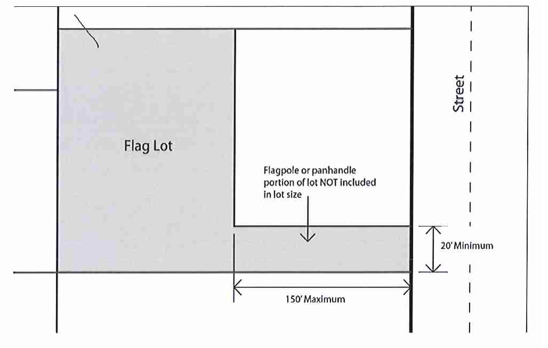
- A flag or L-shaped lot shall be comprised of a staff portion contiguous with the flag portion thereof.
- The staff portion of said lot shall be regulated as a private lane and shall front on and be contiguous to a dedicated public street or private street.
- No building or construction, except for driveways, shall be allowed on the staff portion of said lot, unless the minimum width thereof is the same or greater than the minimum width for a lot as allowed in the underlying zone (excluding entrance features and street lights).
- The front side of the flag portion of said lots shall be deemed to be that side nearest to the dedicated public street or private street upon which the staff portion fronts, unless otherwise determined by staff on a case-by-case basis.
- The staff portion of said lots shall be deemed to end, and the flag portion of said lots shall be deemed to commence at the extension of the front lot line.
- The square footage located in the flag portion of said lot, which shall be exclusive of the square footage located in the staff portion of said lot, shall be the same or greater than the minimum square footage as required in the underlying zone.
- The front, side and rear yard requirements of the flag portion of said lots shall be the same as is required in the underlying zone.
- No more than two flag lots can be served by the staff portion.
- The maximum number of flag lots in the subdivision shall be not more than 20 percent of the total number of lots within the subdivision, unless otherwise approved by the Planning Commission. The Planning Commission may allow more than 20 percent if the subdivision is an infill development and the lot configuration is the most efficient use of land.
- The approved building envelope shall be illustrated upon the final plat.
- No flag lots shall be permitted at the end of an approved cul-de-sac or other private road terminus.
- Below is an example of a flag lot and is included herein to illustrate the concept of flag or L-shaped lots.
(LDC 2008, § 15A-21-22; Ord. No. 14-29, 9-28-2014)
Amended by Ord. 19-23 § 1(Exh. A) on 10/8/2019
Amended by Ord. 21-08 § 1(Exh. A) on 3/23/2021
21-21-23 Seismic Areas
Any subdivision or lot on or adjacent to a seismic area shall comply with provisions of the Sensitive Area Overlay Zone.
(LDC 2008, § 15A-21-23)
Amended by Ord. 21-08 § 1(Exh. A) on 3/23/2021
21-21-24 Public Sites And Open Spaces
Where deemed appropriate by the Planning Commission, upon consideration of the particular type of development proposed in the subdivision, the Planning Commission may require the dedication or reservation of such areas for schools, parks, and other neighborhood purposes.
(LDC 2008, § 15A-21-24)
Amended by Ord. 21-08 § 1(Exh. A) on 3/23/2021
21-21-25 Waivers And Special Exceptions
Any waiver or special exception authorized by the Planning Commission as allowed in this title shall be shown on the final plat and the reasons for them shall be entered in writing in the minutes of the Planning Commission meeting.
(LDC 2008, § 15A-21-25)
Editor's note(s)—Ord. No. 19-23, § 1(Exh. A), adopted Oct. 8, 2019, changed the title of § 21-21-25 from Waivers to Waivers and Special Exceptions.
Amended by Ord. 19-23 § 1(Exh. A) on 10/8/2019
Amended by Ord. 21-08 § 1(Exh. A) on 3/23/2021

