
Sandy City Zoning Code
CHAPTER 21
27 GRADING AND EXCAVATING
21-27-1 Purpose
- The purpose of this chapter is to establish minimum requirements for grading, filling, and excavation work, and the procedures by which these requirements may be complied with and enforced.
- Compliance with the regulations of this chapter in no sense excuses the developer from the applicable requirements outlined elsewhere in this title, the International Building Code (IBC), the International Residential Code (IRC), or any more restrictive provisions of covenants, agreements, or other ordinances or laws, or from obtaining any easements or authorization for grading on property not owned by the developer.
(LDC 2008, § 15A-27-01)
Amended by Ord. 21-08 § 1(Exh. A) on 3/23/2021
21-27-2 Application For Grading And Excavating Permit
- Applications for a grading and excavating permit shall be filed in writing by the property owner or legally authorized agent thereof with the Director.
- The application shall include grading, filling, and excavating plans submitted by a professional engineer licensed by the State of Utah. The plans shall be stamped, signed, and dated. In addition, any required fees, as adopted by the City Council, must be paid.
- A separate application and permit are required for work to be done on each individual project site. If grading, filling, or excavation occurs prior to obtaining a permit, it shall be subject to penalties and abatement procedures, except as otherwise specified.
- In granting any permit, the Director or his representative may attach conditions deemed necessary to prevent creation of a nuisance or hazard to public or private property and to assure completion of the grading, including, but not limited to:
- Improvement of any existing grading to bring it up to the standards of this chapter or the recommendations of the City Engineer.
- Requirements for fencing or protection of grading that would otherwise be hazardous.
- Dust, mud, erosion control, revegetation, noise control, hours of operation, sequence of work, weather condition requirements, and haul routes.
- Time allowed for the work to be completed.
- Construction staking.
- Posting of guarantee for improvements.
- Storm Water Pollution Prevention Plan (SWPPP) and Notice of Intent (NOI) are required according to the requirements identified in Sandy City Standard Specifications.
(LDC 2008, § 15A-27-02; Ord. No. 15-22, 7-15-20151)
Amended by Ord. 21-08 § 1(Exh. A) on 3/23/2021
21-27-3 Final Review And Approval
- Submission to Director. A complete set of plans, including profiles, cross-sections, and specifications, along with all other required documents, shall be submitted to the Director with each application for a grading permit and when otherwise required by the Director for enforcement of any provisions of this chapter.
- Review by City Engineer. Before a final grading permit may be issued by the Director, the final grading plans, application, and all other required documents must be reviewed and approved by the City Engineer and any other departments or commissions deemed necessary to ensure that all applicable engineering standards and Building Code requirements have been met.
- Issuance of Permit. When the final plans and other required documents have been approved as provided and ordinance requirements met, a grading permit may be issued by the Director.
(LDC 2008, § 15A-27-03; Ord. No. 15-22, 7-15-2015
Amended by Ord. 21-08 § 1(Exh. A) on 3/23/2021
21-27-4 Distribution And Use Of Approved Plans
The applicant shall supply reproductions of approved, stamped, and dated plans for use by the project work crew. One or more sets of approved plans shall be retained on the site at all times during the work. If work is performed without the latest revised set of approved, stamped, and dated plans at the work site, a stop-work order may be issued by the City Engineer or a building official causing work to cease. The stop-work order will remain until such time as approved, stamped, and dated plans are obtained, and the order is released.
(LDC 2008, § 15A-27-04)
Amended by Ord. 21-08 § 1(Exh. A) on 3/23/2021
21-27-5 Compliance With Permit Requirements And Plans
The developer shall be responsible for compliance with the requirements of this chapter and related laws, including, but not limited to, the IBC, IRC, AASHTO specifications, the Development Code, Public Utilities Development Standards and Requirements, Storm Water Design Criteria, Jordan Valley Municipalities Permit (Permit UTS000001), Utah Construction General Permit (Permit UTR00000), where required, and the Sandy City Standard Specifications and Details for Municipal Construction (SCSSDMC).
(LDC 2008, § 15A-27-05; Ord. No. 15-22, 7-15-2015)
Amended by Ord. 21-08 § 1(Exh. A) on 3/23/2021
21-27-6 Modification Of Approved Plans
- Proposed modifications that substantially change the location or scope of grading shall be submitted to and approved in writing by the Director and City Engineer prior to modification.
- All necessary soils and geological information and design details shall accompany any proposal to modify the approved grading plans.
- The modification shall be compatible with any subdivision plat or land use requirements.
(LDC 2008, § 15A-27-06)
Amended by Ord. 21-08 § 1(Exh. A) on 3/23/2021
21-27-7 Responsibility Of The Developer
- Protection of Utilities. The developer shall be responsible for the prevention of damage to any public utilities or services.
- Protection of Adjacent Property. The developer shall be responsible for the prevention of damage to adjacent property.
- Inspection Notice. The developer shall notify the Director and City Engineer at least 48 hours prior to the start of work.
- Temporary Erosion Control. The developer shall put into effect and maintain all precautionary measures necessary to protect adjacent watercourses and public or private property from damage by water erosion, blowing dust, flooding, or deposition of mud or debris originating from the site.
- Permit to Work in Public Right-of-Way. The developer shall obtain a separate permit from the Public Works Department for any work performed within a Sandy City right-of-way (see SCSSDMC). Permits for work in other public rights-of-way shall be obtained from the appropriate authority.
- Traffic Control and Protection of Streets. The developer shall provide flag men, signs, barricades, etc., to ensure adequate safety when working in or near public streets. Developers shall comply with all applicable City ordinances, state laws, and the current edition of the Manual on Uniform Traffic Control Devices.
- Hazards From Existing Grading. Whenever the Director and City Engineer determine that any existing excavation, cut, or fill has become a hazard to persons or property, or adversely affects the safety, use, or stability of a public right-of-way or drainage channel, the developer/owner of the property upon which the excavation, cut, or fill is located, or other person or agent in control of said property, upon receipt of notice in writing from the Director or City Engineer, shall, within the period specified therein, repair, reconstruct, or remove such excavations, cut, or fill to eliminate the hazard. The Director or City Engineer shall have authority to cause any situation deemed by the City to be a hazard resulting from such grading to be remedied to the satisfaction of the Director or City Engineer. The party responsible for grading shall promptly pay the City for any costs or expenses incurred by the City for such work. If payment is not received within 30 days of notice, the City may make demand upon the guarantee that was required prior to issuance of any grading permit.
- Tracking of Dirt onto Public Streets. The developer shall provide for adequate cleaning of equipment to prevent the tracking of dirt and debris onto public streets and shall be responsible for cleaning streets in a manner and at intervals as required by the City Engineer.
- Maintenance of Waterway and Irrigation Canals. The developer shall take all necessary measures to protect and maintain the flow of waterways and irrigation canals. The developer shall obtain any permit required by the jurisdictional authority for the waterway or canal.
(LDC 2008, § 15A-27-07)
Amended by Ord. 21-08 § 1(Exh. A) on 3/23/2021
21-27-8 Design Standards
The following shall be considered to be the minimum required standards for cuts, fills, drainage, dust, mud control, erosion control, revegetation, and maintenance, unless otherwise determined by the City Engineer upon review of the plans:
- Cuts.
- Maximum Slope.
- Cuts shall not be steeper in slope than two horizontal to one vertical, unless a soils engineering and an engineering geology report is filed with the Director certifying that the site has been investigated and indicates that the proposed steeper slope will be stable and will not endanger any private or public property or result in the harmful deposition of debris on any public or private property and any public right-of-way or interfere with any existing drainage course.
- The Director and City Engineer may require the excavation to be made with a cut face flatter in slope than two horizontal to one vertical (2:1) for stability and safety. Cut slopes shall be rounded into the existing terrain to produce a contoured transition from cut face to natural ground.
- Drainage Terraces. Cut slopes exceeding 30 feet in vertical height shall have drainage terraces at vertical intervals not exceeding 25 feet. Where only one terrace is required, it shall be at approximately mid-height, unless some other location is approved by the Director and City Engineer. The design and construction of the drainage terraces shall conform to the requirements of this chapter and the International Building Code, as adopted.
- Expansive Soils. If during the grading operation expansive soil is found within two feet of the finished lot grade of any area intended or designed as the location for a building, the expansive soil shall be removed from such building area to a depth specified by a licensed professional civil engineer and replaced with properly compacted nonexpansive soil. The City Engineer may approve other procedures such as footing designs or floor slab designs certified by a professional engineer to alleviate any problem created by such expansive soil.
- 100-Year Storm. No cut shall be allowed in a natural drainage course without a mitigation plan indicating the allowable passage of a 100-year storm that has been approved by the appropriate agency.
- Maximum Slope.
- Fills.
- Layers. Fills shall be constructed in layers and conform with SCSSDMC. Completed fills shall be stable masses of well-integrated material bonded to adjacent materials and to the materials on which they rest. Fills shall be competent to support anticipated loads and be stable at the design slopes shown on the plans. Proper drainage and other appropriate measures shall be taken to ensure the continuing integrity of fills.
- Compaction. All fills shall be compacted throughout their full extent and conform with SCSSDMC. The developer shall perform sufficient tests as determined by the City Engineer to ensure compliance with the provisions of the City standards. The City Engineer may require that an investigation be made by a soils laboratory to establish the characteristics of the soil, the amount of settlement to be expected, and the susceptibility of the soil to erosion or slippage.
- Preparation of Ground to Receive Fill. The natural ground surface shall be prepared to receive fill by removing vegetation, noncomplying fill, top soil, or other deleterious material, and where slopes are five horizontal to one vertical (5:1) or steeper by benching into competent material. The lowermost bench shall be at least ten feet wide, except where recommended by the City Engineer. Subdrains shall be provided under all fills placed in natural drainage courses and in other locations where seepage is evident. Such subdrainage systems shall be of a material and design approved by the City Engineer and acceptable to the Director. The location of the subdrains shall be shown in plan and elevation views on the plan. Such drains shall be designed to accommodate runoff of a 100-year storm. No fill shall be allowed in a natural drainage course without a mitigation plan approved by the appropriate agency.
- Fill Slopes. No fill shall be made which creates an exposed surface steeper in average slope than two horizontal to one vertical (2:1), exclusive of benches and rounds described herein, unless permitted by the Director and City Engineer after receipt of a report by a licensed professional civil engineer based on appropriate laboratory tests certifying the steeper slope will be stable and will support erosion control plantings, when required by the City. The Director and City Engineer may require that the fill be constructed with an exposed surface flatter than two horizontal to one vertical (2:1), or may require such other measures as they deem necessary for stability and safety. Fill slopes shall be rounded into existing terrain to produce a contoured transition from fill face to natural ground and abutting cut or fill surfaces where conditions permit.
- Fill Material. No organic material shall be permitted in fills. Rock or similar irreducible material with a maximum dimension greater than 12 inches shall not be buried or placed in fills within two feet of a finished grade. When such greater sized material is placed in fills, it shall be done in accordance with specifications prepared by the City Engineer (see SCSSDMC).
- Drainage Terraces. Fill slopes exceeding 30 feet in vertical height shall have drainage terraces at vertical intervals not exceeding 25 feet. Where only one terrace is required, it shall be at approximately mid-height, unless some other location is approved by the Director and City Engineer. Such drainage terraces shall be at least six feet wide and shall be designed and constructed to provide a swale or ditch having a minimum depth of one foot and a longitudinal grade of not less than four percent or more than 12 percent. There shall be no reduction in grade along the direction of flow unless the velocity of flow is such that slope debris will remain in suspension on the reduced grade. Downdrains or drainage outlets shall be provided at approximately 300-foot intervals along the drainage terrace or an equivalent location. Downdrains and drainage outlets shall be of approved materials and of adequate capacity to convey the intercepted waters to the point of disposal. The terrace, including the swale or ditch, shall be protected from erosion by a drainage way that discharges into a safe disposal area. If the drainage discharges onto natural ground, adequate erosion protection shall be provided.
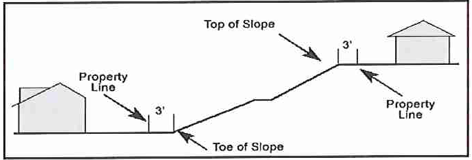
- Slopes to Receive Fill. Fill placed on the top of an existing or proposed cut or natural slope shall be set back a minimum distance of three feet measured horizontally from the edge of the cut or slope.
- Expansive Soils. In areas intended or designed to support buildings, expansive soil shall not be placed within two feet of the finished grade unless recommended by a licensed professional civil engineer based on laboratory tests and the certification that a design of footings or floor slab or other procedure will alleviate problems created by placing the expansive soil within such building areas as reviewed and approved by the Director and City Engineer.
- Drainage/Disposal Requirements. All drainage facilities shall be designed to carry surface and subsurface waters to the nearest practical street, storm drain, or natural watercourse as approved by the Director and City Engineer. Adequate provisions shall be made to avoid damage to adjacent and downstream properties. The following additional restrictions also shall apply:
- Water shall not pond above cut or fill slopes or on drainage terraces. Adequate drainage facilities shall be provided to prevent such ponding.
- Areas designed for buildings shall be graded to provide for at least a two percent slope away from the building for a minimum of six feet.
- All drainage facilities shall meet Sandy City Standard Specifications.
- All provisions of the most current Sandy City Storm Water Ordinance, Sandy City Land Development Code, Sandy City Standard Specifications and Details, Public Works Development Standards and Requirements, Storm Water Design Criteria, Jordan Valley Municipalities Permit (Permit UTS000001), and Utah General Construction Permit (Permit UTR00000) shall be complied with.
- Erosion Control.
- Slope Protection. Provisions shall be made to minimize damage to the face of cuts and fills. Downslopes shall be protected from surface water runoff from above by dikes, swales, cutoff ditches, or other facilities approved by the Director and City Engineer.
- Dikes, Swales, and Ditches. When required, dikes, swales, ditches, or other methods approved by the Director and/or the City Engineer shall be designed and constructed to control runoff and erosion from graded areas. Where concentrated drainage discharges onto natural ground, effective measures shall be taken to dissipate the energy and, where practical, release the accumulated waters as sheet flow unless the discharge is directed into a storm sewer or natural watercourse.
- Storm Water Pollution Prevention Plan (SWPPP) and Notice of Intent (NOI) are required according to the requirements identified in Sandy City Standard Specifications.
(LDC 2008, § 15A-27-08; Ord. No. 15-22, 7-15-2015)
Amended by Ord. 21-08 § 1(Exh. A) on 3/23/2021
Amended by Ord. 26-50 on 7/2/2026
21-27-9 Soil Erosion/Blowing Dust As A Public Nuisance
- Declaration of Nuisance. Soil erosion caused by wind and dust storms produced thereby and blowing of dust, soil, and sand are hereby declared to be destructive of property and natural resources of the City and are harmful to the health and well-being of the residents of the City. The City Council does hereby declare conditions causing, allowing, or maintaining blowing dust, soil, or sand to be public nuisances.
- Duty of Landowner. To conserve property and the natural resources of the City and to prevent injurious effects of blowing dust, soil, or sand, it is the duty of the owner of real property and all responsible parties to prevent by appropriate means the blowing of dust, soil, or sand.
- Action by City Engineer. When the City Engineer is advised of blowing dust, soil, or sand and is supplied with a description of such nuisance, or when, by reason of such blowing, the streets or other public property are damaged, the City Engineer is authorized to immediately inspect or cause to be inspected the source of such blowing dust.
- Should the City Engineer, or City UPDES Inspector, determine that such blowing is injurious to persons, property, streets, public property, or public health and convenience, the City Engineer shall then determine what may be done to prevent or lessen such nuisance.
- Should the City Engineer determine that such blowing dust, soil, or sand can be prevented or lessened, he is hereby authorized to issue an order to the responsible party specifying the nature of the nuisance, the treatment required, the extent thereof, the date by which such treatment is to be commenced, and the date such treatment is to be completed. Notice of such order shall be served on the responsible party in person by the City Engineer or his representative, or by certified mail to the last-known address of the responsible party.
- Method of Enforcement. If the treatment ordered by the City Engineer is not performed in a timely manner and to the extent specified in the order, and if no appeal is made; or, if it is not performed in the manner to the extent and within the time specified in the order or amendment thereof or within three days of any decision as a result of an appeal of an order issued by the City Engineer, the City Attorney may bring an action for abatement of the blowing condition as authorized by the provisions of this title. The bond may be declared forfeited in the amount necessary to complete the treatment required plus 50 percent service charge or may bring a criminal action.
- Revegetation.
- Vegetation Loss. The loss of trees, ground cover, and topsoil shall be minimized on any grading project. In addition to mechanical methods of erosion control, graded areas shall be protected to the extent practical from damage by erosion by planting grass or ground cover plants and trees. Such plantings shall provide for rapid, short-term coverage of the areas as well as long-term permanent coverage. A plan by a landscape architect may be required by the Director and/or the City Engineer.
- Timing of Planting. Weather permitting, the planting shall be completed not more than 30 days after completion of the grading or a portion thereof on large projects.
- Vegetation Removal. If the project is abandoned after vegetation removal has taken place, the area shall be planted as provided herein. If the work is suspended for an extended period, the Director and/or the City Engineer may require the developer to provide temporary planting as needed to control wind and water erosion.
- All areas on development sites cleared of natural vegetation in the course of construction of off-site improvements shall be replanted with vegetation that has good erosion control characteristics.
- No vegetation shall be removed on a continuous hillside, crest (upslope or downslope) or a slope 30 percent or greater unless otherwise determined by the Planning Commission upon recommendation of the City Engineer for uses such as trails and open space improvements. Any revegetation of such a hillside shall have the approval of the City Engineer.
- All disturbed soil surfaces shall be stabilized or covered prior to November 1. If the planned impervious surfaces (e.g., road, driveways, etc.) cannot be established prior to November 1, a temporary treatment adequate to prevent erosion shall be installed on those surfaces.
- The property owner and/or developer shall be fully responsible for any destruction of native or applied vegetation identified as necessary for retention and shall be responsible for such destroyed vegetation. They shall carry the responsibility both for employees and subcontractors from the first day of construction until the final acceptance of improvements. The property owner and developer shall replace all destroyed vegetation with varieties of vegetation approved by the Planning Commission. The property owner shall assume co-responsibility with the developer upon purchase of the lot.
- Maintenance.
- Irrigation. Areas required to be planted shall be provided with an approved system of irrigation where needed for planting propagation and continued maintenance. The plans shall be submitted and approved as a part of the grading permit. If hose bibs are installed, they must be at conveniently accessible locations where a hose no longer than 50 feet is necessary for irrigation.
- Irrigation System Modification. The requirement for a permanent irrigation system may be modified upon the recommendation of a landscape architect based on the type of plants selected, the planting methods, and the soil and climatic conditions at the site as approved by the Director and/or the City Engineer.
- Establishment of Planting. The planting and irrigation system required by this section shall be installed as soon as practical after rough grading. Prior to final approval of grading and before the release of the guarantee for improvements, the planting shall be well established.
- Other Standards. In addition to the standards found in the SCSSDMC, the Director and City Engineer may adopt other supplementary engineering standards as may be appropriate for the carrying out of the provisions of this chapter.
(LDC 2008, § 15A-27-09; Ord. No. 15-22, 7-15-2015)
Amended by Ord. 21-08 § 1(Exh. A) on 3/23/2021
21-27-10 Guarantee For Improvements Required
A guarantee shall be required to assure performance of the work on the project. A permit shall not be issued for grading and excavating unless the permittee first posts a guarantee in a form acceptable to the City in an amount sufficient to cover the costs of the required work as determined by the City Engineer.
(LDC 2008, § 15A-27-10)
Amended by Ord. 21-08 § 1(Exh. A) on 3/23/2021
21-27-11 Reports And Construction Requirements And Procedures
- Reports.
- Soils Engineering Report. The City Engineer may require a soils engineering investigation and a report by a qualified engineer based on the most recent Grading Plan. Such report shall include laboratory tests and data regarding the nature, distribution, and strength of existing soils; conclusions and recommendations for grading procedures; and design criteria for corrective measures.
- Engineering Geologic Report. Based on the proposed grading and land use plans and geologic hazard maps, the Director and/or City Engineer may require an engineering geologic investigation prior to issuing the permit. When required, the engineering geologic report shall include an adequate description of the geology of the site and conclusions and recommendations regarding the effect of geologic conditions on the proposed grading and land use. Reports may include fault studies, rock fall studies and other studies as needed.
- Reports Approved by the City Engineer. All reports shall be subject to the approval of the City Engineer, including supplemental reports and data as may be required by the City Engineer. Recommendations included in the reports and approved by the City Engineer shall be incorporated in the grading plans or specifications.
- Final Reports. The City Engineer may require final reports, including, but not limited to, certification of slope stability and soil bearing capacity, summaries of field and laboratory tests, locations of tests, recommendations regarding building restrictions or foundation setbacks, and other information determined to be necessary by the Director and/or the City Engineer. The final soils or engineering geologic report shall be based on the as-built Grading Plan and shall specifically contain approval of the grading as affected by soils or geologic factors. A revised geologic map and cross-sections may be required.
- Construction Requirements and Procedures.
- Authorization of Private Civil Engineer to Inspect the Work. Upon request, the Director and/or City Engineer may authorize a private licensed professional civil engineer to perform the inspection work and certify compliance with the approved plans and render any required reports. The permittee shall make his own contractual arrangements for such engineering services and be responsible for payment of all costs.
- Changes in Plans. The permittee shall cause the work to be done in accordance with the approved plans and any instructions or recommendations by the private engineer. If, during the course of construction, the engineer finds that the work is not being done in accordance with the approved plans and specifications, he shall immediately notify the person in charge of the work and the Director and City Engineer in writing of the nonconformity and the corrective measures to be taken. When changes in the plans are required, he shall prepare such proposed changes and submit them to the Director and City Engineer for approval.
- Notification of Work Completion. When the grading work has been completed, the Director and the City Engineer shall be notified. Final approval and release of the guarantee for improvements shall not be granted until all the work has been completed and the as-built Grading Plan and any required reports have been submitted and approved by the Director and City Engineer.
- Guarantee for Improvements. The City Engineer, with concurrence of the Director, may release the guarantee for improvements, with the exception of that portion held for guarantee and warranty of the work, upon satisfactory completion and inspection of the approved grading or excavation.
(LDC 2008, § 15A-27-11)
Amended by Ord. 21-08 § 1(Exh. A) on 3/23/2021
21-27-12 Prohibitions And Exemptions
- Prohibitions. No person shall do any grading, cuts, or fills, or cause or allow the same to be done on real property that he owns or controls without first obtaining a grading permit, unless exempt hereunder.
- Exemptions. The following grading may be done without obtaining a permit provided it meets the applicable exemption requirements, does not endanger adjacent property, divert or impair the flow of water in a watercourse, or cause a public nuisance. Any grading work that is done without a permit and not conforming to these limitations and the exemption provisions herein shall be deemed a violation subject to penalties and abatement procedures.
- Minor Projects. Minor projects which have cuts or fills, both of which are less than five feet in vertical depth at their deepest points measured from the natural ground surface, and both of which are less than 150 cubic yards of material on any one site and do not create significantly unstable slopes.
- Government Projects. Grading on projects not requiring a building permit to be done by or under the supervision of the City Engineer or construction control of a governmental agency (where that agency assumes full responsibility for the work). All such grading shall be shown on the approved plans and be inspected and approved by the City Engineer.
- Valid Building Permit. Grading in connection with a building, swimming pool, retaining wall, or other structure shall be authorized by a valid building permit. All such grading shall be shown on the approved plans and inspected and approved by the Chief Building Official and City Engineer. This exemption shall not affect the applicability of this chapter, nor the requirements for a grading permit for any excavation having an unsupported vertical bank greater than five feet in height after the completion of such structure, or any fill that is removed from the site or not shown on approved plans and inspected.
- Agriculture. Grading done exclusively for the growing of agricultural crops or the raising of livestock.
- Excavations for Soils or Geological Investigations by a Soils Engineer or Engineering Geologist. Such work shall be backfilled and shaped to the original contour of the land under the direction of the soils engineer or engineering geologist immediately after the investigation or within 45 days after the start of the work, whichever is sooner. All work shall conform with the latest edition of the SCSSDMC.
- Cemeteries. Excavation or deposition related to grave sites.
- Exemption for Dumps, Mines and Quarries. Grading within the site of a refuse disposal dump, sanitary landfill, quarry or plant for excavating and the processing and stockpiling of rock, sand, gravel, aggregate or clay, provided that such grading or other activities are established and operated in accordance with all laws and the requirements of all permits. Except in the event of reclamation, all City standards must be adhered to.
- Maintenance of Existing Firebreaks and Roads. Maintenance shall mean keeping the firebreak or road in substantially the same condition it has been in previously. Prior to the first maintenance or new construction operation for each existing firebreak or road or portion thereof, a permit shall be obtained from the Director and/or City Engineer as provided herein.
- Permit Denial for Geologic or Flood Hazard. If the Director and/or City Engineer determines that the land area in which grading is proposed is subject to a geologic or flood hazard that no reasonable amount of corrective work can eliminate or sufficiently reduce the hazard, a grading permit may be denied.
- Violation of Other Ordinances. The Director and/or City Engineer shall not issue a grading permit unless all proposed land uses shown on the application or the grading plans for the site will comply with all provisions of this title and all other applicable ordinances.
(LDC 2008, § 15A-27-12)
Amended by Ord. 21-08 § 1(Exh. A) on 3/23/2021
21-27-13 Appeals
Any person adversely affected by a decision of the Director, and/or the City Engineer, may file an appeal in writing pursuant to the provisions of this title.
(LDC 2008, § 15A-27-13)
Amended by Ord. 21-08 § 1(Exh. A) on 3/23/2021

