
Miami Dade County Unincorporated
City Zoning Code
City Zoning Code
ARTICLE IV
TOWERS, POLES AND MASTS5
Cross reference— Height of buildings not applicable to church steeples, spires, domes, etc., § 33-55.
Sec. 33-60.- Compliance with article.
(a)
Before erection of a water tower, standpipe, windmill, tower or mast for any purpose, over ten (10) feet in height above the roof of a structure or over twenty (20) feet in height if erected on natural ground, the requirements of this article and the construction requirements of the South Florida Building Code shall be observed. All towers, poles, and masts requiring notice to the Federal Aviation Administration (FAA) as prescribed in Federal Aviation Regulations (FAR) Part 77, shall be lighted as specifically recommended by the FAA in the determination rendered to the proponent's notice of proposed construction. In addition, for all towers, poles, and masts not requiring notice to the FAA which are one hundred fifty (150) feet or higher above grade in height, one (1) flashing red beacon safety light will be required for each one hundred fifty (150) feet in height. The peak effective intensity of said lights should not be less than one thousand five hundred (1,500) candles (in red) when measured at any horizontal angle. The flashing mechanism should not permit more than forty (40) nor less than twenty (20) flashes per minute. The beacons shall conform to Federal Aviation Administration type L-866 (red) or Military Specification L-6273. All existing towers, poles, and masts, which are one hundred fifty (150) feet or higher above grade shall be made to conform with those requirements by May 1, 1989. This section shall be applicable and enforceable in the incorporated and unincorporated areas of Miami-Dade County.
(b)
Until December 31, 2008, telecommunications antennas owned and operated by a telecommunications company providing services to the public for hire attached to any pole or H-frame or lattice structure owned by a utility which is used in and is part of the utility's network for the provision of electric services, shall be permitted in any zoning district, provided that (a) equipment appurtenant to the antenna is maintained on the utility pole or structure, (b) the utility pole or structure does not exceed one hundred twenty-five (125) feet in height above ground unless the utility pole or structure is located in an easement or right-of-way which is greater than fifty (50) feet in width or, if less than fifty (50) feet in width, such easement or right-of-way is adjacent to and parallel with road right-of-way which is one hundred (100) feet or greater in width, and (c) the antenna was attached to the utility pole or structure prior to January 1, 1997.
(Ord. No. 57-19, § 28(B), 10-22-57; Ord. No. 88-2, § 1, 1-19-88; Ord. No. 88-125, § 1, 12-20-88; Ord. No. 98-173, § 2, 12-1-98)
Sec. 33-61. - Plans and specifications to accompany application for permit.
Plans and specifications for the structures provided in Section 33-60 shall be submitted to the Director showing all dimensions, size and kind of members, footings, guy wires; location, depth and type of guy anchors and footings, type and weight of antenna, apparatus or structures to be attached to or supported by the structure, and application made for permit.
(Ord. No. 57-19, § 28(B)(1), 10-22-57)
Sec. 33-62. - Height and Setback.
No part of any tower, pole or mast shall be higher than ninety (90) percent of the horizontal distance from its foundation at ground elevation to the nearest point on adjacent property under another ownership or to the nearest edge of a highway right-of-way. It is provided, however, that in the BU-3 or IU zoning districts, the following structures 150 feet or less in height above ground elevation shall not be subject to the required setback: (a) radio towers where incidental to a business or industrial use on the premises, or (b) wireless supported service facilities whether a principal or incidental use; provided, however, that such installation under (a) or (b) shall conform to the provisions of all airport zoning regulations contained herein.
(Ord. No. 57-19, § 28(B)(2), 10-22-57; Ord. No. 66-3, § 1, 2-1-66; Ord. No. 02-153, § 1, 9-12-02)
Sec. 33-62.1. - Reserved.
Editor's note— Ord. No. 95-95, § 1, adopted June 6, 1995, repealed former § 33-62.1, relative to communication poles, which derived from Ord. No. 93-53, § 1, adopted May 20, 1993.
Sec. 33-63. - Antennas for amateur radio stations.
Poles, masts and towers for supporting antenna used in the operation of amateur radio stations licensed by the Federal Communications Commission shall be excepted from the above regulations and shall be governed by the following requirements:
(a)
Location on property. All such poles, masts and towers shall be placed no closer than five (5) feet to an official right-of-way line or to property under different ownership, or closer than one (1) foot to an easement. If beam (array) type of antenna installed, no element or part of such beam type array antenna shall extend closer than five (5) feet to an official right-of-way line and/or the property under different ownership or closer than one (1) foot to an easement.
(b)
Compliance with electrical codes and federal regulations. All such installations shall conform to the requirements of the National Electrical Code and the F.C.C. regulations, Part 12, Section 12.60 governing amateur radio services. National Electrical Code installation must maintain a minimum of eight (8) feet clearance from power lines over two hundred fifty (250) volts and all high voltage primary lines, and this includes the beam elements or any part thereof.
(c)
Permits. Permits shall be required for installation of any poles, masts or towers over twenty (20) feet above the roof of any structure to which they may be attached, and for any installation over thirty-five (35) feet in height when erected on natural ground. Where permits are required, they shall be obtained from the Department; and applications for permits shall be accompanied by plans and specifications, three (3) copies, showing all dimensions, size and kind of members, footings and guy wires, if any; locations, depth and type of guy anchors and footings, if any, and showing the type and weight of antenna, apparatus or structure to be attached to or supported by the structure.
(d)
Poles, type. Poles shall be of the approved creosoted type or treated or painted with a chemical preservative and an outer coat of oil base paint before installation (Color to match surrounding development).
(e)
Holes. Recommended sizes and depths of holes for various type poles subject to good engineering standards:
If the earth is damp or soggy, the depth of hole is to be increased by one (1) foot.
If the pole is guyed in accordance with American Standards Association standards, the depth of hole as listed in Code can be decreased by one (1) foot. If carrying a beam, poles must be properly guyed, as is the case where pulling effect of wire antenna or weight of other installations will require guying.
(f)
Masts. Masts constructed of wood (2″ x 2″ or 4″ x 4″ for either the "A" frame type construction or straight masts) shall be properly chemically treated, painted with an outside coat of oil base paint and be properly guyed both at the top and middle in at least three (3) different directions, approximately one hundred twenty (120) degrees apart, or otherwise suitably guyed. Masts to support a beam, whether of wood or metal pipe, must comply with all the regulations applicable in regard to location, guying, etc., and the maximum allowable weight of antenna, rotator and components shall not exceed one hundred fifty (150) pounds.
(g)
Towers. Towers of steel, iron or aluminum, whether of the rigid nondemountable type or the rigid, demountable type with the crank-up, crank-down and either the hinged base or swivel crank-over features shall carry no more weight on the top than specified by the manufacturers' specifications.
(h)
Waiver of objection for certain structures; servicing; removal. All poles, masts or towers, and other structures used for antennas under this section, which exceed thirty-five (35) feet in height above grade elevation, or which exceed twenty (20) feet in height above the roof of any structure shall be subject to the following requirements:
If the top of such poles, masts or towers are higher above their foundation, or the foundation of the structure on which they are erected, than ninety (90) percent of the horizontal distance from its base or projected base to the nearest point on adjacent property under different ownership or to the nearest edge of an official right-of-way, then no permit shall be issued for such installation unless a waiver is obtained from each and every owner of adjacent property that the structure could fall upon.
In calculating the height of demountable type towers, the top of the lower rigid section shall be considered the top for the purpose of this subsection.
Beam array antenna shall be so mounted so as to provide easy servicing and easy access for removal at approach of hurricanes, or provide for the lowering of such beam.
(Ord. No. 57-19, § 28(B)(3), 10-22-57; Ord. No. 95-215, § 1, 12-5-95)
Sec. 33-63.1. - Satellite dish antennas.
The standards of this section pertain to privately owned satellite dish antennas and are intended to enable clear television reception for the private use and enjoyment of the dish owner. The standards for commercial telecommunications facilities and antennas associated therewith are enumerated in Section 33-63.2.
(a)
Definition. A Satellite dish antenna (SDA) shall be defined as a device incorporating a reflective surface that is solid, open mesh, or bar configured and is in the shape of a shallow parabolic dish, cone, horn, or cornucopia. Such device is used to transmit and/or receive radio or electromagnetic waves between terrestrially and/or orbitally based uses. This definition is meant to include but not be limited to what are commonly referred to as satellite earth stations and satellite microwave antennas.
(b)
Measuring an SDA. The diameter of an SDA shall be measured to the outermost part of the SDA. The height of an SDA shall be measured from natural grade to the top of the SDA fastened in a vertical position. The setback of an SDA shall be measured from the property line to the nearest portion of the SDA fastened in a horizontal position.
(c)
Permits and exceptions. Unless preempted by Federal Law, no SDA shall be erected unless a building permit is first obtained from the Building Department. Under current Federal Law no permit is necessary for SDA's measuring less than one (1) meter (39.37 inches) in diameter when placed as an accessory use to any single-family residence, duplex or townhouse unit, or less than two (2) meters (78.74 inches) in diameter when placed as an accessory use to any permitted business, industrial, office or multi-family use.
(d)
The trend determination regulations specified in Section 33-196 for the GU (Interim) District shall govern the standards to be utilized in the placement of SDA's within the GU District.
(e)
As an accessory use to any single-family residence, duplex or townhouse, one (1) ground-mounted SDA is permitted per dwelling unit subject to all the following conditions:
(1)
No installation shall exceed fifteen (15) feet in height.
(2)
SDA's must be located behind the front and side street building line of the principal building and a minimum of seventy-five (75) feet from the front property line. SDA's are to be setback from the interior side property lines a minimum of seven and one-half (7½) feet in RU Districts and twenty (20) feet in the EU, AU and GU Districts. The minimum rear setback is seven and one-half (7½) feet.
(f)
As an accessory use to any single-family residence, duplex or townhouse, one (1) roof-mounted or wall-mounted SDA is permitted per dwelling unit in lieu of a ground mounted SDA, subject to all the following conditions:
(1)
A certified engineer's report reflects that clear reception of all satellite transmissions is not possible with a ground mounted SDA under paragraph (e) above;
(2)
The SDA shall be mounted on the rear or interior side wall of the principal building or on the roof to the rear of the actual front building line;
(3)
The SDA shall not exceed ten (10) feet in diameter;
(4)
The height of the proposed installation shall not exceed the maximum height restriction imposed upon principal uses within the underlying zoning district.
(g)
As an accessory use to any business, office or multi-family use, ground-mounted SDA's are permitted subject to all the following conditions:
(1)
The ground mounted SDA shall not exceed sixteen (16) feet in diameter;
(2)
All installations shall comply with the principal building setback requirements specified within the underlying zoning district. The ground mounted SDA shall be located behind the actual front and side street building line;
(3)
No ground mounted SDA shall project beyond the height of the tallest principal building on the lot on which it is erected.
(h)
As an accessory use to any business, office or multi-family use, roof or wall-mounted SDA's are permitted, in lieu of ground-mounted antennas, subject to all the following conditions:
(1)
The SDA shall not exceed sixteen (16) feet in diameter;
(2)
Each SDA must be mounted on the roof to the rear of the front building line or on the rear or non-street side wall of the principal building;
(3)
The height of the SDA shall not exceed seventeen (17) feet above the height of the principal building on which it is placed.
(i)
SDA's are permitted as an accessory use in any Industrial District (IU) subject to compliance with the principal building setback requirements within the underlying zoning district. In Industrial Districts (IU) abutting or across the street from a residential district, SDA's must also comply with all conditions of paragraphs (g) and (h) above.
(j)
Signage of any type is prohibited on SDA's.
(k)
Nothwithstanding the provisions contained in this section to the contrary, the Director shall have the discretion to administratively modify setback requirements when it can be demonstrated through a certified engineer's report that compliance with such setback requirements would hinder clear reception of signals. In such instances, the Director:
(1)
May require that the SDA be buffered with landscaping or screened from view, providing such buffering or screening does not interfere with clear reception;
(2)
Shall ensure that the modification is within the spirit and intent of this section; and
(3)
To the extent possible shall ensure that the SDA installation is compatible with the appearance and character of the neighborhood.
(Ord. No. 87-8, § 2, 3-3-87; Ord. No. 95-215, § 1, 12-5-95; Ord. No. 02-10, § 1, 1-29-02)
Sec. 33-63.2 - Wireless supported service facilities.
(a)
Permitted Districts and Criteria for Antennas.
(1)
Permitted Districts. Antennas used as part of a Wireless Supported Service Facility which are mounted on existing Structures shall be permitted in the following zoning districts subject to the criteria outlined below.
(A)
In hotels, motels, and apartment hotels in an RU-4A district; in all RU-5, RU-5A, OPD, in all business and industrial districts.
(B)
On multi-family residential buildings in an RU-4L, RU-4M, RU-4 and RU-4A district.
(C)
In any district on any structure lawfully being used for any of the following purposes, where the site is located at the intersection of section-line roads, a transition area, or abutting a major roadway as depicted on the Land Use Plan Map of the Comprehensive Development Master Plan, or section center: public or private/nonpublic educational facilities on a site of 10 or more gross acres, hospitals, race tracks, stadiums, or public or private utilities.
(2)
Criteria. Antennas may be located on existing Structures with a height of thirty (30) feet or greater, so long as the Antennas do not extend (i) more than thirteen (13) feet above the highest point of the roof of a building as measured in accordance with the provisions of Section 33-1(17) or (ii) the highest point on the Structure as measured from the average elevation of the finished building site to the top of the structure.
(A)
Except for Cylinder Type Antennas, Antennas shall be screened from view or wall mounted and shall not exceed nine (9) Sectors.
(B)
Where wall mounted, Antennas shall not extend above the wall where located and shall be painted to match the supporting Structure. Wall mounted Antennas shall be limited to one (1) Sector per building elevation.
(C)
Wall mounted Antennas not exceeding the height of the wall where located and painted to match the supporting Structure will be allowed on rooftop elevator bulkheads, rooftop enclosures for mechanical equipment, and rooftop Accessory Wireless Equipment Buildings in addition to (b)(2)(i), above, but shall be limited to one (1) Sector per elevation on the particular rooftop structure where they are placed.
(D)
Where roof mounted:
1.
Requests to install roof mounted Antennas shall be accompanied by a line of sight analysis for each building elevation. The line of sight analysis shall be as provided for in the sketches shown below as Figures 33-63.2(b)(2)iii and iv. In conducting such analysis, the width of the right-of-way shall be equal to the width of the right-of-way fronting the particular elevation.
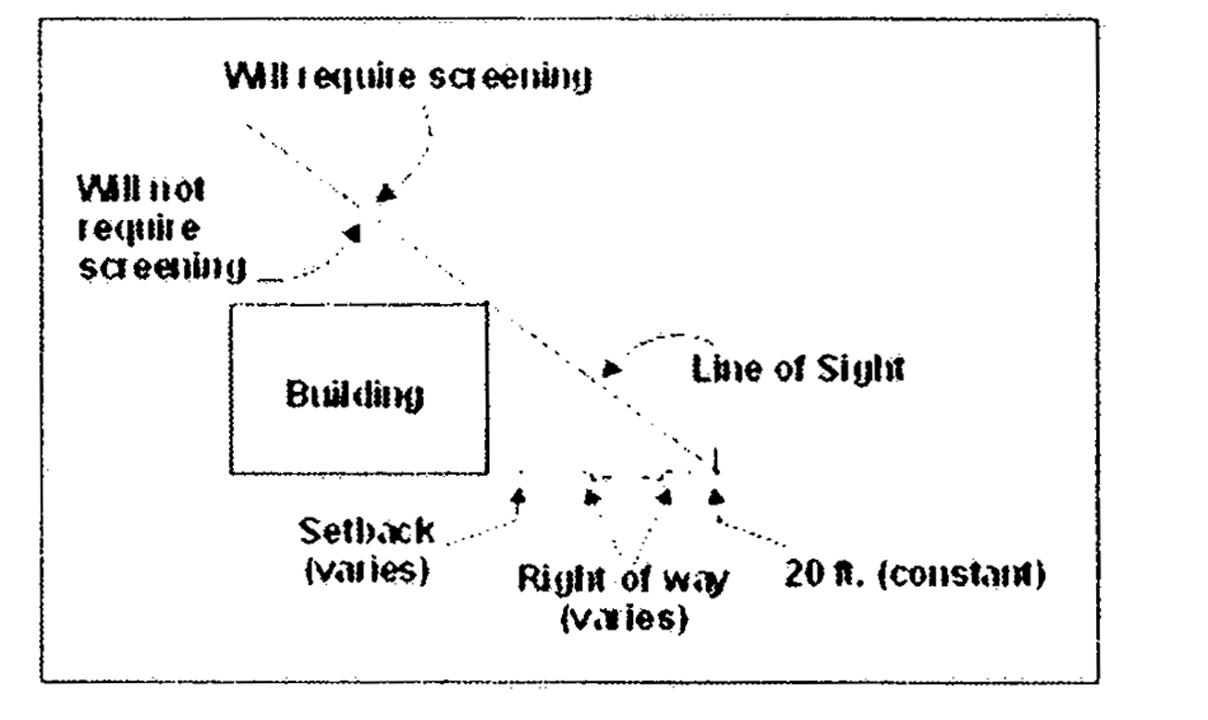
Figure 33-63.2(b)(2)iii
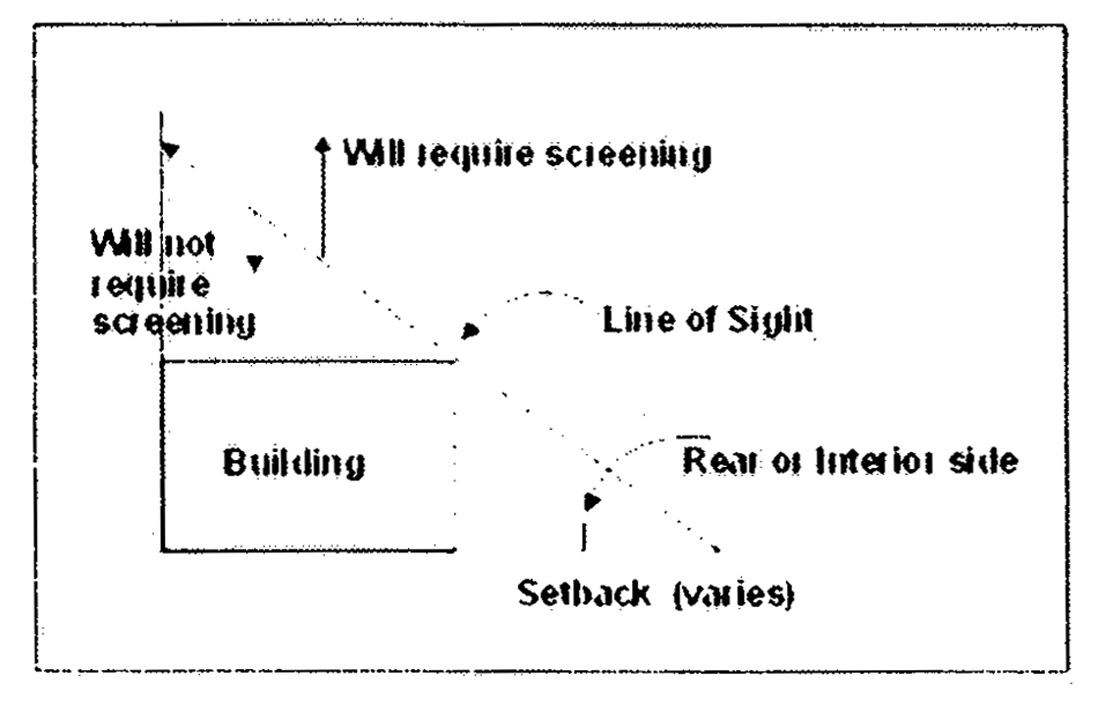
Figure 33-63.2(b)(2)iv
2.
Any Antennas or portion thereof above the line of sight will require screening. All required screening used in conjunction with such rooftop installations shall be architecturally compatible and harmonious in color and materials with the supporting structures and any existing or approved screening on the structure. Screening materials at corners shall be the same length and height on all corners.
(i)
An initial antenna installation within 13 feet of the corner of a structure shall require screening along the rooflines of both sides of the corner to a distance of 13 feet.
(ii)
An initial antenna installation more than 13 feet from the corner of a structure, or the installation of any antenna subsequent to a prior antenna installation, shall provide screening along the entire rooflines from which the line of sight analysis shows that the antenna can be seen.
3.
Cylinder Type Antennas shall be limited to three (3) per Structure and shall be painted to match the Structure.
4.
No sign shall be allowed on an Antenna.
5.
No signals, lights, or illumination shall be permitted on an Antenna, unless required by any applicable federal, state or local rule, regulation or law.
6.
Accessory Wireless Equipment Buildings used in conjunction with Antennas, if located on the ground, shall comply with the minimum principal building setback requirements of the zoning district in which they are located. Self-standing, non sheltered equipment cabinet(s) used in conjunction with Antennas, if located on the ground shall be deemed mechanical equipment similar to air conditioning units and shall be limited to a height not to exceed eight (8) feet and an area not to exceed eighty (80) square feet. There shall be no minimum spacing between Accessory Wireless Equipment Buildings and the building located on the property.
(c)
Permitted Districts and Criteria for Antenna Support Structures.
(1)
Permitted Districts. Wireless Supported Service Facilities including Antenna Support Structures of one hundred (100) feet or less in height used in connection with a Wireless Supported Service Facility shall be permitted in the BU-3 and in all Industrial Districts. For Antenna Support Structures greater than one hundred (100) feet in height in the BU-3 and in the Industrial Districts, and for all Antenna Support Structures, except Antenna Support Structures for broadcast radio and television, in the RU-3M, RU-4L, RU-4M, RU-4, RU4A, RU-5, RU5-A, AU, GU with an agricultural trend determination, BU-1, BU-1A, BU-2, OPD, TND and PAD zoning districts, a public hearing is required pursuant to Section 33-311(A)(18) and this section.
(2)
Criteria.
(A)
Signage.
(1.)
No advertising signs, including commercial advertising, logo, political signs, flyers, flags or banners, whether or not posted temporarily, shall be permitted on any part of the antenna support structures or antenna with the exception of the following:
a.
Warning, danger or other sign designed to maintain public safety;
b.
Any federal, state or municipal flags located on such facilities designed to look like a flagpole; or
c.
Permitted signage associated with the principle use on the property where the principle use incorporates a camouflaged antenna support structure.
(B)
Zoning District. Antenna Support Structures considered for approval under section 33-311(A)(18) of this Code shall meet each of the following requirements, as applicable, except as alternative development options may be approved pursuant to section 33-311(A)(18)(b).
1.
In the BU-1, BU-1A, RU-5, and RU-5A zoning districts:
a)
A stealth or camouflaged Antenna Support Structure shall be designed to resemble a natural object or a man-made structure (i.e. tree, bell tower, clock tower, church steeple, flag pole, etc.), shall be located on a minimum one (1) gross acre parent tract and
1)
shall be a camouflaged artificial tree or flagpole not exceeding 150 feet in height; or
2)
shall be designed to serve a purpose other than supporting antennas (i.e., lighting of sports facilities, transmission of electrical and/or telephone lines, flag poles); or
3)
shall be designed to be harmonious with the architectural elements of the surrounding structures, such as bulk, massing and scale of surrounding properties; or be designed to blend and be harmonious with the principal structure on the property on which the Antenna Support Structure is proposed to be constructed and installed.
b)
A non-camouflaged Antenna Support Structure shall not exceed 125 feet in height and shall be located on a minimum one (1) gross acre parent tract.
2.
In the AU zoning district and the GU zoning district with an agricultural trend determination:
a.
non-camouflaged Antenna Support Structures shall be located on a minimum five (5) gross acre parent tract, and
b.
no Antenna Support Structures shall exceed 200 feet in height.
3.
In all RU-3M, RU-4L, RU-4M, RU-4, and RU-4A zoning districts non-camouflaged Antenna Support Structures shall not exceed 150 feet in height, and shall not exceed 125 feet in height if located on a parcel where the immediate vicinity contains any existing single-family or duplex residential dwelling or is zoned for single-family or duplex dwellings.
4.
In all BU-3, IU-1, IU-2, IU-3, and IU-C zoning districts, a non-camouflaged Antenna Support Structure shall not exceed 200 feet in height.
5.
In all OPD and BU-2 zoning districts, a non-camouflaged Antenna Support Structure shall not exceed 200 feet in height.
6.
On properties zoned PAD or TND, location and design criteria for Antenna Support Structures and related equipment buildings shall be controlled as part of the conditions of approval of the PAD or TND agreement and any amendments thereto, in accordance with the applicable requirements of section 33-284.24 or section 33-284.46 and section 33-246.47 of this Code.
[3]
No signals, lights, or illumination shall be permitted on the Antenna Support Structure or the Antennas, unless required by any applicable federal, state or local rule, regulation or law.
[4]
Accessory Wireless Equipment Buildings used in conjunction with Antenna Support Structures and Antennas, if located on the ground, shall comply with the minimum principal building setback requirements of the zoning district in which they are located. Self-standing, non sheltered equipment cabinet(s) used in conjunction with Antenna Support Structures or Antennas, if located on the ground shall be deemed mechanical equipment similar to air conditioning units and shall be limited to a height not to exceed eight (8) feet and an area not to exceed eighty (80) square feet. There shall be no minimum spacing between Accessory Wireless Equipment Buildings and the building located on the property.
(Ord. No. 01-02, § 2, 1-23-01; Ord. No. 01-157, § 1, 9-25-01; Ord. No. 02-153, § 2, 9-12-02; Ord. No. 03-163, § 1, 7-8-03)
Sec. 33-63.3. - Co-location.
To encourage co-location and the use of sites, which already have Wireless Supported Service Facilities, additions to such facilities may occur as follows:
(a)
The addition of Antennas, cables, and/or Accessory Wireless Equipment Building to an existing Wireless Supported Service Facility shall be permitted in any district regardless of whether the Wireless Supported Service Facility is legally conforming or non-conforming and regardless of any limitations placed by any Resolution approving the Wireless Supported Service Facility.
(Ord. No. 01-02, § 3, 1-23-01)

