
Miami Dade County Unincorporated
City Zoning Code
City Zoning Code
ARTICLE XLIII
STADIUM ZONING ORDINANCE—S, STADIUM DISTRICT
Sec. 33-450.- Short title.
This article shall be known and may be cited as the "Stadium Zoning Ordinance."
(Ord. No. 17-09, § 1, 2-22-17)
Sec. 33-451. - Purpose, intent, and applicability.
(1)
This article applies to the area bounded by N.W. 203rd Street on the north, the Florida Turnpike on the east, N.W. 195th Street on the south, and N.W. 27th Avenue on the west, hereinafter referred to as the Stadium District (S District). A more detailed legal description of this boundary is maintained on file with the Miami-Dade County Department of Regulatory and Economic Resources or successor entity (the "County Department") and with the City of Miami Gardens Planning and Zoning Department (the "City Planning and Zoning Department").
(2)
The purpose of the S District is to provide for a wide range of large-scale commercial, institutional, residential, attraction and other uses, including a regional stadium facility. The regulations for the S District shall be administered primarily by the City of Miami Gardens and also Miami-Dade County, as provided in the Procedures section of this article. The intent of the S District is to generally carry forward the allowable uses under the prior zoning district, with the exceptions and limitations specified herein, in a format that may be administered by the City and the County, as applicable and as provided herein. Certain cross-references to the City of Miami Gardens Code and to the Code of Miami-Dade County are included in this article to clarify the applicable procedures and provisions; all references to the "City" shall refer to the City of Miami Gardens, and all references to the "County" shall refer to Miami-Dade County. Nothing herein shall create an exception to or otherwise vary any Countywide regulations that otherwise exist pursuant to the Code of Miami-Dade County, the Miami-Dade Comprehensive Development Master Plan, or the Miami-Dade County Home Rule Charter.
(3)
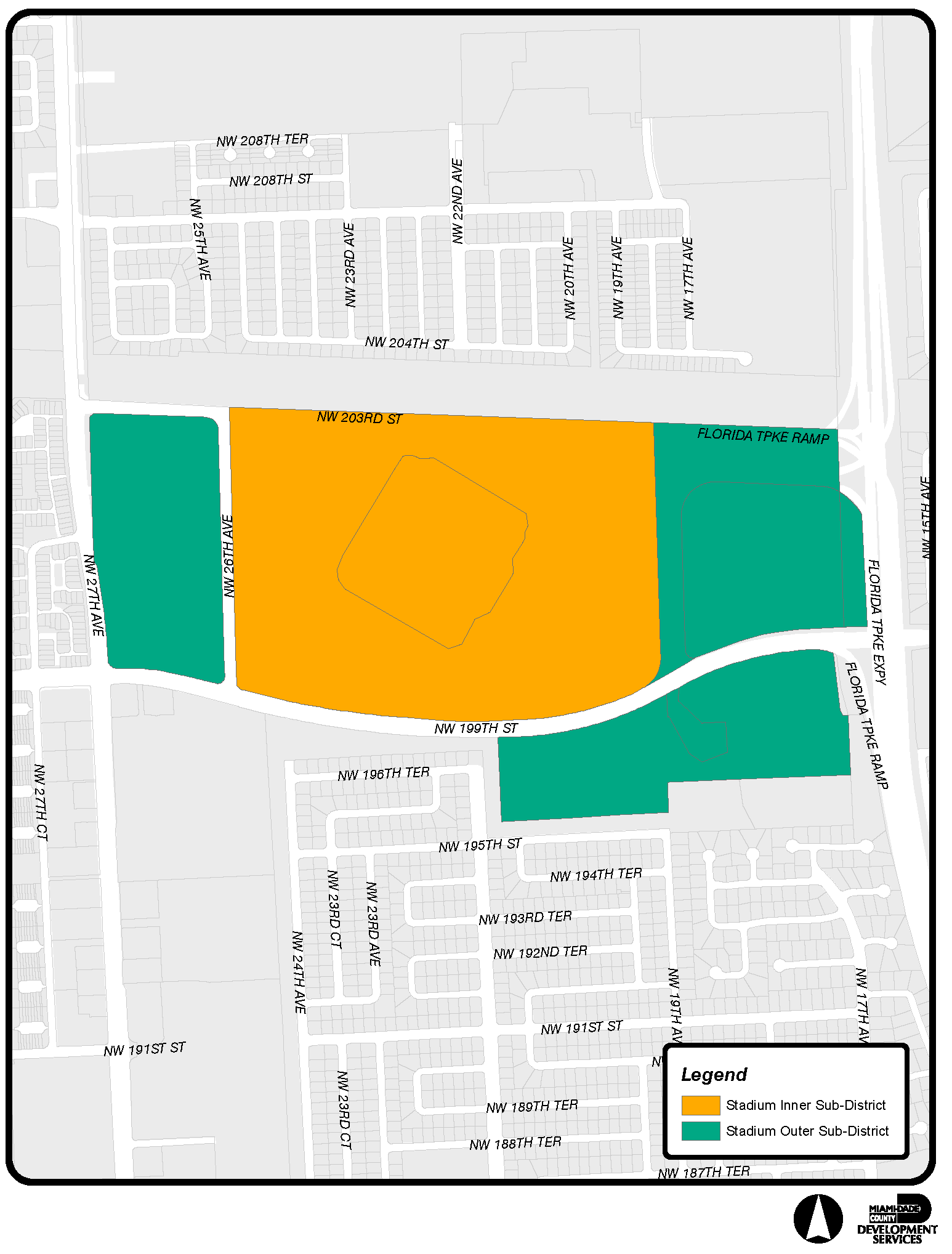
Sub-Districts. The S District is comprised of two sub-districts: the Stadium Inner Sub-District and the Stadium Outer Sub-District. These Sub-Districts control land use and intensity of development that may take place. Unless otherwise specified in this article, the regulations herein apply to both Stadium Sub-Districts.
(4)
Sub-District Plan. The Sub-District Plan (Figure 1), shows the boundaries of the S District and the Sub-Districts and may be used to better interpret this article. Where there is conflict between the Sub-District Plan and the text of this article, the text shall govern. Full-scale maps of the Plan, and the boundaries of the sub-districts, are on file with the County Department and the City Planning and Zoning Department.
Figure 1: S District, Sub-District Plan
(Ord. No. 17-09, § 1, 2-22-17)
Sec. 33-452. - Uses permitted.
No land, body of water and/or structure shall be used or permitted to be used, and no structure shall be hereafter erected, constructed, reconstructed, moved, occupied or maintained for any purpose in the S District except for one or more of the following uses, subject to the prohibited uses enumerated in subsection (18) below:
(1)
Accommodation Uses. Facilities that provide short-term lodging, including hotels, motels, rooming houses, bed and breakfasts, and similar uses.
(2)
Automotive Uses. Sales of new and used automobiles (not including open lot car sales new or used); automotive shows, races, and exhibitions; and gas stations or other form of stations used for the powering/charging of automobile vehicles. Upon approval as a Special Exception by the City, pursuant to Section 34-48 of the City Code, the following uses may also be permitted: establishments specializing in the service or repair of automobiles; automobile tire sales and replacement; and automobile parts sales and installation. For auto service, auto repair or drive-throughs to be located within .25 miles of a premium transit corridor or premium transit station, administrative site plan approval shall be required to assure that the proposed site plan is conducive to public transit ridership.
(3)
Child Care Facilities. Institutions that provide child care and/or instruction from the infant level through the secondary school level and that do not come under the direct operation and administration of the Miami-Dade County School Board or the State of Florida.
(4)
Civic Uses. Uses that are accessible to the public and serve the religious, recreational, educational, cultural, and/or governmental needs of the community. Civic uses include, but are not limited to: convention halls or meeting halls; private clubs; post offices; clubhouses; religious buildings; museums; athletic facilities (e.g. stadiums, arenas, fitness centers, fields, etc.); auditoriums, theaters, and other visual and performance arts buildings; and governmental facilities.
(5)
Private Colleges/Universities. Facilities that serve the educational needs of the adult population. This group shall include universities; colleges; commuter colleges; and trade schools.
(6)
Commercial Parking. Structures and/or surface lots that provide parking as the primary on-site use. These facilities offer short-term parking of vehicles and may charge a fee for such use. This group includes: shared parking facilities; shuttle parking facilities; and transit park-and-ride facilities. This group shall not include parking facilities that are ancillary to another on-site use.
(7)
Health Care Services. Facilities that provide out-patient health care services to the local community. These facilities shall include: clinics; doctor's office; dentist's offices; federally qualified health centers; urgent care facilities; diagnostic centers, including sleep centers; and similar uses. These facilities shall not provide in-patient care.
(8)
Entertainment Uses. Uses in this group shall include: nightclubs; arcades; movie theaters; performance theaters; radio, movie and/or television studios; billiard halls; skating rinks; bingo halls; piano bars; bowling alleys; and similar uses.
(9)
Food/Beverage Establishments (with or without a drive-through). This group shall include: full service restaurants; fast food restaurants; and breweries, distilleries, bars and pubs, including tap rooms and tasting rooms for such breweries and distilleries. For drive-through restaurants to be located within .25 miles of a premium transit corridor or premium transit station, administrative site plan approval shall be required to assure that the proposed site plan is conducive to public transit ridership.
(10)
General Retail/Personal Service Establishments. Establishments that provide goods and services geared toward an individual consumer, with or without a drive-through. This group shall include businesses such as: banks; beauty parlors; bakeries; bookstores; apparel stores; grocery stores; pharmacies; tailor shops; health clubs; gift shops; and indoor pet care centers. This group shall also include schools offering instruction in dance, music, martial arts, and similar activities, but this group shall not include colleges/universities. For drive-through establishments to be located within .25 miles of a premium transit corridor or premium transit station, administrative site plan approval shall be required to assure that the proposed site plan is conducive to public transit ridership.
(11)
Live/work Unit. An individual residential unit integrated with a general retail/personal service establishment, professional business office, or workshop.
(12)
Professional Business Offices. Facilities used primarily for the business of professionals with only limited transactions occurring on-site. This group shall include offices for: accountants; architects; appraisers; attorneys; consulates; financial firms; insurance adjusters; realtors; medical offices; and other similar uses.
(13)
Residential Uses. Rowhouses and multifamily residential uses.
(14)
Workshop. an enclosed workplace on the ground floor area of a building used as an office or for the manufacturing of artifacts and crafts, utilizing only hand held or table-mounted electrical tools.
(15)
To the extent not otherwise permitted in this section, all uses permitted in the PCD District and the Entertainment Overlay (EO) District, as provided in Sections 34-287 through 288 and Sections 34-598 through 600 of the City Code, as such may be amended from time to time.
(16)
To the extent not otherwise permitted in this section, all uses authorized as special exceptions within the PCD District, as provided in the City Code, subject to the City's special exception approval requirements and procedures.
(17)
Such other uses as may be determined to be similar to those enumerated above by the Director of the City Planning and Zoning Department.
(18)
Notwithstanding the foregoing, the following uses are not permitted within the S District:
(a)
Adult day care centers.
(b)
Agricultural uses.
(c)
Attended nonmotorized donation collection vehicles.
(d)
Bait and tackle shops.
(e)
Boats carrying passengers on excursion, sightseeing, pleasure or fishing trips.
(f)
Dairy stores.
(g)
Jewelry loan centers or pawnbrokers.
(h)
Mail order offices, without storage of products sold.
(i)
Medical observation dormitories, other than sleep centers.
(j)
Propagating and growing plants for sale.
(Ord. No. 17-09, § 1, 2-22-17)
Sec. 33-453. - Setbacks.
The following setbacks shall apply in the S District:
(1)
Front - 20 feet.
(2)
Side street - 15 feet.
(3)
Interior side - Shall apply only to business or industrial uses. The wall along the side property line shall be constructed in accordance with the Florida Building Code. Interior side setbacks shall be:
(a)
5 feet where any openings are provided in the wall of the proposed structure, adjacent to the interior side property lot line;
(b)
10 feet for such portions of the business structure as are devoted to residential use; and
(c)
15 feet where the adjacent property is zoned single-family residential, pursuant to the City's zoning regulations.
(4)
Rear - Rear setbacks shall be:
(a)
20 feet from a residential district boundary, except that credit shall be given for the full width of dedicated alleys in computing this setback.
(b)
5 feet from a business or industrial district boundary, pursuant to the City's zoning regulations, or from other S District property, where any openings are provided in wall of proposed structure, adjacent to rear lot line.
(c)
0 feet from business or industrial district boundary, pursuant to the City's zoning regulations, or from other S District property, where no openings are proposed in wall of proposed structure, adjacent to rear lot line.
(d)
Accessory buildings shall be subject to the same setbacks as principal structures.
(5)
Between buildings - 20 feet.
(6)
A building containing residential uses or mixed residential-business uses shall comply with setbacks required for the equivalent residential district pursuant to the City's zoning regulations.
(Ord. No. 17-09, § 1, 2-22-17)
Sec. 33-454. - Lot size.
(1)
Minimum lot frontage—50 feet; but 75 feet for a corner lot.
(2)
Minimum lot area—5,000 square feet; but 7,500 square feet for a corner lot.
Sec. 33-455. - Height, floor area ratio and lot coverage.
The permitted height, density, and intensity of development within the S District shall be as set forth within the City of Miami Gardens Comprehensive Plan; provided, however, that until the City of Miami Gardens Comprehensive Plan is amended to permit floor area ratios higher than 3.0, the floor area ratio for the S District shall be 3.0. Mall areas, whether enclosed or unenclosed, shall not count as part of the floor area for floor area ratio computation purposes, nor as part of the lot coverage.
(Ord. No. 17-09, § 1, 2-22-17)
Sec. 33-456. - Signage.
Signage within the S District shall be as provided for BU Districts in Chapter 33, Article VI of the Code of Miami-Dade County, as such may be amended from time to time, subject to the following:
(1)
Class C billboards, as defined in the Code of Miami-Dade County, shall not be permitted.
(2)
Internally-oriented directional and internally-oriented wayfinding signs for the stadium may be permitted without limitation as to the number, size, location, setback, or height of such signs, provided, however, that any such signs shall be consistent with the customary height and size limits of the directional and wayfinding signs for the stadium. In addition, all such signs shall comply with all other applicable requirements, including but not limited to applicable City or County Public Works regulations and the Americans with Disabilities Act. No minimum number of buildings is required for such signage. Such signs may include a stadium or sponsor logo, provided that the logo does not exceed 75% of the area of the sign.
(Ord. No. 17-09, § 1, 2-22-17)
Sec. 33-457. - Off-street parking.
Minimum number of off-street parking spaces for the following uses within the S District shall be as provided in this section. For all other uses, the minimum number of off-street parking spaces shall be as set forth in Chapter 34, Article XII of the City Code.
(1)
Rowhouses and multi-family:
(a)
1.50 parking spaces for each guest room, efficiency, or 1-bedroom unit.
(b)
1.75 parking spaces for each 2-bedroom unit.
(c)
2.0 parking spaces for each 3- or more bedroom unit.
(2)
Churches. At least 1 parking space for each 100 square feet or fractional part thereof of the seating area in the main auditorium/sanctuary, including adjacent areas which may be used as part of the auditorium/sanctuary.
(3)
Commercial:
(a)
Retail—Food or grocery stores, drug and sundry stores, department stores, membership warehouses, retail stores, retail stores similar to the foregoing, banks, post offices, mortuaries, funeral homes, waiting rooms stations for common carriers, and shopping centers shall have parking at a rate of 1 parking space for each and every 250 square feet of the gross floor area or fractional part thereof. All retail uses within enclosed malls in excess of 300,000 square feet shall provide parking at the rate of 1 parking space for each and every 350 square feet of the gross floor area or fractional part thereof, excluding theaters, restaurants, and food courts, which shall provide parking as required for such uses.
(b)
Auto dealership showrooms, garage and gas station bay areas, and similar uses shall have 3 parking spaces for the first 2,500 square feet of floor area, or fractional part thereof, and 1 parking space for each additional 500 square feet of gross floor area, or fractional part thereof, plus 3 parking spaces for each 5,000 square feet, or fractional part thereof, of open lot area. Office and retail parts areas shall have parking spaces as otherwise contained in this article. Customer and employee parking shall be labeled as such.
(c)
Furniture showrooms shall have 3 parking spaces for the first 2,500 square feet of gross floor area, or fractional part thereof, and 1 parking space for each additional 500 square feet of gross floor area or fractional part thereof.
(d)
Open lot commercial uses such as, but not limited to, used car lots, storage yards, and recreational vehicle sales lots shall have 5 off-street parking spaces for the first 5,000 square feet of net lot area, or fractional part thereof and 1 parking space for each additional 500 square feet of net lot area so used. These spaces shall be reserved for customer and employee parking only, and shall be labeled as such.
(e)
Wholesale showrooms shall have 1 parking space for each 600 square feet of showroom area, or fractional part thereof.
(4)
Restaurants, lounges, nightclubs, or similar places dispensing food, drink or refreshments.
(a)
Table service establishments shall have 1 parking space for each 100 square feet of floor area or fractional part thereof devoted to patron use.
(b)
Take-out establishments shall have 1 parking space for each 250 square feet of gross floor area, or fractional part thereof.
(5)
Stadiums shall have at least 1 parking space for each 6 seats.
(6)
Theaters, including movie theaters, and general auditoriums shall have 1 parking space for each 100 square feet of auditorium seating area or fractional part thereof.
(7)
Office, medical offices, medical clinics, professional building, or similar uses shall have 1 parking space for each 300 square feet of gross floor area of such building or fractional part thereof.
(8)
Housing for low and/or moderate income for older persons and/or persons with disabilities.
(a)
For any publicly owned or non-profit apartment building exceeding 4 units providing housing for elderly persons or persons with disabilities that is developed and financially assisted under the United States Housing Act of 1937, 0.50 parking spaces shall be provided for each dwelling unit in the apartment building.
(b)
For any other apartment building exceeding 4 units providing low and/or moderate income housing for older persons as defined by the Fair Housing Act, 42 U.S.C. § 3607, 1 parking space shall be provided for each dwelling unit in the apartment building.
(c)
If it is determined by the Director of the City Department at the time of annual renewal of certificate of use that the parking reduction permitted pursuant to subsections (1) or (2) above does not allow adequate parking for the apartment building, the owner must increase the number of parking spaces to fulfill the needs as determined by the Director of the City Planning and Zoning Department.
(Ord. No. 17-09, § 1, 2-22-17)
Sec. 33-458. - Declaration of restrictive covenant, procedures for the City of Miami Gardens.
The following procedures shall apply with respect to the City of Miami Gardens for the S District, and all references to administrative officials and departments shall be interpreted to refer to the City of Miami Gardens:
(1)
In lieu of a unity of title, the City may impose a condition of approval requiring a declaration of restrictive covenants. Such declaration of restrictive covenants shall be on an approved legal form and approved by the City Attorney for sufficiency. The declaration of restrictive covenants shall run with the land and be binding upon the heirs, successors, personal representatives, and assigns, and upon all mortgagees and lessees and others presently or in the future having any interest in the property.
(2)
The declaration shall contain, but not be limited to, the following necessary elements:
(a)
That the subject site will be developed in substantial accordance with the approved site plan. That if the subject property will be developed in phases, that each phase will be developed in substantial accordance with the site plan.
(b)
That in the event of multiple ownerships subsequent to site plan approval, that each of the subsequent owners shall be bound by the terms, provisions and conditions of the declaration of restrictive covenants. The owner shall further agree that he or she will not convey portions of the subject property to such other parties unless and until the owner and such other party shall have executed and mutually delivered, in recordable form, an instrument to be known as an "easement and operating agreement" which shall contain, among other things:
i.
Easements in the common area of each parcel for ingress to and egress from the other parcels;
ii.
Easements in the common area of each parcel for the passage and parking of vehicles;
iii.
Easements in the common area of each parcel for the passage and accommodation of pedestrians;
iv.
Easements for access roads across the common area of each parcel to public and private roadways;
v.
Easements for the installation, use, operation, maintenance, repair, replacement, relocation and removal of utility facilities in appropriate areas in each such parcel;
vi.
Easements on each such parcel for construction of buildings and improvements in favor of each such other parcel;
vii.
Easements upon each such parcel in favor of each adjoining parcel for the installation, use, maintenance, repair, replacement and removal of common construction improvements such as footings, supports and foundations;
viii.
Easements on each parcel for attachment of buildings;
ix.
Easements on each parcel for building overhangs and other overhangs and projections encroaching upon such parcel from adjoining parcel such as, by way of example, marquees, canopies, lights, lighting devices, awnings, wing walls and the like;
x.
Appropriate reservation of rights to grant easements to utility companies;
xi.
Appropriate reservation of rights to road rights-of-way and curb cuts;
xii.
Easements in favor of each such parcel for pedestrian and vehicular traffic over dedicated private ring roads and access roads; and
xiii.
Appropriate agreements between the owners of the several parcels as to the obligation to maintain and repair all private roadways, parking facilities, common areas and common facilities and the like.
(3)
Exceptions. These provisions or portions thereof may be waived by the administrative official if they are not applicable to the subject property. These provisions of the easement and operating agreement shall not be amended without prior written approval of the City Attorney. In addition, such easement and operating agreement shall contain such other provisions with respect to the operation, maintenance and development of the property as to which the parties thereto may agree, all to the end that although the property may have several owners, it will be constructed, conveyed, maintained and operated in accordance with the approved site plan.
(4)
Non-use variances created solely by separate ownerships, pursuant to subsection (1) of this section, shall be waived by the administrative official.
(5)
Release, modifications, amendments, revision.
(a)
Approval required. Any release, modification, deletion, revision to a declaration of restrictive covenant or condition thereof, shall only be made upon a request being submitted to the City Department of Planning and Zoning, on a form approved by the administrative official requesting the release, modification, deletion, or revision. The administrative official shall determine if the release, modification, deletions, or revisions represent a substantial change to the approval. If it is determined that the release, modification, deletion, or revision are not a substantial change, the administrative official shall approve the request. Upon approval of the request, the action taken, or an amended declaration of restrictive covenant shall be recorded in the Official Record Book of Miami-Dade County, accordingly.
(b)
Appeals. Where it is determined that the release, modification, deletion, or revision is a substantial change to the approval the decision may be appealed as an appeal of an administrative decision.
(c)
Exceptions.
i.
Where a declaration of restrictive covenant or similar document was proffered to the County or to the City where the release, modification, deletion, or revision required Board of County Commissioners approval or specifically required City Council approval, then such request shall be made as an application to the City Council, pursuant to the City Code; however, if such covenant or similar document provides that it requires the approval of both the City Council and the Board of County Commissioners, then the approval of such modification, deletion, or revision shall require the approval of both the City Council and the Board of County Commissioners.
ii.
Where there is a proffered declaration of restrictive covenants on a property where it is determined that there are no vested rights, the administrative official release, modify, or revise the covenant appropriately, either administratively or by action of the City Council.
iii.
Where it is determined that the development approval has expired as set forth in this chapter, the administrative official shall release the declaration of restrictive covenants appropriately, either administratively or by action of the City Council.
iv.
Where a declaration of restrictive covenants or condition thereof is released, modified, deleted, or revised, and a contribution of funds has been proffered and accepted by the City, the City administrative official may consider such contribution as forfeited.
(Ord. No. 17-09, § 1, 2-22-17)
Sec. 33-459. - Vested rights.
Notwithstanding any other provision of the City Code or the City's Comprehensive Plan, and as to the City, properties within the S District shall have vested rights for any development, structures, uses (including but not limited to ancillary or intermittent activities associated with such uses), landscaping, parking, or other land use entitlements that are in existence as of January 1, 2017 or that were approved, whether at public hearing or administratively, by Miami-Dade County prior to January 1, 2017. Any development approved by a development permit, as defined by Chapter 163.3164, Florida Statutes (including but not limited to any zoning resolution, DRI development order, administrative site plan approval, plat, or building permit) shall be vested against later action by the City without the need for the owners and/or developers of such properties to have taken any affirmative act in reliance upon such prior development permits. Such vested development may be completed and maintained in accordance with the landscaping, buffering, and signage regulations under which it was approved, and is not subject to the requirements of Section 34-62(5) of the City Code relating to amortization of landscaping nonconformities, or any other applicable regulation relating to the amortization of nonconformities of landscaping adopted by the City. To the extent not otherwise enumerated in this article, properties within the S District may also be used for all uses permitted in the BU-2 zoning district of the Code of Miami-Dade County, as of January 1, 2017, with the limitations and exceptions provided in section 33-452 of this article. Nothing herein shall limit any vested rights that may otherwise exist by operation of common law, by the City Code or the County Code.
Procedure for vested rights determination. For properties within the S District, a request for vested rights determination may be filed with the City pursuant to Section 34-62 of the City Code without regard to the one-year time limitation therein; any action by the City Council on appeal of such determination may thereafter be appealed to the Board of County Commissioners in accordance with the procedures set forth in section 33-463 of this article.
(Ord. No. 17-09, § 1, 2-22-17)
Sec. 33-460. - Landscaped open space and impervious area.
(1)
Within the S District's Outer Sub-District, upon redevelopment from surface parking to other permanent use, landscaping shall be provided in accordance with the applicable requirements of Article XIV of the City Code, as such may be amended from time to time; provided, however, that while such properties are used to serve the stadium, they shall be landscaped in accordance with the prior approvals and the Development of Regional Impact Development Order, as applicable.
(2)
Within the S District's Inner Sub-District, landscaping shall be provided in accordance with the provisions of Chapter 18A of the Code of Miami-Dade County, as such may be amended from time to time. Chapter 18A of the Code of Miami-Dade County shall remain applicable to the S District.
(Ord. No. 17-09, § 1, 2-22-17)
Sec. 33-461. - Special events.
(1)
Properties within the S District's Inner Sub-District may be used for temporary special events lasting up to 15 calendar days for any of the sports, entertainment, exhibition and attraction uses listed in Section 33-452 of the County Code. No separate special use permits or other zoning authorizations shall be required for temporary special events governed by the preceding sentence, and for purposes of City Code provisions that refer to permitted events, including without limitation, section 16-26(a)(7), such temporary special events shall be treated as permitted events.
(2)
All other special event uses for the S District shall be governed as provided under Chapter 4 of the City Code. Nothing herein shall modify the obligation to obtain any building permits that may be required under the Florida Building Code for temporary structures used in such special events.
(3)
Notwithstanding any other provisions in Chapter 33 of the County Code, special events and special event permits shall be governed by the provisions of this article.
(Ord. No. 17-09, § 1, 2-22-17)
Sec. 33-462. - Procedures.
(1)
Application. All zoning inquiries and applications for zoning action for properties within the S District shall be submitted to the City of Miami Gardens.
(2)
Approval by City Council. If the City Council approves an application for zoning action by a property owner, or applicant authorized by the owner, after public hearing, then, upon the City's determination becoming final in accordance with the City's rules and regulations, it may only be reviewed by a court of competent jurisdiction.
(3)
Other Action by City Council. If the City Council denies an application for zoning action by an owner or such authorized applicant after public hearing, or approves an application for zoning action after public hearing with conditions that are not agreed to by the owner or authorized applicant, the owner or authorized applicant shall have the right to appeal the City Council's decision to the Board of County Commissioners for its review after public hearing.
(4)
Review by County Commission. On appeal by a property owner or authorized applicant, the Board of County Commissioners may affirm the decision of the City Council, alter the decision of the City Council and approve the application, or alter the decision of the City Council and approve the application with modifications, in each case by a majority vote of the total membership of the Board of County Commissioners, and upon such decision becoming final in accordance with the County's rules and regulations, it may only be reviewed by a court of competent jurisdiction.
(5)
Review of Other City Zoning Actions. If the City denies an application by a property owner or applicant authorized by the owner for zoning action other than public hearing actions, or approves an application for zoning action other than public hearing actions with conditions that are not agreed to by the by the owner or authorized applicant, then the owner or authorized applicant shall have the right to appeal that decision first to the City Council, which shall affirm, affirm with conditions, or alter the decision within 60 days of submittal of the appeal, and then to the Board of County Commissioners in accordance with the above procedures for review of City Council decisions. It is provided, however, that if the City Council does not issue a decision within 60 days of submittal of the appeal, then the owner or authorized applicant may proceed directly to the Board of County Commissioners in accordance with the procedures governing appeals of administrative actions set forth in section 33-314 of the County Code.
(Ord. No. 17-09, § 1, 2-22-17)
Sec. 33-463. - Conflicts.
In the event of any conflict or inconsistency between the terms of these S District regulations and any other provision of the City Code, the terms of these S District regulations shall govern.
(Ord. No. 17-09, § 1, 2-22-17)

