
Miami Dade County Unincorporated
City Zoning Code
City Zoning Code
ARTICLE XXXIIIH
TRADITIONAL NEIGHBORHOOD DEVELOPMENT TND DISTRICT
Sec. 33-284.46.- Purpose and intent.
The TND District is designed to ensure the development of land along the lines of traditional neighborhoods. Its provisions adapt the urban conventions which were normal in the United States from colonial times until the 1940's. The TND ordinance prescribes the following physical conventions:
(A)
The neighborhood is spatially understood and limited in size.
(B)
Residences, shops, workplaces, and civic buildings are interwoven within the neighborhood, all in close proximity.
(C)
A hierarchy of streets serves equitably the needs of the pedestrian, the bicycle and the automobile.
(D)
Carefully placed civic buildings, squares, and greens reinforce the identity of the neighborhood.
(E)
Spatially defined squares, parks, and greens provide places for social activity and recreation.
(F)
Civic buildings provide places of assembly for social, cultural and religious activities, becoming symbols of community identity through their architectural clarity.
(G)
Private buildings form a disciplined edge, spatially delineating the public street space and the private block interior.
(H)
Architecture and landscape respond to the unique character of the region.
Where the terms, design criteria, development parameters, and review procedure contained herein conflict with those provisions provided elsewhere in Chapter 33, the provisions of the TND shall apply.
(Ord. No. 91-41, § 1, 4-2-91; Ord. No. 99-82, § 1, 7-13-99; Ord. No. 03-47, § 1, 3-11-03)
Sec. 33-284.47. - Design criteria.
(A)
The following design criteria and requirements shall be applicable in the TND District. Terms used throughout this ordinance shall take their commonly accepted meaning unless otherwise defined in Chapter 33 or Chapter 28 of the Code of Miami-Dade County. Terms requiring interpretation specific to this ordinance are as follows:
(1)
Alley: A vehicular passageway providing primary, secondary and/or service access to the sides or rear of building lots. Posted speed shall not exceed fifteen (15) miles per hour.
(2)
Artisanal use: The manufacture and sale of artifacts utilizing only handheld and/or table mounted electrical tools contained within an enclosed structure.
(3)
Block: A combination of building lots serviced by an alley, the perimeter of which abuts public use lands (in most cases public right-of-way).
(4)
Building lot: A separately platted portion of private land, not including the specified sidewalk area.
(5)
Civic building: Any permitted or required civic use building when located in a civic use lot.
(6)
Clear zone: An area beyond the curb radius, so specified, which shall be kept clear of all objects to provide emergency vehicle clearance.
(7)
Colonnade: A roof or building structure, extending over the sidewalk, open to the street and sidewalk except for supporting columns or piers. Colonnades shall have, at the sidewalk, a minimum clear height of ten (10) feet (excluding signage or lighting) and a minimum clear width of eight (8) feet (from frontage line to inside column face). Colonnades shall be constructed eighteen (18) inches to twenty-four (24) inches from the face of the curb. Awnings are permitted within the TND but are not considered colonnades. Colonnades shall not cause roof drainage into the public right-of-way.
(8)
Congregate living facilities: A group home for a maximum of six (6) resident clients who are cared for by the owner who permanently resides in the residential unit. The facility must be licensed by the State of Florida Department of Health and Rehabilitative Services and meet Code criteria for such use. In the shopfront use location the total residents may be in excess of six (6) if the use meets the other requirements of the shopfront use category. Congregate living facilities shall include homes for the aged.
(9)
Cornice line: A molded and projecting horizontal member that crowns an architectural composition. A cornice line shall project a minimum of two (2) inches from the front elevation of the structure.
(10)
Curb radius: The curved edge of the street at intersections, measured at the edge of the travel lanes. Curbs at intersections shall not intrude into the intersection beyond the specified maximum curb radius. Where streets of different use categories intersect, the requirements of the higher intensity use shall govern.
(11)
Front porch: A front porch is an unairconditioned roofed structure attached to the front of the unit. A front porch shall have a minimum depth of six (6) feet and a minimum width of twelve (12) feet and, except for insect screening, shall only have supporting columns visible above forty-two (42) inches from the finished porch floor level. Side and rear porches are not subject to these requirements. All or a portion of the front porch may encompass a ramp providing access for people with disabilities.
(12)
Frontage line: The building lot line which coincides to the right-of-way of the street or square. In the case of a building lot abutting upon only one (1) street, the frontage line is the line parallel to and common with the edge of the sidewalk. In the case of a corner lot, that part of the building lot having frontage on any street shall be considered the frontage line.
(13)
Greenbelt: An optional open space area adjoining the neighborhood proper and no less than one (1) hundred fifty (150) feet wide at any place. The area shall be preserved in perpetuity in its natural condition, or enhanced by the owner, as determined by the Miami-Dade County Department of Environmental Resources Management. The greenbelt area may be used for non-row crop farming, wetlands, water retention, animal husbandry, bulky waste site (for the exclusive use of the TND), golf courses, or subdivided into house lots no smaller than five (5) acres. Roadways, exclusive of through streets, may penetrate greenbelts in order to provide access to areas outside the TND.
(14)
Green: A public open space located within the neighborhood proper and bounded by streets. Paved areas in greens shall not exceed twenty percent (20%) of the green area exclusive of dedicated rights-of-way. Greens shall have a length to width ratio no greater than four to one (4:1). A green may be enclosed with a wrought iron or electrostatic plated aluminum fence not exceeding five (5) feet in height.
(14a)
Habitable space: building space whose use involves human presence and entertainment, excluding balconies and terraces.
(15)
Height: Building height shall be measured from the average elevation of the finished exterior building site to the eave line or to the top of the parapet. Flat roofs shall have parapet walls on all sides.
(16)
Home occupation use: Premises used for the transaction of business or the supply of professional services excluding medical and dental. Home occupation shall be limited to the following: Architect, artist, broker, consultant, dressmaker, draftsman, engineer, interior decorator, lawyer, manufacturer's agent, notary public, teacher (excluding group instruction), and other similar occupations. Such use shall not simultaneously employ more than two (2) persons, one (1) of whom must reside on the property. The total gross area of the home occupational use shall not exceed twenty-five percent (25%) of the gross square footage of the residential unit. Certificates of use and occupancy shall be reviewed annually.
(17)
Limited lodging use: The provision of no more than four (4) bedrooms for letting. Food service may be included between the hours of 6:00 a.m. to 11:00 a.m. The maximum length of stay shall not exceed fourteen (14) days.
(18)
Limited office use: The transaction of business or the supply of professional services, employing no more than eight (8) persons.
(19)
Lodging use: Buildings providing food service and bedrooms for letting.
(20)
Maintenance easement: A perpetual four-foot wide wall maintenance easement shall be provided on a lot adjacent to a zero lot line property line, which, with the exception of walls and/or fences, shall be kept clear of structures. This easement shall be shown on the plat and incorporated into each deed transferring title to the property. The wall shall be maintained in its original color and treatment unless otherwise agreed to in writing by the affected lot owners. Roof overhangs may penetrate the easement on the adjacent lot a maximum of twenty-four (24) inches but the roof shall be so designed that water runoff from the dwelling placed on the lot line is limited to the easement area. The easement shall be maintained unless otherwise agreed to, in writing, by the two (2) affected lot owners.
(21)
Meeting hall: A building(s) or an area or room within a building located on a civic use lot, designed for public assembly and equivalent in size to four (4) square feet per dwelling unit or twenty-four hundred (2,400) gross square feet, whichever is greater. The total number of dwelling units shall be established at the time of the TND approval.
(22)
Neighborhood proper: The built-up area planned for development within a TND, including blocks, streets, squares greens and parks, but excluding greenbelts or other open green periphery areas.
(23)
Outbuilding: An accessory use building, for residential, parking, or storage use only, contiguous with the rear lot line, of a maximum of twenty-four (24) feet in height and having a maximum building footprint of five hundred (500) gross square feet.
(24)
Park: An area of land designated for active or passive recreation.
(25)
Pedestrian pathways: Pedestrian pathways are interconnecting paved walkways that provide pedestrian passage through blocks running from street to street. Said pathways shall not be less than ten (10) feet, nor more than twenty (20) feet in width, with a minimum pavement width of ten (10) feet. Pedestrian pathways shall provide an unobstructed view, from street to street, no less than ten (10) feet wide.
(26)
Plaza: An open space area within a town center on which all shopfront lots front. Plazas shall include landscaping, permanent architectural features and/or water oriented features. Parking may be included, but shall be limited to seventy-five percent (75%) of the total area of the plaza.
(26a)
Porte-cochere: A house use category feature consisting of a roofed structure attached to a building and erected over a driveway. It shall be open on three (3) sides and may have a part of the main or principal building over it.
(27)
Private open space: That space on each building lot that is for the private use of the inhabitants of such lot. Said space shall be unenclosed, and open to the sky except for roofed porches. Atriums, gardens, garden courts, walks, ramps, patios, and other similar spaces shall count as private open space. Up to one-third (⅓) of the private open space area may be a roofed porch.
(28)
Prohibited uses: The following uses are not permitted anywhere within a TND: Vending machines, including newspaper, except as an accessory use within a commercial building; detached signs; chemical manufacturing, storage or distribution as a primary use; gun shops, pawn shops, chicken hatcheries, packing houses, tire vulcanizing and retreading, automobile sales and rental, any commercial use in which patrons remain in their automobiles while receiving goods or services, except service stations; on-site enameling, painting or plating, of materials for off-site use, except artist's studios and as provided in the workshop land use category; outdoor advertising or billboard; terminal or yard used for the business of carting, moving, or hauling goods, except delivery of goods to businesses within a TND; prisons, or detention centers, except as accessory to police station; manufacture, storage or disposal of hazardous waste materials; scrap yards; mobile homes; sand, gravel, or other mineral extraction; kennels.
(29)
Residential use: The term residential is applied herein to any lot, plot, parcel, or piece of land or any building used for dwelling purposes.
(30)
Setback: An absolute distance between the building lot line and the outside of the facade closest to said building lot line of the enclosed portion of the building. Front porches and ramps for people with disabilities are exempt from setback requirements. On curvilinear lots only, the required front setback shall be measured at the closest point to the lot line and may exceed the required front setback along the curvilinear property line.
(31)
Shared parking: Any parking spaces intended to be utilized for more than one (1) use occurring on a single lot or within a single building, where persons utilizing the spaces are unlikely to need the spaces at the same time of day.
(32)
Square: An outdoor public tract defined by streets on at least three (3) sides. Squares shall be at least seventy-five percent (75%) paved and surrounded by shopfront use lots or rowhouse use lots on at least sixty percent (60%) of its perimeter (perimeter being defined as the aggregate of the frontage lines of the surrounding lots). Squares shall have a length to width ratio no greater than three to one (3:1).
(33)
Streetedge: In the Civic, Rowhouse and House land use categories, a masonry wall, wood fence, vinyl/PVC fence, aluminum fence. or wrought iron fence, or hedge positioned along the frontage line. When located between the setback and the frontage line, a masonry wall, wood fence, vinyl/PVC fence, aluminum fence, or wrought iron fence shall not exceed six (6) feet in height. Hedges and landscape buffers planted along the frontage line and between the frontage line and the setback shall have no height limitations.
(34)
Streetwall: In the Shopfront and Workshop land use categories, a masonry wall, wood fence, vinyl/PVC fence, aluminum fence, or wrought iron fence between six (6) feet and eight (8) feet in height built along the frontage line. Any openings shall be gated.
(35)
Streetlamp: A light standard not to exceed fifteen (15) feet in height. Streetlamps shall be installed on both sides of streets at no more than seventy-five-foot intervals measured parallel to the street. Any streetlights in alleys shall be designed in accordance with the standards developed by the Illumination Engineering Society. The installation and maintenance of the street light system will be through a special taxing district. Street lighting design shall meet the minimum standards developed by the Illumination Engineering Society.
(36)
Street vista: A view through or along a street centerline.
(37)
Through street: A street constructed in accordance with major and minor roadways as depicted on the adopted comprehensive development land use plan map. A TND may be located adjacent to, but shall not be bisected by a through street.
(38)
Town center: A town center is an optional and accessory use to the TND providing for larger scale commercial shopfront uses in buildings that front a plaza. A portion of the town center plaza may be used for parking. The town center buildings shall surround the plaza on at least thirty-five percent (35%) of its perimeter. The town center shall meet all requirements of said shopfront use category, except as modified below, and all other requirements of the TND, including requirements for parking lots, if any part of the plaza is used for parking.
A maximum of seventy-five percent (75%) of the TND's allocation for shopfront use lots may be transferred to the town center. Any additional commercial area shall only be permitted where designated on CDMP, land use plan map.
A town center shall only be located where through streets or any street adjacent to the neighborhood proper intersect. There shall be no more than one (1) town center in a TND. Town center plazas shall extend no further than six hundred (600) feet along the through street from the centerline of the intersection and shall have a maximum area of fourteen hundred (1,400) square feet per TND acre in area to a maximum of two hundred thousand (200,000) square feet. There shall be a direct street connection between the mandatory square or green and the town center plaza. A minimum of thirty-five percent (35%) of the gross leasable building area (taken in sum) of the lots fronting the plaza shall be for residential use. A maximum of four (4) lots fronting the town center plaza may be consolidated. Colonnades are required on all shopfront use buildings fronting the town center plaza. At least ten percent (10%) of the plaza shall be devoid of parking and developed with permanent architectural and/or water features as a focal point for the town center. Said focal point shall be in addition to other landscape requirements as provided in the TND. Town centers may include, in addition to uses provided in the shopfront use category, one (1) grocery and/or department store use, each not exceeding forty thousand (40,000) square feet of building area.
(39)
Warranted traffic control device: A device (typically a yield or stop sign, or a traffic signal) that has met the minimum criteria for installation based on the Manual on Uniform Traffic Control Devices; National Manual, 1988 Edition.
(Ord. No. 91-41, § 1, 4-2-91; Ord. No. 99-26, § 1, 5-4-99; Ord. No. 99-82, § 1, 7-13-99; Ord. No. 03-47, § 2, 3-11-03; Ord. No. 11-83, § 1, 11-15-11; Ord. No. 15-35, § 1, 5-5-15)
Sec. 33-284.48. - Development parameters.
All applications for a TND shall comply with the following development parameters:
(A)
Size and location of site. The minimum size of the neighborhood proper shall be forty (40) acres and the maximum size shall not exceed two hundred (200) acres. Larger parcels shall be developed as multiple TND's, each individually subject to all the provisions. A TND may be located adjacent to, but shall not be bisected by a through street.
(B)
Density. The requested densities, in terms of number of units per gross residential acre and total number of dwelling units shall be made at the time of application. Said number of dwelling units and densities shall be in conformance with the Comprehensive Development Master Plan (Ordinance No. 88-110), as amended from time to time, including any density bonus as provided therein.
(C)
General development criteria.
(1)
Land use. The entire land area of a TND shall be divided into a neighborhood proper and optional natural or greenbelt areas.
(2)
Land allocation.
(a)
Except for the public use category, land uses in the TND are regulated by net lot area (street and alley rights-of-way excluded) as a percentage of the gross area of the neighborhood proper.
(b)
Similar land use categories shall face across streets. Dissimilar uses may abut at rear lot lines. Public uses and civic uses are considered similar land uses with all TND use categories.
(c)
Land use categories described in Section 33-284.51 of one (1) category greater or lesser intensity may abut at side lot lines (the street requirements of the greater intensity use shall govern) or face across a square or park. For example, across a square or park, house use may front rowhouse use; rowhouse use may front house use or shopfront use; shopfront use may front rowhouse use or workshop use; workshop use may front shopfront use.
(d)
Land use for corner lots which front on streets of dissimilar use shall be designated the more intensive use category.
(3)
Lots and buildings.
(a)
All lots shall share a frontage line with a street, square or green.
(b)
All buildings shall have their main entrance opening to a street or square (except outbuildings).
(c)
All uses shall be conducted within completely enclosed buildings, unless otherwise specified herein.
(d)
Stoops and front porches may encroach up to ten (10) feet into the front setbacks.
(e)
Swimming pools shall be setback five (5) feet from any interior side or rear property line, ten (10) feet from a side street property line, and constructed no closer than eighteen (18) inches to any wall or any enclosure. Swimming pools shall be constructed no closer than five (5) feet to any building foundation, unless both the design and construction are approved by the Director as safe and will not possibly result in a weakening of, or damage to, the building foundation.
(4)
Streets, alleys and pedestrian pathways.
(a)
Traffic control signing shall be established for each community to satisfy intersecting street geometrics and installed at entrances and other appropriate locations.
(b)
Streets or alleys shall provide access to all tracts and building lots.
(c)
All streets, alleys and pedestrian pathways shall connect to other streets within the TND and connect to existing and projected streets outside the TND, if applicable. Cul-de-sacs, T-turnarounds and gated or dead-end streets are not permitted within the TND.
(d)
There shall be a continuous network of alleys to the rear of building lots within the TND except as may be provided herein.
(e)
The average perimeter of all blocks within the TND shall not exceed thirteen hundred (1,300) feet. No block face shall have a length greater than four hundred (400) feet without an alley or pedestrian pathway providing through access to another street or alley.
(f)
All streets shall have a six-inch high curb except for streets in house use areas.
(g)
A curb is required at all street intersections. There shall be curb cuts providing access for people with disabilities at all intersections and points of pedestrian crossing.
(h)
Curb interruptions are permitted only for alleys, access for people with disabilities and other parking access points specified herein.
(i)
A warranted traffic control device shall be placed at intervals no further than six hundred (600) feet on all streets internal to the TND.
(j)
All sidewalks shall have a continuous unobstructed clear area of a width no less than forty-two (42) inches. This area shall be unobstructed by utility poles, fire hydrants, benches or any other temporary or permanent structures. Free and clear public use of the sidewalk area beyond the right-of-way shall be protected by a public access easement, except as provided herein for the shopfront use category.
(k)
Utilities shall run underground.
(l)
Rights-of-way in a TND shall extend a minimum of eighteen (18) inches beyond the curbface/edge of the sidewalk, measured away from the right-of-way centerline.
(m)
Street furniture such as trash containers and bus benches shall be permanently secured to the sidewalk. One bench shall be provided along all edges of squares, greens and parks
(n)
No sign, awning, lighting, wiring or other object higher than twenty-seven (27) inches from the ground shall extend more than four (4) inches horizontally over any sidewalk from the column, post or wall on which it is mounted or shall hang down above the sidewalk unless its bottom edge is more than eighty (80) inches above the sidewalk.
(5)
Parking.
(a)
Parking lots shall be located at the rear or at the side of buildings, except as otherwise permitted in a plaza. Streetwalls or streetedge shall be built on the frontage line.
(b)
Parking lots and parking garages shall not: (1) abut street intersections or civic use lots; (2) be adjacent to squares, parks, or greens; or (3) occupy lots which terminate a street vista, except as provided in a plaza.
(c)
Adjacent parking lots shall have vehicular connections, via an alley.
(d)
Except as otherwise provided by the ordinance, parking requirements for all uses shall be in accordance with sections 33-122 through 33-132 of this Code. On-street parking directly fronting a lot shall count toward fulfilling the parking requirement of that lot. One (1) parking space credit shall be given for every space in front of a lot that is over fifty percent (50%)of the length of the parking space. Civic use lots within or adjacent to public use tracts may count on-street parking fronting the public use tract towards its parking requirements. A group or common parking lot is permitted in shopfront, rowhouse and workshop uses and shall be credited to the required parking for individual uses. Attached and detached single-family units shall have a minimum of two (2) parking spaces.
(e)
There shall be provided a minimum of one (1) parking space for people with disabilities within one hundred (100) feet of each intersection. Such parking shall have a clear unobstructed space five (5) feet from the curb side, measured toward the lot line and shall be the full length of the parking space.
If a combination of on-street parking places and parking lot spaces is used to meet the total number of parking spaces required by sections 33-122 through 33-132 of this Code, then the number of parking spaces for people with disabilities provided in the lot shall be at least as many spaces as would be required to be provided if all of the required parking spaces were provided in the lot.
(f)
Parking requirements for on-site parking may, at the applicants discretion, be reduced by twenty-five (25.0) percent, except in those instances where the use is exclusively residential or town center.
(g)
Shared parking shall be permitted if approved at public hearing, in accordance with Subsection 33-284.47(A)(30) of the Code.
(h)
Parking for community related retail and service uses as listed below shall not require on-site parking provided that: (1) the total floor space for the individual uses does not exceed five hundred (500) square feet of gross floor area; (2) such uses be restricted to shopfront and rowhouse areas and (3) that such uses shall be restricted to the following:
1.
Art galleries.
2.
Bakery.
3.
Barber/beauty parlor.
4.
Bookstore.
5.
Coffee house.
6.
Confectionary, sale of cookies/ice cream.
7.
Convenience grocery.
8.
Dry cleaning (no cleaning on premises).
9.
Sale of newspapers, magazines.
10.
Shoe repair (no sale of shoes).
(6)
Landscape. Landscaping shall be provided in accordance with Chapter 18A of this Code.
(Ord. No. 91-41, § 1, 4-2-91; Ord. No. 95-223, § 1, 12-5-95; Ord. No. 03-47, § 3, 3-11-03; Ord. No. 15-35, § 2, 5-5-15)
Sec. 33-284.49. - Ownership requirements.
An application for approval of a TND District shall meet the requirements of Section 33-304, Code of Miami-Dade County.
(Ord. No. 91-41, § 1, 4-2-91)
Sec. 33-284.50. - Review procedure.
The TND review procedures are divided into four (4) steps: (A) preapplication conference; (B) initial TND review; (C) intermediate site plan review; and (D) final review.
(A)
Preapplication conference. It shall be the responsibility of the Developmental Impact Committee to coordinate with other affected departments, and where applicable, representatives of adjacent municipalities to a joint meeting for the purposes of participating in the review of the TND. Prior to said joint meeting, the applicant may confer with the Department, other affected departments and, where applicable, representatives of adjacent municipalities, in connection with the preparation of the TND District application. The applicant shall provide a general outline of the proposal through schematics and sketch plans including narrative information sufficient for the understanding of the proposed development. Thereafter and within ten (10) working days after the preapplication conference, the Developmental Impact Committee shall furnish the applicant with all written comments resulting from such conference including appropriate recommendations to inform and assist the applicant in the preparation of the components of the TND District application. The applicant shall have the right to apply for an additional preapplication conference prior to filing a formal application with the Department. The same procedure as above shall be followed.
(B)
Initial TND review.
(1)
Following the preapplication conference(s), the total development plan reviews shall be initiated by the applicant. Required exhibits listed below together with an application for public hearing shall be submitted to the Department in accordance with the requirements of Section 33-304, Code of Miami-Dade County.
(a)
Required exhibits—Written documents. The following written documents shall be submitted to the Developmental Impact Committee for review prior to the public hearing.
1.
Recordable agreement guaranteeing the development in accordance with promises made in the written and graphic documents listed below as approved by the Community Zoning Appeals Board. A draft of said agreement shall be submitted to the Developmental Impact Committee twelve (12) days prior to Developmental Impact Committee Executive Council review with final executed agreement received fifteen (15) days prior to Community Zoning Appeals Board review and action.
2.
A development schedule indicating the approximate date(s) when construction of the TND and phases thereof including the mix of residential and commercial, will be initiated and completed.
3.
Quantitative data in a table format indicating the intensity of the land uses proposed in the TND and the total maximum number of units.
(b)
Required exhibits—Graphic documents. Map, site plans and drawings, depicting the proposed TND shall be submitted as part of the development plan and shall contain the following minimum information:
1.
A certificated survey indicating the existing site characteristics including any major variations of elevations, watercourse(s), unique natural historical and archeological features, existing buildings and vegetation.
2.
A plan at a scale of 1″=300′ indicating all land uses on perimeter lots greenbelts, existing and proposed circulation systems for arterial, (i.e. through streets), and major points of ingress and egress to the development.
3.
Adequate information on land areas adjacent to the proposed TND at a scale of 1″=300′ to indicate the relationships between the proposed development and adjacent areas, including existing land uses, zoning districts, densities, vehicular, pedestrian and equestrian circulations systems, access for people with disabilities, and public facilities, as well as unique natural features of the landscape.
4.
The proposed treatment of the perimeter of the TND including materials and techniques to be used to provide transition to other developments.
5.
Any additional information required by the Developmental Impact Committee to evaluate the character and impact of the proposed TND.
It is provided, however, that the requirements of Subsections 33-284.50(B)(1)(a)(1) and (2), and 33-284.50(B)(1)(b)(4) shall not apply to applications of the Director or Zoning Official.
(2)
Upon the filing of a complete application, the Department shall submit the required exhibits for the TND to the Developmental Impact Committee for review in accordance with standards and review procedures of the Developmental Impact Committee as provided in Section 33-303.1. At a public hearing held by the Community Zoning Appeals Board, the applicant shall present the proposal. The Community Zoning Appeals Board shall have the recommendations of the Developmental Impact Committee. The Community Zoning Appeals Board shall consider the information presented by the applicant, the recommendations of the Developmental Impact Committee and viewpoints of the public expressed at the hearing. The Community Zoning Appeals Board shall take formal action either approving the plan as presented, approving it subject to certain specified modifications, and/or conditions disapproving it, or a combination of the foregoing. Upon approval, plans, documents and recordable development agreements shall be filed with the Department and recorded in the official records and shall thereby constitute the TND District. If the TND is approved with specific modifications, as incorporated in the Community Zoning Appeals Board's resolution, those modifications shall be made by the applicant on all applicable documents and plans prior to filing the same with the Department. Such filing shall be completed within sixty (60) calendar days from date the decision becomes final including all appeals. Failure to do so shall nullify the Community Zoning Appeals Board's action unless waived by the Community Zoning appeals Board or if appealed, by the County Commission. The Director shall review all modifications in accordance with the Community Zoning Appeals Board's decision. The approved TND shall be indicated on the zoning maps as would any other district boundary change. Intermediate site plan review shall not be initiated until the above requirements have been met.
(C)
Intermediate site plan review.
(1)
Following final approval of the TND zoning district by the Community Zoning Appeals Board or the Board of County Commissioners, the following plans and documents shall be submitted for Developmental Impact Committee review and approval together with any other relevant information required by said Committee.
The site plan(s) to be reviewed and approved administratively by the Developmental Impact Committee shall include:
(a)
A master plan at a scale of no less than 1″=100′ which shall include the following information:
1.
All land use categories, blocks, squares and parks, greenbelts, greens, civic and/or public/semi-public building footprints, parking, and landscaped open space. In addition, the plan shall indicate existing and proposed circulation systems, including streets, alleys and major points of access.
2.
Drawings of typical street sections.
3.
A table shall be provided as part of the site plan in accordance with the following:
(2)
Following administrative site plan approval by the Developmental Impact Committee, subsequent substantial modifications to the site plan with regard to land use including, but not limited to, the location of streets, parks and squares, civic use lots, greenbelts, greens and parking shall be required to be approved after a public hearing in accordance with the procedures contained in subsection (B) herein.
(D)
Final review.
(1)
Final review for all or a portion of the TND shall be by the Department of Planning and Zoning in accordance with all plans and documents as approved by the Community Zoning Appeals Board or the Board of County Commissioners, the Developmental Impact Committee, and as filed with the Department. Said final review shall be completed prior to tentative plat approval. Upon approval by the Department, the applicant may proceed to develop any portion of the TND as approved under final review. The Building Department shall issue building permits in accordance with all previously approved plans and documents and in accordance with applicable requirements of the Florida Building Code and other applicable State and Miami-Dade County requirements. The following information shall be submitted to the Department of Planning and Zoning.
(a)
Master plan at a scale of not less than 1″=100′ which shall include the following information:
1.
All land use categories, blocks, squares and parks, greenbelts, greens, civic and/or public/semi-public building footprints, parking, and landscaped open space. In addition, the plan shall indicate existing and proposed circulation systems, including streets, alleys and major points of access.
2.
Footprint and height of existing and proposed civic use buildings, fences and walls.
3.
Building lots.
4.
Pedestrian, equestrian and vehicular circulation systems.
5.
Drawings of typical street sections at 1″=20′.
6.
Drawings indicating the type of street furniture, signage, and street lights proposed for the TND.
7.
Parking layouts and drives.
8.
Landscaping and trees shall be provided in accordance with Chapter 18A of this Code.
9.
Building design control which will establish the design criteria for the TND referring to materials and methods of construction, proportions and conformance to regional environmental and design issues including the general use of roof overhangs, colonnades, porches, pergolas, trellises and the maximization of cross ventilation.
10.
A calculation of maximum potential lot coverage for stormwater drainage engineering purposes.
(Ord. No. 91-41, § 1, 4-2-91; Ord. No. 95-215, § 1, 12-5-95; Ord. No. 95-223, § 1, 12-5-95; Ord. No. 96-127, § 32, 9-4-96; Ord. No. 99-26, § 1, 5-4-99; Ord. No. 99-82, § 1, 7-13-99; Ord. No. 03-47, § 4, 3-11-03)
Sec. 33-284.51. - Land use categories.
(A)
Public and/or semi-public use.
(1)
Land use.
(a)
Land designated for public and/or semi-public use shall be tracts consisting of parks, squares, greens, greenbelts, and civic use lots and buildings.
(b)
The only buildings permitted in public and/or semi-public use tracts shall be civic use buildings.
(c)
A maximum of fifteen percent (15%) of a park, green or square may be used as a civic use lot.
(d)
Large area recreational uses such as golf courses and multiple game fields shall be located outside the neighborhood proper.
(2)
Land allocation.
(a)
A minimum of five percent (5%) of the gross area of the neighborhood proper, or five (5.0) acres, (whichever is greater) shall be permanently allocated to tracts totally comprised of parks, squares or greens. Each neighborhood proper shall contain at least one (1) square or green, no less than forty-five thousand (45,000) square feet and no greater than ninety thousand (90,000) square feet. This mandatory square or green shall be within a six-hundred-foot radius of the geometric center of the neighborhood proper.
(b)
The remaining required public use tracts shall be divided into lesser tracts and distributed such that no part of the neighborhood proper is further than a six-hundred-foot radius from a park, square or green.
(c)
Squares, parks and waterfronts shall have at least fifty (50.0) percent of their perimeter abutting public or semi-public tracts or streets.
(3)
Lots and buildings.
(a)
Setbacks for civic use buildings shall be indicated on the master plan at the time of intermediate and final review.
(4)
Parking.
(a)
Parking on public use tracts shall be restricted to required parking for civic use facilities located thereon. Such parking shall be graded, compacted and paved in accordance with the requirements of sections 33-122 through 33-132 of this Code.
(B)
Civic use.
(1)
Land use.
(a)
Land designated for civic use shall be lots containing community buildings, including meeting halls, libraries, schools, child care centers, police stations, fire stations, post offices, clubhouses, religious buildings, playgrounds, museums, cultural societies, visual and performance arts buildings, and governmental buildings.
(b)
The construction of commonly owned buildings on civic use lots shall be supported by a permanent assessment dedicated to this purpose and administered according to the common maintenance provisions provided in Section 33-284.53.
(2)
Land allocation.
(a)
Civic use building lots shall constitute a minimum of two (2.0) percent of the gross area of the neighborhood proper.
(b)
Civic use lots shall be located within or adjacent to a square, park, green or on a lot terminating a street vista.
(c)
The developer shall covenant to construct a minimum of one (1) meeting hall on a civic use lot upon the sale or lease of fifty (50) percent of the lots and/or units of the neighborhood proper.
(d)
The developer shall designate a minimum of any one (1) of the following use lots or an area within a building placed on said use lots for a day care center: civic, shopfront or workshop. The developer shall covenant that a building for said use shall be constructed for a day care center or an area within a building constructed on said use lots be reserved for a day care center when building permits have been obtained for fifty (50) percent of the residential units. Day care centers shall be in accordance with the sections 33-122 through 33-132 of this Code. The developer shall have the option of selling, leasing or transferring title of the lot and building reserved for day care center.
(3)
Lots and buildings.
(a)
Buildings located on civic use lots shall not exceed fifty (50) feet in height excluding spires, cupolas, monuments, flag poles, and chimneys.
(b)
When provided, walls and fences shall follow the streetedge criteria indicated in section 33-284.47.
(c)
A masonry wall, wood fence, aluminum fence, wrought iron fence, or vinyl/PVC fence not exceeding six (6) feet in height may be placed along the rear and interior side property lines. Heights for hedges and any landscape plants placed along the rear and interior side property lines are not limited.
(4)
Parking.
(a)
The number of required parking spaces for civic uses shall be in accordance with sections 33-122 through 33-132 of this Code; however, required parking may be provided within a six hundred-foot radius of the civic use facility provided that the required parking is under common lease or ownership with the civic use building it serves.
(b)
Civic uses within or adjacent to a public use tract may utilize the on-street parking fronting the public use tract toward its parking requirement.
(c)
When on-site parking is provided, no less than seventy-five percent (75%) of the off-street parking spaces shall be placed to the rear of the building. Access may be through the frontage.
(5)
Signage.
(a)
Two (2) wall signs shall be permitted for each structure not to exceed a combined total of eight (8) square feet.
(C)
Shopfront use.
(1)
Land use.
(a)
Land designated for shopfront use shall be on lots containing buildings for residential use, including lodging, and commercial uses as provided below, and other similar uses as approved by the Director at the time of the TND approval, except those listed as prohibited uses in the design criteria. At least twenty-five percent (25%) of the gross square footage shall be restricted to residential use, including lodging and commercial uses as provided below. The following uses shall be permitted on shopfront use parcels. No building for a single use shall exceed four thousand (4,000) square feet of interior floor area.
1.
Antique shops, architects, interior designers, offices.
2.
Apparel stores.
3.
Art goods stores, artist studios and photograph shops and galleries.
4.
Banks, excluding drive-in teller service.
5.
Beauty parlors.
6.
Bakeries, retail only (baking permitted on premises).
7.
Barber shops.
8.
Bicycle sales, rentals and repairs (nonmotorized).
9.
Book stores.
10.
Confectionery, ice cream stores and dairy stores.
11.
Conservatories and music and dance schools.
11a.
Day care center.
12.
Drugstores.
13.
Floral shops.
14.
Galleries.
15.
Grocery stores, fruit stores, health food stores, delicatessen, meat and fish markets and other similar food stores.
16.
Hardware stores.
17.
Insurance and Bonds.
18.
Jewelry stores.
19.
Leather goods and luggage shops.
20.
Liquor package store.
21.
Medical equipment and supply stores.
22.
Mail order offices, without storage of products sold.
23.
Music, tape, CD and record stores.
24.
Museum.
25.
Newsstand.
26.
Office.
27.
Office supply stores.
28.
Optician/Optometrist.
29.
Paint and wallpaper stores.
29a.
Police sub-stations.
30.
Post office.
31.
Pottery shops.
32.
Pubs, bars, and mini-breweries.
33.
Real Estate.
34.
Restaurants and coffee houses including outdoor dining and including alcoholic beverage service. A minimum of forty-two (42) inches clearance shall be reserved along the outside edge of a sidewalk for pedestrian passage.
35.
Religious facilities.
36.
Schools.
37.
Shoe stores and shoe repair shops.
38.
Sporting goods.
39.
Tobacco shops.
40.
Travel Agencies.
41.
Variety stores.
(b)
Residential uses, except for entries and lobbies to residential uses, are not permitted on the ground floors of shopfront use buildings.
(c)
An outbuilding is permitted on each lot.
(2)
Land allocation.
(a)
Shopfront use lots shall comprise a minimum of two percent (2%) and a maximum of twenty percent (20%) of the gross area of the neighborhood proper.
(b)
A maximum of three (3) shopfront use lots may be consolidated for the purpose of constructing a single building.
(c)
A maximum of fifty (50.0) percent of all shopfront use lots may be consolidated.
(d)
A minimum of two (2) shopfront use lots may front on a mandatory square or be placed within two hundred (200) feet of a mandatory green.
(3)
Lots and buildings.
(a)
Shopfront use lots shall have a maximum width of fifty (50) feet and a minimum width of sixteen (16) feet.
(b)
Street-front entries shall be at grade to allow access for people with disabilities.
(c)
Buildings on shopfront use lots shall have the facade, including colonnades if provided, built directly on the frontage line along at least seventy percent (70%) of its linear frontage. For lots at street intersections, the building shall be built directly on the side street frontage for at least fifty percent (50%) of its linear frontage.
(d)
The unbuilt portion of the frontage line shall have a streetwall built directly upon it in accordance with section 33-284.47.
(e)
A masonry wall, wood fence, aluminum fence, wrought iron fence, or vinyl/PVC fence not exceeding six (6) feet in height may be placed along the rear or interior side property lines. Heights for hedges and any landscape plants placed along the rear and interior side property lines are not limited.
(f)
Buildings on shopfront use lots shall have a setback of zero (0) feet along at least one (1) side property line. For buildings without a side setback, a perpetual four foot maintenance easement shall be provided on the lot adjacent to the shopfront property line. There shall be no required setback.
(g)
Buildings on shopfront use lots shall cover no more than fifty percent (50%) of the net lot area. Outbuildings shall not count against lot coverage.
(h)
Buildings on shopfront use lots shall not be less than twenty-four (24) feet in height and shall not exceed forty (40) feet in height (excluding chimneys and elevator towers). When fronting a square, buildings shall be no less than thirty (30) feet in height. A cornice line shall define the first floor.
(i)
At least twenty-five percent (25%) of the net lot area shall be reserved for private open space.
(j)
Unenclosed balconies with a minimum of nine (9) feet of clearance above grade shall be permitted to extend up to six (6) feet over the sidewalk.
(k)
Colonnades, are required when shopfront use lots front on the mandatory square. Enclosed space shall be permitted directly above the sidewalk.
(4)
Streets and alleys.
(a)
Shopfront use lots shall front on streets of sixty (60) feet maximum width consisting of two (2) twelve-foot wide travel lanes, and an eight-foot wide parallel parking lane on at least one (1) side. Parallel parking shall be located adjacent to all shop front lots when such lots front a square, park, green and/or plaza. If the parking lane is provided on only one (1) side, there shall be a planting strip, at least four (4) feet wide, between the opposite travel lane and the sidewalk. Two (2) sidewalks are required and shall be no less than ten (10) feet wide. A public access easement shall provide for public passage—excepting an area within four (4) feet of the shopfronts which may be occupied by furniture for restaurants. (As an example, refer to Figures 1 and 2). Shopfront use lots may also front on a square, park, or green.
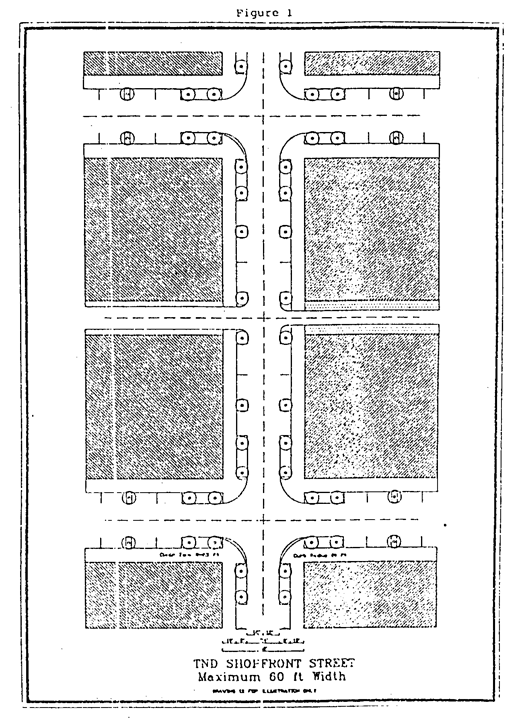
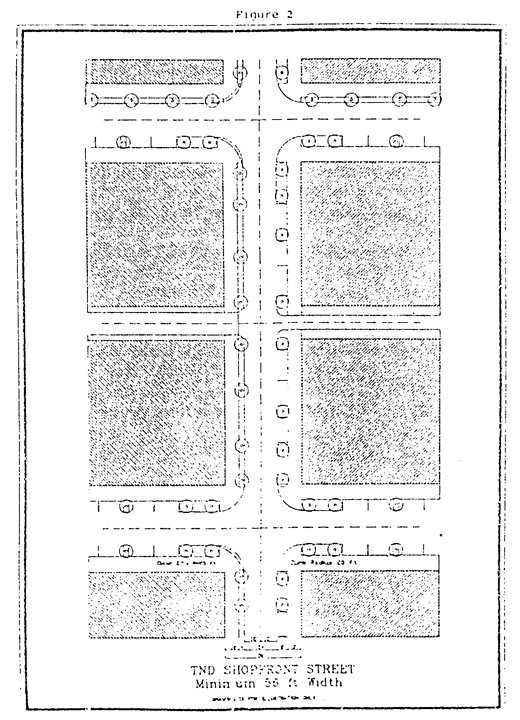
(b)
Posted vehicle speed for shopfront use streets shall not exceed twenty-five (25) miles per hour.
(c)
At intersections, the curb radius shall be twenty (20) feet, with a clear zone radius of twenty-five (25) feet. Parking lanes shall not be closer than twenty-five (25) feet to the nearest intersecting building lot line.
(d)
Signs in colonnades shall have a minimum clearance of eight (8) feet above the sidewalk.
(e)
Shopfront use lots shall have their rear or side lot lines coinciding with an alley twenty-four (24) feet wide, containing a vehicular pavement width of at least nine (9) feet one-way, and a maximum of eighteen (18) feet two-way.
(5)
Parking.
(a)
No less than seventy-five (75.0) percent of the parking spaces shall be to the rear of the building. Access may be through the frontage only if an alley or side street providing access to the alley is not within two hundred (200) linear feet of the lot.
(6)
Signage.
(a)
All signs shall be wall signs or cantilever signs and shall not exceed a total of twenty-four (24) square feet per building with no more than three (3) signs. Individual cantilever signs shall be mounted perpendicular to the building face and shall not exceed eight (8) square feet. No sign shall be mounted above the first floor of the structure.
(D)
Rowhouse use.
(1)
Land use.
(a)
Land designated for rowhouse use shall be on lots containing buildings for residential uses including townhouse, apartment, limited office as permitted in the RU-5A Zoning District, limited lodging, congregate living facilities, family day care, and artisanal use. Where nonresidential uses are proposed, at least fifty percent (50%) of the gross square footage shall be restricted to residential use as demonstrated by the submittal of floor plans identifying the use of each room.
(b)
One hundred (100) percent of the building area above the ground floor shall be designated for residential use.
(c)
An outbuilding is permitted on each lot.
(2)
Land allocation.
(a)
Rowhouse use lots shall constitute a minimum of twenty percent (20%) and a maximum of fifty percent (50%) of the gross area of the neighborhood proper.
(b)
Rowhouse use lots may be consolidated for the purpose of constructing multifamily dwellings.
(c)
A maximum of fifty (50.0) percent of all rowhouse use lots may be consolidated.
(3)
Lots and buildings.
(a)
Rowhouse use lots shall have a maximum width of thirty-two (32) feet.
(b)
Rowhouse use buildings with the minimum setback shall have their front entry set to one (1) side of the facade. This is to preserve the possibility of retro-fitting a ramp for wheelchair access.
(c)
Rowhouse use buildings shall be attached (built with no side setback or as a single building) at not less than five-unit segments. Lots comprising the end of the block adjacent to the street or alley or along street curves may be attached in segments of two (2) to five (5) units.
(d)
Buildings on rowhouse use lots shall be setback eight (8) or fifteen (15) feet from the frontage line. Buildings at street intersections shall be set back eight (8) feet from the frontage line and six (6) feet from the side street line. Setback requirements shall apply to the enclosed portion of the buildings only.
(e)
Buildings on rowhouse use lots shall have a setback of zero (0) feet from at least one (1) side property line. There shall be no required rear setback.
(f)
Outbuildings shall have no required setbacks.
(g)
Setbacks on consolidated rowhouse use lots shall apply as in a single lot.
(h)
Buildings on rowhouse use lots shall cover no more than sixty (60) percent of the net lot area. Outbuildings shall not count towards the lot coverage when the principal buildings do not cover more than fifty (50%) percent of the net lot area. Front porches and covered stoops without habitable space above shall not count towards the lot coverage.
(i)
Buildings on rowhouse use lots shall not exceed thirty-five (35) feet in height (excluding chimneys and elevator towers) and a cornice line shall be used to define the first floor.
(j)
Buildings on rowhouse use lots shall have a minimum first floor front elevation eighteen (18) inches above finished sidewalk grade, except that an apartment building(s), as defined in Section 33-1(6.1) of the Code of Miami-Dade County, in rowhouse use lots shall not be subject to the elevation requirement. Rear entrance(s) shall be accessible for people with disabilities by grading or ramping. Space shall be provided in the front yard area for the construction of a ramp.
(k)
A minimum of thirty percent (30%) of the net lot area shall be developed as private open space.
(l)
Rowhouse use lots shall have a streetedge built along the unbuilt parts of the frontage line in accordance with section 33-284.47.
(m)
A masonry wall, wood fence, aluminum fence, wrought iron fence, or vinyl/PVC fence not exceeding six (6) feet in height may be placed along the rear or interior side property lines. Heights for hedges and any landscape plants placed along the rear and interior side property lines are not limited.
(n)
A minimum of twenty-five percent (25%) of the buildings on rowhouse use lots shall have front porches. Said front porches may encroach into the front setback and shall not count against lot coverage requirements but shall count towards private open space requirements.
(4)
Streets and alleys.
(a)
Rowhouse use lots shall front on streets consisting of a fifty-foot maximum width, including two (2) ten-foot wide travel lanes and an eight-foot wide parallel parking lane on at least one (1) side. If the parking lane is provided on only one (1) side there shall be a planting strip, at least five (5) feet wide, provided between the opposite sidewalk and travel lane. Two (2) sidewalks are required and shall be no less than six (6) feet wide. (As an example, refer to Figures 3 and 4). Rowhouse use lots may also front on squares or park tracts.
(b)
No parking shall be permitted in the front setback area.
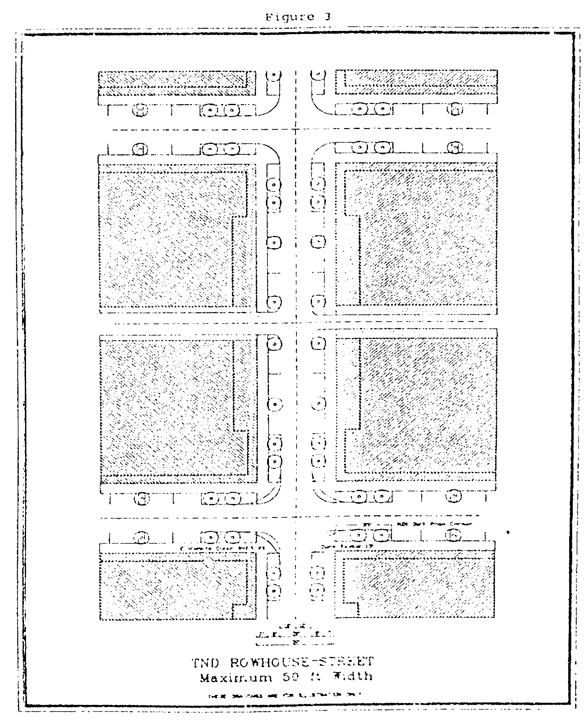
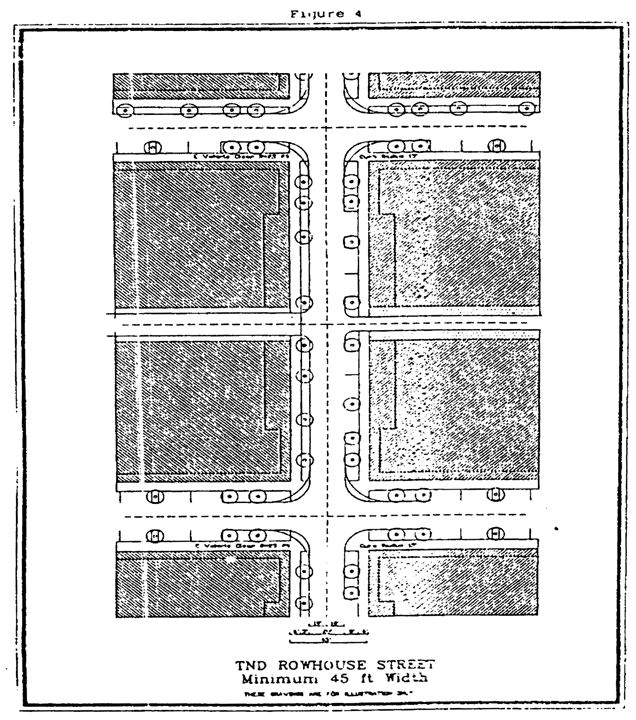
(b)
Posted vehicle speed for rowhouse use streets shall not exceed twenty (20) miles per hour.
(c)
At intersections, the curb radius shall be fifteen (15) feet with a clear zone radius of twenty-five (25) feet. Parking lanes shall not be closer than twenty-five (25) feet from the lot line adjoining intersecting streets.
(d)
Rowhouse use lots shall have their rear or side lot lines coinciding with an alley twenty-four (24) feet wide containing a vehicular pavement width of at least ten (10) feet one-way and sixteen (16) feet two-way.
(5)
Parking.
(a)
All off-street parking places shall be to the rear of the building. Access shall be through a vehicular alley only.
(b)
No parking shall be permitted in the front setback area.
(6)
Signage.
(a)
All signs shall be wall signs and limited to two (2) signs and shall not exceed a cumulative total of four (4) square feet. No signs shall be mounted above the first floor of a structure.
(E)
House use.
(1)
Land use.
(a)
Land designated for house use shall be on lots containing buildings for residential uses including single-family houses, guest houses as outbuildings, home occupation, and family day care.
(b)
One hundred (100) percent of the building area above the ground floor shall be designated for residential use.
(c)
An outbuilding is permitted on each lot.
(2)
Land allocation.
(a)
House use lots shall constitute a maximum of thirty percent (30%) of the gross area of the neighborhood proper.
(b)
A maximum of two (2) house use lots may be consolidated for the purpose of constructing a single residence.
(c)
A maximum of fifty (50.0) percent of all house use lots may be consolidated.
(3)
Lots and buildings.
(a)
Houses on house use lots shall be raised a minimum of eighteen (18) inches from finished exterior sidewalk grade. At least one (1) entrance shall be accessible for people with disabilities either by grading or ramping, and the other entrance shall have sufficient space to construct a possible future ramp
(b)
Buildings on house use lots shall be set back ten (10) or twenty (20) feet from the frontage line. Buildings at street intersections shall be set back ten (10) feet from the frontage line and the side street frontage line.
(c)
House use lots shall have a minimum width of thirty-six (36) feet and a minimum lot size of three thousand six hundred (3,600) square feet with a minimum average lot size of five thousand (5,000) square feet.
(d)
Setbacks on consolidated house use lots shall apply as on a single lot.
(e)
Buildings on house use lots shall be set back from the side lot lines equivalent (in total) to no less than twenty percent (20%) of the width of the building lot. The entire setback may be allocated to one (1) side. If buildings have a zero (0) foot setback on one (1) side, a four-foot maintenance easement shall be provided on the adjacent lot.
(f)
Buildings on house use lots shall be set back no less than five (5) feet from the rear lot line. Outbuildings on house use lots shall have a setback no less than five (5) feet from the rear lot line except on an alley where it shall have a zero-foot setback.
(g)
Buildings on house use lots between 3,600 square feet and 4,999 square feet shall cover no more than forty (40%) percent of the lot area. Buildings on 5,000 square foot and greater house use lots shall cover no more than fifty (50%) percent of the lot area. Outbuildings shall not count towards the lot coverage when the principal buildings do not cover more than forty (40%) percent of the net lot area. Front porches, porte-cocheres and covered stoops without habitable space above shall not count towards the lot coverage.
(h)
Buildings on house use lots shall not exceed twenty-four (24) feet in height (excluding chimneys).
(i)
Buildings on house use lots shall have a streetedge built along the frontage line in accordance with section 33-284.47.
(j)
A masonry wall, wood fence, aluminum fence, wrought iron fence, or vinyl/PVC fence not exceeding six (6) feet in height may be placed along the rear or interior side property lines. Heights for hedges and any landscape plants placed along the rear and interior side property lines are not limited.
(k)
A minimum of twenty-five percent (25%) of the buildings on house use lots shall have front porches which may encroach into the front setback not closer than eight (8) feet from the inside edge of the sidewalk.
(4)
Streets and alleys.
(a)
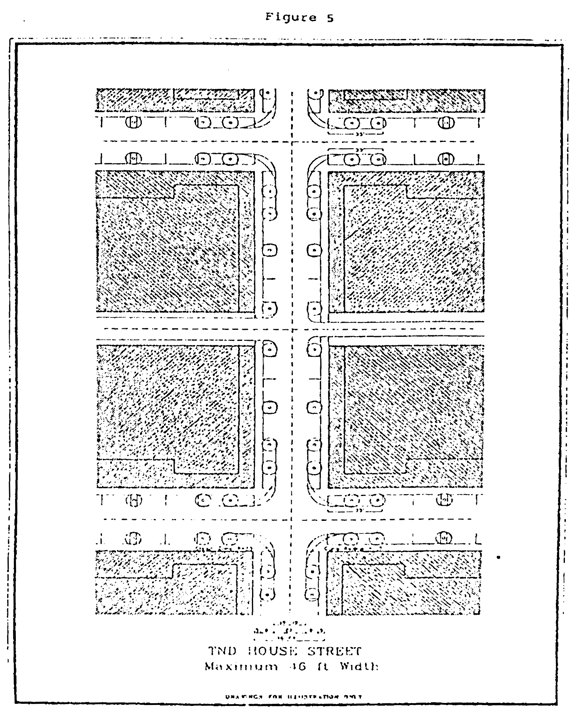
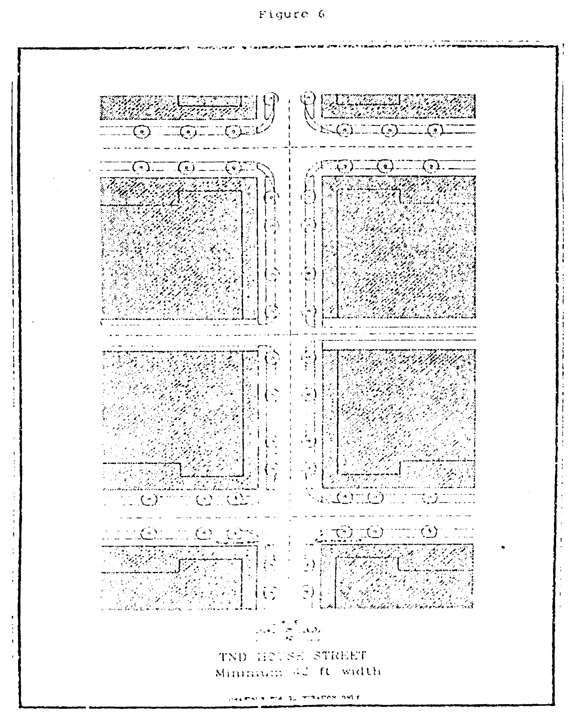
House use lots shall front on streets of a forty-six-foot maximum width consisting of two (2) ten-foot travel lanes, two (2) planting strips of at least six (6) feet wide each, and two (2) sidewalks which shall be no less than five (5) feet wide. A parallel parking lane eight (8) feet wide may be used in place of either planting strip. (As an example, refer to Figures 5 and 6.)
(b)
Posted vehicle speed for house use streets shall not exceed twenty (20) miles per hour.
(c)
At intersections, the curb radius shall be fifteen (15) feet with a clear zone radius of twenty-five (25) feet. Parking lanes shall not be closer than twenty-five (25) feet from the lot line adjoining intersecting streets.
(d)
House use lots may have their rear or side lot lines coinciding with an alley twenty-four (24) feet wide containing a pavement width of at least ten (10) feet one-way and sixteen (16) feet two-way, except where the rear lot adjoins a greenbelt, lake or canal.
(5)
Parking.
(a)
No parking shall be permitted in the front setback area of residential lots of less than fifty (50) foot frontage.
(b)
All off-street parking places shall be to the side or the rear of the building. Where no alley access exists and vehicular access is through the frontage, garages shall be located a minimum of twenty (20) feet behind the front building setback. Porte-cocheres may be located at the front building setback line. Porte-cocheres without habitable space above may encroach into the front setback a maximum of eight (8) feet.
(6)
Signage.
(a)
One wall, or streetedge mounted, sign not to exceed one (1) square foot shall be permitted.
(F)
Workshop use.
(1)
Land use.
(a)
Land designated for workshop use shall be in land containing buildings for the following uses: No building for a single use shall exceed thirty thousand (30,000) square feet of interior floor area.
1.
Artists studios and accessory gallery use.
2.
Artisanal use.
3.
Automobile and motorcycle body shops.
4.
Automobile parking garages.
5.
Automobile service and repairs.
6.
Bait and tackle shops.
7.
Bakeries (wholesale).
8.
Banks excluding drive-in teller services.
9.
Bottling of beverages.
10.
Cabinet shops.
11.
Cold storage warehouse.
12.
Dance studios.
12a.
Day care centers.
13.
Dog and pet hospitals in air conditioned buildings.
14.
Dry cleaning and dyeing establishments.
15.
Engines, sales and services.
16.
Gasoline service stations excluding markets.
17.
Glass installation.
18.
Health and exercise clubs.
19.
Interior design shops.
20.
Leather goods manufacturing, excluding tanning.
21.
Locksmith shops, sharpening and grinding shops.
22.
Lumber yards.
23.
Mail order offices and storage.
24.
Medical equipment and supplies.
25.
Office supply stores.
26.
Office buildings.
27.
Post office substations and police substations.
28.
Photography labs.
29.
Pottery shops.
30.
Printing shops.
31.
Residential use shall be permitted on the second and/or third floor above workplace use. A second floor residential unit must provide access to people with disabilities.
32.
Restaurants excluding drive-in service.
33.
Secondhand stores and antique shops.
34.
Upholstery and furniture shops.
35.
Wholesale salesroom and storage rooms.
36.
Other similar uses as approved by the Director.
(2)
Land allocation.
(a)
Workshop use lots shall constitute a minimum of three percent (3%) and a maximum of seven percent (7%) of the gross area of the neighborhood proper. When a TND borders land designated in the CDMP as agriculture or open land, the land allocation for workshop use lots may constitute only one and one-half (1.5%) percent of the gross area of the neighborhood proper.
(b)
Workshop use lots shall not be within three hundred (300) feet of the geometric center of the neighborhood proper or the mandatory square or green. When a TND borders land designated in the CDMP as agriculture or open land, then workshop use lots shall not be permitted within three hundred thirty (330) feet of said TND boundary except if necessary to maintain consistency with the Goals, Objectives and Policies of the CDMP including the Guidelines for Urban Form.
(c)
All workshop use lots shall be contiguous and located within one (1) area with no intervening uses, provided however, in TNDs exceeding one hundred (100) acres in size, two (2) workshop use areas shall be permitted.
(3)
Lots and buildings.
(a)
Buildings on workshop use lots shall have a setback of zero (0) or five (5) feet from the frontage line. The setback at street intersections shall not exceed five (5) feet from the frontage line and the side street line.
(b)
Street-front entries shall be at grade to allow access for people with disabilities.
(c)
Buildings on workshop use lots shall cover no more than seventy percent (70%) of the net lot area.
(d)
A minimum of fifteen percent (15%) of the net lot area shall be developed as landscaped open space.
(e)
Buildings on workshop use lots shall not exceed thirty-five (35) feet in height.
(f)
Workshop use lots shall be separated from other use types at the side and rear lot lines (excepting an entry on the alley) by a continuous masonry wall no less than six (6) feet in height.
(g)
The unbuilt portion of the frontage line shall have a streetwall built directly upon it in accordance with section 33-284.47.
(h)
Workshop use lots shall have a maximum width of three hundred (300) feet.
(4)
Streets and alleys.
(a)
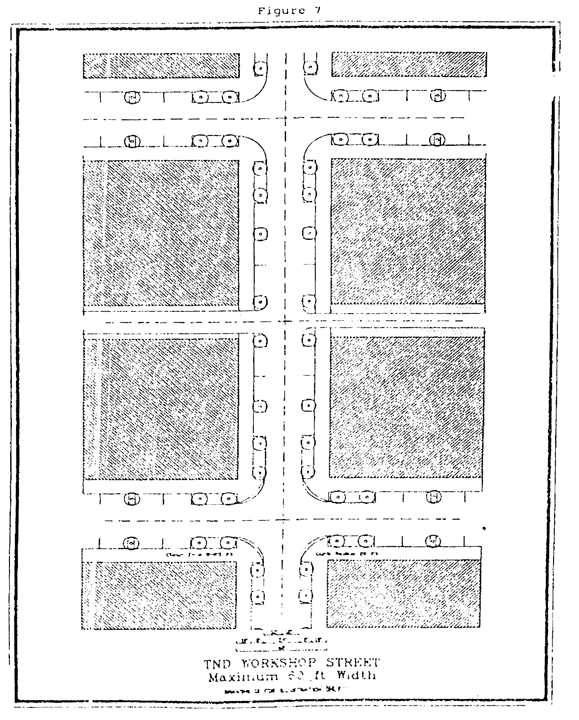
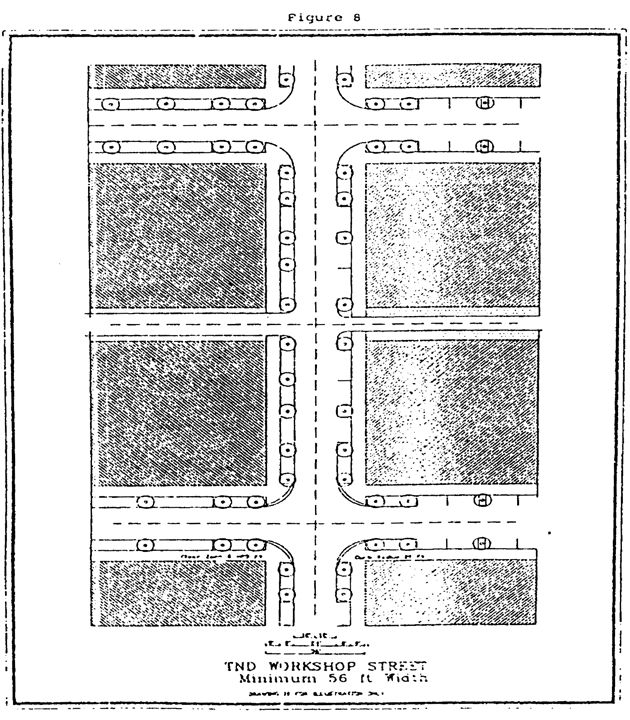
Workshop use lots shall front on streets of a sixty (60) feet maximum width consisting of two (2) twelve-foot wide travel lanes, and eight-foot wide parallel parking on at least one (1) side of the road. If the parking lane is provided on only one (1) side there shall be a planting strip of at least eight (8) feet wide between the opposite lane and the sidewalk. Sidewalks shall be no less than eight (8) feet wide and are required on both sides of the street. (As an example, refer to Figures 7 and 8).
(b)
Posted vehicle speed for workshop use streets shall not exceed twenty-five (25) miles per hour.
(c)
At intersections the curb radius shall be twenty (20) feet, with a clear zone radius of twenty-five (25) feet. Parking lanes shall not be closer than twenty-five (25) feet to the nearest intersecting building lot line.
(d)
Workshop use lots shall have their rear or side lot lines adjacent to an alley twenty-four (24) feet wide containing a vehicular pavement width of at least ten (10) feet one-way and eighteen (18) feet two-way, except where the rear lot line adjoins a greenbelt, lake or canal.
(5)
Parking.
(a)
Off-street parking shall be placed to the side or the rear of the building.
(6)
Signage.
(a)
All signs shall be wall mounted perpendicular to the building face with an eight-foot clearance to the sidewalk and shall not exceed a total of twenty-four (24) square feet and shall be limited to three (3) signs.
(Ord. No. 91-41, § 1, 4-2-91; Ord. No. 96-127, § 32, 9-4-96; Ord. No. 99-26, § 1, 5-4-99; Ord. No. 02-46, § 9, 4-9-02; Ord. No. 03-47, § 5, 3-11-03; Ord. No. 11-83, § 2, 11-15-11; Ord. No. 15-35, § 3, 5-5-15)
Sec. 33-284.52. - Limitation on variances.
The following provisions of the TND ordinance shall not be varied:
(a)
Curb requirements.
(b)
Front porch requirements.
(c)
Location of on-site parking.
(d)
Colonnades.
(e)
Rowhouse and house use with first floor of eighteen (18) inches above finished grade.
(f)
Average block perimeter.
(g)
Public/semi-public use and civic use land allocation requirements.
(h)
Minimum land allocation requirements, except for workplace uses which may be reduced by fifty percent (50%).
(i)
Street width requirements.
(j)
Maximum and minimum setback requirements.
(Ord. No. 91-41, § 1, 4-2-91; Ord. No. 03-47, § 6, 3-11-03)
Sec. 33-284.52.1. - Special exception to the use of alleys.
No alley shall be required for any location where one of the following conditions exist as demonstrated at public hearing;
(a)
Required parking is provided in the rear and due to design or intensity of such parking, alleys cannot provide safe or logical access to such parking, or
(b)
Required parking is provided by on-street parking where permitted.
(Ord. No. 03-47, § 7, 3-11-03
Sec. 33-284.53. - Ownership and maintenance of common open space(s) and civic use buildings.
All land designated on approved plans as common open space, including squares, greens and parks, and all structures devoted to the common use of the inhabitants of a TND will be owned and/or maintained under one or more of the following structures:
(A)
Those projects developed under a condominium ownership shall be in accordance with applicable Florida law, or
(B)
The common open space and civic uses shall be maintained under a special taxing improvement district or community development district as approved by the Board of County Commissioners, or
(C)
The common open space and civic uses shall be owned and maintained as provided under the provisions of the property homeowners' association declaration, which shall, at a minimum, provide for the maintenance of all common facilities covered by the documents in a manner that assures their continued use for their intended purposes and provided further that the property homeowners' association declaration shall comply with the following requirements:
(1)
Approval for form and legal sufficiency as to compliance with the ordinance by the Miami-Dade County Attorney's Office.
(2)
A homeowners' association shall be established before the units or individual building lots are sold.
(3)
Membership shall be mandatory for each property owner and said association shall have the authority to adjust the assessment to meet the needs of maintaining the open space and common facilities.
(4)
Any sums levied by the homeowners' association that remain unpaid, shall become a lien on the individual property and said lien shall be superior to all other liens save and except tax liens and mortgage liens, provided said mortgage liens are first liens against the property encumbered thereby, subject only to tax liens and secure indebtedness which are amortized in monthly or quarter annual payments over a period of not less than ten (10) years.
(Ord. No. 91-41, § 1, 4-2-91; Ord. No. 03-47, § 8, 3-11-03; Ord. No. 11-83, § 3, 11-15-11)
Sec. 33-284.54. - Conflicts with other Chapters.
In the event of express conflict with any provision of Chapter 18A (Landscape Ordinance) or any other provision of Chapter 33, the provisions of this Article shall prevail. The requirement of Section 33-284.51(d) to provide a child care use in a TND zoning district shall not apply where the Director of Planning and Zoning determines that the TND zoning district is encumbered in whole or in part by conflicting airport regulations and no suitable site within a TND zoning district exists for a child care facility outside the areas that are in conflict with the airport regulations.
(Ord. No. 03-47, § 9, 3-11-03)

