
Miami Dade County Unincorporated
City Zoning Code
City Zoning Code
ARTICLE XXXIII
AU, AGRICULTURAL DISTRICT46
Cross reference— Height and type of fences in AU Districts, § 33-11(h); circuses and carnivals in AU Districts without public hearing, § 33-13(f); public hearing required for establishing cemeteries, mausoleums or crematories, § 33-23; permit to use metal buildings in AU Districts, § 33-32.
Sec. 33-279.- Uses permitted.
No land, body of water, or structure shall be maintained, used, or permitted to be used, and no structure shall be hereafter maintained, erected, constructed, moved, reconstructed, structurally altered, or be permitted to be maintained, erected, constructed, moved, reconstructed, or structurally altered in an AU District, which is designed, arranged, or intended to be used or occupied for any purpose, except for one or more of the following uses:
(1)
All uses, except golf courses, permitted in the RU-1, EU-M, or EU-1 Districts and subject to the restrictions thereof not inconsistent with this article.
(2)
A bed and breakfast establishment shall be permitted subject to the following limitations:
(a)
The facility shall be located in property that is subject to a lawful agricultural property tax classification and designated in the Comprehensive Development Master Plan for Agriculture, except as provided in this subsection.
(b)
No more than six (6) bedrooms shall be allocated for rental and no more than six (6) bedrooms shall be rented out per 24-hour period.
(c)
The bed and breakfast establishment use may be conducted from both a principal residence and a legally established accessory guest house detached from the principal residence.
(d)
The maximum length of total stay for any bed and breakfast guest shall be thirty (30) days per consecutive twelve-month period.
(e)
No cooking facilities shall be permitted in any of the bedrooms available for rent.
(f)
The property owner shall obtain a certificate of use from the Department and promptly renew the same annually.
(g)
Regarding compliance with the applicable provisions of Chapter 24 of this Code only, bed and breakfast establishments shall be considered residential establishments.
(h)
The property owner shall obtain and maintain the appropriate licenses from the State of Florida, including the Department of Business and Professional Regulation, Division of Hotels and Restaurants, or successor agency, if applicable.
(i)
The appearance of the bed and breakfast establishment shall not be that of a multi-family, hotel, or commercial use.
(j)
If designated historic by the Miami-Dade County Historic Preservation Board, structures located on a property designated Agriculture and situated outside the Urban Development Boundary on the Comprehensive Development Master Plan Land Use Plan Map shall be exempt from the requirement of subsection (a) above or any requirement that there be a working farm on the property.
(3)
Barns, including, without limitation, pole barns, sheds, and packing facilities, in accordance with the following conditions:
(a)
Barns and sheds used for cattle or stock and ancillary feed storage, provided that such barns and sheds:
1.
shall not be used for hogs; and
2.
shall not be permitted within 250 feet of a residence under different ownership or of an RU or EU District unless approved after public hearing.
(b)
Barns, sheds, or other buildings used for the storage of equipment, feed, fertilizer, produce, or other items, as ancillary to a farm use permitted in this section is permitted only in accordance with the following unless approved after public hearing or as otherwise provided in Section 604.50, Florida Statutes, for nonresidential farm buildings:
1.
Such buildings shall be related to the agricultural use conducted on the property upon which the buildings are located; and
2.
Such structures shall be located at least 50 feet from any residence under different ownership and any RU or EU zoned property.
3.
It is provided, however, that a lawfully-established structure or building shall not be required to be removed based on any subsequent changes in ownership, zoning classification, or development on any adjacent property.
(c)
Packing of fruits and vegetables within a packing facility shall be permitted where ancillary to an ongoing and lawfully established agricultural use conducted on the property upon which the packing facility is located, where the agricultural use encompasses at least 51 percent of the property, and in accordance with the following:
1.
Small packing facilities used for the packing of fruit and vegetables upon compliance with all of the following conditions:
a.
The packing facility shall be located at least 100 feet from any property line.
b.
The small packing facility shall not exceed 3,500 square feet.
2.
Large packing facilities used for the packing of fruit and vegetables upon compliance with all of the following conditions:
a.
The lot upon which the packing facility is located shall not be less than ten acres.
b.
Packing operations shall be discontinued if the farm or grove use is abandoned.
c.
Incidental cleaning, storage, and shipping of the fruit and vegetables is permitted.
d.
Outside storage of refrigerated containers is prohibited unless the refrigeration system is powered by electricity, subject to Section 33-279.3.
e.
The parking of vehicles shall comply with Section 33-279.3.
f.
The packing facility shall be at least 100 feet from any property line.
g.
Site plan approval is secured pursuant to Section 33-310.4.
h.
A certificate of use pursuant to Section 33-8 shall be obtained.
3.
The term "packing facility" shall include: any building, lean-to, pole barn, or open area utilized in the course of packing fruit or vegetables; any areas, whether or not within a building, used for the cleaning of produce, storing of coolers, refrigerated containers, packing crates, or other items used in the packing operation; and storage and parking of any vehicles and equipment allowed pursuant to Section 33-279.3.
4.
The sale, shipping, and marketing of products packed at such facility is allowed as ancillary to a packing operation.
(d)
Except for a large packing facility, a certificate of use pursuant to Section 33-8 shall not be required for the uses authorized by this subsection.
(4)
Cattle or stock grazing (not including hog raising). A certificate of use pursuant to Section 33-8 shall not be required for cattle or stock grazing.
(5)
Commercial Vehicle Storage as defined in Section 33-1, subject to the following conditions:
(a)
Commercial vehicle storage is limited to the following areas:
(1)
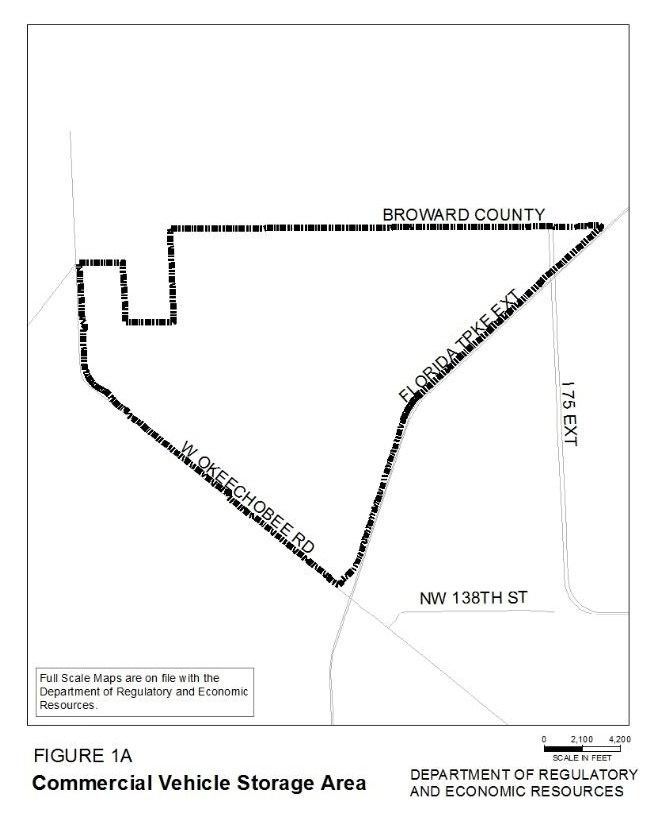
Open Land Subarea 1, as defined under the County's CDMP, and depicted on Figure 1A. For purposes of this section, the allowed truck parking area is generally located east of Okeechobee Road and west of the Homestead Extension of the Florida Turnpike, excluding the former Opa Locka West airport.
(2)
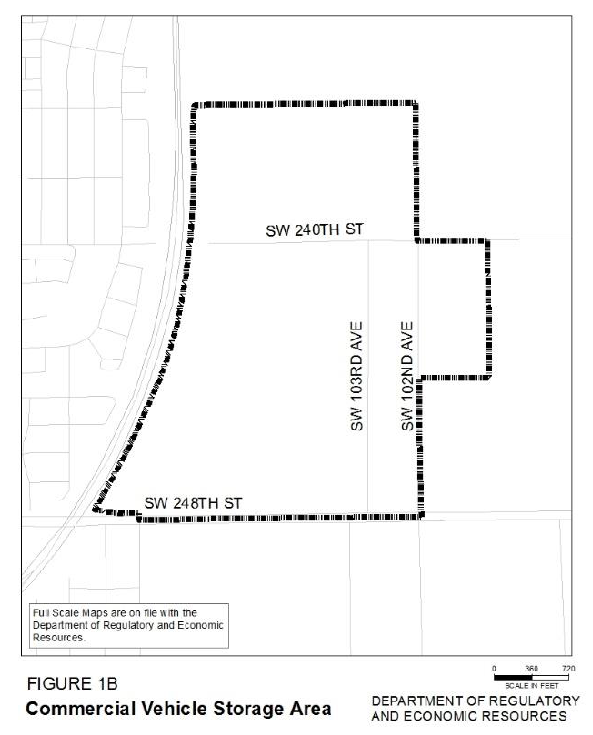
East of the Urban Development Boundary, south of the theoretical extension of SW 236 Street and north of SW 248 Street, as depicted on Figure 1B.
(b)
Minimum site size shall be 10 gross acres. The site may consist of:
(1)
A single parcel; or
(2)
Separate parcels that are:
i.
Adjoining, adjacent, or within 660 feet of each other; and
ii.
Subject to:
a.
A unity of title; or
b.
An equivalent instrument, as determined by the Director, that requires the separate parcels to be treated as a single unit for purposes of this section, including providing for joint and several liability, and the ability to lien any or all such parcels, for violations of this section.
(c)
The site shall be managed by a single entity that holds the required operating permit.
(d)
An annual operating permit shall be obtained pursuant to Section 24-18 prior to operating the commercial vehicle storage use.
(e)
Mechanical repair or maintenance of any kind, including truck washing, shall be prohibited, except that truck washing shall be allowed in the Open Land Subarea 1 under all of the following conditions:
(1)
Truck washing is incidental to a lawfully established commercial vehicle storage use.
(2)
Only trucks that are stored at the facility for at least four hours may be washed.
(3)
The use complies with all applicable requirements of chapter 24, as determined by the Department's Division of Environmental Resources Management or successor department ("DERM").
(4)
Washing is conducted within an enclosed building that is permitted for the truck washing use.
(5)
Washing is conducted with a water system that is 100-percent recyclable, as approved by DERM.
(6)
Secondary containment surrounding all storage tanks shall be installed prior to operating the truck washing use, as approved by DERM.
(7)
Facilities shall install groundwater monitoring devices approved by DERM prior to operating, and shall conduct regular groundwater monitoring on a schedule determined by DERM.
(8)
The Department shall be permitted to inspect the facilities at any time during operating hours.
(f)
Notwithstanding any provisions of Section 33-282, the following minimum setbacks shall apply to the paved area utilized for the storage and the parking area of commercial vehicles:
(1)
25 feet from front and side street property line, except that only a 5-foot setback shall be required from a private roadway.
(2)
25 feet from interior side and rear property line.
(3)
100 feet from a body of water, canal, or lake, as measured from the top of the bank.
(4)
25 feet from a wetland that has not been otherwise mitigated or will not otherwise be mitigated pursuant to chapter 24.
(5)
The setback area shall be landscaped in accordance with Section 33-283.1.
(g)
A guard house and office may be permitted as an ancillary use to the commercial vehicle storage and parking facility provided that said guard house and office is set back at least 50 feet from the front property line and does not exceed 600 square feet of floor space.
(h)
An annually-renewable certificate of use shall be obtained from the Department.
(i)
Landscaping shall comply with Section 33-283.1.
(j)
Administrative site plan review shall be required in accordance with Section 33-283.1.
(k)
Building permits shall be obtained for the construction of any structures and other improvements as required under the Florida Building Code.
(l)
Discharge and handling of waste and hazardous material: The storage, handling, use, discharge, and disposal of liquid or hazardous wastes or hazardous materials shall be prohibited.
(m)
Enforcement.
(1)
In addition to any other enforcement measures authorized pursuant to this code, if the named violator has admitted to or been adjudicated guilty of three violations of this subsection or the terms of the required operating permit having been committed within a three-year period, truck washing shall not be permitted on the subject property, subject to the provisions of subparagraph (2) below.
(2)
After two years from the cessation of truck washing pursuant to subparagraph (1), the owner may apply to reestablish the use. The Director may impose additional conditions on the certificate of use for truck washing, considering the nature of the violations, the potential harm to be avoided, and any change in ownership of the property.
(6)
Raising or keeping of hogs, subject to the following:
(a)
Hog farms and hog raising in excess of two hogs per site shall be permitted only upon approval after public hearing and shall require a certificate of use pursuant to Section 33-8.
(b)
Such use shall not be permitted within 250 feet of a residence under different ownership, or of an RU or EU District, unless approved after public hearing.
(c)
A certificate of use pursuant to Section 33-8 shall not be required for raising or keeping of up to two hogs per site.
(7)
Dairy barn, meaning a barn used for the sole purpose of housing, feeding, and milking cattle, subject to the following:
(a)
Such use shall only be located within 250 feet of a residence under separate and different ownership or within 500 feet of an RU or EU District boundary if approved after public hearing.
(b)
A certificate of use pursuant to Section 33-8 shall:
1.
not be required for a dairy barn that does not require public hearing; and
2.
be required for a dairy barn requiring a public hearing for approval.
(8)
A rural event venue shall be permitted, subject to the following conditions and limitations:
(a)
The property on which the use is located:
1.
is being used, in whole or in part, for a farm; or
2.
includes a bed and breakfast establishment that complies with this section; or
3.
is designated historic, in whole or in part, by the County pursuant to Chapter 16A, or has been specifically recognized by other ordinance or resolution of the Board of County Commissioners as having unique historical or cultural value.
(b)
Except for properties designated historic, in whole or in part, by the County or otherwise recognized pursuant to paragraph (a)(3), the property shall have a minimum size of five gross acres.
(c)
The maximum number of guests or attendees allowed shall be 150 for properties that are less than 10 gross acres and 300 for properties that are 10 gross acres or more.
(d)
The number of events on each property shall be limited to one event per day, and shall not exceed three events per week.
(e)
Events shall only take place between the hours of 9:00 a.m. and 11:00 p.m., and no outdoor amplified sound shall be allowed between the hours of 11:00 p.m. and 9:00 a.m. In addition, the use shall comply with the noise regulations set forth in paragraph (27)(d).
(f)
Portable toilets shall be provided, commensurate with the number of guests, unless the property has adequate restroom facilities that are connected to the sanitary sewer system.
(g)
All lighting installations in connection with a rural event venue shall be designed to minimize direct spillage, sky glow, and hazardous interference with vehicular traffic on adjacent rights-of-way and all adjacent properties, which may be achieved through the use of down-turned lights, light shields, building screening, landscaping, or other similar elements.
(h)
An annually-renewable certificate of use for each such facility is obtained pursuant to Section 33-8 upon demonstrating compliance with this subsection. For each certificate of use or renewal, a complete application for a rural event venue shall be submitted to the Department and shall include the following:
1.
Description of events and proposed schedule;
2.
Hours of operation;
3.
Frequency of events;
4.
Maximum number of guests;
5.
Number of parking spaces, which are not required to be paved and shall not count against any limitations on the area allowed for ancillary uses but which shall at a minimum comply with the following:
a.
One parking space is provided for every four guests.
b.
No parking shall be permitted on road rights-of-way; and
c.
Required parking spaces shall be provided on site, except as allowed in subparagraph (5)(d).
d.
Required parking spaces may be provided off site only upon demonstration of the following as part of the CU application:
i.
Parking is located within one mile of the subject property; and
ii.
A signed statement of consent from the owner of each offsite parking property, including the terms of usage; and
iii.
The types of services, such as valet or shuttle, that will be provided to transport guests to the event venue; and
iv.
A parking and circulation plan for the offsite property, including the location of shuttle or valet pick-up;
6.
Site plan depicting parking, traffic circulation, sanitation and refuse facilities, and portable toilets or restrooms connected to the sanitary sewer system; and
7.
Upon renewal of a CU, the Director may require additional conditions or site plan modifications to address offsite impacts related to traffic, such as requiring the site plan to be reconfigured to increase traffic queuing onsite.
(i)
Notwithstanding the foregoing, when a rural event venue, except for its parking area, is entirely contained within land classified as agricultural land by the Property Appraiser, only the following simplified conditions and limitations to address substantial offsite impacts and emergencies shall apply to the event venue use:
1.
No outdoor amplified sound shall be allowed between the hours of 11:00 p.m. and 9:00 a.m., and the use shall comply with the noise regulations set forth in paragraph (27)(d)
2.
The use shall:
i.
comply with paragraph (g) above regarding lighting;
ii.
provide sufficient portable toilets or other lawful sanitation facilities commensurate with the number of guests;
iii.
provide parking that complies with subparagraph (h)(5) above; and
iv.
provide sufficient emergency vehicle access to serve all guests and attendees.
3.
A certificate of use pursuant to Section 33-8 is not required, except that a CU for the limited purpose of demonstrating compliance with subparagraph (h)(5)(d) above shall be obtained where parking is provided off site.
4.
These simplified conditions and limitations shall apply when the land classified as agricultural land is only a portion of a larger property, provided that the rural event venue is entirely contained within land classified as agricultural land.
(j)
Notwithstanding any other provision to the contrary, within the Horse Country area bounded on the north by S.W. 40th Street/Bird Road, bounded on the east by the Florida Turnpike, bounded on the south by S.W. 72nd Street, and bounded on the west by S.W. 127th Avenue, which was designated as an Area or Facility of Countywide Significance pursuant to Resolution No. R-429-16, the following shall apply:
1.
A rural event venue shall only be permitted when it is entirely contained within land classified as agricultural land by the Property Appraiser, and only in accordance with paragraph (i) above.
2.
For any such permitted rural event venues, outdoor amplified sound shall not be permitted during the operating hours of any religious facility, school, or hospital located within a 500-foot radius of the rural event venue.
(9)
Farms. This classification is for a type of farm not otherwise enumerated in this section. A certificate of use pursuant to Section 33-8 shall not be required.
(10)
Farm stands may be permitted in the area designated "Agriculture" on the Adopted Land Use Plan Map of the Comprehensive Development Master Plan, or as provided in Section 33-279.1, and upon compliance with the following conditions:
(a)
Such stand shall be ancillary to a farm that encompasses 51 percent or more of the property.
(b)
The stand shall be operated only by the party engaged in the farm use on that property.
(c)
The stand shall be operated only during the period of time that the farm is in operation on the site.
1.
The stand use shall be discontinued when the farm use on the property is abandoned.
2.
A farm shall not be deemed abandoned if the property is fallow between seasonal growing periods.
(d)
Refrigerated storage area(s) are prohibited unless the refrigeration system is powered by electricity.
(e)
A minimum of six parking spaces shall be provided; said spaces shall be located a minimum of 35 feet from right-of-way pavement. Such parking areas are not required to be paved and shall not count against any limitations on the area allowed for a farm stand.
(f)
The stand shall be located on the property with the following setbacks:
1.
From right-of-way pavement, 60 feet;
2.
From rear property line, 25 feet;
3.
From side street property line, 25 feet; and
4.
From interior side property line, 100 feet.
(g)
The stand shall be: a permanent structure of at least one open side; an open-sided, portable stand, trailer, or vehicle; or a self-propelled uni-body truck.
(h)
The maximum size of the stand shall not exceed 3,500 square feet. Refrigerated storage area(s) shall be included in computing the size of the stand.
(i)
Products prepared or sold at the stand shall comply with the following:
1.
Agricultural and food products may be offered for retail sale, provided that more than 51 percent of the products offered for sale shall be derived from crops grown in Miami-Dade County or animals raised in Miami-Dade County.
2.
Agricultural products sold at the stand are not limited to products grown on the property where the stand is located.
3.
Products may include souvenirs or other items that promote the farm.
(j)
The hours of operation of the stand shall be limited to between 6:30 a.m. and 9:00 p.m.
(k)
This section shall not be construed to prohibit a farm stand from using only self-contained utilities. It is provided, however, that use of utilities is subject to compliance with other provisions of this code and applicable state and federal law.
(l)
A certificate of use pursuant to Section 33-8 shall be required where the use involves food service or preparation but shall not be required for other uses authorized by this subsection.
(11)
Dispensing facilities for low-THC or medical cannabis, pursuant to article IXA of this chapter may be permitted in the area designated agriculture on the Adopted Land Use Plan Map of the Comprehensive Development Master Plan, upon compliance with the following conditions:
(a)
Such dispensing facility shall be located on property approved by the state for cultivating or processing low-THC or medical cannabis, and shall be operated only by the dispensing organization authorized to cultivate or process the low-THC or medical cannabis on that property.
(b)
A minimum of 6 parking spaces shall be provided; said spaces shall be located a minimum of 35 feet from right-of-way pavement.
(c)
The dispensing facility shall be located on the property with the following setbacks:
1.
From right-of-way pavement, 60 feet;
2.
From rear property line, 25 feet;
3.
From side street property line, 25 feet; and
4.
From interior side property line, 100 feet.
(d)
The dispensing facility shall be a permanent, enclosed structure that shall not exceed 5,000 square feet.
(e)
A dispensing facility shall not be permitted in the area known as Horse Country, as identified in Resolution No. R-429-16.
(12)
Groves. A certificate of use pursuant to Section 33-8 shall not be required for a grove.
(13)
Greenhouses or nurseries. A certificate of use pursuant to Section 33-8 shall not be required for a greenhouse or nursery, but such uses shall be subject to compliance with chapter 581, Florida Statutes, as applicable.
(14)
Dude ranches and riding academies shall be permitted only upon approval after public hearing and shall require a certificate of use pursuant to Section 33-8.
(15)
Horticultural farming—commercial. A certificate of use pursuant to Section 33-8 shall not be required for horticultural farming.
(16)
Hydroponics or other chemical farming. A certificate of use pursuant to Section 33-8 shall not be required for hydroponics or other chemical farming.
(17)
Poultry raising, subject to the following:
(a)
The raising of 100 poultry, or more, shall be considered as commercial poultry raising.
(b)
Buildings housing poultry must be at least 500 feet from any EU or RU District boundary, and at least 50 feet from any residence under separate ownership on any adjacent property.
(c)
A certificate of use pursuant to Section 33-8 shall not be required.
(18)
Recreational vehicles as temporary watchman's quarters in accordance with Section 33-20(g) of this chapter.
(19)
Truck gardens, meaning the cultivation of vegetable crops for market or for sale directly to consumers. A certificate of use pursuant to Section 33-8 shall not be required.
(20)
One single-family permanent or temporary structure to house farm labor personnel will be permitted on a farm site for the first ten (10) acres (or less, if smaller, but not less than five (5) acres) and an additional one-family structure for each five (5) acres of additional land in said farm site will be permitted under the following conditions:
(a)
Providing the structures are located a minimum of one hundred (100) feet from any property under separate and different ownership.
(21)
Except as permitted under item (15), temporary or permanent barracks or structures to house farm labor may be erected only upon approval after public hearing.
(22)
Fish pools and other aquaculture, subject to the following:
(a)
The location of all structures used for aquaculture or uses ancillary to and directly supportive of aquaculture shall conform to setbacks for accessory buildings, as provided in Section 33-282(b), but bin and silo structures used for the storage, mixing, and creation of grain and feed products shall be exempt from the maximum building height restriction set forth in Section 33-283(b).
(b)
Each aquaculture operation shall comply with chapter 597 of the Florida Statutes.
(c)
A certificate of use pursuant to Section 33-8 shall not be required.
(23)
Schools, including institutions of higher learning and primary and secondary schools only shall be permitted; provided, the school structures, buildings or improvements, as well as all incidental school uses, are at least two hundred fifty (250) feet from the boundary, property or lot line and further provided that such uses comply with the regulations of sections 33-151.11 through 33-151.22 of this Code.
(24)
A group home shall be permitted in a dwelling unit provided:
(a)
That the total number of resident clients on the premises not exceed six (6) in number.
(b)
That the operation of the facility be licensed by the State of Florida Department of Health and Rehabilitative Services and that said Department or sponsoring agency promptly notify the Director of said licensure no later than the time of home occupancy.
(c)
That the structure used for a group home shall be located at least one thousand (1,000) feet from another existing, unabandoned legally established group home. The 1,000-foot distance requirement shall be measured by following a straight line from the nearest portion of the structure of the proposed use to the nearest portion of the structure of the existing use.
(25)
Seed drying facility is only permitted on a parcel of land not less than 10 acres gross. A certificate of use pursuant to Section 33-8 shall not be required.
(26)
Farm-related wineries, breweries, and distilleries as defined in Section 33-1, subject to the following conditions:
(a)
Such uses may use local or imported agricultural products and shall be located on a site with a farm, which may include direct sales to the public on a U-Pick Farm.
(b)
A farm brewery or distillery not on a site with a winery shall not exceed production of 250,000 gallons of malted beverage/beer or 125,000 gallons of distilled spirits respectively.
(c)
The property upon which the farm and farm winery, brewery, distillery, or combination thereof, is located shall not be less than five acres gross.
(d)
Such a farm winery, brewery, distillery, or combination thereof may be open to the public for events and activities related to the preserving, processing, packaging, or selling of agricultural products from Florida, including tours, product tasting, festivals, parties, and other similar events.
(e)
Parking shall comply with the following, except as provided for farm-related festivals:
1.
Off-street parking requirements for the tasting and sales areas shall be calculated at one parking space for every 250 square feet of gross floor area or fractional part thereof.
2.
Office and other use areas shall have off-street parking spaces provided for such areas as otherwise provided in this Code.
3.
Parking areas are not required to be paved and shall not count against any limitations on the area allowed for ancillary uses.
(f)
Food service, preparation, and consumption, including table service, shall be ancillary to the production of wine, beer, distilled spirits, or combination thereof.
(g)
The hours of retail sales operation for the farm-related winery, brewery, distillery, or combination thereof shall not extend beyond 11:00 p.m.
(h)
Outdoor farm-related festivals shall be allowable, provided:
(1)
No such festival shall be more than three days long.
(2)
A Zoning Improvement Permit (ZIP) shall be obtained for each festival.
(3)
As part of the ZIP review process, the Director shall determine the required parking for each farm-related festival, which determination shall be based on the number of people that can reasonably be assumed to be lawfully on such premises at one time for the festival use and shall be calculated on a basis of one parking space for each four persons.
(4)
No more than a total of six outdoor farm-related festivals shall be held per calendar year per farm.
(5)
Such outdoor farm-related festivals shall be restricted to between the hours of 9:00 a.m. and 11:00 p.m. only.
(i)
The use of mechanically amplified outdoor entertainment shall be prohibited from 11:00 p.m. to 9:00 a.m., and the use shall comply with the noise regulations set forth in paragraph (27)(d).
(j)
The winery, brewery, distillery, or combination thereof shall not be located in the East Everglades Area of Environmental Concern as that area is described in Chapter 33B, Code of Miami-Dade County.
(k)
The winery, brewery, distillery, or combination thereof may have ancillary indoor and outdoor pub games, ancillary miniature golf courses of no more than 1.5 acres, and other ancillary uses as permitted under this section, including uses that permit the sale and consumption of products as allowed by applicable licenses from the State of Florida Division of Alcoholic Beverages and Tobacco.
(l)
The winery, brewery, distillery, or combination thereof shall not be permitted to have food service, preparation, or consumption, outdoor farm-related festivals, or other ancillary uses except wholesale or retail sales of wine, beer, or spirits, unless it annually produces a minimum of 1,250 gallons of wine, beer, or spirits.
(m)
A certificate of use pursuant to Section 33-8 shall be required for such winery, brewery, distillery, or combination thereof, if it includes food service, preparation, or consumption, including tasting of alcohol by the general public, or other ancillary uses except wholesale or retail sales of wine, beer, or spirits. A certificate of use shall also be required for such winery, brewery, distillery, or combination thereof, for the limited purpose of demonstrating compliance with liquid waste requirements set forth in chapter 24. A certificate of use shall not be required for other uses permitted by this subsection.
(27)
Uses ancillary to and directly supportive of agriculture not otherwise enumerated above and as set forth in this subsection.
(a)
Definitions. For purposes of this subsection, subsections (28) and (29), and Section 33-279.3, the following definitions shall apply:
1.
"Agriculture" or "agricultural" includes, without limitation: horticulture; floriculture; viticulture; aquaculture, including algaculture; pisciculture; apiculture; forestry; dairy farming; keeping or farming of livestock, poultry, or other animals useful to humans; and sod farming.
2.
"Agritourism" means any agricultural related activity consistent with a bona fide farm, livestock operation, or ranch or in a working forest which allows members of the general public, for recreational, entertainment, or educational purposes, to view or enjoy activities, including farming, ranching, historical, cultural, civic, ceremonial, training and exhibition, or harvest-your-own activities and attractions.
i.
Except as expressly provided in this section, an agritourism activity does not include the construction of new or additional structures or facilities intended primarily to house, shelter, transport, or otherwise accommodate members of the general public.
ii.
An activity is an agritourism activity regardless of whether the participant paid to participate in the activity.
3.
"Farm equipment" means, in accordance with sections 316.003 and 604.40, Florida Statutes (2020), tractors or farm implements that are primarily designed for or primarily used in agriculture.
i.
This term includes, without limitation, the following: farm tractor; all-terrain vehicle; combine; harvester; backhoe; front loader; plow; mower; implements of husbandry; irrigation trucks; and any other equipment that is used on a farm that is not required by the State of Florida to be registered as a motor vehicle.
ii.
This term includes such other implements as determined by the Director to be primarily designed for or used in agriculture and not for off-road construction, mining, utility, or industrial purposes.
iii.
This term excludes: equipment designed for or used in off-road construction, mining, utility, and industrial purposes; and Category 3 vehicles as defined in Section 33-124.1.
4.
"Farm supplies" means materials, other than farm equipment, that are primarily designed for or primarily used in agriculture.
(b)
General requirements. Except as provided in this article for outdoor storage, maintenance, and repair of farm equipment, distribution vehicles, and other classified vehicles, all uses enumerated in this subsection shall be subject to the following requirements:
1.
Each use shall only be authorized on a property that:
i.
Is designated Agriculture on the Comprehensive Development Master Plan Land Use Plan Map; and
ii.
Contains land that has been classified by the Miami-Dade County Property Appraiser as agricultural land, except as provided in this section.
2.
Except as provided in this subsection or Section 33-279.3, a certificate of use pursuant to Section 33-8 shall not be required for uses authorized by this subsection.
(c)
The following uses shall be permitted when ancillary to a farm operation on land classified as agricultural pursuant to section 193.461, Florida Statutes:
1.
The packing, processing, or sale of agricultural goods or products produced within the State of Florida and not otherwise enumerated in this section.
2.
Farm tours, including without limitation wagon rides and farm tours on motorized vehicles; farm meals; cooking classes; agricultural workshops and other agricultural education; U-Pick; pony rides and horseback riding; animal exhibits; and seasonal activities such as pumpkin patches.
i.
Except as provided in subsections (8), (26) elsewhere in this section where stricter provisions may be provided, where an agritourism use does not involve construction of new or additional structures or facilities intended primarily to house, shelter, transport, or otherwise accommodate members of the general public:
a.
Off-street parking for such use shall be provided in accordance with subsection (8)(h)5. governing rural event venues;
b.
a certificate of use pursuant to Section 33-8 is not required, except that a CU for the limited purpose of demonstrating compliance with subparagraph (8)(h)5.d. shall be obtained where parking is provided off site; and
c.
the agritourism use need not be subordinate or subsidiary to the agricultural use on the parcel.
ii.
The construction of new or additional structures or facilities intended primarily to house, shelter, transport, or otherwise accommodate members of the general public is permitted for the ancillary uses enumerated in this subparagraph 2, only in the Miami-Redland Agritourism District as defined in this subsection and subject to all the following:
a.
A certificate of use pursuant to Section 33-8 is obtained to demonstrate that the proposed structure or facility allows members of the general public, for recreational, entertainment, or educational purposes, to view or enjoy agriculture-related activities, including farming, ranching, historical, cultural, civic, ceremonial, training and exhibition, or harvest-your-own activities and attractions.
b.
The structure or facility complies with the Florida Building Code, Chapter 24 of this code, and other regulations applicable to construction of such structure or facility.
c.
Structures for such uses shall be limited to no more than 5 percent of the total parcel, provided that the maximum coverage on a single parcel shall not exceed 2.5 acres of structures. Parcels of less than 5 total acres may have structures on up to 5 percent of the total parcel.
d.
Off-street parking for such ancillary uses shall be provided in accordance with subsection (8)(h)5. governing rural event venues. Parking shall not count toward the maximum coverage limitation above.
e.
The use shall only operate between the hours of 9:00 a.m. and 11:00 p.m., no outdoor amplified sound shall be allowed between the hours of 11:00 p.m. and 9:00 a.m., and the use shall comply with the noise regulations set forth in paragraph (27)(d).
f.
Uses and structures allowed by this subparagraph 2 shall be allowed on properties of less than five acres, subject to compliance with other requirements of Section 33-280 applicable to agricultural uses on less than five acres.
iii.
Relief from the requirements of this subparagraph 2 may be approved as a non-use variance pursuant to subsection 33-311(A)(4)(b).
3.
Small scale outdoor amusements, including but not limited to pub games, inflatable waterslide pools and other small water-related or inflatable devices, zip lining, and paintball, and agritourism uses that are not otherwise enumerated above or in this section and that involve the construction of new or additional structures or facilities intended primarily to house, shelter, transport, or otherwise accommodate members of the general public, are permitted only in the Miami-Redland Agritourism District as defined in this subsection and only in accordance with the following:
i.
Such uses shall comply with subparagraph (c)2.ii. and may obtain variances in accordance with subparagraph (c)2.iii. above.
iii.
Miniature golf courses are only permitted when ancillary to a winery, brewery, distillery, or combination thereof.
iv.
The ancillary use shall be operated only by the party engaged in the primary agricultural use on the property.
v.
All such ancillary uses shall be set back 50 feet from any property line and shall be visually screened with vegetation from all other properties or roadways other than for permitted signage.
vi.
Off-street parking for such ancillary uses shall be provided in accordance with subsection (8)(h)5. governing rural event venues.
vii.
Such uses shall comply with the outdoor lighting requirements of Section 33-4.1
viii.
The maximum height for such structures, excluding lighting and zip lines, shall be 25 feet.
4.
Miami-Redland Agritourism District (MRAD). The area consisting of lands that are located outside the Urban Development Boundary, are part of the AU District, and are located between SW 88 Street/Kendall Drive and Old Ingraham Highway shall be referred to as the Miami-Redland Agritourism District. The MRAD does not include any lands that are subject to chapter 33B.
5.
Farmers' markets, meaning sales from multiple vendors and restricted to the sale of fruits, vegetables, live farm animals, plants, and products derived directly therefrom, and souvenirs or other items that promote the farm.
6.
Uses determined by the Director to be similar to those enumerated in subparagraphs (1)—(3) above. In determining similarity between a proposed use and the uses enumerated above, the Director shall be guided by whether the proposed use is ancillary to and directly supportive of agriculture.
7.
The sale and service of farm equipment and farm supplies.
8.
Outdoor storage, maintenance, and repair of farm equipment, distribution vehicles, and other classified vehicles, only in accordance with this subsection and with Section 33-279.3; it is provided, however, that such use may be a primary use on a lot as provided therein.
9.
Box lunch distribution to serve employees of the farm, as provided in Section 33-14 for industrial and manufacturing plants and commercial uses.
10.
Mobile food service operations, only in accordance with the following:
i.
Each such operation complies with Section 33-14.1; and
ii.
The mobile food service operation may use self-contained utilities, including but not limited to gas, water, and waste disposal, except for electrical connections permitted by Section 33-14.1; and
iii.
The storage, processing, or disposal of solid or liquid waste, as defined in Sections 24-5 or 15-1, including, but not limited to, any vegetable or animal product used in, or a byproduct of, the cooking, food preparation, or cleaning process, from any such operation, shall be subject to compliance with all applicable requirements of Chapters 15 and 24.
iv.
Overnight storage of a mobile food service vehicle is permitted on the agricultural property on which it is used only where the vehicle is owned and operated by the property owner. All other vehicle storage is subject to Section 33-279.3.
v.
Such mobile food service operations shall only be permitted outside the Urban Development Boundary.
(d)
Noise regulations. In addition to the regulations set forth in Sections 21-28 and 21-28.1 and any other applicable noise regulations, rural event venues authorized by subsection (8), farm-related wineries, breweries, and distilleries authorized by subsection (26), and the ancillary uses authorized by subparagraph (27)(c) 2. and 3. above shall comply with the following:
1.
Sound emanating from the property with the agritourism use shall not exceed 70 dBA or 80 dBC, when measured:
i.
from any point at least 200 feet from any exterior property line of the property with the agritourism use; or
ii.
from the property line of any abutting or adjacent property with a residential use, or from any other point on such abutting or adjacent property.
2.
Measurement shall be performed by a sound level meter that has been calibrated using a sound level meter calibrator at the measurement site prior to measurement.
3.
A violation of this requirement shall be presumed to occur if sound exceeds the foregoing limitations for a continuous duration of one minute within any 5-minute period. Each minute of violation and each side of the property from which a violation is measured shall constitute a separate offense.
4.
In addition to the foregoing, the use of fireworks shall be deemed a violation of this paragraph (d), except to the extent authorized by section 791.07, Florida Statutes, for the sole and exclusive purpose of frightening birds from agricultural works and fish hatcheries. Each individual firework or explosion shall constitute a separate offense.
5.
Violations of any applicable noise regulations are deemed to be an imminent threat to public health, safety, or welfare and to constitute a public nuisance.
6.
No individual shall impede, obstruct, delay, resist, or in any manner interfere with any authorized personnel engaged in the execution of duties pursuant to this section. This prohibition extends to any actions that would prevent, hinder, or attempt to hinder personnel from performing their responsibilities under these noise regulations, including but not limited to the investigation of noise complaints, enforcement of noise limits, and monitoring of compliance with issued permits.
7.
If a property has been the subject of three or more noise violations on different days within the preceding 12 months, the Director shall not issue or renew, and may revoke, a CU for a use referenced above in this paragraph (d) unless:
i.
All outstanding violations or liens are first satisfied and corrected; and
ii.
A bond in the amount of $25,000.00 is provided to the Department, in a form approved by the Director. The bond shall be subject to forfeiture for future violations, as set forth in this section.
8.
When determining whether a property has three or more violations within the preceding 12 months, if one or more unresolved citations that will affect the decision regarding the CU are pending, the Director may issue or renew a CU on a provisional basis and for a limited time, which may be extended by the Director for good cause shown.
9.
Definitions. For purposes of this section, the following definitions apply:
i.
Amplified sound means sound the volume of which is increased via electronic or other means.
ii.
Decibel (dB) means the unit for sound amplitude as defined in ANSI S1.1-2013, as may be amended.
iii.
dB(A) means A-weighted sound pressure level in decibels, as defined in ANSI S1.4-1983, as may be amended, simulating human ear response at moderate levels without amplified low frequencies.
iv.
dB(C) means C-weighted sound pressure level in decibels, as defined in ANSI S1.4-1983, as may be amended, which is more sensitive to low frequencies than A-weighting.
v.
Sound level meter calibrator means a device for field sound level meter calibration checks, conforming to ANSI S1.40 or IEC 60942.
vi.
Sound level meter means equipment for sound measurement adhering to ANSI or IEC Type 1 or Type 2 standards.
10.
These noise regulations apply to agritourism uses but shall not apply to bona fide agricultural production or other bona fide agricultural purposes as defined in section 193.461, Florida Statutes.
(28)
The sale of farm supplies and farm equipment, together with general retail items, subject to the following requirements:
(a)
Administrative site plan review and approval pursuant to Section 33-310.4 and a certificate of use pursuant to Section 33-8 are required.
(b)
This use shall only be located:
(1)
Along Krome Avenue;
(2)
Within one-quarter mile of a business node depicted on the Comprehensive Development Master Plan Land Use Plan Map along Krome Avenue, as measured from the centerline of Krome Avenue and that of the intersecting streets at the core of such business node; and
(3)
Contiguous with or inclusive of property identified as Business and Office on the Land Use Plan Map.
(c)
Only one such use, established as provided herein, shall be allowed per business node.
(d)
The use shall not exceed 22,000 square feet in an enclosed building, in addition to an outdoor display area as permitted herein, and 15,000 square feet of outdoor storage and sales, which shall be screened by a wall, metal picket fence or equivalent fence not to exceed eight feet in height.
(e)
An outdoor display area may be established subject to the following requirements:
(1)
The outdoor display area is located under a roof overhang of an enclosed building;
(2)
The display area shall abut one of the building's walls;
(3)
The display area is limited to no greater than 30 percent of the lineal building frontage where the display area is located;
(4)
Display items are within 10 feet of the building; and
(5)
All accessible pedestrian circulation is maintained.
(f)
The sale of farm supplies including, without limitation, animal feed, farm equipment, and garden equipment shall account for at least 75 percent of the floor space of the sales area, including indoor and outdoor sales areas. The sale of general retail items, such as clothing, footwear, and other accessories, may account for the balance.
(g)
To retain the character of the initial development of the Redland, at least one architectural element from each of the following three categories of architectural elements typical of the "Frame Vernacular" style, which historically prevailed in the area, shall be required:
(1)
Roof or roof facade
a.
Gable roof with standing seam metal;
b.
Gable roof with wood or metal shingles; or
c.
Shed roof with corrugated metal.
(2)
Exterior wall treatment
a.
Stucco;
b.
Corrugated metal; or
c.
Wood clapboard.
(3)
Front porch under a minimum 6-foot roof overhang.
(29)
General provisions relating to farms.
(a)
For uses allowed pursuant to this article where located on a property with, or ancillary to, a farm, the primary agricultural use shall be one of the following uses enumerated in this section:
1.
Cattle or stock grazing (not including hog raising).
2.
Raising or keeping of hogs.
3.
Dairy barn.
4.
Farm.
5.
Grove.
6.
Greenhouses or nurseries.
7.
Horticultural farming—commercial.
8.
Hydroponics or other chemical farming.
9.
Poultry raising.
10.
Truck garden.
11.
Fish pool or other aquaculture.
12.
Seed drying facility.
(b)
Obtaining an agricultural classification as provided in section 193.461, Florida Statutes, as may be amended, is not required to demonstrate compliance with this subsection. It is provided, however, that compliance with this section shall not be construed to require the property appraiser to classify a property or portion thereof as agricultural and shall not be considered as evidence of compliance with the requirements of section 193.461, Florida Statutes.
(c)
For uses that this section exempts from obtaining a certificate of use pursuant to Section 33-8, the following shall apply:
1.
Building permits shall be obtained for any structure that is not a nonresidential farm building, farm sign, or farm fence, as defined in section 604.50, Florida Statutes.
2.
Where the use involves a structure that is exempt from the Florida Building Code, floodplain management review pursuant to Section 11C-3 shall be required.
3.
It is provided, however, that, notwithstanding chapter 11C or any other provision of this code to the contrary, floodplain management review shall not be required for the following structures when located outside of a special flood hazard area and coastal high hazard area and when they are accessory buildings for an ongoing and lawfully established agricultural use: pre-manufactured sheds; site-built sheds; cargo containers; and pole barns and other structures that are open on at least one side.
(d)
For uses that provide food service to the public:
1.
Where such uses do not provide bathrooms in a permanent building, sufficient portable toilets to accommodate the public shall be provided.
2.
Where such uses provide bathrooms in a permanent building:
i.
the bathrooms shall be served by a public water main and a public sanitary sewer system; or
ii.
where a public water main is not available, the bathroom shall be served by a legally established domestic well approved pursuant to Chapter 24, and where a public sanitary sewer system is not available, the bathroom shall be served by a legally established onsite sewage treatment and disposal system approved pursuant to Chapter 24.
(e)
Presumption of compliance. For uses that require a minimum percentage of products to come from certain areas or sources, the use shall be presumed to comply with such requirement, subject to rebuttal by the Department, where the property owner or tenant presents to the Department: executed contracts, manifests, bills of lading, load tenders, confirmations of tender, proofs of delivery, payment records, or any combination thereof, to establish that the products were obtained from the required area or source.
(f)
Voluntary certificate of use. A use that does not require a certificate of use pursuant to Section 33-8 shall be deemed to comply with this section where:
1.
The property owner has:
i.
voluntarily obtained from the Department such a C.U. after submitting an application that contains the information required by this paragraph; or
ii.
has previously obtained a C.U. for a similar use based on presenting substantially similar information, as determined by the Department.
2.
To comply with this paragraph (f), the application for voluntary C.U. shall include a site plan or sketch, subject to the Department's approval, that identifies:
i.
the location and size of the primary agricultural use or uses;
ii.
the location and size of any ancillary use or uses;
iii.
the location of all structures for agricultural uses and ancillary uses, respectively, including demonstrating compliance with applicable setback standards; and
iv.
the location and type of required visual buffering.
(g)
Annual report required. The County Mayor or the County Mayor's designee shall provide an annual report to the Board of County Commissioners regarding violations of C.U., parking, and noise requirements in the AU District over the preceding year. Such report shall be placed on an available agenda of the full Board without committee review pursuant to rule 5.06(j) of the Board's Rules of Procedure
(30)
A solar facility shall be permitted as a primary use in accordance with the following:
(a)
The solar facility and subject property comply with lot area and width, lot coverage, setbacks and spacing, cubic content of buildings, height, and other requirements of this chapter applicable to the AU District, except that areas covered by solar collection panels shall not count against lot coverage requirements.
(b)
Parking is provided in accordance with Article VII, except that parking spaces may be provided on a natural surface and driveways may be provided on an aggregate base surface.
(c)
Landscaping, street trees, and dissimilar land use buffering shall be provided in accordance with Chapters 18A and 18B, provided that no minimum number of lot trees or maximum lawn area requirements shall apply.
(d)
The solar facility complies with subsection 33-20(p)(2)—(8) or, for a floating solar facility, subsection 33-20(q)(2)—(9).
(31)
Community composting operations, provided that all of the following requirements and conditions have been met:
(a)
Community composting operations shall be required to obtain an administrative approval, pursuant to this subsection (31) and an annually renewable certificate of use approval pursuant to Section 33-8, demonstrate compliance with all applicable requirements, including consistency with the CDMP, and shall be required to comply with all requirements and conditions herein.
(b)
The requirements of this subsection (31) shall apply to all community composting operations, including, but not limited to: any composting operation that is, or is otherwise associated with, a composting related business, including, but not limited to, offering or engaging in any of the following activities: offering any compost materials for sale, selling compost materials, distributing or otherwise allowing or permitting the distribution or other offsite use of compost materials in exchange for consideration; or offering, selling, performing, or otherwise engaging in compost-related subscriptions, pick ups, or other collection services. In addition, any composting of food waste, including, but not limited to, any post-consumer fruit or vegetable materials, shall be considered community composting operations.
(c)
Before any administrative approval or certificate of use may be approved, the composting use must have either a valid operating permit approval for a community compost facility pursuant to Section 24-18 or a valid preliminary operating permit approval for a community compost facility pursuant to Section 24-18 from the Division of Environmental Resources Management or successor department.
1.
Any such application for an operating permit or preliminary operating permit pursuant to Section 24-18 shall include an environmental control plan, pursuant to Chapter 24.
2.
All operating permits and preliminary operating permits for a community compost facility pursuant to Section 24-18 shall require prior approval from the Department of Solid Waste, or successor department, per Section 24-18 and Chapter 15.
(d)
Administrative approval has been obtained pursuant to this subsection (31). Administrative approval applications shall be required to demonstrate compliance with all applicable requirements, and shall be subject to review for consistency with the CDMP.
(e)
Certificate of use approval has been obtained pursuant to Section 33-8. An annually renewable certificate of use shall be required for all composting operations.
(f)
For properties that are within the UDB, community compost operations shall only be permitted pursuant to this subsection (31) on properties that contain an active farm, as determined by the Director. As part of this determination, the Director may consider whether the property has a current classification by the Miami-Dade County Property Appraiser as agricultural land, but the Director shall not be bound by such classification.
(g)
Composting inputs, whether from onsite or offsite, shall be limited to pre-consumer and post-consumer fruits and vegetables, clean yard trash, farm animal manure, and food waste.
1.
For purposes of this subsection (31), food waste shall be defined as any food material or inedible part of food that is discarded, disposed or recovered, and including both pre-consumer and post-consumer food material, along with associated packaging (paper, boxes, utensils, wrappers, containers) provided that such packaging is vegetative in origin, biodegradable, and certified compostable. Food waste may include food material generated by commercial, retail, institutional operations, provided that it meets all of the criteria and requirements of this subsection (31).
2.
Composting inputs shall be source separated before being brought onto the property. Incidental onsite sorting of non-compostable materials that are unintentionally included with otherwise permitted composting inputs may occur, provided that such sorting is limited in scope, conducted in a designated area with an impervious surface, managed in accordance with the approved environmental control plan and all applicable regulations, and that such non-compostable materials are not disposed of onsite. The intentional delivery of commingled or unsorted waste streams shall be strictly prohibited.
3.
Notwithstanding anything to the contrary in this Code, the composting of sargassum shall not be permitted pursuant to this subsection (31).
(h)
Compost outputs may be offered for sale, or otherwise distributed for offsite use, provided that such sale or distribution is consistent with the CDMP. Compost outputs sold or distributed shall be limited to compost final product.
(i)
All composting uses, operations, structures, and facilities are subject to all applicable requirements and regulations in this Code, including, but not limited to, environmental, building, and fire regulations, as well as solid waste, hauling, and other regulations.
(j)
Setbacks.
1.
For community composting operations which are limited to no more than 12,500 tons per year, as reflected in the respective community composting facility operating permit for said operations, the following setbacks shall apply: unless the Director has approved an administrative adjustment pursuant to the administrative adjustment procedure in Section 33-36.1, no compost related equipment or materials shall be placed or otherwise located within 25 feet of any property line, and. additionally, no compost related equipment or materials shall be placed or otherwise located within 25 feet of any EU or RU zoning district boundary, or within 25 feet of any residential structure located on a neighboring or nearby property. These setbacks shall not apply to the application onsite of final compost material for farming or landscaping purposes.
2.
For all other community composting operations, setbacks that are greater than 25 feet shall be required, with the size of the setback to be determined in the Director's discretion, in order to maintain compatibility with the neighborhood and avoid offsite impacts.
(k)
The height of all piles and stockpiles relating to composting shall be limited to 12 feet.
(l)
The Director may require inspections of the community composting operation to confirm compliance with the conditions and criteria of this section, the applicable environmental control plan, and any issued certificate of use and administrative approval. Failure to comply with the foregoing inspection requirement, upon reasonable notice, shall be deemed a violation of this section.
(m)
Community compost operations shall not be located or otherwise approved:
1.
Within any airport land use restriction zone, including, but not limited to, a hazard to aircraft zone, an airport approach zone, or an accident potential zone; or
2.
Within 5,000 feet of any airport that serves piston-powered aircraft; or
3.
Within 10,000 feet of any airport that serves turbine-powered aircraft.
(n)
For composting operations that are not prohibited due to airport-related concerns pursuant to this chapter, any proposed composting located within five miles of any airport or the Homestead Air Reserve Base (HARB) shall require a written approval by the Miami-Dade County Aviation Department and the Planning Division, after review for potential conflicts with airport operations and airport safety concerns, including, but not limited to, concerns related to hazardous wildlife movement into or across any approach or departure airspace, and such review shall include consultation with HARB as may be appropriate.
(o)
Composting operations shall not result in or otherwise create offsite impacts, including, but not limited to, odor or dust.
(p)
Composting operations that do not comply with all of the requirements and conditions of Section 33-279, including this subsection (31), shall not be eligible to be approved administratively pursuant to this subsection (31).
(q)
It shall be a violation of this section to:
1.
operate outside of the scope of an issued certificate of use or administrative approval; or
2.
misrepresent a material fact in an application for a certificate of use or administrative approval; or
3.
allow, suffer, or permit any person to use any property, in whole or in part, for a use for which a certificate of use or administrative approval is required, unless the required certificate of use and administrative approval for such use have first been obtained; or
4.
operate in violation of any of the requirements or conditions of this Section 33-279, including this subsection (31).
(r)
Proposed composting operations may request an optional pre-application conference related to zoning and environmental requirements and conditions, including, for any proposed composting operations that include food waste. Such conference may also address information related to certain minimum submittals required pursuant to Chapter 24, which may include, but shall not be limited to, a stormwater management system, a leachate control system, dust and odor control and management plan, a groundwater monitoring plan for facilities that use high-pathogen inputs (which include, but are not limited to, meat, dairy products, and manure from non-herbivorous animals), and a sampling and analysis plan for the final compost. This paragraph related to the pre-application conference shall not be interpreted as a limitation as to requirements or conditions for any composting operation.
(Ord. No. 57-19, § 26(A), 10-22-57; Ord. No. 59-9, § 1, 4-28-59; Ord. No. 61-33, § 2, 7-19-61; Ord. No. 69-21, § 1, 4-1-69; Ord. No. 69-52, § 1, 9-3-69; Ord. No. 74-16, § 1, 4-2-74; Ord. No. 81-26, § 9, 3-17-81; Ord. No. 81-25, § 1, 3-17-81; Ord. No. 81-60, § 1, 6-2-81; Ord. No. 87-68, § 1, 10-6-87; Ord. No. 91-51, §§ 2, 3, 5-7-91; Ord. No. 91-94, § 1, 9-16-91; Ord. No. 92-48, § 2, 6-2-92; Ord. No. 94-159, § 1, 9-13-94; Ord. No. 94-160, § 1, 9-13-94; Ord. No. 95-215, § 1, 12-5-95; Ord. No. 95-219, § 1, 12-5-95; Ord. No. 96-2, § 2, 1-9-96; Ord. No. 02-46, § 7, 4-9-02; Ord. No. 04-215, § 2, 12-2-04; Ord. No. 10-19, § 2, 3-2-10; Ord. No. 10-20, § 3, 3-2-10; Ord. No. 10-21, § 1, 3-2-10; Ord. No. 10-73, § 2, 11-4-10; Ord. No. 11-59, § 1, 8-2-11; Ord. No. 14-03, § 2, 1-22-14; Ord. No. 16-67, § 4, 7-6-16; Ord. No. 15-115, § 2, 10-6-15; Ord. No. 19-101, § 2, 10-29-19; Ord. No. 20-122, § 2, 11-19-20; Ord. No. 20-108, § 3, 10-6-20; Ord. No. 21-42, § 3, 6-2-21; Ord. No. 21-59, § 3, 7-8-21; Ord. No. 24-14, § 5, 2-6-24; Ord. No. 24-27, § 5, 3-19-24; Ord. No. 25-105, § 3, 10-9-25)
Sec. 33-279.1. - Agricultural Uses Permitted in Open Land Subareas Areas 1 and 4 of the Comprehensive Development Master Plan (CDMP).
(1)
Notwithstanding any provisions to the contrary in this chapter or Chapter 33B, the agricultural uses provided in this section are permissible in areas zoned AU or GU with an AU trend in the Open Land Subareas 1 and 4, as designated in the Comprehensive Development Master Plan Land Use Plan Map, to the extent such uses are permissible under Sections 33-279 and 33-279.3. No additional agricultural uses shall be permitted in these areas.
(a)
The CDMP acknowledges that the lands within these Subareas have special hydrologic conditions and are prone to flooding, and these lands are subject to wetlands regulation (where applicable), stormwater management regulation pursuant to Chapter 24 and floodplain regulations pursuant to Chapter 11C.
(b)
The County does not provide flood protection for properties in these areas, nor does the County have plans to provide flood protection in the future. Property owners should consider the risks of flooding in these areas.
(2)
The following uses are permissible under the conditions set forth below:
(a)
Residential uses are only permitted to the extent otherwise allowed under this code. This section does not provide any additional residential uses.
(b)
The following uses are permissible, to the extent that such uses are permissible under Section 33-279:
a.
Barns and sheds for cattle or stock.
b.
Barns and sheds for storage of equipment.
c.
Beekeeping.
d.
Farms.
e.
Fish pools.
f.
Farm stands.
g.
Groves.
h.
Greenhouses or nurseries, commercial.
i.
Horticultural farming, commercial.
j.
Hydroponics or other chemical farming.
k.
Nurseries, horticultural.
l.
Seed drying facilities.
m.
Truck gardens.
n.
Raising or keeping of 2 hogs per site.
o.
Raising or keeping of 2 of any of the following per acre: cows, horses or other equine animals.
p.
Raising or keeping of 3 of any of the following per acre: goats or sheep.
q.
Raising or keeping of 40 of any of the following per acre: chickens, poultry or fowl.
r.
Raising or keeping of 40 rabbits per acre.
s.
Raising or keeping of cows, horses or other equine animals, goats, sheep, chickens, poultry, rabbits or fowl in excess of any of the above thresholds, only upon issuance of a Certificate of Use (CU) for the property where the uses are to be conducted, subject to site plan approval by the Department. The site plan shall indicate, at a minimum, onsite stormwater retention and waste stream management.
t.
Sales of farm animal feed, provided that such sale is conducted from a farm where animals are raised in accordance with this Section and subject to all of the following:
(1)
The sale shall be conducted from:
a.
A stand consisting of a permanent structure with at least one open side; or
b.
An open-sided, portable stand, trailer or vehicle; or
c.
A self-propelled uni-body truck.
(2)
The stand shall be located on the property with the following setbacks:
a.
From the right-of-way pavement, sixty (60) feet:
b.
From the rear property line, twenty-five (25) feet;
c.
From the side street property line, twenty-five (25) feet; and
d.
From the interior side property line, one hundred (100) feet.
(3)
A minimum of six (6) parking spaces shall be provided; said spaces shall be located a minimum of thirty-five (35) feet from the right-of-way pavement.
(4)
The maximum size of the stand shall not exceed one thousand five hundred (1,500) square feet. Refrigerated storage area(s) shall be included in computing the size of the stand.
(5)
Refrigerated storage area(s) are prohibited unless the refrigeration system is powered by electricity.
(6)
The hours of operation shall be limited to between 6:30 a.m. and 9:00 p.m.
(c)
Outdoor storage, maintenance, and repair of farm equipment, distribution vehicles, and other classified vehicles, is permissible to the extent such uses are permissible under Section 33-279.3 for onsite storage.
(d)
The following uses are permissible only upon approval after public hearing, as provided in Section 33-279, and for floodplain management purposes, the application package must include a site plan which indicates: 1) existing and proposed locations of structures, fences or buffers; 2) onsite stormwater retention; and 3) waste stream management.
a.
Dude ranch.
b.
Hog farm or hog raising, except for the raising of 2 hogs.
(e)
A rural event venue is permissible only where contained entirely within land classified as agricultural land by the Property Appraiser, and only in compliance with:
1.
The requirements set forth in Section 33-279(5.1)(i), applicable to such a rural event venue; and
2.
For properties in Open Land Subarea 4, the applicable requirements of Chapter 33B.
(Ord. No. 11-59, § 2, 8-2-11; Ord. No. 14-116, § 1, 12-2-14; Ord. No. 20-108, § 4, 10-6-20; Ord. No. 21-59, § 3, 7-8-21)
Sec. 33-279.2. - Agricultural Uses Permitted in Areas Located Outside the Urban Development Boundary, Designated Agriculture on the Comprehensive Development Master Plan and Zoned EU, RU, BU or IU.
Notwithstanding any provisions to the contrary in Chapter 33 of this Code, the agricultural uses provided in this Section are permissible in areas zoned EU, RU, BU, and IU that are designated Agriculture on the Comprehensive Development Master Plan Land Use Plan Map and that are located outside of the Urban Development Boundary.
(a)
For areas zoned EU and RU:
(1)
Agricultural uses provided in Section 33-279.1(b) of the Code are permitted, provided that:
a.
The on-site sale of agricultural products is prohibited in properties zoned RU.
b.
The on-site sale of agricultural products is permitted in properties zoned EU only when located on section-line roads.
(b)
For areas zoned BU and IU:
(1)
Agricultural uses provided in Section 33-279 of the Code are permitted.
(c)
For all properties subject to this Section:
(1)
The property shall conform to the minimum lot size and setback requirements of the underlying zoning district.
(2)
Agricultural uses on the property shall not be subject to the underlying zoning district's landscaping and lot coverage requirements.
(3)
Agricultural uses shall be governed by Section 33-279 as to certificates of use, zoning improvement permits, and floodplain review.
(4)
This section shall not be construed to limit the use of the property in accordance with the underlying zoning district to the extent permitted by the CDMP.
(Ord. No. 13-121, § 1, 12-3-13; Ord. No. 24-27, § 5, 3-19-24)
Sec. 33-279.3. - Outdoor storage of farm equipment, distribution vehicles, and other classified vehicles; presumption of illegal commercial vehicle storage.
(1)
Outdoor storage, maintenance, and repair of farm equipment, distribution vehicles, and other classified vehicles is permitted in the AU district, only in accordance with Section 33-279 and this section.
(2)
Definitions. For purposes of this section, the following definitions shall apply:
(a)
Distribution vehicle means any Category 3 vehicle, as defined in Section 33-124.1, that is used to distribute qualified products and is an integral part of a farm operation. It is provided, however, that open commercial car carrier trailers of a double-decker design shall not be construed to qualify for this classification.
(b)
Onsite storage means:
i.
The vehicle is stored on the lot where it is primarily used for the distribution of qualified products; or
ii.
The vehicle is stored on a lot that is adjacent to or contiguous with the lot where it is primarily used, provided that the lots are owned by the same person or legal entity.
(c)
Offsite storage means that the vehicle is stored on a lot that does not qualify for onsite storage.
(d)
Owner includes a lessee, and "own" includes a lease.
(e)
Qualified product means:
i.
An agricultural good or product, including, without limitation, products of fish pools, nurseries, wineries, breweries, and distilleries, that is lawfully grown or cultivated on a property in Miami-Dade County; or
ii.
An agricultural good or product that is packed, processed, or sold at a lawfully established packing house or other property where such packing, processing, or sale is permitted in accordance with this section; or
iii.
Goods or supplies used for or in conjunction with the cultivation, packing, or processing of the goods or products referenced in subparagraphs i. or ii. above.
(f)
Storage includes parking and maintenance and repair, including major overhauls and major repairs.
(3)
Outdoor storage of farm equipment. Notwithstanding any other provision to the contrary, outdoor storage of farm equipment is permitted without limitation, whether onsite or offsite, provided that the equipment is located at least 50 feet away from the nearest boundary of a public road right-of-way.
(4)
General requirements for outdoor vehicle storage uses. The following general requirements apply to all outdoor storage of vehicles:
(a)
The outdoor storage use is ancillary to an agricultural use authorized on the subject property pursuant to Section 33-279, except as provided in this section for offsite storage.
(b)
Vehicles classified pursuant to Section 33-124.1 shall be subject to the following:
i.
Category 1 and 2 vehicles that are used in an agricultural operation may be stored without limitation:
1.
Where ancillary to an authorized agricultural use; or
2.
Where located offsite, in compliance with the setback and ownership provisions of subsections (5) and (8) below.
ii.
Category 1 and 2 vehicles that are not used in an agricultural operation shall be subject to the regulations in Section 33-124.1 applicable to storage of vehicles on residentially zoned properties.
iii.
Category 3 vehicles, other than distribution vehicles as allowed pursuant to this section, shall only be stored where commercial vehicle storage is permitted.
iv.
Notwithstanding Section 33-124.1 or any other provision to the contrary, a vehicle that is more than 8 feet in height from the ground but less than 20 feet in length, other than a truck tractor as defined in Section 320.01, Florida Statutes, shall be treated as a Category 2 vehicle for purposes of this section.
(c)
The primary use of all distribution vehicles shall be the distribution of qualified products.
(d)
Each distribution vehicle shall be maintained in operable condition at all times, except when undergoing repairs.
(e)
A vehicle or container with a refrigeration unit shall not be operated as a refrigeration unit unless the refrigeration is powered by electricity. It is provided, however, that this restriction shall not apply to any distribution vehicle operating in compliance with paragraph (g) below.
(f)
A certificate of use is required for offsite storage of distribution vehicles but not for onsite storage.
(g)
Nothing in this section shall be construed to limit a distribution vehicle from being parked on the lot where the distribution vehicle is actively loading or unloading qualified products from or for a packing house or farm, including where such vehicle is operating a refrigeration unit.
i.
Presumption of compliance. A distribution vehicle shall be presumed to comply with this paragraph, subject to rebuttal by the Department, where the property owner presents to the Department: executed contracts, manifests, bills of lading, load tenders, confirmations of tender, proofs of delivery, payment records, or any combination thereof, to establish that the vehicles are, or were, stored on the property to load or unload qualified products on the relevant dates.
ii.
Voluntary certificate of use for a distribution vehicle loading area. A distribution vehicle shall be deemed to comply with this paragraph where the property owner has obtained from the Department a certificate of use (CU) for a distribution vehicle loading area in accordance with the following, or, as determined by the Department, has previously obtained a CU for a similar use based on substantially similar information:
1.
The distribution vehicle loading area is for parking of distribution vehicles that are actively loading or unloading qualified products from or for a packing house or farm, or that are in queue for such loading or unloading for up to five consecutive days.
2.
The CU application depicts the location of distribution facilities for packing houses or farms ("agricultural operations") comprising a minimum of 150 acres, in the aggregate. The facilities may include any building, lean-to, pole barn, or open area utilized by the agricultural operation in the course of distributing qualified products, storage of farm vehicles, distribution vehicles for qualified products, equipment, coolers, refrigerated containers, packing crates, or other items used in the shipping operation, and parking of any vehicles including employee cars and trucks used by the owner of the agricultural operation.
3.
The CU application includes a site plan or sketch, subject to the Department's approval, that shall:
a.
Identify the lot(s) where the distribution facility is located;
b.
Identify the location and size of the loading area in accordance with the applicable setback standards; and
c.
Indicates the location and type of visual buffering, where required.
(h)
Storage of vehicles pursuant to this section shall not be subject to the off-street parking requirements set forth in article VII, except for Section 33-126 or as specifically provided for herein.
(5)
Setbacks for outdoor storage area.
(a)
The outdoor storage area for onsite or offsite storage of distribution vehicles shall comply with the following setbacks:
i.
50 feet from the front property line;
ii.
25 feet from the rear property line;
iii.
15 feet from the interior side property line; and
iv.
25 feet from the side street property line.
(b)
Notwithstanding the foregoing, no setback for storage of distribution vehicles shall be required from the property line of an adjacent or contiguous property where:
i.
The adjacent or contiguous property is owned by the same person or legal entity that is legally storing the distribution vehicles; or
ii.
Where the owner of the adjacent or contiguous property provides a written waiver on a form acceptable to the Director.
(6)
Maximum number of distribution vehicles.
(a)
Amount allowed as of right. Unless a greater number is approved as provided in this subsection, the maximum number of distribution vehicles allowed on a single lot shall be as follows:
i.
No more than 0.4 distribution vehicles are permitted per gross acre, provided that no more than 200 distribution vehicles are stored on a single lot, regardless of whether the storage is onsite or offsite. Fractions of 0.5 or greater shall be rounded up to the nearest whole number.
ii.
Notwithstanding the foregoing, at least one distribution vehicle, including a semitrailer, truck-tractor, or combination thereof, shall be permitted regardless of lot size.
iii.
Trailer or semitrailer portions may be stored separately from truck tractors. In that event, the maximum permitted number of distribution vehicles shall be calculated based on the trailer or semitrailer portions. It is provided, however, that where the number of truck tractors exceeds the number of trailers or semitrailers, each excess truck tractor shall be counted as a distribution vehicle.
iv.
Notwithstanding the foregoing, additional distribution vehicles beyond the 0.4 per acre limitation above are permitted at a ratio of one vehicle for each 5 acres of property, up to a maximum of 5 additional vehicles, only in accordance with the following:
1.
Fractional portions of property shall be rounded up to the next 5-acre increment for the purposes of this calculation.
2.
The additional distribution vehicles are limited to: box trucks; flatbed trucks; horse and stock animal carriers; and other similar vehicles as approved by the Director in consultation with the County's Agricultural Manager.
3.
Semitrailers, as defined in Section 316.003, Florida Statutes, that are over 20 feet in length, and truck tractors, as defined in Section 320.01, Florida Statutes, shall not qualify for this allowance for additional distribution vehicles.
(b)
Administrative adjustments. Where the applicant demonstrates a need for additional distribution vehicles and demonstrates that approval will not be a detriment to nearby properties, will not have an adverse effect on physical or environmental conditions in the surrounding area, and will be otherwise compatible with the surrounding land uses, an increase of up to 50 percent above the number of distribution vehicles permitted by paragraph (a)i. and ii. for semitrailers or truck tractors, or up to 100 percent for other distribution vehicles, may be approved as follows:
i.
For lots up to 15 acres, by the Director after receiving a recommendation from the County's Agricultural Manager; and
ii.
For lots above 15 acres, by the Executive Council of the Developmental Impact Committee (DIC) in accordance with Section 33-303.1, provided that the total increase does not exceed 200 distribution vehicles.
iii.
The number of additional distribution vehicles allowed pursuant to subparagraph (a)iv. shall not be eligible for administrative adjustment.
(c)
Special exception. A greater number of distribution vehicles is permitted if approved as a special exception after public hearing in accordance with Section 33-311.
(7)
Visual buffering of offsite outdoor storage area for distribution vehicles.
(a)
Visual buffering shall be required where an offsite outdoor storage area for distribution vehicles is located within 500 feet of the closest property line of an adjacent property that is under different ownership, and which contains a residence with a certificate of occupancy issued on or before the effective date of this ordinance.
(b)
Visual buffering shall be provided by screening the storage area from the adjacent property with a buffer consisting of shrubs that normally grow to a minimum height of 6 feet.
i.
Shrubs used as a buffer shall be a minimum of 30 inches in height at time of planting and shall be planted at a maximum average spacing of 36 inches on center, or a minimum of 36 inches in height at time of planting and planted at a maximum average spacing of 48 inches on center.
ii.
The buffer shall form a continuous screen within one year after planting.
(8)
Offsite storage only allowed under same ownership. Offsite storage shall be limited to distribution vehicles that:
(a)
Are owned by the occupant of the lot used for storage of the distribution vehicles; and
(b)
Provided that the same person or entity, which may include a corporate parent or subsidiary, owns or leases the AU district lot from where the qualified products are primarily distributed by the distribution vehicles.
(9)
Certificate of use for offsite storage. Offsite storage of distribution vehicles shall require a certificate of use, as provided herein.
(a)
The application for certificate of use shall include the following:
i.
Proof of satisfaction of the ownership requirements of subsection (8) above.
ii.
A site plan or sketch, subject to the Department's approval, that shall:
1.
Identify the AU district lot from where the qualified products shall be primarily distributed by the distribution vehicles; and
2.
Identify the location and size of the storage area in accordance with the applicable setback standards; and
iii.
The type and maximum number of distribution vehicles to be stored; and
iv.
The location and type of visual buffering, where required.
(b)
The certificate of use is conditioned upon continuous compliance with the requirements herein, shall be conditioned as such, and may therefore be revoked if the property owner fails to provide evidence upon request that the distribution vehicles are being stored and used to transport qualified products in conformity with the requirements of this section.
(10)
Presumption of illegal use.
(a)
An unlawful commercial vehicle storage use shall be presumed to have been created in violation of Section 33-279 when one or more of the following conditions are observed:
i.
The vehicles stored on the property do not meet the requirements of Section 33-279 or this section.
ii.
The number of vehicles exceeds the limitations set forth in this section.
iii.
An agricultural use has not been lawfully established on the property where onsite storage is located.
iv.
A property that contains an offsite distribution vehicle storage use does not have a certificate of use or fails to comply with the conditions of a lawfully issued certificate of use.
(b)
An unlawful salvage yard or junkyard shall be presumed to have been created in violation of Section 33-13 or 33-15 where more than two distribution vehicles being stored are not operable. Vehicles shall be presumed to be in violation of this section if repairs are not completed within 30 days of an inspection by the Department.
(c)
The absence of any factor set forth in paragraph (a) or (b) above shall not create any presumption.
(d)
Rebutting the Presumption. The property owner may rebut the presumptions set forth in this subsection by complying with all of the following:
i.
The owner submits a notarized affidavit on a form acceptable to the Director attesting:
1.
That he or she owns the vehicle stored on the property or that the vehicle is used for an agricultural use on the property where it is stored; and
2.
Where applicable, that the vehicle is operable or is actively under repair but necessary parts are not available at the time of reinspection.
ii.
The owner allows the Department to access the property for the purpose of verifying the ownership, purpose, and operability of the vehicles being stored on the property.
iii.
The property owner submits:
1.
Copies of the Vehicle Registration from the Florida Department of Motor Vehicles, or other state where applicable, and proof of insurance, for all vehicles identified as being stored on the property; and
2.
A certificate of use with accompanying site plan approved in accordance with this article for an offsite storage use; and
3.
Manifests or bills of lading showing that the products hauled by vehicles identified as being stored on the property are primarily qualified products; and
4.
Proof of legally establishing an agricultural use on the property where the storage is located or, for offsite storage, on the property where the vehicles are used; and
5.
Proof that the same person or entity that owns or leases the distribution vehicles also owns or leases the property used for storage of the distribution vehicles as well as the property from where the qualified products are distributed by the distribution vehicles.
6.
Where the presumption is based on the storage area exceeding the limitations of this section, a site plan or survey showing that the storage area is contained within the maximum area allowed by this section.
7.
Where applicable, proof that the vehicles are operable.
(11)
Enforcement.
(a)
Each vehicle parked or stored in violation of these provisions constitutes a separate offense, as does each day during any portion of which a violation occurs.
(b)
Notwithstanding any other provision of this code, civil violation notices may be issued to the real property owner where the violation occurs and to the owner of the vehicle stored in violation of these sections.
(Ord. No. 21-59, § 3, 7-8-21)
Sec. 33-280. - Lot area and width.
Lots for any use in AU District shall contain a minimum of five (5) acres, and have a minimum street frontage of two hundred (200) feet. Credit shall be given towards lot area requirements for right-of-way dedication from the site.
It is provided, however, that non-residential, agricultural uses shall be allowed, on a lot that is less than five (5) acres, only if: (1) the lot is located outside the Urban Development Boundary as shown on the Land Use Plan Map of the Comprehensive Development Master Plan; and (2) the lot has been created by recorded warranty deed; and (3) the property owner has recorded a restrictive covenant on the property on a form approved by the Director that discloses that the property is solely for non-residential agricultural uses and that there is no right to a residential use of the property. Non-residential agricultural use of a property that is less than five (5) acres shall only be permitted upon the submission to the Department of a certified copy of the recorded restrictive covenant required above.
Exceptions to be foregoing requirements shall be as follows:
(1)
Lots platted prior to April 12, 1974, or lots for which tentative plats have been approved as of April 12, 1974, and finally approved and recorded within ninety (90) days from April 12, 1974, or lots purchased under a contract for deed or deeded prior to April 12, 1974, and which lots contain a minimum of one (1) acre in lot area and have a minimum street frontage of one hundred fifty (150) feet for any use provided for in this section except poultry raising; or lots for the raising of one hundred (100) poultry or more containing a minimum lot area of two and one-half (2½) acres. Credit shall be given for right-of-way dedication from the site for both frontage and area computations. If contiguous property of more than the minimum area and frontage indicated herein, but less than the five (5) acres required by this section is already under one (1) ownership on April 12, 1974, such property shall be considered as one (1) parcel of land and cannot be divided or used except as one (1) lot.
(2)
Lots platted or purchased under a contract for a deed or deeded prior to February 13, 1951, containing a minimum lot area of ten thousand (10,000) square feet and having a minimum street frontage of one hundred (100) feet may be used as a building site for residential use.
(3)
A lot rezoned to AU pursuant to application of the Director, which does not meet the five-acre area or the minimum frontage requirements of this section may be used for any use permitted in the AU District where:
(a)
The zoning immediately prior to such rezoning would have allowed the issuance of a building permit on said lot; and either
(b)
Said lot was platted or a waiver of plat was approved prior to the effective date of the rezoning; or
(c)
Said lot was the subject of an approval of tentative plat prior to the date of the rezoning and the plat was finally approved within one hundred twenty (120) days of the tentative plat approval as provided in Section 28-7(e); or
(d)
Said lot was purchased under a contract for deed or deeded prior to the effective date of the rezoning, provided that if contiguous property is already under one (1) ownership at the effective date of the rezoning, such property shall be considered as one (1) parcel of land and cannot be divided or used pursuant to this subsection except as one (1) lot.
Subsections 33-280(1) and (2) shall not apply to any lot which was rezoned to AU from another zoning district pursuant to application of the Director, subsequent to December 28, 1984.
(Ord. No. 57-19, § 26(B), 10-22-57; Ord. No. 59-9, § 1, 4-28-59; Ord. No. 74-16, § 2, 4-2-74; Ord. No. 84-96, § 1, 12-18-84; Ord. No. 95-215, § 1, 12-5-95; Ord. No. 13-120, § 1, 12-3-13)
Sec. 33-280.1. - Vested rights; property rezoned to AU.
(a)
Any landowner whose property was rezoned to AU subsequent to December 28, 1984, as the result of an application by the Director and who claims a vested right to develop or use his property contrary to Section 33-280, may submit an application for a determination of vested rights to the Department within ninety (90) days after the later of: (1) the date that the official resolution of the zoning action by the Board of County Commissioners was transmitted to the owner; or, (2) the date of final judicial action.
(b)
Any person filing an application for a determination of vested rights with the Department shall attach an affidavit setting forth the facts upon which the applicant bases his claim for vested rights. The applicant shall include copies of any contracts, letters and other documents upon which a claim of vested rights is based. The mere existence of zoning prior to the effective date of said resolution transmittal or final judicial action shall not vest rights.
(c)
The Department shall review the application and determine whether the applicant has demonstrated:
(1)
An act of development approval by an agency of Miami-Dade County,
(2)
Upon which the developer has in good faith relied to his detriment,
(3)
Such that it would be highly inequitable to deny the landowner the right to complete the previously approved development.
(d)
A determination that a landowner is entitled to a vested right to develop or use property contrary to Section 33-280 shall entitle development or use in accord with said determination. However, the development or use shall not be excepted from compliance with other standards set forth in this Code.
(Ord. No. 84-96, § 2, 12-18-84; Ord. No. 95-215, § 1, 12-5-95)
Sec. 33-281. - Lot coverage.
The maximum lot coverage for one-acre lots or larger shall be fifteen (15) percent of the total lot area, and for the smaller lots (excepted under Section 33-280) shall be twenty-five (25) percent of the total lot area. There shall be no minimum or maximum lot coverage requirements on buildings housing poultry; nor on nursery buildings housing plants where the same are of glass, slats, saran, or of a similar type construction.
(Ord. No. 57-19, § 26(C), 10-22-57; Ord. No. 59-9, § 1, 4-28-59)
Sec. 33-282. - Setbacks and spacing.
(a)
(1)
Minimum setback requirements for the one-acre lots or larger shall be as follows:
From front property line, fifty (50) feet.
From rear property line, twenty-five (25) feet.
From interior side property line, fifteen (15) feet.
From side street property line, twenty-five (25) feet.
(2)
Minimum setback requirements for the smaller lots (ten thousand (10,000) square foot lots to one (1) acre) shall be as follows:
From front property line, twenty-five (25) feet.
From rear property line, twenty-five (25) feet.
From interior side property line, fifteen (15) feet.
From side street property line, twenty-five (25) feet.
(b)
Minimum setbacks for accessory buildings are:
From front property line, seventy-five (75) feet.
From rear property line, seven and one-half (7½) feet.
Between buildings on same lot, parcel or tract of land, twenty (20) feet.
From interior side property line, twenty (20) feet.
From side street property line, thirty (30) feet.
(c)
Minimum setbacks for horticultural nursery buildings, without a solid roof, consisting of but not limited to vertical poles or slats and cables draped with plastic screening or other similar materials, that are used for the production of plant material:
From front property line, thirty (30) feet.
From rear property line, seven and one-half (7½) feet.
From interior side property line, seven and one-half (7½) feet.
From side street property line, fifteen (15) feet.
There shall be no minimum spacing requirement.
(d)
Horticultural nursery buildings with a solid roof shall comply with accessory building setbacks, except that no minimum spacing need be provided between such structures on the same property and such structures may be constructed to within thirty (30) feet of the front property line.
(e)
Buildings housing poultry shall comply with accessory building setbacks (except as otherwise provided in Section 33-279, item (13) above), except that no minimum spacing need be provided between such buildings on the same property. Fence enclosures for poultry shall be the same as other fence requirements in this district.
(f)
Hogs, cattle and other stock shall not be placed closer than two hundred fifty (250) feet to a residential district and no enclosure for hogs shall be closer than five hundred (500) feet to a residence under separate and different ownership. No hogs, cattle or other stock shall be permitted closer than ten (10) feet to any highway right-of-way.
(Ord. No. 57-19, § 26, 10-22-57; Ord. No. 59-9, § 1, 4-28-59; Ord. No. 74-16, §§ 3, 4, 4-2-74; Ord. No. 84-69, § 1, 9-4-84; Ord. No. 05-113, § 1, 6-7-05)
Sec. 33-283. - Cubic content of buildings; height; construction.
(a)
The minimum cubic content of any principal residential structure shall be seven thousand five hundred (7,500) cubic feet, except where a higher minimum cubic content may be established in a particular district, area or neighborhood. There shall be no minimum cubic content requirement for agricultural support structures including, but not limited to, barns, horse stalls, shade houses, or sheds.
(b)
The maximum height of any building in this district shall be thirty-five (35) feet, two (2) stories.
(c)
All structures in the AU (Agricultural) District shall comply with all technical code requirements for the unincorporated area of the County, as the same may be provided for in this or other ordinances.
(Ord. No. 57-19, § 26, 10-22-57; Ord. No. 59-9, § 1, 4-28-59; Ord. No. 92-18, § 1, 3-17-92)
Sec. 33-283.1. - Site plan review for commercial vehicle storage.
(a)
Procedures. The Department shall review plans for compliance with zoning regulations and for compliance with the site plan review criteria. The purpose of the site plan criteria is to insure compatibility and adequate buffering of the uses with the surrounding area. All plans submitted to the Department shall be reviewed and approved or denied by the Department within fifteen (15) days from the date of submission. The applicant shall have the right to extend the fifteen-day period by an additional fifteen (15) days upon timely request made in writing to the Department. The Department shall have the right to extend the fifteen-day period by written notice to the applicant that additional information is needed to process the site plan. Denials should be in writing and shall specifically set forth the grounds for denial.
The written decisions of the Department in relation to the site plan review criteria may be appealed by the party(ies) which filed the application for the project to the appropriate Community Zoning Appeals Board within thirty (30) days of the date the project was denied approval in writing. Appeals will be heard as expeditiously as possible. All final plans submitted for building permits shall be substantially in compliance with plans approved under the plan review procedure herein established.
(b)
Required Exhibits. Exhibits prepared by design professionals such as architects and landscape architects shall be submitted to the Department of Planning and Zoning and shall include, but not be limited to, the following:
(1)
Schematic site plan at a scale of not less than one (1) inch equals one hundred (100) feet containing the following information:
a.
Proposed commercial vehicle and equipment storage area.
b.
Location of proposed paved area and driveway connections.
c.
Parking and driveway layouts.
d.
Proposed grades.
e.
Existing and proposed fences, signs, architectural accents, guard house (if provided) and location of advertising or graphic features.
f.
Landscaping and trees.
g.
Plans showing the location, height, lights, shades, deflectors and beam directions.
h.
Stormwater management improvements.
i.
Other information and plans as deemed necessary by the Director to evaluate compliance with the CDMP and Chapters 33 and 24 of the Code of Miami-Dade County.
(c)
Criteria. The following criteria shall be considered in the review process:
(1)
Parking and storage: All vehicles and equipment shall be stored or parked only on paved impervious surfaces. The drainage system shall be approved by the Department of Environmental Resources Management.
(2)
Emergency access: Unobstructed access for on-site access for emergency equipment shall be considered.
(3)
Site enclosure: The subject site shall be enclosed by an eight (8) foot high masonry wall, vinyl coated chain link fence, or a chain link fence with visual screening. Said wall/fence shall be located on all property lines.
(4)
Lighting: All outdoor lighting, or outdoor signs or identification features shall be designed as an integral part of the surrounding landscape. Light fixtures shall be designed with a maximum height of 35 feet. Shielding shall be provided to prevent light from projecting upward. Any overspill of lighting onto adjacent properties shall not exceed one-half (½) foot-candle (vertical) and shall not exceed one-half (½) foot-candle (horizontal) illumination on adjacent properties or structures. Lighting shall comply with the standards in Section 8C-3 of this Code.
(5)
Visual screening: Buffer and visual screening shall be provided to make the use compatible with rural and agricultural land uses and to prevent negative visual impact to surrounding areas. The following minimum landscaping shall be provided along all property lines within the required setback area:
a.
A continuous extensively landscaped buffer which shall be maintained in a good healthy condition by the property owner. The required buffer shall be located on the interior side of the required fence or wall along rights-of-way within required setback areas. The landscape buffer shall contain the following plant materials:
1.
Ground Cover. Ground cover shall consist of grass or plants. Plants used in lieu of grass, in whole or in part, shall be planted in such a manner as to present a finished appearance and reasonably complete coverage within one (1) year after planting.
2.
Continuous Hedge. Hedges shall be a minimum of three (3) feet in height when measured immediately after planting, shall be planted at a maximum average spacing of 48 inches on center and shall be planted and maintained to form a continuous, unbroken, solid, visual screen within one (1) year after time of planting. Of the provided hedge at least:
(i)
Thirty (30) percent shall be native species; and
(ii)
Fifty (50) percent shall be low maintenance and drought tolerant; and
(iii)
Eighty (80) percent shall be listed in the Miami-Dade Landscape Manual, the Miami-Dade Street Tree Master Plan and/or the University of Florida's Low-Maintenance Landscape Plants for South Florida list.
3.
Trees. Trees shall be of a species typically grown in Miami-Dade County which normally mature to a height of at least twenty (20) feet. Trees shall have a clear trunk of four (4) feet, an overall height of twelve (12) feet and a minimum caliper of two (2) inches at time of planting, and shall be provided within the buffer area along all property lines at a maximum average spacing of thirty-five (35) feet on center. Of the required trees at least:
(i)
Thirty (30) percent shall be native species; and
(ii)
Fifty (50) percent shall be low maintenance and drought tolerant; and
(iii)
No more than thirty (30) percent shall be palms.
(iv)
Eighty (80) percent of the trees shall be listed in the Miami-Dade Landscape Manual, the Miami-Dade Street Tree Master Plan and/or the University of Florida's Low-Maintenance Landscape Plants for South Florida list.
b.
A stormwater management plan shall be approved by the Department of Environmental Resources Management.
c.
Stormwater retention/detention facilities may be located within the required setback provided all landscaping requirements are met.
(Ord. No. 10-73, § 3, 11-4-10)
Sec. 33-284. - Fees and permits.
Permits shall be required and must be obtained for all structures erected, constructed, moved, reconstructed or structurally altered in this district.
Fees shall be paid for all permits on all residential structures. For all nonresidential structures, fees shall be paid on all structures in excess of two hundred (200) square feet in area. All fees shall be paid in accordance with the fee schedule as otherwise provided for.
(Ord. No. 57-19, § 26, 10-22-57; Ord. No. 59-9, § 1, 4-28-59)
Sec. 33-284.1. - Agricultural disclosure.
(a)
Definitions.
(1)
Affected land for the purpose of this section means:
a.
Any parcel of land that is located outside of the Urban Development Boundary (UDB) delineated on the Comprehensive Development Master Plan Land Use Plan Map and either designated Agriculture, zoned AU or zoned interim (GU) and determined by the director to be subject to an agricultural (AU) trend of development pursuant to Section 33-196, Code of Miami-Dade County, Florida; or
b.
Any parcel of land that is located inside the UDB and designated Agriculture, or zoned AU, or abutting any AU zoned parcel.
(2)
Interest in real property means a nonleasehold, legal or equitable estate in land or any severable part thereof created by deed, contract, mortgage, easement, covenant or other instrument.
(3)
Purchaser means a buyer, transferee, grantee, donee or other party acquiring an interest in real property.
(4)
Real property transaction means the sale, grant, conveyance, mortgage or transfer of an interest in real property.
(5)
Seller means a transferor, grantor, donor [or] other party conveying an interest in real property.
(b)
Disclosure statement for real property transactions involving Affected land. The seller shall provide the purchaser with the following statement, which shall be set forth on a separate sheet of paper and shall be signed by the prospective purchaser prior to the execution of any other instrument committing the purchaser to acquire title to such real property or any other interest in any Affected land, as follows:
(1)
For all Affected land, the statement shall include the following language:
LAND INVOLVED IN THIS TRANSACTION IS ZONED AGRICULTURAL (AU) OR LIES ADJACENT TO LAND THAT IS ZONED AU, OR IS DESIGNATED FOR AGRICULTURAL USE BY THE MIAMI-DADE COUNTY COMPREHENSIVE DEVELOPMENT MASTER PLAN (CDMP), OR IS SUBJECT TO AU REGULATIONS.
AGRICULTURAL ACTIVITIES WHICH MAY BE LAWFULLY CONDUCTED WITHIN THIS AREA INCLUDE BUT MAY NOT BE LIMITED TO CULTIVATION AND HARVESTING OF CROPS; PROCESSING AND PACKING OF FRUIT AND VEGETABLES; BREEDING OF LIVESTOCK AND POULTRY; OPERATION OF IRRIGATION PUMPS AND OTHER MACHINERY; GROUND OR AERIAL SEEDING OR SPRAYING; APPLICATION OF CHEMICAL FERTILIZERS, CONDITIONERS, PESTICIDES AND HERBICIDES; GENERATION OF TRACTOR AND TRUCK TRAFFIC AND OF NOISE, ODORS, DUST AND FUMES ASSOCIATED WITH THE CONDUCT OF THE FOREGOING ACTIVITIES; AND THE EMPLOYMENT AND USE OF AGRICULTURAL LABOR. SUCH AGRICULTURAL ACTIVITIES MAY BE PROTECTED FROM NUISANCE SUITS BY THE "FLORIDA RIGHT TO FARM ACT," SECTION 823.14, FLORIDA STATUTES.
(2)
In addition to the language set forth in Section 33-284.1(b)(1) the statement for all AU land not in the East Everglades Area of Critical Environmental Concern shall include the following language:
Miami-Dade COUNTY ZONING REGULATIONS REQUIRE A MINIMUM OF TWO HUNDRED (200) FEET OF STREET FRONTAGE AND A MINIMUM OF FIVE (5) ACRES OF LAND AREA (INCLUDING RIGHT-OF-WAY DEDICATIONS) AS PREREQUISITES TO ANY USE OF AU LAND, INCLUDING DEVELOPMENT OF ANY SINGLE-FAMILY RESIDENCE THEREON.
(3)
In addition to the language set forth in Section 33-284.1(b)(1) the statement for all AU land in the East Everglades Area of Critical Environmental Concern shall include the following language:
AU LAND IN THE EAST EVERGLADES AREA OF CRITICAL ENVIRONMENTAL CONCERN IS SUBJECT TO RESTRICTIONS LIMITING DENSITY TO NO GREATER THAN ONE (1) DWELLING UNIT PER FORTY (40) ACRES, OR UNDER CERTAIN CONDITIONS TO ONE (1) DWELLING UNIT PER TWENTY (20) ACRES, AS PROVIDED BY SECTION 33B-25, CODE OF MIAMI-DADE COUNTY, FLORIDA.
(4)
In addition to the language set forth in Section 33-284.1(b)(1) the statement for all nonresidential AU land served or to be served by a septic tank shall include the following language:
ALL NONRESIDENTIAL AU LAND SERVED OR TO BE SERVED BY A SEPTIC TANK SHALL BE SUBJECT TO THE FOLLOWING PROVISIONS:
THE ONLY LIQUID WASTE (EXCLUDING LIQUID WASTES ASSOCIATED WITH THE PROCESSING OF AGRICULTURAL PRODUCE IN AGRICULTURAL PACKING HOUSES AND LIQUID WASTES ASSOCIATED WITH AGRICULTURAL VEHICLE OR AGRICULTURAL EQUIPMENT MAINTENANCE FACILITIES WHICH REPAIR OR MAINTAIN VEHICLES OR EQUIPMENT ANCILLARY TO AND DIRECTLY SUPPORTIVE OF A BONA FIDE AGRICULTURAL PURPOSE AND WHICH VEHICLE OR EQUIPMENT ARE OWNED OR OPERATED BY THE OWNER OR LESSEE OF THE AGRICULTURAL VEHICLE OR AGRICULTURAL EQUIPMENT MAINTENANCE FACILITY) WHICH SHALL BE GENERATED, DISPOSED OF, DISCHARGED, OR STORED ON THE PROPERTY SHALL BE DOMESTIC SEWAGE DISCHARGED INTO A SEPTIC TANK.
NON DOMESTIC WASTE, INCLUDING WASTE RESULTING FROM AN AGRICULTURAL VEHICLE OR AGRICULTURAL EQUIPMENT MAINTENANCE FACILITY SHALL NOT BE DISCHARGED TO A SEPTIC TANK AND MUST BE DISPOSED OF IN ACCORDANCE WITH APPLICABLE REGULATIONS.
(5)
For all AU land, the statement shall conclude with the following language:
THE ZONING CODE OF Miami-Dade COUNTY ENUMERATES CERTAIN EXCEPTIONS WHERE SMALLER COUNTY LOT SIZES ARE PERMITTED. IF THE LAND WHICH IS THE SUBJECT OF THIS TRANSACTION DOES NOT QUALIFY FOR AN EXCEPTION, AND DOES NOT MEET BOTH THE LOT FRONTAGE AND AREA REQUIREMENTS NOTED ABOVE, NO SINGLE-FAMILY RESIDENTIAL USE OR ANY OTHER USE OF THE PROPERTY MAY BE PERMITTED UNLESS FIRST APPROVED AFTER PUBLIC HEARING.
I HEREBY CERTIFY THAT I HAVE READ AND UNDERSTAND THE FOREGOING STATEMENT.
___________ _______
Signature of Purchaser Date
(c)
Acknowledgment of agricultural disclosure statement on instrument of conveyance. It shall be the seller's responsibility that the following statement shall appear in a prominent location on the face of any instrument conveying title to or any other interest in Affected land. The seller shall record the notarized statement with the Clerk of the Court:
I HEREBY CERTIFY THAT I HAVE READ, UNDERSTAND AND HAVE SIGNED THE AGRICULTURAL DISCLOSURE STATEMENT FOR THE SALE OF OR OTHER TRANSACTION INVOLVING THIS PARCEL OF AFFECTED LAND AS REQUIRED BY SECTION 33-284.1, CODE OF Miami-Dade COUNTY, FLORIDA.
___________ _______
Signature of Purchaser Date
(d)
Penalties. Any seller who violates any provision of this section, or fails to comply therewith, or with any lawful rule, regulation or written order promulgated under this section, shall be subject to the penalties, civil liability, attorney's fees and enforcement proceedings set forth in Sections 33-39 through 33-39.3, Code of Miami-Dade County, Florida, and to such other penalties, sanctions and proceedings as may be provided by law. Miami-Dade County shall not be held liable for any damages or claims resulting from the seller's failure to comply with provisions of this section.
(e)
Exceptions. Notwithstanding any other provision of the Code of Miami-Dade County, real property that is zoned AU (agriculture) or that is zoned GU (interim) and determined by the Director to be subject to an agricultural trend of development, and which property or property interest is being transferred to the South Florida Water Management District, shall be exempt from all disclosure requirements pertaining to AU land.
(Ord. No. 94-162, § 2, 9-13-94; Ord. No. 97-89, § 1, 7-17-97; Ord. No. 98-29, § 3, 2-19-98; Ord. No. 00-162, § 1, 12-7-00)

