
Miami Dade County Unincorporated
City Zoning Code
City Zoning Code
ARTICLE XXXIIID
1.- EMPLOYMENT CENTER PLANNED AREA DEVELOPMENT DISTRICT ECPAD
Sec. 33-284.28.1.- Purpose, Intent, and Applicability.
(A)
The Business and Office designation of the Miami-Dade County Comprehensive Development Master Plan (CDMP) authorizes the development of an Employment Center Planned Area Development (ECPAD). The purpose of this Article is to establish the implementing regulations that would allow the development of the ECPAD in the unincorporated area, as provided in the CDMP. The intent of the ECPAD is to create environments that connect industries, customers, and the local workforce through the integration of business, office, light industrial and limited residential uses, allowing for the efficient use of shared resources and infrastructure.
(B)
Where the terms, design criteria, development parameters, and review procedures contained herein conflict with those provisions provided elsewhere in Chapter 33, this article shall govern.
(Ord. No. 17-43, § 2, 7-6-17)
Sec. 33-284.28.2. - Definitions.
Terms used throughout this article shall take their commonly accepted meaning unless otherwise defined in chapters 18-A, 28, or 33 of this Code. Terms requiring interpretation specific to this article are as follows:
(1)
Auto-oriented establishments: Establishments specializing in the service or repair of automobiles; automobile tire sales and replacement; automobile parts sales and installation; sales of new and used automobiles; and gas stations or other form of stations used for the powering/charging of automobile vehicles.
(2)
Bike lane: A corridor dedicated specifically for bicycle use.
(3)
Block: A combination of contiguous building lots, the perimeter of which abuts public street(s), private street(s) or easement(s), or designated open space(s).
(4)
Building Frontage: The portion of a building required to adjoin or be located within the building frontage zone.
(5)
Building Frontage Zone: The portion of a lot adjoining the back of the Sidewalk and Landscape/Street Furniture Zone, as defined in section 33-284.28.5(C), or right-of-way. The width of the building frontage zone is established by the applicable street type.
(6)
Colonnade: A roofed structure, extending over a private walkway that is open to the street and sidewalk except for supporting columns or piers.
(7)
Commerce-Oriented: A land use designation within an ECPAD that may contain professional offices, commercial, light industrial, residential only when vertically-integrated with other permitted uses and only when located on a Primary Pedestrian Street, and live-work residential units. The Commerce-Oriented area is intended to facilitate business between industries that rely on each other's goods and services.
(8)
Community-Oriented: An optional land use designation within an ECPAD that may contain a mix of residential and neighborhood-serving business uses, with an emphasis on the residents who live in or near the district.
(9)
Fenestration: Design and position of windows, entrances, and other structural openings in a building.
(10)
Forecourt: An open area where the building pedestal is recessed outside of the building frontage zone.
(11)
Frontage: The property line or lines of a lot which coincide with a right-of-way or other public open space line.
(12)
Habitable space: Building space, the use of which involves regular human presence. Habitable space shall not include areas devoted to parking, storage, or warehouses.
(13)
Live-work: A dwelling unit that contains a commercial, office, or light industrial use. It shall have a workshop and a residential unit, with the workshop directly accessible from the street frontage or a designated open space. The residential component of the live-work unit shall connect internally with the work component.
(14)
Mixed-use building: A building that includes a combination of two or more vertically-integrated uses, such as retail or office uses on the ground floor, with residential uses above.
(15)
Open space: Exterior surface areas consisting of designated open space or residential open space:
a.
Designated open space refers to an outdoor, at-grade space, including greens, squares, plazas and colonnades. Golf courses and parking lot buffers shall not count towards the designated open space requirement. A maximum of 50 percent of a designated open space may contain a lake.
b.
Residential open space refers to open space within a residential development or complex that is accessible to residents and visitors. It shall be in the form of colonnades, courtyards, terraces, lawns, community gardens, pools, and landscaped roof terraces/gardens on buildings or garage structures.
(16)
Primary Pedestrian Streets: Primary Pedestrian Streets shall emphasize pedestrian mobility, interest, safety, and comfort. Buildings located along said streets shall be oriented in a manner that frames the streets and provides sufficient fenestration to ensure pedestrian safety and interest.
(17)
Storefront: Retail or office use areas, lobby areas, or other habitable space located at the building frontage.
(18)
Street: A thoroughfare for the movement of pedestrians and vehicles, as provided in this article.
(19)
Street network: A system of intersecting and interconnecting streets and service roads.
(20)
Temporary use: Seasonal tent sales; stands for the sale of flowers, fruit, or similar products; festivals and farmers' markets; and other uses similar thereto.
(21)
Work-force Housing Unit or WHU: As defined in article XIIA of this chapter.
(Ord. No. 17-43, § 2, 7-6-17)
Sec. 33-284.28.3. - Site Requirements.
A property to be designated as an ECPAD shall comply with the following criteria:
(A)
Minimum Size. The minimum size of the site to be developed as an ECPAD shall be 10 gross acres.
(B)
Location Criteria. The property to be designated as ECPAD shall meet the following locational criteria:
(1)
Designated as Business and Office on the CDMP Land Use Plan Map;
(2)
Located inside the Urban Development Boundary; and
(3)
Have direct access to a Major Roadway, as identified on the CDMP Land Use Plan Map.
(C)
Land uses designations. Two land use designations shall be allowed in the ECPAD, as follows:
(1)
Commerce-Oriented: A minimum of 50 percent and up to a maximum of 100 percent of the total ECPAD shall be designated as Commerce-oriented.
(2)
Community-Oriented: A maximum of 50 percent of the ECPAD may be designated as Community-Oriented (Optional).
(Ord. No. 17-43, § 2, 7-6-17)
Sec. 33-284.28.4. - Uses.
No land, body of water, or structure shall be used or permitted to be used, and no structure shall be hereafter erected, constructed, reconstructed, moved, structurally altered, or maintained for any purpose in the ECPAD District, except as provided in this article. The uses delineated herein shall be permitted only in compliance with the regulations and standards provided in this article.
(A)
Land Uses in General.
(1)
Enclosed uses/outdoor uses.
(a)
Uses. All uses shall be conducted within completely enclosed buildings, except outdoor uses expressly permitted in this article. In addition, if permitted pursuant to chapter 24, particular industrial uses and particular automotive uses that generate liquid waste or other hazardous materials shall be conducted indoors unless otherwise approved by DERM.
(b)
Storage. Materials and products shall be stored within an enclosed building or within an area completely enclosed within walls having a life expectancy of 20 years or more from the date of installation. Storage shall not be visible above the height of the walls. In addition, hazardous materials, if permitted pursuant to chapter 24, shall be stored indoors, unless otherwise approved by DERM.
(c)
Commercial vehicles. Vehicles registered with the State as "Commercial" shall be stored or parked within an enclosed building or an area enclosed by a fence, wall, or hedge, and out of the view from adjacent properties.
(2)
Density Calculation. Consistent with the CDMP requirements for development of residential uses within the Business and Office designation on the Land Use Plan map (LUP), maximum residential density shall be calculated as follows:
(a)
Where a residentially-designated area is located on the same side of the abutting principal roadway as the ECPAD, the maximum residential density of the ECPAD shall be the greater of: (i) one density category higher than the LUP-designated density of the adjacent or adjoining residentially designated area; (ii) the density of any existing residential development; or (iii) the density allowed under the applicable zoning district if the adjacent or adjoining land is undeveloped.
(b)
If no adjacent or adjoining residential use is existing, zoned, or designated on the same side of the roadway, the maximum allowable residential density will be that which exists or which the LUP allows across the roadway.
(c)
Where there is no residential use, zoning, or designation on either side of the roadway, the intensity of residential development, including height, bulk, and floor area ratio shall be no greater than that which would be permitted for an exclusively commercial use of the site.
(d)
Severable Use Rights, Transferable Development Rights, or Workforce Housing or Affordable Housing density bonuses may be applied to exceed the maximum density established under this subsection (A)(2) in accordance with the requirements of the applicable density bonus program.
(3)
Workforce Housing. Density bonuses for provision of Workforce Housing Units may be obtained as provided in article XIIA of this chapter.
(4)
Mixed Uses. The vertical or horizontal integration of authorized uses shall be permitted as provided herein. Vertical integration allows any combination of primary uses, with business uses typically located on the ground floor and office and/or residential uses on the upper floors. Horizontal integration allows any combination of parcels with different primary uses within the same block.
(5)
Temporary Uses. Temporary uses are permitted in the Commerce-Oriented land use areas, and on A and B type streets in the Community-Oriented land use areas, subject to the following conditions:
(a)
No temporary use shall be permitted for more than 14 consecutive days, and the time between temporary activities shall be at least three times as long as the duration of the last event, except for the following:
(i)
The sale of holiday-related items, such as holiday trees, fireworks, and similar items, shall be permitted for 30 consecutive days leading up to the holiday date.
(ii)
A temporary use that occurs on two or less consecutive days shall be permitted weekly.
(b)
When applicable, a Zoning Improvement Permit (ZIP) and Certificate of Use shall be obtained. A site plan shall be submitted with the ZIP application indicating, at a minimum;
(i)
Location of temporary activities and structures, including bathroom facilities, which shall not be subject to the Building Placement Standards set forth in this article;
(ii)
Anticipated number of patrons;
(iii)
Location of parking facilities;
(iv)
Temporary street closures;
(v)
Hours of operation;
(vi)
Location and description of lighting and amplification devices.
(c)
Outdoor festivals and farmers' markets shall be restricted to daylight hours, unless written waivers of objection for the specific use and hours of operation are obtained from all property owners within five 500 feet. The Director may reduce or expand the notification requirement based on potential visual, noise, or traffic impacts to adjacent properties.
(d)
A carnival or circus that involves an amusement ride, acrobatic apparatus, or trained animal shall only be permitted if approved upon public hearing.
(6)
Alcoholic beverage uses. Alcoholic beverage uses shall be permitted in accordance with this article and article X of this chapter.
(7)
Unusual and New Uses. Except as expressly permitted in this article, unusual and new uses, as set forth in Section 33-13 of this chapter, shall only be permitted if approved upon public hearing.
(8)
Agricultural Uses. Legally established agricultural uses that exist prior to a district boundary change to ECPAD may continue as legal uses and shall not be subject to Section 33-35 of this chapter, except that if agricultural uses are discontinued for a period of more than one year, the use may not be reestablished unless the property owner is able to demonstrate that there was no intent to abandon the use. Discontinuance due to fire, flood, explosion, wind, war, riot, or any other act of force majeure shall not constitute abandonment, provided a good faith effort is made to reestablish the use.
(B)
Land Use Groups. The uses listed following each group in this section shall be permitted in the Commerce-Oriented and Community-Oriented land use areas as shown in Table A, subject to the provisions noted for each land use category. Uses provided in Table A below not listed in this subsection shall be permitted subject to the provisions noted for each land use area. The Director shall have the authority to determine that a use not specifically enumerated below may nevertheless be permitted in a land use group because it is similar to an enumerated use.
(1)
Accommodation Uses: Facilities that provide short-term lodging, including hotels, motels, rooming houses, bed and breakfast establishments, and similar uses.
(2)
Automotive Uses: Establishments specializing in the service or repair of automobiles; automobile tire sales and replacement; automobile parts sales and installation; sales of new and used automobiles; and gas stations or other form of stations used for the powering/charging of automobile vehicles.
(3)
Child Care Facilities: Child care facilities shall be those defined in article XA of this chapter and shall be subject to the requirements therein, as applicable.
(4)
Civic Uses: Uses that are accessible to the public and serve the religious, recreational, educational, cultural and/or governmental needs of the community. Civic uses include, but are not limited to: convention halls or meeting halls; private clubs; libraries; schools; police stations; fire stations; post offices; clubhouses; religious buildings; museums; athletic facilities; auditoriums, theaters, movie theaters, and other visual and performance arts buildings; and governmental facilities. The architecture of a civic use building shall reflect its civic nature. The sale of alcohol, if provided, shall be ancillary to the primary civic use and shall comply with article X of this chapter.
(5)
Colleges/Universities: Facilities that serve the educational needs of the adult population. This group shall include universities; colleges; commuter colleges; trade schools; and similar uses.
(6)
Commercial Parking Garages: Structures that provide parking as the primary on-site use. These facilities offer short-term parking of vehicles and may charge a fee for such use. This group includes: shared parking facilities; shuttle parking facilities; and transit park-and-ride facilities. This group shall not include parking facilities that are ancillary to another on-site use.
(7)
Health Care Services: A facility that provides health care services to the local community. These facilities shall include: hospitals; clinics; doctors' offices; dentists' offices; federally qualified health centers; urgent care facilities; free-standing emergency room facilities; diagnostic centers including sleep centers; and similar uses.
(8)
Drive-Through Facilities: Drive-through facilities associated with a retail use, personal service establishment, or restaurant.
(9)
Entertainment Uses: Uses in this group shall include: nightclubs; arcades; auditoriums, theaters, movie theaters, and other visual and performance arts buildings; radio, movie and/or television studios; billiard halls; skating rinks; bingo halls; piano bars; bowling alleys; and similar uses. The sale of alcohol, if provided, shall be ancillary to the primary entertainment use and shall comply with this article and article X of this chapter. This group shall not include adult entertainment uses (as defined in section 33-259.1).
(10)
Food/Beverage Establishments: This group shall include: full service restaurants; fast food restaurants; bars and pubs; and similar uses. The sale of alcohol, if provided, shall comply with this article and Article X of this chapter, except that full-service restaurants serving alcoholic beverages shall be exempt from Sections 33-150(A) and 33-150(B).
(11)
General Retail/Personal Service Establishments: Establishments that provide goods and services geared toward an individual consumer. This group shall include businesses such as: banks; beauty parlors; adult day care; bakeries; bookstores; apparel stores; grocery stores; pharmacies; tailor shops; health clubs; gift shops; indoor pet care centers/boarding and indoor kennels (soundproofed and air-conditioned building required); vehicle retail showrooms; and similar uses. This group shall also include schools offering instruction in dance, music, martial arts and similar activities, but this group shall not include colleges/universities. Except as otherwise authorized in this article, uses enumerated in the BU-3 zoning district shall only be permitted in the Commerce-Oriented land use area.
(12)
Group Residential Homes: A dwelling unit licensed by the State of Florida that serves resident clients and may provide a living environment for unrelated residents who operate as a functional equivalent of a family. Uses in this group shall include: nursing homes, assisted living facilities; congregate living facilities; foster care facilities; community residential homes; group homes; and other similar uses. Services that support the daily operation of group homes are permitted and shall include dining facilities, doctors' offices, nurses' offices, staff offices, recreation rooms, and similar facilities and services.
(13)
Industrial Uses: Industrial uses shall be limited to light industrial uses such as warehousing, wholesaling, light manufacturing, packaging, distribution of products for personal and household consumption, specialized medical technology, biotechnology research and manufacturing, and other similar light industrial uses, including industrial flex space that allows a mix of industrial, office and showroom space. Heavy industrial uses, such as those allowed in IU-2 and IU-3, and adult entertainment uses, as defined in section 33-259.1, shall not be permitted.
(14)
Live-work Units: An individual residential unit integrated with a general retail/personal service establishment, professional business office, or workshop.
(15)
Professional Business Offices: Facilities used primarily for the business of professionals with only limited transactions occurring on-site. This group shall include offices for: accountants; architects; appraisers; attorneys; consulates; financial firms; insurance adjusters; realtors; medical offices and other uses found by the Director to be similar.
(16)
Residential Uses: Townhomes and multi-family residential units shall be permissible only in accordance with the following:
(a)
Townhomes shall be allowed in the Community-Oriented land use area. A townhome is a one-family dwelling unit of a group of three or more such units separated by a common party fire wall.
(b)
Multi-family units shall be permitted in the Commerce-Oriented and Community-Oriented land use areas pursuant to the requirements in this article. Multi-family residential structures shall have four or more residential dwelling units.
(17)
Workshop: An enclosed workplace on the ground floor area of a building used as an office or for the manufacturing of artifacts and crafts utilizing only hand held or table mounted electrical tools.
(18)
The Director shall have the authority to determine that a use not specifically enumerated in this subsection may be permitted in a land use category because it is similar to an enumerated use.
(C)
Table of Permitted Uses. Unless the regulations provide otherwise, the Land Use Groups in paragraph (A) of this section shall be permitted in accordance with the following table:
Table A
Land Use Groups
P: Permitted Use.
[#] Footnote (as provided below).
Footnotes:
1.
Accessory structures shall be permitted as ancillary to the noted uses.
2.
In the Commerce-Oriented land use area:
a.
Multi-family residential shall be permitted only (i) when vertically integrated with allowable non-residential uses and (ii) when located along A and B streets.
b.
The ground floor use shall be limited to lobbies, storefronts, and other non-residential uses.
c.
Home offices as provided in Section 33-25.1 of this chapter shall be permitted.
3.
In the Community-Oriented land use area:
a.
Residential uses may include townhomes and multi-family residential along all street types.
b.
Multifamily residential uses shall be permitted alone or when vertically integrated with other lawful uses.
c.
Home offices as provided in Section 33-25.1 of this chapter shall be permitted.
4.
Live-work units shall be permitted in connection (i) with the allowable business and light industrial uses permitted in the Commerce-Oriented land use area, or (ii) with other uses determined by the Director to be similar thereto.
5.
Schools shall be subject to the requirements of articles XA or XI of this chapter, as applicable.
6.
Group residential homes shall meet the following requirements:
a.
In townhomes, the maximum number of resident clients on the premises shall not exceed six. Facilities with more than six resident clients must seek approval after public hearing as unusual uses pursuant to Section 33-13. The maximum density, i.e., the maximum number of resident clients that may be approved, shall be calculated as set forth below.
b.
A group home, as defined in Section 33-1, shall not be located within a radius of 1,000 feet of another existing, unabandoned, legally established group home. The 1,000-foot distance requirement shall be measured by following a straight line from the nearest portion of the structure of the proposed use to the nearest portion of the structure of the existing use.
c.
In multi-family residential, the maximum density, i.e., the maximum number of resident clients that may be approved, shall be calculated as set forth below.
d.
A community residential home shall not be located within a radius of 1,200 feet of another existing, unabandoned, legally established community residential home in a multi-family district. The 1,200-foot distance requirement shall be measured by following a straight line from the nearest portion of the structure of the proposed use to the nearest portion of the structure of the existing use.
e.
As provided in the CDMP, the maximum density for congregate residential uses shall be calculated as follows: Each 2.5 occupants shall be considered to be 1 dwelling unit, and the maximum number of dwelling units allowed shall be no greater than the number allowed in the next higher residential density category than that for which the site is designated under the CDMP.
7.
General retail and personal service establishments shall be allowed, except that: vehicle retail showrooms shall only be permitted in accordance with Section 33-253(9.5), unless on-site storage of vehicles is approved as a special exception after public hearing.
8.
Liquor package stores shall be permitted in compliance with article X of this chapter and all other applicable regulations of this Code.
9.
Gas/Service stations shall provide a continuous street facade consisting of buildings or walls along all streets except driveways. When provided, walls shall not exceed 3.5 feet in height and shall be a minimum of 75 percent opaque. The main building shall provide a minimum of 40 percent of building frontage along the front property line, except on D Streets.
10.
Light Industrial uses may be located along an A or B street only when a showroom, office, or retail use is fronting the street. No Light Industrial use shall be located within 250 feet of any adjacent RU or EU District. Light Industrial uses shall not comprise more than 40 percent of the floor area designated for non-residential uses.
11.
Child care facilities shall be subject to the requirements of article XA or XI of this chapter, as applicable. Family day care and after-school care for children shall be allowed where townhomes are permitted, subject to the following conditions:
a.
That the total number of children on the premises does not exceed five, including preschool children of the resident family. Preschool children shall consist of children five years of age or younger. The total number of children may exceed five if approved as a special exception after public hearing.
b.
That the age of the children, excluding those of the resident family, shall not exceed 11 years of age.
c.
That the applicant secure a license from the Florida Department of Health and Rehabilitative Service to operate a family day care home at the subject property.
d.
That a certificate of use be secured from the Department and renewed annually.
e.
That the facility shall comply with the safety barrier requirements and restrictions enumerated in Section 33-151.18.
12.
Outdoor table service and outside walk-up window service in conjunction with restaurants and coffee houses may be provided subject to the following conditions:
a.
The restaurant furniture located on the sidewalk shall maintain a minimum five-foot wide obstacle-free corridor for pedestrian circulation along the sidewalk.
b.
Alcoholic beverages may be served outdoors in the Commerce-Oriented land use areas, and on A and B type streets in the Community-Oriented land use areas.
13.
Drive-through facilities shall be permitted, provided that such facilities are concealed from streets by buildings or by walls that are six feet in height.
14.
Commercial parking garages shall meet the requirements of Section 33-284.86(F)(6) of this chapter.
15.
Accommodation uses, such as hotel and motels, shall be measured based on floor area ratio (FAR) and not residential density. Severable Use Rights for commercial developments may be utilized to secure additional FAR in accordance with Section 33B-45.
(Ord. No. 17-43, § 2, 7-6-17)
Sec. 33-284.28.5. - ECPAD Development Parameters and Design Standards.
All applications for the ECPAD shall comply with the following development parameters and design standards:
(A)
Floor Area Ratio (FAR). The maximum FAR for all development within the ECPAD shall be as follows:
(1)
1.25 FAR if located between the UDB and the County's Urban Infill Area (UIA) as established in the CDMP.
(2)
2.0 FAR if located within the UIA.
(3)
A greater FAR may be approved if authorized in the Comprehensive Development Master Plan for the applicable property.
(4)
Individual parcels within the ECPAD may have different FARs, so long as the FAR for the entire ECPAD remains within the thresholds set forth above.
(5)
Severable Use Rights or Transferable Development Rights may be applied to exceed the maximum intensity of commercial development in accordance with the requirements of the applicable program.
(B)
Street Network and Building Site Development Requirements. The street network shall consist of A, B, C, and D streets, as described below. A minimum of 50 percent of the linear roadway length within the Community-Oriented and Commerce-Oriented areas, not including section and half-section line roadways, shall be designated as Primary Pedestrian Streets.
(1)
A Streets.
(a)
A streets shall serve as Primary Pedestrian Streets in Community- and Commerce-Oriented areas. They shall be the most pedestrian active streets, with horizontally or vertically integrated mixed-uses, flanked with human-scale buildings with ample fenestration to ensure pedestrian safety and interest.
(b)
Buildings and designated open spaces located along A streets may be used to frame the streets.
(c)
A minimum of 10 percent of the Primary Pedestrian Streets within the Community-Oriented and a minimum of 10 percent of the Primary Pedestrian Streets within the Commerce-Oriented areas shall be designated as A streets.
(d)
The number of traveling lanes in A streets shall not exceed two lanes.
(e)
A streets and buildings fronting on A streets shall comply with Table B.
(2)
B Streets.
(a)
B streets shall also serve as Primary Pedestrian Streets in Community- and Commerce-Oriented areas. They shall be pedestrian streets, with the potential for mixed uses, commercial, multi-family residential development, or office/warehousing where applicable.
(b)
Buildings, designated open spaces, or lakes located along B streets may be used to frame the streets.
(c)
The number of traveling lanes in B streets shall not exceed four, with a maximum of two in each direction.
(d)
B streets and buildings fronting on B streets shall comply with Table B.
(3)
C Streets.
(a)
C streets may be used in Commerce-Oriented areas for pedestrian and vehicular traffic and shall be designed to serve commercial and industrial uses.
(b)
Sidewalks shall be provided to safeguard pedestrians and avoid conflicts with commerce vehicles and their flow. Sidewalks and landscaping shall be provided in a manner that contributes to an overall pedestrian network.
(c)
C streets and buildings fronting on C streets shall comply with Table B.
(4)
D Streets.
(a)
D streets may be used in the Commerce-Oriented or Community-Oriented areas as major vehicular thoroughfares.
(b)
D streets shall not count towards the Primary Pedestrian Street requirement.
(c)
D streets and buildings fronting on D streets shall comply with Table B.
(5)
Table B: Street Design Criteria.
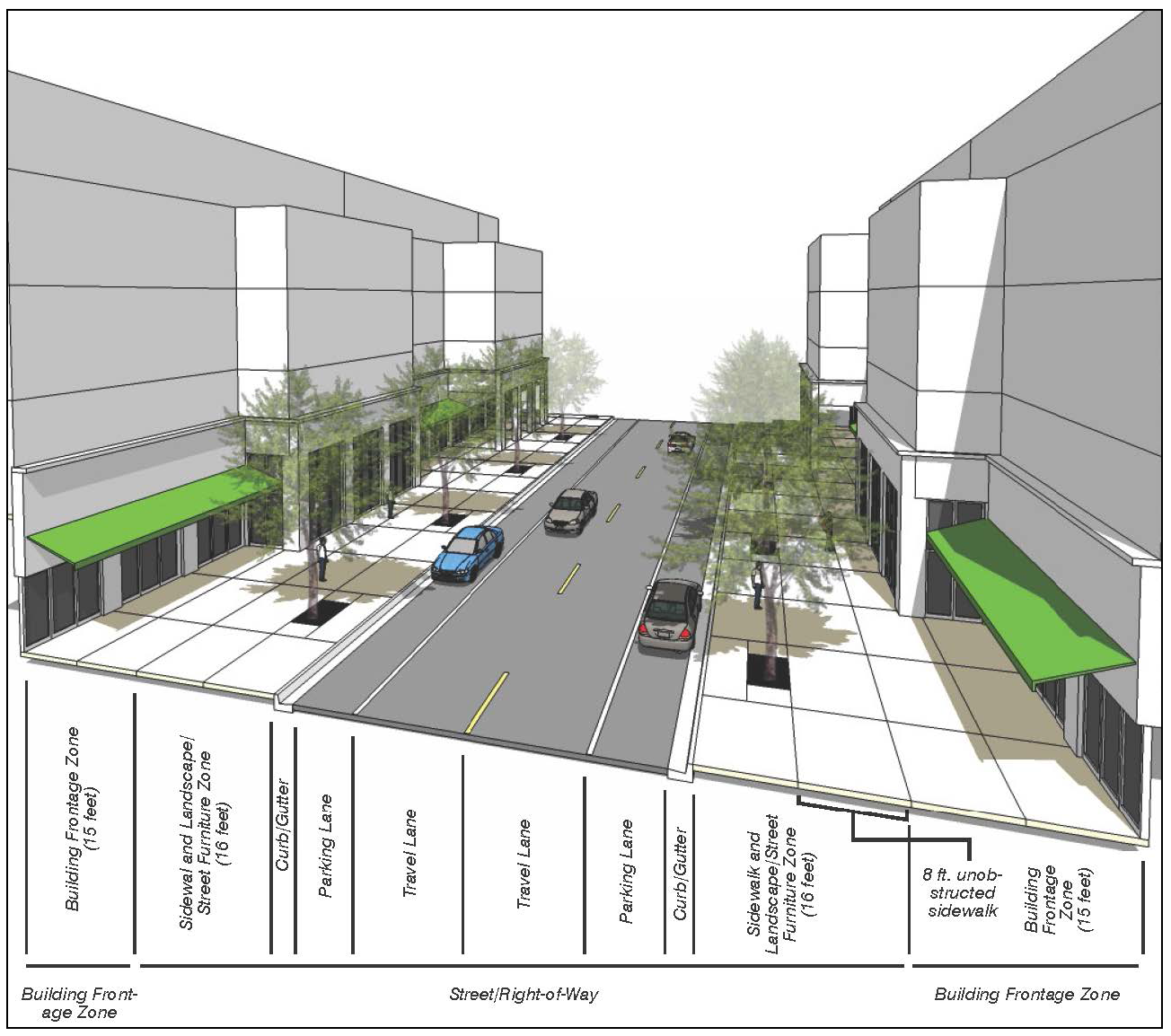
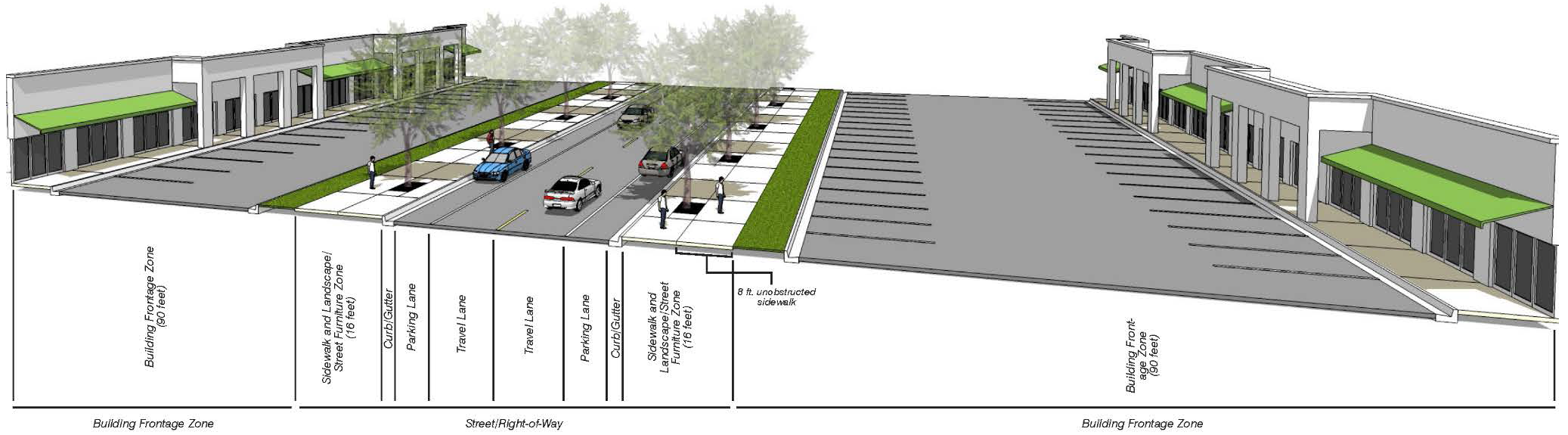
The following illustrations show the configurations described in Table B. Full-scale drawings are on file with the Department.
(a)
Illustration - A and B Streets, Community and Commerce-oriented, 15-foot Building Frontage Zone.
(b)
Illustration - B Street, Commerce-oriented, 90-foot Building Frontage Zone.
Footnotes
(1)
Building Frontage Zone. The following shall be permitted within the building frontage zone:
(a)
The building pedestal may encroach into the building frontage zone after minimum sidewalk width and landscape/street furnishing zone is provided.
(b)
The minimum sidewalk width may be provided in the right-of-way, the building frontage zone, or a combination thereof.
(c)
Along a Commerce-Oriented B Street, the building frontage zone may include parking spaces pursuant to the standards in Article VII of this chapter. At no time shall cars back out into sidewalks or other pedestrian areas.
(2)
Building Frontage. The building pedestal shall be located adjoining or within the building frontage zone for the minimum required percentage of building frontage.
(3)
Sidewalk and Landscape/Street Furniture Zone. The Sidewalk and Landscape/Street Furniture Zone is the area designated for pedestrian travel and for amenities such as landscaping, lighting, and seating.
(a)
The minimum sidewalk width shall comply with Table B. Sidewalks shall be designed as continuous, unobstructed areas designated for pedestrian travel, exclusive of the landscape/street furniture zone.
(b)
The area between the curb line or roadway edge and the sidewalk shall accommodate street furniture, lighting, utility poles, fire hydrants, and any other temporary or permanent structures or pedestrian amenities. The minimum width of the landscape/street furniture zone shall be in compliance with Table B, except that the width may be reduced so long as the difference is added to the adjacent sidewalk.
(c)
Street-edge landscaping may increase where necessary to accommodate pedestrian volumes and enhance the safety and comfort of pedestrians on sidewalks.
(4)
Block Length. The maximum block length shall be in compliance with Table B. It is provided, however, that the Director may approve a modified block length to accommodate odd block shapes and to implement a more appropriate Primary Pedestrian Street network.
(5)
Fenestration. Fenestration shall be provided as required in Table B
(a)
All glazing shall be of a type that permits view of human activities and spaces within the structure.
(b)
Colonnade column spacing, windows, and doors shall be proportioned such that the height of each opening is greater than its width.
(c)
At least 50 percent of the area of security screens and gates shall be transparent.
(C)
Open Space.
(1)
A minimum of 10 percent gross area within each of the Commerce-Oriented and the Community-Oriented areas shall be devoted to designated open spaces that are directly accessible from a pedestrian-friendly street or by safe, comfortable access from a pedestrian friendly street, as determined by the Director.
(2)
In addition, residential open space shall be provided at a minimum of 120 square feet per multi-family residential unit.
(D)
Landscape. Except as provided herein, all landscaping shall be in accordance with chapter 18A of this Code.
(1)
Street trees shall be planted in accordance with the following applicable standards:
(a)
Tree grates; permeable paving. Where trees are planted within openings on the sidewalk, the openings shall be covered by permanently installed grates perforated to permit natural irrigation or by permeable paving. The grates or permeable paving shall be installed flush with the surrounding sidewalk and shall have a minimum area of 24 square feet.
(b)
Tree planters. Trees may be planted within raised planters located on the sidewalk. Each planter shall be defined on all sides by a permanent masonry structure consisting of a minimum 6-inch raised curb. The area within the planter shall be planted with ground cover, shrubs, or other appropriate plant material, in addition to the required trees. Tree planters shall have a minimum area of 32 square feet.
(c)
Continuous landscape strips. Where trees are planted in the area between the curb or roadway edge and the sidewalk, this area, in addition to the required trees, shall be planted with grass. Continuous landscape strips shall have a minimum width of six feet.
(d)
Street Trees/Colonnades:
(i)
Street trees are not required along a sidewalk when: a colonnade open to the public (i) has five feet of continuous unobstructed area and (ii) is located within four feet of the edge of the roadway.
(ii)
Colonnades may encroach into the building frontage zone.
(2)
For all land uses, in addition to the street trees, a minimum of 16 trees per net acre of lot area shall be required. The trees may be placed in greens, squares, plazas, or medians. Areas used for structured parking and wet retention shall not be included in calculating the lot tree requirement.
(E)
Parking.
(1)
Required parking. All required parking shall comply with article VII of this chapter, except as provided in Table B.
(2)
Surface parking lots shall not be permitted along Primary Pedestrian Streets unless screened by landscape, walls, or habitable space, as provided in Table B and in the Illustration set forth in Note 3.b above.
(3)
On-street parking spaces directly abutting a property shall count toward the parking requirement for development of that property. If on-street parking spaces are removed due to roadway improvements, removed spaces that were counted toward a development's parking requirement shall not cause that development to become nonconforming.
(4)
Commercial parking garages shall be permitted either alone or in conjunction with other permitted uses. Along the Primary Pedestrian Street, commercial parking garages shall comply with the storefront and screening requirements of this article.
(F)
Bicycle Facilities. A bicycle route network plan shall be submitted. Bike lanes shall be a minimum of four feet in width when adjacent to curb or swale; five feet in width when adjacent to a parking lane.
(G)
Signs and Entrance Features. At the time of Administrative Site Plan Review (ASPR), applicants may submit a master sign and entrance feature plan. Signs shall comply with Section 33-284.87. Entrance features shall comply with Article VI, Division 4 of this chapter.
(Ord. No. 17-43, § 2, 7-6-17)
Sec. 33-284.28.6. - Review and Approval Procedures.
The review procedure for an ECPAD is divided into three steps: (A) Preapplication conference; (B) Initial development plan review (includes public hearing approval); and (C) Final plan review/Administrative Site Plan Review (ASPR).
(A)
Preapplication Conference.
(1)
Before submitting an application, an applicant seeking a district boundary change to ECPAD, shall participate in a preapplication conference. The Department shall coordinate a preapplication conference with the Developmental Impact Committee, other affected departments, and representatives of adjacent municipalities (where applicable) to review the application and assist the applicant in the preparation of the components of the ECPAD application.
(2)
In preparation for the preapplication meeting, the applicant shall provide a general outline of the proposal through schematics and sketch plans, including narrative information sufficient for the understanding of the proposed development.
(3)
The applicant shall have the right to apply for an additional preapplication conference prior to filing a formal application with the Department.
(B)
Initial development plan review.
(1)
Review and public hearing process. Following the preapplication conference(s), the applicant may initiate the initial development plan review upon the filing of a complete application.
(a)
The application for public hearing and the required exhibits shall be submitted to the Department in accordance with the requirements of Section 33-304, Code of Miami-Dade County.
(b)
The review of the initial development plan of ECPAD shall be by the Developmental Impact Committee in accordance with the procedures in Section 33-303.1.
(c)
One public hearing shall be held by the Board of County Commissioners (Board), at which time the Board shall consider the information presented by the applicant, the recommendations of the Developmental Impact Committee and viewpoints of the public expressed at the hearing, staff recommendations, and any other information contained in the hearing file. Review and action by the Board of County Commissioners shall be in accordance with Section 33-314.
(d)
ECPAD applications that include a development agreement shall be subject to the additional notice and hearings set forth in Section 33-310.3. The required public hearings shall be as follows:
(i)
The first public hearing shall be to review the development agreement in accordance with section 163.3225, Fla. Stat. and shall be held by the Planning Advisory Board, which shall make a recommendation to the Board of County Commissioners.
(ii)
The second public hearing shall be held by the Board of County Commissioners. The development agreement and the ECPAD application shall be heard and decided on the same day before the Board of County Commissioners in accordance with Section 33-314.
(2)
Required Written Exhibits. The following written documents shall be submitted to the Developmental Impact Committee Executive Council for review prior to the first public hearing.
(a)
Recordable instrument guaranteeing the development in accordance with promises made in the written and graphic documents listed below. In the alternative, this requirement may be satisfied through a development agreement presented in accordance with the requirements of Section 33-310.3 of this chapter.
(b)
An equivalency matrix for the proposed uses may be submitted. "Equivalency Matrix" refers to a calculation of the total net external AM and/or PM peak hour vehicle trips generated using the latest edition of the ITE Trip Generation Manual rates and/or equations, or pursuant to an approved methodology, in order to determine the maximum total net external AM and/or PM peak hour vehicle trip generation associated with the overall development uses within the project.
The equivalency matrix shall include the total net external AM and/or PM hour vehicle trips calculated using the same ITE rates and/or equations for the simultaneous increases and decreases of the approved uses within a project provided that the maximum total net external AM and/or PM peak hour vehicle trips are not increased.
(c)
A general development timeframe indicating the approximate date(s) when construction of the ECPAD and phases thereof, including the mix of land uses, are estimated to be initiated and completed.
(d)
Quantitative data in a table format indicating the density and intensity of the proposed land uses in the ECPAD and within the Commerce-oriented and Community-oriented areas. The quantitative data shall include the following:
(i)
Acreage of Commerce-oriented and Community-oriented areas;
(ii)
Range of non-residential and residential uses within each land use area;
(iii)
Range of proposed residential densities;
(iv)
Maximum CDMP density;
(v)
Range of dwelling units;
(vi)
Maximum heights and floor area for nonresidential and residential uses;
(vii)
Total amount of designated open space for the Commerce-Oriented land use area and the Community-Oriented land use area in the development (10 percent minimum required for each land use area);
(e)
A statement of compliance with the Design Standards set forth in Section 33-284.28.5.
(f)
A statement regarding any variances from the Design Standards, other provisions of this chapter, the Landscape Code (chapter 18A), chapter 24, and other applicable provisions of this Code. Any such variances shall only be approved in accordance with the procedures set forth in the applicable sections of the Code.
(3)
Required graphic documents. Maps, site plans, and drawings depicting the proposed ECPAD shall be submitted as part of the initial development plan review and shall contain the following minimum information:
(a)
A signed and sealed boundary survey.
(b)
A plan at a scale of 1"=300' that generally depicts the location of the following, all of which will be finalized and approved through the ASPR process:
(i)
Location and acreage of Commerce-Oriented and Community-Oriented land use areas.
(ii)
General location of major land uses and identification of non-residential and residential uses within each land use area. The final location shall be determined through the ASPR process.
(iii)
Densities and/or floor area ratio for each land use, and maximum structure heights.
(iv)
General location and size of designated open space for the entire development. The final shall be determined through the ASPR process.
(v)
General location and width of A, B, C, and D streets and all points of ingress and egress to the development. The final location and design of the roadway network shall be determined through the ASPR process.
(vi)
General location of any on-site and off- site mitigation areas that may be required, such as storm water retention areas.
(c)
Adequate information on land areas adjacent to the ECPAD at a scale of 1"=300' to indicate the relationships between the proposed development and adjacent areas, including existing land uses, zoning districts, densities, vehicular and pedestrian circulation systems, and public facilities, as well as unique natural features of the landscape.
(d)
The proposed typical treatment of the perimeter of the ECPAD including materials and techniques to be used to provide transition to other developments, such as screens, landscape buffer, fences, walls and berms, when appropriate.
(e)
Any additional information required by the Department to evaluate the character and impact of the application.
(C)
Final Development Review—Administrative Site Plan Review (ASPR).
(1)
ASPR Preapplication Conference. All development in the ECPAD shall require an ASPR. Prior to filing for ASPR, the applicant shall apply for a preapplication conference, in accordance with subsection A above.
(2)
Application Review. Upon submittal of an ASPR application, the Department shall review plans, including the exhibits listed below, for completeness and compliance with the provisions of this article and the design and site plan review criteria provided herein. Additionally, all applications shall be reviewed by the following County departments and other public entities for potential impacts on infrastructure and other services resulting from the application: Department of Transportation and Public Works, Department of Waste Management, Department of Regulatory and Economic Resources - Division of Environmental Resources Management, Water and Sewer Department, Miami-Dade Fire Rescue Department, and Department of Public Housing and Community Development or the successor departments, as well as the Miami-Dade County School Board. In the event the application indicates impacts on services and infrastructure provided by any of the foregoing, the applicant shall meet with the affected department or entity to discuss potential mitigation of the impacts and shall submit evidence to the Department of such discussion.
(3)
Required Exhibits. The documents and site plan(s) to be reviewed and approved administratively during ASPR shall comply with the following:
(a)
A plan indicating existing zoning on site and adjacent areas.
(b)
Aerial photograph or map indicating site and development in the immediate area.
(c)
Site plan at no less than one (1) inch to one hundred (100) feet which shall include the following information:
(i)
Location, shape, size and height of existing and proposed buildings, fences and walls.
(ii)
Pedestrian and vehicular circulation systems.
(iii)
Location and size of designated open space.
(iv)
Parking layouts and drives
(v)
Landscaping in accordance with Section 33-284.28.5 or Section 33-284.28.11, as applicable, or Chapter 18A of this Code.
(vi)
Major changes in grades.
(vii)
Building setbacks and spacing.
(viii)
Location of on-site and off-site mitigation areas (if required).
(ix)
A legend including the following applicable information shall be provided as part of the site plan in accordance with the following format:
(x)
The following information shall be provided on the site plan or in a separate document:
1.
Amount of pervious and impervious surfaces.
2.
Maximum density of development approved at public hearing.
3.
Density as proposed.
4.
Total dwelling units.
5.
Table of dwelling unit mix.
6.
Total number of bedrooms.
7.
Total number of building types including accessory buildings.
8.
Table of buildings by heights, stories, unit types, and square footage.
9.
Name of water utility.
10.
Name of sewer utility.
11.
Required designated open space.
12.
Table of parking spaces required and provided.
13.
Acreage dedicated for public and semipublic facilities.
14.
Survey of existing trees.
15.
Total trees required.
16.
A storm water management plan, wetland survey, and endangered species report, if applicable.
17.
Refuse and recycling collection areas.
18.
Any supplementary data needed to adequately review the proposed development.
(d)
Floor plans, elevations, sections, when appropriate, and either isometrics or perspectives for the different proposed buildings at no less than one (1) inch equals sixteen (16) feet.
(e)
Optional signage plan in conformance with Section 33-284.87.
(4)
Time for decision; appeals. The Director shall issue a final decision within 21 days of the date of submission of the completed application. The applicant shall have the right to extend the 21-day period by up to an additional 21 days upon timely request made in writing to the Director. The Director may also extend the 21-day period by written notice to the applicant that additional information is needed. Denials shall be in writing and shall specifically set forth the grounds for the denial. Any final decision of the Director may be appealed in accordance with the procedures established in this chapter for appeals of administrative decisions.
(Ord. No. 17-43, § 2, 7-6-17)
Sec. 33-284.28.7. - Industrial uses disclosure.
(A)
Definitions. For purposes of this section, the following terms shall have the following meanings:
(1)
"Affected land" means any parcel of land that is zoned Employment Center Planned Area Development (ECPAD).
(2)
"Interest in real property" means a nonleasehold, legal or equitable estate in land or any severable part thereof created by deed, contract, mortgage, easement, covenant, or other instrument.
(3)
"Purchaser" means a buyer, transferee, grantee, donee, or other party acquiring an interest in real property.
(4)
"Real property transaction" means the sale, grant, conveyance, mortgage, or transfer of an interest in real property.
(5)
"Seller" means a transferor, grantor, donor, or other party conveying an interest in real property.
(B)
Disclosure statement for real property transactions involving affected land. The seller of a residential unit within the ECPAD that is located within 100 feet of an industrial use permitted pursuant to this article shall notify any prospective purchaser of the proximity within which industrial uses are permitted. The seller shall provide the purchaser with the following statement, which shall be set forth on a separate sheet of paper and shall be signed by the prospective purchaser prior to the execution of any other instrument committing the purchaser to acquire title to such real property or any other interest in any affected land, as follows:
(1)
For all affected land, the statement shall include the following language:
LAND INVOLVED IN THIS TRANSACTION IS ZONED EMPLOYMENT CENTER PLANNED AREA DEVELOPMENT (ECPAD), WHICH PERMITS CERTAIN INDUSTRIAL ACTIVITIES.
INDUSTRIAL ACTIVITIES WHICH MAY BE LAWFULLY CONDUCTED WITHIN 100 FEET OF THIS PROPERTY INCLUDE BUT MAY NOT BE LIMITED TO: WAREHOUSING, WHOLESALING, MANUFACTURING, PACKAGING, DISTRIBUTION OF PRODUCTS FOR PERSONAL OR HOUSEHOLD CONSUMPTION, MEDICAL TECHNOLOGY, BIOTECHNOLOGY RESEARCH; AND THE GENERATION OF NOISE, ODORS, DUST, AND FUMES ASSOCIATED WITH THE CONDUCT OF THE FOREGOING ACTIVITIES. THESE ACTIVITIES MAY OCCUR AT ANY TIME THROUGH THE DAY OR NIGHT.
I HEREBY CERTIFY THAT I HAVE READ AND UNDERSTAND THE FOREGOING STATEMENT.
(C)
Acknowledgment of industrial uses disclosure statement on instrument of conveyance. It shall be the seller's responsibility that the following statement shall appear in a prominent location on the face of any instrument conveying title to or any other interest in affected land. The seller shall record the notarized statement with the Clerk of the Court:
I HEREBY CERTIFY THAT I HAVE READ, UNDERSTAND AND HAVE SIGNED THE INDUSTRIAL USES DISCLOSURE STATEMENT FOR THE SALE OF OR OTHER TRANSACTION INVOLVING THIS PARCEL OF AFFECTED LAND AS REQUIRED BY SECTION 33-284.28.7, CODE OF MIAMI-DADE COUNTY, FLORIDA.
(D)
Penalties. Any seller who violates any provision of this section, or fails to comply therewith, or with any lawful rule, regulation, or written order promulgated under this section, shall be subject to the penalties, civil liability, attorney's fees, and enforcement proceedings set forth in article I of this chapter and chapter 8CC of this Code, and to such other penalties, sanctions, and proceedings as may be provided by law. Miami-Dade County shall not be held liable for any damages or claims resulting from the seller's failure to comply with provisions of this section.
(Ord. No. 17-43, § 2, 7-6-17)

