
Miami Dade County Unincorporated
City Zoning Code
City Zoning Code
ARTICLE XXXIIII
DOWNTOWN KENDALL URBAN CENTER DISTRICT
Sec. 33-284.55.- Purpose and intent.
This article applies to two (2) contiguous areas on each side of US Highway 1. The western area is bounded by the Palmetto Expressway on the west, the Snapper Creek Expressway on the north and US Highway 1 on the east. The eastern area is bounded by US Highway 1 on the west, SW 80th Street on the north, SW 65th and SW 67th Avenues on the east, and SW 84th Street and Snapper Creek Canal on the south. The intention of this Article is to produce a Metropolitan urban center that fulfills the goals, objectives and policies of the County's Comprehensive Development Master Plan by:
(A)
Coordinating the development intensity within the district by the proximity to mass transit;
(B)
Organizing an interconnected network of colonnaded or tree lined streets to improve pedestrian access to transit; and
(C)
Creating good public open space with specific square and plaza locations and by shaping the way buildings front onto the open space and streets.
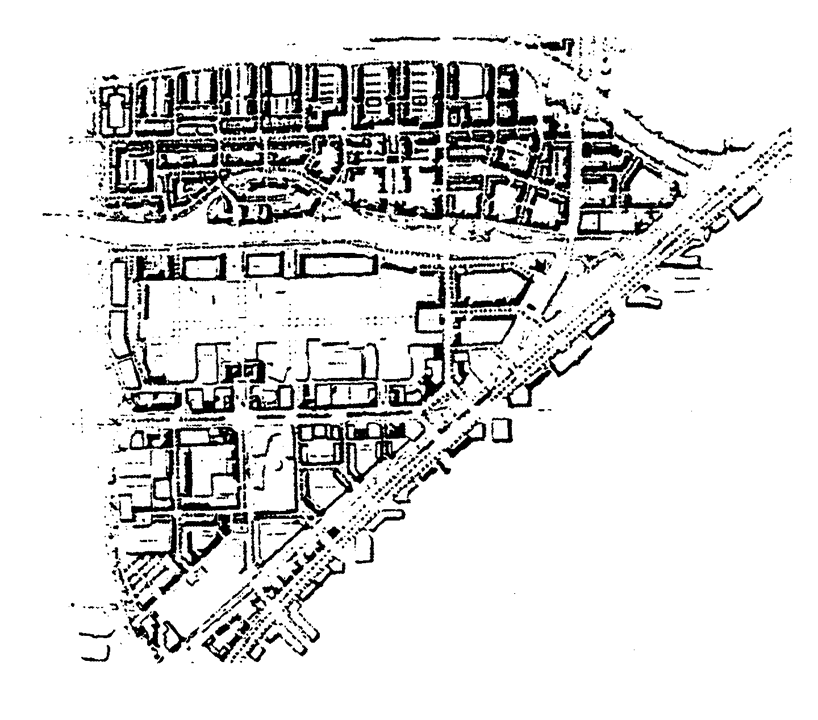
The Illustrative Plan (Figure 1), illustrates the vision and may be used to better interpret this Article. Where there is conflict between the illustrative plan and the text of this article, the text shall govern.
(Ord. No. 99-166, § 1, 12-16-99)
Sec. 33-284.56. - Definitions.
Terms used throughout this Article shall take their commonly accepted meaning unless otherwise defined in Chapter 33 or Chapter 28 of the Code of Miami-Dade County. Terms requiring interpretation specific to this article are as follows:
(1)
Anchor Point: The location depicted on the Designated Open Space Plan on which some portion of the required plaza or square must be situated.
(2)
Block: A combination of building lots, the perimeter of which abuts streets.
(3)
Block face: The right-of-way line or easement line which delineates a block edge.
(4)
Build-to line: A line parallel to the block face, along which a building shall be built.
(5)
Building Height: A limit to the vertical extent of a building measured in stories above grade. Building height shall be measured in stories from the average elevation of the enfronting curb to the eave line.
(6)
Civic Use: Premises used primarily for public education, cultural performances, gatherings and displays administered by non-profit cultural, educational, governmental, and religious organizations.
(7)
Clear Zone: An area within the curb radius, which shall be kept clear of all objects to a prescribed height to provide vehicle clearance.
(8)
Colonnade: A roofed structure, extending over the sidewalk, open to the street that is supported by columns or piers.
(9)
Courtyard Garden: A grade-level garden which may be included as part of the open space requirement and is described in this Article's General Requirements.
(10)
Curb Radius: The curved edge of street paving at an intersection, measured at the inside travel edge of the travel lane.
(11)
Designated Open Space: Colonnades, Squares, and Plazas as indicated on the Designated Open Space Plan.
(11.5)
Electric Vehicle Retail Showroom: Retail showroom for electric vehicles provided that:
(a)
No on-site vehicle storage/stock beyond the showroom and vehicles for test drives is allowed;
(b)
No more than six (6) electric vehicles, outside of the showroom, to be used for test drive purposes;
(c)
No test drive shall be conducted on residential local streets (fifty-foot wide rights-of-way); and
(d)
Vehicles used for test drives and display in the showroom are not permitted to be sold on-site.
(12)
Expression Line: A horizontal line, the full width of a facade, expressed by a material change or by a continuous projection not less than three (3) inches nor more than one (1) foot.
(13)
Floorplate: The total indoor and outdoor area of any given story of a building, measured to the exterior of the wall.
(14)
Frontage: The property line or lines of a lot which coincide with a right-of-way or other public open space line as shown on the Regulating Plan.
(15)
Garden Wall: A wall separating a courtyard garden from a public open space.
(16)
Habitable Space: Building space whose use involves human presence with direct view of the enfronting streets or open space, excluding parking garages, self-service storage facilities, warehouses, and display windows separated from retail activity.
(17)
Open Space: An outdoor, at grade space which is accessible to the public all or most of the time, including parks, plazas, squares, canal-walks, colonnades, courtyard gardens, paseos (when designed predominantly for pedestrians), and pedestrian paths and/or associated ornamental or shading landscaped areas.
(18)
Paseo: A cross-block, primarily pedestrian passage connecting one (1) right-of-way or paseo to another. Paseos shall be designed for pedestrian comfort, but may serve vehicles when minimum standards set forth in this Article are met. Also known as a C Street.
(19)
Penthouse: Topmost built area of a building with a floorplate area less than that of the tower below.
(20)
Pedestal: The bottom portion of a building that creates the street frontage.
(21)
Plaza: An open space with a majority of paved surface. Plazas are fronted with buildings that continue the adjacent street frontage requirements and uses.
(22)
Retail Use: Premises used for the exchange of services or goods.
(23)
Square: An open space surrounded by streets or other vehicular passages.
(24)
Shared Parking: Parking used by more than one (1) use or building.
(25)
Storefront: The portion of a building at the first story of a retail frontage that is made available for retail use.
(26)
Story: A floor level within a building as described in this Article's General Requirements.
(27)
Street: A thoroughfare for the movement of pedestrians and/or vehicles, as provided in this Article.
(28)
Streetwall: The vertical surface of a building or structure that faces public open space.
(29)
Tower: The middle portion of a building above the pedestal and below the penthouse.
(30)
Turnout Radius: the inside turning radius between intersecting travel lanes, which may be independent from the actual curb of the street edge.
(Ord. No. 99-166, § 1, 12-16-99; Ord. No. 09-81, § 1, 9-1-09; Ord. No. 13-41, § 1, 5-7-13)
Sec. 33-284.57. - Review procedure.
Projects following the provisions of this article and the Regulating Plans shall be processed and approved administratively. The Department shall review the applications including exhibits listed below for completeness and compliance with the provisions of this article and the Regulating Plans. All complete submissions to the Department shall be reviewed and approved or denied, within 21 days from the date of submission. The applicant shall have the right to extend the 21-day period by an additional 21 days upon timely request made in writing to the Department. The Department shall have the right to extend the 21-day period by written notice to the applicant that additional information is needed to process the site plan. Denials shall be in writing and shall specifically set forth the grounds for the denial. Any final decision of the Director may be appealed in accordance with the public hearing procedure established in Article XXXVI of this chapter and in accordance with the procedure established for appeals of administrative decision.
Exhibits prepared by design professionals such as architects and landscape architects shall be submitted to the Department and shall include, but not be limited, to the following:
(A)
Site plan(s) including:
(1)
Lot lines and setbacks.
(2)
Location, shape, size and height of existing and proposed building construction and landscaping.
(3)
Location of on-street and off-street parking, loading facilities, waste collection areas, and all above ground utilities.
(4)
Indication of signage.
(5)
Indication of any site or building design methods used to conserve energy.
(6)
Street type designations as per this Article.
(7)
Indication of sub-district boundaries as per this Article.
(8)
Locations for loading and unloading of vehicular passengers, to: (i) accommodate passengers who use vehicles for hire or transportation network companies; and (ii) minimize impacts of passenger loading and unloading on the surrounding roadway network. A loading or unloading zone that is shared among adjacent or adjoining parcels may be permitted, provided that a safe pedestrian route to each parcel is provided.
(B)
Landscape plans including specification of plant material, location and size.
(C)
Floor plans and elevations of all structures, including total gross square foot area of each floor and all dimensions relating to the requirements of this Article.
(D)
Figures indicating the following:
(1)
Gross and net acreage.
(2)
Amount of landscaped open space in square feet and percentage required and provided.
(3)
Total square footage of all land uses.
(4)
Amount of building coverage at ground level in square feet and percentage.
(5)
Total trees required and provided, indicating on site and off site contribution within the District.
(6)
Parking required and provided.
(7)
Total amount of paved area in square feet.
(8)
Total number of dwelling units.
(9)
Such other design data as may be needed to evaluate the project.
In the case of multiple-phase development, each phase of the development, whether standing independently or in conjunction with existing developed or proposed future contiguous phases, shall meet all the requirements of this Article. For future development outside the Center DRI Sub-District, expansions or additions to legal structures, if not in substantial compliance with previously approved plans, shall be subject to those requirements of this Article applicable to the entire block or blocks in the Regulating Plans for which the expansion or addition is proposed.
Notwithstanding the review procedure contained herein, all requests for the subdivision of property within the Downtown Kendall Urban Center District shall have previously received site plan approval in accordance with the requirements of this section or Section 33-284.58 below.
(Ord. No. 99-166, § 1, 12-16-99; Ord. No. 02-11, § 1, 1-29-02; Ord. No. 20-39, § 2, 5-5-20)
Sec. 33-284.58. - Zoning hearing review.
Applications for zoning hearing which seek relief from the regulations contained within this Article shall be in accordance with the procedures set forth in Article XXXVI of this Code. In no event, however, shall the following provisions of this Article be varied:
(1)
Building height restrictions.
(2)
Habitable space regulations.
(3)
Colonnade regulations.
(4)
Landscape regulations for streets, squares, and medians.
(Ord. No. 99-166, § 1, 12-16-99; Ord. No. 09-81, § 2, 9-1-09)
Sec. 33-284.59. - Conflicts with other chapters and regulations.
When conflicts with other Zoning, Subdivision or the Landscape regulations occur, the Downtown Kendall Urban Center District Article shall take precedence. Where conflicts occur with Miami-Dade Department of Public Works Manual of Public Works, unless otherwise approved by the Director of the Public Works Department and the Director of the Department of Planning and Zoning, this Article shall take precedence.
(Ord. No. 99-166, § 1, 12-16-99)
Sec. 33-284.60. - Organization of this article.
(A)
This Article is organized into two (2) primary sections:
(1)
The Development Parameters, which are the instructions for implementing the Regulating Plans; and
(2)
The Additional Parameters, which address issues of quality in the design of buildings and their grounds.
(B)
The controlling factors are the three (3) Regulating Plans which establish four sub-districts, five (5) street frontage types and a number of designated open spaces that interact. Full-scale maps of the Regulating Plans are on file with the Department.
(1)
The Sub-District Plan delineates four sub-districts, the Core, the Center, the Center DRI and the Edge. These sub-districts control land use and intensity of development in accordance with the County's Comprehensive Development Master Plan. Unless developed in accordance with Section 33-284.63.1 below, property in the Center DRI sub-district shall be subject to the provisions of this Article applicable to the Center sub-district.
(2)
The Street Frontage Plan establishes a hierarchy of street types in existing and future locations which shall be provided and shown in all future development. The six (6) street types are lettered "A" through "F". An "A" street is the most important street to accommodate pedestrian activity.
(3)
The Designated Open Space Plan establishes essential open spaces which shall be provided in all future development and construction. The designated open spaces are controlled by anchor points. The Downtown Kendall Urban Center District Designated Open Space Plan Map's legend contains colonnades, squares and greenspaces, and anchor points. The regulating plan map on file with the Department specifies the exact location and size of all squares and greenspaces required within the Downtown Kendall Urban Center District.
(Ord. No. 99-166, § 1, 12-16-99; Ord. No. 02-11, § 2, 1-29-02; Ord. No. 06-114, § 1, 7-18-06; Ord. No. 14-134, § 1, 12-16-14; Ord. No. 16-91, § 2, 9-7-16)
Sec. 33-284.61. - Reserved.
Editor's note— Ord. No. 16-91, § 3, adopted Sept. 7, 2016, repealed § 33-284.61, which pertained to regulating plans and derived from Ord. No. 99-166, § 1, adopted Dec. 16, 1999; Ord. No. 02-11, § 3, adopted Jan 29, 2002; Ord. No. 02-152, § 1, Sept. 12, 2002; Ord. No. 05-197, § 1, adopted Nov. 3, 2005; Ord. No. 09-81, § 3, adopted Sept. 1, 2009; Ord. No. 13-54, § 1, adopted June 4, 2013; Ord. No. 14-134, § 2, adopted Dec. 16, 2014; Ord. No. 15-64, § 1, adopted July 14, 2015; and Ord. No. 15-64, § 1, adopted July 14, 2015.
Sec. 33-284.62. - Development parameters.
(A)
Placement Diagrams. The following diagrams in this section identify design parameters specifically for the fourteen (14) sub-district and frontage type situations:
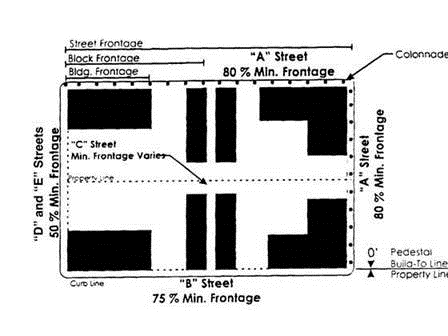
Core/Center Sub-District Placement Program
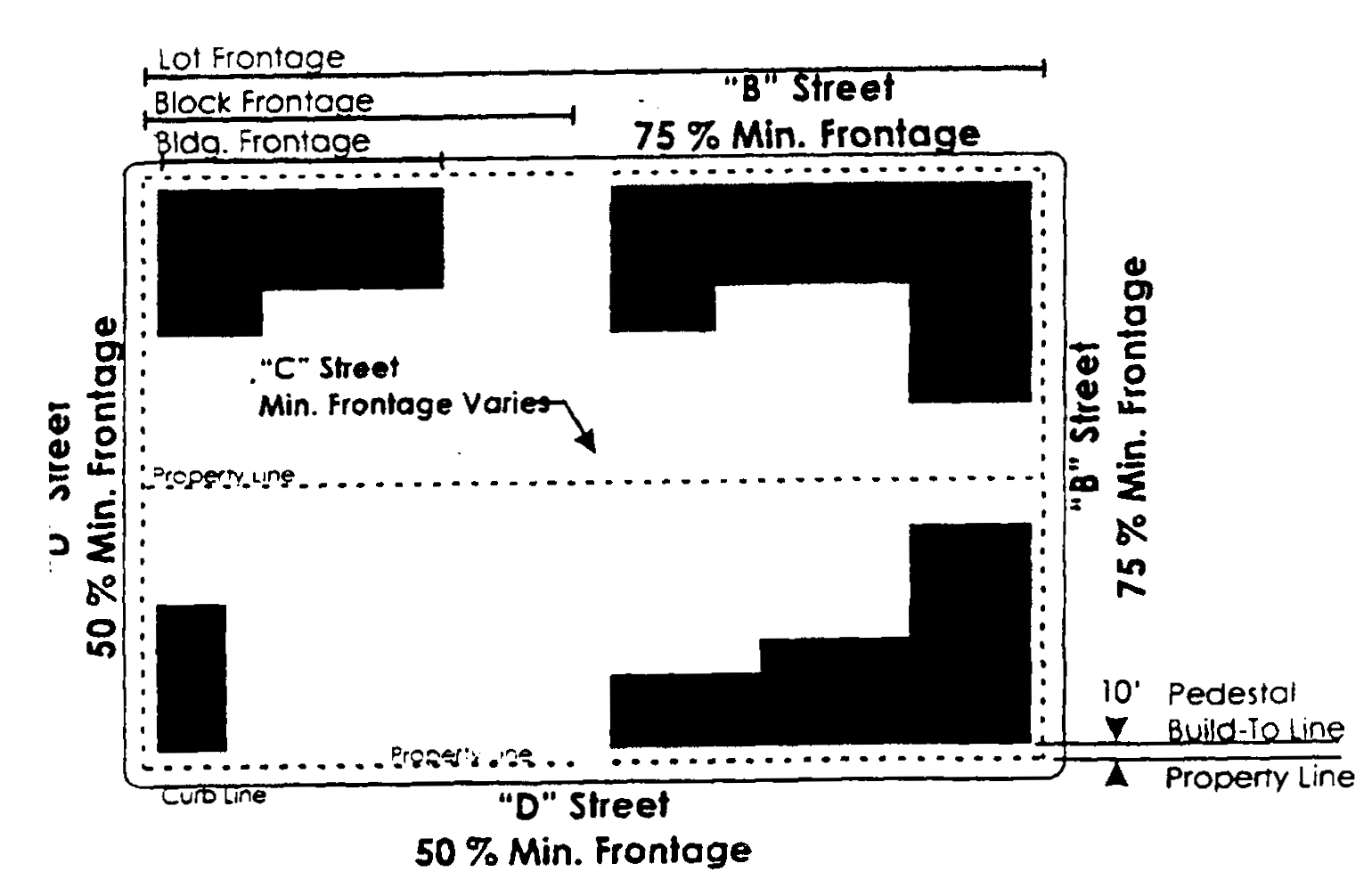
Edge Sub-District Placement Program
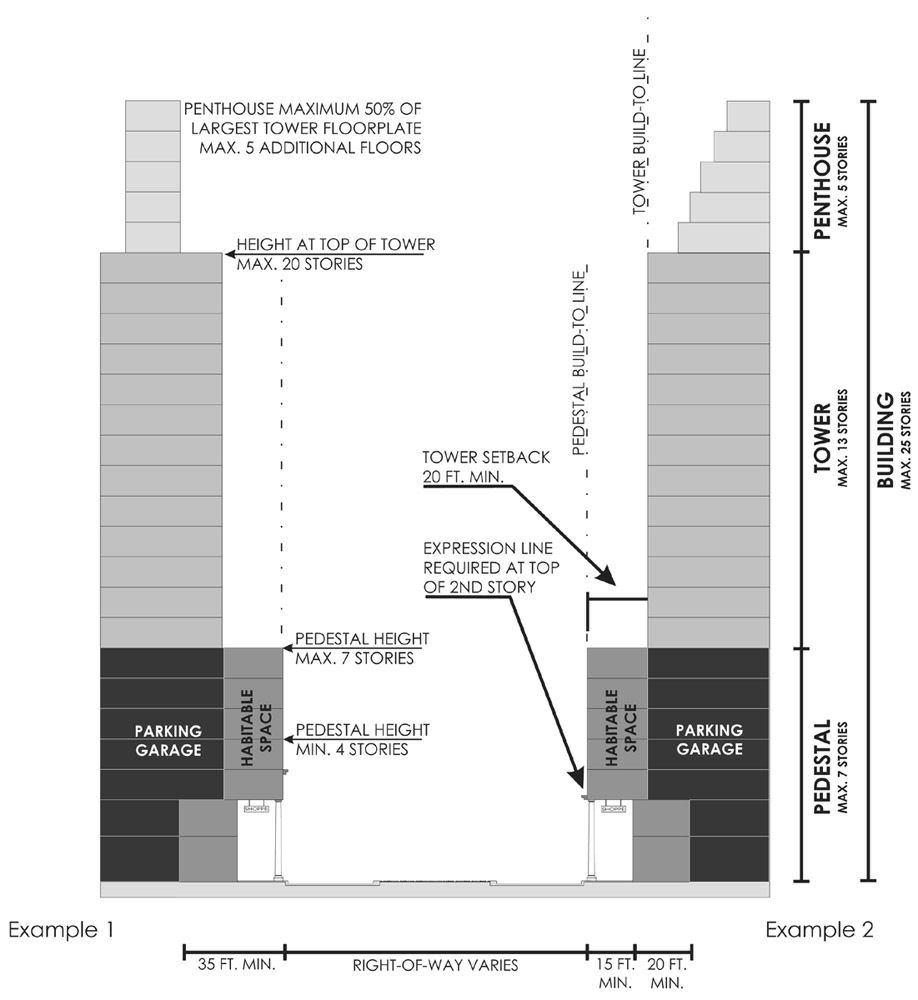
Core Sub-District—"A" Street
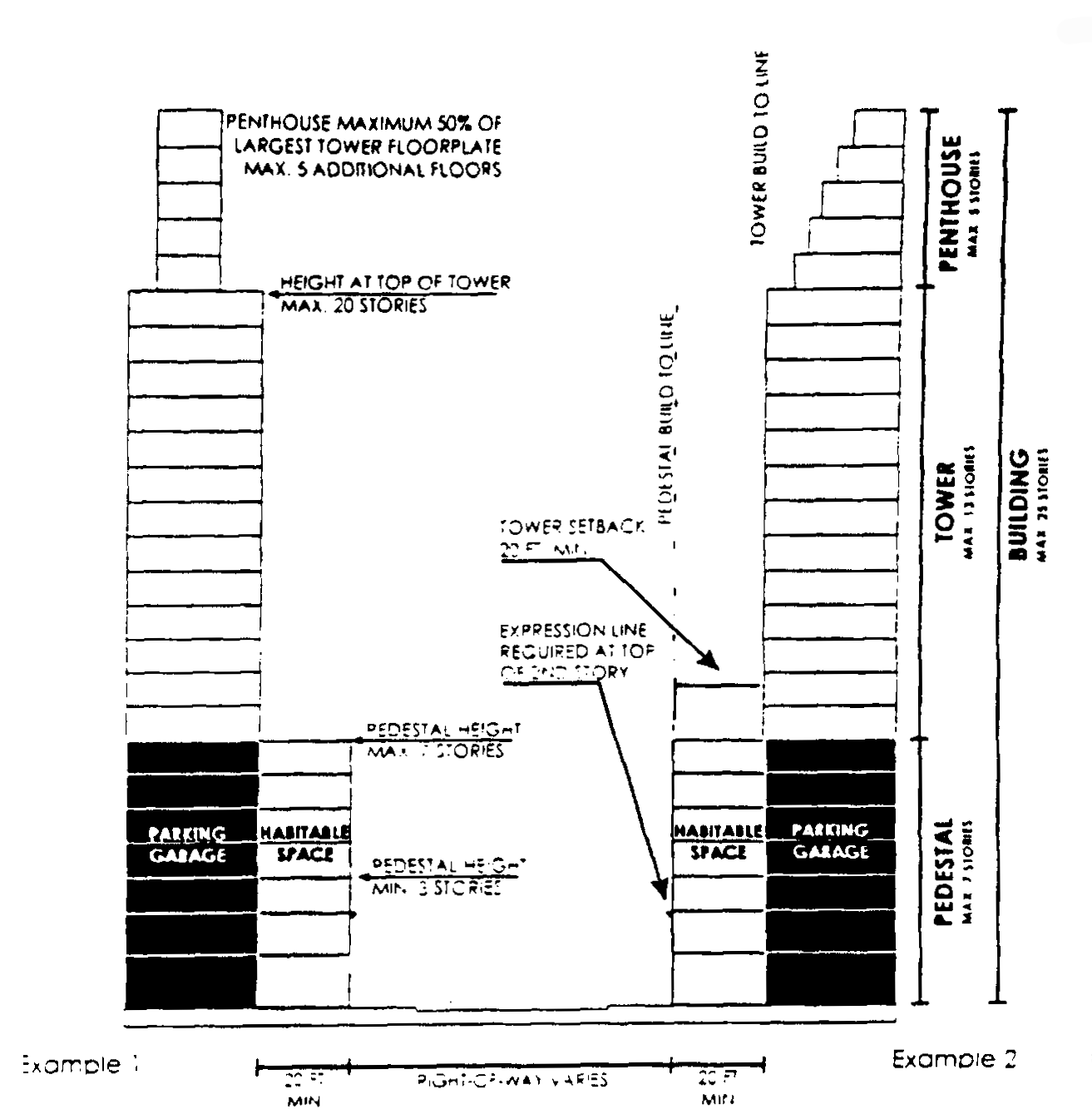
Core Sub-District—"B" Street
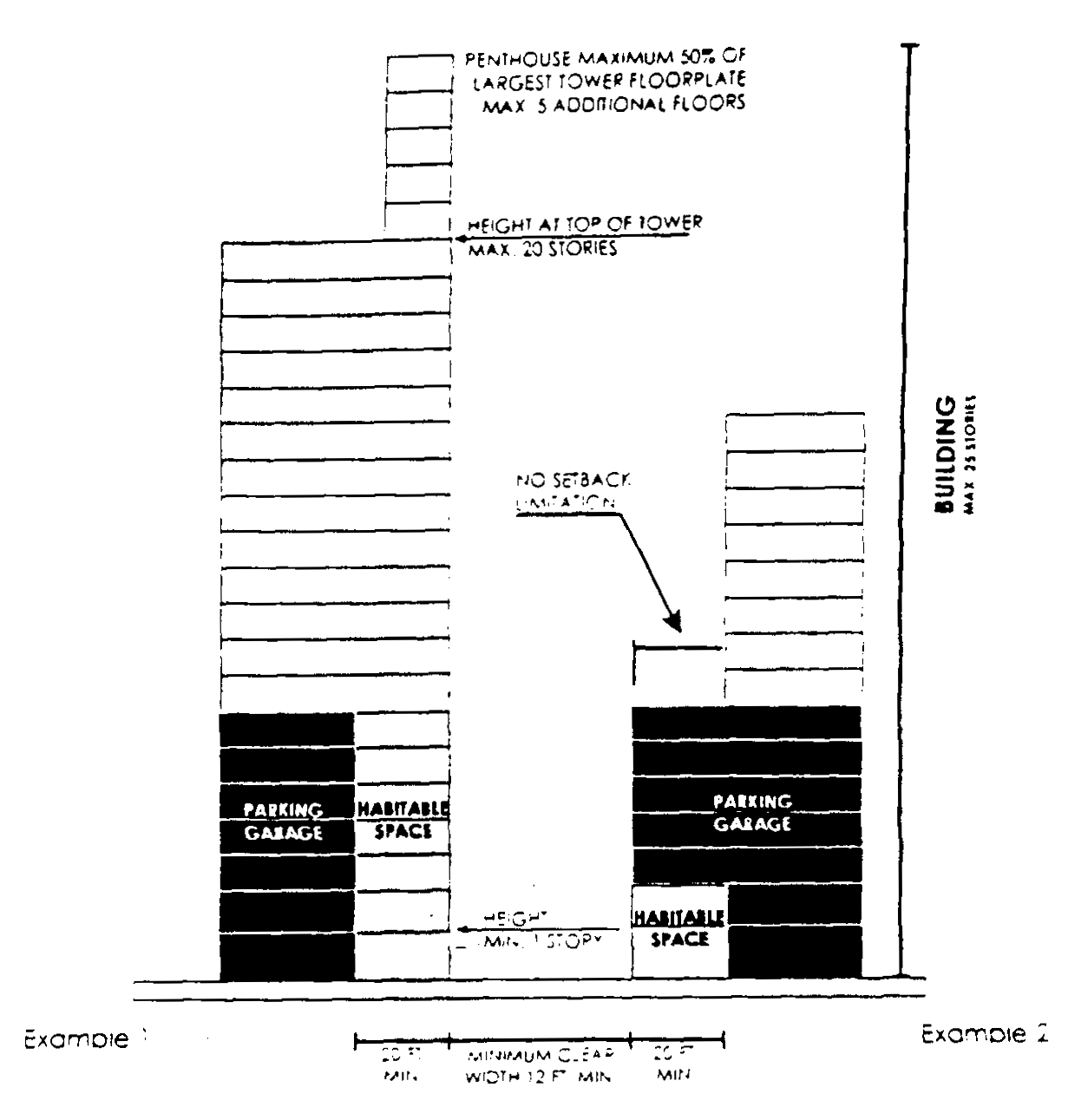
Core Sub-District—"C" Street
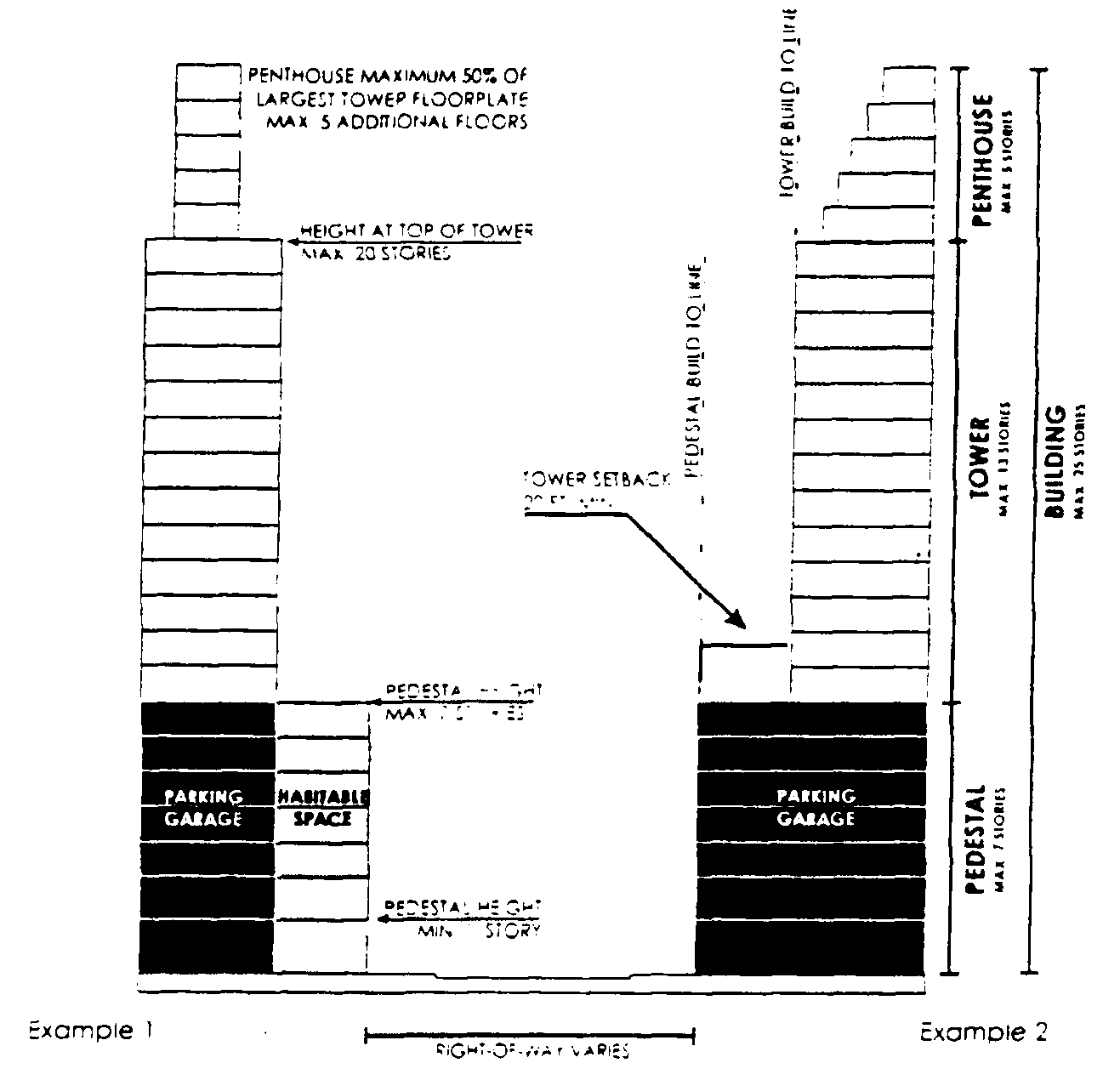
Core Sub-District—"D" Street
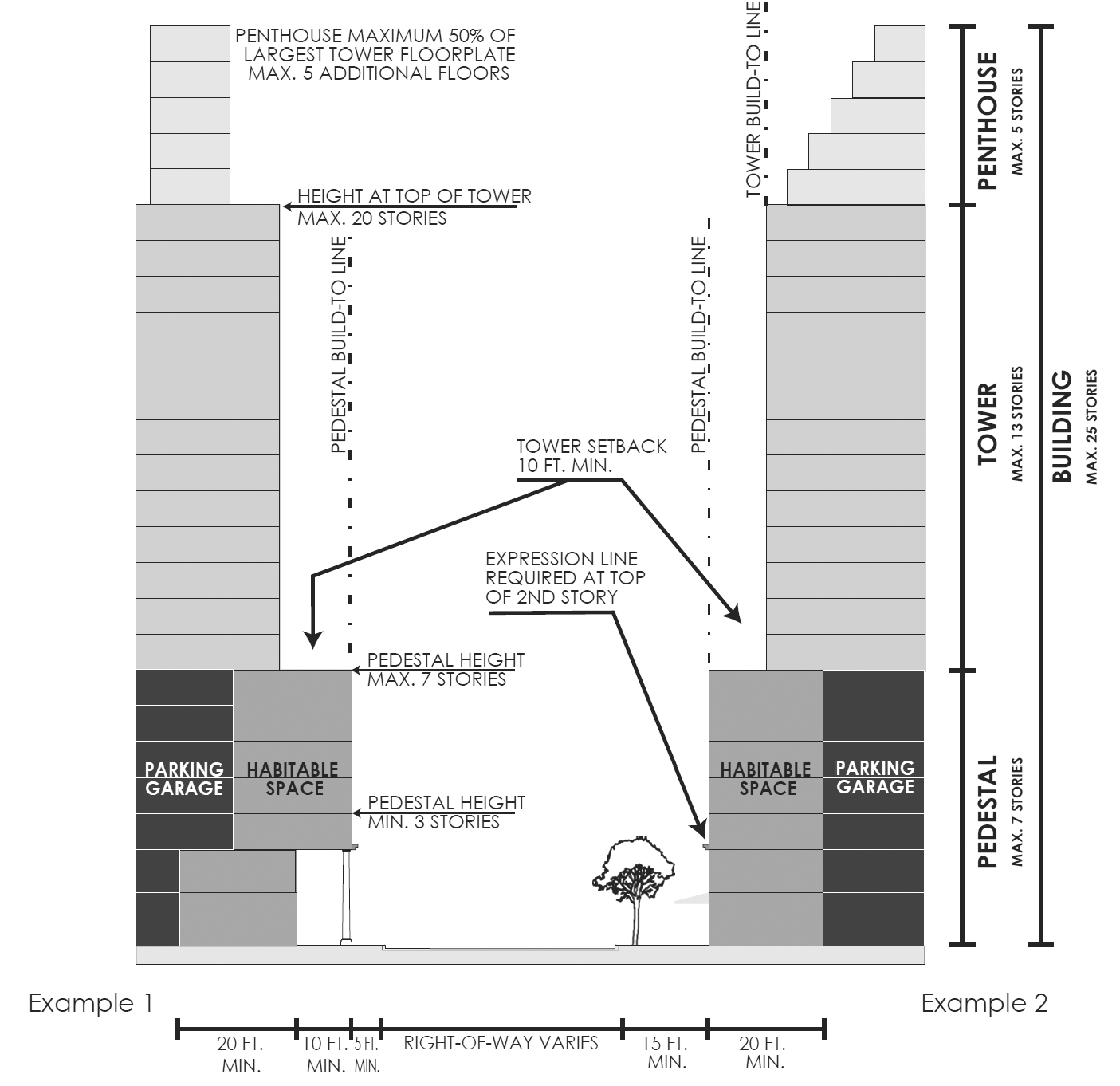
Core Sub-District—"E" and "F" Streets
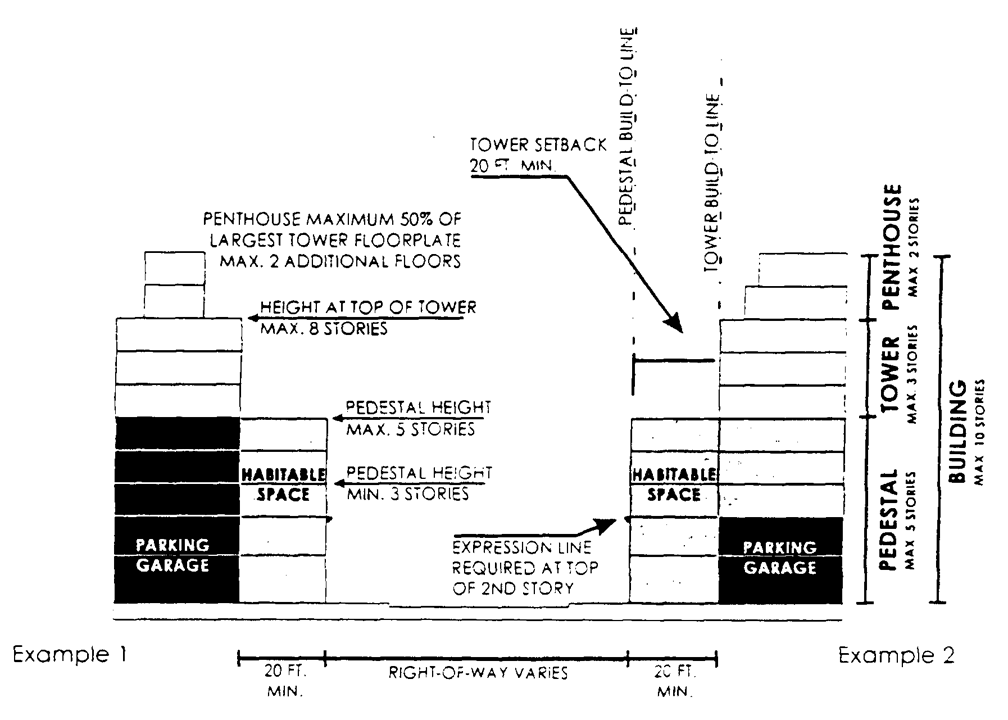
Center Sub-District—"A" Street
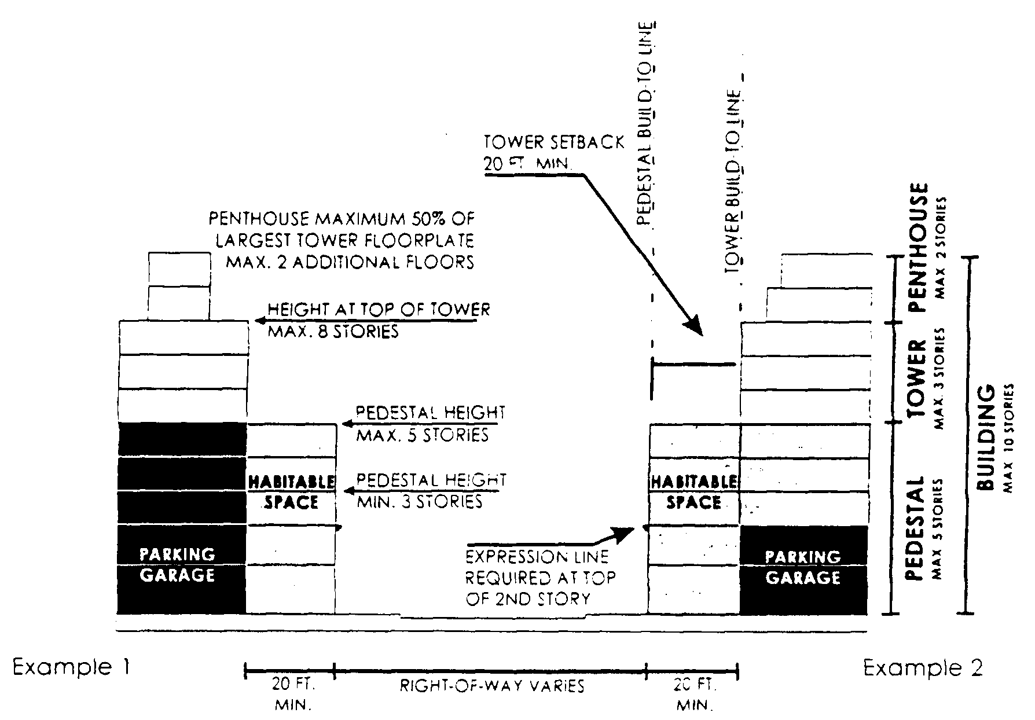
Center Sub-District—"B" Street
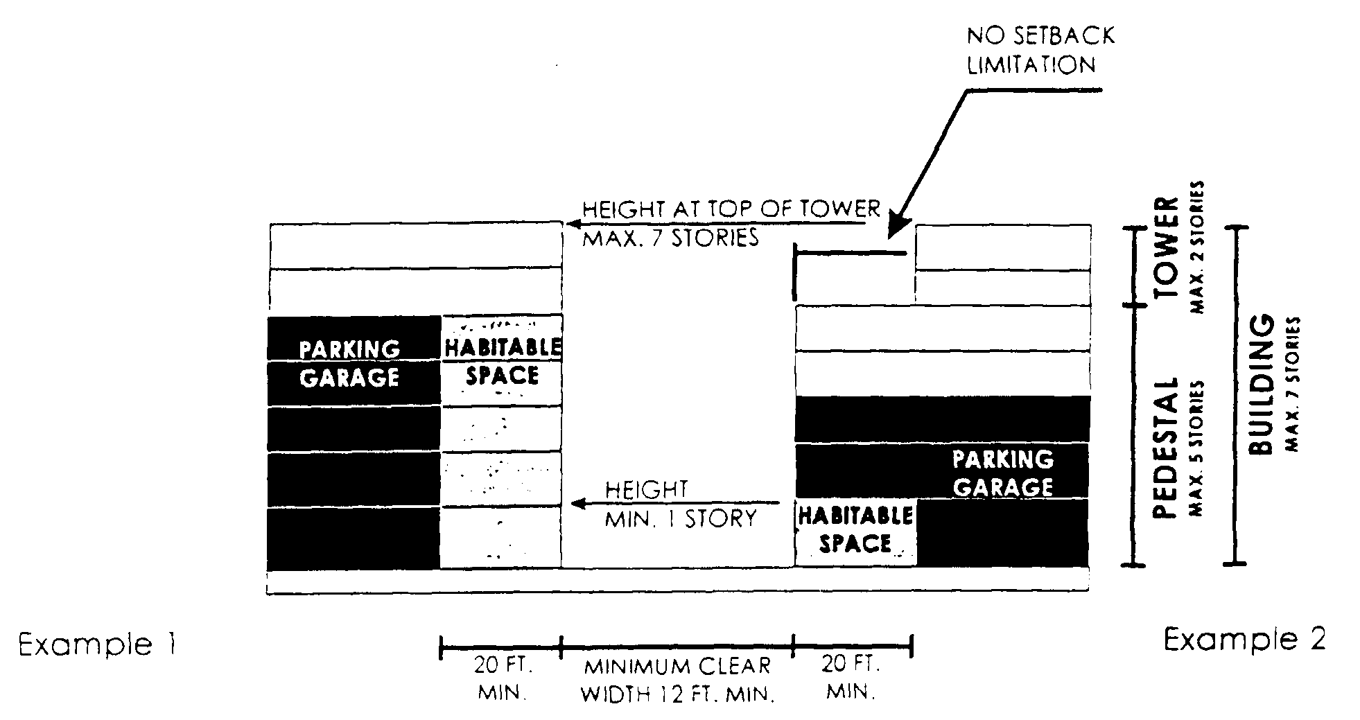
Center Sub-District—"C" Street
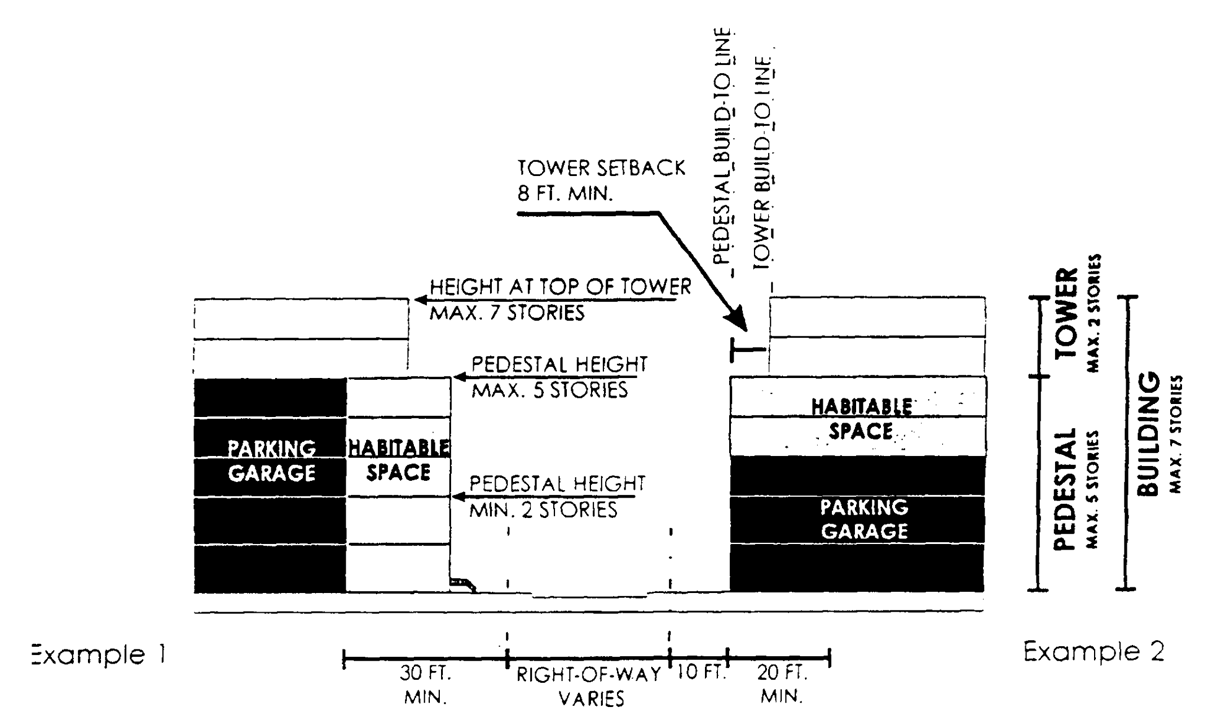
Center Sub-District—"D" Street
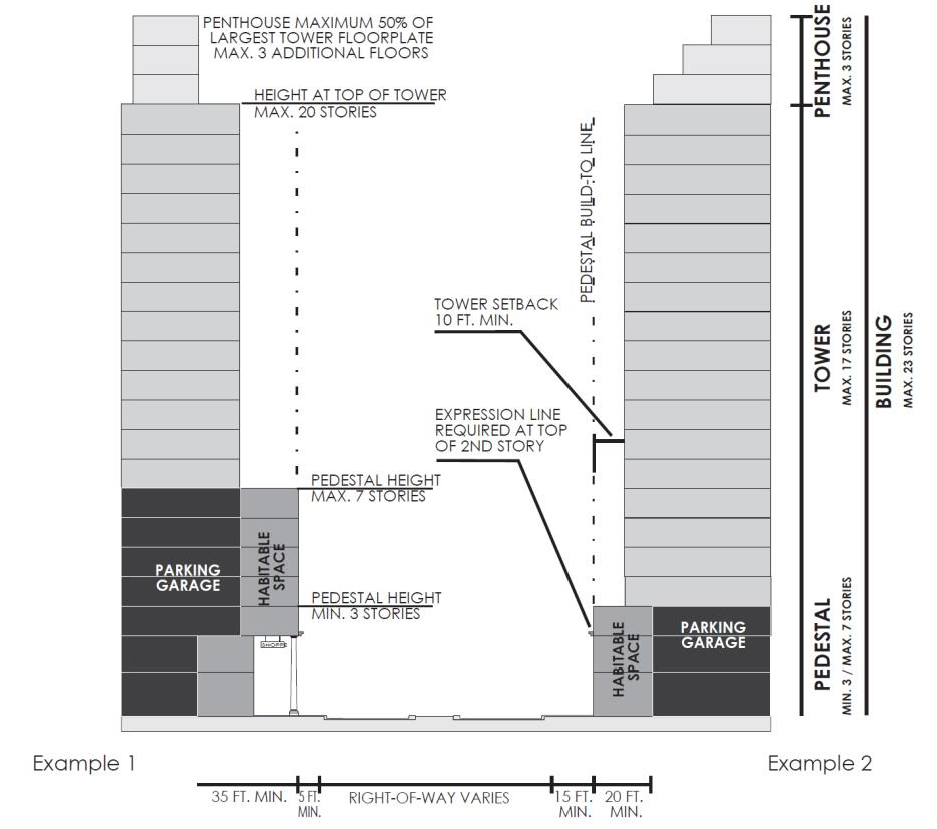
Center Sub-District—"E" Street
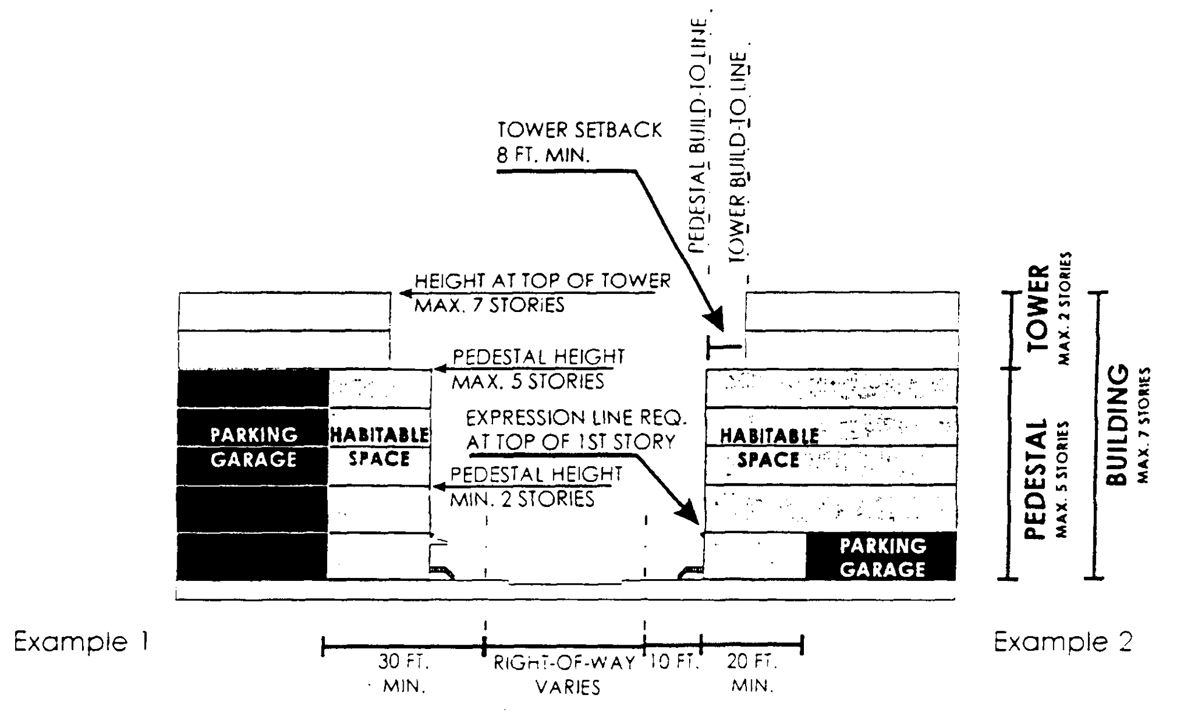
Edge Sub-District—"B" Street
Edge Sub-District—"C" Street
Edge Sub-District—"D" Street
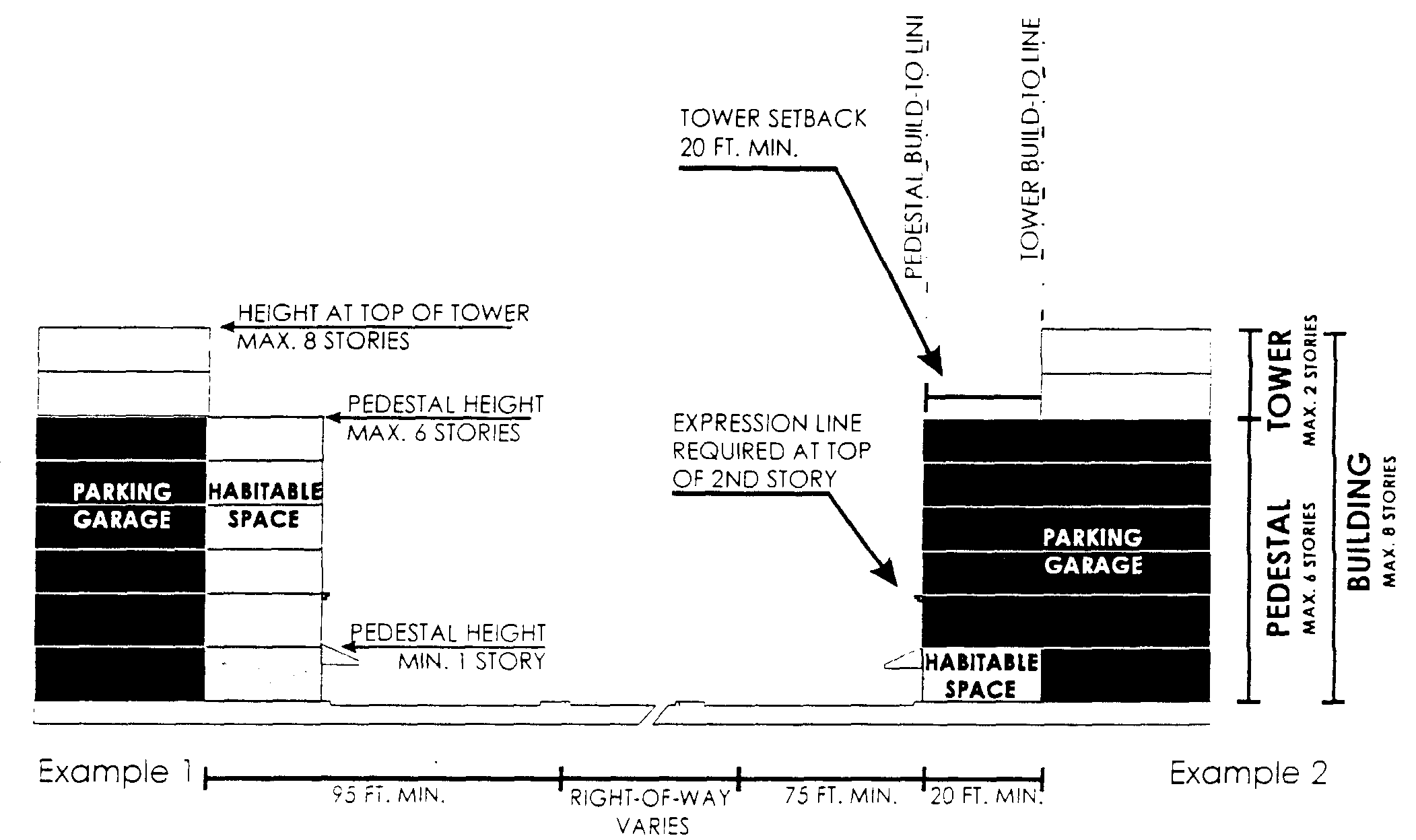
Edge Sub-District—"E" Street
(B)
General Requirements. All new development and redevelopment shall comply with the following parameters irrespective of Sub-District and frontage categories:
(1)
Permitted Uses.
(a)
Permitted uses in Core and Center Sub-Districts shall be all business and civic uses permitted in the BU-1, BU-1A, and BU-2 Districts, and the following:
i.
Area for residential uses shall not require public hearing.
ii.
The following BU-3 uses shall be permitted:
a.
Bakeries, retail and wholesale.
b.
Cabinet working and carpentry shops.
c.
Locksmith shops.
d.
Secondhand stores.
e.
Television and broadcasting stations.
f.
Upholstery and furniture repairs.
iii.
Outside food sales and services including, but not limited to, outdoor dining, cart vendors, and merchandise displays shall not require public hearing.
iv.
Drive-in services shall be concealed from "A", "B", "C", "E" and "F" streets by buildings or garden walls.
v.
The provisions of Section 33-150(A) and (B) of this Code regarding alcoholic beverages shall not apply.
vi.
Group residential facility, in accordance with the following:
a.
The facility shall obtain all applicable state licenses and operate in accordance with applicable state statutes, rules, and regulations, including but not limited to those pertaining to emergency and pandemic preparedness and response so as to ensure the health and safety of facility residents and staff.
b.
If the facility is a community residential home, it shall comply with the community residential home requirements of Section 33-203.
c.
If the facility is a group home, it shall comply with the group home requirements of Section 33-199.
(b)
Land uses permitted in Edge Sub-Districts shall be as follows:
1.
Edge Sub-district west of SW 72nd Avenue and north of Snapper Creek Canal.
i.
All residential, including group residential facilities in accordance with paragraph (1)(a)vi. above, and civic uses permitted in the RU-4, RU-4A, and RU-4M Districts.
ii.
Up to one percent of each building's floor area may be BU-1 business uses.
iii.
Up to four percent of each building's floor area that fronts a street or a square may have BU-1 business uses facing the street or square.
2.
Edge Sub-district east of U.S. Highway 1.
i.
All residential, including group residential facilities in accordance with paragraph (1)(a)vi. above, and civic uses permitted in the RU-4, RU-4M and RU-4A Districts.
ii.
All business and civic uses permitted in the BU-1, BU-1A, BU-2, BU-3, RU-5, RU-5A Districts, except as follows:
iii.
Area for residential uses shall not require public hearing.
iv.
Outside food sales and service including, but not limited to, outdoor dining, cart vendors, and merchandise displays shall not require public hearing.
v.
Drive-in services shall be concealed from "A", "B" and "C" streets by buildings or garden walls.
For Edge Sub-District properties east of US Highway 1 that border an adjacent residential zone, the buildings located within of one hundred (100) feet of the affected rear or side of the property boundary shall not exceed the adjacent district height restrictions by more than two (2) stories.
Primary access to all retail uses fronting on both a street and a paseo, or on both a street and a courtyard garden, shall be from the street.
(2)
Lots and Buildings.
(a)
Minimum lot size is two thousand (2,000) square feet with a minimum frontage of twenty (20) feet.
(b)
All lots shall share a frontage line with a street or square.
(c)
Each story shall be between eight (8) feet and fourteen (14) feet high from floor to ceiling. Floors more than fourteen (14) feet, as measured from floor to ceiling, will count as additional floors. When habitable space is located in front of garage floors along the primary street frontage, the number of floors in a building shall be calculated based on the number of habitable floors on that frontage. Within the pedestal, one (1) story may exceed fourteen (14) feet, up to thirty (30) feet, provided no mezzanine area intended for commercial use exceeds ten (10) percent and no mezzanine area intended for residential use exceeds eighty (80) percent of the area of the floor immediately below. Additionally, one (1) story within the pedestal and one (1) story within the penthouse, may exceed fourteen (14) feet, up to eighteen (18) feet, provided the story is intended for use as an amenity area or penthouse loft area.
(d)
No replatting or subdivision shall serve as a basis for deviating from this Article.
(e)
All buildings shall have their main pedestrian entrance opening to an "A", "B", "C", "E", or "F" street, courtyard garden or square. There shall be pedestrian entrances at maximum intervals of seventy-five (75) feet along "A," and "B" Streets. When ground level uses have entries from both streets and other public open space, the primary entrance will be from the street. Doors facing streets shall remain operational during business hours.
(f)
Maximum building floorplates above eight stories for all uses shall be twenty-five thousand square feet or 25 percent of the lot area whichever is greater. Cantilever balconies six (6) feet or less in depth shall not be counted towards the maximum building floorplate area. Notwithstanding any other provision to the contrary, the penthouse floorplate for buildings on parcels of record that as of December 16, 1999, have at least one frontage facing "A," "E," or "F" streets and have a lot depth at any one point of less than one hundred fifty (150) feet may be the same size as the largest tower floorplate below.
(g)
Minimum spacing between towers within any one (1) continuous property line is sixty (60) feet.
(h)
Aggregate tower frontage facing any street may not exceed two hundred twenty-five (225) feet per block or seventy (70) percent of street frontage, whichever is greater.
(i)
Where an "A", "B", "D", or "F" street intersects with another street, the corner of the building may need to be chamfered (angled) or rounded to satisfy view triangle and minimum sidewalk width requirements, and to make room for traffic signal poles (see diagram 1). The angled wall of the building shall count toward frontage requirements for both streets that it fronts. In situations where the view triangle causes the front facade to "bend" at a shallow angle from the street, the angled or rounded wall may set back farther from the street intersections for esthetic and structural reasons. However, the setback shall not be farther than twenty (20) feet measured from the intersection of the two (2) property lines perpendicularly to the front plane of the angled wall. For curved walls this will be measured to the midpoint of the curve. The depth of the colonnade underneath the angled wall of the building shall also be a minimum of fifteen (15) feet.
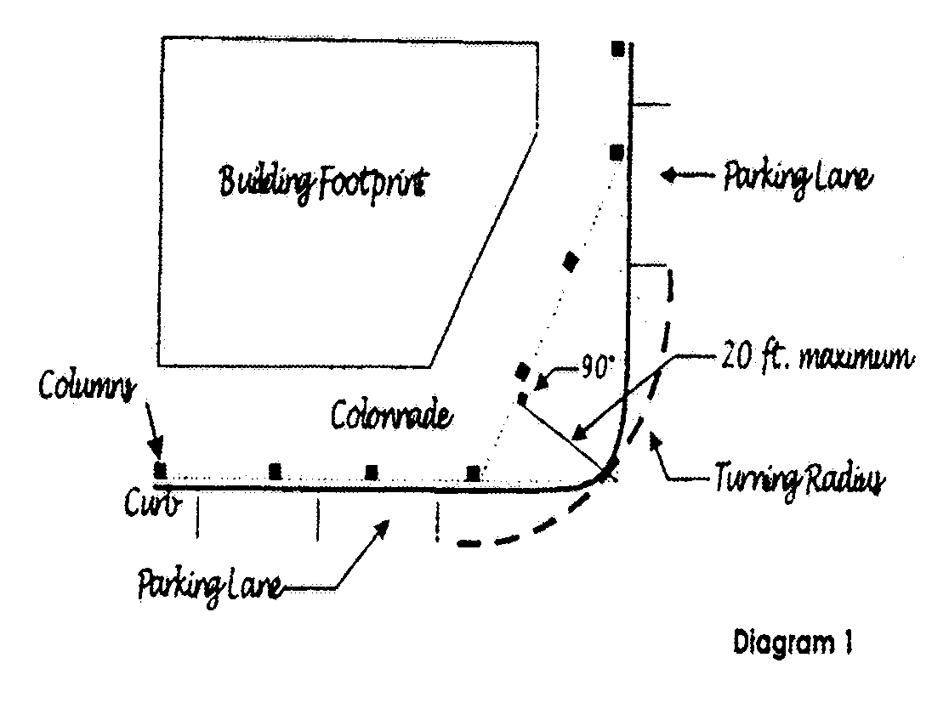
Diagram 1
(j)
Building design shall use energy conservation measures including, but not limited to, self-shading, natural lighting, natural ventilation, outdoor circulation, and reduced dependence on artificial lighting and air conditioning. Porches, balconies, breezeways, pergolas, deep eaves, eyebrows and other elements promoting natural ventilation and shading are encouraged. Each building shall dedicate a specific location for recycling separation, storage and access.
(k)
Vehicular entry gates at garage entries shall be positioned a minimum of twenty (20) feet behind the front wall of the building. At colonnaded frontages, this distance is measured from the interior/rear wall of the colonnade. To increase safety during off-hours, the setback area between the entry gate and the public sidewalk may be gated at the sidewalk edge during times when the garage is closed.
(l)
Exterior finish material shall be limited to concrete, stucco, quarried stone, cast stone, decorative concrete block, terra cotta, tile, metal, and glass. Wood and marble door and window surrounds are permitted, as are wood pergolas and trellises. Fabric awnings are permitted without back lighting.
(m)
Glazing and Transparency Requirements:
(1)
Building streetwall surfaces shall be a minimum thirty (30) percent glazed. Mirror-type glass shall not be allowed. All glazing shall be of a type that permits view of human activities and spaces within. Glazing shall be clear or very lightly tinted, except where used for screening garages, where it may be translucent.
(2)
Storefronts shall be provided on the first floor, directly accessible from Public Space. Storefronts shall be a minimum of sixty (60) percent clear-glazed except for jewelry stores, which may be a minimum of twenty (20) percent, and for residential uses which may be a minimum of forty (40) percent. Except for entrance doors, the bottom edge of the glazed areas shall be between eighteen (18) and thirty-six (36) inches above the sidewalk.
(3)
Storefront security screens, if any, shall be of the mesh type that pedestrians can see through and shall be located behind storefront displays. Storefronts shall remain open to view and lit from within at night.
(4)
Parking garage and loading area security screens and gates shall be a minimum of fifty (50) percent transparent.
(n)
Colonnade column spacing, windows, and doors shall have a vertical proportion. The spacing of the columns of a colonnade, measured from the centerline of the columns, shall not be greater than the height of the colonnade.
(o)
Cantilevers and moldings shall not exceed three (3) feet in extension beyond the vertical wall surface, unless visibly supported by brackets or other supports.
(p)
Parking garages shall have all architectural expression facing public open space consistent and harmonious with that of habitable space. The architectural expression shall include vertically proportioned openings, balconies, glazing, awnings, or other similar architectural elements. Ramping is encouraged to be internalized wherever possible. Exposed spandrels are prohibited. The exposed top level of parking structures shall be covered a minimum of sixty (60) percent with a shade producing structure such as a vined pergola or retractable canvas shade structure. All garage lighting installations shall be designed to minimize direct spillage, sky glow and hazardous interference with vehicular traffic on adjacent rights-of-way and all adjacent properties; this may be achieved through the use of down-turned building beams, garage screening, landscaping, or other similar architectural elements.
(q)
No building fixtures such as backflow preventers, pumps, underground ventilation exhausts, substations or similar shall be permitted above the ground within colonnades, sidewalks and open spaces.
(3)
Streets, Alleys, and Paseos. New streets shall be located according to the Street Frontage Plan. These locations are schematic to allow flexibility in the design of the site plan. The design of new streets and modifications to existing streets shall follow the requirements below:
(a)
Streets shall provide access to all building lots and tracts.
(b)
All streets, alleys and paseos shall connect to other streets. Cul-de-sacs, and T-turnarounds are not permitted. Dead-end streets are only permitted for those shown on the Street Frontages Plan when the adjacent property has not been developed or redeveloped.
(c)
No block face shall have a length greater than three hundred and twenty-five (325) feet without a street, paseo, courtyard garden or alley providing through access to another street, alley, or paseo.
(d)
All new "A", "B" and "D" streets, both public and private, shall have a minimum right-of-way width of fifty-four (54) feet. All new "A", "B" and "D" streets shall have curb and gutter, and have sidewalks on both sides of the travel lanes. Where possible, there shall be parking lanes which in addition to on-street parking may be used for "drop off" areas, valet stands, or bus stops.
i.
All sidewalks shall have a minimum width of ten (10) feet, and a continuous unobstructed area of a width no less than sixty (60) inches. This area shall be unobstructed by utility poles, fire hydrants, benches or any other temporary or permanent structures. Free and clear public use of sidewalk area outside of the right-of-way shall be protected by a public access easement.
ii.
On-street parking lanes shall not be closer than twenty-five (25) feet to intersections measured from the intersecting property lines (see diagram 2).
iii.
All streets, except "C" streets, shall have at least two (2) travel lanes, one (1) in each direction; however, streets around squares may have one (1) travel lane with one-way traffic.
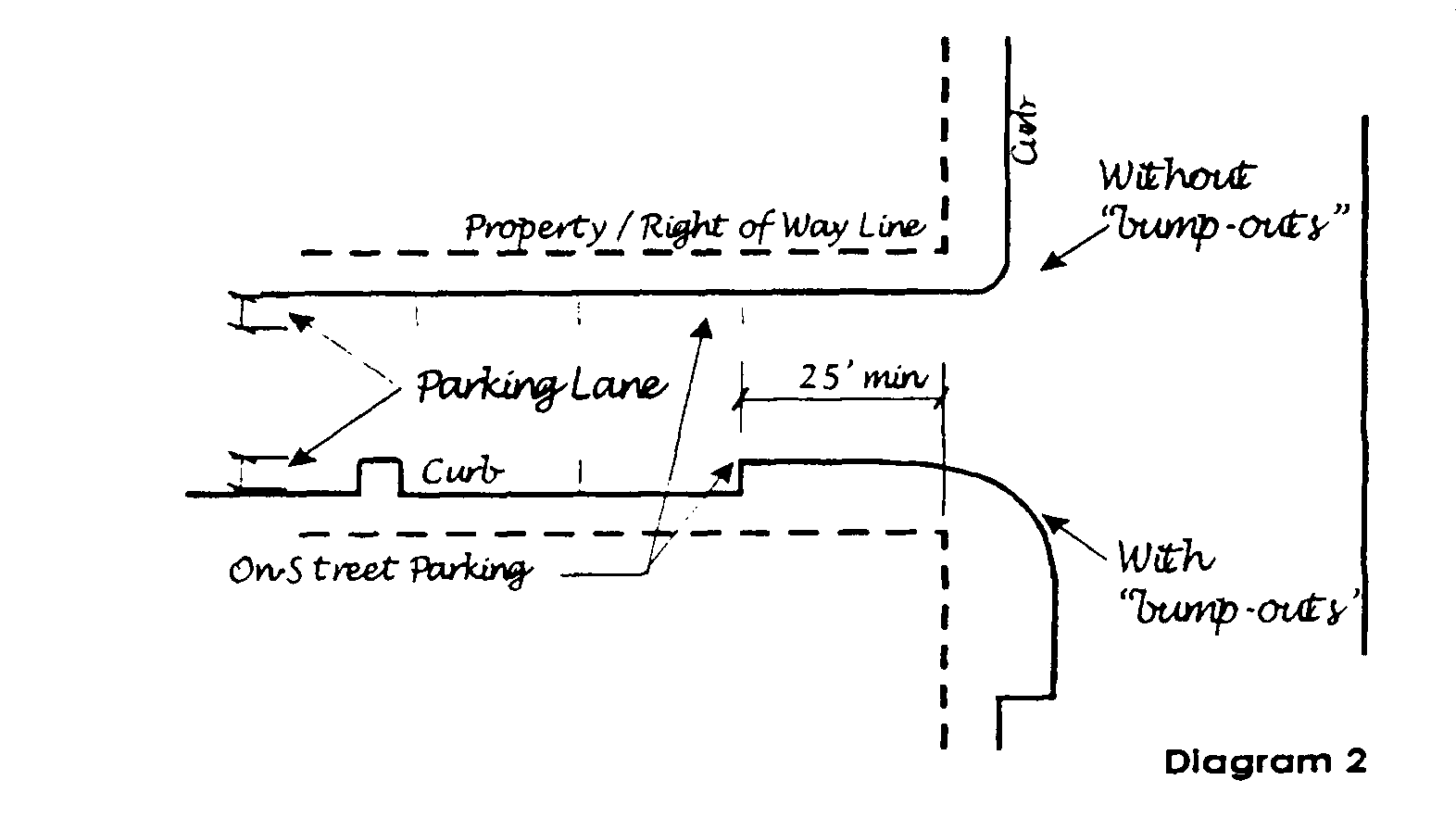
Diagram 2
(e)
In addition to the required "D" streets designated in the Street Frontage Plan, "D" streets or alleys are encouraged to the rear of building lots.
(f)
Curb radii at intersections shall be thirty-four (34) feet six (6) inches or less.
(g)
A minimum turning radius of thirty-six (36) feet shall be provided at street intersections. A clear zone is required when the curb extends beyond the turnout radius.
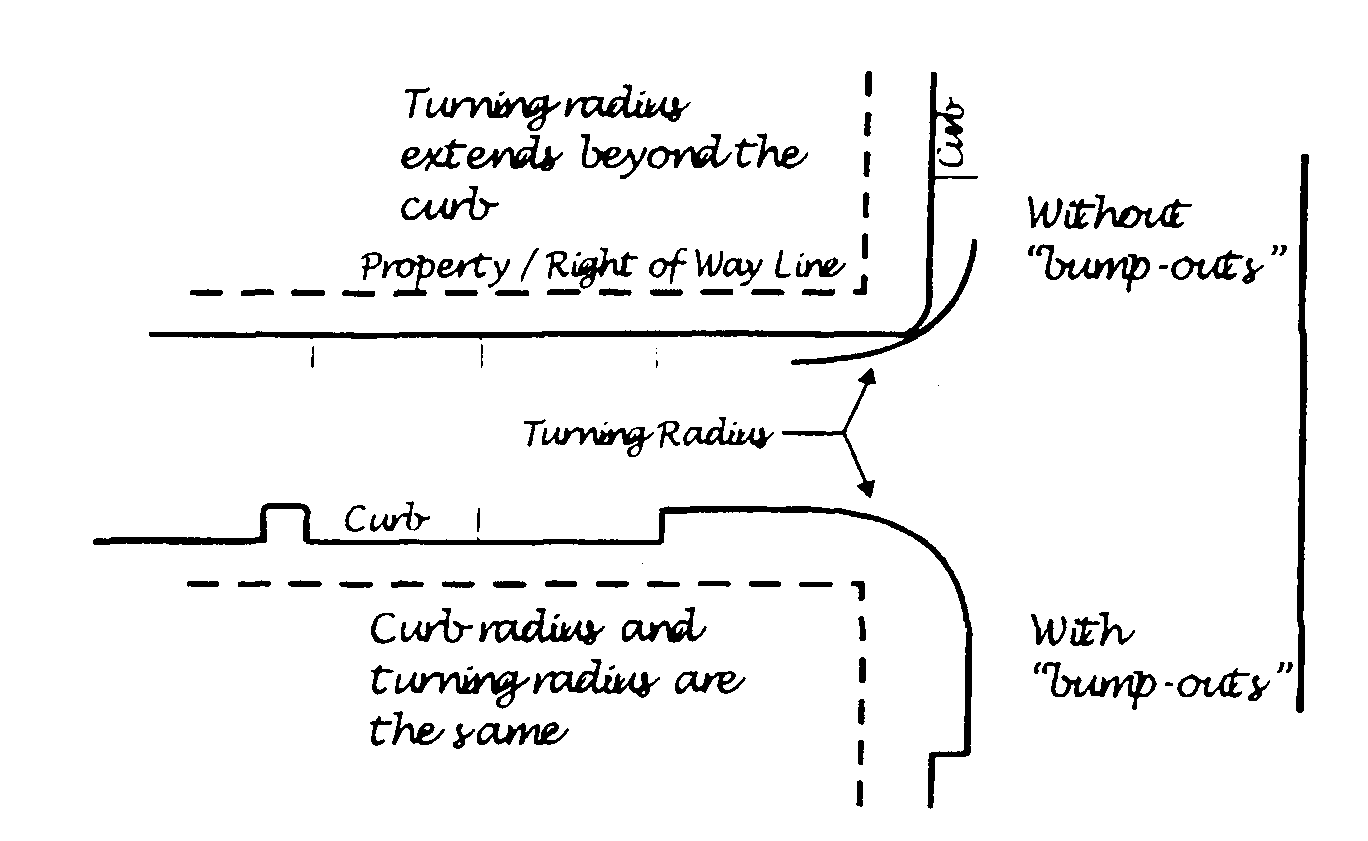
Diagram 3
(h)
Awnings, balconies, roof eaves, signs, porches stoops and ramps may encroach into setbacks. Awnings, balconies, roof eaves and signs may encroach into rights-of-way; however, they shall not extend a distance closer than six (6) inches from the curb face. All right-of-way encroachments shall be a minimum one hundred thirty-two (132) inches above the sidewalk. Encroachments shall not be taller than the building or pedestal, whichever is lower.
(i)
With the exception of fire hydrants, utilities shall run underground and above-ground projections of utilities shall be placed in or along rights-of-way of streets of lower pedestrian quality, wherever practicable.
(4)
Courtyard Gardens, Street and Garden Walls, Fences and Hedges. Street and garden walls, fences and hedges may be placed along property lines, at a height not to exceed ninety-six (96) inches, except in the Edge Sub-District, where side and rear yard walls are limited to seventy-two (72) inches in height. At street frontages, street and garden walls and fences shall be minimum fifty (50) percent transparent, and between thirty-six (36) inches and seventy-two (72) inches above grade for at least eighty (80) percent of the length. Pillars and posts shall average no more than ten (10) feet apart. Chain link fences are not permitted, except for temporary construction fences.
Only where necessary, walls, fences and hedges along street frontages shall angle away from street intersections and driveways to avoid obstructing the sight visibility triangles or to provide the minimum eight (8) foot sidewalk width at the intersecting streets.
A courtyard garden shall have at least two (2) sides enclosed by building walls; the remaining sides shall be enclosed by either fences or garden walls, and a minimum thirty (30) percent of its area shall be landscaped. The street opening to the courtyard garden shall not exceed the width of the street or square that it opens on to.
(5)
Open Space and Recreation Areas.
(a)
Private Open Spaces. A minimum of fifteen (15) percent of each net site shall be reserved for private open space. Colonnades, greens, landscaped roof terraces on buildings or garage structures can be counted towards this requirement.
(b)
Designated Open Spaces. Designated open space in the form of colonnades, squares and plazas shall be located according to the Designated Open Space Plan. All designated open spaces shall be at grade level and shall be accessible to the public. No replatting or other land division shall divide property in such a way that the provision of the required designated open space is avoided or its location changed. Designated open space areas provided in compliance with this section of the code shall count towards the private open space requirement provided herein.
Location, area and dimensions of the designated open spaces shall conform with the Designated Open Space Plan. Total square area must be in accordance with the Designated Open Space Plan; and the square must include the anchor point specified on the Designated Open Space Plan. At least three (3) corners of a square shall have a street intersection; and squares shall have a minimum dimension of one hundred fifty (150) feet between surrounding vehicular access ways.
Squares and plazas shall be densely shaded and provide seating. Trees and shrubs (shrubs are not permitted in plazas) shall be of sufficient quantity and located as to define a specific geometry of open space and shall promote security by allowing visibility through all areas. Ground surface shall be a combination of paving, lawn or ground cover integrated in design with trees and shrubs. Fountains, sculpture, and works of art are encouraged. Street furniture in squares such as trash containers and bus benches shall be permanently secured to the sidewalk. Street furniture shall not obstruct sight visibility triangles at street intersections.
(c)
Recreation Areas. Educational and child care facilities located within an Urban Center District shall be exempt from the outdoor recreation area requirements of Section 33-151.18(a) of this Code and shall be required to provide indoor and/or outdoor recreation areas subject to the following requirements:
(6)
Parking.
(a)
Parking shall be provided as per Section 33-124 of this Code, except as follows:
(1)
In the Core Sub-District, for all single use projects, the minimum parking permitted shall be:
i.
Residential—One (1) parking space per dwelling unit.
ii.
Office—One (1) parking space per four-hundred (400) square feet of gross floor area.
iii.
Hotel—One (1) parking space for every two (2) guest rooms.
iv.
Other uses—Use parking standard as specified in Section 33-124 of this Code.
(2)
In the Core Sub-District, required parking for mixed-use projects shall be calculated by applying the Urban Land Institute (ULI) Shared Parking Methodology, on file with the Director, to the parking standards above. Required parking shall fulfill between ninety (90) percent and one hundred ten (110) percent of the calculated requirement.
(3)
In the Center and Edge Sub-Districts, parking requirements for mixed-use projects shall be calculated by applying the (ULI) Shared Parking Methodology to the parking standards as specified in Section 33-124 of this Code. Parking shall fulfill between ninety (90) percent and one hundred ten (110) percent of the ULI calculated requirement.
(4)
Off-street parking areas shall be located on the same lot, parcel or premises as the use to be served; or may be on a lot or parcel of land that is in the Downtown Kendall Urban Center District and is within three hundred (300) feet from the site of such use(s) to be served; provided such use(s) shall immediately terminate in the event such parking area therefor is not available and all those having any right, title or interest in and to such property site shall execute and place on the public records of this County a covenant approved by the Director that such use(s) shall cease and terminate upon the elimination of such parking area, and that no use shall be made of such property until the required parking area is available and provided.
(5)
On-street parking spaces directly abutting a lot shall count toward the parking requirement for development of that lot, except that such spaces shall not count toward parking requirements for disabled persons or persons transporting baby strollers. All such on-street spaces shall be designed in accordance with the requirements of Section 33-284.62(C) of this Code.
(6)
In all sub-districts, the minimum required parking may be reduced up to one hundred (100) percent for parcels located within five hundred (500) feet of a rapid-rail transit station, up to fifty (50) percent for parcels located within one-quarter (¼) mile from a rapid rail transit station, and thirty (30) percent for parcels located within one-half (½) mile of a rapid rail transit station.
(b)
Surface parking lots shall be located a minimum of twenty (20) feet from the front property line along "A" and "B" Streets. Streetwalls and/or habitable space shall be built at the frontage line or at the build-to line to screen parking from view.
(c)
Parking garages shall be screened at all frontages except "D" streets by a minimum setback of twenty (20) feet of habitable space.
(d)
For parking garages on parcels of record as of December 16, 1999, having at least one frontage facing "A", "E", or "F" streets and having a lot depth at any one point of less than one hundred fifty (150) feet:
(1)
Such parking spaces are required to provide habitable space only at the colonnade or ground levels. However, architectural expression shall remain required as per this article.
(2)
Parking levels within such garages shall not be considered a story, provided that the total height of the building is no greater than a building with habitable spaces lining the parking garage.
(e)
Drop off drives and porte-cocheres fronting onto "A", "B", "E", and "F" street frontages may only occur behind habitable space, in courtyard gardens, on "C" and "D" streets, and alleys.
(f)
Loading and service entries shall be allowed only on "D" streets, alleys and within parking lots and structures. For those properties with frontages only on "A", "B", "C", "E", and "F" streets loading and service entries shall be allowed on the street frontage.
(g)
Pedestrian entries to parking garages shall be directly from the street or paseo as well as from the contiguous building. Pedestrian entries to garages shall be linked to cross-block paseos wherever possible.
(h)
Vehicular entries to garages shall be allowed only from rights-of-way, passes and alleys. Vehicular entries on "A", "B", "C", and "F" frontages shall have a maximum width of thirty-three (33) feet with a minimum separation of seventy (70) feet between entries. Vehicular entries on "E" streets shall have a maximum width of sixty-six (66) feet with a minimum interval of seventy (70) feet between each vehicular entry. On "D" streets they shall not be limited.
(i)
Parking lots shall provide for pedestrian and vehicular cross access to existing and prospective adjacent parking lots.
(j)
Parking stall dimensions and spaces for persons with disabilities and/or strollers shall be in accordance with Article VII of the Miami-Dade County Code.
(k)
Bicycle racks shall be provided on all sites as per Ordinance No. 99-81.
(l)
Mechanized parking shall be allowed for residential multi-family and non-residential buildings and when provided it shall be exempt from the provisions of Section 33-122 of this Code. For the purpose of this article, mechanized parking shall be defined as a mechanism with vertical and horizontal transport capability that provides for automobile storage or retrieval. A mechanized parking space may be counted as a parking space required in this section provided that:
a.
A queuing analysis is submitted and approved during the Administrative Site Plan and Architectural Review.
b.
Mechanized parking shall be located within an enclosed building/garage which shall be screened along all frontages, except along a service road or a pedestrian passage, by a liner building containing a minimum depth of 20 feet of habitable space.
(m)
The provisions of Section 33-131 of this Code shall not apply to the required parking for mixed-use developments.
(n)
Child care facilities located within a mixed-use building shall be exempt from the auto-stacking requirements of Section 33-151.18(c) of this Code.
(Ord. No. 99-166, § 1, 12-16-99; Ord. No. 01-156, §§ 1, 2, 9-25-01; Ord. No. 01-161, § 2, 10-23-01; Ord. No. 02-11, § 3, 1-29-02; Ord. No. 02-152, § 1, 9-12-02; Ord. No. 09-81, § 4, 9-1-09; Ord. No. 13-54, § 2, 6-4-13; Ord. No. 14-121, § 1, 12-2-14; Ord. No. 14-134, § 3, 12-16-14; Ord. No. 15-140, § 3, 12-1-15; Ord. No. 18-05, § 1, 1-23-18; Ord. No. 20-110, § 10, 10-6-20; Ord. No. 22-109, § 2, 9-1-22; Ord. No. 23-24, § 2, 4-4-23; Ord. No. 26-3, § 2, 1-21-26)
Sec. 33-284.63. - Additional parameters.
The following are required irrespective of frontage and Sub-District categories:
(A)
Landscape. With the exception of Sections 18A-7, 18A-8, 18A-9, 18A-11, 18A-12 and 18A-13, the provisions of Chapter 18A of the Code of Miami-Dade County, Florida, shall not apply, except as provided for below. Trees and landscape shall be required for streets, medians, squares, plazas, and private property in accordance with the following:
(1)
Street Trees: Street trees shall be placed along "B", "C", "E", and "F" Streets at a maximum average spacing of twenty (20) feet on center. Street trees shall have a minimum caliper of six (6) inches and shall have a minimum clear trunk of eight (8) feet at time of planting. Palms shall not be used as street trees. Street trees are not required when colonnades are provided along the street.
(2)
Median Trees: Median trees shall have a minimum caliper of six (6) inches and shall have a minimum clear trunk of eight (8) feet at time of planting. Median planting shall provide a one hundred (100) percent canopy coverage within two (2) years of installation. Median trees may be a maximum of twenty (20) percent flowering trees or palms, which at time of planting shall have a minimum height of fifteen (15) feet, a minimum spread of ten (10) feet, and a minimum caliper of three (3) inches.
(3)
Square and Plaza Trees: Trees on squares and plazas shall have a minimum caliper of six (6) inches and shall have a minimum clear trunk of eight (8) feet. Trees on squares and plazas shall provide a one-hundred (100) percent canopy coverage for eighty (80) percent of the entire square within five (5) years of installation. Trees for squares and plazas may be ten (10) percent palms of the following species: phoenix canariensis (Canary Island Date Palm); phoenix dactylifera (North African Date Palm); 'Medjool' (Date Palm); and 'Zahidi' (Date Palm); phoenix sylvestris (Wild Date Palm); roystonea elata (Florida Royal Palm) and regia (Cuban Royal Palm).
(4)
With the exception of squares as provided in Section 33.284.62 (C)(6) above, no shrubs are required.
(5)
Tree requirements for private property shall be based on sixteen (16) trees per net acre of lot area and, in addition to the lot, may be placed in squares, plazas and medians within the District. Trees shall have a minimum caliper of six (6) inches and shall have a minimum clear trunk of eight (8) feet at time of planting.
(6)
At grade parking lots shall follow all requirements of Section 18A(6)(J) of this Code.
(7)
All landscaped areas of squares and required setbacks shall be continuously maintained in a good, healthy condition, and sprinkler systems of sufficient size and spacing shall be installed to serve all required landscaped areas and parking lots. Irrigation shall supply a minimum of the equivalent one and one-half (1½) inch rainfall per week. Rain sensors shall be installed in all systems.
(8)
To ensure quality and longevity, the following additional conditions for tree planting in streets, medians, squares, and plazas shall apply:
i.
All trees shall be Florida Grade #1 or better.
ii.
All trees shall be shaped and branched typical for the species and variety.
iii.
A signed and sealed "Professional Preparer's Statement of Compliance" shall be submitted by the Project Landscape Architect at time of submission for Administrative Site Plan Approval (ASPR), zoning, or other approval.
iv.
A signed and sealed "Professional Preparer's Certification at time of Final Inspection" shall be submitted by the project Landscape Architect before a Certificate of Occupancy may be issued.
v.
A minimum of thirty (30) percent of the total of all trees or palms planted shall be of a native species.
vi.
A minimum six (6) foot by six (6) foot opening, clear of utilities, shall be provided for all trees.
vii.
Root barriers shall be provided for all tree plantings.
viii.
Tree grates or other approved devices shall be provided around all trees in hard surfaced areas to ensure adequate water and air penetration.
(B)
Signage. Signage shall be governed by section 33-284.87.
(Ord. No. 99-166, § 1, 12-16-99; Ord. No. 02-11, § 4, 1-29-02; Ord. No. 05-197, § 2, 11-3-05; Ord. No. 09-81, § 5, 9-1-09; Ord. No. 14-134, § 4, 12-16-14; Ord. No. 21-124, § 2, 11-2-21)
Sec. 33-284.63.1. - Center DRI Sub-District Alternative Development Parameters.
Notwithstanding the provisions of sections 33-284.62 and 33-284.63, property within the Center DRI Sub-district may be developed in compliance with the following provisions. Development undertaken pursuant to the following provisions shall be subject exclusively to those provisions and not to any of the provision or requirements of sections 33-284.62 or 33-284.63. Development in the Center DRI Sub-district pursuant to sections 33-284.62 and 33-284.63 shall be subject exclusively to the provisions and requirements of those sections and not to the provision contained herein.
(A)
Uses permitted. No land, body of water or structure in the Center DRI Sub-district shall be used or permitted to be used, and no structure shall be hereafter erected, constructed, arranged or intended to be used, occupied or maintained for any purpose, except for one or more of the following uses:
(1)
All uses permitted in the BU-2 District.
(2)
Electric Vehicle Retail Showroom.
(B)
Setbacks, cubic content, yard area and lot size requirements. There shall be no setback requirements, minimum cubic content requirements, yard area requirements, or minimum lot size requirements.
(C)
Building height and number of stories. Building height shall be limited to eight (8) stories. A story shall be measured from floor to ceiling, with a minimum clearance of eight (8) feet and a maximum clearance of fourteen (14) feet. In the event that the clearance in any story is greater than fourteen (14) feet, it shall be counted as more than one story.
(D)
Floor area and lot coverage. The floor area ratio and lot coverage are not limited.
(E)
Landscaped open space. There shall be no landscaping requirement. However, if landscaping is provided, all plant material shall be in accordance with Chapter 18A of this Code.
(F)
Parking. No parking spaces are required, but if parking spaces are provided, such spaces shall comply with sections 33-122, 33-122.2, 33-122.3 and 33-131 of this Code.
(G)
Enclosed uses. All uses in the Center DRI Sub-district shall be conducted within completely enclosed buildings, unless otherwise specifically provided herein. All materials and products shall be stored within the building or within an area completely enclosed with masonry walls not less than six (6) feet in height. Storage shall not be made above the height of the walls.
(H)
Plan review standards for the Center DRI Sub-district.
(1)
The purpose of the plan review is to encourage logic, imagination and variety in the design process and thereby insure the congruity of the proposed development and its compatibility with the surrounding area. The Department shall review plans for compliance with zoning regulations and for compliance with the site plan review criteria contained herein. The decision of the Department in relation to the plan review criteria may be appealed by the applicant to the Board of County Commissioners within thirty (30) days of the date the project was denied approval in writing. Such appeals shall be in accordance with Section 33-309 and shall be heard as expeditiously as possible. All final plans submitted for building permits shall be substantially in compliance with the plans approved under the plan review procedure herein established.
(2)
Exhibits which the applicant shall submit to the Department shall include, but not be limited to, the following:
(a)
Schematic and fully dimensioned site plan including the following information:
(i)
Lot lines and setbacks.
(ii)
Location, shape, size, height and use of all existing and proposed buildings.
(iii)
Location of decorative walls, entrance features and signage.
(iv)
Location of landscaping, if any.
(v)
Location of off-street parking, if any, and parking layout.
(vi)
Location of outdoor lighting.
(vii)
Location of loading facilities, waste collection areas and other service areas.
(viii)
Location of internal drives, including ingress and egress drives to existing or proposed roadway and sidewalk systems.
(ix)
Location of pedestrian access points, including connections to existing or proposed bridges, roadways, or sidewalk areas.
(b)
Floor plans and elevations of all structures, including total gross square footage of each floor, the floor area ratio of each building and the total floor area ratio.
(c)
Figures indicating the following:
(i)
Gross and net acreage.
(ii)
Amount of building coverage at ground level in square feet.
(iii)
Total trees and shrubs, if any, percentage of landscaping and type of plant material.
(iv)
Location and number of parking spaces, if any, parking layout and total amount of paved areas in square feet.
(v)
Such other design data as may be needed to evaluate the project.
(3)
The following checklist of criteria shall be utilized by the Department in the review process:
(a)
Circulation. Pedestrian and auto circulation shall be separated insofar as is practicable, and all circulation systems shall adequately serve the needs of the development and be compatible and functional with circulation systems outside the development.
(b)
Signs and outdoor lighting. All signs and outdoor lighting shall be designed as an integral part of and be harmonious with the building design and the surrounding landscape.
(c)
Service areas. Service areas shall be screened and so located as not to be visible from view.
(d)
Roof installations and facilities. All permitted installations housing mechanical equipment located on the roof shall be screened from ground view at the level at which the installations are located, and shall be designed as an integral part of and be harmonious with the building design.
(e)
Outdoor furniture and graphics. All outdoor furniture and graphics shall be designed as an integral part of the overall design of the project.
(f)
Art display. Permanent interior and exterior art displays, sculptures and water features should be encouraged in the overall design of the project.
(Ord. No. 02-11, § 5, 1-29-02; Ord. No. 13-41, § 2, 5-7-13)
Sec. 33-284.63.2. - Palmetto Transit Sub-District.
Notwithstanding the provisions of Sections 33-284.62 and 33-284.63, property within the Palmetto Transit Sub-district may be developed in compliance with the following provisions. Development undertaken pursuant to the following provisions shall be subject exclusively to those provisions and not to any of the provision or requirements of Section 33-284.62 or 33-284.63.
The Palmetto Transit Sub-District shall be bounded by the Palmetto Expressway Ramp to the west, the Palmetto Expressway Extension Ramp to the east, and the South Dade Transitway Corridor to the south.
(A)
General Requirements. All new development and redevelopment shall comply with the following parameters irrespective of Sub-District and frontage categories:
(1)
Permitted Uses. All business and civic uses permitted in the BU-1, BU-lA, BU-2 Districts, and the following:
(a)
Residential uses shall not require public hearing.
(b)
The following BU-3 uses shall be permitted:
(i)
Bakeries, retail and wholesale.
(ii)
Locksmith shops.
(iii)
Secondhand stores.
(iv)
Television and broadcasting stations.
(v)
Other similar uses as approved by the Director.
(c)
Outside food sales and services including, but not limited to, outdoor dining, cart vendors, and merchandise displays shall not require public hearing.
(d)
Drive-in services shall be concealed from streets by buildings or garden walls.
(e)
The provisions of Section 33-150(A) and (B) of this Code regarding alcoholic beverages shall not apply.
(B)
Development parameters.
(1)
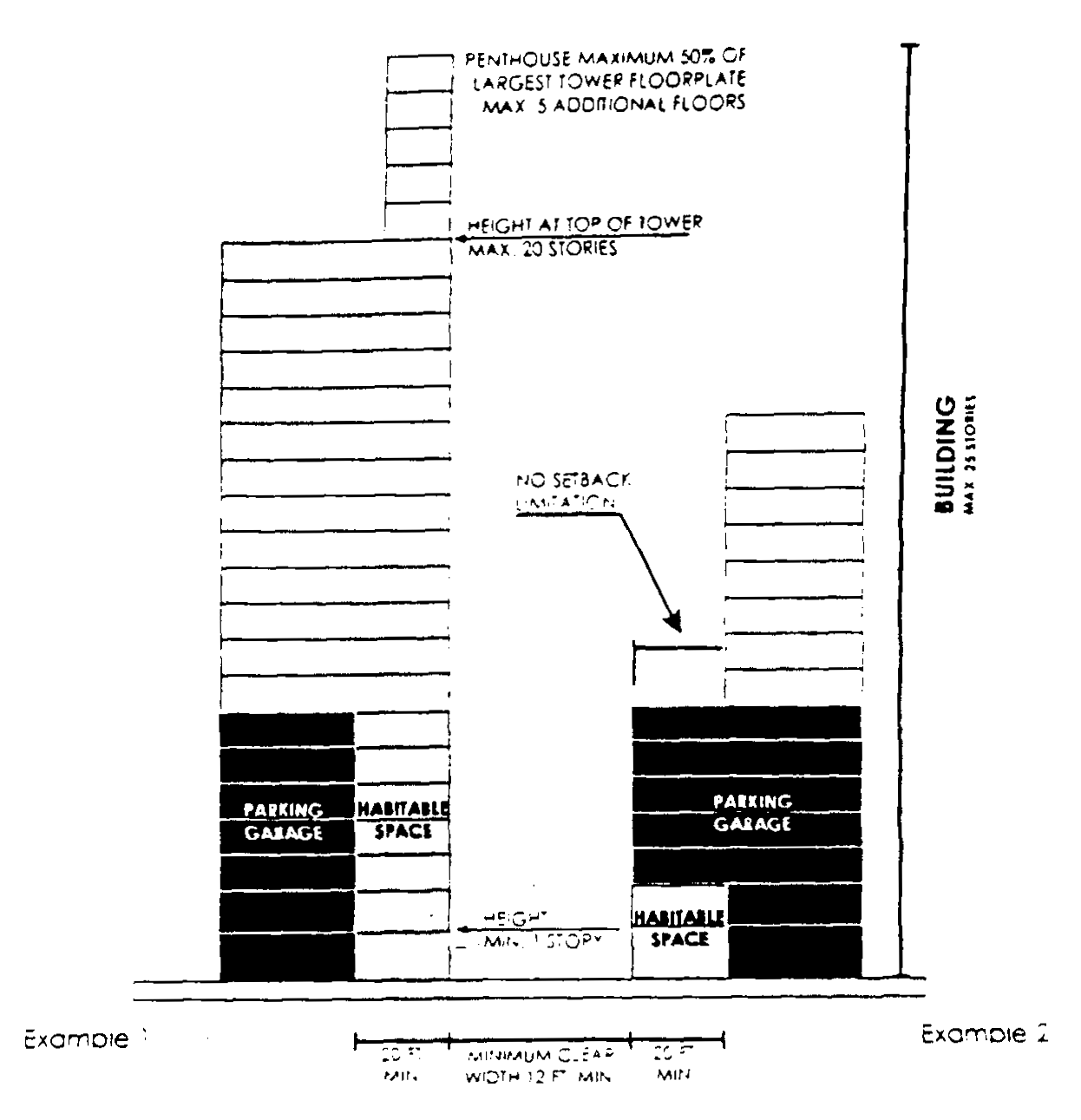
Placement Diagrams. The following diagram identifies design parameters specifically for the Palmetto Transit Sub-district and "C" Street frontage type situations:
Palmetto Transit Sub-District - "D" Street
(C)
Open space. Open space shall be provided as follows:
(1)
Open space shall be any exterior surface areas consisting of designated open space or private open space. A minimum of 15 percent of net lot area shall be provided for open space. Designated open space may count toward open space.
(2)
Open space may include outdoor at-grade or rooftop space accessible to the public all or most of the time, including parks, plazas, squares, colonnades, courtyard gardens, paseos, and pedestrian paths and/or associated ornamental or shading landscaped areas.
(D)
Landscape. All landscaping shall be provided in accordance with Chapter 18A, provided, however, that:
(1)
The minimum number of required trees per acre of net lot area shall be 16 trees;
(2)
The Director may authorize up to 50 percent of the required lot trees to be provided within a three-mile radius at: public parks; or along transit or transportation corridors, as defined in the CDMP;
(3)
Required lots trees may be provided as rooftop trees.
(E)
Street trees. Street trees shall be placed along "D" streets at a maximum average spacing of 20 feet on center. Street trees shall have a minimum caliper of six inches and shall have a minimum clear trunk of eight feet at the time of planting. Palms may be used as street trees. Street trees are not required when colonnades are provided along the street or when obstructing a safe sight distance triangle.
(F)
Parking. Parking shall be provided as per Section 33-124, except as follows:
(1)
In the Palmetto Transit Sub-District, for all single use projects, the minimum parking permitted shall be:
(a)
Residential—One parking space per dwelling unit.
(b)
Office—One parking space per 400 square feet of gross floor area.
(c)
Hotel—One parking space for every two guest rooms.
(d)
Retail—One parking space per 500 square feet of gross floor area.
(e)
Restaurant, Pub, and Bar—One parking space per 100 square feet of patron area.
(2)
Required parking for mixed-use projects shall be calculated by applying the Urban Land Institute Shared Parking Methodology, on file with the Director, to the parking standards above. Required parking shall fulfill between 90 percent and 110 percent of the calculated requirement.
(3)
Off-street parking areas shall be located on the same lot, parcel or premises as the use to be served. Alternatively, off-street parking may be on a lot or parcel of land that is in the Downtown Kendall Urban Center District and is within 300 feet from the site of such use to be served; provided such use shall immediately terminate in the event such parking area therefor is not available. If off-street parking is being used within the DKUCD, all those having any right, title or interest in and to such property site shall execute and place on the public records of this County a covenant approved by the Director that such use(s) shall cease and terminate upon the elimination of such parking area, and that no use shall be made of such property until the required parking area is available and provided.
(4)
No minimum parking shall be required for parcels located within 500 feet of a rapid-rail transit station. For parcels located within ¼ mile and ½, mile from a rapid rail transit station, minimum required parking shall be 50 percent and 30 percent, respectively.
(5)
Bicycle racks shall be provided on all sites in accordance with Section 33-122.3.
(6)
Drop-off drives and porte cocheres may front onto "C" and "D" streets and alleys.
(7)
Loading and service entries shall be allowed on street frontage.
(8)
Mechanized parking shall be allowed. For the purpose of this section, mechanized parking shall be defined as a mechanism with vertical and horizontal transport capability that provides for automobile storage and retrieval. Mechanized parking may be counted as a parking space required per this section provided that:
(a)
A queuing analysis is submitted and approved during the Administrative Site Plan and Architectural Review.
(b)
Mechanized parking shall be located within an enclosed building or garage and shall be screened along all frontages, except along a service road or a pedestrian passage.
(G)
Walls, Fences, and Hedges.
(1)
Walls, fences, and hedges may be placed inside of and within the required setback.
(2)
Walls, fences, and hedges shall not exceed 96 inches in height.
(H)
Parking garages.
(1)
Parking garages shall have architectural expression facing public streets and open spaces consistent and harmonious with that of habitable space. Architectural expression shall include balconies, glazing, awnings, or other similar architectural elements.
(2)
Ramps should be internalized wherever possible.
(3)
For the exposed top level of parking structures, a minimum of 50 percent of the area shall be covered with shade-producing structures, such as a vined pergola or retractable canvas shade structure; in connection with residential or office uses, shading may also be provided by a landscaped roof terrace or amenity area.
(4)
All garage lighting installations shall be designed to minimize direct spillage, sky glow, and hazardous interference with pedestrian and vehicular traffic on adjacent rights-of-way and all adjacent properties; this may be achieved through the use of down-turned building beams, garage screening, landscaping, or other similar architectural elements.
(I)
Plan review standards for the Palmetto Transit Sub-district.
(1)
The purpose of the plan review is to encourage logic, imagination and variety in the design process and thereby ensure the congruity of the proposed development and its compatibility with the surrounding area. The Department shall review plans for compliance with zoning regulations and for compliance with the site plan review criteria contained herein. The decision of the Department in relation to the plan review criteria may be appealed by the applicant to the Board of County Commissioners within 30 days of the date the project was denied approval in writing. Such appeals shall be in accordance with Section 33-309. All final plans submitted for building permits shall be substantially in compliance with the plans approved under the plan review procedure herein established.
(2)
Exhibits that the applicant shall submit to the Department shall include, but not be limited to, the following:
(a)
Schematic and fully dimensioned site plan including the following information:
(i)
Lot lines and setbacks.
(ii)
Location, shape, size, height and use of all existing and proposed buildings.
(iii)
Location of decorative walls, entrance features and signage.
(iv)
Location of landscaping, if any.
(v)
Location of surface parking.
(vi)
Location of outdoor lighting.
(vii)
Location of loading facilities, waste collection areas and other service areas.
(viii)
Location of internal drives, including ingress and egress drives to existing or proposed roadway and sidewalk systems.
(ix)
Location of pedestrian access points, including connections to existing or proposed bridges, roadways, or sidewalk areas.
(b)
Floor plans and elevations of all structures, including total gross square footage of each floor, the floor area ratio of each building and the total floor area ratio.
(c)
Figures indicating the following:
(i)
Gross and net acreage.
(ii)
Amount of building coverage at ground level in square feet.
(iii)
Total trees and shrubs, if any, percentage of landscaping and type of plant material.
(iv)
Location and number of parking spaces, if any, parking layout and total amount of paved areas in square feet.
(v)
Such other design data as may be needed to evaluate the project.
(3)
The following checklist of criteria shall be utilized by the Department in the review process:
(a)
Circulation. Pedestrian and auto circulation at ground level shall be separated insofar as is practicable, and all circulation systems shall adequately serve the needs of the development and be compatible and functional with circulation systems outside the development.
(b)
Signs and outdoor lighting. All signs and outdoor lighting shall be designed as an integral part of and be harmonious with the building design and the surrounding landscape.
(c)
Service areas. Service areas shall be screened and so located as not to be visible from view unless located in an alley, service drive, or at the rear of a building.
(d)
Roof installations and facilities. All permitted installations housing mechanical equipment located on the roof shall be screened from ground view at the level at which the installations are located, and shall be designed as an integral part of and be harmonious with the building design.
(e)
Outdoor furniture and graphics. All outdoor furniture and graphics shall be designed as an integral part of the overall design of the project.
(J)
Notwithstanding anything to the contrary, signage in the Palmetto Transit Sub-District shall be provided in accordance with Section 33-284.63(B).
(Ord. No. 20-12, § 1, 1-22-20)
Sec. 33-284.63.3. - Trail Connector Sub-District.
(A)
Creation and Applicability. The Trail Connector Sub-District of the Downtown Kendall Urban Center District is hereby created to include and encompass all parcels with a property line on the west side of SW 70th Avenue between the Snapper Creek Canal right of way on the south and SW 80th Street on the north. The provisions of this section shall apply to all such parcels.
(B)
Development Standards. Notwithstanding the provisions of Sections 33-284.62 and 33-284.63, property within the Trail Connector Sub-District, as defined in paragraph (A) above, may be developed in compliance with the following provisions. To the extent not inconsistent with the following provisions, the development standards set forth in Sections 33-284.62 and 33-284.63, along with the remaining provisions of Article XXXIII(I) of Chapter 33 of the Code, shall otherwise apply to development within the Trail Connector Sub-District. Where the following provisions are inconsistent with the standards in Sections 33-284.62 and 33-284.63, the provisions herein shall control.
(1)
Trail Connector. Development within the Sub-District shall incorporate a continuous multi-use pedestrian and bicycle path along the western edge of SW 70th Avenue running from the Snapper Creek Canal right-of-way to a point south of, but not connecting to, SW 80th Street. The path shall be at least ten feet in width, except where it abuts existing buildings within the Dadeland North Metrorail Station site, where it must be at least eight feet in width. To the extent consistent with applicable requirements and subject to approval of the Department of Transportation and Public Works or its successor, the connector may be located on public or private property and may be interrupted by vehicle entries, and the multi-use pedestrian and bicycle path may also serve as a parcel's required sidewalk. The western edge of the multi-use pedestrian and bicycle path shall serve as the property line for calculation of building placement, habitable space, and colonnade depth.
(2)
Street Trees. In order to accommodate the required multi-use pedestrian and bicycle path, street trees may be relocated within a parcel as additional lot trees, provided that such relocation conforms to all applicable tree size and spacing requirements and does not result in a reduction in the required number of trees. Where possible, any relocated street trees shall be located within the parcel's front setback.
(3)
Vehicle Entries. To the extent consistent with applicable requirements and subject to approval of the Department of Transportation and Public Works or its successor, vehicle entries within the Trail Connector Sub-District shall be allowed, subject to a maximum vehicle entry width of 35 feet and a minimum interval between vehicle entries of 26 feet. Each parcel may include a maximum of two vehicle entries per street frontage. The street frontage between vehicle entries shall not be required to include habitable space.
(4)
Stepbacks and Floorplates. Development within the Trail Connector Sub-District shall not be subject to the stepback requirements and penthouse floorplate limitations of Section 33-284.62.
(5)
Setback of Surface Parking. Notwithstanding the requirements of Section 33-284.62(B)(6)(b), surface parking on parcels that abut the Dadeland North Metrorail Station site may be located three feet from the front property line, provided that such surface parking is screened from the front property line by a wall, fence, or hedge with a minimum height of 3 feet, 6 inches.
(6)
Glazing. Portions of structures abutting existing buildings within the Dadeland North Metrorail Station site shall not be required to comply with the minimum glazing requirements of Section 33-284.62.
(7)
Street Frontage Plan and Designated Open Space Plan. So long as the connections contemplated by this section are provided and approved by the Department of Transportation and Public Works, development within the Trail Connector Sub-District may diverge from the adopted Street Front Regulating Plan and Designated Open Space Plan, as follows:
(a)
The D Street at approximately SW 81st Street may be extended to meet SW 70th Avenue and re-classified to a C Street east of SW 70th Court;
(b)
The B Street at approximately SW 83rd Street may be terminated east of SW 70th Court;
(c)
The A Street located immediately north of the Snapper Creek canal may be terminated east of SW 70th Court; and
(d)
Anchor Areas 9 and 10 on the Designated Open Space Plan may both be located on the north side of the D Street at approximately SW 82nd Street.
(Ord. No. 25-114, § 2, 12-2-25)
Sec. 33-284.64. - Effective date.
This Article shall become effective (10) days after the date of enactment, unless vetoed, and if vetoed, shall become effective only upon an override by this Board. The Director is hereby authorized to make the necessary notations upon the maps and records of the Miami-Dade County Department of Planning and Zoning and to issue all permits in accordance with the terms and conditions of this article. It is provided however that this Article shall not apply to any project or structure located within the Downtown Kendall Urban Center District that has previously received site plan approval through a public hearing or administrative site plan review (ASPR), yet has not been constructed at the time of adoption of this Article. Said projects may be constructed in accordance with the terms of its approval within the ensuing five (5) years. Any structure that has been issued a valid building permit which is still valid five (5) years from the date of adoption of this Article, may proceed to construction under the terms of that permit. For the purpose of calculating the five (5) year period under this section, the time shall be tolled during the pendency of administrative or judicial proceedings relating to development permits or development orders.
(Ord. No. 99-166, § 1, 12-16-99)
Sec. 33-284.65. - Nonconforming structures, uses and occupancies.
All legal nonconforming structures, uses, and occupancies in the Downtown Kendall Urban Center District that either: (1) were existing on December 16, 1999, or (2) on or before December 16, 1999, had received final site plan approval through a public hearing pursuant to Chapter 33 of this Code or through administrative site plan review (ASPR), by the date specified in Section 33-284.64, shall be exempt from the provisions of Section 33-35(c) of this Code upon compliance with the requirements of this section. Such nonconforming structures shall be allowed to be rebuilt and such uses and occupancies resumed in compliance with plans of record and certificates of use and occupancy approved as of December 16, 1999. Such structures, uses and occupancies shall be in compliance with all other provisions of this Code in effect at the time of the application to rebuild or resume occupancy. Building permits for rebuilding pursuant to this section shall be obtained within one year after the date of damage or destruction of the nonconforming structure. If the building permits necessary to rebuild a nonconforming structure have not been obtained within one year after the date of damage or destruction, or if such permits expire or are revoked after that year has concluded, the structure shall be subject to the provisions of -35(c).
(Ord. No. 01-129, § 1, 7-24-01)

