
New Castle City Zoning Code
CHAPTER 17
18 - SIGN CODE
17.18.010 - Title.
This chapter shall be known and cited as the New Castle Sign Code.
(Ord. No. 2011-4, § 2(D)(exh. A), 4-19-2011; Ord. No. TC 2023-6, § 2(Exh. A), 10-17-2023)
17.18.020 - Purposes.
A.
The regulations in this chapter are intended to coordinate the use, placement, physical dimensions, and design of all signs within the Town of New Castle while preserving the right to free speech and expression. The purpose for these regulations include providing a balanced and fair legal framework for design, construction, and placement of signs that:
1.
Recognizes that signs are a necessary means of visual communication for the convenience of the public and provides fair and consistent permitting and enforcement;
2.
Recognizes and ensures the right of those concerned to identify businesses, services, and other activities by the use of signs;
3.
Provides a reasonable balance between the right of an individual to identify their business and the right of the public to be protected against the visual discord resulting from the unrestricted proliferation of signs and similar devices;
4.
Protects the public from damage or injury caused by signs that are poorly designed or maintained and from distractions or hazards to pedestrians or motorists caused by the indiscriminate placement or use of signs;
5.
Conserves energy by supporting use of lighting elements that utilize light emitting diodes (LED), florescent bulbs, and other low energy consuming lighting devices, thereby reducing energy demands;
6.
Minimizes light pollution by reducing or eliminating the over-lighting of signs and use of inefficient lighting systems;
7.
Supports use of materials in structures that include recycled products and other materials that are designed for longevity and that minimize environmental impacts;
8.
Ensures signs are well designed and contribute in a positive way to the town's visual environment, express local character, and help develop a distinctive image for the town;
9.
Encourages signs which are responsive to the aesthetics and character of their particular location, adjacent buildings and uses, and the surrounding neighborhood;
10.
Ensures signs are compatible and integrated with a building's architectural design and with other signs on and near the property, and prevents the construction of signs that are a nuisance to occupants of adjacent and contiguous property due to brightness, reflectivity, bulk, or height;
11.
Prevents unnecessary or excessive competition between signs in the town;
12.
Provides mechanisms for bringing nonconforming signs into compliance with these regulations as a result of changing use, abandonment, or other legal mechanisms;
13.
Establishes sign districts that differentiate the types of signs allowed in specific areas based upon characteristics particular to that district.
(Ord. No. 2011-4, § 2(D)(exh. A), 4-19-2011; Ord. No. TC 2023-6, § 2(Exh. A), 10-17-2023)
17.18.030 - Definitions.
As used in this chapter, the following words have the following meanings:
"Above-roof sign" means a sign displayed above the peak or parapet of a building.
"Administrator" or "code administrator" means the town administrator or his or her designee.
"Animation" or "animated" (See also "changeable copy" and "movement") means the movement or the illusion of movement of any part of a sign's structure, design, or pictorial or text segment(s), including the movement of any illumination or the flashing or varying of light intensity; the automatic changing of all or any part of the facing of a sign.
"Architectural detail" (See also "sign area," "wall sign" and "roof sign") means any projection, relief, cornice, column, change of building material, window, or door opening on any building.
"Architectural, historic, or scenic area" means an area that contains unique architectural, historic, or scenic characteristics that require additional regulations to ensure that signs enhance the visual character and are compatible with the area.
"Auxiliary sign" means a sign in addition to other signs associated with a business or use. The sign area of any auxiliary sign is calculated in the sum of total square footage for all signs. For example, an awning sign may be considered an auxiliary sign when used in conjunction with a wall sign for a business.
"Awning" means a cloth, plastic, or other nonstructural covering that either is not moveable and permanently attached to a building or can be raised or retracted to a position against the building when not in use.
"Banner" means a sign on a lightweight material that may be temporarily but not permanently affixed to a building or other structure and that may be affected by the movement of air.
"Bare-bulb illumination" means a light source that consists of light bulbs with a twenty-watt maximum wattage for each bulb.
"Building" means a structure having a roof supported by columns or walls.
"Bulletin board" means a type of changeable copy sign located on a premises used for temporary posting of bulletins or notices. Bulletin boards may be open or enclosed, and/or protected by glass, Plexiglas or a similar clear protective cover.
"Canopy" means a structure other than an awning which is made of cloth, wood, metal, or other material with frames affixed to a building and carried by a frame.
"Changeable copy" means copy that changes automatically at intervals of more than once every one hundred eighty (180) seconds.
"Changeable copy—manual" means copy that is changed manually in the field.
"Clearance" means the smallest vertical distance between the grade of the adjacent street or street curb and the lowest point of any sign, including framework and embellishments, extending over that grade.
"Copy" means text, wording or numbers in either permanent or removable form.
"Double-faced" means a sign with two (2) faces.
"External illumination" means illumination of a sign that is affected by an artificial source of light not contained within the sign itself.
"Facade" means the entire building front including the parapet and any other architectural details which faces and is parallel to or nearly parallel to a public or private street. There can be only one (1) building facade for each street upon which a building faces.
"Face" means the area of a sign on which copy or graphics are placed.
"Flashing illumination" means illumination in which the artificial source of light is not maintained stationary or constant in intensity, color, or focus when a sign is illuminated.
"Frontage" means the length of the property line of any premises along a public right-of-way.
"Graphics" means the presentation of information, logos, or symbols in the form of diagrams and illustrations instead of as words or numbers.
"Ground sign" means a sign supported by one (1) or more uprights, posts, or bases placed upon or affixed in the ground and not attached to any part of a building. It includes a pole sign and a monument sign.
"Height" means the vertical distance measured from the highest point of the sign, excluding decorative embellishment, to the grade of the adjacent street or the surface grade beneath the sign, whichever is lowest in elevation.
"Illumination" or "illuminated" means a source of any artificial or reflected light, either directly from a source of light incorporated in, or indirectly from an artificial source, so shielded that no direct illumination is visible elsewhere than on and in the immediate vicinity of the sign.
"Indirect illumination" means a source of external illumination, located away from the sign, that lights the sign, but which is itself not visible to persons viewing the sign from any street, sidewalk or adjacent property.
"Internal illumination" means a light source that is concealed or contained within the sign and becomes visible through a translucent surface.
"Item of information" means a word, logo, abbreviation, symbol, or geometric shape.
"Legal nonconforming sign" means a sign that was lawfully constructed or installed prior to the adoption or amendment of this chapter and was in compliance with all of the provisions of the sign code then in effect, but which does not presently comply with this chapter. If a premises lawfully has more signs than this chapter would otherwise allow, any sign in excess of that number is nonconforming.
"Lot" means a parcel of land legally defined on a subdivision map recorded with the clerk and recorder or a parcel of land defined by a legal record or survey map.
"Marquee" means a permanent structure other than a roof, awning, or canopy which is attached to, supported by, and projecting from a building. Marquees are often, but not always, designed to accept the placement of changeable copy, typically for the purpose of announcing current or upcoming events at the premises.
"Monument sign" means a ground sign permanently affixed to the ground at its base, supported entirely by a continuous base structure, and not mounted on a pole or system of poles.
"Movement" (See also "animation") means physical redirection or revolution up or down, around, or sideways that completes a cycle of change at set intervals.
"Multi-tenant building" or "multi-building complex" means a grouping of two (2) or more business establishments that either share common parking on the lot where they are located, or that occupy a single structure or separate structures that are physically or functionally related or attached.
"Multi-use building" means a building consisting of more than one (1) separate commercial use.
"Neon tube illumination" means a source of light for externally lit signs supplied by a tube filled with neon or other inert gas and which is bent to form letters, symbols, or other shapes.
"Occupancy" means the portion of a building or premises owned, leased, rented or otherwise occupied for a given use.
"Occupant" means a use or tenant located in a building and includes multi-use/multi-tenant buildings, or shopping centers.
"Off-premises sign" means a sign which is not related in manner to the property upon which it is located or which directs attention to a person, business, profession, or activity not conducted on the property in which it is located (See "premises" below).
"Open space" means any interest in real property purchased or leased by the town, or any interest in real property dedicated to the town, for open space purposes, including, but not limited to lawns, landscaped areas, natural areas, parks and public or private trails and recreation areas.
"Owner" means the person with legal title to all or a portion of a piece of property as evidenced by official records such as a deed or assessor's record. The owner of property on which a sign is located is presumed to be the owner of the sign unless facts to the contrary are officially recorded or otherwise brought to the attention of the administrator, e.g., a sign leased from a sign company.
"Painted wall sign" means any sign that is applied with paint or similar substance on the face of a wall.
"Parapet" means the extension of a false front or wall above a roofline.
"Pole cover" means the cover enclosing or decorating a pole or other structural support of a sign.
"Peak" means the highest point on a roof or the highest point on another architectural element that blocks the rear view of a sign.
"Pole sign" means a freestanding sign that is permanently supported in a fixed location by a structure of poles, uprights, or braces from the ground and not supported by a building or a continuous base structure.
"Portable sign" means a sign designed to be transported and not permanently attached to the ground or a building nor designed to be permanently attached to the ground or a building including, but not limited to, menu and sandwich board signs.
"Premises" means the lot or lots, plots, portions, or parcels of land considered as a unit for a single use or development, whether owned or leased.
"Projecting sign" means a sign attached to and projecting from the wall of a building not in the same plane as the wall.
"Public right-of-way" means all streets, roadways, sidewalks and alleys, and all other areas reserved for present or future use by the public as a matter of right for the purpose of vehicular or pedestrian travel.
"Roof sign" (See also "above-roof sign") means a sign painted, erected, constructed, or maintained on the roof of a building; a sign that is displayed above the eaves and under the peak of a building.
"Shopping center" means a commercial development under unified control consisting of four (4) or more separate commercial establishments sharing a common building, or which are in separate buildings that share a common entranceway or parking area.
"Sign" means a lettered, numbered, symbolic, pictorial, or illuminated visual display of copy and/or graphics designed to identify, announce, direct, or inform and that is visible from a public right-of-way. The term "sign" includes banners, pennants, streamers, moving mechanisms, and lights, whether or not the device contains copy or graphics. For the purposes of this chapter, side-walk chalk art, graffiti art, murals, or similar artistic expressions are not considered signs.
"Sign area" means the surface area that describes the largest square, rectangle, triangle, parallelogram, polygon or sphere as further defined under sign area calculations.
"Sign area calculations."
1.
Awning, banner, bulletin board, canopy, changeable copy, marquee, off-premises, portable, suspended, or similar two-dimensional signs: The area of the sign face within a continuous perimeter composed of a single rectangle, circle, triangle, or parallelogram enclosing the extreme limits of characters, lettering, illustrations, ornamentations, or other figures shall be counted in calculating sign area.
2.
Pole and monument signs:
a.
Signs composed of one (1) or two (2) individual sign faces: The area of the single largest sign face (if the sign faces are different sizes) shall be counted in calculating sign area by using the following formula. The area enclosing the perimeter shall be summed to determine total sign area. The perimeter of measurable area shall not include embellishments such as pole covers, framing, decorative roofing, etc., provided that there is not written advertising copy on such embellishments.
b.
Signs composed of more than two (2) sign faces: The area enclosing the entire perimeter of each sign face shall be calculated and shall be summed with all other sign faces and divided by one-half (½) to determine total sign area. The perimeter of measurable area shall not include embellishments such as pole covers, framing, decorative roofing, etc., provided that there is not written advertising copy on such embellishments.
3.
Projecting signs: The area of the single largest sign face (if the sign faces are different sizes) within a continuous perimeter composed of a single rectangle, circle, triangle, or parallelogram enclosing the extreme limits of characters, lettering, illustrations, ornamentations, or other figures shall be counted in calculating sign area.
4.
Wall signs: The area of the sign face free of architectural details on the facade of a building or part of a building within a continuous perimeter composed of a single rectangle, circle, triangle, or parallelogram enclosing the extreme limits of characters, lettering, illustrations, ornamentations, or other figures shall be counted in calculating sign area.
5.
Other signs: Other signs that do not fall into any single sign area calculation category due to geometry, design or other characteristics shall be calculated using one (1) or more of the most applicable aforementioned methodologies and based upon the more restrictive area calculation method as determined by town staff.
"Sign district map" means the map accompanying and to be used with these regulations that identifies the boundaries of each sign district enumerated in these regulations. The official sign district map shall be kept on file in the town clerk's office.
"Size" means the total area of the face used to display a sign, not including its supporting poles or structures. If a sign has two (2) faces that are parallel, not more than two (2) feet apart and supported by the same poles or structures, the size of the sign is one-half (½) the area of the two (2) faces. Spherical sign area shall be the entire surface of the sphere. The total area of multi-faced signs (more than two (2) faces) shall be one-half (½) the area of the two (2) smallest faces plus the total area of all faces greater than the two (2) smallest.
"Structure" means anything which is built or constructed, an edifice or building of any kind or any piece of work artificially built or composed of parts joined together in some definite manner. This term includes a building.
"Suspended sign" means a sign that is suspended from the underside of a horizontal plane surface of a building or structure such as a canopy, porch ceiling or portico and is typically used as a pedestrian scale sign.
"Temporary sign" means a nonpermanent sign subject to the requirements of Section 17.18.040(B) and 17.18.050(B.14).
"Temporary window sign" means a temporary sign displayed in a window.
"Town" means the Town of New Castle, Colorado.
"Unified sign band" means a coordinated arrangement of signs on a structure with the same design style, font type, sign face, height and similar characteristics that create a unified appearance.
"Use" means the purpose for which a building, lot, sign or structure is intended, designed, occupied or maintained.
"Wall sign" means a sign painted on or attached directly to an exterior wall of a building or that which is dependent upon a building for support, with the exposed face of the sign located in a place substantially parallel to the exterior building wall to which the sign is attached or which supports the sign.
"Window sign" means a sign applied, painted or affixed to or in the window of a building. A window sign may be temporary or permanent.
(Ord. No. 2011-4, § 2(D)(exh. A), 4-19-2011; Ord. No. TC 2023-6, § 2(Exh. A), 10-17-2023)
17.18.040 - Sign permits and administration.
A.
Sign Permit Required. To ensure compliance with the regulations of this chapter, a sign permit shall be required in order to erect, move, alter, reconstruct or repair any permanent or temporary sign, except signs that are exempt as set forth in Section 17.18.050 (Exempt Signs). In multitenant buildings, a separate permit shall be required for each business entity's sign(s). Separate building and electrical permits may be required for signs and will be determined on a case-by-case basis. Changing or replacing the copy or graphics on an existing lawful sign shall not require a permit, provided the change does not result in a violation of this chapter.
B.
Temporary Banners. The town may approve temporary sign permits subject to the following:
1.
Temporary banners displaying a one-time event may only be displayed for a period not to exceed two (2), fourteen (14) day periods within any consecutive three hundred sixty-five (365) days. Such banners shall only be permitted as fourteen (14) day timeframes and may not be further subdivided or prorated.
2.
A temporary banner shall be securely attached to the wall of the establishment, other freestanding signs or properly designed and structurally sound poles or posts on private property.
3.
One (1) temporary banner per street frontage per establishment shall be permitted unless more than one (1) business occupies the same building. In that case, each business may be allowed to display a temporary banner. However, the other limitations of this section shall not be increased by the number of businesses at a location.
4.
A temporary banner shall not be placed within the public right-of-way nor off the premises granted the permit.
5.
A temporary banner shall be limited to the height and size provisions of this chapter.
C.
Application for a Sign Permit.
1.
Sign Permit Application Requirements. Applications for sign permits shall be made in writing on forms furnished by town staff. The application shall contain:
a.
The location by street number and the legal description of the property upon which the proposed sign structure is to be located;
b.
Names and addresses of the property owner, applicant (if different from the property owner), sign contractor and erectors;
c.
Evidence of a current New Castle contractor's license may be required at the sole discretion of the town administrator depending on the nature of the sign;
d.
Legible accurately scaled plan which includes the specific location of the sign and setbacks to adjacent property lines and buildings;
e.
A detailed accurately scaled drawing indicating the dimensions, materials, and colors of the proposed sign structure. A certification by a structural engineer may be required by staff for a freestanding or projecting sign;
f.
A graphic drawing or photograph of the sign;
g.
A description of the lighting to be used including a listing of the energy conservation measures incorporated in sign (light fixture type(s), materials used etc.), fixture specifications, bulb type, wattage and placement, and an estimate of energy consumption by the sign;
h.
Proof of premises liability insurance covering freestanding, projecting and wall signs;
i.
If the sign is to be located off the premises listed in the application, a written lease or permission from the property owner of the site on which the sign will be located; and
j.
Payment of a nonrefundable sign permit fee as established by the current fee schedule. The applicant shall pay all costs billed by the Town of New Castle relative to the review of the application including review fees by any outside consultants. Approved sign permit applications shall expire six (6) months from the date of issuance if installation of the sign has not been completed. A single six (6) month extension may be granted administratively upon completion of an extension application including a written narrative by the applicant explaining the basis for the extension request and payment of an extension application fee.
2.
Sign Permit Application Review of Completion. Within fifteen (15) business days of the date of submission of an application, the town administrator or their designee shall determine whether the application is complete. If the application is deemed incomplete, the town administrator shall give written notice of the deficiency to the applicant. The applicant shall have fifteen (15) business days, or such other additional time as the town administrator may grant in their sole discretion, to correct the deficiency or the town administrator may deny the application.
3.
Review and Approval. When the application has been determined to be complete, the town administrator or their designee shall review the sign permit in accordance with the established review criteria. Within fifteen (15) business days of the determination of completeness, the town administrator must issue a written decision on the application. The town administrator may approve, approve with conditions or deny the sign permit. Upon approval of the sign permit, the sign permit and any building permits required for the sign must be obtained by the applicant prior to construction. Electrical permits, if required, shall be obtained from the state electrical inspector and evidence of an approved permit shall be provided to the town prior to construction.
D.
Sign Permit Review Criteria. The following review criteria will be used by town staff to evaluate all sign permit applications:
1.
Sign meets the requirements of this chapter;
2.
Sign conforms to the requirements of all applicable codes, including, but not limited to, building and electrical codes;
3.
Sign conforms to the applicable zoning requirements, including, but not limited to, size, height, material and location for the zoning and sign district in which it is located;
4.
Sign would not create visual obstructions which adversely impact public safety and/or that otherwise interfere with pedestrian or vehicular safety;
5.
Sign would not detract from the character of an architectural, historic, or scenic area;
6.
Sign would not be located so as to have a negative impact on adjacent residential property including, but not limited to, impacts from excessive lighting, shading of or impairment of solar access, visibility of or from public rights-of-way and similar adverse impacts;
7.
Sign would not impair pedestrian access of a street or area;
8.
Sign would not add to an over-proliferation of signs on a particular property or area; and
9.
Sign does not contain hateful, obscene, or threatening speech.
E.
Appeals.
1.
An applicant may file an appeal of the town administrator's decision on a sign permit application to the town council for any of the reasons set forth below. Sign application appeals to the town council shall be filed with the town clerk no later than ten (10) calendar days after the date of action by the town administrator. The following items constitute a basis upon which an applicant may file an appeal. Notice of appeal shall be in writing and shall state specifically any action appealed from and the grounds for such appeal.
a.
Failure of the town administrator to provide a written response concerning completion of an application within fifteen (15) calendar days of the town's receipt of the sign permit application.
b.
Any written decision rendered by the town administrator concerning a permit or an interpretation of this chapter.
2.
The action being appealed shall be held in abeyance pending the decision of the town council. The appeal shall be heard by the town council at the next available meeting, as determined by the town clerk. The town council shall review the decision of the town administrator under the same criteria applied by the town administrator. The town council is not bound by the findings and determinations of the town administrator, but may give such findings deference as determined by town council.
F.
Variances. Any variance requested in association with a sign shall be processed pursuant to the provisions of Chapter 17.12 of the New Castle Municipal Code.
(Ord. No. 2011-4, § 2(D)(exh. A), 4-19-2011; Ord. No. TC 2023-6, § 2(Exh. A), 10-17-2023)
17.18.050 - Exemptions and exceptions.
A.
Sign Permit Exemptions. This chapter does not apply to the following types of signs:
1.
Signs of any type that are installed or posted, or required to be installed or posted, by the Town of New Castle, Garfield County, State of Colorado, Federal Government, or a school district, including, but not limited to signs posted in town open space.
2.
Required signs, posted in accordance with applicable law and regulations.
B.
Sign Permit Exceptions. The following types of signs may be displayed, constructed, installed, erected, or altered in any zoning/sign district without a sign permit. Such signs shall otherwise be in conformance with all applicable requirements contained in this chapter. All such signs (except government signs) shall be located outside of the public right-of-way. Signs shall not interfere with traffic signs or the sight distance triangle at intersections. Evidence of owner's permission to install sign may be required. All other signs shall be allowed only with permit and upon proof of compliance with this chapter.
1.
Address. Nonilluminated signs not to exceed two (2) square feet in area that identify the address and/or occupants of a building.
2.
Building Identification, Historical Markers. Nonilluminated signs not exceeding four (4) square feet, constructed of metal, wood or masonry that are permanently affixed to buildings or structures for the purpose of identifying the name of a building, date of erection or other historical information as approved by town staff.
3.
Bumper Stickers. Bumper stickers on vehicles.
4.
Carried Signs. Signs that are being carried by people or by service animals recognized under the Americans with Disabilities Act, provided that such signs are not set down or propped on objects.
5.
Temporary Site Signs. Temporary site signs installed in association with an active building permit that are removed upon issuance of a certificate of occupancy or expiration of the building permit, provided that:
a.
Such signs shall have a maximum sign area of twelve (12) square feet.
b.
Such signs shall be oriented toward the street.
c.
Such signs shall not be illuminated.
d.
Such signs shall only be installed on the private property on which the construction activity is located.
e.
Such signs shall be removed within seven (7) days after issuance of a certificate of occupancy or expiration of the building permit.
6.
Directional. On-premises directional and instructional signs not exceeding four (4) square feet in area apiece.
7.
Flags. Flags that do not exceed thirty (30) square feet in area that are affixed to permanent flagpoles or flagpoles that are mounted to buildings (either temporary or permanent).
8.
Holiday or Seasonal Decorations.
9.
Private Property Signs. Signs erected on private property that do not exceed two (2) square feet per face, or four (4) square feet in total surface area, limited to four (4) such signs per use or per building, whichever is the greater number.
10.
"Sandwich Board" Signs. A single, temporary, portable sign not exceeding four (4) square feet per face and no more than eighteen (18) inches wide placed in front of the business and only during business hours on sidewalk in a manner that does not present a risk to public safety, accessibility (including handicap) or visibility.
11.
Scoreboards. Scoreboards for athletic fields.
12.
Signs with De Minimus Area. Signs that are affixed to a building or structure (even if wall signs are not permitted) that do not exceed one (1) square foot in sign area, provided that only one (1) such sign is present on each elevation that is visible from public rights-of-way or neighboring properties, and signs that are less than three-fourths (¾) of a square foot in area that are affixed to machines, equipment, fences, gates, walls, gasoline pumps, public telephones or utility cabinets.
13.
Strings of Light Bulbs. Displays of string lights, provided that:
a.
They are steady burning, clear, noncolored bulb lights. No blinking, flashing, intermittent changes in intensity or rotating shall be permitted.
b.
They are no greater in intensity than five (5) watts.
c.
They shall not be placed on or used to outline signs, sign supports, awnings and/or canopies.
d.
They shall not be assembled or arranged to convey messages, words, commercial advertisements, slogans and/or logos.
e.
They shall not create a safety hazard with respect to placement, location of electrical cords or connection to power supply.
f.
They shall be placed only on private property.
g.
They shall be maintained and repaired so that no individual light bulb is inoperative. In the event the bulbs are not maintained or repaired, the string lights may be removed at the expense of the owner after giving notice to the owner pursuant to this chapter.
14.
Temporary Yard Signs. Temporary yard signs are allowed without a sign permit pursuant to the following:
a.
In Residential Zoning Districts.
i.
Shall not exceed more than four (4) signs per property at any one (1) time;
ii.
Shall not exceed twenty-four (24) square feet total yard signage on any property;
iii.
Shall not exceed a height of forty-two (42) inches;
iv.
Shall not be located in the public right-of-way;
v.
Shall be located at least five (5) feet from any property line; and
vi.
Shall not be displayed for a period of more than ninety (90) days per calendar year.
b.
In Nonresidential Zoning Districts.
i.
Shall not exceed more than four (4) signs per property at any one (1) time;
ii.
Shall not exceed twenty-four (24) square feet total yard signage on any property;
iii.
Shall not exceed a height of six (6) feet, or forty-two (42) inches if placed within a sight distance triangle;
iv.
Shall not be located in the public right-of-way; and
v.
Shall not be displayed for a period of more than ninety (90) days per calendar year.
15.
Text. No permit shall be required for text or copy changes on conforming or legal nonconforming signs specifically designed to permit changes of the text or copy, provided that there are no structural changes, changes to sign area, change in illumination or other modifications.
16.
Vehicular Signs. Signs displayed on trucks, buses, trailers or other vehicles that are regularly being operated or stored in the normal course of a business, such as signs indicating the name of the owner or business that are located on moving vans, delivery trucks, rental trucks and trailers and the like, shall be exempt from the provisions of this chapter, provided that the primary purpose of such vehicles is not for the display of signs and that the vehicles are parked or stored in areas appropriate to their use as vehicles for periods that do not exceed thirty (30) days.
17.
Window Sign. Signs affixed, painted on, or otherwise attached to door glass.
(Ord. No. 2011-4, § 2(D)(exh. A), 4-19-2011; Ord. No. TC 2023-6, § 2(Exh. A), 10-17-2023)
17.18.060 - Prohibited signs.
A.
Prohibited Signs. The following signs are inconsistent with the purposes and standards in this chapter and are prohibited in all zoning districts within the town:
1.
Signs located in the public right-of-way subject to the exemptions in Section 17.18.050.
2.
Animated signs or signs that flash, rotate, blink or moving signs, signs with moving, rotating or flashing lights or signs that create the illusion of movement, except for time and temperature devices.
3.
Any sign that is erected in such a location as to cause visual obstruction or interference with motor vehicle traffic, or traffic-control devices including any sign that obstructs clear vision in any direction from any street intersection or driveway.
4.
Mechanical or electrical appurtenances, such as "revolving beacons," that are designed to attract attention.
5.
Off-premises signs.
6.
Any sign that interferes with free passage from or obstructs any fire escape, downspout, window, door, stairway, ladder or opening intended as a means of ingress or egress or providing light or air.
7.
Any sign located in such a way as to intentionally deny an adjoining property owner visual access to an existing sign.
8.
Vehicle-mounted signs, including, but not limited to, signs painted on or attached to semi-trailers or cargo containers when exhibited on private property adjacent to public right-of-way for the purpose of advertising the business or services offered on the property. Vehicle-mounted signs used in connection with a special event are exempted from the requirements of this section during the duration of the special event only and not exceeding seventy-two (72) hours. Upon the conclusion of the special event, such signs must be dismantled.
9.
Portable signs or signs not permanently affixed or attached to the ground or to any structure, except as permitted by this chapter.
10.
Searchlights.
11.
Signs with optical illusion of movement by means of a design which presents a pattern capable of reversible perspective, giving the illusion of motion or changing of copy.
12.
Inflatable freestanding signs or tethered balloons or other inflatable figures or devices installed with the primary purpose of attracting attention.
13.
Stationery or portable electronic message boards, except governmental signs.
14.
Wind signs designed or installed to be activated by movement of the atmosphere.
15.
Any sign or sign structure that:
a.
Is structurally unsafe;
b.
Constitutes a hazard to safety or health by reason of inadequate maintenance or dilapidation;
c.
Is not kept in good repair; or
d.
Is capable of causing electrical shocks.
16.
Any sign or sign structure that:
a.
In any other way obstructs the view of, may be confused with or purports to be an official traffic sign, signal or device or any other official sign;
b.
Uses any words, phrases, symbols or characters implying the existence of danger or the need for stopping or maneuvering a motor vehicle;
c.
Creates in any other way an unsafe distraction for motor vehicle operators or obstructs the view of motor vehicle operators entering a public roadway from any parking area, service drive, private driveway, alley or other thoroughfare.
(Ord. No. 2011-4, § 2(D)(exh. A), 4-19-2011; Ord. No. TC 2023-6, § 2(Exh. A), 10-17-2023)
17.18.070 - Removal, enforcement, and penalties.
A.
Removal of Signs.
1.
Discontinued Establishments. Whenever a business, industry, service or other use is discontinued, the sign(s) pertaining to the use shall be removed by the person or entity owning or having possession over the property within ninety (90) days after the discontinuance of such use.
2.
Removal of Illegal Signs in the Public Right-of-Way. The town may cause the removal of any sign within the public right-of-way or on property that is otherwise abandoned that has been placed there without first complying with the requirements of this chapter.
3.
Storage of Removed Signs. Signs removed by the town or its designee in compliance with this chapter shall be stored by the town for thirty (30) days, during which they may be recovered by the owner only upon payment to the town for costs of removal and storage. If not recovered within the thirty (30) day period, the sign and supporting structure shall be declared abandoned and title shall vest with the town. The costs of removal and storage, up to thirty (30) days, may be billed to the owner. If not paid, the applicable costs may be imposed as a tax lien against the property.
B.
Enforcement. The provisions of this chapter shall be enforced by the town administrator.
C.
Penalties. Violations of this chapter shall be subject to the penalties of the Town of New Castle Municipal Code Chapter 17.96.
(Ord. No. 2011-4, § 2(D)(exh. A), 4-19-2011; Ord. No. TC 2023-6, § 2(Exh. A), 10-17-2023)
17.18.080 - Measurement of sign area and height.
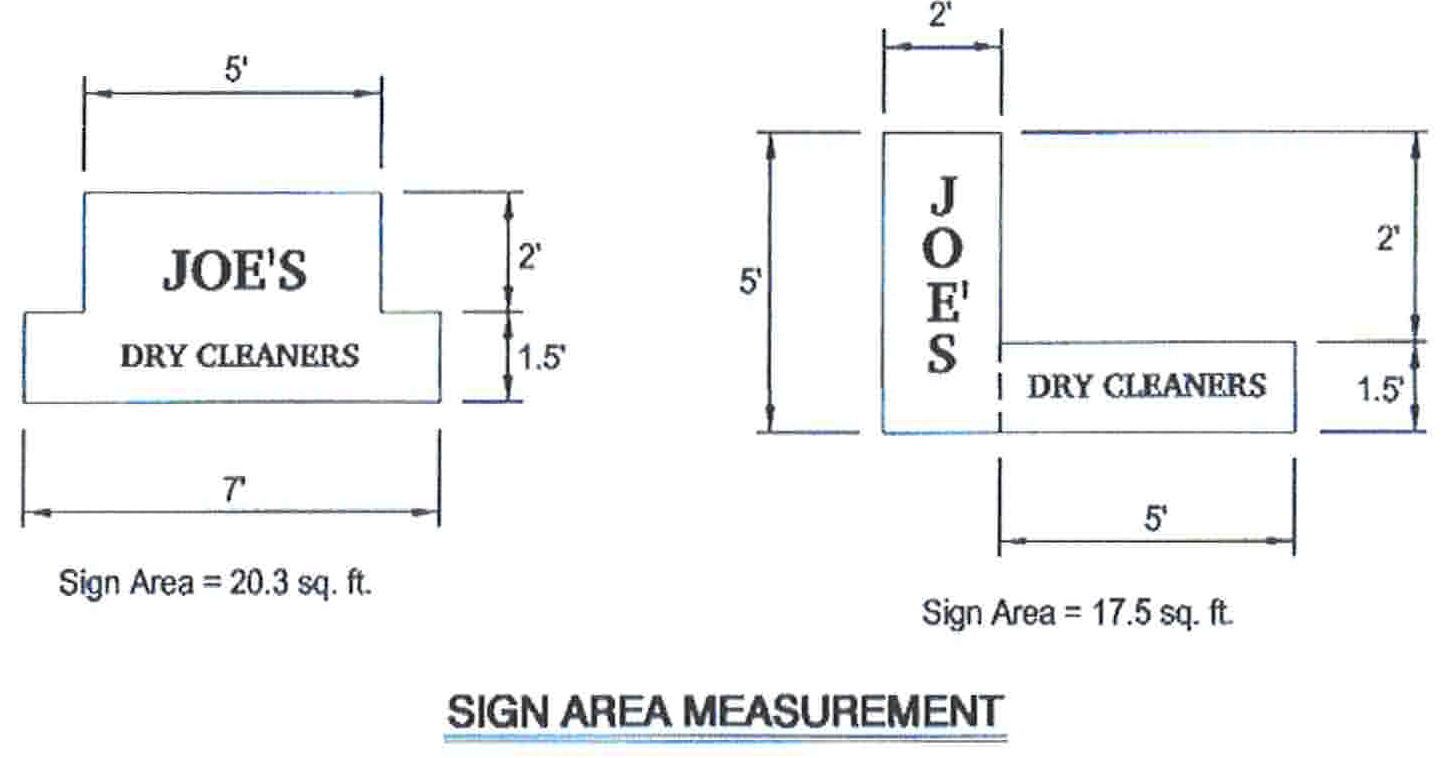
Figure 7-1
A.
Sign Surface Area. The area of a geometric shape enclosing any message, logo, symbol, name, photograph or display face shall be measured using standard mathematical formulas. Time and temperature devices shall not be included within the measurement of maximum sign area.
B.
Sign Support. Supporting framework or bracing that is clearly incidental to the display itself and does not include logos, advertising text or similar commercial messages shall not be computed as sign area.
C.
Back-to-Back (Double-Faced) Signs. Back-to-back signs shall be regarded as a single sign only if mounted on a single structure, and the distance between each sign face does not exceed two (2) feet at any point.
D.
Three-Dimensional Signs. Where a sign consists of one (1) or more three-dimensional objects (i.e., balls, cubes, clusters of objects, sculpture), the sign area shall be measured as their maximum projection upon a vertical plane. Signs with three-dimensional objects that exceed a projection of six (6) inches from the sign face may be approved in compliance with Section 7.18.120 (Creative Signs).
E.
Wall Signs. The area of a rectangle or geometric shape that most closely outlines the sign face or letters of the sign shall be the calculated sign area.
F.
Sign Height. The height of a sign shall be measured from the highest point of a sign, excluding decorative embellishment, to the grade of the adjacent street or the surface grade beneath the sign, whichever is lower in elevation. When berms are used in conjunction with signage, the height of the sign shall be measured from the mean elevation of the fronting street.
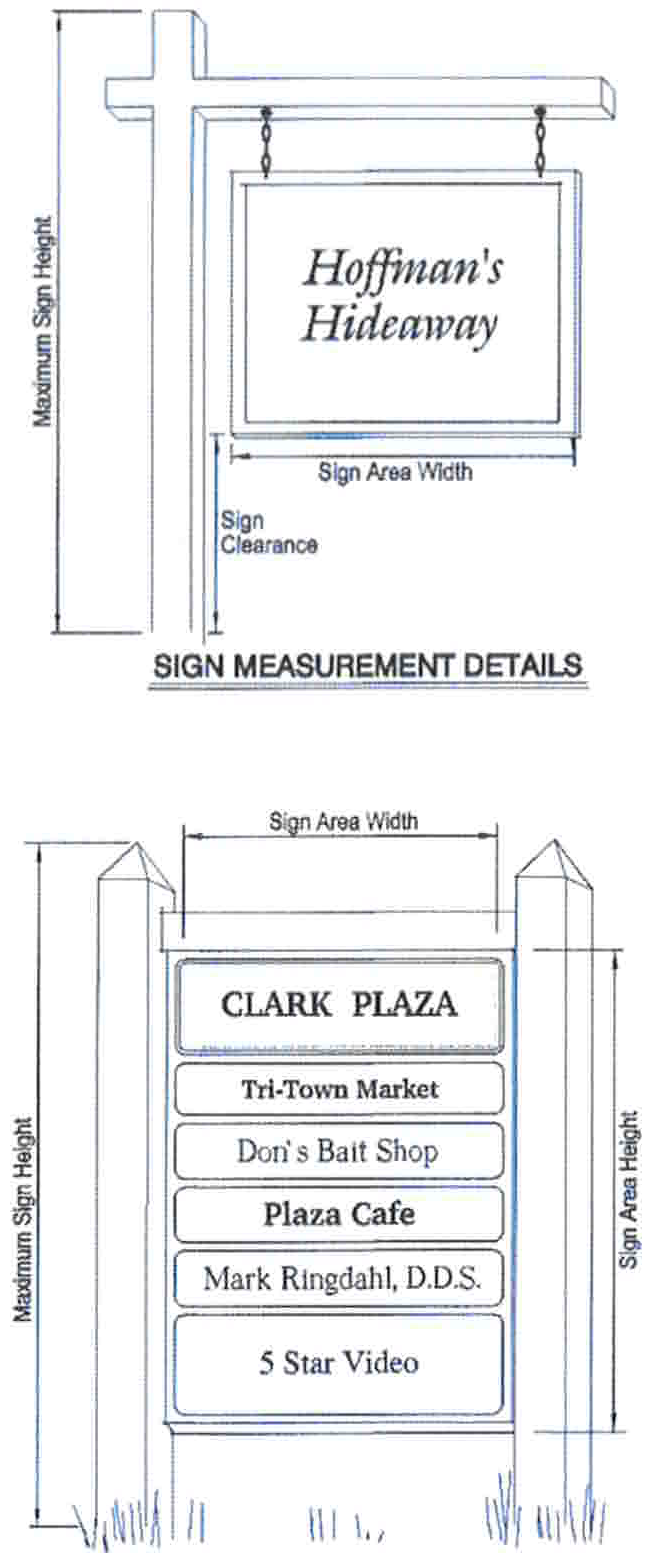
Figure 7-2
(Ord. No. 2011-4, § 2(D)(exh. A), 4-19-2011; Ord. No. TC 2023-6, § 2(Exh. A), 10-17-2023)
17.18.090 - Sign design.
A.
Design Compatibility.
1.
Creative Design Encouraged. Signs shall make a positive contribution to the general appearance of the street and commercial area in which they are located. A well-designed sign can be a major asset to a building. The Town of New Castle encourages imaginative and innovative sign design. The creative sign application procedure (Section 7.18.120) is specifically designed for artistic and unusual signs that might not fit the standard sign regulations and categories.
2.
Proportionate Size and Scale. The scale of signs shall be appropriate for the building on which they are placed and the area in which they are located. Building signs shall be compatible in scale and proportion to the building facade upon which they are mounted.
3.
Sign Location and Placement.
a.
Visibility. Signs shall not visually overpower nor obscure architectural features.
b.
Integration With the Building and Landscaping. Signs shall be carefully coordinated with the architectural design, overall color scheme and landscaping. Signs shall be designed to complement or enhance the other signs for a building.
c.
Unified Sign Band. Whenever possible, signs located on buildings with the same block-face shall be placed at the same height, in order to create a unified sign band. Wall signs for retail uses may only be located at the first floor level.
d.
Monument Signs. Monument signs should be located in a planter setting within a landscaped area at the primary entries to residential, commercial and industrial subdivisions to provide an overall project identity.
e.
Pedestrian-Oriented Signs. Pedestrian-oriented signs are encouraged. It is desirable to include a pedestrian-oriented sign as one (1) of the permitted signs for a business. These signs are designed for and directed toward pedestrians so they can easily and comfortably read the sign as they stand on a sidewalk or location adjacent to the business.
f.
Signs Near or Within the Public Right-of-Way. The provisions of Sections 17.18.050 and 17.18.060 notwithstanding, no sign shall be erected near the intersection of any road(s) or driveways in such a manner as to obstruct free and clear vision of motorists or pedestrians or at any location where, by reason of the position, shape or color, it may interfere with, obstruct the view of, or be confused with any authorized traffic sign, signal or device. Signs located at an intersection must be outside of the sight distance triangle.
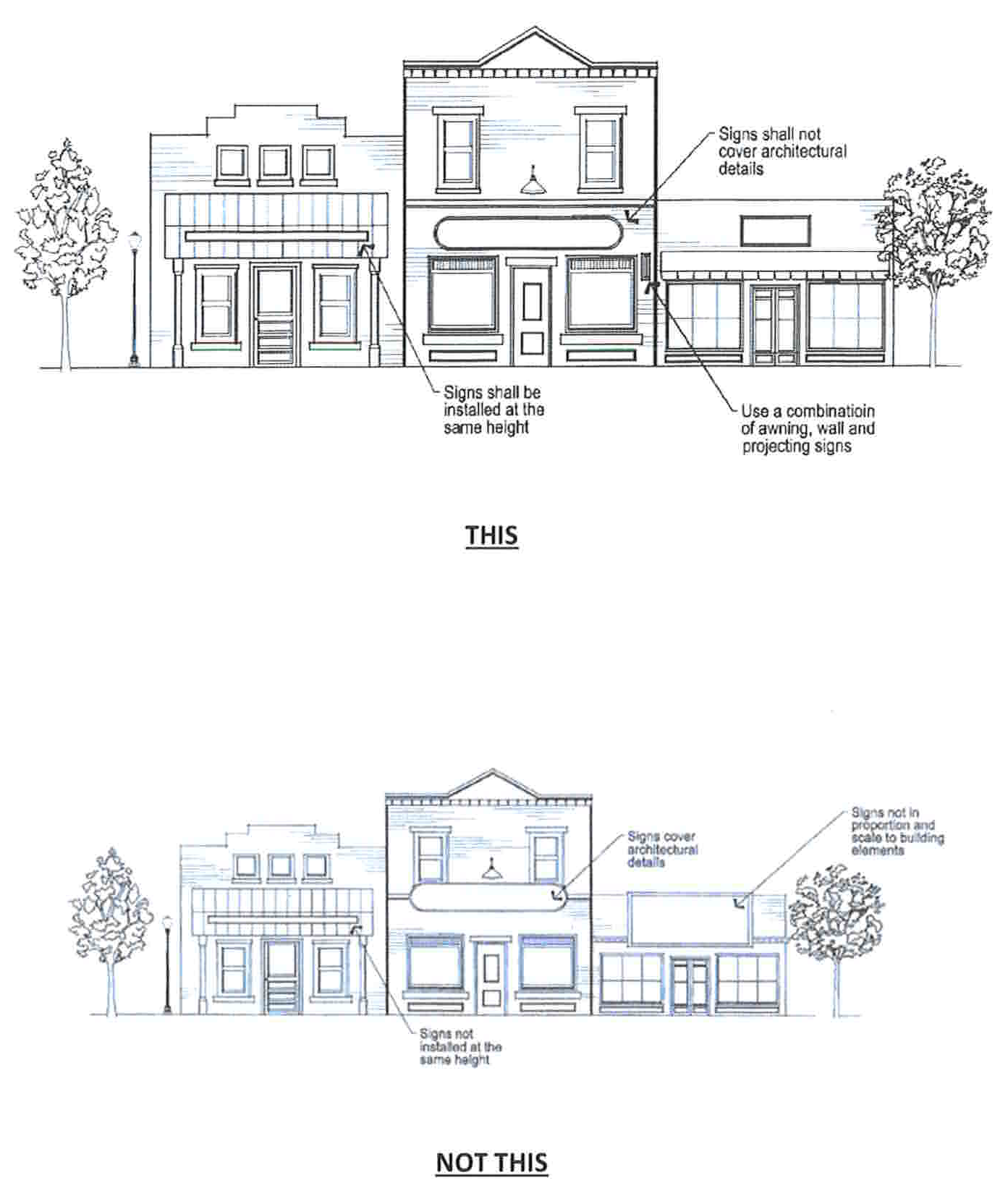
Figure 7-3
4.
Landscaping. Freestanding signs shall be landscaped at their base in a way harmonious with the landscape concept for the whole site. Landscaping shall form an attractive, dense cluster at the base of the sign that is equally attractive in winter and summer.
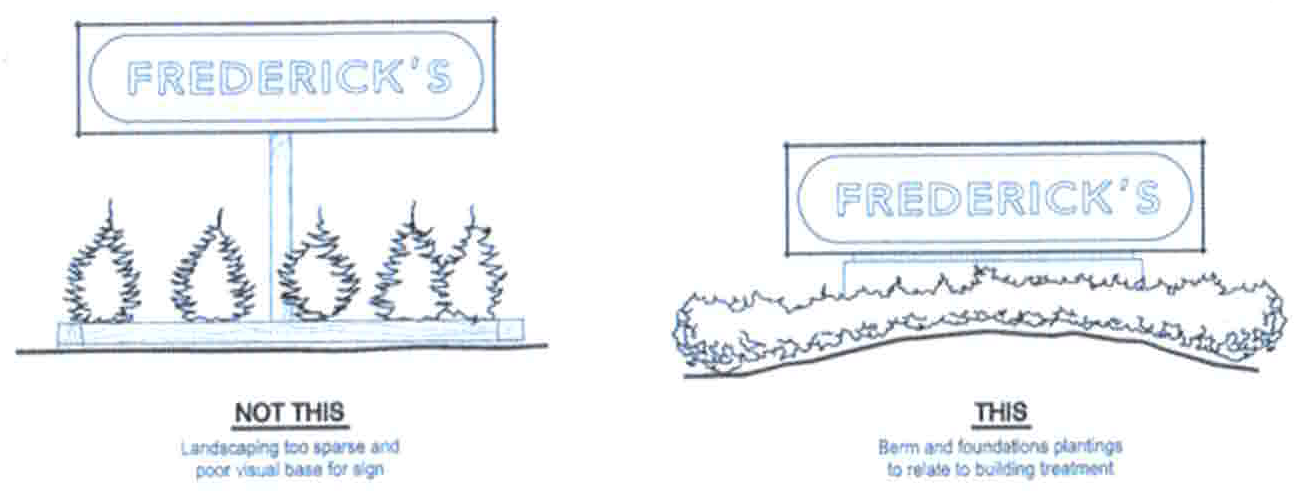
Figure 7-4
5.
Low Impact Signs. Signs adjacent residential neighborhoods shall be designed and located so that they have little or no impact on residential areas. Small-scale signs are encouraged.
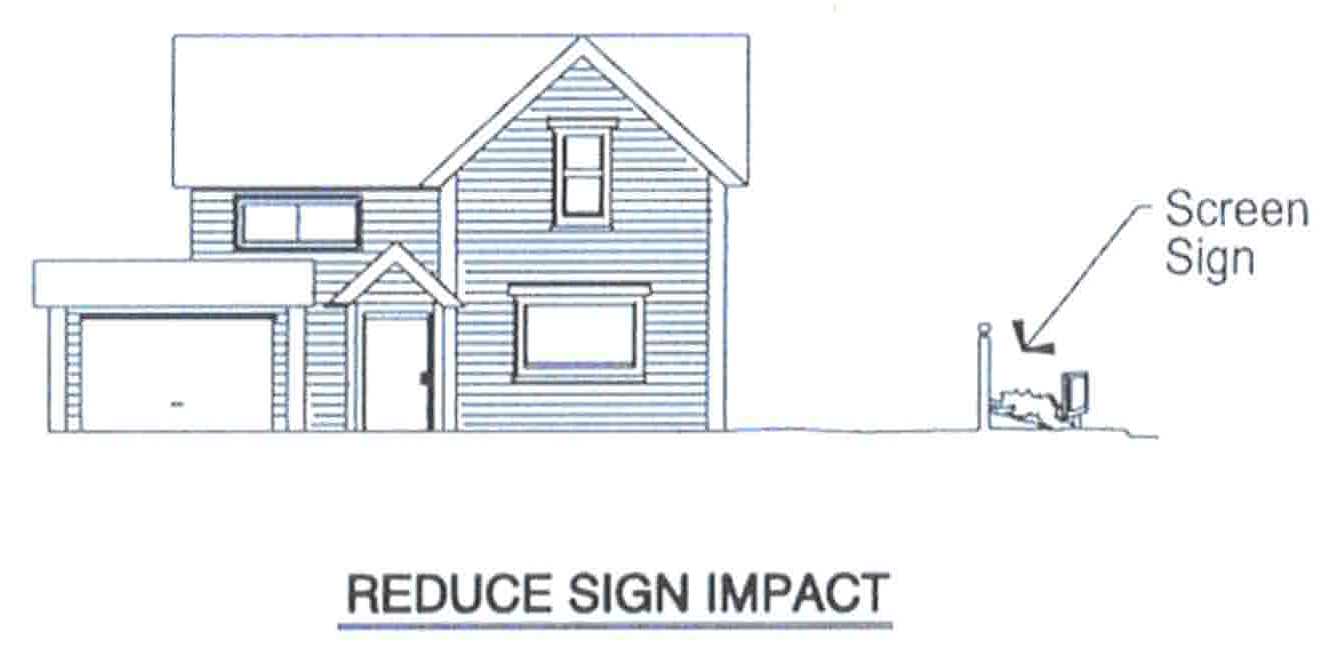
Figure 7-5
B.
Color.
1.
Color Selection. Colors shall be selected to contribute to legibility and design integrity. Sign colors shall complement the colors used on the structures and the project as a whole. Colors or combinations of colors that are harsh and disrupt the visual harmony and order of the street are unacceptable.
2.
Contrasting Colors. Substantial contrast between the color and the material of the background and the letters or symbols will make the sign easier to read during both the day and night. Light letters on a dark background or dark letters on a light background are most legible.
3.
Excessive Colors. Colors or color combinations that interfere with legibility of the sign copy or that interfere with viewer identification of other signs shall be avoided.
C.
Materials.
1.
Signs shall be constructed of durable, high quality architectural materials. The sign package must use materials, colors and designs that are compatible with the building facade. Sign materials must be of proven durability. Treated wood, manufactured composite products with ingredients that use recycled materials, painted/treated/patina metal, stone, brick and stucco are the preferred materials for signs.
D.
Legibility.
1.
Signs shall be adequately legible under the circumstances in which they are primarily seen. The legibility of signs is related to:
a.
The speed at which they are viewed;
b.
Distance from the edge of the right-of-way;
c.
The context and surroundings in which they are seen; and
d.
The design, colors and contrast of the sign copy and sign face.
e.
The design of the sign including copy, lettering size and style, and colors shall logically relate to the average speed of the traffic which will see it. Signs shall legibly convey their messages without being distracting or unsafe to motorists reading them. Symbols and logos can be used in place of words whenever appropriate.
E.
Sign Illumination.
1.
Unnecessary lighting is to be avoided.
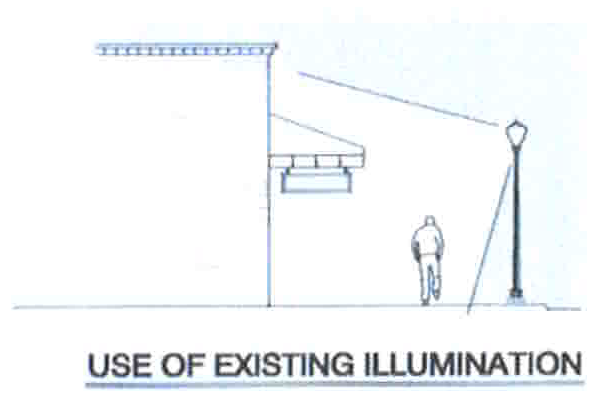
Figure 7-6
2.
Sign illumination shall complement, not overpower, the overall composition of the site.
3.
All lighted signs incorporating a direct light source shall be designed to direct lighting to illuminate only the face of the sign. External light sources aimed at a sign shall be concealed from pedestrians' and motorists' lines of sight.
4.
Signs must be illuminated in a way that does not cause lighting trespass, illumination of adjacent properties, over-lighting or glare onto the street and adjacent properties. Signs shall be lighted only to the minimum level for nighttime readability.
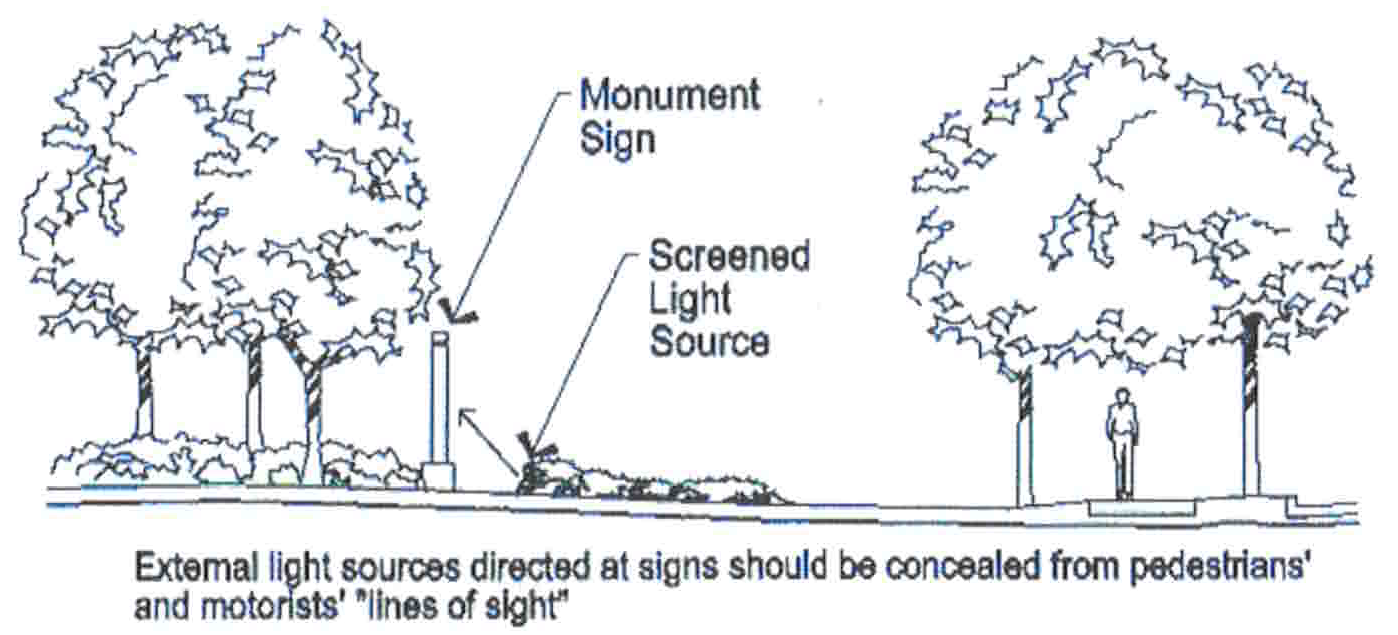
Figure 7-7
5.
All lighted signs shall meet all applicable electrical codes and the electrical components used shall bear the label of an approval agency. Additionally, electrical permits shall be obtained for electric signs.
6.
Flashing, moving, blinking, chasing or other animation effects shall be prohibited on all signs except time and temperature signs.
7.
Neon tubing is an acceptable method of sign illumination for window signs in commercial districts.
8.
The use of individually cut, back-lit letter signs is encouraged.
9.
The use of solar electric lighting devices to illuminate signs is encouraged.
(Ord. No. 2011-4, § 2(D)(exh. A), 4-19-2011; Ord. No. TC 2023-6, § 2(Exh. A), 10-17-2023)
17.18.100 - Sign installation and maintenance.
A.
Projecting signs shall be mounted so they generally align with others in the block.
B.
Owners of signs extending over public right-of-way shall be required to maintain public liability insurance in an amount to be determined appropriate by the town, in which the town is named as an "other or named insured."
C.
All signs and all components thereof, including sign structures and sign faces, shall be kept neatly painted, in a good state of repair and in compliance with all building and electrical codes so they do not constitute a hazard to safety, health or public welfare by reason of inadequate maintenance, dilapidation or obsolescence.
D.
The owner of a sign and the owner of the premises on which such sign is located shall be jointly and severally liable to maintain such sign, including any illumination sources in neat and orderly condition, and in a good working order at all times, and to prevent the development of any rust, corrosion, rotting or other deterioration in the physical appearance or safety of such sign. The sign must also be in compliance with all building and electrical codes.
E.
The owner of any sign regulated by this chapter shall be required to keep signs and supporting hardware structurally safe, clean, free of visible defects and functioning properly at all times. Repairs to signs shall be equal to or better in quality of materials and design than the original sign.
F.
The town may inspect any sign governed by this chapter and shall have the authority to order the painting, repair, alteration, or removal of a sign which constitutes a hazard to safety, health or public welfare by reason of inadequate maintenance, dilapidation or obsolescence.
(Ord. No. 2011-4, § 2(D)(exh. A), 4-19-2011; Ord. No. TC 2023-6, § 2(Exh. A), 10-17-2023)
17.18.110 - Standards for specific types of signs.
A.
Awning Signs. An awning sign is a wall sign which is painted, stitched, sewn or stained onto the exterior of an awning. An awning is a movable shelter supported entirely from the exterior wall of a building and composed of nonrigid materials except for the supporting framework.
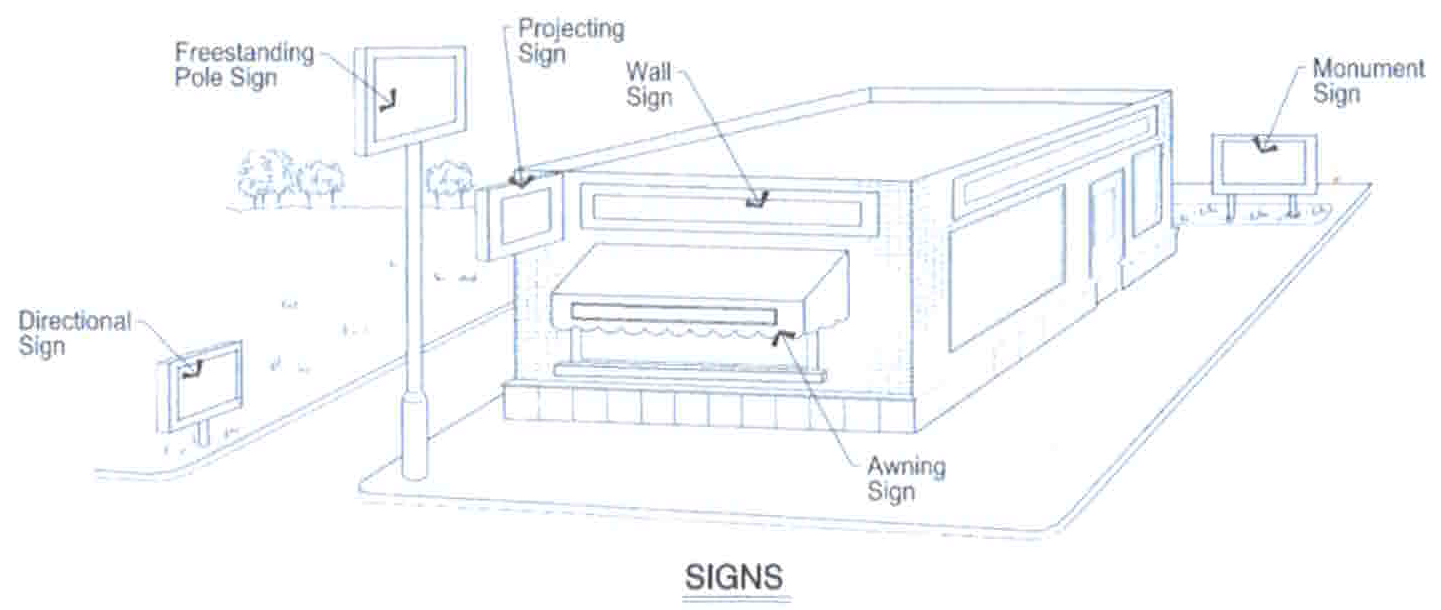
Figure 7-8
1.
Location. Signs may be placed only on awnings that are located on first- and second-story building frontages, including those fronting a parking lot or pedestrian way. No awning sign shall project beyond, above or below the face of an awning.
2.
Maximum Area and Height. Sign area shall comply with the requirements established by Section 17.18.130, sign matrices. No structural element of an awning shall be located less than eight (8) feet above finished grade. Awnings on which awning signs are mounted may extend over a public right-of-way no more than seven (7) feet from the face of a supporting building but in no case shall extend over a roadway or parking area. No awning, with or without signage, shall extend above the roof line of any building.
3.
Lighting. Awnings shall not be internally illuminated except as part of a creative sign. Lighting directed downwards that does not illuminate the awning is allowed.
4.
Required Maintenance. Awnings shall be regularly cleaned and kept free of dust and visible defects.
B.
Canopy Signs. A canopy sign is a wall sign that is permanently affixed to a roofed shelter attached to and supported by a building, by columns extending from the ground or by a combination of a building and columns.
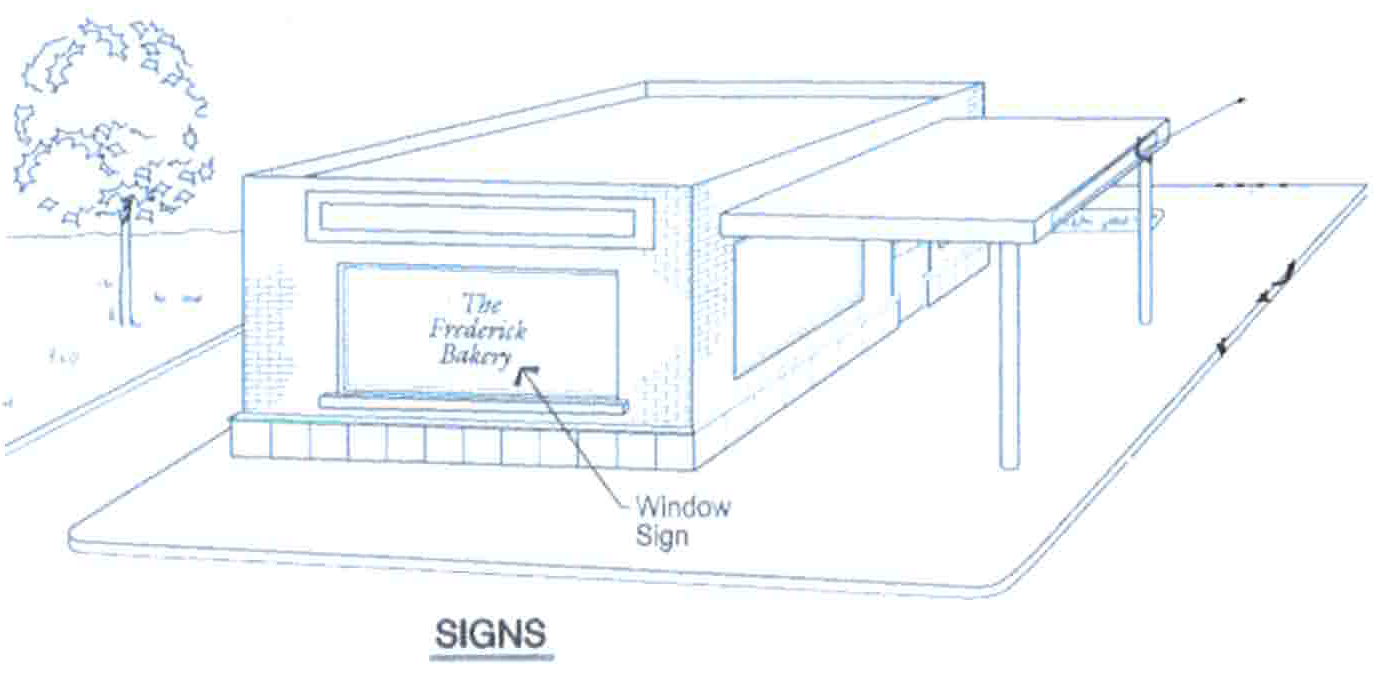
Figure 7-9
1.
Maximum Area and Height. Sign area shall comply with the requirements established by Section 17.18.130, sign matrices. No canopy, with or without signage, shall extend above the roof line of any building. No canopy sign shall project above the top of the canopy upon which it is mounted. However, such signs may project horizontally from the face of a canopy the distance necessary to accommodate the letter thickness and required electrical equipment, but not more than twelve (12) inches (measured from the bottom of the sign). Under-canopy signs which are perpendicular to the face of the building shall be deemed to be projecting wall signs. Under-canopy signs which are parallel to the face of the building shall be a minimum of eight (8) feet above grade and shall be deemed to be flush wall signs.
2.
Required Maintenance. Canopies shall be regularly cleaned and kept free of dust and visible defects.
C.
Freestanding Signs. A freestanding sign is a sign which is supported by one (1) or more columns, uprights, poles or braces extended from the ground, or which is erected on the ground and shall also include a monument sign and pole signs but does not include a sign attached to a structure.
1.
Location. The sign may be located only on a site frontage adjoining a public street. No freestanding sign in any zoning/sign district can be erected closer than eight (8) feet from any curbline, nor closer than four (4) feet to any building. No freestanding signs in business and industrial districts may be located less than twenty-five (25) feet from any property line adjacent to a residential zoning district line.
2.
Maximum Area and Height. The sign shall comply with the height and area requirements established in Section 17.18.130, sign matrices.
3.
Sign Mounting. The sign shall be mounted on one (1) or more posts or have a solid monument-type base. Posts shall not have a diameter greater than twelve (12) inches. Pole bases shall be protected by concrete or a similar sturdy structure to prevent damage. Pole base structures may be used as landscaping planters.
4.
Pole Signs. Pole signs should not be so large as to obscure the patterns of front facades and yards.
D.
Monument Signs. A monument sign is a permanent sign where the entire bottom of the sign is affixed to the ground, not to a building.
1.
Location. The sign may be located only along a site frontage adjoining a public street.
2.
Maximum Area and Height. The sign shall comply with the height and area requirements established in Section 17.18.130, sign matrices.
3.
Design. The design of a monument sign shall be consistent with the overall scale of the building. The design and placement of the sign shall not obstruct traffic safety sight distance areas. Project monument signs shall contain only the name and address of the project which it identifies.
4.
Landscaping Requirements. Landscaping shall be provided at the base of the supporting structure equal to twice the area of one (1) face of the sign. For example, twenty (20) square feet of sign area equals forty (40) square feet of landscaped area. The planning commission may reduce or waive this requirement if it is determined that the additional landscaping would not contribute significantly to the overall aesthetic character of the project.
E.
Projecting Signs. A projecting sign is any sign supported by a building wall and projecting therefrom at least twelve (12) inches or more horizontally beyond the surface of the building to which the sign is attached, but shall not extend more than four (4) feet from the building face.
1.
Location. Projecting signs shall be placed only on a ground floor facade, except for businesses located above the ground level with direct exterior pedestrian access. Projecting signs shall generally align with other projecting signs in the block to create a "canopy line" that gives scale to the sidewalk.
2.
Maximum Area and Height. Projecting signs shall not be higher than the wall from which the sign projects if attached to a single story building, or the height of the bottom of any second story window if attached to a multi-story building. Projecting signs must have eight (8) feet clearance and may not extend more than four (4) feet from the building wall except where the sign is an integral part of an approved canopy or awning. The size of projecting signs is limited to three (3) feet wide and six (6) square feet.
3.
Sign Structure. Sign supports and brackets shall be compatible with the design and scale of the sign.
4.
Quantity. The number of projecting signs is limited to one (1) per business.
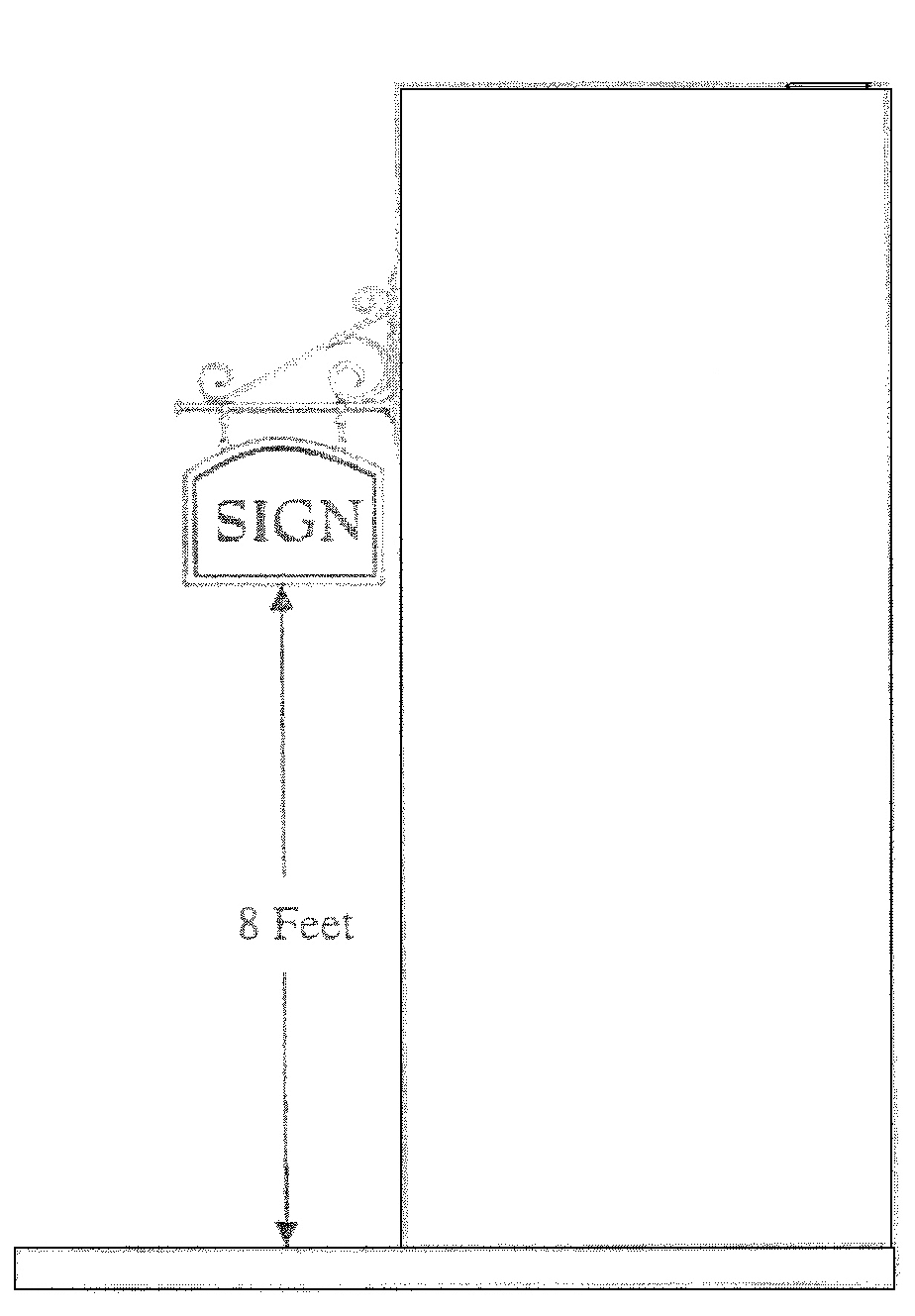
Figure 7-10
F.
Standard Brand-Name Signs. A standard brand-name sign is any sign devoted to the advertising of any standard brand-name commodity or service which is not the principal commodity or service being sold or rendered on the premises, or are not a part of the name or business concern involved.
1.
Maximum Area. Not more than twenty (20) percent of the total allowable sign area for any permitted use shall be devoted to the advertising of any standard brand-name commodity or service.
G.
Wall Signs. A wall sign is any sign painted on, incorporated in or affixed to the building wall, or any sign consisting of cut-out letters or devices affixed to the building wall with no background defined on the building wall.
1.
Location. The sign shall not be placed to obstruct any portion of a window, doorway or other architectural detail. Locate wall signs on buildings at the first floor level only for retail uses. No part of a wall sign shall be located more than twenty-five (25) feet above grade level nor shall it extend above the building eave.
2.
Maximum Area and Height. Wall signs shall not be higher than the eave line of the principal building. The sign shall comply with the height and area requirements established in Section 17.18.130, sign matrices.
3.
Projection from Wall. No sign part, including cut-out letters may project from the surface upon which it is attached more than required for construction purposes and in no case more than twelve (12) inches.
4.
Design. Wall signs shall identify the individual business, building or building complex by name or trademark only.
H.
Window Signs. A window sign is a sign that is painted on, applied or attached to a window or that can be read through the window from the public right-of-way and may be placed at or below the second story above grade.
1.
Maximum Area. When a sign is displayed in a window and is visible beyond the boundaries of the lot upon which the sign is displayed, the total area of such sign shall not exceed twenty-five (25) percent of the window or door area at the ground floor level; and twenty-five (25) percent of the total allowable sign area for the premises.
2.
Lighting. All illuminated window signs shall be included in the total allowable sign area for the premises.
3.
Temporary Window Signs. Temporary signs or posters displayed for periods not exceeding fourteen (14) days shall be exempt from limitations for window signs.
(Ord. No. 2011-4, § 2(D)(exh. A), 4-19-2011; Ord. No. TC 2023-6, § 2(Exh. A), 10-17-2023)
17.18.120 - Creative signs.
A.
Purpose. This section establishes standards and procedures for the design, review and approval of creative signs. The purposes of this creative sign program are to:
1.
Encourage signs of unique design, and that exhibit a high degree of thoughtfulness, imagination, inventiveness, and spirit; and
2.
Provide a process for the application of sign regulations in ways that will allow creatively designed signs that make a positive visual contribution to the overall image of the Town of New Castle, while mitigating the impacts of large or unusually designed signs.
B.
Applicability. An applicant may request approval of a sign permit under the creative sign program to authorize on-site signs that employ standards that differ from the other provisions of this chapter but comply with the provisions of this section.
C.
Approval Authority. A sign permit application for a creative sign shall be subject to approval by the planning commission.
D.
Application Requirements. A sign permit application for a creative sign shall include all information and materials required by the Town of New Castle, and the filing fee based on the same fee schedule as a building permit.
E.
Design Criteria. In approving an application for a creative sign, the planning commission shall ensure that a proposed sign meets the following design criteria:
1.
Design Quality. The sign shall:
a.
Constitute a substantial aesthetic improvement to the site and shall have a positive visual impact on the surrounding area;
b.
Be of unique design, and exhibit a high degree of thoughtfulness, imagination, inventiveness, and spirit;
c.
Provide strong graphic character through the imaginative use of graphics, color, texture, quality materials, scale, and proportion.
2.
Style Criteria. The sign shall contain at least one (1) of the following elements:
a.
Classic historic design style;
b.
Creative image reflecting current or historic character of the Town of New Castle;
c.
Creative symbols or imagery compatible with the classic historic design style; or
d.
Inventive representation of the use, name or logo of the structure or business.
3.
Architectural Criteria. The sign shall:
a.
Utilize and/or enhance the architectural elements of the building;
b.
Be placed in a logical location in relation to the overall composition of the building's facade;
c.
Not cover any key architectural features/details of the facade.
(Ord. No. 2011-4, § 2(D)(exh. A), 4-19-2011; Ord. No. TC 2023-6, § 2(Exh. A), 10-17-2023)
17.18.130 - Sign matrices.
The following section of these regulations corresponds to the following sign districts identified on the sign district map.
1.
Residential district;
2.
Gateway district;
3.
Downtown and mixed-use district; and
4.
Industrial district.
This section includes a series of sign matrices that address permitted, exempt or prohibited signs, sign area, sign illumination and sign height. These tables are intended to assist the user in understanding the type, size, illumination and height of various signs in each sign district. This information is intended to be used in conjunction with the sign district map and other sections of these regulations.
(Ord. No. 2011-4, § 2(D)(exh. A), 4-19-2011; Ord. No. TC 2023-6, § 2(Exh. A), 10-17-2023)
17.18.131 - Sign standards matrix—Permitted, exempt or prohibited.
(a) Portable signs shall be permitted within the residential zone provided all the following conditions are met:
- The portable sign shall be an on-premises sign.
- The portable sign shall be stored inside the establishment after hours of operation.
- The portable sign shall not cause visual interference with motor vehicle traffic, pedestrian traffic, or traffic control devices.
(Ord. No. 2011-4, § 2(D)(exh. A), 4-19-2011; Ord. No. TC 2023-6, § 2(Exh. A), 10-17-2023)
17.18.132 - Sign area matrix.
(a) Allowed in place of a wall sign and one (1) per individual building tenant.
(b) Downward and direct illumination only; when placed on subdivision entry features, only the sign face shall be used to calculate the sign area.
(c) Minimum horizontal distance between signs on the same property is seventy-five (75) feet.
(d) In place of project monument sign; not allowed on local or collector streets. Minimum horizontal distance between signs on the same property is seventy-five (75) feet.
(e) [Reserved.]
(f) One (1) per individual tenant building frontage. The sum of all wall signs on a given wall shall not exceed five (5) percent of the wall area, but shall not exceed one hundred fifty (150) square feet; cannot be more than twenty-five (25) feet above grade level or higher than the eave line of the principal building; first floor level only for retail uses.
(g) One (1) per street frontage, all signs may be no higher than the eave line of the principal building; may be lighted (shielded light source) and include name and address of facility only. Childcare center and bed and breakfast only.
(h) Cannot exceed twenty-five (25) percent of the total allowable sign area for the premises.
(i) Illuminated window signs shall be included in the total allowable sign area for the premises.
(j) Temporary signs or posters displayed for periods not exceeding fourteen (14) days announcing or advertising events sponsored by noncommercial organizations shall be exempt from limitations for window signs.
(Ord. No. 2011-4, § 2(D)(exh. A), 4-19-2011; Ord. No. TC 2023-6, § 2(Exh. A), 10-17-2023)
17.18.133 - Sign illumination matrix.
(a) Downward aimed direct light source only; may not be illuminated between ten p.m. and seven a.m. if within five hundred (500) feet of existing residential uses.
(b) Illuminated window signs shall be included in the total allowable sign area for the premises.
(Ord. No. 2011-4, § 2(D)(exh. A), 4-19-2011; Ord. No. TC 2023-6, § 2(Exh. A), 10-17-2023)
17.18.134 - Sign height matrix.
(a) May be no higher than the eave line of the principal building.
(b) Minimum height above sidewalk or grade eight (8) feet. Shall not be higher than the eave from which the sign projects if attached to a single story building or fifteen (15) feet above grade, whichever is less, or the height of the bottom of any second story window if attached to a multi-story building.
(c) Cannot be twenty-five (25) feet above grade level or higher than the eave line of the principal building; first floor level only for retail uses.
(d) Window signs visible beyond the boundaries of the lot upon which the sign is displayed shall not exceed twenty-five (25) percent of the window or door area at the ground floor level; and twenty-five (25) percent of the total allowable sign area for the premises.
(Ord. No. 2011-4, § 2(D)(exh. A), 4-19-2011; Ord. No. TC 2023-6, § 2(Exh. A), 10-17-2023)
17.18.140 - Sign district map.
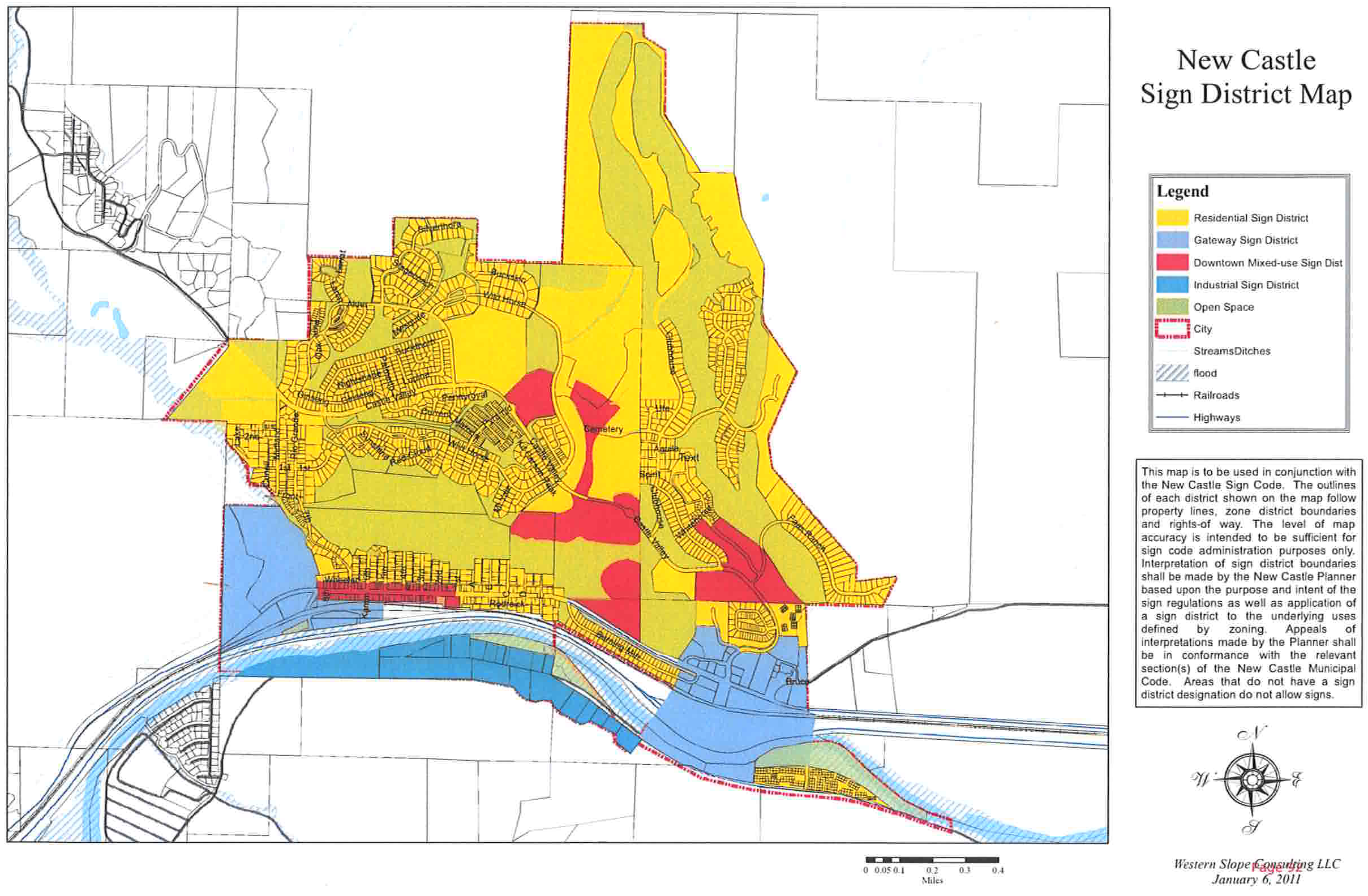
(Ord. No. TC 2023-6, § 2(Exh. A), 10-17-2023)

