
Salem City Zoning Code
CHAPTER 255
STREET NAMING, ADDRESSING AND VACATION OF PUBLIC PROPERTY
Sec. 255.005.- Naming of new public and private streets in land divisions, planned unit developments, manufactured dwelling parks, and site plan approvals.
(a)
Applicability. All new public and private streets created as part of a land division, planned unit development, manufactured dwelling park, or site plan approval shall be named using the standards set forth in SRC 255.015.
(b)
Coordination with county government. The naming of new public and private streets within land divisions, planned unit developments, manufactured dwelling parks, or site plan approvals shall be coordinated with the appropriate county.
(c)
Procedure.
(1)
The naming of new public and private streets within land divisions, planned unit developments, manufactured dwelling parks, and site plan approvals shall be conducted as part of the land division, planned unit development, manufactured dwelling park, or site plan approval, and shall follow the procedures set forth in this section.
(2)
Prior to submission of the final plat or final PUD plan, or at the time of submission of application for manufactured dwelling park or site plan approval, the applicant shall submit a list of proposed street names. Upon receiving the list of street names, the list shall be reviewed to determine if they comply with the street naming criteria under SRC 255.015. If they meet the criteria, the applicant shall be informed of their approval. If proposed names do not meet the criteria, the applicant shall submit alternative names.
(d)
Names to be used on final plat, final PUD plan, or in development. The names approved by the Director pursuant to this section shall be used as the names of the streets on the final subdivision plat, the final planned unit development plan, or in the manufactured dwelling park or development subject to the site plan approval.
(Prior Code, § 255.005; Ord. No. 12-12; Ord. No. 31-13)
Sec. 255.010. - Naming of unnamed public and private streets and new connections between existing public and private streets; renaming existing public and private streets.
(a)
Applicability. The naming of an unnamed public or private street or a new connection between existing public or private streets, or the renaming of an existing public or private street, shall be made in accordance with this section.
(1)
Classes.
(A)
A Class 1 street naming is a proceeding initiated by a petitioner to rename an existing public or private street.
(B)
A Class 2 street naming is a proceeding initiated by the City to:
(i)
Name an unnamed public or private street, or a new connection between existing public or private streets; or
(ii)
Rename an existing public or private street.
(2)
Discretionary act by the Council. The name given to an unnamed public or private street or a new connection between existing public or private streets, or the renaming of an existing public or private street, is a legislative act, subject to the discretion of the Council.
(b)
Coordination with county government. The naming of an unnamed public or private street or a new connection between existing public or private streets, or the renaming of an existing public or private street, shall be coordinated with the appropriate county.
(c)
Procedure. In-lieu of the procedures set forth in SRC chapter 300, the naming of an unnamed public or private street or a new connection between existing public or private streets, or the renaming of an existing public or private street, shall follow the procedures set forth in this subsection.
(1)
Initiation.
(A)
A Class 1 street naming is initiated by application of a person owning real property abutting the street to be renamed.
(B)
A Class 2 street naming is initiated by resolution of the Council.
(2)
Submittal requirements.
(A)
An application for a Class 1 street naming shall include the following:
(i)
Name of street proposed to be changed;
(ii)
Reason for request;
(iii)
No fewer than two suggested new names that meet the street naming criteria set forth in SRC 255.015;
(iv)
A map containing the location of the street, including the beginning and ending address numbers, and the names of all cross streets;
(v)
List of the names, addresses and zip code of each owner and each resident of all property abutting the street;
(vi)
A petition containing signatures of at least 51 percent of the residents and property owners abutting the street, stating that they agree that the street should be renamed, and consent to the suggested new names; and
(vii)
Payment of the application fee.
(B)
A resolution initiating a Class 2 street naming shall include the following:
(i)
Name of street proposed to be changed;
(ii)
A proposed new name that meets the street naming criteria set forth in SRC 255.015; and
(iii)
A map containing the location of the street, including the beginning and ending address numbers, and the names of all cross streets.
(3)
Referral to Planning Commission. A proposal to name an unnamed public or private street or a new connection between existing public or private streets, or rename an existing public or private street, shall be referred to the Planning Commission for its recommendation.
(4)
Council hearing. After receiving the recommendation of the Planning Commission, the Council shall hold a public hearing on the proposal.
(5)
Notice. Notice of the hearing shall be published once in a newspaper of general circulation in the City no later than one week prior to date the hearing is to be held. Notice shall also be given by mail to all property owners and residents abutting the street.
(6)
Criteria. The naming of an unnamed public or private street or a new connection between existing public or private streets, or the renaming of an existing public or private street, shall be granted if all of the following criteria are met:
(A)
The proposed name complies with the street naming standards set forth in SRC 255.015.
(B)
Renaming the street with the proposed name is in the best interest of the City.
(7)
Decision. After the hearing, the Council may enact an ordinance accepting the Planning Commission's recommendation, and naming the unnamed public or private street or the connection between existing public or private streets, or renaming the public or private street, or adopt a resolution rejecting the recommendation.
(8)
Post-decision notice. A certified copy of the ordinance naming the unnamed public or private street or the connection between existing public or private streets, or renaming the public or private street, shall be filed with the county clerk, the county assessor, the county surveyor, and the postmaster, and mailed to all property owners and residents along the street.
(Prior Code, § 255.010; Ord. No. 12-12; Ord. No. 31-13)
Sec. 255.015. - Street naming standards.
(a)
Names, generally.
(1)
A street name shall not duplicate a street name already in use, including any name for a street within Marion and Polk Counties, unless it is reasonably likely that the two streets will be connected at some future time.
(2)
The street name shall not sound like another street name such that the new name could cause confusion between the two streets.
(3)
The street name shall not be a name that is deliberately misspelled, a pun, a frivolous association with another word, a neologism, or slang.
(4)
A new street shall not be given a street name that is a number, unless it is reasonably likely the street will be connected at some future time with another street that has been given a street name that is the same number.
(b)
Cul-de-sacs.
(1)
A street that is not a through-street shall retain its name along the entire length of the street.
(2)
A cul-de-sac that contains five or fewer lots abutting the cul-de-sac shall be considered an extension of the intersecting street and shall not be given a new street name. For purposes of this subsection, a flag lot taking access from the cul-de-sac shall be considered a lot abutting the cul-de-sac.
(3)
A cul-de-sac that does not have a street on the opposing side shall be designated "court." A court may be given the name of the intersecting street along with the designation "court."
(c)
Local or collector streets.
(1)
Local and collector streets running north-south shall be designated "street."
(2)
Local and collector streets running east-west shall be designated "avenue."
(3)
Local or collector streets that are skewed or meandering shall be designated "drive."
(4)
Local or collector streets less than 1,000 feet in length shall be designated "place," "way," or "lane."
(d)
Arterial streets.
(1)
An arterial that includes a linear park alongside the arterial shall be designated "parkway."
(2)
An arterial that includes landscaping dividing opposing lanes of traffic shall be designated "boulevard."
(3)
An arterial that is skewed or meandering shall be designated "road."
(e)
Circle and loop streets.
(1)
A street that intersects one street at two locations shall be designated "loop."
(2)
Loop streets may have only one interior cross street, which has a different name than the loop.
(3)
A street that starts and ends at one entrance/exit shall be designated "circle."
(4)
Loop streets and circle streets shall have no streets intersecting the exterior of the loop or circle.
(f)
Private streets.
(1)
Private streets shall be designated "private way."
(2)
If a private street with the designation of "private way" becomes a public street, the designation shall be removed, and if the street name does not include an appropriate street designation, the designation shall be changed to the appropriate designation for a public street as set forth in this section.
(g)
Indication of addressing district. All street names shall include an identification of the addressing district within which the street, or segment thereof, is located. The addressing district shall follow the street name, and shall be designated by the abbreviation N, NE, NW, SE, or S, as the case may be.
(Prior Code, § 255.015; Ord. No. 12-12)
Sec. 255.020. - Applicability.
(a)
Each building and structure and each premises in the City shall have an address that complies with SRC 255.045, assigned to it by the City.
(b)
The owner or occupant of a building or structure, other than an accessory building or structure, shall place the address number assigned by the City on the building in the location set forth in SRC 255.050.
(Prior Code, § 255.020; Ord. No. 12-12)
Sec. 255.025. - Coordination with the county governments.
Assigning address numbers at or near the City's corporate limits shall be coordinated with the appropriate county.
(Prior Code, § 255.025; Ord. No. 12-12)
Sec. 255.030. - Address map.
The Director shall maintain a map that clearly indicates the current address numbers assigned pursuant to SRC 255.045.
(Prior Code, § 255.030; Ord. No. 12-12)
Sec. 255.035. - Non-conforming numbers.
Sec. 255.040. - Division of the City into addressing districts; baseline.
(a)
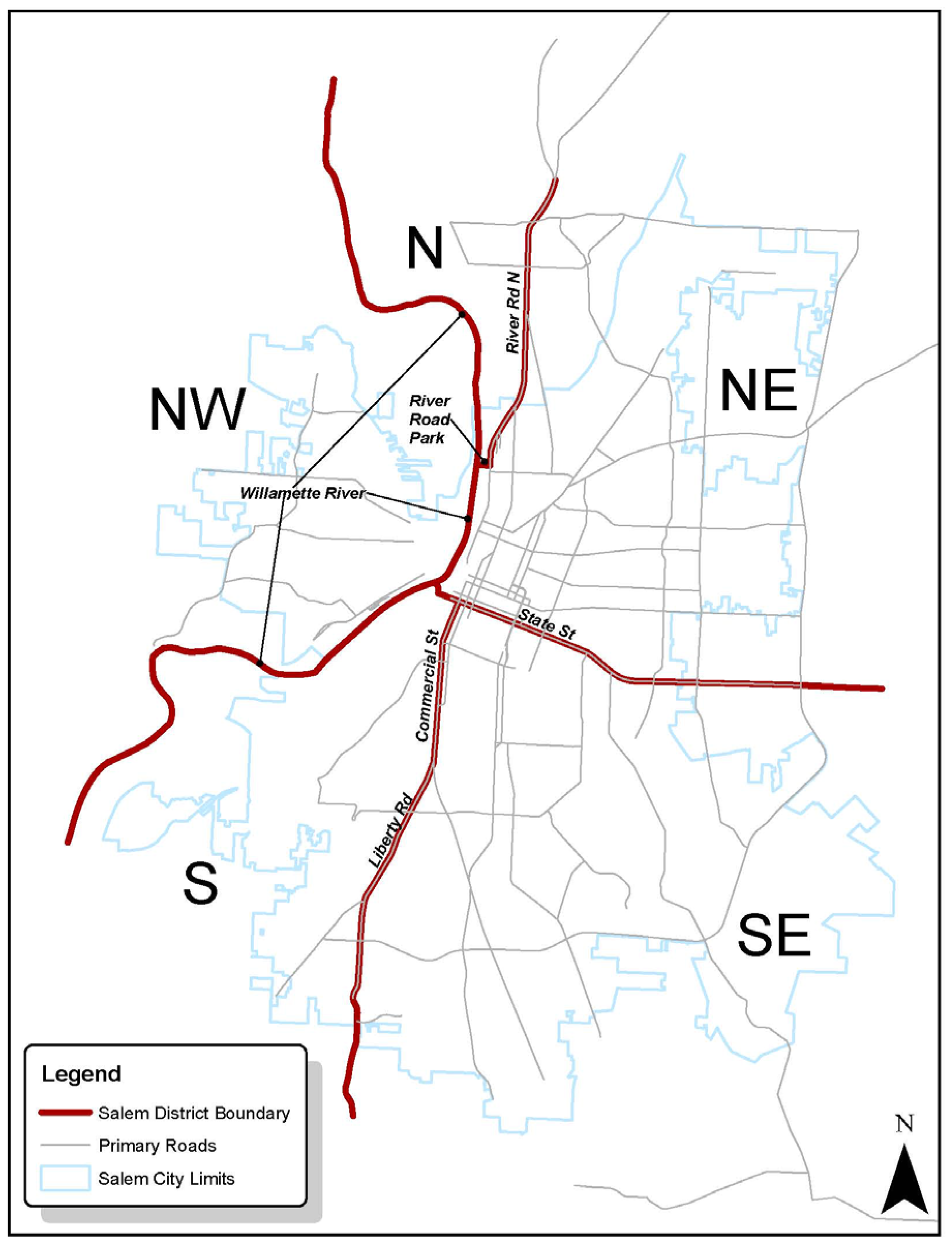
Addressing districts. As illustrated in Figure 255-1, the City is divided into the following addressing districts for the purpose of assigning addresses:
(1)
South District (S): All that portion of the City south of Mission Street, west of Commercial Street and Liberty Road, and south and east of the Willamette River, also including Minto-Brown Island.
(2)
Southeast District (SE): All of the City south of State Street and east of the Willamette River, but not including the South District.
(3)
Northeast District (NE): that part of the City lying north of State Street and east of the Willamette River, but not including the area in the North District.
(4)
North District (N): That part of the City lying east of the Willamette River, west of the North River Road, and north of the southern boundary of River Road Park.
(5)
Northwest District (NW): All that portion of the City in Polk County.
(b)
Baselines. As illustrated in Figure 255-1, the baselines for assigning southerly, easterly, northerly, and westerly addresses shall be as follows:
(1)
The division line between the Northeast District and the Southeast District and the division line between the Northwest District and the South District shall establish the baseline for starting points northerly and southerly.
(2)
The division line between the South District and Southeast District and the division line between Northwest District and Northeast District and the line between North District and the Northwest District shall establish the baseline for starting points easterly and westerly.
(Prior Code, § 255.040; Ord. No. 12-12)
Sec. 255.045. - Address number standards.
(a)
Sequence of one hundred numbers. The segment of a street lying between two blocks shall have addresses assigned from a sequence of one hundred numbers. Both sides of the street shall have addresses assigned from the same one hundred number sequence.
(b)
Assignment of odd and even numbers. Address numbers shall be assigned sequentially along each block face. Odd numbers shall be assigned to the north and west sides of the street and even numbers shall be assigned to the south and east sides of the street. Odd and even numbers shall be assigned continuously along the entire length of a street, regardless of changes in direction.
(c)
Short, irregular, winding, circle, and loop streets and cul-de-sacs. The number sequence for short streets, irregular streets, winding streets, circle streets, loop streets, and cul-de-sacs shall correspond as closely as possible to the numbering required by this section.
(d)
Buildings with more than one principal entrance. Where a building or structure has more than one principal entrance for use by different occupants, each entrance may be assigned a different address number.
(e)
Address numbers for buildings or structures not fronting on street. Any building or structure that does not front on a named street, and is serviced by an unnamed street or accessway, shall be numbered sequentially as if the unnamed street or accessway was an extension of the named street.
(f)
Addresses for accessory buildings and structures. Address numbers shall be assigned to all accessory buildings and structures other than those accessory buildings and structures associated with a residential use.
(Prior Code, § 255.045; Ord. No. 12-12)
Sec. 255.050. - Size and placement of address numbers.
(a)
Addresses shall be in Arabic numbers, shall not be less than three inches high, shall be of a contrasting color from the background, and shall be placed so that the numbers are readily visible from the adjoining street.
(b)
Address numbers shall be placed in a conspicuous place as provided in this subsection:
(1)
Where a building or structure is located 35 feet or less from a street, the address numbers shall be placed in a conspicuous place on the main entrance.
(2)
If the main entrance is not readily visible from the street, address numbers shall be located at the intersection of the street and the driveway providing access to the building or structure. If there is no driveway, the address number shall be placed within ten feet of the property line, at a point that provides pedestrian access to the building or structure.
(3)
Where a building or structure is located more than 35 feet from the street, the address numbers shall be located at the intersection of the street and the driveway providing access to the building or structure. If there is no driveway, the address number shall be placed within ten feet of the property line, at a point that provides pedestrian access to the building or structure.
(4)
Where a building or structure is located on a flag lot, the address numbers shall be located at the intersection of the street and the flag lot accessway providing access to the building or structure.
(Prior Code, § 255.050; Ord. No. 12-12; Ord. No. 31-13)
Sec. 255.055. - Painting address numbers on curbs.
(a)
The owner or occupant of any building, structure, or premises may place the address number on the curb in front of the building, structure, or premises, provided the address number meets the following standards:
(1)
The address number shall be stenciled in black paint upon a rectangular box, approximately six inches by 24 inches, painted on the curb with white or yellow paint;
(2)
The address number shall be four inches high, and shall be centered in the box and evenly spaced; and
(3)
The rectangular box shall be placed as close as possible to the driveway, on the same side of the driveway as the main building. If there is no driveway, the rectangular box shall be painted directly in front of the front door.
(b)
Where an address number is placed on the curb by a person other than the owner or occupant, the person shall inform the owner or occupant, in writing, that placement of the address number is strictly voluntary and not required by the City or any other governmental agency.
(Prior Code, § 255.055; Ord. No. 12-12)
Sec. 255.060. - Change of address number.
Any owner of real property may request a change in the address numbers by submitting a change of address number form and paying the application fee. The Director may not assign a new address number if the address number does not comply with SRC 255.045.
(Prior Code, § 255.060; Ord. No. 12-12)
FIGURE 255-1. ADDRESSING DISTRICTS
Sec. 255.065. - Vacation of public property.
(a)
Applicability. All requests to vacate right-of-way or to vacate the dedication of any other public place, or any part thereof, shall be made in accordance with this section.
(1)
Classes.
(A)
A Class 1 vacation is a proceeding initiated by a petitioner to vacate right-of-way, or any part thereof.
(B)
A Class 2 vacation is a proceeding initiated by the City to:
(i)
Vacate right-of-way, or any part thereof; or
(ii)
Vacate the dedication of any other public place, or any part thereof.
(b)
Procedure. In lieu of the procedures set forth in SRC chapter 300, proceedings to vacate a street, alley, or dedication of any other public place shall follow the procedures set forth in ORS 271.080—271.230 and this section.
(1)
Initiation.
(A)
A Class 1 vacation is initiated by petition of a person owning real property abutting the right-of-way, or any part thereof, to be vacated.
(B)
A Class 2 vacation is initiated by resolution of the Council.
(2)
Submittal requirements.
(A)
A petition for a Class 1 vacation shall be made on forms provided by the Director, contain everything required by ORS 271.080, and be accompanied by the following:
(i)
A title report verifying ownership of the property abutting the area proposed to be vacated;
(ii)
A map showing the area proposed to be vacated and the area encompassing the affected area, with tax lots labeled;
(iii)
A list of all properties and owners, by tax lot, within the affected area;
(iv)
An application form; and
(v)
The application fee, as set by resolution of the Council.
(B)
A resolution initiating a Class 2 vacation shall include the legal description of the proposed area to be vacated.
(3)
Filing of petition; verification of consents. A petitioner shall file a petition for a Class 1 vacation with the Director. The Director shall determine whether the petition contains the required information and consents. The Director shall notify all potentially affected public utilities. If the petition contains all the required information and consents, the Director shall forward the petition to the Council, along with any responses from public utilities and recommendation as to whether there appears to be any reason why the petition should be denied, in whole or in part. If the recommendation is to deny the petition, in whole or in part, or if the Council, on its own motion, determines that the petition should be denied, in whole or in part, the petitioner shall be given notice of the date the Council will take final action on the denial. If the Council determines that there appears no reason why the petition should be not granted, in whole or in part, the Council shall set a public hearing on the petition.
(4)
Application fee. The application fee for a Class 1 vacation shall be used to pay the expenses incurred by the City in the vacation process, including, but not limited to, the costs of publishing and posting notices, and preparing and recording certified copies of the ordinance and map. If the actual expenses exceed the amount of the application fee, the petitioner shall pay, upon request from the Director, the amount the Director estimates will be needed to cover the additional expenses. The vacation proceeding shall be stayed until the additional amount is deposited with the City. If the actual expenses are less than the total amount deposited with the City, the remainder shall be refunded to the petitioner.
(5)
Notice and hearing. Notice for Class 1 and Class 2 vacations shall comply with ORS 271.110 and ORS 271.130. The hearing shall be conducted following the procedures set forth in SRC 300.900 through 300.990.
(6)
Criteria. A Class 1 or Class 2 vacation shall be approved only if the vacation meets the following criteria:
(A)
The area proposed to be vacated is not presently, or will not in the future be, needed for public services, facilities, or utilities;
(B)
The vacation does not prevent the extension of, or the retention of public services, facilities, or utilities;
(C)
Public services, facilities, or utilities can be extended in an orderly and efficient manner in an alternate location;
(D)
The vacation does not impede the future best use, development of, or access to abutting property;
(E)
The vacation does not conflict with provisions of the UDC including the street connectivity standards and block lengths;
(F)
All required consents have been obtained;
(G)
Notices required by ORS 271.080—271.130 have been duly given; and
(H)
The public interest would not be prejudiced by the vacation.
(7)
Decision; conditions and reservations; assessment of special benefit.
(A)
Form of decision. After the hearing, the Council may enact an ordinance granting the vacation, in whole or in part, or adopt a resolution rejecting the proposed vacation.
(B)
Conditions and reservations. The Council may impose such conditions or make such reservations as it deems to be in the public interest, including, but not limited to, reservation of easements for municipal and public utilities in the area vacated.
(C)
Assessment of special benefit. The Council may provide for the payment to the City of such sum of money in a Class 1 vacation as its finds to be just and equitable as an assessment of special benefit upon the real property abutting upon the vacated area, and for the cost of curbs, drainage, paving, sewer, or other local improvement already completed or to be constructed upon the area vacated. Notice of proposed assessment of special benefits shall be given to the owners of the property to be assessed at least three days before the public hearing on the vacation. Notice shall be given to such property owners by mail at the property owners' last known address. If an assessment of special benefit is made, the Council shall include such assessment in the vacation ordinance and a direction to the Finance Officer to enter such assessment in the City lien docket. The assessment, together with all costs, shall not exceed the amount of special benefit inuring to the abutting property by reason of such vacation. The owner may make application to pay the assessment of special benefit in installments, in the same manner as provided in the Bancroft Bonding Act and allowed for systems development charges by the City.
(c)
Recordation of vacation ordinance; notice; effective date. The City Recorder shall:
(1)
Record and file a copy of the vacation ordinance as required by ORS 271.150; provided, however, that the vacation ordinance shall not be recorded until:
(A)
All fees and the assessment of special benefit have been paid, or an application to pay the assessment of special benefit in installments has been approved;
(B)
All required legal documents have been signed, filed, and, if required, recorded; and
(C)
The petitioners have complied with all conditions attached to the vacation.
(2)
Mail a certified copy of the vacation ordinance to each public utility that provided responses to the Director.
(3)
No vacation shall be effective until the vacation ordinance is filed by the City Recorder with the county clerk, assessor, and county surveyor.
(d)
Delegation of authority to City Manager. The City Manager is hereby delegated the authority to sign the consents required by ORS 271.080(2) where the City is the owner of the property abutting the area proposed to be vacated or the property within the affected area.
(Prior Code, § 255.065; Ord. No. 12-12; Ord. No. 31-13)

