Salem City Zoning Code
CHAPTER 111
DEFINITIONS
Sec. 111.001.- Definitions, generally.
Unless the context otherwise specifically requires, terms used in the UDC shall have the meanings set forth in this chapter; provided, however:
(a)
Where chapter specific definitions are included in another chapter of the UDC, those definitions are the controlling definitions; and
(b)
Where a term is not defined within the UDC, the term shall have its ordinary accepted meaning within the context in which it is used. Webster's Third New Int'l Dictionary (unabridged ed. 2002) shall be the standard reference to ordinary accepted meanings.
Abutting means touching along a boundary or point.
Accessory building or structure means a building or structure that is incidental and subordinate to, and dependent upon, the principal use on the same premises.
Accessory dwelling unit means a second dwelling unit that is attached to or detached from a single-family detached dwelling, manufactured home, townhouse, or zero side yard dwelling on the same lot. The accessory dwelling unit is accessory to and is smaller than the primary dwelling unit.
Accessory short-term rental means a type of short-term rental which is operated as an accessory use to a household living use where a resident family rents guest rooms within their dwelling unit, or a guest house if applicable, when they are present as hosts, or rents their entire dwelling unit, including a guest house if applicable, during periods of time when they are away, to overnight guests on a daily or weekly basis for periods of less than 30 consecutive days.
Adjacent means near or close, but not necessarily contiguous with.
Adjoin means to abut.
Adult day care center means day care for adults in a nonresidential structure.
Adult day care home means day care for five or fewer adults provided in the home of the adult day care provider.
Affordable housing means housing that is affordable to households with incomes equal or less than 80 percent of the median family income in the county for which the development is built or for the state, whichever is greater, and in a manner so that no more than 30 percent of the household's gross income will be spent on rent, home loan or mortgage payments, and utilities.
Alley means a public or private way other than a street or flag lot accessway that provides primary or secondary vehicle access to an abutting property where the majority of the width of the alley within a block meets the right-of-way width requirement set forth under SRC Chapter 803, Table 803-1.
Ambulance service facility means a building used for the administrative offices of an ambulance service, the housing of emergency medical personnel, and the ordinary maintenance and repair of emergency vehicles and equipment.
Ambulance station means a building, or a specific portion of a building or development, that is utilized for the housing of on-call emergency medical ambulance personnel.
Apartment means a building that contains three or more dwelling units and which is designed, built, rented, leased, let or hired out to be occupied, or which is occupied as the home or residence of three or more families living independently of each other and doing their own cooking in the said building; or a building in condominium ownership containing three or more dwelling units.
Application for affordable multiple family housing means, for purposes of SRC 300.810, an application for affordable housing which is affordable to households with incomes equal to or less than 60 percent of the median family income for the county in which the development is built or for the state, whichever is greater, and that is:
(a)
A permit or zone change submitted under ORS 227.175;
(b)
For development of a multifamily residential building containing five or more residential units where at least 50 percent of the residential units included in the development will be sold or rented as affordable housing; and
(c)
Subject to a covenant, as required under ORS 197.311, that restricts the owner, and each successive owner, of the development or a residential unit within the development from selling or renting any of the identified affordable residential units as housing that is not affordable housing for a period of 60 years from the date of the certificate of occupancy.
Arcade means a continuous covered arched passageway located parallel to a building, street, or open space, and open and accessible to the public.
Arterial street means a major arterial street or minor arterial street.
Bicycle parking area means an area of a development site used for the parking of bicycles. A bicycle parking area includes the bicycle parking space, or spaces, and the access aisle providing access to, and maneuvering area for, the bicycle parking spaces.
Buildable width means the distance along the street right-of-way, exclusive of side setbacks, wetlands, and riparian corridors, that is sufficiently deep to accommodate a lot depth of 70 feet and meet setback requirements. Where a development fronts on a street which is curved, the buildable width shall be measured radial to the curve.
Building means any structure used or intended for supporting or sheltering any use or occupancy.
Building articulation means design emphasis given to walls, roofs, windows, balconies, entries, and other architectural features to divide buildings into smaller identifiable pieces, reduce the appearance of building bulk and mass, provide visual interest, and introduce elements of scale.
Building frontage means the portion of a lot occupied by buildings placed at the front setback line. The front setback line is the line extending across the front of the lot at the front setback distance. For corner lots, building frontage also means the portion of a lot occupied by buildings placed at the setback line applicable to the intersecting street.
Building official means the Administrator of the Building and Safety Division of the Department of Community Development of the City, or the Building Official's designee.
Building offset means a change in vertical planes along the exterior facade of a building used to divide the building into smaller identifiable pieces and reduce the appearance of building bulk and mass. An offset that does not continue the entire length of the building, and therefore, configured as a "bump out," counts as one building offset. Decks or covers over entryways do not count as building offsets.
Building offset interval means the space between building offsets.
Canopy tree means a deciduous shade tree planted primarily for its high crown of foliage.
Carport means a permanent structure used for the parking or storage of vehicles which is unenclosed on two or more sides.
Central Salem Development Program (CSDP) Area means that area of the City within the following boundaries:
Beginning at the SE corner of 12th Street SE and Mission Street SE in Section 27 Township 7 South Range 3 West in Marion County, Oregon; Thence Northerly along the East line of 12th Street SE to its intersection with the East Right-of-Way line of the Southern Pacific Railroad; Thence continuing Northerly along said East line of Railroad to the North side of "D" Street NE; Thence Westerly along the North side of "D" Street NE to the West Side of Fifth Street NE; Thence Northerly along the West side of Fifth Street NE to the North side of Market Street NE; Thence Easterly along the North side of Market Street NE to an Alley running between Fifth Street NE and Church Street NE; Thence Northerly along Said Alley to the North side of Gaines Street NE; Thence Easterly along the North side of Gaines Street to the West side of Church Street NE; Thence Northerly along the West Side of Church Street to the North line of an Alley running between Hood Street NE and Shipping Street NE; Thence Westerly along the North side of Said Alley to the East bank of the Willamette River; Thence Southerly along the East Bank of the Willamette River and Willamette Slough to the Westerly projection of the South line of Mission Street SE; Thence running Easterly along the South side of Mission Street SE to the Place of Beginning (see Figure 111-3).
Child means a child as defined by ORS 329A.250.
Child day care center means a child care facility as defined in ORS 329A.250, other than a child day care home, that is certified under ORS 329A.280.
Child day care home means a child care facility, as defined in ORS 329A.250, that is registered under ORS 329A.330 or certified under ORS 329A.280 and provides child care in a dwelling unit to not more than 16 children.
Circular driveway means a curved one-way driveway serving a single family, two family, three family, or four family use that has two points of access to a street where one of the points of access is an entrance and the other point of access is an exit.
City infrastructure means public infrastructure providing vehicular and pedestrian transportation, City utilities, and parks.
City utilities means public improvements providing water, wastewater, and stormwater facilities.
Collector street means a street that allows traffic within an area or neighborhood to connect to an arterial street, and designated as such in the Salem Transportation System Plan. Collector streets shall have priority over local streets in the installation of any traffic control devices. Single family and duplex access onto collector streets may be limited according to Public Works Design Standards.
Columnar tree means a tree species that is tall and cylindrical or tapering.
Common open space means open area intended for shared use and enjoyment in a development. Common open space includes landscaping, walkways, play areas, swimming pools, roof gardens, or other open areas which provide active or passive recreational or visual amenities for residents. Common open space does not include parking areas, streets, or other areas designed for motor vehicle circulation or storage.
Complex means a group of buildings, structures, or other development that is functionally or conceptually integrated, regardless of the ownership of the development or underlying land, and regardless of whether located on one or more lots or parcels.
Contiguous means touching along a boundary or point. Unless otherwise provide under the UDC, any properties that are separated by public right-of-way shall not be considered contiguous.
Core network means those bus service corridors within the Salem/Keizer Urban Area that represent the highest priority for service as adopted in Resolution No. 2017-10 by the Salem Area Mass Transit District Board of Directors on July 27, 2017.
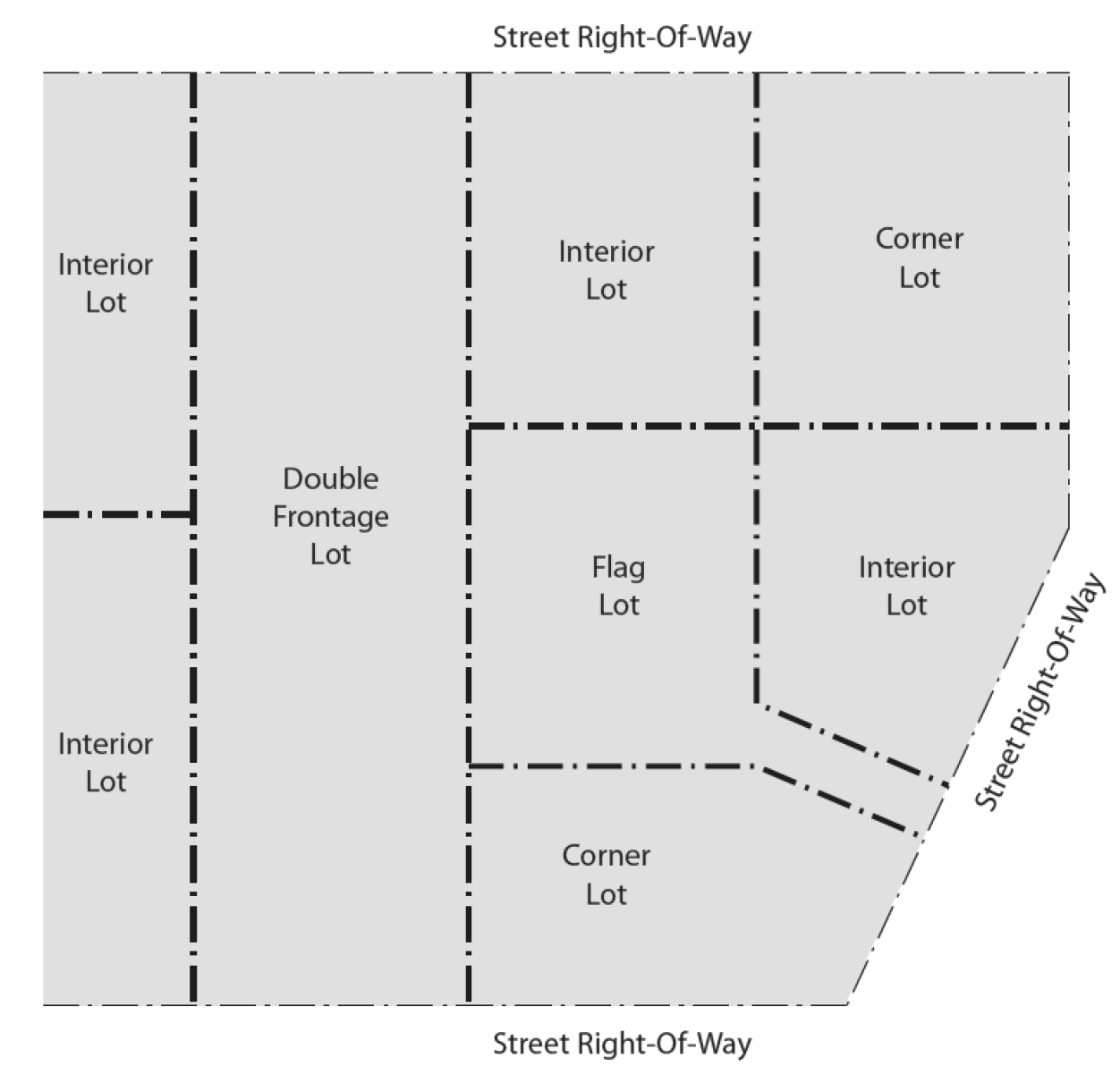
Corner lot means a lot abutting two or more intersecting streets, where the interior angle formed by the intersection of the streets does not exceed 135 degrees; or a lot having two or more adjacent front lot lines in which the interior angle formed by the extensions of the front lot lines in the direction which they take at their intersections with the side lot lines forms an angle of 135 degrees or less. In the event a street front lot line is a curve at its point of intersection with a side lot line, the tangent to the curve at that point shall be considered the direction of the front lot line (see Figure 111-1).
FIGURE 111-1. LOT TYPES
Cottage cluster means a group of five to 12 detached dwelling units, each with a maximum building footprint of 900 square feet, that are located on an individual lot and include a common courtyard.
Cottage housing means a development consisting of at least two or more attached and/or detached dwelling units on one lot as a legal nonconforming use as of May 15, 1979.
Crime prevention through environmental design means specific measures taken to enhance the safety of residents and minimize the potential for crime through the physical design of a development.
Cul-de-sac means a dead end street having a turnaround area at the dead end.
Curbline means the line indicating the edge of the vehicular roadway within the overall right-of-way.
Dbh means the diameter of a tree measured in inches at a height of 4.5 feet above grade. When a fork in the trunk occurs at or above 4.5 feet, the dbh is the smallest diameter at 4.5 feet or below. When the fork occurs below 4.5 feet, or the tree splits into multiple stems at ground level, each stem is considered a separate tree trunk and is measured accordingly. The term "dbh" is also known as "diameter at breast height."
Dead-end street means a street which terminates without a turnaround area and is intended to continue through at some future time.
Development means to construct or alter a structure, to make alterations or improvements to the land or to make a change in use or appearance of land, to divide or reconfigure land, or to create, alter, or terminate a right of access. The term "development" does not include:
(a)
Maintenance and repair, usual and necessary for the continuance of an existing use;
(b)
Reasonable emergency procedures necessary for the safety or operation of property; or
(c)
Interior or exterior remodeling that does not increase the square footage or height of a structure, or substantially alter the appearance of a structure.
Development site means an individual lot or multiple contiguous lots accommodating a single development or a complex.
Double frontage lot means a lot that has frontage on two streets that do not intersect at the lot's boundaries (see Figure 111-1).
Downhill lot means a hillside lot which slopes downhill from the front lot line.
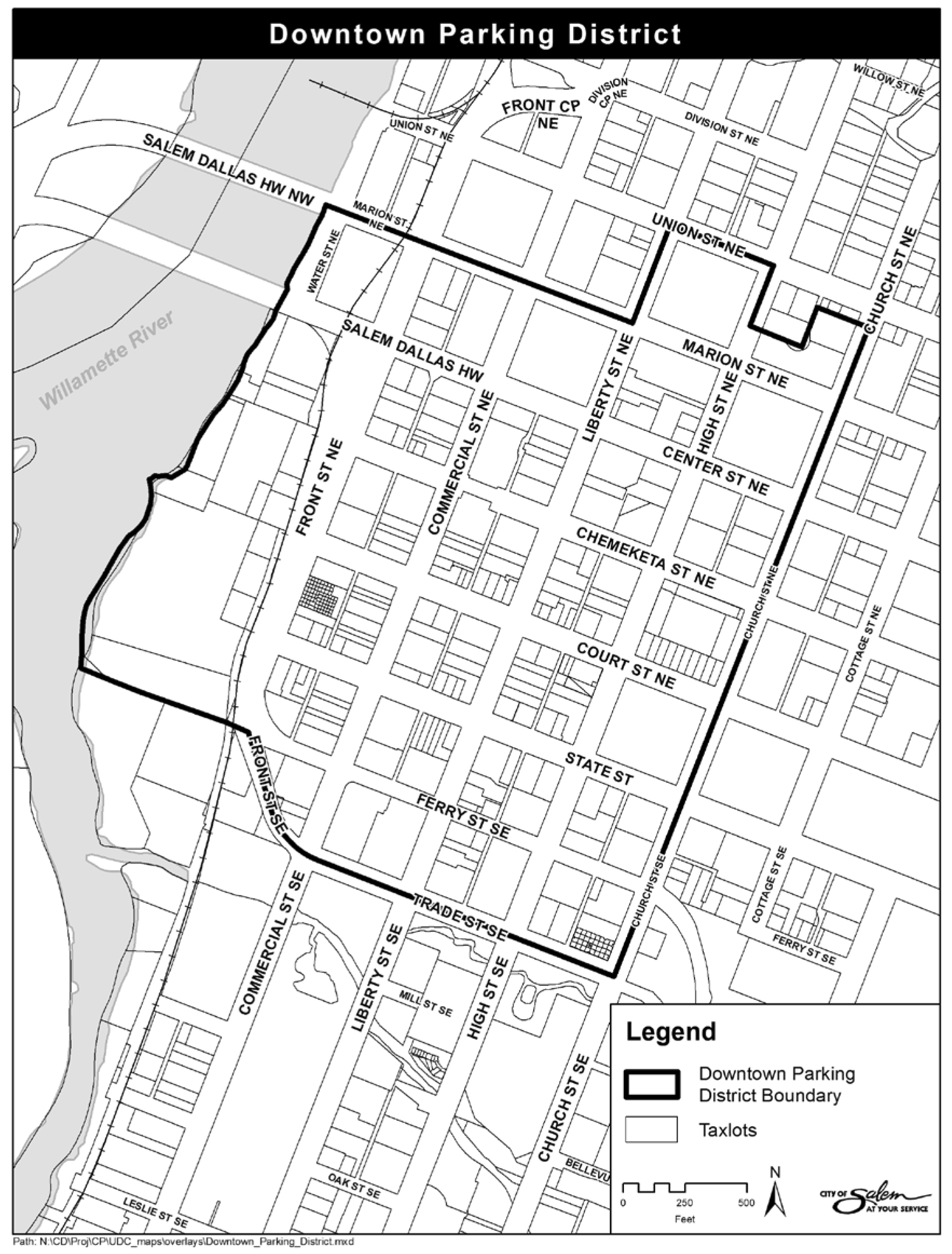
Downtown parking district means that certain district, established under SRC chapter 7, which provides for the financing and administration of programs for economic promotion and public parking for motor vehicles in the Central Business District of the City (see Figure 111-4).
Drive-through means a facility where goods or services are provided to a patron of a business while in their motor vehicle, and typically including queuing lanes leading to drive-up service windows or service areas. A drive-through does not include motor vehicle services, as set forth in SRC 400.055(b).
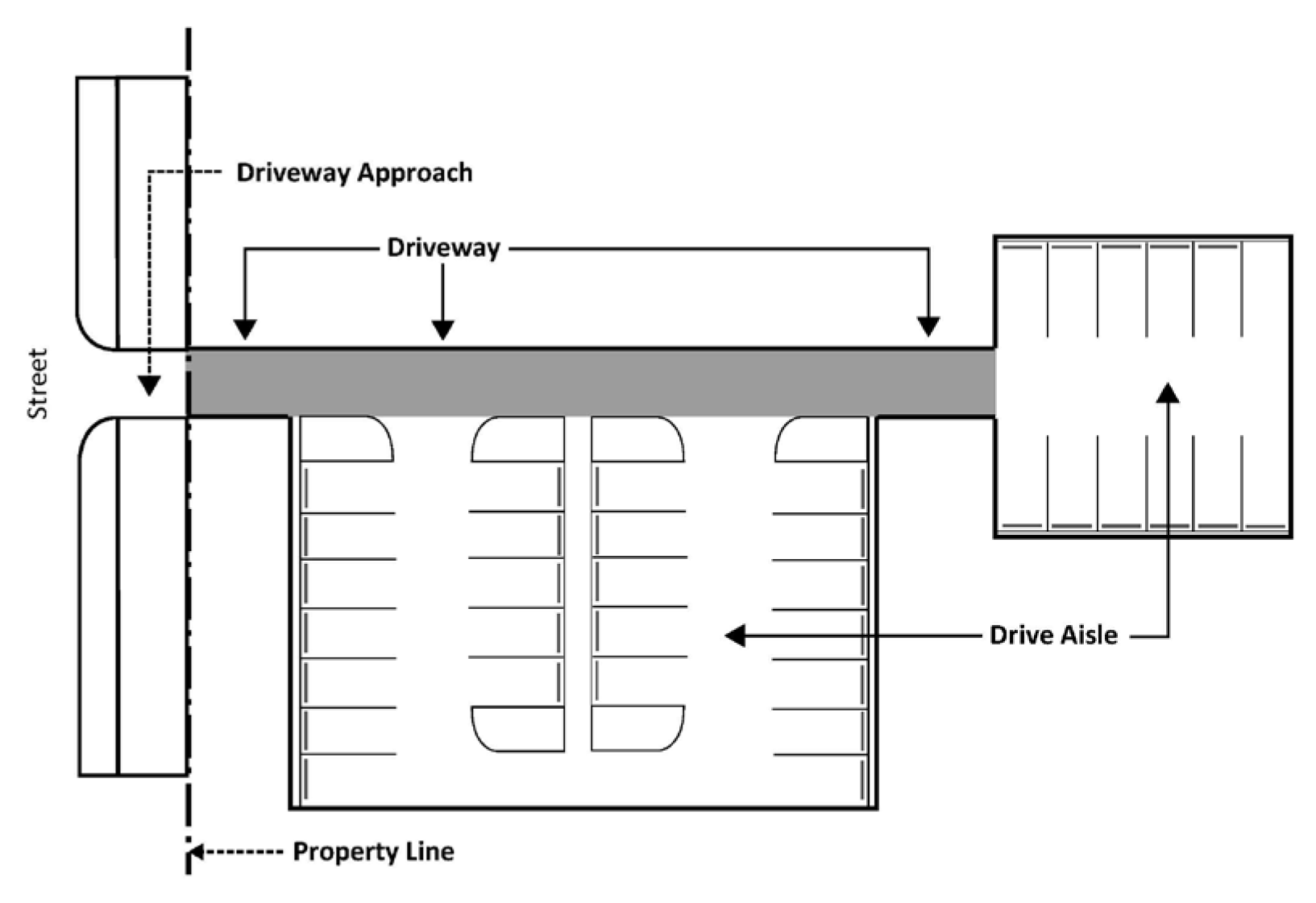
Driveway means an area providing vehicular access to a site that begins at the property line and extends into the site; or an area providing vehicular circulation between parking areas on a site (see Figure 111-2). A driveway does not include maneuvering areas or drive aisles within parking areas.
FIGURE 111-2. DRIVEWAY
Duplex means a building containing two attached dwelling units on an individual lot that share a common wall or common floor/ceiling. For the purposes of this section, a building that contains an accessory dwelling unit attached to a single family detached dwelling, manufactured home, or zero side yard dwelling shall not be considered a duplex.
Dwelling means a building, or portion thereof, which contains one or two dwelling units.
Dwelling unit means a single independent unit providing complete living facilities for one or more persons, including permanent provisions for living, sleeping, eating, cooking, and sanitation. For the purposes of this definition, "independent" means the dwelling unit:
(a)
Is detached from any other dwelling unit or is separated from any other dwelling unit by an approved fire separation as required under the Building Code;
(b)
Includes a kitchen area with a sink and an approved electrical service connection for a stove or range; and
(c)
Does not have a direct interior connection to any other dwelling unit, but may have fire-separated access to a common facility shared with any other dwelling unit.
Employees means all persons, including proprietors, performing work on a premises for compensation. For purposes of SRC chapter 806, employees include all persons, including proprietors, performing work on a premises for compensation during the largest shift at peak season.
Excavation means any act by which earth, sand, gravel, rock, or any similar material is dug into, cut, quarried, uncovered, removed, displaced, relocated, or bulldozed, including the conditions resulting therefrom.
Existing wildlife rehabilitation facility means any building, structure, or land which is occupied or being used by a wildlife rehabilitator who is licensed by the Oregon Department of Fish and Wildlife and actively engaged in wildlife rehabilitation as of July 14, 1994.
Facade means the vertical plane of one exterior side of a building.
Family means:
(a)
An individual;
(b)
Two or more persons related by blood, marriage, domestic partnership, legal adoption, or guardianship;
(c)
Two or more persons with disabilities, as defined in the Fair Housing Amendments Act of 1988, who need not be related by blood, marriage, domestic partnership, legal adoption, or guardianship living together in a dwelling unit; or
(d)
Any number of persons who need not be related by blood, marriage, domestic partnership, legal adoption, or guardianship living together in a dwelling unit.
Fence means an unroofed structure used as an enclosure, barrier, or restriction to light, sight, air, or passage.
Fill or backfill means a deposit of earth or other natural or manmade material placed by artificial means.
Finished grade means the final grade upon completion of excavation, fill, or paving.
Flag lot means a lot that is set back from the street at the rear or at the side of another lot, with vehicular access to the street provided by a flag lot accessway (see Figure 111-1).
Flag lot accessway means a portion of a lot that provides legal access from a street to one or more flag lots. An accessway may be through fee-simple ownership as part of a flag lot or by an access easement with associated reciprocal and irrevocable access rights for all lots using the accessway.
Floor area means the area within the exterior walls of a building or structure, or portion thereof, exclusive of vent shafts and courts. The floor area of an unenclosed building or structure, or portion thereof, is the usable area under the horizontal projection of the roof or floor above.
Floor area ratio (far) means a measure of the intensity of a development, expressed as a ratio of total building floor area to total lot area.
Frontage means that portion of real property which abuts a street, whether or not access to the property is accorded thereby, and whether or not a building or structure faces the street. In context, when coupled with the term "alley," the term "frontage" has the same meaning with respect to an abutting alley.
Garage means a building or portion thereof used for the parking or storage of vehicles.
Grade means the lowest point of elevation of the ground or paved surface excluding stairwells and area wells at the point's contact with a building's foundation, a property line, or a street, depending upon the context.
Grading means the act of excavating and filling.
Guest house means an accessory building maintained for the purpose of providing temporary and gratuitous living accommodations, but dependent upon the main dwelling for cooking or bathroom facilities, or both.
Guest room means any room or rooms used or intended to be used by a guest for sleeping purposes.
Habitable space means space within a structure for living, sleeping, eating, or cooking. Bathrooms, closets, halls, storage or utility space, and similar areas are not considered habitable space.
Hard surface material means concrete, asphalt pavement, pavers, or similar material that is designed and manufactured for the intended purpose. For purposes of this definition, gravel is not considered a hard surface material.
Hillside lot means a lot having an average cross slope of 15 percent or more and that is residentially zoned or developed for uses falling under household living.
Household pet means a domesticated animal that is kept for pleasure rather than for a commercial purpose such as breeding, boarding, grooming, or medical care. Common household pets include cats, dogs, hamsters, gerbils, guinea pigs, canaries, parakeets, parrots, turtles, lizards, and tropical fish.
Infill lot means a residential flag lot created by the partition of land after February 8, 2006.
Interior lot means any lot, other than a corner lot or double frontage lot (see Figure 111-1).
Interior lot line means a lot line that is not adjacent to a street.
Land division means the act of dividing land to create lots or parcels. A property line adjustment is not a land division.
Land use action means the City's process of reviewing an application for a land use or limited land use decision.
Live-work unit means a dwelling unit that includes a designated space for a business or other nonresidential use that is operated by an occupant of that unit. The live-work unit is accessory to the dwelling unit within which it is located.
Livestock means, except as otherwise provided herein:
(a)
One or more members of any species of cattle, swine, sheep, goat, horse or other equine, llama, alpaca or related ruminant, or poultry regardless of the purpose for which they may be kept; and
(b)
Any species of bee, rabbit, or fur-bearing animal kept for sale, for sale of byproducts, for livestock increase, or for value increase.
(c)
Poultry, miniature swine, and bees kept in accordance with SRC chapter 50 shall not be considered livestock.
Loading space means an off-street space for the parking of a vehicle while loading or unloading.
Local street means a street not designated as a collector, minor arterial, major arterial, or parkway in the Salem Transportation System Plan. A local street primarily serves to provide direct access to abutting land and offers the lowest level of traffic mobility.
Lot means a single lawfully established unit of land created by a subdivision of land. Except where otherwise stated, the term "lot" includes the term "parcel."
Lot line means one of the property lines forming the exterior boundaries of a lot.
Major arterial means a street for moving large volumes of intra-city and regional traffic, and designated as such in the Salem Transportation System Plan. A fully improved major arterial serves as the main radial, and provides peripheral routes through the City. The ultimate cross-sectional width of a major-arterial is multi-lane, as shown in the Salem Transportation System Plan.
Manufactured dwelling means a residential trailer, mobile home, or manufactured home. A manufactured dwelling does not include any building or structure constructed to conform to the Oregon Structural Specialty Code or the One and Two Family Dwelling Code adopted pursuant to ORS 455.100 to 455.450 and 455.610 to 455.630, or any unit identified as a recreational vehicle by the manufacturer.
Manufactured dwelling park means any place where four or more manufactured dwellings are located on a development site and intended for residential use. The term "manufactured dwelling park" does not include a lot or lots located within a subdivision being rented or leased for occupancy by no more than one manufactured dwelling per lot if the subdivision was approved pursuant to SRC chapter 205.
Manufactured home means a structure constructed for movement on the public highways that has sleeping, cooking, and plumbing facilities, that is intended for human occupancy, that is being used for residential purposes, and that was constructed after June 15, 1976, and in accordance with federal manufactured housing construction and safety standards and regulations in effect at the time of construction.
Marijuana means the plant Cannabis family Cannabaceae, any part of the plant Cannabis family Cannabaceae and the seeds of the plant Cannabis family Cannabaceae. The term "marijuana" does not include industrial hemp, as defined in ORS 571.300.
Marijuana production means the commercial manufacture, planting, cultivation, growing, or harvesting of marijuana for wholesale or retail trade. The manufacture, planting, cultivation, growing or harvesting of marijuana for personal use, or as a state registered medical marijuana grower for up to four state registered patients, as allowed by state law is not included in this definition.
Middle housing means townhouses, two family uses, three family uses, four family uses, and cottage clusters.
Middle housing land division means a partition or subdivision of a lot, parcel, or other lawfully established unit of land which has been, or is proposed to be, developed for middle housing in order to locate each dwelling unit on a separate lot.
Minor arterial means a street providing primarily intra-area and inter-neighborhood access, and designated as such in the Salem Transportation System Plan. A fully improved minor arterial has a minimum of two travel lanes with left-turn pockets and center left-turn lanes.
Mixed-use building means a building that is two or more stories in height and which contains a combination of residential and non-residential use where at least 75 percent of the ground floor area of the building is occupied by non-residential use and residential use is included on the upper floors.
Mobile home means a structure constructed for movement on the public highways that has sleeping, cooking, and plumbing facilities, that is intended for human occupancy, that is being used for residential purposes, that was constructed between January 1, 1962, and June 15, 1976, and met the construction requirements of Oregon mobile home law in effect at the time of construction.
Native vegetation means plant species which are indigenous to Oregon and appropriate to local site conditions such as hydrology, soils, light availability, and slope aspect.
Natural grade means the grade of the land in an undisturbed state.
Neighborhood means a localized area within the City with a development pattern that provides infrastructure and services which meets the needs of persons residing or working in the area. A neighborhood encompasses a larger area than vicinity.
Neighborhood association means a neighborhood organization that is officially recognized as provided in SRC chapter 64.
Nightclub means an establishment open at night that provides music and space for dancing, and usually serves alcohol.
Nuisance vegetation means native and non-native plant species with a tendency to dominate plant communities, or which are considered harmful to humans, and which are designated as nuisance vegetation in the tree and vegetation technical manual.
Office complex means a group of businesses falling primarily under the business and professional services use category that form a centralized unit and that have a joint parking area available for use by patrons of any single business.
Off-street parking area means an area of a development site used for short-term off-street parking of vehicles. An off-street parking area includes aisles and maneuvering areas within the parking area.
Open space means land designated to preserve community livability, significant plant materials, and natural resources.
Owner means the owner of record of real property as shown on the latest tax rolls or deed records of the county, and includes a person who furnishes evidence that the person is purchasing property under a written recorded or unrecorded land sale contract.
Parcel means a single lawfully established unit of land created by a partition of land.
Parking space means a designated space in a parking area for the parking of one motor vehicle.
Parking structure means a structure, or portion thereof, that provides two or more levels of parking.
Parkway means a street for moving large volumes of both intra-city traffic and regional traffic at higher speeds, and designated as such in the Salem Transportation System Plan. A fully improved parkway is a divided highway with a minimum of four travel lanes and extremely limited access.
Partition means dividing land to create not more than three parcels of land within a calendar year, but does not include:
(a)
Dividing land as a result of a lien foreclosure, foreclosure of a recorded contract for the sale of real property, or the creation of cemetery lots;
(b)
A property line adjustment;
(c)
Dividing land as a result of the recording of a subdivision or condominium plat;
(d)
Selling or granting by a person to a public agency or public body of property for state highway, county road, city street or other right-of-way purposes if the road or right-of-way complies with the applicable comprehensive plan and ORS 215.213(2)(p) to (r) and 215.283(2)(q) to (s). However, any property sold or granted for state highway, county road, city street or other right-of-way purposes shall continue to be considered a single unit of land until the property is further subdivided or partitioned; or
(e)
Selling or granting by a public agency or public body of excess property resulting from the acquisition of land by the state, a political subdivision, or special district for highways, county roads, city streets, or other right-of-way purposes when the sale or grant is part of a property line adjustment incorporating the excess right-of-way into adjacent property. The property line adjustment shall be approved or disapproved by the applicable local government. If the property line adjustment is approved, it shall be recorded in the deed records of the county where the property is located.
Pedestrian connection means a continuous, unobstructed, and reasonably direct route between two points that is intended and suitable for pedestrian use.
Pedestrian pathway means any sidewalk, footpath, or trail which provides on-site pedestrian access and circulation.
Pedestrian scale means site and building design elements that are dimensionally less than those intended to accommodate automobile traffic, flow, and buffering. Examples include ornamental lighting of limited height; bricks, pavers or other modules of paving with small dimensions; a variety of planting and landscaping materials; arcades or awnings that reduce the height of walls; and signage and signpost details that can only be perceived from a short distance.
Planning administrator means the Administrator of the Planning Division, Department of Community Development of the City, or the Planning Administrator's designee.
Plaza means an area generally open to the public on a controlled basis, and usually adjoining and connecting directly to a sidewalk, pedestrian walkway, transit stop, or building entrance, that provides a place for individuals to sit, stand, or rest. Plazas typically include low walls or planters and landscaping to create a semi-enclosed space and to buffer and separate the plaza from adjoining parking lots and vehicle maneuvering areas. Plazas also typically include amenities such as seating, art, and fountains.
Primary building entrance means the principal public pedestrian entrance into a building. A building may have more than one primary building entrance, such as in those situations where a building has multiple individual tenant spaces, each with their own principle public entrance, or a building which has multiple public entrances located at different locations within the building, all of which are of equal significance in providing public entry into the building. A primary building entrance does not include an employee-only or service entrance, unless the use of the building is such that a public entrance does not exist. In those situations where a public entrance does not exist, the main employee-only or service entrance into the building is the primary building entrance.
Primary street means a street that is classified in the Salem Transportation System Plan as an arterial or collector street.
Private open space means a semi-enclosed area which is intended for use by the occupants of an individual dwelling unit. Private open spaces may include porches, patios, balconies, terraces, roof top gardens, verandas, and decks.
Property line means the boundary line between two units of land.
Public right-of-way or right-of-way means the present and future streets, roadways, alleys, public highways, avenues, and pedestrian ways in the City, which may be held by the City in fee, easement, or dedication.
Public utilities means privately owned improvements providing the following services: natural gas; electricity; telephone, internet, and other electronic data or communication services; and cable television.
Quadplex means a building containing four attached dwelling units on an individual lot. Each dwelling unit must share a common wall or common floor/ceiling with at least one other dwelling unit.
Recreational vehicle means:
(a)
A vehicle, with or without motive power, that is designed for sport or recreational use, or human occupancy on an intermittent basis, such as motor homes, off-road vehicles, dune buggies, boats, snowmobiles, and other similar vehicles; or
(b)
A portable vehicular structure designed for sport or recreation use, or for human occupancy on an intermittent basis, that is capable of being towed or transported on the highway by a motor vehicle, such as travel trailers, fifth-wheel trailers, campers, and other similar portable vehicular structures.
Recycling depot means a building, or portion thereof, not more than 1,000 square feet in floor area used for the collection, sorting, and temporary storage of waste and discarded materials which may be reprocessed elsewhere into usable raw materials. The term "recycling depot" does not include a structure maintained solely to provide shelter for no more than three types of recyclable material, such as paper, tin cans, and bottles, deposited by members of the public and collected at regular intervals for further transfer or processing elsewhere.
Resident family means a family who occupies a dwelling unit as their primary residence on a non-transient long-term basis for 30 or more consecutive days. A resident family must be either the owner or the tenant of the dwelling unit.
Residential facility means as defined under ORS 197.660, a residential care, residential training, or residential treatment facility, as those terms are defined in ORS 443.400, that provides residential care alone or in conjunction with treatment or training or a combination thereof for six to 15 individuals who need not be related. Staff persons required to meet licensing requirements shall not be counted in the number of facility residents, and need not be related to each other or to any resident of the residential facility.
Residential home means as defined under ORS 197.660, a residential treatment or training home, as defined in ORS 443.400, a residential facility registered under ORS 443.480 to 443.500, or an adult foster home licensed under ORS 443.705 to 443.825 that provides residential care alone or in conjunction with treatment or training or a combination thereof for five or fewer individuals who need not be related. Staff persons required to meet licensing requirements shall not be counted in the number of facility residents, and need not be related to each other or to any resident of the residential home.
Residential trailer means a structure constructed for movement on the public highways that has sleeping, cooking, and plumbing facilities, that is intended for human occupancy, that is being used for residential purposes, and that was constructed before January 1, 1962.
Riparian corridor means the area adjacent to a waterway, consisting of the area of transition from an aquatic ecosystem to a terrestrial ecosystem. The riparian corridor boundary is measured:
(a)
50 feet horizontally from the top of bank on each side of a waterway with less than 1,000 cubic feet per second average annual stream flow; and
(b)
75 feet horizontally from the top of bank on each side of a waterway with 1,000 or more cubic feet per second average annual stream flow (Willamette River).
Riparian restoration means actions undertaken to improve degraded, or recover lost, ecological or habitat functions in the area adjacent to a waterway in the zone of transition from an aquatic ecosystem to a terrestrial ecosystem, determined by the City to provide net ecological benefits, not reduce the stream's capacity to convey flood flows in a floodplain or floodway, nor pose an impediment to fish passage.
Scrap and waste materials dealers means establishments primarily engaged in the assembling, breaking up, sorting, and wholesale distribution of scrap and waste materials.
Screening means a method of blocking or obscuring view of an area through the use of fencing, walls, berms, densely planted vegetation, of a combination thereof.
Secondary street means a street that is classified in the Salem Transportation System Plan as a local street.
Setback means the distance between a building, accessory structure, vehicle use area, or other structure or area and a property line, special setback line, flag lot accessway, easement, or other specified point.
Shopping center means a group of businesses falling primarily under the retail sales and service use category that form a centralized unit and that have a joint parking area available for use by patrons of any single business.
Short-term rental means short-term commercial lodging where a single family dwelling unit, or guest room(s) within a single family dwelling unit, are rented to overnight guests on a daily or weekly basis for periods of less than 30 consecutive days. For purposes of this definition, a dwelling unit within a condominium is considered a single family dwelling unit.
Single family dwelling means a detached freestanding dwelling unit located on its own lot.
Single-room occupancy means a residential use where no fewer than four attached, lockable, rooms providing living and sleeping space for the exclusive use of an occupant are rented independently, and food preparation and/or sanitary facilities are required to be shared by the occupants.
Solid waste disposal site means land used for disposal of solid waste, including lumber; tile; bricks; concrete rubble; siding; roofing; asphalt; structural metal work; plaster and gypsum board; mortar stones; concrete blocks; pipe; plumbing fixtures; electrical wiring and fixtures; and shredded or split tires. A solid waste disposal site does not include land used for the disposal of leaves, prunings, and grass clippings; household appliances; machinery; motor vehicles and parts, other than shredded or split tires; or any putrescible substance. Solid waste disposal sites do not involve the collection or storage of items for sale or reuse in any form.
Solid waste transfer station means a fixed or mobile facility normally used as an adjunct of a solid waste collection system or resource recovery system between a collection route and a disposal site, including, but not limited to, a large hopper, railroad gondola, or barge. See ORS ch. 459 and OAR ch. 340.
Story means the horizontal division of a building, making up the area between two adjacent levels, but excluding that portion of the building that comprises the horizontal division that is the roof, unless that area includes living space.
Stream enhancement means to modify the stream channel width, length, depth, alignment, location, profile, bank shape, or in-stream structures for the purpose of improving ecological or habitat functions determined by the City to be degraded or lost in the immediate project area, specific stream corridor, or watershed.
Street means a public or private way that is created to provide ingress or egress to one or more lots, parcels, areas, or tracts of land, excluding a private way that is created to provide ingress or egress to land in conjunction with the use of the land for forestry, mining, or agricultural purposes. The term "street" includes the terms "highway," "thoroughfare," "parkway," "throughway," "road," "avenue," "boulevard," "lane," "court," "place," "loop," "drive," "circle," and other such terms. The term "street" does not include alleys or flag lot accessways.
Street tree means a tree planted in proximity to a street in order to provide canopy over the street, to provide shade, and soften the street environment.
Structural alteration means any alteration, addition, or removal of any structural member of a building, other than a minor alteration. As used in this definition:
Minor alteration means the alteration, replacement, or repair of a structural member so as not to alter structural integrity or the manner in which structural integrity was achieved before the alteration, replacement, or repair;
Structural integrity means the capacity of the building and its component parts, other than non-bearing walls, fixtures, electrical systems, plumbing systems, mechanical systems, openings, and ornamental appendages, to withstand the forces, stresses, and loads which are contemplated in the Oregon Structural Specialty Code for the type of construction involved; and
Structural member means any component part of a building which contributes to structural integrity.
Structure means that which is built or constructed; an edifice or building of any kind; or any piece of work artificially built up or composed of parts joined together in some definite manner; any of which is an addition to or fixture on real property. The term "structure" does not include paving, or mobile homes.
Subject property means the real property that is the subject of any land use proceeding. For purposes of mailed notice, subject property includes not only the real property that is the subject of the land use proceeding for which notice is required, but also any contiguous property in which the applicant or owner holds a legal or equitable interest.
Temporary means unless otherwise provided under the UDC, a limited duration more than two hours but less than six months, and which does not involve the construction or alteration of any permanent structure.
Townhouse means a dwelling unit that is part of a row of two or more attached units, where each dwelling unit is located on its own lot and shares a common side wall or walls with the adjacent units. A townhouse is also called a rowhouse.
Triplex means a building containing three attached dwelling units on an individual lot. Each dwelling unit must share a common wall or common floor/ceiling with at least one other dwelling unit.
Turnaround area means a paved area of a sufficient size and configuration that a motor vehicle having a curb-to-curb turning radius of 30 feet or less may maneuver around to head in the opposite direction without having to move in reverse more than once.
Unit of land means a lot, parcel, or other tract of land described by a metes and bounds, which is lawfully established and which has been recorded. A lot, parcel, or tract is lawfully established only if:
(a)
The lot or parcel was created in compliance with all applicable legal requirements for a land division in effect at the time it was created; or
(b)
The lot, parcel, or tract has been validated pursuant to SRC 205.060.
Uphill lot means a hillside lot which slopes uphill from the front lot line.
Use standard means any standard or condition imposed by the UDC, or a decision in a land use action, which regulates, restricts, prohibits, or allows the conduct of a use. A use standard does not include a development standard.
Utility or utilities means water; wastewater; stormwater facilities; natural gas; electricity; telephone, internet, and other electronic data or communication services; and cable television. As the context requires, the term "utility" or "utilities" may include City utilities or public utilities.
Vehicle display area means an area of a development site where motor vehicles, recreational vehicles, trailers, boats, or other vehicles are displayed for sale or lease.
Vehicle storage area means an area of a development site used for the storage of motor vehicles, utility trailers, recreational vehicles, boats, aircraft, or other vehicles.
Vehicle use area means an area of a development site used for parking, storage, display, loading, maneuvering, access, or circulation of vehicles. A vehicle use area includes off-street parking areas, vehicle storage areas, vehicle display areas, loading areas, driveways, and drive-through lanes.
Vertical window means a window with a vertical dimension greater than its horizontal dimension.
Vicinity means land that is surrounding, near, or within close proximity of a particular place. Vicinity is smaller in size than a neighborhood.
Vision clearance area: the area adjacent to the intersection of a street, alley, flag lot accessway, or driveway where an unobstructed clear field of vision is required to ensure safe visibility for vehicular, bicycle, and pedestrian traffic.
Visible transmittance (VT) means a measurement of the amount of light in the visible portion of the spectrum that passes through glass. The higher the number, the greater the amount of light that is passing through the glass.
Waterway means any river, perennial stream, or creek within the City as designated by the Director.
Wetland means an area inundated or saturated by surface water or groundwater at a frequency and duration sufficient to support, and under normal circumstances does support, a prevalence of vegetation typically adapted for life in saturated soil conditions.
Wetland restoration means to restore former wetlands, create new wetlands, or enhance existing wetlands for the purpose of improving ecological or habitat functions. Restoration means to reestablish wetland hydrology to a former wetland. Creation means to successfully convert an area that has never been a wetland to wetland conditions. Enhancement means the alteration and/or active management of degraded wetlands for the sustainable recovery or improvement of lost or degraded wetland functions and values.
Wildlife means any animal defined as wildlife under ORS ch. 496.
Wildlife rehabilitation means the restoration of injured, sick, or immature wildlife, except cougars, wolves, and bears, that are native to Oregon to a condition where they are capable of being released into the wild or, if incapable of survival on their own, retained for educational purposes or transferred to an organization, educational institution, museum, publicly funded zoo, or other facility as determined by the Oregon Department of Fish and Wildlife.
Wildlife rehabilitator means an individual who is licensed as a wildlife rehabilitator by the Oregon Department of Fish and Wildlife and actively engaged in wildlife rehabilitation.
Wildlife rehabilitation facility means any building, structure, or land being used for the purpose of wildlife rehabilitation.
Zero side yard dwelling means a detached dwelling unit located on its own lot and constructed contiguous to one, but not both, interior side lot lines.
(Prior Code, §§ 111.001, 111.005, 111.010, 111.015, 111.020, 111.025, 111.030, 111.035, 111.040, 111.045, 111.060, 111.065, 111.070, 111.075, 111.080, 111.090, 111.095, 111.100, 111.105, 111.110, 111.115, 111.130; Ord. No. 31-13; Ord. No. 22-15, § 1, 11-23-2015; Ord. No. 5-17, §§ 18(111.005), 19(111.010), 20(111.090), 21(111.095), 6-12-2017; Ord. No. 10-17, §§ 2, 3, 7-10-2017; Ord. No. 3-18, § 2, 5-14-2018, eff. 6-13-2018; Ord. No. 6-19, § 1(Exh. A), 6-24-2019, eff. 7-24-2019; Ord. No. 1-20, § 2(Exh. B), 2-24-2020; Ord. No. 13-21, § 1(Exh. A), 2-14-2022; Ord. No. 11-22, § 1(Exh. A), 7-25-2022, eff. 8-24-2022; Ord. No. 4-23, § 1(Exh. A), 4-24-2023; Ord. No. 7-23, § 1(Exh. A), 11-27-2023; Ord. No. 8-24, § 1(Exh. A), 9-23-2024)
FIGURE 111-3. CENTRAL SALEM DEVELOPMENT PROGRAM AREA
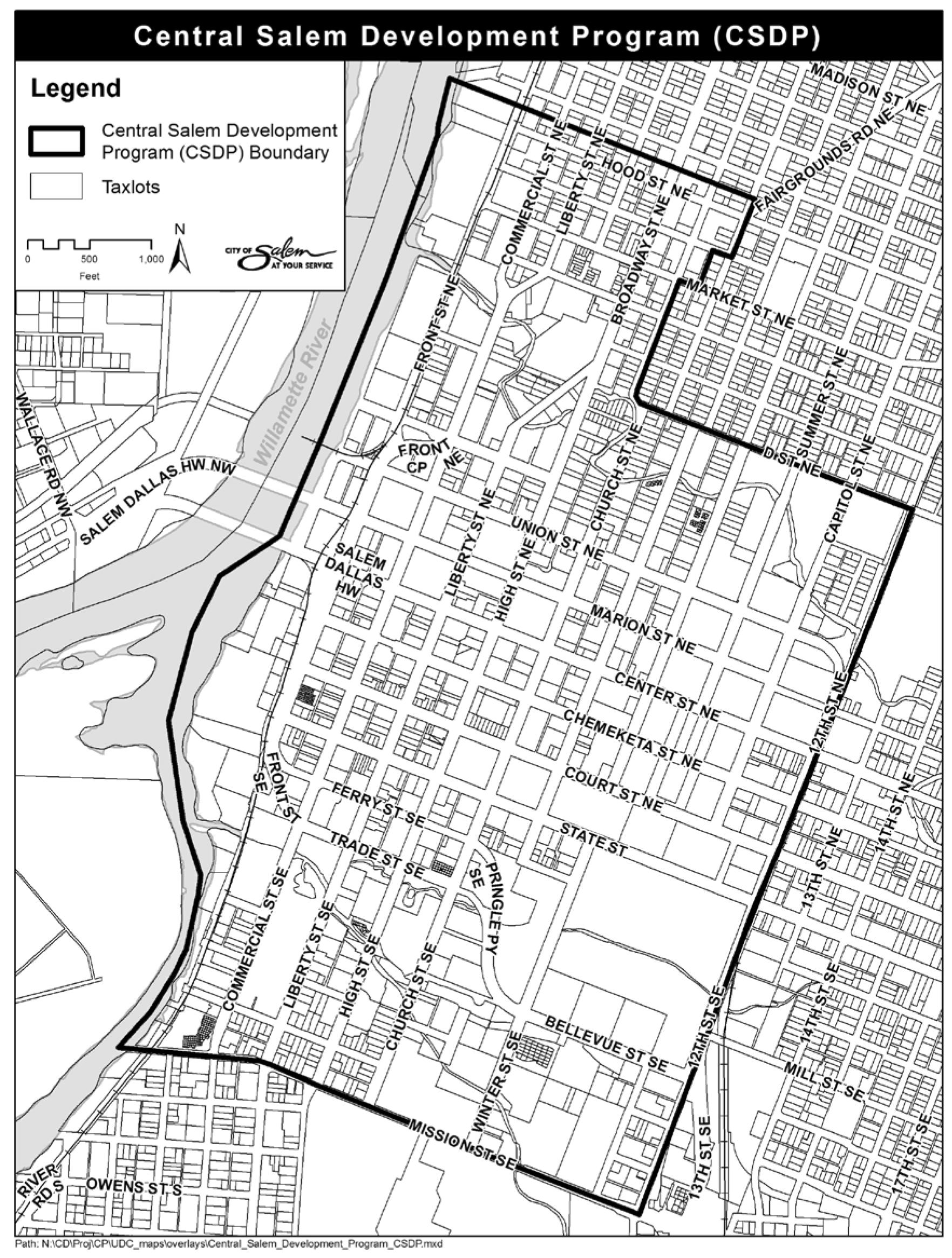
FIGURE 111-4. DOWNTOWN PARKING DISTRICT