
Salem City Zoning Code
CHAPTER 535
MU-III—MIXED USE-III
Sec. 535.001.- Purpose.
The purpose of the Mixed Use-III (MU-III) zone is to identify allowed uses and establish development standards that encourage infill development and redevelopment in mixed-use corridors and centers and promote pedestrian access. The MU-III zone generally allows a variety of retail and office uses, commercial services, and multiple family residential uses.
(Ord. No. 11-22, § 1(Exh. A), 7-25-2022, eff. 8-24-2022)
Sec. 535.005. - Definitions.
Unless the context otherwise specifically requires, as used in this chapter, the following mean:
Pedestrian amenities means areas and objects that are intended to serve as places for public use and are closed to motorized vehicles. Examples include plazas, sidewalk extensions, outdoor seating areas, and street furnishings.
Primary street means a street that is classified in the Salem Transportation System Plan (TSP) as an arterial or collector.
Secondary street means a street that is classified in the TSP as a local street.
(Ord. No. 11-22, § 1(Exh. A), 7-25-2022, eff. 8-24-2022)
Sec. 535.010. - Uses.
(a)
Except as otherwise provided in this section, the permitted (P), special (S), conditional (C), and prohibited (N) uses in the MU-III zone are set forth in Table 535-1.
TABLE 535-1
USES
(b)
Continued uses. Existing, legally-established uses established prior to August 24, 2022, but which would otherwise be made nonconforming by this chapter, are hereby deemed continued uses.
(1)
Building or structures housing a continued use may be structurally altered or enlarged, or rebuilt following damage or destruction, provided such alteration, enlargement, or rebuilding complies with the standards set forth in SRC 535.015(f).
(2)
Cease of occupancy of a building or structure for a continued use shall not preclude future use of the building or structure for that use; provided, however, conversion of the building or structure to a conforming use shall thereafter prevent conversion back to the former continued use or any other continued use.
(c)
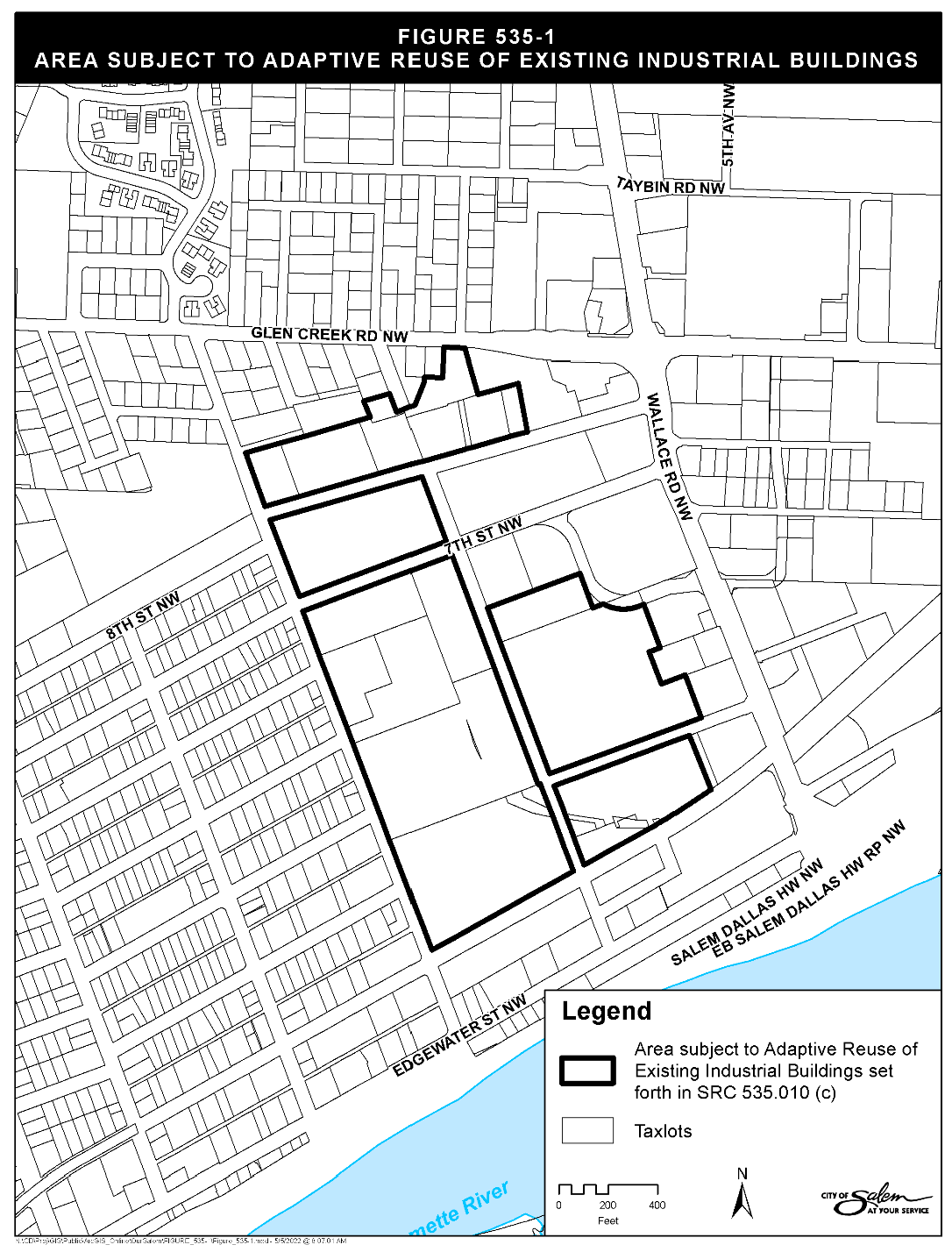
Adaptive reuse of existing industrial buildings and structures. In order to allow for greater flexibility in the use of existing industrial buildings and structures within the area shown in Figure 535-1, the adaptive reuse of industrial buildings and structures existing on August 24, 2022, is allowed as set forth in this subsection.
(1)
Uses. Any use within the industrial use classification that is a permitted, special, or conditional use within the General Industrial (IG) Zone shall be a permitted, special, or conditional use within an existing industrial building or structure within the area shown in Figure 535-1.
(2)
Development standards; design review. The exterior of the existing industrial building or structure may be altered, but shall not be enlarged. The exterior alteration shall comply with all applicable standards of the IG Zone. The exterior alteration shall not be subject to the development standards, or the design review guidelines or the design review standards, of this chapter.
(3)
Termination. Adaptive reuse of an existing industrial building or structure shall terminate as provided in this subsection. When the adaptive reuse of an existing industrial building or structure has terminated, the property shall thereafter only be used for uses allowed in the MU-III zone.
(A)
Change of use to any use that is allowed in the MU-III zone shall terminate the adaptive reuse of the building or structure.
(B)
Determination by the Building Official that the building or structure is derelict or dangerous, as defined in SRC 50.600 and 56.230, shall terminate the adaptive reuse of the building or structure.
(C)
Substantial damage or destruction of the building or structure by any cause, to the extent that the cost of repair or restoration would exceed 60 percent of the building or structure replacement cost using new materials and conforming to the current building codes, shall terminate the adaptive reuse of the building or structure. Cost of repair or restoration, and replacement cost, shall be determined by the Building Official. The Building Official's determination is appealable as provided in SRC 20J.240 through 20J.430 for contested case proceedings.
(Ord. No. 11-22, § 1(Exh. A), 7-25-2022, eff. 8-24-2022; Ord. No. 22-22, § 1(Exh. A), 11-28-2022; Ord. No. 7-23, § 1(Exh. A), 11-27-2023)
Sec. 535.015. - Development standards.
Development within the MU-III zone must comply with the development standards set forth in this section.
(a)
Lot standards. Lots within the MU-III zone shall conform to the standards set forth in Table 535-2.
TABLE 535-2
LOT STANDARDS
(b)
Dwelling unit density. Development within the MU-III zone that is exclusively residential or single-room occupancy shall have a minimum density of 15 dwelling units per acre.
(c)
Setbacks. Setbacks within the MJU-III zone shall be provided as set forth in Tables 535-3 and 535-4.
TABLE 535-3
SETBACKS
TABLE 535-4
ZONE-TO-ZONE SETBACKS
(d)
Lot coverage; height. Buildings and accessory structures within the MU-III zone shall conform to the lot coverage and height standards set forth in Table 535-5.
TABLE 535-5
LOT COVERAGE; HEIGHT
(e)
Landscaping.
(1)
Setbacks. Setbacks, except setback areas abutting a street that provide pedestrian amenities, shall be landscaped to conform to the following standards:
(A)
The required setback abutting a street for development that is exclusively residential shall meet the standard of a minimum of one plant unit per 16 square feet of landscaped area. Landscaping shall conform to the standards set forth in SRC chapter 807.
(B)
For all other uses, landscaping shall conform to the standards set forth in SRC chapter 807.
(2)
Vehicle use areas. Vehicle use areas shall be landscaped as provided under SRC chapters 806 and 807.
(3)
Development site. A minimum of 15 percent of the development site shall be landscaped. Landscaping shall meet the Type A standard set forth in SRC chapter 807. Other required landscaping under the UDC, such as landscaping required for setbacks or vehicle use areas, may count towards meeting this requirement.
(4)
Gasoline stations. In addition to the landscaping requirements set forth in this section, gasoline stations shall be required to provide a minimum of one plant unit per 16 square feet of landscaped area. The landscaped area shall conform to the standards set forth in SRC chapter 807.
(f)
Development standards for continued uses.
(1)
Buildings. Buildings housing a continued use and existing accessory structures may be structurally altered or enlarged, or rebuilt following damage or destruction, provided such alteration, enlargement, or rebuilding conforms to development standards in this chapter and to all other applicable provisions of the UDC; or
(2)
Option to rebuild in same location. Any building or structure rebuilt shall be located on the same location on the lot as the original building or structure and may be enlarged, provided the enlargement does not increase the building or structure's nonconformity to development standards set forth in this chapter and all other applicable provisions of the UDC.
(g)
Pedestrian-oriented design. Development within the MU-III zone, excluding development requiring historic design review and multiple family development, shall conform to the pedestrian-oriented design standards set forth in this section. Any development requiring historic design review shall only be subject to design review according to the historic design review standards or the historic design review guidelines set forth in SRC chapter 230.
(1)
Off-street parking location. New off-street surface parking areas and vehicle maneuvering areas shall be located behind or beside buildings and structures. New off-street surface parking areas and vehicle maneuvering areas shall not be located between a building or structure and a street.
(2)
Drive through location. New drive throughs shall be located behind or beside buildings and structures.
(3)
Outdoor storage. Outdoor storage of merchandise located within 50 feet of the right-of-way shall be screened with landscaping or a site-obscuring fence or wall.
(4)
Building entrances: For buildings within the maximum setback abutting a street, a primary building entrance for each building facade facing a street shall be facing the street. If a building has frontage on more than one street, a single primary building entrance on the ground floor may be provided at the corner of the building where the streets intersect.
(5)
Ground-floor windows. For buildings within the maximum setback abutting a street, ground floor building facades facing that street shall include transparent windows on a minimum of 50 percent of the ground floor facade. The windows shall not be mirrored or treated in such a way as to block visibility into the building. The windows shall have a minimum visible transmittance (VT) of 37 percent.
(Ord. No. 11-22, § 1(Exh. A), 7-25-2022, eff. 8-24-2022; Ord. No. 7-23, § 1(Exh. A), 11-27-2023)
Sec. 535.020. - Design review.
Design review under SRC chapter 225 is required for development within the MU-III as follows:
(a)
Multiple family development shall be subject to design review according to the multiple family design review standards set forth in SRC chapter 702.
(b)
Residential care with five or more self-contained dwelling units shall be subject to design review according to the multiple family design review standards set forth in SRC chapter 702.
(Ord. No. 11-22, § 1(Exh. A), 7-25-2022, eff. 8-24-2022)
Sec. 535.025. - Other provisions.
In addition to the standards set forth in this chapter, development within the MU-III zone must comply with all other applicable development standards of the UDC, including, but not limited to, the following chapters:
(a)
Trees and Shrubs: SRC chapter 86.
(b)
Wireless Communications Facilities: SRC chapter 703.
(c)
General Development Standards: SRC chapter 800.
(d)
Public Improvements: SRC chapter 802.
(e)
Streets and Right-of-Way Improvements: SRC chapter 803.
(f)
Driveway Approaches: SRC chapter 804.
(g)
Vision Clearance: SRC chapter 805.
(h)
Off-Street Parking, Loading and Driveways: SRC chapter 806.
(i)
Landscaping and Screening: SRC chapter 807.
(j)
Preservation of Trees and Vegetation: SRC chapter 808.
(k)
Wetlands: SRC chapter 809.
(l)
Landslide Hazards: SRC chapter 810.
(m)
Sign Code: SRC chapter 900.
(Ord. No. 11-22, § 1(Exh. A), 7-25-2022, eff. 8-24-2022)

