
Salem City Zoning Code
CHAPTER 800
GENERAL DEVELOPMENT STANDARDS
Sec. 800.001.- Purpose.
The purpose of this chapter is to establish certain standards that apply generally to development throughout the City, regardless of zone.
(Prior Code, § 800.001; Ord. No. 31-13)
Sec. 800.005. - Applicability.
The standards set forth in this chapter apply to all development in every zone unless otherwise exempted by the UDC. In the event of a conflict between the standards set forth in this chapter and any other provision of the UDC, the more restrictive provision shall apply.
(Prior Code, § 800.005; Ord. No. 31-13)
Sec. 800.010. - Definitions.
Unless the context otherwise specifically requires, as used in this chapter, the terms identified in this section shall have the following meanings. Where a term used under SRC 800.055 (Solid Waste Service Areas) is not defined in this section, the definitions under SRC chapters 47 (Solid Waste Management) and 50 (Property Maintenance) shall apply.
Compactor means any self-contained, power-driven, mechanical equipment designed for the containment and compaction of solid waste or recyclable materials.
Drop box means a single container designed for the storage and collection of large volumes of solid waste or recyclable materials, which is usually ten cubic yards or larger in size, and requires a special vehicle for pick up.
Enclosure means a structure built consistent with the State of Oregon Structural Specialty Code designed to provide screening for permanent compactors, receptacles, drop boxes, or any other solid waste, recycling, and compostable containment facilities.
Receptacle means any vessel approved by the Director and used for the storage of solid waste, recycling, and compostable material, excluding drop boxes and compactors.
Solid waste service area means an area designed and established for the purpose of satisfying the local collection franchise service requirements for servicing receptacles, drop boxes, and compactors singularly or collectively.
(Prior Code, § 800.010; Ord. No. 31-13)
Sec. 800.015. - Lot standards, generally.
(a)
Lot shape and size. In addition to meeting all applicable lot standards of the UDC, all lots intended for development, as far as practicable, shall be of a size and configuration so that their net remaining area exclusive of required setbacks, easements, riparian corridors, and mapped floodplain/floodway boundaries and wetlands is buildable.
(b)
Buildings to be on a lot. Every building or structure shall be entirely located on an individual lot. Buildings that are attached at a common property line, but which otherwise meet all requirements of SRC chapter 56 as separate buildings shall be considered as separate buildings for purposes of this subsection.
(c)
Side lot lines. As far as is practicable, side lot lines shall run at right angles to the street upon which the lot faces, except that on curved streets they shall be radial to the curve.
(Prior Code, § 800.015; Ord. No. 31-13; Ord. No. 13-21, § 1(Exh. A), 2-14-2022)
Sec. 800.020. - Designation of lot lines.
(a)
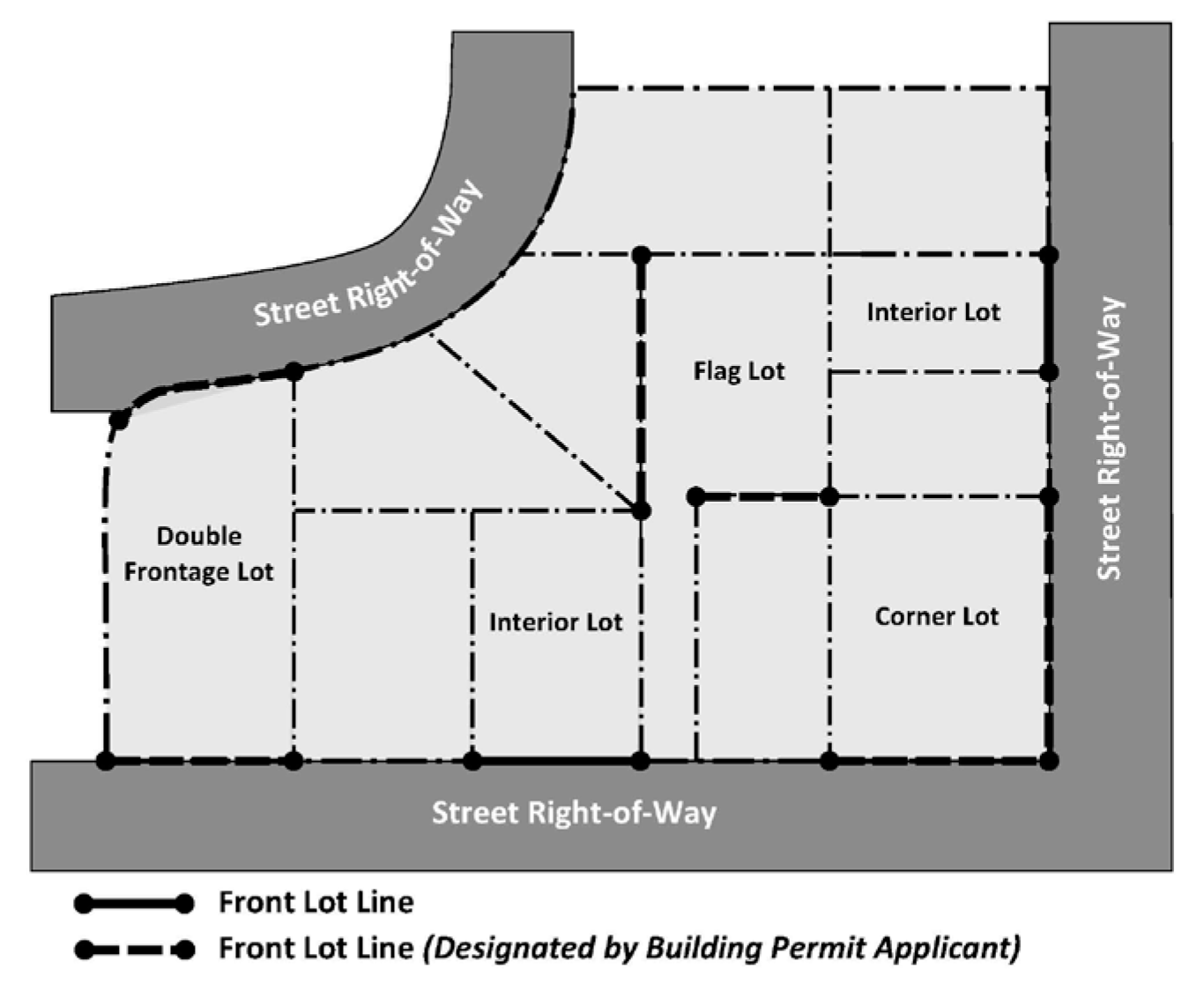
Front lot line. The front lot line shall be designated as set forth in this subsection (see Figure 800-1).
(1)
Interior lot. For an interior lot, the front lot line shall be the property line abutting the street.
(2)
Corner lot. For a corner lot, the front lot line shall be the property line abutting a street designated by the building permit applicant; provided, however, that lot dimension standards are met.
(3)
Double frontage lot. For a double frontage lot, the front lot line shall be the property line abutting a street designated by the building permit applicant; provided, however, that lot dimension requirements are met.
(4)
Flag lot. For a flag lot, the front lot line shall be the outside property line that is an extension of the flag lot accessway or the property line separating the flag portion of the lot from the lot between it and the street from which access is provided to the flag lot, unless the Planning Administrator otherwise directs, in which case the front lot line shall be set forth in the conditions of approval for the tentative plan of the plat, which shall be recorded on deeds conveying lots.
(5)
Other lots. In the case of any lot not covered by subsections (a)(1) through (4) of this section, the front lot line shall be the property line that the architecturally designed front of the building faces.
FIGURE 800-1. DESIGNATION OF FRONT LOT LINE
(b)
Rear lot line. The rear lot line shall be designated as set forth in this subsection (see Figure 800-2).
(1)
Generally. For all lots, except those identified in subsection (b)(2) of this section, the rear lot line shall be the property line that is opposite and most parallel to, and located the greatest distance from, the front lot line.
(2)
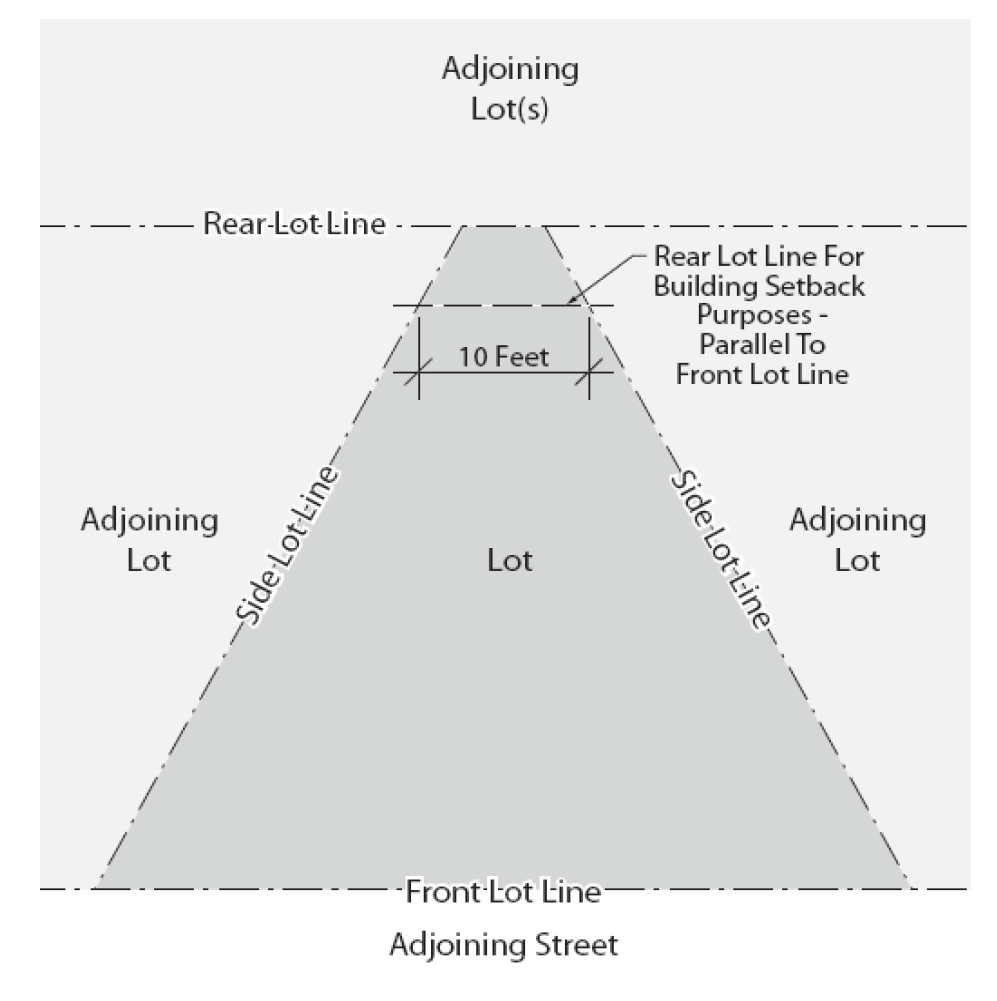
Trapezoidal, triangular, diamond, or other shaped lots. For trapezoidal, triangular, diamond, or other shaped lots with a distance between the side lot lines at the rear of the lot of less than ten feet, the rear lot line for purposes of determining required setbacks shall be a line ten feet in width drawn between the side lot lines and located parallel to and at the maximum distance from the front lot line (see Figure 800-3).
FIGURE 800-2. DESIGNATION OF REAR LOT LINE
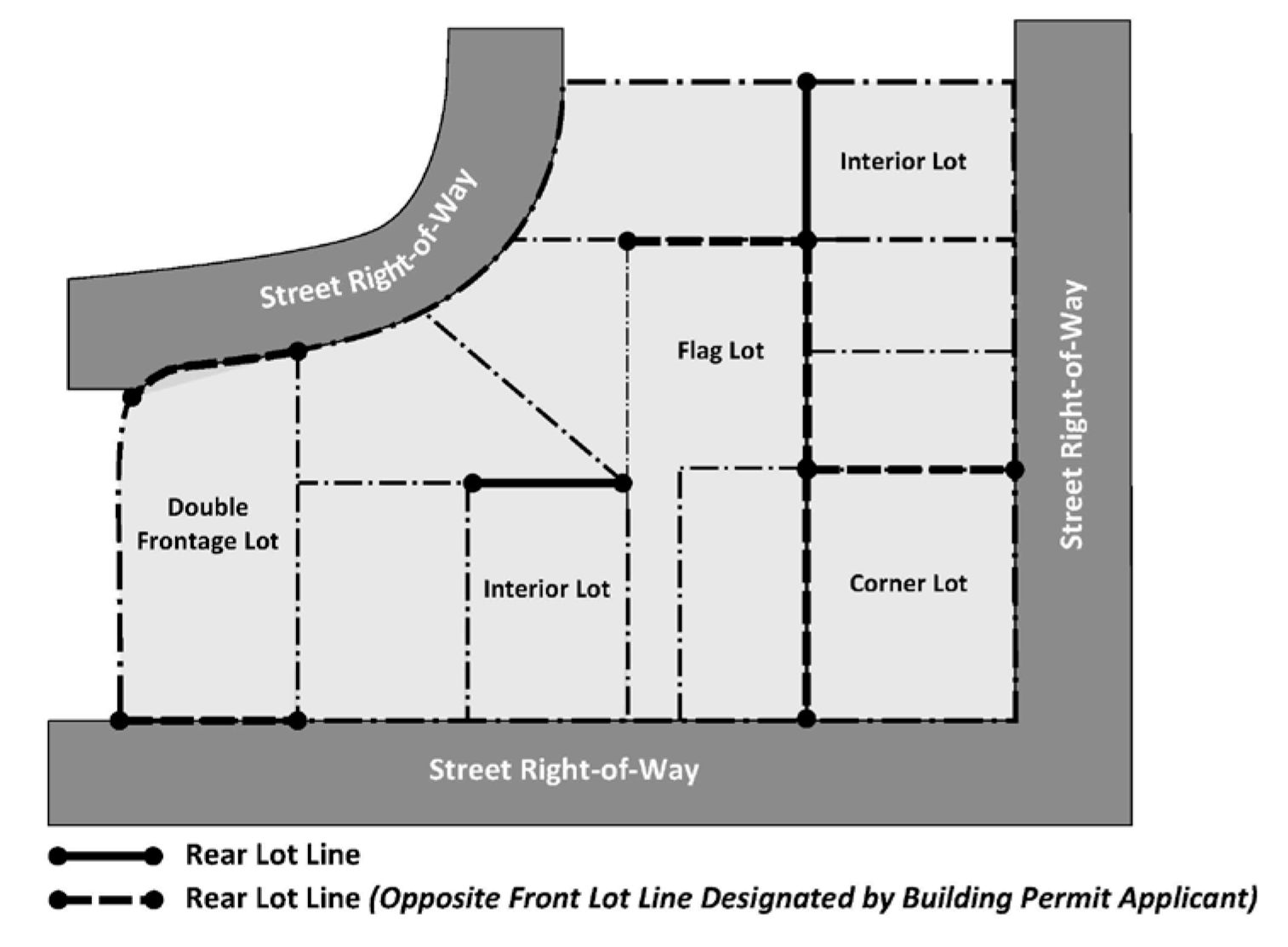
FIGURE 800-3. REAR LOT LINE FOR TRAPEZOIDAL, TRIANGULAR, DIAMOND, OR OTHER SHAPED LOTS
(c)
Side lot line. A side lot line is any lot line which is not a front or rear lot line.
(Prior Code, § 800.020; Ord. No. 31-13)
Sec. 800.025. - Flag lots.
Flag lots are allowed subject to the standards set forth in this section.
(a)
Lot area. The lot area of a flag lot shall conform to the lot area standards of the UDC. Lot area shall be calculated exclusive of the flag lot accessway.
(b)
Lot dimensions. The lot dimensions of a flag lot shall conform to the lot dimension standards of the UDC. Lot dimensions shall be calculated exclusive of the flag lot accessway.
(c)
Flag lot accessways. Flag lot accessways shall be developed and maintained in conformance with the standards set forth in Table 800-1 and this subsection.
(1)
Maximum development served by flag lot accessway. A maximum of four lots may be served by a flag lot accessway. For residential lots created after November 28, 2022, a maximum of four residential units may be served by the flag lot accessway.
(2)
Flag lot accessway grade. Flag lot accessway grade shall conform to the Salem Fire Prevention Code.
(3)
Fire Department access and flag lot accessway turnarounds.
(A)
Unobstructed fire apparatus access shall be provided to within 150 feet of any facility, building, or portion of a building, unless the building is equipped with an approved automatic fire sprinkler system or where geographic features make it impractical and an alternative means of fire protection is provided and approved by the Fire Marshal.
(B)
Flag lot accessways greater than 150 feet in length shall include a turnaround meeting Salem Fire Prevention Code standards, unless the buildings served by the flag lot accessway are equipped with approved automatic fire sprinkler systems or where geographic features make it impractical and an alternative means of fire protection is provided and approved by the Fire Marshal.
(d)
Parking prohibited on flag lot accessways. Parking shall be prohibited on flag lot accessways. No parking signs shall be posted and maintained on both sides of the accessway. The signs shall read "NO PARKING"; provided, however, where parking is prohibited because of a fire lane, the signs shall read "NO PARKING - FIRE LANE" and shall be installed in accordance with Salem Fire Prevention Code standards.
(e)
Maximum percentage of flags lots within a subdivision. Within a subdivision, up to 15 percent of the lots may be flag lots.
(Prior Code, § 800.025; Ord. No. 31-13; Ord. No. 22-22, § 1(Exh. A), 11-28-2022)
Sec. 800.030. - Hillside lots.
Hillside lots may, at the option of the developer or owner, meet the standards set forth in this section, in lieu of the standards applicable in the zone.
(a)
Topographic survey required. An application to develop a lot pursuant to the standards set forth in this section shall include a topographical survey. The survey shall show the topography of the site at two-foot intervals.
(b)
Grade. Natural grade shall be retained on at least 40 percent of the total lot area. Landscaping that does not involve substantial movement of earth shall not be deemed a change to the natural grade. As used in this subsection, the term "natural grade" means both the slope and the elevation of the land in its natural state.
(c)
Cut and fill slopes.
(1)
A fill slope shall begin no closer than two feet from the edge of the curb.
(2)
Cut and fill slopes shall not exceed a slope of 1 to 2; provided, however, the Director may approve slopes not exceeding 1 to 1 upon certification by a qualified engineer or geologist that the slope will remain stable under foreseeable conditions.
(3)
Cut and fill shall comply with SRC chapter 65. If there is a conflict between SRC chapter 65 and this subsection, the more restrictive regulation shall apply.
(d)
Retaining walls. Retaining walls shall not exceed a maximum height of six feet.
(e)
Setbacks.
(1)
Abutting street.
(A)
Buildings and structures, other than garages and carports. All buildings and structures, other than garages and carports, shall have a minimum setback of seven feet from the street.
(B)
Garages and carports.
(i)
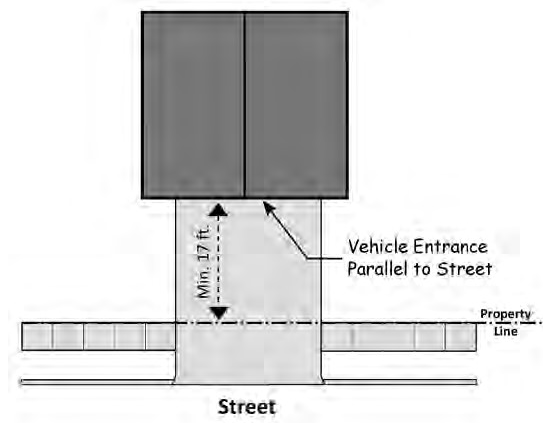
Vehicle entrance parallel to street. Where a garage or carport is located on a hillside lot with an average cross slope of 20 percent or more, and the vehicle entrance to the garage or carport is parallel to the street, the garage or carport shall have a minimum setback of 17 feet from the street.
FIGURE 800-4. GARAGE/CARPORT SETBACK - VEHICLE ENTRANCE PARALLEL TO STREET
(ii)
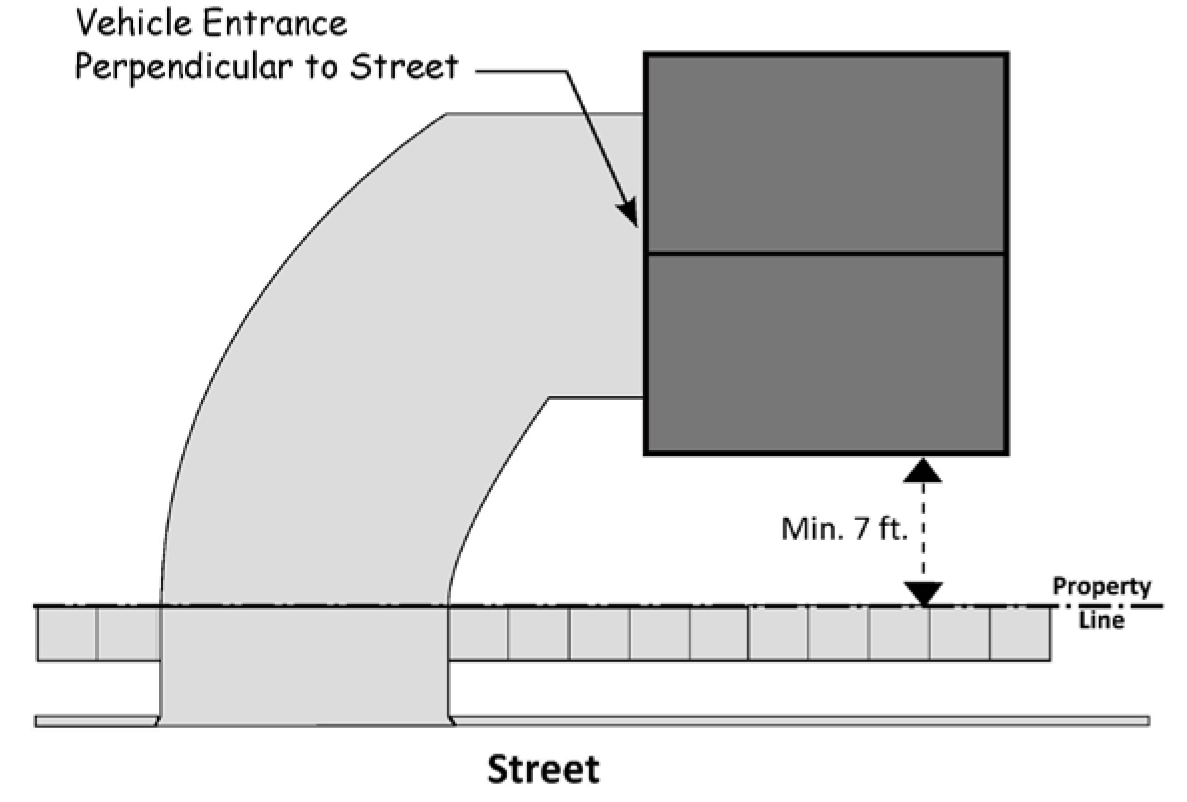
Vehicle entrance perpendicular to street. Where a garage or carport is located on a hillside lot with an average cross slope of 20 percent or more, and the vehicle entrance to the garage or carport is perpendicular to the street, the garage or carport shall have a minimum setback of seven feet from the street.
FIGURE 800-5. GARAGE/CARPORT SETBACK - VEHICLE ENTRANCE PERPENDICULAR TO STREET
(C)
Vision clearance. Notwithstanding subsections (e)(1)(A) and (B) of this section, minimum vision clearance requirements shall be maintained.
(f)
Trees. Building pads and driveways should be sited so as to preserve trees having a dbh of ten inches or greater.
(Prior Code, § 800.030; Ord. No. 31-13)
Sec. 800.031. - Maintenance easements for dwelling units.
No building permit shall be issued for a townhouse, zero side yard dwelling, or any other dwelling unit which is constructed contiguous to a property line unless the applicant provides a copy of a recorded easement from the owner of the property that abuts the dwelling unit providing for reasonable ingress, egress, and use of such abutting property for the purpose of maintaining, repairing, and replacing the premises. The easement shall be in a form approved by the City Attorney.
(Ord. No. 13-21, § 1(Exh. A), 2-14-2022)
Sec. 800.035. - Setbacks.
(a)
Setbacks to be unobstructed. Except as otherwise provided under subsection (b) of this section, required setbacks shall be unobstructed.
(b)
Permitted projections into required setbacks. Permitted projections into required setbacks are set forth in Table 800-2.
(c)
Zone-to-zone setbacks abutting property outside City limits or urban growth boundary.
(1)
Property located outside city limits. Where a zone-to-zone setback is required abutting a property located outside the City limits, the abutting zone for purposes of determining the required zone-to-zone setback shall be the equivalent City zone identified under SRC Chapter 260, Table 260-1, based on the comprehensive plan designation for the property and its zoning in the county.
(2)
Property located outside UGB. Where a zone-to-zone setback is required abutting a property located outside the urban growth boundary (UGB), the abutting zone for purposes of determining the required zone-to-zone setback shall be considered a residential zone.
(d)
Setbacks abutting an interstate freeway, railroad right-of-way, or alley.
(1)
The required setback abutting an interstate freeway, railroad right-of-way, or alley shall be considered either an interior front setback, an interior side setback, or an interior rear setback depending upon the dimensions and configuration of the lot.
(2)
Where the required interior front, interior side, or interior rear setback abutting an interstate freeway or railroad right-of-way is a zone-to-zone setback, the minimum required in interior front, interior side, or interior rear setback shall be five feet in-lieu of the zone-to-zone setback.
(Prior Code, § 800.035; Ord. No. 31-13; Ord. No. 6-19, § 1(Exh. A), 6-24-2019, eff. 7-24-2019; Ord. No. 13-21, § 1(Exh. A), 2-14-2022)
Sec. 800.040. - Special setbacks.
(a)
Generally. To afford better light, air, and vision on public streets and to permit the eventual widening of streets without creating nonconforming structures, special setbacks are hereby established. No structures or paving, other than those identified under subsection (d) of this section, shall be placed within a special setback.
(b)
Setback distance required; how measured. The special setback shall equal one-half of the right-of-way width specified in the Salem Transportation System Plan for the street's applicable classification. Special setbacks shall be measured at right angles to the centerline of the street, or, where there is no street, from the centerline of the right-of-way. Where the centerline is not designated, the Director shall designate the location of the centerline.
(c)
Relationship to other required setbacks. The special setback shall apply in addition to other setbacks required under the UDC. Setbacks required elsewhere under the UDC shall be measured from the special setback line.
(d)
Permitted structures and paving within special setbacks. The following structures and paving are permitted within a special setback with a removal agreement as set forth in subsection (e) of this section:
(1)
Transit stop shelters.
(2)
Signs and their supporting members.
(3)
Fences.
(4)
Off-street parking provided such parking is developed in conformance with the setback and landscaping requirements set forth in SRC chapter 806.
(e)
Removal agreement. Where structures or paving, as permitted under subsection (d) of this section, are proposed to be placed within a special setback, a removal agreement shall be required as provided in this subsection.
(1)
The removal agreement shall be entered into by:
(A)
The owner of the property and the local transit operator, for transit stop shelters located within a special setback. The local transit operator shall have the obligation to remove the shelter when required.
(B)
The owner of the property and/or owner of the sign, for signs and their supporting members located within a special setback.
(C)
The owner of the property, for fences and off-street parking located within a special setback.
(2)
The removal agreement shall be in a form approved by the City Attorney and shall provide that:
(A)
Within six months after notice by the City, any structure, paving, or portion thereof that extends into the special setback shall be completely removed at no expense to the City;
(B)
Where off-street parking set forth in subsection (d) of this section is removed, any remaining portion of the parking area located outside of the special setback shall be brought into conformance with the setback and landscaping requirements set forth in SRC chapter 806 at no expense to the City;
(C)
If the owner or transit operator fails or refuses to make the removal, or fails or refuses to make required improvements to any remaining portion of the parking area located outside of the special setback, the City may cause the removal, or the required parking area improvement, to be made, and the costs incurred shall:
(i)
Be a lien against the property if the removal agreement was entered into by the owner of the property, which may be foreclosed in the manner provided by law;
(ii)
Be the obligation of the transit operator if the removal agreement was entered by the owner and the local transit operator, and that, in the event an action must be brought to enforce the obligation, that the City shall be entitled to its attorney's fees and costs incurred in enforcing the obligation.
(D)
The property owner, sign owner, or transit operator shall not be entitled to damages or compensation as the result of City's exercise of its rights under the removal agreement; provided, however, the property owner shall retain his or her right to just compensation for the unimproved value of any land taken for the widening of the street.
(3)
The removal agreement shall be recorded with the county in which the property is located. Notice to remove any structure, paving, or portion thereof shall not be given until the City or the State proceeds with a project to widen the street in front of the property.
(Prior Code, § 800.040; Ord. No. 31-13; Ord. No. 4-23, § 1(Exh. A), 4-24-2023)
Sec. 800.045. - Height.
(a)
Generally. Unless otherwise provided under the UDC, standards relating to height shall apply to all buildings and structures. Height shall be measured as set forth in SRC chapter 112.
(b)
Height exceptions. Except as otherwise provided in this subsection, the following height exceptions are permitted under the UDC:
(1)
Towers, steeples, chimneys, wind-driven electrical generating equipment, flag poles, and monuments may project above the maximum height limits set forth in the UDC, provided:
(A)
They do not exceed 185 feet in height;
(B)
They do not contain any habitable space;
(C)
The horizontal section of the structure does not exceed 625 square feet at the top of the main building or structure; and
(D)
The sum of the horizontal section of all such projections measured at the maximum height limit applicable to the building or structure on which they are located does not exceed 20 percent of the horizontal area of the roof of the building or structure on which they are located.
(2)
Radio, television, and microwave antennas, and structures used exclusively for their support, are exempt from all height limitations.
(3)
Mechanical equipment necessary for the operation or maintenance of a building or structure, including, but not limited to, ventilators, plumbing and vent stacks, cooling towers, water tanks, panels or collectors for solar energy, and window washing equipment, together with enclosures for any such equipment, may project above the maximum height limits set forth in the UDC, provided:
(A)
They do not project more than 15 feet above the roof;
(B)
They do not contain any habitable space;
(C)
The sum of the horizontal section of all such projections measured at the maximum height limit applicable to the building or structure on which they are located does not exceed 60 percent of the horizontal area of the roof of the building or structure on which they are located;
(4)
Relationship to FAA Part 77 Surfaces. Notwithstanding subsections (b)(1) through (3) of this section, nothing in this subsection shall authorize the projection of a building or structure into an FAA Part 77 surface established under SRC chapter 602.
(c)
Height of structures within 165 feet of capitol mall district. Except as provided under subsection (b) of this section, no portion of a building or structure located outside of, but within 165 feet of, the external boundary of the Capitol Mall (PM) Zone shall exceed a height of 70 feet.
(Prior Code, § 800.045; Ord. No. 31-13)
Sec. 800.050. - Fences, walls, hedges, gates, and retaining walls.
Unless otherwise provided under the UDC, the standards set forth in this section shall apply to fences, walls, hedges, gates, and retaining walls in all zones. Where screening is required under the UDC in the form of a fence, wall, or hedge, it shall meet the standards set forth in SRC chapter 807, in addition to the standards set forth in this section. For purposes of this section, the term "front yard" means that portion of a lot located between the front property line and a line parallel to the front property line extended from the wall of the main building lying at the greatest distance from the front property line.
(a)
Location, height, and density. Fences, walls, hedges, gates, and retaining walls shall comply with the location, height, and density standards set forth in this subsection.
(1)
Fences and walls.
(A)
Residential zones and property used for uses falling under household living in other zones. Fences and walls within residential zones, or on property used for uses falling under household living in other zones, shall not exceed a maximum height of eight feet; provided, however:
(i)
Front yard abutting street. Fences and walls within a front yard abutting a street shall not exceed a maximum height of four feet when located within 20 feet of the property line abutting the street; provided, however, within ten feet of the property line abutting the street any portion of the fence or wall above 30 inches in height shall be less than 25 percent opaque when viewed at any angle at a point 25 feet away from the fence or wall.
(ii)
Side and rear yards abutting street. Fences and walls within a side or rear yard abutting a street shall not exceed a maximum height of six feet when located within ten feet of a property line abutting a street.
(B)
Nonresidential zones. Except for fences and walls on property used for uses falling under household living, fences and walls within nonresidential zones shall not exceed a maximum height of 12 feet; provided, however:
(i)
Front, side, and rear yards abutting street. Fences and walls within a front, side, or rear yard abutting a street shall not exceed a maximum height of eight feet when located within ten feet of a property line abutting a street; provided, however, any portion of the fence or wall above 30 inches in height shall be less than 25 percent opaque when viewed at any angle at a point 25 feet away from the fence or wall.
(2)
Hedges. There is no maximum height limitation for hedges; provided, however, where a hedge is located within ten feet of a property line abutting a street, any portion of the hedge more than 30 inches in height shall be less than 25 percent opaque when viewed at any angle at a point 25 feet away from the hedge.
(3)
Gates. Where a gate is part of a fence, wall, or hedge it shall conform to the height limitations applicable to fences and walls set forth under SRC 800.050(a)(1). Gates shall not swing open onto a public right-of-way or vehicle or pedestrian easement.
(4)
Retaining walls. Retaining walls shall not exceed a maximum height of four feet when located at the property line abutting a street. Retaining walls not located at the property line abutting a street may exceed four feet in height.
(b)
Vision clearance. Notwithstanding any other provision of this section, fence, walls, hedges, gates, and retaining walls shall conform to the vision clearance requirements of SRC chapter 805.
(c)
Material.
(1)
Fences. Fences shall be constructed of materials specifically designed and manufactured for fencing purposes, including, but not limited to, wooden pickets, vinyl, wrought iron, and chainlink fencing, with or without plastic or wood slats. Materials not specifically designed as fencing material, including, but not limited to, corrugated cardboard, corrugated metal, plywood, wooden pallets, garage doors, concrete rubble, and other junked material, are prohibited. Chicken wire may be used within the Residential Agriculture (RA) Zone if used to raise livestock. Fencing for raising livestock in other zones may be replaced if the use was an allowed use on the property prior to December 31, 2002. Fencing used for the establishment and protection of vegetation is permitted for a period not to exceed six months.
(2)
Walls. Walls shall be constructed of materials specifically designed and manufactured for use as walls, including, but not limited to, masonry, rock, concrete, concrete block, or other similar material.
(d)
Hazardous materials. Fences and walls shall not be constructed of or contain any material which will do bodily harm, such as electric or barbed wire, upturned barbed selvage, broken glass, spikes, or any other hazardous or dangerous material, except as follows:
(1)
Concertina wire. Concertina wire is permitted around state and county correctional facilities and secure mental health facilities.
(2)
Barbed wire and upturned barbed selvage.
(A)
Location. Barbed wire and upturned barbed selvage is permitted within the following locations:
(i)
Any zone where the fence will be used to enclose livestock; and
(ii)
The Retail Commercial (CR) and General Commercial (CG) Zones, any industrial or public zone, and any zone where the fence will be used to enclose an electrical substation.
(B)
Standards. Where allowed as set forth this subsection, barbed wire or upturned barbed selvage shall comply with the following additional standards:
(i)
Enclosure of livestock. Fences with barbed wire or upturned barbed selvage enclosing livestock shall be clearly posted with warning signs notifying persons of a dangerous fence. The signs shall be posted at an interval of not less than 15 feet.
(ii)
CR and CG zones; industrial and public zones; enclosure of electrical substations. Fences with barbed wire or upturned barbed selvage located within a Retail Commercial (CR) or General Commercial (CG) Zone, within an industrial or public zone, or enclosing an electrical substation shall comply with the following:
(aa)
The barbed wire or upturned barbed selvage shall be located more than six feet above grade;
(bb)
The barbed wire or upturned barbed selvage shall be setback a minimum of one foot from the public right-of-way, when designed to slant towards the public right-of-way;
(cc)
The barbed wire or upturned barbed selvage shall not extend over a street or alley; and
(dd)
The fence shall be clearly posted with warning signs notifying persons of a dangerous fence. The signs shall be posted at an interval of not less than 15 feet.
(3)
Electric fencing.
(A)
Location. Electric fencing is permitted within the following locations:
(i)
Any zone where the fence will be used to enclose livestock; and
(ii)
Around outdoor storage areas, including vehicle storage areas, for any nonresidential use within the General Commercial (CG) zone or any industrial zone.
(B)
Standards. Where allowed as set forth in this subsection, electric fencing shall comply with the following additional standards:
(i)
Enclosure of livestock. Electric fencing enclosing livestock shall be clearly posted with warning signs notifying persons of a dangerous fence. The signs shall be posted at an interval of not less than 15 feet.
(ii)
Outdoor storage areas for nonresidential uses within the CG Zone and industrial zones. Electric fencing around outdoor storage areas, including vehicle storage areas, for any nonresidential use within the General Commercial (CG) zone or any industrial zone shall comply with the following:
(aa)
The fence shall not exceed ten feet in height and shall be completely surrounded by a non-electric fence or wall a minimum of six feet in height.
(bb)
A minimum one-foot separation shall be maintained between the electric fence and the surrounding non-electric fence or wall.
(cc)
An electrical permit and inspection shall be obtained prior to installation.
(dd)
The electric fence shall be listed by a testing laboratory approved by the State, and shall be installed and used in accordance with the testing laboratory listing.
(ee)
The fence shall be clearly posted with warning signs in English and Spanish notifying persons of a dangerous fence. The signs shall include the statement, "DANGER - ELECTRIC FENCE," or an equivalent, together with a pictorial warning. The signs shall be posted at an interval of not more than 60 feet.
(ff)
Emergency access. Fire department access shall be provided in accordance with the Salem Fire Prevention Code. An approved method to manually disconnect electrical power to all portions of the fence and gates shall be provided at an exterior location. The method and location of the electrical disconnect shall be approved by the Salem Fire Code Official.
(e)
Maintenance. Fences and walls shall be structurally maintained in safe condition. Wooden materials shall be protected from rot, decay, and insect infestation, and replaced as necessary. Failure to maintain an electric fence in conformance with the standards set forth in this section shall result in the fence being declared a public nuisance subject to abatement under SRC chapter 50.
(Prior Code, § 800.050; Ord. No. 31-13; Ord. No. 6-19, § 1(Exh. A), 6-24-2019, eff. 7-24-2019; Ord. No. 13-21, § 1(Exh. A), 2-14-2022)
Sec. 800.055. - Solid waste service areas.
Solid waste service areas shall provide for the safe and convenient collection of solid waste and recyclable and compostable materials by the local solid waste collection franchisee.
(a)
Applicability. Solid waste service area design standards shall apply to:
(1)
All new solid waste, recycling, and compostable service areas, where use of a solid waste, recycling, and compostable receptacle of one cubic yard or larger is proposed; and
(2)
Any change to an existing solid waste service area for receptacles of one cubic yard or larger that requires a building permit.
(b)
Solid waste receptacle placement standards. All solid waste receptacles shall be placed at grade on a concrete pad that is a minimum of four inches thick, or on an asphalt pad that is a minimum of six inches thick. The pad shall have a slope of no more than a three percent and shall be designed to discharge stormwater runoff consistent with the overall stormwater management plan for the site approved by the Director.
(1)
Pad area. In determining the total concrete pad area for any solid waste service area:
(A)
The pad area shall extend a minimum of one foot beyond the sides and rear of the receptacle; and
(B)
The pad area shall extend a minimum three feet beyond the front of the receptacle.
(C)
In situations where receptacles face each other, a minimum four feet of pad area shall be required between the fronts of the facing receptacles.
(2)
Minimum separation.
(A)
A minimum separation of 1.5 feet shall be provided between the receptacle and the side wall of the enclosure.
(B)
A minimum separation of five feet shall be provided between the receptacle and any combustible walls, combustible roof eave lines, or building or structure openings.
(3)
Vertical clearance.
(A)
Receptacles two cubic yards or less. Receptacles two cubic yards or less in size shall be provided with a minimum of eight feet of unobstructed overhead or vertical clearance for servicing.
(B)
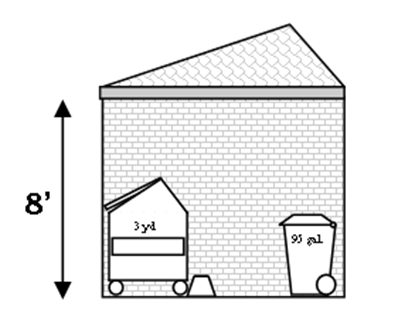
Receptacles greater than two cubic yards. Receptacles greater than two cubic yards in size shall be provided with a minimum of 14 feet of unobstructed overhead or vertical clearance for servicing; provided, however, overhead or vertical clearance may be reduced to eight feet:
(i)
For enclosures covered by partial roofs, where the partial roof over the enclosure does not cover more than the rear eight feet of the enclosure, as measured from the inside of the rear wall of the enclosure (see Figure 800-6); or
(ii)
Where a physical barrier is installed within, and a maximum of eight feet from the front opening of, the enclosure preventing the backward movement of the receptacle (see Figure 800-7).
FIGURE 800-6 REDUCED OVERHEAD OR VERTICAL CLEARANCE FOR PARTIALLY ROOFED ENCLOSURES
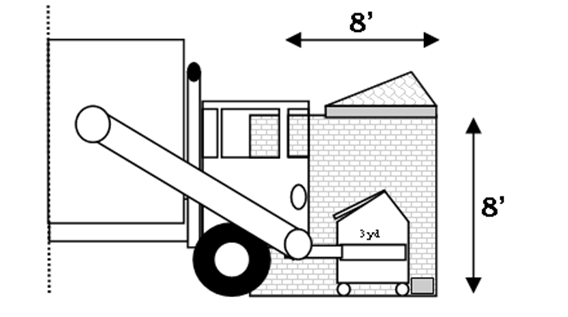
FIGURE 800-7 REDUCED OVERHEAD OR VERTICAL CLEARANCE FOR ENCLOSURES WITH INTERAL PHYSICAL BARRIER
(c)
Permanent drop box and compactor placement standards.
(1)
All permanent drop boxes shall be placed on a concrete pad that is a minimum of six inches thick. The pad shall have a slope of no more than one percent and shall be designed to discharge stormwater runoff consistent with the overall stormwater management plan for the site approved by the Director.
(2)
All permanent compactors shall be placed on a concrete pad that is structurally engineered or in compliance with the manufacturer specifications. The pad shall have a slope of no more than three percent and shall be designed to discharge stormwater runoff consistent with the overall stormwater management plan for the site approved by the Director.
(3)
Pad area. The pad area shall be a minimum of 12 feet in width. The pad area shall extend a minimum of five feet beyond the rear of the permanent drop box or compactor.
(4)
Minimum separation. A minimum separation of five feet shall be provided between the permanent drop box or compactor and any combustible walls, combustible roof eave lines, or building or structure openings.
(d)
Solid waste service area screening standards.
(1)
Solid waste, recycling, and compostable service areas shall be screened from all streets abutting the property and from all abutting residentially zoned property by a minimum six-foot-tall sight-obscuring fence or wall; provided, however, where receptacles, drop boxes, and compactors are located within an enclosure, screening is not required. For the purpose of this standard, abutting property shall also include any residentially zoned property located across an alley from the property.
(2)
Existing screening at the property line shall satisfy screening requirements if it includes a six-foot-tall sight-obscuring fence or wall.
(e)
Solid waste service area enclosure standards. When enclosures are used for required screening or aesthetics, such enclosures shall conform to the standards set forth in this subsection. The overall dimensions of an enclosure are dependent upon the number and size of receptacles the enclosure is designed to accommodate.
(1)
Front opening of enclosure. The front opening of the enclosure shall be unobstructed and shall be a minimum of 12 feet in width.
(2)
Measures to prevent damage to enclosure.
(A)
Enclosures constructed of wood or chainlink fencing material shall contain a minimum four-inch nominal high bumper curb at ground level located 12 inches inside the perimeter of the outside walls of the enclosure to prevent damage from receptacle impacts.
(B)
Enclosures constructed of concrete, brick, masonry block, or similar types of material shall contain a minimum four-inch nominal high bumper curb at ground level located 12 inches inside the perimeter of the outside walls of the enclosure, or a fixed bumper rail to prevent damage from receptacle impacts.
(C)
The requirements under subsections (e)(2)(A) and (B) of this section shall not apply if the enclosure is designed to be separated:
(i)
A minimum distance of two feet from the sides of the container or receptacles; and
(ii)
A minimum of three feet from the rear of the container or receptacles.
(3)
Enclosure gates. Any gate across the front opening of an enclosure shall swing freely without obstructions. For any enclosure opening with an unobstructed width of less than 15 feet, the gates shall open a minimum of 120 degrees. For any enclosure opening with an unobstructed width of 15 feet or greater, the gates shall open a minimum of 90 degrees. All gates shall have restrainers in the open and closed positions.
(4)
Prohibited enclosures. Receptacles shall not be stored in buildings or entirely enclosed structures unless the receptacles are:
(A)
Stored in areas protected by an automatic sprinkler system approved by the City Fire Marshal; or
(B)
Stored in a building or structure of a fire resistive Type I or Type IIA construction that is located not less than ten feet from other buildings and used exclusively for solid waste receptacle storage.
(f)
Solid waste service area vehicle access.
(1)
Vehicle operation area.
(A)
A vehicle operation area shall be provided for solid waste collection service vehicles that is free of obstructions and no less than 45 feet in length and 15 feet in width; provided, however, where the front opening of an enclosure is wider than 15 feet, the width of the vehicle operation area shall be increased to equal the width of the front opening of the enclosure. Vehicle operation areas shall be made available perpendicular to the front of every receptacle, or, in the case of multiple receptacles within an enclosure, perpendicular to every enclosure opening.
(B)
For solid waste service areas having receptacles of two cubic yards or less, the vehicle operation area may be located:
(i)
Perpendicular to the permanent location of the receptacle or the enclosure opening (see Figure 800-8);
(ii)
Parallel to the permanent location of the receptacle or the enclosure opening (see Figure 800-9); or
(iii)
In a location where the receptacle can be safely maneuvered manually not more than 45 feet into a position at one end of the vehicle operation area for receptacle servicing.
FIGURE 800-8. VEHICLE OPERATION AREA PERPENDICULAR TO FRONT OF ENCLOSURE

FIGURE 800-9. VEHICLE OPERATION AREA PARALLEL TO FRONT OF ENCLOSURE

(C)
The vehicle operation area may be coincident with a parking lot drive aisle, driveway, or alley provided that such area is kept free of parked vehicles and other obstructions at all times except for the normal ingress and egress of vehicles.
(D)
Vertical clearance. Vehicle operation areas shall have a minimum vertical clearance of 14 feet.
(E)
In the event that access to the vehicle operation area is not a direct approach into position for operation of the service vehicle, a turnaround, in conformance with the minimum dimension and turning radius requirements shown in Figure 800-10, shall be required to allow safe and convenient access for collection service.
FIGURE 800-10. VEHICLE OPERATION AREA PARALLEL TO FRONT OF ENCLOSURE

(2)
Vehicle operation areas shall be designed so that waste collection service vehicles are not required to back onto a public street or leave the premises.
(3)
Vehicle operation areas shall be paved with asphalt, concrete, or other hard surfacing approved by the Director, and shall be adequately designed, graded, and drained to the approval of the Director.
(4)
Signs. "No Parking" signs shall be placed in a prominent location on the enclosure, or painted on the pavement in front of the enclosure or receptacle, to ensure unobstructed and safe access for the servicing of receptacles.
(g)
Notice to solid waste collection franchisee. Upon receipt of an application to vary or adjust the standards set forth in this section, notification and opportunity to comment shall be provided to the applicable solid waste collection franchisee. Notice required under this subsection shall be in addition to the notification required for a variance or adjustment under SRC chapter 300.
(Prior Code, § 800.055; Ord. No. 31-13; Ord. No. 1-20, § 2(Exh. B), 2-24-2020)
Sec. 800.060. - Exterior lighting.
(a)
Exterior lighting shall not shine or reflect onto adjacent properties, or cast glare onto the public right-of-way.
(b)
Exterior light fixtures shall be located and designed so that the light source, when viewed at a height of five feet above the ground at a distance of five feet outside the boundary of the lot, shall be either:
(1)
Completely shielded from direct view; or
(2)
No greater than five foot-candles in illumination.
(Prior Code, § 800.060; Ord. No. 31-13)
Sec. 800.065. - Pedestrian access.
Except where pedestrian access standards are provided elsewhere under the UDC, and unless otherwise provided in this section, all developments, other than development of single-family, two-family, three-family, and four-family uses, and multiple family uses subject to SRC chapter 702, shall include an on-site pedestrian circulation system developed in conformance with the standards in this section. For purposes of this section development means the construction of, or addition to, a building or accessory structure or the construction of, or alteration or addition to, an off-street parking or vehicle use area. Development does not include construction of, or additions to, buildings or accessory structures that are less than 200 square feet in floor area. Development also does not include the installation of electric vehicle charging stations in existing approved parking lots or vehicle use areas.
(a)
Pedestrian connections required. The on-site pedestrian circulation system shall provide pedestrian connectivity throughout the development site as follows:
(1)
Connection between building entrances and streets.
(A)
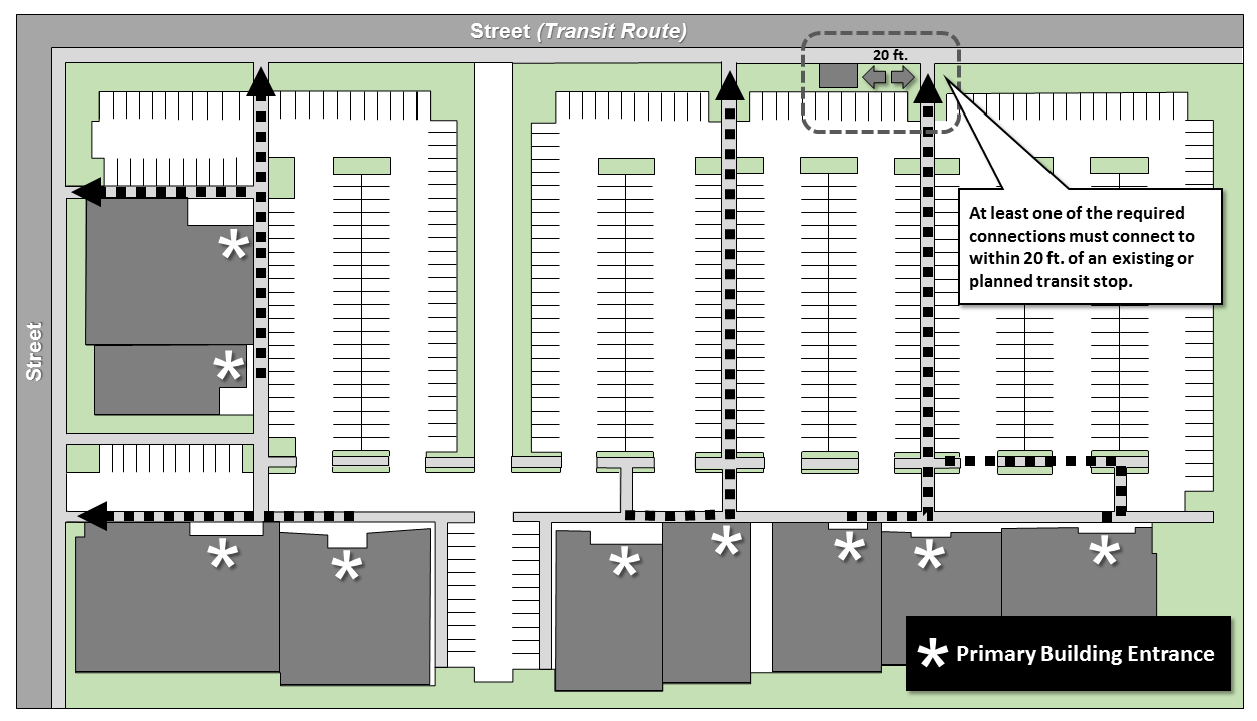
Except as otherwise provided in this subsection, a pedestrian connection shall be provided between the primary building entrance of each building on the development site and each adjacent street. Where a building has more than one primary building entrance, a single pedestrian connection from one of the building's primary entrances to each adjacent street is allowed; provided each of the building's primary entrances are connected, via a pedestrian connection, to the required connection to the street (see Figure 800-11).
(B)
Where an adjacent street is a transit route and there is an existing or planned transit stop along street frontage of the development site, at least one of the required pedestrian connections shall connect to the street within 20 feet of the transit stop (see Figure 800-12).
(C)
A pedestrian connection is not required between the primary building entrance of a building and each adjacent street if:
(i)
The development site is a corner lot and the building has a primary building entrance that is located within 20 feet of, and has a pedestrian connection to, the property line abutting one of the adjacent streets; or
(ii)
The building is a service, storage, maintenance, or similar type building not primarily intended for human occupancy.
FIGURE 800-11. PEDESTRIAN CONNECTIONS BETWEEN BUILDING ENTRANCES AND STREET
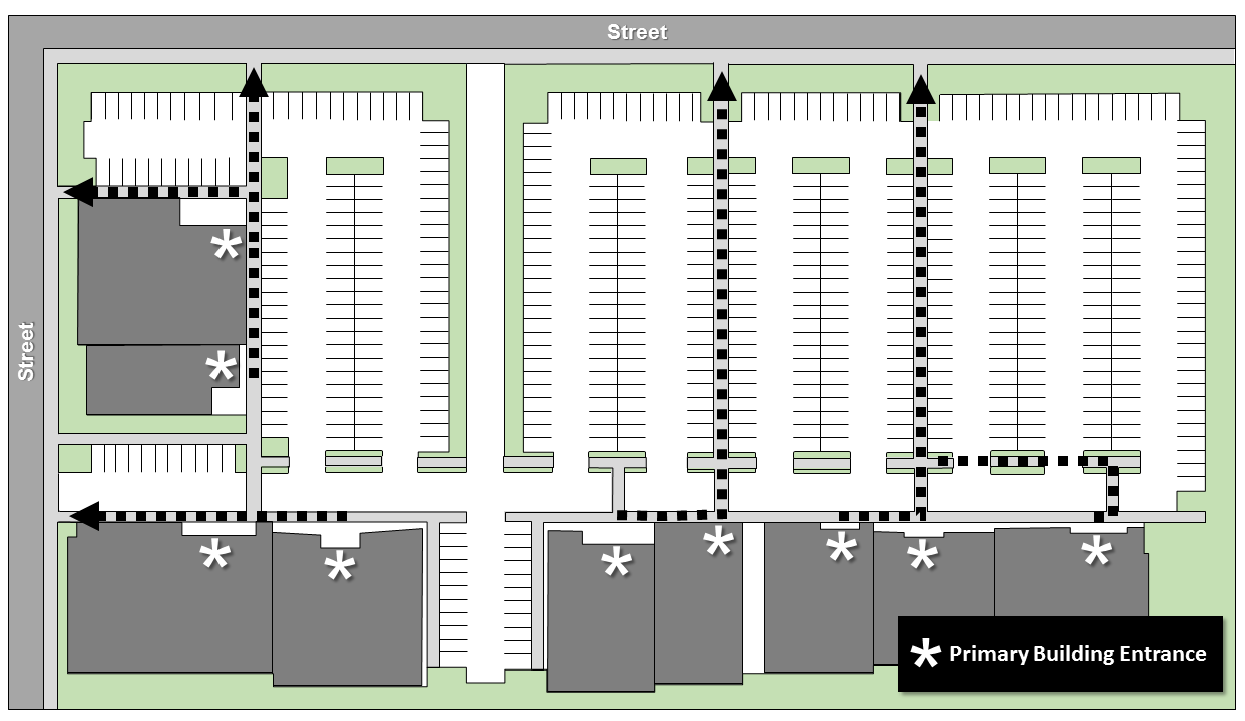
FIGURE 800-12. PEDESTRIAN CONNECTIONS ABUTTING TRANSIT ROUTE
(2)
Connection between buildings on the same development site.
(A)
Except as otherwise provided in this subsection, where there is more than one building on a development site, a pedestrian connection, or pedestrian connections, shall be provided to connect the primary building entrances of all of the buildings.
(B)
A pedestrian connection, or pedestrian connections, is not required between buildings on the same development site if:
(i)
The buildings have a primary building entrance that is located within 20 feet of, and has a pedestrian connection to, the property line abutting a street; and
(ii)
A public sidewalk within the adjacent street right-of-way provides pedestrian access between the primary building entrances; or
(iii)
The buildings are service, storage, maintenance, or similar type buildings not primarily intended for human occupancy.
(3)
Connection through off-street parking areas.
(A)
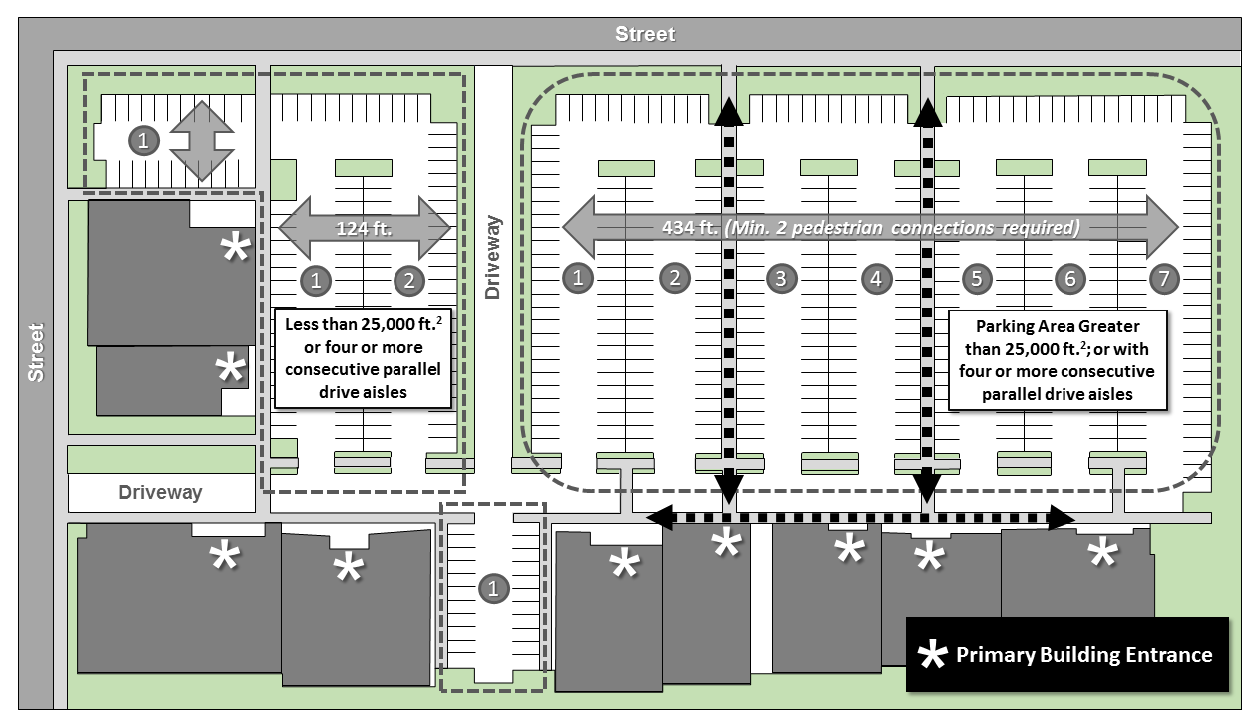
Surface parking areas. Except as provided under subsection (a)(3)(A)(iii) of this section, off-street surface parking areas greater than 25,000 square feet in size or including four or more consecutive parallel drive aisles shall include pedestrian connections through the parking area to the primary building entrance or where there is no building, through the parking area as provided in this subsection.
(i)
The pedestrian connections shall be:
(aa)
Provided in a minimum amount of either one connection for every four drive aisles or one connection for every 250 feet (See Figure 800-13); provided, however, in no case shall less than one pedestrian connection be provided. Where the pedestrian connection requirements of this subsection result in a fractional number, any fractional number greater than 0.5 shall be round up to require an additional pedestrian connection;
(bb)
Spaced a minimum of two drive aisles apart; and
(cc)
Connected to a pedestrian connection, or pedestrian connections, that lead to the primary building entrance. Where there is no building, the pedestrian connections shall connect to the street either at the sidewalk or at the public street right-of-way when there is no sidewalk.
(ii)
Where the off-street surface parking area is adjacent to a street that is a transit route and there is an existing or planned transit stop along the street frontage of the development site, at least one of the required pedestrian connections shall connect to the street within 20 feet of the transit stop.
(iii)
A pedestrian connection provided between a primary building entrance and a street may be counted as a required connection through an off-street surface parking area.
(iv)
Regardless of the size of the off-street parking area, pedestrian connections are not required through off-street surface parking areas that have a depth, in all locations, of not more than 124 feet. For purposes of this subsection, parking area depth is measured through the parking area from its outside edge towards the building.
(v)
For purposes of this subsection, off-street surface parking area means:
(aa)
An off-street surface parking area that is separated from other off-street surface parking areas on the development site by either a driveway, which begins at the street and extends into the site, or other physical separation; or
(bb)
An off-street surface parking area located in a separate location on the development site from other off-street surface parking areas.
FIGURE 800-13. PEDESTRIAN CONNECTIONS THROUGH OFF-STREET
PARKING AREAS
(B)
Parking structures and parking garages. Where an individual floor of a parking structure or parking garage exceeds 25,000 square feet in size, a pedestrian connection shall be provided through the parking area on that floor to an entrance/exit.
(4)
Connection to existing or planned paths and trails. Where an existing or planned path or trail identified in the Salem Transportation System Plan (TSP) or the Salem Comprehensive Parks System Master Plan passes through a development site, the path or trail shall:
(A)
Be constructed, and a public access easement or dedication provided; or
(B)
When no abutting section of the trail or path has been constructed on adjacent property, a public access easement or dedication shall be provided for future construction of the path or trail.
(5)
Connection to abutting properties. Whenever a vehicular connection is provided from a development site to an abutting property, a pedestrian connection shall also be provided. A pedestrian connection is not required, however:
(A)
To abutting properties used for activities falling within the following use classifications, use categories, and uses under SRC chapter 400:
(i)
Single-family;
(ii)
Two-family;
(iii)
Group living;
(iv)
Industrial;
(v)
Infrastructure and utilities; and
(vi)
Natural resources.
(B)
Where the use of an abutting property has specific security needs that make providing a connection impractical or undesirable;
(C)
Where on-site activities on abutting properties, such as the operation of trucks, forklifts, and other equipment and machinery would present safety conflicts with pedestrians;
(D)
Where buildings or other improvements on abutting properties physically preclude a connection now or in the future; or
(E)
Where physical conditions of the land, such as topography or existing natural resource areas, including, but not limited to, wetlands, ponds, lakes, streams, or rivers, make providing a connection impractical.
(b)
Design and materials. Required pedestrian connections shall be in the form of a walkway, or may be in the form of a plaza. Where a path or trail identified in the Salem Transportation System Plan (TSP) or Salem Comprehensive Parks System Master Plan is required, the path or trail shall conform to the applicable standards of the TSP or Salem Comprehensive Parks System Master Plan in-lieu of the standards in this subsection.
(1)
Walkways shall conform to the following:
(A)
Material and width. Walkways shall be paved with a hard-surface material and shall be a minimum of five feet in width.
(B)
Where a walkway crosses driveways, parking areas, parking lot drive aisles, and loading areas, the walkway shall be visually differentiated from such areas through the use of elevation changes, a physical separation, speed bumps, a different paving material, or other similar method. Striping does not meet this requirement, except when used in a parking structure or parking garage.
(C)
Where a walkway is located adjacent to an auto travel lane, the walkway shall be raised above the auto travel lane or separated from it by a raised curb, bollards, landscaping or other physical separation. If the walkway is raised above the auto travel lane it must be raised a minimum of four inches in height and the ends of the raised portions must be equipped with curb ramps. If the walkway is separated from the auto travel lane with bollards, bollard spacing must be no further than five feet on center.
(2)
Wheel stops or extended curbs shall be provided along required pedestrian connections to prevent the encroachment of vehicles onto pedestrian connections.
(c)
Lighting. The on-site pedestrian circulation system shall be lighted to a level where the system can be used at night by employees, customers, and residents.
(d)
Applicability of standards to development sites comprised of lots under separate ownership.
(1)
When a development site is comprised of lots under separate ownership, the pedestrian access standards set forth in this section shall apply only to the lot, or lots, proposed for development, together with any additional contiguous lots within the development site that are under the same ownership as those proposed for development.
(2)
Where the pedestrian access standards of this section would otherwise require additional pedestrian connections throughout the development site beyond just the lot, or lots, proposed for development and any contiguous lots under the same ownership, the required pedestrian connections shall be extended to the boundaries of the lot, or lots, proposed for development and any contiguous lots under the same ownership in order to allow for future extension of required pedestrian connections through the other lots within the development site in conformance with the standards in this section.
(Ord. No. 6-19, § 1(Exh. A), 6-24-2019, eff. 7-24-2019; Ord. No. 1-20, § 2(Exh. B), 2-24-2020; Ord. No. 13-21, § 1(Exh. A), 2-14-2022; Ord. No. 4-23, § 1(Exh. A), 4-24-2023; Ord. No. 8-24, § 1(Exh. A), 9-23-2024)

