
Salem City Zoning Code
CHAPTER 200
URBAN GROWTH MANAGEMENT
Sec. 200.001.- Purpose.
The purpose of this chapter is to implement the urban growth policies of the Salem Area Comprehensive Plan in order to control and accommodate the growth within the urban growth boundary.
(Prior Code, § 200.001; Ord. No. 31-13)
Sec. 200.005. - Definitions.
The following words, terms and phrases, when used in this chapter, shall have the meanings ascribed to them in this section, except where the context clearly indicates a different meaning:
Adequate facilities means major and minor facilities that are in place and meet the master plan requirement for service.
Area facility plan means a public facility plan establishing minor facilities for a defined geographic area that was not fully planned in the applicable master plan.
Complex means a group of structures, or a single structure containing multiple businesses that is functionally or conceptually integrated, regardless of the ownership of the development or underlying land.
Developer contributions means voluntary and non-reimbursable funding by a private developer of all or a portion of the costs of construction of a major or minor facility, intended to reduce the public costs of a potential new urban service area expansion area.
Development means:
(a)
The subdivision of land;
(b)
The construction of a planned unit development;
(c)
The establishment of a mobile home park;
(d)
The construction or structural alteration of a building or structure which will result in increased usage of a public facility; provided, however, that any such construction or structural alteration undertaken in connection with one of the following shall not be considered development for purposes of this chapter:
(1)
Construction or alteration of any building or structure in the following land use classifications under SRC chapter 400:
(A)
Single family;
(B)
Two family;
(C)
Basic utilities;
(D)
Wireless communication facilities.
(2)
Any use established and conducted by the City.
(3)
Construction or structural alteration of a building or structure to comply with existing state or local health, sanitary, or safety code specifications that are solely necessary to assure safe living conditions.
(4)
Construction or structural alteration undertaken for purposes of adaptive reuse under SRC chapter 230, provided that such construction or structural alteration is for the purposes of adaptive reuse only.
(5)
Construction or structural alteration of any building or structure in a complex, provided there is no cumulative increase in total floor area of all buildings and structures within the complex that exceeds 60 percent of the total floor area within any period of three consecutive years. Example: Construction or alteration would not be exempt from this chapter if the total floor area of existing buildings and structures in the complex = 100,000 square feet and cumulative new floor area = 61,000 square feet in the years 2010, 2011, and 2012. For the purposes of this subsection, the percent increase shall be based on the building square footage before the construction or structural alteration is started, or if the building or structure has been damaged and is being restored, before the damage occurred.
Fair market value means the appraised value, as of the date of the Urban Growth Preliminary Declaration, of land reserved for conveyance to the City for public park use. The appraisal shall be procured by the City at the developer's expense, and will be an allowable cost for reimbursement to the developer.
Fully committed means all major and minor facilities required to adequately serve a defined geographic area are provided for in one or more of the following:
(a)
The City's capital construction budget or Capital Improvement Program, but including any major and minor facilities that will be funded by a general obligation bond or other mechanism that requires a vote of the electors of the City;
(b)
An improvement agreement secured by performance guarantees executed prior to approval of construction plans or the expenditure of any matching public funds, if any, by the City;
(c)
A project in an urban renewal plan;
(d)
Commitment to fund and build the major or minor facility within five years of the date of the development will commence has been made by some entity other than the City, including, but not limited to, the State.
Improvement agreement means an agreement between a developer and the City that implements the conditions of a land use approval.
In place means that a required facility has been constructed and is in service.
Major facility means one or more of the following public facilities: an arterial or collector street as shown in the Salem Transportation System Plan; a sewer collection line or sewer pump station shown in the Salem Area Wastewater Management Master Plan; water distribution line, water pump station, or a water reservoir shown in the Water System Master Plan; a storm drainage facility shown in the Stormwater Master Plan; or a park shown in the Comprehensive Park System Master Plan.
Master plans means, collectively, the following:
(a)
Comprehensive Park System Master Plan, adopted May 13, 2013.
(b)
Salem Area Wastewater Management Master Plan, adopted December 16, 1996, and amended September 23, 2002; February 7, 2005; and April 9, 2007.
(c)
Salem Transportation System Plan, adopted June 28, 1998, and amended February 14, 2000; May 14, 2001; January 24, 2005; March 28, 2005; April 23, 2007; April 26, 2010; and December 10, 2012
(d)
Stormwater Master Plan, adopted September 25, 2000.
(e)
Water System Master Plan, adopted April 25, 1994, and amended September 23, 1996; October 25, 1999; February 7, 2005; and July 9, 2007.
Minor facility means a public facility other than a major facility.
Planned means the nature, capacity and location of the major or minor facility have been specifically designated in a master plan.
Public facility means infrastructure to provide transportation, water, wastewater, stormwater or parks for the benefit of the general public.
Required facilities means all major and minor facilities necessary to provide adequate water, sewer, storm drainage, transportation and parks for a development for which a Urban Growth Area Preliminary Declaration must be obtained, and including any major facility which falls within 260 feet of the boundaries of the development, measured at right angles to the length of the boundary of the development site.
Secondary benefit value means the dollar value of a public facility that will provide a new or improved service to already developed areas either in or out of the existing urban service area.
Urban growth area means that territory of the City lying between the urban service area and the urban growth boundary.
Urban service area means that territory of the City where all required facilities are in place or fully committed, and designated as such pursuant to SRC 200.010.
(Prior Code, § 200.005; Ord. No. 31-13)
Sec. 200.010. - Urban service area establishment; effect.
(a)
Following adoption of a capital improvement plan and upon consideration of the extent to which the five required facility types defined in SRC 200.005 are in place or fully committed, the Council may, by ordinance, designate an urban service area (USA).
(b)
Within the USA, public facilities will be constructed by the City consistent with the scheduling and funding of such facilities in the capital improvement plan. Development may occur anywhere in the USA upon annexation if all required facilities adequate to serve the development are in place or constructed and accepted by the City.
(c)
Development proposed outside the USA, or inside the USA, if development precedes city construction of required facilities, shall require an urban growth area development permit and must conform to the requirements of this chapter.
(Prior Code, § 200.010; Ord. No. 31-13)
Sec. 200.015. - Urban service area amendments; procedure; evaluation criteria.
(a)
The USA is intended to be flexible and may be amended to reflect changes in the existence and commitment to fund required facilities. Amendments to the USA may be initiated by the City or a private applicant, and shall only be considered if the property proposed to be included is contiguous to the existing USA, and applications will only be acted upon once a year following adoption of the capital improvement plan.
(b)
Proposals to add property to the USA may be initiated by the City, or by a private applicant on forms prescribed by the Planning Administrator, together with such fees as the Council may set by resolution. Applications shall include, at a minimum, the information referenced in SRC 200.025(c); identification of the proposed facilities and any proposed funding, including the CIP. The applicant shall attend a staff review conference with the Planning Administrator. Applications may be filed at any time, but only those applications deemed complete by the Planning Administrator on or before July 1 of each year may be considered in the following year's CIP cycle. Those complete applications addressing the requirements of this section shall be prioritized according to subsection (c) of this section, and forwarded to Council with staff recommendation for consideration during the capital improvement planning process and thereafter acted upon when amendments to the USA are considered. If the Council, in its discretion, determines as part of the capital improvement planning process that the area encompassing a private application should be considered for amendment to the USA, the proposed amendment shall be processed pursuant to SRC chapter 300; provided, however, that notice by posting shall not be required.
(c)
Prioritization. Proposed additions to the USA will be prioritized by staff based on a "least public cost per developable acreage" basis, calculated utilizing adopted master plans and cost estimating tables adopted by the Director. Public cost is calculated as follows: public cost = total required facility costs, minus proposed developer contributions, minus secondary benefit value.
(d)
Areas proposed for addition to the USA must have required facilities in place or fully committed.
(e)
Evaluation criteria. Land areas to be potentially added to the USA shall be evaluated for public benefit or detriment under the following criteria:
(1)
Geographic distribution of new development;
(2)
Provision of affordable housing opportunities;
(3)
Qualitative improvement in public facility services to developed areas;
(4)
Sufficiency of existing or proposed school capacity;
(5)
Acceptable response times for emergency City services;
(6)
Area susceptibility to landslide, flood or geologic hazards;
(7)
Existence of significant wetlands or fish and wildlife habitat areas.
(f)
Should private funding and construction of any required facilities be proposed, such construction and funding shall be incorporated into an enforceable improvement agreement, secured by performance guarantees acceptable to the City prior to expenditure of any matching public funds.
(g)
Upon evaluation of the criteria set forth under subsection (e) of this section and satisfaction of conditions set forth under subsections (d) and (f) of this section, the Council may adopt amendments to the USA. The USA and adopted amendments shall be shown on the official maps.
(Prior Code, § 200.015; Ord. No. 96-98; Ord. No. 57-2000; Ord. No. 2-2003; Ord. No. 1-10; Ord. No. 31-13)
Sec. 200.020. - Urban Growth Preliminary Declaration required; term and fee.
(a)
Prior to subdivision plat approval for a residential or commercial subdivision, or application for a building permit for any development where no subdivision is contemplated, a developer shall first obtain an Urban Growth Preliminary Declaration if the development is within the urban growth area (UGA), or is within the urban service area (USA), but precedes city construction of required facilities that are shown in the adopted capital improvement plan, public facilities plan or comparable plan for the area of the development.
(b)
Prior to issuance of a building permit for a single family residence or duplex in a subdivision subject to subsection (a) of this section, and prior to issuing a certificate of occupancy for any other development subject to subsection (a) of this section, the Building Official shall ascertain that all required facilities identified in the Urban Growth Preliminary Declaration have been provided consistent with the UDC.
(c)
It shall be unlawful for any person to construct or commence construction of any single family residence or duplex in a subdivision subject to subsection (a) of this section, or to occupy (except under a temporary occupancy certificate issued pursuant to UBC section 306(d) and subsection (d) of this section) any other development subject to subsection (a) of this section without first obtaining an Urban Growth Preliminary Declaration.
(d)
Notwithstanding the provisions of subsection (b) of this section, the Building Official may issue a temporary occupancy certificate as provided in UBC section 306(d) if the required facilities identified in the applicable Urban Growth Preliminary Declaration have been provided consistent with the UDC.
(e)
The fee for a Urban Growth Preliminary Declaration shall be as prescribed by resolution of the Council.
(Prior Code, § 200.020; Ord. No. 31-13; Ord. No. 6-19, § 1(Exh. A), 6-24-2019, eff. 7-24-2019)
Sec. 200.025. - Urban Growth Preliminary Declaration.
(a)
Applicability. This section applies to development within the urban growth area, or within the urban service area but preceding the construction of required facilities that are shown in the adopted capital improvement plan, public facilities plan or comparable plan for the area. An Urban Growth Preliminary Declaration may be obtained prior to, or concurrent with, an application for development.
(b)
Procedure type. Applications for Urban Growth Preliminary Declarations are processed as a Type II procedure under SRC chapter 300.
(c)
Submittal requirements. In addition to the submittal requirements for a Type II application under SRC chapter 300, an application for an Urban Growth Preliminary Declaration shall contain the following:
(1)
The legal description of the total contiguous ownership on which the development is to occur;
(2)
A vicinity map showing the outline of the proposed development and its relation to all existing designated arterial and collector streets within a one mile radius;
(3)
The proposed or anticipated use;
(4)
If property is to be subdivided for residential purposes, the proposed dwelling unit density of the subdivision; and
(5)
Such other information as the Director deems necessary to evaluate the application.
(d)
Determination. The Director shall review a completed application for an Urban Growth Preliminary Declaration in light of the applicable provisions of the master plans and the area facility plans and determine:
(1)
The required facilities necessary to fully serve the development;
(2)
The extent to which the required facilities are in place or fully committed.
(e)
Contents. The Urban Growth Preliminary Declaration shall list all required facilities necessary to fully serve the development and their timing and phasing which the developer must construct as conditions of any subsequent land use approval for the development.
(f)
Nature and effect.
(1)
An Urban Growth Preliminary Declaration is not an approval to develop land, and does not confer any right or authority to undertake any development for which the Urban Growth Preliminary Declaration is obtained.
(2)
Issuance of an Urban Growth Preliminary Declaration does not relieve the applicant of the obligation to obtain other permits required by the Salem Revised Code, or to proceed through any other land use process required by the UDC.
(3)
If a required facility is included in two or more Urban Growth Area Preliminary Declarations, the obligation to provide the required facilities shall be imposed on any land use approval for each property.
(g)
Duration. Notwithstanding SRC 300.850, the Preliminary Declaration shall be valid as follows:
(1)
If the Preliminary Declaration is issued in connection with a subdivision, phased subdivision, planned unit development, manufactured dwelling park, or site plan review approval, the Preliminary Declaration shall be valid so long as the subdivision, phased subdivision, planned unit development, manufactured dwelling park, or site plan review approval remains valid; provided, however, that once a development has received tentative plan approval, in the case of a subdivision, or been granted a building permit in all other cases, the developer and the developer's successors in interests shall be bound to complete all terms and conditions of the permit.
(2)
If the Preliminary Declaration is issued in connection with any land use approval other than a subdivision, phased subdivision, planned unit development, manufactured dwelling park, or site plan review approval, the Preliminary Declaration shall remain valid for a period of four years following the effective date of the decision; provided, however, that once a development has been granted a building permit, the developer and the developer's successors in interests shall be bound to complete all terms and conditions of the permit.
(3)
If the Preliminary Declaration is issued independent of any other land use approval, the Preliminary Declaration shall remain valid for a period of four years following the effective date of the decision.
(Prior Code, § 200.025; Ord. No. 31-13; Ord. No. 6-19, § 1(Exh. A), 6-24-2019, eff. 7-24-2019)
Sec. 200.030. - Amendment to Urban Growth Preliminary Declaration.
(a)
Applicability. A change to the list of required projects, timing, or phasing of an Urban Growth Preliminary Declaration shall be made in the manner provided by this section.
(b)
Procedure type. An amendment to an Urban Growth Preliminary Declaration is processed as a Type II procedure under SRC chapter 300.
(c)
Submittal requirements. In addition to the submittal requirements specified in SRC chapter 300, an application to amend an Urban Growth Preliminary Declaration shall include:
(1)
A copy of the Urban Growth Preliminary Declaration.
(2)
A statement of the circumstances giving rise to the reason for the change.
(d)
Criteria. An amendment to an Urban Growth Preliminary Declaration shall be granted if:
(1)
A change in the circumstances has occurred which has the effect of making the list of required public facilities inappropriate or inadequate.
(2)
The proposed amendment does not simply reduce the developer's costs by shifting construction to later phases or to another developer or the public, unless the benefits received by such other developer and the public are significantly increased.
(3)
The change does not result in a development that does not otherwise meet all requirements of this chapter.
(Prior Code, § 200.030; Ord. No. 31-13)
Sec. 200.035. - Determination of extent of required improvement.
(a)
To the extent that they have not already been provided, an Urban Growth Preliminary Declaration shall identify all of the following:
(1)
All major linear and area facilities which serve the development.
(2)
All major linear and area linking facilities.
(3)
Minor facilities necessary to link the development to the major facilities specified in subsections (a)(1) and (2) of this section.
(4)
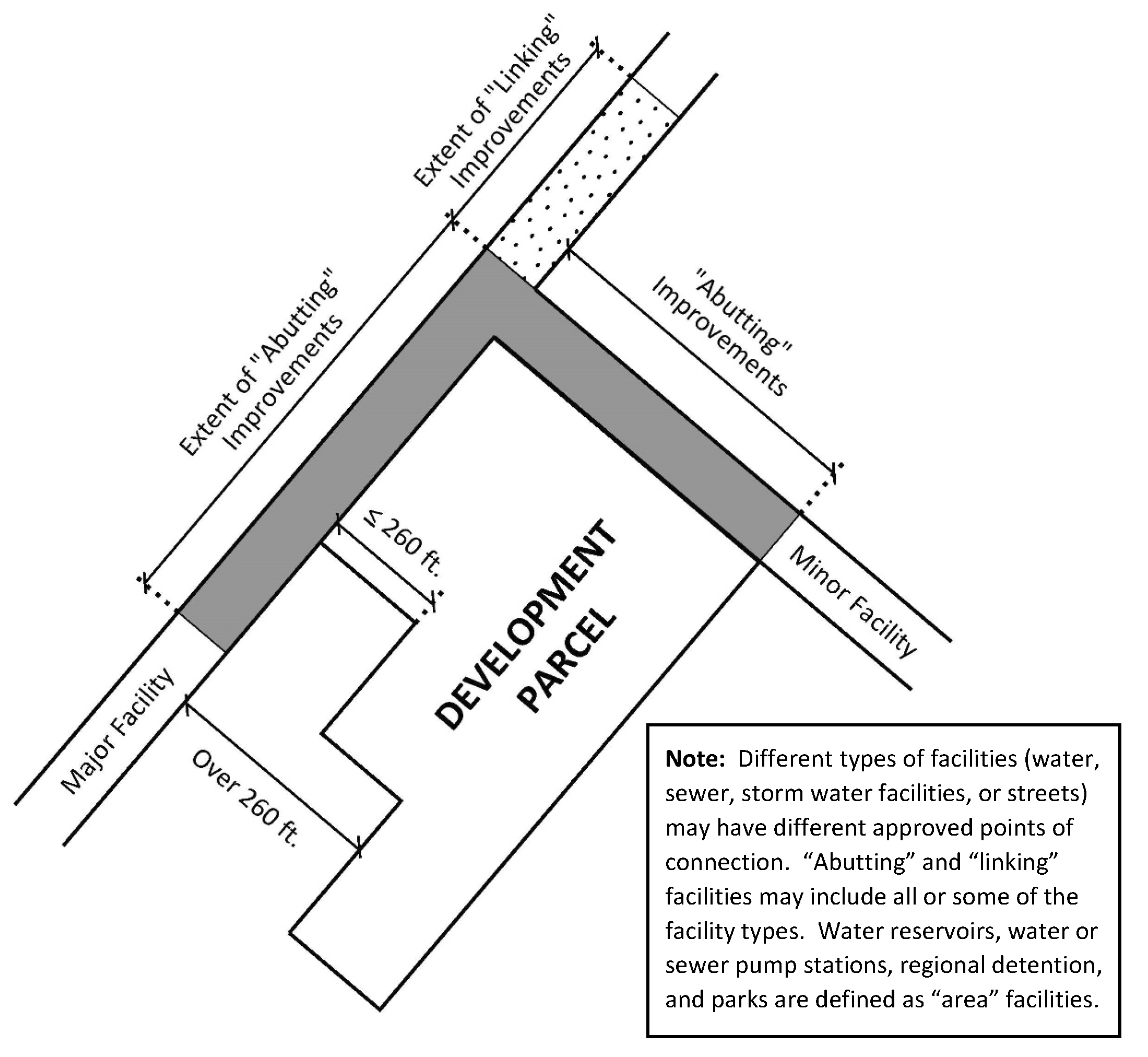
All major and minor facilities abutting or within the development parcel. This includes any major facility which falls within 260 feet of the boundaries of the development parcel, measured at right angles to the length of the facility (see Figure 200-1).
FIGURE 200-1
(5)
Parks facilities as specified in SRC 200.075, to the extent those facilities have not been provided.
(b)
Water, storm drainage, streets and sewer facilities need not, in all cases, link to the same locations. Water, storm drainage, streets and sewer facilities shall be provided as necessary to link the development to a point where existing water, storm drainage, streets and sewer service facilities are adequate, along the shortest preplanned route.
(c)
Water facilities shall conform with existing city service levels and shall be looped where necessary to provide adequate pressure during peak demand at every point within the system in the development to which the water facilities will be connected.
(d)
Where two facilities must be built to their point of intersection, the entire intersection shall be built as well.
(e)
All facilities constructed pursuant to this section shall be and become the property of the City on final acceptance of the work.
(Prior Code, § 200.035; Ord. No. 31-13; Ord. No. 6-19, § 1(Exh. A), 6-24-2019, eff. 7-24-2019)
Sec. 200.040. - Plan approval.
(a)
Upon issuance of a Urban Growth Preliminary Declaration the applicant shall cause a competent registered professional engineer to design the improvements required by the Urban Growth Preliminary Declaration. Such plans shall be drawn to the specifications of the Director and submitted to the Director for approval in accordance with the provisions and fees stated in SRC chapters 72, 73 and 77. Approval of the applicant's plans and execution of an improvement agreement shall be a condition of any land use approval for development on the property that is the subject of the Urban Growth Preliminary Declaration.
(b)
Issuance of an Urban Growth Preliminary Declaration shall not relieve the applicant of the obligation to obtain other permits required by the Salem Revised Code, or of the obligation to proceed through the subdivision or partitioning review and approval process.
(Prior Code, § 200.040; Ord. No. 31-13)
Sec. 200.045. - Reserved.
Editor's note— Ord. No. 6-19, § 1(Exh. A), adopted June 24, 2019, effective July 24, 2019, repealed former § 200.045 which pertained to areas not fully master planned, and derived from Prior Code § 200.045; and Ord. No. 31-13.
Sec. 200.050. - Acquisition of property, easements and right-of-way.
(a)
The developer shall obtain all rights-of-way necessary for street improvements, easements for sewer, drainage and water lines, and fee title to property for parks, pumping stations and reservoirs needed to construct the required facilities identified in the Urban Growth Preliminary Declaration. If the developer is unable to acquire any necessary property, easements, or right-of-way after documented good faith attempts to negotiate and purchase the same, the developer shall prepare the legal descriptions thereof and transmit them to the City Attorney. The City Attorney shall refer the matter to the Council which shall, after public hearing, proceed to determine whether the developer made good faith attempts to acquire the property, easement or right-of-way, and whether to acquire the property, easement, or right-of-way through exercise of eminent domain. The hearing shall be conducted in the manner provided for quasi-judicial hearings in matters other than quasi-judicial land use matters.
(b)
The City Attorney and other city departments shall keep account of time and expenses incurred in acquiring the property, easements, and rights-of-way, including the amount of court costs and attorney fees awarded the other party by the court, and the developer shall pay all such expenses together with the amount of the judgment or settlement. In instances where the City and the developer have responsibility for acquiring abutting portions of right-of-way at the same time, the expenses delineated in this subsection shall be shared in proportion to the area acquired by each party.
(c)
Any settlement of a condemnation action must be concurred in by the developer; provided, however, the developer shall be bound by a final judgment rendered in any eminent domain action unless, within ten days of the verdict being rendered, the developer notifies the City Attorney, in writing, of the developer's intention to abandon the development. If the developer, at any time, decides to abandon the development, the developer shall pay to the City all costs incurred in preparing for and prosecuting the action, including any costs and attorney fees awarded the defendant in the action.
(d)
All property, easements, and rights-of-way acquired by the developer shall be acquired by the developer in the name of, and conveyed to, the City or public, as applicable, free of all liens and encumbrances, no later than the time of recording of the final plat. If the property acquired by the developer is subject to an easement or other interest in land the Director may accept the conveyance if the easement or interest in land does not unreasonably interfere with the City's planned uses of the encumbered area, and the easement holder has consented in writing to allow the City's planned use in the encumbered area, in a form acceptable to the City Attorney. This section does not affect the rights or obligation of a public utility under any franchise agreement entered into with the City pursuant to SRC Chapter 35.
(Prior Code, § 200.050; Ord. No. 31-13; Ord. No. 6-19, § 1(Exh. A), 6-24-2019, eff. 7-24-2019; Ord. No. 7-25, § 1(Exh. A), 6-9-2025)
Sec. 200.055. - Standards for street improvements.
(a)
The proposed development shall be linked by construction of and improvements to public streets which shall extend from the development to an adequate street or streets by the shortest preplanned routes available. Specific locations and classifications of such linking streets shall be based upon the street network adopted in the TSP, and as further specified in any Transportation Impact Analysis (TIA) prepared by public works staff during the adoption of the USA or its amendments. Development proposals for which the public works standards require preparation of an individual TIA may be required to provide more than one linking street or other improvements to accommodate traffic volumes generated by the proposal.
(b)
For purposes of this section, an adequate street is defined as the nearest point on a collector or arterial street which has, at a minimum, a 34-foot wide turnpike improvement within a 60-foot wide right-of-way. The Director shall designate the location or locations where the linking street will connect to the existing street system, based on the definition of adequate street given herein, the results of the TIA studies, and the information in the TSP. A linking street is required to meet the same minimum standard of a 34-foot wide turnpike improvement within a 60-foot wide right-of-way if it is a collector or arterial street. A linking street is required to meet a minimum standard of a 30-foot wide turnpike improvement within a 60-foot wide right-of-way if it is a local street. Where physical or topographical constraints are present to a degree that the standard linking street pavement width cannot be reasonably constructed, the Director may specify a lesser standard which meets the functional levels necessary to improve the existing conditions and meet the increased demands.
(c)
Within the boundaries of the property on which development is to occur, all streets shall be fully improved. All streets abutting the property boundaries shall be designed and improved by the developer to the greater of the standards specified in SRC chapter 803 and the standards for linking streets in this section.
(d)
Standards for geometric design, construction, and materials shall be as specified for the appropriate classification of street, arterial, collector, or local, as contained in the Public Works Design Standards.
(e)
Exemption for industrial infill development.
(1)
Industrial infill development may be partially exempted from the linking street requirements set forth in this section if the industrial development:
(A)
Is located on a lot where more than 60 percent of the lots of record between the lot and the point of linkage have already been developed;
(B)
Generates fewer than 100 peak hour trips onto an arterial or collector street, or fewer than 20 peak hour trips onto a local street;
(C)
Generates less than 100,000 new equivalent axle loads on the linking street; and
(D)
Is an industrial use as defined in SRC chapter 400.
(2)
An industrial infill development that meets the criteria set forth in subsection (e)(1) of this section may have the linking street standards reduced to the lesser of:
(A)
A two-inch structural overlay onto the existing pavement base with no widening, if the base is suitable; or
(B)
If the pavement base has serious failures, a series of Class A patches followed by a chipseal overlay.
The reduced standard shall be determined by the Director and based on the needs of the street. The reduced standard shall be specified in the Urban Growth Preliminary Declaration.
(Prior Code, § 200.055; Ord. No. 31-13)
Sec. 200.060. - Standards for sewer improvements.
(a)
The proposed development shall be linked to existing adequate facilities, by the construction of sewer lines and pumping stations, which are necessary to connect to such existing sewer facilities. Specific location, size and capacity of such facilities will be determined with reference to any one or combination of the following:
(1)
Sewer master plan; or
(2)
Specific engineering capacity studies approved by the Director.
(b)
With respect to facilities not shown in the master plan but necessary to link to adequate facilities, the location, size and capacity of such facilities to be constructed or linked to shall be determined by the Director. Temporary sewer facilities, including pumping stations, will be permitted only if the temporary facilities include all facilities necessary for transition to permanent facilities, and are approved by the Director. Design, construction, and material standards shall be as specified by the Public Works Design Standards for the construction of all such public sewer facilities in the City.
(Prior Code, § 200.060; Ord. No. 31-13)
Sec. 200.065. - Standards for storm drainage improvements.
(a)
The proposed development shall be linked to existing adequate facilities by the construction of storm drain lines, open channels, and detention facilities which are necessary to connect to such existing drainage facilities. Specific location, size, and capacity of such facilities will be determined with reference to any one or a combination of the following:
(1)
The stormwater management plan or, upon adoption, a superseding stormwater master plan; or
(2)
Specific engineering capacity studies approved by the Director.
(b)
With respect to facilities not shown in the applicable management or master plan, but necessary to link to adequate facilities, the location, size, and capacity of such facilities to be constructed or linked to shall be determined by the Director. Temporary storm drainage facilities will be permitted only if the temporary facilities include all facilities necessary for transition to permanent facilities and are approved by the Director. Design, construction, and material standards shall be as specified by the Public Works Design Standards for the construction of all such public storm drainage facilities in the City.
(Prior Code, § 200.065; Ord. No. 31-13)
Sec. 200.070. - Standards for water improvements.
(a)
The proposed development shall be linked to existing adequate facilities by the construction of water distribution lines, reservoirs and pumping stations which connect to such existing water service facilities. Specific location, size and capacity of such facilities will be determined with reference to any one or combination of the following:
(1)
The water master plan; or
(2)
Specific engineering capacity studies approved by the Director.
(b)
With respect to facilities not shown in the master plan but necessary to link to adequate facilities, the location, size and capacity of such facilities to be constructed or linked to shall be determined by the Director. Temporary water facilities, including pumping stations and reservoirs, will be permitted only if the temporary facilities include all facilities necessary for transition to permanent facilities, and are approved by the Director. Design, construction and material standards shall be as specified by the Public Works Design Standards for the construction of all such public water facilities in the City.
(Prior Code, § 200.070; Ord. No. 31-13)
Sec. 200.075. - Standards for park sites.
(a)
The applicant shall reserve for dedication prior to development approval that property within the development site that is necessary for an adequate neighborhood park, access to such park, and recreation routes, or similar uninterrupted linkages, based upon the Salem Comprehensive Park System Master Plan.
(b)
For purposes of this section, an adequate neighborhood park site is one that meets the level of service (LOS) of 2.25 acres per 1,000 population, utilizing an average service radius of one-half mile.
(Prior Code, § 200.075; Ord. No. 31-13)
Sec. 200.080. - Temporary facilities.
(a)
Temporary facilities access agreement.
(1)
Where a development precedes construction of required facilities that are specified to serve development, a land use approval may be conditioned to allow the development to access temporary facilities under conditions specified in a temporary facilities access agreement.
(2)
The terms and conditions of the temporary facilities access agreement shall specify the temporary facilities being constructed or used, the amount of the temporary facility access fee, the provisions for transitioning the use of temporary facilities to permanent facilities once the permanent facilities are constructed, and any other provisions pertinent to the use of temporary facilities.
(3)
The temporary facility access fee shall be calculated by the Director and shall be a reasonable contribution toward the construction of permanent facilities that will ultimately serve the development. The temporary facility access fee shall be held by the City in a dedicated fund and used to pay the costs of construction of required facilities. The applicant shall not be entitled to receive, or have any claim to, any temporary facility access fees collected by the City.
(4)
The temporary facility access fee shall be due and payable by the person or persons seeking a building permit at the time of the granting of a building permit, and payment of the temporary facility access fee, in full, shall be a condition precedent for obtaining building permits within the property. Payment of the temporary facility access fee may be required as a condition of final plat as specified in the tentative subdivision plan approval pursuant to SRC Chapter 205.
(b)
Temporary facilities expansion permit.
(1)
Any person who has been granted the use of a temporary sewer facility under SRC 200.060, a temporary storm drainage facility under SRC 200.065, or a temporary water facility under SRC 200.070 may apply for a temporary facilities expansion permit under this section, which may allow modifications to, or expansion of, the temporary facility in order to better serve the development for which the Urban Growth Preliminary Declaration was issued. The applicant for a temporary facilities expansion permit shall make application therefor on forms promulgated by the Director. Fees for temporary facilities expansion permits shall be established by resolution of the Council.
(2)
The Director may issue a temporary facilities expansion permit if the Director finds that expansion of the facility is not inconsistent with this chapter, the applicant's Urban Growth Preliminary Declaration, or with any master plan, public facilities plan, or other similar plan that is applicable to the development for which the Urban Growth Preliminary Declaration was issued. Any expansion of a temporary facility shall be at the applicant's sole cost and expense, and at the applicant's sole risk. The Director may impose such conditions on a temporary facilities expansion permit as the Director deems are in the public interest.
(c)
Permit revocation. The Director may revoke a temporary facilities expansion permit upon a finding that the permittee is not maintaining the temporary facility in a manner that is consistent with the permit, the provisions of this chapter, or any other applicable federal, state or local law. Appeals of revocations of Temporary Facilities Access permits are contested cases under SRC chapter 20J. Unless a stay is granted in the case of an appeal, when a temporary facilities permit is revoked, use of the temporary facility shall immediately cease until such time as the violation has been cured, and a new temporary facilities expansion permit has been issued.
(Prior Code, § 200.080; Ord. No. 31-13; Ord. No. 6-19, § 1(Exh. A), 6-24-2019, eff. 7-24-2019)
Secs. 200.090—200.200. - Reserved.
DEVELOPMENT DISTRICTS
Sec. 200.205. - Development districts authorized.
A developer of surplus public property may request the formation of a development district if:
(a)
The developer is required to construct public improvements as a condition of a land use decision; and
(b)
One or more of the public improvements required in the land use decision were not included as projects in the applicable master plan for the specific type of public improvement, or all or a significant portion of one or more of the public improvements are ineligible to be built with systems development charges because the public improvement would correct an existing deficiency.
(Prior Code, § 200.205; Ord. No. 10-05; Ord. No. 31-13; Ord. No. 6-19, § 1(Exh. A), 6-24-2019, eff. 7-24-2019)
Sec. 200.210. - Application for formation of development district.
The request for the formation of a development district may be made at any time prior to beginning construction of the public improvements, by filing an application on forms promulgated by the Director. The application shall be submitted to the Director and be accompanied by an application fee, which shall be established by resolution of the Council.
(Prior Code, § 200.210; Ord. No. 10-05; Ord. No. 31-13; Ord. No. 6-19, § 1(Exh. A), 6-24-2019, eff. 7-24-2019)
Sec. 200.220. - Director's report and recommendation; hearing.
(a)
The Director shall prepare a written report, which shall contain, at a minimum, the following information:
(1)
The boundaries and acreage of the proposed district;
(2)
The estimated cost of each public improvement proposed to be built;
(3)
The estimated amount of the infrastructure fee, and methodology whereby the cost was apportioned by EDU or other equivalent unit; and
(4)
The amount necessary to adequately reimburse the City for an administration of the infrastructure agreement.
(b)
The Director's report shall also contain a recommendation whether it is in the public interest to establish the development district. Factors to be considered in evaluating the public interest include, but are not limited to:
(1)
The likelihood that the public improvements would be built without the formation of the proposed district;
(2)
The need for the public improvements to facilitate the development of property within the district;
(3)
The availability of other funding sources to pay for the cost of the public improvements; and
(4)
The extent to which the proposed development district will provide collateral benefits outside the boundaries of the district.
(c)
The Director shall forward the report to the Council, which shall hold a public hearing on the proposal to establish a development district, at which time any person shall be given the opportunity to comment.
(d)
Not less than ten days prior to the public hearing, the developer and any person owning property within the proposed district shall be notified of the public hearing and the purpose thereof. Notification may be made by regular mail, certified mail or by personal service. Notice shall be deemed effective on the date that the notice is mailed or personal delivery is made. Failure of the developer or any person owning property within the proposed district to receive notice shall not invalidate or otherwise affect the proceedings for the establishment of the district.
(e)
The Council has the sole discretion after the public hearing to decide whether to approve the formation of the proposed development district. Because formation of a development district does not result in an assessment against or lien upon real property, the establishment of a development district is not subject to mandatory termination because of remonstrances.
(Prior Code, § 200.220; Ord. No. 10-05; Ord. No. 70-05; Ord. No. 31-13)
Sec. 200.230. - Notice of adoption; recording.
(a)
The Director shall provide written notice to all persons presenting evidence or testimony at the public hearing on the formation of the development district that an order has been adopted, approving formation. The notice shall include a copy of the order approving formation.
(b)
The Director shall cause notice to be provided to potential purchasers of property within the development district, by recording the order establishing the development district with the clerk of the county within which the development district is located. Recording shall not create a lien upon any property within the development district, and failure by the Director to record the order shall not affect the legality of the establishment of the development district or the obligation of any person to pay the infrastructure fee.
(Prior Code, § 200.230; Ord. No. 10-05; Ord. No. 31-13)
Sec. 200.240. - Obligation to pay infrastructure fee.
(a)
The infrastructure fee shall be owing for a period of 20 years after the date the developer accepts the order establishing the development district. The infrastructure fee shall be due and payable when an applicant receives approval from the City for any of the following:
(1)
A building permit for a new building located within the development district;
(2)
A building permit for any additions modifications, repairs or alterations to a building within the development district which exceeds 25 percent of the value of the building within any 12-month period, but excluding the value of repairs made necessary due to damage or destruction by fire or other natural disaster. The value of the building shall be the amount shown as the building's real market value, as shown on the most current records of the county assessor; or
(3)
A permit issued for connection of an existing building within the development district to a public improvement.
(b)
No building permit shall be issued or any connection to the City's infrastructure shall be allowed until the infrastructure fee has been paid in full. If construction is commenced without first obtaining a building permit, then the infrastructure fee shall be deemed as having been due and payable upon the earliest date that any such permit was required.
(Prior Code, § 200.240; Ord. No. 10-05; Ord. No. 31-13)
Sec. 200.245. - Payment of infrastructure fee to developer.
The developer shall receive all infrastructure fees collected by the City pursuant to the infrastructure agreement for as long as the infrastructure agreement is in effect. In no instance shall the City be liable for payment of an infrastructure fee, or any portion thereof, to the developer. Only those funds which the City has received from or on behalf of those persons owing the infrastructure fee shall be payable to the developer. Payment to the developer shall be made periodically, according to the terms set forth in the infrastructure agreement.
(Prior Code, § 200.245; Ord. No. 10-05; Ord. No. 31-13)
Sec. 200.250. - Reimbursement of costs.
(a)
The estimated total amount of reimbursement to the Developer shall be specified in the order approving formation of the development district and the infrastructure agreement.
(b)
The actual total amount of reimbursement to the Developer shall not exceed the certified cost of the public improvements.
(c)
The certified costs to be reimbursed to the Developer shall be limited to the clearly documented costs of design engineering, construction engineering, construction, and acquisition of off-site right-of-way. Costs of construction engineering shall include surveying and inspection costs and shall not exceed 7.5 percent of eligible construction costs. Costs for acquisition of off-site right-of-way shall be limited to the reasonable market value of land or easements purchased by the Developer from a third party in order to complete required off-site improvements.
(d)
The Developer shall receive no reimbursement for any portion of the infrastructure fee charged to the Developer as the result of the Developer's obtaining a building permit or connecting to a public improvement as part of development of the Developer's own property; or for any financing costs, land or easements dedicated by the Developer.
(Prior Code, § 200.250; Ord. No. 10-05; Ord. No. 2-12; Ord. No. 31-13)
Sec. 200.255. - When infrastructure fee not charged.
No infrastructure fee shall be charged if an infrastructure fee has been previously paid pursuant to SRC 200.240, unless such payment is the result of the construction of new buildings; additional modifications, repairs or alterations to a building within the development district which exceeds 25 percent of the value of the building within any additional 12-month period, but excluding the value of repairs made necessary due to damage or destruction by fire or other natural disaster; or new or additional connections to public improvements. No infrastructure fee shall be due where an urban growth development permit has been issued, but no building permit has yet been issued. A person who has paid a development fee may apply for a refund of the infrastructure fee if the building permit lapses because the construction authorized by the building permit has not commenced.
(Prior Code, § 200.255; Ord. No. 10-05; Ord. No. 31-13)
Sec. 200.260. - Non-payment.
Whenever the person responsible for payment of the infrastructure fee refuses to pay the fee, the Director shall notify the developer of such non-payment, in writing. The notice shall include the name of the person or persons owing the infrastructure fee, the street address or tax lot number of the person's property, the amount of the infrastructure fee, and the date upon which the infrastructure fee became due and payable. Upon receipt of such notice, the developer shall proceed forthwith, by private cause of action or otherwise, to cause the infrastructure fee to be paid, and shall indemnify and hold the City harmless from any failure to issue a building permit or allow connection to a public improvement due to such non-payment. Such notice may be either by certified mail or personal service.
(Prior Code, § 200.260; Ord. No. 10-05; Ord. No. 31-13)
Sec. 200.265. - Title to public improvements.
Public improvements installed pursuant to an infrastructure agreement shall become, upon acceptance by the Director, the property of the City.
(Prior Code, § 200.265; Ord. No. 10-05; Ord. No. 31-13)
Sec. 200.270. - Contesting development districts or infrastructure fees.
No legal action intended to contest the formation of the development district or the amount of infrastructure fee, including the amount of the charge designated for each parcel, shall be filed after 60 days following the developer's acceptance of the order establishing a development district. Formation of the development district or the amount of the infrastructure fee shall only be by writ of review pursuant to ORS 34.010—ORS 34.102, and not otherwise.
(Prior Code, § 200.270; Ord. No. 10-05; Ord. No. 31-13)
Secs. 200.280—200.300. - Reserved.
REIMBURSEMENT DISTRICTS
Sec. 200.310. - Application to establish a reimbursement district.
(a)
A Developer may request the formation of a reimbursement district by submitting an application on forms provided by the Director, which shall contain:
(1)
A map showing the boundaries of the proposed reimbursement district and each tax lot within the proposed district;
(2)
The zoning designations for all property located within the proposed reimbursement district; the names and mailing addresses of each owner of property within the proposed district; the tax account number for the owner's property; the width of the frontage, if any and if necessary to determine the allocation of the reimbursement fee; the area of the property in square feet; and any other similar information deemed necessary by the Director for calculating the fair apportionment of the cost; the property or properties owned by the Developer; and
(3)
A description of the location, type, size and actual or estimated cost of each public improvement constructed or to be constructed within the proposed reimbursement district.
(4)
Such other information deemed necessary to evaluate the request by the Director.
(b)
The application shall be accompanied by an application fee, which shall be established by resolution of the Council.
(c)
The application shall be submitted to the Director prior to the construction of the public improvement.
(d)
The City may initiate the formation of a reimbursement district for a public improvement that is constructed by, or through contract for, the City, and paid for, in whole or in part, by City funds.
(Prior Code, § 200.310; Ord. No. 52-05; Ord. No. 31-13; Ord. No. 6-19, § 1(Exh. A), 6-24-2019, eff. 7-24-2019)
Sec. 200.315. - Director's report.
(a)
Upon receipt of a complete application, or upon initiation by the City, the Director shall evaluate whether the proposed reimbursement district should be formed. The Director may require the submission of additional information by the Developer to assist in the evaluation.
(b)
The Director shall prepare a written report based upon an evaluation, which shall make a recommendation on whether the reimbursement district should be formed, based on the following criteria:
(1)
The extent to which the Developer, or City in the case of a City-initiated district, will finance, or has financed some or all of the cost of the public improvement;
(2)
The boundaries and acreage of the proposed reimbursement district;
(3)
The actual or estimated cost of each public improvement built or proposed to be built within the proposed district and methodology for the apportionment of the cost of each public improvement among the properties within the proposed reimbursement district;
(4)
The amount necessary to adequately reimburse the City for administration of the reimbursement district; and
(5)
Whether it is in the public interest to establish the reimbursement district. Factors to be considered in evaluating the public interest include, but are not limited to:
(A)
The need for the public improvement in order to facilitate the development of other property within the district;
(B)
The availability of other funding sources to pay for the cost of the public improvements; and
(C)
The extent to which the reimbursement district will provide incidental benefits outside the boundaries of the reimbursement district.
(Prior Code, § 200.315; Ord. No. 52-05; Ord. No. 31-13; Ord. No. 6-19, § 1(Exh. A), 6-24-2019, eff. 7-24-2019)
Sec. 200.320. - Public hearing.
(a)
The Director shall forward the report to the Council, which shall hold a public hearing on the proposal to establish a reimbursement district, at which time any person shall be given the opportunity to comment.
(b)
Not less than ten days prior to the public hearing, the Developer and all persons owning property within the proposed district shall be notified of the public hearing and the purpose thereof. Notification shall be made by regular mail or certified mail or by personal service. Notice shall be deemed effective on the date that the notice is mailed. Failure of the Developer or any person owning property within the proposed district to receive notice shall not invalidate or otherwise affect the proceedings for the establishment of the reimbursement district.
(c)
Because formation of the proposed reimbursement district does not result in an assessment against or lien upon property, the public hearing is for informational purposes only and establishment of the reimbursement district is not subject to mandatory termination because of remonstrances. The Council has the sole discretion after the public hearing to decide whether a resolution approving and forming the reimbursement district shall be established.
(Prior Code, § 200.320; Ord. No. 52-05; Ord. No. 31-13)
Sec. 200.330. - Notice of adoption of resolution.
The City shall notify the developer and all property owners within the reimbursement district of adoption of the resolution establishing the reimbursement district. The notice shall include a copy of the resolution; the date of adoption; and a short explanation of the process for formation of the reimbursement district, setting forth the amount of the reimbursement fee and stating that a property owner will be legally obligated to pay the fee upon development of the owner's property; and explanation of the circumstances under which the property owner paying the reimbursement fee may obtain systems development charge credits.
(Prior Code, § 200.330; Ord. No. 52-05; Ord. No. 31-13)
Sec. 200.335. - Recording the resolution.
The City Recorder shall record the resolution establishing the reimbursement district with the clerk of the county within which the reimbursement district is located, to provide notice to potential purchasers of property within the reimbursement district. Recording of the resolution does not create a lien upon any property within the reimbursement district. Failure by the City Recorder to record the resolution shall not affect the legality of the establishment of the reimbursement district or the obligation to pay the infrastructure fee at the time development occurs.
(Prior Code, § 200.335; Ord. No. 52-05; Ord. No. 31-13)
Sec. 200.340. - Contesting reimbursement districts or reimbursement fees.
No legal action intended to contest the formation of the reimbursement district or the reimbursement fee, including the amount of the charge designated for each parcel, shall be filed after 60 days following the adoption of a resolution establishing or modifying a reimbursement district or establishing or modifying the reimbursement fee. Formation of the reimbursement district or the reimbursement fee shall only be writ of review pursuant to ORS 34.010—ORS 34.102, and not otherwise.
(Prior Code, § 200.340; Ord. No. 52-05; Ord. No. 31-13)
Sec. 200.345. - Systems development charge credits.
Systems development charges collected from within a development shall be payable as pass-through credits, as defined by SRC 41.100, to any person who has paid the reimbursement fee charged for the public improvement providing service to the person's property.
(Prior Code, § 200.345; Ord. No. 52-05; Ord. No. 31-13)
Sec. 200.350. - Reimbursement fee amount.
(a)
The reimbursement fee shall be based on the cost of each public improvement. The developer shall not be entitled to a reimbursement for any portion of the reimbursement fee that reflects the proportional share of the cost of the public improvement benefitting the developer's own property, unless the developer qualifies for systems development charge credits under SRC 41.160.
(b)
The costs to be reimbursed shall be limited to the cost of design engineering, construction engineering, construction, and off-site acquisition and dedication of right-of-way. Construction engineering shall include surveying and inspection costs and shall not exceed 7.5 percent of eligible public improvement construction costs. Costs to be reimbursed for right-of-way shall be limited to the reasonable market value of land or easements purchased by the developer from a third party in order to accommodate off-site improvements.
(c)
No reimbursement shall be allowed for financing costs, land or easements dedicated by the developer, the portion of costs which are eligible for systems development charge credits or any costs which cannot be clearly documented.
(Prior Code, § 200.350; Ord. No. 52-05; Ord. No. 2-12; Ord. No. 31-13; Ord. No. 6-19, § 1(Exh. A), 6-24-2019, eff. 7-24-2019)
Sec. 200.355. - Obligation to pay reimbursement fee.
(a)
The applicant for a development permit for property within a reimbursement district shall pay the City, in addition to any other applicable fees and charges, the reimbursement fee as determined by the Council, if, within 20 years after the date of adoption of the resolution forming the reimbursement district, the person applies for and receives approval from the City for any of the following activities:
(1)
A building permit for a new building;
(2)
Building permits for any additions modifications, repairs or alterations of a building, which exceed 25 percent of the value of the building within any 12-month period. The value of the building shall be the amount shown on the most current records of the county assessor for the building's real market value, but shall not include repairs made necessary due to damage or destruction by fire or other natural disaster;
(3)
Any other development approval;
(4)
A permit issued for connection to the public improvement constructed by the developer.
(b)
The City's determination of who shall pay the reimbursement fee and when the reimbursement fee is due is final.
(c)
In no instance shall the City be liable for payment of the reimbursement fee, or any portion thereof. Only those payments which the City has received from or on behalf of those owners of properties within a reimbursement district shall be payable to the developer.
(d)
The date for payment of the reimbursement fee shall be for 20 years from the date of the resolution establishing the reimbursement district.
(e)
The reimbursement fee is immediately due and payable to the City by a person upon the occurrence of the earliest happening of one of the events specified in subsection (a) of this section. If connection is made or construction commenced without required City permits, then the reimbursement fee is deemed to have been immediately due and payable upon the earliest date that any such permit was required. Reimbursement fees shall not be eligible for Bancrofting.
(Prior Code, § 200.355; Ord. No. 52-05; Ord. No. 31-13)
Sec. 200.370. - Hardship.
(a)
Persons subject to a reimbursement fee may seek a reduction in the fee, where part or all of a property's development potential is eliminated due to conditions that were unknown or could not reasonably have been anticipated at the time the reimbursement district was formed, including, but not limited to, restrictions from regulations adopted after the district is formed that limit development because of geologic hazards, wetlands, or archeological resources. In such cases, persons may apply for a reduction in the reimbursement fee, by filing an application with the Director, establishing the nature and extent of the conditions that eliminate part or all of the property's development potential and the reduction in the value of the property of the entire parcel as a result of the conditions, and setting forth the amount of the reduction in the reimbursement fee the person is seeking. The Director may require that the applicant submit such other information deemed necessary by the Director to evaluate the application. The Director may grant up to a 50 percent reduction of the reimbursement fee, based on the undevelopable area. The Director shall impose such conditions upon the reduction as necessary to assure that the development potential of the property is maximized. Under no circumstances shall the total reductions within the district exceed ten percent of the total anticipated reimbursement district revenue.
(b)
Upon receipt of a completed application, the Director shall provide notice of the application to the Developer and all persons who are subject to the reimbursement fee, based on the most recent property tax assessment roll. The notice shall provide a 14-day period for submitting written comments prior to the decision, and shall set forth the factual basis for the request in the reduction in the reimbursement fee.
(c)
The Director shall provide notice of the decision to any person who submits comments pursuant to subsection (b) of this section. The notice shall briefly summarize the Director's decision, and shall include an explanation of appeal rights. Appeal of the Director's decision shall be to the Hearings Officer, whose decision shall be final.
(Prior Code, § 200.370; Ord. No. 52-05; Ord. No. 31-13)
Sec. 200.375. - Non-payment.
Whenever the full reimbursement fee has not been paid for any reason after it is due, the City Manager shall file a report with the Council, indicating the amount of the uncollected reimbursement fee, the legal description of the property upon which development giving rise to the duty to pay the fee has occurred, the date upon which the reimbursement fee was due and the name or names of the person owing the fee. The Council shall authorize the setting of a public hearing before the hearings officer, and direct the City Manager to give notice of that hearing to each of the person or persons owing the fee, together with a copy of the City Manager's report concerning the unpaid reimbursement fee. Such notice may be either by certified mail or personal service. If the hearings officer determines the reimbursement fee is due but has not been paid, the hearings office may issue a stop work order or revoke any permits which have been issued, and the developer shall have a private cause of action against the person or persons owing the reimbursement fee.
(Prior Code, § 200.375; Ord. No. 52-05; Ord. No. 31-13)
Sec. 200.380. - Title to public improvements.
Public improvements constructed within a reimbursement district shall become, upon acceptance by the City, the City's sole property.
(Prior Code, § 200.380; Ord. No. 52-05; Ord. No. 31-13)
Sec. 200.385. - Collection and payment; other fees and charges.
(a)
The Developer shall receive all reimbursement fees collected by the City for reimbursement district public improvements constructed by the developer for as long as the reimbursement district is in existence. Payment of reimbursement fees to the developer shall be made quarterly.
(b)
The reimbursement fee is not intended to replace or limit, and is in addition to, any other existing fees or charges collected by the City.
(Prior Code, § 200.385; Ord. No. 52-05; Ord. No. 31-13)
Sec. 200.400. - Definitions.
The following words, terms and phrases, when used in SRC 200.400 through 200.420, shall have the meanings ascribed to them in this section, except where the context clearly indicates a different meaning:
City means the City of Salem, Oregon.
Construction means the construction, reconstruction, major rehabilitation, enhancement or upgrade of a public improvement undertaken pursuant to a development approval.
Developer means any person who undertakes, as a condition of development approval, the construction of a public improvement that is available to provide services to properties, in addition to the property owned by the person, or that person's assignee or successor-in-interest.
Development means "development" as defined in SRC 200.005.
Development approval means any final land use decision, limited land use decision, expedited land division decision, urban growth area permit, master plan approval, building permit, construction permit, or other similar authorization needed in order to develop land.
Person means a natural person, partnership, corporation, limited liability company, association, governmental entity other than the City, or any other entity in law or fact.
Public improvement means a capital facility or asset used for water supply, treatment and distribution; wastewater collection, transmission, treatment and disposal; transportation; or stormwater drainage or flood control.
(Prior Code, § 200.400)
Sec. 200.405. - Fee-in-lieu of construction authorized.
(a)
The Director may allow a Developer to enter into an agreement with the City for the payment of a fee-in-lieu of making a public improvement, required as a condition of a development approval, when the following conditions are met:
(1)
The development approval only requires the construction of a portion of the public improvement, and additional portions are required to be constructed in order to have an operational, fully functioning public improvement;
(2)
Construction of the additional portions of the public improvement will not or cannot occur simultaneously with the construction of the portion required as the condition of development approval because funding for other portions is unavailable at the time the developer would construct the developer's portion of the public improvement; and
(3)
Construction of only a portion of the public improvement would impede the construction of the additional portions or otherwise affect the physical integrity of the public improvement at a future date.
(b)
Notwithstanding any provision of SRC 200.400 through 200.420 construction of the public improvement shall be preferred over the payment of a fee-in-lieu.
(c)
No building permits for any structures within the development subject to the condition of development approval will be issued until the fee-in-lieu of construction is paid.
(d)
The Finance Officer shall deposit the fee-in-lieu into a trust and agency account, and the fee-in-lieu shall only be used to fund construction of the public improvement for which the fee was paid.
(e)
An agreement to pay a fee-in-lieu of construction shall be in a form approved by the City Attorney and recorded in the deed records of the appropriate county. The agreement to pay a fee-in-lieu of construction shall not result in an assessment upon or lien against real property, and the fee-in-lieu collected by the City from a developer are not taxes subject to the property tax limitations of article XI, section 11(b) of the Oregon Constitution.
(Prior Code, § 200.405)
Sec. 200.410. - Fee-in-lieu amount.
The fee-in-lieu of construction shall be based on the estimated cost of construction of the public improvement; shall reflect the proportional share of the cost of the public improvement benefitting the development; and shall be an amount equal to the estimated construction cost of the developer's portion of the public improvement, calculated for the year when the developer commences construction of the project, minus any systems development charge credits for which the developer would be eligible if the public improvement had been constructed.
(Prior Code, § 200.410; Ord. No. 110-07; Ord. No. 31-13)
Sec. 200.415. - Payment of fee-in-lieu of construction as substantial compliance.
Sec. 200.420. - No limitation on authority.
(a)
A fee-in-lieu of construction is not intended to replace or limit, and is in addition to, any other existing fees or charges collected by the City.
(b)
Nothing in SRC 200.400 through 200.420 is intended to modify or limit the authority of the City:
(1)
To provide or require access management;
(2)
To enforce other development conditions contained in the land use approval; or
(3)
To require, in the future, the construction of the public improvement as a condition of development approval against other properties.
(Prior Code, § 200.415)

