
Salem City Zoning Code
CHAPTER 230
HISTORIC PRESERVATION
Sec. 230.001.- Purpose.
The purpose of this chapter is to identify, designate, and preserve significant properties related to the community's prehistory and history; encourage the rehabilitation and ongoing viability of historic buildings and structures; strengthen public support for historic preservation efforts within the community; foster civic pride; encourage cultural heritage tourism; and promote the continued productive use of recognized resources, and to implement the policies contained in the Salem Area Comprehensive Plan for the preservation of historic resources.
(Prior Code, § 230.001; Ord. No. 34-10)
Sec. 230.005. - Definitions; rules of decision; administrative resources.
(a)
Definitions. The following words, terms and phrases, when used in this chapter, shall have the meanings ascribed to them in this section, except where the context clearly indicates a different meaning:
Addition means an expansion or physical modification of the exterior of a historic resource that includes the expansion of the building footprint. Additions do not include painting and color selection or ordinary maintenance or repair of the resource.
Alteration means an addition to, removal of, removal from, or physical modification of, an exterior part of a historic resource. Alteration does not include color selection or ordinary maintenance and repair.
Archaeological artifact means any pre-contact or historic objects or cultural material 75 years of age or older, or 50 years of age or older on federal lands, which contain material remains of past human life or activity that are significant for their potential contribution to the understanding of history or prehistory.
Archaeological resource means an archaeological artifact or archaeological site.
Archeological site means ten or more archaeological artifacts, including debitage, likely to have been generated by patterned cultural activity within an area reasonable to that activity; or the presence of any archaeological feature such as a culturally modified tree, cache pit, hearth, housepit, rockshelter, cairn, historic mining ditch, petroglyph, or historic dendroglyph.
Building means a structure created to shelter any form of human activity, such as a house, barn, church, hotel, or similar structure. The term "building" may refer to a historically related complex such as a courthouse and jail or a house and barn.
Cost prohibitive means the price of completing the repair or restoration work on the historic resource or structure exceeds the real market value of the resource or structure.
Demolition means any act that destroys, removes, or relocates, in whole or in part, a historic contributing building or accessory structure such that its historic, cultural, or architectural character and significance is lost.
Development of new housing means the creation of a new dwelling unit(s) through new construction within a local historic district or through the alteration of, or addition to, a local historic resource or contributing or non-contributing building in a local historic district.
Historic accessory structure means an accessory structure that is 50 years or older located on the site of an individually designated resource, or within a designated historic district, and that is accessory to a primary historic structure designated on the site.
Historic contributing building means a building or structure, including an accessory structure, within a historic district that existed during the period of significance, and has retained sufficient integrity to convey the history of the district and to contribute to its character.
Historic non-contributing building means a building or structure, including an accessory structure, within a historic district that existed during the period of significance, but has been so altered that it no longer conveys the history of the district or contributes to its character.
Historic preservation means preservation, restoration, or rehabilitation of a historic resource.
Historic preservation officer means the administrator of the City's Historic Preservation Program and Cultural Resources Program including professional support to the Historic Landmarks Commission. The Historic Preservation Officer shall meet the professional qualification standards of the United States Department of the Interior and the National Park Service for a preservation professional.
Historic resource means any artifact, object, sign, structure, or building 50 years or older which has potential to further understanding of local, state, or national history or pre-history. Historic resources on a site are categorized as either primary or accessory.
Individually listed resource means a building, structure, site, or object listed individually on the National Register of Historic Places or designated as a local historic resource by the Council.
In-kind replacement means replacement of a deteriorated or damaged historic feature that matches the old in material, design, color, and texture, based upon either direct physical evidence of the feature or photographic evidence of the feature, and that results in a true replication of the original outward appearance of the feature.
Local historic district means and geographically definable area containing a significant concentration, linkage, or continuity of buildings, structures, sites, or objects united historically or aesthetically by plan or physical development, or individual elements separated geographically but linked by association or history. A local historic district is defined by a period of significance, designated as a local historic district by the City Council and adopted as part of Salem's Comprehensive Plan and Historic Preservation Plan, and listed as a historic district in the National Register of Historic Places.
Local historic resource means an individually listed local or National Register resource, or a building, structure, site, artifact, or object that is designated as a historic-contributing or non-contributing resource within a local historic district.
National register historic district means a geographically definable area containing a significant concentration, linkage, or continuity of buildings, structures, sites, or objects united historically or aesthetically by plan or physical development, or individual elements separated geographically but linked by association or history. A National Register Historic District is defined by a period of significance and listed as a historic district in the National Register of Historic Places.
National register resource means a historic resource listed on the National Register of Historic Places.
New construction means a building or structure, other than an accessory structure, constructed on property within a historic district, or on property that is designated as a local historic resource, that is not attached to, or included as a portion of, an existing building or structure.
Non-contributing building means a historic non-contributing building or a non-historic non-contributing building or accessory structure.
Non-historic non-contributing building means a building or structure in a historic district that did not exist during the period of significance.
Object means a material thing of functional, aesthetic, cultural, historic, or scientific value that may be, by nature or design, movable yet related to a specific setting or environment.
Open area means, for the purpose of regulating security fencing/gates under this Chapter, the proportion of perforations or other open voids included within the fence/gate as compared to the total fence/gate area. For example, a security fence/gate that has an open area of 70 percent means that 70 percent of the area of the security fence/gate consists of open voids while the remaining 30 percent constitutes solid material surface.
Ordinary maintenance and repair means restoration of exterior features that does not involve a change in design, material, or outward appearance.
Original means the component was constructed on or added to the building during the period of significance.
Period of significance means the dates stated in the official designation of a historic district by the National Park Service that identifies the period or periods of time when the district attained the characteristics which qualify it for designation as a historic district.
Primary facade means that part of a building or structure where the main entry is located. On a corner lot each wall fronting the street shall be considered a primary facade.
Primary historic structure means a historic resource within a historic district or an individually listed historic resource that is designated as the main resource on the site due to its size or historic significance.
Property pending designation means a building, structure, site, or object for which a formal application for local historic designation has been initiated, or which has been recommended for nomination to the National Register of Historic Places by SACHP, or a building, structure, site, or object within a proposed historic district for which a formal application for historic designation has been submitted, but which have not yet been reviewed by the Keeper of the National Register, or has been reviewed by the Keeper and determined to be "eligible."
Preservation means the act or process of applying measures necessary to sustain the existing form, integrity, and materials of a historic resource. Work, including preliminary measures to protect and stabilize the resource, generally focuses on the ongoing maintenance and repair of historic materials and features rather than extensive replacement and new construction. New exterior additions are not considered preservation; however, the limited and sensitive upgrading of mechanical, electrical, and plumbing systems and other code-required work to make properties functional is appropriate within a preservation project.
Public agency means the State, and all the administrative subdivisions thereof, including, but not limited to, the Oregon Department of Administrative Services.
Public historic resource means a historic resource that is owned by a public agency.
Reconstruction means the act or process of depicting, by means of new construction, the form, features, or detailing of a non-surviving building or structure for the purpose of replicating its appearance at a specific period of time and in its historic location.
Rehabilitation means the process of making possible a compatible use for a historic-contributing resource or individually listed resource through repair, alterations, and additions, while preserving those portions or features which convey its historical, cultural, or architectural values.
Restoration means the act or process of accurately depicting the form, features, and character of a historic-contributing resource or historic-non-contributing resource as it appeared at a particular period of time by means of the removal of features from other periods in its history and reconstruction of missing features from the restoration period. The limited and sensitive upgrading of mechanical, electrical, and plumbing systems and other code-required work to make properties functional is appropriate within a preservation project.
SHPO means the Oregon State Historic Preservation Office.
Significance means the meaning or value ascribed to a structure, landscape, object, or site based on the National Register criteria for evaluation. It normally stems from a combination of association and integrity related to the design, setting, and workmanship of the district or the designated resource, which may include the important people and events connected with the designated resource or the period of significance established for the district or the significant date(s) of the historic resource.
Site means, unless the context requires otherwise, the location of a significant event, a prehistoric or historic occupation or activity, or a building or structure, whether standing, ruined, or vanished, where the location itself maintains historical or archaeological value regardless of the value of any existing structure.
Structure means a work made up of interdependent and interrelated parts in a definite pattern of organization. Constructed by humans, a structure is often an engineering project large in scale.
Visible means the resource, or a portion of the resource, can be seen from the public right-of-way. For example, typically the primary facade of a historic resource can be seen from the public right-of-way.
(b)
Supplemental standards and guidelines for historic design review. In the event the standards and guidelines contained in this chapter fail to provide regulations for a specific type of historic resource, the rules of the decision will be the Secretary of the Interior's Standards for Rehabilitation and Guidelines for Rehabilitating Historic Buildings, published by the U.S. Department of the Interior, National Park Service.
(c)
Authority to promulgate guidelines. The Director may, upon consultation with the Historic Landmarks Commission, promulgate illustrative guidelines to provide general guidance to interested persons on the application of the standards in this chapter.
(Prior Code, § 230.005; Ord. No. 34-10; Ord. No. 25-13; Ord. No. 32-13; Ord. No. 12-20, § 1(Exh. A), 10-26-2020, eff. 11-25-2020; Ord. No. 8-24, § 1(Exh. A), 9-23-2024)
Sec. 230.010. - Designation of local historic resources.
(a)
Applicability. Buildings, structures, sites, or objects may be designated as local historic resources as provided in this section.
(b)
Procedure type. Designation of a local historic resource is processed as a Type IV procedure under SRC chapter 300.
(c)
Standing to request designation.
(1)
Local historic resource designation may be initiated by the following:
(A)
The Council;
(B)
The Historic Landmarks Commission; or
(C)
The owner of the proposed resource.
(2)
Any person may file a request with the Council or the Historic Landmarks Commission for initiation of the designation of a local historic resource, provided the proposed resource is not the subject of a pending application for alteration or demolition.
(d)
Additional submittal requirements. In addition to the submittal requirements for a Type IV application under SRC chapter 300, an application for local historic resource designation shall include:
(1)
Narrative description of the proposed resource including:
(A)
Significant features of the site to be covered by the designation; and
(B)
Significant people and events connected with the proposed resource.
(2)
Site plan;
(3)
Current photographs of all elevations of the building or structure and any significant feature;
(4)
Copies of any historical photographs, plans, or maps; and
(5)
Any other documentation demonstrating the significance of the proposed resource.
(e)
Criteria. An application for the designation of a local historic resource shall be granted if the following criteria are met:
(1)
Age. The proposed historic resource is at least 50 years old, or demonstrates exceptional significance if less than 50 years of age.
(2)
Significance. The proposed historic resource demonstrates significance in at least one of the following areas:
(A)
Cultural significance. The proposed historic resource:
(i)
Contributes to the character and historic identity of the neighborhood or City; or
(ii)
Makes a contribution to the historic character of a historic resource, neighborhood, district, or the City as a whole.
(B)
Human significance. The proposed historic resource:
(i)
Is associated historically with the life or activities of a person, group, organization or institution that has made a significant contribution to the local community; or
(ii)
Is associated with events that have made a significant contribution to the broad patterns of local history; or
(iii)
Has yielded, or may be likely to yield, important information concerning prehistory or history.
(C)
Architectural significance. The proposed historic resource:
(i)
Is significant as an example of a particular architectural style, building type, structural type, or method of construction; or
(ii)
Is the work of an acknowledged master or architect, or possesses high artistic values.
(3)
Integrity. The proposed historic resource retains sufficient original design characteristics, craft work, or material to serve as an example of an architectural period, significant building type or structural type, or recognized architectural style.
(f)
Owner consent. A property owner may refuse to consent to local historic resource designation at any point during the designation process. A refusal to consent shall remove the property from consideration for local historic resource designation. No permit for the demolition or modification of property removed from consideration for local historic resource designation shall be issued for 120 days following the date of the property owner's refusal to consent to local historic resource designation.
(Prior Code, § 230.010; Ord. No. 34-10)
Sec. 230.015. - Removal of local historic resource designation.
(a)
Applicability. Buildings, structures, sites, or objects may have local historic resource designation removed, as provided in this section.
(b)
Classes.
(1)
"Class 1" historic resource designation removal is the removal of a local historic resource designation applied prior to September 9, 1995.
(2)
"Class 2" historic resource designation removal is the removal of a local historic resource designation applied subsequent to September 9, 1995.
(c)
Procedure type.
(1)
Class 1 historic resource designation removal is processed as a Type I procedure under SRC chapter 300.
(2)
Class 2 historic resource designation removal is processed as a Type IV procedure under SRC chapter 300.
(d)
Standing to initiate removal.
(1)
Removal of local historic resource designation may be initiated by the following:
(A)
The Council;
(B)
The Historic Landmarks Commission; or
(C)
The owner of the local historic resource.
(e)
Submittal requirements. In addition to the submittal requirements for a Type I application under SRC chapter 300, an application for removal of local historic resource designation shall include:
(1)
Narrative description of the resource proposed for delisting including:
(A)
Significant features of the site covered by the designation; and
(B)
An evaluation of the current integrity of the resource including an assessment of the amount of remaining original design characteristics, craft work and material.
(2)
Site plan;
(3)
Current photographs of all elevations of the building or structure and any significant feature;
(4)
Documentation demonstrating that the owner objected to the original designation if applicable;
(5)
Any other documentation demonstrating that the resource proposed for delisting no longer meets the requirements of SRC 230.010(d).
(f)
Criteria. An application for removal of local historic resource designation shall be granted if the following criteria are met:
(1)
For a Class 2 historic resource designation removal, the property no longer meets the criteria for local historic resource designation under SRC 230.010(d).
(2)
For a Class 1 historic resource designation removal:
(A)
The local historic resource designation that was imposed on the property by the City over the owner's objections; or
(B)
The property no longer meets the criteria for local historic resource designation under SRC 230.010(d).
(Prior Code, § 230.015; Ord. No. 34-10)
Sec. 230.017. - Recording notice of historic district.
The Director shall cause to be recorded in the docket of City liens created pursuant to SRC 21.060 a notice of historic district for each property where any portion of the property lies within the historic district. The recording of such notice shall not create, and shall not be deemed to create, a lien or other encumbrance on such property.
(Prior Code, § 230.017; Ord. No. 25-13)
Sec. 230.018. - Public historic design review jurisdiction.
The City has jurisdiction over historic design review for all public historic resources. If the public agency is the State, or any administrative subdivision of the State, the public agency may enter into a program with SHPO for the conservation of the National Register designated historic resource pursuant to ORS 358.653, in which case historic design review for that historic resource is exempted from this chapter; provided, however, that such program complies with Secretary of the Interior's Standards for Rehabilitation and Guidelines for Rehabilitating Historic Buildings, published by the U.S. Department of the Interior, National Parks Service, and the public agency provides the Director with notice of such election, no later than the date the contract for construction is advertised for bids.
(Prior Code, § 230.018; Ord. No. 25-13; Ord. No. 12-20, § 1(Exh. A), 10-26-2020, eff. 11-25-2020)
Sec. 230.020. - Historic design review.
(a)
Applicability. Unless undertaken by a public agency pursuant to a program established under SRC 230.018, no exterior portion of a local historic resource, contributing building, non-contributing building, or new construction in a local historic district shall be erected, altered, restored, moved, or demolished until historic design review approval has been granted, as provided in this section.
(1)
Historic design review required. Historic design review is required for the following:
(A)
Remodeling or repair that would change, in any manner, the exterior of a local historic resource or a building or structure in a local historic district, but excluding painting.
(B)
Moving a local historic or National Register resource, or moving a building or structure into or out of a local or National Register Historic District.
(C)
Construction of a new building in a local historic district.
(D)
Alteration of, or addition to, a local historic resource, or to a contributing or non-contributing building in a local historic district.
(E)
Construction of new walks, fences, parking facilities, and other features on the site of a local historic resource, when adjacent to or within view of public right-of-way.
(F)
Demolition of a local or National Register historic resource.
(G)
Streetscape improvements in local historic districts.
(2)
Historic design review not required. Historic design review is not required for the following:
(A)
Ordinary maintenance or repair of any exterior architectural feature of a structure or contributing site feature of a local historic resource or contributing or non-contributing building in a local or National Register Historic District to correct deterioration, decay, or damage, which utilizes in-kind materials and restores, replicates, and sustains the existing form. By way of illustration, but not of limitation, ordinary maintenance and repair includes replacement of cracked or broken window panes; surface treatment that is consistent with accepted historic preservation methods; replacement of broken hardware; repair of a portion of a window frame or sash, part of a roof or a small percentage of siding.
(B)
Change in paint color of a local or National Register historic resource or a contributing or non-contributing building in a local or National Register Historic District.
(C)
Work conducted entirely within the interior of a local historic resource or contributing or non-contributing building in a local historic district which has no effect on exterior architectural features.
(D)
The addition of mechanical (HVAC) and associated equipment to the exterior roof or secondary facade of a structure or site of a local historic resource or contributing or non-contributing building in a local or National Register Historic District provided the equipment is not visible from the right-of-way.
(E)
The addition of temporary and removable alterations, or alterations completed in response to an emergency declared by the City, County, State, or Federal government, to the exterior of a local historic resource or contributing or non-contributing building or site in a local or National Register Historic District.
(F)
The addition of fencing to the site of a local historic resource or contributing or non-contributing resource in a local or National Register Historic District provided the fencing is not attached to any primary or secondary resource on the site, is of wood or metal, and does not exceed four feet in height within the front yard and six feet in height within the side and rear yards.
(3)
Buildings partially within and partially without local historic districts. Where addition or alteration to the exterior of a historic contributing resource or non-contributing building in a local historic district, or construction of a new building in a local historic district, will occur partially inside and partially outside of the district boundaries, historic design review is required for that portion of the building that is within the local district and, if the majority of the area of the building is inside the local historic district, for that portion of the building that is not within the local historic district.
(4)
Relationship to other land use reviews.
(A)
Except as otherwise provided in this subsection, projects that require historic design review may also require other land use reviews. If other land use reviews are requirements for development, such reviews shall be held prior to or concurrently with historic design review.
(B)
Notwithstanding SRC 300.120(c), when a project includes development of new housing and requires both historic design review and an adjustment to a historic design review standard, review of the adjustment shall be consolidated with the historic design review.
(b)
Objectives. The standards in this chapter shall be construed to do the following:
(1)
Historic contributing buildings and individually listed resources. Historic contributing buildings and individually listed resources are valuable community resources that contribute immeasurably to the City's identity, history, unique sense of place, and quality of life. Preserving these buildings and resources involves careful planning, conscientious maintenance and repair, knowledgeable and informed restoration, and sensitive rehabilitation that accommodates modern business and residential lifestyles. The standards set forth in this chapter for historic contributing buildings and individually listed resources are intended to preserve and enhance the buildings, resources and districts generally, while allowing for adaptive reuse through sensitive rehabilitation of these buildings and resources.
(2)
Non-contributing buildings. Some buildings and structures in a historic district are non-contributing. These buildings and structures typically do not contribute to the district's historic significance because they either date from outside the district's period of significance or their historic significance has been materially impaired by additions and alterations. The standards set forth in this chapter for non-contributing buildings and structures do not require restoration to their original appearance or require imitation of the appearance of a historic contributing building or structure; rather, the objectives are two-fold. First, the objective for historic non-contributing is to return, when feasible, these buildings to a historic contributing state. Second, the objective for all non-contributing buildings is to maintain the visual coherence of the historic district as a whole.
(3)
New construction. New buildings and structures will be built in historic districts. These new buildings and structures should enhance, rather than detract, from the overall character of the district. It is crucial that the existing harmony of proportions and materials be enhanced when new construction occurs. Therefore, the objective of the standards set forth in this chapter for new construction is to ensure that the design and construction of new buildings and structures is consistent and compatible with the architectural styles of historic contributing buildings that are found in the district.
(c)
Classes. There are three classes of historic design review which include Class 1 minor historic design review, Class 2 minor historic design review, and Class 3 major historic design review. Table 230-1 classifies activities based on their required historic design review class. Notwithstanding Table 230-1:
(1)
Any activity proposed that is not covered by the table or does not meet the specific standards for historic contributing buildings in SRC 230.025, SRC 230.040, and 230.060; the specific standards for non-contributing buildings and structures in SRC 230.030, SRC 230.045, and SRC 230.063; or the specific standards for new construction in SRC 230.035, 230.050, and 230.064 requires Class 3 major historic design review under either the guidelines for historic contributing resources in SRC 230.065 or the guidelines for non-contributing buildings and structures in SRC 230.070.
(2)
When an application for new construction within a local historic district or the alteration of, or addition to, a local historic resource or contributing or non-contributing building in a local historic district includes development of new housing and the application does not meet the specific standards for historic contributing buildings in SRC 230.025, SRC 230.040, and 230.060; the specific standards for non-contributing buildings and structures in SRC 230.030, SRC 230.045, and SRC 230.063; or the specific standards for new construction in SRC 230.035, 230.050, and 230.064, the applicant may either:
(A)
Apply for an adjustment(s) to the standards and choose to process the historic design review application as either a Class 2 minor historic design review or a Class 3 major historic design review; or
(B)
Choose to process the application as a Class 3 major historic design review subject to the guidelines for historic contributing resources in SRC 230.065 or the guidelines for non-contributing buildings and structures in SRC 230.070, as applicable.
(d)
Procedure type.
(1)
Class 1 minor historic design review is processed as a Type I procedure under SRC chapter 300.
(2)
Class 2 minor historic design review is processed as a Type II procedure under SRC chapter 300.
(3)
Class 3 major historic design review is processed as a Type III procedure under SRC chapter 300.
(e)
Submittal requirements.
(1)
Class 1 and Class 2 minor historic design review. In addition to the submittal requirements set forth under SRC chapter 300, an application for Class 1 or Class 2 minor historic design review shall include the following:
(A)
Plan and elevation drawings, of a size and form and in the number of copies meeting the standards established by the Planning Administrator, of the existing building or structure and of the proposed changes, including materials;
(B)
Photos of the existing building or structure; and
(C)
Historic photos of the existing building or structure, if available.
(2)
Class 3 major historic design review. In addition to the submittal requirements for a Type III application under SRC chapter 300, an application for Class 3 major historic design review shall include the following:
(A)
Plan and elevation drawings of the existing building or structure and of the proposed changes, including materials;
(B)
Photos of the existing building or structure;
(C)
Historic photos, if available; and
(D)
Plan and elevation drawings of adjacent properties, or photo-simulation, for additions that increase the gross square footage of the structure by more than 50 percent, or new construction in a historic district.
(f)
Criteria. Historic design review approval shall be granted if the application satisfies the applicable standards or guidelines set forth in this chapter.
(Prior Code, § 230.020; Ord. No. 34-10; Ord. No. 25-13; Ord. No. 12-20, § 1(Exh. A), 10-26-2020, eff. 11-25-2020; Ord. No. 8-24, § 1(Exh. A), 9-23-2024)
Sec. 230.025. - Standards for historic contributing buildings in residential historic districts.
Modifications to historic contributing buildings in residential historic districts shall comply with this section.
(a)
Siding, exterior trim and minor architectural features. Replacement of siding, exterior trim, and minor architectural features of historic contributing buildings shall be allowed only where the owner has attempted to repair the original siding, exterior trim or minor architectural feature, but repair was determined to be unfeasible due to poor condition of the original materials. If the trim or siding is not original then every effort shall be made to replicate the original trim or siding; the effort shall be substantiated by historic, physical, or pictorial evidence. If the trim and siding cannot be replicated then it should be of a compatible design and material.
(1)
Materials. The replacement materials are the same type and quality as the original siding, exterior trim or minor architectural feature, or duplicate, to the greatest degree possible, the appearance and structural qualities of the material being replaced.
(2)
Design. The replacement reproduces the appearance of the original siding, exterior trim or minor architectural feature.
(3)
Energy efficiency. Improvements to improve energy efficiency are allowed, provided the exterior appearance of the historic resource is preserved to the greatest extent possible. Example: Adding additional insulation to attics, crawl spaces or basements.
(b)
Windows. Replacement of windows in historic contributing buildings shall be allowed only where the owner has attempted to repair the original window, but repair was not feasible due to the poor condition of the original materials. If the window is not original then every effort shall be made to replicate the original window; the effort shall be substantiated by historic, physical, or pictorial evidence. If the window cannot be replicated then it should be of a compatible design and material to the original.
(1)
Materials. All features of the window, including the window frame, sash, stiles, rails, muntins, lamb's tongues and glass, are replaced with materials that duplicate, to the greatest degree possible, the appearance and structural qualities of the original.
(2)
Design. Overall design of the window profile of all parts of the window shall reproduce the appearance of the original window.
(3)
Improvements to create energy efficiency.
(A)
The use of weather-stripping, insulation, storm windows, or materials to either repair or improve the energy efficiency of shall be evaluated as means to achieve the desired energy efficiency objectives prior to seeking authorization to replace a window.
(B)
If an owner wishes to improve the energy efficiency of windows located on the primary facade, only energy efficiency measures that are removable and do not permanently alter the resource, including, but not limited to, exterior storm windows and weather-stripping, shall be used on the primary facade.
(C)
If an owner wishes to improve the energy efficiency of windows located on a facade other than the primary facade, measures that are removable and do not permanently alter the resource, including, but not limited to, exterior storm windows and weather-stripping, shall be used. Reuse of the original window frame and sash with replacement by glass that maintains the overall design and appearance of the window is allowed. Example: Single pane glass can be supplemented or thermally upgraded with the addition of another pane of glazing such as adding an interior energy panel (storm window) or exterior panel mounted on the window sash itself.
(c)
Doors. Replacement of doors in historic contributing buildings shall be allowed only where the owner has attempted to repair the original door, but repair was not feasible due to the poor condition of the original materials. If the doors are not original then every effort shall be made to replicate the original doors; the effort shall be substantiated by historic, physical, or pictorial evidence. If the door cannot be replicated then it should be of a compatible design and material.
(1)
Materials. All features of the door shall be replaced with material that duplicate, to the greatest degree possible, the appearance and structural qualities of the original door.
(2)
Design. The overall design of the door shall reproduce, to the greatest degree possible, the appearance of the original door.
(d)
Porches. Replacement of porches on historic contributing buildings shall be allowed only where the owner has attempted to repair the original porch, but repair was not feasible due to the poor condition of the original materials. If the porch is not original then every effort shall be made to replicate the original porch; the effort shall be substantiated by historic, physical, or pictorial evidence. If the porch cannot be replicated then it should be of a compatible design and material.
(1)
Materials. All features of the porch shall be replaced with material that duplicate, to the greatest degree possible, the appearance and structural qualities of the original porch.
(2)
Design. The overall design of the porch shall reproduce, to the greatest degree possible, the appearance of the original porch.
(e)
Roofs. Replacement of roofs on historic contributing buildings shall be allowed only where the owner has attempted to repair the original roof, but repair was not feasible due to the poor condition of the original materials.
(1)
Materials.
(A)
Historic specialty roofing materials, such as original tile, slate, or rolled composition roofing should be maintained in place whenever possible.
(B)
New roof materials should match the original materials in scale and texture as closely as possible. Use of plastic or concrete simulated materials is not allowed.
(C)
Composition roofing is allowed as a substitute for wood shingles in a complete replacement.
(D)
Imitation slate and wood are allowed as a substitute for original materials in a complete replacement.
(2)
Design.
(A)
The original roof form and detailing shall be preserved.
(B)
Original eave overhangs shall be maintained.
(C)
Cutting back roof rafters and soffits, boxing in exposed rafter tails, adding fascia boards where none existed, or otherwise altering the historical roof overhang is not allowed.
(D)
To the extent feasible, inappropriate repairs or additions should be removed or corrected.
(3)
Solar panels, rooftop mechanical devices, and skylights. Solar panels and other rooftop mechanical structures may be added to historic contributing buildings.
(A)
Materials.
(i)
Non-reflective glass and metal panels are allowed.
(ii)
Reflective glass and plastic frames are prohibited.
(B)
Design.
(i)
Solar panels shall not alter the existing profile of the roof, and shall be mounted parallel to the roof plane on rear-facing roofs or placed on the ground in an inconspicuous location.
(ii)
Satellite dishes, TV antennae and other rooftop mechanical structures shall be installed so they are not visible from the street and do not damage or obscure significant architectural features of the resource.
(iii)
Skylights shall be flat and shall not alter the existing profile of the roof. Bubble-type skylights are prohibited.
(f)
Missing features. Features that were present on a historic contributing building during the period of significance but which were later removed may be reconstructed.
(1)
Materials. Materials used in the replacement shall match as closely as practicable the composition, design, texture, and other visual qualities of the materials of the missing feature.
(2)
Design. The design accurately duplicates the missing feature. The design shall be substantiated by historic, physical, or pictorial evidence. Evidence does not include conjectural designs, or the appearance of features or different elements from other buildings or structures built during the period of significance.
(g)
Alterations and additions. Additions to and alterations of a historic contributing building or site are allowed.
(1)
Materials. Materials for alterations or additions:
(A)
Building materials shall be of traditional dimensions.
(B)
Material shall be of the same type, quality and finish as original material in the building.
(C)
New masonry added to a building shall, to the greatest extent feasible, match the color, texture and bonding pattern of the original masonry.
(D)
For those areas where original material must be disturbed, original material shall be retained to the maximum extent possible.
(2)
Design. Alterations or additions shall:
(A)
Additions shall be located at the rear, or on an inconspicuous side, of the building.
(B)
Be designed and constructed to minimize changes to the building.
(C)
Be limited in size and scale such that a harmonious relationship is created in relationship to the original building.
(D)
Be designed and constructed in a manner that significant historical, architectural or cultural features of the building are not obscured, damaged, or destroyed.
(E)
Be designed to be compatible with the size, scale, material, and character of the building, and the district generally.
(F)
Not destroy or adversely impact existing distinctive materials, features, finishes and construction techniques or examples of craftsmanship that are part of the building
(G)
Be constructed with the least possible loss of historic materials.
(H)
Not create a false sense of historical development by including features that would appear to have been part of the building during the period of significance but whose existence is not supported by historical evidence shall not be added to the building.
(I)
Be designed in a manner that makes it clear what is original to the building, and what is new.
(J)
Be designed to reflect, but not replicate, the architectural styles of the period of significance.
(K)
Preserve features of the building that has occurred over time and has attained significance in its own right.
(L)
Preserve distinguishing original qualities of the building and its site.
(M)
Alterations to the building such as the addition of steps, ramps, railings, and lighting in order to address safety or ADA accessibility needs are allowed provided these alterations are compatible with the resource. Exterior lighting shall comply with SRC 800.060.
(N)
Site alterations such as the addition of walkways, steps, ramps, railings, and lighting in order to address safety or ADA accessibility needs are allowed provided these alterations are compatible with the resource. Exterior lighting shall comply with SRC 800.060.
(h)
Decks. Replacement and addition of decks in historic contributing buildings is allowed.
(1)
Materials. The deck shall be constructed of wood, a wood composite, or a material available during the period of significance.
(2)
Design. The deck shall:
(A)
Be located off the rear of the resource.
(B)
Not obscure any significant architectural features of the resource.
(C)
Be of a reasonable size and scale in relationship to the resource.
(D)
Shall not extend beyond the width of the existing footprint of the resource.
(i)
New accessory structures. New accessory structures may be built on the site of historic contributing buildings.
(1)
Materials. New accessory structures shall have the same siding material as the resource on the site.
(2)
Design. New accessory structures shall:
(A)
Be located at the rear of the site.
(B)
Be no taller than one story.
(C)
Be similar in character to those built during the period of significance.
(D)
Be subordinate to the primary structure in terms of mass, size, and height.
(j)
Fences. Fences may be added to sites of historic contributing buildings, provided the fence will not result in the removal or destruction of site features identified as significant on the historic resource inventory for the district.
(1)
Materials. The fence shall be constructed of traditional materials that were available during the period of significance.
(2)
Design. Fences shall be no taller than four feet in the front yard and no taller than six feet inside and rear yards.
(k)
Retaining walls. Retaining walls may be added to sites of historic contributing buildings, provided the retaining wall will not result in the removal or destruction of site features identified as significant on the historic resource inventory for the district.
(1)
Materials. The retaining wall shall be constructed of traditional materials that were available during the period of significance. Example: If the period of significance is 1920-1940 the materials that were available included, but were not limited to, rusticated stone, formed concrete, poured concrete, and brick.
(2)
Design. Retaining walls shall be no taller than two feet in the front and four feet on the side and rear yard.
(l)
Site features. Replacement or alteration of site features of a historic contributing building that are identified as significant features on the historic resource inventory for the district, including, but not limited to, driveways, sidewalks, gardens, significant trees, lighting, or geological features is allowed, unless the replacement or alteration would materially alter or destroy the features.
(1)
Materials. Materials shall duplicate, to the greatest degree possible, the appearance and physical qualities of the original materials. Example: Rhododendron hedge planted during the period of significance is replanted with heritage varieties available during the period of significance.
(2)
Design. The design shall reproduce, to the greatest extent possible, the appearance of the original site feature. Example: If the site contains a Lord and Schryver garden, the replacements shall be allowed provided the original design and location of plantings of the historical garden are retained.
(Prior Code, § 230.025; Ord. No. 34-10; Ord. No. 12-20, § 1(Exh. A), 10-26-2020, eff. 11-25-2020)
Sec. 230.030. - Standards for non-contributing buildings and structures in residential historic districts.
Modifications to non-contributing buildings in residential historic districts shall comply with this section.
(a)
Siding, exterior trim and minor architectural features. Replacement of siding, exterior trim and minor architectural features of non-contributing buildings in residential historic districts is allowed.
(1)
Materials.
(A)
Building materials shall be of traditional dimensions.
(B)
Replacement materials shall duplicate, to the greatest degree possible, appearance and structural qualities that are consistent with building materials on buildings in the district.
(C)
Wood lap, shingles, brick, and stone are appropriate materials.
(D)
Alternative materials shall appear similar in scale, proportion, texture and finish with buildings in the district.
(2)
Design.
(A)
Elements should be similar in dimension, design, and pattern to those used on buildings in the district.
(B)
Extensive use of glass, polished or galvanized metal or other highly-reflective material as a primary exterior finish is not allowed.
(C)
Ornamental details shall be minimized.
(D)
Use architectural detail that is generally seen in the district.
(3)
Improvements to create energy efficiency. If an owner wishes to improve the energy efficiency of a non-contributing building, the exterior appearance shall be preserved to the greatest degree possible. Example: Adding additional insulation to attics, crawl spaces or basements.
(b)
Windows. Replacement of windows in non-contributing buildings is allowed.
(1)
Materials. The replacement window shall be constructed with materials that duplicate, to the greatest degree possible, an appearance and structural qualities consistent with windows in buildings in the district.
(2)
Design.
(A)
Window openings shall maintain a similar size to the existing windows in the building.
(B)
Window styles and types shall be similar to the styles and types of buildings in the district.
(C)
Windows should be simple in shape, arrangement, and detail.
(D)
Windows shall be finished with trim elements in a manner consistent with buildings in the district.
(E)
The number of different window styles in the building shall be limited.
(3)
Improvements to create energy efficiency.
(A)
The use of weather-stripping, insulation, or materials to either repair or improve the energy efficiency of shall be evaluated as means to achieve the desired energy efficiency objectives prior to seeking authorization to replace a window.
(B)
If an owner wishes to improve the energy efficiency of windows in a non-contributing resource, this is allowed provided the proposed improvements are compatible and do not permanently alter any historic contributing features of the resource.
(c)
Doors. Replacement of doors in non-contributing buildings is allowed.
(1)
Materials. The replacement door shall be constructed with materials that duplicate, to the greatest degree possible, the appearance and structural qualities consistent with doors in buildings in the district.
(2)
Design.
(A)
Door openings shall maintain a similar size to the existing doors in the building.
(B)
Door styles and types shall be similar to the styles and types of buildings in the district.
(C)
Doors should be simple in shape, arrangement, and detail.
(D)
Door shall be finished with trim elements in a manner consistent with buildings in the district.
(E)
The number of different door styles in the building shall be limited.
(d)
Porches. Replacement of porches in non-contributing buildings is allowed.
(1)
Materials.
(A)
Building materials shall be of traditional dimensions.
(B)
Replacement materials shall duplicate, to the greatest degree possible, appearance and structural qualities that are consistent with building materials on buildings in the district.
(C)
Wood lap, shingles, brick, and stone are appropriate materials.
(D)
Alternative materials shall appear similar in scale, proportion, texture and finish with buildings in the district.
(2)
Design. The design should be similar in dimension, style, pattern and detail to porches on buildings in the district.
(e)
Roofs. Replacement of roofs on non-contributing buildings is allowed.
(1)
Materials.
(A)
Replacement materials shall be of traditional dimensions.
(B)
Replacement materials shall duplicate, to the greatest degree possible, appearance and structural qualities that are consistent with building materials on buildings in the district.
(C)
Replacement materials shall have a non-reflective, matte finish.
(2)
Design. The design should be similar in dimension, style, pattern and detail to roofs on buildings in the district.
(3)
Solar panels, rooftop mechanical devices, and skylights. Solar panels and other rooftop mechanical structures may be added to non-contributing buildings.
(A)
Materials.
(i)
Non-reflective glass and metal panels are allowed.
(ii)
Reflective glass and plastic frames are prohibited.
(B)
Design.
(i)
Solar panels shall not alter the existing profile of the roof, and shall be mounted flush on rear-facing roofs or placed on the ground in an inconspicuous location.
(ii)
Satellite dishes, TV antennae and other rooftop mechanical structures shall be installed so they are not visible from the street and do not damage or obscure significant architectural features of the resource.
(iii)
Skylights shall be flat and shall not alter the existing profile of the roof. Bubble-type skylights are prohibited.
(f)
Restoration of missing features. Features present on a historic non-contributing building that were removed after the period of significance may be reconstructed, subject to the following standards:
(1)
Materials. Materials used in the replacement shall match as closely as practicable the composition, design, texture, and other visual qualities of the materials of the missing feature.
(2)
Design. The design shall accurately duplicate the missing feature. The design of the missing feature shall be substantiated by historic, physical, or pictorial evidence. Evidence does not include conjectural designs, or the appearance of features or different elements from other buildings or structures built during the period of significance.
(g)
Alterations and additions. Additions and alterations that comply with the standards in this section may be made to non-contributing buildings or sites. Whenever practical, additions and alterations to historic non-contributing buildings or sites should result in the restoration of missing features from the period of significance, or the removal of alterations that were made outside of the period of significance.
(1)
Materials.
(A)
Materials shall be consistent with those present on buildings in the district generally.
(B)
Roofing materials shall have a non-reflective, matte finish.
(2)
Design.
(A)
Additions shall be located at the rear, or on an inconspicuous side, of the building.
(B)
Alterations to features of the building or site that date from the period of significance shall be minimized.
(C)
Alterations to the building such as the addition of steps, ramps, railings, and lighting in order to address safety or ADA accessibility needs are allowed provided these alterations are compatible with the resource. Exterior lighting shall comply with SRC 800.060.
(D)
Site alterations such as the addition of walkways, steps, ramps, railings, and lighting in order to address safety or ADA accessibility needs are allowed provided these alterations are compatible with the resource. Exterior lighting shall comply with SRC 800.060.
(E)
The design of the addition shall be compatible with general character of historic contributing buildings in the historic district and create a harmonious relationship with historic contributing buildings in the district generally. Factors in evaluating the design under this subsection include, but are not limited to:
(i)
Similarities in the size and scale to those used in historic contributing buildings in the district generally.
(ii)
Use of architectural features that reflect, or are similar to, the architectural style of historic contributing buildings in the district.
(iii)
Simple gable or hipped roofs with a pitch similar to surrounding buildings are generally appropriate. Flat roofs may be appropriate when the prevailing styles of architecture provide an appropriate context. Exotic or complex roof forms that detract from the visual continuity of the district are generally inappropriate.
(iv)
Additions should have a similar mass to surrounding buildings.
(v)
Front elevations should appear similar in scale to those seen traditionally in the surrounding neighborhood.
(vi)
The width and height of the addition should not exceed the typical dimensions seen in the district.
(vii)
Simple rectangular building forms are generally preferred.
(F)
The design shall make clear what is original and what is new.
(G)
Features that have been added over time and have attained significance in their own right shall be preserved, even if the features do not reflect the period of significance.
(h)
Decks. Decks may be added to non-contributing buildings, subject to the following standards:
(1)
Materials. The deck shall be constructed of wood, a wood composite, or a material available during the period of significance.
(2)
Design.
(A)
The deck shall be located off the rear of the building and shall not extend beyond the width of the existing footprint of the building.
(B)
The deck shall be of a reasonable size and scale in relationship to the building.
(i)
New accessory structures. New accessory structures may be built on the site of non-contributing buildings, subject to the following standards:
(1)
Materials.
(A)
Building materials shall be of traditional dimensions.
(B)
Siding material shall consistent with those present in buildings in the district generally.
(2)
Design.
(A)
The accessory structure shall be located at the rear of the lot or parcel.
(B)
The accessory structure shall be no taller than one story.
(C)
The accessory structure shall be of a reasonable size and scale in relationship to the building.
(j)
Fences. Fences may be added to sites of non-contributing buildings, provided the fence will not result in the removal or destruction of site features identified as significant on the historic resource inventory for the district.
(1)
Materials. Fences shall be constructed of traditional materials available during the period of significance.
(2)
Design. Fences shall be no taller than four feet in the front yard and no taller than six feet in side and rear yards.
(k)
Retaining walls. Retaining walls may be added to sites of non-contributing buildings, provided the retaining wall will not result in the removal or destruction of site features identified as significant on the historic resource inventory for the district.
(1)
Materials. The retaining wall shall be constructed of traditional materials that were available during the period of significance. Example: If the period of significance is 1920-1940 the materials that were available included, but were not limited to, rusticated stone, formed concrete, poured concrete, and brick.
(2)
Design. Retaining walls shall be no taller than two feet in the front and four feet on the side and rear yard.
(l)
Site features. Replacement or alteration of site features of a historic non-contributing building that are identified as significant features on the historic resource inventory for the district, including, but not limited to, driveways, sidewalks, gardens, significant trees, lighting, or geological features is allowed, unless the replacement or alteration would materially alter or destroy the features.
(1)
Materials. Materials shall duplicate, to the greatest degree possible, the appearance and physical qualities of the original materials. Example: Rhododendron hedge planted during the period of significance is replanted with heritage varieties available during the period of significance.
(2)
Design. The design shall reproduce, to the greatest extent possible, the appearance of the original site feature. Example: If the site contains a Lord and Schryver garden, the replacements shall be allowed, provided the original design and location of plantings of the historical garden are retained.
(Prior Code, § 230.030; Ord. No. 34-10; Ord. No. 12-20, § 1(Exh. A), 10-26-2020, eff. 11-25-2020)
Sec. 230.035. - Standards for new construction in residential historic districts.
New buildings may be constructed in residential historic districts, subject to the following standards:
(a)
Materials. Materials shall be similar in scale, proportion, texture, and finish to those found on nearby historic structures.
(b)
Design.
(1)
The design shall be compatible with general character of historic contributing buildings in the historic district. Factors in evaluating compatibility include, but are not limited to:
(A)
The height, width, proportions, size and scale is consistent with those used in similar historic contributing buildings in the district generally.
(B)
The new building is similar in size and scale to other buildings in the district such that a harmonious relationship is created in relationship.
(C)
The design reflects, but does not replicate, the architectural style of historic contributing buildings in the district.
(D)
Architectural elements are used that are similar to those found on historic contributing buildings in the district.
(E)
Architectural elements such as porches, dormers, doors and windows reflect the spacing, placement, scale, orientation and proportion of buildings in the district.
(F)
The front facade is designed with human-scaled proportions that are compatible with adjacent buildings and the district as a whole.
(G)
The building uses similar setbacks, orientation on the site, spacing and distance from adjacent buildings that is found on buildings in the immediate vicinity and the district as a whole.
(H)
Manufactured dwelling units are prohibited.
(2)
New buildings shall be designed so that the overall character of the site, including, but not limited to, its topography, special geologic features and trees are retained.
(c)
Accessory structures. Accessory structures may be built on the site of new construction.
(1)
Materials.
(A)
Building materials shall be of traditional dimensions.
(B)
Siding material shall be consistent with those present in buildings in the district generally.
(2)
Design.
(A)
The accessory structure shall be located at the rear of the lot or parcel.
(B)
The accessory structure shall be no taller than one story.
(C)
The accessory structure shall be of a reasonable size and scale in relationship to the building.
(d)
Fences. Fences may be included in new construction.
(1)
Materials. Fences shall be constructed of traditional materials available during the period of significance.
(2)
Design. Fences shall be no taller than four feet in the front yard and no taller than six feet in side and rear yards.
(e)
Retaining walls. Retaining walls may be included in new construction, provided the retaining wall will not result in the removal or destruction of site features identified as significant on the historic resource inventory for the district.
(1)
Materials. The retaining wall shall be constructed of traditional materials that were available during the period of significance. Example: If the period of significance is 1920-1940 the materials that were available included, but were not limited to, rusticated stone, formed concrete, poured concrete, and brick.
(2)
Design. Retaining walls shall be no taller than two feet in the front and four feet on the side and rear yard.
(f)
Solar panels, rooftop mechanical devices, and skylights. Solar panels and other rooftop mechanical structures may be included in new construction.
(1)
Materials.
(A)
Non-reflective glass and metal panels are allowed.
(B)
Reflective glass and plastic frames are prohibited.
(2)
Design.
(A)
Solar panels shall not alter the existing profile of the roof, and shall be mounted flush on rear-facing roofs or placed on the ground in an inconspicuous location.
(B)
Satellite dishes, TV antennae and other rooftop mechanical structures shall be installed so they are not visible from the street and do not damage or obscure significant architectural feature of the resource.
(C)
Skylights shall be flat and shall not alter the existing profile of the roof. Bubble-type skylights are prohibited.
(Prior Code, § 230.035; Ord. No. 34-10)
Sec. 230.036. - Signs in residential historic districts.
Signs in residential historic districts shall meet the standards set forth in this section. The standards in this section are in addition to, and not in lieu of, the applicable standards of SRC chapter 900. Where the standards in this section conflict with the standards of SRC chapter 900, the standards in this section shall be the applicable standard.
(a)
Historic signs.
(1)
Notwithstanding SRC chapter 900, historic signs shall be retained whenever possible, particularly if the sign is:
(A)
Associated with historic figures, events, or places significant as evidence of the history of the product, business, or service advertised, or significant as reflecting the history of the building or the development of the historic district;
(B)
Characteristic of a specific period; or
(C)
Integral to the design of the building or structure.
(2)
Design.
(A)
Historic signs shall be recreated only with historical, pictorial, and physical documentation.
(b)
Permanent non-historic signs.
(1)
Materials. New signs shall be constructed of wood or metal.
(2)
Design.
(A)
Permanent non-historic signs shall be located:
(i)
Within an existing sign frame attached to the historic structure provided this frame does not obscure significant features;
(ii)
On the building, flush to the building facade or perpendicular to the building not obscuring any character defining features of the historic resource;
(iii)
On the historic site within an existing sign monument, provided it does not obscure any character defining features of the historic resource or site; or
(iv)
On the site within 50 feet of the main entrance of the building or tenant space the sign is identifying, not obscuring any character defining features of the historic resource or site.
(B)
Permanent non-historic signs shall be attached:
(i)
Into mortar joints, not into masonry; and
(ii)
Where significant features are not obscured.
(C)
Any permanent non-historic sign that incorporates lighting shall:
(i)
Not be electronic or internally illuminated;
(ii)
Only include lighting that indirectly illuminates the sign. In no case shall such lighting exceed 25 watts (250 nits) or point directly or indirectly at adjacent or neighboring properties within the district; and
(iii)
Not have exposed conduit.
(Ord. No. 12-20, § 1(Exh. A), 10-26-2020, eff. 11-25-2020)
Sec. 230.040. - Standards for historic contributing buildings in commercial historic districts.
Modifications to historic contributing buildings in commercial historic districts shall comply with this section.
(a)
Masonry, siding and exterior trim. Replacement of masonry, siding, and exterior trim of historic contributing buildings shall be allowed only where the owner has attempted repair, but repair was unfeasible due to poor condition of the materials. If the masonry, siding or trim is not original then every effort shall be made to replicate the original feature; the effort shall be substantiated by historic, physical, or pictorial evidence. If the feature cannot be replicated then it should be of a compatible design and material.
(1)
Materials.
(A)
Original material shall, if possible, be retained or repaired.
(B)
Replacement materials shall be, to the greatest degree possible, of the same type, quality, design, size, finish, proportions, and configuration of the original materials.
(2)
Design.
(A)
New materials added to a building shall, to the greatest degree possible, match the color, texture and bonding pattern of the original masonry.
(B)
When repointing brick or masonry, the joint size, profile, color, strength, porosity and permeability of the original mortar should be matched.
(C)
Unpainted masonry should not be painted or sealed.
(D)
Paint should not be removed from brick unless testing demonstrates that no damage to the brick will result.
(E)
The original appearance of the original materials shall be retained, including early signage, whenever possible.
(b)
Windows. Replacement of windows in historic contributing buildings shall be allowed only where the owner has attempted repair, but repair was unfeasible due to poor condition of the materials. If the window is not original then every effort shall be made to replicate the original feature; the effort shall be substantiated by historic, physical, or pictorial evidence. If the feature cannot be replicated then it should be of a compatible design and material.
(1)
Materials.
(A)
Original material shall, if possible, be retained or repaired.
(B)
Replacement materials shall be, to the greatest extent practicable, of the same type, quality, design, size, finish, proportions, and light configuration of the original materials in the windows.
(C)
Glass block or tinted, mirrored, opaque, or colored glass is not permitted, unless it is the historic glazing type.
(2)
Design.
(A)
A replacement window shall, to the greatest extent feasible, match design, size, proportions, configuration, reflective qualities, and profile of the original window.
(B)
The size and shape of original window openings should be preserved so that the configuration of the facade is not changed.
(C)
New window openings into the principal elevations, enlargement or reduction of original historic window openings, and infill of original historic window openings are not permitted.
(D)
New window openings at the rear facade or sides if not visible from the public right-of-way are allowed.
(E)
Original openings that have been covered or blocked should be re-opened when feasible.
(F)
Windows historically used on upper levels shall not be installed at storefront level, and storefront (large paned) windows shall not be installed on upper levels.
(G)
Commercial window types shall not be substituted with residential window types on storefronts.
(H)
Ground floor windows on storefronts of building facades facing a street shall be transparent, with a minimum visible transmittance (VT) of 37 percent, and shall not be tinted, mirrored, or treated in such a way as to block visibility into the building.
(I)
Interior grilles, grilles between layers of insulating glass, or stenciled mullions in lieu of true divided lights or permanently attached exterior mullions are not permitted.
(c)
Doors. Replacement of doors in historic contributing buildings shall be allowed only where the owner has attempted repair, but repair was determined to be unfeasible due to poor condition of the materials. If the doors are not original then every effort shall be made to replicate the original feature; the effort shall be substantiated by historic, physical, or pictorial evidence. If the feature cannot be replicated then it should be of a compatible design and material.
(1)
Materials.
(A)
Original material shall, if possible, be retained or repaired.
(B)
Replacement materials shall be, to the greatest extent practicable, of the same type, quality, design, size, finish, proportions, and configuration of the original materials in the door.
(2)
Design.
(A)
The replacement door shall, to the greatest extent feasible, match design, size, proportions, and profile of the original door.
(B)
The size and shape of original door openings should be preserved so that the configuration of the facade is not changed.
(C)
Original door openings that have been covered or blocked should be re-opened when feasible.
(D)
Commercial door types shall not be substituted with residential door types.
(d)
Storefronts. Replacement of storefronts or components of storefronts in historic contributing buildings shall be allowed only where the owner has attempted repair, but repair was determined to be unfeasible due to poor condition of the materials. If the storefront is not original then every effort shall be made to replicate the original feature; the effort shall be substantiated by historic, physical, or pictorial evidence. If the feature cannot be replicated then it should be of a compatible design and material.
(1)
Materials.
(A)
Original material shall, if possible, be retained or repaired.
(B)
Replacement materials shall be, to the greatest extent practicable, of the same type, quality, design, size, finish, proportions, and configuration of the original materials in the storefront.
(C)
Materials for new security fencing/gates must:
(i)
Be compatible with the character of the building's period and style and the surrounding historic district; and
(ii)
Be metal or another traditional material available during the period of significance for the historic district.
(2)
Design.
(A)
To the extent practicable, original storefront components such as windows, door configuration, transoms, signage, and decorative features shall be preserved.
(B)
Where the original storefront is too deteriorated to save, the commercial character of the building shall be retained through:
(i)
A restoration of the storefront based on historical research and physical evidence.
(ii)
Contemporary design that is compatible with the scale, design, materials, color and texture of historic compatible buildings in the district.
(C)
For buildings that provide a separate upper-story entrance on the exterior facade, the street-level entrance should be the primary focus of the building facade.
(D)
New security fencing/gates must incorporate design characteristics which minimize the overall visual impact of this security feature on the character defining features of the historic storefront. Security fencing/gates must:
(i)
Be fully retractable/movable;
(ii)
Not inhibit access to storefront alcoves during normal business operating hours;
(iii)
Be designed so that no portion of the security fence/gate is sight-obscuring;
(iv)
Be attached to the historic storefront without obscuring or otherwise unreasonably detracting from the character defining features of the resource;
(v)
Be compatible with the building's period and style and the surrounding historic district;
(vi)
Not be used to cover storefront display windows that are not components of a recessed alcove or entry; and
(vii)
Have an open area of 70 percent or greater.
(e)
Roofs and cornices. Replacement of roofs and cornices on historic contributing buildings is allowed.
(1)
Materials.
(A)
Historic specialty materials, such as original tile, slate, or rolled composition roofing visible from the street should be maintained in place whenever possible.
(B)
New roof materials that are visible from the street should match the original materials in type, quality, size, finish, proportions, scale, texture and configuration as closely as possible. Plastic or concrete simulated materials are not allowed. Imitation slate and imitation wood are allowed as a substitute for original materials in a complete replacement.
(2)
Design.
(A)
The original roof and cornice form and detailing shall be preserved.
(B)
Original eave overhangs shall be maintained.
(C)
Cutting back roof rafters and soffits, boxing in exposed rafter tails, adding fascia boards where none existed, or otherwise altering the historical roof overhang is not allowed.
(D)
To the extent practical, inappropriate repairs or additions should be removed or corrected.
(f)
Alterations and additions. Additions to, or alterations of, the historic contributing building may be made to accommodate uses other than the originally intended purpose.
(1)
Materials. Materials for alterations or additions shall:
(A)
Building materials shall be of traditional dimensions.
(B)
Material shall be of the same type, quality and finish as original material in the building.
(C)
New masonry added to a building shall, to the greatest degree possible, match the color, texture and bonding pattern of the original masonry.
(D)
For those areas where original material must be disturbed, original material shall be retained to the maximum extent possible.
(2)
Design. Alterations or additions shall:
(A)
Additions shall be located at the rear, or on an inconspicuous side, of the building.
(B)
Be designed and constructed to minimize changes to the building.
(C)
Be limited in size and scale such that a harmonious relationship is created in relationship to the original building.
(D)
Be designed and constructed in a manner that significant historical, architectural or cultural features of the building are not obscured, damaged, or destroyed.
(E)
Be designed to be compatible with the size, scale, material, and character of the building, and the district generally.
(F)
Not destroy or adversely impact existing distinctive materials, features, finishes and construction techniques or examples of craftsmanship that are part of the building.
(G)
Be constructed with the least possible loss of historic materials
(H)
Not create a false sense of historical development by including features that would appear to have been part of the building during the period of significance but whose existence is not supported by historical evidence.
(I)
Be designed in a manner that makes it clear what is original to the building and what is new.
(J)
Be designed to reflect, but not replicate, the architectural styles of the period of significance.
(K)
Preserve features of the building that has occurred over time and has attained significance in its own right.
(L)
Preserve distinguishing original qualities of the building and its site.
(M)
Not increase the height of a building to more than four stories.
(g)
Lintels, architraves, sills, and other architectural details. Replacement of lintels, architraves, sills and other architectural details in historic contributing buildings shall be allowed only where the owner has attempted repair, but repair was unfeasible due to poor condition of the original materials. If the feature is not original then every effort shall be made to replicate the original feature; the effort shall be substantiated by historic, physical, or pictorial evidence. If the feature cannot be replicated then it should be of a compatible design and material.
(1)
Materials.
(A)
Existing architectural details shall be retained.
(B)
Original material shall, if possible, be retained or repaired.
(C)
If replacement material is required, similar material shall be used.
(2)
Design.
(A)
The replacement shall, to the greatest extent feasible, match design, size, proportions, and profile of the original architectural details.
(B)
Architectural details should not be added unless there is archival evidence suggesting their presence and design.
(h)
Accessibility. Additions or alterations to improve accessibility are allowed.
(1)
Materials. Materials shall be, to the greatest extent practicable, of the same type, quality, design, size, finish, proportions and configuration of the original materials in the building.
(2)
Design.
(A)
Design additions or alterations to improve accessibility in a manner that identifies the building's character-defining spaces and features and prevents their damage or loss.
(B)
Additions and alterations to improve accessibility should be designed in a manner that is compatible with the building and its setting.
(i)
Energy. Retrofitting historic contributing buildings to achieve energy efficiency is permitted, if the retrofitting preserves the building's historic character.
(1)
Materials.
(A)
Materials shall be of a type and quality that will not result in degradation of original material in the resource. Example: Addition of insulation to exterior walls should not negatively affect the function of the wall assembly.
(B)
The materials for any retro-fitted architectural elements, including, but not limited to, windows and doors shall comply with the standards for materials for such elements set forth in this section.
(2)
Design.
(A)
To the extent practicable, original systems to control ventilation, such as double hung, transom windows and awnings, shall be preserved.
(B)
Before seeking to replace windows or doors, improve thermal efficiency through weather-stripping, storm windows, interior shades, blinds and awnings.
(C)
The designs of any retro-fitted architectural elements, including, but not limited to, windows and doors shall comply with the standards for replacement of such elements set forth in this section.
(D)
Retrofitting shall be designed in a manner that prevents loss of original material or architectural elements.
(j)
Mechanical equipment and service areas. Addition and replacement of mechanical equipment, including, but not limited to, heating and cooling systems, solar panels and telecommunications equipment, and service areas, including, but not limited to, dumpster enclosures, is permitted.
(1)
Materials. Materials shall be harmonious in type, color, scale, texture, and proportions with the building and the district generally.
(2)
Design.
(A)
Mechanical equipment and service areas should be located out of public view and designed as an integral part of the overall building design.
(B)
Mechanical equipment and service areas should be placed at the rear of the building, recessed on the roof of the building, or screened by appropriate fencing.
(C)
Low-profile mechanical units and elevator shafts may be placed on rooftops if they are not visible from the street, or set back and screened from view.
(D)
Solar panels should have low profiles and not be visible from right-of-way, other than alleys, and shall be installed in a manner that minimizes damage to historic materials.
(E)
Skylights shall be flat and shall not alter the existing profile of the roof. Bubble-type skylights are prohibited.
(F)
Mechanical equipment placed at street level should be screened in a manner that is compatible with the streetscape and adjacent buildings.
(G)
New skylights and vents shall be placed behind and below the parapet level.
(H)
Any new or replacement communication device(s), including, but not limited to, dishes, antennas, and associated equipment, collocated on existing sites shall not exceed the total number and cumulative size of the dishes, antennas, and associated equipment which have been approved for installation under the most recent historic design review approval for such devices.
(k)
Awnings and canopies. Replacement or installation of awnings and canopies on historic contributing buildings is allowed.
(1)
Materials.
(A)
Materials that are compatible with the character of the building's period and style shall be used.
(B)
Canvass is an approved material for awnings and canopies.
(2)
Design.
(A)
Awnings shall be located within window openings, and below transoms.
(B)
Umbrella-type awnings and non-historic forms are not permitted.
(C)
Awnings shall be attached in such a manner that historic materials or features are not damaged.
(D)
Marquees may be used where compatible with the building and neighboring buildings.
(E)
Awnings, canopies, or marquees shall not obscure significant architectural features on the building.
(F)
Awnings, canopies, or marquees shall have size, scale and design that is compatible with the building and neighboring buildings.
(G)
Where awnings, canopies, or marquees are utilized to provide weather protection adjacent to a street, the awnings, canopies, or marquees shall, in addition to the other applicable standards in this subsection, have a minimum depth of six feet, a minimum clearance height above the sidewalk of eight feet, and may encroach into the public street right-of-way as provided in SRC 76.160.
(Prior Code, § 230.040; Ord. No. 34-10; Ord. No. 12-20, § 1(Exh. A), 10-26-2020, eff. 11-25-2020; Ord. No. 8-24, § 1(Exh. A), 9-23-2024)
Sec. 230.045. - Standards for non-contributing buildings and structures in commercial historic districts.
Modifications to non-contributing buildings in commercial historic districts shall comply with this section.
(a)
Masonry, siding and exterior trim. Replacement of masonry, siding, and exterior trim of non-contributing buildings is allowed.
(1)
Materials.
(A)
For historic non-contributing buildings, material dating from the period of significance shall, if possible, be retained or repaired.
(B)
Replacement materials shall be, to the greatest degree possible, of the same type, quality, design, size, finish, proportions, and configuration of the materials commonly used on other buildings in the district.
(2)
Design.
(A)
The design shall, to the greatest degree possible, match the color, texture and bonding pattern of the original materials.
(B)
For historic non-contributing buildings the appearance of original materials that were used on the building during the period of significance shall be restored or reconstructed whenever possible.
(b)
Windows. Replacement of windows in non-contributing buildings is allowed.
(1)
Materials.
(A)
Windows dating from the period of significance shall, if possible, be retained and repaired or restored.
(B)
Replacement materials shall be, to the greatest extent practicable, of the same type, quality, design, size, finish, proportions and configuration of windows commonly used on other buildings in the district.
(C)
Glass block or tinted, mirrored, opaque, or colored glass is not permitted, unless it is the historic glazing type.
(2)
Design.
(A)
Replacement windows should, to the greatest degree possible, match design, size, proportions, configuration, reflective qualities and profile of original windows dating from the period of significance, if documentary evidence of the appearance is available.
(B)
The size and shape of window openings dating from the period of significance should be preserved so that the configuration of the facade is not changed.
(C)
Original openings that have been covered or blocked should be re-opened when feasible.
(D)
New window openings into the principal elevations, enlargement or reduction of original window openings and infill of original window openings are not permitted.
(E)
Window styles historically used on upper levels shall not be installed at storefront level, and storefront windows shall not be installed on upper levels.
(F)
Commercial window types shall not be substituted with residential window types.
(G)
Ground floor windows on storefronts of building facades facing a street shall be transparent, with a minimum visible transmittance (VT) of 37 percent, and shall not be tinted, mirrored, or treated in such a way as to block visibility into the building.
(H)
Interior grilles, grilles between layers of insulating glass, or stenciled mullions in lieu of true divided lights or exterior mullions are not permitted.
(c)
Doors. Replacement of doors in non-contributing buildings is allowed.
(1)
Materials.
(A)
Doors dating from the period of significance shall, if possible, be retained and repaired or restored.
(B)
Replacement materials shall be, to the greatest degree possible, of the same type, quality, design, size, finish, proportions and configuration of the doors commonly found in the district.
(2)
Design.
(A)
Replacement doors shall, to the greatest degree possible, match design, size, proportions and profile of the original door dating from the period of significance, if documentary evidence of the appearance is available.
(B)
Original door openings that have been covered or blocked should be re-opened when feasible.
(C)
The size and shape of original door openings should be preserved so that the configuration of the facade is not changed.
(D)
Commercial door types shall not be substituted with residential door types.
(d)
Storefronts. Replacement of storefronts or components of storefronts in non-contributing buildings is allowed.
(1)
Materials.
(A)
Materials dating from the period of significance shall, if possible, be retained and repaired or restored.
(B)
Replacement materials shall be, to the greatest degree possible, of the same type, quality, design, size, finish, proportions and configuration of the storefronts commonly found in the district.
(C)
Materials for new security fencing/gates must:
(i)
Be compatible with the character of the surrounding historic district; and
(ii)
Be metal or another traditional material available during the period of significance for the historic district.
(2)
Design.
(A)
To the extent practicable, original storefront components such as windows, door configuration, transoms, signage and decorative features dating from the period of significance shall be preserved.
(B)
Restoration of the appearance of the storefront during the period of significance, based on historical research and physical evidence, is preferred.
(C)
Replacement that is contemporary in design shall be compatible with the scale, proportions, massing, height, rhythm, materials, color and texture of historic contributing buildings in the district.
(D)
New security fencing/gates must incorporate design characteristics which minimize the overall visual impact of this security feature on the character defining features of the historic storefront. Security fencing/gates must:
(i)
Be fully retractable/movable;
(ii)
Not inhibit access to storefront alcoves during normal business operating hours;
(iii)
Be designed so that no portion of the security fence/gate is sight-obscuring;
(iv)
Be attached to the historic storefront without obscuring or otherwise unreasonably detracting from the character defining features of the resource;
(v)
Be compatible with the surrounding historic district;
(vi)
Not be used to cover storefront display windows that are not components of a recessed alcove or entry; and
(vii)
Have an open area of 70 percent or greater.
(e)
Roofs and cornices. Replacement of roofs and cornices on non-contributing buildings is allowed.
(1)
Materials.
(A)
Historic specialty materials, such as original tile, slate, or rolled composition roofing dating from the period of significance should be maintained in place whenever possible.
(B)
Replacement materials that are visible from the street shall be, to the greatest degree possible, of the same type, quality, design, size, finish, proportions and configuration of the roof and cornices commonly found in the district. Plastic or concrete simulated materials are not allowed. Imitation slate and wood are allowed as a substitute for original materials in a complete replacement.
(2)
Design.
(A)
To the extent practicable, original roof and cornice components visible from the street dating from the period of significance shall be preserved.
(B)
Eave overhangs dating from the period of significance shall be maintained.
(C)
Restoration of the appearance of the roof and cornice that is visible from the street, based on historical research and physical evidence from the period of significance, is preferred.
(D)
Replacement of roofs and cornices that are contemporary in design shall be compatible with the scale, proportions, massing, height, rhythm, materials, color and texture of historic buildings in the district.
(E)
Cutting back roof rafters and soffits, boxing in exposed rafter tails, adding fascia boards where none existed, or otherwise altering material that dates from the period of significance is not allowed.
(F)
To the extent practical, inappropriate repairs or additions that occurred after the period of significance should be removed or corrected.
(f)
Lintels, architraves, sills and other architectural details. Replacement of lintels, architraves, sills and other architectural details on non-contributing buildings is allowed.
(1)
Materials.
(A)
Materials dating from the period of significance shall, if possible, be retained and repaired or restored.
(B)
Replacement materials shall be, to the greatest extent practicable, of the same type, quality, design, size, finish, proportions and configuration commonly found in the district.
(2)
Design.
(A)
To the extent practicable, original material dating from the period of significance shall be preserved.
(B)
Restoration of the appearance of architectural details that are visible from the street, based on historical research and physical evidence from the period of significance, is preferred.
(C)
Replacement architectural details that are contemporary in design shall be compatible with the scale, proportions, massing, height, rhythm, materials, color and texture of historic buildings in the district.
(g)
Alterations and additions. Additions and alterations that comply with the standards in this section may be made to historic non-contributing buildings. Whenever practical, additions and alterations to historic non-contributing buildings should result in the restoration of missing features from the period of significance, or the removal of alterations that were made outside of the period of significance.
(1)
Materials.
(A)
Materials shall be consistent with those present in buildings in the district generally.
(B)
Roofing materials shall have a non-reflective, matte finish.
(2)
Design.
(A)
The location for an addition shall be at the rear, or on an inconspicuous side, of the building.
(B)
Changes to features of a historic non-contributing building that date from the period of significance shall be minimized.
(C)
The design shall be compatible with the character of historic contributing buildings in the historic district and create a harmonious relationship with historic contributing buildings in the district generally. Factors in evaluating the design under this subsection include, but are not limited to:
(i)
Similarities in the size and scale to those used in historic contributing buildings in the district generally.
(ii)
Use of architectural features that reflect, or are similar to, the architectural style of historic contributing buildings in the district.
(iii)
Simple gable or hipped roofs with a pitch similar to surrounding buildings are generally appropriate. Flat roofs may be appropriate when the prevailing styles of architecture provide an appropriate context. Exotic or complex roof forms that detract from the visual continuity of the district are generally inappropriate.
(iv)
Additions should have a similar mass to surrounding buildings.
(v)
Front elevations should appear similar in scale to those seen traditionally in the surrounding neighborhood.
(vi)
The width and height of the addition should not exceed the typical dimensions seen in the district.
(vii)
Simple rectangular building forms are generally preferred.
(D)
The design shall make clear what is original and what is new.
(E)
Features that have been added over time and have attained significance in their own right shall be preserved, even if the features do not reflect the period of significance.
(F)
An addition that adds stories shall increase the height of a building to no more than four stories.
(h)
Accessibility. Additions or alterations to improve accessibility are allowed.
(1)
Materials. Materials shall be, to the greatest degree possible, of the same type, quality, design, size, finish, proportions and configuration of materials commonly used in the district.
(2)
Design.
(A)
Design additions or alterations to improve accessibility in a manner that identifies the building's character-defining spaces and features and prevents their damage or loss.
(B)
Additions and alterations to improved accessibility should be designed in a manner that is compatible with the building and its setting.
(i)
Energy. Retrofitting non-contributing buildings to achieve energy efficiency is permitted, if the retrofitting preserves the character of the historic district.
(1)
Materials. The materials for any retro-fitted architectural elements, including, but not limited to, windows and doors shall comply with the standards for materials for such elements set forth in this section.
(2)
Design.
(A)
To the extent practicable, systems to control ventilation, such as double hung, transom windows and awnings, dating from the period of significance should be preserved.
(B)
The designs of any retro-fitted architectural elements, including, but not limited to, windows and doors shall comply with the standards for replacement of such elements set forth in this section.
(C)
Retrofitting shall be designed in a manner that prevents loss of material or architectural elements dating from the period of significance.
(j)
Mechanical equipment and service areas. Addition and replacement of mechanical equipment, including, but not limited to, heating and cooling systems, solar panels and telecommunications equipment, and service areas, including, but not limited to, dumpster enclosures, is allowed.
(1)
Materials. Materials shall be harmonious in type, color, scale, texture and proportions with the building and the district generally.
(2)
Design.
(A)
Mechanical equipment and service areas should be located out of public view and designed as an integral part of the overall building design.
(B)
Mechanical equipment and service areas should be placed at the rear of the building, recessed on the roof of the building, or screened by appropriate fencing.
(C)
Low-profile mechanical units and elevator shafts may be placed on rooftops if they are not visible from the street, or set back and screened from view.
(D)
Solar panels should have low profiles and not be visible from right-of-way, other than alleys, and shall be installed in a manner that minimizes damage to historic materials.
(E)
Skylights shall be flat and shall not alter the existing profile of the roof. Bubble-type skylights are prohibited.
(F)
Mechanical equipment placed at street level should be screened in a manner that is compatible with the streetscape and adjacent buildings.
(G)
New skylights and vents shall be placed behind and below the parapet level.
(H)
Any new or replacement communication device(s), including, but not limited to, dishes, antennas, and associated equipment, collocated on existing sites shall not exceed the total number and cumulative size of the dishes, antennas, and associated equipment which have been approved for installation under the most recent historic design review approval for such devices.
(k)
Awnings and canopies. Replacement or installation of awnings and canopies on non-contributing buildings is allowed.
(1)
Materials.
(A)
Materials that are compatible with the character of the district shall be used.
(B)
Canvass is an approved material for awnings and canopies.
(2)
Design.
(A)
Awnings shall be located within window openings, and below transoms.
(B)
Umbrella-type awnings and non-historic forms are not permitted.
(C)
Awnings shall be attached in such a manner that historic materials or features are not damaged.
(D)
Marquees may be used where compatible with the building and neighboring buildings.
(E)
Awnings, canopies, or marquees shall not obscure significant architectural features on the building.
(F)
Awnings, canopies, or marquees shall have size, scale and design that is compatible with the building and neighboring buildings.
(G)
Where awnings, canopies, or marquees are utilized to provide weather protection adjacent to a street, the awnings, canopies, or marquees shall, in addition to the other applicable standards in this subsection, have a minimum depth of six feet, a minimum clearance height above the sidewalk of eight feet, and may encroach into the public street right-of-way as provided in SRC 76.160.
(Prior Code, § 230.045; Ord. No. 34-10; Ord. No. 12-20, § 1(Exh. A), 10-26-2020, eff. 11-25-2020; Ord. No. 8-24, § 1(Exh. A), 9-23-2024)
Sec. 230.050. - Standards for new construction in commercial historic districts.
New buildings may be constructed in commercial historic districts, subject to the following standards:
(a)
Materials.
(1)
The primary facade shall be constructed of traditional building materials such as brick or stone. Stucco or pre-cast concrete block shall not be used in the primary facade.
(2)
Materials used in the construction shall be identical or similar to those available for similar buildings or structures built during the period of significance.
(3)
Materials shall be similar in scale, proportion, texture, and finish to those found on nearby historic structures.
(b)
Design.
(1)
The design shall be compatible with the general character of historic contributing buildings in the historic district. Factors in evaluating compatibility include, but are not limited to:
(A)
The height, width, proportions, size and scale is consistent with those used in similar historic contributing buildings in the district generally.
(B)
The design reflects, but does not replicate, the architectural style of historic contributing buildings in the district.
(C)
Architectural elements that are similar to those found on historic contributing buildings in the historic district are used.
(D)
Architectural elements such as lintels, cornices, doors, storefronts and windows reflect the spacing, placement, scale, orientation and proportion of buildings in the district.
(E)
The front facade is designed with human-scaled proportions that are compatible with adjacent buildings and the district as a whole.
(2)
Buildings shall be placed contiguous with the right-of-way line.
(3)
Buildings shall be designed without above ground pedestrian walkways which are prohibited across any public street.
(4)
Walls shall include storefronts along each ground floor and shall extend the length of each lot line that is adjacent to a public street. Ground floor building facades facing a street shall include transparent windows on a minimum of 65 percent of the ground floor façade. The windows shall have a minimum visible transmittance (VT) of 37 percent and shall not be tinted, mirrored, or treated in such a way as to block visibility into the building.
(5)
Parking within a building on the ground floor shall only be allowed behind secondary facades. Commercial storefronts or office uses shall be provided between any ground floor parking area and the primary facades fronting the public street. Parking is prohibited between the building and the street.
(6)
No new building shall be designed to allow drive-through uses, except banks and credit unions where construction of the bank or credit union is commenced on or after October 1, 2011, may include a drive-through use as a conditional use subject to the following standards:
(A)
All components of the drive-through, including kiosk, structure, and drive aisle, shall be located on a secondary facade, not visible from the right-of-way, other than an alley,
(B)
Queuing lanes shall not be permitted between the building and the right-of-way, other than an alley,
(C)
Up to two queuing lanes may be permitted,
(D)
If the subject property abuts an alley, access to and from the drive-through from the alley is encouraged.
(7)
Manufactured dwelling units are prohibited.
(c)
Mechanical equipment and service areas. Mechanical equipment, including, but not limited to, heating and cooling systems, solar panels and telecommunications equipment, and service areas, including, but not limited to, dumpster enclosures, shall meet the following standards:
(1)
Materials. Materials shall be harmonious in type, color, scale, texture, and proportions with the building and the district generally.
(2)
Design.
(A)
Mechanical equipment and service areas should be located out of public view and designed as an integral part of the overall building design.
(B)
Mechanical equipment and service areas should be placed at the rear of the building, recessed on the roof of the building, or screened by appropriate fencing.
(C)
Low-profile mechanical units and elevator shafts may be placed on rooftops if they are not visible from the street, or are set back and screened from view.
(D)
Solar panels should have low profiles and not be visible from the street.
(E)
Skylights shall be flat and shall not alter the existing profile of the roof. Bubble-type skylights are prohibited.
(F)
Mechanical equipment placed at street level should be screened in a manner that is compatible with the streetscape and adjacent buildings.
(G)
Skylights and vents shall be placed behind and below the parapet level.
(d)
Awnings and canopies. Awnings and canopies on new construction shall meet the following standards:
(1)
Materials.
(A)
Materials that are compatible with the character of the district shall be used.
(B)
Canvass is an approved material for awnings and canopies.
(2)
Design.
(A)
Awnings shall be located within window openings, and below transoms.
(B)
Umbrella-type awnings and non-historic forms are not permitted.
(C)
Marquees may be used where compatible with the building and neighboring buildings.
(D)
Awnings, canopies, or marquees shall not obscure significant architectural features on the building.
(E)
Awnings, canopies, or marquees shall have size, scale and design that is compatible with the building and neighboring buildings.
(F)
Building facades facing a street shall include weather protection, in the form of awnings or canopies, along a minimum of 90 percent of the length of the ground floor building façade adjacent to a street. The awnings or canopies shall have a minimum depth of six feet, shall have a minimum clearance height above the sidewalk of eight feet, and may encroach into the public street right-of-way as provided in SRC 76.160.
(Prior Code, § 230.050; Ord. No. 34-10; Ord. No. 22-11; Ord. No. 12-20, § 1(Exh. A), 10-26-2020, eff. 11-25-2020; Ord. No. 8-24, § 1(Exh. A), 9-23-2024)
Sec. 230.055. - Murals in commercial historic districts.
Murals that comply with this section are allowed in commercial historic districts:
(a)
Retain historic murals.
(b)
Murals shall be located only on the side or rear of buildings.
(c)
Murals shall not be located on primary facades, or secondary facades that face right-of-way.
(d)
Murals shall be located only on non-historic non-contributing buildings.
(Prior Code, § 230.055; Ord. No. 34-10)
Sec. 230.056. - Signs in commercial historic districts.
Signs in commercial historic districts shall meet with the standards set forth in this section. The standards in this section are in addition to, and not in lieu of, the applicable standards of SRC chapter 900. Where the standards in this section conflict with the standards of SRC chapter 900, the standards in this section shall be the applicable standard.
(a)
Historic signs.
(1)
Notwithstanding SRC chapter 900, historic signs shall be retained whenever possible, particularly if the sign is:
(A)
Associated with historic figures, events, or places significant as evidence of the history of the product, business, or service advertised, or significant as reflecting the history of the building or the development of the historic district;
(B)
Characteristic of a specific period; or
(C)
Integral to the design or physical fabric of the building or structure.
(2)
Design.
(A)
Historic signs shall be recreated only with historical, pictorial, and physical documentation.
(b)
Permanent non-historic signs.
(1)
Materials. Permanent non-historic signs shall be constructed of wood, metal, or acrylic.
(2)
Design.
(A)
Permanent non-historic signs shall be located:
(i)
Within an existing sign frame attached to the historic structure provided the sign frame does not obscure significant features of the historic resource; or
(ii)
Between the transom and sill of the first story and:
(aa)
Perpendicular to the corner;
(bb)
Flush to the facade; or
(cc)
Perpendicular to the building;
(iii)
Suspended from the awning or marquee.
(B)
Permanent non-historic signs shall be attached:
(i)
Into mortar joints, not into masonry; and
(ii)
Where significant features are not obscured.
(C)
Any permanent non-historic sign that incorporates lighting shall:
(i)
Not be internally illuminated, except if it incorporates halo illumination utilizing reversed pan-channel letters with an internal light source reflecting off the building;
(ii)
Not exceed 366 watts or 250 nits between sunset and sunrise; and
(iii)
Not have exposed conduit.
(Prior Code, § 230.056; Ord. No. 34-10; Ord. No. 12-20, § 1(Exh. A), 10-26-2020, eff. 11-25-2020)
Sec. 230.057. - Oregon state capitol.
Unless approved pursuant to SRC 230.065, no significant features on existing resources within the boundary of the Oregon State Capitol as identified in Table 230-2 shall be altered.
(Prior Code, § 230.057; Ord. No. 25-13; Ord. No. 12-20, § 1(Exh. A), 10-26-2020, eff. 11-25-2020)
Sec. 230.058. - Oregon State Hospital Historic District.
Unless approved pursuant to SRC 230.065, no significant features on existing resources within the Oregon State Hospital Historic District as identified in Table 230-3 shall be altered. Any alterations or additions within Zone 1 of the Oregon State Hospital Historic District shall be limited to secondary facades. No alterations shall be allowed on primary facades or significant features as identified in Table 230-3.
(Prior Code, § 230.058; Ord. No. 25-13; Ord. No. 15-19, § 1(Exh. A), 12-9-2019, eff. 1-8-2020; Ord. No. 12-20, § 1(Exh. A), 10-26-2020, eff. 11-25-2020)
Editor's note— Ord. No. 15-19, § 1(Exh. A), adopted Dec. 9, 2019, effective Jan. 8, 2020, changed the title of § 230.58 from "Oregon state hospital district" to read as herein set out.
FIGURE 230-1. OREGON STATE HOSPITAL HISTORIC DISTRICT ZONES
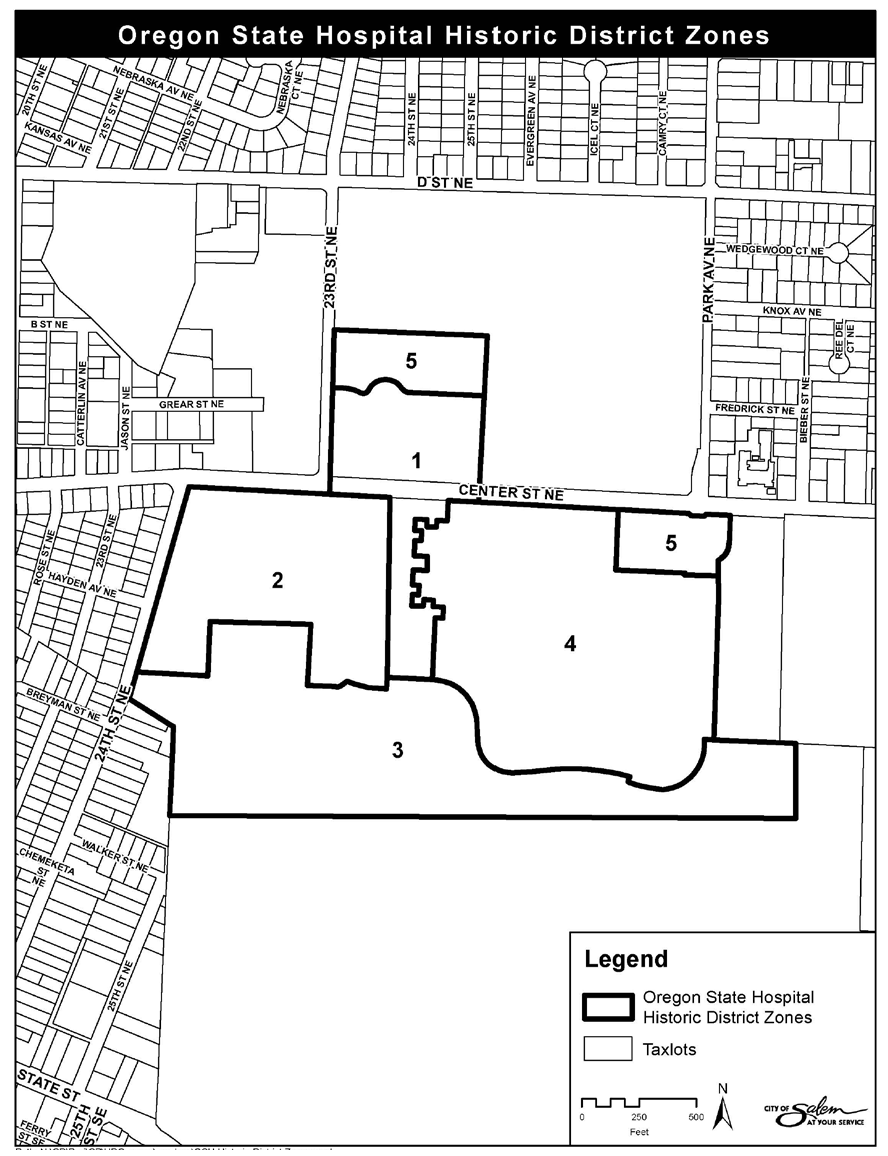
Sec. 230.060. - Standards for historic contributing buildings in public historic districts and individually listed public historic resources.
Modification to historic contributing buildings in public historic districts and individually listed public historic resources shall comply with this section.
(a)
Masonry, siding, exterior trim and minor architectural features. Replacement of masonry, siding, exterior trim, and minor architectural features of historic contributing buildings and individually listed public historic resources shall be allowed only where the owner has attempted to repair the original siding, exterior trim or minor architectural feature, but repair was determined to be unfeasible due to the poor condition of the original materials. If the masonry, siding, or trim is not original then every effort shall be made to replicate the original materials; the effort shall be substantiated by historic, physical, or pictorial evidence. If the masonry, siding, or trim cannot be replicated then it should be of a compatible design and material.
(1)
Materials. The replacement materials are the same type and quality as the original siding, exterior trim or minor architectural feature, or duplicate, to the greatest degree possible, the appearance and structural qualities of the material being replaced.
(2)
Design. The replacement reproduces the appearance of the original siding, exterior trim or minor architectural feature.
(3)
Energy efficiency. Improvements to improve energy efficiency are allowed, provided the exterior appearance of the historic resource is preserved to the greatest extent possible. Example: Adding additional insulation to attics, crawl spaces or basements.
(b)
Windows. Replacement of windows and individually listed public historic resources shall be allowed only where the owner has attempted to repair the original window, but repair was not feasible due to the poor condition of the original materials. If the window is not original then every effort shall be made to replicate the original window; the effort shall be substantiated by historic, physical, or pictorial evidence. If the window cannot be replicated then it should be of a compatible design and material.
(1)
Materials. All features of the window, including the window frame, sash, stiles, rails, muntins, lamb's tongues and glass, are replaced with materials that duplicate, to the greatest degree possible, the appearance and structural qualities of the original.
(2)
Design. Overall design of the window profile of all parts of the window shall reproduce the appearance of the original window.
(3)
Energy efficiency.
(A)
The use of weather-stripping, insulation, or materials to either repair or improve the energy efficiency shall be evaluated as means to achieve the desired energy efficiency objectives prior to seeking authorization to replace a window.
(B)
If an owner wishes to improve the energy efficiency of windows located on the primary facade, only energy efficiency measures that are removable and do not permanently alter the resource shall be used. This includes, but is not limited to, exterior storm windows, weather-stripping.
(C)
If an owner wishes to improve the energy efficiency of windows located on a facade other than the primary facade, measures that are removable and do not permanently alter the resource shall be used. This includes, but is not limited to, exterior storm windows, weather-stripping. Reuse of the original window frame and sash with replacement glass that maintains the overall design and appearance of the window is allowed. Example: Replacement of single-pane glass with new energy efficient double-paned glass is permissible, so long as the window is in satisfactory condition, muntins are wide enough to hold the double-paned glass, the double-paned glass can be inserted into the original window sash, there are only minor alterations to the overall design of the window, and the double-paned glass is not visibly tinted or reflective.
(c)
Doors. Replacement of doors in historic contributing buildings and individually listed public historic resources shall be allowed only where the owner has attempted to repair the original door, but repair was not feasible due to the poor condition of the original materials. If the doors are not original, then every effort shall be made to replicate the original doors; the effort shall be substantiated by historic, physical, or pictorial evidence. If the door cannot be replicated then it should be of a compatible design and material.
(1)
Materials. All features of the door shall be replaced with materials that duplicate, to the greatest degree possible, the appearance and structural qualities of the original door.
(2)
Design. The overall design of the door shall reproduce, to the greatest degree possible, the appearance of the original door.
(d)
Porches. Replacement of porches on historic contributing buildings and individually listed public historic resources shall be allowed only where the owner has attempted to repair the original porch, but repair was not feasible due to the poor condition of the original materials. If the porch is not original, then every effort shall be made to replicate the original porch; the effort shall be substantiated by historic, physical, or pictorial evidence. If the porch cannot be replicated then it should be of a compatible design and material.
(1)
Materials. All features of the porch shall be replaced with material that duplicate, to the greatest degree possible, the appearance and structural qualities of the original porch.
(2)
Design. The overall design of the porch shall reproduce, to the greatest degree possible, the appearance of the original porch.
(e)
Roofs and cornices. Replacement of roofs and cornices on historic contributing buildings and individually listed public historic resources shall be allowed only where the owner has attempted to repair the original roof, but repair was not feasible due to the poor condition of the original materials.
(1)
Materials.
(A)
Historic specialty roofing materials, such as original tile, slate, or rolled composition roofing should be maintained in place whenever possible.
(B)
New roof materials should match the original materials in scale and texture as closely as possible. Use of plastic or concrete simulated materials is not allowed.
(C)
Composition roofing is allowed as a substitute for wood shingles in a complete replacement.
(D)
Imitation slate and wood are allowed as a substitute for original materials in a complete replacement.
(2)
Design.
(A)
The original roof and cornice form and detailing shall be preserved.
(B)
Original eave overhangs shall be maintained.
(C)
Cutting back roof rafter and soffits, boxing in exposed rafter tails, adding fascia boards where none existed, or otherwise altering the historical roof overhang is not allowed.
(D)
To the extent feasible, inappropriate repairs or additions should be removed or corrected.
(f)
Solar panels, rooftop mechanical devices, and skylights. Solar panels and other rooftop mechanical structures may be added to historic contributing buildings and individually listed public historic resources.
(1)
Materials.
(A)
Non-reflective glass and metal panels are allowed.
(B)
Reflective glass and plastic frames are prohibited.
(2)
Design.
(A)
Solar panels shall not alter the existing profile of the roof, and shall be mounted parallel to the roof plane on rear-facing roofs or placed on the ground in an inconspicuous location.
(B)
Satellite dishes, TV antennae and other rooftop mechanical structures shall be installed so they are not visible from the street and do not damage or obscure significant architectural features of the resource.
(C)
Skylights shall be flat and shall not alter the existing profile of the roof. Bubble-type skylights are prohibited.
(D)
Any new or replacement communication device(s), including, but not limited to, dishes, antennas, and associated equipment, collocated on existing sites shall not exceed the total number and cumulative size of the dishes, antennas, and associated equipment which have been approved for installation under the most recent historic design review approval for such devices.
(g)
Missing features. Features that were present on a historic contributing building and individually listed public historic resources during the period of significance but which were later removed may be reconstructed.
(1)
Materials. Materials used in the replacement shall match as closely as practicable the composition, design, texture, and other visual qualities of the materials of the missing feature.
(2)
Design. The design shall accurately duplicate the missing feature. The design shall be substantiated by historic, physical, or pictorial evidence. Evidence does not include conjectural designs, or the appearance of features or different elements from other buildings or structures built during the period of significance.
(h)
Alterations and additions. Additions to and alterations of the historic contributing building and individually listed public historic resources are allowed.
(1)
Materials.
(A)
Building materials shall be of traditional dimensions.
(B)
Material shall be of the same type, quality and finish as original material in the building.
(C)
New masonry added to a building shall, to the greatest extent feasible, match the color, texture and bonding pattern of the original masonry.
(D)
For those areas where original material must be disturbed, original material shall be retained to the maximum extent possible.
(2)
Design. Alterations or additions shall:
(A)
Be located at the rear, or on an inconspicuous side, of the building.
(B)
Be designed and constructed to minimize changes to the building.
(C)
Be limited in size and scale such that a harmonious relationship is created with the original building.
(D)
Be designed and constructed in a manner that significant historical, architectural or cultural features of the building are not obscured, damaged, or destroyed.
(E)
Be designed to be compatible with the size, scale, material, and character of the building, and the district generally.
(F)
Not destroy or adversely impact existing distinctive materials, features, finishes and construction techniques or examples of craftsmanship that are part of the building.
(G)
Be constructed with the least possible loss of historic materials.
(H)
Not create a false sense of historical development by including features that would appear to have been part of the building during the period of significance but whose existence is not supported by historical evidence.
(I)
Be designed in a manner that makes it clear what is original to the building and what is new.
(J)
Be designed to reflect, but not replicate, the architectural styles of the period of significance.
(K)
Preserve features of the building that have occurred over time and have attained significance in their own right.
(L)
Preserve distinguishing original qualities of the building and its site.
(M)
Not increase the height of a building to more than four stories.
(i)
Decks. Replacement and addition of decks in historic contributing buildings and individually listed public historic resources is allowed.
(1)
Materials. The deck shall be constructed of wood, a wood composite, or a material available during the period of significance.
(2)
Design. The deck shall:
(A)
Be located off the rear of the resource.
(B)
Not obscure any significant architectural features of the resource.
(C)
Be of a reasonable size and scale in relationship to the resource.
(D)
Shall not extend beyond the width of the existing footprint of the resource.
(j)
Lintels, architraves, sills, and other architectural details. Replacement of lintels, architraves, sills and other architectural details in historic contributing buildings and individually listed public historic resources shall be allowed only where the owner has attempted repair, but repair was unfeasible due to the poor condition of the original materials. If the feature is not original then every effort shall be made to replicate the original feature; the effort shall be substantiated by historic, physical, or pictorial evidence. If the feature cannot be replicated then it should be of a compatible design and material.
(1)
Materials.
(A)
Existing architectural details shall be retained.
(B)
Original material shall, if possible, be retained or repaired.
(C)
If replacement material is required, similar material shall be used.
(2)
Design.
(A)
The replacement shall, to the greatest extent feasible, match design, size, proportions, and profile of the original architectural details.
(B)
Architectural details should not be added unless there is archival evidence suggesting their presence and design.
(k)
Accessibility. Additions or alterations to improve accessibility are allowed.
(1)
Materials. To the greatest extent practicable, materials shall be of the same type, quality, design, size, finish, proportions and configuration of the original materials in the building.
(2)
Design.
(A)
Additions or alterations to improve accessibility should be designed in a manner that identifies the building's character-defining spaces and features and prevents their damage or loss.
(B)
Additions and alterations to improve accessibility should be designed in a manner that is compatible with the building and its setting.
(l)
Energy efficiency. Retrofitting historic contributing buildings and individually listed public historic resources to achieve energy efficiency is permitted, if the retrofitting preserves the building's historic character.
(1)
Materials.
(A)
Materials shall be of a type and quality that will not result in degradation of original material in the resource. Example: Addition of insulation to exterior walls should not negatively affect the function of the wall assembly.
(B)
The materials for any retrofitted architectural elements shall comply with the standards for materials for such elements set forth in this section. This includes, but is not limited to, windows and doors.
(2)
Design.
(A)
To the extent practicable, original systems to control ventilation, such as double hung, transom windows and awnings, shall be preserved.
(B)
Before seeking to replace windows or doors, improve thermal efficiency through weather-stripping, storm windows, interior shades, blinds and awnings.
(C)
The designs of any retrofitted architectural elements shall comply with the standards for replacement of such elements set forth in this section.
(D)
Retrofitting shall be designed in a manner that prevents loss of original material or architectural elements.
(m)
Mechanical equipment and service areas. Addition and replacement of mechanical equipment is permitted. This includes, but is not limited to, heating and cooling systems, solar panels, telecommunications equipment and dumpster enclosures.
(1)
Materials. Materials shall be harmonious in type, color, scale, texture, and proportions with the building and the district generally.
(2)
Design.
(A)
Mechanical equipment and service areas should be located out of public view and designed as an integral part of the overall building design.
(B)
Mechanical equipment and service areas should be placed at the rear of the building, recessed on the roof of the building, or screened by appropriate fencing.
(C)
Low-profile mechanical units and elevator shafts may be placed on rooftops if they are not visible from the street, or are set back and screened from view.
(D)
Solar panels should have low profiles and not be visible from right-of-way, other than alleys, and shall be installed in a manner that minimizes damage to historic materials.
(E)
Skylights shall be flat and shall not alter the existing profile of the roof. Bubble-type skylights are prohibited.
(F)
Mechanical equipment placed at street level should be screened in a manner that is compatible with the streetscape and adjacent buildings.
(G)
New skylights and vents shall be placed behind and below the parapet level.
(H)
Any new or replacement communication device(s), including, but not limited to, dishes, antennas, and associated equipment, collocated on existing sites shall not exceed the total number and cumulative size of the dishes, antennas, and associated equipment which have been approved for installation under the most recent historic design review approval for such devices.
(n)
Awnings and canopies.
(1)
Materials. Replacement or installation of awnings and canopies on historic contributing buildings and individually listed public historic resources is allowed.
(A)
Materials that are compatible with the character of the building's period and style shall be used.
(B)
Canvass is an approved material for awnings and canopies.
(2)
Design.
(A)
Awnings shall be located within window openings and below transoms.
(B)
Umbrella-type awnings and non-historic forms are not permitted.
(C)
Awnings shall be attached in such a manner that historic materials or features are not damaged.
(D)
Marquees may be used where compatible with the building and neighboring buildings.
(E)
Awnings, canopies, or marquees shall not obscure significant architectural features on the building.
(F)
Awnings, canopies, or marquees shall have size, scale and design that are compatible with the building and neighboring buildings.
(o)
New accessory structures. New accessory structures may be built on the site of historic contributing buildings and individually listed public historic resources.
(1)
Materials. New accessory structures shall have the same siding material as the primary resources, or consistent with other primary structures in the zone.
(2)
Design. New accessory structures shall:
(A)
Not be located on or around the primary facade of an existing resource.
(B)
Be no taller than one story.
(C)
Be similar in character to those built during the period of significance.
(D)
Be subordinate to the primary structure in terms of mass, size, and height.
(p)
Fences. Fences may be added to sites of historic contributing buildings and individually listed public historic resources, provided the fence will not result in the removal or destruction of site features identified as significant on the historic resource inventory.
(1)
Materials. The fence shall be constructed of traditional materials that were available during the period of significance.
(2)
Design. Fences shall be no taller than four feet in the front yard and no taller than six feet in side and rear yards.
(q)
Retaining walls. Retaining walls may be added to sites of historic contributing buildings and individually listed public historic resources, provided the retaining wall will not result in the removal or destruction of site features identified as significant on the historic resource inventory.
(1)
Materials. The retaining wall shall be constructed of traditional materials that were available during the period of significance. Example: If the period of significance is 1920-1940 the materials that were available included, but were not limited to, rusticated stone, formed concrete, poured concrete, and brick.
(2)
Design. Retaining walls shall be no taller than two feet in the front and four feet on the side and rear yards.
(r)
Site features. Replacement or alteration of site features of a historic contributing building and individually listed public historic resources that are identified as significant features on the historic resource inventory, including, but not limited to, driveways, sidewalks, gardens, significant trees, or geological features is allowed, unless the replacement or alteration would materially alter or destroy the features.
(1)
Materials. Materials shall duplicate, to the greatest degree possible, the appearance and physical qualities of the original materials. Example: Rhododendron hedge planted during the period of significance is replanted with heritage varieties available during the period of significance.
(2)
Design. The design shall reproduce, to the greatest extent possible, the appearance of the original site feature. Example: If the site contains a Lord and Schryver garden, the replacements shall be allowed provided the original design and location of plantings of the historical garden are retained.
(Prior Code, § 230.060; Ord. No. 25-13; Ord. No. 12-20, § 1(Exh. A), 10-26-2020, eff. 11-25-2020)
Sec. 230.062. - Signs in public historic districts.
Signs in public historic districts and on an individually listed public historic resource shall comply with this section, as well as any applicable requirements set forth in SRC chapter 900.
(a)
Historic signs shall be retained whenever possible, particularly if the sign is associated with historic figures, events or places, significant as evidence of the history of the product, business or service advertised, significant as reflecting the history of the building or the development of the historic district, characteristic of a specific period, or integral to the building's or structure's design or physical fabric.
(b)
Reconstruction of historic signs shall only be allowed if there is sufficient historical, pictorial, and physical documentation to replicate the sign's appearance at a specific period of time and in its historic location.
(c)
New signs shall:
(1)
Be compatible with the size, scale, and design of the historic resource.
(2)
Be located where they do not obscure significant features of a historic resource.
(3)
Use materials that are compatible with and characteristic of the period of significance.
(4)
Be attached in a manner that prevents damage to historic materials.
(5)
Any sign identifying the use of the building or structure shall be limited to the minimum size necessary to provide such identification.
(Prior Code, § 230.062; Ord. No. 25-13)
Sec. 230.063. - Standards for non-contributing buildings and structures in public historic districts.
Modifications to non-contributing buildings in public historic districts shall comply with this section.
(a)
Masonry, siding, exterior trim, and minor architectural features. Replacement of masonry, siding, and exterior trim of non-contributing buildings is allowed.
(1)
Materials.
(A)
For historic non-contributing buildings, material dating from the period of significance shall, if possible, be retained or repaired.
(B)
Replacement materials shall be, to the greatest degree possible, of the same type, quality, design, size, finish, proportions, and configuration of the materials commonly used on other buildings in the district.
(2)
Design.
(A)
The design shall, to the greatest degree possible, match the color, texture and bonding pattern of the original materials.
(B)
For historic non-contributing buildings the appearance of original materials that were used on the building during the period of significance shall be restored or reconstructed whenever possible.
(b)
Windows. Replacement of windows in historic non-contributing buildings is allowed.
(1)
Materials.
(A)
Windows dating from the period of significance shall, if feasible, be retained and repaired or restored.
(B)
Replacement materials shall be, to the greatest extent practicable, of the same type, quality, design, size, finish, proportions and configuration of windows commonly used on other buildings in the district.
(C)
Glass block or tinted, mirrored, opaque, or colored glass is not permitted, unless it is the historic glazing type.
(2)
Design.
(A)
Replacement windows should, to the greatest degree possible, match design, size, proportions, configuration, reflective qualities and profile of the original windows dating from the period of significance, if documentary evidence of the appearance is available.
(B)
The size and shape of the window openings dating from the period of significance should be preserved so that the configuration of the facade is not changed.
(C)
Original openings that have been covered or blocked should be re-opened when feasible.
(D)
New window openings into the principal elevations, enlargement or reduction of original window openings, and infill of original window openings are not permitted.
(E)
Window styles historically used on upper levels shall not be installed at storefront level, and storefront windows shall not be installed on upper levels.
(F)
Commercial window types shall not be substituted with residential window types, unless the type of window being replaced is residential.
(G)
Interior grilles, grilles between layers of insulating glass, or stenciled mullions in lieu of true divided lights or exterior mullions are not permitted.
(c)
Doors. Replacement of doors in non-contributing buildings shall be allowed.
(1)
Materials.
(A)
Doors dating from the period of significance shall, if possible, be retained and repaired or restored.
(B)
Replacement materials shall be, to the greatest degree possible, of the same type, quality, design, size, finish, proportions and configuration of the doors commonly found in the district.
(2)
Design.
(A)
Replacement doors shall, to the greatest degree possible, match design, size, proportions and profile of the original door dating from the period of significance, if documentary evidence of the appearance is available.
(B)
Original door openings that have been covered or blocked should be reopened when feasible.
(C)
The size and shape of original door openings should be preserved so that the configuration of the facade is not changed.
(D)
Commercial door types shall not be substituted with residential door types, unless the type of door being replaced is residential.
(d)
Porches. Replacement of porches on non-contributing buildings is allowed.
(1)
Materials.
(A)
All features of the porch shall be replaced with material that duplicate, to the greatest degree possible, the appearance and structural qualities of the original porch.
(B)
Replacement materials shall duplicate, to the greatest degree possible, the appearance and structural qualities that are consistent with building materials on buildings in the district.
(C)
Wood lap, shingles, brick, and stone are appropriate materials.
(D)
Alternative materials shall appear similar in scale, proportion, texture and finish with buildings in the district.
(2)
Design. The design should be similar in dimension, style, pattern and detail to porches on buildings in the district.
(e)
Roofs and cornices. Replacement of roofs and cornices on non-contributing buildings shall be allowed.
(1)
Materials.
(A)
Historic specialty roofing materials, such as original tile, slate, or rolled composition roofing dating from the period of significance should be maintained in place whenever possible.
(B)
Replacement materials that are visible from the street shall be, to the greatest degree possible, of the same type, quality, design, size, finish, proportions and configuration of the roof and cornices commonly found in the district. Plastic or concrete simulated materials are not allowed. Imitation slate and wood are allowed as a substitute for original materials in a complete replacement.
(2)
Design.
(A)
To the extent practicable, original roof and cornice components visible from the street dating from the period of significance shall be preserved.
(B)
Eave overhangs dating from the period of significance shall be maintained.
(C)
Restoration of the appearance of the roof and cornice that is visible from the street, based on historical research and physical evidence from the period of significance, is preferred.
(D)
Replacement of roofs and cornices that are contemporary in design shall be compatible with the scale, proportions, massing, height, rhythm, materials, color and texture of historic buildings in the district.
(E)
Cutting back roof rafters and soffits, boxing in exposed rafter tails, adding fascia boards where none existed, or otherwise altering material that dates from the period of significance is not allowed.
(F)
To the extent practical, inappropriate repairs or additions that occurred after the period of significance should be removed or corrected.
(f)
Solar panels, rooftop mechanical devices, and skylights. Solar panels and other rooftop mechanical structures may be added to historic contributing buildings and individually listed public historic resources.
(A)
Materials.
(i)
Non-reflective glass and metal panels are allowed.
(ii)
Reflective glass and plastic frames are prohibited.
(B)
Design.
(i)
Solar panels shall not alter the existing profile of the roof, and shall be mounted parallel to the roof plane on rear-facing roofs or placed on the ground in an inconspicuous location.
(ii)
Satellite dishes, TV antennae and other rooftop mechanical structures shall be installed so they are not visible from the street and do not damage or obscure significant architectural features of the resource.
(iii)
Skylights shall be flat and shall not alter the existing profile of the roof. Bubble-type skylights are prohibited.
(iv)
Any new or replacement communication device(s), including, but not limited to, dishes, antennas, and associated equipment, collocated on existing sites shall not exceed the total number and cumulative size of the dishes, antennas, and associated equipment which have been approved for installation under the most recent historic design review approval for such devices.
(g)
Missing features. Features that were present on a non-contributing building during the period of significance but which were later removed may be reconstructed.
(1)
Materials. Materials used in the replacement shall match as closely as practicable the composition, design, texture, and other visual qualities of the materials of the missing feature.
(2)
Design. The design accurately duplicates the missing feature. The design shall be substantiated by historic, physical, or pictorial evidence. Evidence does not include conjectural designs, or the appearance of features or different elements from other buildings or structures built during the period of significance.
(h)
Alterations and additions. Additions and alterations that comply with the standards in this section may be made to historic non-contributing buildings. Whenever practical, additions and alterations to historic non-contributing buildings should result in the restoration of missing features from the period of significance, or the removal of alterations that were made outside of the period of significance.
(1)
Materials.
(A)
Materials shall be consistent with those present in buildings in the district generally.
(B)
Roofing materials shall have a non-reflective, matte finish.
(2)
Design.
(A)
The location for an addition shall be at the rear, or on an inconspicuous side of the building.
(B)
Changes to features of a historic non-contributing building that date from the period of significance shall be minimized.
(C)
The design shall be compatible with the character of non-contributing buildings in the historic district and create a harmonious relationship with historic contributing buildings in the district generally. Factors in evaluating the design under this subsection include, but are not limited to:
(i)
Similarities in the size and scale to those used in historic contributing buildings in the district generally.
(ii)
Use of architectural features that reflect, or are similar to, the architectural style of historic contributing buildings in the district.
(iii)
Simple gable or hipped roofs with a pitch similar to surrounding buildings are generally appropriate. Flat roofs may be appropriate when the prevailing styles of architecture provide an appropriate context. Exotic or complex roof forms that detract from the visual continuity of the district are generally inappropriate.
(iv)
Additions should have a similar mass to surrounding buildings.
(v)
Front elevations should appear similar in scale to those seen traditionally in the surrounding neighborhood.
(vi)
The width and height of the addition should not exceed the typical dimensions seen in the district.
(vii)
Simple rectangular building forms are generally preferred.
(D)
The design shall make clear what is original and what is new.
(E)
Features that have been added over time and have attained significance in their own right shall be preserved, even if the features do not reflect the period of significance.
(F)
An addition that adds stories shall increase the height of a building to no more than four stories.
(i)
Decks. Replacement and addition of decks in non-contributing buildings is allowed, subject to the following standards:
(1)
Materials. The deck shall be constructed of wood, a wood composite, or a material available during the period of significance.
(2)
Design. The deck shall:
(A)
Be located off the rear of the resource.
(B)
Be of a reasonable size and scale in relationship to the resource.
(j)
Lintels, architraves, sills, and other architectural details. Replacement of lintels, architraves, sills, and other architectural details on non-contributing buildings is allowed.
(1)
Materials.
(A)
Materials dating from the period of significance shall, if possible, be retained and repaired or restored.
(B)
Replacement materials shall be, to the greatest extent practicable, of the same type, quality, design, size, finish, proportions and configuration commonly found in the district.
(2)
Design.
(A)
To the extent practicable, original material dating from the period of significance shall be preserved.
(B)
Restoration of the appearance of architectural details that are visible from the street, based on historical research and physical evidence from the period of significance, is preferred.
(C)
Replacement of architectural details that are contemporary in design shall be compatible with the scale, proportions, massing, height, rhythm, materials, color, and texture of historic buildings in the district.
(k)
Accessibility. Additions or alterations to improve accessibility are allowed.
(1)
Materials. Materials shall be, to the greatest extent practicable, of the same type, quality, design, size, finish, proportions and configuration of the original materials in the building.
(2)
Design.
(A)
Additions or alterations to improve accessibility shall be designed in a manner that identifies the building's character-defining spaces and features, and prevents their damage or loss.
(B)
Additions and alterations to improve accessibility should be designed in a manner that is compatible with the building and its setting.
(l)
Energy efficiency. Retrofitting non-contributing buildings to achieve energy efficiency is permitted, if the retrofitting preserves the character of the historic district.
(1)
Materials. The materials for any retrofitted architectural elements shall comply with the standards for materials for such elements set forth in this section. This includes, but is not limited to, windows and doors.
(2)
Design.
(A)
To the extent practicable, original systems to control ventilation, such as double hung, transom windows and awnings, dating from the period of significance shall be preserved.
(B)
The designs of any retrofitted architectural elements shall comply with the standards for replacement of such elements set forth in this section. This includes, but is not limited to, windows and doors.
(C)
Retrofitting shall be designed in a manner that prevents loss of original material or architectural elements dating from the period of significance.
(m)
Mechanical equipment and service areas. Addition and replacement of mechanical equipment is permitted. This includes, but is not limited to, heating and cooling systems, solar panels, telecommunications equipment, and dumpster enclosures.
(1)
Materials. Materials shall be harmonious in type, color, scale, texture, and proportions with the building and the district generally.
(2)
Design.
(A)
Mechanical equipment and service areas should be located out of public view and designed as an integral part of the overall building design.
(B)
Mechanical equipment and service areas should be placed at the rear of the building, recessed on the roof of the building, or screened by appropriate fencing.
(C)
Low-profile mechanical units and elevator shafts may be placed on rooftops if they are not visible from the street, or are set back and screened from view.
(D)
Solar panels should have low profiles and not be visible from right-of-way, other than alleys, and shall be installed in a manner that minimizes damage to historic materials.
(E)
Skylights shall be flat and shall not alter the existing profile of the roof. Bubble-type skylights are prohibited.
(F)
Mechanical equipment placed at street level should be screened in a manner that is compatible with the streetscape and adjacent buildings.
(G)
New skylights and vents shall be placed behind and below the parapet level.
(H)
Any new or replacement communication device(s), including, but not limited to, dishes, antennas, and associated equipment, collocated on existing sites shall not exceed the total number and cumulative size of the dishes, antennas, and associated equipment which have been approved for installation under the most recent historic design review approval for such devices.
(n)
Awnings and canopies. Replacement or installation of awnings and canopies on non-contributing buildings is allowed.
(1)
Materials.
(A)
Materials that are compatible with the character of the district shall be used.
(B)
Canvass is an approved material for awnings and canopies.
(2)
Design.
(A)
Awnings shall be located within window openings, and below transoms.
(B)
Umbrella-type awnings and non-historic forms are not permitted.
(C)
Awnings shall be attached in such a manner that historic materials or features are not damaged.
(D)
Marquees may be used where compatible with the building and neighboring buildings.
(E)
Awnings, canopies, or marquees shall not obscure significant architectural features on the building.
(F)
Awnings, canopies, or marquees shall have size, scale, and design that are compatible with the building and neighboring buildings.
(o)
New accessory structures. New accessory structures may be built on the site of non-contributing buildings, subject to the following standards:
(1)
Materials.
(A)
Building materials shall be of traditional dimensions.
(B)
Siding material shall be consistent with those present in buildings in close proximity to the accessory, generally.
(2)
Design. New accessory structures shall:
(A)
Not be located on or around the primary facade of an existing resource.
(B)
Be no taller than one story.
(C)
Be of a reasonable size and scale in relationship to the building.
(p)
Fences. Fences may be added to sites of non-contributing buildings, provided the fencing will not result in the removal or destruction of site features identified as significant on the historic resource inventory for the district.
(1)
Materials. Fences shall be constructed of traditional materials that were available during the period of significance.
(2)
Design. Fences shall be no taller than four feet in the front yard and no taller than six feet in side and rear yards.
(q)
Retaining walls. Retaining walls may be added to sites of non-contributing buildings, provided the retaining wall will not result in the removal or destruction of site features identified as significant on the historic resource inventory for the district.
(1)
Materials. The retaining wall shall be constructed of traditional materials that were available during the period of significance. Example: If the period of significance is 1920-1940, the materials that were available included, but were not limited to, rusticated stone, formed concrete, poured concrete, and brick.
(2)
Design. Retaining walls shall be no taller than two feet in the front and four feet on the side and rear yard.
(r)
Site features. Replacement or alteration of site features of a non-contributing building that are identified as significant features on the historic resource inventory for the district, including, but not limited to, driveways, sidewalks, gardens, significant trees, or geological features is allowed, unless the replacement or alteration would materially alter or destroy the features.
(1)
Materials. Materials shall duplicate, to the greatest degree practicable, the appearance and physical qualities of the original materials. Example: Rhododendron hedge planted during the period of significance is replanted with heritage varieties available during the period of significance.
(2)
Design. The design shall reproduce, to the greatest extent practicable, the appearance of the original site feature. Example: If the site contains a Lord and Schryver garden, the replacements shall be allowed provided the original design and location of plantings of the historical garden are retained.
(Prior Code, § 230.063; Ord. No. 25-13; Ord. No. 12-20, § 1(Exh. A), 10-26-2020, eff. 11-25-2020)
Sec. 230.064. - Standards for new construction in public historic districts.
New buildings may be constructed in public historic districts, subject to the following standards:
(a)
Materials.
(1)
The primary facade shall be constructed of building materials that are consistent with other primary structures in the vicinity.
(2)
Materials used in the construction shall be identical or similar those available for similar buildings or structures built during the period of significance.
(3)
Materials shall be similar in scale, proportion, texture, and finish to those found on nearby historic structures.
(b)
Design.
(1)
Within all public historic districts, other than the Oregon State Hospital Historic District, the design shall be compatible with general character of historic contributing buildings in the historic district. Factors in evaluating compatibility include, but are not limited to:
(A)
The height, width, proportions, size and scale is consistent with those used in similar historic contributing buildings in the district generally.
(B)
The design reflects, but does not replicate, the architectural style of historic contributing buildings in the district.
(C)
Architectural elements that are similar to those found on historic contributing buildings in the historic district are used.
(D)
Architectural elements such as lintels, cornices, doors, and windows reflect the spacing, placement, scale, orientation and proportion of buildings in the district.
(E)
The front facade is designed with proportions that are compatible with adjacent buildings in the vicinity.
(2)
Within the Oregon State Hospital Historic District the design shall be compatible with general character of the historic contributing buildings, as identified in Table 230-3, located in the zone, as identified in Figure 230-5, where the work is occurring.
(A)
The height, width, proportions, size and scale is consistent with those used in similar historic contributing buildings in the district generally.
(B)
The design reflects, but does not replicate, the architectural style of historic contributing buildings in the district.
(C)
Architectural elements that are similar to those found on historic contributing buildings in the historic district are used.
(D)
Architectural elements such as lintels, cornices, doors, and windows reflect the spacing, placement, scale, orientation, and proportion of buildings in the district.
(E)
The front facade is designed with proportions that are compatible with adjacent buildings in the vicinity.
(c)
Mechanical equipment and service areas. Mechanical equipment, including, but not limited to, heating and cooling systems, solar panels, and telecommunications equipment, and service areas, including, but not limited to, dumpster enclosures, shall meet the following standards:
(1)
Materials. Materials shall be harmonious in type, color, scale, texture, and proportions with the building and the district generally.
(2)
Design.
(A)
Mechanical equipment and service areas should be located out of public view and designed as an integral part of the overall building design.
(B)
Mechanical equipment and service areas should be placed at the rear of the building, recessed on the roof of the building, or screened by appropriate fencing.
(C)
Low-profile mechanical units and elevator shafts may be placed on rooftops if they are not visible from the street, or are set back and screened from view.
(D)
Solar panels should have low profiles and not be visible from the street.
(E)
Skylights shall be flat and shall not alter the existing profile of the roof. Bubble-type skylights are prohibited.
(F)
Mechanical equipment placed at street level should be screened in a manner that is compatible with the streetscape and adjacent buildings.
(G)
Skylights and vents shall be placed behind and below the parapet level.
(d)
Accessory structures. Accessory structures may be built on the site of new construction.
(1)
Materials.
(A)
Building materials shall be of traditional dimensions.
(B)
Siding material shall be consistent with those present in buildings in the district generally.
(2)
Design.
(A)
The accessory structure shall be located at the rear of the lot or parcel.
(B)
The accessory structure shall be no taller than one story.
(C)
The accessory structure shall be of a reasonable size and scale in relationship to the building.
(e)
Awnings and canopies. Awnings and canopies on new construction shall meet the following standards:
(1)
Materials.
(A)
Materials that are compatible with the character of the district shall be used.
(B)
Canvass is an approved material for awnings and canopies.
(2)
Design.
(A)
Awnings shall be located within window openings, and below transoms.
(B)
Umbrella-type awnings and non-historic forms are not permitted.
(C)
Marquees may be used where compatible with the building and neighboring buildings.
(D)
Awnings, canopies, or marquees shall not obscure significant architectural features on the building.
(E)
Awnings, canopies, or marquees shall have size, scale, and design that are compatible with the building and neighboring buildings.
(f)
Fences. Fences may be included in new construction.
(1)
Materials. Fences shall be constructed of traditional materials available during the period of significance.
(2)
Design. Fences shall be no taller than four feet in the front yard and no taller than six feet in side and rear yards.
(g)
Retaining walls. Retaining walls may be included in new construction, provided the retaining wall will not result in the removal or destruction of site features identified as significant on the historic resource inventory for the district.
(1)
Materials. The retaining wall shall be constructed of traditional materials that were available during the period of significance. Example: If the period of significance is 1920-1940, the materials that were available included, but were not limited to, rusticated stone, formed concrete, poured concrete, and brick.
(2)
Design. Retaining walls shall be no taller than two feet in the front and four feet on the side and rear yard.
(h)
Solar panels, rooftop mechanical devices, and skylights. Solar panels and other rooftop mechanical structures may be included in new construction.
(1)
Materials.
(A)
Non-reflective glass and metal panels are allowed.
(B)
Reflective glass and plastic frames are prohibited.
(2)
Design.
(A)
Solar panels shall not alter the existing profile of the roof, and shall be mounted flush on rear-facing roofs or placed on the ground in an inconspicuous location.
(B)
Satellite dishes, TV antennae and other rooftop mechanical structures shall be installed so they are not visible from the street and do not damage or obscure significant architectural feature of the resource.
(C)
Skylights shall be flat and shall not alter the existing profile of the roof. Bubble-type skylights are prohibited.
(Prior Code, § 230.064; Ord. No. 25-13; Ord. No. 15-19, § 1(Exh. A), 12-9-2019, eff. 1-8-2020; Ord. No. 12-20, § 1(Exh. A), 10-26-2020, eff. 11-25-2020)
Sec. 230.065. - General guidelines for historic contributing resources.
In lieu of the standards for historic contributing buildings set forth in SRC 230.025 and 230.040, an applicant may make a proposal for preservation, restoration, or rehabilitation activity, regardless of type of work, which shall conform to the following guidelines:
(a)
Except as otherwise provided in this chapter, the property shall be used for its historic purpose, or for a similar purpose that will not alter street access, landscape design, entrance(s), height, footprint, fenestration, or massing.
(b)
Historic materials, finishes, and distinctive features shall, when possible, be preserved and repaired according to historic preservation methods.
(c)
Distinctive stylistic features or examples of skilled craftsmanship significance shall be treated with sensitivity.
(d)
Historic or original features shall be restored or reconstructed only when supported by physical or photographic evidence.
(e)
Changes that have taken place to a historic resource over the course of time are evidence of the history and development of a historic resource and its environment, and should be recognized and respected. These changes may have acquired historic significance in their own right, and this significance should be recognized and respected.
(f)
Additions and alterations to a historic resource shall be designed and constructed to minimize changes to the historic resource.
(g)
Additions and alterations shall be constructed with the least possible loss of historic materials and so that significant features are not obscured, damaged, or destroyed.
(h)
Structural deficiencies in a historic resource shall be corrected without visually changing the composition, design, texture or other visual qualities.
(i)
Excavation or re-grading shall not be allowed adjacent to or within the site of a historic resource which could cause the foundation to settle, shift, or fail, or have a similar effect on adjacent historic resources.
(Prior Code, § 230.065; Ord. No. 34-10; Ord. No. 12-20, § 1(Exh. A), 10-26-2020, eff. 11-25-2020)
Sec. 230.070. - General guidelines for non-contributing buildings and structures.
In lieu of the standards for non-contributing buildings and structures set forth in SRC 230.030 and 230.045, an applicant may make changes to a non-contributing building or structure, regardless of type of work, which shall conform to the following guidelines:
(a)
Materials shall be consistent with those present in buildings and structures in the district generally.
(b)
Alterations and additions shall be compatible in design and construction with the general character of buildings or structures in the historic district. Factors in evaluating compatibility include, but are not limited to:
(1)
Architectural elements such as porches, dormers, doors and windows reflect the spacing, placement, scale, orientation and proportion of buildings in the district, generally.
(2)
The location is at the rear, or on an inconspicuous side, of the building or structure.
(3)
The size and scale is consistent and harmonious with the buildings and structures in the district generally.
(4)
The design reflects, but does not replicate, the architectural style of historic contributing buildings and structures in the district.
(5)
The building uses similar setbacks, orientation on the site, spacing and distance from adjacent buildings that is found on buildings in the immediate vicinity and the district as a whole.
(Prior Code, § 230.070; Ord. No. 34-10)
Sec. 230.075. - Streetscape standards.
Streetscape improvements in historic districts shall comply with this section.
(a)
Non-contributing features within the public right-of-way. Alterations to non-contributing features within the public right-of-way shall comply with the Public Works Design Standards.
(b)
Materials.
(1)
Replacement materials should match as closely as possible to the original color, texture, size, and finish of the original materials.
(c)
Design.
(1)
Historic street lamps shall be preserved, if feasible.
(2)
Historic landscaped buffer zones, such as the grassy median between the sidewalk and curb shall be preserved.
(3)
Historic retaining walls should be preserved, if feasible.
(4)
Significant sidewalk and driveway features should be preserved when they contribute to the character of the district.
(5)
Original driveway locations and curb cuts should be preserved when they contribute to the character of the district.
(6)
Only those portions of character-defining streetscape that are deteriorated beyond repair shall be replaced.
(7)
New sidewalks should align with existing historic sidewalks on the block, if present.
(8)
When feasible, replacement or new sidewalks should exhibit scoring lines and brush patterns consistent with the historic material when those elements contribute to the historic character of the district.
(d)
City trees.
(1)
Removal of contributing City trees shall comply with SRC chapter 86.
(2)
Any contributing City tree that has been removed shall be replanted in the same location and with the same species, except as otherwise approved through an adjustment under SRC chapter 250.
(Prior Code, § 230.075; Ord. No. 34-10; Ord. No. 12-20, § 1(Exh. A), 10-26-2020, eff. 11-25-2020)
Sec. 230.080. - Individually listed resources.
Historic preservation activity on an individually listed resource shall comply with the standards for historic contributing buildings for the type of resource.
(Prior Code, § 230.080; Ord. No. 34-10)
Sec. 230.082. - Public historic mitigation.
(a)
A public agency shall avoid inadvertent impacts to a historic resource for which the agency is responsible.
(b)
A public agency that alters an historic resource for which the agency is responsible to the degree where the alteration has adverse effect on the historic resource shall mitigate the adverse effect as provided in this subsection.
(1)
Level of effect. Any proposed alteration that will have an adverse effect to the historic resource shall be classified as to the level of effect, as set forth in Table 230-4. The level of effect is based on the scale of work and the location of the work. Example: An alteration that involves minor work on a secondary facade will not have as high of an adverse effect on a public historic resource as a project involving major work on a primary facade.
(2)
Mitigation required. Mitigation shall be commensurate with the level, as set forth in this subsection.
(A)
Level One: minor adverse effect. Work involves loss of historic features or minor alterations. Mitigation shall include photo documentation of original feature or features prior to removal and an intensive level documentation of the historic resource. The historic resource shall be documented utilizing the standards for photographing and documenting historic resources established by the SHPO.
(B)
Level Two: moderate adverse effect. Work involves major alterations or additions. Mitigation shall include photo documentation of original feature or features prior to commencement of work, ILS level documentation of the historic resource, and the development of both on-site and stand-alone educational materials which will meaningfully educate the public about the historic resource. Examples of stand-alone educational materials include, but are not limited to, informational websites and pamphlets. A digital version of any educational materials shall be provided and adequate hard copies printed for distribution by the City. On-site materials include, but are not limited to, informational kiosks or panels containing historical photos, architectural information and maps relating to the historic resource and site that are installed on the site of the historic resource.
(C)
Level Three: major adverse effect. Work results in demolition of a historic resource. Mitigation shall include photo documentation of historic resource prior to commencement of demolition. ILS level documentation of the historic resource, and the development of both on-site and stand-alone educational materials which will meaningfully educate the public about the historic resource, and donation to the City's Historic Preservation Trust Fund, as provided in this subsection. Examples of stand-alone educational materials include, but are not limited to, informational websites and pamphlets. A digital version of any educational materials shall be provided along, and adequate hard copies printed for distribution by the City. On-site materials include, but are not limited to, informational kiosks or panels containing historical photos, architectural information and maps relating to the historic resource and site that are installed on the site of the historic resource. The public agency shall donate 0.1 percent of the estimated market value of the historic resource to the City's Historic Preservation Trust Fund.
(3)
Completion of mitigation. Mitigation shall be complete at the time of completion of project giving rise to the required mitigation.
(Prior Code, § 230.082; Ord. No. 25-13; Ord. No. 12-20, § 1(Exh. A), 10-26-2020, eff. 11-25-2020)
Sec. 230.084 - Determination of historic resource relocation feasibility.
(a)
Applicability. No historic contributing building within a local or National Register Historic District or individually listed local or National Register historic resource shall be relocated or demolished without first obtaining a determination of relocation feasibility as provided in this section.
(b)
Procedure Type. An application for determination of historic resource relocation feasibility is processed as a Type I procedure under SRC chapter 300.
(c)
Submittal requirements. In addition to the submittal requirement for a Type I application under SRC chapter 300, an application for determination of historic resource relocation feasibility shall include the following:
(1)
A report from a structural engineer evaluating the structural integrity of the building or resource and the feasibility of transporting it on the public street right-of-way.
(2)
A determination from the Building Official whether the building or resource can be reasonably moved.
(d)
Criteria. The relocation of a historic contributing building or individually listed resource shall be determined to be feasible if the following criterion is met:
(1)
The structural integrity of the building or resource is such that transporting it on the public street right-of-way will not result in the reasonable likelihood of collapse and will not otherwise endanger public health, safety, and welfare.
(Ord. No. 12-20, § 1(Exh. A), 10-26-2020, eff. 11-25-2020)
Sec. 230.085. - Historic resource relocation.
(a)
Applicability. No historic contributing building within a local or National Register Historic District or individually listed local or National Register historic resource shall be relocated without obtaining historic resource relocation approval pursuant to this section.
(b)
Procedure type. Historic resource relocation is processed as a Type III procedure under SRC chapter 300.
(c)
Submittal requirements. In addition to the submittal requirement for a Type III application under SRC chapter 300, an application for historic resource relocation shall include the following:
(1)
Site plan and vicinity map of the proposed new location.
(2)
A determination of historic resource relocation feasibility pursuant to SRC 230.084.
(3)
A plan for transporting the building or resource on the public street right-of way from its current location to the proposed new location.
(d)
Criteria. An application for historic resource relocation shall be granted if the following criteria are met:
(1)
The proposed new location is within the City limits; or a reasonable attempt has been made to locate the resource in a jurisdiction that has the ability to designate the resource as a historic resource.
(2)
A reasonable attempt has been made to relocate the resource within an existing local or National Register Historic District.
(3)
The structural integrity of the building or resource is such that transporting it on the public street right-of-way will not result in the reasonable likelihood of collapse and will not otherwise endanger public health, safety, and welfare.
(e)
Historic resource designation. If the proposed new location is within the City limits and the original requirements relating to the historic integrity of the resource under SRC 230.010(e)(3) are met after the building or resource has been relocated, the applicant shall initiate redesignation of the building or resource pursuant to SRC 230.010 prior to obtaining Certificate of Occupancy at the new location. If, however, the original requirements relating to the historic integrity of the resource are not met after the building or resource has been relocated, the applicant shall initiate removal of local historic resource designation pursuant to SRC 230.015.
(Ord. No. 12-20, § 1(Exh. A), 10-26-2020, eff. 11-25-2020)
Editor's note— Ord. No. 12-20, § 1(Exh. A), adopted 10-26-2020, repealed § 230.085 in its entirety and enacted new provisions to read as herein set out. Former § 230.085 pertained to historic resource adaptive reuse, and derived from prior Code 230.085; Ord. No. 34-10; Ord. No. 25-13; and Ord. No. 31-13.
Sec. 230.090. - Demolition of primary historic structures.
(a)
Applicability. Prior to the issuance of a permit for the demolition of a historic contributing building within a local or National Register Historic District or individually listed local or National Register [historic] resource, the owner must obtain historic resource demolition approval pursuant to this section.
(b)
Procedure type. Historic resource demolition is processed as a Type III procedure under SRC chapter 300.
(c)
Submittal requirements. In addition to the submittal requirements for a Type III application under SRC chapter 300, an application for historic resource demolition shall include:
(1)
A statement of the historic value and significance of the building or resource to the community from the listing document (Local, National Register listing) as well as any relevant supportive documentation from a preservation professional, taking into consideration its designation as a local landmark, individually listed historic contributing building on the National Register, or its location within a National Register Historic District;
(2)
Documentation confirming that the property owner has owned the property for at least one year prior to applying for historic resource demolition; and
(3)
Documentation of economic hardship demonstrating the property is incapable of generating a reasonable economic return, including, but not limited to:
(A)
The purchase price of the building or resource;
(B)
Assessed value for the two years immediately preceding the application;
(C)
Current fair market value of building or resource as determined by appraiser;
(D)
Real estate taxes for the two years immediately preceding the application;
(E)
The annual gross income generated from the building or resource for the last two years;
(F)
The debt associated with the building or resource including a profit and loss statement for the two years immediately preceding the application; and
(G)
Any expenditures associated with the building or structure during the two years immediately preceding the application.
(4)
Documentation demonstrating good faith efforts of the property owner to sell, rent, or lease the building or resource, including, but not limited to:
(A)
All real estate listings for the building or resource for the past two years, including prices asked/offers received; and
(B)
All real rental listings for the building or resource for the past two years including rental prices and number of rental applications received.
(5)
Analysis of the proposed adaptive reuse of the building or resource, including, but not limited to:
(A)
Report from structural engineer on the condition of building or resource;
(B)
Estimate of cost for rehabilitation of building or resource with an existing use;
(C)
Report from real estate or other market professional identifying potential alternative uses allowed for development of the building or resource with existing zoning. The report should include a market analysis evaluating need for alternative uses as well as the number of existing alternative uses already present within the zone;
(D)
Estimate of cost for rehabilitation of building or resource for at least two other identified uses; and
(E)
Report identifying available economic incentives for adaptive reuse of the building or resource, including any federal tax credits available for rehabilitation of National Register properties.
(6)
A determination of historic resource relocation feasibility pursuant to SRC 230.084.
(7)
A proposed plan for deconstruction of the resource, including provisions to salvage historic material for sale, donation, or reuse on the site.
(8)
A proposed plan for redevelopment of the site on which the building or resource is located.
(d)
Criteria. An application for a historic resource demolition shall be granted if the following criteria are met:
(1)
The value to the community of the proposed use of the property outweighs the value of retaining the designated historic resource on the present site.
(2)
The designated historic resource is not capable of generating a reasonable economic return and the demolition is economically necessary.
(3)
The owner has made a good faith effort to sell or relocate the designated resource.
(4)
No prudent and feasible alternative exists to rehabilitate and reuse the designated resource in its present location.
(5)
The applicant has demonstrated that the resource will be deconstructed and historic material will be salvaged at the time of demolition.
(Prior Code, § 230.090; Ord. No. 34-10; Ord. No. 12-20, § 1(Exh. A), 10-26-2020, eff. 11-25-2020)
Editor's note— Ord. No. 12-20, § 1(Exh. A), adopted 10-26-2020, changed the title of § 230.090 from "Demolition" to read as herein set out.
Sec. 230.095. - Demolition of historic accessory structure.
(a)
Applicability. Prior to the issuance of a permit for the demolition of a historic accessory structure the owner must first obtain a historic accessory structure demolition approval pursuant to this section.
(b)
Classes.
(1)
Class 1 historic accessory structure demolition is the demolition of a historic accessory structure located at the rear of the property and not visible from the right-of-way.
(2)
Class 2 historic accessory structure demolition is the demolition of a contributing historic accessory structure visible from the right-of-way.
(c)
Procedure type.
(1)
Class 1 historic accessory structure demolition is processed as a Type I procedure under SRC chapter 300.
(2)
Class 2 historic accessory structure demolition is processed as a Type III procedure under SRC chapter 300.
(d)
Submittal requirements. In addition to the submittal requirements set forth under SRC chapter 300, an application for Class 1 or Class 2 historic accessory structure demolition shall include:
(1)
Site plan. A site plan, of a size and form and in the number of copies meeting the standards established by the Planning Administrator, containing the following information:
(A)
The total site area, property lines with dimensions, and orientation relative to north.
(B)
The location, width, and names of all existing streets, alleys, flag lot accessways, and public accessways abutting the perimeter of the subject property.
(C)
The location and distance to property lines of all existing primary and accessory structures and other improvements including fences, walls, driveways, off-street parking areas, off-street loading areas, vehicle turnaround areas.
(2)
A summary of the estimated real market value of the structure, estimated costs to repair the accessory structure, any efforts to repair the structure and a statement regarding why repair is not feasible.
(3)
A report from a structural engineer as to the soundness of the structure and the feasibility of repair.
(e)
Criteria.
(1)
An application for Class 1 historic accessory structure removal shall be granted if the accessory structure lacks structural integrity and would be cost prohibitive to repair on site.
(2)
An application for Class 2 historic accessory structure removal shall be granted if the following criteria are met:
(A)
The historic accessory structure is not individually significant nor comprised of distinctive stylistic features or examples of skilled craftsmanship that contribute significantly to the historic value of the primary historic structure on the site.
(B)
The historic accessory structure lacks structural integrity and would be cost prohibitive to repair on site; and
(C)
No feasible alternative exists to rehabilitate the historic accessory structure.
(Ord. No. 12-20, § 1(Exh. A), 10-26-2020, eff. 11-25-2020)
Sec. 230.100. - Demolition by neglect.
(a)
No owner of a historic contributing building or an individually listed resource shall maintain and keep such building or resource in a manner that promotes or allows deterioration, dilapidation and decay of any portion of the building or resource, or that would, if the building or resource is vacant, allow open entry by unauthorized persons. Violation of this subsection is hereby declared to be a public nuisance which may be abated as provided in this section.
(b)
Criteria. An owner violates subsection (a) of this section, if the owner promotes or allows any of the following to occur to, or exist in, the historic contributing building or individually listed resource:
(1)
Faults, defects, or other conditions which render the building or resource structurally unsafe or not properly watertight including any condition which allows the building or resource to allow standing water.
(2)
Deterioration of walls or support members due to damage caused by pests or animals, failure to paint, or otherwise maintain the building or resource.
(3)
Failure to secure the building or resource and prevent entry by unauthorized persons.
(4)
Failure to maintain parts of the resource so they are securely attached and will not fall or injure persons or property.
(5)
Deterioration to the foundation.
(6)
Deterioration to floor supports such that they cannot carry imposed loads with safety.
(7)
Deterioration to members of walls, or other vertical supports in such a manner to prevent splitting, leaning, listing, buckling, or becoming insufficient to carry imposed loads with safety.
(8)
Deterioration of members of ceiling, roofs, ceiling and roof supports, or other horizontal members to the extent that they sag, split, or buckle.
(9)
Deterioration of ceilings, roofs, or their supports, or other horizontal members such that they become insufficient to carry imposed loads with safety.
(10)
Fireplaces or chimneys which list, bulge, or settle due to defective material or deterioration.
(c)
Abatement. When the code enforcement official has reasonable grounds to believe that a violation of this section has occurred or is occurring, the code enforcement official may initiate enforcement proceedings by issuing an enforcement order, as provided in SRC 20J.090. Enforcement proceedings, and appeals thereof, shall follow the procedures set forth in SRC 20J.090 through 20J.430.
(d)
Nothing in this section shall prevent the summary abatement of unsafe or dangerous condition of a historic resource that constitutes an imminent and serious threat to public safety.
(Prior Code, § 230.095; Ord. No. 34-10; Ord. No. 12-20, § 1(Exh. A), 10-26-2020, eff. 11-25-2020)
Editor's note— Ord. No. 12-20, § 1(Exh. A), adopted Oct. 26, 2020, renumbered § 230.095 as § 230.100.
Sec. 230.105. - Preservation of archeological resources.
(a)
Archeological resources shall be protected and preserved in place subject to the requirements of federal, state, and local regulations, including the guidelines administered by the Oregon State Historic Preservation Office and ORS 358.905—358.961.
(b)
A person may not excavate, injure, destroy or alter an archaeological site or object or remove an archaeological object located on public or private lands unless that activity is authorized by a permit issued under ORS 390.235. A violation of this subsection is a misdemeanor.
(Prior Code, § 230.100; Ord. No. 34-10; Ord. No. 12-20, § 1(Exh. A), 10-26-2020, eff. 11-25-2020)
Editor's note— Ord. No. 12-20, § 1(Exh. A), adopted Oct. 26, 2020, renumbered § 230.100 as § 230.105.
Sec. 230.110. - Enforcement.
In addition to any remedies set forth in this chapter, SRC 230.001—230.095 may be enforced through SRC 110.110.
(Prior Code, § 230.101; Ord. No. 34-10; Ord. No. 12-20, § 1(Exh. A), 10-26-2020, eff. 11-25-2020)
Editor's note— Ord. No. 12-20, § 1(Exh. A), adopted Oct. 26, 2020, renumbered § 230.101 as § 230.110.
Sec. 230.200. - Historic districts.
The historic districts in Salem are:
(a)
Gaiety Hill/Bush's Pasture Park Historic District (Figure 230-2). The Gaiety Hill/Bush's Pasture Historic District was listed on the National Register of Historic Places in 1986. The period of significance is 1878-1938. The area of the district is 143 acres, and includes 113 historic contributing resources and 32 non-contributing resources. Resources are primarily residential, and the most predominant style the Craftsman Bungalow. The district includes four major Lord and Schryver gardens. The district is most noted for Bush's Pasture Park, located at the center of the district.
FIGURE 230-2. GAIETY HILL/BUSH'S PASTURE PARK
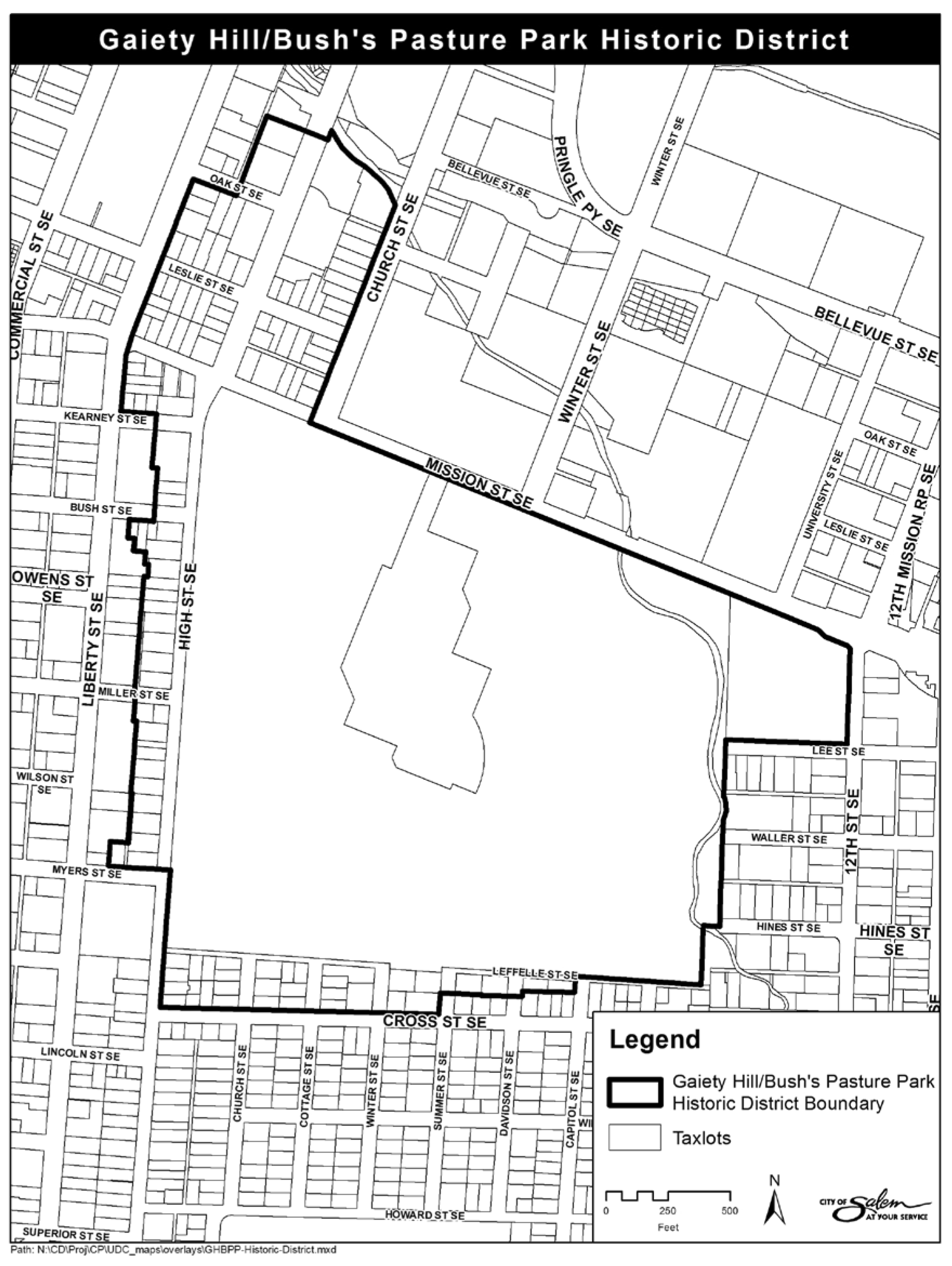
(b)
Court Street-Chemeketa Street Historic District (Figure 230-3). The Court Street-Chemeketa Historic District was listed on the National Register of Historic Places in 1987. The period of significance is 1860-1937. The area of the district is 38.75 acres and includes 99 historic contributing and 48 non-contributing resources. The overall character of the district is that of a late 19th and early 20th century neighborhood. Resources are primarily residential. The district is named for its two east-west streets. Court Street is a 99-foot wide boulevard lined with larger and older houses. Chemeketa Street is narrower and lined primarily with bungalows and cottages, some of which front Mill Creek.
FIGURE 230-3. COURT/CHEMEKETA DISTRICT
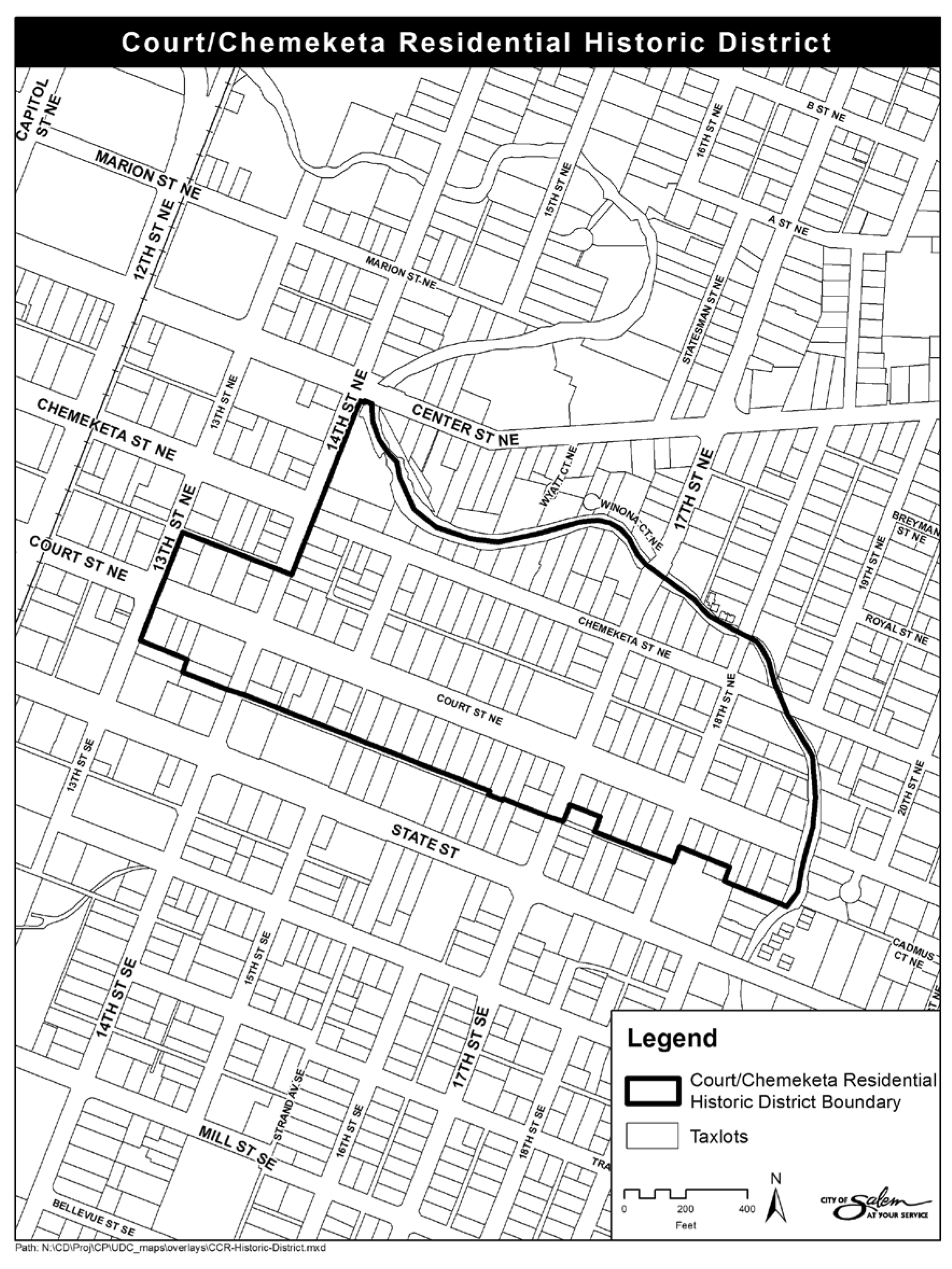
(c)
Salem Downtown Historic District (Figure 230-4). The Salem Downtown Historic District was listed on the National Register of Historic Places in 2001. The period of significance is 1867-1950. The district is comprised of approximately seven City blocks and includes 57 historic contributing resources and 35 non-contributing resources. Resources are primarily commercial in character. The district comprises commercial buildings which share a continuity of scale, lot-line development at the street, common building materials such as brick and concrete, and stylistic elements derived from traditional architectural styles such as Richardsonian Romanesque and Italianate. The storefronts throughout the district reflect both the downtown's early development, as well as efforts to modernize over time.
FIGURE 230-4. SALEM DOWNTOWN HISTORIC DISTRICT
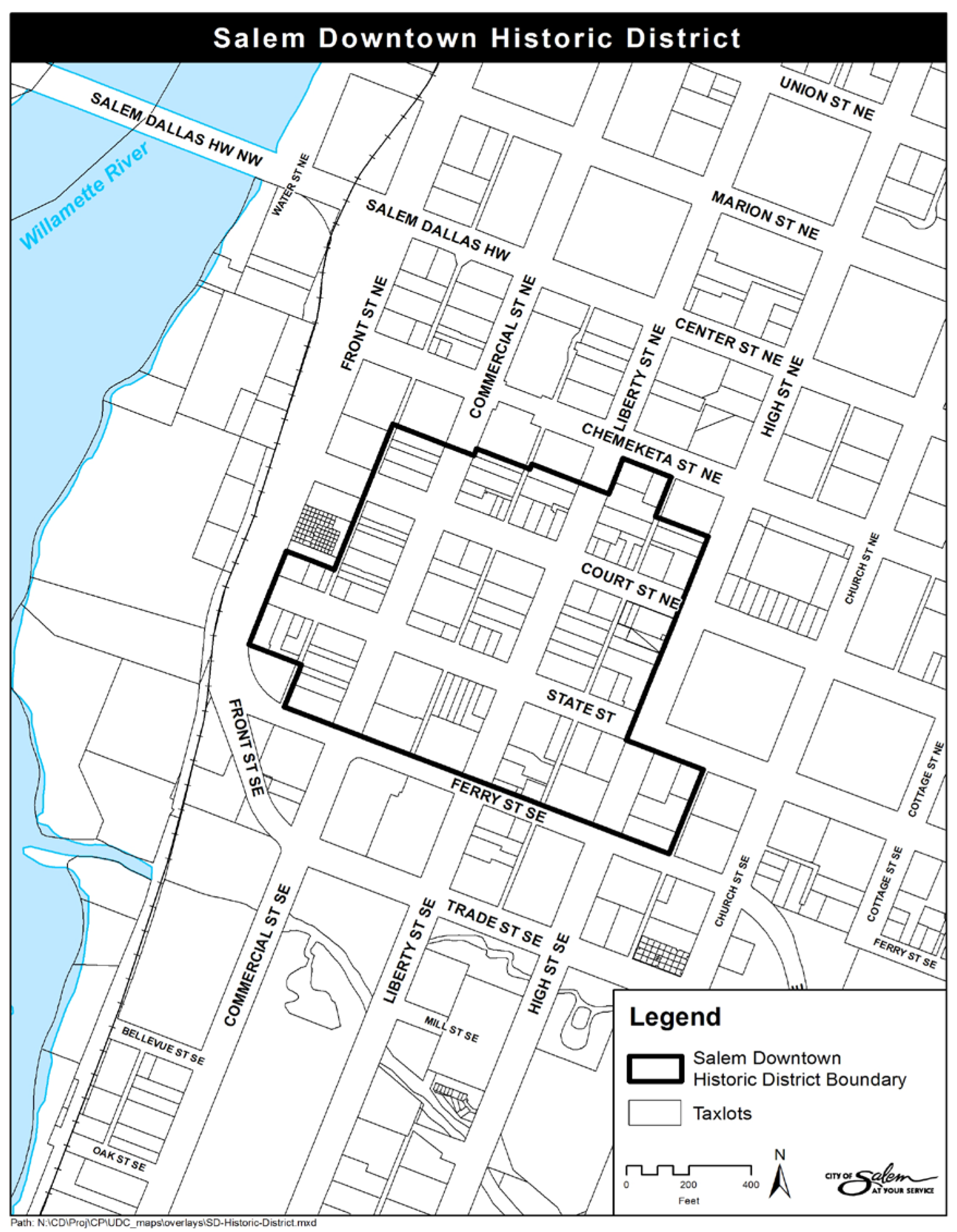
(d)
Oregon State Capitol (Figure 230-5). The Oregon State Capitol was listed on the National Register of Historic Places in 1988. The Oregon State Capitol was constructed between 1936 and 1938, is 14.49 acres; includes the Capitol Building and adjacent wings, Wilson Park to the west, Capitol Park to the east, and extends to the north from the Capitol steps across Court Street to include one block of the former East and West Summer Streets and the sunken lawn terrace between these two streets.
FIGURE 230-5. OREGON STATE CAPITOL
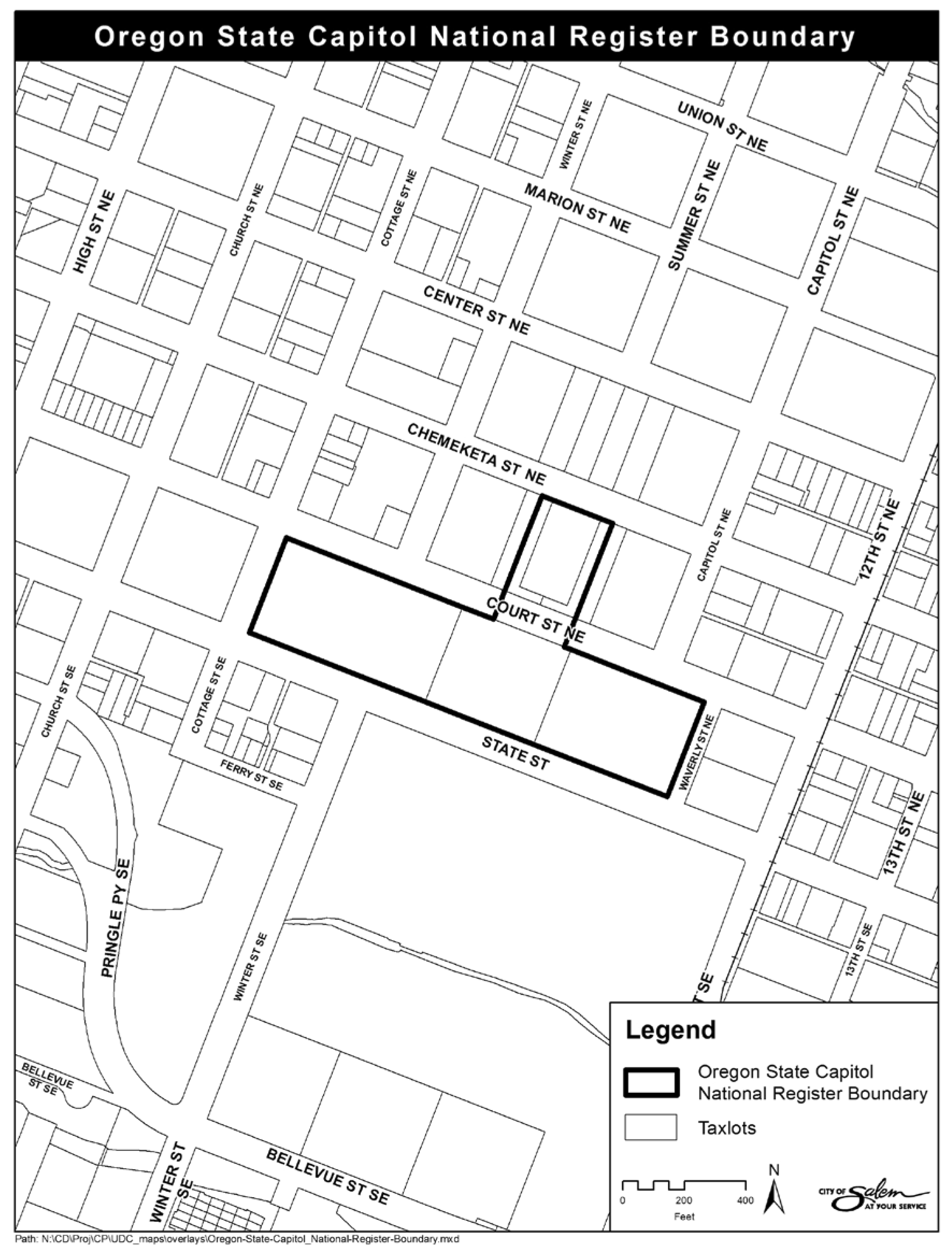
(e)
Oregon State Hospital Historic District (Figure 230-6). The Oregon State Hospital Historic District was listed on the National Register of Historic Places in 2008. The period of significance is 1883-1958. The area of the district had 67 resources at the time of designation. The resources included buildings constructed for office use, a physical plant and support buildings, patient treatment wards, and staff residences.
FIGURE 230-6. OREGON STATE HOSPITAL HISTORIC DISTRICT
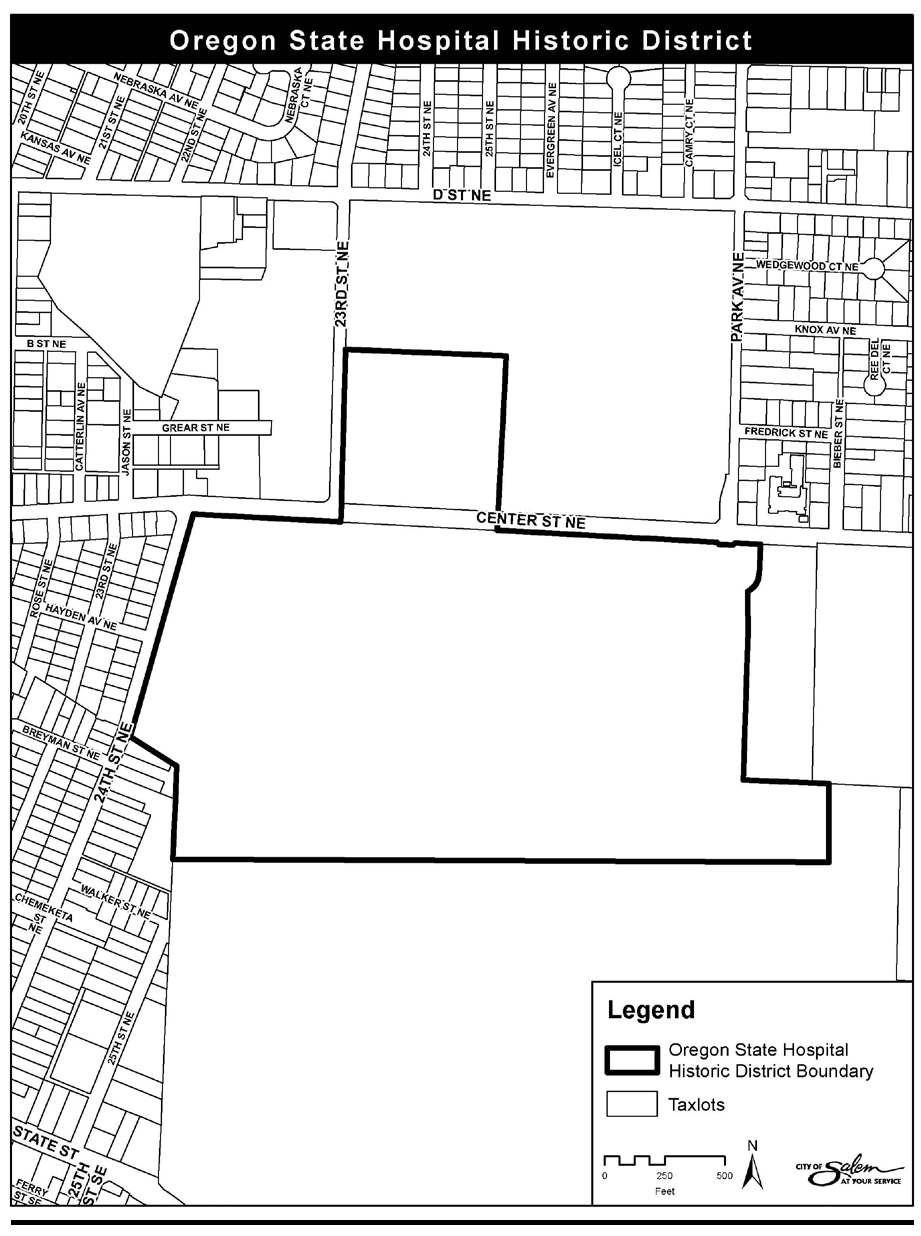
(Prior Code, § 230.200; Ord. No. 25-13; Ord. No. 15-19, § 1(Exh. A), 12-9-2019, eff. 1-8-2020)
Sec. 230.225. - Individually listed resources.
The list of individually listed local resources shall be maintained by the Director. The list may be maintained electronically, and shall be available to the general public.
(Prior Code, § 230.225; Ord. No. 25-13)

