
Salem City Zoning Code
CHAPTER 702
MULTIPLE FAMILY DESIGN REVIEW STANDARDS1
Editor's note—Ord. No. 1-20, § 2(Exh. B), adopted Feb. 24, 2020, repealed Ch. 702 in its entirety and enacted new provisions to read as herein set out. Former Ch. 702, §§ 702.001—702.040, pertained to similar subject matter, and derived from Prior Code §§ 702.005—702.040; Ord. No. 31-13; Ord. No. 11-17, § 2, adopted June 26, 2017; and Eng. Ord. No. 4-18, § 6, adopted Aug. 13, 2018.
Sec. 702.001.- Purpose.
The purpose of this chapter is to establish design review standards for multiple family development.
(Ord. No. 1-20, § 2(Exh. B), 2-24-2020)
Sec. 702.005. - Multiple family design review.
(a)
Except as provided under subsection (b) of this section, and unless otherwise provided in the UDC, design review under SRC chapter 225 is required for all multiple family development.
(b)
Exceptions. Multiple family design review is not required for:
(A)
Cottage clusters, when allowed as a special use.
(B)
Multiple family development within a mixed-use building.
(C)
Multiple family development within:
(i)
The Central Business District (CB) Zone.
(ii)
The South Waterfront Mixed-Use (SWMU) Zone.
(iii)
A National Register Historic District.
(iv)
The Public and Private Health Services (PH) Zone.
(v)
The Mixed Use-I (MU-I) Zone.
(vi)
The Mixed Use-II (MU-II) Zone.
(vii)
The Mixed Use-Riverfront (MU-R) Zone.
(viii)
The West Salem Central Business District (WSCB) Zone.
(Ord. No. 1-20, § 2(Exh. B), 2-24-2020; Ord. No. 13-21, § 1(Exh. A), 2-14-2022; Ord. No. 11-22, § 1(Exh. A), 7-25-2022, eff. 8-24-2022)
Sec. 702.010. - Multiple family design review standards.
Multiple family development shall comply with all of the applicable design review standards as follows:
(a)
Multiple family development with five to 12 dwelling units shall comply with the design review standards set forth in SRC 702.015 or the design review standards set forth in SRC 702.020.
(b)
Multiple family development with 13 or more dwelling units shall comply with the design review standards set forth in SRC 702.020.
(c)
The design review standards set forth in this chapter are in addition to, and not in lieu of, all other applicable development standards in the UDC. Where the design review standards conflict with the development standards in the UDC, the design review standards shall be the applicable development standard.
(Ord. No. 1-20, § 2(Exh. B), 2-24-2020)
Sec. 702.015 - Design review standards for multiple family development with five to twelve units.
(a)
Open space standards.
(1)
To encourage the preservation of natural open space qualities that may exist on a site and to provide opportunities for active and passive recreation, all newly constructed multiple family developments shall provide a minimum 20 percent of the gross site area as designated and permanently reserved open space. For the purposes of this subsection, the term "newly constructed multiple family developments" shall not include multiple family developments created through only construction or improvements to the interior of an existing building(s). Indoor or covered recreation space may count toward this open space requirement.
(A)
To ensure usable open space, at least one common open space area shall be provided within the development that is at least 500 square feet in size and has a minimum dimension of 20 feet for all sides.
(B)
To allow for a mix of different types of open space areas and flexibility in site design, private open space, meeting the size and dimension standards set forth in Table 702-1, may count toward the open space requirement. All private open space must meet the size and dimension standards set forth in Table 702-1.
(C)
To encourage active recreational opportunities for residents, the square footage of an improved open space area may be counted twice toward the total amount of required open space, provided each such area meets the standards set forth in this subsection. Example: a 500-square-foot improved open space area may count as 1,000 square feet toward the open space requirement.
(i)
Be a minimum 500 square feet in size with a minimum dimension of 20 feet for all sides; and
(ii)
Include at least one of the following types of features:
a.
Covered pavilion.
b.
Ornamental or food garden.
c.
Developed and equipped children's play area, with a minimum 30-inch tall fence to separate the children's play area from any parking lot, drive aisle, or street.
d.
Sports area or court (e.g., tennis, handball, volleyball, basketball, soccer).
e.
Swimming pool or wading pool.
(D)
To encourage proximity to and use of public parks, the total amount of required open space may be reduced by 50 percent for developments that are located within one-quarter mile of a publicly-owned urban, community, or neighborhood park as measured along a route utilizing public or private streets that are existing or will be constructed with the development.
(b)
Landscaping standards.
(1)
Where a development site abuts property that is zoned Residential Agricultural (RA) or Single Family Residential (RS), a combination of landscaping and screening shall be provided to buffer between the multiple family development and the abutting RA or RS zoned property. The landscaping and screening shall include the following:
(A)
A minimum of one tree, not less than 1.5 inches in caliper, for every 30 linear feet of abutting property width; and
(B)
A minimum six-foot tall, decorative, sight-obscuring fence or wall. The fence or wall shall be constructed of materials commonly used in the construction of fences and walls, such as wood, stone, rock, brick, or other durable materials. Chainlink fencing with slats shall not be allowed to satisfy this standard.
(2)
Multiple family developments shall comply with the landscaping standards applicable in the underlying zone in which such developments are located.
(c)
Site safety and security.
(1)
Windows shall be provided in all habitable rooms, other than bathrooms, on each wall that faces common open space, parking areas, and pedestrian paths to encourage visual surveillance of such areas and minimize the appearance of building bulk.
(2)
Lighting shall be provided that illuminates all exterior dwelling unit entrances, parking areas, and pedestrian paths within the development.
(d)
Parking and site design.
(1)
To minimize the visual impact of on-site parking and to enhance the pedestrian experience, off-street surface parking areas and vehicle maneuvering areas shall be located behind or beside buildings and structures. Off-street surface parking areas and vehicle maneuvering areas shall not be located between a building or structure and a street.
(2)
To ensure safe pedestrian access to and throughout a development site, pedestrian pathways shall be provided that connect to and between buildings, common open space, and parking areas, and that connect the development to the public sidewalks. Pedestrian pathways shall be a minimum of five feet in width.
(e)
Façade and building design.
(1)
Where a development site abuts property zoned Residential Agricultural (RA) or Single Family Residential (RS), buildings shall be setback from the abutting RA or RS zoned property as set forth in Table 702-2 to provide appropriate transitions between new buildings and structures on-site and existing buildings and structures on abutting sites.
(A)
A five-foot reduction is permitted to each required setback in Table 702-2 provided that the height of the required fence in Sec. 702.015(b)(1)(B) is increased to eight feet tall.
(2)
On sites with 75 feet or more of buildable width, a minimum of 40 percent of the buildable width shall be occupied by building placed at the setback line to enhance visual interest and activity along the street. Accessory structures shall not apply towards meeting the required percentage.
(3)
To orient buildings to the street, any ground-level unit, cluster of units, or interior lobbies, or portions thereof, located within 25 feet of the property line abutting a street shall have an architecturally defined primary building entrance facing the street, with direct pedestrian access to the adjacent sidewalk.
(4)
A porch or architecturally defined entry area shall be provided for each ground level dwelling unit. Shared porches or entry areas shall be provided to not more than four dwelling units. Individual and common entryways shall be articulated with a differentiated roof, awning, stoop, forecourt, arcade or portico.
(5)
Roof-mounted mechanical equipment, other than vents or ventilators, shall be screened from ground level view. Screening shall be as high as the top of the mechanical equipment, and shall be integrated with exterior building design.
(6)
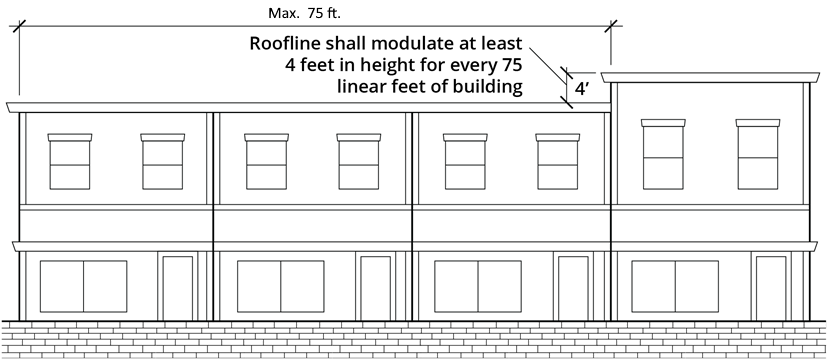
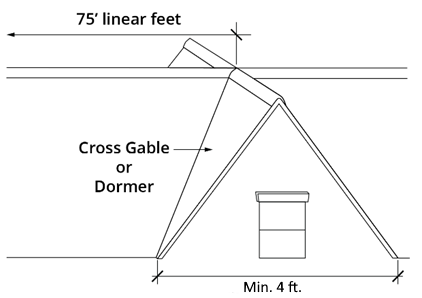
To reinforce the residential character of the neighborhood, flat roofs, and the roof ridges of sloping roofs, shall not exceed a horizontal length of 75 feet without providing differences in elevation of at least four feet in height. In lieu of providing differences in elevation, a cross gable or dormer that is a minimum of four feet in length may be provided. (See Figure 702-1)
FIGURE 702-1. MULTIPLE FAMILY ROOFLINE MODULATION OPTIONS
(Ord. No. 1-20, § 2(Exh. B), 2-24-2020; Ord. No. 13-21, § 1(Exh. A), 2-14-2022; Ord. No. 11-22, § 1(Exh. A), 7-25-2022, eff. 8-24-2022)
Sec. 702.020 - Design review standards for multiple family development with thirteen or more units.
(a)
Open space standards.
(1)
To encourage the preservation of natural open qualities that may exist on a site and to provide opportunities for active and passive recreation, all newly constructed multiple family developments shall provide a minimum 30 percent of the gross site area in designated and permanently reserved open space. For the purposes of this subsection, the term "newly constructed multiple family developments" shall not include multiple family developments created through only construction or improvements to the interior of an existing building(s). Indoor or covered recreation space may count toward this open space requirement.
(A)
To ensure usable open space that is of sufficient size, at least one common open space area shall be provided that meets the size and dimension standards set forth in Table 702-3.
(B)
To ensure the provided open space is usable, a maximum of 15 percent of the common open space shall be located on land with slopes greater than 25 percent.
(C)
To allow for a mix of different types of open space areas and flexibility in site design, private open space, meeting the size and dimension standards set forth in Table 702-4, may count toward the open space requirement. All private open space must meet the size and dimension standards set forth in Table 702-4.
(D)
To ensure a mix of private and common open space in larger developments, private open space, meeting the size and dimension standards set forth in Table 702-4, shall be provided for a minimum of 20 percent of the dwelling units in all newly constructed multiple family developments with 20 or more dwelling units. Private open space shall be located contiguous to the dwelling unit, with direct access to the private open space provided through a doorway.
(E)
To encourage active recreational opportunities for residents, the square footage of an improved open space area may be counted twice toward the total amount of required open space, provided each such area meets the standards set forth in this subsection. Example: a 750-square-foot improved open space area may count as 1,500 square feet toward the open space requirement.
(i)
Be a minimum 750 square feet in size with a minimum dimension of 25 feet for all sides; and
(ii)
Include at least one of the following types of features:
a.
Covered pavilion.
b.
Ornamental or food garden.
c.
Developed and equipped children's play area, with a minimum 30-inch tall fence to separate the children's play area from any parking lot, drive aisle, or street.
d.
Sports area or court (e.g., tennis, handball, volleyball, basketball, soccer).
e.
Swimming pool or wading pool.
(F)
To encourage proximity to and use of public parks, the total amount of required open space may be reduced by 50 percent for developments that are located within one-quarter mile of a public urban, community, or neighborhood park as measured along a route utilizing public or private streets that are existing or will be constructed with the development.
(b)
Landscaping standards.
(1)
To encourage the preservation of trees and maintain or increase tree canopy, a minimum of one tree shall be planted or preserved for every 2,000 square feet of gross site area.
(2)
Where a development site abuts property that is zoned Residential Agricultural (RA) or Single Family Residential (RS), a combination of landscaping and screening shall be provided to buffer between the multiple family development and the abutting RA or RS zoned property. The landscaping and screening shall include the following:
(A)
A minimum of one tree, not less than 1.5 inches in caliper, for every 30 linear feet of abutting property width; and
(B)
A minimum six-foot tall, decorative, sight-obscuring fence or wall. The fence or wall shall be constructed of materials commonly used in the construction of fences and walls, such as wood, stone, rock, brick, or other durable materials. Chainlink fencing with slats shall be not allowed to satisfy this standard.
(3)
To define and accentuate primary entryways, a minimum of two plant units, shall be provided adjacent to the primary entryway of each dwelling unit, or combination of dwelling units.
(4)
To soften the visual impact of buildings and create residential character, new trees shall be planted, or existing trees shall be preserved, at a minimum density of ten plant units per 60 linear feet of exterior building wall. Such trees shall be located not more than 25 feet from the edge of the building footprint.
(5)
Shrubs shall be distributed around the perimeter of buildings at a minimum density of one plant unit per 15 linear feet of exterior building wall.
(6)
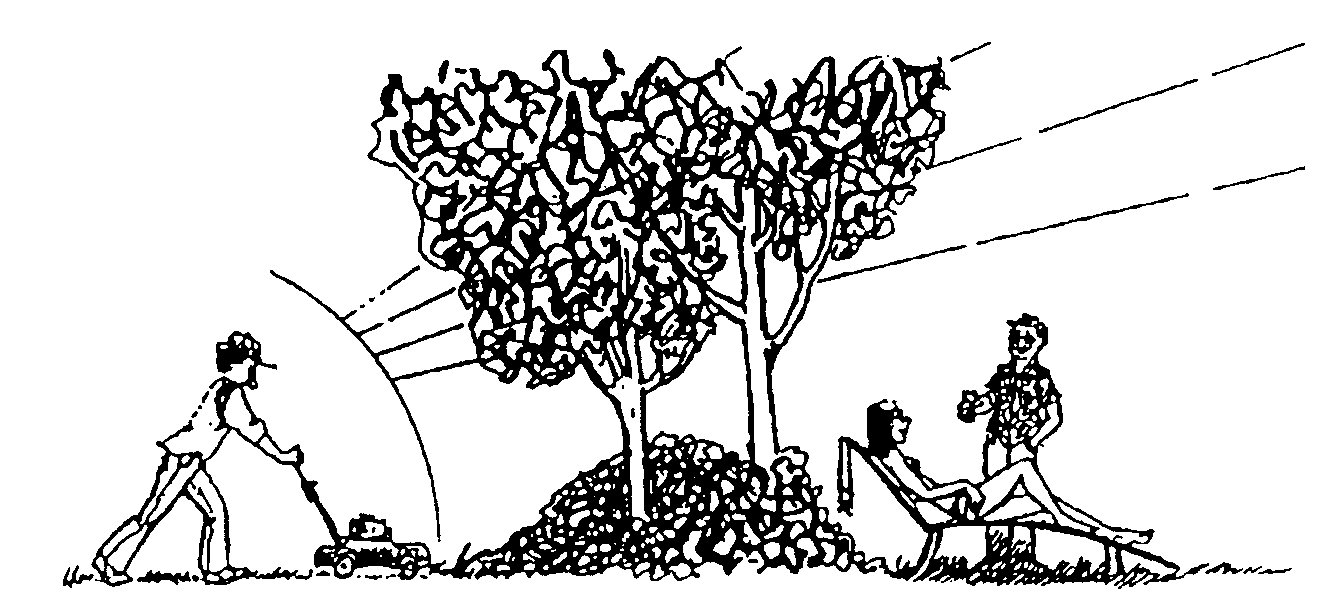
To ensure the privacy of dwelling units, ground level private open space shall be physically and visually separated from common open space with perimeter landscaping or perimeter fencing.
FIGURE 702-2. SEPARATION OF PRIVATE AND COMMON OPEN SPACE
(7)
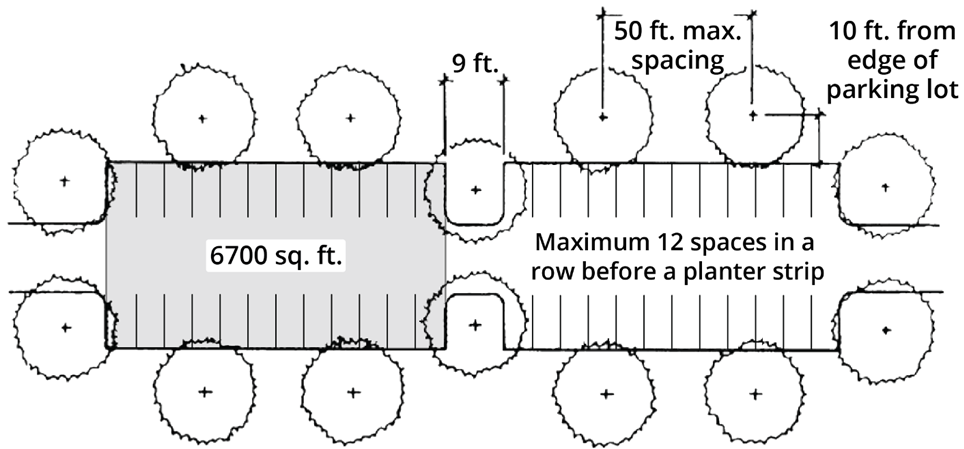
To provide protection from winter wind and summer sun and to ensure trees are distributed throughout a site and along parking areas, a minimum of one canopy tree shall be planted along every 50 feet of the perimeter of parking areas. Trunks of the trees shall be located within ten feet of the edge of the parking area (see Figure 702-3).
(A)
A minimum of one canopy tree shall be planted within each planter bay.
(B)
A landscaped planter bay a minimum of nine feet in width shall be provided at a minimum spacing of one for every 12 spaces. (see Figure 702-3).
FIGURE 702-3. CONCEPTUAL PARKING AREA LAYOUT
(8)
Multiple family developments with 13 or more units are exempt from the landscaping requirements in SRC chapter 806; provided, however when a development includes more than one-half acre of new off-street surface parking, SRC 806.035(n) shall apply.
(c)
Site safety and security.
(1)
Windows shall be provided in all habitable rooms, other than bathrooms, on each wall that faces common open space, parking areas, and pedestrian paths to encourage visual surveillance of such areas and minimize the appearance of building bulk.
(2)
Lighting shall be provided that illuminates all exterior dwelling unit entrances, parking areas, and pedestrian paths within the development to enhance visibility and resident safety.
(3)
Fences, walls, and plant materials shall not be installed between street-facing dwelling units and public or private streets in locations that obstruct the visibility of dwelling unit entrances from the street. For purposes of this standard, the term "obstructed visibility" means the entry is not in view from the street along one-half or more of the dwelling unit's frontage.
(4)
Landscaping and fencing adjacent to common open space, parking areas, and dwelling unit entryways shall be limited to a maximum height of three feet to encourage visual surveillance of such areas.
(d)
Parking and site design.
(1)
To minimize large expanses of continuous pavement, parking areas greater than 6,700 square feet in area shall be physically and visually separated with landscaped planter bays that are a minimum of nine feet in width. Individual parking areas may be connected by an aisle or driveway (see Figure 702-3).
(2)
To minimize the visual impact of on-site parking and to enhance the pedestrian experience, off-street surface parking areas and vehicle maneuvering areas shall be located behind or beside buildings and structures. Off-street surface parking areas and vehicle maneuvering areas shall not be located between a building or structure and a street.
(3)
Where a development site abuts, and is located uphill from, property zoned Residential Agriculture (RA) or Single Family Residential (RS), and the slope of the development site within 40 feet of the abutting RA or RS zoned property is 15 percent or greater, parking areas shall be set back not less than 20 feet from the property line of the abutting RA or RS zoned property to ensure parking areas are designed to consider site topography and minimize visual impacts on abutting residential properties.
(4)
To ensure safe pedestrian access to and throughout a development site, pedestrian pathways shall be provided that connect to and between buildings, common open space, and parking areas, and that connect the development to the public sidewalks. Pedestrian pathways shall be a minimum of five feet in width.
(e)
Façade and building design.
(1)
To preclude long monotonous exterior walls, buildings shall have no dimension greater than 150 feet.
(2)
Where a development site abuts property zoned Residential Agricultural (RA) or Single Family Residential (RS), buildings shall be setback from the abutting RA or RS zoned property as set forth in Table 702-5 to provide appropriate transitions between new buildings and structures on site and existing buildings and structures on abutting sites.
(A)
A 5-foot reduction is permitted to each required setback in Table 702-5 provided that the height of the required fence in Sec. 702.020(b)(2)(B) is increased to eight feet tall.
(3)
To enhance compatibility between new buildings on site and abutting residential sites, balconies located on building facades that face RA or RS zoned properties, unless separated by a street, shall have fully sight-obscuring railings.
(4)
On sites with 75 feet or more of buildable width, a minimum of 40 percent of the buildable width shall be occupied by building placed at the setback line to enhance visual interest and activity along the street. Accessory structures shall not apply towards meeting the required percentage.
(5)
To orient buildings to the street, any ground-level unit, cluster of units, interior lobbies, or portions thereof, located within 25 feet of the property line abutting a street shall have an architecturally defined primary building entrance facing that street, with direct pedestrian access to adjacent sidewalks.
(6)
A porch or architecturally defined entry area shall be provided for each ground level dwelling unit. Shared porches or entry areas shall be provided to not more than four dwelling units. Individual and common entryways shall be articulated with a differentiated roof, awning, stoop, forecourt, arcade or portico.
(7)
Roof-mounted mechanical equipment, other than vents or ventilators, shall be screened from ground level view. Screening shall be as high as the top of the mechanical equipment, and shall be integrated with exterior building design.
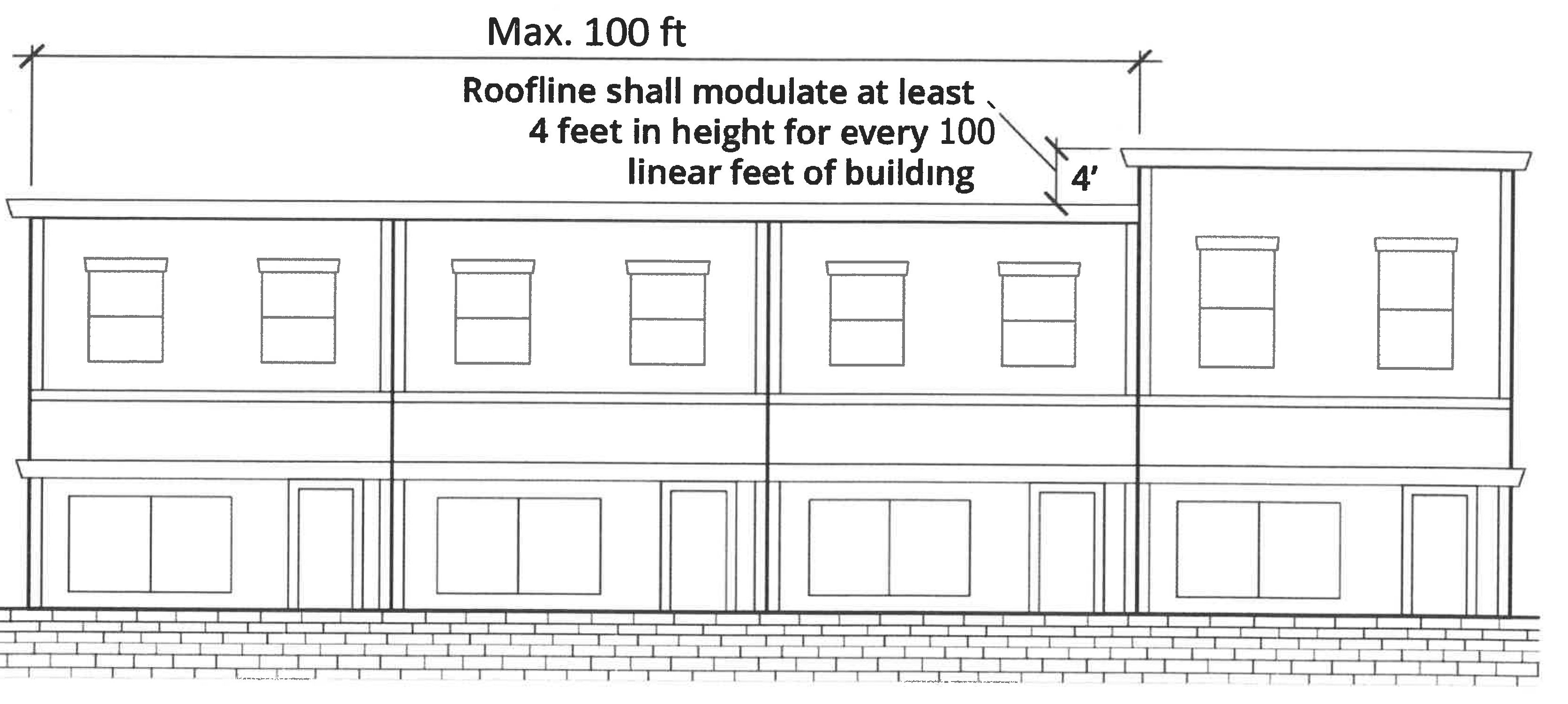
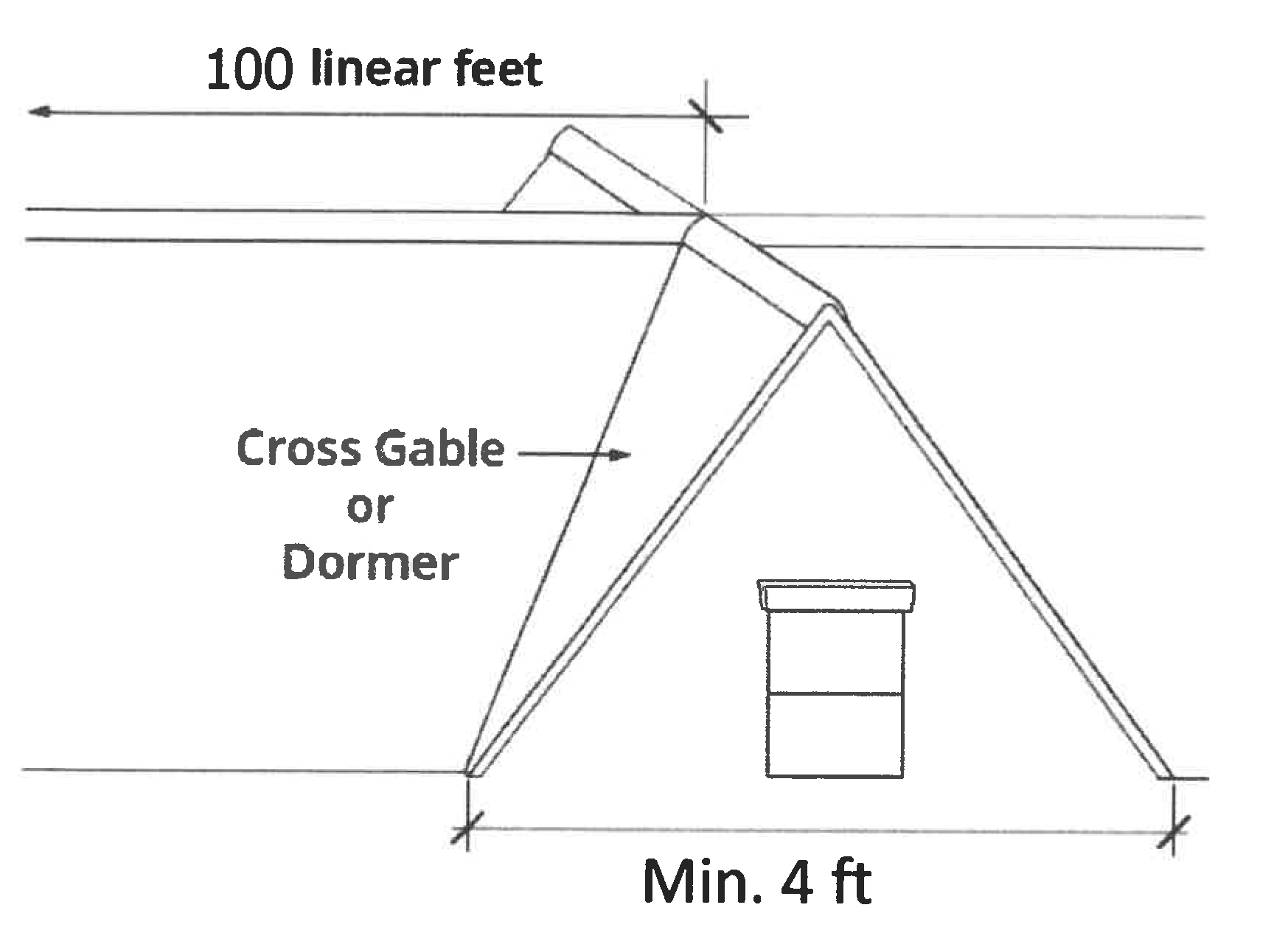
(8)
To reinforce the residential character of the neighborhood, flat roofs, and the roof ridges of sloping roofs, shall not exceed a horizontal length of 100 feet without providing differences in elevation of at least four feet in height. In lieu of providing differences in elevation, a cross gable or dormer that is a minimum of four feet in length may be provided. (See Figure 702-4)
FIGURE 702-4. MULTIPLE FAMILY ROOFLINE MODULATION OPTIONS
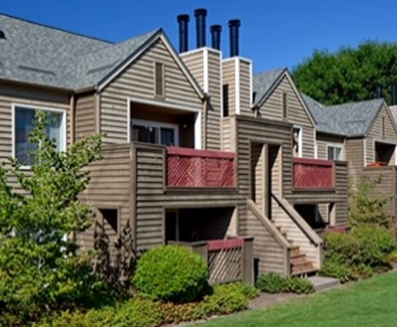
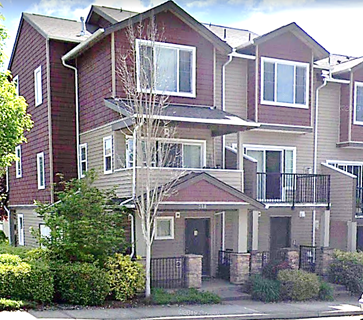
(9)
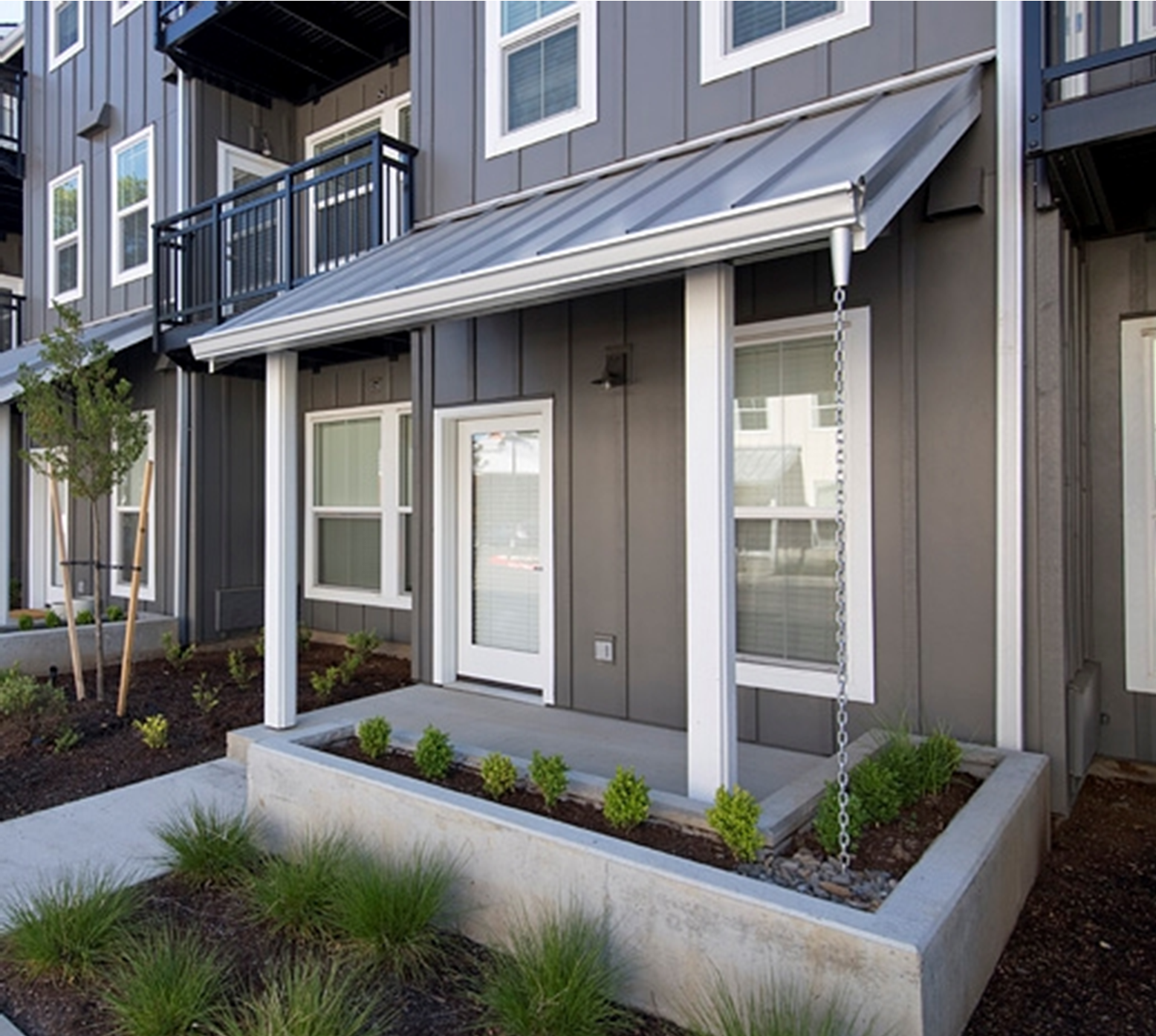
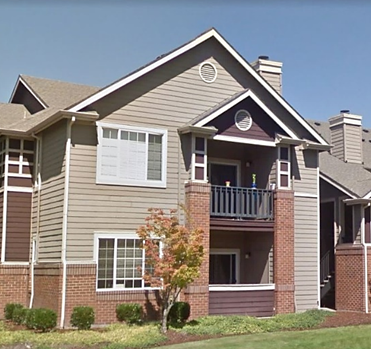
To minimize the appearance of building bulk, each floor of each building's vertical face that is 80 feet in length or longer shall incorporate one or more of the design elements below (see examples in Figure 702-5). Design elements shall vary from other wall surfaces by a minimum of four feet and such changes in plane shall have a minimum width of six feet.
(A)
Offsets (recesses and extensions).
(B)
Covered deck.
(C)
Covered balcony.
(D)
Cantilevered balcony, provided at least half of its depth is recessed.
(E)
Covered entrance.
FIGURE 702-5. EXAMPLE OF DESIGN ELEMENTS FOR ARTICULATION
 |  |
 |  |
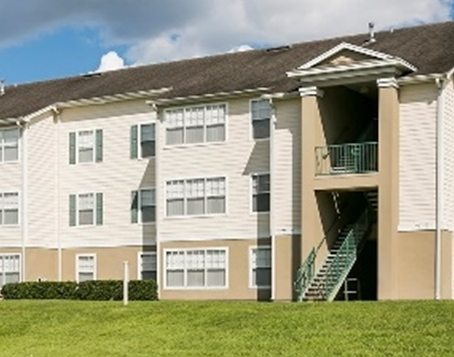
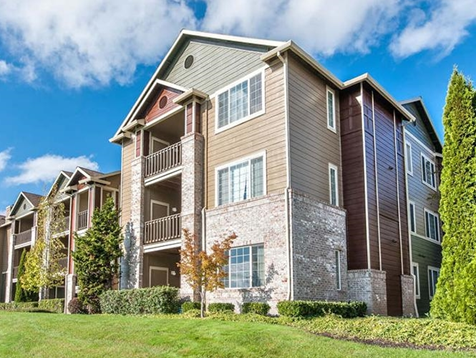
(10)
To visually break up the building's vertical mass, the first floor of each building, except for single-story buildings, shall be distinguished from its upper floors by at least one of the following (see examples in Figure 702-6):
(A)
Change in materials.
(B)
Change in color.
(C)
Molding or other horizontally-distinguishing transition piece.
FIGURE 702-6. EXAMPLE OF DESIGN ELEMENTS FOR ARTICULATION
 |  |
(Ord. No. 1-20, § 2(Exh. B), 2-24-2020; Ord. No. 13-21, § 1(Exh. A), 2-14-2022; Ord. No. 11-22, § 1(Exh. A), 7-25-2022, eff. 8-24-2022; Ord. No. 7-23, § 1(Exh.A), 11-27-2023)

