
Salem City Zoning Code
CHAPTER 524
CB—CENTRAL BUSINESS DISTRICT
Sec. 524.001.- Purpose.
The purpose of the Central Business District (CB) Zone is to implement the central business district designation of the Salem Area Comprehensive Plan through the identification of allowed uses and the establishment of development standards. The CB zone serves Salem and the region as a principal center of business and commerce. It allows a compact arrangement of retail and commercial enterprises together with office, financial, cultural, entertainment, governmental, and residential use designed and situated to afford convenient access by pedestrians.
(Prior Code, § 524.001; Ord. No. 31-13)
Sec. 524.005. - Uses.
(a)
Except as otherwise provided in this section, the permitted (P), special (S), conditional (C), and prohibited (N) uses in the CB zone are set forth in Table 524-1.
(b)
Notwithstanding Table 524-1, any permitted, special, or conditional use within the CB zone shall be a prohibited use within the zone if developed with a drive-through.
(Prior Code, § 524.005; Ord. No. 31-13; Ord. No. 11-14; Ord. No. 22-15, § 13, 11-23-2015; Ord. No. 10-16, § 2, 8-8-2016; Ord. No. 6-17, § 14, 5-8-2017; Ord. No. 10-17, § 15, 7-10-2017; Ord. No. 6-19, § 1(Exh. A), 6-24-2019, eff. 7-24-2019; Ord. No. 1-20, § 2(Exh. B), 2-24-2020; Ord. No. 13-21, § 1(Exh. A), 2-14-2022; Ord. No. 22-22, § 1(Exh. A), 11-28-2022; Ord. No. 7-23, § 1(Exh. A), 11-27-2023; Ord. No. 8-24, § 1(Exh. A), 9-23-2024)
Sec. 524.010. - Development standards.
Development within the CB zone must comply with the development standards set forth in this section.
(a)
Lot standards. Lots within the CB zone shall conform to the standards set forth in Table 524-2.
(b)
Development density. Development density within the CB zone shall conform to the standards set forth in table 524-3.
(c)
Setbacks. Setbacks within the CB zone shall be provided as set forth in Table 524-4.
(d)
Lot coverage; height; building frontage. Buildings and accessory structures within the CB zone shall conform to the lot coverage, height, and building frontage standards set forth in Table 524-5.
(e)
Landscaping. Landscaping within the CB zone shall be provided as set forth in this subsection.
(1)
Setbacks. Required setbacks shall be landscaped. Landscaping shall conform to the standards set forth in SRC chapter 807.
(2)
Vehicle use areas. Vehicle use areas shall be landscaped as provided under SRC chapters 806 and 807.
(f)
Design. Development within the CB zone shall conform to the design standards set forth in this subsection; provided, however, any development requiring historic design review shall only be subject to design review according to the historic design review standards or the historic design review guidelines set forth in SRC chapter 230 and any development within an overlay zone shall only be subject to the design standards set forth in this subsection in-lieu of the design review standards or the design review guidelines of the overlay zone. The design standards included in this subsection are not design review standards and are therefore not subject to design review under SRC Chapter 225.
(1)
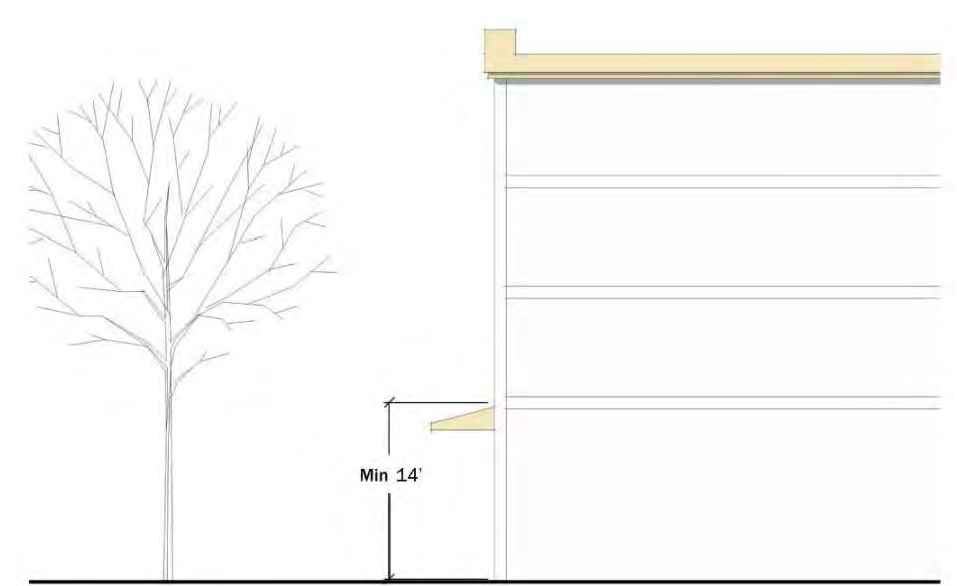
Ground floor building height. The ground floors of buildings shall be a minimum of 14 feet in height (see Figure 524-1). For the purposes of this standard, ground floor height is measured from the floor to the ceiling of the first floor.
FIGURE 524-1. GROUND FLOOR BUILDING HEIGHT
(2)
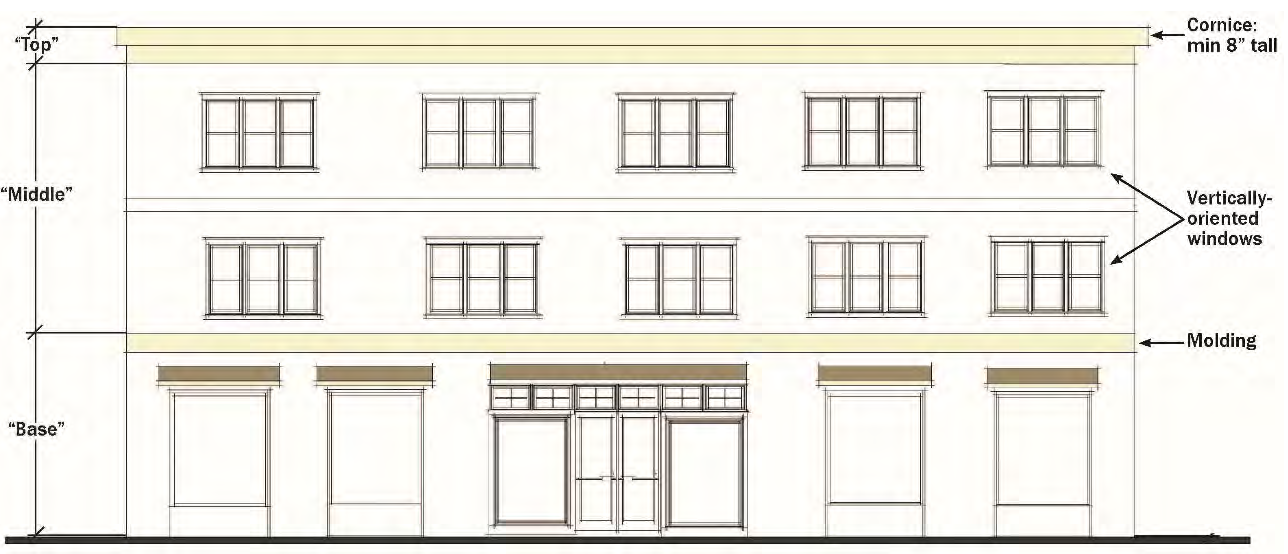
Building façade articulation. The ground floor facades of buildings shall be distinguished from their upper floor facades through incorporation of at least one of the following architectural detailing techniques identified in this subsection (see Figure 524-2). This standard does not apply to the repainting of the façade of an existing building.
(A)
Change in materials;
(B)
Change in color; or
(C)
Molding or other horizontally-articulated transition piece.
FIGURE 524-2. BUILDING FAÇADE ARTICULATION
(3)
Building entrances. Primary building entrances shall be provided for each building façade facing a street as follows:
(A)
For non-residential uses on the ground floor, a primary building entrance shall be provided for each non-residential ground floor tenant space facing a street. If a non-residential ground floor tenant space within a building has frontage on more than one street, a single primary building entrance for the non-residential ground floor tenant space may be provided at the corner of the building where the streets intersect.
(B)
For residential uses on the ground floor, a primary building entrance shall be provided for each building facade facing a street. If a building has frontage on more than one street, a single primary building entrance may be provided at the corner of the building where the streets intersect.
(4)
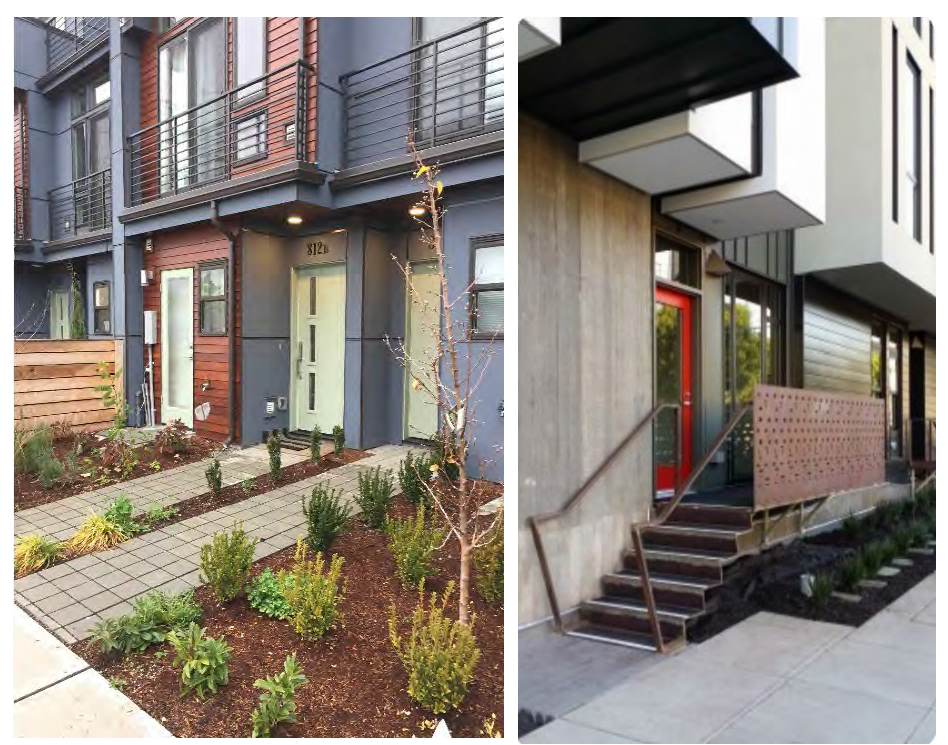
Separation of residential ground floor entrances from street. When a residential entrance is located on the ground floor of a building adjacent to a street, the entrance shall be vertically or horizontally separated from the public right-of-way as follows:
(A)
Vertical separation. Where vertical separation is provided between the residential entrance and the public right-of-way, the vertical separation shall be a minimum of 1.5 feet but not more than three feet and shall take the form of steps or a ramp to a porch, stoop or terrace (see Figure 524-3).
(B)
Horizontal separation. Where horizontal separation is provided between the residential entrance and the public right-of-way, the horizontal separation shall be a minimum of five feet but not more than ten feet and shall take the form of a landscaped area, such as private open space, or a hardscaped area, such as a plaza (see Figure 524-3).
FIGURE 524-3. RESIDENTIAL GROUND FLOOR
ENTRANCE SEPARATION FROM STREET
(5)
Windows. Windows shall be provided throughout building facades as follows:
(A)
Ground floor windows.
(i)
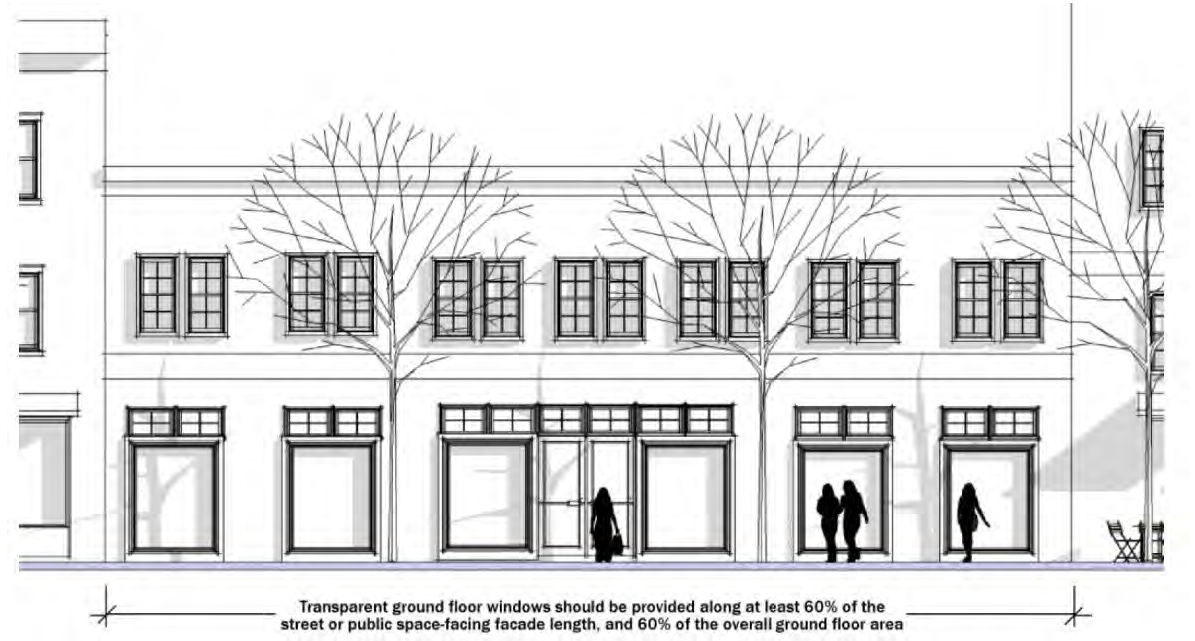
Ground floor building facades facing a street shall include transparent windows on a minimum of 65 percent of the ground floor façade (see Figure 524-4). The windows shall not be mirrored or treated in such a way to block visibility into the building. The windows shall have a minimum visible transmittance (VT) of 37 percent.
(ii)
Alternative standard for existing buildings. Notwithstanding subsection (f)(5)(A)(i) of this section, where a building existing on March 16, 2022, does not include ground floor windows as required under this subsection, the percentage of transparent windows existing on the ground floor façade shall not be reduced and additional windows meeting the transparency requirements of subsection (f)(5)(A)(i) may be added without meeting the minimum 65 percent standard.
(B)
Upper floor windows. Upper floor building facades facing streets and open space shall include windows along a minimum of 30 percent of each building floor length, and on a minimum of 30 percent of the overall exterior wall area, of the upper floor façade.
FIGURE 524-4. GROUND FLOOR WINDOWS
(6)
Weather protection.
(A)
Building facades facing a street shall include weather protection, in the form of awnings or canopies, along a minimum of 90 percent of the length of the ground floor building façade adjacent to a street. Awnings or canopies shall have a minimum depth of six feet, shall have a minimum clearance height above the sidewalk of eight feet, and may encroach into the public street right-of-way as provided in SRC 76.160 (see Figure 524-5).
(B)
Alternative standard for existing buildings. Notwithstanding subsection (f)(6)(A) of this section, where a building existing on March 16, 2022, does not include weather protection as required under this subsection, the percentage of weather protection existing along the ground floor façade shall not be reduced and additional weather protection meeting the sidewalk clearance requirements of subsection (f)(6)(A) may be added without meeting the minimum 90 percent standard.
FIGURE 524-5. WEATHER PROTECTION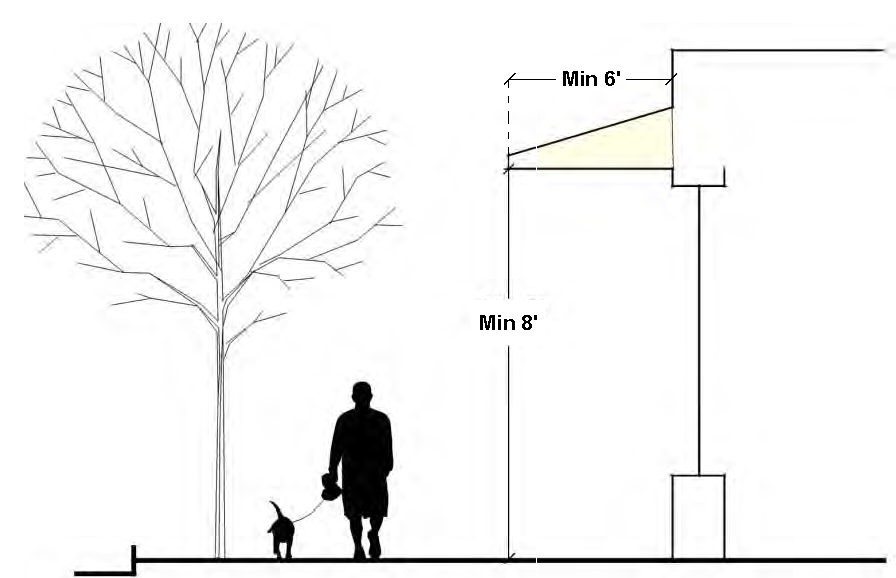
(7)
Security fencing/gates. Where fencing/gates are used for security at recessed alcoves or entries of buildings, the security fencing/gates shall:
(A)
Be made of metal;
(B)
Not inhibit access to storefront alcoves during normal business operating hours;
(C)
Not be sight-obscuring;
(D)
Not be used to cover storefront display windows that are not components of a recessed alcove or entry; and
(E)
Have an open area of 70 percent or greater. For purpose of this standard, open area means the proportion of perforations or other open voids included within the fence/gate as compared to the total fence/gate area. For example, a security fence/gate that has an open area of 70 percent means that 70 percent of the area of the security fence/gate consists of open voids while the remaining 30 percent constitutes solid material surface.
(8)
Balconies. Building facades facing Front Street shall provide upper floor balconies for residential units. Balconies shall be a minimum of 48 square feet in size, have no dimension less than six feet, and shall be directly accessible from each dwelling unit through a doorway.
(9)
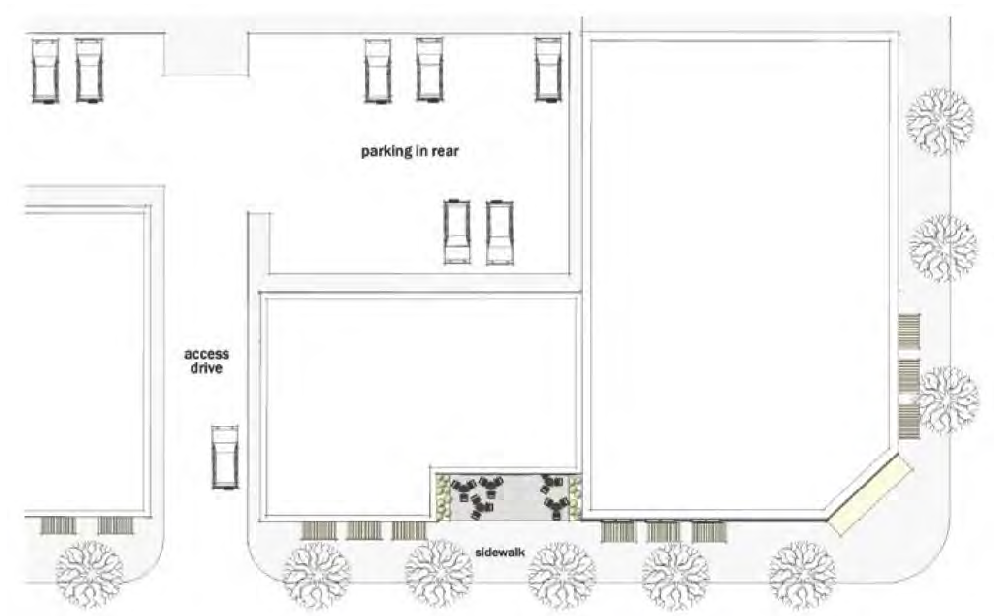
Off-street parking location. Off-street surface parking areas and vehicle maneuvering areas shall be located behind or beside buildings and structures. Off-street surface parking areas and vehicle maneuvering areas shall not be located between a building or structure and a street (see Figure 524-6).
FIGURE 524-6. OFF-STREET PARKING LOCATION
(10)
Mechanical and service equipment. Mechanical and service equipment shall conform to the following standards:
(A)
Ground level mechanical and service equipment. Ground level mechanical and service equipment shall be screened with landscaping and/or a sight-obscuring fence or wall. Ground level mechanical and service equipment shall be located behind or beside buildings (see Figure 524-7).
(B)
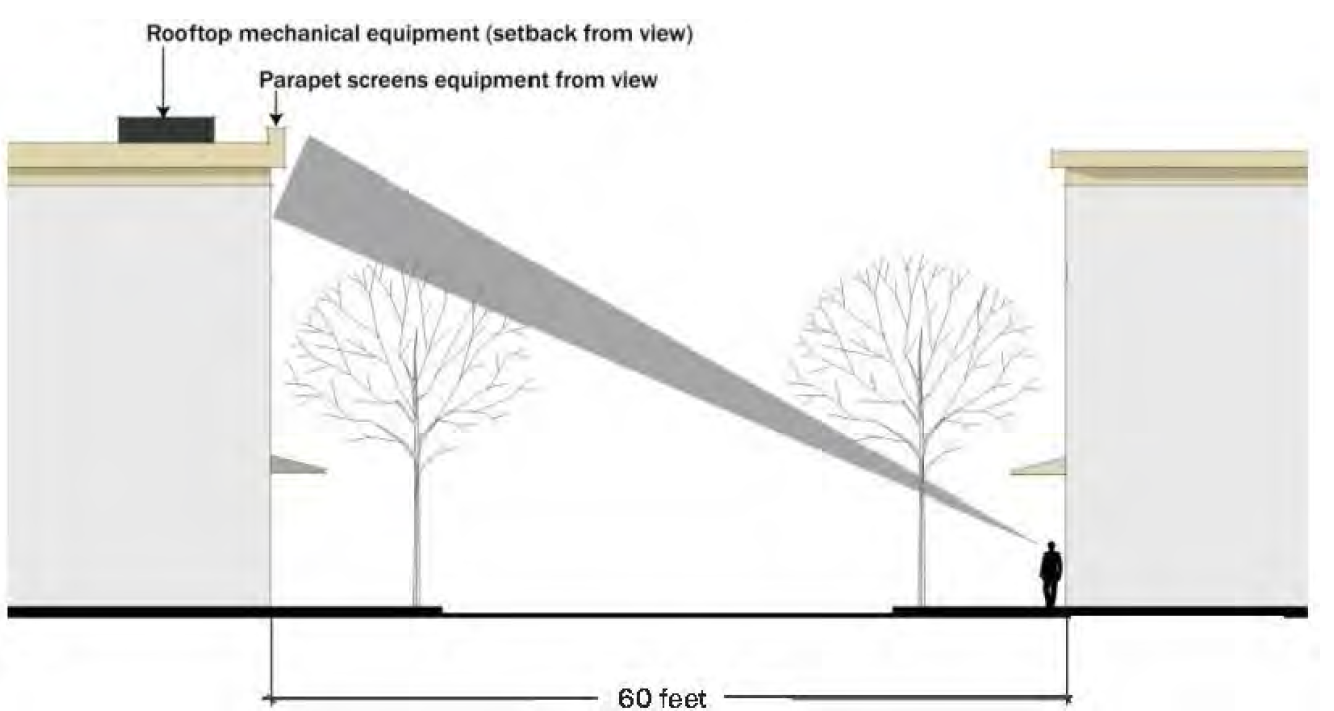
Rooftop mechanical and service equipment. Rooftop mechanical and service equipment, with the exception of solar panels and wind generators, shall be setback or screened so as to not be visible to a person standing at ground level 60 feet from the building. (see Figure 524-8).
FIGURE 524-7. GROUND LEVEL MECHANICAL AND SERVICE EQUIPMENT
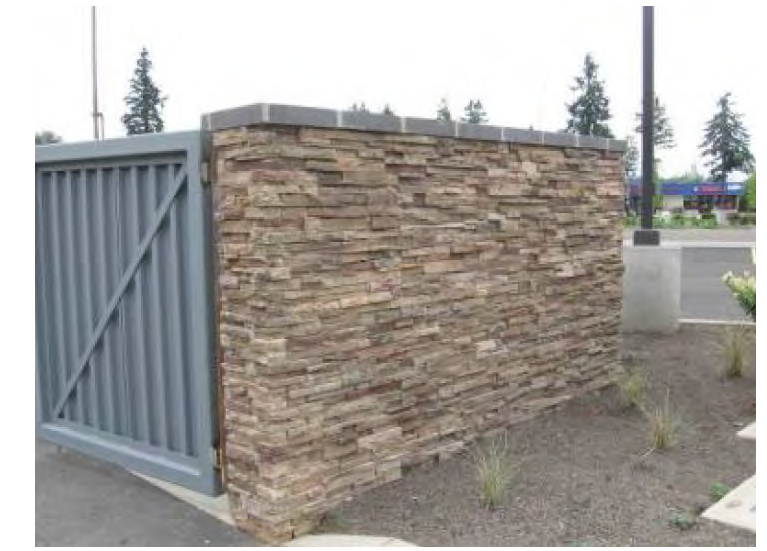
FIGURE 524-8. ROOFTOP MECHANICAL AND SERVICE EQUIPMENT
(11)
Pedestrian walkways. Above grade pedestrian walkways may be provided, except that no above grade pedestrian walkway shall be provided to property located within the Salem Downtown Historic District.
(Prior Code, § 524.010; Ord. No. 31-13; Ord. No. 1-20, § 2(Exh. B), 2-24-2020; Ord. No. 13-21, § 1(Exh. A), 2-14-2022; Ord. No. 7-23, § 1(Exh. A), 11-27-2023; Ord. No. 8-24, § 1(Exh. A), 9-23-2024)
Sec. 524.015. - Other provisions.
In addition to the standards set forth in this chapter, all development within the CB zone must comply with the applicable development standards of the UDC, including, but not limited to, the following chapters:
(a)
Trees and Shrubs: SRC chapter 86.
(b)
Wireless Communications Facilities: SRC chapter 703.
(c)
General Development Standards: SRC chapter 800.
(d)
Public Improvements: SRC chapter 802.
(e)
Streets and Right-of-Way Improvements: SRC chapter 803.
(f)
Driveway Approaches: SRC chapter 804.
(g)
Vision Clearance: SRC chapter 805.
(h)
Off-Street Parking, Loading and Driveways: SRC chapter 806.
(i)
Landscaping and Screening: SRC chapter 807.
(j)
Preservation of Trees and Vegetation: SRC chapter 808.
(k)
Wetlands: SRC chapter 809.
(l)
Landslide Hazards: SRC chapter 810.
(m)
Sign Code: SRC chapter 900.
(Prior Code, § 524.015; Ord. No. 31-13)

