
Salem City Zoning Code
CHAPTER 700
SPECIAL USE PROVISIONS
Sec. 700.001.- Purpose.
The purpose of this chapter is to establish standards for uses which, within certain zones or overlay zones, are designated as special uses under the UDC.
(Prior Code, § 700.001; Ord. No. 31-13)
Sec. 700.005. - Special uses, generally.
(a)
A special use is a use that, while allowed in certain zones and overlay zones, has the potential for creating impacts that merit special standards beyond those that would otherwise apply to uses generally in that zone or overlay zone. A use that is designated as a special use in one zone or overlay zone may be a permitted use in another zone or overlay zone.
(b)
The special use standards set forth in this chapter apply only where a use is designated as a special use.
(c)
A special use that complies with the standards set forth in this chapter and with the applicable standards of the UDC does not require approval beyond that required for a use that is a permitted use.
(d)
Except as specifically provided in this section, a project may only deviate from the special use standards in this chapter through conditional use approval as provided in SRC chapter 240, and not through an adjustment or variance.
(e)
Notwithstanding subsection (d) of this section, deviation from a special use standard for the following uses shall be made pursuant to adjustment approval, as provided in SRC chapter 250, or variance approval, as provided in SRC chapter 245:
(1)
Accessory dwelling units;
(2)
Cottage clusters;
(3)
Live work;
(4)
Secondary dwellings and guest rooms;
(5)
Self-service storage within an existing building;
(6)
Three family and four family uses;
(7)
Townhouses; and
(8)
Zero side yard dwellings.
(Prior Code, § 700.005; Ord. No. 31-13; Ord. No. 10-17, § 22, 7-10-2017; Ord. No. 1-20, § 2(Exh. B), 2-24-2020; Ord. No. 13-21, § 1(Exh. A), 2-14-2022; Ord. No. 8-24, § 1(Exh. A), 9-23-2024)
Sec. 700.006. - Accessory short-term rentals.
Where designated as a special use, accessory short-term rentals shall comply with the additional standards set forth in this section. The standards in this section cannot be modified through conditional use approval.
(a)
Operated as accessory use. An accessory short-term rental shall only be operated as an accessory use to a single family or two family use on the same lot. In order to qualify as an accessory use:
(1)
The accessory short-term rental must be operated by the resident family who resides in the dwelling unit; and
(2)
The resident family must reside in the dwelling unit for a minimum of 270 days during each calendar year.
(3)
For purposes of this subsection, the resident family must be:
(A)
The owner of the dwelling unit; or
(B)
A tenant of the dwelling unit, provided there are no more than five existing tenants within the dwelling unit.
(b)
Structure type. An accessory short-term rental shall be located within a lawfully-built single family dwelling unit, two family dwelling unit, or guest house, that meet building code requirements. For purposes of this subsection, a dwelling unit within a condominium is considered a single family dwelling unit. An accessory short-term rental shall not be allowed in:
(1)
An accessory dwelling unit (ADU);
(2)
A tent or other temporary enclosure or shelter;
(3)
A recreational vehicle, travel trailer, or similar structure;
(4)
A motor vehicle; or
(5)
Any structure not intended for ongoing human occupancy;
(c)
Relationship to other accessory uses on lot. In order to minimize the cumulative impacts of multiple accessory uses located on one lot, an accessory short-term rental shall not be allowed if any of the following accessory uses are being conducted on the lot:
(1)
Accessory dwelling unit (ADU).
(d)
Number of guest rooms.
(1)
Hosted rental. When the resident family is present as a host, the maximum number of guest rooms, including those within a guest house, that may be rented shall not exceed three.
(2)
Non-hosted rental. When the resident family is not present as a host, the entire dwelling unit, and if applicable guest house, may be rented; there is no maximum limit on the number of guest rooms that may be used.
(e)
Number of guests.
(1)
Hosted rental. The maximum number of guests shall not exceed two per guest room.
(2)
Non-hosted rental. When the resident family is not present as a host, the maximum number of guests shall not exceed two per guest room, but in no case shall the total number of guests exceed ten.
(3)
For purposes of this subsection, children under 12 years of age do not count toward the maximum number of guests.
(f)
Length of stay. The maximum length of stay for any guest shall not exceed 29 consecutive days.
(g)
Booking limits.
(1)
Hosted rental.
(A)
There is no maximum limit on the number of days within a calendar year an accessory short-term rental may be rented when the resident family is present as a host.
(B)
Multiple bookings at any given time by more than one group of guests are allowed.
(2)
Non-hosted rental.
(A)
The total number of days within a calendar year an accessory short-term rental may be rented without the resident family being present as a host shall not exceed a maximum of 95 days.
(B)
Rental of the accessory short-term rental shall be limited to a maximum of one booking at any given time. Multiple bookings at any given time by more than one group of guests are not allowed.
(h)
Activities allowed. Accessory short-term rentals shall be limited to the provision of lodging. Activities other than lodging, such as events, gatherings, luncheons, banquets, parties, weddings, meetings, fundraising, or commercial or advertising activities, are prohibited.
(Ord. No. 5-17, § 8(700.006), 6-12-2017; Ord. No. 13-21, § 1(Exh. A), 2-14-2022)
Sec. 700.007. - Accessory dwelling unit.
Where designated as a special use, accessory dwelling units shall comply with the standards set forth in this section. Where the standards in this section conflict with other standards in the UDC, the standards in this section shall be the applicable standard. Standards for accessory structures elsewhere in the UDC shall not apply to accessory dwelling units.
(a)
All accessory dwelling units. The standards set forth in this subsection shall apply to all accessory dwelling units.
(1)
Number. Only one accessory dwelling unit shall be allowed per lot.
(2)
Size. Accessory dwelling units shall not exceed 900 square feet, or 75 percent of the main building gross area, whichever is less.
(3)
Types of structures allowed. Accessory dwelling units shall only be allowed in lawfully-built dwelling units that meet building code requirements. Accessory dwelling units shall not be allowed in:
(A)
A recreational vehicle, travel trailer, or similar structure;
(B)
A motor vehicle;
(C)
Any structure not intended for permanent human occupancy.
(4)
Condominium ownership. Accessory dwelling units shall not be separated in ownership from the underlying property on which it and the main house to which it is accessory are located. Attached accessory dwelling units shall not be separated in ownership from the main house to which it is accessory.
(5)
Development with townhouses. An accessory dwelling unit shall only be allowed on the same lot as a townhouse if the following standards are met:
(A)
The lot is at least 2,500 square feet in size; and
(B)
No more than two townhouses are attached in a row.
(6)
Other uses. Accessory dwelling units shall be prohibited from being used as short-term rentals or accessory short-term rentals.
(7)
Exemptions. Accessory dwelling units are exempt from the following standards required elsewhere in the UDC:
(A)
Dwelling unit density requirements, including requirements for a minimum or maximum number of dwelling units;
(B)
Development standards and design standards within overlay zones;
(C)
Requirements to build garages.
(b)
Detached accessory dwelling units. The standards set forth in this subsection shall apply to all detached accessory dwelling units and are in addition to the standards in subsection (a) of this section.
(1)
Location. Detached accessory dwelling units shall be located in the side yard or rear yard.
(2)
Setbacks. Setbacks for detached accessory dwelling units shall be provided as set forth in Table 700-1.
(3)
Lot coverage. The total lot coverage for buildings, accessory structures, and accessory dwelling units shall not exceed a maximum lot coverage of 60 percent.
(4)
Height. Detached accessory dwelling units shall be no more than 25 feet in height.
(Ord. No. 10-17, § 23(700.006), 7-10-2017; Ord. No. 8-24, § 1(Exh. A), 9-23-2024)
Sec. 700.010. - Basic education.
Where designated as a special use, basic education shall comply with the additional standards set forth in this section.
(a)
Setbacks.
(1)
Buildings shall be set back from every lot line a minimum of one foot for each one foot of building height; provided, however, the setback need not exceed 35 feet in depth.
(2)
Off-street parking and loading areas shall be setback a minimum of ten feet from any abutting residentially zoned property or property used for a residential use.
(Prior Code, § 700.010; Ord. No. 31-13; Ord. No. 1-20, § 2(Exh. B), 2-24-2020)
Sec. 700.011. - Cottage clusters.
Where designated as a special use, cottage clusters shall comply with the additional standards set forth in this section. Where the standards in this section conflict with other standards in the UDC, the standards in this section shall be the applicable standard.
(a)
Dwelling unit density.
(1)
The minimum required dwelling unit density for cottage clusters is four dwelling units per acre.
(2)
There is no maximum dwelling unit density for cottage clusters.
(b)
Maximum building footprint. No dwelling unit within a cottage cluster shall have a building footprint that is greater than 900 square feet. Where a dwelling unit within a cottage cluster has an attached garage or carport, up to 200 square feet of the attached garage or carport may be excluded from the maximum building footprint calculation for that unit. For purposes of this subsection, building footprint means the horizontal area of the building, measured from outside of all exterior walls and supporting columns. It includes the dwelling, garage, and carport, but not trellises, patios, and areas of porch, deck, and balcony less than 30 inches from finished grade, or cantilevered porches, or projections which do not have a post touching the ground or ramps and stairways required for access.
(c)
Common courtyard. Cottage clusters shall include a common courtyard. The common courtyard shall:
(1)
Be a single, contiguous area;
(2)
Be a minimum size of 150 square feet per dwelling unit;
(3)
Have no dimension less than 15 feet;
(4)
Be developed with one or more of the following, provided that any impervious elements shall not exceed 75 percent of the total common courtyard area:
(A)
Landscaping;
(B)
Lawn area;
(C)
Paved courtyard area; or
(D)
Recreational amenities; and
(5)
Abut dwelling units on at least two sides.
(d)
Cottage orientation.
(1)
A minimum of 50 percent of the dwelling units within a cottage cluster shall be oriented to the common courtyard and shall:
(A)
Have a main entrance facing the common courtyard;
(B)
Be located within ten feet of the common courtyard, as measured from the nearest point on the dwelling unit to the nearest edge of the common courtyard; and
(C)
Be connected to the common courtyard by a pedestrian path.
(2)
Dwelling units within 20 feet of a property line abutting a street may have their main entrances facing the street.
(3)
Each dwelling unit within the cottage cluster that is not oriented to the common courtyard or does not have their main entrance facing the street shall have its main entrance facing a pedestrian path that is directly connected to the common courtyard.
(e)
Pedestrian access.
(1)
An accessible pedestrian path shall be provided that connects the main entrance of each dwelling unit within the cottage cluster to the following:
(A)
The common courtyard;
(B)
Shared parking areas;
(C)
The community building, if one is included within the development; and
(D)
All streets abutting the development site.
(2)
The pedestrian path shall be a hard-surface material, and shall be a minimum of four feet in width.
(f)
Off-street parking and vehicle use area location and setbacks. Off-street parking, vehicle storage, vehicle maneuvering areas, and driveways shall be located and setback as follows:
(1)
Except as otherwise provided in this section, off-street parking, vehicle storage, and vehicle maneuvering areas:
(A)
Shall not be located between the front property line abutting a street and those dwelling units within the cottage cluster that are located closest to the front property line abutting a street;
(B)
Shall be setback a minimum of 20 feet from the property line abutting a street; and
(C)
Shall be setback a minimum of ten feet from all other property lines, except property lines abutting an alley where there is no minimum required setback.
(2)
When a cottage cluster is located on a corner lot or double frontage lot, off-street parking, vehicle storage, and vehicle maneuvering areas shall conform to the location and setback requirements included under subsection (f)(1) of this section, except that such areas may be located between the dwelling units and a property line abutting a street on the side or rear of the lot, but shall be setback a minimum of ten feet from the property line abutting such street.
(3)
Driveways shall conform to the location and setback requirements included under subsection (f)(1) of this section, except that they:
(A)
Shall be setback a minimum of ten feet from the property line abutting a street on the side or rear of a lot;
(B)
May be located within ten feet of a property line which does not abut a street; and
(C)
May be located within a required setback where the driveway provides direct access to the street.
(g)
Existing single-family detached dwellings. When an existing single family detached dwelling is located on a lot that is proposed to be developed as a cottage cluster, the existing single-family dwelling:
(1)
May remain on the lot regardless of whether it conforms to the standards of this section and the underlying zone;
(2)
Shall count as a dwelling unit within the cottage cluster; and
(3)
May be expanded, provided:
(A)
It does not exceed the maximum building footprint established in this section and the maximum building height of the underlying zone; and
(B)
The expansion conforms to the applicable standards of this section and the applicable standards of the underlying zone.
(h)
Community building. Cottage clusters may include a community building for the shared use of residents that provides space for accessory uses such as community meeting rooms, guest housing, exercise rooms, day care, or community eating areas. Community buildings shall meet the following standards:
(1)
No more than one community building is allowed;
(2)
The footprint of the community building shall not exceed 900 square feet; and
(3)
The community building shall meet the applicable standards of this section and the applicable standards of the underlying zone.
(Ord. No. 13-21, § 1(Exh. A), 2-14-2022)
Sec. 700.015. - Golf courses.
Where designated as a special use, golf courses shall comply with the additional standards set forth in this section.
(a)
Setbacks.
(1)
Buildings shall be setback a minimum of 100 feet from every lot line.
(2)
Golf fairways, and if provided, any tennis courts and similar sports courts or fields, shall be set back a minimum of 25 feet from any abutting residentially or commercially zoned property or property used for a residential or commercial use.
(3)
Swimming pools, if provided, shall be set back a minimum of 50 feet from any abutting residentially or commercially zoned property or property used for a residential or commercial use.
(4)
Off-street parking and loading areas shall be setback a minimum of five feet from interior side and interior rear lot lines.
(b)
Screening. Off-street parking and loading areas shall be screened from adjacent uses by a sight-obscuring fence, wall, or hedge.
(Prior Code, § 700.015; Ord. No. 31-13)
Sec. 700.020. - Home occupations.
Where designated as a special use, a home occupation shall comply with the additional standards set forth in this section. The standards in this section cannot be modified through conditional use approval.
(a)
A home occupation shall only be conducted in the residence of the person engaged in the home occupation.
(b)
A home occupation shall be restricted to lawfully-built fully enclosed structures, and shall not be conducted in a manner as to give the outward appearance of a business.
(c)
A home occupation shall not create a public or private nuisance, including, but not limited to, noise, odors, vibration, fumes, smoke, fire hazard, or electrical, electronic, or electromagnetic interference.
(d)
A home occupation shall be limited to the provision of services, and shall not include on-site sales.
(e)
Nonresident persons engaged in home occupation.
(1)
Not more than one nonresident person engaged in the home occupation shall work at the subject property. Additional persons may be employed by or associated with the home occupation, so long as they do not report to work or pick up/deliver at the subject property.
(2)
The subject property shall not be used as a gathering place for nonresident persons who work off-site from the home occupation.
(f)
Vehicles, parking, and traffic.
(1)
Parking of customer's or client's vehicles shall not create a hazard or excessive congestion.
(2)
Delivery and pick-up of materials in connection with the home occupation shall be made by vehicles not exceeding two axles in size.
(g)
Storage.
(1)
On-site storage of hazardous materials not normally incidental to household living, including, but not limited to, those that are toxic, explosive, noxious, combustible, or flammable, is prohibited.
(2)
Outside storage or display of materials, equipment, or merchandise used in or produced in connection with the home occupation is prohibited.
(h)
The total floor area of all accessory structures used in connection with the home occupation shall cover no more than five percent of the total lot area.
(i)
The total floor area of all buildings and accessory structures used in connection with the home occupation shall not exceed 25 percent of the habitable space of the dwelling.
(j)
No alterations shall be made to the building or premises that would prevent its future use exclusively for household living.
(Prior Code, § 700.020; Ord. No. 31-13; Ord. No. 4-23, § 1(Exh. A), 4-24-2023)
Sec. 700.021. - Live work.
Where designated as a special use, a live-work unit shall comply with the additional standards set forth in this section.
(a)
Live-work units shall only be permitted on lots that are located on major or minor arterials and meet the minimum frontage requirements on such streets.
(b)
Live-work units shall be no greater than 3,000 square feet in size.
(c)
Persons engaged in nonresidential use.
(1)
The nonresidential use in the live-work unit shall only be conducted by the person who lives in that live-work unit.
(2)
Not more than three nonresident persons engaged in the live-work unit shall work at the subject property at any one time. Additional persons may be employed by or associated with the nonresidential use, so long as they do not report to work or pick up/deliver at the subject property.
(3)
The subject property shall not be used as a gathering place for nonresident persons who work off-site from the nonresidential use.
(d)
The nonresidential use in the live-work unit shall be limited to the provision of services and retail sales.
(e)
If customers are served on site, a primary entrance to the nonresidential use shall be oriented toward the street, with direct pedestrian access from that street.
(f)
Limitations on nonresidential use in live-work unit.
(1)
The nonresidential area shall not exceed 50 percent of the area of the live-work unit.
(2)
The nonresidential area shall be limited to the first or main floor only of the live-work unit.
(g)
Establishments shall not be open for business earlier than 7:00 a.m. and shall close no later than 9:00 p.m.
(h)
A live-work unit shall be restricted to lawfully-built fully enclosed structures and shall comply with all applicable requirements of the Americans with Disabilities Act.
(i)
A live-work unit shall not create a public or private nuisance, including, but not limited to, noise, odors, vibration, fumes, smoke, fire hazard, or electrical, electronic, or electromagnetic interference.
(j)
Delivery and pick-up of materials in connection with the home occupation shall be made by vehicles not exceeding two axles in size and shall be prohibited earlier than 7:00 a.m. and later than 7:00 p.m.
(k)
Storage.
(1)
On-site storage of hazardous materials not normally incidental to household living, including, but not limited to, those that are toxic, explosive, noxious, combustible, or flammable, is prohibited.
(2)
Outside storage or display of materials, equipment, or merchandise used in or produced in connection with the home occupation is prohibited.
(l)
No alterations shall be made to the building or premises that would prevent its future use exclusively for household living.
(m)
Live-work units shall be prohibited from being combined with a home occupation on the same lot.
(Ord. No. 11-22, § 1(Exh. A), 7-25-2022, eff. 8-24-2022; Ord. No. 4-23, § 1(Exh. A), 4-24-2023)
Sec. 700.025. - Reserved.
Editor's note— Ord. No. 22-22, § 1(Exh. A), adopted Nov. 28, 2022, repealed § 700.025, which pertained to manufactured home and derived from Prior Code, § 700.025; Ord. No. 31-13.
Sec. 700.030. - Reserved.
Editor's note— Ord. No. 22-22, § 1(Exh. A), adopted Nov. 28, 2022, repealed § 700.030, which pertained to manufactured home as dwelling for a caretaker and derived from Prior Code, § 700.030; Ord. No. 31-13.
Sec. 700.035. - Marijuana production.
Where designated as a special use, marijuana production shall comply with the additional standards set forth in this section.
(a)
Marijuana production shall be conducted indoors.
(b)
The marijuana production facility must utilize an air filtration system to ensure that odor impacts upon neighboring properties are minimized.
(Ord. No. 22-15, § 28, 11-23-2015)
Sec. 700.040. - Nonresidential uses in a mixed-use project.
Where designated as a special use, nonresidential uses in a mixed-use project shall comply with the additional standards set forth in this section.
(a)
Additional permitted uses. Notwithstanding the permitted, special, conditional, or prohibited uses in the zone, the nonresidential uses set forth in Table 700-2 are additional permitted (P) uses within a mixed-use project.
(b)
A mix of residential and nonresidential uses shall be provided. A mixed-use project shall include a minimum of 25 dwelling units.
(c)
A minimum of 50 percent of the floor area of each building within a mixed-use project shall include dwelling units; except that eating and drinking establishments may be housed in a separate building without dwelling units if the floor area of all nonresidential uses within the mixed-use project, including eating and drinking establishments, totals no more than 50 percent of the total floor area of the mixed-use project.
(d)
Except for office uses, all nonresidential uses shall be limited to the ground floor of a building or buildings within a mixed-use project. Office uses may be located on upper floors.
(e)
Uses within a mixed-use project shall not include:
(1)
Rendering, processing, or cleaning of animals, fish, seafood, fowl, poultry, fruits, vegetables, or dairy products except for consumption on the premises.
(2)
Packaging of products for retail sale, except for purchases made by a retail customer at the time of purchase.
(3)
Outdoor display or storage of merchandise or materials.
(Prior Code, § 700.035; Ord. No. 22-15, § 28, 11-23-2015; Ord. No. 10-17, § 24, 7-10-2017)
Sec. 700.045. - Nursing care.
Where designated as a special use, nursing care shall comply with the additional standards set forth in this section.
(a)
Setbacks.
(1)
Abutting street.
(A)
Buildings and accessory structures shall be setback a minimum of 20 feet from the street.
(B)
Vehicle use areas shall be setback a minimum of 20 feet from the street, except where a driveway provides direct access to the street.
(2)
Interior front, interior side, and interior rear.
(A)
Buildings and accessory structures shall be setback a minimum of 20 feet from interior front, interior side, and interior rear property lines.
(B)
Vehicle use areas shall be setback a minimum of five feet from interior front, interior side, and interior rear property lines, except where a shared driveway is located over the common lot line providing access to one or more uses.
(b)
Lot coverage. Lot coverage shall not exceed a maximum of 40 percent.
(c)
Landscaping. All lot area not developed for buildings, accessory structures, and vehicle use areas shall be landscaped as provided under SRC chapter 807.
(d)
Screening. Off-street parking and loading areas shall be screened from adjacent uses by a sight-obscuring fence, wall, or hedge.
(Prior Code, § 700.040; Ord. No. 31-13; Ord. No. 22-15, § 28, 11-23-2015)
Sec. 700.050. - Reserved.
Editor's note— Ord. No. 13-21, § 1(Exh. A), adopted Feb. 14, 2022, repealed former § 700.050 which pertained to commercial parking, and derived from Prior Code, § 700.045; Ord. No. 31-13; and Ord. No. 22-15, § 28, adopted Nov. 23, 2015.
Sec. 700.055. - Religious assembly.
Where designated as a special use, religious assembly shall comply with the additional standards set forth in this section.
(a)
Where a development site is located in two or more zones, the entire development site shall comply with the more restrictive development standards of the zones involved.
(b)
Notwithstanding SRC chapter 270, existing nonconforming religious assemblies that are substantially damaged or destroyed by any cause may be rebuilt provided that the degree of nonconformity is not increased. For purposes of this section, "existing nonconforming religious assemblies" are religious assemblies that were nonconforming on February 25, 1993.
(c)
Seating capacity. The seating capacity of the largest space within a religious assembly shall not exceed the standards set forth in Table 700-3. Where seating is provided in the form of fixed individual seating, one fixed individual seat equals one seat. Where seating is provided in the form of fixed benches, two feet of fixed bench length equals one seat. In areas where portable seating is provided, 15 square feet of floor area equals one seat. Maximum seating capacity cannot be modified through conditional use approval.
(d)
Locational standards. Religious assemblies shall be located on streets as set forth in Table 700-4.
(e)
Access. Access to religious assemblies may be provided from local, collector, or arterial streets. Access provided from a local street shall conform to the standards set forth in Table 700-5.
(f)
Lot standards. Maximum lot area and minimum street frontage requirements for religious assemblies are set forth in Table 700-6. The lot standards identified in Table 700-6 apply to an individual lot, or contiguous lots when two or more lots under a single ownership are combined to accommodate the development. For purposes of this subsection, contiguous lots shall include lots that are separated by an alley.
(g)
Setbacks. Setbacks for religious assemblies shall be provided as set forth in Table 700-7.
(h)
Lot coverage; height. Buildings and accessory structures for religious assemblies shall conform to the lot coverage and height standards set forth in Table 700-8.
(i)
Off-street parking.
(1)
Location.
(A)
Off-street parking may be located on-site or off-site. When parking is provided off-site, it shall be located:
(i)
On a lot or lots that are contiguous to the lot containing the main building or use; or
(ii)
Within 600 feet of the lot containing the main building or use, on a lot or lots within a nonresidential zone.
(B)
For the purposes of this subsection, contiguous shall include a lot or lots that are separated from the lot containing the main building or use by an alley.
(2)
Screening. Off-street parking areas shall be screened from abutting residential zoned property as provided in SRC 806.
(j)
Landscaping. All lot area not developed for buildings, structures, sports fields, parking, loading, or driveways shall be landscaped as provided in SRC chapter 807.
(k)
Related uses. Schools, day care facilities, kindergartens, meeting facilities for clubs and organizations, and other similar activities operated primarily for the purpose of religious instruction, worship, government of the church, or the fellowship of its congregation shall be permitted. When such activities are not operated primarily for the purpose of religious instruction, worship, government of the church, or the fellowship of its congregation, the activities shall be allowed only if they are an allowed use in the zone.
(Prior Code, § 700.050; Ord. No. 31-13; Ord. No. 22-15, § 28, 11-23-2015; Ord. No. 10-17, § 25, 7-10-2017; Ord. No. 11-22, § 1(Exh. A), 7-25-2022, eff. 8-24-2022; Ord. No. 22-22, § 1(Exh. A), 11-28-2022)
Sec. 700.060. - Residential facility.
Where designated as a special use, residential facilities, as defined under ORS 197.660, shall comply with the additional standards set forth in this section.
(a)
Setbacks. Setbacks for residential facilities shall be provided as set forth in Table 700-9.
(b)
Lot coverage. Buildings and accessory structures shall not exceed a maximum lot coverage of 40 percent.
(c)
Landscaping. All lot area not developed for buildings, structures, parking, loading, or driveways shall be landscaped as provided in SRC chapter 807.
(d)
Screening. Off-street parking and loading areas shall be screened from adjacent uses by a sight-obscuring fence, wall, or hedge.
(Prior Code, § 700.055; Ord. No. 31-13; Ord. No. 22-15, § 28, 11-23-2015; Ord. No. 10-17, § 26, 7-10-2017)
Sec. 700.065. - Scrap and waste material wholesalers.
Where designated as a special use, scrap and waste material wholesalers shall comply with the additional standards set forth in this section.
(a)
Heavy operations. If conducted outdoors, the following operations shall be conducted more than 300 feet away from residentially zoned property or property used for a residential use:
(1)
Shredding or baling of tires;
(2)
Compression, cutting, or baling of scrap metal;
(3)
Cutting or baling of used lumber; and
(4)
Breaking up of concrete or masonry, other than the removal of mortar for the salvage of stone or brick masonry products.
(b)
Screening. All outdoor operations shall be screened from adjacent streets and adjacent property by:
(1)
A sight-obscuring fence or wall not less than seven feet in height; or
(2)
A landscaped berm in combination with a sight-obscuring fence, the top of which is at least eight feet above the highest grade on either side thereof.
(Prior Code, § 700.060; Ord. No. 31-13; Ord. No. 22-15, § 28, 11-23-2015)
Sec. 700.070. - Secondary dwellings and guest rooms.
Where designated as a special use, secondary dwellings and guest rooms shall comply with the additional standards set forth in this section.
(a)
Location.
(1)
Secondary dwelling units and guest rooms may be located within a building devoted primarily to a nonresidential use, provided that none of the ground floor area within 25 feet of the exterior wall of the building facing a business street is occupied by any portion of a dwelling unit or guest room other than an entrance, hallway, or stairway not more than six feet in width.
(2)
For purposes of this subsection, the term "business street" means a collector or arterial street providing access to commercially or industrially zoned lots fronting thereon.
(Prior Code, § 700.065; Ord. No. 31-13; Ord. No. 22-15, § 28, 11-23-2015)
Sec. 700.071. - Self-service storage within an existing building.
Where designated as a special use, self-storage within an existing building shall comply with the additional standards set forth in this section. Where the standards in this section conflict with other standards in the UDC, the standards in this section shall be the applicable standard.
(a)
Location. Self-service storage shall only be located within a building existing on March 16, 2022.
(b)
Ground floor active uses required. In order to ensure that when an existing building is used for self-surface storage that it will continue to contribute to a vibrant and active pedestrian environment along the street and avoid situations where low activity levels detract from the vitality and desired interaction among the uses in the area, any existing building used for self-service storage shall include ground floor active uses other than storage. Ground floor active uses:
(1)
Shall occupy the entire ground floor of the building, except for those portions of the ground floor where loading docks and service elevators are allowed pursuant to subsection (c)(2)(B) of this section; and
(2)
Shall include one or more uses, other than storage, that are allowed within the zone except for any use within the following use categories which shall not be allowed:
(A)
Motor vehicle, trailer, and manufactured dwelling sales and service.
(B)
Construction contracting, repair, maintenance, and industrial services.
(C)
Wholesale sales, storage, and distribution.
(D)
Manufacturing.
(E)
Utilities.
(c)
Maximum floor area and location of storage within building.
(1)
Not more than 50 percent of the total floor area of the existing building shall be occupied by self-service storage; provided, however:
(A)
If the building is expanded to add additional floors, storage may be located within the new additional floors but only when the storage space within the new floors is surrounded by perimeter uses facing the street other than storage.
(B)
Non-storage perimeter uses are not required for those portions of new floors facing an interior side property line, an interior rear property line, or an alley.
(2)
Storage shall not be located on the ground floor of the building; provided, however:
(A)
A leasing office and other non-storage customer service areas associated with the use may be located on the ground floor; and
(B)
Loading docks and service elevators associated with the use may be located on the ground floor provided they are located at the rear of the building and do not occupy any portion of the ground floor space within the building abutting a street.
(3)
Access to individual storage spaces shall be provided from within the building.
(d)
Building appearance and design.
(1)
No alteration, regardless of whether a building permit is required, shall be made to the existing building that would result in the building either being made nonconforming or having its degree of nonconformance increased with respect to the following design standards of the Central Business District (CB) zone included under SRC 524.010(f):
(A)
Ground floor building height;
(B)
Building façade articulation;
(C)
Building entrances;
(D)
Ground floor and upper floor windows;
(E)
Weather protection; and
(F)
Balconies.
(e)
Outdoor storage not allowed. Outdoor storage of any type, including, but not limited to, commercial vehicles, recreational vehicles, boats, and moving vans is prohibited.
(f)
Loading and service area location.
(1)
Any loading and service area associated with the self-service storage use must be located behind the building and accessed either from an alley at the rear of the lot or a side street.
(2)
Any loading and service area associated with the self-service storage use must be completely screened from view from the street and abutting properties. Screening may be satisfied by either a minimum eight-foot-tall decorative masonry wall architecturally finished to match the building or by locating the loading and service area within the building.
(Ord. No. 13-21, § 1(Exh. A), 2-14-2022)
Sec. 700.075. - Small animal veterinary services.
Where designated as a special use, small animal veterinary services shall comply with the additional standards set forth in this section.
(a)
All operations, other than outside runs for dogs and other animals, shall be conducted within completely enclosed and soundproof buildings.
(b)
Outside runs for dogs and other animals shall:
(1)
Be operated only between the hours of 7:00 a.m. to 6:00 p.m. An attendant shall be present on the premises at all times during the hours of operation.
(2)
Be setback a minimum of 60 feet from residentially zoned property or property used for a residential use.
(3)
Be screened from adjacent streets and adjacent property by a sight-obscuring fence, wall, or hedge.
(Prior Code, § 700.070; Ord. No. 31-13; Ord. No. 22-15, § 28, 11-23-2015)
Sec. 700.080. - Social services.
Where designated as a special use, social services shall comply with the additional standards set forth in this section.
(a)
Lot area. Social services shall have a minimum lot area of 43,560 square feet.
(b)
Setbacks. Social services shall be set back a minimum of 35 feet from residentially zoned property or property used for a residential use.
(c)
Lot coverage. Buildings and accessory structures for social services shall not exceed a maximum lot coverage of 40 percent.
(d)
Screening. Social services shall be screened from adjacent uses by a sight-obscuring fence, wall, or hedge.
(Prior Code, § 700.075; Ord. No. 31-13; Ord. No. 22-15, § 28, 11-23-2015)
Sec. 700.081. - Three family and four family uses.
Where designated as a special use, three family and four family uses shall comply with the additional standards set forth in this section.
(a)
Main entrance orientation. At least one main entrance for each building within a three family or four family use must meet the following standards:
(1)
The entrance must be located within eight feet of the longest street-facing wall of the dwelling unit and either:
(A)
Face the street;
(B)
Be at an angle of up to 45 degrees from the street;
(C)
Face a common open space that is adjacent to the street; or
(D)
Open onto a porch that:
(i)
Is at least 25 square feet in area; and
(ii)
Has at least one entrance facing the street or has a roof.
(2)
The standards of this subsection shall not apply to any detached structure for which more than 50 percent of its street-facing façade is separated from the property line abutting the street by a dwelling.
(b)
Off-street parking location. Garages and off-street parking areas shall not be located between a building and a street, except in compliance with the following standards:
(1)
The garage or off-street parking area is separated from the property line abutting the street by a dwelling;
(2)
The combined width of all garages and outdoor on-site parking and maneuvering areas does not exceed 50 percent of the street frontage; or
(3)
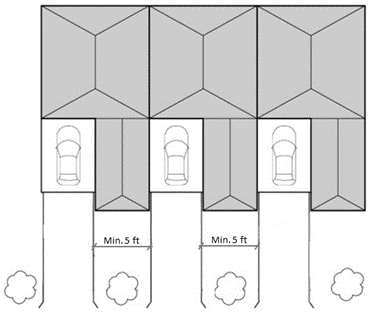
For a flag lot that is set back from the street at the side of another lot:
(i)
Each individual garage and off-street parking spce is separated from any other garage and outdoor off-street parking space by a minimum of five feet; and
(ii)
Each driveway leading to the individual garage and off-street parking space is separated from any other driveway by a minimum five-foot-wide landscape strip, planted with grass or planted to the Type A, standard set forth in SRC chapter 807. (See Figure 700-1)
Figure 700-1. SEPARATION OF GARAGE AND PARKING SPACES
(c)
Exception for existing single-family detached dwelling conversions. A triplex or quadplex that is created through a conversion of, or addition to, an existing single-family detached dwelling shall not be required to comply with the standards of this section.
(Ord. No. 1-20, § 2(Exh. B), 2-24-2020; Ord. No. 13-21, § 1(Exh. A), 2-14-2022; Ord. No. 22-22, § 1(Exh. A), 11-28-2022)
Sec. 700.085. - Townhouses.
Where designated as a special use, townhouses shall comply with the additional standards set forth in this section.
(a)
Permitted development.
(1)
Within the Residential Agriculture (RA) and Single Family Residential (RS) Zones, not more than four townhouses, each on a separate platted lot, may be attached.
(2)
Within any zone, other than the Residential Agriculture (RA) and Single Family Residential (RS) Zones, not more than six townhouses, each on a separate platted lot, may be attached.
(b)
Interior side setback. Any exterior wall or portion thereof which faces but is not contiguous to an interior side lot line shall be setback a minimum of five feet for new townhouses or three feet for existing townhouses; otherwise, the interior side setback requirements of the UDC shall not apply. The provisions of this subsection shall also apply to accessory structures, except for detached accessory dwelling units.
(Prior Code, § 700.080; Ord. No. 31-13; Ord. No. 22-15, § 28, 11-23-2015; Ord. No. 13-21, § 1(Exh. A), 2-14-2022; Ord. No. 22-22, § 1(Exh. A), 11-28-2022; Ord. No. 8-24, § 1(Exh. A), 9-23-2024)
Sec. 700.090. - Reserved.
Editor's note— Ord. No. 13-21, § 1(Exh. A), adopted Feb. 14, 2022, repealed former § 700.090 which pertained to two family shared dwellings, and derived from Prior Code, § 700.085; Ord. No. 31-13; and Ord. No. 22-15, § 28, adopted Nov. 23, 2015.
Sec. 700.095. - Zero side yard dwellings.
Where designated as a special use, zero side yard dwellings shall comply with the additional standards set forth in this section.
(a)
Permitted development. Any number of zero side yard dwellings, each on a separate platted lot, may be developed under this section in any zone.
(b)
Interior side setback. Any exterior wall or portion thereof which faces but is not contiguous to an interior side lot line shall be setback a minimum of five feet; otherwise, the interior side setback requirements of the UDC shall not apply.
(Prior Code, § 700.090; Ord. No. 31-13; Ord. No. 22-15, § 28, 11-23-2015; Ord. No. 13-21, § 1(Exh. A), 2-14-2022)

