
Woodland Park City Zoning Code
CHAPTER 18
48 - SIGNS
Sections:
18.48.010 - Purpose.
The purpose of these regulations is to promote the health, safety, and welfare of the city's residents and visitors by creating the legal framework for a comprehensive and balanced system of signage that will provide easy, pleasant, and effective communication between people and their built environment; minimize hazards to pedestrians and vehicular traffic; protect property values; prevent sign clutter that is confusing for motorists and harmful to business success; and create a community appearance that promotes economic vitality, encourages tourism, and reflects civic pride, the city's heritage, and the natural environment.
(Ord. No. 1115-2010, § 2, 4-1-2010)
18.48.013 - Definitions.
For the purposes of this chapter, the following terms, phrases, and words shall have the meaning ascribed to them in this section, except where the context clearly indicates a different meaning.
A.
"Awning sign" means a type of wall sign on a cloth, canvas-like, or other nonstructural covering that is either permanently attached to the wall of a building or can be raised or retracted to a position against the building when not in use.
B.
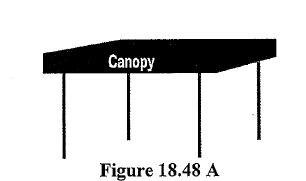
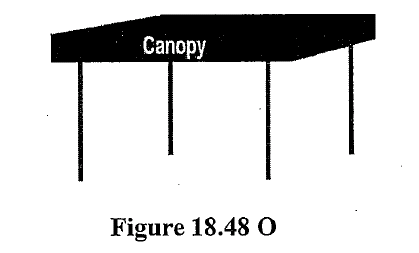
"Canopy sign" means a sign that is attached to and erected parallel to a permanent roof-like structure that projects over a building entrance, such as at a hotel, theater, or fueling station, and is supported throughout its entire length by such canopy, and does not protrude more than twelve inches from the face of such canopy.
C.
"Detached freestanding sign" means a sign not attached to a building.
D.
"Electronic message display" means a sign on which the alphabetic, numeric, pictographic, or symbolic informational content is composed of a series of lights that may be changed through electronic means.
E.
"Externally illuminated" means the illumination of a sign by an artificial source of light not contained within the sign itself or on the sign face. The sign itself does not emit artificial light.
F.
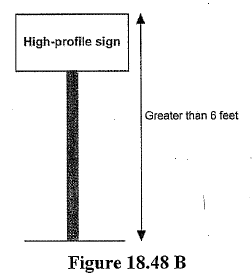
"High-profile sign" means a detached freestanding sign and support structure, the standard height of which exceeds six feet, that is permanently affixed to the ground and independently supported by one or more columns, poles, uprights, or braces.
G.
"Illegal nonconforming sign" means a sign that was illegally erected or maintained with respect to any laws or ordinances governing such sign at the time of its erection or maintenance.
H.
"Internally illuminated" means the illumination of a sign by self-illumination or by an artificial source of light either on the face of the sign, such as light emitting diodes (LEDs) or light bulbs, or contained within such sign, including, but not limited to, fluorescent and neon signs. The sign itself emits artificial light.
I.
"Legal nonconforming sign" means a sign that was lawfully erected prior to the adoption or the amendment of this most current ordinance and (1) that was in compliance with all of the provisions of the previous sign ordinance then in effect, or (2) was issued a permit, regardless of whether it was in compliance with all of the provisions of the previous sign ordinance then in effect.
J.
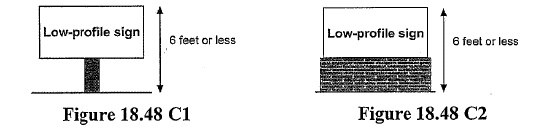
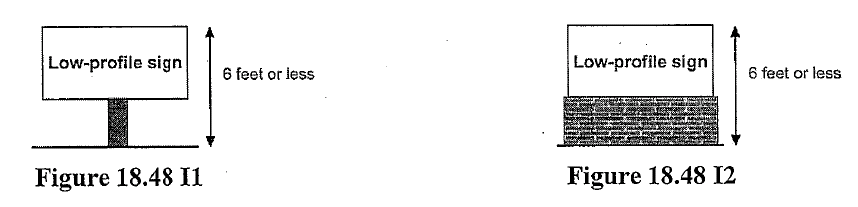
"Low-profile sign" means a detached freestanding sign and support structure, the standard height of which does not exceed six feet, that is permanently affixed to the ground and independently supported by a masonry, timber, or other type of foundation or by one or more columns, poles, uprights, or braces.
K.
"Manual changeable copy sign" means a sign on which the alphabetic, numeric, pictographic, or symbolic informational content can be changed or rearranged manually.
L.
"Nonilluminated" sign means a sign that neither emits artificial light nor is lit by an external source of artificial light.
M.
"Off-premises sign" means a sign that directs attention to an establishment, business, person, commodity, place, or service that is entirely or primarily located, conducted, sold, or offered elsewhere than on the premises where such sign is erected.
N.
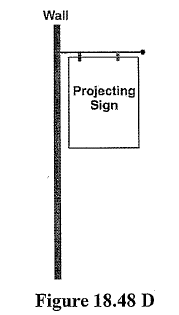
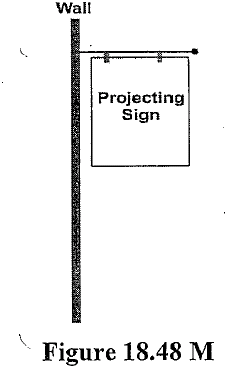
"Projecting sign" means a sign that is attached to a building and extends outward at some angle.
O.
"Public sign" means a sign that:
1.
Regulates traffic or provides general public information;
2.
Is required to be posted by law; or
3.
Is erected or posted by a governmental agency to protect the public health, safety, and welfare.
P.
"Roof sign" means a type of wall sign that is displayed above the eaves and does not extend more than three inches above the primary peak of the roofline of a building.
Q.
"Sign" means a lettered, numbered, symbolic, pictorial, or visual display that is designed to identify, announce, direct, or inform and is visible from a public right-of-way.
R.
"Sign area" means:
1.
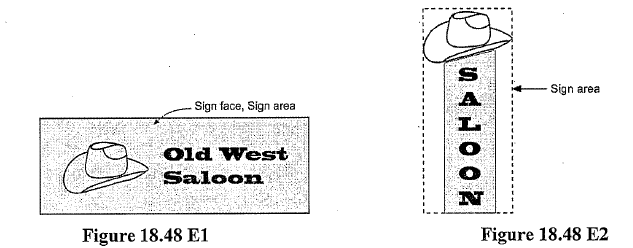
The area of the smallest single rectangle or circle within which the entire sign can fit excluding structural supports and architectural features.
2.
Only one side of a double-faced sign shall be included in a computation of sign area.
3.
The sign area of a cylindrical sign shall be calculated using the following formula: ½ Πdh, where d is the diameter and h is the height of the cylinder.
S.
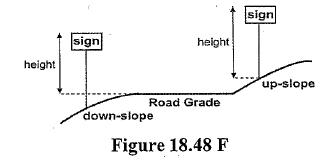
"Standard height" means the height to the topmost point of a sign measured from the ground on an upslope relative to the adjacent road grade and measured from the adjacent road grade on a downslope.
T.
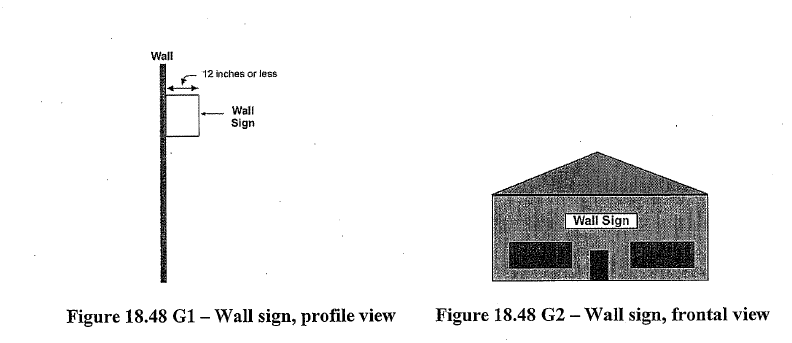
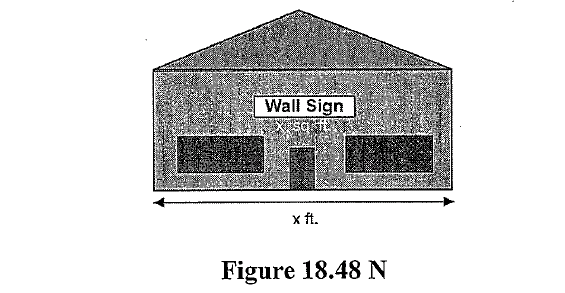
"Wall sign" means a sign that is attached to and erected parallel to an outside wall of a building, an awning, or a roof; is supported along its length by such wall, awning, or roof; and does not protrude more than twelve inches from the face or ends of such wall. A wall sign includes any awning sign, roof sign, any permanent window sign, and any sign that is painted directly on the exterior of a building.
U.
"Window sign" means a sign (1) mounted, (2) painted on, or (3) affixed to the glass of a window or door, or (4) placed inside a window facing the outside of the building to be seen from the exterior of the building but excludes merchandise and/or mannequins included in a window display.
(Ord. No. 1115-2010, § 2, 4-1-2010)
18.48.015 - Interpretation and application.
The following shall be used as methods of interpreting and applying this chapter:
A.
This chapter is not intended to interfere with, abrogate, or annul any other regulation, statute, or other provision of law;
B.
Where any provision of this chapter imposes regulations that are different from any other provision of this chapter or any other regulation, ordinance, statute, or provision of law, that provision which is most restrictive or imposes higher standards shall govern;
C.
Notwithstanding anything herein to the contrary, noncommercial copy may be substituted for commercial copy on any lawful sign; and
D.
This chapter is intended to regulate works of art, merchandise, or thematic sculptures that consist of a company name, product, or trademark designed to be readily identifiable as a logo that encourages a commercial transaction.
(Ord. No. 1115-2010, § 2, 4-1-2010)
18.48.020 - No permit required.
For the purposes of this chapter "permit" means a sign zoning development permit (ZDP) obtained from the city planning department. Public signs and the signs described in subsections A—J of this section may be erected without a permit, provided such signs meet all other standards and regulations of this chapter:
A.
Window Signs. Signs displayed in windows that are not permanent signs;
B.
Residential Nameplates. Residential nameplates that do not exceed eight square feet in sign area, which identify the occupant, name, and/or address of a dwelling.
C.
Garage Sale Signs. Garage sale signs, signs advertising yard, rummage, and estate sales, and other similar types of sales (all referred to in this chapter as garage sale signs) that are installed no more than twenty-four hours prior to the sale, removed within twenty-four hours after the end of the sale, and not displayed for longer than a total display time of ninety-six hours.
D.
Temporary signs relating to the development, sale, or rental of real property that comply with the following standards:
1.
On-Premises Real Estate Signs. One temporary real estate sign on the premises is allowed on each street frontage to advertise a property for sale, lease, or rent provided that:
a.
Within any residential zoning district such sign, including any attached rider signs, shall be nonilluminated and shall not exceed an aggregate sign area of eight square feet. The standard height shall not exceed six feet. A brochure box may also be attached; and
b.
Within any nonresidential zoning district, such sign shall be nonilluminated or externally illuminated and shall not exceed thirty-two square feet in sign area. The standard height shall not exceed eight feet. If the street frontage faced by such sign exceeds two hundred feet, one additional thirty-two square-foot real estate sign is allowed, provided that the two signs are at least one hundred feet apart.
2.
Directional Real Estate Signs. Within any zoning district, five directional open house and/or for sale, lease, or rent signs are allowed per property being advertised.
a.
The sign area of directional real estate sign shall not exceed six square feet.
b.
Directional real estate sign(s) shall be nonilluminated in residential zoning districts and shall be nonilluminated or externally illuminated in nonresidential zoning districts.
c.
Directional open house signs shall be erected no more than twenty-four hours prior to the open house and shall be removed within twenty-four hours of the end of the open house.
d.
Directional for sale, lease, or rent signs shall be displayed only between the hours of 5:00 p.m. on Friday and 5:00 p.m. on Sunday.
3.
Model Home Project Signs. For purposes of this chapter, a model home is defined as a house that is used as an exhibit, not a private residence (and never has been a private residence), to advertise or market it or other houses.
a.
One nonilluminated sign advertising a model home is allowed on the premises of the model home.
b.
Model home project signs shall not exceed a sign area of twenty-four square feet. The standard height shall not exceed six feet.
4.
Directional Model Home Signs.
a.
One directional sign any place within two hundred feet of an access to a master-planned residential subdivision or to a particular filing of a residential development is allowed for the purpose of indicating the presence of one or more model homes.
b.
Directional model home signs shall not exceed a sign area of eight square feet. The standard height shall not exceed six feet.
5.
Development Project Signs. A common sign that identifies the owner, architect, financial institution, real estate agency, and/or general contractor and may contain other statements relevant to the development project shall be governed by the following standards:
a.
One temporary nonilluminated or externally illuminated development project sign is allowed on each street frontage of a nonresidential property;
b.
One temporary nonilluminated development project sign is allowed any place within two hundred feet of an access to a master-planned residential subdivision or to a particular filing of a residential development. If the development contains more than one point of access, the developer may place two signs at one access in lieu of one sign at each access;
c.
The aggregate sign area of such signs shall not exceed thirty-two square feet, divided between not more than two signs;
d.
The standard height shall not exceed eight feet;
e.
In all zoning districts, development project signs shall not be placed closer than ten feet to any side or rear property line;
f.
In all residential zoning districts, all development project signs must be removed when the developer sells the last lot in the development; and
g.
In all nonresidential zoning districts, development project signs must be removed when construction for that project is complete. The city may withhold the authorization of a certificate of occupancy until all development signs have been removed. In cases of phased development, each phase will be allowed a development project sign that must be removed prior to the city's authorization of the certificate of occupancy for that phase.
5.1.
Development Project Signs, Large Lot. A large lot development project sign is a type of development project sign allowed in new residential subdivisions where the average lot exceeds one-half acre. A single large lot development project sign per every eight lots held in common ownership is allowed in addition to the development project signs allowed pursuant to Section 18.48.020 D.5.b. A large lot development project sign may be installed on an individual lot and must comply with the setbacks contained in Section 18.48.020 D.5.e. It shall be removed within seven days after the sale of the lot on which it is installed. It shall not exceed sixteen square feet in sign area. The standard height shall not exceed six feet.
6.
Construction, Contractor, or Subcontractor Identification Signs. These signs advertise a specific contractor service, company, or trade. In all zoning districts, one temporary construction-related sign is permitted for each contractor and subcontractor on each street frontage of a property up to a maximum of ten individual signs that is under construction or redevelopment and must be removed prior to the city's authorization of the certificate of occupancy. Signs in residential zoning districts shall be nonilluminated; signs in nonresidential zoning districts shall be nonilluminated or externally illuminated. The sign area of such sign shall not exceed eight square feet. The standard height shall not exceed six feet.
E.
No Trespass Signs. Signs not exceeding three square feet in sign area, prohibiting trespassing on property, and spaced not closer than every fifty feet.
F.
Informational Signs. Signs erected on private property indicating whether the establishment is open or closed, or providing directions or information regarding entrances and exits, hours of operation, accepted credit cards, parking areas, restrooms, telephones, walkways, or other similar facilities located on the premises, provided that no individual sign shall exceed four square feet in sign area or a height of eight feet to the topmost point of the sign measured from the ground.
G.
Commemorative Signs. A wall sign or detached freestanding sign providing information related to a building including the name of the building, the date of erection, or the historic significance, when cut into any masonry surface or inlaid so as to be part of the building or when constructed of carved or sandblasted wood; formed, etched, or cast metal; high density pre-formed foam; or other similar new materials matching the building's architecture, provided the sign does not exceed six square feet in sign area. When detached, the sign shall not exceed a height of eight feet to the topmost point of the sign measured from the ground.
H.
Flags. Noncommercial flags, including but not limited to flags of the United States of America, the state of Colorado, other state flags, flags of the city, flags from other governmental entities, or civic club flags, provided no flag shall exceed ninety-six square feet in total area and no flag pole shall exceed a height of thirty feet. Flags for private schools and businesses may be incorporated into noncommercial flag displays, adhering to the USA Flag Protocol, provided that the aggregate area of commercial flags for such organizations shall not exceed sixty-four square feet in total area.
I.
Holiday and Seasonal Decorations. Temporary decorations or displays that are clearly incidental to and are customarily and commonly associated with any national, local, or religious holiday or celebration and that do not include the name of any business or product or the price of any product. Holiday and seasonal decorations may incorporate strands of lights that blink, flash, or emit light intermittently.
J.
Campaign Signs. Campaign signs shall be allowed in addition to any other signage allowed by this chapter. All campaign signs shall be removed within five days after the election for which the sign pertains. The responsibility of removing campaign signs is that of the property owner.
(Ord. No. 1115-2010, § 2, 4-1-2010)
18.48.030 - Prohibited signs.
The signs described in subsections A—G of this section are specifically prohibited in the city.
A.
Signs which by color, location, design, or reasonable interpretation resemble or conflict with traffic control signs or signals.
B.
Signs that emit light that simulates lights or devices customarily associated with those used by police, fire, ambulance, or similar emergency vehicles.
C.
Exterior Flashing Signs. Illuminated signs on which the artificial or reflected light is not maintained stationary and constant in intensity at all times when in use, excluding electronic message displays to the extent allowed in this chapter. All signs may be dimmed at night without violating this section. Nothing herein shall be construed as a prohibition on holiday and seasonal lighting.
D.
Non-Portable Commercial Off-Premises Signs. Non-portable commercial off-premises signs are prohibited, except for tourist oriented directional signs erected by the Colorado Department of Transportation (CDOT) and travelers' directional signs erected by the city. All signs erected in the city shall be accessory to the principal use of the premises on which the sign is located. Notwithstanding the prohibition stated herein, a person may appeal for a variance from the prohibition and the board of adjustment may grant a variance subject to the provisions and procedures in Chapter 18.60 of this Code.
E.
Stationary Vehicle Signs. Signs mounted, painted on, or attached to a parked vehicle or trailer for the primary purpose of attracting people to a product, business, or activity located on the same or nearby premises, or to a product, business, or activity located on a public right-of-way in the vicinity of such vehicle or trailer. Signs on vehicles or trailers that are merchandise are not included in this definition.
F.
Mailbox Signs. Mailboxes shall not display commercial advertising beyond business name.
G.
Other than public signs: signs in city-owned open-space; signs at Meadow Wood Sports Complex; signs set into or on city-owned lawns, other than parks; and signs attached to city-owned property, including but not limited to buildings, fences, light posts and street signs.
(Ord. No. 1115-2010, § 2, 4-1-2010)
18.48.040 - Permit required.
For the purposes of this chapter, "permit" means a sign zoning development permit (ZDP) obtained from the city planning department.
A.
Permit Required. Except for those signs that do not require a permit as provided in Section 18.48.020 of this chapter, or those signs requiring a temporary sign permit as provided in Section 18.48.050 of this chapter, a permit is required to erect, install, relocate, structurally modify, or perform any other non-routine maintenance of any sign. An administrative review at no fee is required to reface an existing sign. Tenant signs on directory signs do not require a permit or a review if refaced.
B.
Application for Permit. The applicant for a permit shall complete an application on forms available from the city and shall pay the required application fee. An application shall be accompanied by such drawings and specifications as may be required to fully advise and acquaint the city with the design, location, dimensions, sign fastening, and manner of illumination. Additionally, the shape, color, text, and images will be reviewed to ensure each sign does not imitate a public sign.
C.
Application Acceptable. The planning director or designee shall review the permit application at the time of submittal for completeness and shall either accept the application or reject it and notify the applicant of the information required to make it complete.
D.
Review and Approval. The planning director or designee shall review the application relative to the regulations contained in this chapter and approve, approve with conditions, or disapprove the application. Upon this decision, the planning director or designee shall issue or deny a permit. If the permit is denied, the planning director or designee shall explain in writing the reason for the denial. An applicant whose permit application has been denied may re-apply or appeal the decision in accordance with Chapter 18.48.085 or 18.54.
E.
Permit Expiration. A permit shall expire if the work permitted is not completed within one year from the date of issuance. In the event of the expiration of a permit, the applicant may apply for a new permit.
F.
The sign shall adhere to all applicable building and electrical codes.
G.
Variances from the regulations contained in this chapter are governed by Chapter 18.60 and minor variations may be granted administratively by Section 18.48.085.
(Ord. No. 1115-2010, § 2, 4-1-2010)
18.48.050 - Temporary signs and permits.
For the purposes of this chapter "temporary sign permit" means a specific type of sign zoning development permit (ZDP) obtained from the city planning department. A temporary sign permit application is subject to the same review process as a permit application, but the temporary sign permit application fee is reduced relative to the permit application fee.
A.
Temporary Sign Permit Required. It is unlawful to construct, erect, or display any temporary sign for longer than twenty-four hours without obtaining a temporary sign permit, with the exception of signs as set forth in Section 18.48.020 of this chapter.
B.
Banners are a type of temporary sign and shall be governed by the standards for temporary signs as set forth in this chapter.
C.
Temporary signs shall be governed by the following standards:
1.
The temporary sign permit shall be issued for a specified period. Temporary signs shall be displayed for no more than one hundred twenty days during any calendar year and no more than thirty consecutive days during any display period. Grand-opening or special event attention-getting devices such as pennants, streamers, balloons, and inflatable balloon characters or symbols, and devices or figures that are constructed of fabric, inflated, and designed to dance, wave, or flail may be displayed for up to thirty days during any calendar year and no more than ten consecutive days during any display period. The display period of attention-getting devices shall be deducted from the one hundred twenty days granted for other temporary signs;
2.
The aggregate sign area of all temporary signage shall not exceed thirty-six square feet, to be divided among up to three temporary signs per establishment or organization, with up to two temporary signs on any street frontage;
3.
The temporary sign permit fee for an event sponsored by a governmental entity or non-profit organization shall be waived; and
4.
Banners shall be affixed to a building or other permanent structure, including but not limited to canopies, permanent sign structures, fences, retaining walls, and trees. No banners shall be affixed to fencing stakes or other methods of temporarily affixing the sign to the ground.
(Ord. No. 1115-2010, § 2, 4-1-2010)
18.48.060 - General sign standards.
These standards apply to all signs, unless specifically provided otherwise in this chapter.
A.
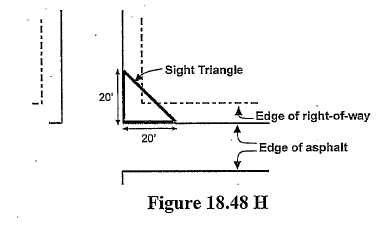
Intersection Visibility. No sign shall be placed, erected, or maintained in the sight triangle between the elevations of three feet and eight feet relative to the adjacent road grade. The sight triangle is the triangular area formed by two intersecting streets at the edge of asphalt (or curb if closer to the property line) and by the line drawn between points on the edge of asphalt twenty feet (or curb if closer to the property line) distant from their intersection as shown in Figure 18.48 H below.
B.
Sign Materials. Awning signs shall be made from cloth, canvas-like, or other non-structural covering materials. Signs other than awning and temporary signs shall not be constructed of cloth, canvas-like, vinyl, rolled plastic, cardboard, or other manmade fiber material.
C.
Sign Illumination. No sign shall emit light of such intensity that it either creates a hazardous condition or annoys, disturbs, injures, or endangers the comfort, repose, health, peace, or safety of motorists or adjoining neighbors. Light from external illumination sources may not create a hazardous condition or annoy, disturb, injure, or endanger the comfort, repose, health, peace, or safety of motorists or adjoining neighbors. No complaint shall be issued in the event the light from the sign is removed, or the condition abated or fully corrected.
D.
Support Structures. No permanent sign shall be attached to, supported by, painted on, or drawn on fences, railings, utility poles, or trees.
E.
Attached Sign Height. No sign that is attached to a building shall be constructed to extend more than three inches above the primary peak of the roofline of a building.
F.
Sign Movement. All signs and any portions thereof must maintain a permanent, stationary, and fixed position, unless specifically allowed in this chapter. Suspended and/or hanging signs are allowed.
G.
Sound. No sign shall incorporate any sound-making device.
H.
Certain Words Prohibited. No sign shall copy or imitate a public sign. Other than public signs, no sign shall use the word "danger" in the absence of a threat of eminent danger. This provision shall not apply when the words are part of a business name or an attraction title for a theatrical or similar event or purpose.
(Ord. No. 1115-2010, § 2, 4-1-2010)
18.48.070 - Standards—Residential.
A.
Signs for Residential Uses Located in Nonresidential Zoning Districts. Signs for single-family residential uses that are located in nonresidential zoning districts shall be governed by the standards in Section 18.48.070 C. 1. of this chapter. Signs for multi-family uses that are located in nonresidential zoning districts shall be governed by the standards in Section 18.48.070 C. 2. of this chapter. Signs for mobile home parks that are located in nonresidential zoning districts shall be governed by standards in Section 18.48.070 C. 3. of this chapter.
B.
Residential Areas. Signs in residential areas shall be nonilluminated and no larger than eight square feet in sign area. For purposes of this chapter, residential areas mean real property within residential zoning districts except (1) model home sites; (2) any place within two hundred feet of an access to a master-planned residential subdivision or to a particular filing of a residential development; and (3) new residential subdivisions where the average lot exceeds one-half acre with at least eight lots held in common ownership.
C.
Low-Profile and Wall Signs.
1.
In the suburban residential and urban residential zoning districts, one low-profile sign any place within two hundred feet of an access to a master-planned residential subdivision or to a particular filing of a residential development, not exceeding a sign area of twenty-four square feet, is allowed for the purpose of identifying the name of a residential development.
2.
In the multi family residential-suburban and multi family residential-urban zoning districts:
a.
One low-profile sign is allowed any place within two hundred feet of an access to a master-planned residential subdivision or to a particular filing of a residential development for the purpose of identifying the name of a multi-family residential development according to the table below. If the development contains more than one point of access, the developer may place two signs at one access in lieu of one sign at each access.
Table 18.48 A
b.
One wall or low-profile sign, not exceeding a sign area of eight square feet, is allowed for the purpose of identifying an office, each common facility, and each specific multi-family structure.
3.
In the mobile home park zoning district:
a.
One low-profile sign any place within two hundred feet of an access to a mobile home park or to a particular filing of a mobile home park development not exceeding a sign area of twenty-four square feet, is allowed for the purpose of identifying the mobile home park. If the mobile home park contains more than one point of access, the developer may place two signs at one access in lieu of one sign at each access; and
b.
One wall or low-profile sign, not exceeding a sign area of eight square feet, is allowed for the purpose of identifying an office and each common facility.
D.
Ranch-Style Archways. In any residential zoning district, one nonilluminated or externally illuminated ranch-style archway is allowed per approved driveway or access point to a residential property or any place within two hundred feet of an access to a master-planned residential subdivision or to a particular filing of a residential development. The ranch-style archway shall not exceed a height of eighteen feet to the peak of the arch measured from the ground below the arch. Notwithstanding any contrary provision in this Chapter 18.48, any ranch-style archway shall not exceed a maximum sign area of eight square feet over an approved driveway or access point or twenty-four square feet over any place within two hundred feet of an access to a master-planned residential subdivision or to a particular filing of a residential development. Ranch-style archways and their supports shall be constructed of natural materials such as brick, sandstone, wood, stucco, textured concrete masonry, wrought iron, or other similar materials.
(Ord. No. 1115-2010, § 2, 4-1-2010)
18.48.071 - Standards—Nonresidential.
A.
Detached Freestanding Signs. Detached freestanding signs are allowed in all nonresidential zoning districts and shall be governed by the following standards:
1.
Number of Detached Freestanding Signs.
a.
Independently located establishment. An independently located establishment means an establishment not located in a commercial center. One detached freestanding sign is allowed for each independently located establishment except that (1) if such establishment occupies a corner lot with a minimum area of twenty thousand square feet, or (2) if such establishment has one continuous street frontage that exceeds two hundred feet, a second detached freestanding sign is permitted. If both signs are located on the same street frontage they must be at least one hundred feet apart.
b.
Commercial Centers. A commercial center means any commercial development on a site that contains either (1) three or more contiguous tenant spaces in any one building on a single lot or (2) two or more buildings on contiguous lots or the same lot that share parking facilities and accesses. All signs within a new commercial center completed after the effective date of this section or a commercial center that is substantially improved, as defined in Section 18.06.560, after the effective date of this section must be compatible with the main buildings and the other signs in the commercial center.
i.
The number of detached freestanding signs allowed for a commercial center is determined according to the following table:
Table 18.48 B
ii.
Commercial center out-parcels. One detached freestanding sign is allowed for an independently located establishment on an outparcel of a commercial center and separated by a minimum distance of fifty feet from any other building in the commercial center.
2.
Area of Detached Freestanding Signs. The maximum sign area for a detached freestanding sign depends upon the type of sign to be erected and shall be determined as follows:
Table 18.48 C
Table 18.48 D
For commercial centers, the entire length of the commercial center's street frontage on which the sign will be located shall be used.
3.
Height of Detached Freestanding Signs.
a.
Low-profile signs. The standard height of low-profile signs shall not exceed six feet.
b.
High-profile signs. The standard height of a high-profile sign shall not exceed the following:
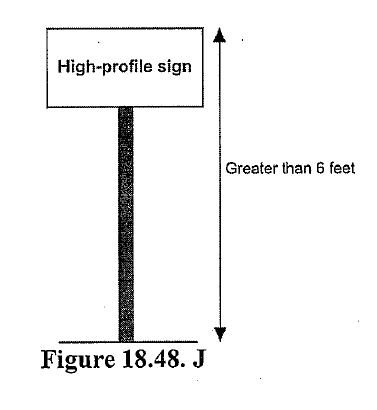
Table 18.48 J
4.
Minimum height to bottom of high-profile sign.
a.
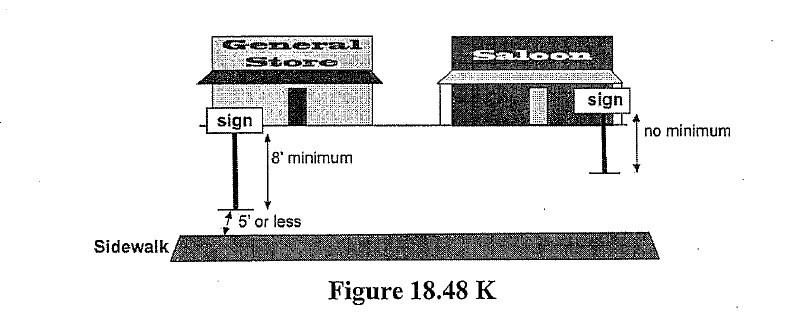
Any high-profile sign that is within five feet of a sidewalk shall have a minimum height to the bottom of the face of the sign of eight feet.
b.
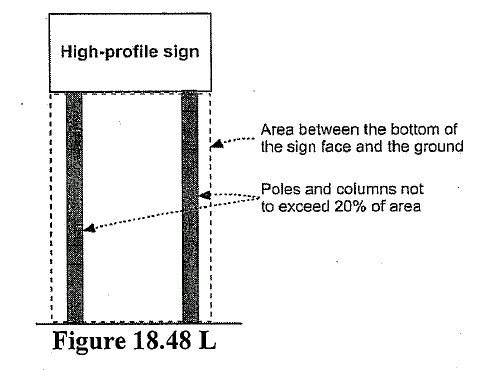
Columns, poles, or other supports for a high-profile sign shall not occupy more than twenty percent of the area between the bottom of the sign face and the ground.
B.
Projecting Signs. In all nonresidential zoning districts, projecting signs are allowed for each independently located establishment, provided that the aggregate sign area of all projecting signs on each street frontage or wall shall not exceed twelve square feet.
C.
Wall Signs. In all nonresidential districts, wall signs shall be governed by the following standards:
1.
The aggregate sign area shall not exceed one square foot for each linear foot of length of the wall on which such signs are mounted up to two hundred square feet. For establishments having a store front less than fifty feet in length and being set back one hundred to less than two hundred feet from the right-of-way, the aggregate sign area shall not exceed 1.25 square feet for each linear foot of length of the wall on which such signs are mounted. For a setback of two hundred feet or more the maximum aggregate sign area shall not exceed 1.5 square feet for each linear foot of length of the wall on which such signs are mounted. For buildings with irregular wall faces, the length of the wall shall include all the wall lengths that are generally parallel; and
2.
An establishment may have both wall signs and projecting signs on the same wall provided that the aggregate sign area of the wall signs and projecting signs does not exceed the maximum allowable sign area for wall signage, except as provided in Section 18.48.072.
D.
Mural Signs. A mural sign is any scene or image painted, frescoed, tiled, or otherwise attached to a building exterior or window in which more than twenty-five percent of the image (1) identifies or advertises a business, business activity, or product that is for sale on the premises, or (2) consists of a company name, symbol, or trademark designed to be readily identifiable as a logo which promotes a commercial transaction. In all nonresidential zoning districts one mural sign shall be allowed at each establishment and such sign shall be governed by the same standards that apply to wall signs.
E.
Canopy Signs. In all nonresidential zoning districts, the aggregate sign area for each side of the canopy shall not exceed 0.30 square feet per linear foot of the side of the canopy on which the sign is mounted.
F.
Signs Under Covered Walkways. A sign under a covered walkway is any sign that is suspended beneath a roof-like structure over a walkway. In all nonresidential zoning districts signs under covered walkways must be elevated at least eight feet above the walkway and the aggregate sign area for each entrance to the establishment shall not exceed four square feet.
G.
Portable Signs. Any sign designed to be moved easily and not permanently affixed to the ground or to a structure or building shall be governed by the following standards:
1.
Sidewalk signs. In the Central Business District, Neighborhood Commercial and Community Commercial zoning districts, and PUD commercial centers, portable signs placed on or adjacent to an improved pedestrian sidewalk, including sandwich signs which are constructed in such a manner as to form an "A" or tent-like shape, hinged or not hinged at the top, with each angular piece held at an appropriate distance by a supporting member shall be governed by the following standards:
a.
One nonilluminated or externally illuminated sidewalk sign is allowed per establishment;
b.
Sidewalk signs shall be allowed in the public right-of-way only in the Special Downtown Area;
c.
Sign area within a public right-of-way shall not exceed six square feet;
d.
Sign area within private property boundaries shall not exceed sixteen square feet;
e.
Illumination and sign anchoring of sufficient weight to prevent the sign from becoming a hazard in windy conditions must be approved by the city planning department prior to issuance of a permit;
f.
Sidewalk signs that are within the public right-of-way shall be located directly adjacent to the property and on the same side of the street as the establishment. The sign placement shall not prevent the sidewalk from being ADA accessible nor shall it cause a pedestrian to move further from a building and closer to a roadway;
g.
Sign must be removed from the public right-of-way and stored during non-business hours or during periods of snow removal;
h.
All sidewalk signs existing at the time this section becomes effective must comply with all standards of this chapter within sixty days of notification from the city planning department. Any existing sign that does not comply within sixty days is in violation of this chapter and shall be removed immediately;
i.
Acceptable materials for sidewalk signs may include chalk, dry-erase, or other similar type of boards, provided that such temporary surface area shall not exceed seventy-five percent of the sign area; and
j.
An establishment may not have both a sidewalk sign and a poster frame sign.
2.
Poster Frame Signs. In all nonresidential zoning districts, one nonilluminated or externally illuminated poster frame sign is allowed per establishment. Poster frame signs shall be governed by the following standards:
a.
Poster frame signs must possess sufficient weight to prevent them from becoming a hazard in windy conditions;
b.
Such signs shall not be located on a public sidewalk, nor shall they impede pedestrian, bicycle or vehicle traffic;
c.
The sign area inside each frame may not exceed eight square feet;
d.
All poster frame signs existing at the time this section becomes effective must comply with all standards of this chapter within sixty days of notification from the city planning department. Any existing sign that does not comply within sixty days is in violation of this chapter and shall be removed immediately; and
e.
An establishment may not have both a sidewalk sign and a poster frame sign.
3.
Handheld Signs or Costumed Characters with Signs Promoting a Business. In the Central Business District, Neighborhood Commercial and Community Commercial zoning districts, and PUD commercial centers, one nonilluminated handheld sign directing attention to an establishment is allowed per establishment. Handheld signs or costumed characters with signs promoting a business shall be governed by the following standards:
a.
A handheld sign shall not exceed six square feet;
b.
Handheld signs or costumed characters with signs promoting a business that are within the public right-of-way shall be located directly adjacent to the property and on the same side of the street as the establishment and shall not obstruct traffic;
c.
Handheld signs or costumed characters with signs promoting a business shall be displayed only during regular or daylight business hours;
d.
Handheld signs or costumed characters with signs promoting a business shall not be displayed during periods of limited visibility; and
e.
All handheld signs existing at the time this section becomes effective must comply with all standards and regulations of this chapter within thirty days of notification from the city planning department. Any existing sign that does not comply within thirty days is in violation of this chapter and shall be removed immediately.
4.
Recurring Balloon Displays. In all commercial districts, recurring balloon displays are permitted and shall be governed by the following standards:
a.
The display shall be removed during non-business hours;
b.
The display location must be approved by the city planning department prior to issuance of a permit. The location of the balloon display shall not inhibit ingress or egress at the establishment; impede access to the sidewalk, parking lot, other on-site facilities, or any other establishment; or obstruct visibility on a nearby road right-of-way; and
c.
Balloons that are used as part of a special event are governed by Section 18.48.050.
H.
Manual Changeable Copy Signs. In all nonresidential zoning districts, not more than two manual changeable copy sign are permitted per establishment. Places of worship and educational institutions may also apply for a manual changeable copy sign, regardless of zoning classification. Manual changeable copy signs shall be governed by the following standards:
1.
The sign shall comply with the standards and regulations for wall signs or detached freestanding signs;
2.
Manual changeable copy signs shall not exceed a maximum size of thirty-two square feet in sign area; and
3.
Manual changeable copy signs shall be erected as part of a larger sign. The sign area of the manual changeable copy sign shall count toward the maximum allowable sign area of the detached freestanding or wall sign of which it is part. If erected as part of a detached freestanding sign, the manual changeable copy portion shall account for no more than fifty percent of the sign area. If erected as part of a wall sign, the manual changeable copy portion of the sign shall account for no more than seventy-five percent of the sign area.
I.
Electronic Message Displays. These standards shall not apply to fuel pricing signs. For the standards that apply to fuel pricing signs, see Section 18.48.071.K. Places of worship and educational institutions may apply for an electronic message display, regardless of zoning classification. Electronic message displays shall be governed by the following standards:
1.
The displays shall only be allowed as wall signs or detached freestanding signs and shall comply with the standards for whichever is applicable;
2.
Electronic message displays shall be erected as part of a larger sign. The sign area of the electronic message display shall count toward the maximum allowable sign area of the sign of which it is part;
3.
Electronic message displays shall not exceed a maximum nighttime brightness of one thousand NITs (candelas per square meter) between dusk and dawn as certified by the manufacturer. City officials have the right to view the programmed specifications of the sign to determine compliance, and the burden of proof is on the sign owner with respect to verifying the light compliance should a field measurement of brightness be necessary;
4.
Electronic message displays shall not exceed a maximum size of thirty-two square feet in sign area;
5.
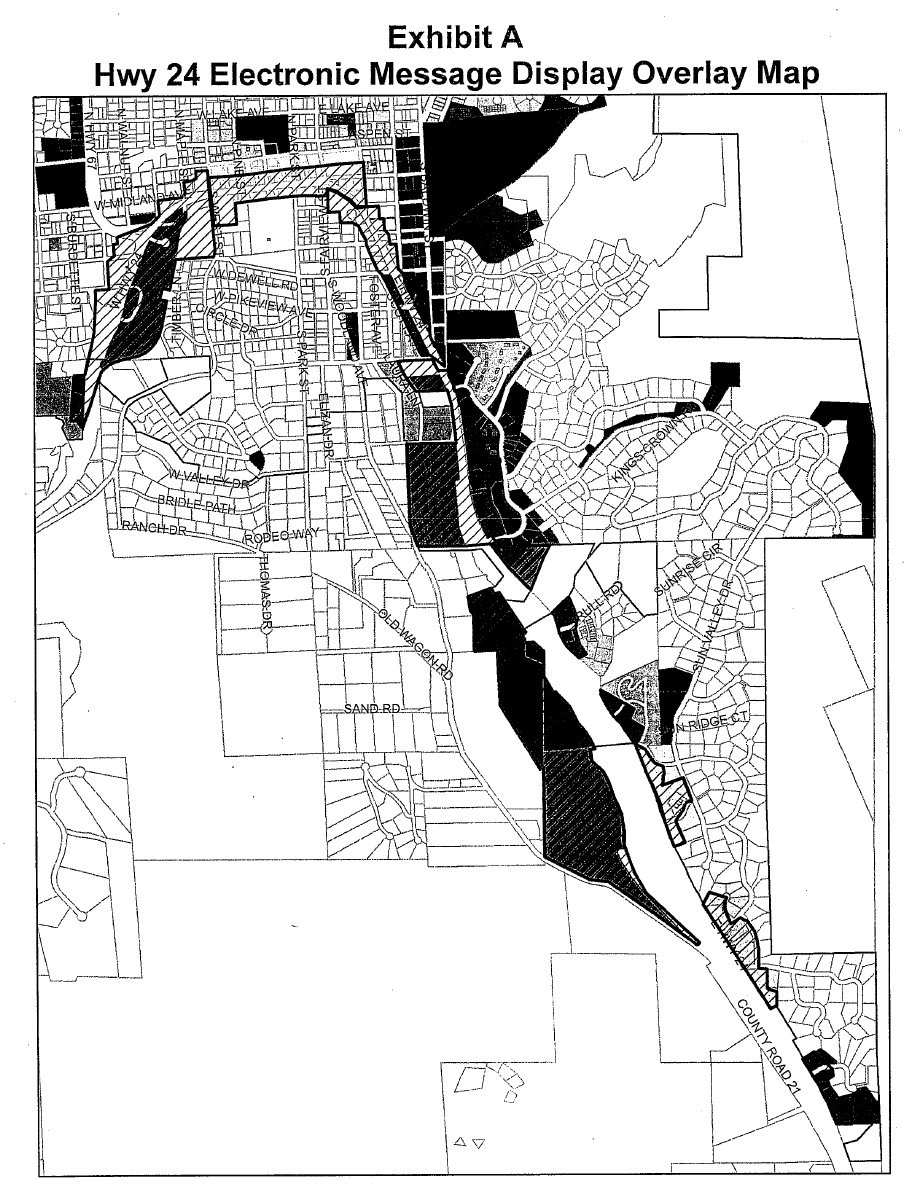
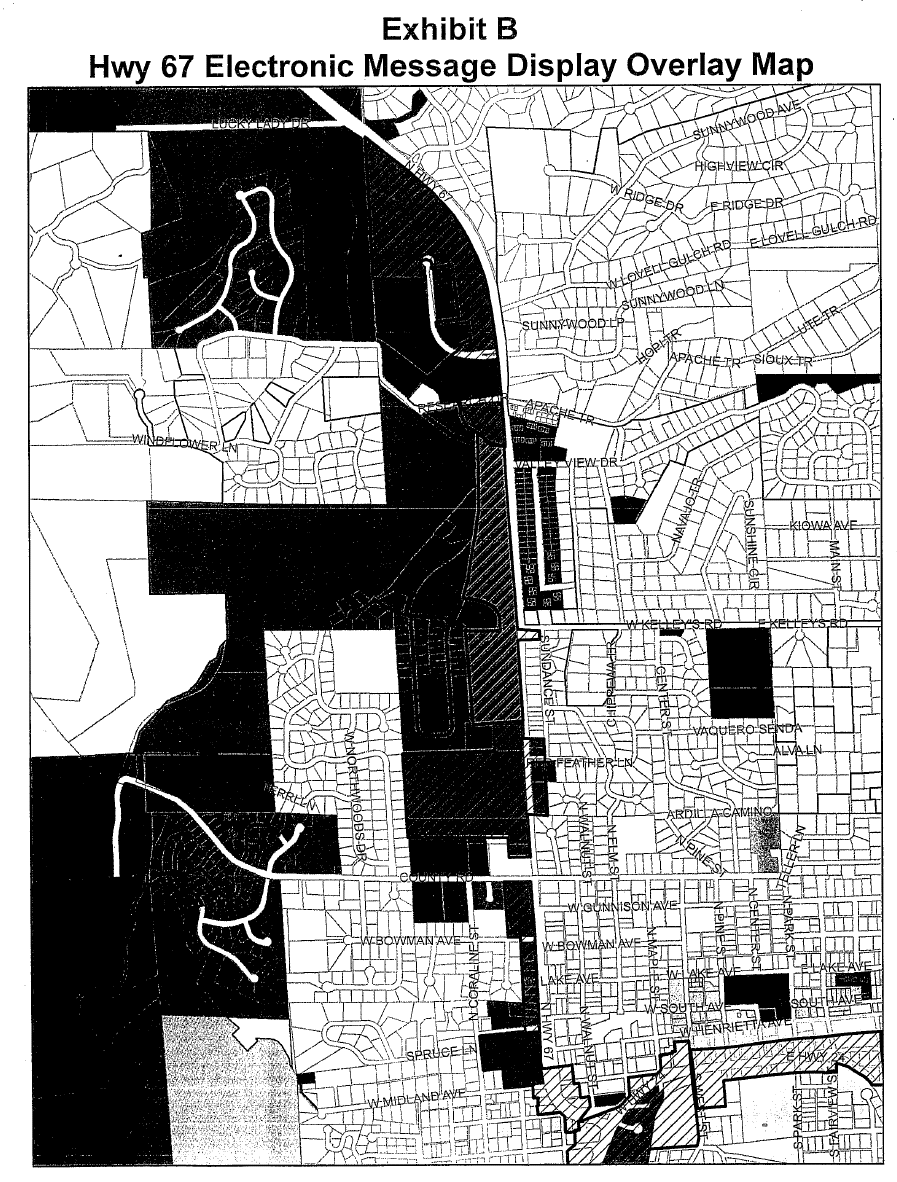
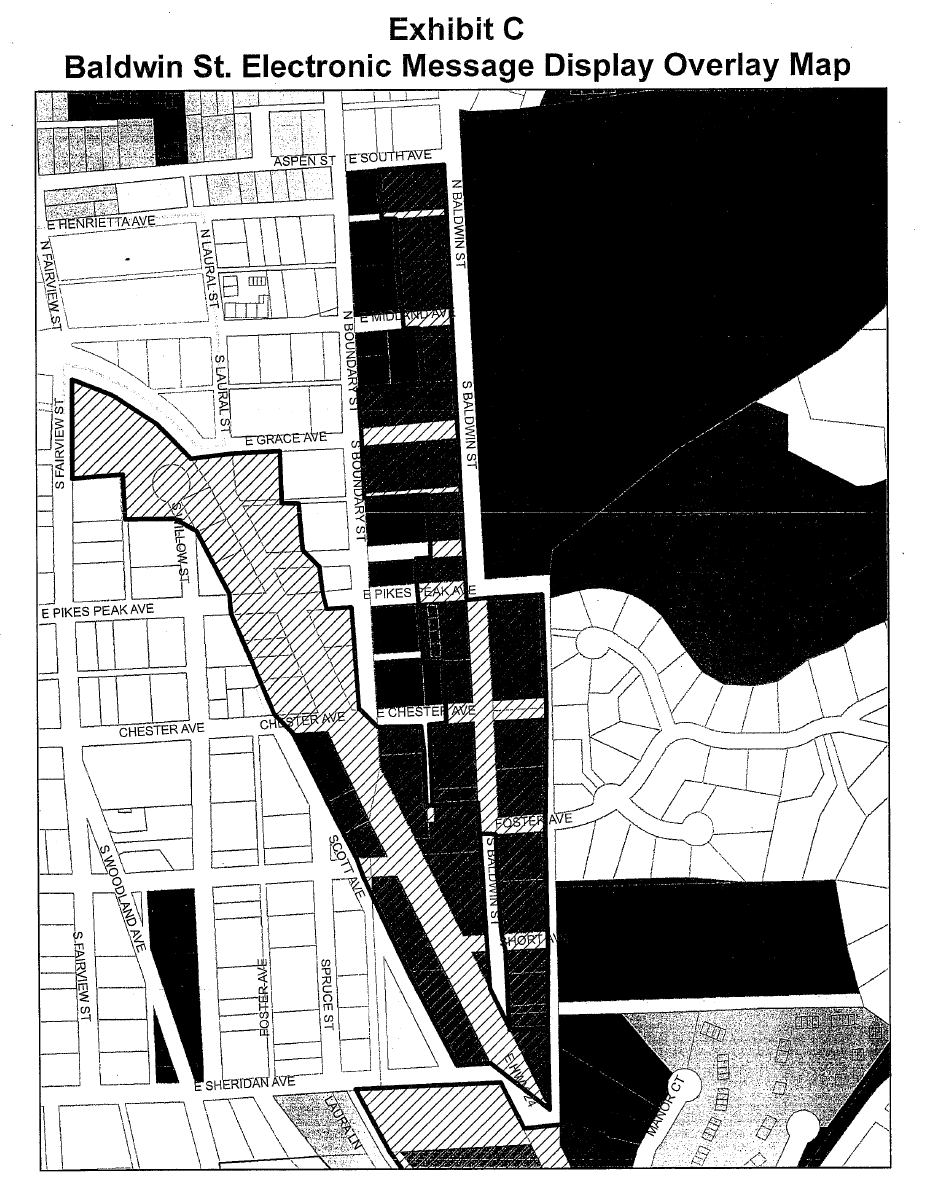
Electronic message displays shall be allowed only in those areas identified on the Electronic Message Display Overlay Map for Highway 24, Highway 67 and Baldwin Street, which is contained in Section 18.48.095. The electronic message display shall be located on the establishment's highway or Baldwin Street frontage; and
6.
If erected as part of a detached freestanding sign, the electronic message display portion shall account for no more than fifty percent of the sign area. If erected as part of a wall sign, the electronic message display portion of the sign shall account for no more than seventy-five percent of the sign area.
J.
Directory Signs. In all nonresidential zoning districts, one sign that identifies the name and location of tenants in a multi-tenant commercial, industrial, or institutional building or in a development composed of a group of buildings or in a commercial center is allowed. Directory signs shall be governed by the following standards:
1.
Directory signs shall be detached freestanding signs or wall signs;
2.
In addition to the other signage allowed on the premises, one directory sign not exceeding a sign area of twenty-four square feet is allowed for each platted access to the commercial or industrial center or for each public entrance in a multi-tenant building;
3.
If the total building footprint exceeds seventy-five thousand square feet, one additional directory sign is allowed. If the total building footprint exceeds one hundred thousand square feet, three signs are allowed;
4.
No more than three directory signs are allowed for a single multi-tenant building or a multi-building center; and
5.
When more than one detached freestanding directory sign is present, such signs shall be at least one hundred feet apart.
K.
Fuel Pricing Signs. In all commercial districts, signs advertising the price of fuels are allowed in addition to any other signs allowed on the premises and shall be governed by the following standards:
1.
One fuel pricing sign shall be permitted for each street frontage and no more than two pricing signs are permitted on a single premises;
2.
The sign must be attached to a principal structure or to the structure covering fueling station islands or to the support structure of a detached freestanding sign provided that when attached to the supporting structure of a high-profile sign the bottom of the fuel pricing sign is elevated not less than eight feet above ground;
3.
A pricing sign shall not exceed a sign area of eight square feet for each fifty feet of frontage provided that the maximum sign area shall not exceed twenty-four square feet; and
4.
A fuel pricing sign may utilize electronic message display technology to display fuel prices, provided the display message only changes when the price of fuel changes and the sign does not exceed a maximum nighttime brightness of one thousand NITs (candelas per square meter) between dusk and dawn as certified by the manufacturer. City officials have the right to view the programmed specifications of the sign. The sign owner has the burden of establishing compliance by measuring sign brightness with equipment that is of standard use in the industry for making such measurements.
(Ord. No. 1115-2010, § 2, 4-1-2010)
18.48.072 - Special area standards.
A.
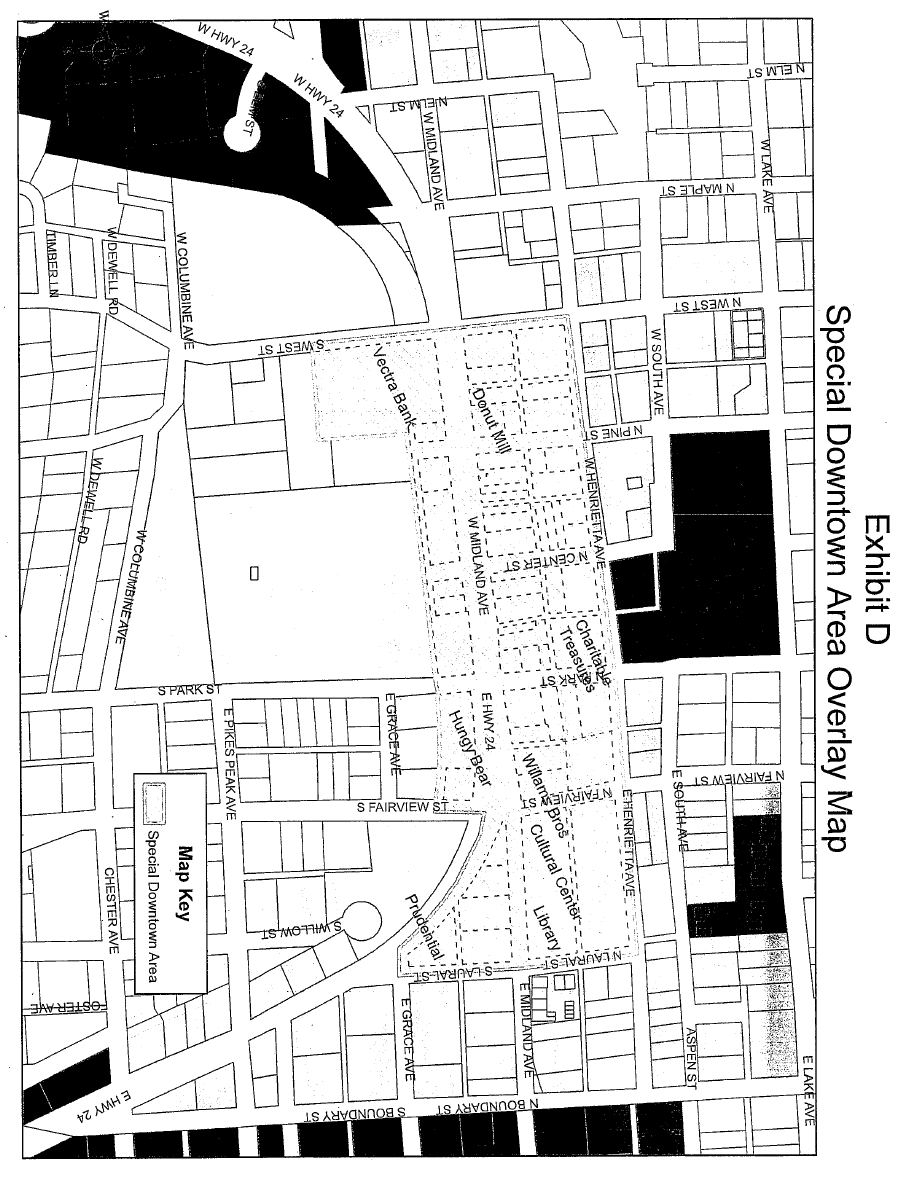
Special Downtown Area. Notwithstanding anything herein to the contrary, signs located within the Special Downtown Area, shown on the Special Downtown Area Overlay Map, which is contained in Section 18.48.095, shall be governed by the following standards:
1.
Projecting signs shall not extend more than forty-two inches over the public right-of-way;
2.
Storefronts shall be entitled to a minimum sign area of twenty-five square feet for a wall sign, in addition to the twelve square feet allowed for a projecting sign; and
3.
Recurring balloon displays that adhere to the regulations in Section 18.48.071 G. 4. may be located in the right-of-way.
B.
Signs Allowed in Planned Unit Development (PUD) Districts. If not otherwise stated in the final development plan, signs within a PUD district shall be governed by the general standards and the applicable residential and nonresidential standards of this chapter.
C.
Woodland Station Overlay District. Sign standards and regulations for the Woodland Station Overlay District are contained in Section 18.31.060 of this Code.
(Ord. No. 1115-2010, § 2, 4-1-2010)
18.48.075 - Sign maintenance.
All signs, including temporary signs and signs not requiring a permit, are required to comply with this section.
A.
The owner and lessee of a sign shall keep such sign properly maintained at all times, in accordance with the following standards:
1.
All materials used in permanent signs shall be kept in good condition, free of graffiti and free of holes, rot, peeling paint, and other forms of structural or superficial decay;
2.
All temporary signs shall be kept in good condition. Any temporary sign or banner that becomes ripped, torn, sagging, or otherwise illegible must be removed, repaired, or replaced immediately;
3.
If the sign is intended to be illuminated, all lighting shall be maintained in working order;
B.
The owner and lessee shall promptly remove graffiti or repair any hole or structural or superficial decay within fourteen days or such longer time as specified in the written notice sent to the owner and lessee at the last address shown in the Teller County Assessor's real property records and the city's business license records for the address at which the sign is located. Failure to take corrective action by the specified deadline is a violation of this chapter. If the owner and/or lessee fails to take the corrective action by the deadline specified in the written notice the planning director or designee may enter the property and take the corrective action necessary to remove graffiti or repair any hole or structural defect. The owner and lessee shall be jointly and severably responsible for the actual costs incurred by the city in taking any corrective action. In the event that such costs remain unpaid for a period of sixty days from the date of the written bill of costs sent to the owner and lessee at the last address shown in the Teller County Assessor's real property records and the city's business license records for the address at which the sign is located, the city clerk may certify the delinquent payment to the Teller County Treasurer to be placed upon the tax list for the current year and to be collected in the same manner as taxes, plus a charge thereon to defray the costs of collection.
C.
In the case of any structural defect, if the city determines immediate action is required for the protection of the public health, safety and/or welfare, the city may take immediate action without prior notice to the owner and lessee of the sign. The owner and lessee shall be jointly and severably responsible for the actual costs incurred by the city in taking the corrective action. In the event that such costs remain unpaid for a period of sixty days from the date of the written bill of costs sent to the owner and lessee at the last address shown in the Teller County Assessor's real property records and the city's business license records for the address at which the sign is located, the city clerk may certify the delinquent payment to the Teller County Treasurer to be placed upon the tax list for the current year and to be collected in the same manner as taxes, plus a charge thereon to defray the costs of collection.
(Ord. No. 1115-2010, § 2, 4-1-2010)
18.48.080 - Nonconforming signs.
A.
All off-premises signs which are within the purview of the provisions of the Federal Highway Beautification Act of 1965 and the Colorado Outdoor Advertising Act shall be governed by the regulations set forth therein and are not subject to the regulations contained in this section.
B.
Illegal Nonconforming Sign. For purposes of this chapter, illegal nonconforming sign means a sign that was illegally erected or maintained with respect to any laws or sign ordinances governing such sign at the time of its erection or maintenance. Unless conclusive evidence can be found to the contrary, any nonconforming sign at the time of the effective date of this chapter shall be deemed a legal nonconforming sign except for the following:
1.
Those signs meeting the requirements of subsections: Section 18.48.020 C. Garage sale signs; Section 18.48.020 D. Temporary signs relating to the development, sale, or rental of real property; Section 18.48.020 F. Informational signs; Section 18.48.020 G. Commemorative signs; and Section 18.48.020 H. Flags.
2.
Prohibited signs as described in Section 18.48.030.
3.
Temporary signs as described in Section 18.48.050.
4.
Portable signs as described in Section 18.48.071 G.
All illegal nonconforming signs shall be brought into conformance with the provisions of this chapter within ninety days of the date of the written notice sent to the owner and lessee of any illegal nonconforming sign at the last address shown in the Teller County Assessor's real property records and the city's business license records for the address at which the sign is located. Failure to take the corrective action necessary to bring an illegal nonconforming sign into conformance within the ninety-day period is a violation and punishable under Section 18.48.090 of this chapter. Each day that a violation is allowed to exist beyond the time designated in the written notification by the administrative officer shall constitute a separate offense.
C.
Legal Nonconforming Sign. Any legal nonconforming sign may continue in existence and function provided such sign is maintained in good condition. A legal nonconforming sign shall not be:
1.
Structurally changed, except to reduce or eliminate the nonconformity of the sign, although its content may be changed;
2.
Structurally altered in order to prolong the life of the sign, except to meet safety requirements;
3.
Altered, enlarged, or extended, except to reduce or eliminate the nonconformity of the sign;
4.
Continued in use if a substantial improvement to the principal building structure occurs as defined in Section 18.06.560; or
5.
Replaced with a nonconforming sign if destroyed.
(Ord. No. 1115-2010, § 2, 4-1-2010)
18.48.085 - Variances and appeals.
A.
Requests for variances from the standards and regulations contained in this chapter shall be applied for in accordance with Chapter 18.60 Variances.
B.
Appeals from any rulings of the planning director or designee shall be made to the city manager. Appeals from any decision of the city manager shall be made in accordance with Chapter 18.54 Appeals.
C.
Application to the Planning Director for Minor Variations.
1.
Any person may apply to the planning director or designee for a minor variation(s) from the provisions of this chapter in cases where special circumstances including but not limited to unanticipated sign location issues or unusual physical site conditions cause the need for some minor adjustments to be made to the allowable sign area, sign location, or sign height. Applicants shall submit their requests for minor variations on a form supplied by the planning department. The planning director or designee may authorize minor variations from the provisions of this chapter to:
a.
Allow maximum and minimum heights to be adjusted by as much as two feet;
b.
Increase the allowable sign area by up to ten percent; or
c.
Allow other similar minor variations.
2.
The planning director or designee shall consider each application for a minor variation on a case-by-case basis and may grant an application where special circumstances impose some difficulty or hardship on the applicant.
3.
The planning director or designee shall make a written recommendation within seven working days of the complete application for a minor variation being received by the planning department.
4.
Minor variations may be granted retroactively.
D.
Appeals to the City Manager from Orders and Decisions of the Planning Director. The city manager or his/her designated hearing officer shall have the power to hear and decide appeals from the rulings of the planning director or designee where it is alleged there is an error in any order, requirement, decision or determination made by the planning director or designee in the enforcement of this chapter. In the exercise of his/her powers, the city manager or designee may reverse or affirm, wholly or partly, or may modify the order, requirement, decision or determination as ought to be made, and, to that end, shall have all the powers of the planning director or designee under this chapter. The applicant shall file with the planning director or designee and the city manager a notice of appeal containing the applicant's address and specifying the error in any order, requirement, decision or determination made by the planning director or designee within seven calendar days of the date of the order, requirement, decision or determination. The city manager or designee shall hold a hearing and may take the matter under advisement and issue a written decision within a reasonable length of time (not to exceed thirty days), or may issue a decision at the hearing. A written decision shall be issued with findings of fact, setting forth the grounds of the decision, based on the evidence presented at the hearing. The decision shall be mailed to the applicant at the address contained in the application. The decision shall be effective as to the applicant on the date mailed or on such other date as specified in the decision.
(Ord. No. 1115-2010, § 2, 4-1-2010)
18.48.090 - Penalties.
A.
Violations of this chapter are punishable by fine only and not punishable by imprisonment and are deemed decriminalized.
B.
Upon a determination by the planning director or designee that a violation exists, a phone call or personal visit from the planning director or designee to the violator will be made and a written notice of noncompliance will be mailed, faxed or hand-delivered. If after a reasonable period of time a resolution cannot be reached and/or the violation continues, a written notice of violation and assessment of fine detailing the violation and the consequences of noncompliance with this chapter will be mailed to the owner and lessee of the sign at the last address shown in the Teller County Assessor's real property records and the city's business license records for the address at which the sign is located. If thereafter the violation continues, the violator may be subject to the following administrative fines in addition to any other fines imposed pursuant to Chapter 18.75:
1.
A fine of up to one hundred dollars for each violation on the eighth calendar day following the date of mailing the written notice of violation on which the violation(s) continue(s);
2.
A fine of up to two hundred dollars for each violation on the ninth calendar day following the date of mailing the written notice of violation on which the violation(s) continue(s);
3.
A fine of up to three hundred dollars for each violation on the tenth calendar day and any subsequent twenty-four-hour period following the date of mailing the written notice of violation on which the violation(s) continue(s);
4.
Nothing herein is intended as nor shall it be construed as a limitation on the city's power to enforce the provisions of this chapter in the municipal court or through any other means of enforcement. In the event that any fine remains unpaid for a period of fourteen days from the date of the written notice of violation and assessment of fine sent to the owner and lessee at the last address shown in the Teller County Assessor's real property records and the city's business license records for the address at which the sign is located, the city clerk may certify the delinquent payment to the Teller County Treasurer to be placed upon the tax list for the current year and to be collected in the same manner as taxes, plus a charge thereon to defray the costs of collection or the municipal court may order payment of such fines in addition to any other fines imposed pursuant to Chapter 18.75. The city shall be entitled to recover all costs and expenses including reasonable attorney fees incurred in enforcement, prosecution and/or litigation of any person found to have violated any section of this chapter; and
5.
Should a similar violation occur subsequently while the sign is under the same ownership or management, the notice of noncompliance need not be preceded by a phone call or personal visit.
6.
As an additional remedy, the continued use of any sign or failure to maintain any sign in violation of any provision of this chapter and which causes discomfort or annoyance to reasonable persons or normal sensitiveness or which endangers the comfort, repose, health or peace of motorists or adjacent residents, shall be deemed, and is declared to be, a public nuisance and may be subject to abatement summarily by a restraining order or injunction issued by a court of competent jurisdiction.
(Ord. No. 1115-2010, § 2, 4-1-2010)
18.48.095 - Overlay maps.
1.
The electronic message display map shall define the areas where electronic message displays are allowed and are shown by the attached Exhibits A, B and C.
2.
The special downtown area overlay map shall define the area contained within the special downtown area and is shown by the attached Exhibit D.
(Ord. No. 1115-2010, § 2, 4-1-2010)

