
Griffin City Zoning Code
722 A
General provisions.
1.
Scope of regulations. This ordinance establishes standards and procedures that apply to any development, use, alteration, height, parking, open space, public space and building that lies, in whole or in part, within the Mixed Use/TOD Overlay District, hereinafter referred to as the Griffin Overlay District. The Griffin Overlay District is based upon the urban design and development guidelines included in the Downtown Griffin Livable Centers Initiative (LCI) plan, Griffin LCI Area Design Guidelines, as well as other associated plans. The plans call for a community that incorporates higher design standards in the downtown Griffin area and near the proposed commuter rail station while providing a mix of commercial, office, recreation, and housing options.
Wherever the underlying zoning regulations are in conflict with the provisions of this overlay district, the regulations of this overlay district shall apply.
2.
Statement of purpose and intent. The purpose and intent of the board of commissioners in establishing the Griffin Overlay District is as follows:
a.
To promote the development of a more dynamic, mixed-use district of appropriate scale and magnitude in the downtown Griffin area;
b.
To design and arrange structures, buildings, streets, and open spaces to create an inviting, walkable, human-scale environment as well as active ground floor commercial spaces;
c.
To ensure a proportional relationship of surrounding buildings with respect to the general spacing of structures, building mass and scale, and street frontage by using techniques to achieve compatibility;
d.
To provide for connectivity of streets and communities and reduce the dependence on automobile use by increasing the ease of movement and opportunities for alternative modes of travel;
e.
To promote the preservation of historic structures that reflect the history, character and architecture of the City of Griffin;
f.
To provide property owners, builders and developers with a clear description of criteria used to review and evaluate the project;
g.
To reclaim industrial land; and
h.
To implement the policies and objectives of the Comprehensive Plan and other adopted planning documents within the Griffin Overlay District.
3.
Applicability of regulations. This ordinance applies to each application for a business license, land-disturbance permit, building permit or sign permit which involves the development, use, alteration, or modification of any structure or land where the subject property is located in whole, or in part, within the boundaries of the Griffin Overlay District. The procedures, standards, and criteria apply only to that portion of the subject property within the boundaries of the Griffin Overlay District. This ordinance contains regulations for new construction, existing building renovation and rehabilitation and public improvements to encourage the orderly development within and along the edges of the central business district and the future commuter rail station.
The ordinance divides development into two types, new construction and existing buildings. Depending upon the project scope and existing building status and condition, new construction standards may apply to an existing building. Design review and a certificate of compliance are required for all development.
a.
Design review and a certificate of compliance by the planning and development services department are required for all new construction, existing building renovation or rehabilitation within the Griffin Overlay District. Plan submittal is required for buildings built on vacant lots after adoption or for the replacement of demolished buildings as well as any exterior rehabilitation or renovation.
i.
Exceptions:
The planning and development service department director can deem the project a minor application which requires more limited submittals from those outlined in Section 721 B., which will be determined on case by case basis.
(a)
"Minor Modifications" are small deviations from otherwise applicable standards of this ordinance that may be approved by the planning and development services director without being required to apply for conceptual and final plan submittal. Minor modifications are to be used when the limited nature of the modification requested, and the unlikelihood of any adverse effects on nearby properties or the neighborhood, make it unnecessary to complete a formal process.
1.
Applicability: The planning and development services director may approve a minor modification of up to a maximum of ten percent from only numeric development standard in this ordinance provided that the intent of this ordinance is met. At no time shall the planning and development services director approve a minor modification that results in the following:
a.
An increase in the overall project intensity, density, or impervious cover;
b.
Change in permitted uses; or
c.
Design compatibility, based on this ordinance, is compromised.
(b)
Routine maintenance does not require design review or a certificate of compliance.
b.
Structures: The City of Griffin has a vast array of contributing historic structures that should be preserved and possibly adaptively re-used if their original use is no longer practical. The following criteria should be used by staff to determine if a structure is contributing or non-contributing. It also establishes the sections of the code that should be used for each type of structure
i.
Contributing Structures:
a.
The building adds to the historical or architectural qualities of the overlay;
b.
The building retains its physical integrity;
c.
The building is 50 years old or older;
d.
If a building is 50 years old or older and considered contributing, development must comply with Section 722 L., Existing Buildings.
ii.
Non-contributing Structures:
a.
The building does not add to the historical or architectural qualities of the overlay;
b.
The building has had inappropriate and irreversible alterations or additions;
c.
Existing Buildings which are less than 50 years old and possess no distinguishing architectural features, are hereby determined to be non-contributing, and may be maintained, demolished or renovated. If a building of this type replaced with a new building or undergoes a substantial rehabilitation, it must comply with Sections 722 D—K.
iii.
Demolition: Design review by the City Staff is required if the building is 50 years or older. Staff shall determine whether or not the building is contributing or non-contributing when determining the approval or denial of a request for demolition in accordance with the criteria established above. Contributing buildings shall be retained unless the applicant can provide a condition report and structural letter from a licensed building inspector or engineer who determines the building unsalvageable. The City Staff may call on the building official to provide them with a report on the state of the repair and structural stability of the structure under consideration. Request for demolition must be accompanied by a plan for the replacement of the building.
4.
District boundaries and map.
a.
The boundaries and development categories of the Griffin Overlay District are described below and shall be established by a zoning map amendment adopted pursuant to this ordinance which shall be incorporated herein and made a part of this ordinance (Figure 1, Overlay District Map).
b.
Street Classification: Additional parcels outside downtown Griffin may achieve the Mixed Use Overlay district designation by application, according to procedures for zoning map amendments (rezoning). Applications must identify which Tier and Street Classification type most appropriately provides for the context of the proposed development.
i.
Primary Streets: Hill Street from Overlay boundary to Chappell Street, Broad Street, Broadway Street;
ii.
Secondary Streets: All other.
c.
The Griffin Overlay District shall be divided into three development categories:
i.
Neighborhood tier. The intent of the neighborhood tier is to preserve the residential traditional neighborhood character, historic structures and uses while allowing office adaptive re-use for structures along a primary streets and mixed use, and commercial uses along the primary streets where the property is vacant or currently utilized for commercial purposes within the district. This neighborhood character shall be guided by residential architecture such as pitched roofs, smaller scale, fenestration, cornices, columns and other architectural features. The height in this district shall be compatible to residential structures.
(a)
Tier summary.The Neighborhood tier summary is provided in Figure 722.1. All development shall conform to the dimensions, design, and other standards identified within Figure 722.1. Where text differs from the figure, the text shall control.
ii.
Village tier. The intent of the village tier is to revitalize the downtown core in conjunction with the Historic District and create a well defined, integrated core area for the downtown Griffin area. Vertical mixed use type development with commercial, residential, and office uses is encouraged to help enhance the downtown character. The urban character of this district shall be guided by zero setbacks, urban design features, preservation of historic building and compatible massing, scale and architectural detailing.
(a)
Tier summary. The Village tier summary is provided in Figure 722.2. All development shall conform to the dimensions, design, and other standards identified within Figure 722.2. Where text differs from the figure, the text shall control.
iii.
Corridor tier. The intent of the corridor tier is to encourage mixed use type development that creates a more aesthetically pleasing and pedestrian friendly environment. Commercial, office, residential, multi-family, vertical mixed use type developments are desired. The orientation of any development shall be toward the street, focused on the primary street (if one exists) and the secondary if no primary street exists; however access can be from the rear and historic structures shall be preserved.
(a)
Tier summary. The Corridor tier summary is provided in Figure 722.3. All development shall conform to the dimensions, design, and other standards identified within Figure 722.3. Where text differs from the figure, the text shall control.
d.
The planning and development services director shall have the final authority to determine whether any property is located within the boundaries of the Griffin Overlay District and which tier the subject property falls under.
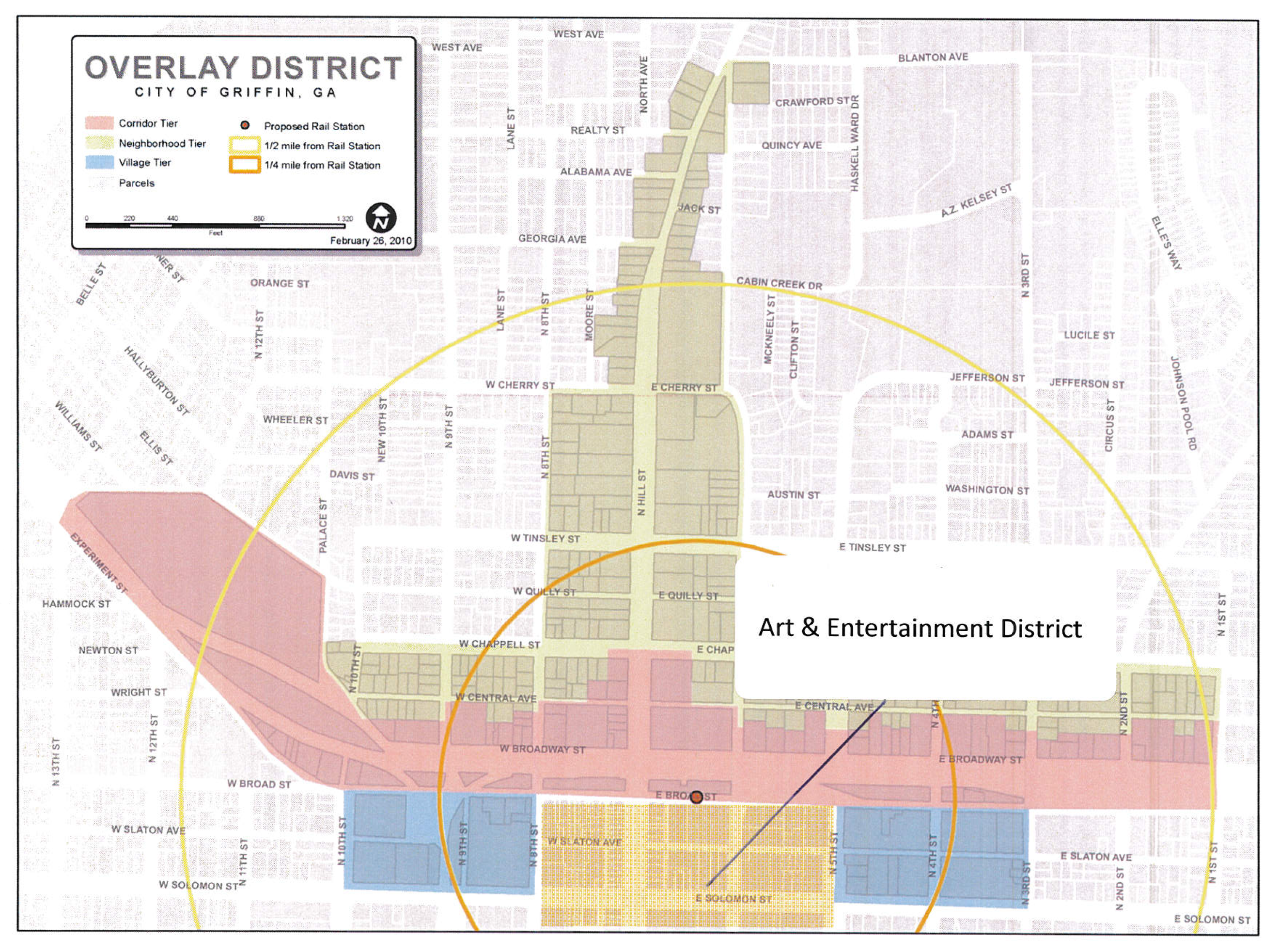
7.1 Overlay District Map

