
Taylor City Zoning Code
ARTICLE 12
- TAYLOR-DEARBORN HEIGHTS GATEWAY OVERLAY DISTRICT TDHG
Sec. 12.01.- Intent.
The Taylor Dearborn Heights Gateway Overlay District is intended to create a uniform set of land use regulations along the Taylor-Dearborn Heights border that is intended to lead to development in both communities that supports a pedestrian-orientated district with enhanced design requirements that will improve the visual character of the Van Born Gateway corridor during the next 20 years. Each use shall be complimentary to the stated function and purpose of the district and shall not have adverse impact upon adjacent street capacity and safety, utilities, and other city services. The Gateway Overlay District is further intended to:
(1)
Ensure a coordinated effort between the Cities of Taylor and Dearborn Heights through adoption of the same regulations and procedures within the Gateway overlay district.
(2)
Enhance the appearance of the cities by introducing site and building design requirements that will enhance the character of the Gateway overlay district.
(3)
Support economic development within the Gateway overlay district by improving the overall sense of place.
(4)
Create a positive impression of the cities and to provide an attractive introduction to the communities.
(5)
Protect the public health, safety, and welfare of the residents of the cities through coordinated land use regulations.
(6)
Improve the vehicular and pedestrian safety of the cities residents and visitors through land use regulations and physical improvements.
(7)
Provide a mechanism for retrofitting previously developed sites in conformance with these regulations through incentives.
(8)
Improve the sustainability through increased landscaping that break-up large areas of impervious surfaces, provide shade, control noise and dust, buffer and screen incompatible land uses, and promote a safe environment with an overall pleasant appearance and that facilitate internal circulation.
(9)
Maximize retention of existing trees, shrubs, and other natural and environmentally sensitive areas which are deemed a valuable resource.
(Ord. No. 23-508, § 1, 5-16-2023)
Sec. 12.02. - Scope and applicability.
(a)
Scope. The requirements of this chapter shall apply to all lands that are designated within the TDBH Gateway district as shown on the City of Taylor Zoning Map.
The provisions and restrictions of this chapter shall apply in addition to the provisions of the underlying zoning districts shown on the official zoning map, and sufficient to fulfill the purposes of this chapter. Uses and regulations otherwise applicable in existing zoning shall not be allowed unless also permitted and developed in accordance with the following.
(b)
Applicability. During project approval, the administrative review committee or the planning commission, as applicable, may determine that a practical difficulty exists preventing the applicant from complying with all of the requirements outlined in this article. The site plan approval will govern which requirements shall apply.
(1)
New construction.
a.
All new construction where new structures are proposed shall comply with all of the requirements outlined within the TDBH Gateway overlay district chapter
b.
All new additions that measure greater than 2,500 square feet shall comply with all of the requirements outlined within the TDBH Gateway overlay district chapter, as determined by the planning commission, administrative review committee or planning director.
(2)
Remodeling, renovation, and re-occupancy.
a.
All remodeling/renovation/change of use/tenant/occupancy projects shall comply with all of the requirements outlined within the TDBH Gateway overlay district chapter that do not require relocation of the building.
b.
All re-occupancy projects shall comply with all of the TDBH Gateway requirements, as determined by the planning commission, administrative review committee or planning director.
(3)
Maintenance and regular repair. All maintenance and regular repair of existing sites and buildings are exempt from the requirement of the TDBH Gateway overlay district.
(Ord. No. 23-508, § 1, 5-16-2023)
Sec. 12.03. - Schedule of uses.
Buildings or land shall be not used and buildings shall not be erected except for one or more of the following specified uses, unless otherwise provided for in this ordinance. Land and/or buildings in the districts indicated at the top of table 12.03 may be used for the purposes denoted by the following abbreviations:
(1)
Permitted use (P). Land and/or buildings in this district may be used for the purposes listed by right.
(2)
Special Land Use (SLU). The following uses may be permitted by obtaining special land use approval when all applicable requirements in article 13, use requirements, and the standards of section 21.04, review standards, are met.
(3)
Not permitted (—). The use is not permitted in the district.
(4)
Additional requirements. Indicates requirements or conditions applicable to the use.
TABLE 12.03. TDH GATEWAY OVERLAY DISTRICT
SCHEDULE OF USES
(Ord. No. 23-508, § 1, 5-16-2023)
Sec. 12.04. - Area, height, and placement requirements.
(a)
Siting requirements. All lots and buildings within the Gateway overlay district shall meet the following dimensional requirements. Certain dimensional requirements apply to all types of buildings while others distinguish between residential and nonresidential/mixed use.
TABLE 12.04 GATEWAY OVERLAY DISTRICT DIMENSIONAL REQUIREMENTS
| Front yard | Ten foot (10') maximum | 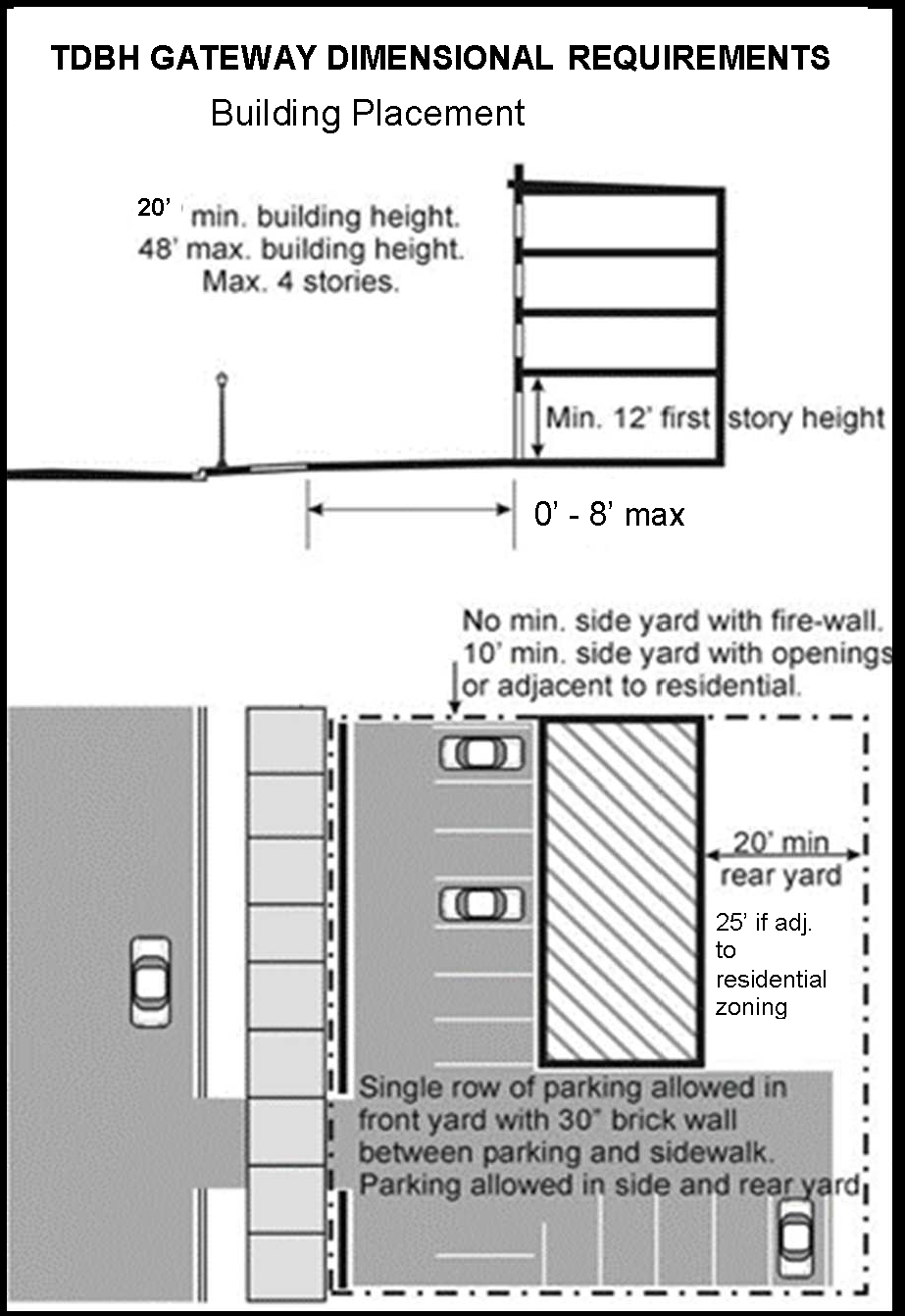 |
| Side yard |
None required with fire-rated wall
Minimum ten feet with windows or other openings Minimum ten feet from adjacent residential lot | |
| Rear yard |
Ten feet
Minimum 20-feet when adjacent to residentially zoned or used property | |
| Building height |
Minimum 20-feet, single story
Maximum four stories/48 feet | |
| First story height |
Minimum 20-feet, single story
Minimum 12-feet first story height measured from floor to ceiling | |
| Accessory building | Accessory building only in side or rear yard minimum three feet from side and rear lot line |
(b)
Modifications. The administrative review committee or planning commission may modify the area, height, and placement requirements where strict adherence would serve no good purpose or where the overall intent of the district would be better served by allowing an alternative setback provided all of the conditions are found to exist. The applicant shall provide the review body with a written description as to how the proposed deviations shall meet the intent of the overlay district, and the review body shall accept, modify, or reject the proposed deviations.
(1)
That a modification in setback will not impair the health, safety or general welfare of the city as related to the use of the premises or adjacent premises.
(2)
That the setback shall be consistent with the building lines of adjacent buildings and not be setback a greater distance from the street than adjacent buildings.
(3)
The building will still be oriented towards the street, provide pedestrian connections between the building, and the sidewalk along the street and maintain or enhance the continuity of the pedestrian-oriented environment.
(4)
That waiver of the setback along a common parcel line between two premises would result in a more desirable relationship between a proposed building and an existing building.
(5)
The adherence to a minimum required setback would result in the establishment of non-usable land area that could create maintenance problems.
(Ord. No. 23-508, § 1, 5-16-2023)
Sec. 12.05. - Review procedures.
To support the expeditious review of proposed projects within the Gateway Overlay District, all projects that meet all requirements of the ordinance and the TDBH Gateway district are as-a-right and do not require special land use approval. They may be reviewed and approved by the city's administrative review committee. All other projects shall require planning commission review.
(1)
Administrative review. The administrative review committee (ARC), is comprised of the building official, planner, engineer, and representatives from police and fire. After review, the ARC committee may approve projects that are as-a-right projects (not SLU or RLU) and meet all requirements of the ordinance and the TDBH Gateway district. All other projects shall require planning commission approval.
(2)
Planning commission review. For all reviews that do not qualify for administrative review.
a.
Special land use. All applications that require special land use approval shall be reviewed by the planning commission.
b.
Denial by administrative review committee. If denied by the administrative review committee, applicant may appeal for a review by the planning commission at a public hearing. The review committee shall submit a written report to the planning commission seven days prior to the date of the public hearing. Planning commission may approve, modify, or disapprove of the plan. If denied by the planning commission, the applicant may appeal the planning commission decision to the zoning board of appeals.
(3)
Relief from TDBH gateway district requirements. In instances where the requirements described within this section cannot be met due to site constraints and/or unique issues generated by the proposed use, the ARC/PC reviewing agency may modify the requirements found in this article and approve alternative designs that meet the design intent of the sections found within the article. Prior to approval, the applicant shall provide to the review body with a written description as to how the proposed deviations shall meet the intent of the provisions that are being requested to receive relief from, and the ARC/PC review body shall accept, modify, or reject the proposed deviations.
(Ord. No. 23-508, § 1, 5-16-2023)
Sec. 12.06. - Site design requirements.
(a)
Siting.
(1)
Location. To promote good proportional spatial definition within the TDBH Gateway overlay district, all new front building walls shall be located within the eight-foot front setback area, unless allowed to be setback due to a design provision within this article. Existing buildings, structures, and foundations that are not at the end of their useful life or scheduled for demolition may be provided with an exemption from this setback requirement at the discretion of the reviewing entity.
(2)
Corner lots. For buildings on corner lots with two front yards, the buildings shall meet the setback-line requirements for both frontages.
(3)
Service areas. All service areas including loading docks, mechanical equipment, and refuse storage areas shall be located in the rear yards and not visible from the right-of-way.
(4)
Setbacks. All front yards shall have a maximum of an eight-foot (8') setback and all side lot setbacks adjoining other commercial uses shall be eliminated unless the adjoining use is residential in nature where the existing requirements shall apply.
(b)
Building entrances.
(1)
Orientation. To encourage pedestrian movement and accessibility within the district, all buildings shall front onto the Van Born Road right-of-way and all main building entrances shall be orientated towards the Van Born Road sidewalk and not orientated toward the site's parking areas. Entrances located at corners of buildings shall satisfy this requirement.
(2)
Entrance prominence. To heighten the prominence of building entrances, architectural embellishments are encouraged to be employed around the main building entrances including but not limited to columns, engaged columns, decorative lighting fixtures, awnings, pediments, use of accent materials, etc. Entrances may be recessed to provide a transition from the public realm at the sidewalk to the private interior.
(3)
Entrance spacing. Entrances on large single-use retail structures shall be spaced no less than every 250 feet while multi-tenant buildings shall be spaced at a maximum of a public entrance every 100 feet.
(4)
Pedestrian-orientated signage. Projecting pedestrian-orientated decorative signage, with a sign area measuring less than six square feet, shall be permitted at primary building entrances and will not count towards wall signage area maximum or number of signs. In the case of multiple tenant buildings, one additional projecting pedestrian-orientated decorative sign shall be permitted at each tenant's main pedestrian entrance that opens directly onto any public sidewalk or interior circulation sidewalk.
(5)
Secondary entrances. To ease pedestrian movements, non-primary entrances shall be allowed from rear parking lots. If the location of secondary entrance signage is not visible from any adjacent right-of-way, additional wall signs measuring up to one quarter of the total allowable frontage wall signage may be installed adjacent to the secondary entrances to assist with pedestrian orientation. Wording revised to provide clarification
(6)
Signage or canopies encroaching on the Van Born right-of-way may require a permit from Wayne County.
(c)
Pedestrian enhancements.
(1)
Pedestrian connectivity. To improve pedestrian safety and limit pedestrians crossing vehicular traffic in parking lots, direct protected access shall be provided from the public sidewalk along all property boundaries to main building entrances or other reasonable configurations. Added wording to allow additional design options
(2)
Interior circulation. All interior sidewalks shall connect with the main entrance connections, where possible.
(3)
Inter-site connectivity. Inter-connectivity of interior pedestrian walkways is desired between adjacent parcels/uses and should be coordinated to the greatest extent possible. Interconnectivity will be evaluated during the review of the site's circulation plan. Use of colored pavement and/or differing textures are techniques that may be deployed to denote interior pedestrian walkways.
(4)
Amenities. The provision of pedestrian amenities including benches, tables, gazebos, public art decorative pedestrian lighting, gardens, and other enhancements, (as approved by ARC/PC), are encouraged.
(d)
Outdoor dining.
(1)
Location. To encourage the construction of outdoor dining spaces that enliven the district, buildings may be additionally setback for the creation of areas designated for active outdoor dining only. Setbacks of up to 16 feet from front property line for 100 percent of the building's frontage, or up to 26 feet for a zero-lot line building that creates a recessed dining area for up to 50 percent of the building frontage, may be permitted. Revised language for further clarification
(2)
Buffering. To provide visual buffering from parking lots and roadways, outdoor dining areas shall be decoratively screened from transportation areas with opaque vegetation measuring four feet tall in planters, beds, or a combination of decorative ornamental fencing with a hedgerow, decorative masonry walls of less than four feet in height, or other means.
(3)
Shading. For dining areas that face south and/or west, provision of shade is necessary for diner comfort and shall be provided for in the outdoor dining areas through the use of canopy shade trees, trellises, tensile shade structures, table umbrellas, awnings, or other means acceptable to the review body. At least 35 percent of the total outdoor dining area shall be shaded by the approved structures or landscaping.
(4)
Separation. In addition to the transportation buffering requirement, architectural or landscape features including decorative fences, railings, low masonry walls (less than four feet in height), planters, or decorative planter beds shall be used to separate dining areas from all walkways, plazas, or building entrances.
(e)
Drive throughs and drive-up uses.
(1)
These uses shall be prohibited along all street frontages.
(2)
Ordering windows and ordering kiosks shall be set-back at least 30 feet from the front lot line.
(f)
Lighting.
(1)
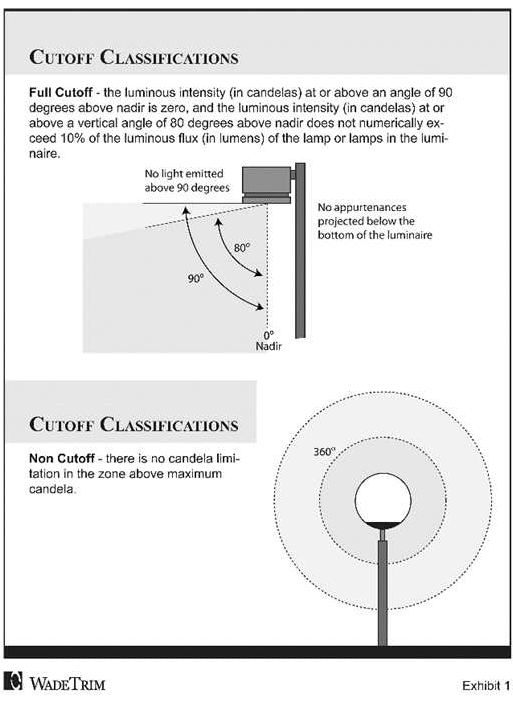
Dark-sky friendly fixtures. All lighting shall meet the International Dark-Sky Association's Fixture Seal of Approval or similar standard that minimizes glare, sky glow, and short-wavelength blue-rich white light.
(2)
Pedestrian and landscape lighting. The use of decorative pedestrian and landscape lighting is encouraged along all pedestrian walkways.
(3)
Decorative lighting. The use of decorative and architectural accent lighting is encouraged that enhances the aesthetic appearance of all buildings.
(Ord. No. 23-508, § 1, 5-16-2023)
Sec. 12.07. - Architectural requirements.
(a)
Building materials.
(1)
All buildings. The building materials shall comply with section 16.01(d)(1) and the following table.
Table 12.07
Business, Multiple-Family and Institutional Material Requirements
(b)
Color.
(1)
All exterior colors shall comply with the color requirements found in section 16.01(c)(2).
(2)
Painting of primary façade and elevation elements shall not be permitted.
(c)
Horizontal wall planes. To assist in breaking up long undifferentiated horizontal wall surfaces, the use of decorative vertical elements shall be required to meet the following requirements for all facades or street-facing elevations.
(1)
Wall planes measuring between 100 and 200 feet in length. Vertical design treatments shall be provided that divide the horizontal wall surface into vertical design bays of 50 feet or less. These elements may be articulated by changes in primary wall materials, accent materials, piers, pilasters, other architectural elements, and roofing elements that create varying vertical bays that provide differentiation across the entire building elevation.
(2)
Wall planes measuring over 200 feet in length. To provide further differentiation on longer horizontal wall surfaces, setbacks or bump-outs including decorative piers, pilasters, or other decorative treatments, extending at least 18 inches from the predominate horizontal plane, shall be employed to provide additional horizontal differentiation. These treatments shall be used at a minimum, once every 100 lineal feet of wall.
(d)
Architectural detailing. Long monotonous facades, including but not limited to, those characterized by unrelieved repetition of shape or form, or by unbroken extensions of a line are discouraged. To enhance the visual interest of the pedestrian realm, building design of all primary structures is encouraged to include:
(1)
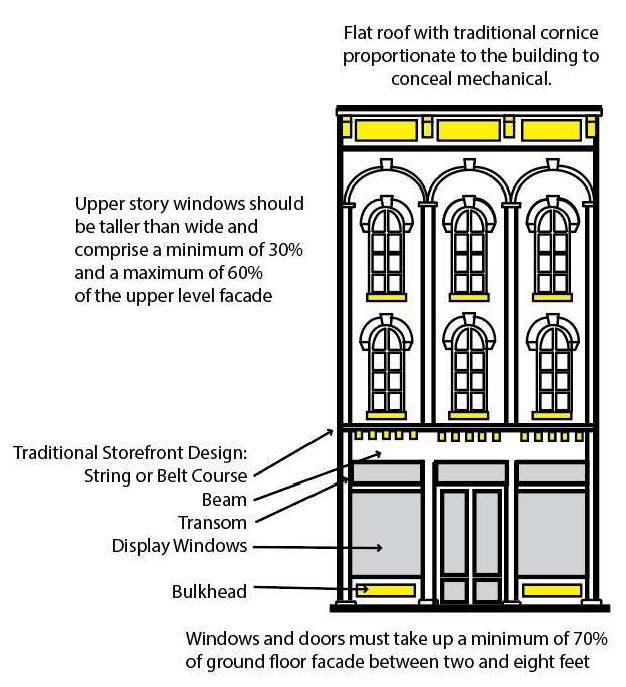
Fenestration. The arrangement of windows and doors are an important architectural element that provides visual interest for pedestrians while reducing the scale and massing of buildings. Storefront windows on the ground floor shall not be required to include any decorative architectural detailing besides meeting the transparency requirement found in 12.07(e)(1); however, use of traditional storefront window design is encouraged. This design technique includes the use of decorative bulkhead, display window, transom, and beam elements. Use of quoins, divided lites, shutters, and other features are encouraged for upper-level windows. Upper story windows should utilize traditional proportions and balance of height over width with window frames inserted into the wall surface in a traditional manner, not mounted flush with the wall.
(2)
String and belt courses. To break up the verticality of buildings, the use of decorative horizontal string and belt courses are encouraged.
(3)
Three-part building design. For buildings over two stories in height, the use of three-part building design is encouraged. This approach features a decorative base element, body component, and cap element that reinforces the sense of human scale and massing while enhancing the overall pedestrian realm.
(4)
Awnings and canopies. To break up the massing of a building and to assist in user orientation, awnings and canopy structures may be utilized to add visual character and differentiation to wall surfaces.
(5)
Entrances. To call attention to building entrances, the use of wall setbacks, expression of structural elements, specialized seating areas, increased architectural detailing, and other design elements, is encouraged at main entrances.
(6)
Roof design. To provide additional visual character to buildings, use of decorative roof elements including hipped, gable ended, and pitched decorative roofs are encouraged.
a.
Decorative towers and cupolas may be used as additional roof design elements. These elements may exceed the district's overall height maximum, if they are less than ten percent of the square feet of the main structure or 425 square feet, whichever is less.
b.
Gables shall have a minimum depth of 12 feet and parapet walls that abut a corner shall extend around to the side elevation to a minimum depth of 12 feet.
c.
All decorative roof elements should be proportional to the building design, mass, and form, and roof appurtenances, such as dormers, roof monitors, light wells, and mechanical vents should receive decorative detailing including the use of gables, hipped, or shed designs so that these roof structures should appear as functional elements, not just aesthetic conceits. Language adjusted for clarification.
(e)
Windows and doors. Entire section 12.07(e) expanded to clarify.
(1)
Transparency. On commercial buildings, no less than 70 percent of the ground-floor façade between two and eight feet in height shall be clear glass storefront glazing and doorways designed for retail and consumer uses. For office, service, institutional, and other nonretail uses, a minimum of 50 percent of the ground floor façade shall be clear glass storefront glazing or doorway uses.
(2)
Depth of window opening. Required window areas shall be either windows that allow views into retail space, working areas or lobbies, pedestrian entrances, or display windows set into the wall. Windows shall not be blocked with opaque materials, walls, or the back of shelving units.
(3)
Window requirements above first floor. Window openings above the first story shall comprise a minimum of 30 percent and a maximum of 60 percent of the total façade area.
(4)
Security gates. Exterior solid metal security gates or solid roll-down metal doors shall be prohibited. Link or grill type security devices shall be permitted only if installed on the interior of the window openings.
(5)
Clear glazing. First floor windows shall be glazed with clear glass without any tinting while windows located above the first floor may be tinted.
(f)
Encroachments.
(1)
Architectural elements including awnings, canopies, and perpendicular pedestrian-scaled signs, may encroach up to five feet into the public rights-of-way as long as eight feet of clear room is maintained over all walkways and a Wayne County Right-of-Way permit is obtained.
a.
Awnings shall be permitted if positioned immediately above the ground floor windows area of the storefronts. Awnings shall be affixed directly to the building face, and poles or columns are not permitted.
b.
All awnings shall be constructed of durable materials such as canvas or similar material, as opposed to metal, plastic, or rigid fiberglass. High-gloss or plasticized awnings are prohibited.
c.
Internally illuminated awnings or awnings lit from the underside are prohibited. Lighting shall be from fixtures located above the awning and directed downward.
(2)
Balconies on upper floors may encroach up to eight feet into the public right-of-way as long as they are setback five feet from the outside curb line of active roadway and a Wayne County Right-of-Way permit is obtained.
(Ord. No. 23-508, § 1, 5-16-2023)
Sec. 12.08. - Landscaping.
(a)
Landscaping. All landscaping shall minimally comply with the requirements found in section 16.02.
(1)
Foundation plantings. To soften the appearance of the building and to reduce stormwater run-off, foundation planting beds shall be planted along all non-façade elevations, where feasible. These plantings should emphasize softening the large expanses of building walls length and height while providing accents to building entrances and architectural features.
a.
Foundation planting beds shall measure at a minimum of five feet in depth.
b.
Decorative deciduous and evergreen trees and shrubs shall be planted at a minimum of one per every five lineal feet of planting bed.
c.
Additional trees, shrubs, perennials, annuals, and groundcover are encouraged to be maintained in these foundation planting beds. Revised language for further clarification.
(2)
Canopy trees. To lessen the impact of unshaded hard surfaces on climate and stormwater and to increase the city's tree canopy, the following shall be required.
a.
Public rights-of-way. Along all public rights-of-way, canopy shade trees shall be planted three per 100 lineal feet.
b.
Internal circulation drives. Three canopy trees per 100 lineal feet shall be planted on each side of private drives.
c.
Parking lot perimeters. Canopy shade trees shall be planted along the perimeter of all parking lots at a spacing of three canopy trees per 100 lineal feet, where more than 15 feet exists between buildings and the edge of the parking lot and/or when seven feet exists between the surface of the parking lot and other adjacent paved surfaces including sidewalks and adjoining parking areas. Revised language for further clarification
d.
Open space plantings. For each 3,000 square feet of open space that is not utilized for buildings, stormwater control, or parking lots, shall be planted with one canopy tree, five decorative trees or shrubs, and 20 ornamental grasses or perennials. These plantings may be bunched together for enhanced visual affect. Revised language for further clarification
(3)
Parking lot landscaping. In addition to the requirement found at 16.02(e).
a.
Placement. All required trees shall be planted within the interior of the parking area in parking lot islands measuring seven feet wide by 16 feet long for single aisles and seven feet wide by 32 feet long for double aisles. One tree is to be planted in each single aisle location while two required trees are to be planted in the double aisle configuration.
b.
Location. Rear yard locations do not receive a reduction in amount of required parking lot landscaping.
c.
Industrial uses. Parking lot landscaping requirements shall apply to parking areas for employees and customers but not to loading and vehicle storage areas; however, parking lot perimeter landscaping requirements shall apply to the loading and vehicle storage areas. Revised language for further clarification
d.
Buffering of adjacent residential uses. All adjacent residential uses shall be buffered from adjoining commercial or industrial uses by a six-foot wide buffer strip with a six-foot tall masonry wall and row of six-foot tall evergreen trees planted on ten foot centers or an eight-foot wide buffer strip with six-foot tall opaque fence and row of six-foot tall evergreen trees planted on six-foot centers.
e.
Adjacent unshared parking lots. Where parking lots are not shared between properties, a filtering buffer strip of eight feet wide shall be planted with evergreen trees planted on ten foot centers. This requirement shall be waived if shared parking agreements exist between adjacent properties/uses.
(b)
Screening.
(1)
Hardscape versus landscape materials. Living landscape materials may be substituted for all required hardscape screening features (walls, fences), as long as opacity of the living landscape provides year-round screening.
(2)
Size and height. All screening materials (both hard and living) shall be tall enough to adequately conceal the object to be screened.
(c)
Environment.
(1)
Protection of the natural environment. Existing natural and environmentally sensitive areas, such as streams, drains, ponds, wetlands, and woodlands shall be maintained and enhanced through incorporation of pedestrian linkages and park-like settings on the entire site, to the greatest extent possible. If any alteration is planned in the existing natural and environmentally sensitive areas, those changes shall be indicated on the plan.
(2)
Setback. All site improvements should be set back at least 25 feet from all environmentally sensitive areas including streams, drains, ponds, wetlands, and woodlands.
(Ord. No. 23-508, § 1, 5-16-2023)
Sec. 12.09. - Lighting.
(a)
Standards.
(1)
Light intrusion and glare: See section 16.05(b).
(2)
Shielding: see section 16.05(c)(3).
(3)
Intensity: see table 16.05.
(4)
Photometric site lighting plan: see section 16.05(h).
(Ord. No. 23-508, § 1, 5-16-2023)
Sec. 12.10. - Parking.
(a)
Location. This accessory use shall be located behind all structures, where possible. If this location is not feasible, parking uses may be permitted in the required front and/or side yard as long as the use is setback five feet from the front property line and screened per section 16.02(e)(4).
(b)
Interior walkways. For parking lots with more than 100 parking stalls, interior parking walkways shall be provided within the parking lots that provide protected direct access to the main building entrance and improve sight lines for both the pedestrians and motorists.
(c)
Driveway design. Parking drives shall be no wider than 24 feet for two lanes of traffic, and 15 feet for single-lane driveways, excluding tapers or curb radii. For more highly trafficked locations, the planning commission may allow additional lanes and other modifications during the site plan review process.
(d)
Turn radii. The maximum turning radii of all driveway corners and intersections shall be 25 feet, but radii ranging between 15 feet and 20 feet are recommended.
(e)
Parking space reductions. The administrative review committee or planning commission may reduce the required number of off-street parking spaces by up to 15 percent during the course of site plan review for provision of suggested design features.
(1)
Additional consideration of five percent reduction may be given for:
a.
Type of land use/development.
b.
Hours of operation.
c.
Pedestrian traffic and accessibility.
d.
Provision of shared parking.
e.
Availability of other public parking.
f.
Elimination of existing curb cuts.
(2)
Shared Parking: See Section 17.01(b).
(3)
Bicycle Parking: See Section 17.01(i).
(f)
Schedule of parking. The following parking schedule shall apply for the land uses described in the following table within the TDBH Gateway overlay district:
Table 12.10
Parking Space Requirements
(Ord. No. 23-508, § 1, 5-16-2023)
Editor's note— Ord. No. 23-508, § 1, adopted May 16, 2023, set out provisions intended for use as §§ 12.09—12.11. Inasmuch as there were already provisions so designated, said section has been codified herein as §§ 12.10—12.12 at the discretion of the editor.
Sec. 12.11. - Signage.
The signage regulations of the TDBH Gateway overlay district shall be in addition to those found in article 18. In order to provide visual unity between the cities of Taylor and Dearborn Heights and to limit blight and visual clutter caused by poor sign design and location placement, the following regulations shall apply to commercial and industrial uses located within the TDBH Gateway overlay district.
(1)
Ground-mounted signs.
a.
Location. Monument/ground-mounted signs shall be permitted to by placed within two feet of the front property line.
b.
Size. The maximum size of a single-tenant sign shall be 32 square feet per face with a maximum area of 50 square feet for multi-tenant signs.
c.
Height. Single-tenant signs shall not exceed eight feet in height and multi-tenant signs shall not exceed ten feet in height, as measured from the sidewalk or grade.
(2)
Wall-signs.
a.
Size. The maximum size of a single tenant wall sign shall be 50 square feet. Multi-tenant buildings may have one wall sign per tenant having individual means of public access.
b.
Height. The top of a wall sign shall not exceed 12 feet in height, as measured from the sidewalk or grade.
(3)
Projecting pedestrian-orientated signage.
a.
Location. Projecting pedestrian-orientated signage may be located at all primary and secondary pedestrian entrances. Signs and mounting brackets shall not extend more than four feet from the surface of the building wall plane.
b.
Size. Each sign shall not exceed six square feet in overall sign face size.
c.
Height. Projecting pedestrian-orientated signage shall provide at least 84 inches of clearance between the sidewalk surface and the underside of the projecting sign.
d.
Number. Projecting pedestrian-orientated signs shall not count towards either ground-mounted or wall sign area calculations.
(4)
Prohibited signs. The following signs are specifically prohibited:
a.
Murals.
b.
Neon-signs, window surround lighting with LED string lights or by other means shall not be permitted. See section 18.03(m).
c.
Electronic reader boards/changeable message signs.
d.
Window signs.
(Ord. No. 23-508, § 1, 5-16-2023)
Editor's note— See editor's note under § 12.10.
Sec. 12.12. - Definitions.
The following words, terms and phrases, when used in this article, shall have the meanings ascribed to them in this section, except where the context clearly indicates a different meaning:
Beam means part of traditional storefront design, this horizontal band may be capped with a decorative string or belt course, and the beam is often the location of store advertising. This area usually measures between 24 to 40 inches tall.
Bulkhead means part of traditional storefront design, this short, often decorative wall, extends typically 18 to 24 inches above the sidewalk. The bulkhead protects the display window from damage from snow storage and debris from the sidewalk.
Display window means large panes of transparent glass that sit on top of the storefront bulkhead, typically measuring between six and ten feet tall.
Outdoor dining, active means outdoor active dining areas shall have either table service or an exterior pedestrian pick-up area with tables and chairs, landscaping, and shade-structures that is designed for diners.
Three-part building design means an architectural design technique, often used for buildings over two stories tall, intended to give taller buildings more human scale with significant architectural detailing in the pedestrian realm. This approach utilizes richly detailed base element often including a decorative ground-floor storefront; a body element with less architectural detailing; and a cap design element that often includes a decorative cornice that offers a visual termination to the structure.
Traditional and natural materials means materials consisting of clay bricks (full or thin set, if thin set, corners must have full brick appearance), stone, manufactured stone, or ceramic tile
Transom means horizontal band of windows located above the display window, often measuring between 24 and 36 inches tall. Not all traditional storefronts include transom windows in their designs. Transom windows located over the entrance door may provide natural ventilation by tilting in or hinging outwards.
(Ord. No. 23-508, § 1, 5-16-2023)
Editor's note— See editor's note under § 12.10.

