
Taylor City Zoning Code
ARTICLE 03
SINGLE-FAMILY RESIDENTIAL DISTRICTS
Sec. 3.01.- Intent.
The R-1A through R-1C Single-Family Residential Districts are intended to provide sites for single-family detached dwellings and residentially-related uses that serve the residents in the district. These districts provide a range of housing opportunities from larger suburban lots to more compact urban neighborhoods. These districts are intended to create walkable neighborhoods that are integrated into the character of the city. It is also the intent of these districts to protect natural areas and include recreational open space within neighborhoods and throughout the city.
(Ord. No. 09-434, § 3.01, 1-20-2009)
Sec. 3.02. - Schedule of uses.
Buildings or land shall be not used and buildings shall not be erected except for one or more of the following specified uses, unless otherwise provided for in this ordinance. Land and/or buildings in the districts indicated at the top of table 3.02 may be used for the purposes denoted by the following abbreviations:
(a)
Permitted use (P). Land and/or buildings in this district may be used for the purposes listed by right.
(b)
Special land use (SLU). The following uses may be permitted by obtaining special land use approval when all applicable requirements in article 13, use requirements, and the standards of section 21.04, review standards, are met.
(c)
Additional requirements. Indicates requirements or conditions applicable to the use.
TABLE 3.02. SINGLE-FAMILY RESIDENTIAL DISTRICTS
SCHEDULE OF USES
(Ord. No. 09-434, § 3.02, 1-20-2009; Ord. No. 23-511, § 1, 6-20-2023)
Sec. 3.03. - Area, height, and placement requirements.
All lots and buildings shall meet the following dimensional requirements:
TABLE 3.03. SINGLE-FAMILY RESIDENTIAL DISTRICTS
AREA, HEIGHT AND PLACEMENT REQUIREMENTS
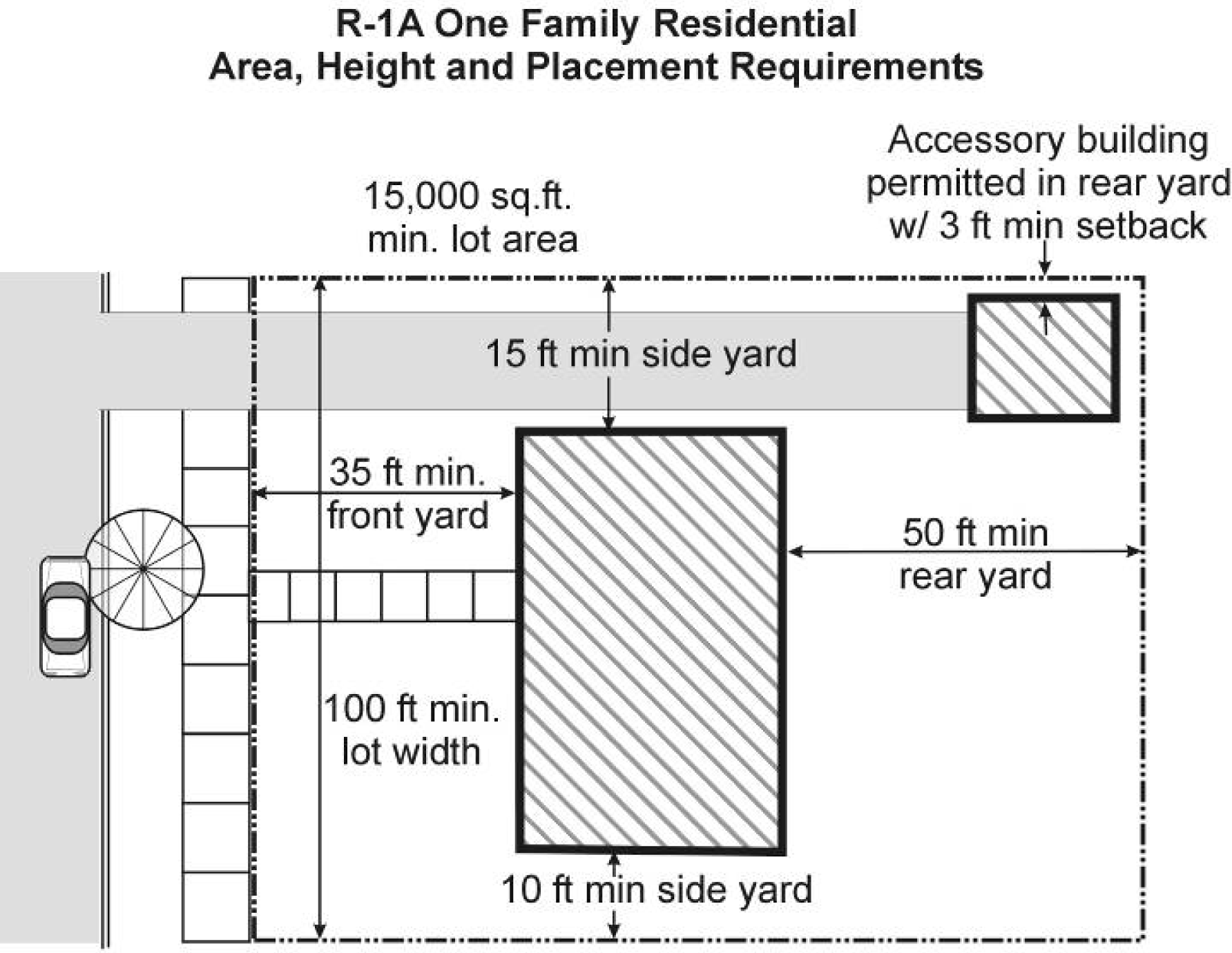
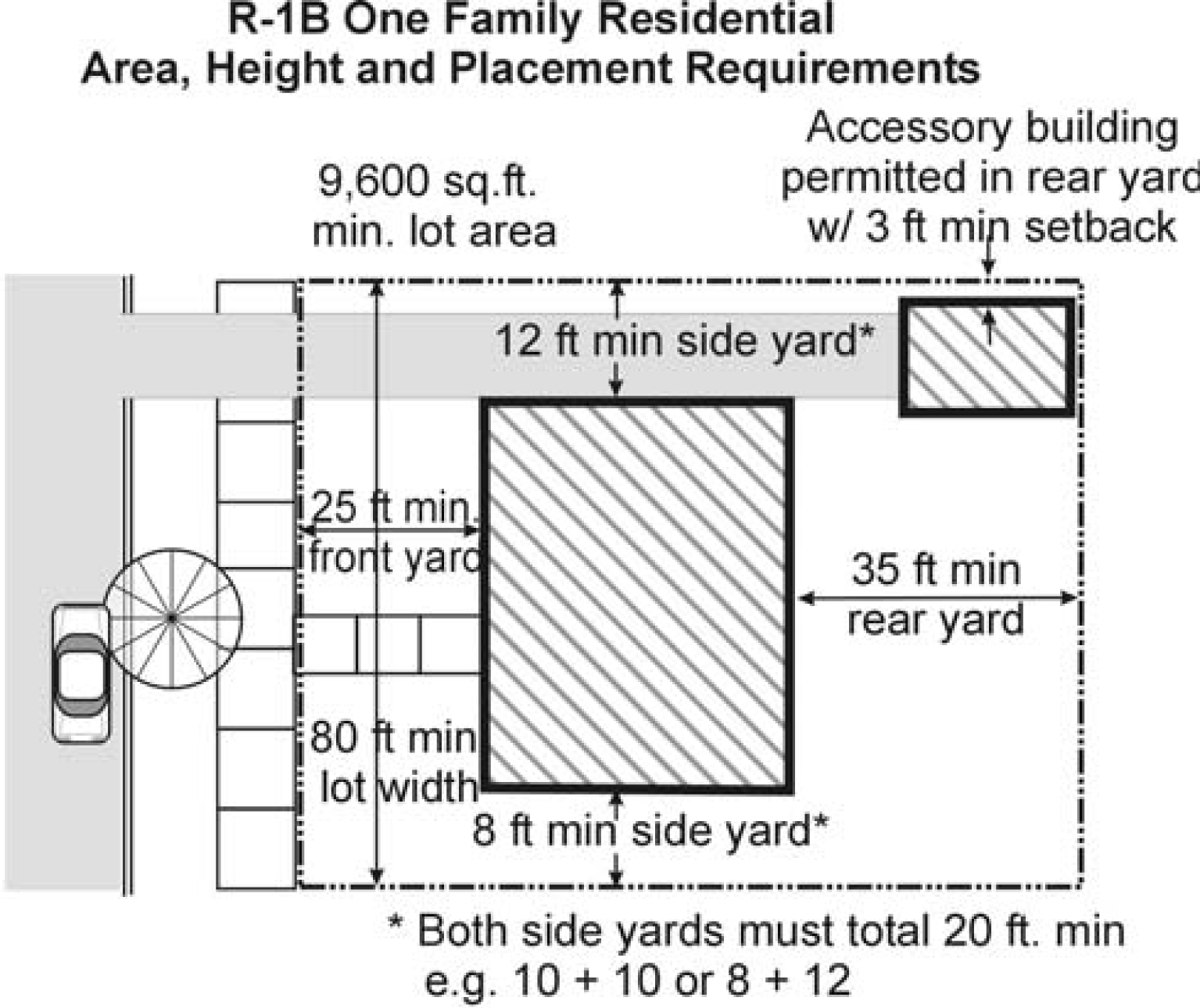
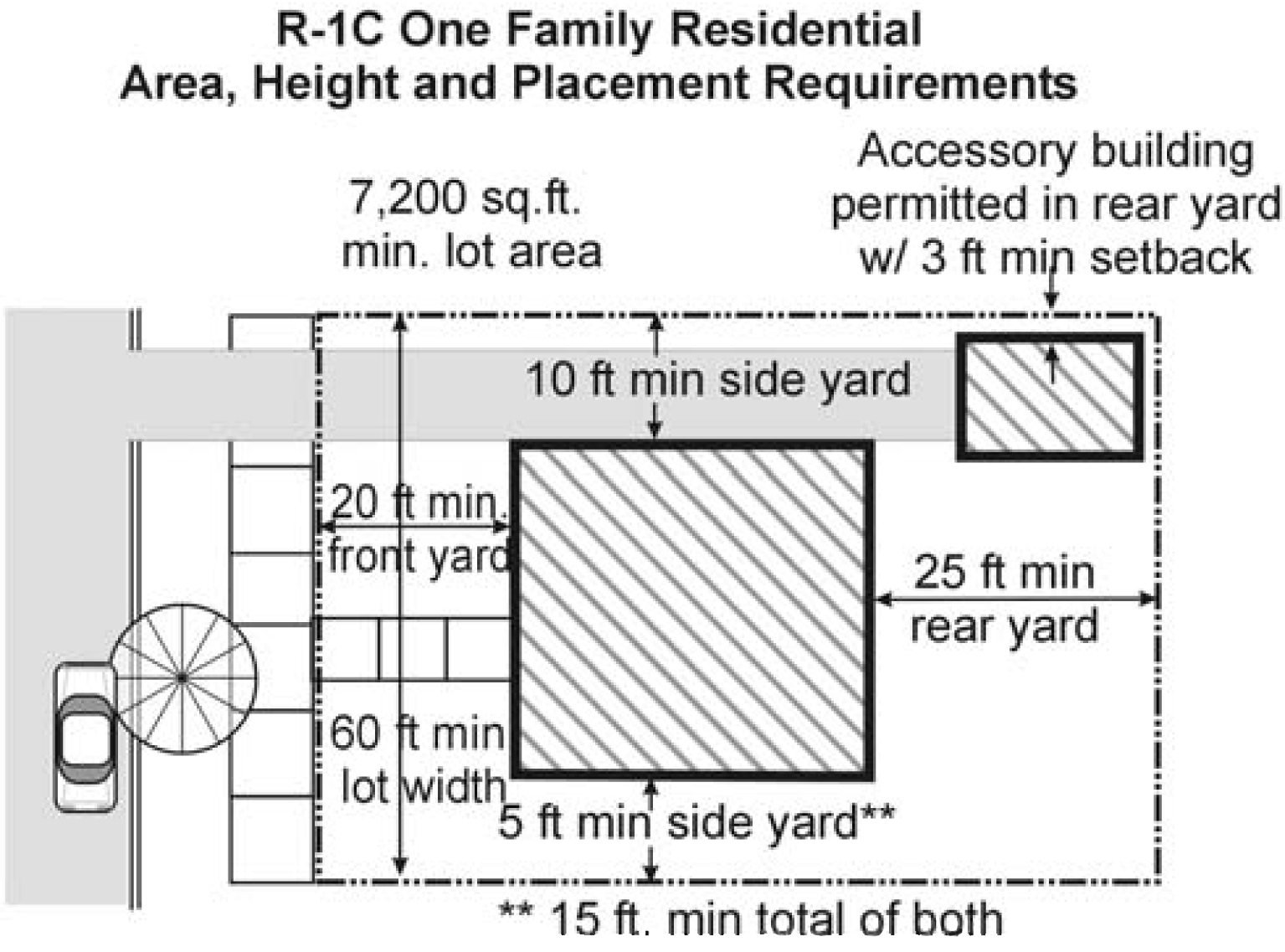
(a)
Recreational area. All residential developments containing more than six dwelling units shall provide a recreational area and amenities to sufficiently meet the anticipated needs of the residents of the development.
(1)
Open space/recreation areas equaling 1,500 square feet per dwelling unit shall be provided and be clearly delineated on the plat or site plan.
(2)
The planning commission shall determine the adequacy of any proposed recreation areas and amenities, considering the type of unit, the recreation needs of anticipated residents and the proximity of nearby recreation amenities.
(3)
Recreational amenities such as playscapes, athletic fields, trails, picnic tables or other suitable recreation facility to meet the needs of the residents shall be provided within the recreation area. Provisions for separate adult and youth recreation areas are encouraged.
(4)
Recreation amenities shall be centrally located within neighborhoods.
(5)
Required setbacks, buffers, greenbelts, individual lots, public rights-of-way, private road easements, wetlands and stormwater management areas shall not be considered as recreation areas.
(6)
The recreational area shall be well drained, graded, seeded or sodded, safe from hazard, accessible to all dwellings. Preserved natural features on the site may be counted toward meeting the open space requirement if improvements are provided that allow passive recreation use such as pathways, gazebos and picnic areas. At least one-half of the required recreation area shall be developed for active recreational use.
(7)
Recreational areas shall be irrevocably reserved for this use and required maintenance shall be the responsibility of the homeowners association unless otherwise approved by the city.
(8)
In a phased development, a land reservation and a performance guarantee meeting the requirements of section 25.08, performance guarantees, shall be required to guarantee the completion of planned improvements if not completed in the current phase.
(b)
Lot frontage. All lots shall have frontage on a dedicated public street. The frontage shall be of sufficient width so that the lot meets or exceeds the minimum lot width requirement at the front yard setback for in the district in which the lot is located. Flag or stacked lots that do not provide adequate frontage shall be prohibited.
(c)
Building height. Exceptions to building height shall be allowed as provided for in section 14.08, height limit.
(d)
Projections into yards. Those structures listed in section 14.11, projections into required yards, are permitted to project into required yard setbacks.
(e)
Natural features setback. All structures shall be set back at least 25 feet from all natural features such as drains, regulated wetlands, natural ponds, lakes and streams.
(f)
Landscape areas. Greenbelts and buffer zones shall be provided in accordance with section 16.02, landscaping.
(g)
Corner lot setbacks. The front yard setback shall apply to all yards that adjoin a street including public streets, private streets and interstate highways. Corner lots and double frontage lots shall be considered to have two front yards. Buildings shall meet front setback requirements along all street frontages.
(h)
Detention ponds. Detention/retention ponds shall be prohibited in the required front yard setback, unless the city engineer determines there is no reasonable alternative due to existing topography and natural drainage problems. This restriction shall not apply to rain gardens, bio-retention swales, irrigation trench planters and other similar stormwater management alternatives to retention or detention ponds.
(i)
Driveways in front yards. Front yards shall not be paved, with exception of a maximum 16-foot wide driveway leading to a garage or dedicated parking pad, except homes with a three-car garage may have up to a 24-foot wide driveway. Refer to section 17.01, off-street parking, loading, access and circulation requirements, for additional requirements for residential parking.
(j)
Railroad setback. Principal residential structures shall be setback from any railroad right-of-way the minimum rear yard setback of the zoning district.
(k)
Floor area. The required dwelling unit floor area does not include basements, utility rooms, breezeways, porches, or attached garages.
(l)
Lot coverage. Maximum lot coverage shall be regulated by two measures:
(1)
The maximum percent of the lot area that can be covered by buildings.
(2)
The maximum percent of the lot area that can be covered by buildings plus other impermeable surfaces, such as pavement, decks and pools.
(m)
R-1A lot sizes. Where a division is proposed to an existing recorded lot in a platted subdivision, the resulting lots shall not have an area or width that is less than the median lot area and width for the other lots in the subdivision. This shall apply to the creation of a new building site through a land division, subdivision or site condominium.
(Ord. No. 09-434, § 3.03, 1-20-2009)
Sec. 3.04. - Open space preservation (cluster) development.
(a)
Intent. This section permits, by special land use approval, residential development which, through innovative design, will encourage creative development benefiting the total community by preserving desirable open space in the form of woodlands, wetlands and other natural assets, or providing useable open space as an integral part of the residential living environment. This development option is also intended to be applied to infill parcels or sites exhibiting unusual characteristics or land use relationships. These provisions are not intended to result in an increase in density, but rather to allow for a more creative distribution of the permitted number of dwelling units on designated portions of the site.
(b)
Qualification of parcel. At least one of the following qualifications must be demonstrated to approve an open space preservation development:
(1)
The parcel contains natural assets, supported by documented evidence, which will be preserved through as an integral part of the design. These assets may include natural stands of large trees, land which serves as a natural habitat for wildlife, wetlands, steep topography, bodies of water (e.g., streams or ponds), or other natural features that should be preserved.
(2)
The parcel contains floodplain or wetlands that would be preserved as undeveloped common open space.
(3)
At least 20 percent of the site will be set aside as open space for conservation or active recreational purposes.
(4)
Unusual physical characteristics, such as size or shape of the parcel, are present that reasonably prevent using conventional development.
(5)
Conventional development would result in a substantial number of the lots abutting a major or secondary thoroughfare and be subjected to disturbance by vehicular traffic, noise and lights.
(6)
The adjoining or adjacent land uses warrant a creative development alternative to facilitate a suitable transition between uses.
(c)
Density. The number of dwelling units allowable within an open space preservation development shall be determined through preparation of a alternate conventional development plan. The alternate conventional development plan shall show how the site would be developed with a conventional subdivision based upon the existing zoning district. The alternate conventional development plan is intended only to illustrate the allowable density for a site based upon the existing zoning district and is not an approved development plan.
(1)
The applicant shall present to the planning commission for review, an alternate conventional development plan for the project that is consistent with state, county, and city requirements and design criteria for a tentative preliminary plat. The alternate conventional development plan shall include sufficient right-of-way for roadways, common park area, and contain sufficient area for stormwater detention.
(2)
The alternate conventional development plan shall provide lots meeting all dimensional standards of the zoning district. Lots may include wetlands or other unbuildable land provided that a buildable area for each lot is available.
(3)
Once the allowed density is determined, then the same number of units shall be used for the open space preservation development.
(d)
Dwelling unit type. Detached and attached single-family units are permitted. The maximum number of attached units permitted in a single building is four.
(e)
Placement and building requirements for attached units. All attached units shall comply with the following requirements:
(1)
All principal buildings shall be set back at least 35 feet from all perimeter lot lines of the development site, including major streets. Accessory buildings, common parking areas and driveways may be located a minimum of ten feet from any adjoining lot line, except a street right-of-way.
(2)
Buildings shall be set back at least 25 feet from the internal street right-of-way line. For private streets where there is no public right-of-way or access easement, the required front yard setback shall be measured from a parallel line 30 feet from the centerline of the street.
(3)
A setback of at least 15 feet shall be provided between the sides of buildings. There shall be at least 40 feet between the backs of residential buildings.
(4)
The minimum required floor area shall be as required by the applicable district within which the parcel is located.
(5)
No dwelling unit shall exceed a height of 25 feet.
(6)
Variety in the design of individual groups of units shall be provided through the use of design details to avoid a continuous or repetitious appearance.
(f)
Placement standards for detached units.
(1)
To achieve the minimum open space requirement, lot areas and widths may be reduced below the district requirements; provided that an area equal to or greater than the total net area of lot reduction for the development shall be set aside as common open space.
(2)
The setback requirements of the district may be reduced by up to 25 percent. The setbacks may be further reduced by the planning commission upon a specific finding that it will result in enhanced buffering from adjacent land uses or public rights-of-way, or preservation of additional natural features.
(3)
The maximum building height shall meet the requirements of the district.
(4)
The minimum dwelling unit floor area shall meet the requirements of the district.
(g)
Open space.
(1)
A minimum of 20 percent of the site shall be set aside as common open space for conservation or recreational purposes. At least one-half of the required open space shall be useable for recreation.
(2)
The open space preservation development shall meet all of the design standards required by the city subdivision regulations.
(3)
The master deed shall provide that all designated open space will be irrevocably dedicated for that purpose and shall prohibit use of the open space for future development. The city may require that conveyances or other documents be placed in escrow to accomplish this purpose. The master deed required by this section shall be reviewed and approved by the city, at the applicant's cost. A performance guarantee in accordance with section 25.08, performance guarantees may be required.
(h)
General development requirements.
(1)
At least two deciduous trees per dwelling unit meeting the size requirements of section 16.02, landscaping, shall be planted along internal streets and throughout the development portion of the site.
(2)
A greenbelt in accordance with table 16.02.a shall be provided, in addition to any rear yard setback, along any part of the property that abuts a major street. The greenbelt or an equivalent natural buffer shall be landscaped with an undulating landscaped berm. Berms shall be planted with grass and slopes shall be gentle enough to avoid erosion. Berm locations shall be designed so that the view of oncoming traffic is not obscured.
(3)
Sidewalks are required along all streets in accordance with the city's subdivision regulations and section 16.04, sidewalks. A pedestrian circulation plan shall be submitted and approved by the planning commission for the lands included in the open space.
(i)
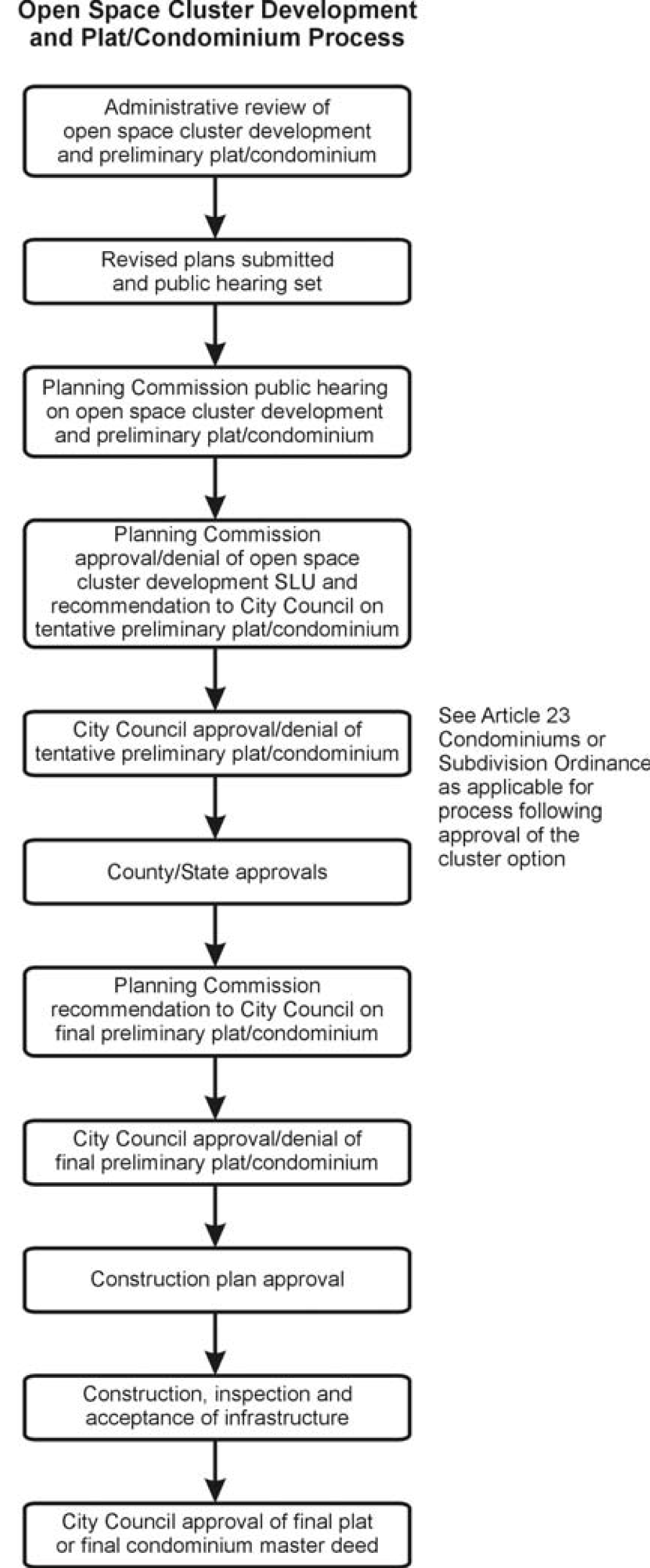
Review procedures. Applications for residential open space preservation developments shall reviewed in accordance with the following process:
(1)
Special land use and preliminary plan review.
a.
In submitting an application for qualification of a parcel for open space preservation development to the planning commission, the petitioner shall include documentation substantiating one or more of the characteristics outlined in section 3.04(b), qualification of parcel. The qualification approval shall remain valid for a period of 18 months from the date of the special land use and concept plan approval.
b.
The application shall include an aerial photograph depicting the entire site and a concept plan (drawn to scale) showing how the petitioner intends to develop the site. At a minimum the concept plan shall include the following:
1.
Outline of the property showing the relationship of abutting properties and/or structures.
2.
Placement and basic configuration of buildings.
3.
Circulation patterns.
4.
Preservation/open space areas.
5.
Density calculations and number of units proposed.
6.
Buffering/screening techniques to be used.
c.
The petitioner shall also submit a tentative preliminary plat or a preliminary condominium site plan with the special land use for concurrent review. Tentative preliminary plat applications shall meet all of the requirements of the city subdivision regulations. Tentative preliminary condominium plans shall meet all of the requirements of article 23, condominiums.
d.
Upon receipt of the completed application, the request shall be given to the planning commission for placement on an agenda as a special land use as provided in article 21, special land use review. Following the public hearing, the planning commission shall take action on the special land use and make a recommendation to the city council on the tentative preliminary plat or condominium, as applicable.
e.
Once the city council approves the tentative preliminary plat or condominium, as applicable, the approved plan shall become the basis for the final approval process.
f.
Substantial departures from the tentative preliminary plat or condominium shall require a public hearing and approval of a new plan following the process above.
(2)
Final plan review. Following approval of the special land use and tentative preliminary plat approval or site condominium, as applicable, the applicant shall prepare detailed plans for final approval. Final plans along with a draft of the master deed and bylaws or restrictive covenants shall be submitted for approval of the final preliminary plat or final condominium site plan in accordance with the applicable process under the city subdivision regulations or article 23, condominiums. All final preliminary plats or condominium plans shall conform with the tentative preliminary plan, all conditions attached to the special land use approval, and the other requirements of this ordinance.
(j)
Appeals. The zoning board of appeals (ZBA) shall not have the authority to hear appeals of the planning commission's decision to approve or deny a special land use for an open space preservation development, nor to grant variances to the specific standards of this section or any conditions imposed on preliminary approval. The ZBA may hear requests for variances to dimensional requirements of individual lot owners following approval of the final site plan for the development.
(Ord. No. 09-434, § 3.04, 1-20-2009)

