
Taylor City Zoning Code
ARTICLE 23
- CONDOMINIUMS9
State Law reference— Condominium act, MCL 559.101 et seq.
Sec. 23.01.- Intent.
This article is intended to provide for condominium projects within the city and establish regulations to guide development of such projects in a manner similar to comparable development allowed within the zoning ordinance and the subdivision ordinance. This article also establishes development standards and required information to assure compliance within the purposes of this ordinance including:
(a)
Orderly growth and harmonious development of the community as planned for in the master plan.
(b)
Secure adequate traffic circulation and safety through coordinated, interconnected street systems, including safe and coordinated pedestrian and bicycle facilities.
(c)
Provide for development which can be timed in a manner consistent with planned or needed public improvements so as not to create an undue inconvenience, hazard or financial burden for residents of the city.
(d)
Secure adequate provisions for water supply, storm drainage, sanitary sewage disposal, lighting, and other public services and facilities necessary to support public health and safety.
(e)
Evaluate the impact of proposed developments to assure minimum impact of the natural environment including, but not limited to, the surface water, groundwater, flora and fauna of the community.
(Ord. No. 09-434, § 23.01, 1-20-2009)
Sec. 23.02. - Submittal requirements.
Concurrently with notice required to be given City of Taylor pursuant to section 71 (notice of proposed action) of Public Act No. 59 of 1978 (MCL 559.171), as amended (the Condominium Act), a person, firm, or corporation in intending to develop a condominium development shall provide the following information:
(a)
The name, address and telephone number of:
(1)
The owners of record in the land on which the condominium project will be located together with a description of the nature of and the identity of, any other entity's interest in the property (for example, fee owner, optionee or land contract vendee).
(2)
The engineer who prepared the site plan, attorney who prepared the master deed, and other professionals associated with the project.
(3)
The developer or proprietor of the condominium project.
(b)
The legal description of the land on which the condominium project will be developed together with appropriate tax identification numbers.
(c)
The acreage content of the land on which the condominium project will be developed.
(d)
The purpose of the project (for example, residential, commercial, industrial, etc.).
(e)
Number of condominium units to be developed on the subject parcel.
(f)
A site plan meeting the requirements of article 19, site plan review, for any project requiring site plan approval.
(g)
The size, location, area and horizontal boundaries of each unit as well as vertical boundaries and volume for each unit comprised of enclosed air space. A number shall be assigned to each condominium unit.
(h)
The nature, location and approximate size of common elements.
(i)
A draft of the master deed and bylaws shall be submitted with the final preliminary site plan.
(Ord. No. 09-434, § 23.02, 1-20-2009)
Sec. 23.03. - Review.
Prior to recording of the master deed required by section 72 of the Condominium Act, as amended (MCL 559.172), the condominium project shall undergo site plan review and approval under the requirements of article 19, site plan review, and this section. In addition, the city shall require appropriate engineering plans and inspection prior to the issuance of any certificate of occupancy. Prior to expansion or conversion of a condominium project onto additional land, the new phase of the project shall undergo site plan review and approval. Fees for these reviews shall be established by resolution of the city council in addition to those otherwise required by city ordinances. All condominium plans shall be reviewed under the following procedures:
(a)
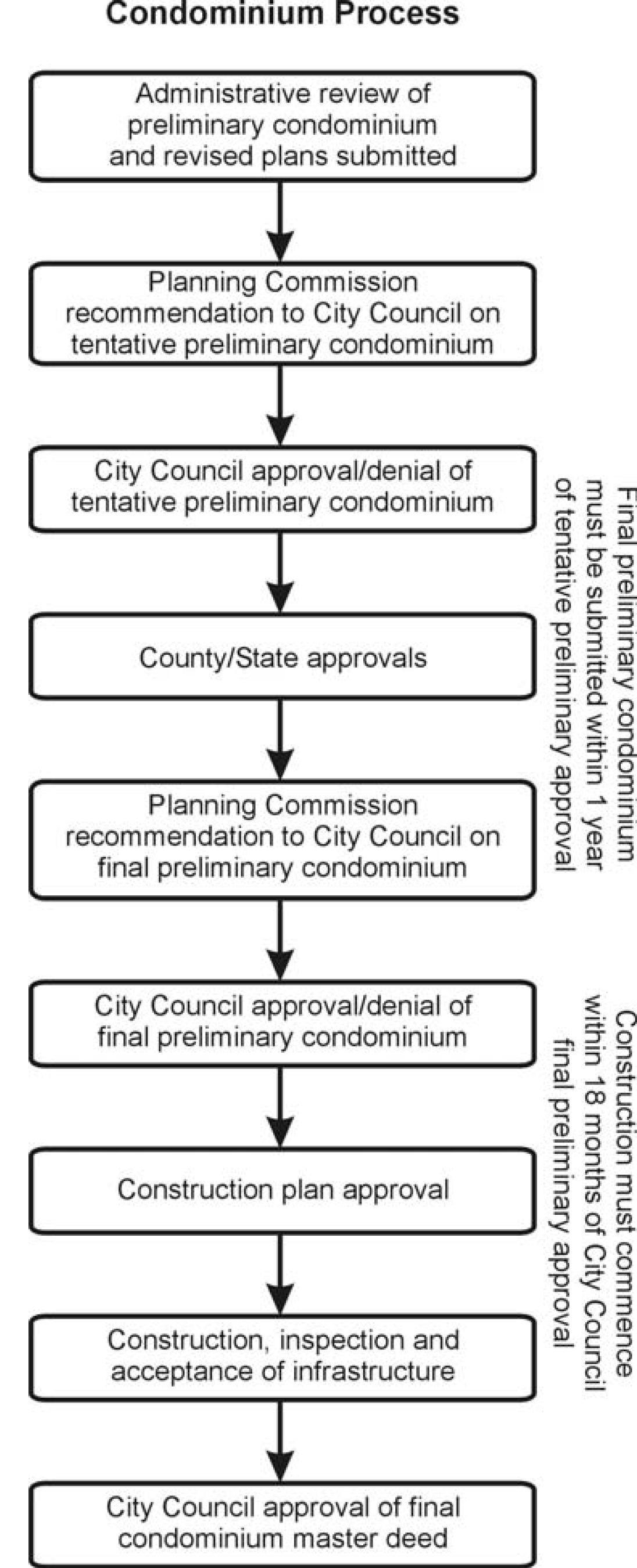
Tentative preliminary approval. A full site plan, meeting the requirements of article 19, site plan review, and a preliminary street plan shall be submitted for preliminary condominium site plan review by the planning commission. Plans shall be reviewed by the city staff and consultants and written recommendations are to be submitted to the planning commission in accordance with the following:
(1)
Planning commission shall review the site plan, in accordance with the procedures of article 19, site plan review. If a condominium site plan is incomplete, the planning commission may table the request and direct the applicant to prepare additional information or revise the plan.
(2)
Planning commission shall make a recommendation to the city council to tentatively approve, approve with conditions or deny the preliminary plan.
(3)
If the preliminary plan is tentatively approved or approved with conditions, an application for final preliminary condominium site plan approval must be submitted within one year after the date of tentative approval of the preliminary condominium site plan by the city council, or such tentative preliminary approval shall be deemed null and void. The proprietor may be granted one six-month extension with approval from the city council.
(4)
Installation or construction of any improvements or land balancing or grading shall not begin until the preliminary condominium site plan has received final approval and the public improvements agreement is entered into between the developer and the city. Trees and/or other vegetation shall not be removed until after construction plan approval, except for minor clearing required for surveying and staking purposes.
(b)
Agency reviews. Upon receipt of tentative preliminary site plan approval, the applicant shall submit the preliminary condominium site plan to all authorities for necessary permits, as required by local, Wayne County and state regulations. Approvals and/or any required permits shall be obtained from Wayne County, the MDNRE and the health department. Where streams, regulated wetlands or floodplains are proposed to be impacted, MDNRE approval shall also be obtained.
(c)
Final preliminary approval. The following information shall be submitted for final approval of the preliminary condominium site plan by the city council, based upon a recommendation by the planning commission. Plans shall be reviewed and written recommendations are to be provided to the planning commission by city staff, engineer, fire chief, police chief, and attorney. The planning commission shall review the site plan following the procedures of article 19, site plan review, and make a recommendation to the city council to approve, approve with conditions or deny. If a condominium site plan is incomplete, the planning commission may table the request and direct the applicant to prepare additional information or revise the plan. Submittals shall include:
(1)
Full site plan meeting the requirements of article 19, site plan review. Within a phased project, the final plan shall constitute only that portion of the approved preliminary plan which the proprietor proposes to record and develop at that time.
(2)
County and state approvals applicable to the development.
(3)
Draft condominium master deed and bylaws.
(d)
Construction plan approval. Following final approval of the preliminary site plan by the city council, detailed construction plans shall be submitted for review and approval by the development services department and city engineer. Site clearing, grading or construction shall not commence until the city engineer has approved the construction plans.
(e)
Performance guarantee. To ensure compliance with the zoning ordinance and any condition imposed hereunder, the planning commission shall require that a cash deposit, certified check, or irrevocable bank letter of credit, acceptable to the city covering the estimated cost of improvements associated with a project for which site plan approval is sought in accordance with section 25.08, performance guarantees.
(f)
Final approval. Final approval of master deed, restrictive covenants and exhibit B drawings.
(1)
The condominium project developer shall furnish the development services department with the following for review:
a.
One copy of the recorded master deed.
b.
One copy of all restrictive covenants.
c.
One copy of the condominiums owner's association bylaws.
d.
Two copies of an as-built survey. The as-built survey shall be reviewed by the city engineer for compliance with city ordinances. Fees for this review shall be established by resolution of the city council.
(2)
The master deed, restrictive covenants and exhibit B drawings shall be reviewed by the city attorney at the expense of the applicant and approved by the city council. The master deed shall be recorded with the county register of deeds following final approval by the city council and prior to the issuance of any building permits for construction of any condominium units.
(3)
After submittal of the condominium plan and bylaws as part of the master deed, the proprietor shall furnish the city a copy of the site plan on a Mylar sheet of at least 13 by 16 inches with an image not to exceed 10½ by 14 inches.
(4)
Digital as-built files shall be submitted to the development services department compatible with the city's geographic information system software (ArcGIS). Acceptable data formats are ESRI geofiles (desired), DXF, or DWG. Digital files shall contain information which references either government corners or existing public right-of-way intersections in distance and direction from the project area. All digital files will be created at a 1:1 scale. Feature or element information within the digital files shall be isolated by both feature groups (files) and layers/levels to meet the city's level specification. Any other information provided within the digital files shall be layer isolated from data included in the city's specification and shall include a written description of both the layer name and the information contained on the layers. Digital information provided to the city shall be delivered in a format compatible with the Microsoft Windows operating system. Acceptable delivery media shall be RW-CD, or zip disk.
(5)
The site plan, as approved, shall become part of the record of approval, and subsequent actions relating to this activity authorized shall be consistent with the approved site plan, unless a change conforming to the zoning ordinance receives the mutual agreement of the landowner and the planning commission. The execution of a site maintenance agreement by the petitioner having such form and content as may be established by resolution of the city council, as may be amended, shall be a requirement of site plan approval to provide for the continued care and maintenance of the property and improvements thereto. The approved site plan shall be valid for 18 months. If site plan approval lapses, a new submittal to the planning commission and city council is required with applicable fees.
(Ord. No. 09-434, § 23.03, 1-20-2009)
Sec. 23.04. - District requirements.
The areas and setbacks required for condominium buildings shall be based on the density provisions contained in the area, height and placement requirements of the zoning district. The submerged area of a lake, pond, drain or stream shall not be included in the unit area of a condominium lot, but shall be recorded as a general common element.
(Ord. No. 09-434, § 23.04, 1-20-2009)
Sec. 23.05. - Design standards.
All condominium projects shall comply with the design standards contained in the city subdivision regulations, all applicable requirements of this article and any other applicable regulations and are herein incorporated by reference. The intent of this section is to require that condominium projects meet the same standards required for other projects in the same district.
(Ord. No. 09-434, § 23.05, 1-20-2009)
Sec. 23.06. - Site condominiums.
(a)
Authority. Pursuant to authority conferred by section 141, regulation of local unit of government, of the Condominium Act, Public Act No. 59 of 1978 (MCL 559.241), as amended, all condominium subdivision plans must be approved by the city council following review and recommendation for approval by the planning commission. In determining whether to recommend a condominium subdivision plan for approval to the city council, the planning commission shall consult with and receive a written response from the city staff regarding the adequacy of the design and compliance with all requirements of the Condominium Act and city zoning ordinance.
(b)
Site plan review requirements.
(1)
Existing conditions.
a.
An overall area map at a scale of not less that one inch equals 1,000 feet, showing the relationship of the subdivision to its surroundings such as section lines and/or major streets or collector streets shall be provided.
b.
Boundary line of proposed subdivision, section or corporation lines within or adjacent to the tract and overall property dimensions.
c.
Lot lines of adjacent tracts of subdivided and un-subdivided land shown in relation to the tract being proposed for subdivision including those of areas across abutting streets.
d.
Location, widths, and names of existing or prior platted streets and private streets, and public easements within or adjacent to the tract being proposed for subdivision, including those located across abutting streets.
e.
Location of existing sewers, water mains, storm drains and other underground facilities within or adjacent to the tract being proposed for subdivision.
f.
Topography drawn as contours with an interval of at least two feet; except if grades exceed five percent the contour interval shall be five feet. Topography to be based on USGA datum.
g.
The school board or superintendent of the school district having jurisdiction in the area concerned shall be informed and made aware of the proposed site condominium development by the proprietor. A letter or document from the school board or school superintendent indicating awareness of the proprietor's intentions shall be submitted to the planning commission.
(2)
Proposed conditions.
a.
Layout of streets indicating proposed street names, right-of-way widths, and connections with adjoining platted streets and also the widths and locations of alleys, easements, sidewalks and nonmotorized pathways.
b.
Layout, numbers and approximate dimensions of lots, including building setback lines showing dimensions.
c.
Indication of parcels of land intended to be dedicated or set aside for public use or for the use of property owners in the site condominium development.
(3)
Proprietor's responsibilities. The proprietor should concern themselves with the following factors:
a.
The proprietor shall secure a copy of the zoning ordinance, subdivision regulations, engineering specifications and other similar ordinances or controls relative to the subdivision and improvement of land so as to make the proprietor aware of the requirements of the city.
b.
The area for the proposed development shall be properly zoned for the intended use.
c.
An investigation of the adequacy of existing schools and the adequacy of pubic open spaces including parks and playgrounds to serve the proposed development shall be made by the proprietor.
d.
The relationship of the proposed development with respect to major thoroughfares and plans for widening of thoroughfares shall be investigated by the proprietor.
e.
Standards for sewage disposal, water supply and drainage of the city shall be investigated by the proprietor.
(c)
Design and engineering standards for site condominiums.
(1)
A site condominium shall be subject to all of the requirements and standards of the applicable residential district. Single-family detached condominium project shall be subject to all requirements and standards of the applicable single-family residential districts.
(2)
The design of a site condominium project shall be subject to the design layout and engineering standards, as provided below, except as may otherwise be provided by this ordinance. The following design standards are intended as a guide to sound land planning to ensure that such projects are constructed and designed as if they were single-family developments. Should there be unusual topographic or property problems, these standards may have to be modified to either greater or lesser conformance in accordance with the judgment of the planning commission and the requirements of the article.
a.
The design of a single-family detached condominium project shall be subject to the design layout standards of the city subdivision regulations.
b.
The construction of a single-family detached condominium project shall be in accordance with the improvements and engineering design standards of the city subdivision regulations.
(3)
Street layout and design.
a.
Layout. The layout of the proposed streets shall provide for the continuation of existing streets in surrounding areas and/or shall conform to a plan for the neighborhood approved by the planning commission in cases where topographical or other conditions preclude the continuation of existing streets. In general, such streets shall be of width as least as great as that of the street so extended. Due consideration shall be given to traffic safety. Minor residential streets shall be laid out as to discourage their use by through traffic while still achieving an interconnected grid street network. Due consideration shall also be given by the developer to the attractiveness of the street layout in order to obtain the maximum livability and amenity of the site condominium development. Consideration shall also be given to the proposed use of the site condominium.
b.
Major streets. Where the condominium development abuts or contains an existing or proposed major street, the planning commission may, at its discretion, require the construction of marginal access streets, double frontage of condominium units with provision of a screen planting contained in a no-access reservation along the rear lot lines, or other treatment which the planning commission considers essential for the adequate protection of the residential area and the separation of through and local traffic.
c.
Private streets. Where private streets are allowed by the city council, they shall be constructed to the same design and engineering standards and specifications as public streets.
d.
Access to property. Each condominium unit within a condominium development shall be provided with a satisfactory means of access. Building permits shall not be issued for the construction of buildings that do not have access onto a street constructed in compliance with the requirements of this ordinance.
e.
Intersections. Intersecting street shall be laid out so that the intersection angles approximately 90 degrees but in not case shall the angle of the intersection by less than 80 degrees. No more than two streets shall cross at one intersection.
f.
Intersections adjacent to railroad crossing. Any intersection occurring on a street which crosses a railroad track shall not be less than 400 feet from the nearest railroad right-of-way. Greater distances may be required if it is deemed necessary for safety, approach gradients, or future grade separations by the planning commission.
g.
Half-streets. Half-streets shall not be permitted.
h.
Street jogs. Where streets intersect, their alignment shall be continuous. Street jogs shall not be permitted.
i.
Cul-de-sac. Where required for the full and best utilization of the property, cul-de-sacs may be utilized. The maximum permissible length of cul-de-sacs shall be 1,200 feet measured from the right-of-way line of the nearest intersecting street to the farthest point on the right-of-way of the cul-de-sac. Each cul-de-sac shall be provided at its closed end with a turn-around having a diameter at the outside of the street pavement of at least 80 feet and a lot line diameter of at least 110 feet. The remaining portion of the cul-de-sac shall have a right-of-way width of at least 60 feet. The straight portion of the right-of-way shall be joined to the circular portion of the right-of-way by circular curves with radii not less than 50 feet.
j.
Dead-end streets. Dead-end streets shall be permitted only in cases where the planning commission is of the opinion that there is a reasonable expectation that such streets will be extended to a suitable outlet when the adjacent property is developed. If the planning commission permits the construction of dead-end streets with the expectation of such future expansions, a cul-de-sac shall be constructed and maintained at the end of the street to allow vehicles to turn around. Construction of the cul-de-sac shall be in accordance with the standards and specifications for cul-de-sacs as provided in section 20.08(c)(3)i above.
k.
Street names. Street names shall not be permitted which may cause confusion with names of existing streets in or near the City of Taylor. Streets that will be continuations of existing streets shall be called by the same names of such existing streets. The city council shall approve all names.
l.
Right-of-way width. Minimum right-of-way width shall be 60 feet. Greater right-of-way widths for major streets as may be required by the city engineer or as may be designated in the master plan may be required when determined by the planning commission to be necessary.
m.
Horizontal alignment. Centerline of pavement shall coincide with centerline of right-of-way, for irregular rights-of-way widths.
n.
Street grades. Profiles and cross sections shall be required for all streets. The minimum gradient allowed shall be not less than 0.5 percent. Streets shall be reviewed by the city engineer for conformance with the provisions of this ordinance.
o.
Street curvature. The minimum horizontal centerline radii of curved local streets shall be 200 feet. Greater radii may be required for principal streets having through traffic. A minimum 50-foot tangent shall be introduced between reverse curves on streets of 60-foot right-of-way. Greater tangents shall be required on streets of greater right-of-way.
p.
Radii at intersections. Minimum pavement radii at intersections shall be 50 feet at intersections of county primary streets, 30 feet at intersections with major streets of over 60-foot right-of-way, and 30 feet on local streets.
q.
Access to streets across ditches. The project developer shall provide access to all proposed streets across watercourses or ditches in a standard manner approved by the city engineer. Drainage ditches shall be enclosed unless deemed to be impractical or unfeasible by the city engineer.
r.
Acceleration and deceleration lanes. Acceleration and deceleration lanes should be placed at the intersections of a minor street with a major street as required by the City of Taylor in conjunction with the road authority having jurisdiction.
(4)
Utility and drainage easements. The proprietor of a residential condominium development shall make arrangements for all lines for telephone, electric, television, and other similar services distributed by wire or cable to be placed underground entirely throughout the developed area. The proprietor in an industrial or commercial condominium development shall make arrangements for all lines for telephone, electric, television, and other similar services distributed by wire or cable to be placed underground where such occur in the front yards of condominium units.
a.
In all condominium developments, such underground conduits or cables shall be placed within private easements provided to such service companies by the developer or within public ways.
b.
Overhead lines may be permitted upon written recommendation of the city engineer and planning commission and the approval of the city council at the time of approval of the condominium subdivision plan in those areas where it is determined that overhead lines will not constitute a detriment to the health, safety, general welfare, design, and character of the development.
c.
All such facilities placed in dedicated public ways shall be planned so as not to conflict with other underground utilities.
d.
Recommendations on the proposed layout of telephone and electric company easements should bee sought from all of the utility companies serving the area. It shall be the responsibility of the proprietor to submit copies of the proposed condominium development plan to all appropriate public utility companies. All such facilities shall be constructed in accordance with the standards of construction approved by the Michigan Public Service Commission.
(5)
Drainage.
a.
All proposed surface drainage shall be subject to the review and approval of the city engineer. The preferred plan for yard drainage shall provide for drainage from the rear of the condominium unit to the front of the condominium unit with a minimum grade of one percent and a maximum grade of three percent (FHA type A).
b.
In the event it is found to be essential to the economical development of substantial portions of a project, the easement at the rear of the condominium unit may be below the building grade. In this event, the grade shall be not less than one percent nor more than three percent and the grade from the house to the street shall be not less than one percent with the building grade being not less than 12 inches above the street grade.
c.
Where low easements are essential to the economical development of major portions of the project, the longitudinal grade of said easement shall not be less than 0.4 of one percent and the length of run of said longitudinal easement shall not exceed 500 feet of continuous drainage with no more than 100 feet of said distance being upstream from an angle point in the easement. Where required by the city engineer or planning commission, a drainage tile of suitable size as determined by the engineer shall be provided for easement drainage. The depth, grade and outlet for said tile being subject to city approval.
(6)
Building sites. The size, shape, and orientation of condominium units shall be appropriate for the location of the development and for the type of development and use contemplated. Condominium units shall be of such size as to permit a variety of house types, to provide side yards for desirable access, light, air, privacy, and safety from fire hazards, and to provide for setbacks from the street line and allow sufficient space for household purposes.
a.
Access. All building sites shall abut by their full frontage on an approved street constructed to the standards of this ordinance. Dwelling units shall have a front-to-front relationship across all streets where possible. Dwelling unit access onto more than one street is prohibited. Dwelling unit access onto a major thoroughfare shall be discouraged. Building sites abutting major thoroughfares or collector streets, where marginal access streets are not desirable or possible to attain, shall be situated with reverse frontage or with the side lines of the building sites parallel to the major traffic streets.
b.
Width. The minimum width of any building site shall be subject to the requirements of the applicable zoning district.
c.
Building lines and setback lines. The condominium unit within site condominium project shall conform to the setback requirements of the district in which it is located.
d.
Depth. No building site shall be less in depth than the requirements of the applicable zoning district. The depth of a building site should not exceed a depth to width ratio of 3:1.
e.
Corner building sites. Corner building sites shall be provided ten feet of extra width to provide setbacks equivalent to front yard setback of adjoining street.
f.
Side building site lines. Side building site lines shall generally be perpendicular to straight street lines and radial to curved street lines unless a variation from this rule will give a better layout plan. Lot lines of sides and rear of building sites should be straight.
g.
Area. Building site area shall be such that minimum areas will be in accordance with the requirements of the district in which it is located.
(7)
Blocks.
a.
Size. The size and shape of blocks shall be appropriate for the land use proposed. Blocks shall be designed so as to permit good condominium unit orientation, safe street design, and economical use of the land.
b.
Length. Length of blocks between intersecting streets shall normally be from 600 to 1,000 feet. This form shall be altered only where the topography of the land makes it advisable to do so in order to protect the public safety and convenience, and in no event shall blocks be less than 300 or more than 1,320 feet in length.
(8)
Areas subject to flooding. Any areas within the proposed development that are subject to flooding, inundation by stormwater or within the floodplain of a river, stream, creek, or lake or have inadequate drainage shall not be developed or recorded for any use so as to increase danger to life, health, or property. If the city determines that a flood problem does exist, than it shall reject all or part of the proposed development proposed lying with the floodway. Areas of land lying within a floodplain shall require compliance with the Michigan Department Natural Resources and Environment (MDNRE) regulations and permit requirements. The proprietor may show by be engineering site plan that a change in the topography will eliminate flooding and shall demonstrate that any planned topographical change will not aggravate the flood hazard beyond the limits of the proposed development.
(9)
Open spaces. The recreational open space requirements specified in the residential zoning districts shall be met. In the design of the condominium development, thorough and equitable consideration shall be given by the developer and the planning commission to the provision of suitable sites for recreational, open space, and other public purposes, in conjunction with the City of Taylor's park department recommendation ratios of residential to open space requirements, as adopted in the parks and recreation plan.
(10)
Protection of natural features. Due regard shall be shown for all natural features, such as large trees, exceptionally fine groves of trees, watercourses, scenic points, historic spots, and similar community assets, which, if preserved, will add attractiveness and value to the condominium development. A preservation plan shall be submitted showing all trees greater than eight inches in caliper.
(d)
Required improvements for site condominiums. In order to provide healthful, clean, and desirable living conditions, the developer shall be entirely responsible for installing the following site improvements, or shall furnish a financial guarantee acceptable to the city sufficient to permit the completion of all contemplated improvements, before a plan shall be accepted by the city.
(1)
Street pavement and storm drainage. All condominium developments shall have concrete paved streets and six inch curb and gutter. In addition, all such street shall have enclosed storm drainage sewers. The city shall approve all enclosed storm sewers.
(2)
Sanitary sewerage system. Where provided, the location and design of all trunk line and lateral sanitary sewers and any other necessary appurtenances such as pumping stations shall be first approved by the city and all applicable reviewing agencies, and all work shall be carried out under the supervision of the city.
(3)
Water system. Where provided, the location and design of water mains with house connections and the installation of fire hydrants, and any other necessary appurtenances shall be first approved by the city and all applicable reviewing agencies as to suitability, and all work shall be carried out under the supervision of the city.
(4)
Sidewalks. Sidewalks shall be concrete and be provided along both sides of all streets. Sidewalks shall not be less than five feet in width and four inches in thickness and shall be approved by the city and all applicable reviewing agencies as to suitability and all work shall be carried out under the inspection of the city.
(5)
Installation of public utilities. All utilities and driveways shall be located in accordance with the rules of the City of Taylor and shall be approved by the city. The underground work for utilities shall be stubbed to the lot line. All utilities in a condominium development shall be underground.
(6)
Driveways. All driveways shall be concrete from the street to the front building line. Such driveway shall also be at least nine feet in width. Driveways shall be constructed according to accepted standard for construction as approved by the city.
(7)
Street name signs. Street name signs shall be installed in the appropriate locations at each street intersection in accordance with the requirements of the City of Taylor.
(8)
Street trees and landscaping. Street trees shall be provided in the ratio of at least one per dwelling unit. Corner lots shall have two trees, one on each right-of-way frontage. Trees shall be planted along the street within a reserved planting strip and shall not be less than eight feet in height at time of planting and shall comply with section 16.02, landscaping.
(9)
Street lighting. A street lighting plan shall be approved as part of the condominium site plan. Street lighting shall be installed by the developer prior to final approval of the condominium.
(Ord. No. 09-434, § 23.06, 1-20-2009)
Sec. 23.07. - Attached condominium units.
Attached residential condominium units shall be subject to the requirements for multiple-family site plan review, or planned unit development (PUD) review.
(Ord. No. 09-434, § 23.07, 1-20-2009)
Sec. 23.08. - Commercial or industrial condominiums.
(a)
The term "commercial" shall mean office, retail, wholesale, or other uses of free enterprise.
(b)
Commercial or industrial condominium building sites shall meet the same requirements for zoning compliance and site development as any other form of ownership. When this section does not regulate, then the provisions of the zoning district in which the proposed development is located will apply.
(c)
Commercial or industrial condominium building site when detached shall be of sufficient size to accommodate parking and loading zone requirements of article 17, off-street parking, loading, access and circulation requirements. When parking for more than one facility is proposed for common use, the parking shall be the cumulative required for all users who potentially will have simultaneous need for parking, subject to the modifications allowed under article 17, off-street parking, loading, access and circulation requirements. When commercial or industrial condominium developments are attached, the parking requirements shall be calculated in the same manner as detached units.
(Ord. No. 09-434, § 23.08, 1-20-2009)
Sec. 23.09. - Monuments required.
All condominium developments which consist in whole or in part of condominium units which are building sites, manufactured home sites, or recreational sites, shall be marked with monuments as provided in this section.
(a)
All monuments used shall be made of solid iron or steel bars at least one-half inch in diameter and 36 inches long and completely encased in concrete at least four inches in diameter.
(b)
Monuments shall be located in the ground at all angles in the boundaries of the condominium development; at the intersection lines of street and at the intersection of the lines of streets with the boundaries of the condominium development and at the intersection of alleys with the boundaries of the condominium development; at all points of curvature, points of tangency, points of compound curvature, points of reverse curvature and angle points in the side lines of streets and alleys and at all angles of an intermediate transverse line. It is not intended or required that monuments be placed within the traveled portion of a street to mark angles in the boundary of the condominium development if the angle points can be readily reestablished by reference to monuments along the sidelines of the streets.
(c)
If the required location of a monument is in an inaccessible place, or where the locating of a monument would be clearly impracticable, it is sufficient to place a reference monument nearby and the precise location thereof be clearly indicated on the plans and referenced to the true point.
(d)
If a point required to be monumented is on a bedrock outcropping, a steel rod, at least one-half inch in diameter shall be drilled and grouted into solid rock to a depth of at least eight inches.
(e)
All required monuments shall be placed flush with the ground where practicable.
(f)
All unit corners and the intersection of all limited common elements and all common elements shall be identified in the field by iron or steel bars or iron pipe at least 18 inches long and one-half inch in diameter, or other approved markers.
(g)
The city council may waive the placing of any of the required monuments and markers for a reasonable time, not to exceed one year, on the condition that the proprietor deposits with the city cash or a certified check, or irrevocable bank letter of credit to the City of Taylor, whichever the proprietor upon receipt of a certificate by a surveyor that the monuments and markers have been placed as required within the time specified.
(Ord. No. 09-434, § 23.09, 1-20-2009)

