
Taylor City Zoning Code
ARTICLE 14
- GENERAL PROVISIONS
Sec. 14.01.- Access.
(a)
All lots shall have frontage on a dedicated public or private street. The frontage shall be of sufficient width so that the lot meets the minimum lot width requirement at the front yard setback for in the district in which the lot is located. Flag lots that do not provide adequate frontage shall be prohibited. A building permit shall not be issued by the city for construction of a new principal building unless all of the following requirements are met:
(1)
The proposed building shall be on a lot that is provided access by an improved public or private street. The street and all utilities shall be constructed to city standards along the entire frontage of the lot. Lots that are located on right-of-way that is unimproved or not fully improved to city street standards shall be required to extend the street and all necessary utilities to the lot and along the entire frontage of the lot.
(2)
A copy of an approved driveway permit from the city for a city street or Wayne County for a county street shall be provided for access to an improved public street.
(b)
Multiple-family, commercial, office, or industrial developments need not front each structure within the development upon publicly dedicated streets, provided that adequate interior pedestrian and vehicular circulation and ingress/egress is provided, subject to compliance with the provisions of article 19, site plan review.
(c)
In no case shall a commercial, office, or industrial use have direct access to or from a residential street or through a residential district.
(Ord. No. 09-434, § 14.01, 1-20-2009)
Sec. 14.02. - Building regulations.
(a)
Conformity required. Buildings or structures shall not hereafter be erected, constructed, used, reconstructed, altered or maintained, and any lot or land shall not hereafter be used or maintained and new uses shall not be made of any building, structure or land, except in conformity with the provisions of this ordinance.
(b)
Unlawful building. Any building that is used, erected, occupied or altered contrary to the provisions of this ordinance hall be deemed an unlawful structure and a nuisance and may be required to be vacated, torn down or abated by any legal means, and shall not be used or occupied until it has been made to conform to the provisions of this ordinance. Public expenditures toward abating such nuisance shall become a lien upon the land.
(c)
Setback. Any space used for a required setback, open space, or lot area for a building may not be counted or calculated to meet the same requirements for any other building.
(d)
Frontage. No building shall be erected on a lot, unless said lot fronts its full width, as required by section 14.01, access, upon an improved street that has been dedicated to the public. Multiple-family, commercial, office, or industrial developments need not front each structure within the development upon publicly dedicated streets, provided that adequate interior pedestrian and vehicular circulation and ingress/egress is provided, subject to compliance with the provisions of article 19, site plan review.
(e)
Temporary building. Temporary buildings shall not be erected unless a building permit has been issued for a permanent building or a new use of land on the same site. Any temporary building shall be removed from the site within 30 days of issuance of a certificate of occupancy or upon completion of the project. Failure to remove the temporary building shall constitute an automatic revocation of the certificate of occupancy.
(f)
One lot, one building. In one-family residential districts, only one principal building shall be placed on a lot of record in accordance with section 14.13, uses per lot.
(g)
Site plan. In the case of commercial, office or industrial development, prior to a building permit being issued, a site plan should be submitted and approved by the development services department meeting the requirements of article 19, site plan review, and site/civil engineering plans should be approved.
(h)
Single-family dwelling. In the case of single-family or infill homes a plot plan is required in accordance with section 25.04, plot plan/survey.
(i)
Grading. Grading shall comply with the requirements of section 14.07, grading.
(Ord. No. 09-434, § 14.02, 1-20-2009)
Sec. 14.03. - Corner clearance (clear vision triangle).
(a)
Fences, walls, structures, or plantings shall not be erected, established, or maintained on any lot that will obstruct the view of drivers in vehicles approaching the intersection adjacent to a corner lot or a driveway on any lot.
(b)
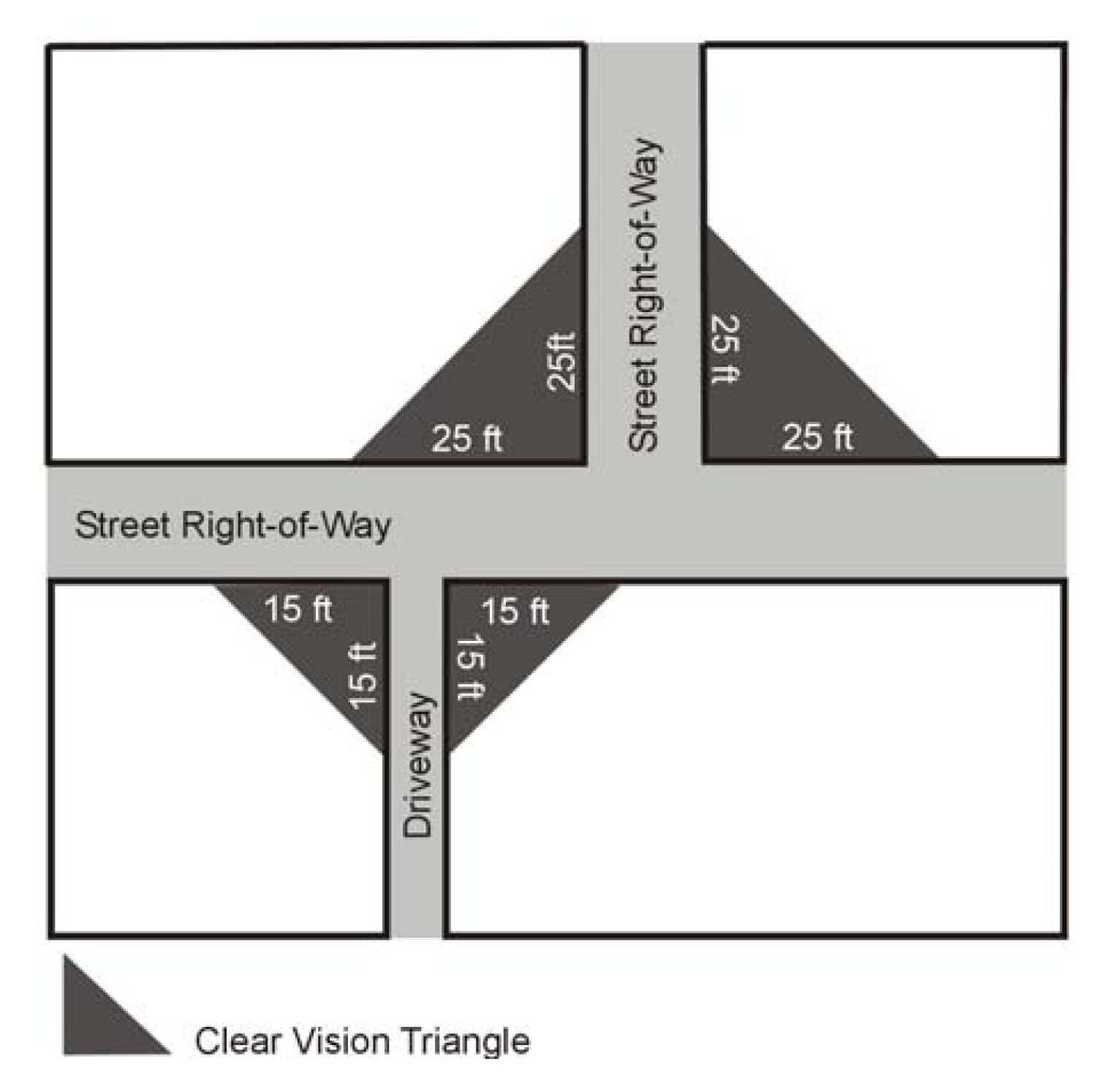
Fences, walls, structures, or plantings located in the clear vision triangle, as depicted below, shall not be permitted to exceed a height of 24 inches above the lowest point of the intersecting streets. The unobstructed triangular area is described as follows:
(1)
The area formed at the corner intersection of two street right-of-way or easement lines, the two sides of the triangular area being 25 feet in length measured along abutting public right-of-way lines, and third side being a line connecting these two sides.
(2)
The area formed at the corner intersection of a street right-of-way, easement, or alley and a driveway, the two sides of the triangular area being 15 feet in length measured along the right-of-way line and edge of the driveway, and the third side being a line connecting these two sides.
(Ord. No. 09-434, § 14.03, 1-20-2009)
Sec. 14.04. - Determination of similar uses.
Every type of potential use cannot be addressed in this ordinance. Applications for a use not specifically addressed in any zoning district shall be submitted to the development services department for a determination based on the following process.
(a)
A finding the proposed use is not listed as a permitted or special land use in any zoning district.
(b)
Unless otherwise provided in this ordinance or by law, the development services department shall select the use listed in this ordinance which most closely resembles the proposed use using criteria such as the nature of the use, aesthetics, traffic generated, potential impact on property values, noise, vibration, dust, smoke, odor, glare and other objectionable impacts in terms of health, safety and welfare in the city.
(c)
Once a similar use is determined, the proposed use shall comply with any special land use standards that apply to the similar use.
(d)
Where the development services department determines a proposed use is not similar to a use addressed in this zoning ordinance, the applicant may petition for an interpretation from the zoning board of appeals, as described in article 26, zoning board of appeals.
(e)
The determination as to whether a proposed use is similar in nature and class to another permitted or special land use within a district should be considered as an expansion of the use regulations, not a variance applying to a particular situation. Any use determined by the development services department to be similar shall thereafter be included in the enumeration of the uses.
(Ord. No. 09-434, § 14.04, 1-20-2009)
Sec. 14.05. - Dwellings in nonresidential districts.
(a)
It is the intent of this ordinance to discourage development of residential structures where not otherwise permitted by this ordinance.
(b)
As an accessory use for certain nonresidential uses it may be necessary or desirable to permit living or sleeping quarters for watchmen, caretakers or certain employees subject to the following conditions.
(1)
A detached dwelling unit for one family may be permitted by the development services department upon showing that the unit is necessary for security reasons or that a resident manager is necessary to carry on the business of the use.
(2)
Dwellings permitted by this section shall be used only by the security persons or resident managers directly affiliated with the principal business and their families.
(3)
Dwelling units, sleeping or living quarters shall be contained wholly within the principal building and be incidental and subordinate to the principal use. Garages, basements or cellars shall not be used for living area.
(4)
All dwelling units, living or sleeping quarters shall meet or exceed the minimum housing standards adopted by the City of Taylor and the State of Michigan.
(5)
All new or enlarged dwelling units, living or sleeping quarters shall be required to receive a certificate of occupancy separate from the principal use.
(c)
Any violation of this section shall result in termination of the residential use until the violation is fully corrected.
(Ord. No. 09-434, § 14.05, 1-20-2009)
Sec. 14.06. - Essential services.
(a)
Essential services shall be permitted as authorized under any franchise in effect within the city, subject to regulation as provided in any law of the State of Michigan or in any ordinance of the city.
(b)
It is the intent of this section to ensure conformity of all structures and uses to the requirements of this ordinance wherever such conformity shall be practicable and not in conflict with the specific requirements of such franchise, legislation or other city ordinance. In the absence of such conflict, the zoning ordinance shall prevail.
(c)
Wireless communication facilities shall be subject to the requirements of section 13.12(k), wireless communication facilities and services.
(Ord. No. 09-434, § 14.06, 1-20-2009)
Sec. 14.07. - Grading.
(a)
Drainage. Elevations for any site with a building shall have a grade sloping away from the walls of the building to permit the flow of surface water. However, sunken or terraced areas may be permitted if they are constructed to prevent the runoff of surface water from flowing onto adjacent properties.
(b)
Finished floor elevation. Prior to basement walls/foundations being placed the permit holder, contractor and/or owner shall verify that the top of wall elevation is appropriate for the proposed finished floor elevation. The permit holder, contractor and/or owner will accomplish this by field verifying the top of the wall/foundation forms prior to concrete being placed. Verification shall be provided by a land surveyor licensed in the State of Michigan.
(c)
Elevations at lot lines. Proposed elevations at all lot lines shall match existing elevations of adjacent existing property. Final grades shall be approved by the development services department and city engineer/DPW director.
(d)
Grade differential. Grade elevation shall not exceed seven percent across any portion of the site, except for driveways.
(e)
Grade verification. Prior to a certificate of occupancy being issued, verification shall be provided by a land surveyor licensed in the State of Michigan that the site grade is consistent with the approved plan.
(f)
Finished grade.
(1)
Shall be no higher than two feet at the highest point of elevation of adjacent properties and be equal to the existing grade at the lot lines.
(2)
Property shall be graded to provide positive drainage away from proposed structure and shall not drain on adjacent properties.
(3)
Four inches of topsoil shall be provided over all graded areas.
(g)
Finished floor elevation. Finished floor elevation shall be no higher than two feet to adjacent properties or top of curb (or top of bank of ditch line).
(h)
Engineering standards. Grading shall comply with the city's engineering standards.
(i)
Certificate of occupancy. A certificate of occupancy will not be issued until final grades are approved by the development services department or city engineer.
(Ord. No. 09-434, § 14.04, 1-20-2009)
Sec. 14.08. - Height limit.
(a)
Except as noted in subsection (b) below, buildings erected, converted, enlarged or structurally altered shall not exceed the height limit established for the district in which the building is located.
(b)
Penthouse, mechanical equipment or roof structures for the housing of elevators, stairways, tanks, ventilating fans, or similar equipment required to operate and maintain the building, and fire or parapet walls, skylights, towers, steeples, stage lofts, and screens, flagpoles, chimneys, individual domestic radio and television aerials and wireless masts, water tanks, or similar structures may be erected above the height limits of this ordinance.
(c)
None of the structures described in subsection (b) above may be erected to exceed the building height by more than 20 percent of the building height or ten feet, whichever is greater. If located on a roof, these structures shall not cover an area greater than ten percent of the roof area of the building.
(d)
None of the structures described in subsection (b) above shall be used for any residential, commercial, or industrial purpose other than a use incidental to the principal use of the building.
(e)
Wind energy conversion system, such as wind turbines, shall be allowed to exceed the height limits of the district in which they are located, subject to the regulations and limits set forth in section 13.12(j), wind energy conversion systems (WECS).
(f)
The construction of commercial radio and television transmitting, relay, or other types of antenna towers, where permitted, shall be governed by the regulations set forth in section 13.12(k), wireless communication facilities and services.
(Ord. No. 09-434, § 14.08, 1-20-2009)
Sec. 14.09. - Keeping of animals.
(a)
Domestic animals, dogs, cats, birds and nonbreeding rabbits are limited to a total of three animals age four months or older per household.
(b)
Unless otherwise provided in this ordinance, no building or land in any district shall keep, raise, procreate or otherwise allow on the premises any wild or exotic animal, fowl, farm animal or livestock.
(c)
Excluded from this regulation are facilities owned and operated by the city and fully accredited academic institutions. All are subject to the health and sanitation provisions of the City of Taylor and shall not become a nuisance.
(Ord. No. 09-434, § 14.09, 1-20-2009)
Sec. 14.10. - Performance standards.
(a)
Application. Any use established or changed after the effective date of this ordinance, shall comply with all of the performance standards herein. If any existing use or building or other structure is extended, enlarged, or moved, the performance standards for the district involved shall apply with respect to such extended, enlarged, moved, structurally altered or reconstructed building or other structure or portion thereof, and with respect to land use which is enlarged or moved.
(b)
Determination of compliance.
(1)
Subsequent to a preliminary study of the performance characteristics of an existing or proposed use, the development services department shall make a determination as to whether there exist reasonable grounds to believe that the use in question may violate the performance standards set forth in this section and may initiate an official investigation.
(2)
Following the initiation of an official investigation, the development services department can require the owner or operator of the use in question to submit such data and evidence as deemed essential to permit an objective determination. Failure to submit data required by the development services department shall constitute grounds for denying a permit for that use of land. The evidence may include, but is not limited to, the following items:
a.
Plans of the existing or proposed construction and development.
b.
A description of the existing or proposed machinery, process and products.
c.
Specifications for the mechanisms and techniques used or proposed to be used in restricting the possible emission of any of the dangerous and objectionable elements as set forth in this section.
d.
Measurements of the amount or rate of emission of said objectionable elements.
(3)
Where determinations can reasonably be made by the development services department or other city department, using equipment and personnel normally available to the city or obtainable without extraordinary expense, such determinations shall be so made before notice of violation is issued. Where determination of a violation is made, the development services department shall take or cause to be taken lawful action as provided by this ordinance to eliminate such violation. Failure to obey lawful orders concerning cessation of violation shall be punishable as provided in this ordinance.
(4)
Where determination of violation of performance standards will likely entail the use of highly skilled personnel and expensive or unusual instrumentation not ordinarily available to the city and when a violation exists, costs of the determinations will be charged against those responsible in addition to such other penalties as may be appropriate.
(5)
If, after the conclusion of the time granted for compliance with the performance standards, the development services department finds the violation is still in existence, any permits previously issued shall be void and the operator shall be required to cease operation until the violation is remedied.
(c)
Performance standards. Any use established shall not be permitted to carry out any activity or operation or use of land, building or equipment that produces an irritant to the sensory perceptions greater than the following measures for safeguarding human safety and welfare.
(1)
Noise.
a.
All noise originating within the limits of the City of Taylor shall comply with all applicable local ordinances.
b.
Operations or activities shall not be carried out in a manner which causes or creates measurable noise levels exceeding the maximum sound pressure levels depicted in table 14.10.a as measured on or beyond the lot line of the operation or activity.
TABLE 14.10.A. MAXIMUM PERMITTED SOUND PRESSURE LEVELS
IN DECIBELS
(Pre-1960 Octave Bands American Standards Association, Z24)
*Sound level meter set on the C or flat scale, slow response.
c.
A sound level meter and an octave band analyzer shall be used to measure the level and frequency of the sound or noise during the day and the night. The measuring equipment and measurement procedures shall conform to the latest American National Standards Institute (ANSI) specifications on acoustics. The sound level meter and octave band analyzer shall be calibrated before and after the measurements. Sounds of very short duration, which cannot be measured accurately with the sound level meter, shall be measured by an impact noise analyzer; and the measurements so obtained may be permitted to exceed the maximum levels provided in tables 14.10.a or b by no more than five decibels. For purposes of this ordinance, impact noises shall be considered to be those noises whose peak values are more than seven decibels higher than the values indicated on the sound level meter.
d.
For some post-1960 manufactured instruments, the octave bands mentioned above have been converted to the new preferred frequencies as established by the American Standards Association. To accommodate the possible use of either type of instrumentation, table 14.10.b lists the preferred frequencies. Care shall be exercised to assure the proper correlation between instruments and tables used in measuring performance.
TABLE 14.10.B. MAXIMUM PERMITTED SOUND PRESSURE LEVELS
IN DECIBELS
(Post-1960 Preferred Frequencies)
*Sound level meter set on the C or flat scale, slow response.
e.
Where street traffic noises directly adjacent to the boundary line exceed these maximum permitted levels, the intensity levels permitted may then exceed those levels specified in the tables but may not exceed the level of the subject adjacent street traffic noises. For those areas in which the existing background noise levels exceed the maximum permitted levels, the noise levels at the boundary line may not exceed the background noise levels. In such cases, a study shall be made to determine the character of the background noise to include sources, levels and duration.
f.
Sounds of an intermittent nature or characterized by pure tones may be a source of complaints even if the measured level does not exceed that specified. In such cases, the complaints shall be investigated to determine the nature of and justification for the complaint and possible corrective action. If the complaints are not resolved within 60 days, the development services department may then proceed to take steps to enforce the terms of the zoning ordinance in accordance with the remedies provided herein.
(2)
Drifted and airborne matter generally. The drifting or airborne transmission beyond the lot line of dust, particles or debris shall be unlawful and shall be summarily caused to be abated.
(3)
Dust, soot, dirt, fly ash and products of wind erosion. A person, firm or corporation shall not operate or cause to be operated, maintained or cause to be maintained, any process for any purpose, or furnace or combustion device for the burning of coal or other natural or synthetic fuels, without maintaining and operating, while using said process or furnace or combustion device, recognized and approved equipment, means, method, device or contrivance to reduce the quantity of gas borne or airborne solids of fumes emitted into the open air, which is operated in conjunction with said process, furnace, or combustion device so that the quantity of gas borne or airborne solids shall not exceed 0.20 grains per cubic foot of the carrying medium at the temperature of 500 degrees Fahrenheit.
For the purpose of determining the adequacy of such device, these conditions are to be conformed to when the percentage of excess air in the stack does not exceed 50 percent at full load. The foregoing requirement shall be measured by the American Society of Mechanical Engineers (ASME) test code for dust-separating apparatus. All other forms of dust, dirt and fly ash shall be completely eliminated insofar as escape or emission into the open air is concerned. The chief building official may require such additional data as is deemed necessary to show that adequate and approved provisions for the prevention and elimination of dust, dirt, and fly ash have been made.
(4)
Vibration. Vibrations which are discernible to humans shall not be perceptible at any point beyond the lot line of the lot upon which the source of such vibration is located.
(5)
Odor. The emission of odors which are generally agreed to be obnoxious to any considerable number of persons, at their place of residence, shall be prohibited.
(6)
Glare and heat. Any operation producing intense glare or heat or such other radiation shall be performed only within an enclosed or screened area and then only in such a manner that the glare, heat, or radiation emitted will not be discernible from any point exterior to the site or lot upon which the operation is conducted.
(7)
Fire and safety hazards.
a.
The storage and handling of flammable liquids, liquefied petroleum gases, and explosives shall comply with all regulations of the city and with all state rules and regulations, and all applicable local ordinances.
b.
All storage tanks for flammable liquid materials above ground shall be located at least 150 feet from all lot lines, and shall be completely surrounded by earth embankments, dikes or other types of retaining wall which will contain the total capacity of all tanks so enclosed.
c.
Bulk storage tanks of flammable liquids below ground shall be located not closer to the lot line than the greater depth to the bottom of the buried tank.
(8)
Gases. The escape of or emission of any gas which is injurious or destructive or explosive shall be unlawful and may be summarily caused to be abated. SO 2 gas, as measured at the lot line at ground elevation, shall not exceed an average of 0.3 ppm, H 2 S likewise shall not exceed 1.0 ppm, Fluorine shall not exceed 0.1 ppm, Nitrous fumes shall not exceed 5.0 ppm, and carbon monoxide shall not exceed 15 ppm; all as measured as the average intensity during any two hour sampling period.
(9)
Electromagnetic radiation. Applicable rules and regulations of the Federal Communications Commission (FCC) in regard to propagation of electromagnetic radiation are hereby made a part of this ordinance.
(10)
Smoke. It shall be unlawful for any person, firm or corporation to permit the emission of any smoke from any source whatsoever to a density greater than that density permitted by the U.S. Environmental Protection Agency (EPA). For the purpose of grading the density of smoke, EPA method 9 shall be the standard method of measurement.
(Ord. No. 09-434, § 14.10, 1-20-2009)
Sec. 14.11. - Projections into required yards.
(a)
Certain features may project into the required yard setbacks in accordance with table 14.11.
TABLE 14.11. PERMITTED PROJECTIONS INTO REQUIRED YARDS
(b)
Equipment used for central air conditioning, heating and water filtration purposes and installed outside of single-family or two-family dwellings and their attached structures shall be located in the rear yard no more than three feet in from the extreme sides of the main structure and in no cases less than 15 feet from adjoining single-family and two-family dwellings. The development services department may allow units to be located within the side yard in those instances where such location does not adversely impact an abutting dwelling, conditioned upon screening of the equipment with appropriate landscaping to reasonably conceal the equipment from view.
(c)
Any walk, terrace, patio, drive or other pavement or surface less than six inches above grade shall not be considered to be a structure, and are permitted in any required yard. No more than 30 percent of the front yard area of any residentially zoned lot shall be paved.
(Ord. No. 09-434, § 14.11, 1-20-2009)
Sec. 14.12. - Temporary buildings, structures, uses, and special events.
Temporary principal or accessory buildings, structures, uses and special events may be permitted, subject to the following conditions:
(a)
Temporary construction, buildings, structures and uses.
(1)
Temporary buildings and structures may only be used for the storage of construction materials, tools, supplies and equipment, for construction management and supervision offices, and for temporary on-site sanitation, solid waste, or fuel facilities, related to construction activity on the same lot.
(2)
No temporary building or structure shall be used for dwelling purposes.
(3)
The placement of temporary buildings and structures shall be in conformance with the sketch plan requirements of article 19, site plan review. A building permit for such building or structure shall be issued by the development services department prior to installation.
(4)
Temporary buildings and structures shall be removed from the lot within 30 days after an occupancy permit is issued by the development services department for the permanent structure on such lot, or within 30 days after the expiration of a building permit issued for construction on such lot.
(b)
Temporary uses, seasonal, and special events. Temporary uses and seasonal or special events may be allowed in any district upon issuance of a permit by the development services department, when meeting the standards listed below:
(1)
Temporary uses, seasonal, and special events may be allowed on any lot with a permitted principal building.
(2)
Temporary uses, seasonal, and specials events may be allowed on a vacant lot when providing the minimum setback for all buildings, structures, and parking required for the appropriate zoning district.
(3)
In no case shall the setbacks for any buildings, structures or parking be less than 100 feet of residential districts or uses and ten feet from nonresidential districts or uses, except in the midtown districts.
(4)
The temporary use, seasonal, and special event shall not prevent the continued use of sidewalks, rights-of-way, fire lanes, etc.
(5)
If the petitioner is not the owner of the property, the petitioner shall provide written permission of the owner of the property to allow such an event prior to beginning such temporary use, seasonal, and special event.
(6)
A minimum of one parking space shall be provided for each 800 square feet of gross lot area used for the activity (not including storage areas) plus additional parking space for any structure utilized for retail sales computed in accordance with the requirements for retail stores.
(7)
A sketch plan (to scale) shall be provided illustrating:
a.
Lot lines.
b.
Adjacent uses and zoning districts.
c.
Existing and proposed buildings and structures.
d.
Location of any areas for storage such as inventory not being displayed.
e.
Fire hydrants.
f.
Layout of parking.
g.
Boundaries of proposed sales areas.
h.
Location and size of any proposed sign (off-premises signs shall also be mapped).
(8)
All equipment, materials, goods, poles, wires, signs, and other items associated with the temporary use shall be removed from the premises within five days of the end of the event. Following the five-day period, the city shall apply the escrow fee towards clearing such items from the property.
(9)
The length of a temporary use or special event shall not exceed seven days, except seasonal sales of items such as Christmas trees, flower and garden supplies, and pumpkins which are permitted for up to 15 days. The sale of sport or other special event merchandise do not constitute seasonal sale items.
(10)
Two temporary use permits for a temporary use, seasonal or special event by a single business or property are permitted each year.
(11)
Special standards for carnivals, circuses and similar events shall be as follows:
a.
A sketch plan in accordance with subsection (b)(7) above shall be submitted to the city clerk and reviewed by the administrative review committee (ARC). The ARC will make a recommendation to the city council for approval.
b.
All carnivals are subject to the requirements of chapter 4, article IV, Carnivals, Amusement Rides, Related Concessions, of the City of Taylor Code of Ordinances.
c.
Such uses shall be approved by the city council. The city council shall consider the intensity of the proposed use in relation to adjacent land uses and sufficiency of parking. The city council may require site improvements, such as fencing, increased setbacks, and restricted hours of operation to help ensure compatibility with surrounding land uses.
d.
The applicant shall provide information establishing that a reasonable amount of liability insurance coverage is carried, as determined by the city's insurance carrier. A copy of the certificate of insurance shall be submitted with the application.
e.
The sketch plan for the event shall include a description of traffic flow and parking management to ensure safe and efficient traffic operations without creating unreasonable congestion on city streets.
f.
The responsible/contact person and contact information must be on the application.
g.
No ride, protruding portion of ride, booth or concession may be within five feet of any sidewalk or traffic right-of-way.
h.
The city may require security fencing around the carnival, subject to review and approval of the City of Taylor.
i.
The maximum duration of a carnival, circus or similar event shall not exceed five days per year.
j.
No carnival shall be operated except between the hours of 10:00 a.m. and 10:00 p.m.
k.
No more than one carnival may operate in the City of Taylor at one time.
(12)
Farmers markets which are to occur on a regular schedule shall be permitted only in nonresidential districts. The city council may extend the time period for the temporary use permit so that a separate permit is not required for each event within any one calendar year, provided the number of dates and a schedule are established at the time of application and that the conditions and requirements of the city council are maintained.
(c)
Review procedures. Except as otherwise noted above for carnivals, circuses, and similar events, the development services department shall review and approve requests for a temporary use or seasonal event. Where appropriate, the development services department shall consult with the police chief and fire department official. If the request is denied, the development services department shall state the reasons for denial in writing and provide a copy to the applicant.
(d)
Portable moving and storage containers. A single portable moving and storage container may be placed on an occupied lot for the purpose of loading or unloading personal belongings to be transported to another location, subject to the following restrictions:
(1)
The portable moving and storage container shall be placed on an occupied lot for up to seven days.
(2)
The container shall be located on a paved surface on the lot and shall not be located in the public right-of-way or a private road easement.
(3)
This section shall not apply to freight containers or truck trailers located on a lot in an industrial district where the storage has been approved by the city under the industrial district regulations of article 8, industrial districts.
(Ord. No. 09-434, § 14.12, 1-20-2009; Ord. No. 15-490, § 1, 6-16-2015)
Sec. 14.13. - Uses per lot.
(a)
Except as otherwise specifically provided in this ordinance, lots may not contain more than one principal building or principal use.
(b)
Groups of multiple-family buildings, retail business buildings, multi-tenant offices, leased industrial space or other groups of buildings contained within a single integrated complex may be deemed by the development services department to be a principal use collectively. To be considered as an integrated complex the site shall share parking, signs, access, or other similar features, which together form a unified function and appearance.
(c)
Wireless communication facilities may be located on a lot that contains another use, except single-family and two-family dwellings, subject to the requirements of section 13.12(k), wireless communication facilities and services.
(d)
In single-family residential districts, only one principal building shall be placed on a lot of record. For the purposes of this ordinance, a two-family dwelling shall be considered as a principal building and principal use occupying one lot. Where a lot contains a single-family or two-family dwelling, no other use may be established on the lot, except accessory uses that are permitted in the district, such as home occupations, residential childcare up to a maximum of six children by right or 12 children by special land use, kennels by special land use, and agricultural uses.
(e)
This section shall not prohibit a mixed use building where the mixture of uses is specifically allowed by the zoning district, such as residential or office above a retail use in the midtown districts.
(f)
An accessory building shall only be located on a lot that is occupied by a principal building.
(Ord. No. 09-434, § 14.13, 1-20-2009)
Sec. 14.14. - Voting place.
The provisions of this ordinance shall not be so construed as to interfere with the temporary use of any property as a voting place in connection with a city, school or other public election.
(Ord. No. 09-434, § 14.14, 1-20-2009)

