
Taylor City Zoning Code
ARTICLE 21
- SPECIAL LAND USE REVIEW7
State Law reference— Special land uses, MCL 125.3502 et seq.
Sec. 21.01.- Intent.
(a)
The formulation and enactment of the zoning ordinance is based upon the division of the city into zoning districts, in each of which are permitted specified uses which are mutually compatible. In addition to permitted compatible uses there are certain other uses which may be necessary or desirable to allow in certain locations within certain districts; but because of their actual or potential impacts on neighboring uses or public facilities, there is a need to carefully regulate them with respect to their location for the protection of the city. These uses, due to their peculiar locational need or the nature of the service offered, may be established in a district where they cannot be reasonably allowed as a permitted use, but may be allowed on a case-by-case basis as special land uses.
(b)
Special land uses are uses considered to be more intense, or potentially more disruptive, compared to the various uses permitted by right in a particular zoning district. The uses classified as special land uses vary by district and are listed in the regulations of each zoning district. The special land use procedures and standards are intended to: provide a procedure by which special land uses can be evaluated to determine their potential impacts; ensure impacts can be accommodated within the environmental, infrastructure, and public services capacities of the area; and, provide site design, and operational standards to minimize any negative impact on adjoining or nearby properties.
(Ord. No. 09-434, § 21.01, 1-20-2009)
Sec. 21.02. - Scope.
Prior to the establishment of a special land use, the city shall follow special procedures and carefully review the proposed use so as to minimize potential conflicts with the uses in conformance with this article.
(a)
The planning commission shall have the sole authority to approve, approve with conditions or disapprove all special land uses.
(b)
The planning commission shall hold a public hearing in accordance with the requirements of section 25.09, public hearings. If the proposed special land use meets the requirements and standards of the zoning ordinance, the planning commission shall approve the use. Approval shall be granted only for those uses specified in the application and shown on the site plan.
(c)
A site plan conforming to the requirements and procedures of article 19, site plan review, is required for all special land uses which shall be reviewed and approved by the planning commission concurrently with the special land use.
(Ord. No. 09-434, § 21.02, 1-20-2009)
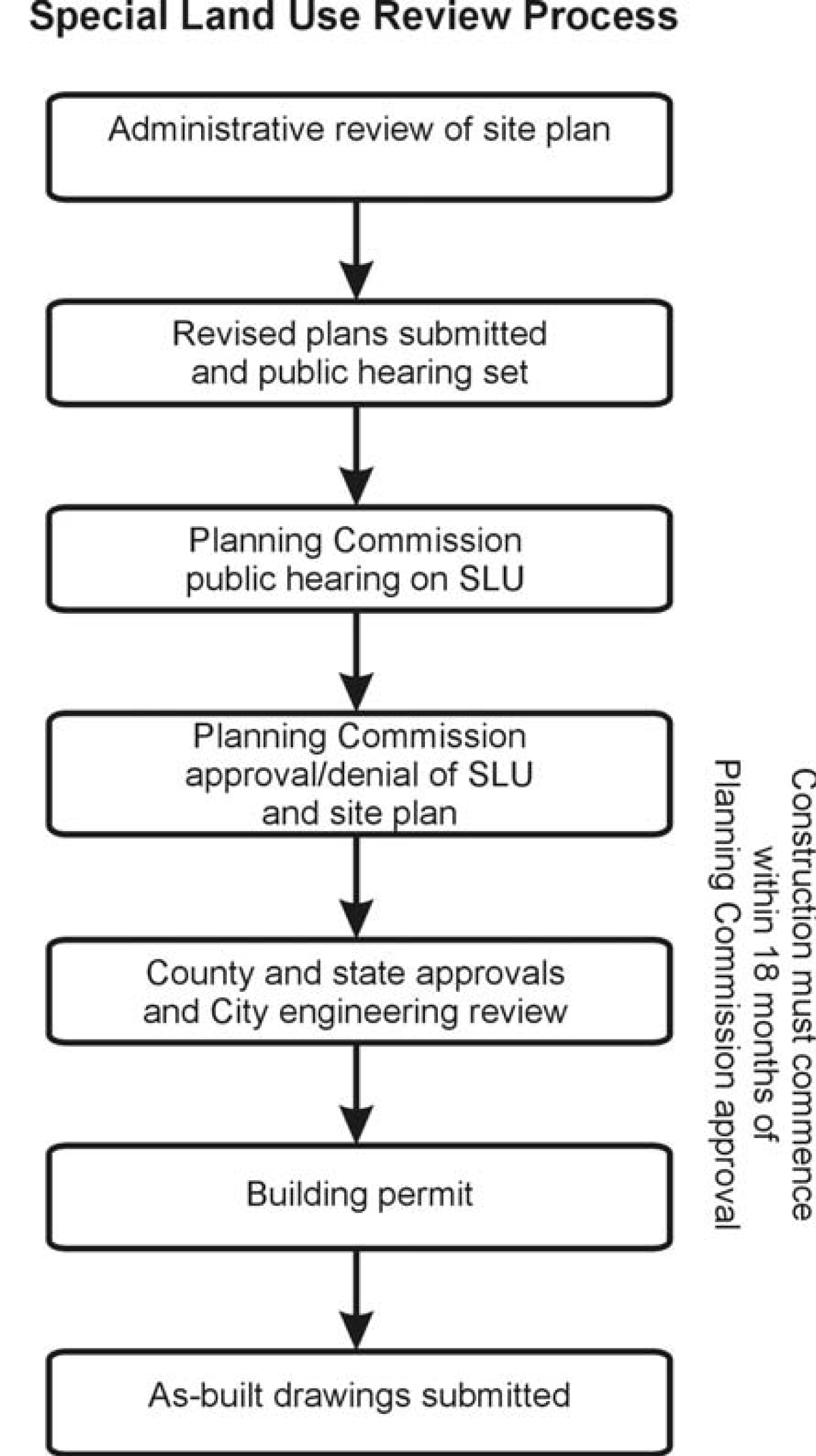
Sec. 21.03. - Procedures.
(a)
Application. An application for the approval of a special land use shall be made by an owner, lessee, or other person with a legal interest in the property who has the owner's written consent to file the application. All of the following shall be submitted with the application for a special land use permit:
(1)
A complete site plan in accordance with the requirements of article 19, site plan review.
(2)
An application fee determined by the city council shall be made payable to the City of Taylor.
(3)
For uses that require an environmental impact statement (EIS) under article 13, use requirements, the EIS shall be submitted to the planning commission at the time of its review of the special land use. If a traffic analysis, community impact report or environmental impact report is required by the city, it shall be submitted to the planning commission at the time of review of the special land use.
(4)
The owner, developer, or their agent may submit additional information or exhibits in support of their application.
(b)
Planning commission.
(1)
The planning commission shall hold a public hearing and request recommendations from city staff. Notice of the public hearing shall be published in accordance with section 25.09, public hearings.
(2)
The planning commission shall review the application and approve, deny, or approve with conditions, the application.
(3)
In reaching its decision the planning commission shall consider the application, staff reports, and other relevant materials.
(4)
Upon a finding that the application meets the general standards of section 21.04, review standards, and the specific standards for that use contained in the use regulations of article 13, use requirements, the planning commission may approve the special land use. Upon approval the planning commission may attach those conditions it deems necessary, in accordance with the provisions of this section.
(5)
If the planning commission determines that the application for the requested special land use does not meet the standards and requirements of this ordinance, it shall deny the application setting forth the reasons for the denial.
(c)
Conditions. Reasonable conditions may be imposed by the planning commission upon any use of land requiring special land use approval. Any such conditions shall be:
(1)
Designed to protect natural resources, the health, safety, and welfare and the social and economic well-being of those who will use the land use or activity under consideration, residents, and landowners immediately adjacent to the proposed land use or activity, and the community as a whole;
(2)
Related to the valid exercise of the police power and purposes which are affected by the proposed use or activity; and
(3)
Necessary to meet the intent and purpose of the zoning ordinance, be related to the standards established in the ordinance for the land use or activity under consideration and be necessary to ensure compliance with those standards.
(d)
Site plan approval. The site plan for the special land use shall be approved by the planning commission. The site plan shall be approved concurrently with the special land use.
(Ord. No. 09-434, § 21.03, 1-20-2009)
Sec. 21.04. - Review standards.
The planning commission shall permit any special land use under the terms of this ordinance if such use meets the various specific standards set forth in the various sections of this ordinance pertaining to uses allowed after special approval and if the planning commission finds the proposed use requiring special land use approval is:
(a)
Compatible with adjacent uses of land. The proposed special land use shall be designed, constructed, operated and maintained to be compatible with uses on surrounding land. The site design of the proposed special land use shall minimize the impact of site activity on surrounding properties. In determining whether this requirement has been met, consideration shall be given to:
(1)
The location and screening of vehicular circulation and parking areas in relation to surrounding development.
(2)
The location and screening of outdoor storage, outdoor activity or work areas, and mechanical equipment in relation to surrounding development.
(3)
The hours of operation of the proposed use. Approval of a special land use may be conditioned upon operation within specified hours considered appropriate to ensure minimal impact on surrounding uses.
(4)
The bulk, placement, and materials of construction of the proposed use in relation to surrounding uses.
(b)
Not injurious to adjacent property, surrounding neighborhoods, or the community as a whole. The proposed special land use shall not involve any activities, processes, materials, equipment, or conditions of operation, and shall not be located or designed so as to be detrimental to public health, safety, and welfare. In determining whether this requirement has been met, consideration shall be given to the production of traffic, noise, vibration, smoke, fumes, odors, dust, glare, and light.
(c)
Enhancement of surrounding environment. The proposed special land use shall provide the maximum feasible enhancement of the surrounding environment, and shall not unreasonably interfere with or discourage the appropriate development and use of the adjacent land and buildings or unreasonably affect their value.
(d)
Provision of landscaping and other site amenities. Provision of additional landscaping over and above the requirements of this ordinance may be required as a condition of approval of a special land use to buffer higher impact uses or screen views.
(e)
Compatibility with the master plan and zoning ordinance. The proposed special land use shall be compatible with and in accordance with the general principles and objectives of the master plan and shall promote the intent and purpose of this ordinance.
(f)
Compatible with the natural environment. The proposed special land use shall not have an unacceptable significant adverse effect on the quality of the natural environment in comparison to the impacts associated with the district's permitted uses. The planning commission may require a quantitative comparison of the impacts of typical permitted uses and the special land use to assist in making this determination (such as an overlay of conceptual development plans, on a natural features map, illustrating other site development options to demonstrate the impacts have been minimized to the extent practical). If the cumulative impact creates or contributes to a significant environmental problem, mitigation shall be provided to alleviate the impacts associated with the requested use (i.e., ensure the end result is at least similar to the preexisting conditions).
(g)
Compatible with the capacities of public services and facilities. The proposed special land use shall be located so as to be adequately served by essential public facilities and services, such as highways, streets, police and fire protection, drainage systems, water and sewage facilities, and schools.
(h)
Impact of traffic. The location of the proposed special land use within the zoning district shall minimize the impact of traffic generated by the proposed use. In determining whether this requirement has been met, consideration shall be given to the following:
(1)
Proximity and access to major streets.
(2)
Estimated traffic generated by the proposed use.
(3)
Proximity and relation to intersections.
(4)
Adequacy of driver sight distances.
(5)
Location of and access to off-street parking.
(6)
Required vehicular turning movements.
(7)
Provision for pedestrian and nonmotorized travel.
(i)
Isolation of existing uses. The location of the proposed special land use shall not result in a small residential area being substantially surrounded by nonresidential development, and further, the location of the proposed special land use shall not result in a small nonresidential area being substantially surrounded by incompatible uses.
(j)
Enhance the social and economic welfare. The approval of a special land use provision is a privilege granted when it can be demonstrated that there is an overriding and compelling benefit that is in the best interest of the city as well as the petitioner. The petitioner must demonstrate that the proposed use will enhance the social and economic welfare of the city.
(k)
Other studies. The planning commission shall have the authority to require other studies and materials be submitted to confirm compliance with the standards of this section including, but not limited to, traffic impact studies, market studies, environmental assessments or utility capacity analysis.
(Ord. No. 09-434, § 21.04, 1-20-2009)
Sec. 21.05. - Validity of permit.
(a)
Start of construction. Special land use approval is valid for a period of 18 months from the date of planning commission approval. A building permit must be issued and physical construction on structures must commence within that period. In the case of a reoccupancy of an existing building, the use must be established within 18 months.
(b)
Extensions. Upon written application filed prior to the termination of the 18-month period as provided above, the planning commission may authorize a single extension of the time limit for a further period of not more than one year. Such extension shall be granted only based on evidence from the applicant that the development has a reasonable likelihood of commencing construction within the one year extension. The planning commission may require compliance with any amendments to the zoning ordinance since the special land use was originally approved.
(c)
Expiration of special land use permit. Where actual construction of a substantial nature of structures authorized by a special land use permit has not commenced within 18 months of issuance, and a written application for extension of the approval has not been filed as provided below, the special land use permit shall become null and void and all rights there under shall terminate.
(Ord. No. 09-434, § 21.05, 1-20-2009)
Sec. 21.06. - Amendments, expansions and change in use.
(a)
Amendments. The property owner shall notify the development services department of any desired change in an approved special land use. The development services department shall determine whether the proposed amendment constitutes a minor or major amendment, based on the total cumulative expansion since the original special land use approval as follows:
(1)
Changes increase the buildings usable floor area by more than 20 percent.
(2)
Parking lots are expanded by more than 20 percent.
(3)
The occupancy, capacity or membership of the use is increased by more than 20 percent.
(4)
The use is expanded to occupy an additional 20 percent or more land area.
(5)
The expansion will result in a 20 percent or more increase in traffic generation based upon the latest edition of the Institute of Traffic Engineers Trip Generation Manual or will change the number or location of driveway access points.
(6)
Any change affecting any previous approved special use condition imposed by the city.
(b)
Major amendments. Any major amendment to an approved special land use by the amounts in subsection (a) above or greater shall require a new special land use permit and shall be reviewed using the procedures and requirements of this article.
(c)
Minor amendment. Minor amendment to an approved special land use less than the amounts noted in subsection (a) above does not require submittal of a new application for a special land use, but shall still be subject to the site plan review requirements of article 19, site plan review.
(d)
Change in use. Change to another type of special land use shall require submission of a new application for a special land use following the review procedures contained in this article. A change in use that is still the same type of use shall not require a new special land use, unless it involves a major expansion. A change in ownership shall not constitute a change in use.
(Ord. No. 09-434, § 21.06, 1-20-2009)
Sec. 21.07. - Revocation of an approved special land use.
The planning commission shall have the authority to revoke any special land use approval after the applicant has failed to comply with any of the applicable requirements of this article, other applicable sections of this ordinance, or conditions of the special land use approval. Prior to any action, the planning commission shall conduct a public hearing following the notification process for the original approval. The applicant shall be provided an opportunity to present information and to answer questions. The planning commission may revoke any previous approval if it finds that a violation exists and has not been remedied. The special use permit may be suspended or revoked according to the following procedure:
(a)
Conditions which may give rise to a suspension or revocation proceeding include, but are not limited to, the following:
(1)
The special land use was not constructed in conformance with the approved plans, or the property is not being used in conformance with the approval special land use;
(2)
Compliance with the special land use permit and any conditions have not been consistently demonstrated, and administrative attempts to secure compliance have been unsuccessful;
(3)
The special land use permit is issued erroneously on the basis of incorrect or misleading information supplied by the applicant and/or his/her agents;
(4)
The operation of the use granted by the special land use permit has created a risk or danger to the public health, safety or welfare; or
(5)
The special use is a violation of any provision of this ordinance or other city, county, state or federal regulations.
(b)
If the development services department determines that a condition for suspension or revocation of the special land permit exists, the development services department shall prepare a report in writing specifying the specific factual details for the violation and which support the suspension or revocation of the special land use permit.
(c)
The development services department shall file the report with the planning commission, and serve a copy of such report on the permitee or his/her authorized agent or employee by regular mail and certified mail, return receipt requested.
(d)
Within 20 days from the date such report has been filed with the planning commission, a date will be set for a hearing before the planning commission on the alleged violations for a determination by the planning commission as to whether or not the special land use permit should be suspended or revoked. Notice of the hearing should be served by the city upon the permittee or its authorized agent or employee personally or by regular mail and certified mail, return receipt requested, not less than seven days before a scheduled hearing date.
(e)
That all such hearings, the permittee shall have the legal right to defend against the allegations made by way of confronting any adverse witnesses, by being able to present witnesses on his/her behalf, by being allowed to present arguments, personally or through legal counsel in his/her own behalf.
(f)
The planning commission shall prepare a written statement of its findings within 30 days of the conclusion of all such hearings and serve such findings upon the permittee either personally or by regular mail and certified mail, return receipt requested. If the planning commission decides that the special land use permit shall be suspended or revoked, the permittee shall not thereafter conduct, operate or carry on the business or use for which the special use permit was granted.
(Ord. No. 09-434, § 21.07, 1-20-2009)
Sec. 21.08. - Appeals.
(a)
Appeals. The zoning board of appeals (ZBA) shall not have the authority to hear appeals of the planning commission's decision to approve or deny a special land use, nor to grant variances to any conditions imposed on special land use approval. Appeals from decisions under this article may be taken to circuit court.
(b)
Variances. The ZBA may hear requests for variances to district or site plan requirements that are not related to the conditions of special land use approval.
(Ord. No. 09-434, § 21.08, 1-20-2009)
Sec. 21.09. - Restrictions on resubmittal of a special land use request.
An application for a special land use permit which has been denied wholly or in part shall not be resubmitted for a period of one year from the date of denial, except on the grounds of new evidence or proof of changed conditions relating to all of the reasons noted for the denial found to be valid by the planning commission. A resubmitted application shall be considered a new application.
(Ord. No. 09-434, § 21.09, 1-20-2009)

