
Taylor City Zoning Code
ARTICLE 04
MULTIPLE-FAMILY RESIDENTIAL DISTRICTS
Sec. 4.01.- Intent.
(a)
The R-2 Townhouse Residential District is designed as an intermediate density zoning district that allows a variety of housing types, including the single-family attached dwelling commonly termed the townhouse. It is intended that this district be used primarily on collector streets on smaller land parcels and in situations where the close proximity of single-family detached housing developments would be adversely influenced by the higher density traditional multiple family complex. It is intended to encourage development which, though multiple-family in nature, is closer in character or scale to single-family development, with duplexes and attached townhouses, each having individual entrances, yards, driveways and garages.
(b)
The RM-1 Low Rise Multiple-Family Residential District is intended to provide sites for multiple-family dwellings of low-rise construction and residentially-related uses that serve the residents in the district. This district is intended to provide a proper environment for families that are smaller in size than those living in single-family dwellings, who wish to live in low-rise multiple-family dwellings. The RM-1 district is designed to furnish sites for various types of attached single-family and multiple-family dwelling structures and may serve as a transition between nonresidential districts and lower density single-family residential districts.
(c)
The RM-2 High Rise Multiple-Family Residential District is intended to provide sites for multistory multiple-family dwelling structures primarily for the elderly. These structures shall serve the residential needs of elderly persons desiring multiple-family accommodations with central services.
(Ord. No. 09-434, § 4.01, 1-20-2009)
Sec. 4.02. - Schedule of uses.
Buildings or land shall be not used and buildings shall not be erected except for one or more of the following specified uses, unless otherwise provided for in this ordinance. Land and/or buildings in the districts indicated at the top of table 4.02 may be used for the purposes denoted by the following abbreviations:
(a)
Permitted use (P). Land and/or buildings in this district may be used for the purposes listed by right.
(b)
Special land use (SLU). The following uses may be permitted by obtaining special land use approval when all applicable requirements in article 13, use requirements, and the standards of section 21.04, review standards are met.
(c)
Not permitted (—). The use is not permitted in the district.
(d)
Additional requirements. Indicates requirements or conditions applicable to the use.
TABLE 4.02. MULTIPLE-FAMILY RESIDENTIAL DISTRICTS
SCHEDULE OF USES
(Ord. No. 09-434, § 4.02, 1-20-2009; Ord. No. 23-511, § 1, 6-20-2023)
Sec. 4.03. - Area, height, and placement requirements.
All lots and buildings shall meet the following dimensional requirements:
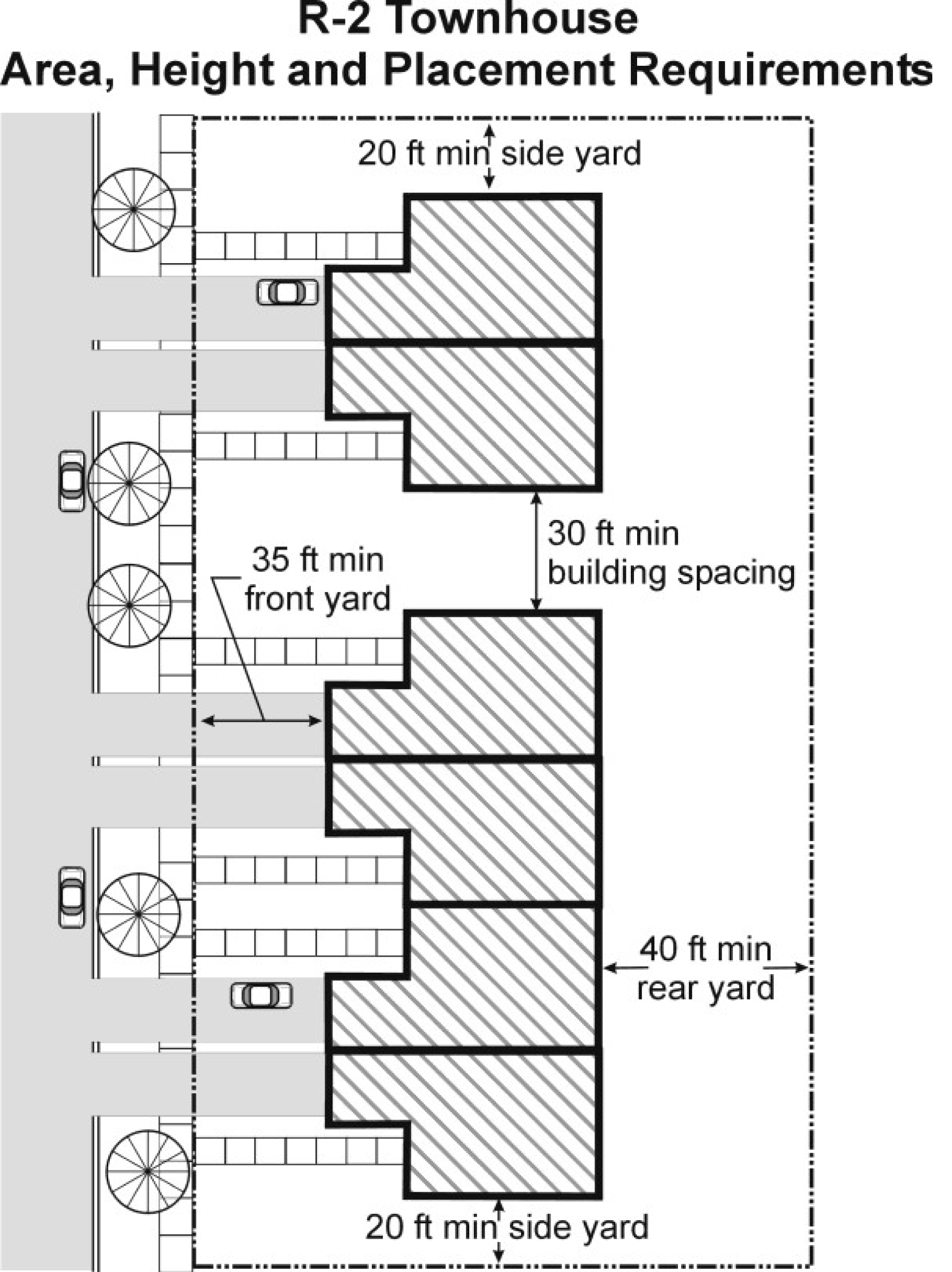
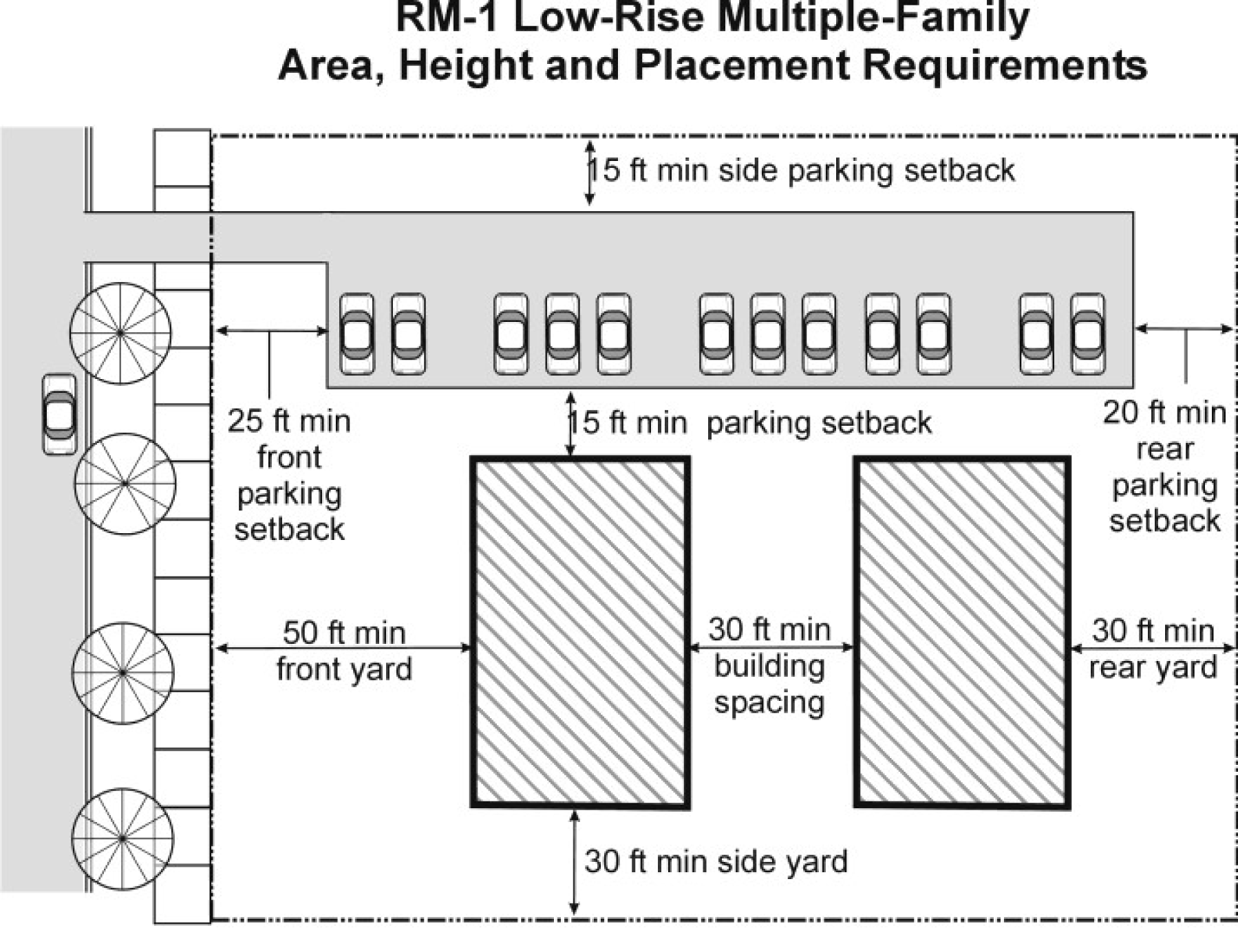
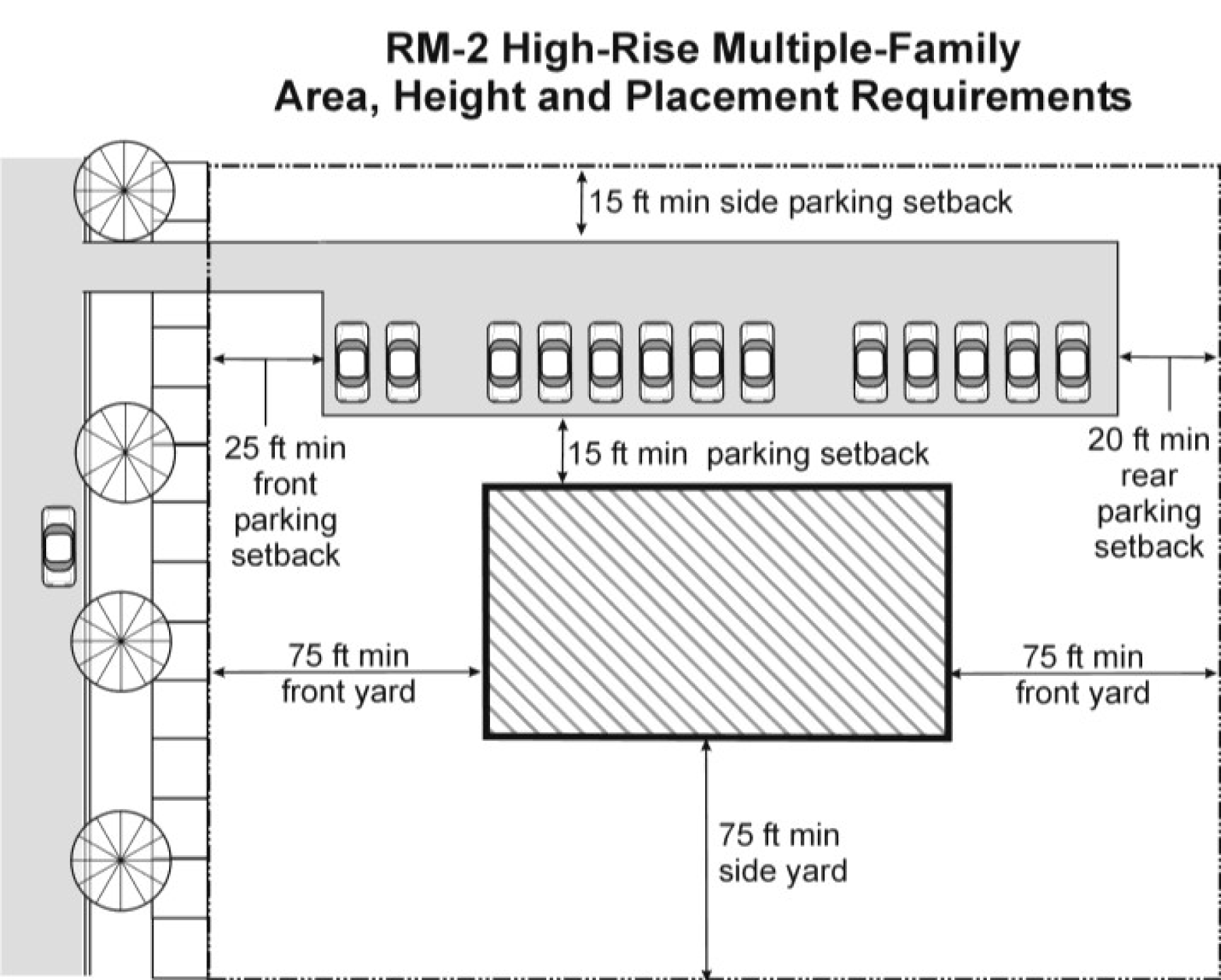
TABLE 4.03.A. MULTIPLE-FAMILY RESIDENTIAL DISTRICTS
AREA, HEIGHT AND PLACEMENT REQUIREMENTS
(a)
Recreational area. Recreation areas and amenities shall be provided to sufficiently meet the anticipated needs of the residents of the development.
(1)
Open space/recreation areas equaling 400 square feet per dwelling unit shall be provided and be clearly delineated on the site plan.
(2)
The planning commission shall determine the adequacy of any proposed recreation areas and amenities, considering the type of unit, the recreation needs of anticipated residents and the proximity of nearby recreation facilities.
(3)
Recreational amenities such as playscapes, athletic fields, trails, picnic tables or other suitable recreation facility to meet the needs of the residents shall be provided within the recreation area. Provisions for separate adult and youth recreation areas are encouraged.
(4)
Recreation amenities shall be centrally located within neighborhoods.
(5)
Required setbacks, buffers, greenbelts, individual lots, public rights-of-way, private street easements, wetlands and stormwater management areas shall not be considered as recreation areas.
(6)
The recreational area shall be well drained, graded, seeded or sodded, safe from hazard, accessible to all dwellings. Preserved natural features on the site may be counted toward meeting the open space requirement if improvements are provided that allow passive recreation use such as pathways, gazebos and picnic areas. At least one-half of the required recreation area shall be developed for active recreational use.
(7)
Recreational areas shall be irrevocably reserved for this use and required maintenance shall be the responsibility of the homeowners association unless otherwise approved by the city.
(8)
In a phased development, a land reservation and a performance guarantee meeting the requirements of section 25.08, performance guarantees, shall be required to guarantee the completion of planned improvements if not completed in the current phase.
(b)
Lot frontage. All lots shall have frontage on a dedicated public street. The frontage shall be of sufficient width so that the lot meets or exceeds the minimum lot width requirement at the front yard setback for in the district in which the lot is located. Flag or stacked lots that do not provide adequate frontage shall be prohibited.
(c)
Access. All multiple-family developments shall have direct access to major or secondary thoroughfares. All public streets shall meet the city street standards. All private streets shall have a minimum width of 31 feet.
(d)
Building length. The maximum length of continuous and/or contiguous buildings shall not exceed 200 feet.
(e)
Building height. Exceptions to building height shall be allowed as provided for in section 14.08, height limit.
(f)
Yards maintained as landscaped open space. All buildings, parking, loading driveways, circulation aisles, and storage areas shall meet the setback requirement. Setback areas shall be provided with landscape greenbelts and buffer zones as required in section 16.02, landscaping.
(g)
Projections into yards. Those structures listed in section 14.11, projections into required yards, are permitted to project into required yard setbacks.
(h)
Natural features setback. All structures shall be set back at least 25 feet from all natural features such as drains, regulated wetlands, natural ponds, lakes and streams.
(i)
Building spacing. The setback requirements indicated in table 4.03.a shall be measured from the perimeter of the lot. Internal setbacks shall be as follows:
(1)
There shall be at least 30 feet between any two principal buildings in the R-2 and RM-1 districts. The building spacing may be reduced to 20 feet between the sides of two townhouse or two-family buildings.
(2)
Where two or more multiple-family structures are erected on the same lot or parcel in the RM-2 district, they shall be separated by at least 50 feet, plus one foot for each two feet of the total combined height of the two structures.
(3)
The minimum yard, spacing, and setback requirements (both perimeter and interior) may be reduced by up to ten feet if the same space is increased by an equal amount on the opposite side of the building.
(j)
Buffer from single-family residential districts. The area within setbacks which abut a single-family residential district shall be maintained as landscaped open space unoccupied and unobstructed by any sign, building, paving or any use or activity that may be detrimental to adjacent single-family uses.
(k)
Single-family residential. Detached single-family residential located on individual lots shall meet the setbacks and building height requirements of the R-1B district.
(l)
Freeway and railroad setback. All dwelling units shall be setback a minimum of 200 feet from a freeway or railroad right-of-way.
(m)
Front yard setback. The front yard setback shall apply to all yards that adjoin a street including public streets, private streets and interstate highways. Corner lots and double frontage lots shall be considered to have two front yards. All buildings and parking areas shall meet the front yards setback requirement. Detention/retention ponds shall be prohibited in the required front yard setback, unless the city engineer determines there is no reasonable alternative due to existing topography and natural drainage problems. This restriction shall not apply to rain gardens, bio-retention swales, irrigation trench planters and other similar stormwater management alternatives to retention or detention ponds.
(n)
Parking and building setbacks. A minimum 15-foot setback from all internal streets, drives and parking areas shall be provided for multiple-family, two-family and attached single-family residential units. This setback shall not apply to individual unit driveways; provided, driveways shall maintain a minimum 25 feet between the building and a sidewalk for the parking of a vehicle without blocking the sidewalk.
(o)
Front yard setback. The planning commission may decrease the minimum front yard setback requirement for buildings by up to 50 percent where all of the following are met:
(1)
The building is designed to create a pedestrian-friendly environment.
(2)
The parking lot is not located in the front yard or, where there are individual garages, the garages are side entry, rear entry or front entry with a 25-foot setback from the front lot line.
(3)
The building design and reduced setback are consistent with the overall character of the neighborhood.
(p)
Lot coverage. Maximum lot coverage shall be regulated by two measures:
(1)
The maximum percent of the lot area that can be covered by buildings.
(2)
The maximum percent of the lot area that can be covered by buildings plus other impermeable surfaces, such as pavement, decks and pools.
(q)
Floor area. The minimum floor area per dwelling unit shall not include area of attics, basements, utility rooms, breezeways, porches, or attached garages.
(r)
Senior housing.
(1)
The maximum density for elderly housing and congregate housing shall be: 30 units per acre in the RM-1 district and 60 units per acre in the RM-2 district.
(2)
In the RM-2 district, the maximum building height may be increased to seven stories and 77 feet for buildings designed exclusively for elderly housing and congregate housing.
(3)
The minimum floor area for elderly housing and congregate housing shall be in accordance with table 4.02.b.
TABLE 4.02.B. MINIMUM FLOOR AREAS FOR SENIOR HOUSING
(Ord. No. 09-434, § 4.03, 1-20-2009)

