
Taylor City Zoning Code
ARTICLE 06
BUSINESS AND OFFICE DISTRICTS
Sec. 6.01.- Intent.
(a)
The B-1 Local Business District is intended to meet the day-to-day convenience shopping and service needs of persons residing in adjacent residential areas. B-1 district designations are located within close proximity to areas planned for large residential populations, and are intended to serve the immediate vicinity so as not to create unnecessary additional traffic. In order to promote business development compatible with nearby residential, uses are prohibited that would create hazards, offensive and loud noises, vibration, smoke, glare, heavy truck traffic, or late hours of operation.
(b)
The B-2 Regional Business District is intended to serve a larger population than is serviced by a B-1 district. The district is general characterized by an integrated or planned cluster of establishments serviced by a common parking area and generating a large volume of vehicular and pedestrian traffic. The intent of this district is also to encourage the concentration of regional business areas to the mutual advantage of both the consumers and merchants and thereby to promote the best use of land at certain strategic locations and to avoid encouraging marginal strip, business development along arterial streets. Special attention must be focused on site layout, building design, vehicular and pedestrian circulation and coordination of site features between adjoining sites.
(c)
The B-3 General Business District is intended to provide for retail commercial services dependent on major street traffic. The uses in the B-3 district will be more automotive oriented and serve a market that includes city residents and residents from surrounding communities. The permitted uses would be located at the juncture of principal streets and are generally not appropriate immediately adjacent to residential zoning districts. Special attention must be focused on site layout, building design, vehicular circulation and buffering from other nearby uses.
(d)
The O-1 Office District is intended to accommodate uses such as offices for professional and business services, planned office developments, as well as appropriately located related and ancillary services and uses. The O-1 district is intended to permit those office and personal service uses which will establish an appropriate district for uses which do not generate large volumes of traffic, traffic congestion, and parking problems, and which will promote the most desirable use of land in accordance with the master plan. The O-1 district is further intended to provide a buffer or zone of transition between residential and commercial districts and between residential districts and arterial streets.
(e)
The O-2 Regional Office District is designed and intended to accommodate large office buildings and restricted related retail and service establishments which service large numbers of people. The O-2 district is intended to permit those office and personal service uses which will provide office buildings in landscaped settings to create office parks or landmark office buildings.
(Ord. No. 09-434, § 6.01, 1-20-2009)
Sec. 6.02. - Schedule of uses.
Buildings or land shall be not used and buildings shall not be erected except for one or more of the following specified uses, unless otherwise provided for in this ordinance. Land and/or buildings in the districts indicated at the top of Table 6.02 may be used for the purposes denoted by the following abbreviations:
(a)
Permitted use (P). Land and/or buildings in this district may be used for the purposes listed by right.
(b)
Special land use (SLU). The following uses may be permitted by obtaining special land use approval when all applicable requirements in article 13, use requirements, and the standards of section 21.04, review standards, are met.
(c)
Not permitted (—). The use is not permitted in the district.
(d)
Additional requirements. Indicates requirements or conditions applicable to the use.
TABLE 6.02. BUSINESS AND OFFICE DISTRICTS
SCHEDULE OF USES
(Ord. No. 09-434, § 6.02, 1-20-2009; Ord. No. 13-474, § 1, 2-19-2013; Ord. No. 25-520, § 1, 5-6-2025)
Sec. 6.03. - Area, height and placement requirements.
All lots and buildings shall meet the following dimensional requirements:
TABLE 6.03. BUSINESS AND OFFICE DISTRICTS
AREA, HEIGHT AND PLACEMENT REQUIREMENTS
(a)
Building height. Exceptions to building height shall be allowed as provided for in section 14.08, height limit.
(b)
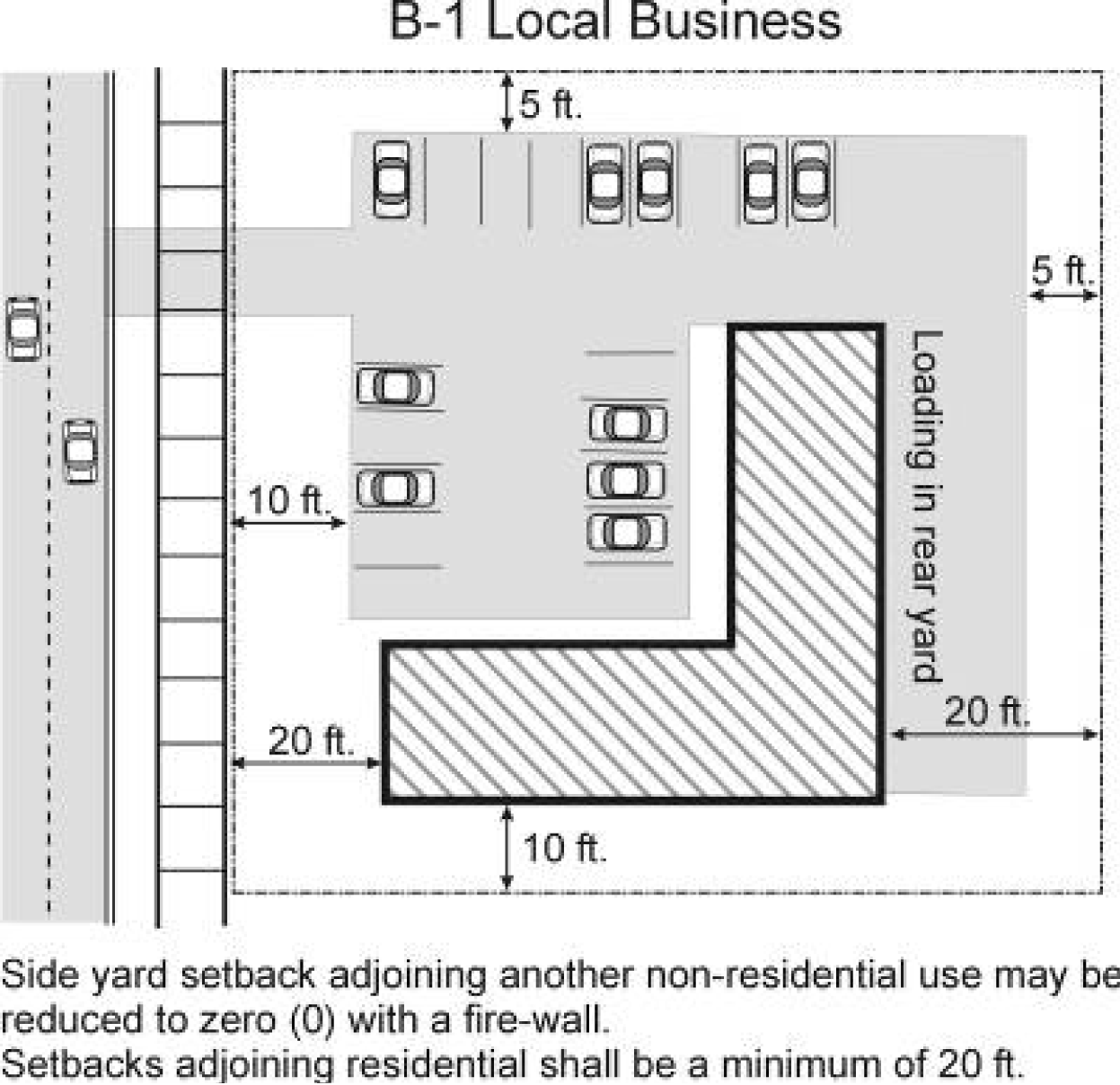
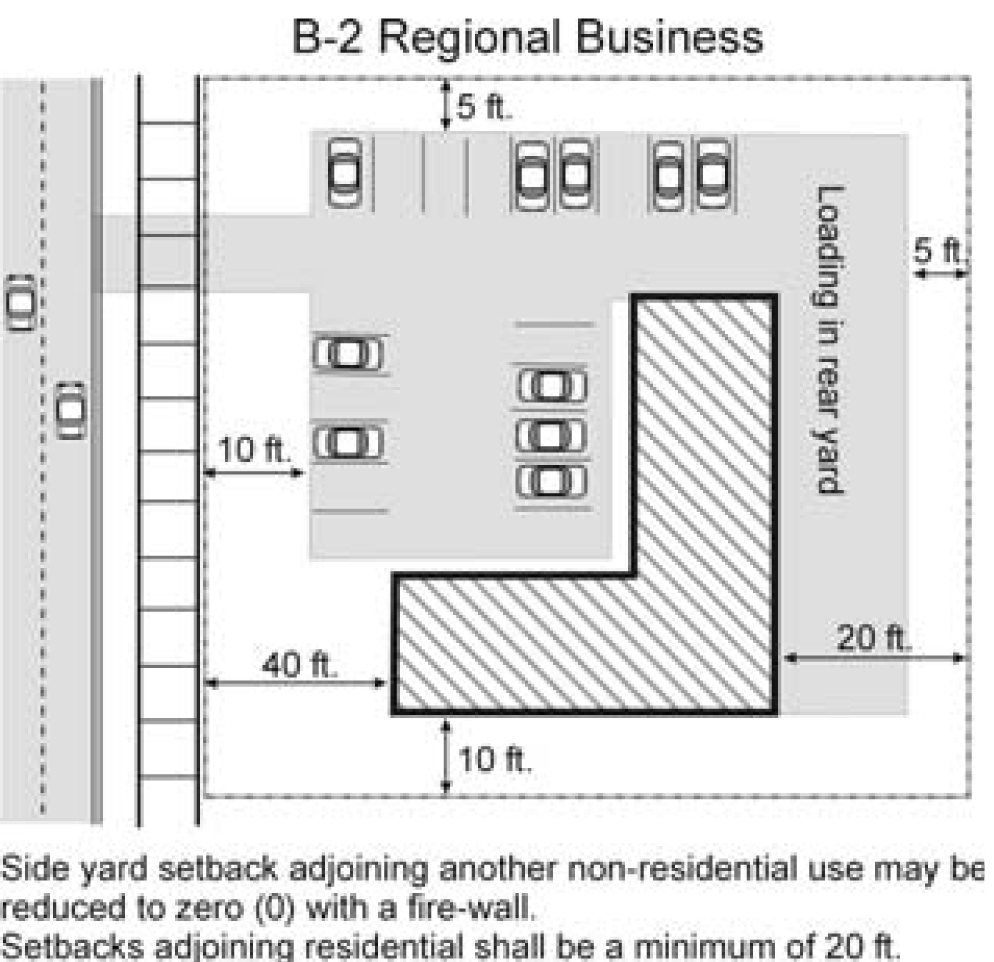
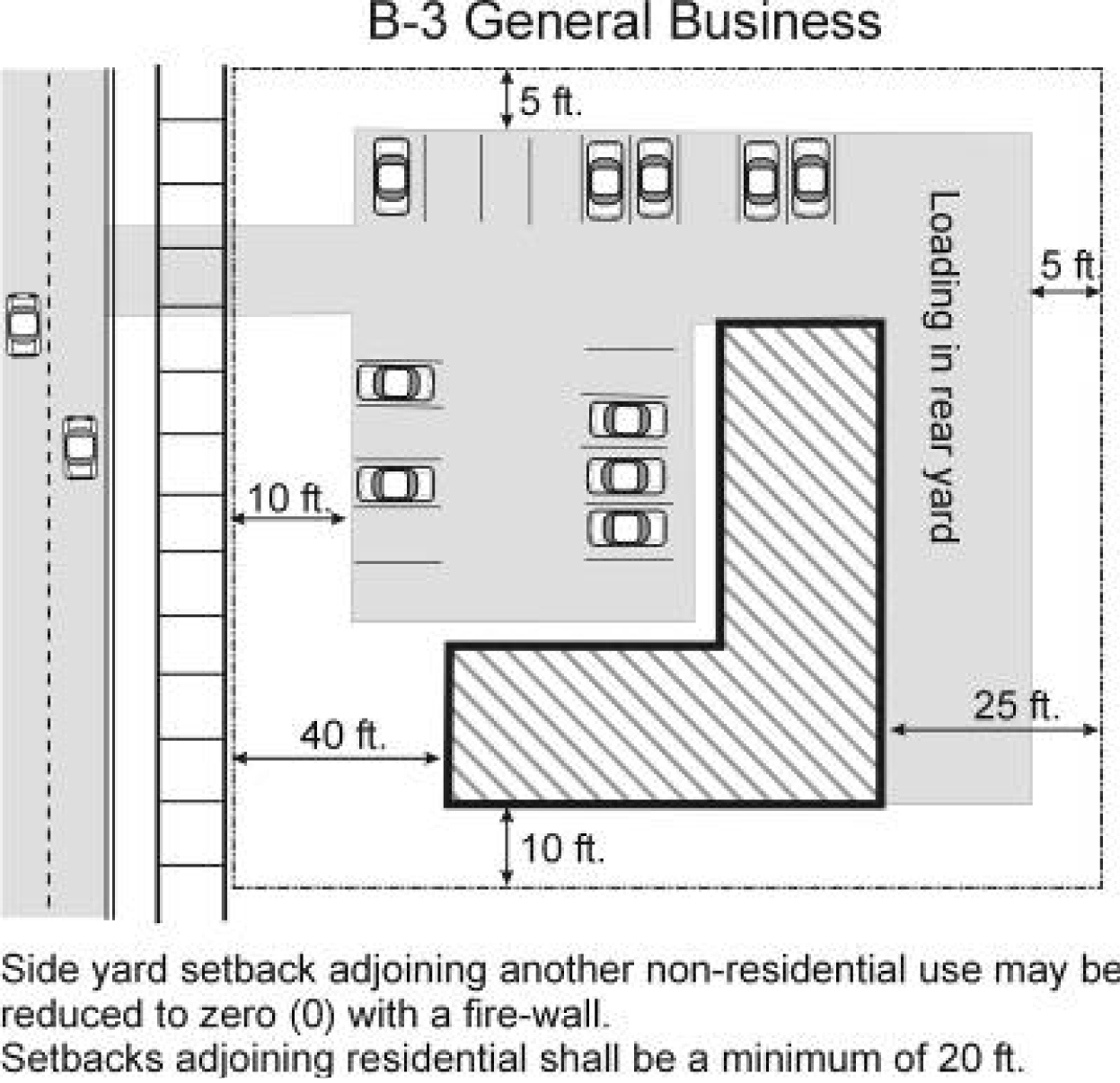
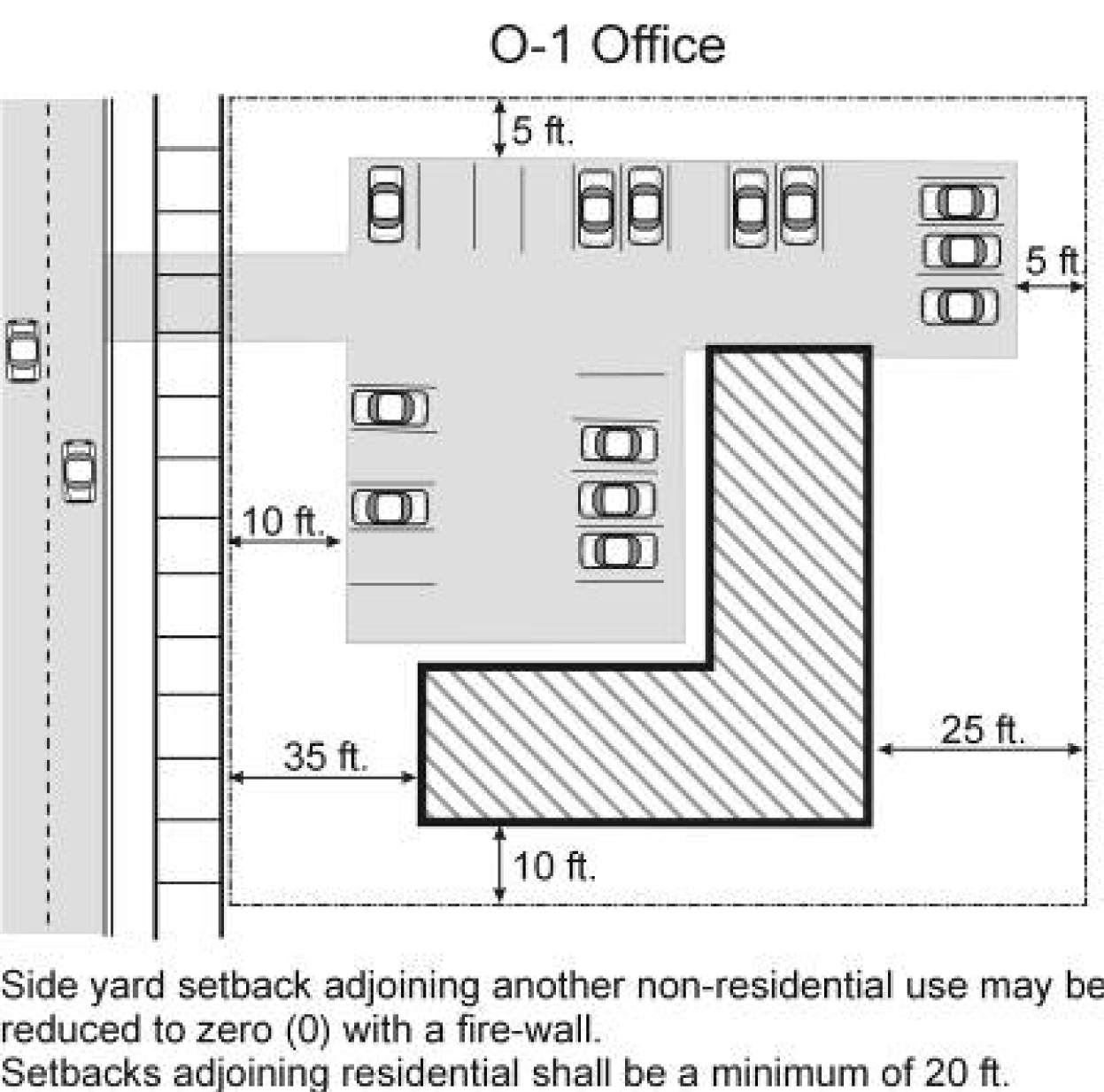
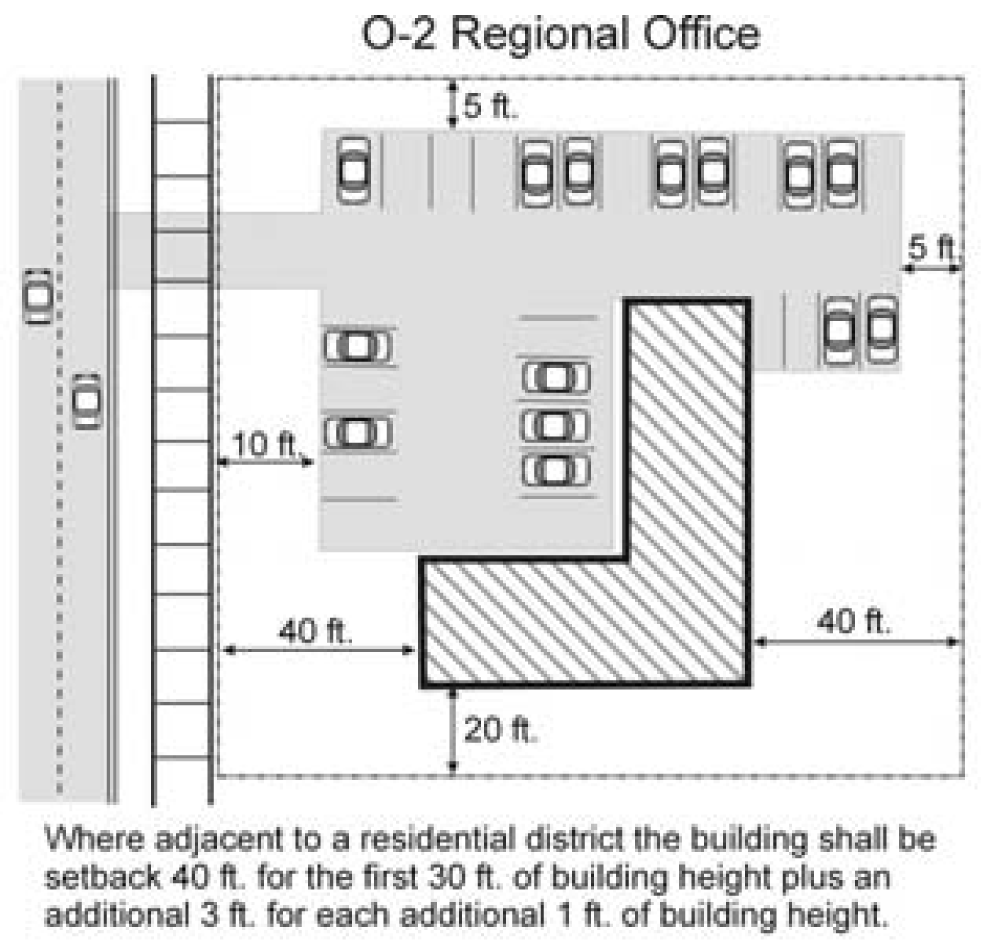
Yards maintained as landscaped open space. All buildings, parking, loading driveways, circulation aisles, and storage areas shall meet the setback requirement. Setback areas shall be provided with landscape greenbelts and buffer zones as required in section 16.02, landscaping.
(c)
Outdoor storage. Outdoor storage shall be screened in accordance with section 16.02, landscaping. Storage areas shall meet the applicable building setback requirements from each lot line.
(d)
Projections into yards. Structures in section 14.11, projections into required yards, shall be permitted to project into required yard setbacks.
(e)
Natural features setback. All structures shall be set back at least 25 feet from all natural features such as drains, regulated wetlands, natural ponds, lakes and streams.
(f)
Front yard setback. The front yard setback shall apply to all yards that adjoin a street including public streets, private streets and interstate highways. Corner lots and double frontage lots shall be considered to have two front yards. All buildings, parking, loading and storage areas shall meet the front yards setback requirement. Detention/retention ponds shall be prohibited in the required front yard setback, unless the city engineer determines there is no reasonable alternative due to existing topography and natural drainage problems. This restriction shall not apply to rain gardens, bio-retention swales, irrigation trench planters and other similar stormwater management alternatives to retention or detention ponds.
(g)
Front yard setback on small lots. For lots that are less than 150 feet in depth, the front yard setback of a new building may match the front yard setback of the majority of existing buildings within the block.
(h)
Building side yard setback. No side yards are required along the interior side lot lines of the district adjoining another nonresidential lot where all requirements of the state construction code are met. If walls of structures facing interior side of lot lines contain windows, or other openings, side yard setbacks shall be provided in accordance with table 6.02. Where a lot borders on a residential district, there shall be provided a setback of not less than 20 feet on the side bordering the residential district.
(i)
Parking side yard setback. The parking setback shall not be required adjoining another nonresidential lot where the lots have shared driveway access, shared parking or other cross access circulation between the sites without the need to access a public street. Where a parking lot of loading area borders on a residential district, there shall be provided a buffer and screening from the residential district as required by section 16.02, landscaping.
(j)
Loading areas. Loading space shall be provided in the rear yard. Where an alley exists or is provided at the rear of buildings, the rear building setback and loading requirements may be computed from the center of said alley. All loading and unloading shall be provided off-street in the rear yard or interior side yard, and shall in no instance be permitted in a front yard. Loading and unloading areas located in a side yard shall be fully screened from view from a public street. No overhead doors shall be permitted in the front elevation of the building. All residential districts and uses must be screened from truck loading and unloading activities.
(k)
Lot coverage. Maximum lot coverage shall be regulated by two measures:
(1)
The maximum percent of the lot area that can be covered by buildings.
(2)
The maximum percent of the lot area that can be covered by buildings plus other impermeable surfaces, such as pavement, decks and pools.
(l)
Regional office setback from residential. Where a O-2 district site abuts a residential district and is not separated by a street or railroad right-of-way, the building shall be setback from the residential district a minimum of 40 feet for the first 30 feet of building height plus an additional three feet for each additional one foot of building height in excess of 30 feet.
(Ord. No. 09-434, § 6.03, 1-20-2009)

