
Taylor City Zoning Code
ARTICLE 07
MIDTOWN DISTRICTS
Sec. 7.01.- Intent.
The MT-1 Midtown Taylor Office/Institutional District and MT-2 Midtown Taylor Mixed Use Commercial District, are intended to promote the development of a pedestrian oriented and accessible, central commercial service district in which a variety of retail, commercial, office, civic and residential uses are permitted consistent with the City of Taylor Master Plan. Each use shall be complimentary to the stated function and purpose of the district and shall not have adverse impact upon adjacent street capacity and safety, utilities, and other city services. The MT-1 and MT-2 districts are further intended to:
(a)
Encourage traditional, pedestrian-oriented commercial/mixed use developments in a walkable main street environment.
(b)
Extend greater opportunities for greater traditional community living, working, housing, and recreation to all citizens and residents of the city.
(c)
Encourage a more efficient use of land and of public services and to reflect changes in technology of land development, by directing new development in a traditional pattern of mixed use and varied commercial styles.
(d)
Create a community center that is pedestrian, and transit-friendly, which supports a healthier and more sustainable community.
(e)
Reduce the excess sprawl of development and the segregation of land uses that cause increased vehicle travel and traffic congestion.
(f)
Discourage the development of separate off-street parking facilities for each individual use, and to encourage the development of off-street parking facilities to accommodate the needs of several individual uses.
(g)
Prohibit the development of drive-through facilities, which degrade the pedestrian environment, contribute to traffic congestion and create a nuisance to residential uses in the type of compact mixed use environment desired for the Midtown area.
(h)
Prohibit uses that are disruptive to pedestrian activities and have as their principal function the sale and services of motor vehicles, such as automobile service stations, auto parts retail stores, carwashes, new and used motor vehicle sales or service establishments, drive-in restaurants and restaurants with drive-through facilities, business with drive-through facilities such as, but not limited to banks, credit unions, pharmacies, etc.
(i)
Promote the creation of urban places, which are orientated to the pedestrian, thereby promoting citizen security and social interaction.
(j)
Promote developments where the physical, visual and spatial characteristics are established and reinforced through the consistent use of compatible urban design and architectural design elements. Such elements shall relate to the design characteristics of an individual structure or development of other existing and planned structures or developments in a harmonious manner (architectural texture or pattern), resulting in coherent overall development patterns and streetscape.
(k)
Discourage commercial and business uses that create noise, glare or odors, which are a nuisance in a mixed use environment.
(l)
More efficiently provide for parking through shared parking and on-street parking where appropriate.
(Ord. No. 09-434, § 7.01, 1-20-2009)
Sec. 7.02. - Schedule of uses.
Buildings or land shall be not used and buildings shall not be erected except for one or more of the following specified uses, unless otherwise provided for in this ordinance. Land and/or buildings in the districts indicated at the top of table 7.02 may be used for the purposes denoted by the following abbreviations:
(a)
Permitted use (P). Land and/or buildings in this district may be used for the purposes listed by right.
(b)
Special land use (SLU). The following uses may be permitted by obtaining special land use approval when all applicable requirements in article 13, use requirements, and the standards of section 21.04, review standards, are met.
(c)
Not permitted (—). The use is not permitted in the district.
(d)
Additional requirements. Indicates requirements or conditions applicable to the use.
TABLE 7.02. MIDTOWN DISTRICTS
SCHEDULE OF USES
(Ord. No. 09-434, § 7.02, 1-20-2009; Ord. No. 23-511, § 1, 6-20-2023)
Sec. 7.03. - Area, height, and placement requirements.
(a)
MT-1 district. All lots and buildings in the MT-1 district shall meet the following dimensional requirements. Certain dimensional requirements apply to all types of buildings while others distinguish between residential and nonresidential/mixed use. Nonresidential/mixed use buildings refer to buildings containing commercial, office, or institutional, live/work units and buildings with multiple-family residential/apartment units above nonresidential uses on the first floor. Residential refer to single-family residential, two-family residential, townhouses and multiple-family residential.
MT-1 DIMENSIONAL REQUIREMENTS
| Front yard |
Nonresidential/mixed use
No minimum/maximum | 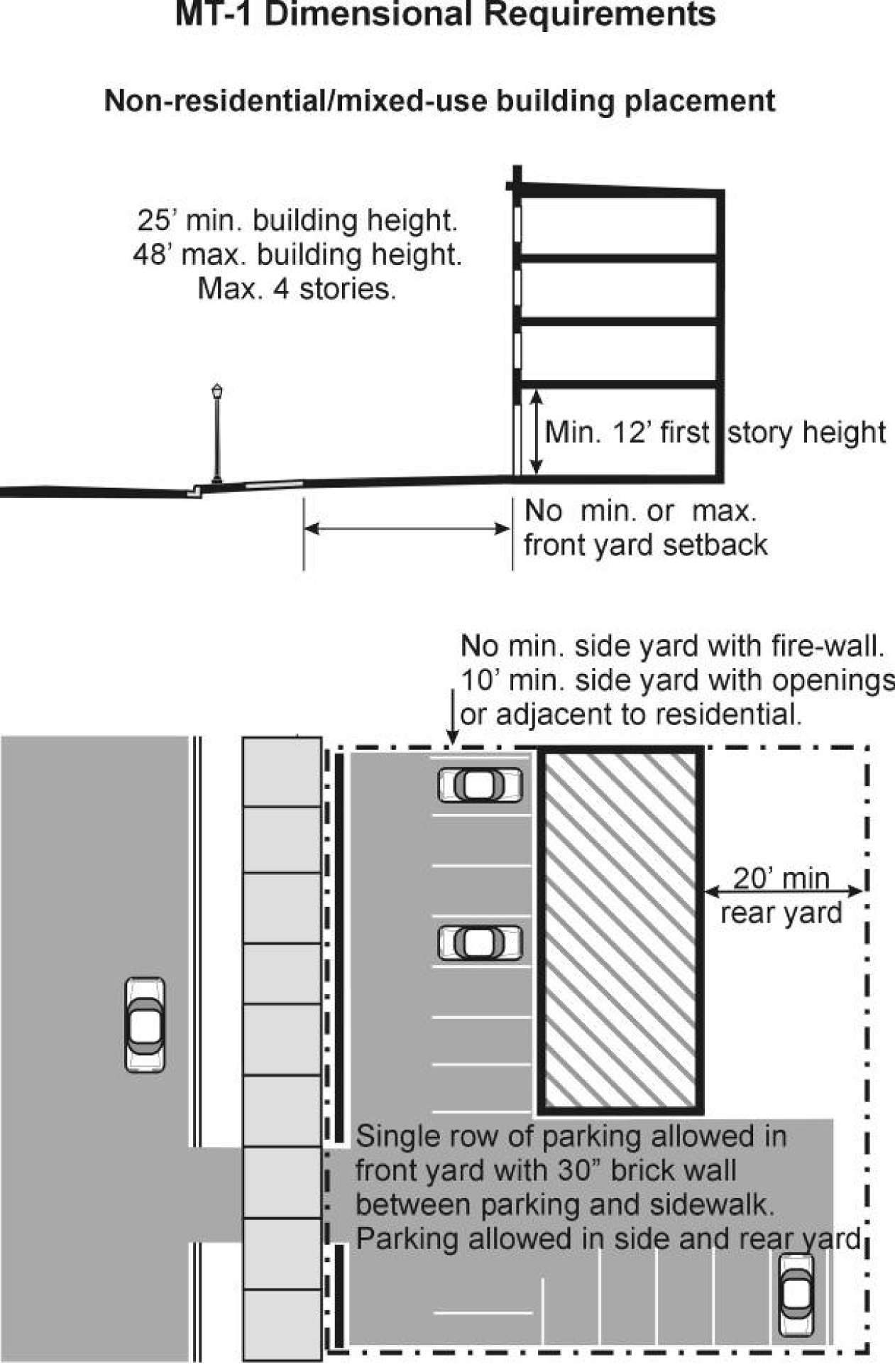 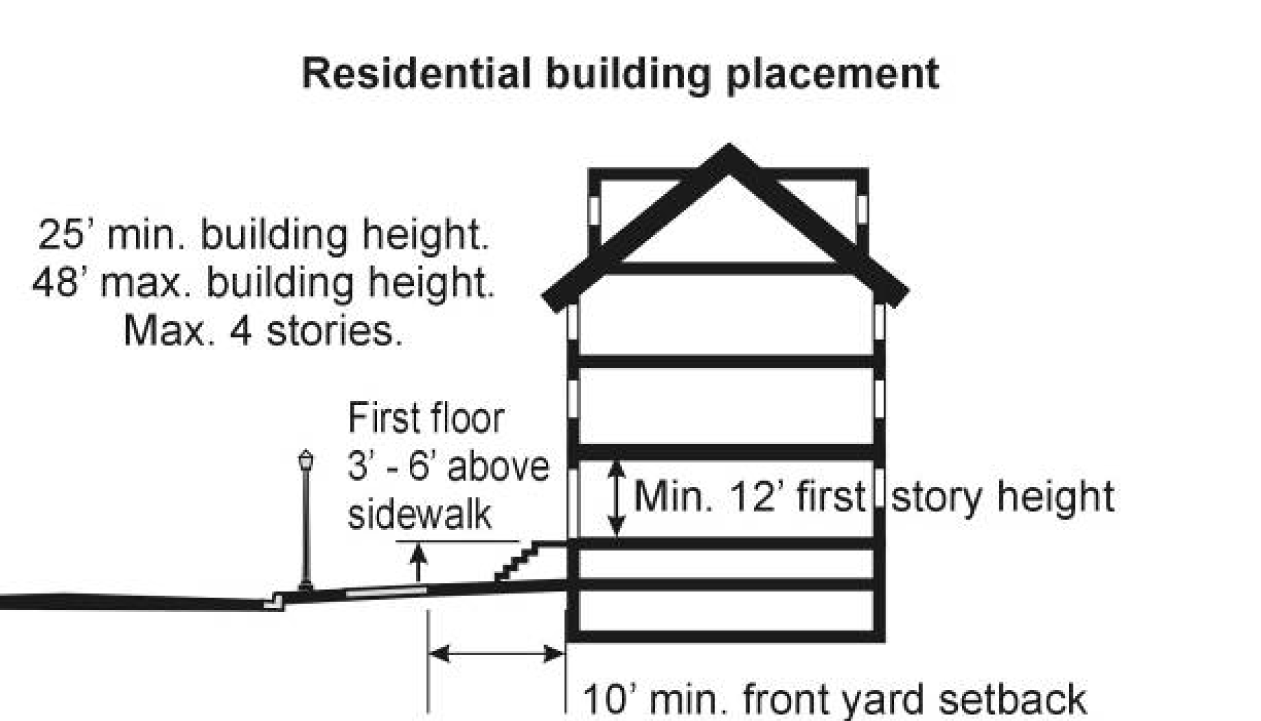 |
|
Residential
Ten-foot minimum | ||
| Side yard |
None required with fire-rated wall
Minimum ten feet with windows or other openings Minimum ten feet from adjacent residential lot | |
| Rear yard | Minimum 25-foot | |
| Building height |
Minimum 25-foot
Maximum four stories/48 feet | |
| First story height |
Nonresidential/mixed use
Minimum 12-foot first story height measured from floor to ceiling | |
|
Residential
First floor three to six feet above front sidewalk grade along any arterial or collector street, zero to six feet along local street Minimum nine-foot first story height measured from floor to ceiling | ||
| Accessory building | Accessory building only in side or rear yard minimum three feet from side and rear lot line | |
| Parking |
Nonresidential/mixed use
No more than a single row of parking shall be allowed in the front yard facing Goddard Road All other parking shall be in a side or rear yard, or fronting on a side street | |
|
Residential
No parking shall be permitted in the front yard All garages shall be located in the rear yard | ||
| Residential density |
Maximum 16 dwelling units per acre in a residential building
Maximum 24 dwelling units per acre in mixed use building (such as apartments above commercial or live/work units) |
(b)
MT-2 district. All lots and buildings in the MT-2 district shall meet the following dimensional requirements. Certain dimensional requirements apply to all types of buildings while others distinguish between residential and nonresidential/mixed use. Nonresidential/mixed use buildings refer to buildings containing commercial, office, or institutional, live/work units and buildings with multiple-family residential/apartment units above nonresidential uses on the first floor. Residential shall refer to single-family residential, two-family residential, townhouses and multiple-family residential.
MT-2 DIMENSIONAL REQUIREMENTS
| Front yard |
Nonresidential/mixed use
Minimum zero feet, maximum 15 feet | 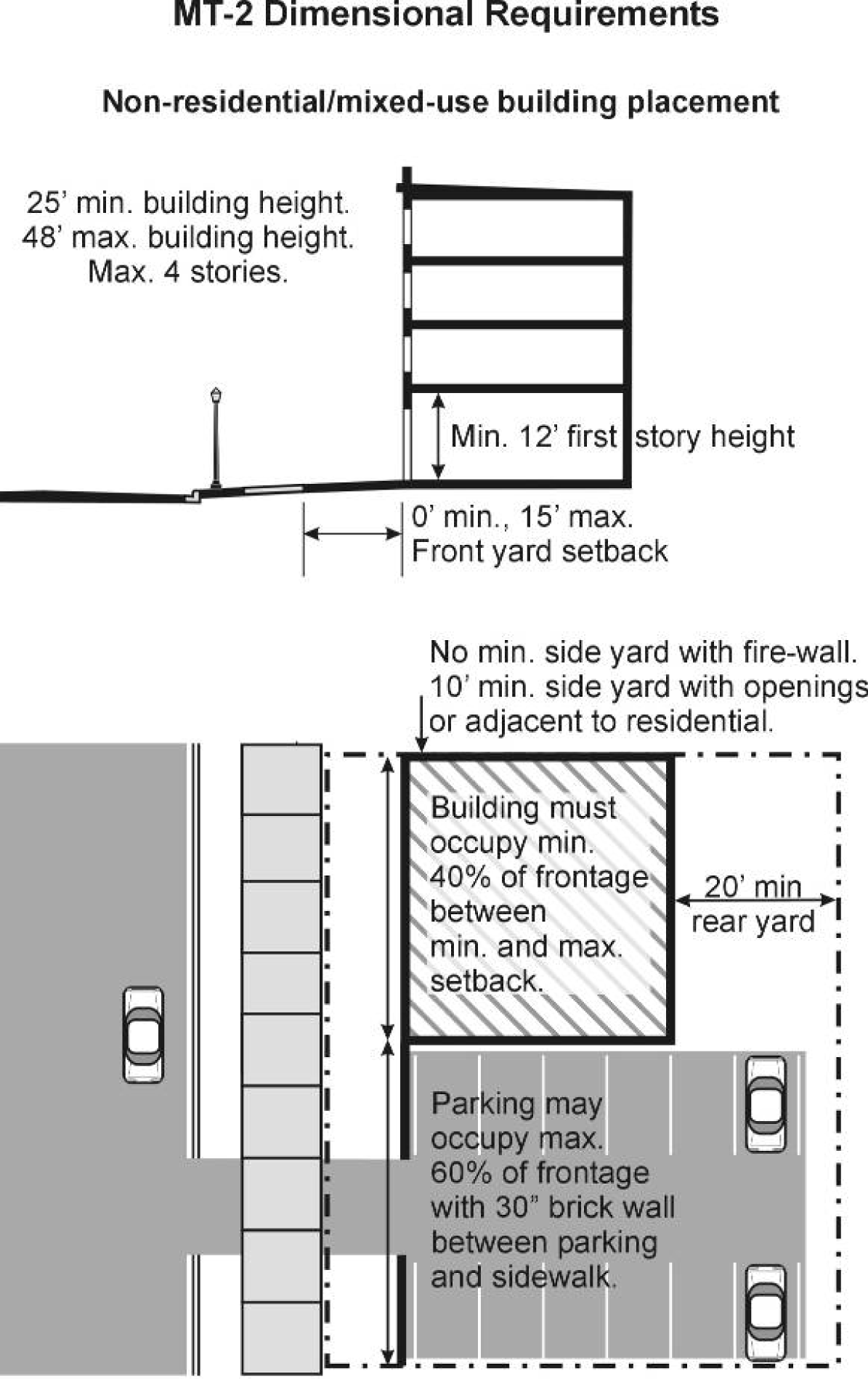 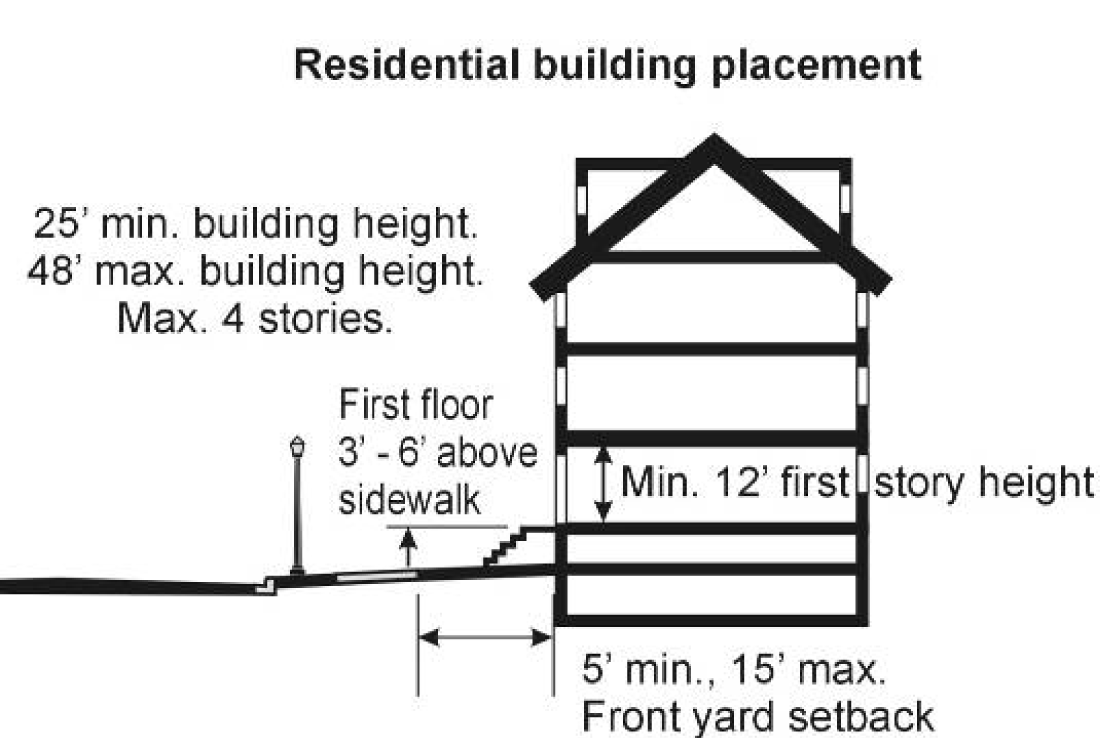 |
|
Residential
Minimum five feet, maximum 15 feet | ||
| Building frontage required | Building facade shall occupy a minimum of 40 percent of the frontage length along Goddard Road between the minimum and maximum setback | |
| Side yard |
None required with fire-rated wall
Minimum ten feet with windows or other openings Minimum ten feet from adjacent residential lot | |
| Rear yard | Minimum 20 feet | |
| Building height |
Minimum 25 feet
Maximum four stories/48 feet Minimum 12-foot first story height measured from ground level grade to ceiling | |
| First story |
Nonresidential/mixed use
Minimum 12-foot first story height measured from floor to ceiling | |
|
Residential use
First floor three to six feet above front sidewalk grade along any arterial or collector street Zero to six feet along local street Minimum nine-foot first story height measured from floor to ceiling | ||
| Accessory building | Accessory building only in side or rear yard minimum three feet from side and rear lot line | |
| Parking |
Nonresidential/mixed use
Parking lots shall be not be allowed in the front yard facing Goddard Road Side and rear yard parking is permitted up to 60 percent of the frontage to the side of the building may be occupied by off-street parking, provided a 30-inch tall brick wall is located between the sidewalk and parking lot | |
|
Residential use
No parking shall be permitted in the front yard All garages shall be located in the rear yard | ||
| Residential density |
Maximum 16 dwelling units per acre in a residential building
Maximum 24 dwelling units per acre in mixed use building (such as apartments above commercial or live/work units) |
(c)
Modifications. The planning commission may modify the area, height and placement requirements where strict adherence would serve no good purpose or where the overall intent of the district would be better served by allowing an alternative setback provided all of the conditions below are found to exist.
(1)
That a modification in setback will not impair the health, safety or general welfare of the city as related to the use of the premises or adjacent premises.
(2)
That the setback shall be consistent with the building lines of adjacent buildings and not be setback a greater distance from the street than adjacent buildings.
(3)
The building will still be oriented towards the street, provide pedestrian connections between the building, and the sidewalk along the street and maintain or enhance the continuity of the pedestrian-oriented environment.
(4)
That waiver of the setback along a common parcel line between two premises would result in a more desirable relationship between a proposed building and an existing building.
(5)
The adherence to a minimum required setback would result in the establishment of nonusable land area that could create maintenance problems.
(Ord. No. 09-434, § 7.03, 1-20-2009)
Sec. 7.04. - Architectural requirements.
(a)
Nonresidential and mixed use architecture. Nonresidential buildings, mixed use buildings (with residential and nonresidential uses) and live/work units shall meet the following architectural design requirements:
(1)
Front facade requirements.
a.
Buildings shall front onto the sidewalk with windows, doors, and architectural detailing customary of traditional storefronts and contain varying materials, and appearances.
b.
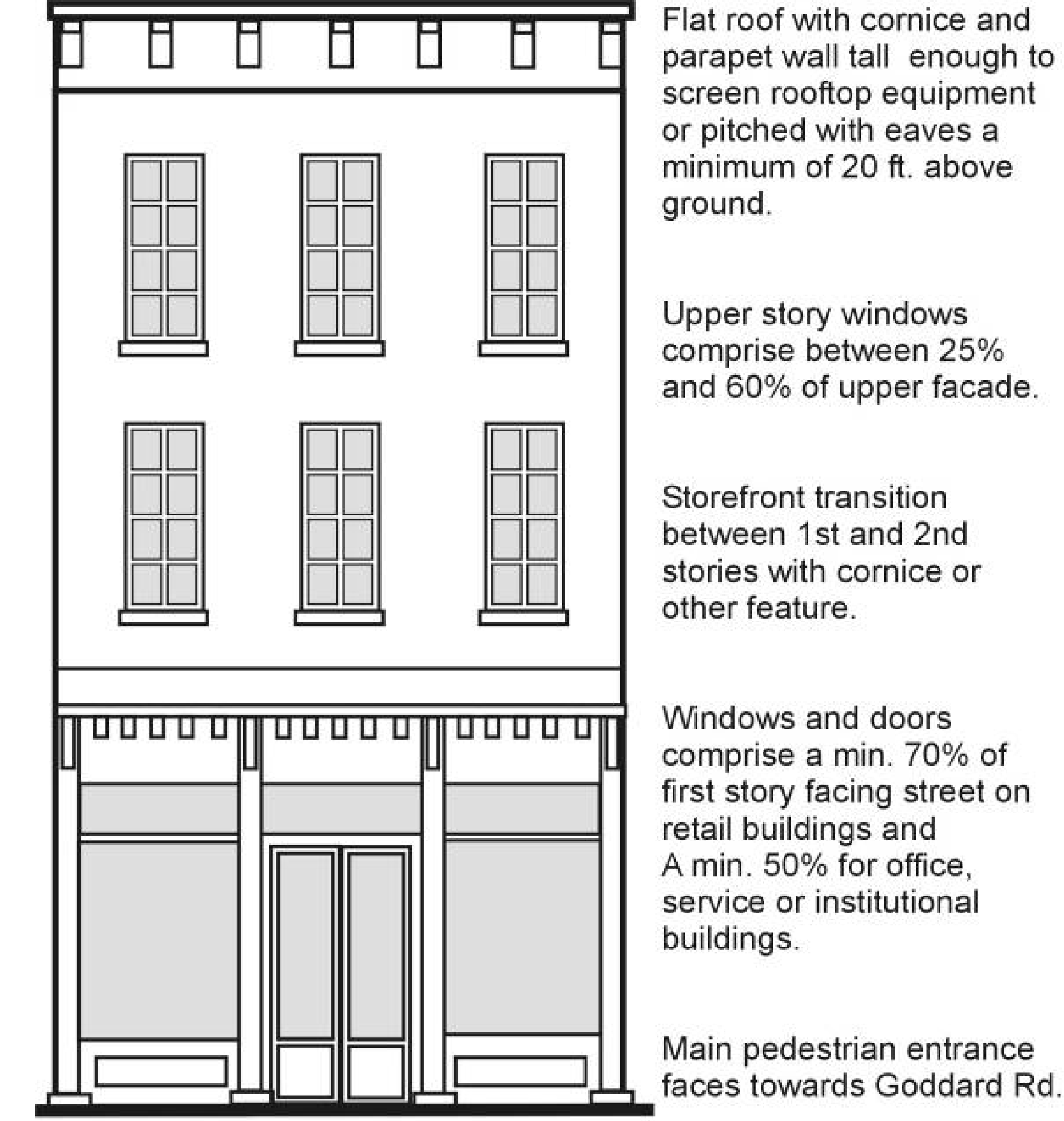
All buildings shall have a public entrance that faces towards Goddard Road. Rear entrances are permitted, only if there is a primary entrance from Goddard Road.
c.
Main entrances shall have design details that enhance the appearance and prominence of the entrance so that it is recognizable from the street and parking areas.
d.
For buildings longer than 100 feet, there shall be a minimum of one usable entrance every full 50 feet of frontage and architectural variation shall be provided to visually break the building up.
(2)
Windows and doors.
a.
On a retail building, no less than 70 percent of the storefront/ground floor front facade between two feet and eight feet high shall be clear glass panels and doorway for retail and consumer service uses. For office, service, institutional or other nonretail uses a minimum of 50 percent of the ground floor front facade shall be clear glass panels and doorway.
b.
Required window areas shall be either windows that allow views into retail space, working areas or lobbies, pedestrian entrances, or display windows set into the wall.
c.
Windows shall not be blocked with opaque materials or the back or shelving units.
d.
Openings above the first story shall be a minimum of 25 percent and a maximum of 60 percent of the total facade area.
e.
Solid metal security gates or solid roll-down metal windows shall be prohibited. Link or grill type security devices shall be permitted only if installed from inside, within the window or door frames; or, if installed on the outside, if the coiled box is recessed and concealed behind the building wall. Security grills shall be recessed and concealed during normal business hours. Models that provide a sense of transparency, in light colors are encouraged. Other types of security devices fastened to the exterior wall are prohibited.
(3)
Storefront transition. Buildings that have upper stories shall be designed to create a distinct and separated ground floor area through the use of accent such as a cornice, change in material or textures, or an awning or canopy between the first and second stories.
(4)
Roof design.
a.
Unless otherwise approved by the planning commission, buildings shall have a flat roof appearance from the street with a decorative cornice that is designed proportionate to the size of the building and length of the wall.
b.
The planning commission may permit a pitched roof. Pitched roofs shall not be permitted with eaves below a height of 20 feet. Mansard roofs shall not be permitted on single story buildings.
c.
Flat roofs shall be enclosed by parapets.
d.
All rooftop mounted equipment shall be screened from view on all sides of the building.
e.
Parapets and other screening treatment shall use high quality building materials and shall blend with the design of the building in terms of color, materials, style, scale and height.
(5)
Building materials.
a.
The following exterior finish materials are required on the front facade and any facade facing a street or parking area. These requirements do not include areas devoted to windows and doors. These requirements apply in lieu of section 16.01, building appearance.
b.
All walls exposed to public view from the street or parking area shall be constructed of not less than 75 percent brick, stone, masonry, or other natural materials, not including window or door areas. Up to 25 percent of the facade may include wood siding or fiber cement siding.
c.
Panel brick, tilt-up brick textured paneling, bare metal, aluminum siding, metal panels, plastic, imitation stucco, texture 1—11, and mirrored glass shall be prohibited.
d.
Exterior insulation finish systems (EFIS) may be used for architectural detailing above the first floor only.
(6)
Building colors. Exterior colors shall be compatible with the colors on adjacent buildings, subject to review by the planning commission. Proposed colors shall be specified on the site plan. Gaudy or fluorescent colors are prohibited.
(7)
Side or rear facade design. Wherever a side or rear facade is visible from a public street, or if parking is located at the side or rear of a building, the facade shall be designed to create a harmonious appearance, in accordance with the following design criteria. Materials and architectural features similar to those present on the front of the building shall be used on the side or rear facade.
(8)
Corner buildings.
a.
Buildings situated at a corner shall possess a level of architectural design that incorporates accents and details that accentuate its prominent location. This can be accomplished through height projections incorporated into a design feature such as additional height, a building peak, tower, or similar accent with the highest point located at the intersecting corner. Alternatively, a pedestrian plaza may be provided at the corner of the intersecting streets.
b.
A main entrance must be on a street-facing wall and either at the corner or within 25 feet of the corner.
(9)
Awnings.
a.
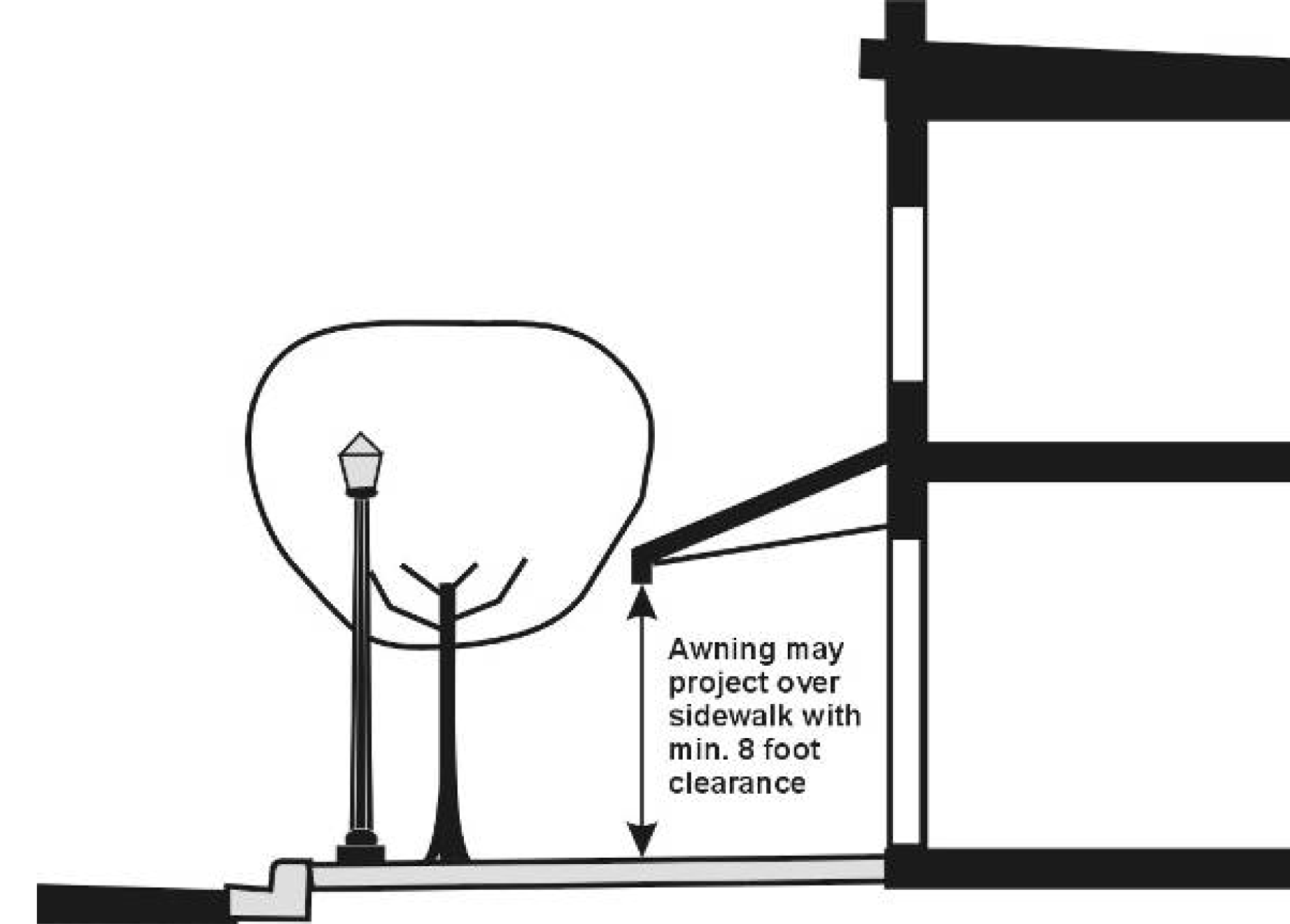
Awnings may project over the public sidewalk with a minimum eight-foot clearance provided from the sidewalk, but may not extend beyond the street curb.
b.
Awnings shall be are positioned immediately above the ground floor window area of the facade and have a straight shed that projects from the building at a straight angle with open sides.
c.
All awnings shall be attached directly to the building, rather than supported by columns or poles.
d.
Awnings shall be constructed of a durable, material such as canvas or similar material, rather than metal, plastic, or rigid fiberglass. High gloss or plasticized awning are prohibited.
e.
Awnings shall not be internally illuminated and any signs shall be illuminated by fixtures located above the awning and directed downward.
f.
Awnings shall be maintained in good appearance and repair.
g.
Streamers, banners or similar items are prohibited.
(10)
Live/work. Live/work units shall be dwelling units attached with common side walls wherein the main floor of each unit is designed to accommodate a small business with upper floors utilized for dwelling purposes. The first floor space of each unit shall be designed to be utilized as an office or retail store with a commercial storefront that is at-grade with the sidewalk. The upper floors shall include a dwelling unit with the unit designed to be under single occupancy as an integral unit.
(b)
Residential architecture. Detached single-family and two-family residential dwellings, townhouses and multiple-family residential shall meet the following architectural design requirements. Mixed use buildings with multiple-family residential/apartment units above nonresidential uses on the first floor shall be subject to the design requirements of section 7.04(a) above.
(1)
Building design.
a.
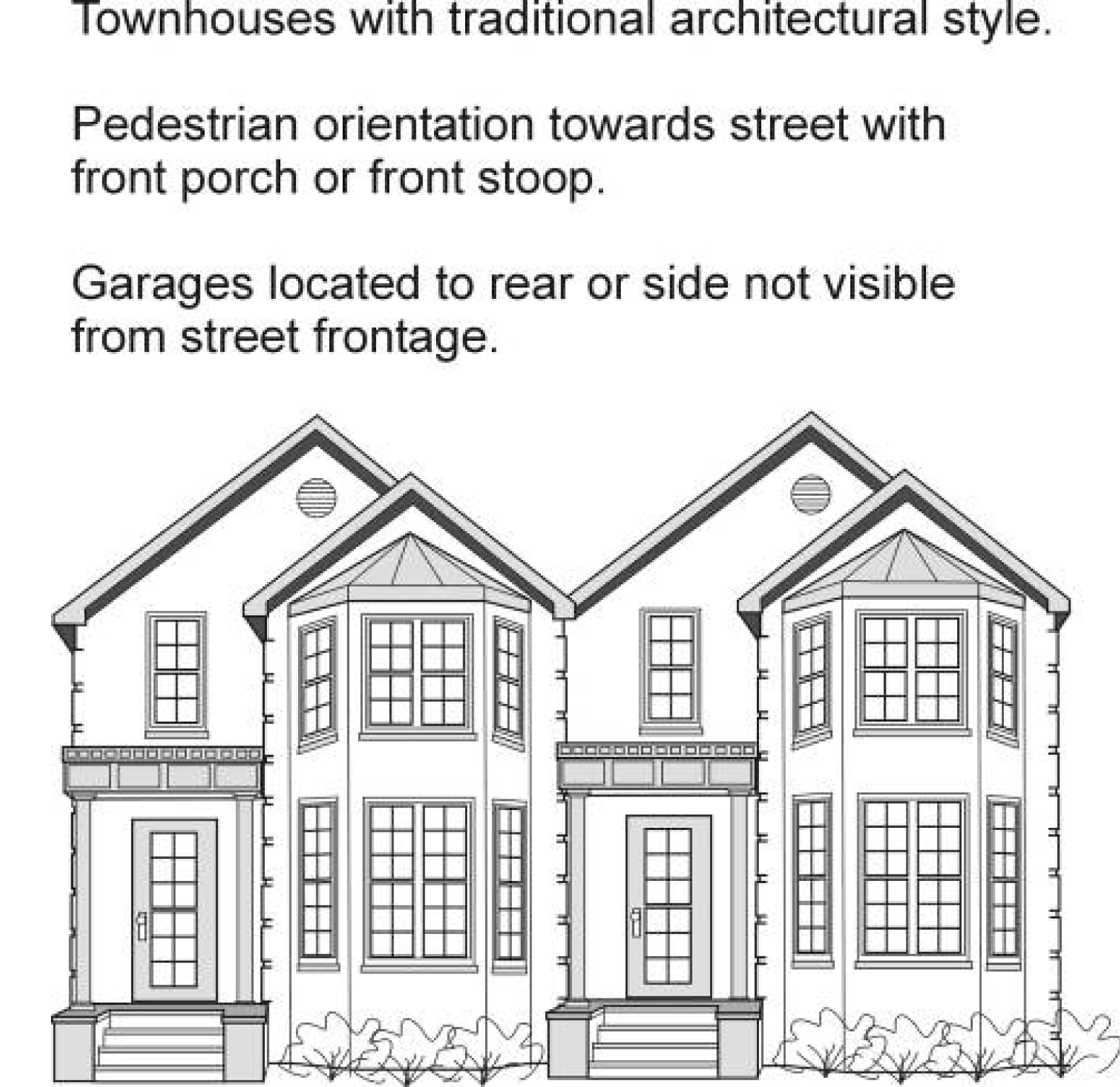
Residential buildings shall be design based on traditional architectural styles, such as but not limited to: arts and crafts/bungalow, colonial, gothic revival, Italianate, Tudor, Victorian and others characteristic of the Midwestern United States and with historic buildings characteristic of Wayne County.
b.
For any residential development that contains five or more dwelling units, typical elevations shall be approved by the planning commission as part of the development's design guidelines or a pattern book.
c.
Townhouses shall each provide a separate entryway with direct access to the outdoors at ground level by way of a front porch or stoop. Each unit shall have defined front and rear yards. Each unit shall be provided with an individual garage, which may be attached or detached. All garages shall be located in the rear yard.
(2)
Front facade, single-family, two-family and townhouse.
a.
Each residential unit shall have an individual front door that faces the front lot line.
b.
All dwellings shall include a front porch or front stoop with steps.
c.
A stop or porch (plus steps) shall not extend any nearer than three feet to the sidewalk located at the front of the lot. An ADA accessibility ramp may extend up to within one foot of any lot line.
d.
The front facade of all residential units shall be at least 15 percent windows or doors.
e.
The finished floor elevation shall be no less than three feet and no more than six feet above the elevation of the exterior sidewalk located at the front of the building along frontages of arterial and collector streets, as designated in the City of Taylor Master Plan. Entrances may be at grade along local street frontages.
(3)
Front facade, multiple-family residential/apartments.
a.
There shall be at least one pedestrian door facing the front lot line with access either directly to the sidewalk or to a center court that opens to the sidewalk along the street frontage.
b.
The entrance shall be inserted three feet from the front building wall.
c.
The first floor elevation shall be no less than three feet and no more than six feet above the average elevation of the exterior sidewalk located at the front of the building along frontages of arterial and collector streets, as designated in the City of Taylor Master Plan. Entrances may be at grade along local street frontages. An ADA accessibility ramp may extend up to within one foot of any lot line.
d.
The front facade of all residential units shall be at least 15 percent windows or doors.
(4)
Building material.
a.
All buildings shall utilize high-quality building materials that are in keeping with traditional architectural styles found in Wayne County.
b.
Permitted wall materials are limited to brick, stone, wood and fiber cement siding only. Vinyl siding shall be permitted above the ground floor only.
(5)
Garages.
a.
Detached garages shall be located in the rear yard and may be accessed by a rear alley or, in the case of single-family detached dwellings, by a driveway that runs from the front yard to the rear along the side of the dwelling.
b.
Attached garages may be permitted on the rear of the building or on the side of the building; provided the garage is setback at least five feet behind the front building line of the living portion of the dwelling and the garage wall facing the street is less than 50 percent of the total length of the street-facing building facade.
c.
Front loaded garages for attached residential dwellings are prohibited.
(c)
Modifications. The planning commission may approve deviations to the architectural requirements of this section in order to achieve the objectives of the midtown districts through the use of creativity and flexibility in development and design. Each deviation shall be evaluated based upon all of the following criteria:
(1)
Innovations in architectural design may be permitted, provided the building design shall be in keeping with the desired character of the midtown district, as articulated in the Midtown Taylor Design Manual, and the proposed building fits within the context of adjacent buildings along the block.
(2)
The building shall be oriented towards the front sidewalk and maintain or enhance the continuity of the pedestrian-oriented environment.
(3)
The exterior finish materials shall be of equal or better quality and durability as those permitted herein, with the intent to allow for new technologies in building material while maintaining the desired character of the midtown district.
(4)
Ground floor windows shall be provided along the front sidewalk to maintain the pedestrian orientation of the streetscape and upper story windows shall not be incompatible with the rhythm and proportions of windows on other buildings along the block.
(Ord. No. 09-434, § 7.03, 1-20-2009; Ord. No. 10-442, § 1, 3-16-2010)
Sec. 7.05. - Streetscape requirements.
(a)
Match downtown development authority. The area within the right-of-way between the curb and the building shall be identical to or compatible with the streetscape scheme of the downtown development authority (DDA).
(b)
Street trees. Street trees shall be provided at 25-foot to 40-foot intervals. The species of street tree and exact location shall be as specified on the DDA master street tree plan that is on file with the development services department. In the event that a DDA master street plan has not been prepared, than any of the following street trees shall be planted within the street right-of-way at 25-foot to 40-foot intervals: Norway maple, red maple, Bradford pear, or little leaf linden.
(c)
Landscape plan. On every site involving new development or redevelopment, a landscape plan shall be submitted for review and approval. The landscape design shall be identical to or compatible with the Midtown Taylor Design Manual on file with the development services department. Landscaping shall also meet the requirements of section 16.02, landscaping.
(d)
Street furniture. Benches and trash receptacles shall be provided in park and plaza areas and along sidewalks where the planning commission determines that pedestrian activity will benefit from these facilities.
(e)
Bicycle facilities. Developments shall be designed to accommodate bicycle travel, including the provision of bike paths, and bike racks at destination points such as shopping and recreational facilities.
(Ord. No. 09-434, § 7.05, 1-20-2009)
Sec. 7.06. - Parking and loading.
(a)
Parking requirements. Parking lots shall conform to the requirements of section 17.02, off-street parking facility design. Because the regulations of this section are intended to encourage pedestrian/transit friendly design and compact mixed use development that requires less reliance on automobiles, the planning commission shall have the discretion to reduce the number of parking spaces required by section 17.01, off-street parking, loading, access and circulation requirements, by up to 30 percent.
(b)
On-street parking. Where on-street parking is permitted, it may be credited towards meeting off-street parking requirements of section 17.01, off-street parking, loading, access and circulation requirements.
(c)
Location. Off-street parking shall be located in the side or rear yard to the maximum extent practical.
(1)
In the MT-1 district, no more than a single row of parking shall be allowed in the front yard facing Goddard Road. All other parking shall be in a side or rear yard, or fronting on a side street. A 30-inch tall brick kneewall, ornamental fence, evergreen landscaping, or combination thereof, shall be provided between the parking and the sidewalk.
(2)
In the MT-2 district, parking is permitted in the side yard where it is setback a distance equal to the building, and a 30-inch tall brick kneewall, ornamental fence, evergreen landscaping, or combination thereof, that serves as an extension of the adjacent building is provided between the parking and the sidewalk.
(d)
Screening from residential. Where parking is visible from a street, it shall be screened by a 30-inch tall brick screenwall, kneewall, ornamental fence, evergreen landscaping or combination thereof, located between the parking lot and the sidewalk. Where a parking lot for a nonresidential use is adjacent to a single-family residential use, a six-foot tall brick screen wall shall be provided between the parking lot, including drives, and the residential use instead of the greenbelt required by section 16.02, landscaping. Wherever feasible, a five-foot wide openings shall be provided in the wall to encourage and connect to existing or future planned pedestrian pathway systems located on adjacent parcels.
(e)
Landscaping. Parking lot landscaping shall be provided as required by section 16.02, landscaping, except the area of landscape islands and number of parking lot trees may be reduced to one-half the normal requirement for parking that is located in the rear yard.
(f)
Loading areas. Loading areas shall be provided for uses required to have loading areas by section 17.03, off-street loading requirements. A service alley or designated loading space shall be reserved at the rear of the building. The planning commission may allow shared loading areas and waste receptacles between adjacent uses where shared use and maintenance easements are provided. Loading zones shall be hidden from public view by walls and landscaping to the greatest extent possible. All loading areas shall be screened from any adjacent residential areas and from view of any street by a six-foot tall brick wall.
(g)
Waste receptacle enclosure. Waste receptacle enclosures shall be located in the rear yard and meet the requirements of section 16.06, waste receptacles.
(Ord. No. 09-434, § 7.06, 1-20-2009)
Sec. 7.07. - Sidewalk displays and cafes.
(a)
Sidewalk displays. Sidewalk displays shall be permitted directly in front of an establishment, provided that at least five feet of clearance is maintained along pedestrian routes.
(1)
Display cases shall be located against the building wall and shall not be more than two feet deep. The display area shall not exceed 50 percent of the length of the storefront.
(2)
Display cases shall be permitted only during normal business hours, and shall be removed at the end of the business day. Cardboard boxes shall not be used for sidewalk displays.
(3)
Sidewalk displays shall maintain a clean, litter-free and well-kept appearance at all times and shall be compatible with the colors and character of the storefront from which the business operates.
(4)
All vending machines and arcades shall be located within a completely enclosed building.
(b)
Outdoor cafes. Outdoor cafes, outdoor eating areas and open front restaurant (i.e., window service) shall be permitted subject to the requirements of section 13.06(b).
(Ord. No. 09-434, § 7.07, 1-20-2009)

