
Taylor City Zoning Code
ARTICLE 18
- SIGNS5
State Law reference— Highway advertising act, MCL 252.301 et seq.
Sec. 18.01.- Intent.
The intent of this article is to regulate signs within the City of Taylor. The regulations and standards of this article are intended to be content neutral and are considered the minimum amount necessary to achieve a substantial government interest for public safety, aesthetics, and protection of property values. These objectives are accomplished by establishing the minimum amount of regulations necessary concerning the size, placement, construction, illumination and other aspects of signs in the city so as to:
(a)
Protect the public right to receive or convey messages and information protected by the First Amendment of the U.S. Constitution.
(b)
Maintain and improve the image of the city by encouraging signs of consistent size which are compatible with and complementary to related buildings and uses, and harmonious with their surroundings.
(c)
Recognize that the proliferation of signs is unduly distracting to motorists and nonmotorized travelers, reduces the effectiveness of signs directing and warning the public, causes confusion, reduces desired uniform traffic flow, and creates potential for accidents.
(d)
Recognize that the principal intent of commercial signs is for identification of an establishment on the premises, and not for advertising off-premises activities.
(e)
Enable the public to locate goods, services and facilities without excessive difficulty and confusion by restricting the number and placement of signs.
(f)
Prevent placement of signs which will conceal or obscure signs of adjacent uses.
(g)
Prevent off-premises signs form conflicting with land uses.
(h)
Prevent signs that are potentially dangerous to the public due to structural deficiencies or disrepair.
(i)
Prohibit most portable commercial signs in recognition of their significant negative impact on traffic safety and aesthetics.
(Ord. No. 09-434, § 18.01, 1-20-2009)
Sec. 18.02. - Scope of requirements.
It shall be unlawful for any person, firm, or corporation to erect, repair, alter, relocate, or maintain any sign within the city except in conformance with the provisions of this article, subject to issuance of a permit, except as otherwise provided herein.
(Ord. No. 09-434, § 18.02, 1-20-2009)
Sec. 18.03. - Prohibited signs.
The following signs are specifically prohibited:
(a)
Signs not expressly permitted. Any sign not expressly permitted.
(b)
Banners. Pennants, spinners, and streamers, and banners bearing any logo, product name, business name or other advertising, and balloons, except those temporarily attached to automobiles or temporarily displayed as part of a special sale, promotion or community event.
(c)
Commercial vehicles used as signs. An unlicensed or inoperable stationary or abandoned motor vehicle, trailer or water craft parked on public or private property used specifically for signage and not for the intended use of the vehicle. No commercial vehicle may be parked on a business or industrial premises for a time period exceeding 48 hours for the intended purpose of advertising a product or serving as a business sign.
(d)
High intensity/flashing light signs. Signs that blink, flash or are animated by lighting in any fashion that would cause such signs to have the appearance of traffic safety signs or lights, or municipal vehicle warnings from a distance.
(e)
Moving signs. Signs having moving members or parts or appearance of movement.
(f)
Obsolete signs. Signs that advertise a product that is no longer made, an event that has already occurred, or that advertises a business that has closed.
(g)
Portable signs. Except where expressly allowed in this article.
(h)
Roof signs. A sign erected above the roofline of a building.
(i)
Signs on utility and other structures. Signs attached to any utility pole, light standard, bench, street tree or any public facility.
(j)
Signs that confuse traffic. Signs that make use of the words "stop," "look," "go," "slow," "caution," or "danger" or any other words, phrases, symbols, or characters, in such a manner as to interfere with, mislead, or confuse traffic. Signs that in any way simulate or could be confused with the lighting of emergency vehicles or traffic signals; there shall be no red, yellow, or green illumination on any sign located in the same line of vision as a traffic control system, nor interference with vision clearance along any highway, street, or intersection of two or more streets.
(k)
Signs that obstruct access. Signs that prevent free and unobstructed access to any door, window, fire escape, or other required exit.
(l)
Signs that obstruct vision. Signs located in such a manner as to obstruct or otherwise interfere with an official traffic sign, signal or device or obstruct or interfere with a driver's view of approaching, merging or intersecting traffic. Signs located in, encroaching upon or overhanging public rights-of-way.
(m)
String lights. String lights used for commercial purposes, other than holiday decorations.
(n)
Structurally unsafe signs. Any sign or sign structure which:
(1)
Is structurally unsafe.
(2)
Constitutes a hazard to safety or health by reason of inadequate maintenance, dilapidation, or abandonment.
(3)
Is capable of causing electric shock to person who comes in contact with it; or is not kept in good repair, such that it has broken parts, missing letters, or nonoperational lights.
(o)
Painted on walls Signage painted on exterior walls.
(p)
Containing explicit sexual areas and activities. Signs which contain, words, lettering, photographs, silhouettes or drawings or pictorial representations of any specified anatomical area or sexually explicit activity as defined in this ordinance.
(q)
Advertising illegal uses. Signs advertising use or items which are illegal by state, federal or municipal law.
(Ord. No. 09-434, § 18.03, 1-20-2009; Ord. No. 10-447, § 1, 3-16-2010)
Sec. 18.04. - Signs not requiring a permit.
The following signs shall be permitted without the issuance of a sign permit subject to all other requirements of this article, but remain subject to the limitations set forth herein.
(a)
Device signs. Permanent signs on gas pumps, or ice containers indicating only the contents of such devices, provided that the sign area of each device shall not exceed three square feet in area, limit of one sign per vending machine, gas pump or ice container.
(b)
Employment signs. Help wanted signs soliciting employees for the place of business where posted, provided that the maximum area for all such signs shall not exceed six square feet with a maximum height of four feet.
(c)
Flags. Flags of any type, provided there shall a maximum of three flags per lot, the maximum size of each flag shall be 50 square feet, with a maximum height of 35 feet.
(d)
Historical signs. Historical marker including plaques or signs designating a building or premises as a historic structure or premises not to exceed 12 square feet.
(e)
Identification signs. Signs for the sole purpose of designating an assigned house number, owner name, occupant, or building name. Identification signs shall not be counted in the total sign area allowed on the premises, however, such signs in excess of one square foot in surface display area may be allowed as part of the total sign area otherwise allowed by this ordinance.
(f)
Incidental signs. Small signs, emblems, or decals informing the public of the address, goods, facilities, or services available on the premises. Examples of incidental signs include credit card signs, signs indicating the hours of business, no smoking signs, signs used to designate bathrooms, and signs providing information on business affiliations. The total of all such incidental signs shall not exceed two square feet.
(g)
Interior signs. Any sign that is located completely within an enclosed building and is not visible from the outside.
(h)
Nameplate. Signs identifying the occupants of the building and/or their professional or home occupation, provided such sign shall not exceed two square feet in area; the sign must be attached to an exterior building wall.
(i)
Traffic control signs. Traffic, directional or other regulatory signs, legal notices, danger signs and such temporary emergency or nonadvertising signs, or private traffic control signs which conform to the requirements of the Michigan Manual of Uniform Traffic Control Devices and as may be approved by the city that bear no advertising, including logos.
(j)
Warning signs. Publicly authorized warning signs, such as no trespassing, warning of electrical currents or animals, provided such signs do not exceed two square feet in area.
(Ord. No. 09-434, § 18.04, 1-20-2009)
Sec. 18.05. - General provisions for permitted signs.
The following general requirements apply for all signs in the city:
(a)
Location.
(1)
Right-of-way setbacks. All signs, unless otherwise provided for, shall be set back a minimum of ten feet from any public street right-of-way. This distance shall be measured from the nearest edge of the sign, measured at a vertical line perpendicular to the ground to the right-of-way.
(2)
Yard setbacks. Side and rear yard setbacks for signs shall be the same as that required for the main structure, provided that all nonresidential signs shall be setback at least 100 feet from any residential district, measured along a straight horizontal line that represents the shortest distance between the sign and the lot line.
(3)
Obstruction to doors, windows and fire escapes. Signs shall not be erected or maintained so as to prevent free ingress and egress from any door, window or fire escape. Signs shall not be attached to a stand pipe or fire escape.
(4)
Clearance from utilities. Signs, including any cables, guy wires, or supports shall have a minimum clearance of four feet from any electric fixture, street light, or other public utility pole.
(5)
Clear vision triangle. Signs shall be in accordance with section 14.03, corner clearance (clear vision triangle). This distance shall be measured from the nearest edge of the sign, measured at a vertical line perpendicular to the ground to the right-of-way.
(b)
Sign height.
(1)
The permitted height of all signs shall be measured from the average grade to the uppermost point of the sign in accordance with table 18.04, table 18.06.a and as regulated elsewhere in this article.
(2)
Sign height shall be measured from the level of the ground, finished surface, adjacent to the sign.
(3)
Sign height shall not be measured from an area of the ground that has been built-up or constructed in a manner that would have the effect of allowing a higher sign height than permitted by these regulations (e.g. the height of signs erected on a berm shall be measured from the finished grade adjacent to the berm).
(c)
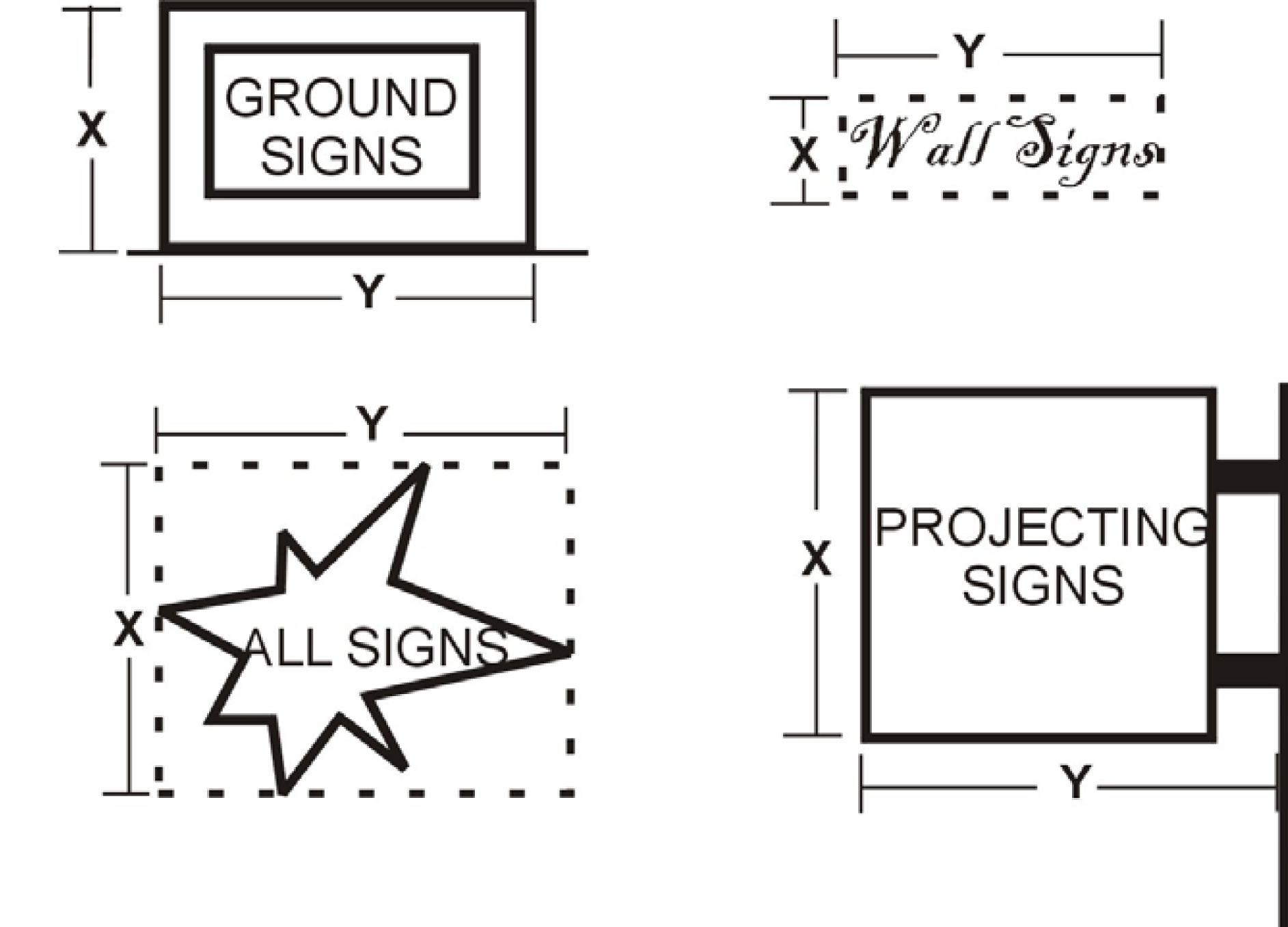
Determination of sign area. Signs shall not exceed the maximum size for display area in accordance with table 18.06.a and as regulated elsewhere in this article. The sign display area shall be expressed in square feet, computed to the nearest tenth of a square foot, and computed as follows:
(1)
The allowable area for a single faced sign shall be measured by calculating the square footage of the sign face as measured by enclosing the most protruding points or edges of a sign within a parallelogram or rectangle, including any frame.
(2)
When a sign consists of individual letters or other sign elements printed, painted or mounted on a wall or a window, the area of the sign shall be computed by enclosing the edges of the sign elements (i.e., letters, logos) within a parallelogram or rectangle.
(3)
Where a sign has two faces, the area of only the larger face shall be considered when calculating maximum size, provided all faces are part of the same structure, back-to-back and are separated by no more than 18 inches.
(d)
Illumination.
(1)
General requirements. Unless otherwise permitted, signs shall be illuminated only by steady, stationary, shielded light sources using approved electrical devices directed solely at the sign, or internal to it. An animated sign may be permitted by the planning commission provided the message or scene occurs at a frequency, which is not distracting to passersby.
(2)
Nonglare, shielded lighting. Use of glaring undiffused lights or bulbs shall be prohibited. Lights shall be shaded and/or shielded downward so as not to project onto adjoining properties or streets.
(3)
Bare bulb illumination. Illumination by bare bulbs, neon, luminous tubing or flames is prohibited, except that bare bulbs are permitted on theater marquees.
(4)
Wiring. Underground wiring shall be required for all illuminated signs not attached to a building.
(e)
Design and construction.
(1)
Architectural features. Signs shall be placed in a manner that does not obstruct or intrude upon architectural features of a building.
(2)
Materials. Signs shall be designed to be compatible with the character of the principal building's materials and the site's landscaping to promote an overall unified and aesthetic effect in accordance with the standards set forth herein.
(3)
Fastenings. Signs shall be erected in such a manner and with such materials to remain safe and secure during the period of use and all bolts, cables, and other parts of such signs shall be kept painted and free from corrosion.
(4)
Screening of supports. Signs shall be designed so that the supporting framework is contained within or behind the face of the sign or within the building to which it is attached so as to be totally screened from view.
(5)
Wind pressure. All signs erected, constructed, reconstructed, altered or moved shall be constructed in such a manner and of such materials so that they shall be able to withstand wind pressure of at least 20 pounds per square foot.
(6)
Prevention of birds. All signs shall be designed and constructed so as to prevent the roosting and/or nesting of birds.
(7)
Compliance with codes. Signs shall be constructed in a safe and stable manner in accordance with the city's ordinances and any adopted building, fire, electrical, or other applicable codes.
(Ord. No. 09-434, § 18.05, 1-20-2009)
Sec. 18.06. - Permitted sign regulations.
(a)
The following signs are permitted in accordance with table 18.06.a and the following regulations:
TABLE 18.06.A.SPECIFIC SIGN REQUIREMENTS
1 For apartments or other types of buildings that wish to have permanent signs indicating space to lease, the leasing advertisement must be included in the total freestanding, wall or window signage.
(b)
Additional requirements from table 18.06.a.
(1)
Awning, canopy or marquee signs.
a.
The display area of the sign on a marquee, or canopy shall be counted toward determining compliance with the requirements for total allowable area of wall signs allowed on the parcel.
b.
Marquee signs are prohibited from projecting over any public easement or right-of-way, however, other limitations imposed by this article concerning projecting signs shall not apply to marquee, or canopy signs.
c.
Any lettering used solely for the purpose of presenting the numerals of a street address shall not be included within the computed sign area on a marquee, or canopy, provided that the height or width of the numerals does not exceed the height or width of other letters or numerals on the marquee, or canopy.
d.
Awnings and canopies shall not be internally illuminated.
e.
Marquees are only permitted on buildings containing a theater.
(2)
Billboards.
a.
Billboards shall be located on a lot adjacent to and face the I-94 highway.
b.
Billboards shall be located at least 200 feet from any park, playground, school, church and residential district or use.
c.
Billboards shall be located at least 50 feet from the street right-of-way.
d.
Billboards shall be separated by a minimum of 1,000 lineal feet along freeways and streets having a right-of-way of 120 feet or more in width. The spacing requirements apply to signs on either side of the street and shall be measured parallel to the right-of-way.
e.
The applicant must demonstrate that they have obtained all permits required by the state.
f.
Site plan review is required in accordance with article 19, site plan review.
g.
There shall be an unobstructed access to a proposed billboard structure, for operation, maintenance, repair, and inspection purposes, which may be provided through an easement. This access shall have a width and location determined by such factors as: the location of adjacent thoroughfares and traffic circulation within the site; and any attendant facilities; the location of buildings and parking facilities; proximity to residential districts and minimizing disturbance to the natural landscape; and the type of equipment which will need to access the site.
(3)
Changeable message signs.
a.
Electronic reader boards shall not be allowed within 300 feet of an intersection or interchange of collector or arterial streets.
b.
Electronic reader boards shall have a minimum separation distance of 100 feet from any other electronic reader board.
c.
Minimum duration of any message shall be a 30 seconds.
d.
The message shall only consist of letters and logos.
e.
Signs which convey the appearance of movement or animation of message or picture in any form shall not be permitted. Scrolling or flashing shall not be permitted.
f.
When any part of the message display is not working properly, the use of the electronic reader board will be discontinued until the repairs are made.
g.
Electronic reader board displays shall have a black background.
(4)
Freestanding signs (ground or monument).
a.
Freestanding signs shall be located a minimum of 100 feet from any residential district.
b.
One additional ground freestanding sign is permitted along a lot line which has more than 300 feet of frontage, provided the signs are at least 100 feet apart.
c.
Freestanding ground signs shall incorporate a masonry base.
(5)
Portable signs (menu/sandwich board, poster panels, A-frames).
a.
Portable signs shall not be illuminated in any manner.
b.
Portable signs shall not be located in the right-of-way and shall be located a minimum of two feet from the edge of the curb and must be located so that at least a five-foot wide sidewalk is maintained between the sign and the building wall for pedestrian traffic flow and safety.
c.
Portable signs are permitted only during operating business hours and must be stored inside when the business is not open.
d.
Portable signs shall be constructed of weatherproof, durable material and kept in good repair.
(6)
Projecting signs.
a.
Projecting signs shall not be located within 20 feet of another projecting sign.
b.
Projecting signs may not project more than two feet from building wall.
(7)
Wall signs.
a.
Wall signs shall not extend more than 12 inches beyond the wall.
b.
Multi-tenant building or shopping center may have one wall sign per tenant having an individual means of public access.
c.
Wall signs may be directly or indirectly illuminated.
d.
For signs that face directly onto adjacent public street right-of-way, the maximum allowable wall sign area may be increased in accordance with table 18.06.b up to a maximum of 140 square feet.
e.
Combined area of signs to be no more than two square feet for each lineal foot of building wall.
TABLE 18.06.B. WALL SIGNS AREA INCREASE
(8)
Window signs.
a.
The area of permanent window signs shall be counted in determining compliance with requirements for total area of wall signs.
b.
Window signs that are faded, yellowed, ripped, or otherwise damaged shall be removed immediately.
(Ord. No. 09-434, § 18.06, 1-20-2009)
Sec. 18.07. - Nonconforming signs.
(a)
Continuance.
(1)
Existing signs. Any sign lawfully existing at the time of the adoption of this article that does not fully comply with all provisions shall be considered a legal nonconforming sign and may be permitted to remain as long as the sign is properly maintained and not detrimental to the health, safety and welfare of the community except as herein provided.
(2)
Damaged signs. A nonconforming sign may continue as long as it is not destroyed, abandoned, or discontinued. A sign damaged in excess of 50 percent of its replacement cost is considered destroyed.
(3)
Site plan review. Whenever the principal building on a site on which a nonconforming sign is located is modified or there is a change in use requiring site plan review and approval is required, the nonconforming sign shall be removed.
(4)
Abandonment. Where an existing nonconforming sign ceases to display advertising matter, has obsolete advertising mater or is blank for a period of six months, it will be considered discontinued or abandoned and must be removed by the property owner.
(b)
Restrictions. A nonconforming sign shall not be altered or reconstructed, unless the alteration or reconstruction is in compliance with the provisions of this section. For the purpose of this article only, the term "altered" or "reconstructed" shall not include any of the following:
(1)
Normal maintenance.
(2)
The addition, construction, installation, or changing of electrical wiring or electrical devices.
(c)
Requirements. Nonconforming signs shall comply with the following requirements:
(1)
Repairs and maintenance. Normal maintenance shall be allowed, provided that any nonconforming sign that is destroyed by any means to an extent greater than 50 percent of the sign's preexisting fair market value, exclusive of the foundation, shall only be reconstructed in conformance with article 18, signs. Normal maintenance shall include painting of chipped or faded signs; replacement of faded or damaged signage panels; or repair or replacement of electrical wiring or electrical devices.
(2)
Nonconforming changeable copy signs. The message on a nonconforming changeable copy sign or nonconforming bulletin board sign may be changed provided that the change does not create any greater nonconformity.
(3)
Substitution. Nonconforming signs shall not be replaced with another nonconforming sign.
(Ord. No. 09-434, § 18.07, 1-20-2009)
Sec. 18.08. - Sign inspection and maintenance.
(a)
Sign inspection.
(1)
Responsibility for compliance. The owner of any property on which a sign is located is declared to be responsible for the permit, erection, inspection, safety, condition, and removal of a sign and the area in the vicinity thereof.
(2)
Inspection of new signs.
a.
All signs for which a permit has been issued shall be inspected by the development services department when erected. Approval shall be granted only if the sign has been constructed in compliance with the approved plans and applicable city ordinances and codes.
b.
In cases where fastenings or anchorages are to be eventually bricked in or otherwise enclosed, the sign erector shall advise the development services department when such fastenings are to be installed so that inspection may be completed before enclosure.
(3)
Inspection of existing signs. The development services department shall have the authority to routinely enter onto property to inspect existing signs. In conducting such inspections, the development services department shall determine whether the sign complies with all the provisions of this article. The development services department shall order the removal of any sign erected illegally in violation of this article.
(b)
Sign maintenance.
(1)
Maintenance of signs. All signs for which a permit is required and all supports therefor shall:
a.
Be kept in compliance with the plans and specifications filed and approved for issuance of the construction permit.
b.
Be kept and maintained in a safe condition, consistent with adopted building and mechanical codes.
c.
At all times conform to all the provisions of this article.
(2)
Correction of defects. If the development services department finds that any sign is unsafe, insecure, improperly constructed, or poorly maintained, the sign erector, owner of the sign, or owner of the land shall make the sign safe and secure by completing any necessary reconstruction or repairs, or entirely remove the sign in accordance with the timetable established by the development services department. Existing signs determined to be unsafe and an immediate hazard to health or safety shall be removed or repaired within 12 hours of notification.
(c)
Abandoned signs. Permanent signs applicable to a business temporarily suspended by a change in ownership or management shall not be deemed abandoned unless the structure remains vacant for at least six months. An abandoned sign shall be removed by the owner or lessee of the premises within 30 days.
(Ord. No. 09-434, § 18.08, 1-20-2009)
Sec. 18.09. - Sign permits.
(a)
Application for permit. Applications for sign permits shall be made upon forms provided by the development services department and shall contain or have attached thereto the following information:
(1)
Name, address and telephone number of the applicant.
(2)
Location of building, structure or lot to which or upon which the sign or other advertising structure is to be attached or erected.
(3)
Position of the sign or other advertising structure in relation to nearby buildings or structures.
(4)
Two blueprints or drawings of the plans and specifications and method of construction and attachments to the building or in the ground.
(5)
Copy of streets sheets and calculations showing the sign structure is designed for dead load and wind pressure in any direction in the amount required by this and all other laws and ordinances of the city, provided further that where the development services department may require the approval of the structural design by a registered engineer.
(6)
Name of person, firm, corporation or association erecting structure.
(7)
Written consent of the owner where the sign is to be erected on vacant land.
(8)
Color renderings including lettering, graphics, logos, etc.
(9)
Details for sign components, including mechanical and electrical systems.
(10)
Such other information as the development services department shall deem necessary to show full compliance with this and all other laws and ordinances of the city.
(b)
Permit issued if application in order. The development services department will, upon the filing of an application for a permit, examine the plans and specifications and other data and the premises upon which it is proposed to erect the sign or other advertising structure, and if it appears that the proposed structure is in compliance with all requirements of city codes and ordinances, then the building permit shall be issued. Both an electrical permit and an erection permit must be issued in the case of illuminated signs.
(c)
Permit fee. It is unlawful in the city for any person to erect or alter any sign, except those signs specifically exempted in this article, unless a permit has first been obtained from the building official, permit fee paid to the city treasurer according to the schedule established by resolution of the city council, and pertinent information to allow a reasonable administrative interpretation pursuant to this section has been provided.
(d)
Permit revocable at any time. All rights and privileges acquired under the provisions of this ordinance or any amendment thereto are mere licenses and may be revoked upon the violation of any of the conditions contained in this article. If the work authorized under a permit has not been completed within six months after date of issuance, the permit shall become null and void.
(e)
Exceptions. A sign shall not be enlarged or relocated except in conformity with the provisions set forth herein for new signs, nor until a proper permit has been secured. However, a new permit shall not be required for ordinary servicing or repainting of an existing sign message, cleaning of a sign, or changing of the message on the sign where the sign is designed for such changes (such as lettering on a marquee or numbers on a gasoline price sign).
(Ord. No. 09-434, § 18.09, 1-20-2009)

