
Taylor City Zoning Code
ARTICLE 16
- GENERAL SITE DEVELOPMENT REQUIREMENTS
Sec. 16.01.- Building appearance.
(a)
Intent. The intent of this section is to provide exterior building wall material standards to enhance the visual environment of the city, thereby improving property values, stimulating investment, encouraging quality development projects, and enhancing the quality of life for city residents. Furthermore, the intent is to encourage developers and their representatives to explore the design implications of their project within the context of the site and surrounding area. It is not the intent of this section to regulate the workmanship, durability, endurance, maintenance performance, load capacity, or fire resistant characteristics of the wall.
(b)
Applicability.
(1)
This section shall apply to all new construction, except single-family detached and two-family residential structures and their associated accessory buildings.
(2)
Architecture shall be reviewed by the planning commission as a part of site plan review under the requirements of this section. For applications that are administratively approved, architecture shall be reviewed by the development services department.
(3)
Where additions or remodeling of existing buildings is proposed, the following standards shall apply:
a.
Where a new wall material is proposed for an existing building wall, only that portion of the building being altered shall be subject to the standards of this section. However, in considering the proposed alteration, the planning commission may modify the material requirements of the section where it will be consistent with the architecture of the entire building.
b.
Where an addition is proposed to an existing building, the planning commission may allow the use of existing wall materials for the addition provided that the design of the alteration is consistent with the existing building wall design.
(c)
Building design.
(1)
Architectural details.
a.
Buildings shall possess architectural variety, but enhance the overall cohesive community character or character of the neighborhood.
b.
All buildings shall provide architectural features, details, and ornaments such as archways, colonnades, cornices, recesses, projections, wall insets, arcades, window display areas, peaked rooflines, or towers.
c.
Building walls and roofs over 100 feet in length shall be broken up with varying building lines, windows, gables, and/or architectural accents and trees.
d.
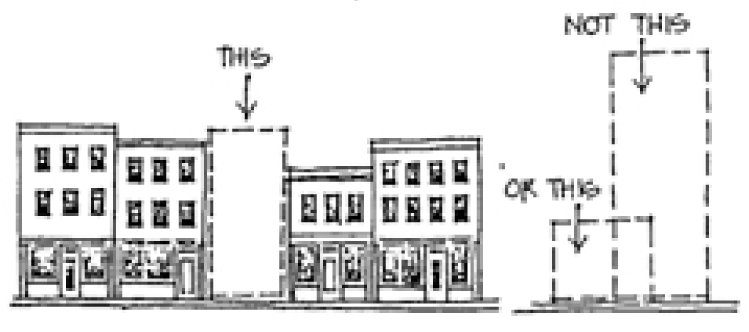
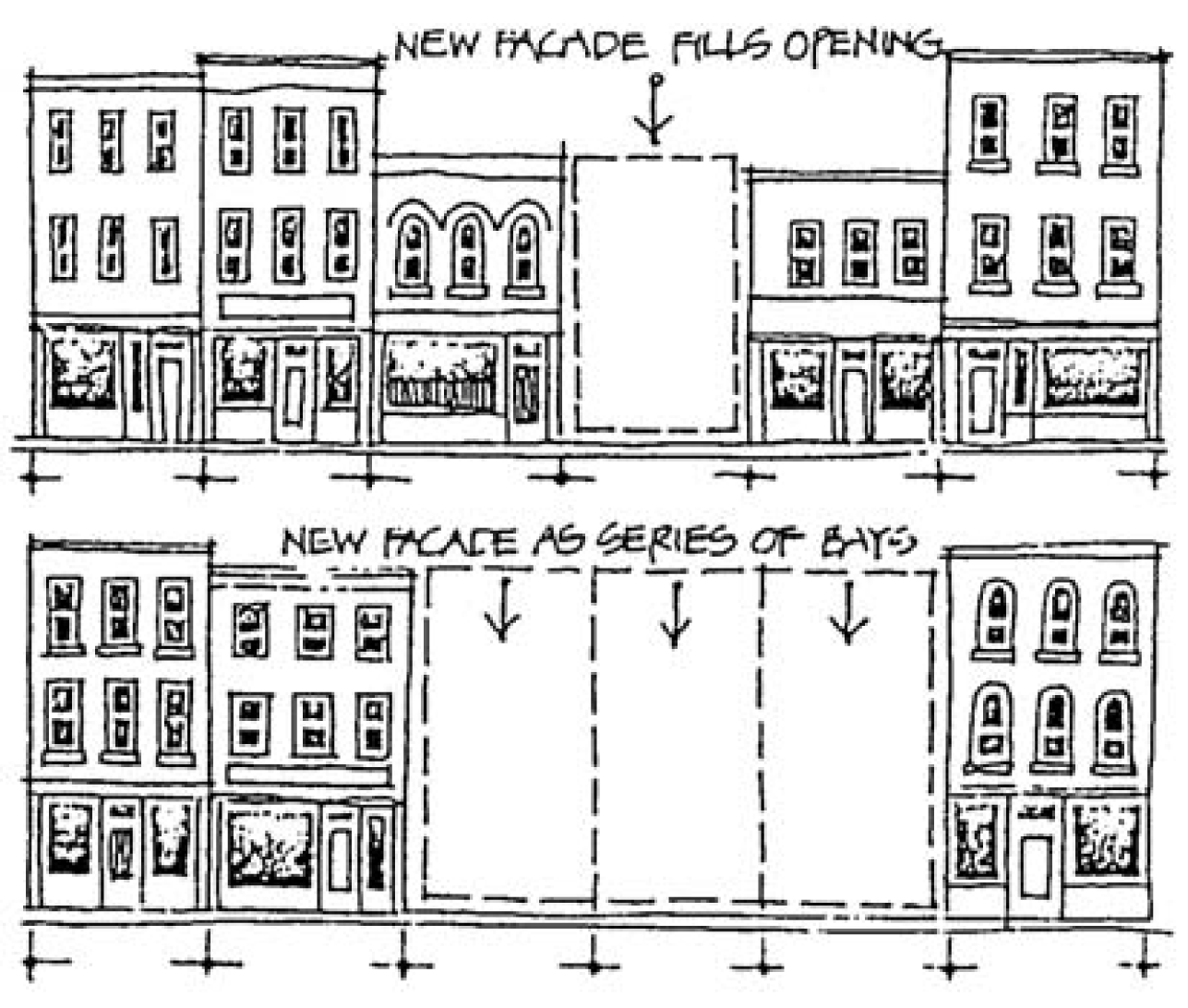
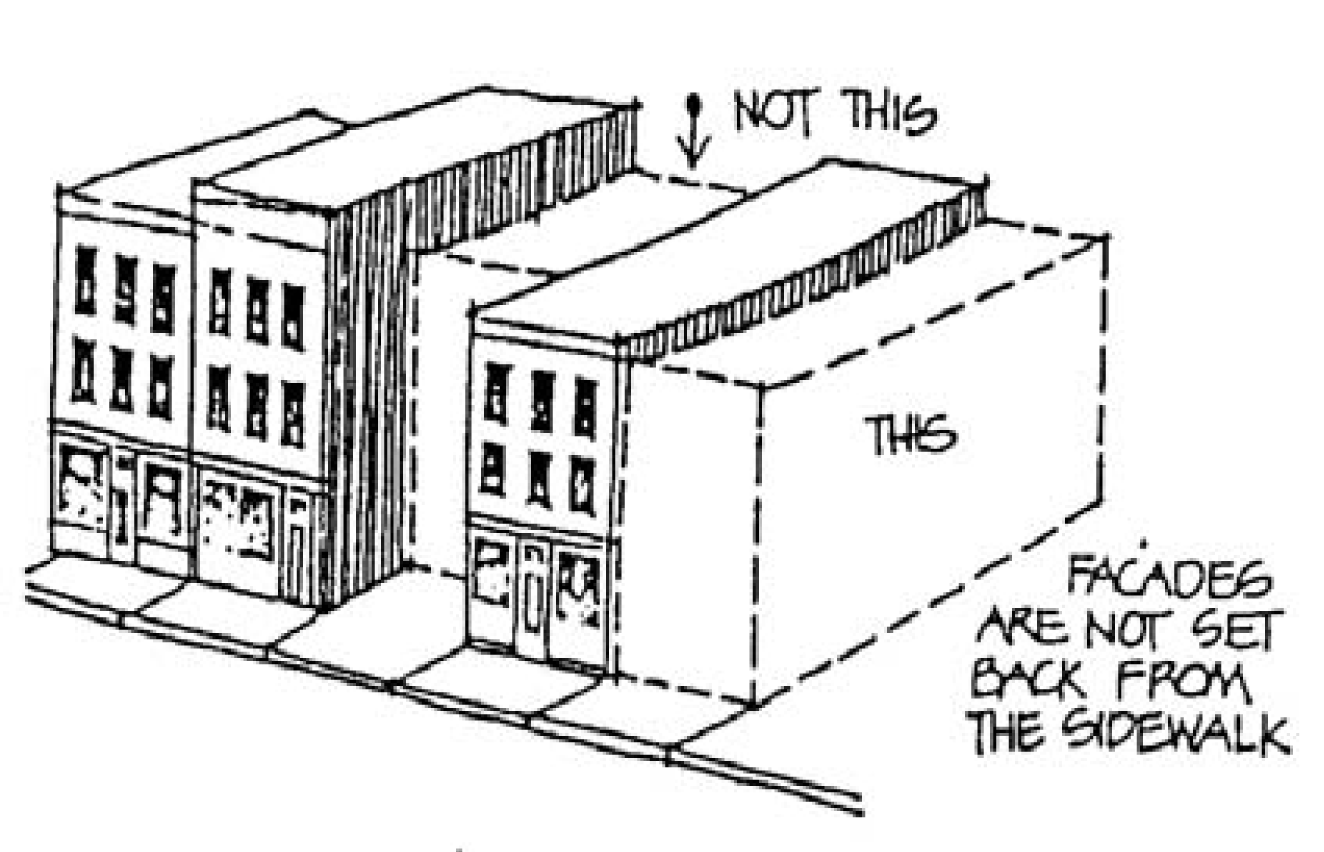
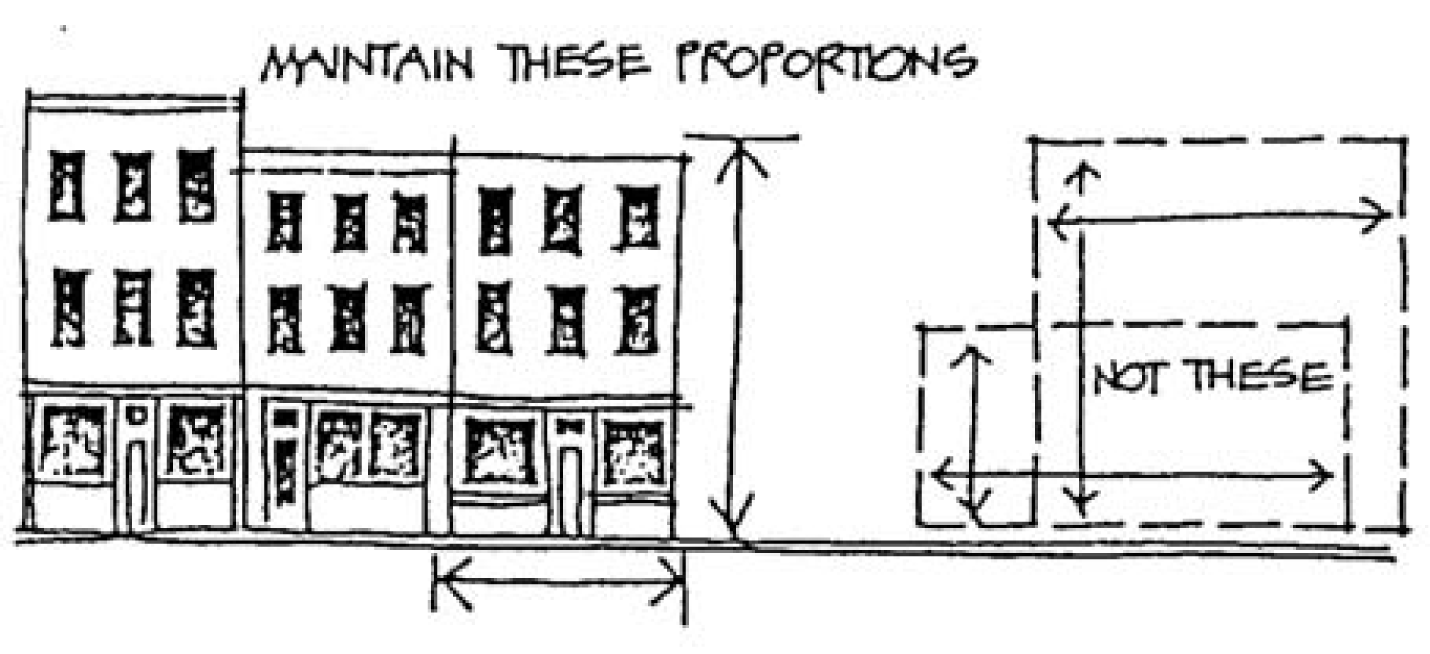
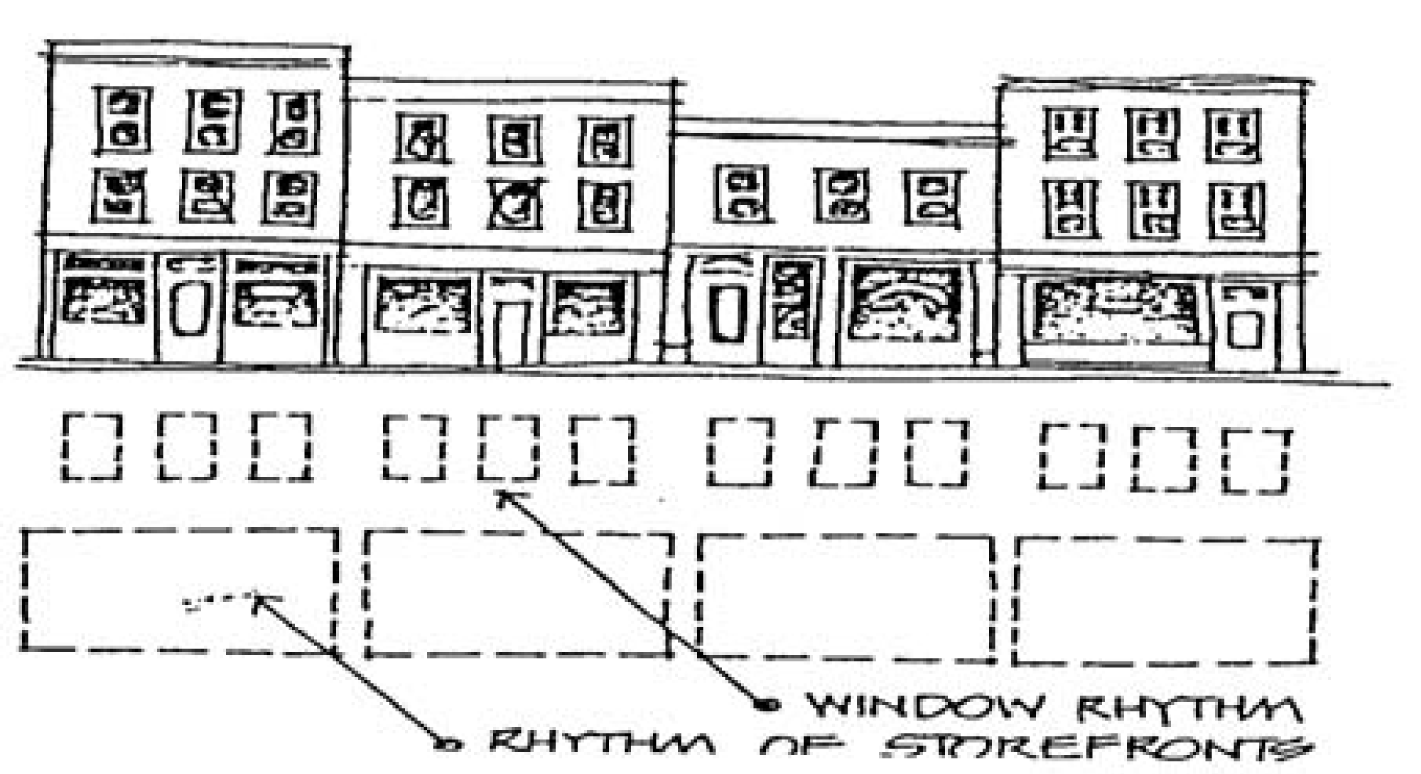
Building setback and rooflines shall generally match the established pattern of buildings on site and adjacent properties to maintain the existing street wall patterns and design as depicted in table 16.01.a. The rhythm established through the existing architectural elements shall also be maintained. The elements shall include, but be not limited to, frequency and spacing of windows, doorways, and storefronts.
TABLE 16.01.A. BUILDING CONTEXT
| Height | Width |
 |  |
| Setback | Proportion |
 |  |
| Rhythm | |
 | |
(2)
Color.
a.
Exterior building facade and roof colors shall be established by the applicant as an integral part of the building design, and shall exhibit evidence of coordination and selection with respect to the overall visual effect of the building.
b.
Exterior colors shall be of low reflectance, subtle, neutral, or earth tone colors.
c.
The color of each facade material shall be harmonious with the colors of all other facade materials used on the same building, as well as the color of facade materials on adjacent buildings.
(3)
Roofs.
a.
Roofs shall be designed to reduce the apparent exterior mass of a building, add visual interest and be appropriate to the architectural style of the building.
b.
Multistory buildings or buildings taller than 25 feet may have flat or pitched roofs. Flat roof buildings shall provide a parapet wall around the roof with a decorative cornice.
c.
Flat roofs are discouraged on single-story buildings less than 25 feet tall. A pitched roof of four in 12 or greater is preferred in order to add visual interest. Mansard roofs may be used to conceal a flat roof. Single-story buildings with flat roofs shall be designed to provide the scale of a two-story building with a minimum height of 20 feet and a parapet wall around the roof with a decorative cornice.
d.
Metal roofs may be allowed if compatible with the overall architectural design of the building.
(4)
Sustainable design. Building design that promotes sustainable development, including leadership in energy and environmental design (LEED), shall be encouraged.
(5)
Overhead doors. Overhead doors shall not face a public street or residential district. The planning commission can modify this requirement upon a determination that there is no reasonable alternative and the visual impact will be moderated through use of building materials, architectural features and landscaping beyond that required.
(6)
Mechanical features. Mechanical and service features on the building or roof such as gutters, ductwork, service doors, etc. that cannot be screened in accordance with section 16.07, mechanical equipment, shall be of a color that blends in with the color of the building.
(d)
Building materials.
(1)
All districts.
a.
The predominant building materials shall be in accordance with the following tables. Building materials such as smooth-faced concrete block, undecorated tilt-up concrete Dryvit panels, or pre-fabricated steel panels may only be used as accents.
b.
Building materials shall be durable, weather-resistant, rustproof, and shall be maintained by the property owner or tenant at all times.
c.
Building materials that promote sustainable development, including leadership in energy and environmental design (LEED), shall be encouraged.
d.
The planning commission may waive the materials required by this section if it finds that a proposed building design and the materials or combinations of materials are in keeping with the intent of this section and the recommendations of the master plan.
e.
The materials review board shall review these materials standards on an annual basis. Any revisions, changes or modifications of these materials standards shall be submitted, in the form of a resolution, to the planning commission for adoption.
(2)
Single- and two-family residential. All single and two-family residential buildings shall meet the requirements of section 13.01(b) or (c) as applicable.
(3)
Multiple-family residential. All multiple-family residential buildings located in any district shall meet the requirements of table 16.01.b.
TABLE 16.01.B. MULTIPLE-FAMILY RESIDENTIAL
BUILDING MATERIAL REQUIREMENTS
(4)
Business and institutional. All nonresidential buildings located in residential districts and all buildings located in the business zoning districts shall meet the requirements of table 16.01.c. Sites in the midtown districts shall meet the architectural requirements of article 7, Midtown districts.
TABLE 16.01.C. BUSINESS AND INSTITUTIONAL
BUILDING MATERIAL REQUIREMENTS
(5)
Industrial. Buildings located in industrial districts shall meet the requirements of table 16.01.d.
TABLE 16.01.D. INDUSTRIAL BUILDING MATERIAL REQUIREMENTS
(1) For buildings over 80,000 square feet that are set back more than 100 feet from the front lot line and the amount of required landscape materials within the frontage greenbelt is increased by 50 percent, split face block or tilt-up panels may be substituted for the 50 percent brick required on the building's front facade.
(2) These requirements shall not apply to the facade of a building of any size where it is set back more than 300 feet from the front lot line and the amount of required landscape materials within the frontage greenbelt is increased by 50 percent.
(Ord. No. 09-434, § 16.01, 1-20-2009)
Sec. 16.02. - Landscaping.
(a)
Intent. Landscaping requirements are set forth to:
(1)
Protect and preserve the appearance, character and value of surrounding neighborhoods, thereby promoting the public health safety and general welfare.
(2)
Increase water retention and absorption to reducing stormwater runoff, flooding and soil erosion.
(3)
Maximize retention of existing trees, shrubs, wetlands, drains, streams, floodplains, natural drainage systems, ponds, and other natural and environmentally sensitive areas which are deemed a valuable resource within the city.
(4)
Assure sufficient buffering and screening of incompatible uses or offensive or unattractive views.
(5)
The regulations contained in this section are considered the minimum necessary to achieve the intent. Additional landscaping beyond the minimum specified is encouraged to further improve the function, appearance and value of the property.
(b)
Applicability.
(1)
The provisions of this section shall apply to any area proposed for development, redevelopment, or expansion that is subject to site plan approval under article 19, site plan review.
(2)
Each requirement of this section must be met independently on a site. Landscaping for one of the requirements may not be double counted towards meeting other requirements of this ordinance.
(c)
Greenbelts. All yards adjacent to streets and rights-of-way shall be landscaped along the entire frontage (except access points) in accordance with table 16.02.a.
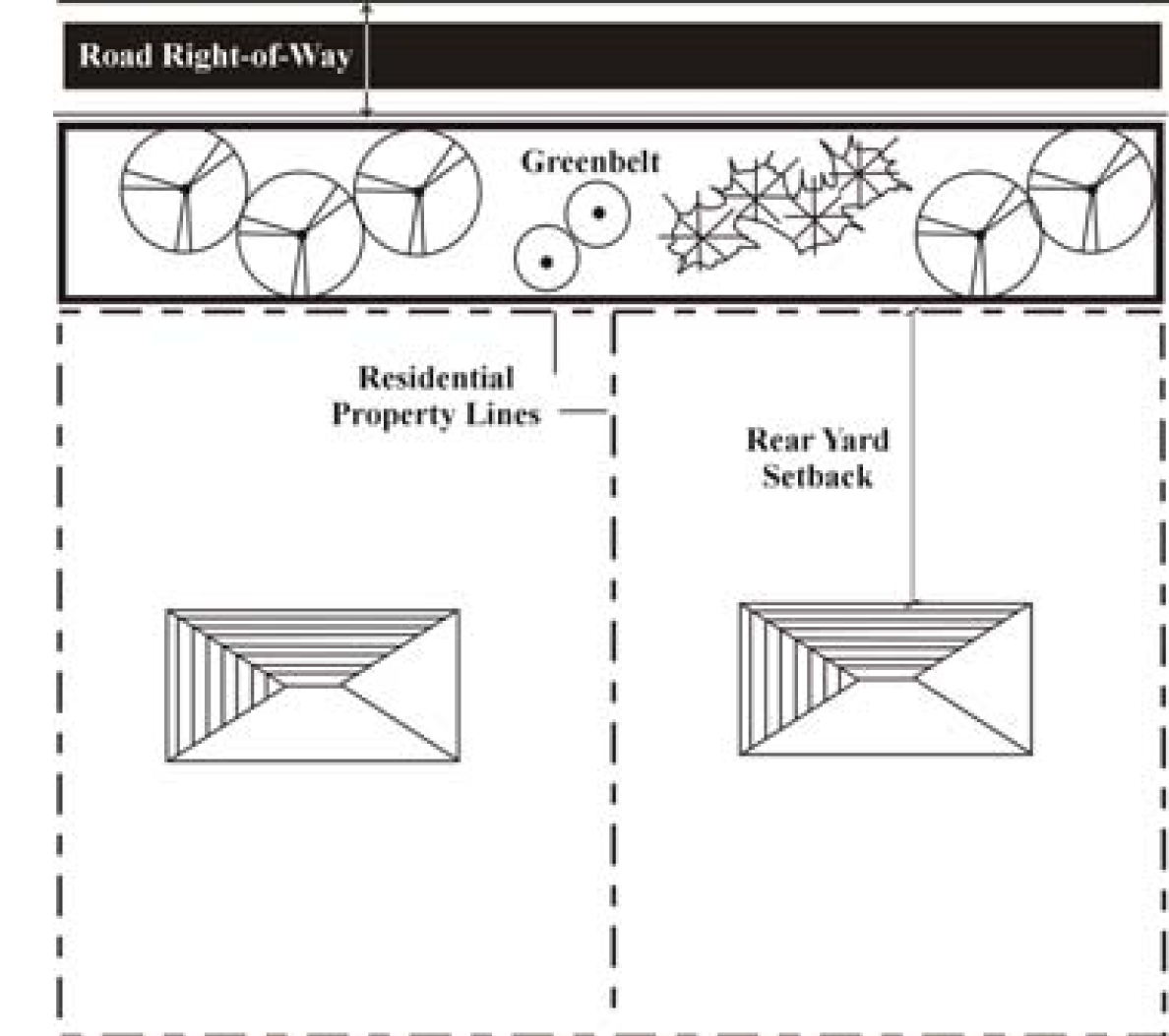
TABLE 16.02.A. FRONTAGE GREENBELT REQUIREMENTS
(1) Calculations shall be based upon total frontage, including yards, buildings, driveways and parking lots. For lots less than 100 feet in width, the minimum plantings shall be provided.
(2) Greenbelts around the perimeter of single-family residential developments shall be in addition to the rear yard setback requirement of the district.
(3) In the midtown district, greenbelts shall only be required in front of parking lots, not in front of buildings with rear yard parking. Sites in the midtown district with parking to the side of the building shall only be required to provide greenbelts in front of the parking, not along the building frontage.
(4) In the B-1, B-2 and B-3 districts, the planning commission may reduce the greenbelt depth requirement to ten feet where more than one-half of the parking spaces will be located in the side or rear yard and only one row of parking is located in the front yard or where the commercial building is less than 10,000 square feet.
(5) The berm shall not be required along a commercial frontage where a three-foot tall brick wall or a combination of a three-foot tall wrought iron fence with a continuous evergreen hedge row is provided along the entire frontage (except driveway and sidewalk access points), the hedge row plantings may be credited towards the shrub plantings listed above.
(d)
Buffer zones. Buffer zones shall be required where a proposed use shares a common lot line with an adjacent use in accordance with table 16.02.b.
TABLE 16.02.B. REQUIRED BUFFER ZONES
(1) Buffer zone landscaping shall not be required between business uses where shared access, shared parking or service drive connections are provided or where there is a zero lot line setback between uses.
(2) Buffer zone A shall be required where an industrial use has outdoor storage or truck loading area adjacent to a commercial use or district.
(3) Walls shall be constructed in accordance with section 15.03, fences and walls and berms in accordance with section 16.02(j), berms.
(e)
Parking lot landscaping. All parking lots of 20 or more spaces shall be landscaped according to the following requirements:
(1)
All parking lots of 20 or more spaces shall provide one canopy tree and 100 square feet of landscape area for every ten parking spaces.
(2)
A minimum of one-third of the trees shall be placed on the interior of the parking area and the remaining may be placed surrounding the parking lot within 18 feet.
(3)
Where parking lots are located in the rear yard, the amount of parking lot landscaping shall be reduced by 50 percent.
(4)
Where parking lots are located within the required front yard, a berm, hedge row, three-foot tall brick wall, or a three-foot tall wrought iron fence with a continuous evergreen hedge row shall be provided between the parking spaces and the street. The hedge row shall be planted with evergreen or deciduous shrubs, 2½ feet on-center. The landscape greenbelt required by section 16.02(c), greenbelt, shall also be provided, except the hedge row plantings may be credited towards the shrub plantings of table 16.02(a).
(5)
Where a parking lot or loading area for a nonresidential use abuts a residential district or use a minimum six-foot tall wall shall be provided between the parking lot and residential lot. Walls shall be constructed of brick or other masonry material compatible with the front facade of the principal building as determined by the planning commission or development services department. The planning commission may approve a privacy fence where it is more compatible with adjacent residential uses.
(6)
Landscaping shall be installed so that, when mature, it does not obscure traffic signs, fire hydrants, lighting, drainage patterns on site or adjacent properties, or obstruct vision for safety of ingress or egress.
(7)
All landscaped areas shall be protected by a six-inch standard or rolled concrete curb, except where landscape islands are being utilized as part of a stormwater detention or conveyance system. Landscape islands shall be a minimum of ten feet in width.
(8)
Parking structures shall provide one canopy or ornamental tree and four shrubs for every 30 linear feet of parking structure facade length that is visible from a public right-of-way.
(f)
Detention/retention pond landscaping. Detention/retention ponds shall be landscaped to provide a natural setting in open space areas as follows:
(1)
Detention and retention ponds shall be landscaped in character with properties and shall be required to provide lawn areas, shrubs and trees to accomplish a suitable appearance compatible with development on the property and on nearby properties. Landscaping shall be required on all areas disturbed by grading to establish detention/retention ponds.
(2)
Where possible, ponds or basins shall be free form following the natural shape of the land to the greatest practical extent. Side slopes shall not exceed one foot vertical for every six feet of horizontal distance.
(3)
One deciduous shade or evergreen tree and ten shrubs, or groupings of ornamental grasses shall be planted in a random pattern or in groupings for every 50 lineal feet of pond perimeter, measured along the top of the bank elevation. Required landscaping is not limited to the top of the pond bank, as long as the plant species is adapted to saturated soil conditions. Plantings within rain gardens, bio-retention swales, irrigation trench planters may be credited towards meeting these requirements.
(4)
Where the side slopes or depth of the pond require security fencing, fencing shall be decorative in nature or if chainlink, black or dark green vinyl coated. Shrub plantings shall be provided around the outside of the fence for screening spaced no more than five feet on-center.
(5)
An aerator shall be provided in any pond where there will be standing water.
(g)
Residential landscaping.
(1)
Deciduous trees shall be planted along each residential lot or residential unit within the proposed right-of-way between the street and the sidewalk before a certificate of occupancy is granted in accordance with table 16.02.g.
TABLE 16.02.G. MINIMUM REQUIRED RESIDENTIAL STREET TREES
(2)
Existing trees within the right-of-way may be utilized as street trees.
(3)
In any new subdivision or condominium, where residential dwellings are designed so that rear yards front a public street, a landscaped privacy screen shall be provided along the street consisting of trees, shrubs, and berming in accordance with section 16.02(c), greenbelts. For any new subdivision or condominium, the greenbelts around the perimeter of single-family residential developments shall be in addition to the rear yard setback requirement of the district. The greenbelt may be a common area or an easement across the individual lots with the rear yard setbacks measured from the greenbelt easement.
(4)
The planning commission or development services department may also require landscaping within cul-de-sacs, street medians and at site entrances.
(5)
For any new subdivision or condominium, all of the required landscaping shall be installed by the developer prior to issuance of building permits to construct homes on individual lots, unless the developer has posted a performance guarantee in accordance with subsection (p)(5) below.
(h)
Interior site landscaping. Site landscaping shall be located near building entrances, along building foundations, along pedestrian walkways, near service areas or as landscaped plazas.
(i)
Accessory structure landscaping. Accessory structures and utility structures such as waste receptacle enclosures, air conditioning units, transformers, utility substations and clustered mailboxes that are in a visible location on the site shall be landscaped with evergreens of sufficient height to screen the structure or equipment.
(j)
Berms.
(1)
Where required, berms shall have a slope no greater than 1:3, i.e., one foot of vertical rise for each three feet of horizontal distance on the exterior side facing the street or adjacent land use with at least a two-foot flat area on top (measured from the ground adjacent to the berm).
(2)
The berm area shall be planted with grass or other suitable ground cover to ensure that it withstands wind and weather and retains its height and shape.
(k)
Plant material spacing and size. Minimum plant spacing and sizes at time of installation shall be in accordance with table 16.02.k:
TABLE 16.02.K. MINIMUM PLANT SIZE AND SPACING
(1)
With the exception of shrubs, plant material shall not be placed closer than four feet from the fence line or lot line.
(2)
Where plant materials are placed in two or more rows, plantings shall be staggered in rows.
(l)
Design creativity. Creativity in landscape design is encouraged. Accordingly, required trees and shrubs may be planted at uniform distances, at random, or in groupings, depending on the designer's desired visual and functional effect and, equally important, the desire of the city to coordinate landscaping on adjoining properties.
(m)
Lawn grass.
(1)
Landscaped areas shall be covered by grass or other living ground cover. Grass areas shall be planted in species normally grown as permanent lawns in the City of Taylor.
(2)
Grass may be sodded, plugged, sprigged or seeded except that solid sod shall be used in swales or other areas subject to erosion. In areas where grass is to be established by a method other than complete sodding or seeding, nurse-grass seed shall be sown for immediate effect and protection until coverage is achieved.
(n)
Living plant material. All areas not occupied by building, pavement or storage shall be landscaped with living plant material. Stone or wood chips may be permitted by the planning commission when the maintenance of the living material would be impractical or undesirable due to size, configuration or character of the area or if part of drainage erosion control.
(o)
Plant material species.
(1)
The overall landscape plan shall not contain more than 33 percent of any one plant species.
(2)
The use of trees native to the area, and mixture of trees from the same species association, is encouraged.
(3)
All plants shall conform to the current issue of the American Standard for Nursery Stock published by the American Association of Nurserymen and shall have passed inspections required under state regulations.
(4)
Plant materials recommended as part of landscape plans are included in table 16.02.o.1.
TABLE 16.02.O.1. RECOMMENDED PLANT MATERIALS
(5)
Plant materials that are not permitted, as they split easily, their wood is brittle and breaks easily, their roots clog drains and sewers, and they are unusually susceptible to disease or insect pests, are included in table 16.02.o.2.
TABLE 16.02.O.2. PROHIBITED PLANT MATERIALS
(p)
Installation and maintenance provisions. All landscaping shall be maintained in a healthy, neat and orderly state free from refuse and debris.
(1)
Inground automatic irrigation shall be provided for all landscaped areas.
(2)
All trees required on the site plan must be maintained and shall not be removed unless approved as a site plan amendment or a tree removal permit is obtained. Any dead or diseased plants shall be removed and replaced.
(3)
Landscaping shall be installed such that, when mature, it does not obscure traffic signs, fire hydrants, lighting, drainage patterns on site or adjacent properties, or obstruct vision for safety of ingress or egress.
(4)
If any building or paving construction is completed during a planting season no certificate of occupancy shall be issued until the landscaping complies with the requirements contained in this section. If building or paving construction is completed in an off-planting season, the certificate of occupancy shall be issued only after the owner provides a performance guarantee, in an amount deemed sufficient by the development services department to ensure installation of required landscaping during the next planting season.
(5)
The city may request performance guarantees in accordance with section 25.08, performance guarantees. The city may require a performance guarantee for landscaping for two growing season to ensure plant material survives.
(q)
Tree removal. The removal of trees shall comply with section 16.03, tree preservation and replacement.
(r)
Removal, depositing or dumping of earth.
(1)
The removal, depositing or dumping of topsoil, subsoil, sand, gravel and other materials shall comply with all applicable local ordinances.
(2)
All excavation or earth removal shall comply with all applicable local ordinances.
(3)
Grading of sites shall be in accordance with section 14.07, grading.
(s)
Replacement of removed trees. A tree survey prepared by a licensed professional shall be submitted with any site plan; however, this requirement may be waived by the development services department upon a finding it is unnecessary information to conduct a complete site plan review. This includes areas not to be disturbed, provided they are identified as such on the site plan and appropriate protection is put in place on site. The survey shall identify the location, species and size of existing trees on the proposed site. Existing trees that are planned to be removed shall be replaced in accordance with table 16.02.s and the following regulations:
TABLE 16.02.S. REPLACEMENT OF REMOVED TREES
(1)
Trees that are dead or diseased, with no visible growth, as determined by the development services department, are exempt from replacement requirements.
(2)
Replacement trees shall be located on the site in question to provide the optimum enhancement, preservation, and protection of the areas. In instances where tree replacement on site is not feasible as determined by the development services department, payment shall be made to the city's tree fund, per section 16.03(e), tree replacement fund.
(t)
Incentives to preserve existing trees. The standards listed below are intended to encourage the preservation of quality and mature trees by providing incentive bonuses toward required landscape components.
(1)
When significant deciduous and evergreen trees are preserved on the developed portion of the site, the applicant will receive an incentive bonus in accordance with table 16.02.t.1.
TABLE 16.02.T.1. TREE PRESERVATION INCENTIVE BONUSES(1)
(1) The incentive bonus only applies to deciduous and evergreen trees, and not to evergreens used for screening purposes, ornamental trees, or shrubs.
(2)
Trees intended to be preserved shall be indicated on the site plan.
(3)
During construction, tree protection fencing shall be placed ten feet beyond the drip line of existing trees labeled "to be preserved." The ground area within the fence line shall be maintained with vegetative landscape material or pervious surface cover. Vehicles or other construction equipment shall not be parked or stored within the drip line of any plant material intended to be saved.
(4)
All plant material proposed to be preserved must be inspected by a registered landscape architect, forester or arborist to determine the health and desirability of such materials, from which final approval of preserved plants shall be obtained. In addition, in the event plant materials are to be preserved, prior approval must be obtained from the city before any delimbing, root pruning, or other work is done.
(5)
In the event that healthy trees labeled to be preserved on the approved site plan are destroyed or damaged within three years after completion of the construction, as determined by the city, the owner, developer, or contractor shall replace the trees with trees of comparable type and size or multiple trees that compensate for the preexisting trunk diameter in accordance with table 16.02.t.2.
TABLE 16.02.T.2. REPLACEMENT OF DAMAGED TREES
(u)
Modifications. The planning commission may determine that existing landscaping or screening intended to be preserved would provide adequate landscaping and screening or that dimensional conditions unique to the parcel would prevent development of off-street parking area landscaping, greenbelts or buffer zones. If such determination is made, the planning commission may waive, in whole or in part, the landscaping provisions of this section. Criteria which shall be used when considering a waiver shall include, but shall not be limited to:
(1)
Existing natural vegetation.
(2)
Topography.
(3)
Existing and proposed building placement.
(4)
Building heights.
(5)
Adjacent land uses.
(6)
Distance between land uses.
(7)
Dimensional conditions unique to the parcel.
(8)
Traffic sight distances.
(Ord. No. 09-434, § 16.02, 1-20-2009)
Sec. 16.03. - Tree preservation and replacement.
(a)
Intent. It is the intent of this section to promote an increased quality of life through the protection of trees, to provide for their replacement, where necessary, and to provide for the improvement of the quality of the replaced trees over time.
(b)
Tree removal permit.
(1)
Required.
a.
The removal or relocation of any tree with a diameter at breast height (DBH) of six inches or greater on any property without first obtaining a tree removal permit shall be prohibited.
b.
The removal, damage or destruction of any landmark tree without first obtaining a tree removal permit is prohibited.
c.
The removal, damage or destruction of any tree located within a forest without first obtaining a tree removal permit is prohibited.
d.
Clear cutting or grubbing within the drip line of a forest without first obtaining a tree removal permit is prohibited.
(2)
Exemptions.
a.
All agricultural/farming operations, commercial nursery/tree farm operations and occupied lots of less than two acres in size, including utility companies and public tree trimming agencies shall be exempt from all permit requirements of this section.
b.
Diseased and dying ash trees shall be exempt from all permit requirements of this section.
(3)
Display. Tree removal permits shall be continuously displayed for the entire period which the trees are being removed.
(4)
Application. Permits shall be obtained by submitting a tree removal permit application in a form provided by the development services department, which will include the following information:
a.
The owner and/or occupant of the land on which the tree is located.
b.
The legal description of the property on which the tree is located.
c.
A description of each tree to be removed, including diseased or damaged trees, and the location thereof.
d.
A general description of the affected area after the proposed tree removal.
(5)
Review procedures. The development services department shall review the applications for tree removal permits and may impose such conditions on the manner and extent of the proposed activity as are necessary to ensure that the activity or use will be conducted in such a manner as will cause the least possible damage, encroachment or interference with natural resources and natural processes within the affected area.
(6)
Review standards. The following standards shall be used to review the applications for tree removal permits:
a.
The protection and conservation of healthy, landmark and high quality trees from pollution, impairment or destruction is of paramount concern.
b.
The tree shall be evaluated for effect on the quality of the area of location, including tree species, habitat quality, health and vigor of tree, tree size and density. Consideration must be given to scenic assets, wind blocks and noise buffers.
c.
The trees and surrounding area shall be evaluated for the quality of the involved area by considering the following:
1.
Soil quality as related to potential tree disruption.
2.
Habitat quality.
3.
Tree species (including diversity of tree species).
4.
Tree size and density.
5.
Health and vigor of tree stand.
6.
Understory species and quality.
7.
Other factors such as value of the trees as an environmental asset (i.e., cooling effect, etc.).
d.
The removal or relocation of trees within the affected areas shall be limited to instances:
1.
Where necessary for the location of a structure or site improvement and when no reasonable or prudent alternative location for such structure or improvement can be had without causing undue hardship.
2.
Where the tree is dead, diseased, injured and in danger of falling too close to proposed or existing structures, or interferes with existing utility service, interferes with safe vision clearances or conflicts with other ordinances or regulations.
3.
Where removal or relocation of the tree is consistent with good forestry practices or if it will enhance the health of remaining trees.
e.
The burden of demonstrating that no feasible or prudent alternative location or improvement without undue hardship shall be upon the applicant.
(7)
Landmark trees.
TABLE 16.03. LANDMARK TREES
(c)
Protective barriers. It shall be unlawful to develop, clear, fill or commence any activity for which a use permit is required in or around a landmark/historic tree or forest without first erecting a continuous protective barrier around the perimeter drip line, per section 16.02(t)(3).
(d)
Relocation or replacement.
(1)
Landmark tree replacement. Whenever a tree removal permit is issued for the removal of any landmark tree with a DBH of six inches or greater, such trees shall be relocated or replaced by the permit grantee. Every landmark/historic tree that is removed shall be replaced by three trees with a minimum DBH of four inches. Such trees will be of the species from table 16.02.o.1.
(2)
Replacement of other trees. Whenever a tree removal permit is issued for the removal of trees, other than landmark/historic trees, with a DBH of six inches or greater, such trees shall be relocated or replaced by the permit grantee if more than 20 percent of the total drip line area is removed. Tree replacement shall be done in accordance with the following:
a.
If the replacement trees are of at least two inches in DBH, but less than three inches in DBH, the permit grantee shall be given credit for replacing one tree.
b.
If the replacement trees are of at least three inches in DBH, but less than four inches in DBH, the permit grantee shall be given credit for replacing 1½ trees.
c.
If the replacement trees are of at least four inches in DBH, the permit grantee shall be given credit for replacing two trees.
(3)
Exemptions. All agricultural/farming operations, commercial nursery/tree farm operations and occupied lots of less than two acres shall not be required to replace or relocate removed trees.
(4)
Replacement tree standards. All replacement trees shall:
a.
Meet both the American Association of Nurserymen Standards (AANS) and the requirements of the state department of agriculture.
b.
Be nursery grown.
c.
Be guaranteed for two years, including labor to remove and dispose of dead material. The city may request performance guarantees in accordance with section 25.08, performance guarantees.
d.
Be replaced immediately after removal of the dead tree, in accordance with AANS.
e.
Be of the same species as the removed trees. When replacement trees of the same species are not available from Michigan nurseries or a removed tree type is considered to be undesirable, the applicant may substitute any species listed in table 16.02.o.1, provided that shade trees are substituted with shade trees.
f.
Ornamental trees need not necessarily be replaced with ornamental trees, but this shall be encouraged where feasible.
g.
Be located on the same parcel of land on which the activity is to be conducted. Where tree relocation or replacement is not possible on the same property on which the activity is to be conducted, the permit grantee shall pay monies into the city tree fund for tree replacement within the city, at the time a permit is applied for.
(e)
Tree replacement fund.
(1)
The city tree replacement fund is intended to provide for the off-site replacement of trees, to compensate for the loss of trees due to development, construction and inadequate safeguards during construction.
(2)
This fund is to be used for the planting of trees in areas to be determined by the city, for public areas.
(3)
Tree replacement shall be valued per inch for each inch over six inches times the number of trees lost. The per inch fee shall be set by city council by resolution.
(f)
Violation. If a violation of this section is noted, the development services department will notify the owner of record and the occupant of the property of the violation. Such notice shall specify the violation and the time within which corrective action must be completed. This notice may be served personally or by mail. If the property is not in compliance with this section at the end of the period specified in the notice of violation, an appearance ticket may be issued.
(Ord. No. 09-434, § 16.03, 1-20-2009)
Sec. 16.04. - Sidewalks.
(a)
Intent. The purpose of this section is to enhance the health, safety and welfare of the public by the development of a comprehensive nonmotorized system to allow for improved access and recreation opportunities.
(b)
Sidewalks. Sidewalks shall be required along both sides of all streets of all subdivision plats, condominiums, and multiple-family developments.
sidewalks shall also be required for all uses along all major street frontages
as defined in section 28.11(q), streets.
(c)
Other locations. Sidewalks may be required in other locations as part of site plan review where the planning commission determines that they are needed for pedestrian traffic or safety.
(d)
Open space paths. The planning commission may require walking trails within open space areas of residential developments. Trails shall be five-foot wide asphalt or wooden boardwalks in areas with sensitive environmental features.
(e)
Location. Sidewalks shall be installed by the developer within one-foot of the dedicated street right-of-way, private street access easements or special easement where grades or other factors prevent placement within the right-of-way or access easement. Sidewalks shall be located to align with existing or future sidewalks on adjacent lots.
(f)
Construction standards. All sidewalks shall be concrete, at least five feet wide and constructed to the specifications of the city engineer.
(g)
Crosswalks. An inclined approach shall be required where sidewalks intersect curbs for barrier free access to the sidewalk. Crosswalk pavement markings and signs may be required at intersections.
(h)
Installation of residential sidewalks. Required sidewalks may be installed for a residential lot in a new residential subdivision or condominium after construction of the dwelling unit if the developer has posted a performance guarantee to cover the cost of all sidewalk installation. A certificate of occupancy for the dwelling shall not be issued until the required sidewalk is installed.
(i)
Performance guarantees. The city may request performance guarantees in accordance with section 25.08, performance guarantees.
(Ord. No. 09-434, § 16.04, 1-20-2009; Ord. No. 10-445, § 1, 3-16-2010)
Sec. 16.05. - Lighting.
(a)
Intent. The purpose of this section is to permit reasonable uses of outdoor lighting for night-time safety, utility, security, productivity, enjoyment and commerce while minimizing the effects of excessive or uncontrolled light to:
(1)
Maintain consistent and uniform light levels for traffic and pedestrian safety along streets, sidewalks and in parking lots.
(2)
Ensure uniform lighting for security and law enforcement.
(3)
Minimize glare, obtrusive light, and artificial sky glow by limiting outdoor lighting that is misdirected, excessive, or unnecessary.
(4)
Minimize light pollution and light trespass from light sources onto adjacent properties.
(5)
Preserve the restful quality of nighttime by eliminating intrusive artificial light and lighting that unnecessarily contributes to sky glow.
(6)
Curtail and reverse the degradation of the nighttime environment and the night sky.
(7)
Preserve the dark night sky for astronomy.
(8)
Conserve energy and resources to the greatest extent possible.
(b)
Lighting intensity.
(1)
Light levels on a site that is subject to site plan approval under this ordinance shall meet the requirements in table 16.05 for the developed portion of the site containing buildings, drives and parking lots.
TABLE 16.05. REQUIRED SITE ILLUMINATION
(1) Lighting levels may be reduced to 0.5 footcandle with a uniformity ratio of not more than 10:1 ratio after 12:00 midnight, or after established hours of operation.
(2) The minimum illumination levels shall not apply to portions of the site that are fenced to restrict public access, such as storage yards.
(3) For automobile dealerships and other types of outdoor sales areas the maximum illumination may be increased to 15 footcandles, provided the limits at the lot line are not exceeded.
(4) Shall not apply to ornamental street lighting, public street lights or driveway/intersection lighting necessary for pedestrian and traffic safety.
(5) The light level along a nonresidential lot line may be increased to five footcandles where there is shared access/vehicular connections or the adjacent use is a similar use.
(2)
The uniformity ratio between the average and minimum illumination within the developed portion of the site shall not exceed 4:1 ratio.
(c)
Light fixtures.
(1)
All lamps shall be metal halide, unless otherwise approved by the city.
(2)
Outdoor lighting in all zoning districts shall be directed toward and confined to the ground areas of lawns or parking lots except as noted elsewhere in this section.
(3)
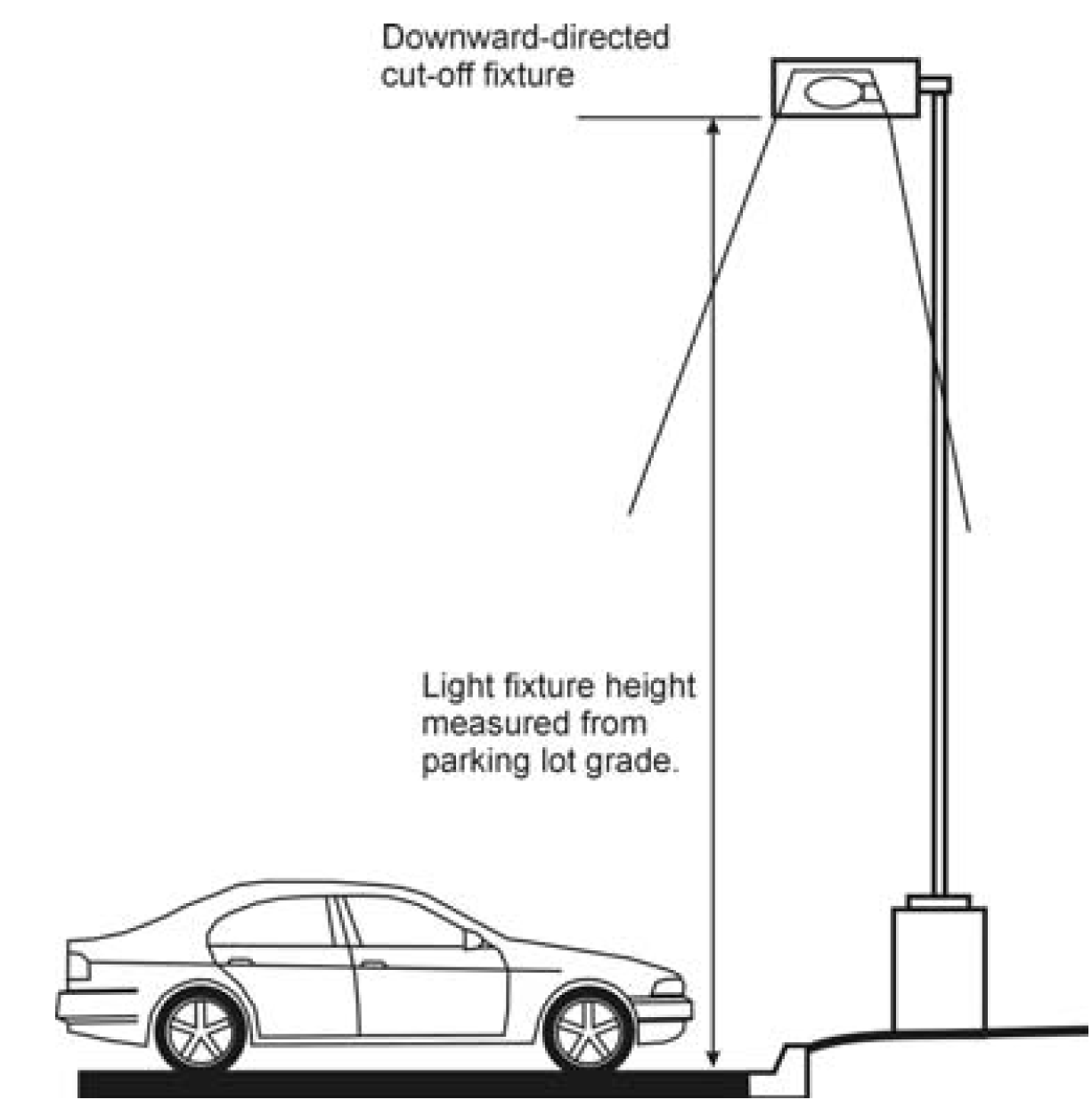
Lighting shall utilize cutoff fixtures that are recessed sufficiently such that the light source is not visible from off site.
(4)
Bollard lights are permitted to light driveways and pedestrian areas.
(5)
Floodlight type fixtures shall be used only for building accent, landscaping and sign lighting.
(d)
Fixture height. Light fixtures shall have a maximum height of 20 feet where adjacent to any residential district. Light fixtures shall have a maximum height of 25 feet where adjacent to nonresidential districts. Heights is measured from the parking lot grade.
(e)
Ornamental lighting. The requirement for downward directed lighting may be waived for ornamental lighting which is part of an overall architectural theme and street lighting.
(f)
Constant light. All illumination of signs and any other outdoor feature shall not be of a flashing, moving or intermittent type. Artificial light shall be maintained stationary and constant in intensity and color at all times when in use.
(g)
Sign lighting. Internally illuminated signs shall be permitted and light fixtures directed at a sign may be permitted where the fixtures are shielded so not to cause visible glare to persons on adjacent streets or adjacent property illumination of signs shall comply with the requirements of article 18, signs.
(h)
Photometric plan. Any site plan application for new or revised lighting shall include a photometric plan overlaid on the site plan illustrating the planned layout and footcandles of site lighting. The following are required for review:
(1)
Lighting plan showing light pole and fixture locations and type designations.
(2)
Photometric plan showing horizontal luminance levels in a point by point format with contour lines. Canopy lighting will also be included in luminance levels.
(3)
Lighting manufacturers equipment specifications and data sheets on the photometric plan.
(4)
Any other presentations required to convey the intent of the design.
(Ord. No. 09-434, § 16.05, 1-20-2009)
Sec. 16.06. - Waste receptacles.
Waste receptacles, including dumpsters and compactors, shall be designed, constructed and maintained according to the standards of this section. A change in waste receptacle location or size shall require modification to the enclosure, as warranted by this section.
(a)
Applicability.
(1)
The regulations of this section shall apply to all uses that have their refuse removal needs serviced by collective refuse containers in multiple-family residential and nonresidential districts.
(2)
The planning commission may waive the requirement for a waste receptacle enclosure for businesses, such as banks, that store all waste material indoors or other uses that provide alternate means of handling waste disposal.
(3)
Grease traps shall be required for all restaurant uses.
(b)
Location.
(1)
Waste receptacles shall be located in the rear yard, not closer than three feet from the rear lot line, or nonrequired side yard, unless otherwise approved by the planning commission or development services department for administrative reviews.
(2)
For nonresidential uses adjoining a residential district, the waste receptacle shall be as far as practical, and in no case be less than 20 feet from any adjacent residential district.
(3)
Waste receptacles shall be easily accessed by refuse vehicles without potential to damage automobiles parked in designated parking spaces or interfering with the normal movement of vehicles on or off the site.
(4)
Waste receptacles shall not be located below any overhead power lines.
(5)
The waste receptacle shall be oriented to not directly face a street or driveway, unless approved by the planning commission or development services department for administrative reviews.
(c)
Materials and screening.
(1)
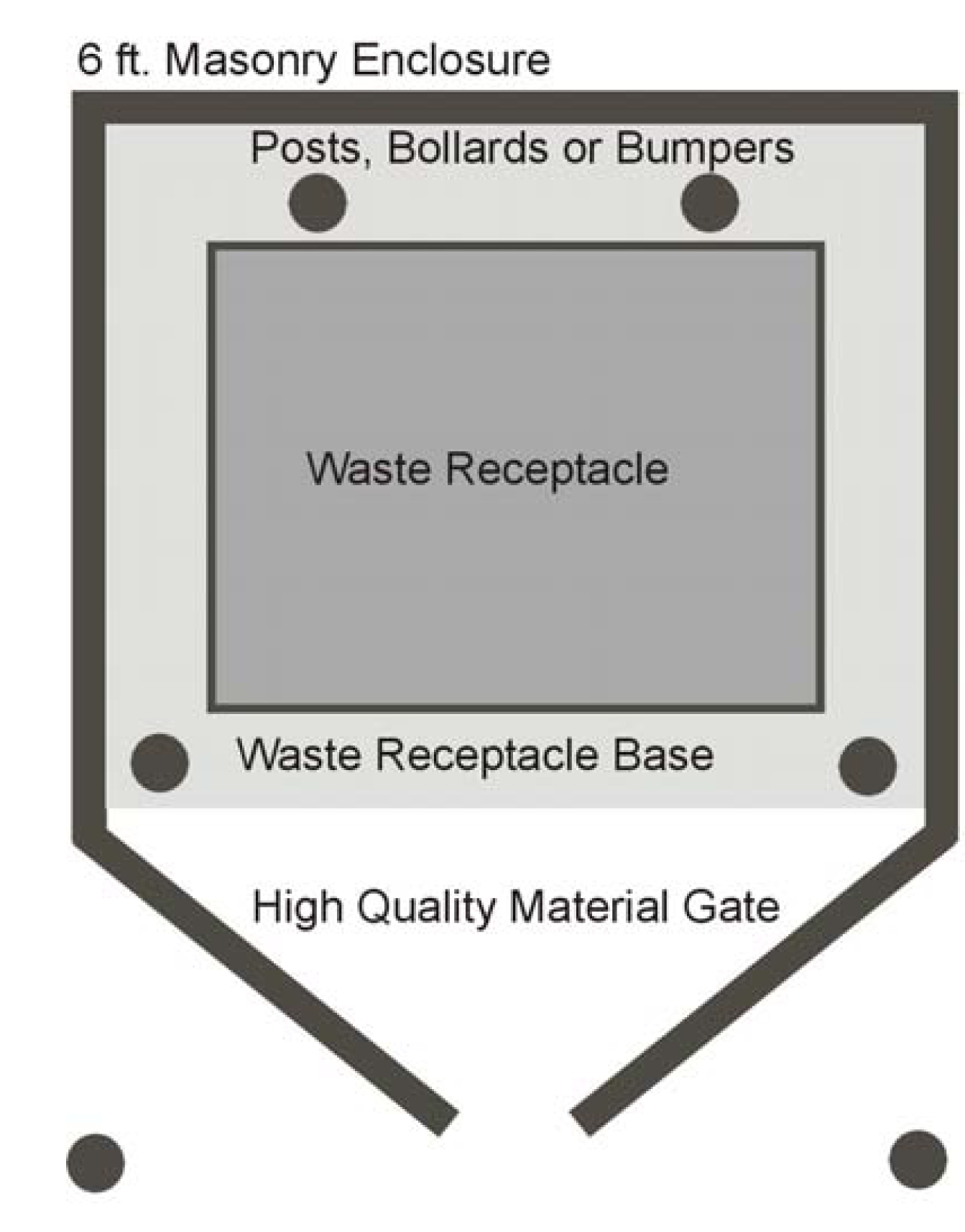
Waste receptacles shall be enclosed on three sides with a masonry enclosure with a maximum height of six feet or at least one foot higher than the dumpster.
(2)
The enclosure shall be constructed of brick or split face block that matches the building color. Other decorative masonry material may be approved if it matches the material used on the principal building and landscape screening is provided. Poured concrete with false brick design or plain concrete slag blocks are not permitted.
(3)
The enclosure shall include a gate, made of high quality material, as determined by the planning commission or development services department for administrative reviews, on the fourth side. If the waste receptacle is a dumpster it shall have an enclosing lid or cover.
(d)
Generally.
(1)
The waste receptacle base shall be at least eight feet by five feet in area, constructed of six inches of reinforced concrete pavement.
(2)
The base shall extend six feet beyond the waste receptacle pad or gate to support the front axle of a refuse vehicle.
(3)
Where grease disposal receptacles are used, curbing shall be provided around the enclosure base to contain any spillage.
(4)
Posts, bollards or bumpers shall also be provided to protect the enclosure from damage.
(5)
The shared use of receptacles shall be allowed by adjoining businesses where sharing will not create a health or safety concern and where it does not result in the accumulation of visibly excessive quantities of waste. Necessary shared use agreements are required.
(Ord. No. 09-434, § 16.06, 1-20-2009)
Sec. 16.07. - Mechanical equipment.
Any mechanical equipment or utilities and similar equipment associated with a commercial, industrial or other nonresidential use, including water and gas meters, elevator housings, stairways, tanks, heating, ventilation and air conditioning equipment, exhaust pipes or stacks, satellite dishes and other telecommunications receiving devices and other similar equipment, shall comply with the following standards:
(a)
Roof-mounted equipment.
(1)
All roof-mounted equipment shall be screened by parapet walls or a pitched roof integrated into the architectural design of the building of sufficient height to screen rooftop equipment and provide sound attenuation. The location, height, and screening methods shall be shown on the site plan.
(2)
Roof-mounted equipment shall not exceed a height of ten feet above the surrounding roof surface.
(3)
All roof-mounted mechanical units must be set back a minimum of 20 feet from the front of the building and any side of the building facing an adjacent residential district.
(4)
Fire escapes shall not be permitted on a buildings front facade. In buildings requiring a second means of egress pursuant to the state construction code, internal stairs or other routes of egress shall be used.
(b)
Ground-mounted equipment.
(1)
Mechanical equipment and utilities located on or around any nonresidential building shall be screened by decorative walls that are compatible with the material used on the building or landscaping. The height of the wall shall be sufficient to fully screen the mechanical equipment.
(2)
Screening materials for ground-mounted mechanical equipment and utilities shall include a solid wall, fence, plantings, berms and/or other decorative features compatible with the materials used on the main building.
(3)
In a nonresidential district, ground-mounted mechanical equipment shall not be located within 20 feet of any residential district.
(4)
Mechanical equipment may not be located within the required yard setback, except as provided in section 14.11, projections into required yards.
(c)
Security gates.
(1)
Solid metal security gates or solid roll-down metal windows shall be prohibited.
(2)
Link or grill type security devices shall be permitted only if installed from inside, within the window or door frames; or, if installed on the outside, if the coiled box is recessed and concealed behind the building wall.
(3)
Security grills shall be recessed and concealed during normal business hours.
(4)
Models that provide a sense of transparency, in light colors are encouraged.
(5)
Other types of security devices fastened to the exterior wall are prohibited.
(Ord. No. 09-434, § 16.07, 1-20-2009)
Sec. 16.08. - Stormwater drainage.
(a)
Stormwater drainage shall be accommodated through underground storm sewers meeting the city's engineering standards. All streets shall be required to have underground storm sewers.
(b)
Any lot that currently has open stormwater drainage, including open ditch drainage along the street frontage, shall be enclosed in belowground sewers. This requirement may be waived by the city engineer in the following instances:
(1)
Where existing conditions would make such requirements difficult from an engineering and construction standpoint.
(2)
Where enclosing a portion of a drain would cause drainage problems for adjacent properties.
(3)
Where an open drain is under the jurisdiction of Wayne County and the county has indicated that they will not allow the drain to be enclosed.
(c)
The regulations of this section shall not apply to stormwater detention or retention ponds, which may be open in accordance with Wayne County and city engineering standards.
(Ord. No. 09-434, § 16.08, 1-20-2009)
Sec. 16.09. - Outdoor amplification.
Outdoor loudspeakers, public address systems shall be prohibited in all districts. This provision shall not apply to speakers used for drive-through uses, provided the sound is less than 40 dBA at the lot line.
(Ord. No. 09-434, § 16.09, 1-20-2009)

