
Taylor City Zoning Code
ARTICLE 27
- AMENDMENTS TO ORDINANCE12
State Law reference— Zoning adoption and enforcement, MCL 125.3401 et seq.
Sec. 27.01.- Initiation of rezoning and text amendments.
The city may, from time to time, amend, modify, supplement, or delete any provision of this ordinance (text amendment) or change the zoning district boundaries shown on the zoning map (rezoning) pursuant to the provisions of the zoning act.
(a)
Initiation of rezonings. An amendments to the zoning district boundaries contained on the zoning map (rezoning) may be initiated by the city or the owner, or owners of property, or with permission of the owner which is the subject of the proposed amendment.
(b)
Initiation of text amendment. Amendments to the text provisions of this ordinance may be initiated by the city or by petition of one or more residents or property owners of the city.
(Ord. No. 09-434, § 27.01, 1-20-2009)
Sec. 27.02. - Application procedure.
(a)
Initiation by application unless initiated by the city. A rezoning or text amendment request, except those initiated by the city, shall be initiated by submission of a completed application on a form supplied by the city, including an application fee to cover publication, administrative costs, and fees for any consultant reviews. Such fee and escrow shall be established by resolution of the city council.
(b)
Application for rezoning.
(1)
Application information. The following information shall accompany the rezoning application form:
a.
Legal description and street address of the subject property.
b.
Map identifying the subject property in relation to surrounding properties.
c.
Name, signature, and address of the owner of the subject property; a statement of the applicant's interest in the subject property if not the owner in fee simple title, and proof of consent from the property owner.
d.
Existing and proposed zoning district designation of the subject property.
e.
Existing zoning district designation of all adjacent property.
f.
Site analysis at a scale not less than one inch equals 100 feet, or aerial photograph illustrating existing conditions on the site and adjacent properties; such as woodlands, wetlands, soil conditions, topography, drainage patterns, existing buildings, adjacent land uses, any sight distance limitations, and access points on both sides of the streets within 200 feet of the subject site.
g.
Conceptual plan at a scale not less than one inch equals 100 feet, demonstrating that the site could be developed with representative uses permitted in the requested zoning district meeting requirements for setbacks, lot coverage, building spacing, parking, loading, drainage, general landscaping, and other site design factors; while the anticipated use can be shown, an illustration of the maximum development permitted under current zoning shall also be provided.
h.
Traffic impact analysis.
i.
Written description of how the requested rezoning meets section 27.04, criteria for amendment of the official zoning map (rezoning).
j.
The planning commission shall have the authority to require other studies and materials be submitted to confirm compliance with the standards of this article including, but not limited to, market studies, environmental assessments or utility capacity analysis.
(2)
Site requirements. In the case of an amendment to the official zoning map (rezoning), the applicant is required to do all of the following:
a.
The site must be staked to clearly indicate the location of the requested amendment. Flagged stakes shall be placed at each parcel corner.
b.
A sign shall be posted on the property by the applicant indicating that the property is proposed to be rezoned. The sign shall:
1.
Be four feet by eight feet in size with minimum three-inch tall lettering.
2.
Be erected in full public view along the street frontage.
i.
If the property to be rezoned is located at an intersection, a sign for each street frontage must be provided.
ii.
If the property exceeds 80 acres in area, two signs must be provided.
3.
State "This Property Proposed To Be Rezoned."
4.
Include the current and proposed zoning, area in acres of the property and a generalized map of the property.
5.
Indicate the date, time, and location of the planning commission public hearing where the proposal will be reviewed.
6.
Be erected and maintained by the applicant at least 15 days prior to the scheduled planning commission public hearing and removed within 15 days after the public hearing.
7.
Be exempt from the regulations of article 18, signs, provided a temporary sign permit be obtained from the development services department in accordance with city requirements.
(3)
Exemptions. Any rezoning initiated by the city for updates to the zoning ordinance or zoning map or a city initiated rezoning consistent with the master plan shall be exempt from subsection (b)(1) and (2) of this section.
(c)
Application for text amendment. An application for a text amendment to this ordinance shall include a general description of the proposed amendment.
(Ord. No. 09-434, § 27.02, 1-20-2009)
Sec. 27.03. - Rezoning and text amendment procedure.
(a)
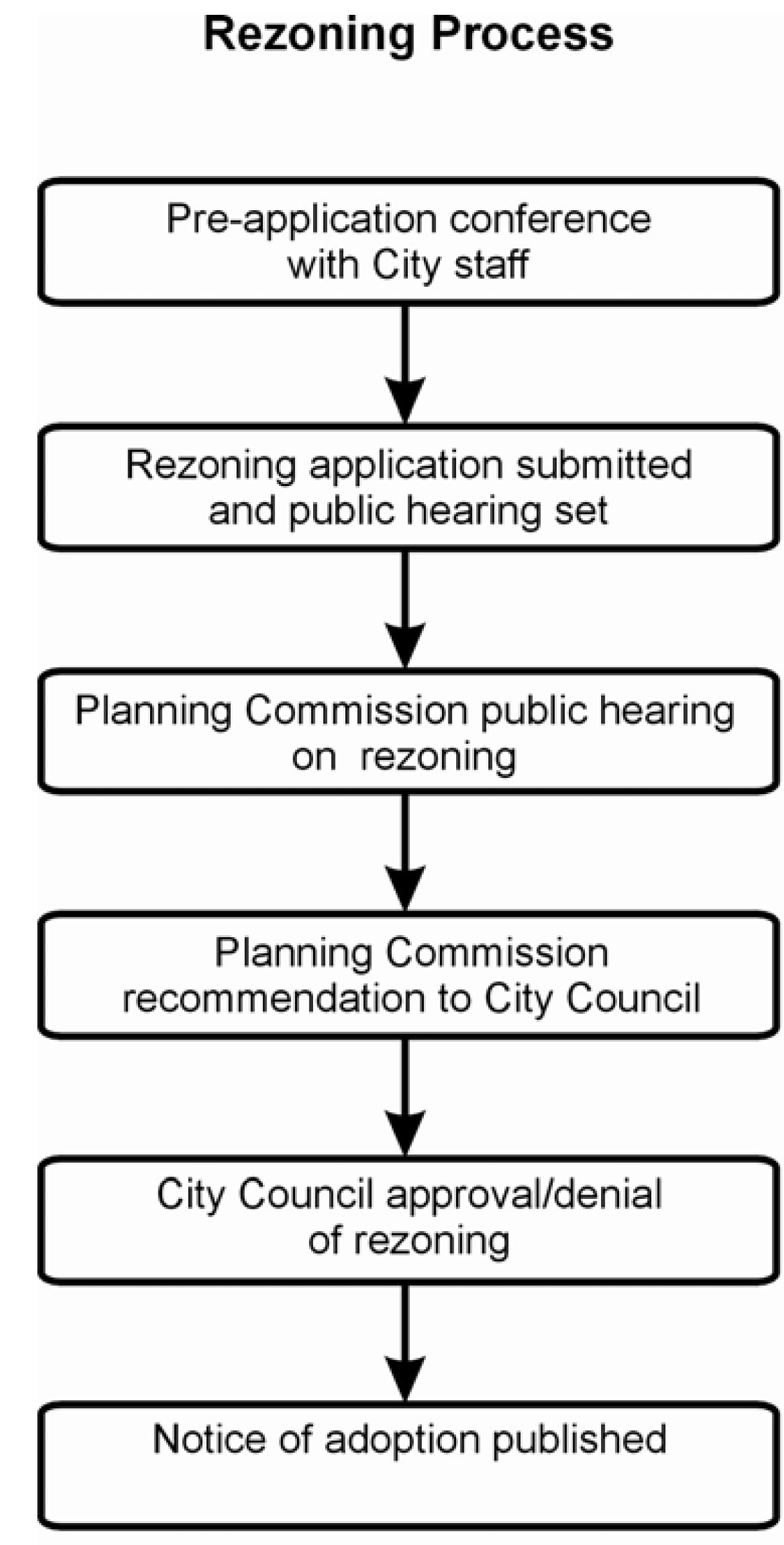
Preapplication conference. A preapplicant conference with city staff to review the amendments, discuss the level of environmental information, concept plan uses market studies, utility capacity analysis, and type of traffic study required including intersections to be evaluated, background traffic, and data availability, may be requested by the applicant.
(b)
Public hearing. Upon initiation of a rezoning or a text amendment, a public hearing on the proposed amendment shall be scheduled before the planning commission in accordance with the standards set forth in section 25.09, public hearings.
(c)
Planning commission review and recommendation. Following the public hearing, the planning commission shall identify and evaluate all factors relevant to the petition and shall report its findings and recommendation to the city council. In the case of a rezoning request, the planning commission shall consider the criteria contained in section 27.04, criteria for amendment of the official zoning map (rezoning) in making its finding and recommendation.
(d)
City council review and action. Following receipt of the findings and recommendation of the planning commission, the city council shall consider the proposed amendment to be adopted following two readings.
(1)
In the case of a rezoning request, the city council shall approve or deny the request based on the consideration of the criteria contained in section 27.04, criteria for amendment of the official zoning map (rezoning).
(2)
In the case of a text amendment, the city council may modify or revise the proposed amendment, prior to adoption.
(e)
Notice of adoption. Following adoption of a zoning map amendment (rezoning) or text amendment by the city council, a notice will be published in accordance with the provisions of the zoning act.
(f)
Resubmittal. No petition for rezoning or zoning ordinance text amendment that has been denied by the city council shall be resubmitted for a period of one year from the date of denial except on the grounds of new evidence or proof of changed conditions relating to all of the reasons noted for the denial found to be valid by the planning commission.
(Ord. No. 09-434, § 27.02, 1-20-2009)
Sec. 27.04. - Criteria for amendment of the zoning map (rezoning).
(a)
In considering any rezoning application, the planning commission and the city council shall consider the following criteria in making its findings, recommendations, and decisions:
(1)
Consistency with the City of Taylor master plan, including any subarea or corridor studies. If conditions have changed since the master plan was adopted, the consistency with recent development trends in the area.
(2)
Capability of the site's physical, geological, hydrological and other environmental features with the host of uses permitted in the proposed zoning district.
(3)
Whether development under current zoning is impractical or less reasonable than the requested zoning district given factors such as development trends and other factors.
(4)
Compatibility of all the potential uses allowed in the proposed zoning district with surrounding uses and zoning in terms of land suitability, impacts on the environment, noise, density, nature of use, traffic impacts, aesthetics, infrastructure, impact on ability to develop adjacent properties under existing zoning, and potential influence on property values.
(5)
Capacity of city infrastructure and services sufficient to accommodate the uses permitted in the requested district without compromising the health, safety and welfare of the city.
(6)
Demand for the types of uses permitted in the requested zoning district in the city in relation to the amount of land in the city currently zoned to accommodate the demand.
(7)
The request has not previously been submitted within the past one year, unless conditions have changed or new information has been provided.
(b)
A determination shall be made that the requested zoning district is more appropriate than another district or amending the list of permitted or special land uses within a district.
(Ord. No. 09-434, § 27.04, 1-20-2009)
Sec. 27.05. - Conditional rezoning.
(a)
Applicant may volunteer for conditional rezoning. An applicant requesting a rezoning may voluntarily offer a conditional rezoning along with an application for rezoning. An election to submit a conditional rezoning agreement shall be pursuant to the zoning act and this section.
(1)
The conditional rezoning shall be in writing, executed by the applicant and the city and recorded with the Wayne County Register of Deeds. All costs associated with the review and approval of the conditional rezoning agreement shall be the responsibility of the applicant.
(2)
The conditional rezoning may include limitations on the uses permitted on the property in question, specification of lower density or less intensity of development and use, or may impose more restrictions on the location, size, height, or other measure for buildings, structures, improvements, setbacks, landscaping, buffers, design, architecture and other features.
(3)
The conditional rezoning shall not authorize uses or developments of greater intensity or density, or which are not permitted in the proposed zoning district; nor may a conditional rezoning agreement permit variations from height, area, setback or similar dimensional requirements that are less restrictive than the proposed zoning district.
(4)
The conditional rezoning may include conditions related to the use and development of the property that are necessary to:
a.
Serve the property with improvements, including but not limited to, the extension, widening, or realignment of streets; construction, or extension of utilities, or other infrastructure improvements serving the site; or the construction of recreational facilities.
b.
Minimize the impact of the development on surrounding properties and the city overall.
c.
Preserve natural features and open space beyond what is normally required.
(b)
Content of agreement. In addition to any limitations on use or development of the site, preservation of site features or improvements described above, the conditional rezoning agreement shall also include the following:
(1)
An acknowledgement that the conditional rezoning agreement was proposed voluntarily by the applicant.
(2)
A statement that the property shall not be developed or used in any manner that is not consistent with the conditional rezoning agreement.
(3)
A statement that the approval of the rezoning and the conditional rezoning agreement shall be binding upon and inure to the benefit of the property owner and the city, and also their respective heirs, successors, assigns, receivers or transferees. Where the applicant for rezoning is acting on behalf of the landowner through some form of purchase agreement or other mechanism, then the landowner must also consent and sign the agreement.
(4)
A statement that, if a rezoning with a conditional rezoning agreement becomes void in accordance with this section, that no further development shall take place and no permits shall be issued.
(5)
A statement that no part of the conditional rezoning agreement shall permit any activity, use, or condition that would otherwise violate any requirement or standard that is otherwise applicable in the new zoning district.
(6)
A legal description of the land to which the agreement pertains.
(7)
Any other provisions as are agreed upon by the city and applicant.
(c)
Process. The conditional rezoning agreement shall be reviewed concurrently with the petition for rezoning following the process in section 27.02, application procedure, and the following:
(1)
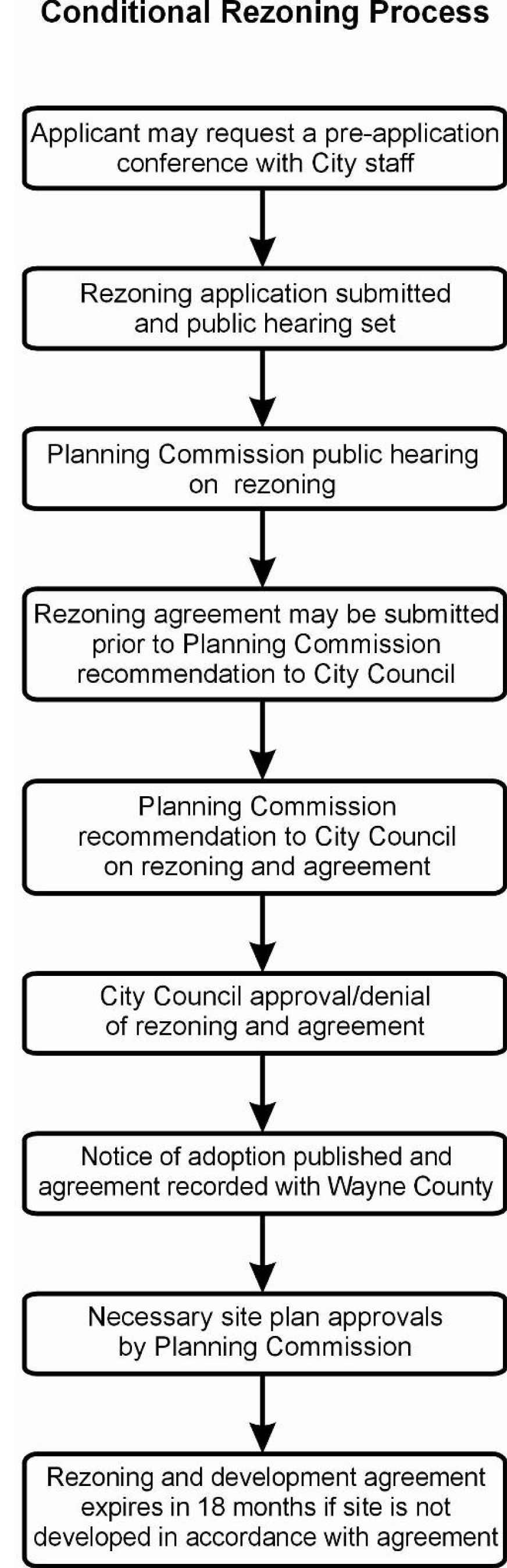
The conditional rezoning agreement may be submitted prior to planning commission making its recommendation on the rezoning to the city council. The conditional rezoning agreement shall be reviewed by the city attorney, at the expense of the applicant, to determine that the conditional rezoning agreement conforms to the requirements of this section and the zoning act and shall confirm that the conditional rezoning agreement is in a form acceptable for recording with the Wayne County Register of Deeds.
(2)
Following the public hearing for a proposed zoning amendment, the planning commission shall make a recommendation to the city council based upon the criteria listed in section 27.04, criteria for amendment of the official zoning map (rezoning). In addition, the planning commission shall consider whether the proposed conditional rezoning agreement:
a.
Is consistent with the intent of this ordinance.
b.
Bears a reasonable and rational connection or benefit to the property being proposed for rezoning.
c.
Is necessary to ensure that the property develops in such a way that protects the surrounding neighborhood and minimizes any potential impacts to adjacent properties.
d.
Is necessary to allow the rezoning to be approved, in that the property could not or would not be rezoned without the proposed conditional rezoning agreement.
e.
Leads to a development that is more compatible with abutting or surrounding uses than would have been likely if the property had been rezoned without a conditional rezoning agreement, or if the property were left to develop under the existing zoning classification.
f.
Is in the public interest and is consistent with the recommendations of the master plan.
(3)
If a conditional rezoning agreement has been offered by the applicant and recommended for approval by the planning commission, the city council may approve the conditional rezoning agreement as a condition to the rezoning if it meets all requirements of subsection (c) above. The conditional rezoning agreement shall be incorporated by attachment or otherwise as an inseparable part of the ordinance adopted by the city council to accomplish the requested rezoning.
(4)
If the rezoning and conditional rezoning agreement are approved, the zoning classification of the rezoned property shall consist of the district to which the property has been rezoned, and a reference to the conditional rezoning agreement. The zoning map shall specify the new district, plus the acronym "C" to indicate that the property is subject to a conditional rezoning agreement (i.e., R-1A through C). The city clerk shall maintain a listing of all properties subject to conditional rezoning agreements and shall provide copies of the agreements upon request.
(5)
The approved conditional rezoning agreement shall be recorded with the Wayne County Register of Deeds.
(6)
Any uses proposed as part of a conditional rezoning agreement that would otherwise require approval of a special land use or site plan approval shall be subject to the applicable review and approval requirements of article 19, site plan review, and article 21, special land use review.
(d)
Expiration.
(1)
The rezoning and conditional rezoning agreement shall expire 18 months after adoption of the rezoning and conditional rezoning agreement, unless substantial construction on the approved development of the property pursuant to building and other required permits issued by the city commences within the 18 month period and proceeds diligently to completion, unless extended by the city council for good cause.
(2)
In the event that substantial construction on the approved development has not commenced within the aforementioned 18 months, the conditional rezoning agreement shall be void and of no effect.
(3)
Should the conditional rezoning agreement become void, all development on the property shall cease, and no further development shall be permitted. Until action satisfactory to the city is taken to bring the property into compliance with the conditional rezoning agreement, the city may withhold or, following notice to the applicant and being given an opportunity to be heard, revoke permits and certificates. This shall be in addition to or in lieu of any other lawful action to achieve compliance, including rezoning.
(4)
Notwithstanding the above, if the property owner applies in writing for an extension of the conditional rezoning agreement at least 30 days prior to the expiration date, the city council may grant an extension of up to one year where the city council determines that the landowner has made diligent effort towards completing the conditions of the agreement.
(e)
Reversion of zoning. If the rezoning and conditional rezoning agreement becomes void as outlined above, then the land shall automatically revert back to its original zoning classification as set forth in the zoning act. The development services department will advise the landowner and/or developer, by registered letter, of the reversion of zoning. The city shall take affirmative action to rezone the property.
(f)
Continuation. Provided that all development and/or use of the property in question is in compliance with the conditional rezoning agreement, a use or development authorized there under may continue indefinitely, provided that all terms of the conditional rezoning agreement continue to be met.
(g)
Amendment. The conditional rezoning agreement may be amended by the city council with the landowner's consent in the same manner as was prescribed for the original rezoning and conditional rezoning agreement.
(h)
Violation of agreement. Failure to comply with the conditional rezoning agreement at any time after approval will constitute a breach of the agreement and also a violation of this ordinance and further use of the property may be subject to legal remedies available to the city.
(i)
Subsequent rezoning of land. Nothing in the conditional rezoning agreement, nor any statement or other provision, shall prohibit the city from later rezoning all or any portion of the property that is the subject of the conditional rezoning agreement to another zoning classification. Any rezoning shall be conducted in compliance with this ordinance and the zoning act.
(j)
Failure to offer conditions. The city shall not require an owner to offer conditions as a requirement for rezoning. The lack of an offer of conditions shall not affect the owner's rights under this ordinance.
(k)
City not obligated. The city is not required or obligated to accept any or all conditions offered by a developer on a rezoning application. In no way is an offer of a conditional rezoning agreement the basis for requiring the city to approve a rezoning application.
(Ord. No. 09-434, § 27.05, 1-20-2009)

