
Taylor City Zoning Code
ARTICLE 22
- PLANNED UNIT DEVELOPMENTS PUDS8
State Law reference— Planned unit development, MCL 125.3503.
Sec. 22.01.- Intent.
The planned unit development (PUD) is intended as a development option to provide a degree of flexibility in the regulation of land development and the arrangement of uses. Through this option, more creative approaches to development can be utilized which take better advantage of the special characteristics of the land than would be possible through the strict enforcement of this ordinance. The specific objectives of this article are to:
(a)
Encourage innovation in land use and variety in design, layout and type of structures constructed.
(b)
Achieve economy and efficiency in the use of land, natural resources, energy, and the provision of public services and utilities.
(c)
Permit flexibility in the placement, lot area and building type regulations, and combination of uses while assuring the application of sound site planning standards.
(d)
Encourage the provision of useful open space and more extensive landscaping.
(e)
Provide opportunities for improvements to public streets or facilities, pathways and natural stormwater systems.
(f)
Promote the development of walkable, mixed use developments that will result in more sustainable and healthy neighborhoods.
(g)
Achieve consistent and coordinated site design (e.g., lighting, signs, building design, etc.), and high quality architectural design and materials.
(h)
Encourage the use, reuse, and improvement of existing sites.
(i)
Encourage the use and improvement of land where site conditions make development under conventional zoning difficult and less desirable.
(Ord. No. 09-434, § 22.01, 1-20-2009)
Sec. 22.02. - Qualifying conditions.
(a)
Ownership. An application for the approval of a PUD shall be made by an owner, lessee, or other person with a legal interest in the property who has the owner's written consent to file the application.
(b)
Public utilities. The PUD site shall be serviced by public sewer and water systems. The proposed type and density of use shall not result in an unreasonable increase in the use of public services, public facilities, and utility capacities.
(c)
Recognizable and substantial benefits. The PUD application shall demonstrate that the project will result in recognizable and substantial benefits to the residents, users, visitors, adjacent neighbors, and the city overall that would not be available under the existing, underlying zoning classification. Benefits beyond those otherwise required by this ordinance include, but are not limited to:
(1)
Preservation of significant natural features.
(2)
A complementary mixture of uses.
(3)
Extensive open space and recreational amenities.
(4)
Open space greenways to link to adjacent greenway corridors.
(5)
Transition areas from adjacent land uses.
(6)
Preservation of historical buildings or site features.
(7)
Improvements to the public street system to mitigate traffic impacts or other public facility improvements to mitigate impacts of development.
(8)
Pedestrian and transit oriented development.
(9)
Coordinated development of multiple assembled small parcels.
(10)
Removal or renovation of blighted buildings or sites or cleanup of site contamination.
(d)
Consistency with the master plan. The PUD shall be compatible with the overall goals and recommendations as proposed in the City of Taylor Master Plan.
(Ord. No. 09-434, § 22.02, 1-20-2009)
Sec. 22.03. - Permitted uses.
Uses permitted in a PUD are based on the underlying zoning district. All permitted uses of the underlying zoning district shall be permitted and all special land uses of the underlying zoning district shall be allowed with special land use approval. Additional uses may be allowed in a PUD as follows:
(a)
Residential PUD. The PUD may provide for a variety of permanent housing types, including single-family detached, townhomes or multiple-family residential.
(1)
Where the underlying zoning is single-family residential, a minimum of 80 percent of the dwellings shall be detached single-family dwellings and up to 20 percent may be townhomes.
(2)
Where the underlying zoning is multiple-family, any mixture of single-family, townhouses and multiple-family is permitted.
(b)
Mixed use residential PUD. For a PUD in a residential district that has an area of at least 20 acres, commercial uses allowed in the B-1 district may occupy up to ten percent of the gross site area. Planned commercial sites are to be located at an intersection of two major streets or a major street.
(c)
Mixed use/nonresidential PUD. For a PUD in a nonresidential district, residential uses may be permitted in a mixed use PUD in addition to the uses allowed by the underlying zoning district. Other uses may be allowed where the planning commission determines them to be consistent with surrounding uses and the future land use plan of the City of Taylor Master Plan.
(d)
Industrial PUD. For a PUD in an I-1, I-2 or TRO district, uses allowed by the underlying zoning district shall be allowed. Other commercial uses that provide services to businesses and employees in the immediate area, such as convenience retail, restaurants, business services and hotels, may be permitted where the planning commission determines the uses contribute towards an integrated mixed use employment district.
(Ord. No. 09-434, § 22.03, 1-20-2009)
Sec. 22.04. - Residential density.
(a)
Single-family residential. Where the underlying zoning is single-family, residential density shall be determined by a parallel plan that illustrates how the site could be developed as a conventional subdivision or site plan, meeting all applicable city zoning and subdivision requirements. The city shall review the design and determine the number of buildable lots that could be feasibly constructed, taking into consideration any wetlands or other nonbuildable land. This number shall be the maximum number of dwelling units allowable for the PUD.
(b)
Multiple-family residential or commercial. Where the underlying zoning is multiple-family, density shall be determined based upon the underlying zoning district and the definition of density. Where the underlying zoning is nonresidential, density shall be determined based upon the RM-1 district.
(c)
Change in underlying zoning. Where the master plan recommends a different zoning district than the current zoning, a rezoning of the underlying zoning district consistent with the master plan may be considered concurrently with the PUD.
(d)
Density bonus. The city council may grant a density bonus of up to ten percent, where the planning commission finds that the development provides extraordinary benefits and furthers smart growth principals by meeting all of the following:
(1)
The project will provide a wide range of housing opportunities and choices through varied housing types, varied dwelling sizes and variable lot sizes, or the project will provide a mixture of compatible and complementary residential and nonresidential land uses;
(2)
The project will create a walkable neighborhood with a continuous pedestrian circulation system that links all areas of the development, links the development to other destinations in the surrounding area and is designed to facilitate a variety of transportation choices by providing alternatives to automobile travel;
(3)
The project takes advantage of compact design through clustering development into a walkable scale neighborhood and preserving significant open space, and natural features; and
(4)
The project is consistent with the Taylor Master Plan, furthers the stated goals of the plan and provides extraordinary benefits to the city.
(Ord. No. 09-434, § 22.04, 1-20-2009)
Sec. 22.05. - Dimensional requirements.
(a)
Base zoning regulations. All zoning ordinance requirements for the underlying zoning district shall remain in full force, except as modified under this section.
(b)
Regulatory flexibility. To encourage flexibility and creativity, the planning commission may recommend the city council grant specific departures from the requirement of the zoning ordinance as a part of the approval process. Lot area, width, setback, height and parking standards may be modified, provided that such modifications result in preservation of open space, enhanced buffering from adjacent land uses, screening along major streets, preservation of natural features, pedestrian-oriented development, a more efficient use of land or improved compatibility with adjacent land uses.
(c)
Approval of modifications. Any regulatory modification shall be approved through a recommendation by the planning commission stating that the deviation shall result in a higher quality of development than would be possible using conventional zoning standards.
(d)
Table of modifications. A table shall be provided on the PUD site plan that specifically details all deviations from the established zoning district's lot area, width, setback, height and parking standards or other zoning ordinance provisions that would otherwise be applicable to the uses and development proposed. This specification must include ordinance provisions, from which deviations are sought, and the reasons and mechanisms to be utilized for the protection of the public health, safety, and welfare in lieu of the regulations from which deviations are sought. Only those deviations consistent with the intent of this ordinance and the master plan shall be considered.
(Ord. No. 09-434, § 22.05, 1-20-2009)
Sec. 22.06. - Open space.
(a)
All PUDs shall include common open space located to preserve significant natural features, central to the residents of the development, along the arterial street frontage, adjacent to adjoining residential or to connect open spaces throughout the development. Common open space shall be in locations and configuration to be easily accessible from all parts of the residential area of the PUD.
(b)
Open space shall be provided at the following minimum rates, one-half of which must be usable and one-half of which may be natural wetland or woodland area:
TABLE 22.06. PUD OPEN SPACE REQUIREMENTS
(c)
The minimum size of open space shall be 20,000 square feet with a maximum width to depth ratio of 3:1. This standard is intended to ensure open space is valuable and usable rather than scattered, isolated or remnant lands. The city may waive this standard for clearly identified pathway corridors between a single row of lots intended to connect open spaces, if such corridors are determined to be desirable as part of the overall project layout.
(d)
Areas not considered open space. Stormwater detention or retention, land under water, street right-of-way, parking lots, required setbacks or landscaped areas required in section 16.02, landscaping shall not be counted towards meeting common open space.
(e)
Protection. The open space or common areas shall be placed under a conservation easement or otherwise committed by dedication to an association of the residents, and the use shall be irrevocably dedicated in perpetuity and retained as open space for park, recreation, conservation or other common uses. The necessary documents will be approved by the city, recorded by the applicant, with all costs paid by the applicant, prior to the issuance of a building permit.
(Ord. No. 09-434, § 22.06, 1-20-2009)
Sec. 22.07. - General development requirements.
(a)
Screening and buffering. Yards, fences, walls or vegetative screening shall be provided where needed to protect residents from undesirable views, lighting, noise or other off-site influences, or to protect residential occupants of neighboring areas from similar adverse influences within the PUD. In particular, screening shall be provided for large off-street parking areas, service areas for loading and unloading delivery vehicles, and areas for storage and collection of refuse and garbage. All requirements of article 16, general site development requirements, shall be met.
(b)
Transitional areas. That portion of a PUD abutting a single-family district shall include a compatible land use transition, such as similar single-family dwellings or 50-foot wide buffer zone consisting of landscaping in accordance with section 16.02, landscaping.
(c)
Vehicular circulation. The PUD must have direct access to a major street, as defined in section 28.11(k), streets. Access shall be fully integrated within the site to allow cross circulation between uses within the PUD and provide a shared access system with major streets. All streets shall meet the street design standards in the city subdivision and engineering regulations. Street connections shall be provided to existing adjacent streets and allow for future connection to adjacent vacant land.
(d)
Nonmotorized circulation. The PUD shall incorporate pedestrian-oriented design and create a walkable neighborhood. Sidewalks or nonmotorized pathways shall be provided along all streets. Small block sizes with connections to adjacent areas shall provide for convenient walkability.
(e)
Architecture. Architectural features of all nonresidential structures, regardless of use, shall be compatible with the overall character and image of the PUD and integrated into a unified appearance.
(f)
Flooding and other hazards. The site shall be developed without hazards to persons or property, whether within the PUD or not, and be reasonably free from probability of flooding, erosion or other dangers, annoyances, or inconvenience. Drainage and topography of the final grade of the site shall be consistent throughout the PUD and to adjacent properties.
(Ord. No. 09-434, § 22.07, 1-20-2009)
Sec. 22.08. - PUD site plan information.
(a)
Concept plan requirements. At a minimum the following information shall be provided for the concept plan review:
(1)
The name, address and phone number of all persons with ownership interests in the property; all professionals associated with the project including engineers, architects, land surveys; the developer, proprietor or applicant for the PUD.
(2)
Application and other required fees.
(3)
The legal description and tax identification numbers of the proposed PUD property.
(4)
The gross and net area (in acres) of the proposed PUD property.
(5)
A concept plan drawn to scale that showing the proposed development. The concept plan shall illustrate the following:
a.
A general location map.
b.
A map indicating the zoning designation of the proposed PUD property.
c.
The vehicular circulation system proposed for the PUD.
d.
The location of existing public and private streets adjacent to the proposed PUD with an indication of how they will connect with the proposed circulation system for the new development.
e.
General locations and approximate size of any wetland areas (regulated or nonregulated), significant woodlands, unusual slopes, streams and water drainage areas.
f.
The general layout of dwelling units, nonresidential buildings, parking, open space and recreation areas.
g.
Locations for landscape screening along the perimeter of the proposed PUD.
h.
A general description of the proposed sewage treatment and water supply systems and the proposed stormwater drainage system.
(6)
A description of how the proposed PUD will result in recognizable and substantial benefits to the residents, users, visitors, adjacent neighbors, and the city overall that would not be available under the existing, underlying zoning classification.
(b)
Preliminary PUD site plan requirements. The following information shall accompany the PUD rezoning and preliminary site plan application:
(1)
The name, signature, and address of the owner of the subject property; a statement of the applicant's interest in the subject property if not the owner in fee simple title, and proof of consent from the property owner.
(2)
Application and other required fees.
(3)
A preliminary PUD site plan providing the following information:
a.
Cover sheet providing: the applicant's name, the name of the development, the preparer's name and professional seal of preparer, date of preparation and any revisions, north arrow, property lines and dimensions, legal description, size of property in acres, small location sketch, zoning and current land use of site and all abutting properties.
b.
An existing site conditions sheet providing:
1.
Lot lines and all structures on the property and within 100 feet of the site;
2.
Rights-of-way and easements, access points on both sides of the street within 200 feet of the site;
3.
Topography of the entire site at two-foot contour intervals, significant natural, and historical features, existing drainage patterns, surface water bodies, floodplain areas, wetlands and woodlands.
c.
A site plan sheet providing:
1.
Conceptual layout of proposed land use, acreage allotted to each use, residential density, lot sizes, building footprints, structures, setbacks and building spacing.
2.
Proposed right-of-way, streets, driveways, parking areas, loading areas and nonmotorized pathways.
3.
General location and type of landscaping proposed noting existing trees over eight inches in caliper to be retained, and any woodlands that will be designated as "areas not to be disturbed" in development of the PUD.
4.
A preliminary layout of contemplated stormwater drainage, detention pond location, water supply and wastewater disposal systems, connection points to existing utilities, concepts for layout, size, and phasing of utilities, any public or private easements and a note of any utility lines to be relocated.
5.
Open space areas and locations for recreational facilities, including calculations to demonstrate compliance with minimum open space requirements.
6.
If a multiphase PUD is proposed, identification of the areas included in each phase. For residential uses identify the number, type, and density proposed by phase.
d.
Conceptual elevation drawings of all nonresidential buildings and typical elevations for residential buildings.
(4)
A table shall be provided on the site plan that specifically details any requested deviations from the applicable district regulations. The table shall identify the ordinance provisions from which deviations are sought, the reasons the deviations are necessary and mechanisms to be utilized to minimize any impacts.
(5)
Sufficient documentation, in the form of written development and design standards and supporting graphics, to ensure that the design of the individual elements of the proposed PUD will be designed in a cohesive and compatible manner, and consistent with the city's desire to establish and maintain a high level of quality design.
(6)
A written statement explaining in detail the full intent of the applicant, indicating the type and number of dwelling units planned, estimated population, expected number of elementary school children, and supporting documentation such as, but not limited to, soil surveys, market studies, and scheduling of the development.
(7)
A draft PUD agreement meeting the requirements of section 22.09, PUD review procedures.
(8)
The planning commission shall have the authority to require other studies and materials be submitted to confirm compliance with the standards of this article including, but not limited to, traffic impact studies, market studies, environmental assessments or utility capacity analysis.
(c)
Final PUD site plan requirements. Final PUD site plans shall contain all of the information required for site plan approval in article 19, site plan review. For condominium projects, the final PUD site plan shall also include all information required under article 23, condominiums. For subdivision plats and site condominiums, the final PUD site plan shall comply with the final preliminary plat requirements of the city's subdivision regulations.
(Ord. No. 09-434, § 22.08, 1-20-2009)
Sec. 22.09. - PUD review procedures.
(a)
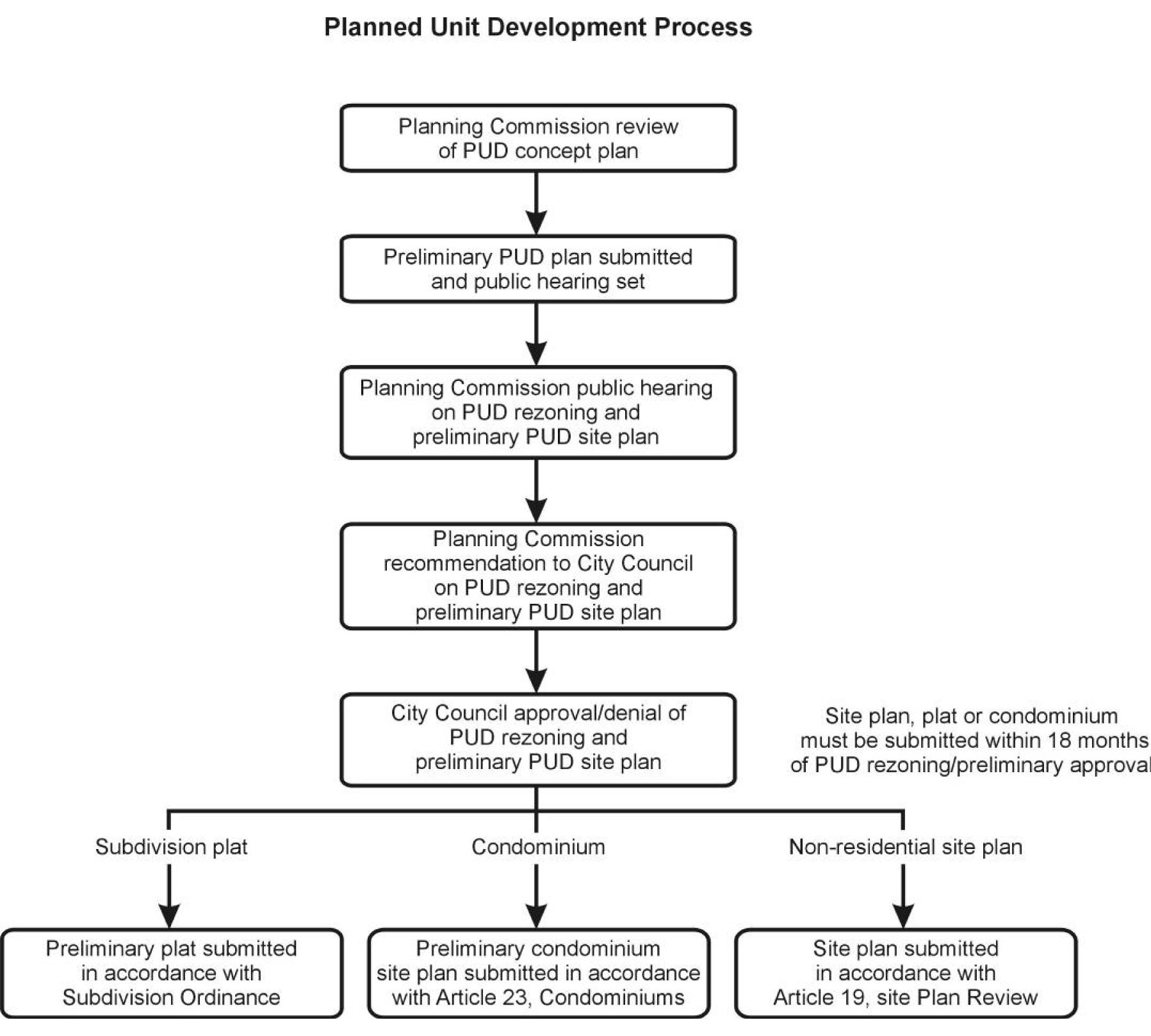
Concept plan review. Prior to making a formal application, a concept plan for the proposed PUD project, meeting the requirements of section 22.08(a), concept plan requirements, shall be presented to the planning commission. No formal action shall be taken on the PUD as the concept plan is intended to give the applicant direction on the merits of the PUD proposal. The concept plan review does not constitute any form of approval of the PUD or the preliminary site plan. The process is intended to give the applicant an indication of the issues and concerns that must be resolved prior to preliminary PUD submittal.
(b)
PUD rezoning and preliminary site plan review. Establishment of a PUD shall be a amendment to the zoning map creating a PUD overlay district. Review of applications for PUD rezoning shall be in accordance with the requirements of article 27, amendments, to ordinance for other amendments to this ordinance, and the ordinance amendment procedures shall be followed.
(1)
Planning commission public hearing. Upon receipt of a preliminary PUD application, prepared in accordance with section 22.08(b), preliminary PUD site plan requirements the request shall be referred to the planning commission for review and recommendation to the city council. The planning commission shall hold a public hearing to hear and consider the PUD rezoning and preliminary site plan. Notice and procedures for the public hearing shall follow the requirements of section 25.09, public hearings, and article 27, amendments to ordinance.
(2)
Planning commission recommendation on rezoning and preliminary PUD site plan review. Following the public hearing, the planning commission will forward a report and recommendation to the city council on the PUD rezoning, preliminary PUD site plan and development agreement, as required by section 22.10, development agreement. In its review and recommendation, the planning commission shall consider:
a.
That all applicable provisions of this article and this ordinance have been met, including the requirements of section 22.02, qualifying conditions. If any provision of this article conflicts with any other provisions of this ordinance, this article shall apply to lands within the PUD.
b.
That adequate areas have been provided for all common areas, utilities, walkways, playgrounds, recreation areas, parking areas and other spaces.
c.
The site shall be served by adequate public infrastructure, including streets, sanitary sewer, storm drainage and water, or provisions shall be made in the PUD agreement for the developer to provide the necessary improvements as part of the PUD development.
d.
The preliminary PUD site plan provides for an efficient, aesthetic and desirable use of the open areas, and the plan is in keeping with the physical character of the city and the area surrounding the development.
(3)
City council action on the rezoning and preliminary PUD site plan. Upon receipt of the recommendation from the planning commission, the city council shall hold a public hearing to hear and consider the PUD rezoning, preliminary site plan and development agreement. Notice for the public hearing shall follow the requirements of section 25.09, public hearings. The city council shall consider the recommendation of the planning commission, and the public hearing comments on the PUD rezoning and preliminary PUD site plan as follows:
a.
The city council may postpone, approve, approve with conditions, or deny the application and accompanying PUD preliminary site plan based on the provisions of article 27, amendments to ordinance, and this article.
b.
If the application is denied, the city council shall indicate in writing which standards and requirements the proposed PUD district failed to meet.
c.
Approval of the application and preliminary PUD site plan constitutes a rezoning of the property. Once rezoned to a PUD no use or development may take place except in accordance with the rezoning and approved preliminary PUD site plan. The petitioner shall have 18 months from the date of city council approval of the PUD rezoning to obtain final site plan approval. Failure to obtain final site plan approval within 18 months shall cause the land to automatically revert back to its prePUD zoning, provided the city council may grant a one year extension upon written request by the applicant.
(c)
Final site plan. A final PUD site plan for the phase or area to be constructed shall be submitted to the planning commission for review and approval, or in the case of plats or condominiums recommendation to the city council.
(1)
Final site plan. Application for final PUD site plan approval shall be made according to the requirements of article 19, site plan review.
(2)
Public hearing not required. Final PUD site plan approval does not require public notice or hearing.
(3)
Compliance with ordinance and preliminary PUD. Review and approval of final PUD site plans shall comply with this ordinance and any other applicable ordinances, except as modified in the approved preliminary PUD site plan. If necessary, review and approval of a plat shall comply with the land division act and the city subdivision regulations, in addition to the requirements of this article.
(4)
Review standards. In reviewing the final PUD site plans, the planning commission shall ensure that the following conditions shall be completed prior to issuance of building permits:
a.
That the final PUD site plan conforms to the approved preliminary PUD site plan, development agreement and this article.
b.
A dedication of all public streets to ensure continuity of public access between the adjacent arterial streets and ingress and egress to all private development within the plan.
c.
That the open space and common areas have been irrevocably committed to those uses by dedication, restrictive covenants, or in a manner satisfactory to the city.
(5)
Effect of approval. Approval of the final PUD site plan shall be effective for a period of 18 months. Failure to complete substantial construction in that period shall void the PUD rezoning, and final site plan and the PUD zoning designation shall automatically revert back to its prePUD zoning. The planning commission may grant a one year extension upon written request by the applicant.
(6)
Plats and condominiums. For a PUD that is being developed as a subdivision plat or condominium, the preliminary plat or the preliminary condominium site plan shall be submitted and reviewed concurrently with the final PUD. In such case, the planning commission shall recommend approval of the preliminary plat or the preliminary condominium site plan to the city council in accordance with the city subdivision regulations or condominium regulations as applicable. The regular subdivision or condominium approval process shall be followed from this point forward.
(d)
Business park. Following final approval of an industrial PUD for a business park in an I-1, I-2 or TRO district, development of individual lots or building sites may be approved administratively in accordance with section 19.09, master development plan for business parks.
(Ord. No. 09-434, § 22.09, 1-20-2009)
Sec. 22.10. - Development agreement.
(a)
The city attorney shall prepare a PUD agreement to be entered into upon approval of the preliminary PUD site plan. The draft PUD agreement shall be reviewed along with the preliminary PUD site plan and include all of the following:
(1)
The permitted uses within the PUD, including the approved preliminary site plan for the site.
(2)
The conditions upon which the approval is based, including phasing requirements, requirements for on-site improvements and contributions to required improvements to public facilities.
(3)
Open space or common areas which shall be conveyed in fee or committed by dedication to an association of the property owners. As part of the final site plan approval, documentation shall be recorded establishing a homeowners association for the maintenance of the open space.
(4)
A program and financing for maintaining common areas and features, such as walkways, signs, lighting and landscaping. A fund shall be established for continual maintenance of the open space.
(5)
Architectural standards and requirements for building elevations and building materials.
(6)
Assurance that trees and woodlands will be preserved as shown on the site plan, or replaced on a caliper for caliper basis.
(7)
Assurance that the construction and maintenance of all streets and utilities (including public water, waste water collection and treatment), recreational facilities and other improvements shall be completed. Such assurance shall include financial guarantees as required by this ordinance, and the establishment of a condominium or owner's association with appropriate assessments to ensure the ongoing maintenance of all streets, storm drainage improvements, landscaping and all other common areas. If private roads are proposed, the association or condominium documents shall include provisions for a sinking or reserve fund on accumulative basis in an acceptable form to pay for the longterm maintenance and reconstruction of streets.
(8)
Provisions addressing any other concerns of the city regarding construction and maintenance of streets and common area improvements.
(9)
Provisions for liability insurance in an amount to be determined by the city, naming the city as an additional insured.
(10)
Provisions including specific terms or conditions regarding the expiration or revocation of the PUD zoning.
(b)
The agreement shall be prepared by the city attorney prior to rezoning and preliminary PUD site plan approval. The applicant shall be responsible for all attorney fees associated with the preparation of the development agreement.
(c)
Following city council approval of the rezoning and preliminary PUD site plan, the development agreement shall be recorded with the office of the Wayne County Register of Deeds at the expense of the applicant and a recorded copy of the agreement shall be delivered to the city by the applicant.
(Ord. No. 09-434, § 22.10, 1-20-2009)
Sec. 22.11. - Deviations from approved final PUD site plan.
(a)
Deviations and amendments from the approved final PUD site plan shall be reviewed and approved in accordance with section 19.08, amendment to approved plans.
(b)
Should the planning commission determine that the modifications to the final PUD site plan significantly alter the intent of the preliminary PUD site plan, a new submittal illustrating the modification shall be required and must be approved by the city council as a new preliminary PUD plan.
(c)
Any amendment to the PUD agreement shall be adopted by resolution of the city council, upon recommendation of the planning commission.
(Ord. No. 09-434, § 22.11, 1-20-2009)
Sec. 22.12. - Appeals and variances.
The zoning board of appeals (ZBA) shall only have the authority to hear and decide appeal requests by individual lot owners for variances from the zoning ordinance following final approval of the PUD. The of ZBA shall not have the authority to reverse the decision of the city council, or planning commission on a PUD preliminary, or final site plan, change any conditions placed by the planning commission, or city council or grant variances to the PUD agreement or the requirements of this article.
(Ord. No. 09-434, § 22.12, 1-20-2009)

