Zoneomics Logo
search icon

Taylor City Zoning Code

ARTICLE 08

INDUSTRIAL DISTRICTS

Sec. 8.01.- Intent.

(a)

The purpose of the TRO Technology-Research-Office District, is to provide an environment where high tech uses and functions such as engineering, design, research and development, computer assisted design, robotics research, prototype development and limited manufacturing, telecommunications, and related storage, warehousing and limited assembly operations associated with principal permitted uses can be located. Advances in industry, technology, and office research facilities, have created uses which are related to industry and office uses, but may not be appropriate or function adequately in a typical industrial or office zoning district. These uses have been identified as high tech uses. The TRO district will be located in a campus-type environment and so situated that uses will be developed without being negatively impacted by elements and conditions which are commonly found in an industrial zoning district.

(b)

The I-1 Light Industrial District is designed so as to primarily accommodate wholesale activities, warehouses, and industrial operations whose external, physical effects are restricted to the area of the district and in no manner affect in a detrimental way any of the surrounding districts. The I-1 district is so structured as to permit, along with any specified uses, the manufacturing, compounding, processing, packaging, assembly, and/or treatment of finished or semi-finished products from previously prepared materials. It is further intended that the processing of raw material for shipment in bulk form, to be used in an industrial operation at another location, not be permitted. Uses in this district must have less of an impact on surrounding uses and generate less truck traffic than the other industrial developments. Limitations regarding the degree of noise, smoke, glare, odor, and vibration are placed upon such uses to preclude any adverse effects upon nearby commercial or residential districts. It is intended that this district act as a transition between heavier industrial uses and residential or commercial areas. The general goals of this use district include, among others, the following specific purposes:

(1)

To provide sufficient space, in appropriate locations, to meet the needs of the city's expected future economy for the types of manufacturing and related uses described herein.

(2)

To protect abutting residential districts by separating them from manufacturing activities, and by prohibiting the use of such industrial areas for new residential development.

(3)

To promote manufacturing development which is free from danger of fire, explosion, toxic and noxious matter, radiation, and other hazards, and from offensive noise, vibration, smoke, odor, and other objectionable influences.

(4)

To promote the most desirable use of land in accordance with a well considered plan. To protect the character and established pattern of adjacent development, and in each area to conserve the value of land and buildings and other structures, and to protect the city's tax revenue.

(c)

The I-2 General Industrial District is designed primarily for manufacturing, assembling, and fabrication activities including large scale or specialized industrial operations, whole external physical effects will be felt to some degree by surrounding districts. The I-2 district is so structured as to permit the manufacturing, processing, and compounding of semi-finished or finished products from raw materials as well as from previously prepared material. The I-2 district is further designed to provide areas within the city where heavy industrial uses can most efficiently utilize major streets, utilities and other infrastructure while minimizing any incompatible aspects with neighboring districts.

(Ord. No. 09-434, § 8.01, 1-20-2009)

Sec. 8.02. - Schedule of uses.

Buildings or land shall be not used and buildings shall not be erected except for one or more of the following specified uses, unless otherwise provided for in this ordinance. Land and/or buildings in the districts indicated at the top of Table 8.02 may be used for the purposes denoted by the following abbreviations:

(a)

Permitted use (P). Land and/or buildings in this district may be used for the purposes listed by right.

(b)

Special land use (SLU). The following uses may be permitted by obtaining special land use approval when all applicable requirements in article 13, use requirements, and the standards of section 21.04, review standards, are met.

(c)

Not permitted (—). The use is not permitted in the district.

(d)

Additional requirements. Indicates requirements or conditions applicable to the use.

TABLE 8.02. INDUSTRIAL DISTRICTS
SCHEDULE OF USES

UseTROI-1I-2Additional
Requirements
Animal and agricultural uses
Commercial kennels SLU SLU Section 13.02(a)
Greenhouses P P
Pet daycare P P P Section 13.02(c)
Processing and refining of animal products SLU
Stables, livestock barns and boarding stables SLU SLU
Public and institutional uses
Business or technical colleges P P P
Colleges, universities, and other institutions of higher learning, offering courses in general, technical, or religious education and not operated for profit P P Section 13.03(b)
Public buildings and uses but not including storage yards P P P
Public works uses with outdoor storage P P
Trade or industrial schools and uses with the principal function of technical training P P P
Union halls P P
Retail uses
Nurseries and similar outdoor retail sale of trees, fruits, vegetables, shrubbery, plants, seed, topsoil, humus, fertilizer, trellises, lawn furniture, other home garden supplies and equipment and similar uses P P P Section 13.04(b)
Motor vehicle uses
Automobile impound facilities and towing companies SLU Section 13.05(b)
Automobile pawn facilities SLU SLU Section 13.05(c)
Automobile storage SLU SLU
Motor vehicle maintenance and minor repair P P Section 13.05(d)
Motor vehicle major engine and body repair SLU P Section 13.05(e)
Moving van, small truck and trailer rental SLU SLU
Truck and heavy equipment rental SLU SLU Section 13.05(h)
Truck repair as a principal use SLU Section 13.05(e)
Truck stops SLU Section 13.05(i)
Lodging and food service
Food/beverage service with accessory outdoor seating SLU SLU Section 13.06(b)
Restaurants designed exclusively for consumption of food or beverages without a liquor license SLU SLU SLU
Taverns/pubs/microbrewery (restaurants with liquor license but less than 30 percent bar area) SLU SLU SLU Section 13.06(c)
Other services
Central dry cleaning plants and laundries P P P
Service establishment of an office, showroom or workshop nature of a taxidermist, decorator, dressmaker, tailor, baker, painter, upholsterer or an establishment doing radio or home appliance repair, photographic reproduction or similar service establishments which require a retail adjunct, providing such use is within a completely enclosed building and excludes outside storage yards P P
Tool and equipment rental, nonindustrial, which may include outdoor storage P P Section 13.07(a)
Finance, insurance, real estate, professional
Conference centers, convention facilities, corporate education and training facilities P P P
Data processing and computer centers, including sales, service, and maintenance of electronic data processing equipment P P P
High technology service activity which has as its principal function the providing of services including computer, information transfer, communication, distribution, processing, administrative, laboratory, experimental, development technical, or testing services P P P
Newspaper offices P P
Office buildings, providing for uses such as corporate offices in accordance with the purpose of this district, including any of the following occupations: Executive, administrative, professional, accounting, engineering, drafting, legal, writing and clerical P P P
Health care and social assistance
Child care centers and day care centers SLU SLU SLU Section 13.09(c)
Technological, medical and dental clinics; medical, optical, pharmaceutical and dental laboratories P P P
Entertainment and recreation uses
Drive-in outdoor theaters SLU SLU Section 13.10(a)
Indoor recreation uses such as gymnasiums, ice skating rinks, tennis clubs, roller skating rinks, court sports facilities, rock climbing facilities, and similar recreational uses P SLU
Public parks and recreational facilities P P P
Racetracks including mini-auto, carting, motorcycles, dirt bikes, and snow mobile SLU Section 13.10(f)
Recreational equipment storage SLU SLU Section 13.10(g)
Shooting ranges when totally enclosed in a building SLU
and
RLU
SLU
and
RLU
article 20
Transportation and warehousing uses
Bus and railroad passenger stations P P
Mini-warehouse or self-storage facilities P P Section 13.11(a)
Petroleum or other flammable liquid storage including fuel storage tank farms SLU Section 13.11(b)
Railroad transfer and storage tracks and railroad terminals P
Small package and overnight delivery distribution facilities
 Facilities up to 80,000 square feet P P Section 13.11(c)
 Facilities over 80,000 square feet SLU P Section 13.11(c)
Truck driving schools SLU
Truck terminals and truck trailer and container storage yards P Section 13.11(d)
Warehousing establishments providing storage for a single company, may include multiple warehouses in multitenant buildings
 Facilities up to 80,000 square feet P P Section 13.11(e)
 Facilities over 80,000 square feet SLU P Section 13.11(f)
Utilities and waste disposal uses
Composting facilities (yard waste) SLU Section 13.12(a)
Conversion or composting of sewage or sludge into a useable or saleable product SLU Section 13.12(b)
Deep well or underground injection wells to be used for the storage or disposal of any material hazardous and nonhazardous SLU Section 13.12(d)
Essential services and uses not requiring outdoor storage of materials or vehicles SLU SLU SLU Section 13.12(c)
Hazardous waste storage handling and disposal facilities SLU Section 13.12(d)
Heating and electric power generating plants and all necessary accessory uses P
Incineration of garbage or refuse SLU Section 13.12(e)
Junkyards, salvage yards and outdoor recycling of nonhazardous materials SLU Section 13.12(f)
Public water plants, public works garages, public works storage yards and similar uses P P Section 13.12(g)
Public utility buildings, telephone exchange buildings; electric transformer stations and substations; gas regulator stations P P P Section 13.12(g)
Recycling and refuse transfer operations within an enclosed building SLU Section 13.12(h)
Sewage treatment plants SLU Section 13.12(i)
Transfer stations, treatment, storage or disposal facilities and recycling stations for nonhazardous waste SLU
Wind energy conversion systems SLU SLU SLU Section 13.12(j)
Wireless communication facilities and services
 Attached or collocated on existing structures P P P Section 13.12(k)
 New wireless communication support structure SLU SLU SLU Section 13.12(k)
Construction uses
Asphalt, concrete mortar, plaster or mixing plant SLU Section 13.13(a)
Brick, tile, cement block and pipe manufacturing and storage SLU Section 13.13(b)
Contractors equipment storage and storage yards SLU SLU Section 13.13(c)
Landscape contractor supply yard, including retail sales P P
Service establishments of an office, showroom or workshop nature within a completely enclosed building of a contractor, including carpentry, electrical, glazing, heating, painting, paper hanging, plastering, plumbing, roofing, and ventilating, exterminator and similar establishments that require a retail adjunct; but excluding outside storage yards P P
Wholesale lumber yards, building material, planing mills SLU SLU
Manufacturing uses
Assembling and/or manufacture of automobiles and automobile bodies, trucks, engines, batteries, corrosive acid or alkali, cement, lime, gypsum, or plaster of Paris P P
Breweries and distilleries P P
Lumber and planing mills P P
Manufacturing, compounding, assembling or treatment of articles or merchandise from previously prepared materials, as listed below, up to 80,000 square feet
 a. Textile mills and apparel production
 b. Wood product manufacturing
 c. Furniture and fixture manufacturing
 d. Rubber and plastic product manufacturing
 e. Leather and leather product manufacturing
 f. Glass, clay and stone product manufacturing
 g. Fabricated metal product manufacturing including tool and die shops
 h. Industrial machinery and equipment manufacturing
 i. Electronic equipment manufacturing
 j. Vehicles and transportation equipment manufacturing
 k. Instruments and related product manufacturing
 l. Manufacturing of miscellaneous products, including jewelry, silverware, musical instruments, toys, sporting goods, office and art supplies and similar items
P P
Manufacturing, compounding, assembling or treatment of articles or merchandise from previously prepared materials, as listed above, over 80,000 square feet SLU P Section 13.14(a)
Painting and sheet metal and welding shops; metal and plastic molding and extrusion shops P P
Primary metal manufacturing including iron and steel mills and ferroalloy manufacturing, aluminum production, nonferrous metal production and foundries SLU SLU Section 13.14(b)
Production, refining, storage of petroleum and other flammable or combustible materials SLU
Publishing and printing establishments P P P
Research, development, and testing facilities for technological, scientific and business establishments including the development of prototypes P P P
Research, experimental, or testing laboratories P P P
Accessory uses
Accessory buildings and uses customarily incidental to any of the principal permitted uses P P P Section 15.01
Accessory buildings and uses customarily incidental to any of the principal special land uses SLU SLU SLU Section 15.01
Accessory above ground fuel storage tanks for on-site vehicles and equipment SLU P P Section 13.15(a)
Accessory minor maintenance of trucks and equipment used by the business where it is located SLU P
Accessory outdoor storage of raw materials, supplies, equipment, and finished or semifinished products, except for outdoor uses listed above
 Occupying an area not exceeding five percent of the floor area of the principal building not including truck loading areas SLU P P
 Occupying an area between five percent and 25 percent of the floor area of the principal building not including truck loading areas SLU P
 Occupying an area exceeding 25 percent of the floor area of the principal building not including truck loading areas SLU SLU
Accessory parking of semi truck tractors or trailers
 For a period not exceeding 24 hours P P P
 For a period exceeding 24 hours SLU P
Marijuana Facility or Establishment Uses
Provisioning Centers, Grower Facilities, Processors, Safety Compliance Facilities, Secure Transporters P P Section 13.16


(Ord. No. 09-434, § 8.02, 1-20-2009; Ord. No. 13-473, § 1, 2-19-2013; Ord. No. 19-499, § 1, 11-19-2019)

Sec. 8.03. - Area, height, and placement requirements.

All lots and buildings shall meet the following dimensional requirements:

TABLE 8.03. INDUSTRIAL DISTRICTS
AREA, HEIGHT AND PLACEMENT REQUIREMENTS
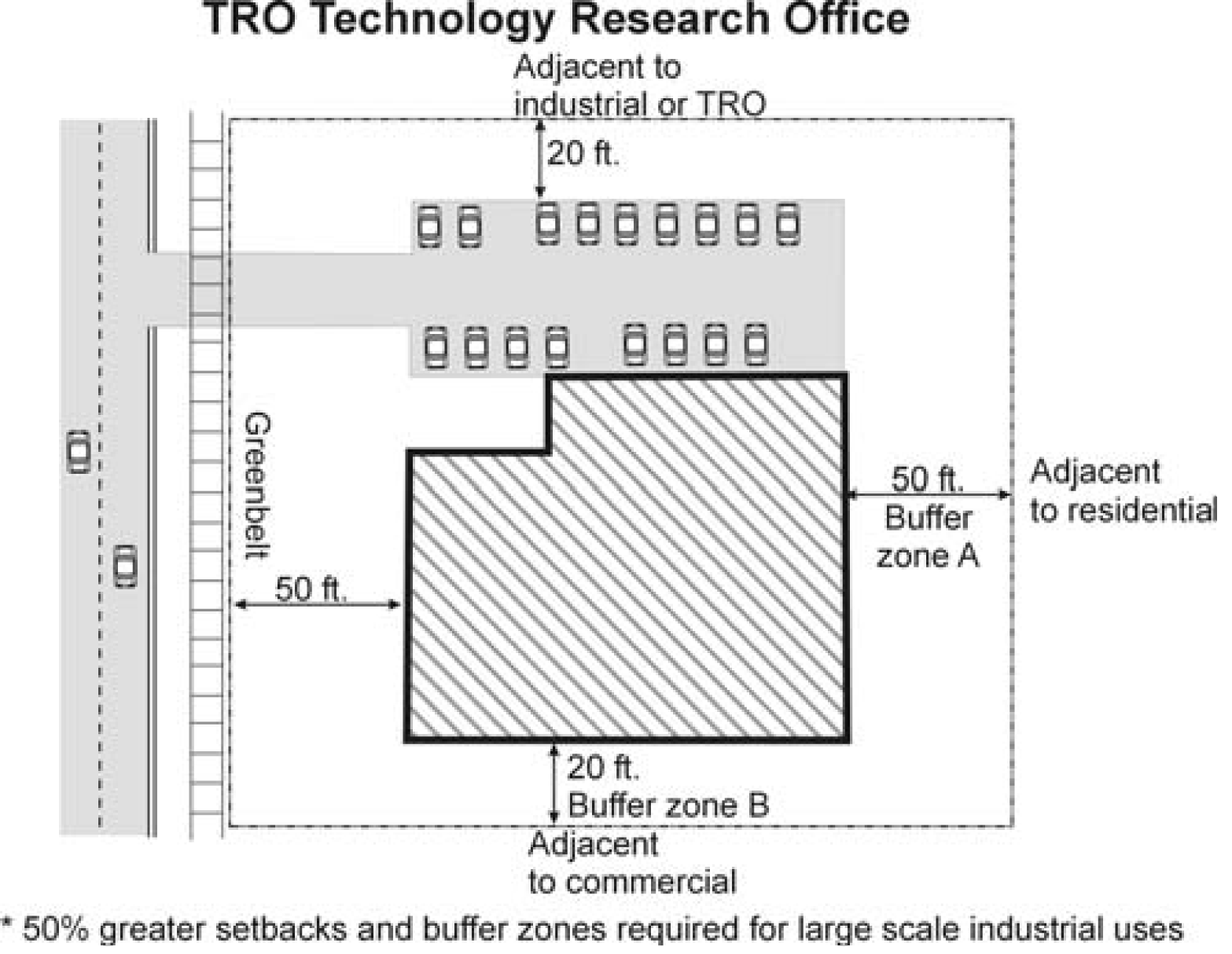
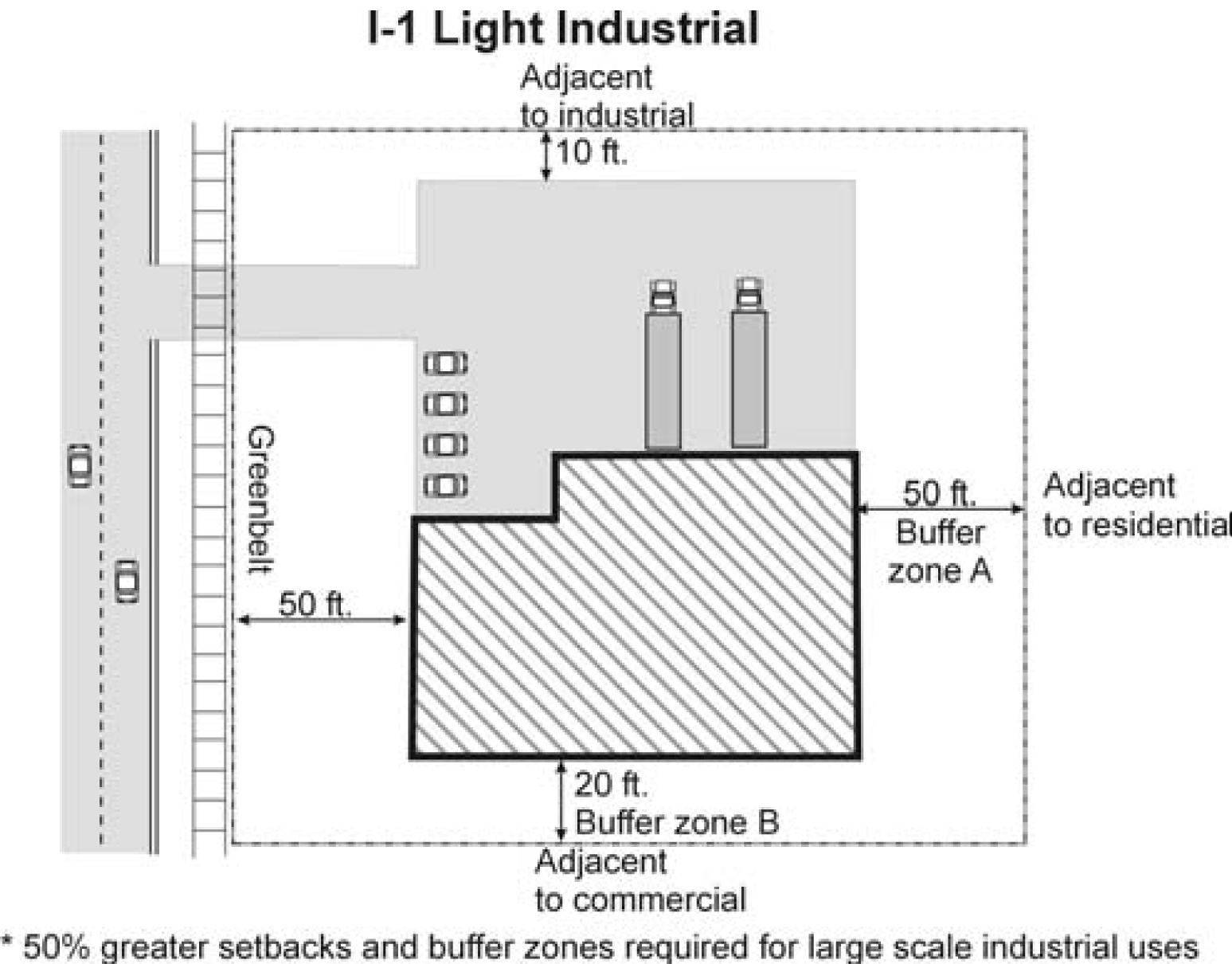
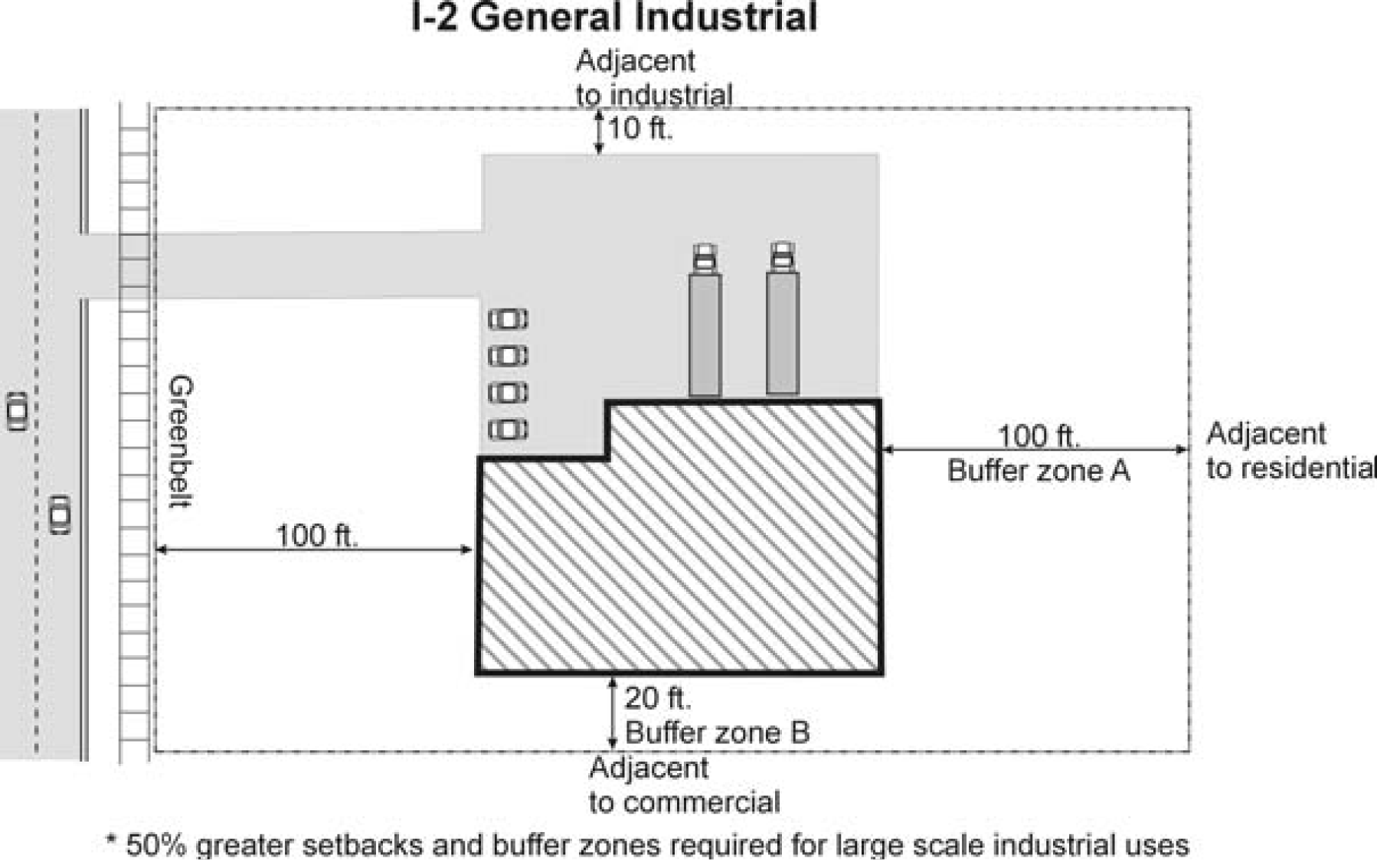
Zoning District Maximum Height of Buildings Minimum Yard Setbacks (ft.) (b, c, d, e) Maximum Percent of Lot Area Covered (i) (percent)
Stories Feet (a) Front Yard (f, g) Side Yard Rear Yard (h) Setback from Adjacent Use All Buildings All Impermeable Surface
From Adjacent Industrial From Adjacent Commercial From Adjacent Residential
TRO 10(j) 115(j) 50 20 20 20 20 50 35 80
I-1 40 50 10 10 10 20 50 35 80
I-2 50 100 10 10 10 20 100 35 80


(a)

Building height. Exceptions to building height shall be allowed as provided for in section 14.08, height limit.

(b)

Yards maintained as landscaped open space. All buildings, parking, loading driveways, circulation aisles, and storage areas shall meet the setback requirement. All required yard setbacks that are adjacent to a nonindustrial use shall maintain the minimum yard area as an uninterrupted landscape area.

(c)

Outdoor storage. Outdoor storage shall be screened in accordance with section 16.02, landscaping. Storage areas shall meet the applicable building setback requirements from each lot line.

(d)

Projections into yards. Structures in section 14.11, projections into required yards, shall be permitted to project into required yard setbacks.

(e)

Natural features setback. All structures shall be set back at least 25 feet from all natural features such as drains, regulated wetlands, natural ponds, lakes and streams.

(f)

Front yard setback. The front yard setback shall apply to all yards that adjoin a street including public streets, private streets and interstate highways. Corner lots and double frontage lots shall be considered to have two front yards. All buildings, parking, loading and storage areas shall meet the front yards setback requirement. Detention/retention ponds shall be prohibited in the required front yard setback, unless the city engineer determines there is no reasonable alternative due to existing topography and natural drainage problems. This restriction shall not apply to rain gardens, bio-retention swales, irrigation trench planters and other similar stormwater management alternatives to retention or detention ponds.

(g)

Front yard from local industrial street. The front yard setback may be reduced to 40 feet in the I-1 district and 50 feet in the I-2 district where the frontage is on a local industrial street. A local industrial street shall mean a street that is within an industrial park or a street that is zoned, or master planned for industrial use along its entire length on both sides.

(h)

Loading areas. All loading and unloading shall be provided off-street in the rear yard or interior side yard, and shall in no instance be permitted in a front yard. In those instances where exterior side yards have a common relationship with an industrial district across a public thoroughfare, loading and unloading may take place in said exterior side yard when the setback is equal to at least 50 feet. Loading and unloading areas located in a side yard shall be fully screened from view from a public street. No overhead doors shall be permitted in the front elevation of the building. All nonindustrial districts and uses must be screened from truck loading and unloading activities. The portion of a site used for parking or storage of truck tractors or trailers shall be obscured by a four-foot high landscaped berm and the required fence or wall. The berm shall be landscaped in accordance with section 16.02, landscaping.

(i)

Lot coverage. Maximum lot coverage shall be regulated by two measures:

(1)

The maximum percent of the lot area that can be covered by buildings.

(2)

The maximum percent of the lot area that can be covered by buildings plus other impermeable surfaces, such as pavement or storage yards.

(j)

TRO building height and setbacks. For buildings or portions of buildings that are taller than 65 feet, the minimum required building setbacks from all lot lines shall be increased by one foot for every one foot of building height above 65 feet. For a building or complex of multiple buildings that have variable building heights, the additional setback requirements shall only apply to those buildings or portions of a building taller than 65 feet; allowing for lower portions of buildings at the minimum setback and taller portions of buildings to be stepped-back based upon the increased height.

(Ord. No. 09-434, § 8.03, 1-20-2009)