
Taylor City Zoning Code
ARTICLE 28
- DEFINITIONS
Sec. 28.01.- Construction of language.
The following rules of construction apply to the text of this ordinance:
(a)
Interpretations.
(1)
In case of any difference of meaning or implication between the text of this ordinance and any caption or illustration, the text shall control.
(2)
If the meaning of this ordinance is unclear in a particular circumstance, then the individual or body charged with interpreting or applying the ordinance shall construe the provision to carry out the intent of the ordinance, if the intent can be discerned from other provisions of the ordinance or law.
(3)
All words and phrases shall be construed and understood according to the common preferred use of the language; but technical words and phrases that may have acquired a peculiar and appropriate meaning in the law shall be construed and understood according to that peculiar and appropriate meaning.
(4)
The definitions contained in this article are for the purposes of this ordinance.
(b)
Terms.
(1)
The word "shall" is always mandatory and not discretionary. The word "may" is permissive.
(2)
The terms "ordinance" and "act" shall be understood to include the term "as amended" where the context is appropriate.
(3)
The particular shall control the general. For terms used in this ordinance the use of a general term shall not be taken to be the same as the use of any other specific term. For example, a "pharmacy," as used in this ordinance, shall not be interpreted to be the same as a "retail business" since each is listed as a separate and distinct use.
(4)
Words used in the present tense shall include the future; words used in the singular number shall include the plural; and the plural the singular, unless the context clearly indicates otherwise.
(5)
A "building" or "structure" includes any part thereof.
(6)
The terms "abutting" or "adjacent to" include property along the lot lines of the subject site including those in another community, but do not include lands separated by a street right-of-way.
(7)
The phrase "used for" includes "arranged for," "intended for," "occupied for" and "maintained for."
(8)
The word "build" includes to "erect" or "construct."
(9)
The word "person" includes an individual, a corporation, a partnership, an incorporated association, or any other similar entity. A masculine term shall include the feminine version of the term and vice versa.
(10)
Unless the context clearly indicates the contrary, the conjunctions noted below shall be interpreted as follows:
a.
"And" indicates that all connected items, conditions, provisions, or events shall apply.
b.
"Or," indicates that the connected items, conditions, provisions or events may apply separately or in combination.
c.
"Either … or" indicates that the connected items, conditions, provisions or events shall apply separately, not in combination.
(11)
Computing the number of days, the first day is excluded and the last day is included. If the last day of any period during which an application, filing, or request is required to be made to the city or other governmental agency is a Saturday, Sunday, or legal holiday, the period is extended to include the next day which is not a Saturday, Sunday, or legal holiday.
(12)
All measurements shall be to the nearest integer, unless otherwise specified herein.
(13)
Words or terms not herein defined shall have the meaning customarily assigned to them.
(Ord. No. 09-434, § 28.01, 1-20-2009)
Sec. 28.02. - Definitions A-B.
(a)
Abandon. To cease or discontinue a use or activity, excluding temporary or shortterm interruptions during periods of remodeling, maintaining, or otherwise improving or rearranging a facility, during normal periods of vacation or seasonal closure, during labor-related shutdowns, and similar events.
(b)
Abutting. Having a common border with or being separated from such a common border by a right-of-way, alley, or easement.
(c)
Access management. A technique to improve traffic operations and safety along a major street through the control of driveway locations and design; consideration of the relationship of traffic activity for properties adjacent to, and across from, one another, and the promotion of alternatives to direct access.
(d)
Accessory building. A detached building on the same lot with, and of a nature customarily incidental and subordinate to, a principal structure, and occupied or devoted exclusively to an accessory use. Examples may include: detached garages, sheds and storage buildings.
(e)
Accessory structure. A detached building or other type of structure on the same lot with, and of a nature customarily incidental and subordinate to, a principal structure, and occupied or devoted exclusively to an accessory use. Examples include: accessory buildings, fences, decks and swimming pools.
(f)
Accessory use. A use which is clearly incidental to, customarily found in connection with, and located on the same zoning lot, unless otherwise specified, as the principal use to which it is related. When accessory is used in this text, it has the same meaning as accessory use. An accessory use includes, but is not limited to, the following:
(1)
Residential accommodations for servants and/or caretakers.
(2)
Outdoor swimming pools, hot tubs and saunas for the use of the occupants of a residence, or their guests.
(3)
Fences when constructed and located in accordance with the requirements of this ordinance.
(4)
Domestic or agricultural storage in a barn, shed, tool room or similar accessory building or other structure.
(5)
A newsstand primarily for the convenience of the occupants of a building, which is located wholly within such building and has no exterior signs or displays.
(6)
Storage of merchandise normally carried in stock in connection with a business or industrial use, unless such storage is excluded in the applicable district regulations.
(7)
Storage of goods used in or produced by industrial uses or related activities, unless such storage is excluded in the applicable district regulations.
(8)
Accessory off-street parking spaces, open or enclosed, subject to the accessory off-street parking regulations for the district in which the zoning lot is located.
(9)
Uses clearly incidental to a principal use, such as, but not limited to, offices of an industrial or commercial complex located on the site of the commercial or industrial complex.
(10)
Accessory off-street loading, subject to the off-street loading regulations for the district in which the zoning lot is located.
(11)
Accessory signs, subject to the sign regulations for the district in which the zoning lot is located.
(12)
Solar panels, wind generators, television reception antenna and air conditioning units.
(g)
Addition. An extension or increase in floor area or height of a building or structure.
(h)
Administrative review committee (ARC). A committee composed of members of the city's development services department, fire and police departments, and city engineer, whose responsibility is to review and comment on site plan submittals prior to forwarding to the planning commission.
(i)
Adult foster care facilities. A facility for the care of adults, over 18 years of age, as licensed and regulated by the state under Public Act No. 218 of 1979 (MCL 400.701 et seq.), and rules promulgated by the state department of human services, providing foster care to adults. It includes facilities and foster care homes for adults who are aged, mentally ill, developmentally disabled, or physically handicapped who require supervision on an ongoing basis, but do not require continuous nursing care. An adult foster care facility does not include nursing homes, homes for the aged, hospitals, alcohol or substance abuse rehabilitation center, or a residential center for persons released from or assigned to a correctional facility. Such organizations shall be defined as follows.
(1)
Adult day care. A facility other than a private residence, which provides care for more than six adults for less than 24-hour period.
(2)
Adult foster care congregate facility. An adult foster care facility with the approved capacity to receive more than 20 adults to be provided with foster care.
(3)
Adult foster care family home. A private home with the approved capacity to receive six or fewer adults to be provided with foster care for 24 hours a day for five or more days a week and for two or more consecutive weeks. This may include adult day care for six or fewer adults. The adult foster care family home licensee must be a member of the household and an occupant of the residence.
(4)
Adult foster care large group home. An adult foster care facility with approved capacity to receive at least 13 but not more than 20 adults to be provided supervision, personal care, and protection in addition to room and board, for 24 hours a day, five or more days a week, and for two or more consecutive weeks for compensation. This may include adult day care for 20 or fewer adults.
(5)
Adult foster care small group home. A private home with the approved capacity to receive more than six but not more than 12 or fewer adults who are provided supervision, personal care, and protection in addition to room and board, for 24 hours a day, five or more days a week, and for two or more consecutive weeks for compensation. This may include adult day care for 12 or fewer adults.
(j)
Adult regulated uses. A parlor, nude body painting or modeling studio, adult bookstore, adult novelty store, adult video store, cabaret, adult motion picture theater, adult outdoor motion picture theater, adult mini motion picture theater, escort services, massage. For the purpose of this ordinance, the following uses shall be classified as adult regulated uses:
(1)
Adult arcade. Any place to which the public is permitted or invited wherein cash-operated, credit-operated, coin-operated or slug-operated or electronically, internet or mechanically controlled still or motion picture machines, projectors or other image producing devices are maintained to show images and where the images so displayed are distinguished or characterized by the depicting or describing of sexually explicit activities or specified anatomical areas."
(2)
Adult book, novelty, retail or video store. A commercial establishment which offers for sale or rental for any form of consideration, as one of its principal business purposes, any one or more of the following:
a.
Books, computer diskettes, tapes or hard drives, magazines, periodicals or other printed matter or photographs, films, motion pictures, video matter or photographs, cassettes, compact discs or video reproductions, slides or other visual representation, recordings, other audio matter which depict or describe sexually explicit activities or specified anatomical areas; or
b.
Instruments, devices novelties or paraphernalia which are designed for use in connection with sexually explicit activities; or
c.
Items, materials, gimmicks, or paraphernalia depicting, displaying, advertising or packaged as sexually explicit activities or depict or describe specified anatomical areas;
d.
For purposes of this ordinance, the term "principal business purpose" means:
1.
The devotion of a significant or substantial portion of its stock-in-trade or interior floor space, meaning at least 30 percent of the floor area.
2.
The receipt of 30 percent of more of its revenues from the sale of the items listed above.
3.
Other business purposes shall not exempt an establishment from being categorized as an adult book retail, novelty store or video store so long as more than 30 percent of its business includes the offering for sale or rental for consideration of the specified materials which are distinguished or characterized by their emphasis on matter depicting, describing or relating to specified sexual activities or specified anatomical areas, as defined herein;
e.
An establishment may have other principal business purposes that do not involve the offering for sale, rental or viewing of materials depicting or describing sexually explicit activities or specified anatomical areas, and still be characterized as an adult book store, adult novelty or retail store or adult video store. Such other business purposes will not serve to exempt such establishment from being categorized as an adult bookstore, adult novelty store or adult video store, so long as the establishment falls within the definition of an adult bookstore, adult novelty store or adult video store as set forth above.
(3)
Adult cabaret. A nightclub, bar, restaurant or similar commercial establishment, whether or not alcohol is served, which regularly features:
a.
Persons who appear in a state of restricted nudity.
b.
Live performance which are characterized by the partial exposure of specified anatomical areas.
c.
Films, motion pictures, video cassettes, compact discs, slides or other photographic reproductions which are characterized by the depiction or description of sexually explicit activities or specified anatomical areas.
(4)
Adult massage parlor. Any place where, for any form of consideration or gratuity, massage, alcohol rub, administration of fomentations, electric or magnetic treatments, or any other manipulation of the human body which occurs as part of or in connection with specified sexual activities, or where any person providing such treatment, manipulation, or service related thereto, exposes his or her specified anatomical areas. The definition of sexually oriented business shall not include the practice of massage in any licensed hospital, nor by a licensed chiropractor or osteopath, nor by any nurse or technician working under the supervision of a licensed physician, surgeon, chiropractor or osteopath, nor by trainers for any amateur, semiprofessional or professional athlete or athletic team or school athletic program nor a therapeutic massage practitioner. An adult massage parlor is considered an adult regulated use for purposes of these regulations.
(5)
Adult mini-motion picture theater. An enclosed building with a capacity for fewer than 20 persons used for presenting more than ten percent of its material distinguished or characterized by an emphasis on matter depicting, describing or relating to specified sexual activities or specified anatomical areas, as defined herein, for observation by patrons therein.
(6)
Adult motel. A hotel, motel or similar commercial establishment which:
a.
Offers accommodations to the public for any form of consideration and provides patrons with closed-circuit television transmission, films, motion pictures, video cassettes, compact discs, slides or other photographic reproductions which are regularly characterized by the depiction or description of sexually explicit activities or specified anatomical areas; and which advertises the availability of this adult type of material by means of a sign, visible from the public right-of-way, or by means of any off-premises advertising, including, but not limited to, newspapers, magazines, pamphlets or leaflets, radio, internet or television.
b.
Permits patrons to be filmed or photographed performing sexually explicit activities or displaying specified anatomical areas for electric transmission over the World Wide Web.
c.
Offers a sleeping room for rent for a period of time that is less than ten hours.
d.
Allows a tenant or occupant of a sleeping room to subrent the room for a period of time that is less than ten hours.
(7)
Adult motion picture theater. An enclosed building with a capacity of 20 or more persons used for presenting more than ten percent of its material distinguished or characterized by an emphasis on matter depicting, describing or relating to specified sexual activities or specified anatomical areas, as defined herein, for observation by patrons therein.
(8)
Adult outdoor theater. An open space, area or premises principally devoted to the presentation of motion picture films, videos, tape recordings or live performances which are characterized by an emphasis on matters depicting or relating to specified sexual activities or specified anatomical areas, as defined herein.
(9)
Adult personal service establishment. Any business, agency or service which arranges, solicits or provides, for the benefit of its customers or clients, escorts, dates, models, therapists, companions or entertainers, either on or off the premises, for the purpose of engaging in specified sexual activities, or displaying specified anatomical areas.
(10)
Adult physical culture establishment. Any establishment, club or business by whatever name designated, which provides, offers or advertises, or is equipped or arranged so as to provide as part of its services, either on or off the premises, massages, body rubs, body painting, tattooing, body piercing, physical stimulation, baths or other similar treatment by any person. The following uses shall not be included within the definition of an adult physical culture establishment:
a.
Establishments which routinely provide such services by licensed physician, a licensed chiropractor, a licensed osteopath, a state certified physical or massage therapist, a licensed practical nurse, or any other similarly licensed medical professional.
b.
Electrolysis treatment by a licensed operator of electrolysis equipment.
c.
Continuing instruction in martial or performing arts or in organized athletic activities.
d.
Hospitals, nursing homes, medical clinics or medical offices.
e.
Barbershops or beauty parlors operated by licensed practitioners, health spas and/or salons which offer massage to the scalp, face, the neck or shoulders only.
(11)
Entertainer. A person who performs some type of activity or pose with the intent of allowing others to witness that activity or pose.
(12)
Escort. A person who, for consideration in any form, agrees or offers to act as a companion, guide or date for another person, or who agrees or offers to privately perform as an entertainer, including, but not limited to, the modeling of lingerie, the removal of clothing, and the performance of a dance or skit. Under this definition, the term "privately" shall mean a performance for an individual or that individual's guests.
(13)
Escort agency. A person or business association that furnishes, offers to furnish or advertises to furnish escorts as one of its primary business purposes, for a fee, tip or other consideration.
(14)
Massage. The treating of external parts of the body for remedial or hygienic purposes, consisting of stroking, kneading, rubbing, tapping, pounding, vibrating, or stimulating with the hands or with the aid of any mechanical or electrical apparatus or appliances, with or without such supplementary aids as rubbing alcohol, liniments, antiseptics, oils, powder, creams, lotions, ointment or other such similar preparations commonly used in the practice of massage, under such circumstances that it is reasonably expected that the person to whom the treatment is provided shall pay any consideration whatsoever therefore. For purposes of this ordinance, the term "bodywork" shall mean massage.
(15)
Nude model studio. Any place where a person appears in a state of nudity or displays specific anatomical areas, and is provided money or any form of consideration to be observed, sketched, drawn, painted, sculpted, photographed or similarly depicted by other persons. This includes modeling studios that provide for nude modeling on an occasional basis, but it does not include a modeling studio whose primary function is to provide art classes as part of a college, university or educational institution and which is certified by the State of Michigan.
(16)
Nudity or a state of nudity. The appearance of a human bare buttock, anus, male genitals, female genitals or female breasts.
(17)
Obscene. Objectionable or offensive to accepted community standards of decency.
(18)
Seminude. A state of dress in which clothing covers no more than the genitals, pubic region and areola of the female breast, as well as portions of the body covered by supporting straps or devices.
(19)
Sexual encounter center. A business or commercial enterprise that, as one of its primary business purposes, offers a place where two or more persons may congregate, associate or consort for the purpose of sexually explicit activities or the exposure of specified anatomical areas for any form of consideration, including, but not limited to:
a.
Physical contact in the form of wrestling or tumbling between persons of the same or opposite sex.
b.
Activities when one or more of the persons is in a state of nudity or semi-nudity.
c.
Permits patrons to display or be filmed or photographed performing sexually explicit activities or displaying specified anatomical areas for recording or transmission over the World Wide Web or any other media.
(20)
Specified anatomical areas. Less than completely and opaquely covered human genitals, pubic regions, buttock, or female breast below a point immediately above the top of the areola; and male genitals in a discernible turgid state, even if completely and opaquely covered.
(21)
Specified sexual activities. Human genitals in a state of sexual stimulation or arousal; acts of masturbation, sexual intercourse or sodomy; and fondling or other erotic touching of human genitals, pubic region, buttock, or female breast.
(k)
Alterations. Any change, addition, or modification in construction or type of occupancy, or in the structural members of a building, such as walls or partitions, columns, beams or girders, the consummated act of which may be referred to herein as "altered" or "reconstructed."
(l)
Amusement device. Any device, machine or apparatus activated or operated upon payment by a patron or patrons for the purpose of playing, exhibiting, emitting videos, auto recordings, live performances or similar types of entertainment. The term shall not apply to devices commonly referred to as kiddie rides, vending machines used to dispense foodstuffs, toys or other products for use and consumption, billiard or pool tables, bowling alley apparatus, juke boxes, shuffleboard, or dart board games.
(m)
Animals.
(1)
Domestic. An animal that has, through a long association with humans, lived in a state of dependence upon humans and has been traditionally kept as a household pet; such as dogs, cats, hamsters, gerbils, mice, nonbreeding (under human control) rabbits, parakeets, birds, noncarnivorous fish, nonpoisonous and nonconstricting reptiles under three feet in length, nonpoisonous amphibians and nonpoisonous spiders.
(2)
Livestock. Horses, ponies, jackasses, equine, cattle, sheep, goats, and other domestic animals normally kept or raised on a farm. Wild, vicious or exotic animals shall not be considered livestock.
(3)
Wild or exotic. Any animal not domesticated and being incapable by its nature of being domesticated normally found in the wild, including, but not limited to: alligators, badgers, bears, beavers, bobcats, chinchilla, chipmunk, cougars, coyotes, crows, deer, doves, dog-wolves, eagles, elk, foxes, gophers, grouse, hares, hawks, jaguars, kangaroos, lions, lynx, mink, muskrats, opossums, owls, partridges, peacocks, pheasants, porcupines, prairie dogs, quails, raccoons, skunks, squirrels, tigers, weasels, wild turkeys, wolverines, wolves and woodchucks, wild hybrids, or the offspring of any animals that have been bred to a wild animal. Poisonous, predatory animals and endangered species are included.
(n)
Antique and collectible shop. A place offering antiques and collectibles for sale. An antique or collectible, for the purpose of this ordinance, shall be a work of art, a piece of furniture, decorative object, or the like, of or belonging to the past at least 30 years old. Used clothing shall not be considered antiques or collectibles, for the purpose of this ordinance. A specialty retail store that sells used merchandise, not donated for sale, including but not limited to record stores, furniture stores and sports trading card stores, listed in a bona fide published collectible guidebook, with price guides, with a maximum square footage of 1,500 square feet.
(o)
Antique mall. A building or part of a building that is partitioned to provide spaces for the sale of antiques by antique dealers, for items such as clocks, lamps, rugs, furniture and collectibles, such as sports trading cards, records and the like, listed in a bona fide published collectible guidebook, with price guides.
(p)
Arcade. Any place of business or establishment containing five or more mechanical or electrical devices which provide amusement or entertainment, and which may be operated or set in motion upon the insertion of a coin or token.
(q)
Architectural features. Architectural features of a building or structure shall include cornices, eaves, gutters, belt courses, sills, lintels, bay window, chimneys, and decorative ornaments.
(r)
Attached building/structure. A building or structure that is attached to a principal building by connection of walls, a foundation, and a roof.
(s)
Automobile uses. See section 28.08(f), motor vehicle uses.
(t)
Bars. See section 28.04(o), food and beverage service.
(u)
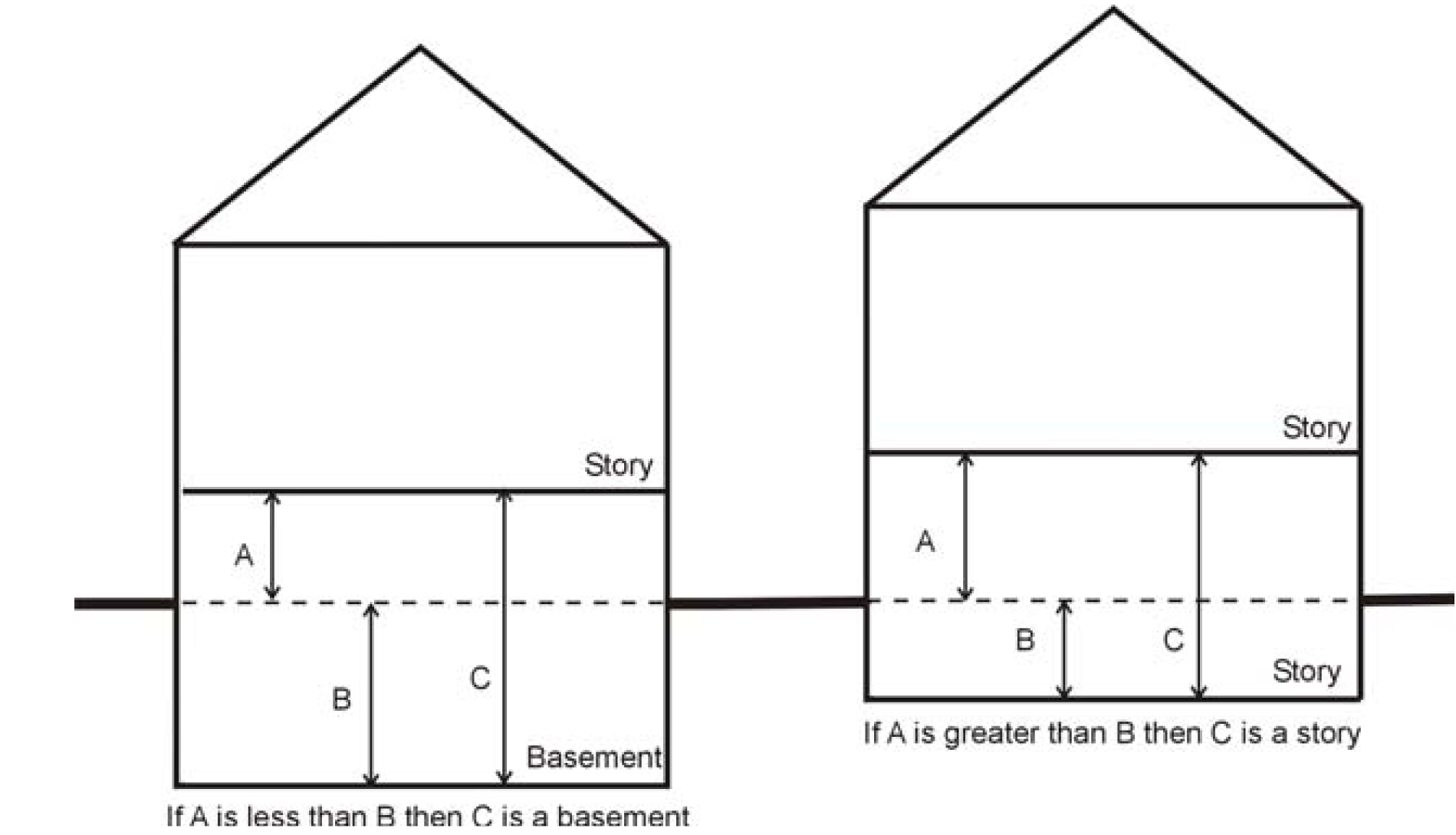
Basement. That portion of a building which is partly or wholly below grade, but so located that the vertical distance from the average grade to the floor is greater than the vertical distance from the average grade to the ceiling. A basement shall not be counted as a story.
(v)
Block. The property, abutting one side of a street lying between the two nearest intersecting streets or between an intersecting street and a railroad right-of-way; unsubdivided acreage, river or stream; or between any of the foregoing and any other barrier to the continuity of development.
(w)
Boardinghouse. Dwellings with rooms rented or leased to persons outside of the immediate family. Such dwellings shall have only one set of kitchen facilities.
(x)
Building.
(1)
Building. A structure, either temporary or permanent, having a roof supported by columns, or walls, for the shelter, support or enclosure of persons, animals or chattels, is a building. When any portion thereof is completely separated from every other part thereof by division walls from the ground up, and without openings allowing ingress or egress of persons, each separated portion of the building shall be deemed a separate building.
(2)
Building envelope (buildable area). The ground area of a lot which is defined by the minimum setback and spacing requirements within which construction of a principal and any attached accessory structures (such as a garage) is permitted by the ordinance. For condominium developments, the building envelope shall be illustrated on a site plan.
(3)
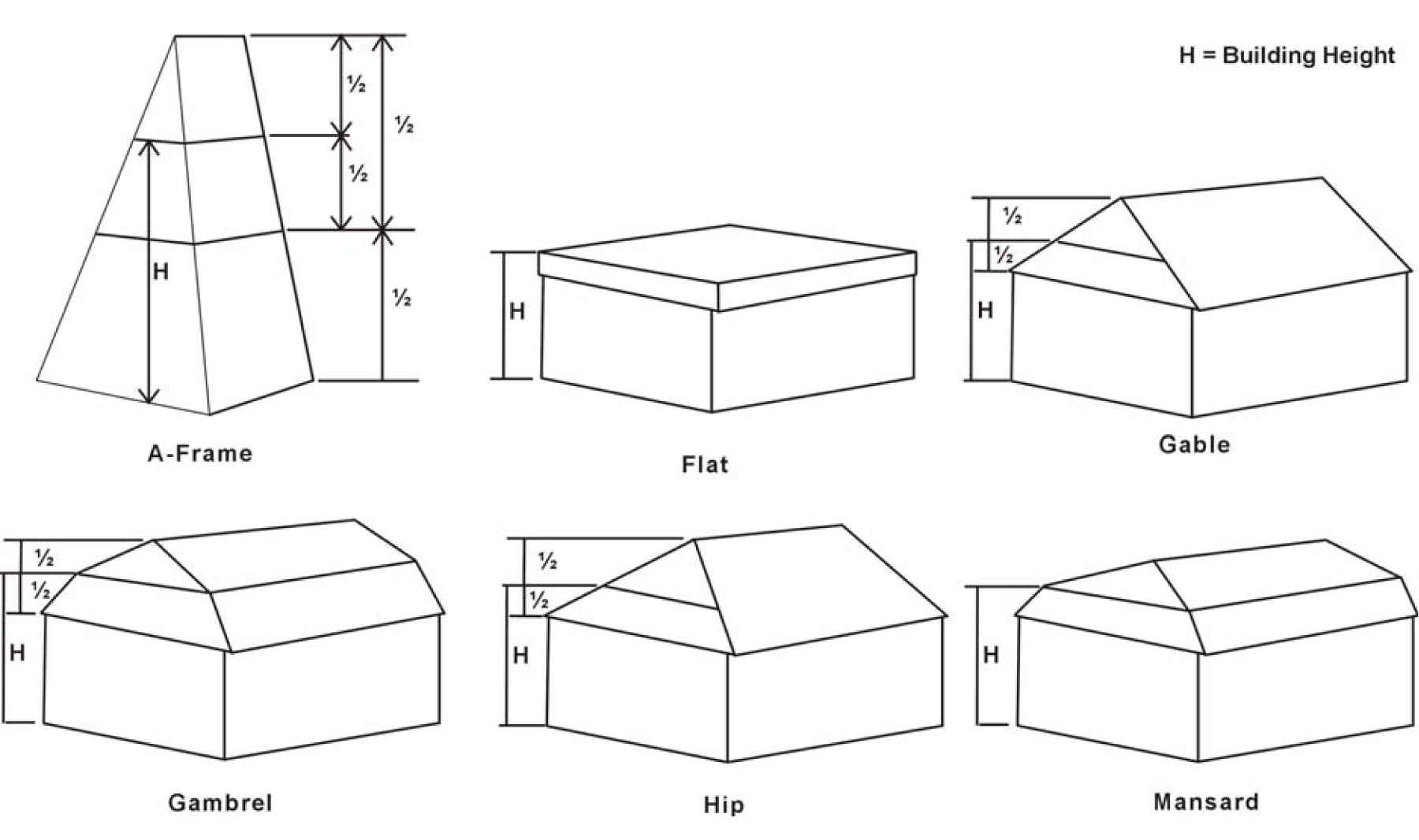
Building height. The vertical distance measured from the established grade to the highest point of the roof surface for flat roofs; to the deck line of mansard roofs; and to the average height between eaves and ridge for gable, hip, and gambrel roofs. Where a building is located on sloping terrain, the height may be measured from the average ground level of the grade at the building wall.
(4)
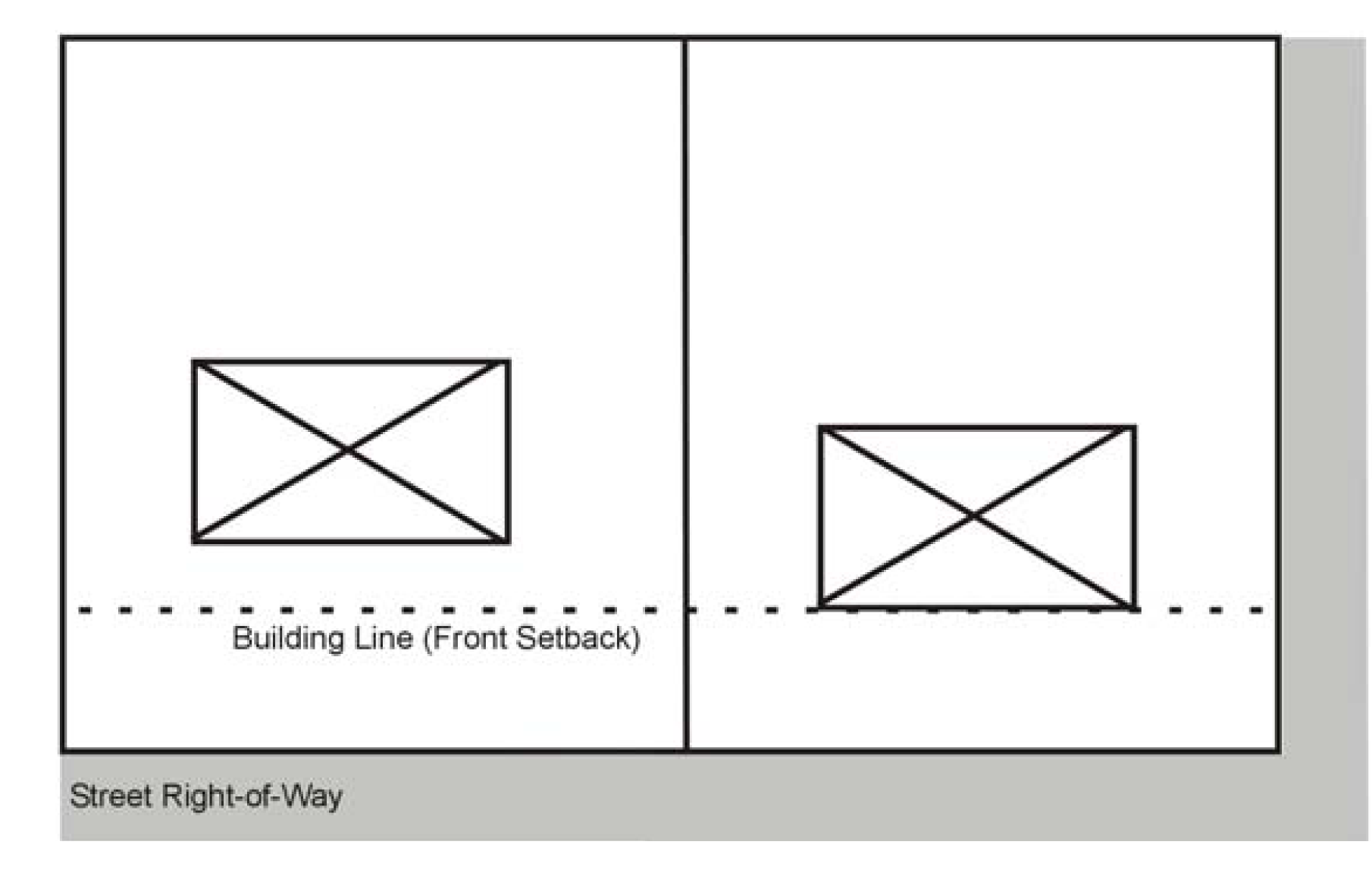
Building line. A line formed by the face of the building, and for the purposes of this ordinance, a minimum building line is the same as a front setback line.
(5)
Building permit. An authorization issued by the development services department to move, erect or alter a structure within the city.
(y)
Bulk. The term used to indicate the size and setbacks of buildings and structures and the location of same with respect to one another, including standards for the height and area of buildings; the location of exterior walls in relation to lot lines, streets, and other buildings; gross floor area of buildings in relation to lot area; open space, and, the amount of lot area required for each dwelling unit.
(z)
Business service establishment. A business which provides business type services to patrons including but not limited to copy centers, postal centers, data centers and computer repair establishments.
(Ord. No. 09-434, § 28.02, 1-20-2009)
Sec. 28.03. - Definitions C-D.
(a)
Caretaker living quarters. An independent residential dwelling unit designed for and occupied by no more than two persons, where at least one is employed to look after goods, buildings, or property on the parcel on which the living quarters are located.
(b)
Carport. A shelter for vehicles consisting of a roof extended from a wall or a building or a partially open structure consisting of a roof and possibly walls. Carports shall comply with all yard requirements applicable to private garages.
(c)
Cemetery. A parcel of land intended for the burial of deceased humans (or pets within pet cemeteries). A marker or memorial is erected at each gravesite for permanent remembrance of the deceased. Cemeteries may include columbariums and mausoleums.
(d)
Change of tenancy. A change in tenant occupying a building or portion thereof.
(e)
Change of use. A use that changes which affects any of the usual elements involved with site plan review, e.g., parking, drainage, circulation, landscaping, signage, and building arrangements.
(f)
Child care facilities. Facilities for the care of children under 18 years of age, as licensed and regulated by the state under Public Act No. 116 of 1973 (MCL 722.111 et seq.) and the associated rules promulgated by the state department of human services. Such organizations shall be further defined as follows:
(1)
Child care center or day care center. A facility, other than a private residence, receiving one or more preschool or school-age children for care for periods of less than 24 hours a day, where the parents or guardians are not immediately available to the child. The term "child care center" or "day care center" includes a facility that provides care for not less than two consecutive weeks, regardless of the number of hours of care per day. The facility is generally described as a child care center, day care center, day nursery, nursery school, parent cooperative preschool, play group, before- or after-school program, or drop-in center. The term "child care center" or "day care center" does not include any of the following:
(1)
A Sunday school, a vacation bible school, or a religious instructional class that is conducted by a religious organization where children are attending for not more than three hours per day for an indefinite period or for not more than eight hours per day for a period not to exceed four weeks during a 12-month period.
(2)
A facility operated by a religious organization where children are in the religious organization's care for not more than three hours while persons responsible for the children are attending religious services.
(3)
A program that is primarily supervised, school-age-child-focused training in a specific subject, including, but not limited to, dancing, drama, music, or religion. This exclusion applies only to the time a child is involved in supervised, school-age-child-focused training.
(4)
A program that is primarily an incident of group athletic or social activities for school-age children sponsored by or under the supervision of an organized club or hobby group, including, but not limited to, youth clubs, scouting, and school-age recreational or supplementary education programs. This exclusion applies only to the time the school-age child is engaged in the group athletic or social activities and if the school-age child can come and go at will.
(2)
Family child care home. A private home in which one but fewer than eight minor children are received for care and supervision for periods of less than 24 hours a day, unattended by a parent or legal guardian, except children related to an adult member of the family by blood, marriage, or adoption. Family child care home includes a home in which care is given to an unrelated minor child for more than four weeks during a calendar year.
(3)
Foster family home. a private home in which one but not more than four minor children, who are not related to an adult member of the household by blood or marriage, or who are not placed in the household under the Michigan adoption code, chapter X of the probate code of 1939, Public Act No. 288 of 1939 (MCL 710.21 et seq.), are given care and supervision for 24 hours a day, for four or more days a week, for two or more consecutive weeks, unattended by a parent, legal guardian, or legal custodian.
(4)
Foster family group home. A private home in which more than four but fewer than seven minor children, who are not related to an adult member of the household by blood or marriage, or who are not placed in the household under the Michigan adoption code, chapter X of the probate code of 1939, Public Act No. 288 of 1939 (MCL 710.21 et seq.), are provided care for 24 hours a day, for four or more days a week, for two or more consecutive weeks, unattended by a parent, legal guardian, or legal custodian.
(5)
Group child care home. A private home in which more than eight but not more than 14 children are given care and supervision for periods of less than 24 hours a day unattended by a parent or legal guardian, except children related to an adult member of the family by blood, marriage or adoption. It includes a home that gives care to an unrelated child for more than four weeks during a calendar year.
(g)
Churches, temples and other places of worship. A site used for or intended for the regular assembly of persons for the conducting of religious services and accessory uses therewith. Such accessory uses may include rectories, living quarters for ministry and other members of the religious order who carry out their duties primarily on the site, religious education classes, day care, outdoor recreation facilities, religious office space, youth centers and other similar activities. Rescue missions, tent revivals and other temporary assemblies are not included in this definition.
(h)
Church, temples and other places of worship, large-scale. A religious institution with a seating capacity of 1,500 people or more in its sanctuary or main area of assembly or more than 500 parking spaces. A large-scale church may also be characterized by any one or more of the following features: Region-serving accessory facilities such as high schools, colleges, and seminaries; one or more buildings 100,000 square feet in floor area or greater; retreat and conference centers or other features. Large-scale churches have negative impacts on single-family residential areas because of scale of buildings, large off-street parking lots, large size of assemblies and resultant traffic surges and frequency of use, which are different from smaller churches which have traditionally been compatible with single-family areas. Because of these impacts, large-scale churches are more compatible with nonresidential districts, subject to conditions, which minimize the impacts.
(i)
City council. The city council of the City of Taylor.
(j)
Clinic, medical. An establishment where human patients who are not lodged overnight are admitted for examination and treatment by a group of physicians, dentists, or similar professions. A medical clinic may incorporate customary laboratories and pharmacies incidental to or necessary for its operation or to the service of its patients, but may not include facilities for overnight patient care or major surgery.
(k)
Club or fraternal organization. A nonprofit organization of persons for charitable, fraternal or social purposes or for the promulgation of agriculture, sports, arts, science, literature, politics or the like, but not operated to espouse beliefs or further activity that is not in conformance with the constitution of the United States or any laws or ordinances.
(l)
Cluster residential development. A form of residential subdivision that permits housing units to be grouped on lots with dimensions, frontages, and setbacks reduced from conventional sizes, provided the density of the tract as a whole shall not be greater than the density allowed by the zoning district under existing regulations and the remaining land area is devoted to common open space.
(m)
Commercial nursery/tree farm. Any commercial establishment which is licensed by the state or federal government for the planting, growing and sale of live trees, shrubs, plants and plant materials for gardening and landscaping purposes.
(n)
Commercial use. The use of property for retail sales or similar businesses where goods or services are sold or provided directly to the consumer. As used in this ordinance, the term "commercial use" shall not include industrial, manufacturing, or wholesale businesses.
(o)
Commercial vehicle. Any vehicle bearing or required to bear commercial license plates and which falls into one or more of the following categories:
(1)
Truck tractor.
(2)
Semitrailer, which shall include flat beds, stake beds, roll-off containers, tanker bodies, dump bodies and full or partial box-type enclosures.
(3)
Vehicles of a type that are commonly used for the delivery of ice cream, milk, bread, fruit or similar vending supply or deliver trucks. This category shall include vehicles of a similar nature which are also of a type commonly used by electrical, plumbing, heating and cooling, and other construction oriented contractors.
(4)
Tow trucks.
(5)
Commercial hauling trucks.
(6)
Vehicle repair service trucks.
(7)
Snow plowing trucks.
(8)
Any other vehicle with a commercial license plate having a gross vehicle weight in excess of 10,000 pounds.
(p)
Compatibility. The characteristics of different uses or activities that permit them to be located near each other in harmony and without conflict.
(q)
Composting. A controlled process of degrading organic matter by microorganisms.
(r)
Condominium. A system of separate ownership of individual units and/or multiple-unit projects according to the Condominium Act. The following definitions are related to condominiums:
(1)
Building area. The portion of the condominium project designed and intended for separate ownership as described in the master deed, regardless of whether it is intended for residential, office, industrial, business, recreational, use as a time-share unit, or any other type of use.
(2)
Condominium Act. Public Act No. 59 of 1978 (MCL 559.101 et seq.), as amended.
(3)
Condominium subdivision plan. Drawings and information which show the size, location, area, and boundaries of each condominium unit, building locations, the nature, location, and approximate size of common elements, and other information required by section 66 of the Condominium Act.
(4)
Condominium unit. That portion of a condominium project designed and intended for separate ownership and use, as described in master deed.
(5)
Contractible condominium. A condominium project from which any portion of the submitted land or buildings may be withdrawn in accordance with this ordinance and the Condominium Act.
(6)
Conversion condominium. A condominium project containing condominium units some or all of which were occupied before the filing of a notice of taking reservations under section 71 of the Condominium Act.
(7)
Expandable condominium. A condominium project to which additional land may be added in accordance with this ordinance and the Condominium Act.
(8)
General common element. Area of common elements other than the limited common elements intended for the common use of all co-owners including:
a.
The land in the condominium project.
b.
The foundations, main walls, roofs, halls, lobbies, stairways, entrances, exits, or communication ways.
c.
The basements, flat roofs, yards and gardens, except as otherwise provided or stipulated.
d.
The premises for the use of janitors or persons in charge of the condominium project, including lodging, except as otherwise provided or stipulated.
e.
The compartments or installations of central services such as heating, power, light, gas, cold and hot water, refrigeration, air-conditioning, reservoirs, water tanks, and pumps and the like.
f.
The elevators, incinerators and, in general, all devices or installations existing for common use.
g.
All other elements of the condominium project intended for common use or necessary to the existence, upkeep, and safety of the project.
(9)
Limited common element. Area of the common elements reserved in the master deed for the exclusive use of less than all of the co-owners.
(10)
Master deed. The condominium document recording the condominium project as approved by the city including attached exhibits and incorporated by reference the approved bylaws for the project and the approved condominium subdivision plan for the project.
(11)
Site condominium. A development concept for a condominium development containing residential, commercial, office, industrial or other structure for uses permitted in the zoning district in which located; in which each co-owner owns exclusive rights in a condominium unit as described in the master deed.
(s)
Contractor's yard. A site on which a building or construction contractor stores equipment, tools, vehicles, building materials, and other appurtenances used in or associated with building or construction. A contractor's yard may include outdoor or indoor storage, or a combination of both.
(t)
Conservation easement. A legal agreement in which the landowner retains ownership of private property, but conveys certain specifically identified rights to a land conservation organization or a public body.
(u)
Construction. Any act or process that is carried out under a current and valid building permit consisting of on-site erection, fabrication, installation, alteration, demolition, or removal of any structure, facilities or addition thereto, including related activities. The term "construction" implies a diligent continuance of action toward completion, and any construction that has ceased due to expiration of a permit shall be considered inactive.
(v)
Corner clearance. An area of each lot near any street intersection or commercial driveway which shall remain clear of obstructions to ensure safe sight distance for motorists.
(w)
Curb cut. An opening from the public street to a private driveway or public drive serving an individual site or group of sites.
(x)
Deck. An accessory platform structure that is open, unenclosed by a roof or walls, either freestanding or attached to the principal structure that is supported by pillars or posts.
(y)
Deep well injection or underground injection well. A well used for pumping hazardous or nonhazardous waste or substances into deep wells, where it is intended that it be contained in the pores of permeable subsurface rock.
(z)
Density. The number of dwelling units situated on or to be developed per net acre of land. The following calculation shall be utilized in determining maximum density:
(1)
The acreage exclusive of subsections (z)(2) and (3) below shall be calculated at 100 percent toward the total site acreage.
(2)
The acreage comprised of land within the 100-year floodplain elevation, or wetlands protected by the Goemaere-Anderson Wetland Protection Act, PA 203 of 1979, shall be calculated at 25 percent toward the total site acreage.
(3)
All open bodies of water and public rights-of-way are excluded from density calculation.
(aa)
Development. The construction of a new building or other structure on a zoning lot, the relocation of an existing building on another zoning lot, or a new use of open land.
(bb)
Development services department. The city department charged with the enforcement of this ordinance which includes the planning and building departments. The managerial staff, department head, or anyone authorized by such supervisor has the ability to enforce this ordinance.
(cc)
Disposal. The final placement or destruction of either hazardous or nonhazardous substances or waste. Disposal includes placing the above substances in landfills, surface impoundments, land farms, deep wall injection or underground injection wells or incineration.
(dd)
Distribution center. A use which typically involves both warehouse and office/administration functions, where short and/or long term storage takes place in connection with the distribution operations of a wholesale or retail supply business.
(ee)
District. A portion of the city within which, on a uniform basis, certain regulations and requirements or various combinations thereof apply under the provisions of this ordinance. Districts in the City of Taylor include:
(1)
Business district. A zoning district with one of the following zoning designations on the zoning map: B-1, B-2, B-3, O-1 or O-2.
(2)
Industrial district. A zoning district with one of the following zoning designations on the zoning map: TRO, I-1 or I-2.
(3)
Mixed use district. A zoning district with one of the following zoning designations on the zoning map: MT-1 or MT-2.
(4)
Nonresidential district. A zoning district with one of the following zoning designations on the zoning map: B-1, B-2, B-3, O-1, O-2, TRO, I-1, I-2 or P-1.
(5)
Parking district. A zoning district with a P-1 zoning designation on the zoning map.
(6)
Residential district. A zoning district with one of the following zoning designations on the zoning map: R-1A, R-1B, R-1C, R-2, RM-1, RM-2 or R-3.
(7)
Zoning district. A portion of the city where certain uses of land and buildings are permitted and certain yards, open spaces, lot areas, and other requirements are established.
(ff)
Drive-in. A business establishment so developed that its retail or service character is dependent on providing a driveway approach or parking spaces for motor vehicles so as to serve patrons while in the motor vehicle rather than within a building or structure, including customer communication facilities for banks or other uses. A drive-in restaurant is distinct from a drive-through restaurant in that the majority of drive-in patrons consume food and beverages while in the vehicle and parked on the premises.
(gg)
Drive-through. A business establishment so developed that its retail or service character is wholly or at least ten percent dependent on providing a driveway approach and service windows or facilities for vehicles in order to serve patrons food and beverages in a ready-to-consume state from a drive-through window to patrons in motor vehicles. A drive-through restaurant may or may not also have indoor seating.
(hh)
Dwellings. A structure or portion thereof which is used exclusively for human habitation. A dwelling may consist of any of the following:
(1)
Apartment. An attached dwelling unit with party or common walls, contained in a building with other dwelling units or sharing the occupancy of a building with other than a residential use. Apartments are commonly accessed by a common stair landing or walkway. Apartments are typically rented by the occupants, but may be condominiums. Apartment buildings often may have a central heating system and other central utility connections. Apartments typically do not have their own yard space. Apartments are also commonly known as garden apartments or flats.
(2)
Live/work. A multistory dwelling unit wherein the first floor is designed as a storefront for retail, service, office or artisan studio and a dwelling unit on the upper floors. The live/work unit shall be designed as an integral unit with interior stairway connections between floors and the first floor storefront shall be owned and operated by the occupant of the upper floor dwelling. The type of use allowed in the first floor shall be subject to uses permitted in the district, which may be limited to the list of permitted home occupations in residential districts or allowable commercial used in mixed use districts. Live/work dwellings may be attached to a similar single dwelling unit with party or common walls, each with a separate entryway with direct access to the outdoors at ground level.
(3)
Manufactured. A dwelling which is substantially built, constructed, assembled, and finished off the premises upon which it is intended to be located and constructed in conformance with appropriate state construction code and/or HUD code. The unit shall also be affixed with a state and model code sticker.
(4)
Multiple-family. A building, or portion thereof, used or designed as residences for three or more families living independently of each other and each doing their own cooking in the building, with the number of families in residence not exceeding the number of dwelling units provided.
(5)
Single-family. A detached building or manufactured home designed exclusively for the complete living accommodations of one family, and containing one dwelling unit only.
(6)
Single-family attached. A single-family dwelling erected side by side to another similar unit as a single building, each unit being separated from the adjoining unit by an uninterrupted wall extending from the basement floor to the roof. Units may be attached to each other only by one or more of the following methods:
a.
Through a common party wall which does not have over 80 percent of its area in common with an abutting dwelling wall.
b.
By means of an architectural wall detail which does not form interior room space.
c.
Through a common party wall in only the garage portion of an abutting structure.
(7)
Single-family detached. A building containing not more than one dwelling unit entirely surrounded by open space on the same lot.
(8)
Site built. A dwelling which is substantially built, constructed, assembled, and finished on the premises which are intended to serve as its final location. Site built dwellings include those constructed of precut materials and panelized wall, roof and floor sections when such sections require substantial assembly and finishing on the premises which are intended to serve as its final location.
(9)
Stacked. A dwelling where units are stacked above each other such as lofts.
(10)
Townhouse. A self-contained single dwelling unit attached to a similar single dwelling unit with party or common walls, designed as part of a series of three or more dwelling units, each with: A separate entryway with direct access to the outdoors at ground level, a separate basement, a separate garage, separate utility connections and defined front yards. Townhouses may also be known as attached single-family dwelling units, row houses, clustered single-family dwellings or stack ranches. Any three or more attached dwellings not meeting the above criteria shall be considered a multiple-family dwelling.
(11)
Two-family. A detached building, designed for or occupied exclusively by two families living independently of each other, also called as a duplex.
(ii)
Dwelling unit.
(1)
Dwelling unit. A building, or portion thereof, designed for occupancy by one family for residential purposes and having cooking facilities.
(2)
Efficiency unit. A dwelling unit consisting of one room, exclusive of bathroom, kitchen, hallway, closets, or dining alcove located directly off the principal room.
(3)
Substandard. A dwelling of any class which is not so equipped as to have each of the following items: Running water, inside toilets; or a dwelling which has either inadequate cellar drainage, defective plumbing, inside habitable room having no windows, or improper exits or defective stairways so as to make such dwelling a fire hazard.
(Ord. No. 09-434, § 28.03, 1-20-2009; Ord. No. 23-511, § 1, 6-20-2023)
Sec. 28.04. - Definitions E-F.
(a)
Easement. A right-of-way granted, but not dedicated, for limited use of private land for private, public or quasi-public purpose, such as for franchised utilities, a conservation easement or an access easement for a private road or service drive, and within which the owner of the property shall not erect any permanent structures.
(b)
Erected. Built, constructed, altered, reconstructed, moved upon, or any physical operations on the premises which are required for construction. Excavation, fill, drainage and the like shall be considered a part of erection.
(c)
Essential services. The erection, construction, alteration or maintenance by public utilities or municipal departments of underground, surface, or overhead gas, electrical, steam, fuel or water transmission or distribution systems, communication, collection, supply or disposal systems, including poles, wires, mains, drains, sewers, pipes, conduits, cables, fire alarm and police call boxes, traffic signals and hydrants in connection herewith, but not including buildings which are necessary for the furnishing of adequate service by such utilities or municipal departments for the general health, safety or welfare. Wireless communication towers, devices and facilities are not defined as an essential service.
(d)
Excavation. Any breaking of ground, except common household gardening and ground care.
(e)
Facade. The exterior wall of a building exposed to public view. The facade shall include the entire building walls, including wall faces, parapets, fascia, windows, doors, canopies, and visible roof structures of one complete elevation.
(f)
Family. Any of the following:
(1)
A domestic family, that is, one or more persons living together and related by the bonds of consanguinity, marriage or adoption, together with servants of the principal occupants and not more than one additional unrelated person, with all of such individuals being domiciled together as a single, domestic, housekeeping unit in a dwelling.
(2)
The functional equivalent of the domestic family which is persons living together in a dwelling unit whose relationship is of a permanent and distinct character with a demonstrable and recognizable bond which render the persons a cohesive unit. All persons must be cooking and otherwise operating as a single housekeeping unit.
(3)
This definition shall not include any society, club, fraternity, sorority, association, lodge, coterie, organization or group where the common living arrangement and/or the basis for the establishment of the functional equivalency of the domestic family is likely or contemplated to exist for a limited or temporary duration.
(g)
Farm. The land, plants, animals, buildings, structures, including ponds used for agricultural or aquacultural activities, machinery, equipment, and other appurtenances used in the commercial production of farm products.
(h)
Fence. An artificially constructed barrier of wood, masonry, stone, wire, metal or any other manufactured material or combination of materials, used to prevent or control entrance, confine within, or mark a boundary.
(1)
Decorative fence. A fence, ornamental in nature, that is more than 50 percent open to the free passage of air and light, not intended to provide a barrier to passage or for screening, including but not limited to: picket fences, wrought iron fences, and split rail fences. Decorative fencing does not include chainlink or privacy fencing and may not be used as pool, protective or security fencing.
(2)
Privacy fence. A fence or wall that is designed to be used as a visual barrier to inhibit or prevent observation of an area and which is less than 50 percent open to the free passage of air and light.
(i)
Filling. The deposit or dumping of any matter onto or into the ground, except for common household gardening, farming and general ground care.
(j)
Flood hazard. A hazard to land or improvements due to overflow water having sufficient depth or velocity to transport or deposit debris, scour the surface soil, dislodge or damage buildings, or erode the banks of watercourses.
(k)
Floodplain. The channel and the relatively flat area adjoining the channel of a stream or river that has been or may be covered by floodwater with a rainfall or flood of 100-year recurrence frequency after total development of the watershed.
(l)
Floodplain area. The area defined by the 100-year flood boundary in the FEMA (Federal Emergency Management Agency) flood insurance rate map for the City of Taylor, as amended.
(m)
Flood insurance rate map. The official map on which the Federal Emergency Management Agency has delineated both areas of special flood hazards and the risk premium zones applicable to the community.
(n)
Floor area.
(1)
Floor area ratio. The gross floor area of all buildings on a lot divided by the lot area.
(2)
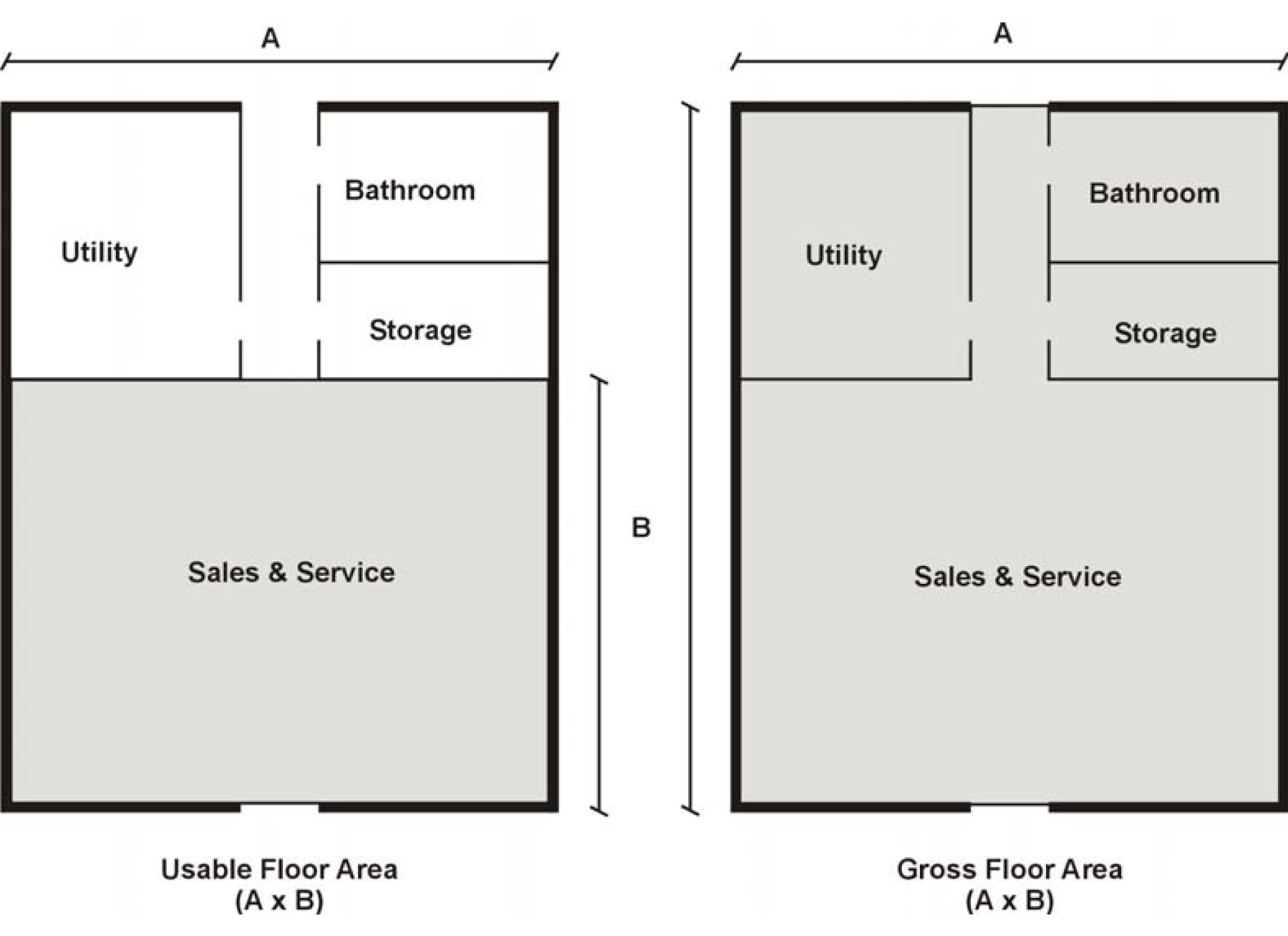
Gross floor area (GFA). The area within the perimeter of the outside walls of the building under consideration, without deduction for hallways, stairs, closets/storage rooms, thickness of walls, columns, or other features, but excluding any space where the floor-to-ceiling is less than six feet.
(3)
Gross leasable area (GLA). The total floor area for which the tenant pays rent and that is designed for the tenant's occupancy and exclusive use, not including public or common areas, such as utility rooms, stairwells, halls, and so on.
(4)
Residential floor area. For the purposes of computing the minimum allowable floor area in a residential dwelling unit, the sum of the horizontal areas of each story of the building shall be measured from the exterior faces of the exterior wall. The floor area measurement is exclusive of areas of basements, unfinished attics, attached garages, breezeways, and enclosed and unenclosed porches.
(5)
Usable floor area (UFA). That area used for or intended to be used for the sale of merchandise or services, or for use to serve patrons, clients or customers. Such floor area which is used or intended to be used principally for the storage or processing of merchandise, or areas such as hallways, stairways, elevator shafts, utilities space or sanitary facilities, shall be excluded from the UFA. Measurement of UFA shall be the sum of the horizontal areas of the several floors of the building, measured from the exterior faces of the exterior walls. When a detailed floor plan is not available, a factor of floor area 80 percent shall be used to estimate the useable floor area for purposes of calculating parking requirements and other standards based on useable floor area.
(o)
Food and beverage service.
(1)
Cocktail lounge, nightclub or bar. An establishment licensed by the State of Michigan to sell at retail and serve alcoholic beverages on the premises where more than 30 percent of the gross floor area is made up of a bar, being a barrier or counter at which any alcoholic beverages are sold or served to and consumed by customers, and also including areas dedicated for the use of stages, dance floors, standing-room areas, pool tables and similar mechanical amusement devices.
(2)
Carryout restaurant. A business establishment whose method of operation involves sale of food, beverages, and/or frozen desserts in disposable or edible containers or wrappers in a ready-to-consume state for consumption primarily off the premises.
(3)
Drive-in restaurant. A business establishment whose method of operation involves delivery of prepared food so as to allow its consumption in a motor vehicle or elsewhere on the premises, but outside of an enclosed building. A drive-in restaurant may also have interior seating.
(4)
Drive-through restaurant. A business establishment whose method of operation involves the delivery of the prepared food to the customer in a motor vehicle, typically through a drive-through window, for consumption off the premises. A drive-in restaurant may also have interior seating.
(5)
Microbrewery. A brewer licensed by the State of Michigan which produces and manufactures barrels of beer, and who may sell at the licensed brewery premises the beer produced and manufactured to consumers for consumption on or off the licensed brewery premises. A microbrewery may be considered a tavern or a bar depending on the percent of floor area dedicated to the bar as defined in subsection (o)(1) of this definition above.
(6)
Open front restaurant. A food and beverage service establishment so developed that service to the patron is extended beyond the walls of the structure by means of a walk-up window, not requiring the patron to enter the structure. The term open front restaurant shall not include a drive-in restaurant, a drive-through restaurant or a restaurant with outdoor seating accessory where seating for food/beverage service is also available indoors.
(7)
Restaurant. Any establishment whose principal business is the sale of food and beverages to the customer in a ready-to-consume state, and whose method of operation is characteristic of a carryout, drive-in, drive-through, fast-food, standard restaurant, and which may include up to 30 percent of the floor area as part of a bar (see subsection (o)(1) of this definition above).
(8)
Standard sitdown restaurant. A business establishment whose method of operation involves either the delivery of prepared food by waiters and waitresses to customers seated at tables within a completely enclosed building or the prepared food is acquired by customers at a cafeteria line and is subsequently consumed by the customers at tables within a completely enclosed building. Restaurants may also include a portion of their seating outdoors as a seasonal use.
(9)
Tavern or pub. A restaurant licensed by the State of Michigan to sell at retail and serve alcoholic beverages on the premises where less than 30 percent of the gross floor area is made up of a bar, being a barrier or counter at which any alcoholic beverages are sold or served to and consumed by customers, and also including areas dedicated for the use of stages, dance floors, standing-room areas, pool tables and other mechanical amusement devices.
(Ord. No. 09-434, § 28.04, 1-20-2009)
Sec. 28.05. - Definitions G-H.
(a)
Garage. An accessory building or portion of a main building designed or used solely for the storage of motor-driven vehicles, boats, and similar vehicles owned and used by the occupants of the building to which it is accessory.
(b)
Garage sale. A temporary, short term sale of personal effects, jewelry, or household items, furnishings and equipment belonging to the owner or occupant of a residential dwelling by the owner or occupant.
(c)
Glare. The effect, measured at the lot line, of excessive brightness sufficient to cause annoyance, discomfort, or loss in visual performance and visibility.
(d)
Grade. The ground elevation established for the purpose of regulating the number of stories and the height of buildings. The established grade elevation shall be the grade at the centerline of the street in front of the lot, or the grade determined by the city engineer when the centerline of the street provides an impractical grade.
(e)
Habitable space. Space in a structure for living, sleeping, eating, or cooking. Bathrooms, toilet compartments, closets, halls, storage or utility spaces and similar areas are not considered habitable spaces.
(f)
Hazardous substance or waste. Any material or substance:
(1)
Which is or becomes defined as a "hazardous substance," "pollutant" or "contaminant," pursuant to the comprehensive environmental response compensation and liability act (CERCLA) (42 USC 9601 et seq.) and amendments thereto and regulations promulgated thereunder.
(2)
Containing gasoline, oil, diesel fuel or other petroleum products.
(3)
Which is or becomes defined as "hazardous waste" pursuant to the resource conservation and recovery act (RCRA) (42 USC 6901 et seq.) and amendments thereto and regulations promulgated thereunder.
(4)
Containing polychlorinated biphenyls (PCBs).
(5)
Containing asbestos.
(6)
Which is radioactive.
(7)
The presence of which requires investigation or remediation under any environmental law which means any law, regulation, rule or similar requirement which governs or protects the environment enacted by the United States, State of Michigan, Wayne County or any agency or subdivision thereof.
(8)
Which is or becomes defined or identified as a "hazardous waste," "hazardous substance," "pollutant," "contaminant" or "biologically hazardous material" under any environmental law.
(g)
Health care facility. A facility or institution, whether public or private, principally engaged in providing services for human health maintenance, diagnosis and treatment of disease, pain, injury, deformity or physical condition allowing overnight stay, including but not limited to, a general hospital, special hospital, mental hospital, public health center, diagnostic center, treatment center, rehabilitation center, extended care facility, tuberculosis hospital, chronic disease hospital.
(h)
Home occupation. Any use customarily conducted entirely within the dwelling and carried on by the inhabitants thereof that is clearly incidental and secondary to the use of the dwelling for dwelling purposes, does not change the character thereof, and which does not endanger the health, safety, and welfare of any other persons residing in that area by reasons of noise, noxious odors, unsanitary or unsightly conditions, excessive traffic, fire hazards and the like, involved in or resulting from such occupation, profession or hobby. Activities not deemed to be home occupations include among others, medical clinics, barbershops, nurseries, day medical clinics, child care centers, beauty parlors, tea rooms, veterinarian's offices, animal hospitals, kennels, professional offices where clients visit the premises (e.g., insurance, real estate, lawyer).
(i)
Hospital. An institution where sick or injured persons are given medical care and, in the course of same, are housed overnight, fed and provided nursing and related services. This definition shall include any related, accessory facilities such as laboratories, outpatient departments, training facilities, central service facilities and staff offices which are integral parts of the facility. This definition shall not include drug rehabilitation facilities, halfway houses, convalescent or nursing homes, institutions for mentally ill individuals, or other similar facilities.
(j)
Hotel. A building or part of a building with a common entrance or entrances in which the dwelling units or rooming units are used primarily for transient occupancy, and in which one or more of the following services are offered: maid service, furnishing of linen, telephone, secretarial or desk services, and bellboy service. A hotel shall include tourists cabins and homes, motor courts, and motels. A hotel shall not be considered or construed to be a multiple-family dwelling.
(Ord. No. 09-434, § 28.05, 1-20-2009)
Sec. 28.06. - Definitions I-J.
(a)
Impervious surface. Manmade material which covers the surface of land and substantially reduces the infiltration of stormwater to a rate of five percent or less. Impervious surfaces include but are not limited to pavement, buildings, and structures.
(b)
Indoor recreation facility. An establishment which provides indoor exercise facilities and/or indoor court and field sports facilities, and which may include spectator seating in conjunction with the sports facilities such as skating rinks, swimming pools, indoor golf facilities, pool or billiard halls and bowling alleys. Auditoriums and stadiums are not included.
(c)
Industrial uses. Uses relating to, concerning, or arising from the assembling, fabrication, finishing, manufacturing, packaging, or processing of goods, or mineral extraction.
(1)
Industrial park. A planned, coordinated development of a tract of land with two or more separate industrial buildings that is planned, designed, constructed, and managed on an integrated and coordinated basis with special attention given to on-site vehicular circulation, parking, stormwater and utility needs, building design and orientation, screening and open space.
(2)
Heavy industrial. A use engaged in the basic processing and manufacturing of materials or products predominantly from extracted or raw materials, or a use engaged in storage of, or manufacturing processes using flammable or explosive materials, or storage or manufacturing processes that potentially involve hazardous or commonly recognized offensive conditions.
(3)
Light industrial. A use engaged in the manufacture, predominantly from previously prepared materials, of finished products or parts, including processing, fabrication, assembly, treatment, packaging, incidental storage, sales, and distribution of such products, but excluding basic industrial processing.
(d)
Junk. For the purpose of this ordinance, the term junk shall mean any motor vehicles, machinery, appliances, product, or merchandise with parts missing or scrap metals or other scrap materials that are damaged, deteriorated, or are in a condition which cannot be used for the purpose for which the product was manufactured.
(e)
Junkyard. An area where waste, used or secondhand materials are bought and sold, exchanged, stored, baled, packed, disassembled or handled, including but not limited to: scrap iron and other metals, paper, rags, rubber tires and bottles. A junkyard includes automobile wrecking yards and includes any open area of more than 200 square feet for storage, keeping or abandonment of junk.
(Ord. No. 09-434, § 28.06, 1-20-2009)
Sec. 28.07. - Definitions K-L.
(a)
Kennel. Any lot or premises on which more than three dogs, cats or other domestic animals age four months or older are kept, either permanently or temporarily, for hobby, sporting activity, protection or pets, and are not kept for breeding or sale.
(b)
Land division act. Public Act No. 288 of 1967 (MCL 560.101 et seq.).
(c)
Landscaping. The treatment of the ground surface with live plant materials normally grown in Wayne County such as, but not limited to, grass, ground cover, trees, shrubs, vines, and other live plant material. In addition, a landscape design may include other decorative natural or processed materials, such as wood chips, crushed stone, boulders or mulch. Structural features such as fountains, pools, statues, and benches shall also be considered a part of landscaping if provided in combination with live plant material.
(1)
Berm. A manmade mound of earth that is graded and shaped to a specified height and slope and improved with landscaping in such a fashion as to be used for visual and/or audible screening purposes.
(2)
Buffer zone. A strip of land with landscaping, berms or walls singularly or in combination required between certain zoning districts based on the landscaping standards of this ordinance to lessen visual and noise impacts.
(3)
Caliper. The diameter of a tree trunk measured as follows:
a.
Existing trees are measured at 4.5 feet above the average surrounding grade.
b.
Trees which are to be planted shall be measured 12 inches above the base of the tree if the tree caliper is more than four inches, or if the tree caliper is less than four inches, it shall be measured at six inches above the base of the tree.
(4)
City tree replacement fund. A fund established for maintenance and preservation of forest areas and the planting and maintenance of trees within the city.
(5)
Clear cutting. The complete clearing, cutting or removal of trees and vegetation.
(6)
Diameter at breast height (DBH). The diameter in inches of a tree measured at 4½ feet above the existing grade. on multistemmed trees, the largest diameter stem shall be measured.
(7)
Drip line. An imaginary vertical line that extends downward from the outermost tips of the tree branches to the ground.
(8)
Greenbelt. A strip of land, from property line to property line, located between the property line and the front yard building or parking setback line dedicated to the planting of shrubs, trees or grasses to serve as an obscuring screen or buffer between the property and the adjacent street.
(9)
Ground cover. Low-growing plants or sod that in time forms a dense mat covering the area, preventing soil from being blown or washed away and the growth of unwanted plants.
(10)
Grubbing. The effective removal of under story vegetation, ground cover, or shrubs from a site, not including the removal of any trees.
(11)
Hedge row. A two to three-foot tall row of evergreen or deciduous shrubs that are planted close enough together to form a solid barrier.
(12)
Landmark/historic tree. Any tree which stands apart from neighboring trees by size, form or species, as specified in the landmark tree list in section 16.03, tree preservation and replacement, or any tree, except box elder, catalpa, ash, poplar, silver maple, tree of heaven, elm or willow, which has a DBH of 24 inches or more.
(13)
Landscape screening. A method of visually shielding or obscuring one abutting or nearby structure or use from another by means of berms or vegetation.
(14)
Ornamental tree. A deciduous tree which is typically grown because of its shape, flowering characteristics, or other attractive features, and which grows to a mature height of 25 feet or less.
(15)
Shrub. A self-supporting, deciduous or evergreen woody plant, normally branched near the base, bushy, and less than 15 feet in height.
(16)
Tree. A woody plant with an erect perennial trunk, which at maturity is 13 feet or more in height and which has a more or less definite crown of foliage.
(d)
Loading space. An off-street space on the same lot with a building or group of buildings for the temporary parking of a commercial vehicle while loading and unloading merchandise or materials.
(e)
Lot. A parcel of land occupied, or intended to be occupied, by a main building or a group of such buildings and accessory buildings, or utilized for the principal use and uses accessory thereto, together with such yards and open spaces as are required under the provisions of this ordinance. A lot may or may not be specifically designated as such on public records. For purposes of meeting the dimensional standards of this ordinance, a lot does not include public rights-of-way or private street easements, but does include access easements for a service drive. A lot may be a single lot of record, a portion of a lot of record, a combination of contiguous lots of record, contiguous portions of lots of record, a parcel of land described by metes and bounds. The following definitions relate to lots:
(1)
Lot (or parcel) of record. A lot which actually exists in a subdivision plat as shown on the records of the county register of deeds, or a lot or parcel described by metes and bounds, the description of which has been so recorded. A lot may also mean a portion of a condominium project, as regulated by the Condominium Act, designed and intended for separate ownership and use.
(2)
Lot area. The total horizontal area within the lot lines of a lot excluding public or private street rights-of-way or street easements.
(3)
Lot coverage. The part or percent of the lot occupied by buildings, including accessory buildings or structures.
(4)
Lot coverage, impervious surface. The part or percent of a lot occupied by building, structures, uses, accessory buildings, accessory structures and paved areas.
(5)
Lot depth. The mean horizontal distance from the front street line to the rear lot line.
(6)
Lot frontage. A straight line connecting the points where the side lot lines intersect the street right-of-way or private street easement.
(7)
Lot lines. The lines bounding a lot as defined as follows:
a.
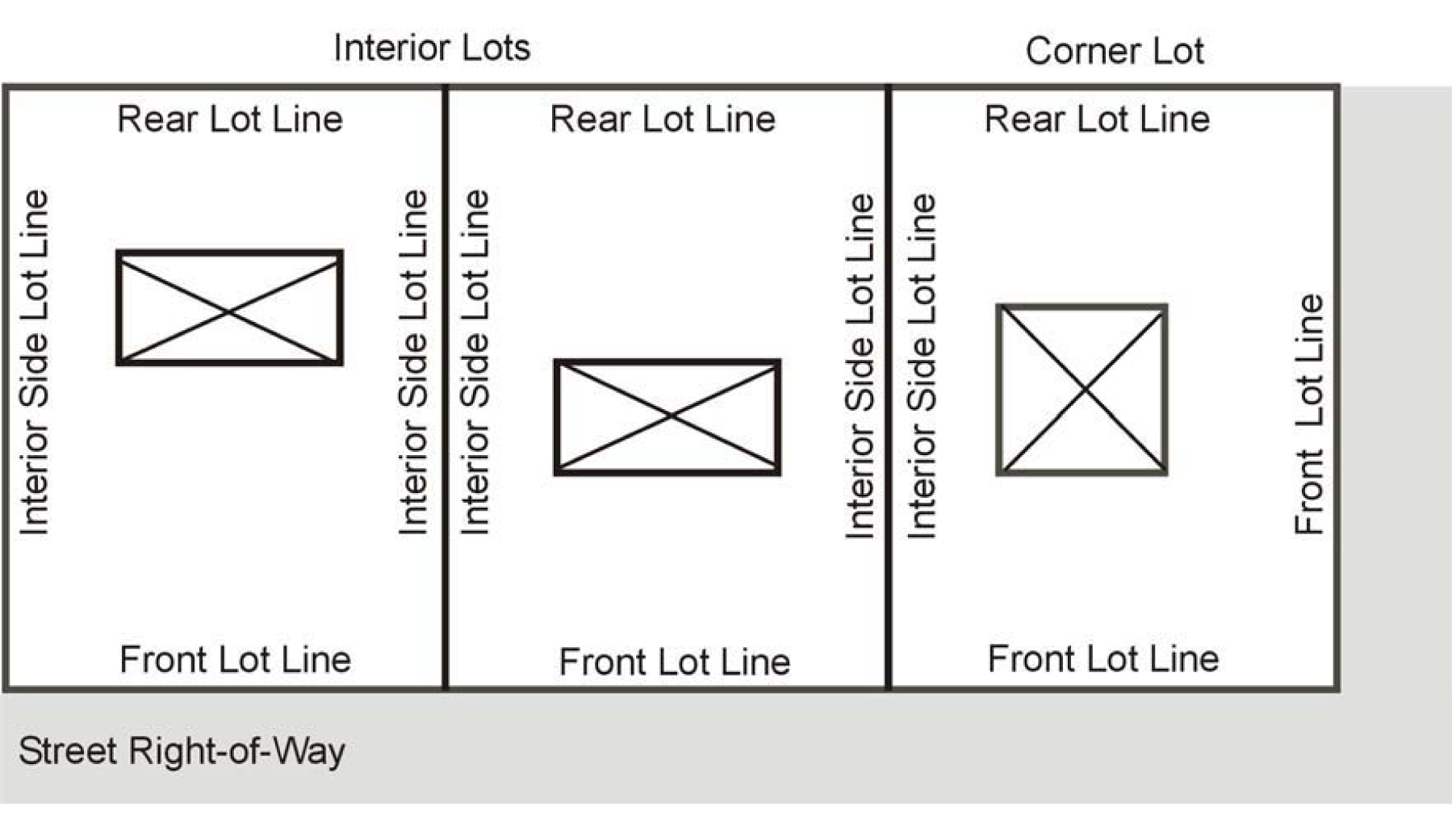
Front lot line. In the case of an interior lot, abutting upon one public or private street, the front lot line shall mean the line separating the lot from the street right-of-way. In the case of a double frontage lot, the front lot line shall be that line separating the lot from the street designated as the front street in the plat or in the request for a building permit.
b.
Rear lot line. The rear lot line is that boundary which is opposite and most distant from the front lot line. In the case of an irregular shaped lot, the rear lot line shall be that assumed line parallel to the front lot line not less than ten feet long lying farthest from the front lot line and wholly within the lot.
c.
Side lot line. Any lot line not a front lot line or a rear lot line. A side lot line separating a lot from a street is a front lot line. A side lot line separating a lot from another lot or lots is an interior side lot line.
(8)
Lot types. All lots shall be classified as one of the following:
a.
Corner lot. A lot located at the intersection of two streets or a lot bounded on two sides by a curving street, any two chords of which form an angle of 135 degrees or less. The point of intersection of the street lot lines is the corner. For a curved street line, the corner is that point on the street lot line nearest to the point of intersection of the tangents described above.
b.
Double frontage lot. An interior lot having frontages on two more or less parallel streets as distinguished from a corner lot. In the case of a row of double frontage lots, one street will be designated as the front street for all lots in the plat. If there are existing structures in the same block fronting on one or both of the streets, the required front yard setback shall be maintained along both street frontages.
c.
Flag lot. A lot not having the required frontage on or abutting a public right-of-way, and where access to the public street is by a narrow, private right-of-way.
d.
Interior lot. A lot other than a corner lot with only one lot line fronting on a street.
e.
Stacked lot. A lot located behind another lot and not having any frontage on a public right-of-way, where access to the public street is by an easement across the front lot.
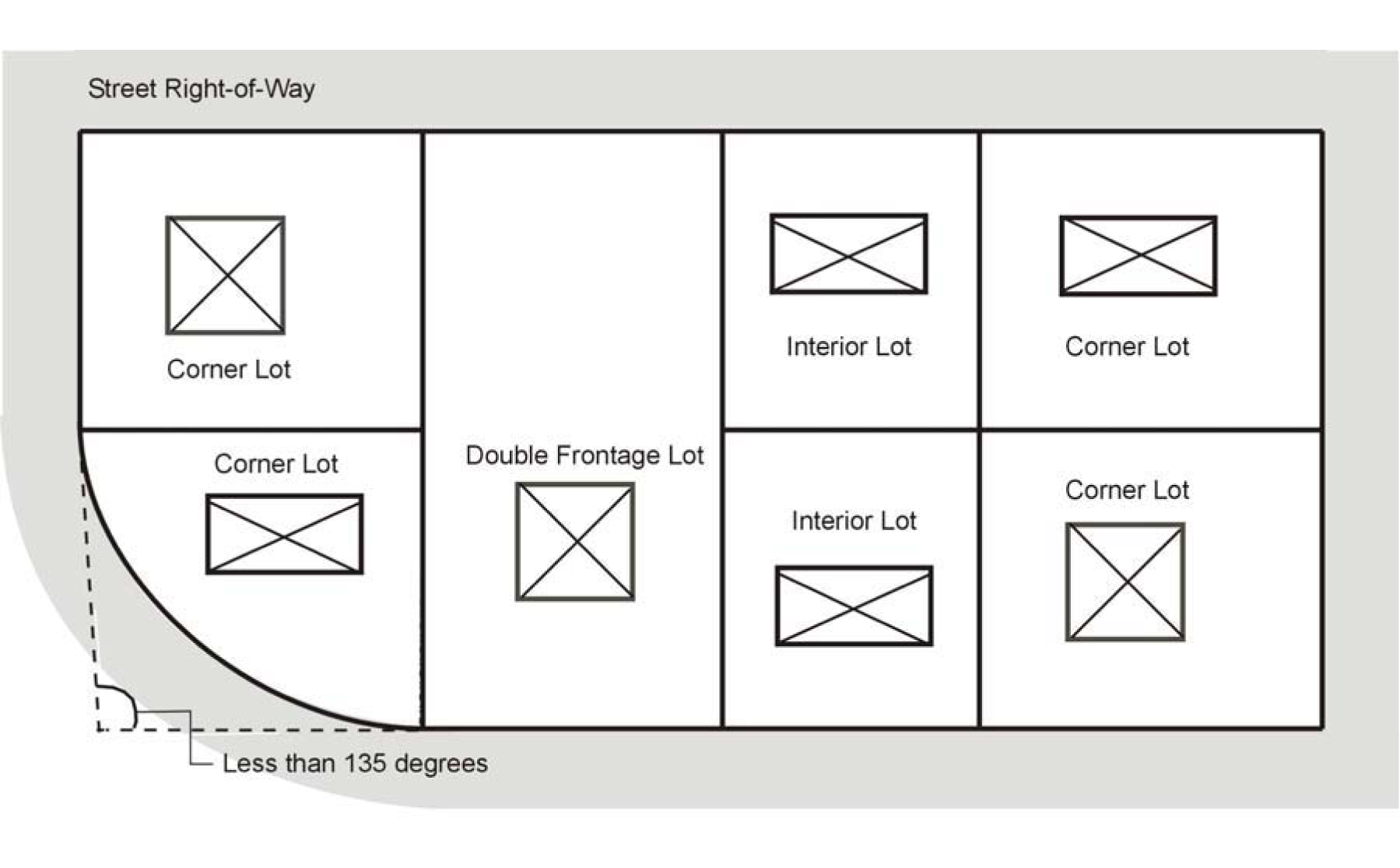
(9)
Lot width. The horizontal straight line distance between the side lot lines, measured between the two points where the front setback line intersects the side lot lines.
(Ord. No. 09-434, § 28.07, 1-20-2009)
Sec. 28.08. - Definitions M-N.
(a)
Manufactured homes.
(1)
Manufactured home. Any vehicle or structure constructed to permit occupancy as sleeping or living quarters for one or more persons, containing living, cooking, sleeping, heating, lighting, toilet and bathing facilities, and so designed that it is or may be mounted on wheels and used as a conveyance on streets or highways, propelled or drawn or carried to and installed on a lot (site). This definition does not include a vehicle such as a tent trailer, travel trailer, self-contained trailer, motor home or camp trailer 24 feet or less.
(2)
Manufactured home lot. A parcel of ground or a lot within a manufactured home park designed for the accommodation of one manufactured home.
(3)
Manufactured home park. A parcel of land which has been designed and/or improved for the placement of manufactured homes for residential use, approved under Public Act No. 96 of 1987 (MCL 125.2301 et seq.).
(b)
Marijuana uses.
(1)
Grower facilities. Also known as "marijuana cultivation facility," means a licensee that is a commercial entity located in the City and is licensed by the State of Michigan and the City of Taylor that cultivates, dries, trims or cures and packages marijuana for sale to a processor or medical marijuana provisioning center.
(2)
Processor. A person licensed to obtain marijuana from marihuana establishments; process and package marijuana; and sell or otherwise transfer marijuana to marijuana establishments.
(3)
Provisioning centers. A commercial or business entity located in the city that is licensed or approved to operate by the state pursuant to the MMFLA and is licensed by the city pursuant to the terms and conditions of this chapter, that sells, supplies, or provides marijuana to registered qualifying patients only as permitted by state law. Medical marijuana provisioning center, as defined in the MMMA, MMFLA and MTA, includes any commercial property or business where marijuana is sold in conformance with state law and regulation. A noncommercial or nonbusiness location used by a primary caregiver to assist a qualifying patient, as defined in the MMMA, MMFLA or MTA connected to the caregiver through the state's marijuana registration process in accordance with the MMMA, MMFLA or MTA is not a medical marijuana provisioning center.
(4)
Safety compliance facility. A commercial entity that is licensed by the state that receives marijuana from a medical marijuana facility or a registered qualifying patient or a registered primary caregiver, tests it for contaminants and for tatrahydrocannabinal and other cannabinoids, and returns it to the marijuana facility or a registered qualifying patient or registered primary caregiver with the test results.
(5)
Secure transporters. A commercial entity that is licensed by the state that stores marijuana and transports marijuana between medical marijuana facilities for a fee.
(c)
Master plan. The comprehensive longrange plan, adopted by the planning commission and city council, intended to guide growth and development within the City of Taylor and that includes analysis, recommendation, and proposals for the community's population, economy, housing, transportation, community facilities and land use.
(d)
Mezzanine. An intermediate floor in any story occupying not to exceed one-third of the floor area of such story.
(e)
Mini- or self-storage warehouse or facility. A building or group of buildings in a controlled-access and fenced compound that contains varying sizes of individual, compartmentalized, and controlled-access stalls or lockers for the storage of customer's goods or wares.
(f)
Motel. A series of attached, semidetached, or detached rental units containing a bedroom, bathroom and closet space which provide for overnight lodging and are offered to the public for compensation and cater primarily to the public traveling by motor vehicle. A motel may include a restaurant or cocktail lounge, public banquet halls, ballrooms or meeting rooms.
(g)
Motor vehicle uses.
(1)
Automobile filling station. A building or structure designed or used for the retail sale or provision of fuels (which must be stored only in underground tanks), lubricants, air, batteries, water and other operating commodities for motor vehicles, and including the customary space and facilities for the installation of these commodities on or in vehicles, and including space for facilities for the temporary shortterm storage, minor repair, or servicing. The definition shall not include bumping, painting, refinishing, major repairs and overhauling, steam cleaning, rustproofing whether a principal or accessory use, nor shall it be construed as automobile repair or body shop. A filling station may also include other uses such as a convenience store or carryout restaurant.
(2)
Automobile pawn facility. Any shop, store, building, facility, or other location at which a pawn broker loans money on deposit of an automobile on the condition of selling the same back again at a stipulated price.
(3)
Automobile storage. Long-term parking facility for storage of privately owned personal motor vehicles for a period of 12 hours or more, including: Facilities used by airport travelers, long-term park and fly space, and parking lots for the storage of new or used motor vehicles not located on the same lot as a dealership.
(4)
Motor vehicle maintenance and minor repair. A building or premises used primarily to provide general maintenance on automobiles such as oil changes and lubrication; servicing and repair of spark plugs, batteries, pumps, belts, hoses, air filters, and windshield wipers; replacement of mufflers and exhaust systems, brakes and shock absorbers; radiator cleaning and flushing; auto detailing; sale and installation of automobile accessories such as tires, radios and air conditioners; wheel alignment, balancing; but excluding tire recapping or grooving or any major mechanical repairs, collision work, undercoating or painting. An automobile maintenance/service establishment may be located in the same building and be a part of a vehicle service station.
(5)
Motor vehicle major engine and body repair. An automotive repair establishment which may conduct in addition to activities defined below as "minor repairs" one or more of the following: general repair, engine rebuilding, rebuilding or reconditioning of motor vehicles, collision service, such as body, frame, or fender straightening and repair; overall painting and undercoating of automobiles, major overhauling of engine requiring removal of cylinder-head or crank case pan, recapping or retreading of tires, steam cleaning and similar activities.
(6)
Motor vehicle wash (automatic). A structure that is completely enclosed in a building containing facilities for washing of automobiles with automatic, semiautomatic or touchless applications of cleaner, brushes, rinse water and with air, heat or towel drying.
(7)
Motor vehicle wash (self-service or coin-operated). A structure containing individual washing stalls whereby the customer, through use of a timed mechanical wand, applies cleaner, rinse water, car wax and similar agents directly to their personal vehicle.
(8)
Vehicle dealership. A building or premises used primarily for the sale of new and used automobiles and other motor vehicles such as motorcycles, boats, recreational vehicles or other similar methods of transportation. Such a dealership may include outdoor display and accessory indoor maintenance and repair.
(h)
Municipality. The City of Taylor, Wayne County, State of Michigan.
(i)
Nonconforming.
(1)
Nonconforming building or structure. A building or structure portion thereof lawfully existing at the effective date of this ordinance, or amendments thereto, and that does not conform to the provisions of the ordinance in the district in which it is located.
(2)
Nonconforming lot. A lot of record, lawfully in existence on the effective date of this ordinance and any amendments thereto, which no longer meets the dimensional requirements of this ordinance for the district in which it is located.
(3)
Nonconforming site. A site that lawfully occupied land on the effective date of this ordinance or any amendments thereto, that does not conform to the site regulations of the district in which it is located, including landscaping, lighting, and parking requirements.
(4)
Nonconforming use. A use which lawfully occupied a building or land at the effective date of this ordinance, or amendments thereto, and that does not conform to the use regulations of the district in which it is located.
(j)
Nuisance. An offensive, annoying, unpleasant or obnoxious thing or practice, a cause or source of annoyance, especially a continuing or repeating invasion of any physical characteristics of activity or use across a property line which can be perceived by or affects a human being, or the generation of an excessive or concentrated movement of people or things, such as, but not limited to, noise, dust, smoke, odor, glare, fumes, flashes, vibration, shock waves, heat, electronic or atomic radiation, objectionable effluent, noise of congregation of people, particularly at night, passenger traffic, invasion of nonabutting street frontage by traffic, a burned-out structure, a condemned structure.
(k)
Nuisance per se. Any violation of this ordinance.
(Ord. No. 09-434, § 28.08, 1-20-2009; Ord. No. 19-500, § 3, 11-19-2019; Ord. No. 25-525, § 2, 11-18-2025)
Sec. 28.09. - Definitions O-P.
(a)
Occupied. Includes any land or structure arranged, designed, built, altered, converted to, rented or leased, or intended to be inhabited or used.
(b)
Off-street parking lot. A facility providing off-street vehicular parking spaces along with adequate drives and aisles, for maneuvering, so as to provide access for entrance and exit for the parking of more than three vehicles.
(c)
Open space. An area that is intended to provide light and air, and is designed for environmental, scenic, or recreational purposes. The term "open space" may include, lawns, decorative planting, walkways, gazebos, active and passive recreation areas, playgrounds, fountains, swimming pools, woodlands, wetlands and watercourses. The term "open space" shall not be deemed to include driveways, parking lots or other surfaces designed or intended for vehicular travel, but may include a recreational clubhouse or recreation center.
(d)
Open space, usable. An area that is intended for recreational use. The term "usable open space" may include, lawns, walkways, gazebos, active and passive recreation areas, playgrounds, fountains, swimming pools, woodlands, but shall not include wetlands, watercourses or submerged land.
(e)
Outdoor display, sales or storage. Outdoor display, sales, or storage that is accessory to a permitted commercial use or a business operated substantially outside of any building, including: retail sales of garden supplies and equipment (including but not limited to, trees, shrubbery, plants, flowers, seed, topsoil, trellises, and lawn furniture); sale of building and lumber supplies; automobiles, recreational vehicles, boats, mobile homes, garages, swimming pools, playground equipment, mowing equipment, farm implements, construction equipment and similar materials or equipment; rental and leasing establishments; and yearround farmer's markets, roadside stands, and auctions.
(f)
Outdoor recreation. Tennis courts, archery courts, shuffleboard, horseshoe courts, miniature golf, golf driving range, children's amusement park or similar recreation uses.
(g)
Overhead door. Any at-grade door in excess of 64 square feet.
(h)
Park. A tract of land, designated and used by the public for active and/or passive recreation.
(i)
Parking garage. A multilevel building that is designed for the purpose of providing parking spaces for automobiles.
(j)
Parking space. An area of definite length and width; such area shall be exclusive of drives, aisles or entrances giving access thereto and shall be fully accessible for the parking of permitted vehicles.
(k)
Paved. An impervious surface constructed out of asphalt or concrete, placed on the land to facilitate passage.
(l)
Pawn shop. Any business that loans money on deposit of personal property or deals in the purchase or possession of personal property on condition of selling the same back again to the pledger or depositor, or loans or advances money on personal property by taking chattel mortgage security thereon, and takes or receives such personal property.
(m)
Performance guarantee. A security, in the form of cash deposit, certified check, or irrevocable bank letter of credit in an amount sufficient to cover the estimated cost of improvements required as part of an application for development that is deposited with the city to ensure that said improvements are satisfactorily completed.
(n)
Personal service establishment. A use that performs services on the premises, such as barber and beauty shops; watch, radio, television, clothing and shoe repair shops; tailor photographic studios; locksmiths; and similar establishments requiring some minor retail activity.
(o)
Planned unit development. An area of land in which a variety of residential, commercial, industrial uses are planned and developed as a whole, according to comprehensive and detailed plans with more flexible standards, such as lot sizes and setbacks, than those restrictions that would normally apply under these regulations.
(p)
Planning commission. The planning commission of the City of Taylor as established under provisions of the Michigan planning enabling act (MCL 125.3801 et seq.).
(q)
Pond. A natural or manmade body of water used to provide water for fish and wildlife, recreation, fire control, crop and orchard spraying and irrigation, and other related uses for the personal use of the property owner and/or tenants.
(r)
Pond, detention/retention. An artificially created pond or basin that holds collected stormwater that has run off the surrounding landscape of lawns, streets, and rooftops. A detention pond has an outlet that releases water at a controlled rate. Detention basins are designed to reduce how quickly runoff enters our natural waterways to protect downstream areas from flooding and erosion. Retention ponds are designed to hold water until it infiltrates the soil or evaporates without an outlet to a drainageway, except emergency overflows. Where this ordinance specifies requirements or restrictions on detention ponds, these regulations shall also apply to retention ponds.
(s)
Pool or billiard hall. An establishment wherein the substantial or significant portion of all useable floor area is devoted to the use of pool or billiard tables.
(t)
Porch.
(1)
Porch, enclosed. A covered projection from the main wall of a building, enclosed on three sides by permanent or detachable glass sash, but not used as general living space. A porch shall become general living space when the enclosed space is heated or air-conditioned and when the percentage of window area to wall is less than 50 percent.
(2)
Porch, open. A covered projection from the main wall of a building, open on three sides except for wire screening. A porch shall not be considered open if enclosed by either permanent or detachable glass sash.
(u)
Principal.
(1)
Principal building. A building or, where the context so indicates, a group of buildings in which is conducted the principal use of the lot on which the building is situated.
(2)
Principal use. The primary use to which the premises are devoted and the primary purpose for which the premises exist.
(v)
Property line. See section 28.07(e)(7), lot lines.
(w)
Public building. A building that is open to the general public, including meeting halls, libraries, clubhouses, religious buildings, museums, cultural societies, visual and performance arts buildings, municipal buildings, and community buildings that are administered by nonprofit cultural, educational or religious organizations.
(x)
Public utility. A person, firm or corporation, municipal department, board or commission duly authorized to furnish and furnishing under federal, state or city regulations to the public: gas, steam, electricity, sewage disposal, communication, telegraph, transportation or water. Wireless communication towers, devices and facilities are not defined as a public utility.
(Ord. No. 09-434, § 28.09, 1-20-2009)
Sec. 28.10. - Definitions Q-R.
(a)
Recreation area. A place designed and equipped for the conduct of sports, leisure time activities, and other customary and usual recreational activities.
(b)
Recreational facility. Any publicly or privately owned property that is utilized for active and passive, indoor and outdoor recreational activities and uses such as, but not limited to: camping, swimming, ball sports, picnicking, hiking, natural and historical sites and/or structures, community recreation centers, golfing, boating, fishing, and other related sports and leisure time activities.
(1)
Commercial recreational facility. A recreational facility operated as a for profit business and open to the public for a fee.
(2)
Private recreational facility. A recreational facility operated by a nonprofit organization and open only to bona fide members and guests of such nonprofit organization.
(3)
Public recreational facility. A recreational facility that is open to the general public, which may or may not charge a fee.
(c)
Recreational vehicle. A vehicle which moves one or more persons over the ground, water, ice, or snow, and which is either self propelled or connects to a vehicle which is self propelled and all associate trailers and equipment. Recreational vehicles include, but are not limited to:
(1)
Boats and boat trailers. Boats, personal watercrafts, canoes and rafts, and the normal equipment to transport the same on the highway.
(2)
Folding tent trailer. A canvas folding structure mounted on wheels and designed for travel and vacation use.
(3)
Motorized home. A portable dwelling designed and constructed as an integral part of a self-propelled vehicle.
(4)
Pickup camper. A structure designed primarily to be mounted on a pickup or truck chassis and with sufficient equipment to render it suitable for use as a temporary dwelling for travel, recreational, and vacation uses.
(5)
Snow mobile and all-terrain vehicles. Snow mobile and all terrain vehicles and the normal equipment to transport them on the highway.
(6)
Travel trailer. A vehicular, portable structure built on a chassis, designed to be used as a temporary dwelling for travel, recreational and vacation uses, permanently.
(d)
Recycling collection center. A facility for the drop-off and temporary holding of materials such as paper, cardboard, glass, metal, plastic, batteries, and motor oil. Processing of materials is limited to glass breaking and separation. Recycling materials are not sold to a recycling drop-off center. A recycling drop-off center is intended for household or consumer use. Use by commercial or industrial establishments is not included. Unattended drop-off stations for single materials, such as newsprint, are also not included.
(e)
Recycling facility. A facility that accepts recyclable materials and may perform some processing activities. The principal function is to separate and store materials that are ready for shipment to end-use markets, such as paper mills, aluminum smelters, or plastic remanufacturing plants. The presence of power-driven processing equipment distinguishes a processing facility from a collection facility. The facility receives and processes only residential and commercial recyclables such as food and beverage containers and paper.
(f)
Recycling plant. A facility that is not a salvage yard and in which recoverable resources, such as newspapers, magazines, books, and other paper products, glass, metal cans, and other products are recycled, reprocessed, and treated to return such products to a condition in which they may again be used for production.
(g)
Resale shop. Retail sales of previously used merchandise, such as clothing, household furnishings or appliances, sports/recreational equipment. This classification does not include secondhand motor vehicles, parts, or accessories.
(h)
Restaurant. See section 28.04(o), food and beverage service.
(i)
Retail business. Any business in which goods, wares, or merchandise are sold to the consumer for direct consumption and not for resale.
(j)
Right-of-way. A street, alley or other thoroughfare or easement intended to be occupied by a street, crosswalk, railroad, electric transmission line, oil or gas pipeline, water main, sanitary or storm sewer main, shade trees, or other facility or use, permanently established for passage of persons or vehicles and under the legal authority of the agency having jurisdiction over the right-of-way.
(k)
Roadside stand. A structure erected for the display and sale of agricultural products produced on the premises upon which such roadside stand is located.
(Ord. No. 09-434, § 28.10, 1-20-2009)
Sec. 28.11. - Definitions S-T.
(a)
Satellite television antenna or dish. A device incorporating a reflective surface that is solid, open mesh, or bar configured and is in the shape of a shallow dish, cone, horn, or cornucopia. Such device shall be used to transmit and/or receive radio or electromagnetic waves between terrestrially and/or orbitally based uses. This definition is meant to include, but not be limited to, what are commonly referred to as satellite earth stations, television reception only satellite dish antennas, and satellite microwave antennas.
(b)
School. An institution for the teaching of children or adults including primary and secondary schools, colleges, professional schools, dance schools, business schools, trade schools, art schools, and similar facilities.
(1)
Charter. A public school established by a contract with a district governing board, the state board of education or the state board for charter schools pursuant to state law to provide learning that will improve pupil achievement.
(2)
Parochial. Any building or group of buildings, the use of which meets state requirements for primary, secondary, or higher education, offers instruction in the several branches of learning and study required to be taught in the public schools.
(3)
Private or business. Any building or group of buildings, the use of which meets state requirements for primary, secondary, or higher education, offers instruction in the several branches of learning and study required to be taught in the public schools and which does not secure the major part of its funding from any governmental agency.
(4)
Business, trade, technical, industrial or vocational. A school established to provide for the teaching of industrial, aviation, clerical, managerial, or artistic skills. This definition applies to schools that are owned and operated privately for profit and that do not offer a complete educational curriculum (e.g., beauty school, modeling school).
(c)
Secondhand goods drop box. An outdoor receptacle made available to the public to allow the drop-off of second hand goods such as clothing.
(d)
Self-storage facility. A facility consisting of a building or a group of buildings in a controlled-access compound, where individual stalls or lockers are rented out to different tenants for the dead storage of customers' goods and wares. The use of the premises shall be limited to storage only, and shall not be used for any auction, or sales, or storage and transfer business; for the servicing, repair, or fabrication of any vehicle, boat, trailer, appliance, or similar item; or for the operation of power tools, compressors, kilns, or similar equipment; except, that limited sales to tenants of products and supplies incidental to the principal use, such as packing materials, identification labels, rope, locks, tape, etc., shall be permitted on the site devoted to this use.
(e)
Semitrailer. A trailer, which may be enclosed or not enclosed, having wheels generally only at the rear, and supported in front by a truck tractor or towing vehicle.
(f)
Senior housing.
(1)
Convalescent home or nursing home. A nursing care facility, including a county medical care facility, but excluding a hospital or a facility created by Public Act No. 152 of 1885 (MCL 36.1 et seq.), which provides organized nursing care and medical treatment to seven or more unrelated individuals suffering or recovering from illness, injury, or infirmity.
(2)
Senior assisted living. A type of semi independent housing facility for senior citizens containing congregate kitchen, dining, and living areas, but with separate sleeping rooms. Such facilities typically provide special support services, such as transportation and limited medical care.
(3)
Senior independent living. Typically multiple-family dwelling units occupied by persons 55 years of age or older. Units will include individual kitchen facilities; however, common dining and community facilities may be provided.
(4)
Housing for the elderly/senior apartments. A building or group of buildings containing dwellings where the occupancy of the dwellings is restricted to persons 62 years of age or older, or couples where either spouse is 62 years of age or older. This does not include an adult foster care facility, home for the aged, or nursing home.
(g)
Setback. The distance required to obtain minimum front, side or rear yard open space provisions of this ordinance.
(h)
Shopping center. A structure or group of structures located on the same lot or parcel which is developed in accordance to an overall plan and designed and built as an interrelated project that provides a variety of commercial uses and also provides for common off-street parking, pedestrian access and vehicular movements. Buildings constructed on outlots shall not be considered part of the shopping center unless access and parking easements are provided.
(i)
Signs. Any device, structure, fixture, or placard which uses words, numbers, figures, graphic designs, logos or trademarks for the purpose of informing or attracting the attention of persons. The term "signs" includes, but is not limited to: figures, devices, balloons pennants, emblems and pictures and any similar device of any kind whether bearing lettering or not. The following definitions are related to signs:
(1)
Animated sign. A sign which uses lights, moving parts, or other means to depict action, create an image of a living creature or person, or create a special effect or scene.
(2)
Awning sign. A sign which is painted on, printed on, or attached flat against the surface of an awning.
(3)
Banner sign. A sign made of fabric, cloth, paper, or other nonrigid material that is typically not enclosed in a frame.
(4)
Billboard. A sign other than an off-premises directional sign or political sign, which does not pertain to the principal use of the premises and which is regulated in accordance with the highway advertising act, Public Act No. 106 of 1972 (MCL 252.301 et seq.), as amended, and this ordinance.
(5)
Canopy sign. A sign which is painted on, printed on, or attached flat against the surface of a canopy constructed of rigid material such as plastic or metal.
(6)
Changeable message sign. A sign on which the message is changed mechanically, electronically or manually, including time/temperature signs.
(7)
Community special event sign. Signs, banners, decorations or displays celebrating a traditionally-accepted patriotic or religious holiday, or special municipal or school activities.
(8)
Construction sign. A sign which identifies the pertinent facts regarding the construction of the building and site improvements.
(9)
Directional sign. A sign installed to direct traffic flow, regulate traffic operations and provide information in conformance with the Michigan Manual of Uniform Traffic Control Device.
(10)
Entranceway sign. A sign which marks the entrance to a subdivision, apartment complex, condominium development, industrial park or other development complex.
(11)
Flashing sign. A sign which contains an intermittent or sequential flashing light source.
(12)
Freestanding sign (ground or monument). A three dimensional, base-mounted freestanding sign, that is supported by uprights or braces in or upon the ground surface or mounted on a base, and consisting of two or more sides extending up from the base, and upon which a message, business, group of businesses or center name is affixed.
(13)
Illegal sign. A sign which does not meet the requirements of this ordinance and which has not received legal nonconforming status.
(14)
Incidental sign. A small sign, emblem, or decal informing the public of goods, facilities, or services available on the premises. Examples of incidental signs include signs indicating the hours of business, no smoking signs, signs used to designate bathrooms, and signs providing information on credit cards and business affiliations money order, postal services and lottery sales.
(15)
Marquee sign. A display sign attached to or hung from a theater, performing arts or other similar use marquee, canopy or other covered structure projected from and supported by the building and extending beyond the building wall, or street lot line.
(16)
Moving sign. A sign in which the sign itself or any portion of the sign moves or revolves. A rotating sign is a type of moving sign. Such motion does not refer to the method of changing the message on the sign. Moving signs include any sign which has any visible moving parts, visible revolving parts, visible mechanical movement, or other visible movement achieved by electrical, electronic, or mechanical means, including intermittent electric pulsations or movement caused by normal wind current.
(17)
Nameplate. An on-premises identification sign giving only the name, address, and/or occupation of an occupant or group of occupants.
(18)
Nonconforming sign.
a.
A sign which is prohibited under the terms of this ordinance, but was erected lawfully and was in use on the date of enactment of this ordinance, or amendment thereto.
b.
A sign which does not conform to the requirements of this ordinance, but for which a variance has been granted.
(19)
Obsolete sign. A sign that advertises a product that is no longer made or that advertises a business that has closed.
(20)
Pennant. A lightweight plastic, fabric, or other material, whether or not containing a message of any kind, suspended from a rope, wire, or string, usually in series, designed to move in the wind.
(21)
Political sign. A temporary sign expressing a political opinion or message or relating to matters to be voted on in a local, state, or national election or referendum.
(22)
Portable sign. A sign and sign structure which is designed to facilitate the movement of the sign from one lot to another. The sign may or may not have wheels, changeable lettering and/or hitches for towing. A sign shall be considered portable only if such sign is manifestly designed to be portable to facilitate its movement from one lot to another.
(23)
Poster panel sign. A sign that is used to draw attention to matters that are temporary in nature, such as price changes, menus, or sales. A-frame or sandwich signs are types of poster panel signs.
(24)
Projecting sign. A sign other than a flat wall sign that is affixed to a building or structure, other than a marquee, and any part of which extends more than 12 inches beyond the building wall.
(25)
Real estate sign. An on-premises temporary sign which makes it known that real estate upon which the sign is located is for sale, lease, or rent.
(26)
Real estate development sign. A temporary sign that is designed to promote the sale or rental of lots, homes, or building space in a real estate development (such as a subdivision or shopping center) that is under construction on the parcel on which the sign is located. The sign may also be placed on a site that is undergoing redevelopment. The sign may also identify the designer, contractors and subcontractor, and material suppliers participating in construction on the property on which the sign is located.
(27)
Roof sign. A display sign which is erected, constructed and maintained above the roof of the building.
(28)
Sign face. The area of display surface used for the sign message.
(29)
Surface. That part of the sign upon, against, or through which the message is displayed or illustrated.
(30)
Temporary sign. A display sign, banner or other advertising device not constructed or intended for long term use, with or without a structural frame, intended for a limited period of display.
(31)
Vehicle sign. A sign painted or mounted on the side of a vehicle, including signs on the face of a truck trailer.
(32)
Wall sign. A display sign attached parallel to the wall of a building. Painted signs, signs which consist of individual letters, cabinet signs, and signs mounted on the face of a mansard roof or parapet shall be considered wall signs. Permanent signs which are not affixed directly to a window or are positioned next to a window so that they are visible from the outside shall also be considered wall signs.
(33)
Window sign. A sign located in or on a window or glass door which is intended to be viewed from the outside.
(j)
Site plan. A scaled drawing, containing all required information and drawn in compliance with this ordinance, illustrating existing conditions and containing the elements required herein as applicable to the proposed development to ensure compliance with zoning provisions. Site plans must be prepared, signed and sealed by a licensed engineer or registered land surveyor registered in the State of Michigan.
(k)
Sketch plan. A drawing, containing less information than a site plan, drawn in compliance with this ordinance, development to ensure compliance with zoning provisions. A sketch plan need not be prepared by a licensed engineer or registered land surveyor.
(l)
Special event. A temporary use on private property that extends beyond the normal uses and standards allowed by this ordinance including but is not limited to, art shows, sidewalk sales, haunted houses, carnivals, special auto sales, grand openings, festivals, home exhibitions and church bazaars.
(m)
Small package and overnight delivery distribution facility. A facility designed and equipped to provide for the receipt, temporary storage (under 24 hours), and distribution of small packages and parcels under 150 pounds primarily by means of small trucks and/or vans.
(n)
Special land use. A use of land for an activity which, under usual circumstances, could be detrimental to other land uses permitted within the same district but which may be permitted because of circumstances unique to the location of the particular use and which use can be conditionally permitted without jeopardy to uses permitted within such district. A special land use requires that a special land use approval be obtained.
(o)
Stable. The structure, building or use on the premises of an owner wherein horses, ponies or other equine are kept for boarding purposes for a fee or for sale.
(p)
Story.
(1)
Full story. That part of a building, except a mezzanine, included between the surface of one floor and the surface of the next floor, or if there is no floor above, then the ceiling next above. A basement shall not be counted as a story.
(2)
Half story. The part of a building between a pitched roof and the uppermost full story, said part having a floor area which does not exceed 50 percent of the floor area of the story immediately below. Trilevel shall be considered as 1½ stories.
(q)
Street. A dedicated public right-of-way, other than an alley, which affords the principal means of access to abutting property. Various types of streets are further defined below:
(1)
Alley. Any dedicated public way affording a secondary means of access to abutting property, and not intended for general traffic circulation.
(2)
Arterial street. A main traffic artery, designated on the functional classification map of the master plan as a principal arterial or minor arterial or having a planned right-of-way of at least 120 feet in the Wayne County Right-of-Way Master Plan. The following streets are arterial streets in the city: Allen, Beech Daly, Ecorse, Eureka, Goddard, Inkster, Northline, Pelham, Pennsylvania, Racho, Telegraph, Van Born and Wick.
(3)
Collector street. A street used to carry traffic from local streets to arterials, including principal entrance streets of large residential developments or having a planned right-of-way of at least 86 feet in the county right-of-way master plan. The following streets are collector streets in the city: Monroe, Mortenview, Pardee Road and Superior.
(4)
Cul-de-sac. A local street of short length, having one end permanently terminated by a vehicular turnaround.
(5)
Local streets. Local streets provide access primarily to individual properties and homes. All streets that are not classified as major streets are considered local streets.
(6)
Major streets. An arterial or collector street which is intended to serve large volumes of traffic for both the immediate municipal area and the region beyond. Streets considered major streets in the city include:
a.
Allen Road.
b.
Beech Daly Road.
c.
Ecorse Road.
d.
Eureka Road.
e.
Goddard Road.
f.
Inkster Road.
g.
Northline Road.
h.
Pelham Road.
i.
Pennsylvania Road.
j.
Racho Road.
k.
Telegraph Road.
l.
Van Born Road.
m.
Wick Road.
(7)
Marginal access road. A local street that is parallel and adjacent to major streets and which provides access to abutting properties and protection from through traffic.
(8)
Private road/street. A street that is owned, and maintained by the landowners served and has not been dedicated to the city, county or state as a public street.
(9)
Public street. A public dedicated right-of-way which affords traffic circulation and principal means of access to abutting property, including avenue, place, way, drive, lane, boulevard, highway, street, alley, and other thoroughfare.
(10)
Service drive. A street, typically private, that provides for cross circulation between adjacent properties. Service drives may be parallel to and follow the frontage along a major street allowing travel between adjacent commercial businesses without the need to travel on the thoroughfare, located behind businesses, or shared along common side lot lines.
(r)
Structure. Anything constructed or erected, the use of which requires location above the ground or attached to something having location on the ground. A structure will include buildings, fences, walls, decks, towers, pools, gazebos, play structures, tree house, and other similar above ground structures.
(s)
Structural alteration. Any change in the supporting members of a building or structure, such as bearing walls, partitions, columns, beams, girders, or any change in the width or number of exits, or any substantial change in the roof.
(t)
Supermarket/grocery store. A retail store with more than 20,000 square feet of gross floor area offering groceries, meats, poultry, seafood, dairy products, produce, bakery products, other food products, and other associated merchandise, and may have facilities for a butcher shop, fresh seafood, a delicatessen, a bakery, a party store, a restaurant, an ice cream parlor, a florist, a pharmacy, a financial institution, or other services.
(u)
Swimming pool. A permanent, structure or container located either above or below grade designed to allow holding of water to a depth of greater than two feet, intended for swimming, bathing or relaxation. The definition of swimming pool includes spa, hot tubs and similar devices.
(v)
Tattoo parlor. A business operation which performs the service of marking permanent marks or designs on the skin (tattoos) by puncturing it and inserting indelible colors.
(w)
Temporary use or building. A temporary use or building permitted to exist during a specified period of time.
(x)
Therapeutic massage. Massage provided in any licensed hospital, nor by a licensed chiropractor or osteopath, nor by any nurse or technician working under the supervision of a licensed physician, surgeon, chiropractor or osteopath, nor by trainers for any amateur, semi-professional or professional athlete or athletic team or school athletic program nor a therapeutic massage practitioner. The term "therapeutic massage" shall not include an adult massage parlor, as defined, which is considered an adult regulated use for purposes of these regulations.
(y)
Tobacco retailer/store. Business who sells, offers for sale, or does or offers to exchange for any form of consideration, tobacco, tobacco products or tobacco paraphernalia. "Tobacco retailing" shall mean the doing of any of these things. This definition is without regard to the quantity of tobacco products or tobacco paraphernalia sold, offered for sale, exchanged, or offered for exchange.
(z)
Traffic impact assessment/study. The analysis of the potential traffic impacts at site access points and intersections in the vicinity of a proposed project or rezoning. The following definitions are related to traffic impact assessments and studies:
(1)
Average day. A Tuesday, Wednesday or Thursday for most uses. The average day may be a Saturday for uses that have higher peak-hour traffic volumes on a Saturday rather than midweek.
(2)
Background traffic. Traffic anticipated to occur regardless of the decision on the subject application based on overall trends as demonstrated by, annual traffic increases and associated with specific approved projects for the opening year of a project. Data such as historic counts and long-range traffic projections shall be considered as part of the background traffic calculation.
(3)
Level of service (LoS). A qualitative measure describing operational conditions within a traffic stream; generally described in terms of such factors as speed and travel time, delay, freedom to maneuver, traffic interruptions, comfort and convenience and safety.
a.
Level of service A. Operations with very low control delay occurring with favorable progression and/or short cycle lengths.
b.
Level of service B. Operations with low control delay occurring with good progression and/or short cycle lengths.
c.
Level of service C. Operations with average control delays resulting from fair progression and/or longer cycle lengths. Individual cycle failures begin to appear. Typically determined to be acceptable for signalized intersections.
d.
Level of service D. Operations with longer control delays due to a combination of unfavorable progression, long cycle lengths, or high V/C ratios. Many vehicles stop and individual cycle failures are noticeable. Typically determined to be acceptable for unsignalized intersections.
e.
Level of service E. Operations with high control delays due to a combination of poor progression, long cycle lengths, and high V/C ratios. Individual cycle failures are a frequent occurrence. This is considered to be the limit of acceptable delay.
f.
Level of service F. Operation with control delays unacceptable to most drivers occurring due to oversaturation where arrival rates exceed the capacity of the intersection, poor progression, or very long cycle lengths.
(4)
Peak hour. A one-hour period representing the highest hourly volume of traffic flow in the adjacent street system during the morning (a.m. peak hour), during the afternoon or evening (p.m. peak hour); or representing the hour of highest volume of traffic entering or exiting a site (peak hour of generator).
(5)
Trip (directional trip). A single or one direction vehicle movement with either the origin of the destination (existing or entering) inside a study site.
(aa)
Truck terminal. A structure to which goods, except raw or unprocessed agricultural products, natural minerals, equipment or other resources, are delivered for immediate distribution or to be amalgamated or divided for delivery in larger or smaller units to other points, or for distribution, amalgamation, or division involving transfer to other modes of transportation.
(bb)
Truck repair garage. A repair garage designed and operated to provide repair services to commercial trucks and/or vans.
(cc)
Truck stop. Any building, premises or land in which or upon which a business, service or industry involving the maintenance, servicing, storage or repair of commercial vehicles is conducted or rendered including the dispensing of motor fuel or other petroleum products directly into motor vehicles, the sale of accessories or equipment for trucks and similar commercial vehicles. A truck stop may include overnight accommodations and restaurant facilities.
(Ord. No. 09-434, § 28.11, 1-20-2009; Ord. No. 25-520, § 1, 5-6-2025)
Sec. 28.12. - Definitions U-V.
(a)
Unbuildable area. For cluster residential development, unbuildable area is land which includes bodies of water, wetlands, ponds, lakes, streams, culverts, and existing easements.
(b)
Use. The principal purpose for which land or a building is arranged, designed or intended, or for which land or a building is or may be occupied.
(c)
Underground storage tank system. A tank or combination of tanks, including underground pipes connected to the tank or tanks, which is, was, or may have been used to contain an accumulation of hazardous substances, as defined in part 213 of the natural resources and environmental protection act, Public Act No. 451 of 1994 (MCL 324.21301a et seq.).
(d)
Urgent care center or emergency medical station. A facility offering immediate or emergency health care treatment and can be considered either a principal or accessory use.
(e)
Variance.
(1)
Variance. A relaxation or modification of the requirements of this ordinance as authorized by the zoning board of appeals (ZBA) under the provisions of this ordinance.
(2)
Dimensional variance. A variance approved by the ZBA relaxing one or more requirements of this ordinance related to buildings, lots, and other dimensional requirements.
(3)
Use variance. A variance approved by the ZBA which allows a use of property not otherwise permitted by this ordinance.
(f)
Veterinary clinic or hospital. An institution which is licensed by the Michigan Department of Health to provide for the care, diagnosis, and treatment of sick or injured animals, including those in need of medical or surgical attention. A veterinary clinic or hospital may include customary pens or cages for the overnight boarding of animals and such related facilities as laboratories, testing services, and offices.
(Ord. No. 09-434, § 28.12, 1-20-2009)
Sec. 28.13. - Definitions W-Z.
(a)
Wall. A structure of definite height and location to serve as an obscuring screen in carrying out the requirements of this ordinance.
(b)
Wall, obscuring. An artificially constructed upright barrier of any material or combination of materials erected to enclose, buffer, divide, screen, or protect areas of land.
(c)
Warehouse. A building used for longterm and shortterm storage and wholesale of manufactured products, supplies, and equipment related to the operation of a single business and material for "just in time" delivery to a manufacturing facility. The use will include truck loading and unloading, provided the area dedicated to the outdoor storage of trucks and trailers is no more than the area of the warehouse building. Where the area dedicated to the outdoor storage of trucks and trailers exceeds the area of the warehouse building or the number of truck parking spaces exceeds the number of dock doors, the use shall be considered a truck terminal.
(d)
Waste receptacle (dumpster). Any accessory exterior container used for the temporary storage of rubbish, pending collection, having the capacity of at least one cubic yard. Recycling stations and exterior compactors shall be considered to be dumpsters or waste receptacles for the purposes of screening regulations.
(e)
Watercourses. Any waterway or other body of water having reasonably well-defined banks, including rivers, streams, creeks, drains and brooks, whether continually or intermittently flowing, and lakes and ponds.
(f)
Wetlands.
(1)
Wetlands. Lands generally or intermittently covered with water which, by nature of their surface and/or subsurface soil characteristics either contribute to the replenishment of subsurface water supply, or are self-contained water resources, including marshes, swamps and bogs.
(2)
Wetlands, state regulated. Lands generally or intermittently covered with water which, by nature of their surface and/or subsurface soil characteristics either contribute to the replenishment of subsurface water supply, or are self-contained water resources,
a.
Contiguous to any lake, pond, river, or stream.
b.
Not contiguous to any lake, pond, river, or stream; and more than five acres in size.
c.
Not contiguous to any lake, pond, river or stream; and five acres or less in size if the Michigan Department of Natural Resources and Environment (MDNRE) determines that protection of the area is essential to the preservation of the natural resources of the state from pollution, impairment or destruction and, the (MDNRE) has so notified the owner.
(g)
Wholesale establishment. An establishment primarily engaged in selling merchandise to retailers; to industrial, commercial, institutional or professional business users; to other wholesalers; or acting as agents or brokers and buying merchandise for or selling merchandise to such individuals or companies.
(h)
Wind energy conversion system (WECS).
(1)
Wind energy conversion system (WECS). A device used to convert wind energy into useful form, such as electricity, using wind turbines. These systems will include a surface area (typically a blade or rotor), a shaft, gearing, belt, or coupling utilized to convert the rotation of the surface area into a form suitable for driving a generator, alternator, or other electricity-producing device and a tower and other support structures.
(2)
WECS height. The distance between the ground (at normal grade) and the highest point of the WECS (being the tip of the blade, when the blade is in the full vertical position).
(i)
Wireless communication.
(1)
Attached wireless communication facilities (antennas). Wireless communication facilities affixed to existing structures, including but not limited to existing buildings, towers, water tanks, or utility poles.
(2)
Collocation. The location by two or more wireless communications providers, public authority or other dually authorized party of wireless communications facilities on a common structure, tower or building, in a manner that reduces the overall need for additional or multiple freestanding single use communications facilities and/or support structures.
(3)
Wireless communication facilities (WCF). All structures and accessory facilities relating to the use of the radio frequency spectrum for the purpose of transmitting or receiving radio signals. This may include, but shall not be limited to, radio antenna, television broadcasting antenna, telephone devices, personal communication transmission equipment and exchanges, microwave relay, telephone transmission equipment building and commercial mobile radio service facilities. This definition does not include reception antenna for an individual lot as otherwise regulated in the applicable zoning district.
(4)
Wireless communication support structure (WCSS). Structures erected or modified to support wireless communication antennas. Support structures within this definition include, but shall not be limited to, monopoles, lattice towers, and guyed towers, or other structures that are erected for the purpose of supporting WCFs.
(j)
Yards. An open space, unoccupied and unobstructed from the ground upward and not including stormwater detention/retention facilities, except as otherwise provided herein, and being on the same lot with a building. The measurement of a yard shall be construed as the minimum horizontal distance between the lot line and the building or structure. Yards are defined as:
(1)
Front yard. The open space between the front line of the building and the front lot line, extending from one side lot line to the other side lot line. A corner lot will be considered to have two front yards: a front yard and a side street front yard.
(2)
Nonrequired yard. The open space between the minimum setback line and the main building. The nonrequired yard is the additional yard area that the building is setback beyond the minimum setback requirement for the district.
(3)
Rear yard. The open space between the rear line of the building and the rear lot line, extending from one side lot line to the other side lot line. In the case of a corner lot, the rear yard may be opposite either street frontage, but there shall be only one rear yard.
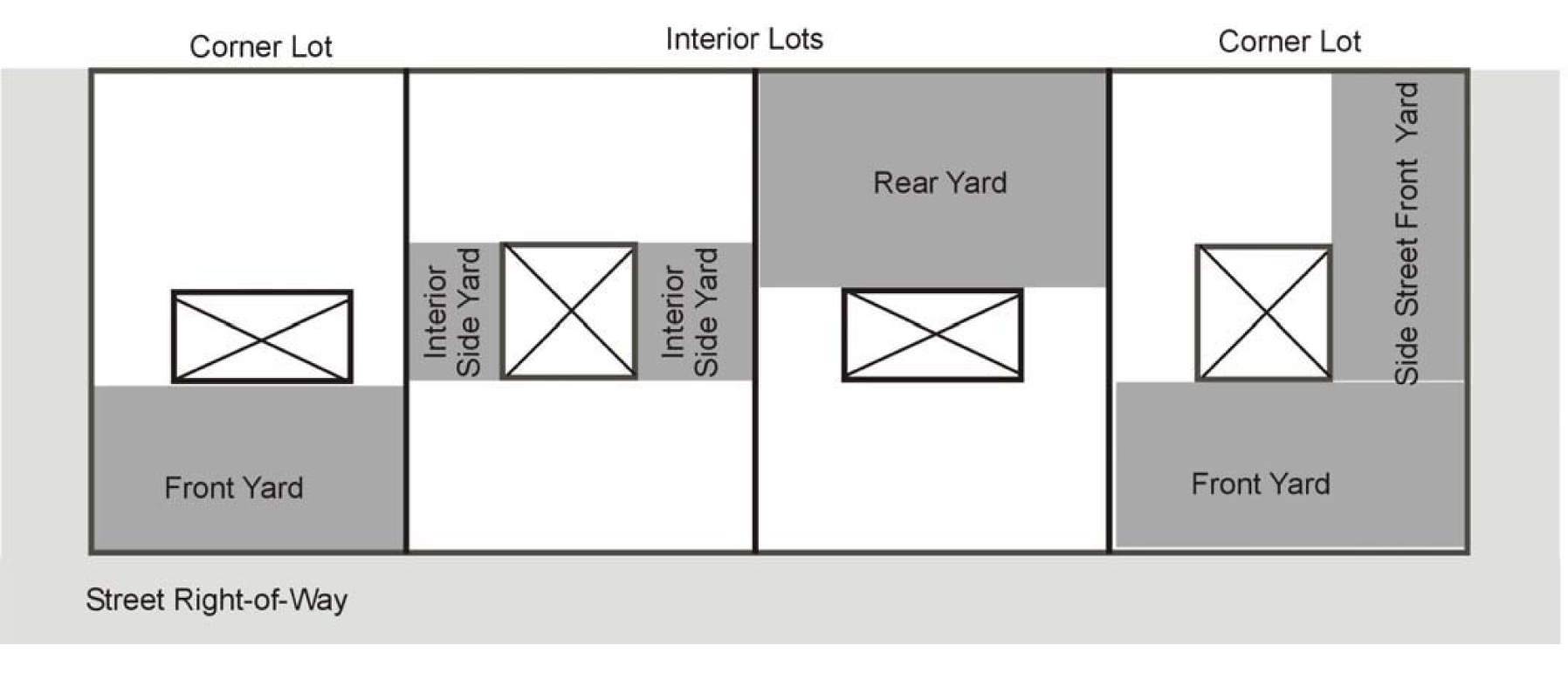
(4)
Required yard. The open space between the lot line and the minimum setback line. The required yard corresponds to the minimum setback requirement for the district.
(5)
Side yard. The open space on the same lot with a building between the side lot line and the nearest side line of the building and extending from the rear to the front yard. A side yard will also be referred to as an interior side yard where it adjoins another lot. The exterior side yard is a side yard on a corner lot that faces a side street and will be considered a side street front yard, as noted above under front yard.
(k)
Zoning district. A zoning district is a portion of the city within which, on a uniform basis, certain uses of land and buildings are permitted and within which, certain yards, open spaces, lot areas, and other requirements are established by this ordinance.
(l)
Zoning act. The Michigan zoning enabling act, Public Act No. 110 of 2006 (MCL 125.3101 et seq.), as amended.
(m)
Zoning board of appeals (ZBA). The zoning board of appeals for the City of Taylor.
(Ord. No. 09-434, § 28.13, 1-20-2009)

