
Taylor City Zoning Code
ARTICLE 15
- ACCESSORY BUILDINGS AND USES
Sec. 15.01.- Accessory buildings, structures, and uses.
Accessory buildings, except as otherwise permitted in this ordinance, shall be subject to the following regulations:
(a)
Generally.
(1)
Accessory buildings, structures, and uses are permitted only in connection with, incidental to and on the same lot with a principal building, that is occupied by a use permitted in the particular zoning district.
(2)
Accessory buildings, structures, or uses shall not be utilized unless the principal structure to which it is accessory is occupied or utilized.
(3)
Accessory buildings, structures, and uses shall not be located within a dedicated easement or right-of-way.
(4)
Accessory buildings shall not be occupied for dwelling purposes unless otherwise provided in this ordinance.
(5)
Accessory buildings shall not be used for a home occupation.
(6)
A total of the combined buildings accessory to a residential building shall not exceed the ground floor area of the principal building. The maximum area shall not exceed 720 square feet on parcels one-half acre or less, 900 square feet on parcels one-half acre to one acre, and 1,500 feet on parcels over one acre.
(7)
A minimum separation distance of ten feet shall be maintained between any two accessory buildings or structures. This minimum ten-foot distance may be reduced to not less than three feet in instances where firewall construction exists in each structure, on the same parcel of property.
(8)
The design and building materials of accessory buildings shall generally be consistent with the character of the principal building on the property (e.g. material, color), as determined by the planning commission or development services department.
(9)
All accessory structures over 200 square feet shall have a footing.
(b)
Detached accessory buildings.
(1)
Detached accessory buildings and structures shall only be located in the rear yard and shall be at least three feet from any lot line. In those instances where the rear lot line abuts an alley right-of-way, the accessory building shall not be closer than one foot to such rear lot line. In no instance shall an accessory building be located within one foot of a dedicated easement or right-of-way.
(2)
Detached accessory buildings shall be setback a minimum of ten feet from the principal building.
(3)
The maximum height of detached accessory buildings shall be 14 feet on parcels less than one-half acre, 16 feet on parcels one-half acre to one acre, and 25 feet on parcels over one acre.
(c)
Attached accessory buildings. Accessory buildings that are structurally attached to a principal building by connection of walls, a foundation, and a roof shall be subject to, and must conform to, all regulations of this ordinance applicable to the principal building, including setbacks and lot coverage, and not the regulations of this section. Attached garages shall not exceed the height of the living portion of the dwelling and shall not exceed 60 percent of the livable floor area of the dwelling.
(d)
Existing stable buildings. A preexisting legal nonconforming private stable for the housing and care of horses and their associated accessory buildings are permitted. Suitable fencing must be erected and maintained to contain the animals and the stables shall be kept clean and manure and stable refuse shall be treated and handled in such a manner so as to control odor and flies and shall be suitably screened from view. Accessory buildings shall be located a minimum of 50 feet from any lot line and 60 feet from any residential dwelling on adjacent properties. All accessory buildings pertaining to the horses shall be in conjunction with the principal residential use.
(Ord. No. 09-434, § 15.01, 1-20-2009)
Sec. 15.02. - Entranceways.
Entranceway structures including, but not limited to, walls, columns, and gates marking entrances to single-family subdivisions, multiple family housing projects, business centers, and industrial and office parks may be permitted and may be located in a required yard, except as provided in section 14.03, corner clearance, provided that such entranceway structures shall comply to all codes of the City of Taylor and shall be approved by the development service department and a permit issued.
(Ord. No. 09-434, § 15.02, 1-20-2009)
Sec. 15.03. - Fences and walls.
(a)
All districts.
(1)
Fences and walls shall not be erected within any public right-of-way.
(2)
Fences and walls may be located along a lot line.
(3)
Fences or walls shall not be erected or maintained in such a way as to obstruct the vision of motorists exiting driveways.
(4)
Electronic fences buried beneath the ground are permitted in all districts.
(5)
Barbed wire, razor wire, spikes, nails or any other sharp point or instrument of any kind on the top or sides of any fence, or fences that carry an electric current or charge that could cause injury, are prohibited unless otherwise provided in this section.
(6)
All structural members of the fence or wall shall be installed to face toward the inside of the area to be enclosed, unless otherwise agreed to in writing by all affected property owners and approved by the development services department.
(7)
Fences within the City of Taylor shall comply with all applicable local ordinances.
(b)
Residential districts.
(1)
Fences shall be permitted in the side and rear yard unless otherwise provided in this section and shall not exceed six feet.
(2)
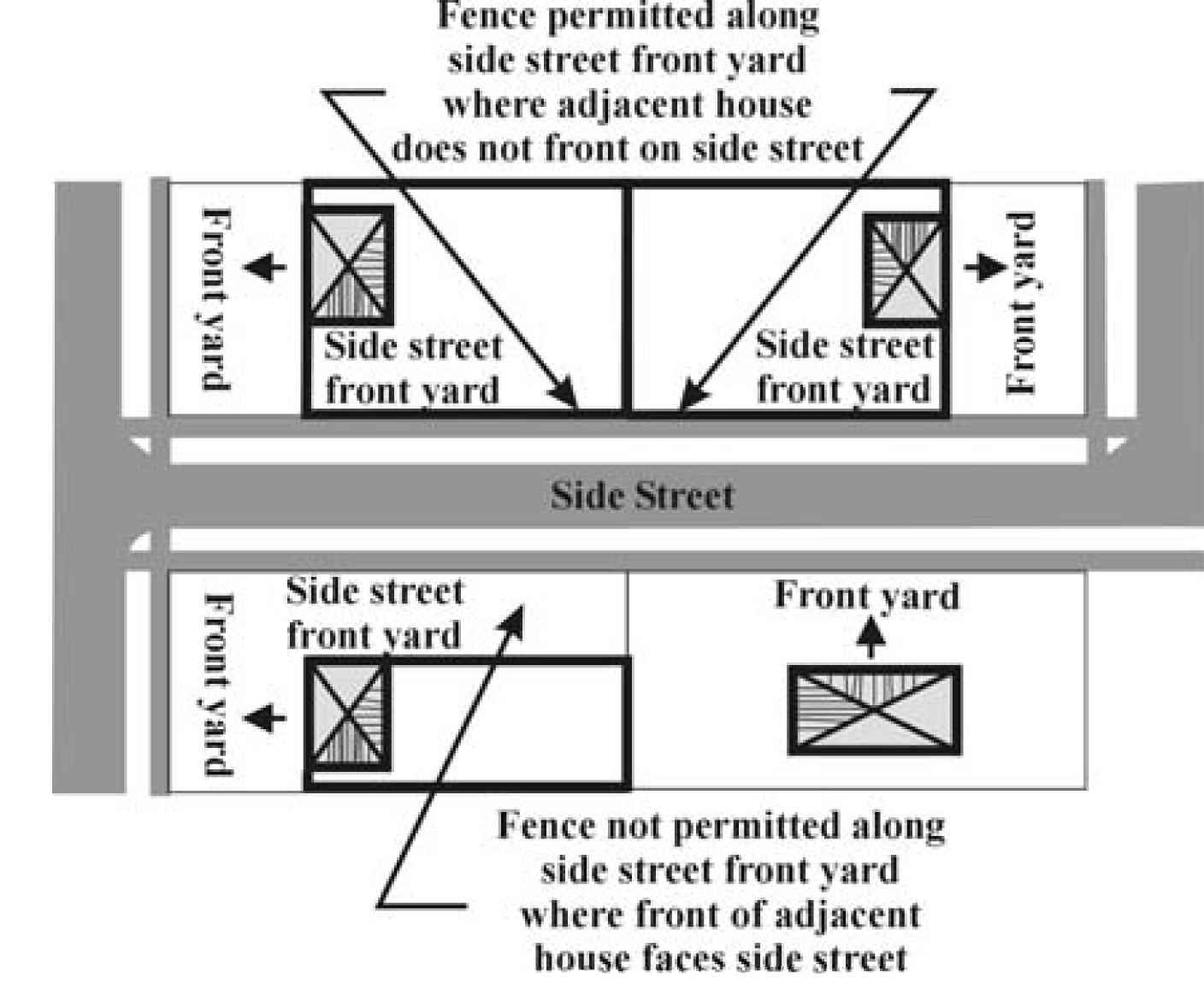
On corner lots, a fence is permitted within a front yard of a side street only if the dwelling on the adjacent lot does not front towards the same side street. The fence shall not extend beyond the front building line into the front yard of the street that the front of the dwelling faces.
(3)
Decorative fences or walls up to 3½ feet in height may be located within the front yard but may not enclose more than 50 percent of the front yard.
(4)
On all lots, fences or walls over 3½ feet tall are not allowed within ten feet of the intersection of a driveway and street right-of-way. This also applies to driveways located on adjoining lots. On corner lots, fences and walls located within a front yard shall maintain the corner clearance requirement of section 14.03, corner clearance.
(5)
Fences shall be constructed of durable quality material such as wrought iron, decorative aluminum, cedar, pressure treated wood, chainlink, vinyl, brick or stone.
(c)
Nonresidential districts.
(1)
Decorative fences are permitted in the front yard setback subject to the provisions set forth for residential districts in subsection (b) above.
(2)
The height of fences in the side or rear yard shall not exceed six feet; except taller fences shall be permitted for public recreation facilities, wireless communication facilities, commercial uses that have received special land use approval for outdoor storage and industrial uses.
(3)
Substantially solid or opaque fences located in the front yard shall not exceed a three feet, and four feet for wrought iron fences. The zoning board of appeals may permit a taller privacy fence or an obscuring wall in the front yard on nonresidential lots where necessary for screening from adjacent uses.
(4)
Fences shall be permitted within all yards in industrial districts; provided, however, that a fence located in the front yard shall be set back a distance equal to the required front yard setback. The greenbelt required by section 16.02(c), greenbelts, shall be planted in the front yard outside of the fence.
(5)
The planning commission may approve the use of black, vinyl-coated chainlink fence, or ornamental wrought iron fencing in the front yard of an industrial use when needed for security purposes, where there is no outdoor storage, or truck loading areas that require screening.
(6)
Chainlink fences shall not be erected in any front yard, except in industrial districts or for essential public service buildings and storage yards. Chainlink fences visible from the public street right-of-way or an adjacent residential district shall be black vinyl-coated.
(7)
During site plan review the planning commission may approve barbed wire on fences for sites in the I-1 and I-2 districts. If permitted, the bottom strands of barbed wire shall be at least six feet from the ground.
(d)
Screening walls. Required screening walls in accordance with table 16.02.b and the specific requirements of article 13, use requirements, shall comply with the following standards:
(1)
Location.
a.
Walls shall be placed on the lot line except in instances where this ordinance requires conformance with front yard setback lines.
b.
In cases where underground utilities or access interfere with placement of the wall on the lot line, the wall may be placed on the utility easement line located nearest the lot line.
c.
Where an alley separates a nonresidential and residential use, the planning commission may allow the screening wall for the nonresidential to be located on the opposite side of the alley abutting the residential district, when mutually agreeable to affected property owners. The continuity of the required wall on a given block will be a major consideration of the planning commission in reviewing such request.
(2)
Materials.
a.
Wall shall be constructed six feet in height of stone, brick, colored textured brick, or other decorative masonry material. Other durable material may be approved by the planning commission for industrial uses.
b.
In those cases where a wall cannot be constructed because of proximity to utility easements or unstable soil conditions, a drop in place cement wall, cedar wood fence, or vinyl fence shall be provided.
c.
Walls shall have no openings for vehicular traffic or other purposes, except as otherwise provided in this ordinance and except such openings as may be approved by the planning commission.
d.
Required walls shall be similarly finished on all sides.
e.
Where a required wall would be located within a 100-year floodplain as defined by FEMA, the development services department may administratively approve a fence or landscaped design alternative to the wall.
(3)
Maintenance. All walls shall be maintained by the property owner or tenant at all times equal in condition to the completed structure at the time of initial installation. The city may require that suitable maintenance guarantee be provided for the continued maintenance of walls or fencing required under this section.
(4)
Waivers and modifications. The planning commission may waive or modify the wall requirements under the following conditions:
a.
The requirement for a screen wall may be waived where the developed portion of the nonresidential site, including all buildings, pavement, storage and structures will be setback more than 200 feet from the residential district.
b.
Where conditions are such that a more effective and harmonious development with adjacent land uses would result, the planning commission may allow or require an earth berm and evergreen plantings to serve as the complete and continuous screen wall, provided adequate security is provided for the maintenance of the berm and evergreen planting.
(Ord. No. 09-434, § 15.03, 1-20-2009; Ord. No. 10-443, § 1, 3-16-2010)
Sec. 15.04. - Porches and decks.
(a)
Materials. Porch materials shall be harmonious and similar in design and construction as the principal structure.
(b)
Front yard.
(1)
Uncovered porch. An open, unenclosed and uncovered porch or terrace may project into a required front yard setback for a distance not exceeding ten feet, provided a minimum front yard setback of 20 feet is maintained.
(2)
Covered porch. Porches or terraces sheltered partially or wholly by a canopy, awning, metal, lattice, pergola or any other material shall be considered covered. Covered porches and decks may project into a required front yard setback for a distance not exceeding eight feet.
(3)
Enclosed porch. Porches that are covered and enclosed by walls or windows are subject to the front yard setback applicable to the principal structure, as regulated in the applicable zoning district.
(4)
Exception. In the case of an existing residential dwelling, an unenclosed porch may be added to the front of a house within the required front setback area provided all of the following criteria have been found to be present by the development services department.
a.
The home was built prior to the adoption of this ordinance.
b.
The proposed overhang would not have a depreciating effect on the neighborhood and would be in conformance with other similar appurtenances in the area.
c.
The design and construction of the overhang will not depreciate the value of the structure to which it is being attached.
(c)
Side yard. A deck or porch must not be closer to a side lot line than the minimum required side yard setbacks that apply to the principal structure on the property, as set out in the applicable zoning district.
(d)
Rear yard. Decks and porches are permitted to extend into the minimum required rear yard setback providing the following standards are met:
(1)
Decks and porches shall be setback at least 20 feet from the rear lot line.
(2)
Decks and porches shall occupy no more than 15 percent of the area of the required rear yard, as determined by applying the standards set out in the applicable zoning district, shall be covered by a first story deck, a ground-level deck, or a deck located above a walk-out basement.
(3)
If covered structures are installed on a deck or porch they shall be subject to the standards applicable to the principal structure and in the applicable zoning district.
(Ord. No. 09-434, § 15.04, 1-20-2009; Ord. No. 10-444, § 1, 3-16-2010)
Sec. 15.05. - Solar panels.
Freestanding solar panels shall be considered an accessory building and shall be subject to the requirements for such, together with the state construction code and other applicable codes and ordinances.
(Ord. No. 09-434, § 15.05, 1-20-2009)
Sec. 15.06. - Swimming pools and hot tubs.
(a)
Location.
(1)
Swimming pools, spas, hot tubs and similar devices shall not be located in any front or side yard or in any easement.
(2)
A minimum distance of six feet shall be maintained between any swimming pool and any accessory structure.
(3)
Swimming pools, spas, hot tubs and similar facilities shall be setback at least ten feet rear lot line and meet the side yard setback of the applicable zoning district.
(b)
Security fencing. Swimming pools, spas, hot tubs and similar devices that contain 24 inches or more of water in depth at any point shall meet the requirements of the state construction code.
(Ord. No. 09-434, § 15.06, 1-20-2009)
Sec. 15.07. - Antennas.
Television and radio antennas including satellite dish antennas and transmission or reception antennas, may be permitted as an accessory use in any district subject to the following conditions. Conventional television antennae and satellite dishes less than 3.3 feet (one meter) in diameter for a residential use and 6.6 feet (two meters) in diameter for a nonresidential use shall be exempt from the regulations of this section, provided the equipment is not located in the front yard or on the portion of the building facing the front lot line. Wireless communication facilities, such as cellular phone towers, wireless internet antenna and commercial broadcasting antenna, shall be subject to the requirements of section 13.12(k), wireless communication facilities and services.
(a)
Generally.
(1)
No advertising or identification display shall be placed on any portion of an antenna or tower, including a satellite dish antenna, except for the name of the manufacturer and serial number.
(2)
No more than three antennas shall be located on the same lot as a principal building. Antennae are permitted only in connection with, incidental to, and on the same lot as a principal building or use.
(3)
The color of the antennae shall be of tones similar to the surroundings.
(b)
Roof mounted.
(1)
The receiving portion of a roof-mounted reception antenna shall not exceed a dimension of seven square feet of wind resistance surface in any residential district.
(2)
The receiving portion of a roof-mounted reception antenna shall not exceed a dimension of 50 square feet of wind resistance surface in any nonresidential district.
(3)
The total height of the reception antenna and the building that it is mounted on shall not exceed the maximum height requirements for the applicable zoning district in which it is located and shall not exceed a height of more than three feet above the highest point of the roof on which it is mounted in any residential district.
(4)
Roof-mounted reception antenna shall be placed on a section of the roof in the rear yard.
(5)
Recreation antenna shall be designed to withstand a wind force of 85 miles per hour without the use of supporting guy wires.
(c)
Ground mounted.
(1)
The receiving portion of a ground-mounted antenna shall not exceed a dimension of 50 square feet of wind resistance surface.
(2)
The reception antenna shall be constructed to the rear of the principal building and is not permitted in any front or side yard.
(3)
The reception antenna, including its concrete base slab or other substructure, shall be setback a minimum of ten feet from any lot line or easement in any residential district and a minimum of five feet from any lot line or easement in any nonresidential district.
(4)
Reception antenna shall be constructed with appropriate landscaping to reasonably conceal the antenna from view.
(5)
Reception antenna shall be located on the same lot as the receiver or an adjacent contiguous lot that is owned or managed by the same person and/or company.
(6)
Any reception antenna shall be in conformance with section 14.08, height limit.
(7)
Wiring between a reception antenna and receiver shall be placed at least four inches beneath the surface of the ground within rigid conduit.
(8)
Reception antenna shall be designed to withstand a wind force of 75 miles per hour without the use of supporting guy wires.
(Ord. No. 09-434, § 15.07, 1-20-2009)
Sec. 15.08. - Storage of recreational vehicles or utility trailers.
Any owner of camping and recreational equipment may park or store such equipment in residential districts subject to the following conditions:
(a)
On lots of one acre or less, one recreational vehicle or one trailer may be stored outside. On lots of two to three acres, two recreational vehicles may be stored outside. On lots of three acres or more, three recreational vehicles be stored outside. Limitations on the number of recreational vehicles shall not apply to vehicles that are stored within an enclosed building.
(b)
A recreational vehicle, travel trailer or a utility trailer may be parked or stored in a garage, accessory building, or in the rear yard consistent with the requirements for accessory buildings. No recreational vehicle, travel trailer or utility trailer may be parked or stored in the front or side yards, except as provided for in subsection (d) below.
(c)
On lots of one acre or less, any recreational vehicle parked or stored outside shall be a maximum of 200 square feet in size, except as provided for in subsection (d) below.
(d)
Recreational vehicles of any size may be parked on any part of the lot for not more than 48 hours for the purpose of loading and unloading as long as the view of driveways, or vehicular and pedestrian traffic of adjoining properties is not obstructed.
(e)
Recreational vehicles parked or stored shall be licensed and registered to the owner or occupant of the property and must be kept in good repair.
(f)
Recreational vehicles parked or stored shall not be connected to sanitary facilities, water or electric, and shall not be occupied.
(g)
Recreational vehicles must be stored on a hard or pervious concrete, asphalt, permeable/grass pavers, or gravel surface.
(Ord. No. 09-434, § 15.08, 1-20-2009; Ord. No. 11-460, § 1, 7-5-2011)
Sec. 15.09. - Sale and maintenance of vehicles.
(a)
Sale of vehicles.
(1)
A resident of a dwelling unit may have not more than one motorized vehicle for sale on the site of such dwelling unit at any time.
(2)
Vacant residential lots or parcels shall not be utilized for the sale of vehicles.
(3)
In no instance shall a vehicle for sale be displayed in a front yard other than on the driveway portion of the yard. In those cases where a driveway of a residence is not more than 12 feet in width, the vehicle for sale may be parked within an area adjacent to the driveway not to exceed 15 feet in width as measured from the side edge of the driveway.
(4)
Vehicles must be parked and displayed on hard or pervious concrete, asphalt, permeable/grass pavers, or gravel surface.
(b)
Maintenance of vehicles. The parking, carrying out of repair, restoration and maintenance procedures or projects on vehicles in any residential district, when such work is not conducted entirely within the interior of the vehicle, shall be subject to the following limitations:
(1)
All vehicles parked or being worked on outside shall be:
a.
Located on a concrete or asphalt driveway surface.
b.
Licensed.
c.
Operable.
(2)
Procedures exceeding 48 hours in duration or which require the vehicle to be inoperable in excess of 48 hours shall be conducted within an enclosed building.
(3)
Inoperable vehicles and vehicle parts shall be stored inside an enclosed building.
(Ord. No. 09-434, § 15.09, 1-20-2009)
Sec. 15.10. - Commercial vehicles.
(a)
In nonresidential districts the parking of trucks and other commercial vehicles shall be limited to no more than 24 hours. Parking or storage of trucks and other commercial vehicles for longer than 24 hours shall only be permitted where the vehicles are accessory to a permitted use and the location for parking and storage of vehicles is approved as part of the site plan by the planning commission.
(b)
Commercial vehicles under 10,000 pounds that are pickup trucks or vans are the only commercial vehicles that may be parked in a residential district, and shall be only parked on designated paved parking areas.
(c)
Any commercial vehicle over 10,000 pounds is prohibited to be parked in any residential district or city street located in a residential district.
(Ord. No. 09-434, § 15.10, 1-20-2009; Ord. No. 24-519, § 1, 11-6-2024)
Sec. 15.11. - Drop boxes and vending machines.
(a)
Outdoor clothes drop boxes shall be permitted on lots in the I-1 and I-2 districts, only in the side or rear yard. The drop boxes shall not be permitted in the front yard, or any landscape greenbelt and shall not be permitted in a location that would block parking spaces, or loading areas and shall not obstruct vehicular circulation, fire lanes, or sidewalks.
(b)
Outdoor vending machines shall be prohibited. This provision shall not apply to newspaper stands.
(Ord. No. 09-434, § 15.11, 1-20-2009)

