
Keizer City Zoning Code
2.130
RIVER-CHERRY OVERLAY DISTRICT RCOD
Sec. 2.130.01. - Purpose.
The purpose of the River-Cherry Overlay District (RCOD) is to implement the land use principles of the Keizer Revitalization Plan, dated November 18, 2019. The RCOD is intended to promote efficient use of land and urban services; create a mixture of land uses that encourages employment and housing options in close proximity to one another; and encourage pedestrian-oriented development. This zone is intended to be accessible to pedestrians and bicyclists, as well as people using automobiles. (12/19)
Sec. 2.130.02. - Boundaries of the River-Cherry Overlay District.
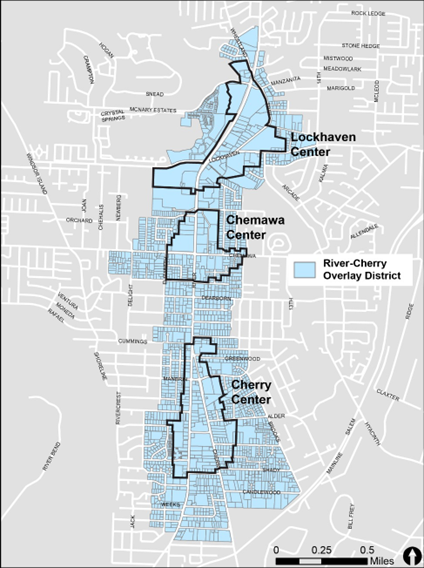
The boundaries of the RCOD, and boundaries of the three centers subdistricts, are shown in Figure 2.130.02-1. (12/19)
Sec. 2.130.03. - Applicability.
A.
The provisions of this section shall apply to all lands located within the boundaries of the RCOD illustrated in Figure 2.130.02-1. The three centers subdistricts of the RCOD are illustrated in Figure 2.130.02-1 and are established as follows: (12/19)
1.
Lockhaven Center. Extends from approximately McNary Heights Drive N at the north to Rose Park Lane NE at the south; and from approximately Lakefair Place N at the west to Crestwood Court NE at the east. The intersection of River Road N and Lockhaven Drive N is intended to be the center of activity within Lockhaven Center. (12/19)
2.
Chemawa Center. Extends from approximately Claggett Street NE at the north to James Street NE at the south; and from approximately Elizabeth Street N at the west to Bailey Road NE at the east. The intersection of River Road N and Chemawa Road N is intended to be the center of activity within Chemawa Center. (12/19)
3.
Cherry Center. Extends from approximately Dietz Avenue NE at the north to Bever Drive NE at the south; and from approximately 3rd Avenue N at the west to Partridge Lane NE at the east. The intersection of River Road N and Cherry Avenue NE and Sam Orcutt Way is intended to be the center of activity within Cherry Center. (12/19)
B.
The provisions of the RCOD shall apply as follows:
1.
They shall apply to all new construction or major renovation, where major renovation is defined as construction valued at 25 percent or more of the assessed value of the existing structure and parcel of land on which it is located, unless otherwise specified by the provisions in this section, and with the following exceptions. (12/19)
a.
Interior remodels which do not change the exterior of the building or increase its floor area or building footprint. (12/19)
b.
Replacement of equipment needed to operate an existing use, such as, but not limited to, commercial kitchen equipment, HVAC equipment, plumbing or electrical fixtures. (12/19)
c.
Maintenance required to maintain the structural integrity of the building, such as, but not limited to, replacement of a roof. (12/19)
2.
Applications for new construction or major renovation in the RCOD are subject to city review as provided in KDC section 3.101, and to the standards and guidelines in sections 2.130.04 through 2.130.10. (12/19)
C.
The RCOD replaces selected development standards in the underlying zoning districts, as set forth in section 2.130.05. (12/19)
Sec. 2.130.04. - Uses.
A.
Permitted uses.
1.
The uses in Table 2.130.04-1 are permitted in the Mixed Use (MU) Zone within the RCOD. All other zones remain unchanged. (12/19)
2.
Uses that are identified as permitted in the MU zone (section 2.107.02 through 2.107.04) are permitted in the MU zone within the RCOD, excluding commercial parking lots that are surface lots. (12/19)
3.
Uses that are not listed in Table 2.130.04-1 and that the zoning administrator determines to be similar to the uses in Table 2.130.04-1 or consistent with the RCOD purpose statement (section 2.130.01) are permitted. (12/19)
Table 2.130.04-1: Uses Permitted in the RCOD (6/23)
P = Permitted outright
S = Permitted subject to special use provisions
C = Permitted conditionally
B.
Prohibited uses. The following uses are prohibited in the Mixed Use Zone of the RCOD. This prohibition does not apply to any legally established use as of the date of the adoption of this ordinance. (12/19)
1.
Farm uses. (12/19)
2.
Rendering, processing, and/or cleaning of food products for wholesale use. (12/19)
3.
Outdoor storage or display whose impacts are not mitigated for consistent with section 2.107.05.B.7. (12/19)
4.
Camping and overnight parking in parking lots. (12/19)
5.
Hospitals, but not including surgicenters and day surgery facilities. (12/19)
(Ord. No. 2026-912, § 1(exh. A), 6-15-2026)
Sec. 2.130.05. - Dimensional and development standards.
The following subsections indicate dimensional standards and development standards required in the RCOD. These standards supplement, and in some cases replace, the development standards in the underlying zoning districts. Where the standards set forth in this section conflict with standards in the underlying zoning districts, the RCOD development standards set forth in this section shall control. (12/19)
Section 2.130.09 provides dimensional and development standards for Centers. For properties located within Centers, the standards of section 2.130.09 shall supersede the standards of this section. (12/19)
A.
Dimensional standards.
1.
Minimum lot dimension requirements. (6/22)
Table 2.130.05-1: Minimum Lot Size and Average Width Standards,
by Development Type
B.
Development standards.
1.
Minimum landscaping and maximum lot coverage. The minimum landscaping and maximum lot coverage standards are provided in the following table. Minimum landscaping for a property shall include all required yards. Landscaped areas shall be landscaped as provided in sections 2.309 and 2.130.06. Maximum lot coverage shall include all buildings, accessory structures, and paved parking areas. (12/19)
Table 2.130.05-2: Minimum Landscaping and Maximum Lot Coverage Standards
(1) Lot coverage standards do not apply to cottage cluster development. (6/22)
2.
Residential density. The minimum and maximum density for subdivisions, partitions, multifamily or any residential development shall be as follows: (6/22)
Table 2.130.05-3: Minimum and Maximum Residential Density Standards
(1) Accessory residential housing units are included in the minimum density calculations but are not included in the maximum density calculations. (7/21)
(2) There shall be no minimum residential density requirement for multifamily development within a mixed use building.
(3) For property designated medium density in the comprehensive plan, the minimum density shall be eight units per acre; the maximum density shall be 14 units per acre. For property designated medium-high density in the comprehensive plan, the minimum density shall be ten units per acre; the maximum density shall be 24 units per acre.
(4) Maximum density does not apply to duplexes, triplexes, quadplexes, or cottage cluster housing. (6/22)
3.
Off-street automobile parking requirements. (12/19)
a.
Applicability. (12/19)
i.
This section shall apply to new development or redevelopment in the RCOD, as defined in section 2.130.03. (7/25)
ii.
A change in the use of a building or structure from one permitted use to another permitted use shall not require additional parking. (7/25)
b.
Off-street automobile parking requirements(12/19). Off-street parking, when provided, shall not be provided in the amount more than the maximum amounts listed below. (7/25)
Table 2.130.05-4: Maximum Off-Street Parking
Requirements (7/25)
4.
Flexibility for mixed use development. (12/19) The following provisions are intended to provide additional flexibility for mixed use development within the RCOD. These provisions shall apply if an applicant wishes to consolidate one or more parcels zoned mixed use (MU) with one or more adjacent and contiguous residentially zoned parcels. The residentially zoned portions of the consolidated site may develop with any use permitted in the MU zone, provided the following requirements are met: (12/19)
a.
One new housing unit shall be provided for each existing housing unit that is displaced by the redevelopment of the site. (12/19)
b.
Buffering and screening shall be provided between any multifamily, mixed use, or nonresidential uses developed on-site and any adjacent residentially zoned parcel, pursuant to KDC section 2.309.05. (12/19)
C.
Standards for accessory residential housing. (12/19) Accessory residential housing in the RCOD is subject to the following development standards. Where the standards set forth in this subsection conflict with standards in section 2.403 (Accessory Dwelling Unit), the standards set forth in this subsection shall control. (6/23)
1.
Number of dwelling units. Up to two accessory housing units are permitted per lot. If two units are proposed, one of the units shall be attached. If one unit is proposed, that unit may be attached to, or detached from the primary residence. (12/19)
2.
Parking. No parking is required for the accessory housing unit. Existing parking for the primary residence must be maintained or replaced on-site following development of accessory housing units. (7/25)
(Ord. No. 2025-895, § 1(exh. A), 7-7-2025)
Sec. 2.130.06. - Landscaping standards.
The following subsections indicate landscaping standards required in the RCOD. These standards supplement, and in some cases replace, the landscaping standards in KDC section 2.309. Where the standards set forth in this section conflict with standards section 2.309, the RCOD development standards set forth in this section shall control. (12/19)
A.
Purpose. The purpose of the landscaping standards in this section is to provide enhanced landscape design for sites within the RCOD, in order to create attractive street frontages that enhance the appearance of the district and provide a pleasant experience for pedestrians. The purpose is also to balance the reduced requirements for minimum landscaped area in the district, per section 2.130.05.B.1. Landscaping standards in the RS zone remain unchanged. (12/19)
B.
Landscape standards.
1.
All front yards and all side yards abutting a street either shall be landscaped according to the following standards or shall be occupied by pedestrian amenities (e.g., plaza, outdoor seating, outdoor eating areas): (12/19)
a.
All street-facing façades shall have landscaping along their foundation. (12/19)
b.
The landscaped area shall be at least three feet wide. (12/19)
c.
An evergreen shrub meeting the planting standards of section 2.309.06.H shall be planted for every three linear feet of foundation. (12/19)
d.
Where landscaped areas in front yards and in side yards abutting a street are a minimum of ten feet wide, trees shall be planted for every 30 linear feet of building foundation. (12/19)
e.
Ground cover meeting the planting standards of section 2.309.06.I shall be planted in the remainder of the landscaped area. (12/19)
f.
Plants approved by the zoning administrator or on city-approved lists shall be used. (12/19)
g.
Exceptions. These standards do not apply to properties with front yard setbacks that are less than ten feet. (12/19)
2.
The following planting standards shall apply to all required landscape areas, except for front yards or side yards abutting a street, as provided in subsection 1: (12/19)
a.
Trees. A minimum of one tree shall be planted for every 500 square feet of required landscape area. Evergreen trees shall have a minimum height of six feet and deciduous trees shall have a minimum caliper of two inches and a minimum height of eight feet at the time of planting. (12/19)
b.
Shrubs. One evergreen shrub having a minimum mature height of four feet shall be provided for every 75 square feet of required landscape area. (12/19)
c.
Ground cover. Ground cover meeting the standards of section 2.309.06.I shall be planted in the landscaped area not occupied by required trees or shrubs. (12/19)
d.
Plants approved by the zoning administrator or on city-approved lists shall be used. (12/19)
e.
Rock, bark, or similar landscape cover materials may be used for up to 25 percent of the required landscape area. Hardscape treatments may be substituted upon approval of the zoning administrator. (12/19)
Sec. 2.130.07. - Access standards.
A.
Purpose. The purpose of managing access points onto public streets, especially onto collectors and arterials, is to reduce conflicts between users of the transportation system, to increase safety, to aid in the flow and mobility of traffic by all modes, and to create a more welcoming pedestrian environment. (12/19)
B.
Applicability. In addition to the general applicability standards established in 2.130.03(B), the provisions of this section shall apply to development when a site's number of parking spaces will increase by more than 15 percent of the existing number of parking spaces or more than 20 percent of a site's existing parking area will be reconstructed. (12/19)
C.
Access standards. Street functional classifications and spacing standards referred to in the following provisions are established in the currently adopted City of Keizer Transportation System Plan. (12/19)
1.
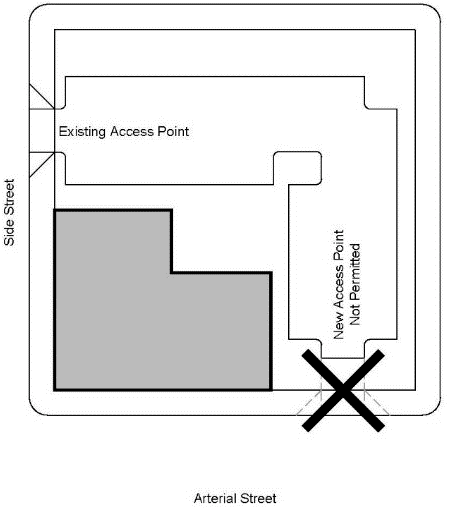
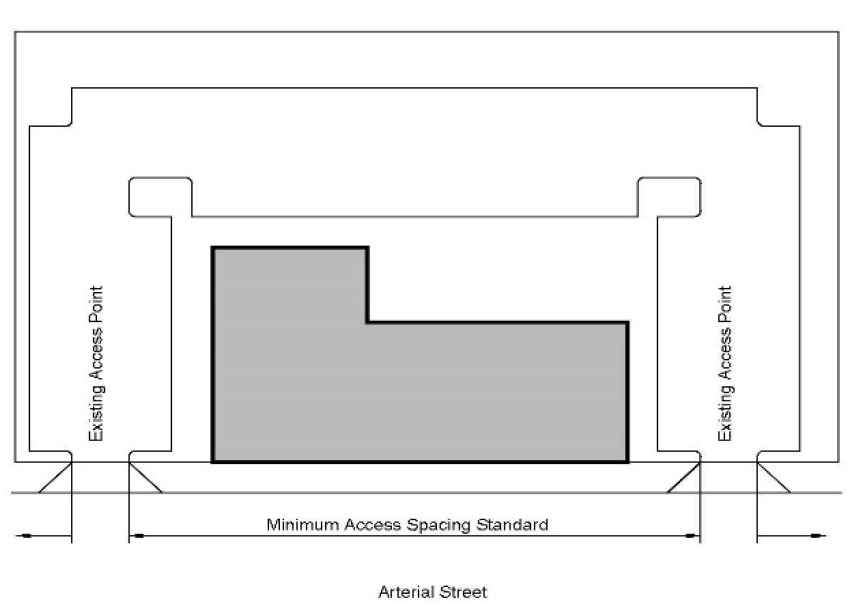
Standard A. A property fronts an arterial and a side street, which is not classified as an arterial, and has its existing access point on the side street. The access point on the side street shall be maintained and a new access point on the arterial is not permitted. (12/19)
2.
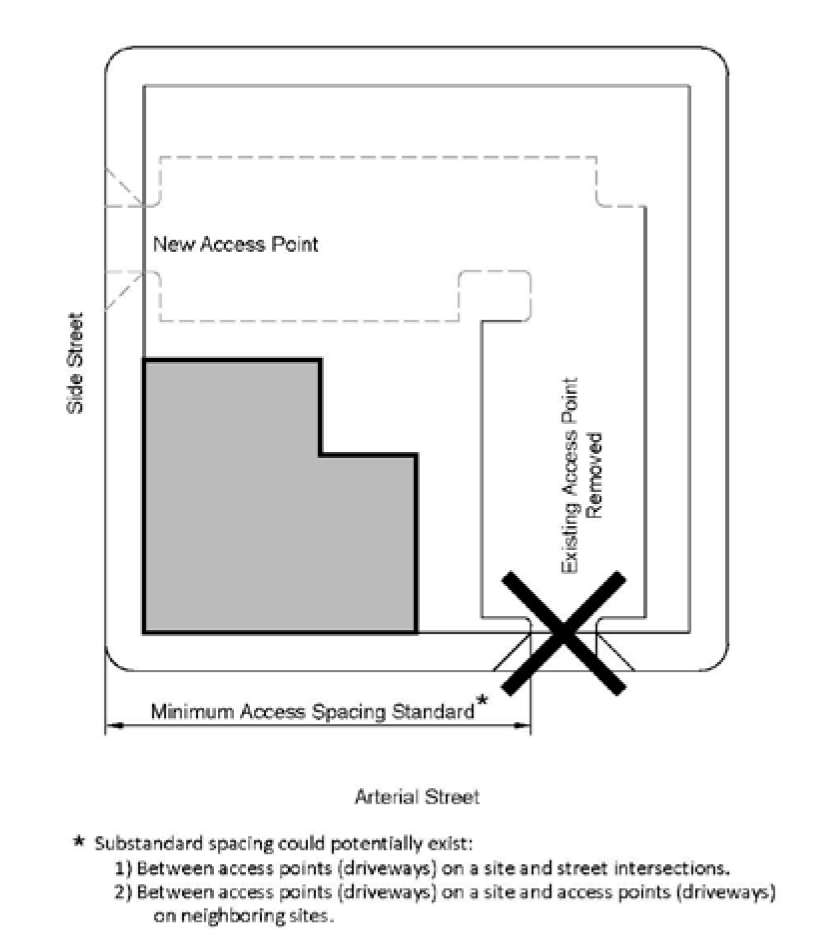
Standard B. A property has a single existing access point on an arterial street and also fronts a side street that is not an arterial or an alley. If the existing access point has substandard spacing from the nearest intersection or driveway, the existing access point shall be closed and a new access point on the side street shall be established. (12/19)
3.
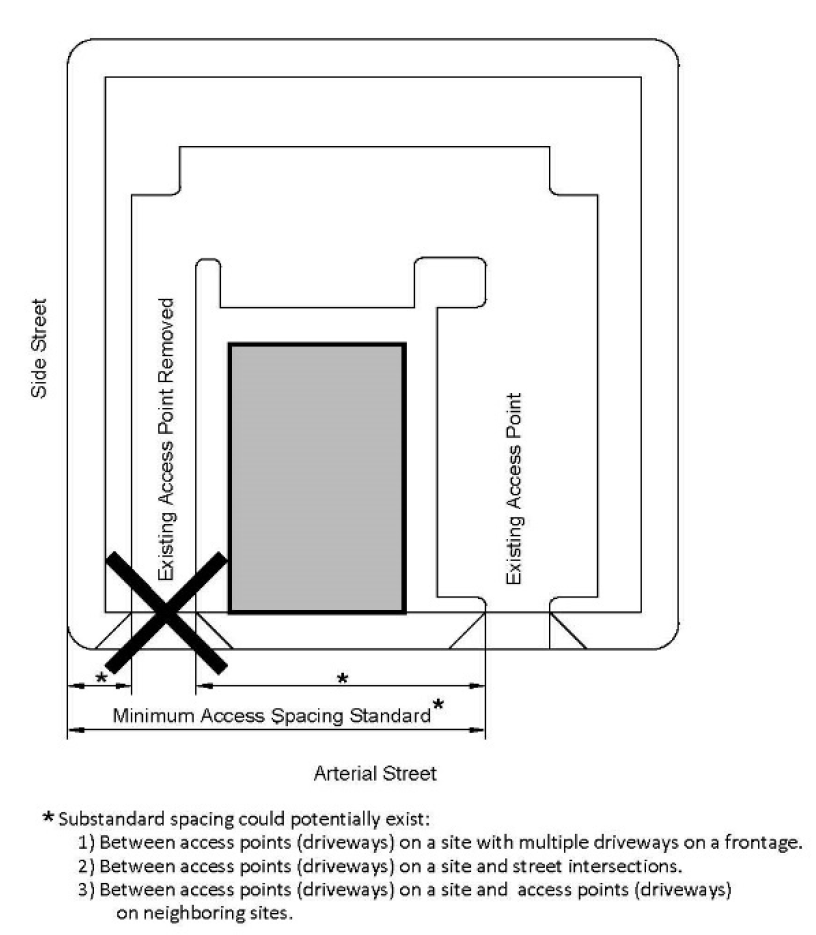
Standard C. A property has two or more existing access points on an arterial. All access points with substandard spacing shall be closed, while a minimum of one access point may be maintained. If all existing access points have substandard spacing from the nearest intersection or driveway, the access point with spacing that is closest to meeting spacing standards shall be maintained. (12/19)
4.
Standard D. A property has one or more access points on an arterial and all access points have sufficient spacing from the nearest intersection or driveway. The access points may be maintained. (12/19)
5.
Exceptions. Where there are safety or traffic operations issues identified in a traffic impact analysis prepared consistent with section 2.301.04, which are the result of substandard access spacing, the public works director may require one or more of the following: (12/19)
a.
A limit on the number, location, and/or turning movements of existing and new proposed connections to a city street. (12/19)
b.
A driveway to extend to one or more edges of a parcel to allow for future extension and inter-parcel circulation as adjacent properties develop. (12/19)
c.
A recorded access easement for future joint use of the approach and driveway as the adjacent property(ies) develop(s). (12/19)
Sec. 2.130.08. - Master plans in Lockhaven Center.
Development within the Lockhaven Center may be subject to master plan approval as provided in section 3.114 and this section 2.130.(12/19)
Sec. 2.130.09. - Dimensional and development standards in centers.
The following subsections indicate dimensional standards and development standards required within designated centers in the RCOD. These standards supplement, and in some cases replace, the general standards for the RCOD provided in section 2.130.05, as well as in the underlying zoning districts. Where the standards set forth in this section conflict with standards in section 2.130.05 or in the underlying zoning districts, the standards of this section shall control. (12/19)
A.
Dimensional standards in centers.
1.
Minimum and maximum front yard setback requirements. (12/19)
a.
The following front yard setback standards apply to multifamily, commercial, and mixed use development on properties fronting on River Road, Lockhaven Drive, Chemawa Road, and Cherry Avenue within designated centers: (12/19)
Table 2.130.09-1: Front Yard Setback Standards in Centers
(1) A zero-foot setback is permitted on properties fronting River Road where right-of-way has already been provided or dedicated, consistent with the adopted 84-foot right-of-way width for arterials identified in the Keizer Transportation System Plan standards. Where such right-of-way is not already provided or dedicated, a minimum six-foot setback is required. (12/19)
(2) The maximum setback may be extended to 20 feet for up to 50 percent of the building façade if a plaza or other pedestrian open space is provided between the building and the sidewalk. The pedestrian open space must meet the standards of section 2.130.10.E. (12/19)
(3) Nonresidential development in the RM zone shall be subject to the same minimum and maximum setback standards as multifamily development. (12/19)
b.
Properties not subject to the setback standards listed in subsection a of this section are subject to the setback standards of the underlying base zone. (12/19)
B.
Development standards in centers.
1.
Minimum landscaping and maximum lot coverage in centers. (12/19) The minimum landscaping and maximum lot coverage standards for properties located in designated Centers are provided in the following table. Minimum landscaping for a property shall include all required yards. Landscaped areas shall be landscaped as provided in KDC sections 2.309 and 2.130.06. Maximum lot coverage shall include all buildings, including accessory structures consistent with the definition of lot coverage. (12/19)
Table 2.130.09-2: Minimum Landscaping and Maximum Lot Coverage Standards in Centers (12/19)
2.
Standards for auto-oriented uses and development. (12/19)
a.
Applicability. The standards of this subsection apply to auto-oriented uses and development on properties fronting River Road, Lockhaven Drive, Chemawa Road, and Cherry Avenue within centers. For the purposes of this subsection, "auto-oriented uses and development" refers to the following uses: (12/19)
i.
Gasoline service stations (section 2.419). (12/19)
ii.
Drive-through windows or car service associated with eating and drinking places. (12/19)
iii.
Vehicle sales and secondary repair (section 2.420). (12/19)
iv.
Public utility structures and buildings. (12/19)
v.
Recreational vehicle parks (section 2.412). (12/19)
vi.
Structured automobile parking not associated with an allowed use. (12/19)
vii.
Automotive dealers. (12/19)
viii.
Automotive rental and leasing, without drivers. (12/19)
ix.
Automotive repair shops (section 2.420). (12/19)
x.
Automotive services, except repair (section 2.420). (12/19)
xi.
Utilities; secondary truck parking and material storage yard. (12/19)
b.
Auto-oriented uses and development in centers may be permitted, subject to obtaining a conditional use permit. Applicants must demonstrate how the proposed development either limits or mitigates the safety and aesthetic impacts of the auto-oriented use on the pedestrian environment. Possible strategies to limit/mitigate impacts include increased setbacks, provision of pedestrian-oriented amenities, screening and buffering from the right-of-way and from adjacent residential uses, and access management and control measures. These strategies shall be consistent with screening and other requirements in existing special use standards that address limiting and mitigating impacts. (12/19)
(Ord. No. 2025-895, § 1(exh. A), 7-7-2025)
Sec. 2.130.10. - Urban design standards in centers.
A.
Purpose. The purpose of the urban design standards for centers is to create pedestrian-oriented places that serve as the centers of commercial and civic activity and as destinations for residents and visitors in the River Road/Cherry Avenue Corridor. Pedestrian-oriented places provide visual interest at eye level, feel safe and comfortable for people walking, contain a variety of activities and services, are easy to navigate on foot, and provide open areas and amenities for gathering and resting. The regulations for centers modify the regulations of the overall River-Cherry Overlay District and of the underlying base zones to ensure pedestrian-oriented land uses and design. (12/19)
B.
Applicability. The following standards apply to multifamily, mixed use, and nonresidential development on properties, except as noted below. Some standards only apply to properties fronting on River Road, Lockhaven Drive, Chemawa Road, and Cherry Avenue, as provided in each applicable subsection below. Outside of the centers in the RCOD, section 2.315 applies. (12/19)
C.
Building entry orientation and design. The following building entry orientation and design standards apply to development on properties fronting on River Road, Lockhaven Drive, Chemawa Road, and Cherry Avenue. (12/19)
1.
Orientation. (12/19)
a.
All buildings shall have at least one primary entrance facing the street, where facing means positioned at an angle of 45 degrees or less. (12/19)
b.
For the purposes of this section, the primary building entrance is the main public entrance to the building. In the case where no public entrance exists, the primary building entrance is the main employee or resident entrance. Where there are multiple buildings on a lot, all buildings shall comply with this standard. (12/19)
2.
Walkway. All primary entrances to a building must be connected to the sidewalk by a direct and continuous walkway. A direct walkway follows a route that does not deviate unnecessarily from a straight line and it does not involve a significant amount of out-of-direction travel. Walkway materials and dimensions shall be consistent with pedestrian circulation standards in section 2.315.06.A. (12/19)
3.
Entry design. (12/19)
a.
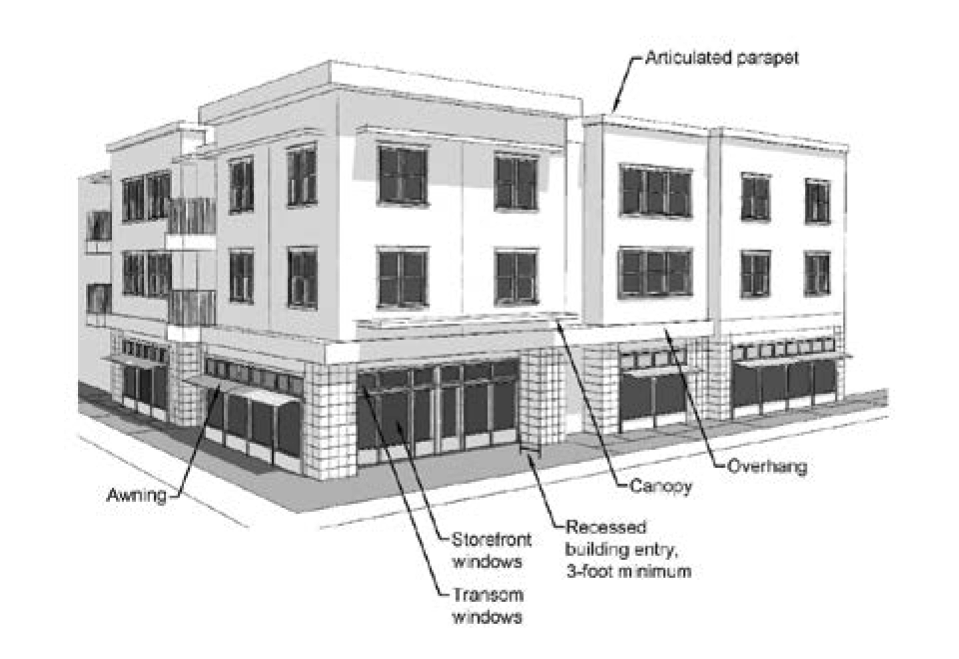
Primary building entrances shall provide weather protection for pedestrians and must be architecturally emphasized, subject to the following standards: (12/19)
i.
Nonresidential and mixed use buildings must comply with at least two of the following: (12/19)
a)
Recessed entrances. If recessed, primary entrances shall be recessed a minimum of three feet into the building façade. (12/19)
b)
Awnings, canopies, or overhangs. These may be used to provide weather protection and a visual element and meet height, projection, and materials standards in sections 2.312 and 2.315. Awnings and canopies must also meet the standards of section 2.130.10.L.4. (12/19)
c)
Architectural features. Primary entrances may be reinforced with architectural features such as increased heights of entrance areas and doors, articulated parapets, transom windows above the doors, sidelights beside the doors, and/or windows (glass) in the doors. (12/19)
d)
Decorative features. Entries may be reinforced through the use of decorative exterior light fixtures (i.e., wall sconces) or other decorative features. (12/19)
e)
Columns, piers, or pilasters that extend at least six inches from the building may be used to frame and highlight entrances. (12/19)
ii.
Multifamily residential buildings must provide weather protection over the primary building entrance and over entrances to all ground floor units. Weather protection may be provided using awnings, canopies, building overhangs such as eaves extending over front doors, covered front porches, or inset front doors. Awnings, canopies, and overhangs are subject to height, projection, and materials standards in sections 2.312 and 2.315. (12/19)
D.
Corner entrances and features. Nonresidential and mixed use buildings on corner lots are encouraged to have corner entrances. Where a corner entrance is not provided, the building design shall provide an architectural element or detailing (e.g., tower, beveled/chamfered corner, art, special trim). (12/19)
E.
Pedestrian open space.
1.
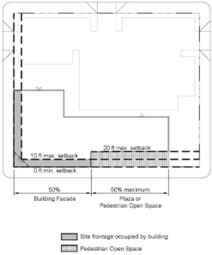
Pursuant to section 2.130.09.A.1, the maximum setback for properties fronting on River Road, Lockhaven Drive, Chemawa Road, and Cherry Avenue may be extended to 20 feet for up to 50 percent of the building façade if a plaza or other pedestrian open space is provided between the building and the sidewalk. (12/19)
2.
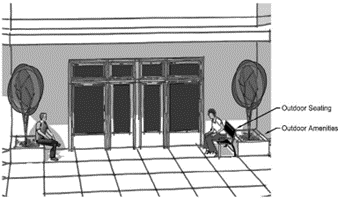
The pedestrian open space must include at least one type of outdoor seating from the list in subsection a below, and a total of at least two pedestrian amenities from the lists in subsections a or b. (12/19)
a.
Outdoor seating: benches, tables and chairs, or seat walls. (12/19)
b.
Other amenities: fountains, drinking fountains, landscape planters, bollards, shade structures, or public art. (12/19)
3.
Pedestrian open space shall not be entirely paved and shall include pedestrian amenities as listed in subsection 2 above. (12/19)
F.
Parking location.
1.
Parking or vehicle circulation areas shall not be located within a required front yard setback or within a required side yard setback abutting River Road, Lockhaven Drive, Chemawa Road, or Cherry Avenue. (12/19)
2.
Parking or vehicle circulation areas shall be limited to 50 percent of the street frontage abutting River Road, Lockhaven Drive, Chemawa Road, or Cherry Avenue. (12/19)
G.
Parking perimeter landscaping.
1.
Where surface parking or vehicular circulation areas are located adjacent to the right-of-way, perimeter landscaping with a minimum width of five feet and a minimum height of 2.5 feet shall be provided. Perimeter landscaping shall include trees spaced not more than 30 feet on center and shall include a mix of shrubs and ground cover and/or a landscaped swale for stormwater management. (12/19)
2.
The buffering and screening requirements for parking areas in KDC section 2.309.05.A.5 shall not apply within centers, except for parking areas abutting residential zones. (12/19)
H.
Window coverage. Window coverage standards apply to building façades facing River Road, Lockhaven Drive, Chemawa Road, and Cherry Avenue. (12/19)
1.
Nonresidential or mixed use buildings are subject to the following standards: (12/19)
a.
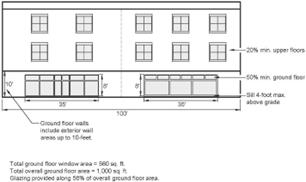
Ground floor windows. A minimum of 50 percent of the ground floor wall area of nonresidential or mixed-use buildings shall contain windows, display areas, or doorway openings. Windows, display areas, or doorway openings used to meet this standard shall comply with the following provisions: (12/19)
i.
Required window areas shall be either windows that allow views into working areas or lobbies, pedestrian entrances, or display windows. (12/19)
ii.
Windows used to meet this standard shall have a visible transmittance (VT) of 0.6 or higher. (12/19)
iii.
The sill or lower edge of a window, display area, or doorway used to meet this standard shall be no more than four feet above grade. Where interior floor levels prohibit such placement, the sill or lower edge must be raised to allow it to be no more than two feet above the finished floor level, up to a maximum height of six feet above grade. (12/19)
b.
Upper floor windows. For buildings with more than one story, a minimum of 20 percent of the upper floor wall area of nonresidential or mixed-use buildings shall contain windows. (12/19)
2.
Multifamily residential buildings are subject to the following standards: (12/19)
a.
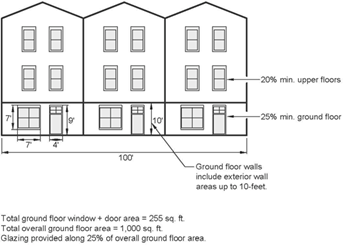
Ground floor windows. A minimum of 25 percent of the ground floor wall area of multifamily residential buildings shall contain windows. (12/19)
b.
Upper floor windows. A minimum of 20 percent of the upper floor wall area of multifamily residential buildings shall contain windows. (12/19)
3.
For all building façades subject to the window coverage standards of this section, ground floor walls shall include all exterior wall areas up to ten feet above the finished grade of the entire width of the street-facing elevation. Upper floor wall area shall include all exterior wall areas above ten feet above the finished grade. (12/19)
I.
Façade variation and detailing. The following standards apply to building façades facing River Road, Lockhaven Drive, Chemawa Road, and Cherry Avenue. (12/19)
1.
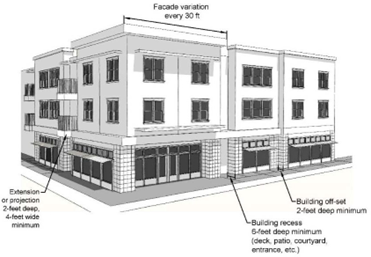
Façades shall avoid large expanses of uninterrupted building surfaces in areas which are visible to the public by incorporating features listed in I.2 below to vary the look of the façade at intervals not to exceed 30 feet. (12/19)
2.
Each façade subject to this standard shall provide at least two of the following features in order to meet the façade variation and detailing standard: (12/19)
a.
Variation in building materials between primary materials and trim materials established in section 2.315.06.B.4, where at least 65 percent of each building façade consists of primary materials; (12/19)
b.
Building offset of at least two feet; (12/19)
c.
Recess (e.g., deck, patio, courtyard, entrance or similar feature) that has a minimum depth of six feet; (12/19)
d.
Extension or projection (e.g., floor area, deck, patio, porch, roof over a porch, entrance, or similar feature) that projects a minimum of two feet and runs horizontally for a minimum length of four feet; (12/19)
e.
Other similar façade variations approved by the zoning administrator. (12/19)
J.
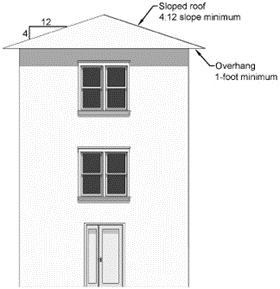
Roof forms. The following standards apply to building façades facing River Road, Lockhaven Drive, Chemawa Road, and Cherry Avenue. Roof forms may be flat or sloped. Requirements for chosen roof forms are as follows: (12/19)
1.
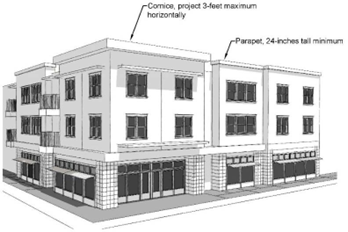
Flat roofs. All flat roofs shall employ a detailed, projecting cornice or projecting parapet to visually cap the building and meet all of the following requirements: (12/19)
a.
Cornices shall project horizontally a maximum of three feet. (12/19)
b.
Parapets must be a minimum of 24 inches in height. Parapets must include a cornice, molding, trim, or variations in brick coursing. (12/19)
c.
Cornices and parapets shall wrap around all sides of the building visible from any adjacent street or parking area. (12/19)
2.
Sloped roofs must meet all of the following requirements: (12/19)
a.
All sloped roofs shall provide a minimum one-foot overhang. (12/19)
b.
All sloped roofs must have a minimum slope of 4:12. (12/19)
K.
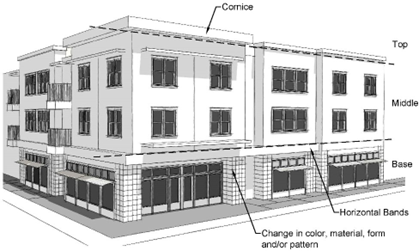
Base, middle, and top of building. The following standards apply to building façades of nonresidential and mixed use buildings facing River Road, Lockhaven Drive, Chemawa Road, and Cherry Avenue: (12/19)
1.
All buildings with two stories or more shall have a clear and distinct base, middle and top to break up vertical mass. (12/19)
2.
All façades subject to this standard must utilize horizontal bands and/or changes in color, material, form and/or pattern to differentiate the base, middle, and top of the building, subject to the following requirements: (12/19)
a.
Horizontal bands or other changes in pattern or material shall be a minimum of eight inches high (the length of a standard brick) and must project a minimum of three-fourths inch from the building face. (12/19)
b.
Changes in building massing and form may also be used to differentiate a building's base, middle, and top. This may include architectural setbacks or projections, measuring a minimum of three inches. (12/19)
L.
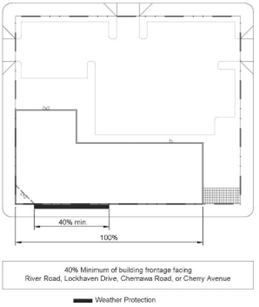
Weather protection for nonresidential or mixed use buildings. Weather protection for pedestrians shall be provided along a minimum of 40 percent of a building frontage facing River Road, Lockhaven Drive, Chemawa Road, or Cherry Avenue, subject to the following provisions and consistent with section 2.130.10.C.3: (12/19)
1.
Weather protection may be provided by awnings, canopies, arcades, colonnades, recessed entries, or combination of these elements. (12/19)
2.
Vertical clearance from the weather protection element to the sidewalk must be between nine to 12 feet. (12/19)
3.
Recessed entries must be recessed a minimum of four feet from the building façade. (12/19)
4.
Awnings and canopies shall project a minimum of five feet from the building façade, or a minimum of four feet for a recessed building entry, and shall be constructed of canvas, acrylic fabric, laminated vinyl, metal or similar standard material. Awnings and canopies of corrugated fiberglass or polycarbonate roofing shall be prohibited. Awnings and canopies shall not be back lit. (12/19)
M.
Building materials. Buildings shall be subject to the materials and texture standards of section 2.315.06.B.4, as modified by the following requirements: (12/19)
1.
The following exterior materials or finishes are prohibited within designated Centers: (12/19)
a.
Vinyl siding. (12/19)
b.
T-111 or similar sheet materials. (12/19)
c.
Plain concrete block (not including split faced, colored, or other block designs that mimic stone, brick, or other masonry); foundation material may be skim-coated concrete block where the foundation material is not revealed for more than three feet. (12/19)
2.
Each building façade facing River Road, Lockhaven Drive, Chemawa Road, and Cherry Avenue shall include a minimum of two types of exterior materials, each with an area of at least 20 percent of the façade. Brick or masonry (except CMU) may be used singly and applied to the entirety of the façade. (12/19)
N.
Screening of mechanical equipment. (12/19)
1.
Building walls. (12/19)
a.
Where mechanical equipment, such as utility vaults, air compressors, generators, antennae, satellite dishes, or similar equipment, is permitted on a building wall that abuts a public right-of-way, it shall be screened from view by a sight-obscuring fence, wall, landscape screen, or combination of screening methods. (12/19)
b.
Standpipes, meters, vaults, and similar equipment need not be screened but such equipment shall be placed on a side or rear building elevation except where the applicant can demonstrate that such locations are not physically or financially feasible. (12/19)
2.
Rooftop mechanical equipment. Rooftop mechanical units shall be set back or screened behind a parapet wall so that they are not visible from any public right-of-way. Where the applicant demonstrates that such placement and screening is not physically or financially feasible, the zoning administrator may approve painting of mechanical units in lieu of screening; such painting may consist of muted, earth-tone colors that make the equipment visually subordinate to the building and adjacent buildings, if any. Solar panels are exempt from this standard. (12/19)
3.
Ground-mounted mechanical equipment. Ground-mounted equipment, such as generators, air compressors, trash compactors, and similar equipment, shall be limited to side or rear yards and screened with fences or walls constructed of materials similar to those on adjacent buildings. Hedges, trellises, and similar plantings may also be used as screens where there is adequate air circulation and sunlight, and irrigation is provided. (12/19)

