
Keizer City Zoning Code
2.309
SITE AND LANDSCAPING DESIGN
Sec. 2.309.01. - Purpose.
The purpose of the site and landscaping design requirements is to provide standards that can be used in the development of property. A development design that incorporates landscaping serves to enhance the appearance of not only the subject property but also that of the city; provides shade and windbreaks where appropriate to conserve energy in building and site design; provides public amenities and provides for buffering and screening of dissimilar land uses. (11/17)
Sec. 2.309.02. - Scope.
A.
Landscaping required. All new construction, as well as expansion or redevelopment of structures, including interior remodeling over $100,000.00 in value, or any parking lot reconfiguration for commercial, multifamily, or industrial uses shall be subject to the requirements of this section. (11/17)
B.
Landscape plan review. Landscaping plans shall be submitted for review, subject to procedures of this section and subject to Type 1-A review procedures set forth in section 3.2. (7/06)
C.
Tree plan. A tree plan in accordance with section 2.309.04.B.7 is required with all Type II and III applications and the following Type I application: partitioning. (5/98)
(Ord. No. 2024-878, § 2(exh. B), 7-15-2024)
Sec. 2.309.03. - Minimum area requirements.
Landscaped areas may include landscaping around buildings; open spaces and outdoor recreation areas; islands and perimeter planting areas in parking and loading areas; and areas devoted to buffering and screening as required in this section and elsewhere in this ordinance. The minimum areas devoted to landscaping are established within the applicable zone district the property is located. (11/17)
Sec. 2.309.04. - General provisions.
A.
Landscaped area. For purposes of satisfying the minimum requirements of this ordinance, a landscaped area must be planted in a mixture of landscaping elements to include such things as lawn, ground cover plants, shrubs, annuals, perennials or trees, or desirable native vegetation, or be used for other landscape elements such as site furnishings, water features, artwork, or other similar features that provide aesthetic value and open space. Landscaping shall be designed, planted, and maintained in accordance with professional landscaping standards. Landscaping installed over asphalt shall be prohibited. (11/17)
B.
Submittal requirements. A submitted landscaping plan shall include the following: (5/98)
1.
Type, variety, scale and number of plants used. (5/98)
2.
Placement and spacing of plants. (5/98)
3.
Size and location of landscaped areas. (5/98)
4.
Contouring, shaping and preparation of landscaped areas. (5/98)
5.
Use and placement of non-plant elements within the landscaping used as accents. Such elements may only be used minimally and shall total no more than 25 percent of the total landscape area. (11/17)
6.
Method of irrigation. (5/98)
7.
Location, and identification of any trees, both existing and planned consistent with section 2.309.04.C. (7/06)
a.
On the landscaping plan, the existing significant trees identified by their common names, along with the size of such significant trees. Existing significant trees shall include any trees which were removed within the two-year period prior to the date the application was first submitted shall be shown on the landscape plan. (7/06)
b.
Which significant trees are proposed to be removed or have been removed within the past two years. (7/06)
c.
Which significant trees are to be left standing and what steps will be taken to protect and preserve those trees according to current best management practices. (11/17)
d.
Location, size and type of replacement trees proposed to be added, if any. (5/98)
C.
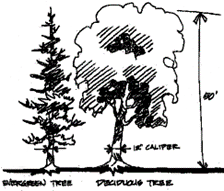
Significant trees. As used herein, significant trees are trees having a height of more than 50 feet and/or having a trunk whose diameter is more than 12 inches diameter at breast height (DBH) (five feet above ground level). (11/17)
a.
The city recognizes that factors such as disease, safety concerns, and site development requirements may require removal of significant trees. Depending on these factors, the removal of significant trees may be appropriate and approved as part of the landscaping plan. Development of the property shall be in conformance with an approved landscaping site plan that is a condition of a land use approval or a building permit. Significant trees removed (including trees removed within the two years prior to the application) must be replaced at the rate of two new trees for each significant tree removed or less if a large tree specimen size is planted. Replacement trees shall be a type that will be at least 12 inches (DBH) when fully mature. At the time of planting, replacement trees shall be planted in accordance with the standards of section 2.309.06. In lieu of an on-site tree replacement plan, an off-site tree mitigation plan consistent with requirements within this section shall be submitted to the community development director for approval. Such off-site location shall be within the public right-of-way, on public property, or on private property if qualifying as a streetscape tree and must be approved by the city. If no suitable off-site location is identified for the immediate installation of replacement trees, a contribution to the city's landscape mitigation fund in the amount equal to the cost of a replacement tree (including installation) as determined by the city may be made for the city to install replacement trees at a later date, as determined appropriate. Such funds shall be used only for replacement tree planting. (11/17)
b.
The above provisions include and apply to all significant trees located on the subject property or on any adjacent public right-of-way. These requirements shall be applied to both public and private development. (11/17)
D.
Existing vegetation. The landscape design shall also incorporate as much of the existing desirable vegetation on the site as is possible. (7/06)
Sec. 2.309.05. - Screening and buffering.
A.
Screening and buffering shall be used to mitigate visual impacts, dust, or noise, and to provide for compatibility between dissimilar adjoining uses. Screening and buffering shall be used to eliminate or reduce the impacts of the following uses: (11/17)
1.
Commercial and industrial uses when abutting residential uses. (5/98)
2.
Industrial uses when abutting commercial uses if necessary due to site conditions. (11/17)
3.
Service areas and facilities, including garbage and waste disposal containers, recycling bins, and loading areas. (5/98)
4.
Outdoor storage areas. (5/98)
5.
Parking areas for 20 or more vehicles for multifamily developments or 30 or more vehicles for commercial or industrial uses. (5/98)
6.
At- and above-grade electrical and mechanical equipment, such as transformers, heat pumps, and air conditioners. (5/98)
7.
Multifamily developments when abutting lower density residential uses. (11/17)
B.
Where screening or buffering is determined to be necessary, one of the following alternatives shall be employed: (7/06)
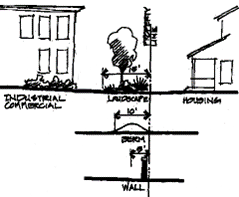
1.
Width not less than 15 feet shall be planted with the following materials: (7/06)
a.
At least one row of deciduous or evergreen trees staggered and spaced not more than 15 feet apart. (5/98)
b.
At least one row of evergreen shrubs that will grow to form a continuous hedge at least five feet in height within one year of planting. (5/98)
c.
Lawn, low-growing evergreen shrubs or evergreen ground cover covering the balance of the area. (5/98)
2.
Width not less than ten feet shall be developed in accordance with the following standards: (7/06)
a.
Berm form should not slope more than 40 percent (1:2.5) on the side away from the area screened from view. The slope for the other side (screened area) may vary. (5/98)
b.
A dense evergreen hedge shall be located so as to most effectively buffer the proposed use. (5/98)
c.
The combined total height of the berm and hedge shall be not less than five feet. (5/98)
3.
Width must not be less than five feet shall be developed in accordance with the following standards: (7/06)
a.
A masonry wall or sight-obscuring fence, not including vinyl slatted chain link fences not less than six feet in height. In addition, a fence shall be maintained in a safe and attractive manner. (7/06)
b.
A mixture of lawn, low-growing evergreen shrubs, and evergreen ground cover covering the balance of the area. (7/06)
4.
Other alternative methods which produce an adequate screening or buffering may be approved by the city. (11/17)
Sec. 2.309.06. - Planting and maintenance.
A.
Planting height. No sight-obscuring plantings exceeding 30 inches in height shall be located within any required vision clearance area in accordance with section 2.312.09 of this ordinance. (5/98)
B.
Plant materials. Plant materials shall not cause a hazard. Landscape plant materials over walkways, pedestrian paths and seating areas shall be pruned to a minimum height of eight feet and to a minimum height of 13 feet over streets and vehicular traffic areas. (11/17)
C.
Utility interference. Landscape plant materials shall be selected which do not generally interfere with utilities above or below ground. (5/98)
D.
Installation. Landscape plant materials shall be properly guyed and staked to current industry standards as necessary. Stakes and guy wires shall not interfere with vehicular or pedestrian traffic. (5/98)
E.
Suitability. Plant materials shall be suited to the conditions under which they will be growing. As an example, plants to be grown in exposed, windy areas that will not be irrigated should be sufficiently hardy to thrive under these conditions. Plants should have vigorous root systems, and be sound, healthy, free from defects, diseases, and infections. (5/98)
F.
Deciduous trees. Deciduous trees shall have a minimum caliper of two inches (DBH), and a minimum height of eight feet at the time of planting. (11/17)
G.
Evergreen trees. Evergreen trees shall be a minimum of eight feet in height and fully branched at time of planting. (11/17)
H.
Shrubbery. Shrubs shall be supplied in a minimum one gallon containers or eight inch burlap balls with a minimum spread of 12 to 15 inches. (5/98)
I.
Ground cover. Ground cover plants shall be spaced in accordance with current nursery industry standards to achieve covering of the planting area. Rows of plants are to be staggered for a more effective covering. Ground cover shall be supplied in a minimum four inch size container. (7/06)
J.
Irrigation. All developments are required to provide appropriate methods of irrigation for the landscaping. Sites with over 1,000 square feet of landscaped area shall be irrigated with automatic sprinkler systems to insure the continued health and attractiveness of the plant materials unless otherwise approved by the zoning administrator. Sprinkler heads shall not cause any hazard to the public. Irrigation shall not be required in wooded areas, wetlands, floodplains, or along natural drainage channels or stream banks. (7/06)
K.
Replanting. Trees or shrubbery which die-off shall be replaced with a new plant of the same or similar type. Replacement is the responsibility of the property owner. (11/17)
L.
Maintenance. Landscaping shall be continually maintained. Appropriate methods of care and maintenance of landscaped plant material shall be provided by the owner of the property. This requirement applies to existing, as well as new, development. (11/17)
M.
Plant protection. Landscape plant material shall be protected from damage due to heavy foot traffic or vehicular traffic by protective tree grates, pavers or other suitable methods. (5/98)

