
Keizer City Zoning Code
2.315
DEVELOPMENT STANDARDS
Sec. 2.315.01. - Purpose.
The development standards, herein called standards, are intended to implement the Keizer Comprehensive Plan and the purpose of each zoning district. "Standards" only includes the development standards referred to in this section. They do this by promoting functional, safe, and attractive developments that maximize compatibility with surrounding uses and commercial corridors, and that are compatible with and enhance the transportation system. The standards mitigate potential conflicts and problems and maximize harmonious relationships. Alternatives to the standards on a case-by-case basis may be reviewed and approved as a land use action. In such cases, the purpose of this development code shall be met through factual findings and conclusions about the proposed design and attachment of specific conditions, if necessary, by the review body. Application of the standards does not evaluate the proposed use, nor the specific architectural style or design. Rather, the standards focus on the structural elements of texture, color, and materials, and on the site elements of building placement. (12/18)
Sec. 2.315.02. - Applicability.
A.
Exterior changes to all buildings in matters relating to color or façade materials only shall comply with the applicable or relevant standards found in section 2.315.06 of this code. (12/18)
B.
Serial additions, alterations or expansions as defined in section 1.2 of this code shall be limited so that the standards specified in section 2.315.03.A and B are not exceeded in a three-year period. (12/18)
C.
The provisions of this section shall apply to all development as defined in section 1.2 of this code. (1/04)
D.
In addition to the standards in this chapter, development in the overlay zone RCOD is subject to development standards in section 2.130. If there is a conflict between this chapter and section 2.130, then section 2.130 shall apply. (12/19)
Sec. 2.315.03. - Exemptions.
A.
The following are exempt from the standard structural additions, alterations, or expansions which are 25 percent or less of existing building(s) gross floor area and/or impervious surface area are affected; or, when 500 square feet or less of an existing building(s) gross floor area and/or impervious surface area, whichever is less, is affected. (1/04)
B.
Exterior changes involving the addition, alteration or moving of a door, window, porch, canopy, or awning where the combined area of change is less than 500 square feet in area in a three-year period. (1/04)
C.
Repainting of exterior walls due to minor repairs or vandalism, which is 25 percent or less, or no more than 100 sq. ft. (1/04)
D.
Agricultural uses. (1/04)
E.
Any residential building housing four or fewer dwelling units and cottage clusters. (6/22)
F.
Any interior remodeling. (1/04)
G.
A temporary business. (1/04)
H.
A mobile food vendor. (12/18)
Sec. 2.315.04. - Administration of the development standards.
These standards are intended to be objective and to serve as a guide to designers of developments. The standards are applied in one of four ways: (1/04)
A.
The standards embodied in this development code are administratively reviewed at the time of a building permit application. Compliance to the standards is a condition of building permit approval. (12/18)
B.
In instances where conformance to the standards is outside of the scope of a building permit, such as repainting a building, the owner shall be responsible for conformance with these standards. (12/18)
C.
The standards embodied in this development code are to be perpetually maintained on all properties. This particularly applies to color and façade materials, which may change without requiring a building permit. (12/18)
D.
In the event a development proposal or a change to an existing building does not conform to the standards due to an applicant wishing to propose alternatives, the applicant may choose to apply for approval of a development standards alternative application. A development standards alternative application shall be processed as a Type II-B land use decision consistent with section 3.202. The initial decision shall be rendered by the planning commission, appealable to city council. For properties located within the Keizer Station, the initial decision shall be rendered by the city council. No building permit will be issued for a use requiring development standards alternative approval until the application is approved. (12/18)
Sec. 2.315.05. - Nonconforming buildings.
Any building that did not conform to the standards on May 18, 1998, is considered a legally nonconforming building as regulated within this code. (1/04)
Sec. 2.315.06. - Development standards.
All applicable development must meet the following standards: (12/18)
A.
Pedestrian circulation. As used herein, "walkway" means a hard surfaced area intended and suitable for use by pedestrians, including both public and private sidewalks. (1/04)
1.
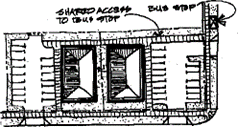
Connection required. The pedestrian circulation system for the proposed development must connect uses, building entrances, adjacent streets and transit facilities (existing or planned). (12/18)
2.
Walkway location and design. Walkway(s) shall be located so that a pedestrian can conveniently walk between a transit street and the entrance(s) to a building(s). Except where it crosses a driveway, a walkway shall be separated by a raised curb or other physical barrier from the auto travel lane and parking. If a raised path is used the ends of the raised portions must be equipped with curb ramps which comply with Oregon State Building Code requirements. (12/18)
3.
Additional street access. One walkway from a building to a public street shall be provided for every 300 feet of street frontage. (12/18)
4.
Driveway crossings. Driveway crossings shall be a maximum of 36 feet in width. Where the pedestrian system crosses driveways, parking areas and loading areas, the system must be clearly identifiable through the use of elevation changes, a different paving material, texture, or other similar method. (1/04)
5.
Lighting. Lighting shall be provided for all walkways. Pedestrian walkways must be lighted to a level where the system can be safely used at night by employees and customers. (12/18)
6.
Walkway coverage.
a.
Any portion of a walkway located within three feet of a building frontage shall be covered with awnings or building overhangs. The minimum vertical clearance shall be nine feet for awnings and building overhangs. The maximum vertical clearance shall be 15 feet. (1/04)
b.
In the EG zone, any portion of a walkway located within three feet of a building frontage shall be covered with awnings or building overhangs as provided in subsection a, except for buildings, which have greater than 300 feet of linear frontage, where this requirement shall apply to at least 33 percent of the building frontage. The maximum vertical clearance shall be 15 feet. (12/18)
7.
Dimensions. Walkways shall be at least five feet in paved unobstructed width. Walkways that serve multiple uses or tenants shall have a paved minimum unobstructed width of eight feet. (12/18)
8.
Stairs or ramps shall be in place where necessary to provide a direct route between the transit street and the building entrance. Walkways without stairs shall comply with the accessibility requirements of the Oregon State Building Code. (1/04)
9.
Access to adjacent property. If the proposed development has the potential of being a significant attractor or generator of pedestrian traffic, potential pedestrian connections between the proposed development and existing or future development on adjacent properties other than connections via the street system shall be identified. (1/04)
10.
Alternative application. The building permit application or development standards shall designate walkways and pedestrian connections on the proposed site plan. If the applicant considers walkways are infeasible, evidence and proposed findings shall be submitted demonstrating that the walkway or connection is infeasible. The evidence will be evaluated in conjunction with the building permit or development standards alternative process. (12/18)
B.
Building design.
1.
Ground floor windows.
a.
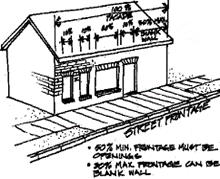
In the CM, CR, and MU zones, all street-facing elevations containing permitted uses as listed under sections 2.110.02(F), (G), (H), (I), (J) and (K) shall have no less than 50 percent of the ground floor wall area with windows, display areas or doorway openings. (5/98)
b.
In the EG zone, one elevation of any building with more than 100,000 square feet of floor area, which contains permitted uses listed under sections 2.119.05(F), (G), (H), (I), (J) and (K), shall have no less than 33 percent of the ground floor wall area, defined from the ground to the height of the awning, with windows or window facsimiles or other architectural features that simulate windows, display areas or doorway openings. The location of this elevation shall be determined as part of the required master plan review described in section 2.125. (12/18)
2.
Building façades.
a.
In the CM, CR, and MU zones, façades that are visible from a public street shall extend no more than 30 feet horizontally without providing a variation in building materials, a building offset of at least two feet, or a wall area entirely separated from other wall areas by a projection, such as a porch or a roof over a porch or a roof over a porch and no more than 15 feet between vertical design elements such as columns, pilasters, or patterns. (12/18)
b.
In the EG zone, façades facing a public street shall extend no more than 60 feet without providing a variation of building materials for buildings over 20,000 square feet. (12/18)
3.
Awnings. Awnings are a roof-like cover extending immediately in front of a doorway or window to provide protection from the sun or rain. Awnings shall be provided along building storefronts abutting a public sidewalk. Awnings are not allowed in locations not listed above. Awnings shall be constructed of canvas, acrylic fabric, laminated vinyl, metal or similar standard material. Awnings shall not be back lit. (12/18)
4.
Materials and texture.
a.
Building materials. (1/04)
1)
All buildings shall have wood, brick, stone, architectural block, slump stone block, architectural concrete, stucco siding, or vinyl siding made to look like wood siding as the predominant building material. (12/18)
2)
A minimum of two separate and distinct building materials must be used. (12/18)
3)
Metal siding other than reflective material is allowed as part of a design to incorporate differing materials but shall not be the predominant material used. (6/22)
4)
Plain concrete masonry block, plain concrete, plywood and sheet press board may not be used as exterior finish materials. (12/18)
b.
Trim material. (1/04) Building trim shall be wood, brick, stone, stucco, vinyl siding material made to look like wood, or metal. (1/04)
c.
Roofing material. (1/04) Any roofing material is allowed, including metal roofs. (5/98)
d.
Foundation material. (1/04) Foundation material may be plain concrete or plain concrete block where the foundation material is not revealed for more than three feet. (5/98)
5.
Color.
a.
Any portion of a building that is painted or stained may use as the main color, and roof color for all portions of the roof visible from the ground, any color which meets all of the following criteria: (1/04)
1.
Exterior building colors shall be of low reflective, subtle, neutral or earth tone color. The use of high intensity colors such as black, neon, metallic or florescent colors for the façade of the building are prohibited except as may be approved for building trim. (12/18)
2.
Light reflectance value (LRV) of any color shall be between the values of 30 and 85. (12/18)
3.
The finish shall be either matte or satin. (12/18)
b.
For the purpose of this section, "main color" is the principal color of the building which must be at least 75 percent of the surface of the building excluding windows; the trim colors of all buildings may be any color except as set forth below. (12/18)
c.
In no case shall the main color or the trim color of any structure be "florescent," "day-glo," or any similar bright color. (1/04)
6.
Rooflines. Rooflines shall establish a distinctive "top" to a building. When flat roofs are proposed, a cornice a minimum 12 inches high projecting a minimum six inches from the wall at the top of the wall or parapet shall be provided. (5/98)
7.
Roof-mounted equipment. In a CM, CR, CO, EG or MU zone, all roof-mounted equipment, including satellite dishes and other communication equipment, must be screened from view from adjacent public streets. Solar heating panels are exempt from this standard. (12/18)
C.
Commercial accessory structures. (12/18)
1.
Commercial accessory structures, including buildings, sheds, trash receptacles, mechanical devices, and other structures outside the main building, shall either be screened from view by the public by either a hedge or fence or, with the exception of trash receptacles, be screened by painting them the same color as the main color of the building. (12/18)
2.
Trash enclosures shall be designed to be large enough to accommodate the projected amount of trash being generated at the development. The area must be able to fully contain all necessary trash and recycling containers. (9/10)
D.
Transit facility requirement. New retail, office and institutional buildings at or within 600 feet of an existing or planned transit facility, as identified in the city TSP, shall provide either the transit facility on site or connection to a transit facility along a transit route when the transit operator requires such an improvement. (7/09)
E.
Transit access. New retail, office and institutional buildings within 600 feet of an existing or planned transit facility, as identified in the city TSP, shall provide for convenient pedestrian access to transit through the measures listed in subsections 1 and 2 below. (12/18)
1.
Walkways shall be provided connecting building entrances and streets adjoining the site; (7/09)
2.
Pedestrian connections to adjoining properties shall be provided except where such a connection is impracticable. Pedestrian connections shall connect the on-site circulation system to existing or proposed streets, walkways, and driveways that abut the property. Where adjacent properties are undeveloped or have potential for redevelopment, streets, access ways and walkways on site shall be laid out or stubbed to allow for extension to the adjoining property; (7/09)
3.
In addition to subsections 1 and 2 above, sites at transit facilities must provide the following: (7/09)
a.
Either locate buildings within 20 feet of the transit facility, a transit street, or an intersecting street or provide a pedestrian plaza at the transit facility or a street intersection; (7/09)
b.
A reasonably direct pedestrian connection between the transit facility and building entrances on the site; (7/09)
c.
A transit passenger landing pad accessible to disabled persons; (7/09)
d.
An easement or dedication for a passenger shelter if requested by the transit provider; and (7/09)
e.
Lighting at the transit facility. (7/09)
F.
Multifamily design. Multifamily structures shall create a form and scale to provide interest and aesthetic appeal. (12/18)
1.
In addition to the requirements outlined in 2.315.06, all new multifamily buildings shall include a minimum of three significant different materials and textures in the design of the exterior building façade. (12/18)
2.
Building planes for multifamily dwellings facing property lines or the street shall be subject to the following standards: (12/18)
a.
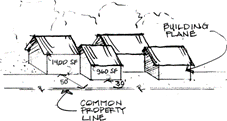
No building plane shall exceed 960 square feet within 30 feet of the property line. No building plane that faces the common property line shall exceed 1,400 square feet within 50 feet of the property line. (12/18)
b.
No building plane shall have a greater dimension than 40 feet in length or 35 feet in height. (10/15)
c.
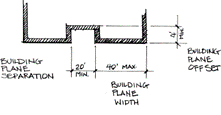
If more than one building plane faces a street or property line and the building planes align at a common distance from the line, the building planes shall be horizontally separated by at least 20 feet. For the purposes of this standard, "common distance" shall be defined within 12 feet. (12/18)
d.
When a structure along a wall juts out from the wall or is offset from an adjacent part less than four feet, the structure is considered part of the building plane of a wall behind it. If the structure protrudes greater than four feet, it represents a separate building plane. If a building plane is at an angle in relation to the property line, the midpoint of the wall shall provide the point at which the plane and related distance are measured. (12/18)
Sec. 2.315.07. - Determination of conformance to development standards as part of building permit review.
The zoning administrator, or designee, during the normal course of reviewing a building permit application, shall conduct a concurrent development review. As part of that review, a determination of the proposal's conformance with the provisions of this section shall be determined. Corrections may be noted on the plans, or required to be submitted as amended plans, to assure conformance to the standards or as a design alternative, which was approved by the planning commission or city council. Building plans shall not be approved unless there is conformance with the provisions of this section. (12/18)
Sec. 2.315.08. - Criteria for development standard alternative approval.
The planning commission or city council (for properties within Keizer Station) may approve the proposed design alternatives or approve them with conditions through a development standards alternative application, if it finds the alternative design can meet the purpose and intent of this section and be successfully applied to a particular property. (12/18)

