
Keizer City Zoning Code
2.303
OFF-STREET PARKING AND LOADING
Sec. 2.303.01. - Purpose.
The purpose of this section is to provide standards to ensure adequate areas for maneuvering, loading and unloading of vehicles and bicycles for all land uses in the City of Keizer. (7/25)
The provision of a minimum number of off-street parking spaces for vehicles is not a requirement of this Code. However, when provided, off-street vehicle parking spaces and areas are subject to applicable City codes and standards. including the standards in this Section. (7/25)
(Ord. No. 2025-895, § 1(exh. A), 7-7-2025)
Sec. 2.303.02. - Scope.
This section shall apply to the following types of development: (7/25)
A.
New building. Any new building or structure erected after the effective date of this ordinance. (5/98)
B.
Expansion. The construction or provision of additional floor area, seating capacity, or other expansion of an existing building or structure. (5/98)
C.
Change in use. A change in the use of a building or structure which proposes additional parking spaces or off-street loading areas. (7/25)
(Ord. No. 2025-895, § 1(exh. A), 7-7-2025)
Sec. 2.303.03. - General provisions off-street parking and loading.
A.
Owner responsibility. The maintenance of off-street parking and loading space are continuing obligation of the property owner. Building or other permits will only be issued after receipt of plans that show the location of parking facilities that are designed consistent with the applicable standards. (7/25)
B.
Use of parking spaces. Parking spaces shall be available for the parking of operable passenger automobiles of residents, customers, patrons or employees only and shall not be used for storage of vehicles or materials, including solid waste collection containers. (7/25)
C.
Drainage. All new parking areas and expansion of existing parking areas shall provide a storm drainage system to dispose of runoff generated by the impervious surface. Provisions shall be made for the appropriate on-site collection, storage, conveyance, and treatment of drainage water. All development shall be designed and constructed to prevent sheet flow of such water onto sidewalks, public rights of way, and abutting properties. The drainage system shall be approved by Keizer Public Works Department prior to construction and shall be constructed in accordance with the city's storm water management regulations. (9/17)
(Ord. No. 2025-895, § 1(exh. A), 7-7-2025)
Sec. 2.303.04. - Location and use provisions.
Off-street parking and loading areas which are provided are subject to the following standards: (7/25)
A.
Accessory parking use, nonresidential. Parking of vehicles in a structure, or outdoors, is a permitted accessory or secondary use in nonresidential zones. (7/06)
B.
Accessory parking use, residential. Parking of vehicles in a structure or outdoors is a permitted accessory use in conjunction with a dwelling in any zone, provided: (5/98)
1.
All of the vehicles are owned by the owner or lessee of the lot. (5/98)
2.
Vehicles parked outdoors in a residential zone may be parked in a driveway, as regulated herein, and must be located within the front yard meeting the requirements for required parking in this section. (9/17)
3.
Vehicles parked on a lot in a residential zone shall be for the personal use of the occupants of the dwelling. One vehicle used in conjunction with a home occupation or other employment may be parked on the lot, provided it complies with the provisions in section 2.407.G. (12/11)
4.
A parking plan must be approved for all development not served by a public street or for development served by any public street that does not include parking on both sides of the street. The parking plan shall illustrate how minimum parking requirements will be met for all newly created lots.
C.
Yard parking restrictions. No parking of vehicles, trailers, boats, or recreational vehicles shall be allowed in a front yard except on a driveway. (12/15)
D.
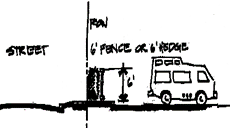
Storage restrictions. Side and rear yards may be used for storage and parking of vehicles, trailers, boats, and recreational vehicles. Storage and parking areas shall be screened by a six-foot-high fence, wall, or hedge. Storage and parking areas shall be either durable hard surface or gravel surface consistent with the requirements in section 2.413 (recreational vehicle storage—single-family homes). The fence, wall, or hedge shall comply with the provisions regarding the location for fences and maintaining a vision clearance area. (12/15)
E.
All vehicles are subject to the regulations prohibiting illicit discharge, as governed by applicable city regulations. (9/17)
(Ord. No. 2025-895, § 1(exh. A), 7-7-2025)
Sec. 2.303.05. - Reserved.
Editor's note— Ord. No. 2025-895, § 1(exh. A), adopted July 7, 2025, repealed § 2.303.05, which pertained to joint use and derived Ord. No. 98-389, adopted May 4, 1998; and amended July 2006.
Sec. 2.303.06. - Reserved.
Editor's note— Ord. No. 2025-895, § 1(exh. A), adopted July 7, 2025, repealed § 2.303.06, which pertained to off-street automobile parking requirements and derived Ord. No. 98-389, adopted May 4, 1998; and amended Dec. 2015; Sept. 2017; June 2022.
Sec. 2.303.07. - Standards for disabled person parking spaces.
Disabled person parking spaces shall comply with the requirements of the building code and ODOT standards. (9/17)
Sec. 2.303.08. - Bicycle parking.
A
Bicycle parking required. Bicycle parking shall be required in all public and semi-public, commercial, multifamily, and industrial development as well as park-and-ride lots. Bicycle parking shall be based on the amount of automobile parking provided. In addition to a required one bicycle parking space, bicycle parking spaces shall be calculated at five percent of the amount of the automobile parking spaces provided and all fractions are rounded up the next whole number. (7/25)
B.
Bicycle parking development requirements.
1.
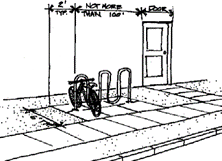
Space size. Each bicycle parking space shall be a minimum of six feet long and two feet wide and be accessible by a minimum four-foot aisle. (5/98)
2.
Location. All bicycle parking areas shall be within 50 feet of a building entrance and located within a well-lit area. Bicycle parking areas shall be separated by a physical barrier or sufficient distance to protect parked bicycles from damage by automobiles. (12/15)
3.
Rack design. Bicycle racks must be designed to secure the bicycle frame and at least one wheel, and, accommodate a locking device. Racks, lockers or other related facilities shall be securely anchored to the ground or to a structure. As an alternative, the bicycle spaces can be provided within a secured compound. Fixed objects which are intended to serve as bicycle parking facilities but which are not obviously designed for such purposes shall be clearly labeled as available for bicycle parking. (12/15)
4.
Access. Access to a public right-of-way and pedestrian access from the bicycle parking area to the building entrance must be provided. (5/98)
C.
Exemptions. The following uses are exempt from the bicycle parking requirements: (5/98)
1.
Seasonal or temporary businesses. (5/98)
2.
Wireless telecommunication facilities, and other utilities. (12/15)
(Ord. No. 2025-895, § 1(exh. A), 7-7-2025)
Sec. 2.303.09. - Carpool and vanpool parking.
New office or industrial development providing 50 or more parking spaces, shall designate preferential parking for carpool or vanpool. These designated spaces shall be the closest parking spaces to the building entrance normally used by employees, with the exception of handicapped parking spaces. The carpool/vanpool spaces shall be clearly marked "Reserved—Carpool/Vanpool Only" along with specific hours of use. (7/25)
(Ord. No. 2025-895, § 1(exh. A), 7-7-2025)
Sec. 2.303.10. - Off-street loading requirements.
Off-street loading space shall be provided as listed below: (5/98)
A.
Commercial office. Commercial office buildings shall require a minimum loading space size of 12 feet wide, 20 feet long and 14 feet high in the following amounts: for buildings over 5,000 square feet of gross floor area, one space; for each additional 40,000 square feet of gross floor area, or any portion thereof, one space. (5/98)
B.
Commercial and industrial. All other commercial or industrial buildings shall require a minimum loading space of 12 feet wide, 30 feet long, and 14 feet high in the following amount: for buildings containing over 5,000 square feet of gross floor area, one space; for each additional 40,000 square feet of gross floor area, or any portion thereof, one space. (5/98)
Sec. 2.303.11. - Parking and loading area development requirements.
All parking and loading areas shall be developed and maintained as follows:
A.
Surfacing. All driveways, parking and loading areas shall have a durable, hard, dust-free surface such as asphalt, concrete, or pavers (segmented bricks). Temporary or overflow parking areas may be allowed on a case-by-case basis, subject to public works and community development approval to be exempt from this requirement. "Overflow" is defined as being on an infrequent or occasional basis and is in addition to parking that already exists on the site. "Temporary" is less than two years in duration. (12/15)
B.
Parking spaces.
1.
Dimensions. Head-in parking spaces shall be a minimum nine feet wide and 18 feet in length. Parallel parking spaces shall be a minimum nine feet wide and 22 feet in length. (9/17)
2.
Compact spaces. Compact parking spaces, at a reduced width of 8.5 feet and 16 feet in length, shall be permitted on sites with more than five parking spaces. No more than 30 percent of the required parking shall be compact spaces and each space must be identified as a compact space. (12/15)
C.
Aisle dimensions. (9/17) The following minimum aisle dimensions shall apply: (5/98)
1.
Without adjacent parking (drive aisle): (9/17)
a.
Single-family residence: 12 feet.
b.
One-way: 12 feet.
c.
Two-way: 22 feet.
2.
With adjacent parking: (9/17)
D.
Screening. When any parking or loading area abuts a residential zone, the parking or loading area shall be screened or buffered as is required in section 2.309.05. (7/06)
E.
Lighting. All lighting shall be directed entirely onto the loading or parking area and away from any residential use. The lighting shall not cast a glare or reflection onto the public rights-of-way and shall provide appropriate shielding so the light source is not visible from any public right-of-way or adjacent residential property. (9/17)
F.
Landscaping.
1.
Parking lot landscaping should be designed to provide shade, reduce storm water runoff, and direct traffic. Incorporation of approved stormwater quality facilities in landscaped areas is encouraged. (9/17)
2.
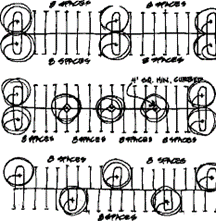
One tree shall be planted for every eight linear parking spaces. The planting space shall measure no less than four feet square and be contained by appropriate methods to ensure landscaping materials are kept in place, and vegetation is protected from vehicle maneuvering and parking areas. Trees may be planted in clusters to screen or buffer the development if approved in the landscaping plan. (9/17)
3.
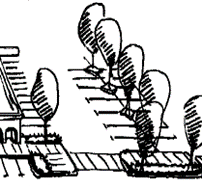
Trees shall be of a species that the root system will not interfere with underground utilities or the parking surface and must be capable of achieving a minimum 15-foot canopy radius. (9/17)
4.
All trees must be planted in proximity to proposed parking areas. At a minimum, one-third of the diameter of each proposed mature tree canopy shall provide shade and overlap the parking area. (9/17)
5.
Trees may be planted within a storm drainage area subject to public works review and approval, provided the selected tree species will not adversely impact the function of the storm drainage facility. (9/17)
6.
Trees shall be a minimum two inch caliper at the time of planting, of a suitable species, and be healthy with no visible damage. (9/17)
G.
Traffic flow. Service drives to off-street parking areas shall be designed and constructed to allow flow of traffic, provide maximum safety of traffic access and egress and the maximum safety of pedestrians and vehicular traffic on the site. (5/98)
H.
Entrance/exits. Service drive exits shall have a minimum vision clearance area of 15 feet from the intersection of the street and driveway. (5/98)
I.
Bumper rails. Parking spaces along the outer boundaries of a parking area shall be contained by a curb or a bumper rail to prevent a motor vehicle from extending over an adjacent property, a street, or a sidewalk. The bumper shall be at least four inches high and located a minimum of three feet from the property line. (5/98)
J.
Existing development may redevelop a portion of existing parking areas to accommodate or provide transit-related amenities such as transit stops, pull-outs, shelters, and park-and-ride stations. (7/25)
(Ord. No. 2025-895, § 1(exh. A), 7-7-2025)

