
Keizer City Zoning Code
2.312
YARD AND LOT STANDARDS
Sec. 2.312.01. - Lot coverage generally.
Specific standards for lot size or area, for lot dimensions, and for lot coverage are set forth in the applicable zone. Where a standard for lot coverage is expressed as a percentage, such standard means the percentage of total lot area covered by buildings and by roofed but unenclosed structures, whether or not attached to buildings. Covered structures less than five feet in height and having less than 20 square feet of gross floor area (such as pet shelters, play houses, etc.) shall not be included in calculating lot coverage. (5/98)
Sec. 2.312.02. - Yards and yard area generally.
A.
Yards apply only to one building. No required yard or other open space or required driveway provided around or for any building or structure for the purpose of complying with the provisions of this ordinance shall be considered as providing a yard or open space for any other building, nor shall any yard or other required space on an adjoining lot be considered as providing a yard or open space on the lot whereon the building is to be erected. (5/98)
B.
Yards to be unobstructed. A required yard is the minimum required setback area between a structure or manufactured dwelling and a lot line, whether or not additional open space is actually provided between the structure and the lot line. Every required yard or setback area shall be open and unobstructed by buildings, or structures from the ground to the sky except for those exceptions permitted in this section. (7/06)
Sec. 2.312.03. - Separation of lot or yard areas.
A.
Reduction in lot area. Except as provided in 2.312.03(C), no portion of a lot necessary to provide the required area per dwelling unit shall be separated in ownership from the portion of the lot on which the building containing the dwelling units is located. (7/06)
B.
Separation of required yards. Except as provided in 2.312.03(C), no required yard or other open space around an existing building shall be separated in ownership from the lot upon which the building is located. (7/06)
C.
Exceptions. In a planned unit development building setbacks and yard areas, open space, and other areas without buildings established pursuant to the standards and the requirements of this ordinance may be part of a lot containing a dwelling if the area is not common area or other area required to be located within a lot owned by the homeowners association. (5/98)
Sec. 2.312.04. - Special street setbacks.
A.
Purpose. The special setbacks in this section are based upon the functional classification of streets and roads as described in the comprehensive plan. The purpose of these special setbacks is to allow for the expansion or improvement of streets and roads in order to safely accommodate vehicular or pedestrian traffic. The special setback shall be measured from the centerline of the street right-of-way are as noted in 2.312.04(D). (7/06)
B.
Setback requirements. Required yards and setbacks adjacent to a street shall be in addition to the special setbacks required by this section. These setback distances shall be measured at right angles to the centerline of the established right-of-way. (5/98)
C.
Special provisions. Except as provided herein, structures and paved surfaces shall not be located within the special setbacks specified in 2.312.04(D) below. Any portion of a structure lawfully established within a special street setback prior to adoption of this ordinance shall be considered a nonconforming structure. (5/98)
D.
Special setback requirements. (5/98)
* See functional classification in section 2.302.04
Sec. 2.312.05. - No parking in front yard, yards adjacent to a street.
Moved to 2.303.04.
Sec. 2.312.06. - Front yard projections.
A.
Building features. Cornices, eaves, gutters and fire escapes, when not prohibited by any other code or ordinance, may project into a required front yard not more than two feet. (7/06)
B.
Architectural features. Chimneys, flues, belt courses, leaders, sills, pilasters, lintels and ornamental features, window projects and cantilevered second story portion of a building may project not more than two feet into a required front yard. (7/06)
C.
Decks and patios. Uncovered porches and covered but unenclosed porches, or awnings that are not more than one story high may extend ten feet into the front yard setback. (7/06)
Sec. 2.312.07. - Side yard projections.
A.
Building features. Cornices, eaves, gutters and fire escapes, when not prohibited by any other code or ordinance, may project into a required side yard not more than one-third of the width of the side yard, nor more than four feet in any case. (7/06)
B.
Architectural features. Chimneys, flues, belt courses, leaders, sills, pilasters, lintels and ornamental features may project not more than 1 ½ feet into a required side yard; provided, however, chimneys and flues shall not exceed six feet in width. (5/98)
C.
Decks and patios. Uncovered decks and patios attached to the main building when measured directly beneath the outside edge of the deck or patio may be extended to the side yard property line when they are three feet or less in height from ground level. (5/98)
Sec. 2.312.08. - Rear yard projections.
A.
Building features. A fire escape, outside stairway, cornice, eaves, gutters or other unenclosed, unroofed projections may project not more than five feet into a required rear yard. (7/06)
B.
Architectural features. Chimneys, flues, belt courses, leaders, sills, pilasters, lintels, gutters, other ornamental features, window projection, and cantilevered second story portion of the building may project not more than two feet into a required rear yard; provided, however, chimneys and flues shall not exceed six feet in width. (5/98)
C.
Steps, porches, decks and patios. Planter boxes, steps, decks, patios, uncovered porches, and covered but unenclosed porches, including covered patios, which are not more than 30 inches above grade, are exempt from the minimum rear yard depth requirements. These same features that are more than 30 inches above grade may encroach up to a maximum of ten feet into the rear yard setback area. (7/06)
Sec. 2.312.09. - Vision clearance.
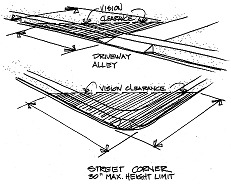
A vision clearance area shall be maintained where roadways, including streets, alleys, and private points of access, intersect. The vision clearance area shall conform to the following unless it is determined by the Keizer traffic engineer that other methods may be more feasible: (12/12)
A.
Generally. A vision clearance area is a triangular area at the intersection of two streets, or a street and a driveway, two sides of which are lines measured from the corner intersection for a specific distance. The third side of the triangle is a line across the corner of the lot joining the ends of the other two sides. Where the lines at the intersections have rounded corners, the lines will be extended in a straight line to a point of intersection. The vision clearance area shall be measured from the point of intersection and extend the designated distance in both directions along the intersection. Where there is no curb, the vision clearance area shall be measured from the edge of the pavement and extend at right angles for the appropriate distance in both directions along the intersection. (12/12)
B.
Street-driveway intersection. A vision clearance area at the intersection of a street and a driveway shall be the triangular area established according to the following procedure: (5/98)
1.
A line extending ten feet from the intersection along the public street right-of-way; (5/98)
2.
A line extending ten feet from the intersection along the driveway; (5/98)
3.
A third line that creates the triangular vision clearance area by connecting the ends of the lines described in (1) and (2), above. (7/06)
4.
This subsection shall apply for street-alley intersections. (12/12)
5.
There is no vision clearance area minimum for driveway/alley intersections. (12/12)
C.
Street-street intersections. The vision clearance area for street-street intersections with at least one arterial street shall be computed as above but with legs of 40 feet in each direction. The vision clearance area for street-street intersections along collector and local streets on all approach legs shall be computed as above but with legs of 30 feet in each direction. (12/12)
D.
Prohibited placements. A vision clearance area shall contain no planting, fence, wall, structure, or temporary or permanent obstruction, placement of a sign exceeding 30 inches in height, measured from the top of the curb or, where no curb exist, from the established street centerline grade. In addition, vehicles shall not be parked in a vision clearance area. The following may be allowed in the vision clearance area: (12/12)
1.
Trees, provided all branches and foliage are removed to a height of seven feet above grade; (5/98)
2.
Telephone, power, and cable television poles; and
3.
Telephone switch boxes provided they are less than ten inches wide at the widest dimension. (5/98)
4.
Public or governmental signs. (12/12)
Sec. 2.312.10. - Fences, walls and hedges.
A.
Residential, public and semi-public uses.
1.
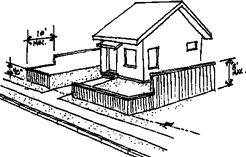
Height, location. Fences, walls and hedges may be located in any required yard or along the edge of any yard, subject to the maintenance of any vision clearance area identified in section 2.312.09. Fences, walls, and hedges shall not exceed a height of four feet within ten feet of any property line adjacent to the street. A fence, wall, or hedge that is placed in the rear yard or side yard may encroach within this ten-foot setback area but shall be placed no closer than three feet to the property line along a street (excluding alleys and access easements) and may exceed the four-foot height restriction. A fence, or wall, may not exceed eight feet in height and shall comply with all applicable building code requirements. (6/20)
2.
Construction material. Fences or walls constructed of the following materials, including, but not limited to, barbed wire, electric fencing, broken glass, wooden pallets, tarps, corrugated metal, and spikes shall generally be prohibited. Agricultural uses may utilize electric and barbed wire fencing. (7/06)
3.
An entrance wall or gate to a subdivision, planned unit development or other residential development shall be permitted, provided the wall or gate does not exceed six feet in height nor violate provisions of the vision clearance area. (5/98)
B.
Commercial and industrial uses.
1.
Height, location. Fences, walls and hedges may be located in any required yard or along the edge of any yard, subject to the maintenance of clear-vision area. A fence or wall may not exceed 12 feet in height and shall comply with all applicable building code requirements. (6/20)
2.
Construction material. No electrical or barbed wire fencing shall be allowed, except for in the IG, AI, and CG zones, provided that a proposed fence is not placed within ten feet along either a public or private street, is screened from adjacent residential zones, and does not include any concertina wire. In no event shall barbed wire be placed lower than six feet above finished ground level, except for fences constructed in connection with agricultural uses. Barbed wire fencing shall be angled inward. (6/20)

