
Keizer City Zoning Code
2.313
ACCESSORY STRUCTURES AND USES
Sec. 2.313.01. - Single-family, duplex, triplex and quadplex. (6/22)
Accessory structures are considered secondary to the primary use occurring on the property and require that the primary use be located on the same parcel as the accessory structure. Accessory dwelling units are not to be considered as an accessory structure for purposes of this section. For single-family, duplex, triplex and quadplex uses on an individual lot, the following standards apply: (6/22)
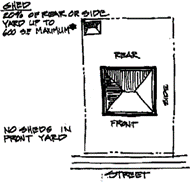
* Except as outlined in 2.313.01.E
A.
Location and number. Accessory structures shall be located within the rear or side yard. A maximum number of two accessory structures are permitted. (1/07)
B.
Height. The maximum allowable building height is 24 feet, except that the accessory structure shall not exceed the height of the primary building. (3/21)
C.
Property setbacks. Setbacks shall be applied to each face of the building according to its wall height. Wall height shall be measured from finish grade to the top of the wall. Gabled ends shall be measured from finish grade to the peak of the gable. An accessory structure eight feet or less in wall height may be located at the property line provided it is constructed consistent with building and fire code regulations. For each one-foot increase in the wall height above eight feet, the setback shall increase one additional foot. Wall height shall be rounded up in one-foot increments. The minimum setback adjacent to an alley shall be one foot regardless of whether or not there is additional setback to a property line. For yards adjacent to a street, in no case may the setback be less than that required of a fence. (3/21)
D.
Building separation. An accessory structure shall be separated from the primary building by a minimum of six feet. An accessory structure that is less than six feet from the primary structure or is connected to the primary structure by a breezeway or fully enclosed walkway which is architecturally compatible with the architecture of the primary structure will be subject to the setback requirements of the primary structure; however, the requirements governing height, size, lot coverage and exterior finish will still apply. Structures that are fully attached to the primary dwelling by a common wall of at least ten feet in length or habitable space shall be considered an addition to the primary dwelling and not regulated as an accessory structure. Such additions must be constructed of material compatible with the primary dwelling. (3/21)
E.
Building size and lot coverage. The accessory structure shall be limited to a maximum ground floor area of 600 square feet. If no garage exists on the property and the new accessory structure is proposed to accommodate a vehicle it may be 750 square feet in size. Additionally, in no case shall the accessory structure occupy more than 20 percent of the entire rear or side yard. The building size limitation shall be considered the maximum allowable area permitted for the sum of all accessory structures on the property. (3/21)
F.
Exterior finish. Accessory structures greater than 200 square feet in area shall be constructed of material generally compatible with the existing residential structure. For example, wood, stone, brick, and vinyl/resin/metal made to look like wood siding is allowed. Membrane structures over 200 square feet are prohibited. (3/21)
G.
Prohibited materials. Unmodified shipping containers, tarps, and other material not intended for long-term exposure to the elements are not considered to be accessory structures and are prohibited. (3/21)
Sec. 2.313.02. - Multifamily, commercial, industrial structures.
For multifamily, public, semi-public, commercial and industrial uses: (5/98)
A.
Location and number. Accessory structures may be located within any yard area. There is no limit to the number of permitted accessory structures. (1/16)
B.
Height. The accessory structure shall comply with the height limitations of the underlying zone. (5/98)
C.
Property setbacks. Accessory structures shall comply with the setbacks for the primary building in the underlying zone. (5/98)
D.
Building separation. Accessory structures shall be separated from the primary buildings by a minimum of ten feet. (5/98)
E.
Building size and lot coverage. There is no limit to the size of the accessory structure provided the structure and all buildings on the property comply with the lot coverage limitations of the underlying zone. (5/98)

