
Keizer City Zoning Code
2.302
STREET STANDARDS
Sec. 2.302.01. - Purpose.
A.
Safety. To provide for safe, efficient, and convenient vehicular, bicycle and pedestrian movement in the City of Keizer. (11/16)
B.
Access. To provide adequate access to all proposed developments in the City of Keizer. (5/98)
C.
Public facility access. To provide adequate area in all public rights-of-way for sidewalks, sanitary sewers, storm sewers, water lines, natural gas lines, power lines and other utilities commonly and appropriately placed in such rights-of-way. (5/98)
Sec. 2.302.02. - Scope.
The provisions of this section shall be applicable for the following: (5/98)
A.
Land divisions. The creation, dedication or construction of all new public or private streets in all subdivisions, partitions or other developments in the city. (05/98)
B.
Street expansion. The extension or widening of existing public or private streets or rights-of-way, easements, or street improvements, including those which may be proposed by an individual or the city, or which may be required by the city in association with other development approvals. (10/02)
C.
Utility improvements. The construction or modification of any utilities or sidewalks in public rights-of-way, existing private street, or private access easements. (10/02)
D.
Street trees. The planting of any street trees or other landscape materials in public rights-of-way. (5/98)
E.
Exceptions. Provisions of this section do not apply in existing developed areas of the city. Improvements in these areas shall be based on standards adopted by the department of public works. (5/98)
F.
Private streets. Private streets and improvements on private streets are allowed only in the following situations:
1.
Improvements and/or widening of existing and allowed private streets.
2.
Creation of new private streets within an existing subdivision or PUD already containing approved private streets.
3.
Creation of new private streets in a proposed subdivision, PUD, or partition if the only access to the proposed subdivision, PUD, or partition is via existing and approved private streets. (10/02)
Sec. 2.302.03. - General provisions.
The following provisions shall apply to the dedication, construction, improvement or other development of all public streets in the City of Keizer: (5/98)
A.
General requirements. The location, width, and grade of streets shall be considered in their relation to existing and planned streets, to topographical conditions, to public convenience and safety, and to the proposed use of the land to be served by the streets. (5/98)
B.
Continuation of streets. Development proposals, including subdivisions and partitions, shall provide for the continuation of, and connection to, streets where necessary to promote appropriate traffic circulation in the vicinity of the development. Where necessary to give access or permit a satisfactory future division of adjoining land, streets and utilities shall be extended to property boundaries to allow the future extension of streets and infrastructure. A temporary turnaround shall be constructed for stub streets in excess of 150 feet in length. (01/02)
No street or utility extensions are required when any of the following circumstances exist: (01/02)
1.
Less than three additional existing or future lots on adjoining parcels would gain access from the extension. For purposes of this criterion, the size of said future lots shall be no greater than two times the minimum lot size of the zone. (01/02)
2.
Parcel shape or size prevents new lots from meeting lot width or depth standards when a public street is proposed through the parcel. (10/15)
3.
Partial-width streets where adjoining development would provide a full-width public street does not eliminate the need for variances to lot depth or width requirements. (10/15)
4.
Natural physical obstructions or barriers, such as parkland, floodplain, slopes, or significant trees, make access and connectivity unreasonable or impracticable. (01/02)
5.
Providing access and connectivity to one or more adjoining parcel(s) would not be useful given that at least one of the following conditions exist: (01/02)
a.
A future street plan demonstrates that adequate access and connectivity is provided from the adjacent parcel(s). (01/02)
b.
The development potential of the adjoining parcel(s) is (are) limited due to physical or jurisdictional constraints to such a degree that connectivity is unreasonable or impracticable. (01/02)
C.
Alignment. All streets other than minor streets or culs-de-sac, as far as practical, shall be in alignment with existing streets by continuation of the existing centerlines. The staggering of street alignments resulting in T intersections shall, wherever practical, leave a minimum distance of 200 feet between the center lines of streets having approximately the same direction and otherwise shall not be less than 100 feet. (5/98)
D.
Future extension of streets. When it appears possible to continue a street, bicycle path and/or pedestrian accessway into a future subdivision, adjacent acreage or area attractors such as schools and shopping centers, streets, bicycle paths and/or pedestrian accessway facilities shall be platted and built to a boundary of the subdivision. The street may be platted without a turnaround unless the public works department finds a turnaround is necessary for reasons of traffic safety. Any street extension exceeding 150 feet in length shall be provided with an approved turnaround as set forth in the fire code. (11/16)
E.
Intersection angles. Streets shall be laid out to intersect at angles as near to right angles as practical, except where topography requires lesser angles. Intersections of less than 60 degrees shall require special intersection designs. Streets shall have at least 50 feet of tangent adjacent to intersections unless topography requires lesser distances. Intersections that are not at right angles shall have minimum corner radii of 15 feet. Major arterial intersections shall have curb radii of not less than 35 feet. Other street intersections shall have curb radii of not less than 20 feet. (5/98)
F.
Existing streets. Whenever existing public streets adjacent to or within a tract are of a width less than the street design standards, additional right-of-way shall be provided at the time of subdivision, partitioning, or development. (5/98)
G.
Half-streets. Half-streets may be approved where essential to the reasonable development of an area and when the city finds it to be practical to require the dedication of the other half when the adjoining property is developed. When a three-fourths-width street can reasonably be developed, as determined by the department of public works, a half-street will be constructed with an additional ten feet of pavement on the opposite side of the street from full improvement. (5/98)
H.
Culs-de-sac. The maximum length shall be 800 feet. (5/98)
I.
Street names. Street names and numbers shall conform to the established standards and procedures in the city. (5/98)
J.
Grades and curves. Grades shall not exceed seven percent on arterials, ten percent on collector streets or 15 percent on any other street. Street grades of 15 percent shall not exceed 200 feet in length. To provide for adequate drainage, all streets shall have a minimum slope of 0.5 percent. On arterials there shall be a tangent of not less than 100 feet between reversed curves. (5/98)
K.
Frontage streets. If a development abuts or contains an existing or proposed arterial or collector street, the city may allow frontage streets, or may require reverse frontage lots with suitable depth, screen planting contained in a non-access reservation along the rear or side property line, or such other treatment as may be necessary for adequate protection of residential properties, to afford separation of through and local traffic, and to preserve the capacity and safety of the collector or arterial street. (5/98)
L.
Alleys. Alleys shall be provided in commercial and industrial zones unless other permanent provisions for access to off-street parking and loading facilities are provided. The corners of alley intersections shall have radii of not less than ten feet. (5/98)
M.
Street landscaping. Where required as part of the right-of-way design, planting strips shall conform with the following standards: (5/98)
1.
Street trees shall be planted at a ratio of no less than one tree per 30 feet of property frontage. Street trees shall conform with the list of acceptable trees included in the city's street tree ordinance. Installation of street trees shall be included in any improvement agreement covering the installation of public facilities and services on a property. (5/98)
2.
Planting strips shall be planted and maintained in predominantly living ground cover materials with hard surfaces consisting of bricks, pavers, rocks, decorative concrete work, etc., only being included as part of an overall landscape design where living plant material is predominant. In no case shall asphalt be used within the planting strip. (5/98)
N.
Access control standards. The following access control standards apply to public, industrial, commercial and residential developments, including land divisions. Access shall be managed to maintain an adequate level of service and to maintain the functional classification of roadways as required by the City of Keizer Transportation System Plan. Major roadways, including arterials and collectors, serve as the primary system for moving people and goods within and through the city. Access management is a primary concern on these roads. Local streets and alleys provide access to individual properties. If vehicular access and circulation are not properly designed, these roadways will be unable to accommodate the needs of development and serve their transportation function. (10/15)
The regulations in this section further the orderly layout and use of land, protect community character, and conserve natural resources by promoting well-designed road and access systems and discouraging the unplanned subdivision of land. (7/09)
1.
Traffic impact analysis requirements. The city or other agency with access jurisdiction may require a traffic study prepared by a qualified professional to determine access, circulation and other transportation requirements. (See also section 2.301.03 (traffic impact analysis). (7/09)
2.
The city or other agency with access permit jurisdiction may require the closing or consolidation of existing curb cuts or other vehicle access points, recording of reciprocal access easements (i.e., for shared driveways), development of a frontage street, installation of traffic control devices, and/or other mitigation as a condition of granting an access permit, to ensure the safe and efficient operation of the street and highway system. Access to and from off-street parking areas shall not permit backing onto a public street. (7/09)
3.
Access options. When vehicle access is required for development (i.e., for off-street parking, delivery, service, drive-through facilities, etc.), access shall be provided by one of the following methods (a minimum of ten feet per lane is required; planned access shall be consistent with adopted public works standards for road construction). These methods are options to the developer/subdivider. (7/09)
1.
Option 1. Access is from an existing or proposed alley or mid-block lane. If a property has access to an alley or lane, direct access to a public street is not permitted. (7/09)
2.
Option 2. Access is from a private street or driveway connected to an adjoining property that has direct access to a public street (i.e., shared driveway). A public access easement covering the driveway shall be recorded in this case to ensure access to the closest public street for all users of the private street/drive. (7/09)
3.
Option 3. Access is from a public street adjacent to the development parcel. If practicable, the owner/developer may be required to close or consolidate an existing access point as a condition of approving a new access. Street accesses shall comply with the access spacing standards in subsection 6 below. (7/09)
4.
Subdivisions fronting onto an arterial street. New residential land divisions fronting onto an arterial street shall be required to provide alleys or secondary (local or collector) streets for access to individual lots. When alleys or secondary streets cannot be constructed due to topographic or other physical constraints, access may be provided by consolidating driveways for clusters of two or more lots (e.g., includes flag lots and mid-block lanes). (7/09)
5.
Double frontage lots. When a lot has frontage onto two or more streets, access shall be provided first from the street with the lowest classification. For example, access shall be provided from a local street before a collector or arterial street. (7/09)
6.
Access spacing. The following minimum access spacing standards apply to public streets and driveways on arterial streets: (7/09)
Arterial Access Spacing Standards
7.
Number of access points. For single-family (detached and attached), two-family, and three-family housing types, one street access point is permitted per lot, when alley access cannot otherwise be provided; except that two access points may be permitted for two-family and three-family housing on corner lots (i.e., no more than one access per street), subject to the access spacing standards in subsection 6, above. The number of street access points for multiple family, commercial, industrial, and public/institutional developments shall be minimized to protect the function, safety and operation of the street(s) and sidewalk(s) for all users. Shared access may be required, in conformance with subsection 8 below, in order to maintain the required access spacing, and minimize the number of access points. (7/09)
8.
Shared driveways. The number of driveway and private street intersections with public streets shall be minimized by the use of shared driveways with adjoining lots where feasible. The city shall require shared driveways as a condition of land division or site design review, as applicable, for traffic safety and access management purposes in accordance with the following standards: (7/09)
a.
Shared driveways and frontage streets may be required to consolidate access onto a collector or arterial street. When shared driveways or frontage streets are required, they shall be stubbed to adjacent developable parcels to indicate future extension. "Stub" means that a driveway or street temporarily ends at the property line but may be extended in the future as the adjacent parcel develops. "Developable" means that a parcel is either vacant or it is likely to receive additional development (i.e., due to infill or redevelopment potential). (7/09)
b.
Access easements (i.e., for the benefit of affected properties) shall be recorded for all shared driveways, including pathways, at the time of final plat approval or as a condition of site development approval. (7/09)
c.
Exception. Shared driveways are not required when existing development patterns or physical constraints (e.g., topography, parcel configuration, and similar conditions) prevent extending the street/driveway in the future. (7/09)
9.
Street connectivity and formation of blocks required. In order to promote efficient vehicular and pedestrian circulation throughout the city, land divisions and large site developments shall produce complete blocks bounded by a connecting network of public and/or private streets, in accordance with the following standards: (7/09)
Block length. The maximum block length shall be consistent with 2.310.04 (additional design standards for subdivisions). (7/09)
Street standards. Public and private streets shall also conform to section 2.302 Street Standards in the City of Keizer Development Code (Table 4.1 Street Design Standards in the TSP). (7/09)
Exception. Exceptions to the above standards may be granted when blocks are divided by one or more pathway(s), in conformance with the provisions of 2.310.04(C)(2). (7/09)
10.
Pedestrian/bicycle accessways. Accessways shall be located to minimize out-of-direction travel by pedestrians and may be designed to accommodate bicycles. (7/09)
11.
Streetlights. Streetlights shall be required for public streets serving more than four dwelling units. Streetlights shall be located within a right-of-way or in utility easements. Streetlights are not required along private access easements. Streetlights shall be designed to direct the light down toward the street and sidewalk and as much as practicable away from adjoining homes. (10/15)
O.
Trees along public streets. Streetscape trees are required along public streets, shall comply with the provisions of section 2.309, and must be located according to the following provisions: (10/15)
1.
Streetscape trees shall be planted within the boundaries of each lot within ten feet of street improvements. (10/15)
2.
Lots measuring less than 60 feet in width shall be required to plant one streetscape tree. Lots measuring 60 feet or more in width shall be required to plant two streetscape trees. (5/20)
3.
Streetscape trees shall be selected from a list of approved trees. (10/15)
Sec. 2.302.04. - General right-of-way and improvement widths.
The following standards are general criteria for public streets in the City of Keizer. These standards shall be the minimum requirements for all streets, except where modifications are permitted under subsection 2.302.05. (6/23)
The street design standards show five different options for local streets. These standards allow the city flexibility in the design of the street network. (7/09)
Table 4.1 Street Design Standards (07/09)
1 All local street categories have a ten-foot public utility easement on both sides and a five-foot slope and utility easement on collectors and arterials.
2 Standard bike lane widths are six feet, although five feet may be approved on a case-by-case basis.
3 Street improvements and right-of-way widths may be increased on a case-by-case basis as required by the city in accordance with public works design standards.
4 All streets will have five-foot-wide sidewalks on both sides, unless noted. Meandering sidewalks may be considered/required on arterials and collectors.
5 Additional right-of-way may be required at intersections for additional turning lanes. Right-of-way at intersections is required to provide for a minimum 20-foot curb return radius.
6 Depending on installed improvements.
7 Parking/sidewalks only required on one side of street.
Sec. 2.302.05. - Modification of right-of-way and improvement width.
The city, pursuant to variance approval, may allow modification to the public street standards of subsection 2.302.04, when the following criteria are satisfied: (5/98)
A.
Modification permitted. The modification is necessary to provide design flexibility where: (5/98)
1.
Unusual topographic conditions require a reduced width or grade separation of improved surfaces; or
2.
Parcel shape or configuration precludes accessing a proposed development with a street which meets the full standards of section 2.302.04; or
3.
A modification is necessary to preserve trees or other natural features determined by the city to be significant to the aesthetic character of the area; or
4.
The modification of street standards is necessary to provide greater privacy or aesthetic quality to the development. (5/98)
B.
Vehicular access maintained. Modification of the standards of section 2.302.04 shall only be approved if the city finds that the specific design proposed provides adequate vehicular access based on anticipated traffic volumes. (5/98)
Sec. 2.302.06. - Construction specifications.
Construction specifications for all public and private streets shall comply with the standards of the most recently adopted public works/street standards of the City of Keizer. Construction permits are required by the public works department. (10/02)
Sec. 2.302.07. - Improvement width for private streets (if allowed in section 2.302.02.F).
Private streets may be constructed to the same or greater width of the existing connecting private street. (10/02)
Sec. 2.302.08. - Private access easements.
A private access easement created as the result of an approved partitioning or subdivision shall conform to the following: (5/98)
A.
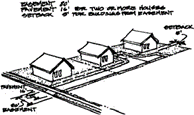
Width. Private access easements shall only be allowed where the applicable standards of section 2.310.03.D are satisfied. The easement shall comply with the following additional standards: (11/16)
1.
Minimum easement width: 20 feet with no parking within the minimum required width. (11/16)
2.
Minimum paved width: 12 feet for one dwelling unit; 16 feet for two or more dwelling units. (5/98)
3.
Maximum length: 300 feet for single access to a public street. If there are two or more access points to a public street, the proposed easement may be more than 300 feet if it is the only way to allow for effective development in unique circumstances where it is not practical to serve the development with a public street. Access easements exceeding 300 feet in length must be reviewed by the local fire district for compliance with the fire code and must receive city approval. The following criteria for city approval will be used: (11/16)
a.
A public street is impractical and an easement is the only feasible method to provide access. (11/16)
b.
Adequate parking and safe maneuverability is provided. (11/16)
c.
Does not preclude the ability for future redevelopment and must allow a density no less than 75 percent of the maximum density of the underlying zone. (11/16)
4.
Single-family/duplex development: No more than four parcels or lots shall have their sole access via an access easement unless through access (two or more public street access points) are provided. If the access easement connects to a collector or arterial street the public works director may require all parcels or lots to be served by the access easement. In such case, no more than six parcels or lots shall have their sole access via an access easement. If the access easement provides through access, no more than eight parcels or lots may be served by the access easement. All through access easements providing access to more than four parcels or lots must provide public bicycle and pedestrian access for connectivity. The instrument recording the access easement must indicate public bicycle and pedestrian access is allowed. (5/20)
5.
Triplex, quadplex, cottage cluster, and multifamily/commercial development: Access easements may be allowed if it is the only feasible method to provide access to a parcel without public street frontage, or if it is impractical to serve the development with a public street. Access easements are subject to fire district review and city approval. The design of the easement must be reviewed by the local fire district for compliance with the fire code and must meet the requirements outlined in section 2.303 for parking lot aisle widths, and all other city standards governing vehicle access contained in the KDC and adopted public works street standards. (6/23)
B.
Maintenance. Provision for the maintenance of the private access easement and storm drainage facilities within the easement area, along with any required turnaround area, no parking signage, and screening, shall be provided in the form of a recorded maintenance agreement, covenants, conditions, and restrictions (CCRs), or other recorded instrument acceptable to the city. Such instrument shall include, at a minimum, that the instrument may not be extinguished or modified without written consent of the city and that the provisions set forth above may be enforced by the city. (11/21)
C.
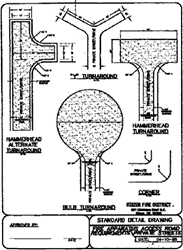
Turnaround. A turnaround shall be required for any access easement which is the sole access and which serves two or more parcels or lots. Turnarounds shall be either a circular turnaround with a minimum paved radius of 38 feet, or a "tee" or "hammerhead" turnaround with a minimum paved dimension across the "tee" of 60 feet. Alternate turnaround designs may be approved, subject to public works department approval. (5/20)
D.
Parking.
1.
No parking allowed. All private access easements serving as the sole access for two or more parcels or lots shall display no parking signs approved by the city. (5/20)
2.
Parking shall be provided as outlined in section 2.303. (11/16)
E.
Trees along access easements. Streetscape trees are required along access easements, shall comply with the provisions of section 2.309, and must be located according to the following provisions: (10/15)
1.
Streetscape trees shall be planted within the boundaries of each lot within ten feet of access improvements. (10/15)
2.
Parcels or lots measuring less than 60 feet along the access easement shall be required to plant one streetscape tree. Parcels or lots measuring 60 feet or more along the access easement shall be required to plant two streetscape trees. (5/20)
3.
Streetscape trees shall be selected from a list of approved trees. (10/15)
F.
Screening. A six-foot-high sight-obscuring fence, wall, or hedge shall be placed along the exterior side of an access easement to provide screening to any adjacent properties. (10/15)

