
Keizer City Zoning Code
2.310
DEVELOPMENT STANDARDS FOR LAND DIVISIONS
Sec. 2.310.01. - Purpose.
To provide for the orderly, safe, efficient and livable development of land within the City of Keizer. (5/98)
Sec. 2.310.02. - Scope.
A.
Application. The provisions of this section shall apply to all subdivisions and partitions within the City of Keizer. (5/98)
B.
Modification. The design standards in this section may be modified, provided findings are established which indicate compliance with these standards is infeasible due to parcel shape, terrain, or location of existing structures. (5/98)
Sec. 2.310.03. - Standards for lots or parcels, property line adjustment required.
A.
Minimum lot area. Minimum lot area shall conform to the requirements of the zoning district in which the parcel is located. (5/98)
B.
Property line adjustment. Any adjustment of common boundaries between two or more abutting lots or parcels shall require approval of a property line adjustment in accordance with the standards of chapter 3.1 and the procedures of chapter 3.2. (6/16)
C.
Lot width and depth. The depth of a lot or parcel shall not be more than three times the width of the parcel, with the following exceptions: (5/98)
1.
Individual lots for townhouse units shall not be less than 20 feet in width. Lot depth may vary but shall be adequate to provide a minimum of 300 square feet with no dimension less than six feet of semi-private outdoor living space for each unit. (5/98)
2.
Individual lots for single-family attached dwelling units shall be designed so that lot depth is not greater than 3 ½ times lot width. (5/98)
3.
Parcels created for public utility uses or in zones where there is no minimum lot area requirement shall be exempt from width to depth ratio provisions. (5/98)
D.
Access. All lots and parcels created after the effective date of this ordinance shall provide a minimum frontage, on an existing or proposed public street, equal to the minimum lot width required by the underlying zone. The following exceptions shall apply: (5/98)
1.
Lots or parcels may be accessed via an access easement developed in accordance with the provisions of section 2.302.08. (11/16)
2.
Lots or parcels in townhouse developments or planned unit developments may be accessed via public or private streets, in accordance with the following standards: (5/98)
a.
Internal local streets or drives may be private if allowed in section 2.302.02F and shall be subject to the provisions of section 2.302. (10/02)
b.
Collector and arterial streets shall be public and shall comply with the applicable provisions of section 2.302. Collector or arterial streets may be determined either by design or anticipated traffic volumes. (5/98)
c.
Local streets that are needed to provide access to adjoining properties shall be public and shall comply with the applicable provisions of section 2.202. (5/98)
3.
Cul-de-sac lots shall have a minimum frontage of 25 feet. (5/98)
4.
Flag lots, as permitted in subsection 2.310.03, E. (5/98)
E.
Flag lots. Flag lots shall only be permitted if it is the only reasonable method by which the rear portion of a lot being unusually deep or having an unusual configuration may be accessed and when in compliance with section 2.302.03.B. If a flag lot is permitted, the following standards shall be met: (5/98)
1.
The access strip shall not be less than 20 feet wide. The access strip shall be improved with a minimum 12-foot-wide paved driveway and paved encroachment which meet applicable city standards. (5/98)
2.
The access strip shall not be included in the calculation of lot area for purposes of determining compliance with any minimum lot size provision of this ordinance. (5/98)
F.
Through lots. Through lots shall be avoided except where essential to provide separation of residential development from major streets, adjacent nonresidential activities, or to overcome specific development constraints due to topography or lot orientation. Through lots shall be no less than 100 feet in depth. Lots having their access off a private access easement or adjacent to a private access easement shall not be construed as qualifying as through lots. Screening or buffering, pursuant to the provision of section 2.307, may be required by the city during the review of the land division request.(5/98)
G.
Lot lines. The side lines of lots, as far as practicable, shall run at right angles to the right-of-way line of the street upon which the lots face. The rear lot line shall be no less than one-half the dimension of the front lot line. (5/98)
H.
Utility easements. Utility easements shall be provided on lot areas where necessary to accommodate public utilities. Such easements shall have a minimum total width as specified in section 2.302.04 of this code. (5/98)
Sec. 2.310.04. - Additional design standards for subdivisions.
A.
Standards for blocks.
1.
General. The length, width, and shape of blocks shall be designed with regard to providing adequate building sites for the use contemplated; consideration of needs for convenient access, circulation, control, and safety of street traffic; and recognition of limitations and opportunities of topography. (5/98)
2.
Sizes. Blocks should not exceed 600 feet in length between street lines, except blocks adjacent to arterial streets, or unless the previous adjacent development pattern or topographical conditions justify a variation. The recommended minimum distance between intersections on arterial streets is 1,800 feet. (5/98)
B.
Traffic circulation. The proposed subdivision shall be laid out to provide safe and, convenient vehicle, bicycle and pedestrian access to nearby residential areas, transit stops, neighborhood activity centers such as schools and parks, commercial areas, and industrial areas; and to provide safe and convenient traffic circulation. At a minimum, "nearby" is interpreted to mean uses within ¼ mile which can be reasonably expected to be used by pedestrians and uses within one mile of the subdivision boundary which can reasonably be expected to be accessed by bicyclists. (5/98)
C.
Connectivity. To achieve the objective in B above, the director may require the following: (5/98)
1.
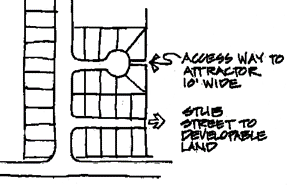
Stub streets. Where the potential exists for additional residential development on adjacent property. (5/98)
2.
Pedestrian/bicycle accessways. Public accessways to provide a safe and efficient connection from a residential area to nearby residential areas, transit stops, neighborhood activity centers, including schools, parks, shopping centers, other community services and other commercial and industrial areas when such connections are not available by streets and when a pedestrian must go at least one-quarter of a mile out of his or her way to make that connection using the street system. (5/98)
D.
Design standards. Pedestrian/bicycle accessways shall meet the following design standards: (5/98)
1.
Minimum dedicated width: ten feet.
2.
Minimum improved width: ten feet.
3.
Maximum length: 250 feet. A clear line of vision for the entire length of the accessway shall be required. (5/98)
4.
Lighting shall be provided illuminating any walkway exceeding 150 feet in length to a level where the system can be used at night. Lighting shall be included in the lighting district(s) established for the subdivision. (5/98)
5.
The accessway shall be designed to prohibit vehicle traffic. (5/98)
Sec. 2.310.05. - Improvement requirements—Partitions.
During the review of partition proposals, the city shall require, as a condition of approval, the following improvements: (5/98)
A.
Private access. Private driveways serving flag lots, or private streets and access easements, shall be surfaced per the requirements of this code. (10/02)
B.
Walkways for private streets. Sidewalks shall be required in accordance with applicable provisions in sections 2.302 only if sidewalks currently exist along the connecting street. (10/15)
C.
Street frontage improvements. The following improvements shall be required: (5/98)
1.
If the street frontage of the subject property is less than or equal to 100 feet, and not along a collector or arterial street the applicant shall sign a non-remonstrance agreement with the City of Keizer. This agreement shall stipulate that the applicant or future property owner will agree to participate in right-of-way improvements. The agreement may include provisions for the following: street paving, curbing, sidewalks, water lines, storm sewer facilities and sanitary sewer facilities. (7/07)
2.
If the street frontage of the subject property exceeds 100 feet or is located along a collector or arterial street, or extends an existing dedicated right-of-way, the applicant shall improve the following unless it is determined by the city that any or all of the required improvements may not be practical or desirable due lack of connecting facilities, or topographical or engineering constraints that may preclude the placement of improvements: (7/07)
a.
Public streets upon which the property fronts to public standards, including: surfacing from center line to curb, installation of curbing, storm sewers, sanitary sewers, water lines and other necessary public utilities. (5/98)
b.
Sidewalks, meeting city standards, along public street frontage. (5/98)
c.
The installation of storm sewers, sanitary sewers, water lines and other utilities necessary to serve lots accessing off of the new street. (5/98)
D.
Completion requirements. All required improvements shall be completed prior to the issuance of any building permits for the subject property. Alternatively, improvements required under this section shall be completed or assured through a performance bond or other instrument acceptable to the city prior to the approval of the final plat of the partition. At the discretion of the public works director, certain improvements may be further postponed through a non-remonstrance agreement, or other performance agreement. (5/98)
Sec. 2.310.06. - Improvement requirements—Subdivisions.
The following improvements shall be required for all subdivisions in the City of Keizer: (5/98)
A.
Frontage improvements. Street improvements to full city standards shall be required for all public streets on which a proposed subdivision fronts in accordance with section 2.302 of this code. Such improvements shall be designed to match with existing improved surfaces for a reasonable distance beyond the frontage of the property. Additional frontage improvements shall include sidewalks, curbing, storm sewer, sanitary sewer, water lines, other public utilities as necessary, and such other improvements as the city shall determine to be reasonably necessary to serve the development or the immediate neighborhood. (5/98)
B.
Walkways for private streets. Sidewalks shall be required in accordance with applicable provisions in sections 2.302 only if sidewalks currently exist along the connecting street. (10/15)
C.
Project streets. All public or private streets within the subdivision shall be constructed as required by the provisions of section 2.302. (5/98)
D.
Monuments. Upon completion of street improvements, centerline monuments shall be established and protected in monument boxes at every street intersection and all points of curvature and points of tangency of street center lines. (5/98)
E.
Benchmarks. Elevation benchmarks shall be set at intervals established by the city engineer. The benchmarks shall consist of a brass cap set in a curb or other immovable structure. (5/98)
F.
Surface drainage and storm sewer system. Drainage facilities shall be provided within the subdivision and to connect the subdivision drainage to drainage-ways or to storm sewers outside the subdivision. Design of drainage within the subdivision shall take into account the capacity and grade necessary to maintain unrestricted flow from areas draining through the subdivision and to allow extension of the system to serve such areas. Drainage shall be designed to avoid impacts on adjacent property. (5/98)
G.
Sanitary sewers. Sanitary sewers shall be installed to serve the subdivision and to connect the subdivision to existing mains both on and off the property being subdivided. (5/98)
If the required sewer facilities will, without further sewer construction, directly serve property outside the subdivision, the city may recommend to the city council construction as an assessment project with such arrangement with the subdivider as is equitable to assure financing his share of the construction and to provide for appropriate reimbursements of costs above those directly attributable to the subdivision. (5/98)
The city may require that the subdivider construct sewage lines of a size in excess of that necessary to adequately service the development in question, where such facilities are or will be necessary to serve the entire area within which the development is located when the area is ultimately developed. The city may also require that the construction take place as an assessment project with such arrangement with the subdivider as is desirable to assure his share of the construction. (5/98)
H.
Water system. Water lines with valves and fire district-approved fire hydrants serving the subdivision and connecting the subdivision to the city mains shall be installed and operating prior to start of combustible construction. The design shall take into account provisions for extension beyond the subdivision to adequately grid the city system and to serve the area within which the development is located when the area is ultimately developed; however, the developer will be responsible for water main sizes necessary to meet minimum fire flow requirements per Uniform Fire Code. The city will not expect the developer to pay for the extra pipe material cost of mains exceeding eight inches in size. (5/98)
I.
Sidewalks. Sidewalks shall be installed along both sides of each public street and in any pedestrian ways within the subdivision. The city may defer sidewalk construction until the dwellings or structures fronting the sidewalk are constructed. Any required off-site sidewalks (e.g., pedestrian walkways) or sidewalks fronting public property shall not be deferred. (5/98)
J.
Streetlights. The installation of streetlights is required at locations and of a type required by city standards. (5/98)
K.
Street signs. The installation of street name signs and traffic control signs is required at locations determined to be appropriate by the city and shall be of a type required by city standards. Each street sign shall display the one hundred block range. Street signs shall be installed prior to obtaining building permits. (5/98)
L.
Public works requirements. All facility improvements shall conform to the requirements and specifications of the Keizer Department of Public Works. (5/98)
M.
Curb cuts. Curb cuts and driveway installations, excluding common drives, are not required of the subdivider but, if installed, shall be according to the city standards. (5/98)
N.
Street trees. Street tree planting is mandatory where a planting strip is part of the street design. Plantings shall conform to section 2.302.03(M). (5/98)
O.
Grading and fills. All grading which results in fills in excess of three feet located within the identified building envelope on a subdivision lot or parcel must be engineered. (5/98)
P.
Financial requirements. All improvements required under this section shall be completed to city standards or assured through a performance bond or other instrument acceptable to the city attorney, prior to the approval of the final plat of the subdivision. (5/98)
Sec. 2.310.07. - Improvement procedures.
In addition to other requirements, improvements installed by a developer for any land division, either as a requirement of these regulations or at his own option, shall conform to the requirements of this ordinance and improvement standards and specifications adopted by the city, and shall be installed in accordance with the following procedure: (5/98)
A.
Plan review. Improvement work shall not commence until plans have been checked for adequacy and approved by the city. Plans shall be prepared in accordance with requirements of the city. (5/98)
B.
Notification. Improvement work shall not commence until the city has been notified in advance, and if work has been discontinued for any reason, it shall not be resumed until the city has been notified. (5/98)
C.
Inspection. Improvements shall be constructed under the inspection and to the satisfaction of the city engineer and the director of public works. The city may require changes in typical sections and details in the public interest if unusual conditions arise during construction to warrant the change. (5/98)
D.
Underground facilities. All underground utilities, sanitary sewers, and storm drains installed in streets by the developer shall be constructed prior to the surfacing of the streets. Stubs for service connections for underground utilities and sanitary sewers shall be placed to a length eliminating the necessity for disturbing the street improvements when service connections are made. (5/98)
E.
Final engineering plans. Upon completion of the public improvements and prior to final acceptance of the improvements by the city, the developer shall provide certified as-built drawings of all public utility improvements to the city. As-built conditions and information shall be reflected on one set of Mylar base as-built drawings. The as-built drawings shall be submitted to the city engineer by the developer's engineer. (5/98)

