
Keizer City Zoning Code
3.114
LOCKHAVEN CENTER MASTER PLAN
Sec. 3.114.01. - Purpose.
The purpose of requiring master plans within the Lockhaven Center is to allow for a mixture of intensive land uses, emphasizing employment opportunities, housing, transit and pedestrian facilities, and circulation; to allow some flexibility in how sites are developed; and to ensure coordination between the development of different sites within the center. Each master plan shall be reviewed through a Type III review process. (12/19)
Sec. 3.114.02. - Applicability.
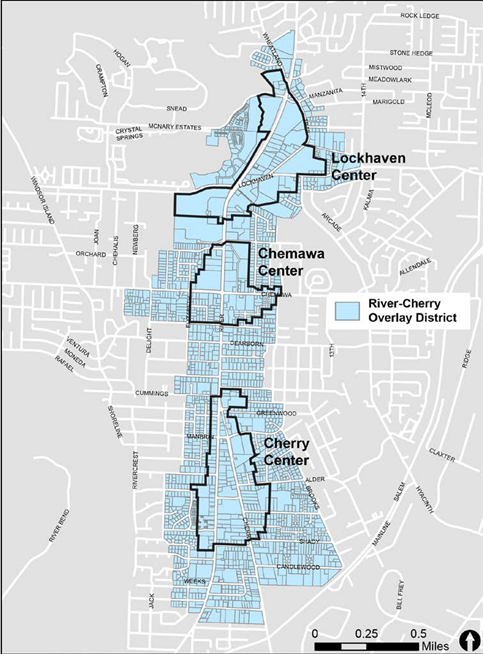
The provisions of this section shall apply to development sites that are: (1) located within the Lockhaven Center, as identified in Figure 3.114.02-1; (2) larger than four acres; and (3) zoned Mixed Use (MU). For cohesive developments that partially include MU property, all of the development shall be included in the master plan. (12/19)
Sec. 3.114.03. - Review procedures.
All development over four acres within the Lockhaven Center is subject to Type III review as provided in KDC section 3.101 and shall be required to submit a site master plan for approval as part of the application process. (12/19)
Type III actions follow the procedures found in section 3.204.02. Staff has an advisory role. The zoning administrator shall make a recommendation to the planning commission, which then makes a recommendation to the city council for public hearing and decision, bypassing the hearings officer. Public notice and a public hearing are provided. Section 3.202 lists the notice requirements. Sections 3.205 and 3.206 set forth the hearings process. (12/19)
The elements of a site master plan shall include, but are not limited to, the following:
A.
A master plan map showing the location of land uses, open spaces, and pedestrian and vehicular circulation and a written explanation showing how these features achieve the purpose of the Keizer Revitalization Plan. (12/19)
B.
For any project for which the projected average daily traffic will exceed 250 vehicle trips per day, in accordance with the Institute of Traffic Generation Manual, a traffic impact analysis will be required and a written explanation how negative impacts will be mitigated. (12/19)
Sec. 3.114.04. - Submittal requirements.
A.
Infrastructure engineering and architectural site plans showing all structures in relation to projected final topography of the project, all proposed connections to existing or proposed roads, transportation facilities (including proposed right-of-way and pedestrian connections), utilities, open space and parking areas, depicting the number and types of spaces. (12/19)
B.
Landscape plans generally showing the common and botanical name of plant species, the number and size of plantings and demonstrating the location and type of irrigation. (12/19)
C.
Building elevations, typical cross sections and typical wall sections of all building areas. (12/19)
D.
Typical elevations of the buildings to determine the specific configuration and relationship of design elements of the typical building exteriors which describe the general aesthetic and technical aspects of the building exterior, including materials. (12/19)
E.
Elevations, typical cross sections of the interior space layout of the building areas, entrance canopies, interior public courts, specialty areas, and service area layouts. (12/19)
F.
Proposed layouts for exterior signage and graphics. (12/19)
G.
Preliminary outline specifications describing exterior construction materials and methods, including indications of colors, finishes, and patterns. (12/19)
H.
An outline of amenities, including, but not limited to, public art, furniture, handrails, seating areas and food areas, if any. (12/19)
I.
A description of servicing requirements, trash compactors and related areas, loading docks, etc. (12/19)
J.
Calculation of gross building, parking and open space. (12/19)
K.
For any project for which the projected daily average daily traffic will exceed 250 vehicle trips per day, in accordance with the Institute of Traffic Generation Manual, a traffic impact analysis will be required and a written explanation how negative impacts will be mitigated. (12/19)
L.
Location of land uses, open spaces, and pedestrian and vehicular circulation and a written explanation showing how these features achieve the purpose of the activity center design plan. (12/19)
Sec. 3.114.05. - Review criteria.
Approval of a master plan for the Lockhaven Center area shall require compliance with the following criteria: (12/19)
A.
Meet all applicable standards within the RCOD and Lockhaven Center, as provided by sections 2.130.04 through 2.130.07, sections 2.130.08.D.2 through 2.130.08.D.3, and sections 2.130.09 through 2.130.10, in addition to applicable standards within base zones; or (12/19)
B.
Mix of uses and housing types. (12/19)
1.
Residential use shall occupy no less than 35 percent and no more than 65 percent of the building floor area on any property or a coordinated development on more than one property. (12/19)
2.
The master plan must identify at least two different housing types. The following are considered distinct housing types for purposes of meeting this standard: (12/19)
a.
Single-family detached dwellings (with or without accessory residences) or residential homes. (12/19)
b.
Duplexes or single-family attached dwellings. (12/19)
c.
Townhouses. (12/19)
d.
Cottage cluster development. (12/19)
e.
Multifamily dwellings or residential care facility. (12/19)
f.
Manufactured dwelling park. (12/19)
C.
Minimum residential density. The minimum density for any residential development shall be ten units per acre. (12/19)
D.
Transit orientation. The development shall emphasize transit usage by residents, employees and customers. This may require conditions regarding: (12/19)
1.
Orienting building and facilities towards transit services. (12/19)
2.
Minimizing transit/auto conflicts. (12/19)
3.
Encouraging transit supportive uses. (12/19)
4.
Minimizing walking distance to transit stops. (12/19)
5.
Avoiding excess parking areas. (12/19)
6.
Encouraging shared parking and structures or understructure parking. (12/19)
E.
Pedestrian/bicycle circulation and orientation. The development shall facilitate pedestrian/bicycle circulation and orientation. This may require conditions regarding: (12/19)
1.
Providing efficient, convenient, and continuous pedestrian and bicycle transit circulation systems, linking developments within Lockhaven Center facilities, and surrounding development. (12/19)
2.
Separating auto and truck circulation and activities from pedestrian areas. (12/19)
3.
Pedestrian-oriented design. (12/19)
4.
Pedestrian amenities. (12/19)
5.
Pedestrian-scale building and site features. (12/19)
6.
Bicycle parking. (12/19)
7.
Outdoor lighting. (12/19)
F.
Coordination and connectivity. Coordination of development within the Lockhaven Center area. This may require conditions regarding: (12/19)
1.
Continuity and/or compatibility of landscaping, circulation, access, public facilities, and other improvements. (12/19)
2.
Siting and orientation of land uses. (12/19)
3.
Consistency with development concepts adopted as part of the Keizer Revitalization Plan. (12/19)
4.
Frontage roads or shared access to provide connectivity to future development within the property or on adjacent property. (12/19)
5.
Non-road connections to adjacent sites and transportation facilities intended to provide direct connections to surrounding development as well as to other key destinations in the area. (12/19)
G.
Compatibility. Developments within Lockhaven Center should be compatible with, and complement the surrounding neighborhood. This may require conditions regarding: (12/19)
1.
Sensitive use of landscaping, building heights, building scale, materials, lighting, circulation systems, and architectural features. (12/19)
2.
Buffering of adjacent residential uses. (12/19)
H.
At the time of development, the zoning administrator may approve some minor variations to the adopted master plan if the applicant can demonstrate that the variation equally or better meets the purpose of the RCOD and the Keizer Revitalization Plan. (12/19)
Sec. 3.114.06. - Conditions of approval.
The council may impose other conditions of approval it deems appropriate for the health, safety, and welfare of the citizens of Keizer or to ensure the desired implementation of the approved master plan, including, but not limited to, conditions designed to minimize congestion and traffic impact within the development and in adjacent areas. (12/19)

