
Millcreek City Zoning Code
18.24 SUBDIVISIONS
18.24.010 Purpose
The purpose of this Title is to establish standards for the development and construction of subdivisions in Millcreek that comply with all applicable zoning, building, health, and fire requirements, including but not limited to, all use and development standards adopted by Millcreek.
HISTORY
Repealed & Reenacted by Ord. 25-12 on 4/28/2025
Repealed & Reenacted by Ord. 25-12 on 4/28/2025
18.24.020 Applicability
- This Title applies to any subdivision of land within Millcreek’s municipal boundary. The description of a lot or parcel by metes and bounds may not exempt the transaction from the requirements of this Title.
- No plat of any subdivision within the application of these regulations nay be entitled to be filed or recorded or have any validity until such plat has been approved by the City and acknowledged in the manner prescribed by applicable standards of this Code and applicable regulations and standards.
- No building permits may be issued for development on any vacant parcel, unless such parcel has been subdivided and platted in accordance with the procedures set out in these regulations. For existing vacant lots or parcels that were recorded in the office of the Salt Lake County Recorder prior to the establishment of the first Salt Lake County subdivision ordinance dated August 28, 1946, and have remained intact since that date, a building permit may be issued for said lot and/or parcel, however further subdivision of said property would require compliance with the standards of this Title. The applicant has the burden of proving that a lot or parcel was legally established in compliance with all zoning and subdivision standards applicable at the time of its creation.
- On properties pending subdivision approval, no building permit may be issued nor may any site work be performed prior to subdivision approval, except for improvements as required as part of a subdivision approval.
HISTORY
Repealed & Reenacted by Ord. 25-12 on 4/28/2025
Repealed & Reenacted by Ord. 25-12 on 4/28/2025
18.24.030 Design Standards
- Blocks and Walkways
- Blocks shall not exceed 600 feet in length unless adequate turnaround space is provided either via a looped roadway or a cul-de-sac with a minimum radius of 48 feet. Hammer head or T-shaped turnarounds are not considered sufficient to meet this requirement.
- The arrangement of streets in new subdivisions shall provide for the continuation of the existing streets in adjoining areas and shall provide access to unsubdivided adjoining areas insofar as such continuation or access is necessary as reasonably determined by the Land Use Authority as determined in Table 18.1. New streets shall connect with existing public streets.
- Blocks shall accommodate various lot arrangements and designs that provide satisfactory and desirable building sites, and are appropriately related to topography, the character of surrounding development, and existing requirements.
- Dedicated walkways on blocks greater than six hundred feet (600’) shall be required through the block to provide access to schools, existing and planned trails, transit facilities, community facilities, or a similar public amenity at a point designated by the Land Use Authority as determined in Table 18.1, unless determined otherwise by the Land Use Authority. For such walkways, the following standards apply:
- Walkways shall be located at the approximate middle of the block.
- Walkways shall be a minimum of six feet in width.
- Walkway surface shall be concrete.
- A fence that is at least four feet high on each side and the full length of each walkway shall be provided, unless alternative screening arrangements have been desired and approved by the City.
- Bollards or similar barriers shall be placed at each walkway entrance to prevent vehicles from using the walkway.
- Lots
- Each lot shall be arranged and designed such that the lots will provide satisfactory and desirable sites for buildings and be properly designed according to topography, the character of surrounding development, and to existing requirements.
- All lots must conform to the minimum requirements of the Zoning District for the zone in which the subdivision is located.
- Every portion of a property being subdivided or recorded as a condominium shall be included in a lot or lots in the proposed subdivision plat or as common, limited common or private ownership in a condominium except for public rights-of-way, parks or other areas dedicated for public use. Non-buildable parcels shall be so identified with clarifying information to indicate their purpose.
- Each lot must be contained entirely within a single zoning district.
- Lot Access.
- Residential Lots.: Each lot shall abut the right-of-way line of a public or private street.
- Commercial, Industrial, and Institutional Lots. No minimum lot width is required for lots serving commercial, industrial, or institutional uses. Lots not fronting on a street must be accessible to the public through a recorded easement or right-of-way.
- Side lot lines shall be approximately at right angles, or radial to the street lines.
- All remnants of lots below minimum size must be added to adjacent lots rather than allowed to remain as unusable lots or parcels.
- Subdivisions in Sensitive Lands
- In subdivisions proposed for development in the MKZ 18.61, Sensitive Lands, the general layout of lots, roads, driveways, utilities, drainage facilities, and other services within the proposed subdivision shall be designed consistent with the requirements of the Sensitive Lands Standards as set forth in MKZ 18.61.
- Applicants shall consider and apply the development design considerations set forth in MKZ 18.61, Sensitive Lands in (1) the layout of the subdivision and (2) the designation of buildable areas on individual lots to avoid creating lots or patterns of lots that will make compliance with such development standards difficult or infeasible.
- All preliminary and final subdivision plats shall outline buildable areas on each lot intended to accommodate planned principal and accessory structures.
- Clustering of lots within a subdivision is strongly encouraged and may be required by the Planning Commission to meet the requirements of this provision and any applicable overlay zone.
- Flag Lots. Flag lots shall be prohibited unless the following requirements are met:
- No other viable subdivision design alternatives exist that will allow for a conventional lot, including consideration of:
- The current or proposed zoning;
- The possibility of incorporating the subject property with adjacent property to achieve a more unified development of the area and eliminate the need for a flag lot; and
- Alternative street designs and improvements.
- Feasible connections to a nearby public right-of-way.
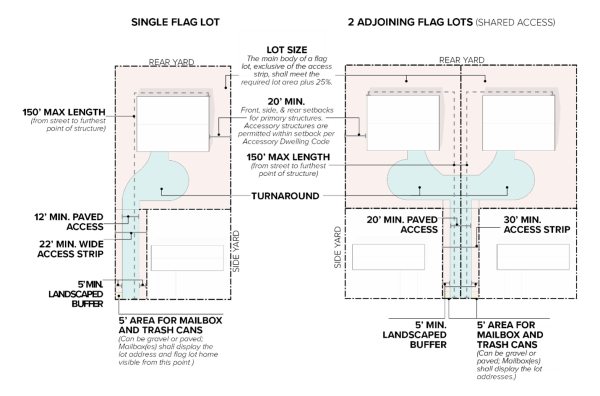
- Flag lots shall meet the following requirements, generally as depicted in Figure 18.24.1:
- No more than two (2) flag lots may be created from an existing lot or parcel.
- The flag lot(s) shall be used exclusively for a Single-Household Detached Dwelling and shall be located to the rear of the original or front lot.
- The main body of a flag lot, exclusive of the access strip, shall meet the required lot area plus 25 percent. The main body of a flag lot shall meet the minimum lot width of the zone in which the flag lot(s) are proposed. The minimum side yard, front yard and rear yard shall be 20 feet. Accessory structures are allowed in the minimum yards of a flag lot, subject to the standards as set forth in MKZ 18.59, Accessory Structures.
- The access strip portion of a flag lot shall be platted as a contiguous portion of the flag lot.
- No more than one primary dwelling on a flag lot may be accessed from an access strip, unless the access strip meets the standards as set forth in MKZ 18.24.030 (B)(9)(c)(2), and the flag lots are configured as depictured in Figure 18.24.1.
- The subdivision plat shall include an outline of the buildable area proposed for the house. The maximum height of the house is set forth in the underlying zoning district, and no house shall be taller than two stories, excluding a pitched roof.
- A turnaround area, subject to approval by the Fire Marshal, to prevent backing out the driveway is required, as illustrated in Figure 18.24.1.
- The flag lot(s) shall front on a public street.
- The length of the flag lot, as measured from the right-of-way line to the furthest point of a residential structure, may not exceed 150 feet in length unless approved by the Fire Department.
- Landscaped areas that abut the public street shall contain a mailbox(es), displaying the lot addresses, and a gravel or paved area for trash cans.
- Hard surfaced driveways shall be located at least 10 feet from existing homes on neighboring lots and at least eight feet (8’) from the home on the original lot.
- All public and private access, utility, and maintenance easements shall be recorded prior to building permit submittal.
- The access strip portion of a flag lot(s):
- A single flag lot shall have an unobstructed access strip a minimum of 22 feet wide for its entire length from the street to the point where the access strip adjoins the main body of the flag lot and shall include:
- A paved driveway a minimum of 12 feet in width;
- Landscaped areas that are a minimum of five feet (5’) in width on either side of the driveway to allow for utility access, drainage, and snow storage adjacent to the neighboring property line.
- Two flag lots with a shared access strip shall have a minimum unobstructed access strip width of 25 feet wide for its entire length from the street to the point where the access strip adjoins the main body of the flag lot and shall include:
- A paved driveway a minimum of 15 feet in width;
- Landscaped areas that are a minimum of five feet (5’) in width on either side of the driveway to allow for utility access, drainage, and snow storage adjacent to the neighboring property line.
- A single flag lot shall have an unobstructed access strip a minimum of 22 feet wide for its entire length from the street to the point where the access strip adjoins the main body of the flag lot and shall include:
- The address of the flag lot dwelling shall be clearly visible on the dwelling(s) when viewed from the point where the access strip adjoins the street.
- No other viable subdivision design alternatives exist that will allow for a conventional lot, including consideration of:
Figure 18.24.1 Flag Lot Layout
HISTORY
Repealed & Reenacted by Ord. 25-12 on 4/28/2025
Repealed & Reenacted by Ord. 25-12 on 4/28/2025
18.24.040 Required Improvements
- The following improvements shall be required and adhere to the standards in the Millcreek Code of Ordinances:
- Storm Water System
- Public Sanitary Sewer
- Storm Drainage to Comply with Low Impact Design Standards
- Street Improvements
- Street Lighting
- Curb and Gutter
- Utility and Facility Systems to be Undergrounded
- Sidewalks
- Street Name Signs
- Trails
- Fire Hydrants
- Stormwater Inlets
- Fencing Along Right-of-Ways where lots rear public streets
- Undergrounding/piping of Canals where adjacent to public right-of-way
- Construction of Improvements.
- The Planning Director and City Engineer shall be notified at least twenty-four hours prior to construction of any required improvements so that proper inspection may be provided and the City may verify if the required authorization and/or permits are documented.
- As-built plans, profile drawings, and corresponding GIS data shall be furnished to the Planning Director and City Engineer for all street improvements, storm sewers, sanitary sewers, and water systems upon completion. The City shall retain the improvement assurance guarantee and associated approved bond agreement until such plans have been submitted.
- Certification of Improvements. No final plat of a subdivision of land may be recorded without receiving a statement signed by the Planning and Engineering Departments certifying that the improvements described in the subdivider’s plans and specifications have been completed (or an improvement assurance guarantee has been submitted for the required improvements as required by of this Code and applicable regulations and standards), that they meet the minimum requirements of all ordinances of the City, that they comply with the standards and requirements of the health department, and the fire authority serving the area.
HISTORY
Repealed & Reenacted by Ord. 25-12 on 4/28/2025
Repealed & Reenacted by Ord. 25-12 on 4/28/2025
18.24.050 Responsibility For Damages
All damages to any bonded improvements or facilities incurred during the period of development shall be the sole responsibility of the subdivider and must be replaced to the satisfaction of the City before final acceptance of any improvements caused by the subdivider or any agents of the subdivider shall be repaired by the subdivider to the satisfaction of the City prior to final acceptance and bond release.
HISTORY
Repealed & Reenacted by Ord. 25-12 on 4/28/2025
Repealed & Reenacted by Ord. 25-12 on 4/28/2025
18.24.060 Improvement Assurance Guarantee
- In lieu of actual completion of the improvements listed in this Title and if Millcreek estimates that the cost to complete the required improvement is more than ten thousand dollars, then the subdivider must file with Millcreek a cash bond, an escrow agreement, or a letter of credit in a form acceptable to Millcreek and in an amount specified by the City Engineer or designee to assure actual construction of such improvements within two years or other time period as approved by Millcreek.
- Warranty. Ten percent of the bond amount for public improvements such as required landscaping, curb, gutter, sidewalk, road surfacing, flood control and fire hydrants shall extend for a one-year period beyond the date the City accepts the required landscaping or infrastructure. The City may extend the warranty period beyond one year if it determines for good cause that a one-year period would be inadequate to protect the public health, safety, and welfare; and if it has substantial evidence, on record, of prior poor performance by the applicant; or that the area upon which the infrastructure will be constructed contains suspect soil and the municipality has not otherwise required the applicant to mitigate the suspect soil.
- The improvement completion assurance shall also secure all lot improvements on individual lots in the subdivision, including stormwater system improvements, transportation system improvements, public landscaping, public parks, public trails, and public open spaces required by this Title.
- If the City Engineer or their designee determines that the required improvements should be completed in a specified sequence and/or in less than a two-year period to protect the health, safety, and welfare of the City or its residents from traffic, flood, drainage, or other hazards, it may require in approving the final subdivision plat that the improvements, including required landscaping, be installed in a specified sequence and period which may be less than two years and shall incorporate such requirements in the bond.
- Inspections and Warranty Inspections.
- Inspections and Warranty Inspection shall be conducted within 15 days after the City receives a written request from the applicant to accept or reject the required improvements, or as soon as practicable thereafter if winter weather conditions impede the inspection. If winter weather prevents a full and complete inspection of the warranty work within the required timeframe, the land use authority shall notify the applicant in writing before the deadline. The notice shall state that due to winter weather, additional time is needed to inspect and determine acceptance or rejection of the warranty work. The land use authority shall complete the inspection and provide a decision as soon as practicable.
- If the City rejects an applicant’s warranty work three times, it may extend the inspection period by an additional 15 days for any subsequent inspections of the applicant’s warranty work.
- If extraordinary circumstances prevent the City from completing an inspection within the required time period and thereby hinder its ability to accept or reject the warranty work, the City shall notify the applicant in writing before the applicable deadline. The notice shall explain that, due to extraordinary circumstances, additional time is required to inspect and make a determination regarding the warranty work. In such cases, the City shall complete the inspection and provide a written acceptance or rejection within 30 days after the original inspection period ends. For the purposes of this section, the following constitute extraordinary circumstances:
- The City is processing an inspection request that significantly exceeds the typical scope of inspections the City normally performs;
- The applicant has submitted two or more written inspection requests within the same 30-day period; or
- The City is handling an unusually large volume of inspection requests related to subdivision improvements or warranty work.
- If the City determines that required improvements within a specific infrastructure improvement category meets City standards, and the applicant has submitted complete as-built drawings, the City shall return 90% of the applicant’s improvement completion assurance allocated to that infrastructure improvement category.
- Within 15 days after the warranty period expires, and upon a determination that the infrastructure improvement meets City standards, the City shall return the remaining 10% of the improvement completion assurance for that category, along with any remaining portion of a bond as described in Utah Code Section 10-9a-604.5(5)(b).
- If the City determines that required improvements or warranty work do not meet City standards, the City shall provide the applicant a comprehensive and specific list of the reasons for its decision within 15 days of making that determination.
- If the applicant elects to post a cash deposit as a form of completion assurance, the City shall place the cash deposit in the City’s PTIF account and return any earned interest to the applicant with the return of the completion assurance.
- Bonds filed pursuant to this section shall be processed and released in accordance with the procedures set forth in MKC 3.56, Bonds.
HISTORY
Repealed & Reenacted by Ord. 25-12 on 4/28/2025
Repealed & Reenacted by Ord. 25-12 on 4/28/2025

