
Millcreek City Zoning Code
18.75 WIRELESS
TELECOMMUNICATIONS FACILITIES
18.75.010 Purpose
The purpose of this chapter is to reasonably regulate, to the extent permitted by Utah and federal law, the location, installation, operation, collocation, modification, and design of personal transmission equipment and commercial wireless telecommunications facilities. All facilities shall comply with the following regulations and all other ordinances of the City and any pertinent regulations of the Federal Communications Commission (FCC) and the Federal Aviation Administration (FAA).
Repealed & Reenacted by Ord. 25-12 on 4/28/2025
18.75.020 Applicability
- This chapter’s requirements apply to existing and new installations of both personal transmission equipment and commercial transmission equipment, which are referred to as commercial wireless telecommunication facilities. Commercial wireless telecommunication facilities are categorized into the following four types of facilities: roof mount, wall mount, freestanding stealth structures, and monopoles.
- This chapter does not regulate small wireless facilities, which are defined and regulated in MKZ Title 16.
- Amateur radio antennas and related equipment are exempt from the regulations of this chapter.
- This chapter does not regulate TV and radio broadcasting towers as they are not permitted in the City, and this chapter does not govern such facilities.
- Lattice or guyed structures intended for transmission equipment of any type are not permitted.
Repealed & Reenacted by Ord. 25-12 on 4/28/2025
18.75.030 Site Plan Review Required
An applicant who desires to place personal and commercial transmission equipment, including wireless telecommunication facilities, shall submit a site plan to the Planning Department following the procedures as set forth in MKZ 18.15.030 (B) for review prior to submitting and processing any building permits.
Repealed & Reenacted by Ord. 25-12 on 4/28/2025
18.75.040 Personal Transmission Equipment
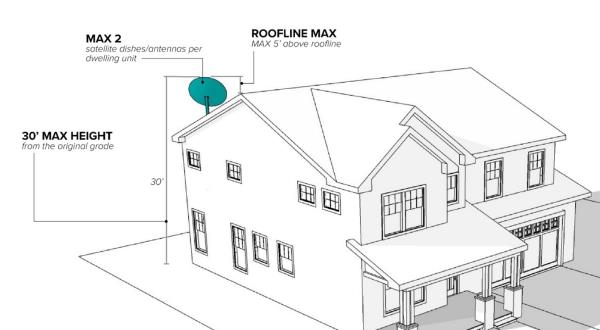
This section shall apply to all personal transmission equipment for individual use such as antennas or satellite dishes. Personal transmission equipment associated with legally-established single-household or two-household dwellings, provided that the installation and maintenance of transmission equipment complies with the following standards, as depicted in Figure 18.75.1:
- All personal transmission equipment shall be ancillary and accessory to legally established single or two-household dwellings.
- An antenna or dish may extend up to five feet (5’) above the highest point of the primary structure to which it is affixed and in no case shall antennas, dishes, or any other transmission equipment exceed an overall height of 30 feet as measured from original grade.
- Satellite dishes shall not exceed three feet (3') in diameter.
- No more than two (2) antennas or dish per dwelling unit may be installed.
- Individual freestanding structures used for transmission equipment of any kind are prohibited except as regulated by the FCC for amateur radio.
- Antennas, dishes, and other transmission equipment shall be attached to the primary structure and shall make a reasonable effort for complete concealment or locate such transmission equipment in the least conspicuous location possible as viewed from a public street as determined by the Planning Director.
Figure 18.75.1, Personal Transmission Equipment Illustration
Repealed & Reenacted by Ord. 25-12 on 4/28/2025
18.75.050 General Standards For Wireless Telecommunication Facilities
Commercial wireless telecommunication facilities are permitted in non-residential and non-agricultural zones according to the standards listed within this chapter.
- Commercial mechanical and transmission equipment shall satisfy the following standards, as depicted in Figure 18.75.2:
- The property shall be used as a commercial, office or manufacturing use or is in conjunction with a public property with a public or quasi-public use such as a public school, fire station, library, park, or other government use.
- Equipment may be located within 30 feet, but no closer than 10 feet of a residential property line if:
- All mechanical equipment shall be placed within a below-grade vault, or;
- All ground equipment shall be located within a completely enclosed decorative masonry accessory building. Such accessory buildings shall satisfy the height and setback requirements prescribed by the underlying zone.
- A sound study may be required, as determined by the Planning Director, for equipment located within 30 feet of a residential property line as set forth in MKZ 18.69, Required Studies and Plans.
- Ground equipment shall be entirely screened with a minimum eight foot (8’) tall decorative masonry wall with solid metal gates and may not be located closer than 30 feet to any residential property line.
- Antennas, dishes, and other commercial mechanical and transmission equipment shall not create visual clutter, nuisance or hazard as determined by the Planning Director.
Figure 18.75.2, Commercial Transmission Equipment Illustration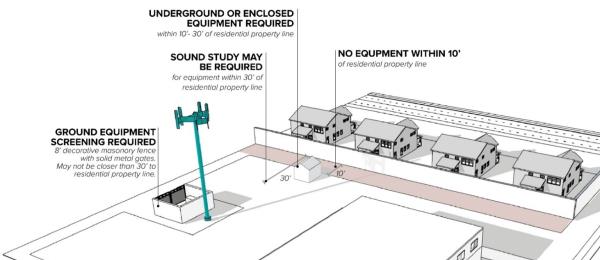
- Commercial wireless telecommunication facilities may be located within a residential or agricultural zone, provided that the installation and maintenance of commercial wireless telecommunication facilities comply with the following standards, as depicted in Figure 18.75.3:
- To the Planning Director’s satisfaction, the applicant has provided technological justification and made all reasonable efforts to first exhaust all other options before locating or co-locating a new facility within a non-residential or non-agricultural zone.
- Facilities shall only be installed on public property and shall be associated with public or quasi-public uses such as a public school, fire station, library, park, or other government use
- Facilities satisfy all commercial mechanical and transmission equipment standards as set forth in MKZ 18.75.050 (B).
- Facilities shall be made stealth within a steeple, flagpole, or as an approved freestanding stealth structure.
Figure 18.75.3, Commercial Transmission Equipment in a Residential or Agricultural Zone Illustration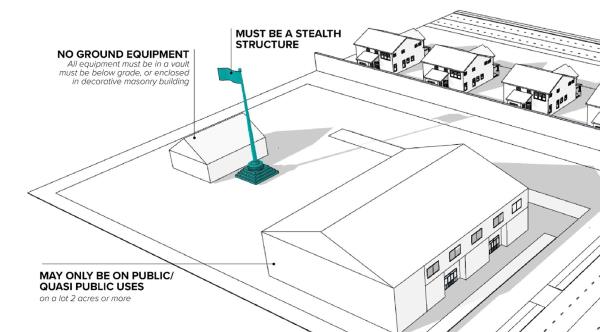
Repealed & Reenacted by Ord. 25-12 on 4/28/2025
18.75.060 Wall Mounted Wireless Telecommunication Facilities
Wall-mounted wireless telecommunication facilities shall satisfy the following standards, as depicted in Figure 18.75.4:
- Wall mounted wireless telecommunication facilities shall be mounted to the wall of the primary structure and not extend more than 24 inches as measured from the surface edge of the wall to the front or furthest portion of the equipment.
- Wall-mounted wireless telecommunication facilities shall be located at least 30 feet above the finished grade of the wall surfaces to which it is mounted.
- Wall-mounted commercial transmission equipment shall not extend above the wall to which it is mounted.
- Wall-mounted wireless telecommunication facilities, including the supporting structure, shall be colored to match the building colors, textures, and materials.
Figure 18.75.4, Wall Mounted Transmission Equipment Illustration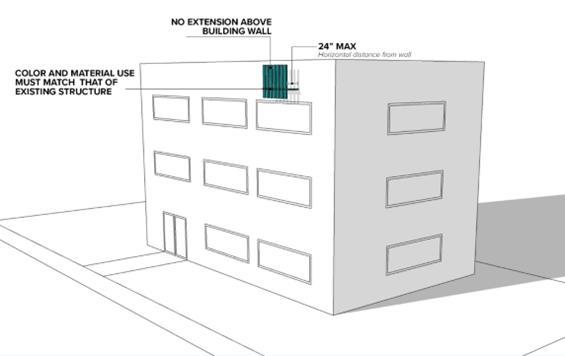
Repealed & Reenacted by Ord. 25-12 on 4/28/2025
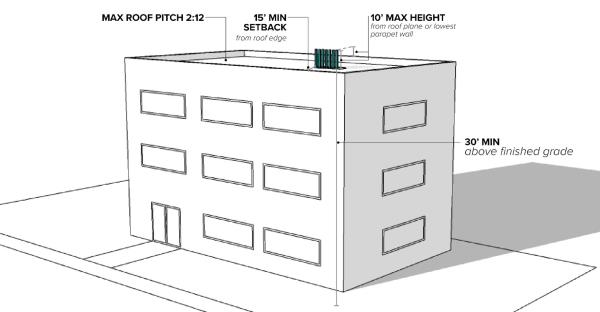
18.75.070 Roof Mounted Wireless Telecommunication Facilities
Roof-mounted wireless telecommunication facilities shall satisfy the following standards, as depicted in Figure 18.75.
- Transmission equipment shall be located at least 30 feet above the finished grade to which it is mounted.
- Transmission equipment shall not be placed on a roof pitch that is greater than 2:12.
- The equipment shall be set back a minimum distance of 15 feet from the edge of the roof to which the equipment is mounted.
- The equipment shall not exceed a maximum of 10 feet in total height as measured from the roof surface to which it is mounted or the top of the lowest parapet wall on the same roof surface.
- Stealth roof-mounted wireless telecommunication facilities are encouraged and are allowed to vary from the height and setback provisions of this section if the stealth installation achieves the desired stealth appearance and provides a similar effect to the listed stealth options, as determined by the Planning Director.
Figure 18.75.5, Roof Mounted Transmission Equipment Illustration
Repealed & Reenacted by Ord. 25-12 on 4/28/2025
18.75.080 Freestanding Stealth Wireless Telecommunication Facilities
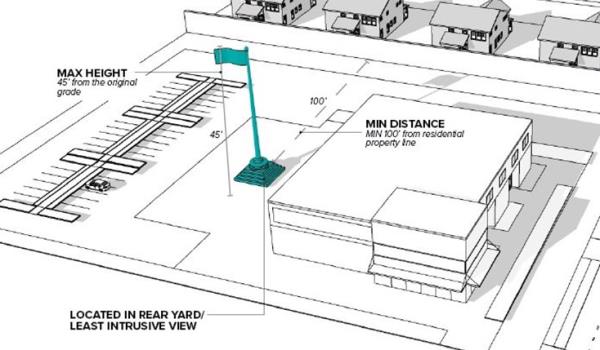
Freestanding stealth wireless telecommunication facilities shall satisfy the following standards, as depicted in Figure 18.75.6:
- Freestanding stealth wireless telecommunication facilities are defined by height and are limited to a maximum height of 45 feet.
- Freestanding stealth wireless telecommunication facilities are permitted in all non-residential zones and may be allowed in residential and agricultural zones when associated with public or quasi-public uses.
- No distance separation between the stealth wireless telecommunication facility and other wireless telecommunication facilities is required.
- Freestanding stealth wireless telecommunication facilities shall be located at least 100 feet from a residential property line.
- The applicant has demonstrated in writing that they have made at least three attempts to explore the option of first roof-mounting, wall-mounting, or co-locating on an existing monopole on properties located within a one-half (½) mile radius of the desired location.
- All freestanding wireless telecommunication facilities shall have a stealth design and shall be proportionate to the type of structure they intend to imitate. Depending on the environment and surrounding uses, freestanding wireless telecommunication facilities may include but are not limited to flag poles, water towers, ball field lights, steeples, clock towers, existing signs, utility poles, boulders, monopines, or other stealth designs as determined by the Planning Director.
Figure 18.75.6, Freestanding Stealth Structures Illustration
Repealed & Reenacted by Ord. 25-12 on 4/28/2025
18.75.090 Monopole Wireless Telecommunication Facilities
Freestanding stealth wireless telecommunication facilities shall satisfy the following standards, as depicted in Figure 18.75.7, provided that:
- Monopole wireless telecommunication facilities may only be considered after the applicant has submitted a statement of need demonstrating why the proposed facility cannot be wall-mounted, roof mounted, co-located, or integrated into a freestanding structure.
- Monopoles are prohibited on properties within an R-1, R-2, R-4, or AG Zone, or a sensitive land designation unless the monopole and equipment are made stealth based upon the surrounding natural and architectural environment within 1,320 feet of the facility, as directed by the Planning Director.
- Monopoles are prohibited in residential and agricultural zones except in public parks and schools or properties exceeding two (2) acres in size.
- A minimum of one-half (1/2) mile distance is required between monopoles.
- Monopoles shall not be allowed in the front yard setback of any lot or parcel, or between the primary building and abutting right-of-way.
- Monopoles shall be set back from any residential property line three times (3x) the height of the monopole.
- Monopoles shall not exceed 60 feet in height as measured from the top of the monopole or equipment to the finished grade.
- Monopoles and related pole-mounted transmission equipment, including antennas, shall have non-reflective or powder coated surfaces in unobtrusive earth-tone colors.
- External pole mounted antennas shall not project more than four feet (4’) as measured from the front of or furthest portion of the antenna, or similar equipment, to the nearest surface edge of the monopole.
- No exposed cabling is permitted, and all cables shall be routed internally within the pole and/or buried underground. The Planning Director may consider exterior cable trays designed to replicate an existing vertical element. Standard cable trays painted and textured to match the existing facade do not satisfy the intent or qualify as hidden or concealed.
Figure 18.75.7, Monopole Installation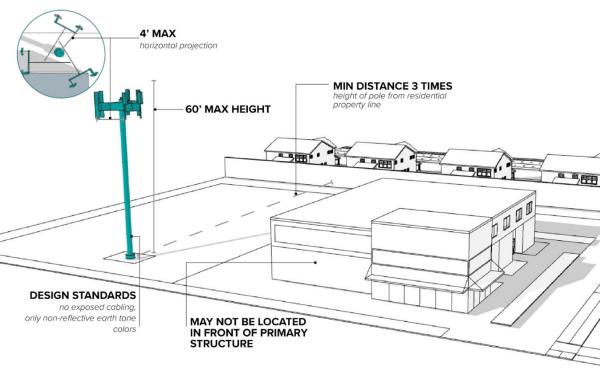
- Stealth monopole wireless telecommunication facilities are encouraged and shall be allowed to vary from this section’s setback, height, and other design provisions if the stealth installation achieves the desired stealth appearance as determined by the Planning Director.
Repealed & Reenacted by Ord. 25-12 on 4/28/2025
18.75.100 Eligible Facility Request (EFR)
- The purpose and intent of this section are:
- To implement § 6409(a), which requires the City to approve an EFR for a modification of an existing tower or base station that does not substantially change the physical dimensions of such tower or base station;
- To implement the FCC rules set forth at 47 C.F.R. Part 1 (Part 1 - Practice and Procedure), new Subpart U § 1.6100 (Wireless Facility Modifications), which rules implement § 6409(a);
- To establish procedural requirements and substantive criteria applicable to review and approval or denial of applications for an EFR;
- To ensure that application submittal requirements are related to information reasonably necessary to the determination of whether or not the proposed modification will result in a substantial change in the physical dimensions of the eligible support structure;
- To exempt EFR from zoning and development regulations that are inconsistent with or preempted by § 6409(a);
- To preserve the City's right to continue to enforce and condition approvals under this chapter on compliance with generally applicable building, structural, electrical, and safety codes and with other laws codifying objective standards reasonably related to health and safety;
- To promote timely decisions under this chapter; and
- To ensure that decisions are made consistently and predictably.
- Applicability:
- Sole And Exclusive Procedure: Except as may be otherwise provided in this chapter and not withstanding any other provisions in the City Code, the provisions of this chapter shall be the sole and exclusive procedure for review and approval of an EFR which the applicant asserts are subject to review under § 6409(a). The provisions of this chapter shall control the extent that other provisions of the City Code establish a parallel process for review and approval of a project permit application for a proposed EFR..
- First Deployment; Base Station: This chapter shall not apply to a proposed facility modification to a structure, other than a tower, that does not, at the time of submittal of the application, already house or support transmission equipment lawfully installed within or upon, or attached to, the structure.
- Interpretation: Interpretations of this chapter shall be guided by § 6409(a) and applicable FCC reports and orders.
- Building Permit: The City will process, review, and, if practicable, issue a decision regarding a building permit for the facility modification concurrent with the EFR permit described herein.
- Reservation of Authority: Nothing herein is intended or shall operate to waive or limit the City's right to enforce, or condition approval on, compliance with generally applicable building, structural, electrical, and safety codes and with other laws codifying objective standards reasonably related to health and safety.
- Application and Submittal Requirements: Applications shall follow the procedures as set forth in MKZ 18.15.030 (G).
- Review and Approval of an Application:
- Application Review. The Planning Director will review and approve an EFR application. The Planning Director will determine if the proposed EFR will substantially change the physical dimensions of an eligible support structure.
- Timeframe For Review and Approval. The City shall comply with all applicable shot clocks when reviewing an EFR application. If an EFR application satisfies the requirements of this chapter, the Planning Director shall approve the EFR application and issue an EFR permit.
- Code Requirements. Any EFR permit issued pursuant to this chapter, and any approved application shall be and are conditioned upon compliance with any generally applicable building, structural, electrical, and safety codes and other laws codifying objective standards reasonably related to health and safety. Violation of any such applicable code or standard shall be deemed to be a violation of the EFR or deemed approved application.
Repealed & Reenacted by Ord. 25-12 on 4/28/2025

