
Millcreek City Zoning Code
18.36 SINGLE-HOUSEHOLD
RESIDENTIAL R-1 ZONES
18.36.010 Purpose
The purpose of the Single-Household Residential R-1 Zones is to establish single-household neighborhoods consistent with the City's general plan for low density residential areas within the City. It is the intent to balance neighborhood compatibility with the private property interests of those who wish to expand, develop, improve, or otherwise make exterior modification to their residential property.
Repealed & Reenacted by Ord. 25-12 on 4/28/2025
18.36.020 Applicability
This chapter applies to the following residential zones: R-1-3, R-1-4, R-1-5, R-1-6, R-1-8, R-1-10, R-1-15, and R-1-21 zones. Development in the Single-Household Residential Zones may be subject to the requirements set forth in MKZ 18.61, Sensitive Lands.
Repealed & Reenacted by Ord. 25-12 on 4/28/2025
18.36.030 Permitted Uses And Conditional Uses
Uses in the Single-Household Residential (R-1) Zones are allowed, either as permitted or conditional, and may include certain limitations as set forth in Table 18.36-1 Permitted and Conditional Uses in the Single-Household Residential (R-1) Zones. If a use is not explicitly designated in the table, then the use is prohibited. An applicant seeking a Millcreek Business License may submit a Classification Request by following the procedure as set forth in MKZ 18.15.030 (J), to determine whether a proposed land use aligns with an existing land use listed in Table 18.36-1.
| Table 18.36-1 Permitted and Conditional Uses in the Single-Household Residential (R-1) Zones | ||
| Land Use | R-1 (All Zones) | Limitations/References |
| P= Permitted C= Conditional Use Review Required | ||
| Residential Uses | ||
| Accessory Dwelling Unit | P | Limitations set forth in MKZ 18.71, Accessory Dwelling Unit Standards. |
| Dwelling, Single Household - Detached | P | |
| Home Business | P | Subject to MKZ 18.76, Special Business Land Use Regulations |
| Home Daycare or Preschool – up to 6 children | P | Subject to MKZ 18.76, Special Business Land Use Regulations |
| Home Daycare or Preschool – 7 to 12 children | C | Subject to MKZ 18.76, Special Business Land Use Regulations |
| Residential Facilities for Elderly Persons or Persons With a Disability | P | Limitations as set forth in MKZ 18.74, Residential Facilities for Persons With a Disability |
| Short-Term Rental | P | Provided a valid Millcreek business license has been issued and is in good standing with respect to the property. Further limitations are as set forth in MKC 5.19, Short-Term Rentals. |
| Non-Residential Uses | ||
| Noncommercial Agriculture | P | |
| Cemetery | P | |
| Civic and Institutional Uses | ||
| Public Uses | P | |
| Quasi-Public Use | P | |
| Religious Assembly | P | |
| Schools, Public and Private | P | |
| Miscellaneous Uses | ||
| Accessory Uses, Buildings, and Structures | P | Limitation as set forth in MKZ 18.59, Accessory Structures |
| Temporary Uses | P | Limitation as set forth in MKZ 18.58, Temporary Uses and Structures |
Repealed & Reenacted by Ord. 25-12 on 4/28/2025
18.36.040 Spatial Requirements
- Setback Measurements. The minimum property size, width, setbacks, and maximum property coverage requirements are as determined by Table 18.36-2 Spatial Requirements for the Single-Household Residential (R-1) Zones and are as illustrated in Figure 18.36.2.
- Side and Rear Setbacks for Civic and Institutional Uses. Civic and Institutional Uses require a minimum 30-foot rear and side yard setback when abutting and sharing a property line with a residential use.
- Rear Setback on Sloped Lots or Parcels. If the average slope of the original ground surface, as measured from the rear property line to the front property line, is more than 20 percent, then the rear setback shall be increased one additional foot for every one degree of slope in excess of 20 percent, up to a maximum of 25 feet.
- Side Yard Setbacks on Lots Fifty Percent Larger Than Minimum Lot or Parcel Width. Lots or parcels with a width at least 50 percent larger than the required minimum lot or parcel width shall measure side yard setbacks as set forth in the following:
- The combined measurements of the side yard setbacks shall be at least 25 percent of the lot or parcel width.
- No side setback shall be less than the required minimum side yard setback.
- The width of the lot or parcel is measured as the diameter of the largest circle that can be inscribed entirely within the lot or parcel excluding any streams, floodplains, wetlands, areas of thirty percent slope or greater, or other natural hazard areas shall be excluded from the circle, as illustrated in Figure 18.36.1.
- A lot or parcel containing an existing legally-established two-household dwelling may be subdivided, subject to the standards as set forth in MKZ 18.26, Division of Legally-Established Two-Household Dwellings.
Figure 18.36.1 Combined Side yard Setback Spatial Requirements Diagram
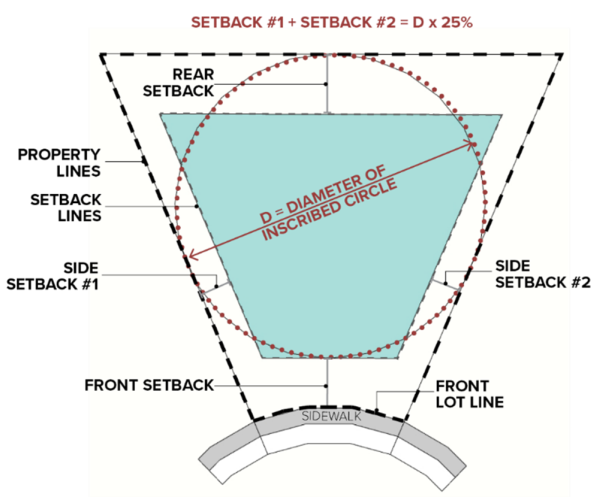
Figure 18.36.2 Spatial Requirements Diagram (letter labels related to Table 18.36-2)
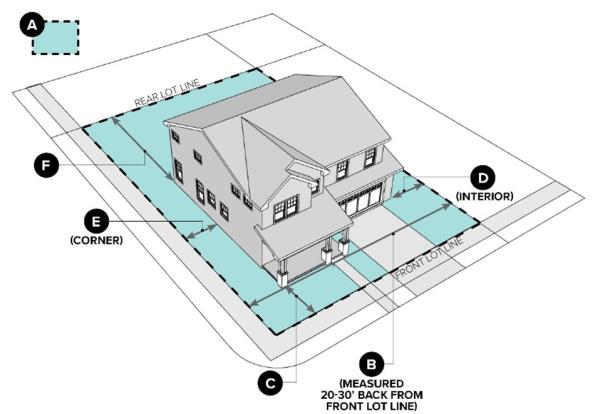
| Table 18.36-2 Spatial Requirements for the Single-Household Residential (R-1) Zones | ||||||||
| Zone | Min. Lot or Parcel area (A) | Min. Lot or Parcel width
(B) | Min. Front Setback (C) | Residential Use Min. Side Setbacks on interior Lots or Parcels (D) | Residential Use Min. Side Setbacks on corner (E) | Civic/Institutional and Non- Residential Use Min. Side Setback | Min. Rear Setback (F) | Max. Lot or Parcel Coverage |
| R-1-3 | 3,000 sq ft | 30' | 20' | 3’ (unless attached to a dwelling on an abutting lot or parcel) | 10' | 20' | 15' | 50% |
| R-1-4 | 4,000 sq ft | 40' | 20' | 4’ (unless attached to a dwelling on an abutting lot or parcel) | 15' | 20' | 15' | 45% |
| R-1-5 | 5,000 sq ft | 50' | 20' | 5’ (unless attached to a dwelling on an abutting lot or parcel) | 20' | 20' | 15' | 40% |
| R-1-6 | 6, 000 sq ft | 60' | 25' | 8' | 20' | 20' | 15' | 35% |
| R-1-8 | 8,000 sq ft | 65' | 25' | 8' | 20' | 20' | 15' | 33% |
| R-1-10 | 10, 000 sq ft | 80' | 30' | 10' | 20' | 20' | 15' | 31% |
| R-1-15 | 15,000 sq ft | 80' | 30' | 10' | 20' | 20' | 15' | 25% |
| R-1-21 | 21,000 sq ft | 100' | 30' | 10' | 20' | 20' | 15' | 25% |
Repealed & Reenacted by Ord. 25-12 on 4/28/2025
Amended by Ord. 26-52 on 7/27/2026
18.36.050 Building Height And Building Envelopes
- Minimum height. All dwelling structures shall be a minimum of one story in height.
- Maximum Height. Maximum building height is set forth in Table 18.36-3 Building Height and Building Envelope for R-1 Zones.
- Building Envelope. The height of structures may be further limited by the building envelope. The building envelope is formed by a box defined by the perimeter of the property line extended vertically perpendicular to the property line to a height and subsequent angle as set forth in Table 18.36-3 and as illustrated in Figures 18.36.3, 18.36.4, 18.36.5, and 18.36.6. The entire building shall fit under this envelope except as described in the projections section below.
- Lots or parcels located in the R-1-8 zone determined by staff to be a Lot or Parcel of Record and are nonconforming due to minimum lot or parcel width and minimum lot or parcel area can qualify to use the 60 degree (60°) Building Envelope Angle and 12-foot Building Envelope Wall Height.
- For buildings located in planned unit developments, the building envelope is formed by a box defined by the perimeter of the property line of the planned unit development.
| Table 18.36-3 Building Height and Building Envelope for R-1 Zones | |||||
| R-1-3 R-1-4 R-1-5 | R-1-6 | R-1-8 | R-1-10 R-1-15 | R-1-21 | |
| Building Height Maximum | 30' | 30' | 30' | 32' | 32' |
| Building Envelope Wall Height and Angle | 30' | 12' | 8' | 8' | 8' |
| Building Envelope Angle | 0 degrees | 60 degrees | 45 degrees | 45 degrees | 45 degrees |
Figure 18.36.3 R-1-3, R-1-4, and R-1-5 Building Envelope
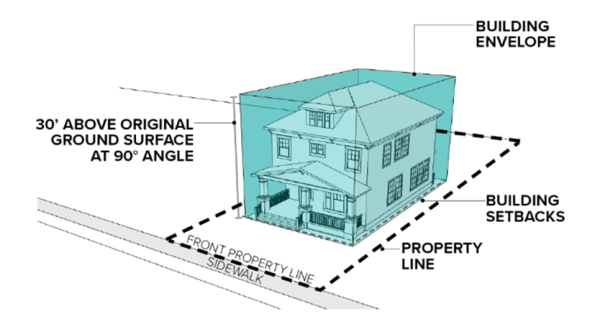
Figure 18.36.4 R-1-6 Building Envelope
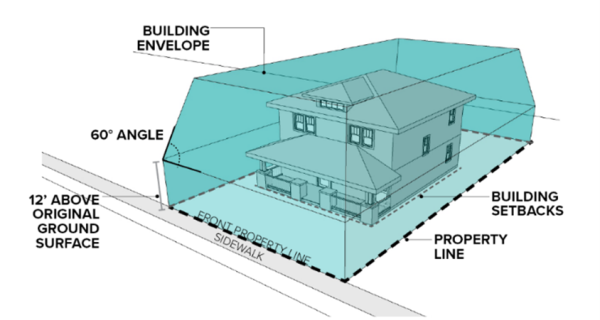
Figure 18.36.5 R-1-8, R-1-10, R-1-15, and R-1-21 Building Envelope
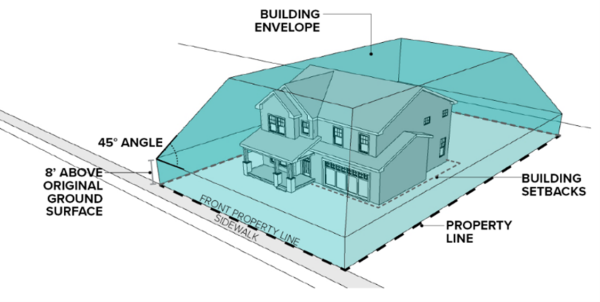
Figure 18.36.6 Sloped Building Envelope Example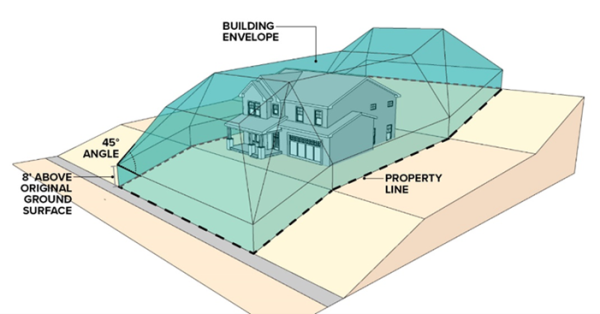
Repealed & Reenacted by Ord. 25-12 on 4/28/2025
Amended by Ord. 26-52 on 7/27/2026
18.36.060 Projections
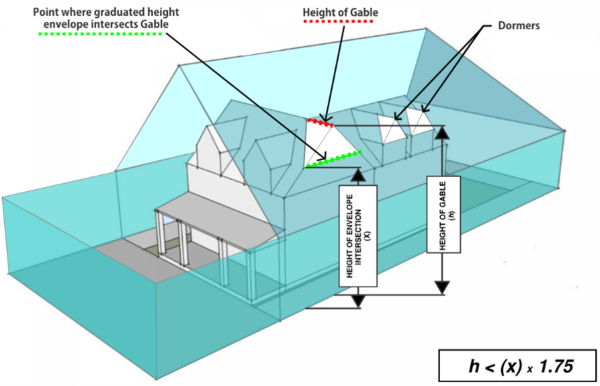
Dormers, Gables, and non-habitable architectural elements may project beyond the building height envelope if they meet the following criteria, as illustrated in Figure 18.36.7, and as follows:
- Dormers
- The width of the dormer shall not exceed 14 feet;
- Multiple dormers shall be spaced such that the distance to the edges of the roof is at least one-half the distance between dormers; and
- The dormer shall be no higher than the ridge of the roof.
- Gables
- The height of the gable is less than 1.75 times higher than the point where the graduated building height envelope intersects the gable; and
- The height of the gable is less than the maximum building height.
- Non-Habitable Architectural Elements:
- Parapets and railings shall not exceed 30 inches in height above the intersection of the roof surface and the wall.
- Chimneys and vents may project beyond the building envelope by 30 inches, if required by the building code.
- Towers, spires, cupolas, elevator penthouses, mechanical appurtenances, or similar non-habitable architectural elements may not project beyond the building envelope.
Figure 18.36.7 Dormer and Gable illustration with height envelope exception
Repealed & Reenacted by Ord. 25-12 on 4/28/2025
Amended by Ord. 26-52 on 7/27/2026
18.36.070 Setback Encroachments
The following may be erected on, or encroach into the required yard setbacks:
- Fences and walls in conformance with this code.
- Landscape elements, including trees, shrubs, and other plants.
- Utility or irrigation equipment or facilities.
- Decks, patios, porches, driveways, sidewalks, stairs, landings, not exceeding two feet (2’) above grade.
- Covered porches and balconies may project up to 10 feet into the front yard or street side yard setback if they meet the following criteria:
- Porches and balconies shall remain unenclosed or “open style” (no walls, doors, windows, screens, etc.) except for the minimum required handrail.
- Porches and balconies shall not encroach into any easements or clear vision site areas.
- Porches, balconies, stairs, landings, eaves which project into the setbacks, shall not be located nearer than 15 feet from a street property line, or project outside of the building height envelope.
- Exception. Covered porches and balconies located in the R-1-3, R-1-4, and R-1-5 Zones may protrude into the front setback no more than five (5’) feet.
- Other architectural elements which are not used as habitable space.
- Cornices, eaves, sills, planter boxes, stairways, landings, awnings, window wells, or similar architectural features attached to the building and not enclosed by walls, extending not more than two feet (2') into a side yard or four feet (4’) into the front or rear yard. In no case shall a side yard setback be less than six feet (6’).
- Chimneys, fireplace keys, box or bay windows or cantilevered walls attached to the building, no greater than eight feet (8') wide, extending not more than two feet (2') into a side yard, or four feet (4') into a front or rear yard. In no case shall a side yard setback be less than six feet (6’).
Repealed & Reenacted by Ord. 25-12 on 4/28/2025
18.36.080 Articulation
To avoid a large, continuous building mass of uniform height; no portion of any building shall continue more than forty feet horizontally without a minimum of an eighteen-inch break in the roofline or introduction of a contrasting architectural element such as an overhang, projection, or inset of a minimum depth of two feet (2’) from the primary façade plane, to create shadow patterns along the elevation of the building.
Repealed & Reenacted by Ord. 25-12 on 4/28/2025
18.36.090 Neighborhood Compatibility Modification (NCM)
The Neighborhood Compatibility Modification (NCM) allows for modified standards from one or more of the spatial standards based upon the compatibility of the proposed residential development application with other properties/dwellings in the proximate neighborhood. The Planning Director may approve an NCM request at time of site plan submittal provided the following conditions are met:
- Evidence. Compliance with the corresponding neighborhood conditions must be established by a survey from the proximate neighborhood, defined as a 200-foot radial distance from the property boundary. The survey must be completed by a surveyor licensed to practice in the State of Utah.
- Submittal. NCM requests shall be submitted on a separate form and shall include an additional review fee as set forth in the Millcreek Consolidated Fee Schedule.
- Permissible Modifications. Building height, setbacks and lot or parcel coverage modifications may be accommodated if the request does not exceed the allowances as set forth below:
- Lot or Parcel Coverage. Lot or parcel coverage may not exceed 1.15 times the average coverage of all lots and parcels in the proximate neighborhood, up to a maximum lot or parcel coverage as set forth in Table 18.36-4 Lot or Parcel Coverage Maximums. Lot or parcel coverage is calculated by dividing the total area of all building footprints by the total area of the lot or parcel, where building footprints are measured at the outside of exterior walls at ground level. In the case where buildings or covered porches are supported by columns, footprints are measured at the outside perimeter of the base of the columns at ground level.
Table 18.36-4 Lot or Parcel Coverage Maximums Zone Lot or Parcel Coverage May Not Exceed R-1-3 40% R-14 40% R-1-5 40% R-1-6 40% R-1-8 38% R-1-10 36% R-1-15 33% R-1-21 30% - Front Yard Setback. The front yard setback may not exceed the average front yard setback of all lots or parcels within the proximate neighborhood that front to the same street, road, or right-of way. For the purposes of determining an average front yard setback, setback encroachments described in MKZ 18.36.070 shall not be included the average front yard setback.
- Side Yard Setback. The combined side yard shall setback be at least twenty-five percent (25%) of the average lot or parcel width of all lots or parcels within the proximate neighborhood. In no case can an approved NCM for a side yard setback be no less than five feet (5’) on each side.
- Maximum Building height. The maximum building height shall be the lesser of:
- Three feet plus the average maximum ridge height of residential buildings that are on six lots or parcels of the applicant’s choice that are within the proximate neighborhood; and
- The maximum height of the zone specified in Table 18.36-5 Height Maximums
Table 18.36-4 Building Height Maximums Zone Building Height May Not Exceed R-1-3 33' R-14 33' R-1-5 33' R-1-6 33' R-1-8 33' R-1-10 35' R-1-15 37' R-1-21 37'
- Lot or Parcel Coverage. Lot or parcel coverage may not exceed 1.15 times the average coverage of all lots and parcels in the proximate neighborhood, up to a maximum lot or parcel coverage as set forth in Table 18.36-4 Lot or Parcel Coverage Maximums. Lot or parcel coverage is calculated by dividing the total area of all building footprints by the total area of the lot or parcel, where building footprints are measured at the outside of exterior walls at ground level. In the case where buildings or covered porches are supported by columns, footprints are measured at the outside perimeter of the base of the columns at ground level.
- Non-Permissible Modifications. Building envelope, mass and scale, rear yard setbacks, and accessory structure modifications do not qualify under the NCM.
Repealed & Reenacted by Ord. 25-12 on 4/28/2025
Amended by Ord. 26-34 on 5/26/2026

